Homebirth midwifery and the problem of informed consent

image

It’s hardly surprising that homebirth midwives have a serious problem with obtaining informed consent. That’s because selling homebirth midwifery services implicitly depends on being dishonest about the risks of homebirth: minimizing them, lying about them or omitting disclosure altogether.

Simply put, if homebirth midwives had to honestly disclose risks, they’d have very limited employment opportunities.

Therefore, homebirth midwives have devised a variety of strategies to avoid obtaining informed consent.

1. Delay

Melissa Cheyney and the Oregon homebirth midwives are masters of this strategy. They simply didn’t obtained informed consent for homebirth and when forced by the legislature to begin doing so, they stalled, and stalled and stalled again.

As I wrote two years ago, the legislature mandated informed consent by June, 2011:

… [I]t is remarkable that Oregon homebirth midwives have still not begun obtaining consent for these high risk situations, arguing repeatedly that they need “more time” to create consent forms. Homebirth midwives petitioned for and were granted an extension until October 15, and as the date drew near, they petitioned to postpone the requirement for informed consent until January 1, 2012. That request was formalized on 9/26/11. A little over a week later, having postponed compliance with the requirement for 6 months, Oregon homebirth midwives petitioned to postpone it a further 6 months.

The idea that they needed any extension at all is bizarre. The increased risks posed by VBAC, breech, twins and postdates pregnancy are well known and have been quantified for years. For example, obstetricians have been obtaining informed consent for VBAC for at least 20 years. The Board of Direct Entry Midwifery could easily assemble and print the information in one day.

But Oregon homebirth midwives depend on their friends in the legislature to protect them from even the most basic requirements for consent. I’m not sure that they have yet begun obtaining consent for high risk situations.

2. “More research is needed.”

Homebirth midwives will do just about anything to avoid acknowledging risks. Hence the inane claim by MANA executive Jeannette McCulloch, in a recent post on the blog of the Midwives Alliance of North America, that “no one knows” how to tell the difference between low risk and high risk.

More research is needed into what constitutes low-risk for home birth. It is critically important that mothers and their care providers have accurate, evidence-based information so that they can make true informed consent. Risk factors that need further examination include breech, multiples, post-dates, and a variety of different VBAC circumstances.

That’s funny. MANA’s official stance is that:

…[F]or low-risk women with a skilled midwife in attendance, home birth is a safe option for newborns with lower rates of interventions and complications for mothers.

Well, which is it MANA? Does “research show” that homebirth is safe for low risk women or do we need more research to figure out just what low risk really means?

Now you or I might think that statements like these represent confusion on the part of MANA about what constitutes low risk, but that’s not true. The EXPLICIT policy of MANA is that each homebirth midwife can “decide for herself” what constitutes low or high risk. That makes no sense at all until you remember that the entire point of MANA is to provide intellectual cover for homebirth midwives, who are nothing more than lay people, to do whatever they want to do.

Standards apparently are only for real medical professionals, not for homebirth midwives.

3. An “informed consent” form that doesn’t obtain informed consent

Some homebirth midwives, like Mountain View Midwives in Charlottesville, VA, have come up with an informed consent that doesn’t obtain informed consent:

Each
 woman 
must 
weigh 
for 
herself 
the 
risks 
of 
birthing 
outside 
an 
emergency
facility 
against 
the 
risks 
of 
in‐hospital
 birthing,
 where
 the
 risks
 of
 unnecessary
 interventions,
 emergency‐mentality,
 and
 hospital
 born
 infections
 present
 their
 own
 dangers.
 
 Babies
 (and
 very
 rarely,
 mothers)
 do
 sometimes
 die
 in
 spite
 of
 the
 best
 care
 and
 great
 love.
 
 It
 happens
 at
 home
 and
 in
 the
 hospital.

Evidently the folks at Mountain View Midwifery don’t know what informed consent actually is. They have written a release, not an informed consent. This is probably going to come as a huge surprise to them, but medical care is not the same as going to a water park or going skiing. In those situations, the park or the ski slope is not required to enumerate all possible risks of swimming or skiing. They simply need you to acknowledge that you are willing to proceed at your own risk.

Informed consent is something else entirely.

The first and most important element of informed consent is:

… [D]isclosure by the [provider] to the patient of adequate clear information about the patient’s diagnosis; the alternatives available to treat the patient’s problem, including surgical and nonsurgical management; the benefits and risks of each alternative, including nonintervention … and a frank explanation of those factors about which the medical profession, and the individual [provider] in particular, are uncertain and cannot provide guarantees…

In other words, informed consent REQUIRES enumeration and disclosure of risks SPECIFIC to the individual patient’s diagnosis and proposed treatment.

Those are the three major ways in which homebirth midwives avoid obtaining informed consent for their services, but the real issue is not how, but why. The reason homebirth midwives are strenuously resisting informed consent requirements is that their financial success depends on HIDING the risks of homebirth. They are frightened to the core of informing patients of the risks of homebirth, because they know that the risks are real, substantial (particularly in the case of high risk situations), and frightening. Better to just hide them and wash their hands of all responsibility for the disasters that occur why they enjoy their birth junkie hobby.

The key to homebirth advocacy is NOT an informed patient. It’s a gullible patient who doesn’t know the real risks, but has been flattered into thinking that she is “informed.”

If breastfeeding is so awesome, why do lactivists have to spend so much time convincing us of its awesomeness?

image

Lactivists, help me out here.

If breastfeeding is everything you say it is, why do you have to write lengthy screeds touting its virtues?

You know what’s awesome? Chocolate is awesome. It appears that there is no need for blogs explaining its awesomeness to doubters. That’s the thing about awesomeness. It doesn’t need to be explained.

You know what else is awesome? Sex is awesome. I don’t notice too many people in need of convincing that sex is pleasurable. People figure it out for themselves without help.

In fact, if you need the purported awesomeness of something explained to you, perhaps it isn’t that awesome after all.

Consider this post, old, but filled with so many mistruths, half truths and falsehoods, that it is worthy of discussion as masterpiece of the genre, What Formula Is Not, by Martha Neovard.

It is also a masterpiece of inanity.

It leads with this witless gem:

Formula is not sterile

Actually formula is sterile. But let’s leave that aside for a moment. Apparently Martha has no clue that breastmilk is not sterile. It can pass pathogens as dangerous as HIV. Martha also is appears clueless that breasts are not sterile. They are covered with the millions of bacteria that live everywhere on human skin.

Then Martha offers this bit of idiocy:

Formula is not convenient

Not convenient for what? No doubt it’s not convenient for birth goddess/natural mother cred among your crunchy peers, but it’s damn convenient for a lot of other things.

Formula is convenient for mothers who want to/have to work. Formula is convenient for mothers who wish to share feeding with fathers or grandparents. It’s not merely convenient, but actually lifesaving for women who don’t make enough milk to supply their babies’ needs. It’s also convenient, and in many cases can preserve a breastfeeding relationship, for women who have agonizing pain while nursing or while nursing often.

Pro-tip for Martha: if something isn’t convenient, women figure it out for themselves. If you need to “explain” it to them, it suggests that you are not correct in your assessment of its convenience.

Formula will not save you from “breastfeeding problems” like mastitis, engorgement, breast pain, and leaking.

Regardless of whether you breastfeed or not, your milk will still come in, you will still get engorged, you may still get mastitis, and you will still need to buy breast pads and special bras. You will leak like mad. That milk has to go somewhere, and since the baby isn’t easing your pain, there will be several days to weeks of suffering while you wait for your milk to “dry up”…

Martha clearly believes that truth is overrated. While engorgement can be a breastfeeding problem, most breastfeeding problems have nothing to do with engorgement. If you choose not to breastfeed, it is extremely unlikely that you will get mastitis; you might need a few breastpads but you won’t need special bras. That’s just a lie. Moreover, if you choose not to breastfeed, you WON’T experience the breastfeeding problems that lead so many women to quit. You won’t get excruciatingly painful, bloody nipples. You won’t get exhausted by nursing every 2 hours. You won’t have to carry the entire responsibility for feeding your baby yourself. And most important, you will never have to listen to your baby scream from hunger because he or she is not getting enough milk.

Formula batches and ingredients are not approved by the FDA … No one inspects individual batches, no one even regulates the ingredients to ensure the same cocktail is made up for every can, or every batch.

Apparently Martha’s motto is “if at first you don’t succeed” lie, lie again. Those claims are bald faced lies. Formula is extremely heavily regulated at every stage of the manufacturing process and even after the formula is sold

You can find some of the regulations here:

(1) The results of tests conducted to determine the purity of each nutrient …

(2) The weight of each nutrient added;

(3) The results of any quantitative tests conducted to determine the amount of each nutrient certified or guaranteed …

(e) The manufacturer shall maintain all records necessary to ensure proper nutrient quality control in the manufacture of infant formula products. Such records shall include the results of any testing conducted to verify that each nutrient required by section 412(i) of the act or § 107.100 of this chapter is present in each batch of infant formula at the appropriate concentration. This requirement pertains to ingredients, in process batch and finished product from the time of manufacture through its expiration date.

(f) The manufacturer shall maintain all records necessary to ensure required nutrient content at the final product stage. Such records shall include, but are not limited to, testing results for vitamins A, B1 (thiamine), C, and E for each batch of infant formula. “Final product stage” means the point in the manufacturing process prior to distribution at which the infant formula is homogenous and not subject to further degradation from the manufacturing process.

(h) The manufacturer shall maintain all records pertaining to the microbiological quality and purity of raw materials and finished powdered infant formula…

(k) The manufacturer shall maintain procedures describing how all written and oral complaints regarding infant formula will be handled. The manufacturer shall follow these procedures and shall include in them provisions for the review of any complaint involving an infant formula and for determining the need for an investigation of the possible existence of a hazard to health.

Oops. It seems that Martha didn’t do her research.

You can read the rest of Martha’s “revelations” for yourself, but I do want to note one claim beloved of lactivists:

Formula Is Not Safe Or Easily-Available During Natural Disasters

I don’t know why this impresses lactivists so much. Breastmilk is not available at all if a mother is killed during a natural disaster or if a mother succumbs to a serious illness.

Let’s get back to the original issue.

If breastfeeding is so awesome, Martha, why do you have to explain its awesomeness? Maybe it’s because lactivists like Martha are well aware that for many women breastfeeding isn’t awesome at all. Otherwise, they wouldn’t be writing screeds that chivvy, lie to and guilt women into breastfeeding as Martha is trying to do.

Why do lactivists spend so much time proclaiming the awesomeness of breastfeeding? Because they are really proclaiming the awesomeness of themselves. See how dedicated lactivists are! See how educated lactivists are! See how selfless lactivists are!

Sorry Martha, but breastfeeding doesn’t make you awesome. It doesn’t make you anything other than a woman who chose to breastfeed her children because YOU think it is awesome.

Why isn’t that enough for you? If breastfeeding really is awesome, why do you need to spend so much time convincing other women of its awesomeness?

The new MANA blog: the gift that keeps on giving

iStock_000002533013XSmall

I don’t know that I’ve every chortled before, but I’m chortling now. The new blog of the Midwives Alliance of North America (MANA), the organization that represents homebirth midwives, is a dream come true for me. I’m nearly giddy over the possibility of an endless stream of stonewalling and misrepresentation. If the first post is anything to go by, this is going to be a goldmine!

I wrote about the post two days ago pointing out the mistruths, half truths and outright lie in the piece. The comments by MANA executive Jeannette McCulloch trying to defend the piece are so delicious, I think they merit this follow up post.

Consider:

1. I submitted the following comment to the blog:

The heart of Gordon’s piece is this:

“What we know about using information drawn from birth certificates is that they are pretty good for capturing information about things like mother’s age and whether she is carrying twins. They are not very accurate when it comes to rare outcomes like very low Apgar scores, seizures, or deaths (Northam & Knapp, 2006).”

But the Northam & Knapp article, SPECIFICALLY says the OPPOSITE!

“Birthweight, Apgar score, and delivery method agreed 91.9% to 100%. The high-percent agreement supports the reliability of those variables …”

So the heart of Gordon’s argument is completely untrue. And Gordon referenced the mistruth with a citation that showed the opposite of what she claimed it showed.

There was no denial of my claim despite the fact that I basically said that Wendy had included a bald-faced lie in her piece. How could anyone deny it? If you can read, you can see that Wendy misrepresented the findings of the study.

There was no correction. Why correct it when the intent was to mislead? I guess they figure their own followers are not smart enough to understand the comments, so they can simply pretend they don’t exist.

2. When it was pointed out that failure to list place of birth on the birth certificate means that the study being discussed, the one that showed that homebirth increases the rate of stillbirth by nearly 1000%, likely UNDERCOUNTS the real rate of homebirth stillbirth, McCulloch responded with this bit of misleading information:

… [Wh]ile a small percentage of intended home birth deaths are wrongly attributed to hospital deaths using birth certificate data, a much larger percentage of home births with no injury to mother or baby are wrongly attributed to hospitals as well.

So what?

There were 200 times as many hospital births as homebirths, so even if a massive proportion of homebirth attempts ended in a live hospital birth, it would have NO IMPACT on the overall rate of hospital birth death or hospital live birth. However, since the number of women attempting homebirth is only 1/200th of that attempting hospital birth, and since death is a relatively rare outcome, leaving a few deaths out of the homebirth group would make a very big difference in the homebirth death rate.

In other words, the hospital birth death rate is basically unaffected by the liveborn homebirth transfers, while the homebirth death rate is considerably lowered by removing the deaths that occurred after transfer.

The study shows that homebirth increases the stillbirth rate by nearly 1000% and that’s an underestimate of the true rate.

McCulloch offered no denial and no correction.

3. The very best comment from McCulloch so far is the latest one, just another in an endless string bizarre excuses for not releasing their own death rates:

Thanks for your questions relating to the topic of MANAstats and how and when that data is available. We hope the following will help answer all of your questions. Please read this first before asking a question about MANAstats release, as we’re going to limit new comments on the subject to questions not answered here…

Midwives, mothers, and others interested in conducting research with MANA Stats data but who do not have academic affiliations and thus no access to IRB or ethics boards are invited to access the dataset through the DOR’s ConnectMe program. This program connects individuals with researchers for support and mentorship and provides the IRB access needed to allow non-academics to access the data while still maintaining ethical protection of research subjects. All academic journals require that researchers go through ethics or IRB review before conducting research, so this process also insures that applicants to the data set will be able to take their work through to publication if they so choose.

But NO ONE is asking to do research with the MANA death rate; they simply want to know what it is.

MANA has had no problem releasing other statistics from the database. As early as April, 2011, they went public with the C-section rate for the database and in July of 2012 they released all of these statistics from the database.

MANA stats 2004-2007

Obviously they could release the death rate, but they won’t.

Let’s be honest here: is there anyone in the US homebirth community who believes those death rates are anything other than hideous? I doubt it. Yet by refusing to release the death rate, MANA can maintain the illusion of plausible deniability and continue to fool unsuspecting women who are contemplating homebirth.

It’s only taken one post, and MANA has already resorted to “moderating” comments because they know the facts are not on their side.

As far as I’m concerned, this is just awesome. The first post contained an outright lie, which MANA does not deny, but does not correct, either, and is filled with obvious attempts to mislead readers.

Bravo, MANA! And thanks. When it comes to my campaign to abolish the CPM credential I am willing to give credit where credit is due: I couldn’t do it without you, MANA. Keep up the good work!

5 Questions to ask about every birth blog

hands counting

So you’re pregnant and you’ve decided you want to educate yourself about childbirth. Or perhaps a friend or family member has called your decisions to give birth in a hospital, use an obstetrician and get an epidural into question, claiming that you’ll change what you want when you read what she recommends.

There are a plethora of birth blogs out there. How can you be sure that you are getting accurate information and truly educating yourself when so many are filled with mistruths, half truths and outright lies?

I’d like to suggest 5 simple criteria by which you can evaluate every birth blog (or message board or book).

1. Is the blog ideologically driven?

Does the blog start with a conclusion — e.g. natural childbirth is best, epidurals interfere with bonding, women who do it “my way” are the strongest, most empowered and best educated — and work backward from there? If so, you can be sure that the blog is not evidenced based (even, or especially, if it says that it is).

2. Is the blog based on the latest scientific evidence?

How can you tell? Does the author read the latest scientific papers in full, analyze them and encourage you to analyze them? That’s a good sign. Or does the author append an impressive looking list of scientific papers and ask you take her word for what they say? If so, odds are that she herself hasn’t read the papers and doesn’t know what’s in them. She just copied the list from another birth blog or book.

3. Are dissenting comments allowed and addressed?

This is critical. Someone who knows that the scientific evidence supports their claims welcomes dissent as an opportunity to clarify and to educate. Everyone else is afraid of dissent. Therefore, you can be 100% certain that you cannot educate yourself about childbirth by reading any blog or message board when only some of the comments are published, when only praise and agreement are published, when critical comments are published but ignored, when criticism is addressed by saying “don’t listen to so and so,” or when people with actual medical training are banned from commenting at all. Be especially wary about websites that claim to delete and ban “unsupportive” comments. If you are truly trying to educate yourself about childbirth, you are looking for evidence, not for support.

4. Is the site vetted by an obstetrician?

If not, it’s bound to be incomplete and possibly filled with inaccuracies as well. No one knows more about childbirth safety than obstetricians. After all, everyone agrees that they are the ones who have the most knowledge, the most training and the most experience in identifying, preventing and managing childbirth complications. No one else even comes close. So if anyone else besides and obstetrician tells you that something is “safe,” you can’t be sure that is true.

5. Are there circumstances under which the writer will acknowledge that new evidence shows that she was wrong?

This is a corollary to #1. If a website is ideologically driven, there is no way the author will ever acknowledge that the central premise is wrong. For example, a creationist website will NEVER conclude that God doesn’t exist. An anti-vax website will NEVER conclude that a vaccine, any vaccine, is safe and effective. Similarly, if you can’t imagine the author ever acknowledging that new scientific evidence shows that homebirth isn’t safe or that new scientific evidence shows that epidurals are safe and effective, you can’t get accurate information from that website.

Let’s use these criteria to evaluate a few influential birth blogs.

We can start with the Lamaze blog Science and Sensibility, since Lamaze is one of the most influential birth organizations out there. How does S&S measure up?

Is the blog ideologically driven? Absolutely. The blog will always support the central tenets of natural childbirth regardless of what the evidence shows.

Is the blog evidence based? The blog does offer analysis of scientific papers, but it never presents any papers which undermine its ideological stance except to criticize them. It ignores any papers or statistics that conflict with its ideological bias if the papers are well done or the statistics are incontrovertible, since the authors don’t want you to know about them. Of course, it’s impossible for anyone who doesn’t scan the obstetric literature on a regular basis, to know what’s left out, but there are telltale signs. As far as I can determine, S&S, over the many years it has existed, has never presented unfavorable papers or data except to criticize it. Another way to tell, is to see if I and other obstetricians are discussing papers and data that appear to be missing from S&S. Unfortunately, that happens all the time.

Does the blog allow and analyze dissenting comments. When it comes to Science and Sensibility, the answer is a big, fat NO. None, but the mildest dissent is tolerated and commentors who are able to accurate quote the scientific literature are not allowed to do so. The authors of S&S are well aware that they are presenting a skewed picture of the scientific evidence, so they go to great lengths to be sure that you won’t find out.

Is the site vetted by an obstetrician? Of course not.

Are there any circumstances under which the authors will acknowledge they were wrong? I’ve been reading S&S for years, I haven’t haven’t noticed a single one.

Based on these criteria, you can be 100% certain that you CANNOT become educated by reading Science and Sensibility, since it is ideologically driven, presents an incomplete picture of the existing scientific evidence, and will not allow dissent.

How about the website of the Midwives Alliance of North America (MANA) and the statements of their many spokespersons (Melissa Cheyney and Wendy Gordon, among others)?

Is it ideologically driven? Yes, 100% of what is on the website is based on the unalterable conviction that homebirth is safe in all but the rarest of circumstances.

Is the blog evidenced based? Absolutely not. It bears no relationship to the existing scientific evidence and routinely quotes “sources” that aren’t scientific papers at all. Not only does MANA hide the scientific evidence discovered by others, MANA hides its OWN scientific evidence, if it doesn’t show homebirth to be safe. That’s why years after they have collected the data, and long after they have publicly released the C-section rate, the intervention rate, the transfer rate and every other rate for the 27,000 homebirths in their database, they still are HIDING their own death rate.

Is the site vetted by an obstetrician? Surely you jest!

Are there any circumstances under which the authors will acknowledge they were wrong? Never. It doesn’t matter whether homebirth is safe or not; it won’t matter how many babies die; it won’t matter how many homebirth midwives are tried for manslaughter, MANA will never acknowledge that homebirth is unsafe.

The bottom line is that if you really want to become educated, you have to get your information from a scientifically accurate source.

When you come across a birth blog (or message board or book) ask yourself the 5 questions:

1. Is the blog ideologically driven?
2. Is the blog based on the latest scientific evidence?
3. Are dissenting comments allowed and addressed?
4. Is the site vetted by an obstetrician?
5. Are there circumstances under which the author will acknowledge that new evidence shows that she was wrong?

I’ll let you analyze the blogs and books and message boards for yourself, but I will make a prediction:

You will not find a single popular natural childbirth or homebirth blog that is able to fulfill the criteria.

You and I might quibble about certain details of each site, but every single one bans dissent. And if dissenting opinions aren’t freely published, if the authors are afraid to let you hear them and decide for yourself, then you can’t become educated by the site; you can only become indoctrinated.

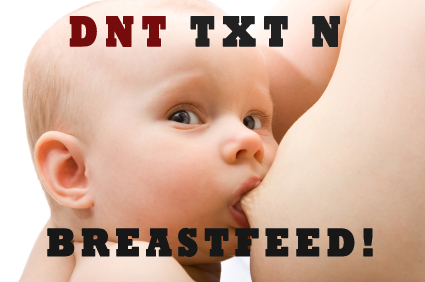
Sanctimommy alert: DNT TXT N BREASTFEED!!!

Breastfeeding

Ohmigod! Ohmigod! Ohmigod!

Lactivists have just discovered that some mothers text while they breastfeed!

The horror!!!!!

You see, a sanctimommy’s work is never done. She has to constantly move the goal posts and make up ever more outrageous stunts and ever more stringent “standards” to maintain that fragile sense of superiority over other mothers. Don’t worry though, she’s up to the task.

Think you’ve met the goal by exclusively breastfeeding your baby until she is 7 years old? Think again. Not if you’ve marred the pristine process of breastfeeding by daring to text while you breastfeed.

Today’s piece in the Lamaze blog Science and Sensibility, Texting While Driving And Texting While Feeding The Baby, Two Sides Of The Same Coin?, is a masterful piece of self-parody. There are lots of lessons here for sanctimommy wannabees.

Lesson 1: Always lead with a question that equates violation of sanctimommy principles with killing someone.

If you’re going for the guilt, and lactivist sanctimommies are always going for the guilt, it’s best to compare other mothers’ behavior to a heinous crime.

Lesson 2: Ask a stupid question.

The question could have made sense if it compared texting while driving to breastfeeding while driving. Both can result in serious injury or death. But breastfeeding while driving appears to be a protected sanctimommy activity, so you can’t criticize that. Texting while breastfeeding, that’s a hideous affront to gods of breastfeeding.

Lesson 3: Always assert that offenders are destroying their relationship to their babies.

Don’t worry. It doesn’t have to be true.

The fact is that mothers and babies now have a third party in their relationship—technology.

That’s right; texting introduced technology into the mother-baby dyad. It was perfectly pristine before that since there was no house, no central heating, no clothes, nothing but moss and hemp and naked skin before that, amirite?

Lesson 4: Always, always, always misuse existing research to make your point.

Now back to the frantic thumbs and feeding the baby. Here’s what research is showing—that as we humans text, a few interesting things happen physiologically Our breathing becomes rapid, shallow, or non-existent (we hold our breaths until we must breathe). Our pulse increases. Our temperature goes up. Sound familiar? Many of us will recognize the physical symptoms of “fight or flight”, or the human body in the sympathetic state. To be super basic about it, there is a massive release of several hormones in our body that prepare us to act to save ourselves. And it’s contagious. We share our hormonal responses, breathing and heart rate with others who are near us.

That’s a pretty big heap of bullshit. What, you didn’t know that texting destroys our normal hormonal balance (since it is so very similar to fleeing from a predator)?

Lesson 5: Be sure to include citations that have absolutely nothing to do with the issue under discussion.

Never forget, misrepresentation is key.

Lesson 6: Don’t let the main purpose get away from you. Remember, its always about making women feel bad and showing them how YOU would do it.

Mothers, if you find yourself catching up while you are feeding your baby, take intentional, slow, deep belly breaths while you do it. Keep yourself out of “fight or flight” and in the state so appropriately dubbed “feed and breed” or “rest and digest”. Your body can actually only be in one or the other state at any given time.

More hilarious bullshit.

Lesson 7: Be sure to promote an arbitrary standard that is utterly incompatible with reality.

If you are a professional—take a moment to teach the mothers you work with, in prenatal visits, private sessions, groups, or classes, this simple lesson: that humans breathe too fast and shallow, and that our temperatures, pulses, and breathing rates rise when we are texting or using technology while trying to do something else that shifts frequently and requires a lot of attention. Teach them to intentionally take slow cleansing breaths while nursing. Talk about taking some of the time while nursing to tend to their emotional health and connection with each other.

Maybe they can do that on Planet Boob where most of the lactivists hide out, but here in the real world, most nursing women have OTHER CHILDREN. Those other children must be supervised even though the baby has to eat.

Perhaps lactivists cage their older children while nursing the baby, but most women don’t feel that is appropriate. Most women in the REAL WORLD, are trying to ensure that the older children do not kill each other, do not give each other haircuts with kindergarten scissors and do not take the opportunity to wreak havoc in other parts of the house, while they are simultaneously nursing the baby. Some of us poor benighted souls even have to think about such menial tasks such as — dare I say it — what to make for dinner.

Maybe on Planet Boob all the older children respect nothing more than the need for a pristine breastfeeding relationship between the mother and the new baby, but in the real world, older children couldn’t care less. I can recall spending many nursing sessions reading to the older children or talking to them about the day at pre-school, simultaneously keeping them in view, engaging them and soothing feelings of jealousy toward the baby. I wonder if that produced fight or flight hormones and destroyed my relationship with my babies? I doubt it.

Raising children is not about gazing adoringly into their eyes 24/7. It’s about meeting everybody’s needs (not just the baby’s) every single day.

DNT TXT N BREASTFEED? You have got to be kidding.

Here’s my response:

KP YR SNCTMNY 2 YRSLF.

Don’t be afraid; the worst thing that can happen is a dead baby

iStock_000002298811XSmall

Ha, ha, ha, ha, ha. The possibility of his baby’s permanent brain injury or death at homebirth is just a big joke to this father.

Serge Bielanko wrote Don’t Be Afraid, It’s Just a Home Birth, and he apparently thinks its simply hilarious that people are warning him about the increased rate of death at homebirth.

The fact is, we aren’t really scared of anything.

Why not? She could die. Everyone could die. I could die. I’m not sure how, to be honest, but there’s got to be a way that I could perish during our home birth, right?

Oh well.

Oh well.

Why be afraid of harming your own baby when you could be afraid of something really important?

You want to know what I am scared of?

Snakes.

Freaking snakes and ferris wheels…

Fear is stupid, mostly. It’s really just an excuse to be excused.

Fear is stupid? Yeah, putting your baby is a car seat while driving to the grocery store is just plain stupid. Why fear a potentially fatal car accident? And it’s not like the risk of a baby dying at homebirth is greater than the risk of a baby dying in a car accident. Oh, wait, the risk of a baby dying at homebirth IS higher. Who cares, right?

Bielanko is inadvertently insightful about the homebirth industry:

People manipulate fear and overt scare tactics for financial gain and power. It isn’t exactly a new phenomenon on this planet, but here in America it is. People want you scared, because when you’re scared you’re jittery, and when you’re jittery, well, to be frank, you’re a damn fool.

And fools follow other fools. And fools spend money.

People foolishly believe that they should be afraid of doctors and hospitals, because homebirth midwives tell them they should be afraid. That makes them, in Bielanko’s own words, “damn fools” who spend money … on homebirth midwives.

The piece is filled with what passes for “reasoning” among the homebirth crowd:

In the beginning I was uncertain, as anyone would be. I needed to investigate it, to look into the whole phenomenon of midwives and the long, storied culture of home birthing and I needed to figure it all out on my own. Then, gradually, it dawned on me that this is how people have been having babies since the beginning of time.

No, really? Perhaps it will eventually dawn on Bielanko that women and babies were dying in droves at those homebirths, but that’s probably too much to hope for.

But don’t worry, like George W. Bush who famously evaluated Vladimir Putin and declared: “I looked the man in the eye. I found him to be very straight forward and trustworthy … I was able to get a sense of his soul,” Bielanko has evaluated the midwife:

Monica and I have looked hard into the eyes of a midwife, checking her out with our awkward leery Larry David stares and squints and looks. Now we trust her. Now we have collectively tuned out the white noise of trembling fear that’s always slashing away at the radio silence of your decisions gone public, forever threatening to try and torpedo any good and decent day.

Personally, when I evaluate a health care provider look at her education, her training, her professional credentials and the disciplinary actions (if any) against her. But, hey, that’s just me.

We have looked hard at having a baby in our home. How awesome is that? How awesome is it that we think it’s awesome?

It certainly could be awesome, as long as the baby and the mother don’t need immediate medical attention. In that case, it could be a nightmare, the baby slowly suffocating to death in the womb, or in the immediate aftermath of birth, all because his parents thought it would be “awesome” to give birth far away from the medical professionals who could perform an emergency C-section or an expert neonatal resuscitation.

Odds are high that there will be no problems. That’s would be awesome. But if something goes wrong, this father’s casual dismissal of the possibility of disaster will probably haunt him for the rest of his life.

That wouldn’t be awesome at all.

Another day, another bunch of lies from the Midwives Alliance of North America

iStock_000000335618XSmall

Hey, MANA, how long do you think lying about homebirth deaths is going to work? Don’t you think women are going to notice the growing pile of tiny dead bodies? Do you really think you can continue to mislead American women as you have done in the past?

The latest mendacity from MANA is this piece of junk, Understanding Outliers In Home Birth Research.

It is written by Wendy Gordon, CPM, a member of the MANA Division of Research.

You may remember Wendy Gordon, CPM, LM, MPH, Assistant Professor, Bastyr University Dept of Midwifery (and placenta encapsulation specialist!). She’s been arguing with me in print for years, and she hasn’t been correct yet.

What’s Wendy up to now (besides withholding the death rates of the 27,000 homebirths in MANA’s own database)?

Wendy is upset that a recent study showed that homebirth increases the stillbirth rate by 1000%. I wrote about the paper when it first appeared online ahead of print in June.

The authors found:

Home births (RR 10.55) and births in free-standing birth centers (RR 3.56) attended by midwives had a significantly higher risk of a 5-minute Apgar score of zero (p<.0001) than hospital births attended by physicians or midwives. Home births (RR 3.80) and births in free-standing birth centers attended by midwives (RR 1.88) had a significantly higher risk of neonatal seizures or serious neurologic dysfunction (p<.0001) than hospital births attended by physicians or midwives. (my emphasis)

What does Wendy have to say? You guessed it, she advises homebirth advocates to ignore the new paper. The heart of her argument is this:

This research, which claims to be the largest study of its kind, relies on data from birth certificates (known as “vital records”). What we know about using information drawn from birth certificates is that they are pretty good for capturing information about things like mother’s age and whether she is carrying twins. They are not very accurate when it comes to rare outcomes like very low Apgar scores, seizures, or deaths (Northam & Knapp, 2006).

Too bad for Wendy that the Northam & Knapp article, says the OPPOSITE!

Birthweight, Apgar score, and delivery method agreed 91.9% to 100%. The high-percent agreement supports the reliability of those variables …

So the heart of Gordon’s argument is a bald faced lie. And Gordon referenced the lie with a citation that showed the opposite of what she claimed it showed.

In order to discredit the study that shows a nearly 1000% increase in stillbirth, Wendy Gordon and MANA apparently feel they have no choice but to deceive their followers, since telling the truth would require accepting the validity of the paper. Homebirth kills babies. MANA knows it; their OWN data tells them so.

So, homebirth advocates, I have some questions for you:

How can you trust that homebirth is safe when those you look to to inform you about the scientific literature lie about?

How can you trust that homebirth is safe when the organization that represents homebirth midwives is hiding their own death rates?

How can you trust that homebirth is safe when the most comprehensive study ever done of homebirth (and analyzed by a midwife) found that PLANNED homebirth with a LICENSED midwife has a death rate approximately 800% higher than comparable risk hospital birth, and even MANA can’t figure out how to criticize it?

The ONLY people who think homebirth is safe are those who make money from it. Everyone else, including the authors of the paper that showed a 1000% increase in stillbirths at homebirth, knows better.


Correction: In Gordon’s piece, DOR stands for Division of Research, not Director of Research. Therefore, Wendy is a member of the DOR, not the director. I’ve changed the text to reflect that.

Would you feed your newborn a kale smoothie?

kale smoothie

I recently came across a perfect example of sanctimommy literature. It’s a classic because the author has no idea what she is talking about (of course), deliberately makes a false analogy, is incredibly judgmental and is falling all over herself to demonstrate her natural mommy cred.

I’m referring to this piece: What if someone suggested morphine to help your newborn sleep? by Kristin Dibeh, who amazingly believes she is qualified to write about childbirth because she is a childbirth educator.

She starts with typical first world privilege and self-absorption:

I knew that birth was possible without drugs, and that if my baby sister can do it under the circumstances she was coping with, so can anyone.

Duh! Of course birth is possible without drugs. Who would think otherwise? 100% of women who existed prior to 1850 gave birth without pain relief, and around the world most women give birth without pain relief each and every day.

Kristen goes on to excoriate women who opt for epidurals during labor.

I knew that I wouldn’t use an Opiate or a Caine derived drug BEFORE I was pregnant, so it confused me as to why people would be so shocked by the idea of NOT using controlled substances when there was a baby inside me. It still confuses me, actually…

Her “confusion” might be cleared up if she learned something about physiology and pharmacology, but that’s obviously too much to ask, so let me make it simple.

There is nothing dangerous about medical use of opiates or ‘caine anesthetics. If Kristen wants to tolerate the pain of a broken bone or a 3rd degree burn without morphine, she’s welcome to do so. If she wants to tolerate the pain of a root canal without novocaine, she’s welcome to do so. But that doesn’t justify pretending that opiates or ‘caine local anesthetics are dangerous.

The same thing applies to pregnant women. Both opiates and ‘caine anesthetics are safe in pregnancy, too. There is no reason for a pregnant woman who breaks her leg or sustains a severe burn to forgo morphine, and there is no reason for a pregnant woman undergoing root canal to avoid novocaine.

These medications are also safe for babies. Were a baby to be experiencing severe pain (from surgery, for example) opiates are perfectly appropriate to treat that severe pain and local anesthetics are appropriate for local procedures that require pain relief.

In other words, physiology and pharmacology tells us that opiates and ‘caine anesthetics are safe for use in non-pregnant women, in pregnant women, and in babies. Hope that clears up the confusion.

Let’s address the deliberately misleading and outlandish analogies.

If you took your baby home and he or she appeared to be in pain, would you give the baby…would you even consider giving your baby the likes of morphine? epinephrine? fentanyl? stadol? bupivicaine? chloroprocaine? lidocaine? The are all in the class of Opiates or Caine derived drugs. Would you give them to your baby short of ABSOLUTE medical necessity once they are in your arms?

If my infant had severe pain, you bet I’d be giving him or her opiates or ‘caine anesthetics. You’d have to be a monster to refuse to treat severe pain in an infant.

And here’s a helpful hint: Treating severe pain IS an ABSOLUTE medical necessity. What other reason is there to use analgesics and anesthetics?

The above list of drugs are serious, you wouldn’t dream of giving it to your baby the day after your baby is born unless the risk of giving it, outweighed the risk of not giving it.

Wrong! I’m not sure what Kristen imagines the “risks” of not treating severe pain in infants to be, but we give babies (or anyone) pain medication not because the “risk” of leaving the pain untreated outweighs the “risk” of treating it. We give pain medication to relieve pain, PERIOD. We don’t encourage burn patients to do without morphine even though that’s what our ancestors did. We don’t encourage people to do without novocaine during dental work because that’s what are ancestors did. So why should we be wandering around berating women for having pain relief in labor, for no better reason than because our ancestors avoided it?

Of course, the santimommy heart of the piece is the title:

What if someone suggested morphine to help your newborn sleep?

Is anyone suggesting giving morphine to anyone who is not in pain? You wouldn’t give morphine as a sleep aid to ANYBODY, so why ask if you would give it to an infant? Because the question reinforces the sanctimommy self-satisfaction, which, of course, is what this piece is all about. Good mothers would never drug their infants to sleep with morphine so why would a “good mother” allow opiates injected into her epidural space to relieve your own agonizing pain? How about because one thing has nothing to do with the other?

Imagine if we asked sanctimommies:

Would you feed a newborn a kale smoothie the day after it was born?

Think about the risks of doing that, everything from aspiration to severe GI pain. So if you wouldn’t feed a newborn a kale smoothie, how can you justify drinking one while you are pregnant?

No doubt a sanctimommy, in her own defense, would point out that a pregnant woman drinking a kale smoothie is very different from a newborn drinking a kale smoothie; the mother digests and metabolizes the kale so the baby doesn’t have to do so; that the placenta is not a sieve so that the kale itself does not get into the baby’s bloodstream; and that the chemical components of the digested kale are safe for babies.

Guess what? The same principles apply to the opiates and ‘caine anesthetics in epidurals.

Let there be no mistake about the inevitable conclusion: the fact that a woman refuses an epidural does NOT make her a better mother than someone who has one. What determines the quality of a mother is how she raises the child, not what she does to treat severe pain while pregnant.

If you don’t want to have an epidural, don’t have an epidural. But if you think that marks you as a good mother, think again. It merely identifies you as a gullible consumer of natural childbirth propaganda.

The World Championship of Childbirth

golden podium

Hi, folks, we at the Extreme Sports Network are proud to be reporting from this year’s World Championship of Childbirth. We’re especially fortunate to have world renowned childbirth expert Ima Frawde, CPM here with us as a commentator.

Ima, tell us about competitive childbirth.

Ima Frawde, CPM here. I want to start by thanking the Extreme Sports Network for inviting me to comment on this very important event. Many people may not know about competitive childbirth, but it’s an obvious outgrowth of our understanding about birth. We used to think that childbirth was about having a healthy baby and a healthy mother, but we now realize that birth as a piece of performance art whose goal is to perfectly replicate birth in prehistoric times.

I like to think of the sport as akin to rhythmic gymnastics. In rhythmic gymnastics participants are judged on how closely they execute a variety of stylized moves and how closely they mimic each other. In competitive childbirth, the judges evaluate each mother for how closely she executes the pre-approved moves of competitive childbirth and how closely she mimics childbirth in prehistory as imagined by a bunch of high school graduates thoroughly ignorant of both obstetrics and history.

The competition involves 3 phases. Competitors are awarded marks in each area: each competitor receives risk points, the object being to enter the arena with as many pre-existing childbirth risks as possible. Basic individual risks —breech, twins, postdates, VBAC —- receive small numbers of points. The key in this phase of the competition is to combine risks for bonus points. Bonus points are also awarded for women who willingly expose their babies and themselves to above average risks —- like a history of a previous stillbirth, intrauterine growth restriction, or a history of postpartum hemorrhage. pushing for more than 6 hours, ignoring thick meconium, or failing to monitor the fetal heart rate for hours at a time.

The strategy in this phase is come as close as possible to killing your baby and yourself without actually dying. No, there’s no point penalty if your baby or you actually die, but you can’t brag about the award if you don’t live to see it.

The second phase, which we’ll be watching today, awards style points for how closely the competitor mimics childbirth in nature as a imagined by a bunch of ignorant clowns. Style points are awarded for prolonged latent phase (regular contractions for two or more days BEFORE labor really starts), arrest of labor lasting 6 hours of more (extra style points for going over 8 hours), and pushing for more than 6 hours (extra style points for pushing more than 12 hours). Style points are also awarded for how much food a woman consumes during labor (it doesn’t matter if she vomits it up later), how much time she spends in the fecally contaminated birth pool, and how many herb preparations she consumes. Bonus points are awarded for pushing for more than 6 hours, ignoring thick meconium, or failing to monitor the fetal heart rate for hours at a time. Giving birth in creative place, such as in the Amazon rainforest or on top of Mount Everest also merits bonus points. Additional bonus points are awarded for being accompanied by animals like dolphins or sharks.

The final phase awards points for defiance of authority, but don’t thinks it’s merely about refusing postpartum interventions meant to protect the health of your child. Competitors are judged both on the seriousness of withholding those interventions; as you might expect, refusing the vitamin K shot, which could result in the baby bleeding into its brain and sustaining permanent damage, gets more points than refusing the eye ointment, which might only lead to blindness. Points are also awarded for bizarre childbirth practices attributed to indigenous peoples but actually made up by white women like lotus birth or eating the placenta. Additional bonus points are awarded for tricky maneuvers like attempting to breastfeed a non-responsive baby, or breastfeeding while in hypovolemic shock due to hemorrhage.

The winner of the competition is determined by adding together risk points, style points and defiance points. The winner has the satisfaction of knowing that she met the highest standards fabricated by a bunch of ignorant clowns.

Wait, what? The baby? Oh, yes, a live baby can be an unexpected bonus of the competition, but that’s hardly a requirement, especially because many women enter because they want to experience a “healing” birth after a previous loss (of the competition, silly, not the previous baby), as opposed to wanting another child. There’s so much more to childbirth than whether the baby lives or dies!

The prize? Thanks for reminding me. The winner receives a golden pessary and a lifetime supply of Depends, which is going to come in very handy when she develops urinary incontinence after the inevitable uterine prolapse.

What do the runners-up receive. They receive the consolation prize failing to meet the high standards of the competition: a lifetime supply of guilt!


This piece is satire.

Dear tech and legal journalists: the underlying dispute in the DMCA case is neither unsavory nor petty

Access is denied notice on a notebook

Dear tech and legal journalists,

In January of this year, I filed a lawsuit in Federal Court in an attempt to protect my blog, The Skeptical OB, from being hounded off the web by someone who doesn’t like what I have to say, and who was raising money and soliciting followers in an express attempt to do just that.

I had no idea that abuse of the Digital Millennium Copyright Act was a topic of profound interest in both the tech and legal communities and therefore I was quite surprised to see the case reported in these venues. I am very grateful that others recognize the potential for abuse of the DMCA, but I’m a bit concerned that many have dismissed the underlying issue as unsavory or petty. It is anything but.

I’ll concede that the proximate cause of the lawsuit, the picture of the finger seen round the world is both unsavory and petty, but that should not confuse people. The underlying dispute is about censorship, whether purveyors of pseudoscience should be allowed to censor critics when they cannot counter the scientific evidence that the critics present.

I’m a Harvard educated, Harvard trained obstetrician gynecologist who has spent my entire professional life attempting to ensure safe childbirth for babies and women. I am a respected expert on the issue of homebirth, writing for Time.com, Salon.com and The New York Times among other places, and quoted widely.

I am very effective at what I do; it’s not that hard to be effective when the scientific evidence is on your side. I merely present it in a way that lay people can understand. And in doing so, I threaten a multimillion dollar industry of childbirth paraprofessionals such as homebirth midwives, doulas and childbirth educators.

The scientific evidence on safe childbirth is so clear that no professional homebirth advocates would dare debate me in an open forum, despite multiple offers on my part to do so. Rather, they have attempted to censor me.

As far back as 2007 doulas and homebirth organizations sent multiple complaints to the Massachusetts Board of Registration in Medicine (they were dismissed), and as recently as within the past several months, the American Congress of Obstetricians and Gynecologists has received multiple letters from homebirth activists demanding that I not be allowed to speak at a forthcoming ACOG district conference where I am a featured speaker.

While my experience may be the first time that a homebirth critic has been targeted, this is hardly a unique experience for those who fight to correct the misinformation of people who profit from pseudoscience. From Simon Singh, PhD, a critic of chiropractic who was sued for libel, to Dr. Paul Offit, who has tenaciously countered the misinformation of the anti-vaccination lobby and has required a bodyguard for protection from threats against his life, physicians and scientists who debunk pseudoscientific misinformation with scientific evidence routinely face efforts at censorship.

When it comes to the misinformation from the homebirth lobby that threatens the lives of babies and mothers, I’ve found that sunshine is the best disinfectant. Exposing the deaths of babies at homebirth, the efforts of homebirth midwives to escape culpability for injuries and deaths and the misinformation that leads women to choose homebirth in the first place, I’ve found that there is no better antidote than scientific evidence.

My critics obviously agree that there is no better antidote than scientific evidence. That’s why they can’t debate me and why they want to silence me instead. One homebirth activist hit upon filing multiple false DMCA notices against me as a tool for censoring me from the internet. If an activist can do that to me, what’s to stop purveyors of pseudoscience from attempting to use the DMCA to shut down the free flow of information about climate change or evolution? Nothing, unfortunately.

Don’t be fooled by an obscene photograph. This isn’t about a personal dispute and this isn’t about homebirth. It’s hard to debate when science isn’t on your side; how much easier then to censor instead.

Dr. Amy