
No limit to the stupidity at Midwifery Today

wise and stupid in letterpress wood type

Over on that festival of stupidity known as the Midwifery Today Facebook page, I found this:

Midwifery Today

From Stephanie-jean *****

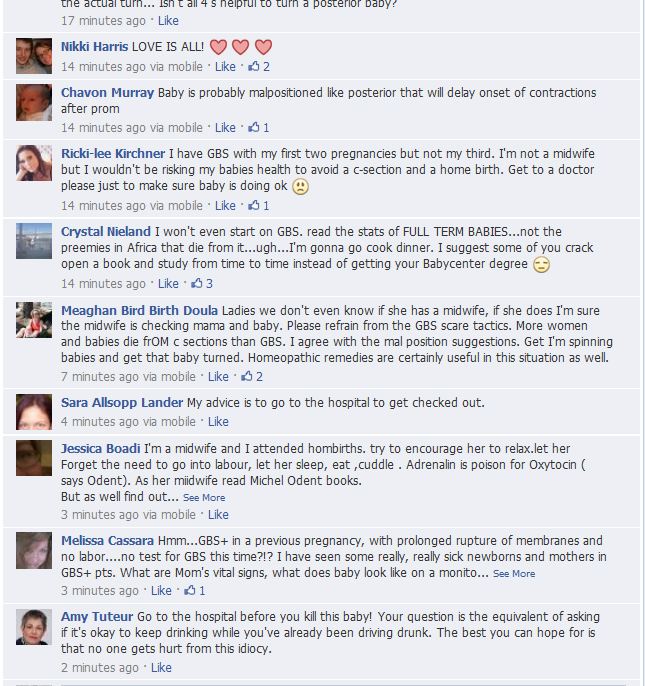
My best friend is currently attempting a hbac and is a at road block. Her membranes ruptured 56 hours ago. She was group b strep positive in her last pregnancy, but was not tested this time. All over our research would suggest that 95% of women will go into labor on their own within 72 hours of prom. She is looking to hear other women’s experiences with hbac with prom. She really wants to avoid a repeat c-section as she had a really traumatic c-section the first time. All advice, support, and baby waves is highly appreciate!

My comment (soon to be deleted no doubt):

Go to the hospital before you kill this baby! Your question is the equivalent of asking if it’s okay to keep drinking while you’ve already been driving drunk. The best you can hope for is that no one gets hurt from this idiocy.

Midwifery Today 4-18-13

Step 1: ignore homebirth deaths

OOPS sign with clipping path

Hi, folks! It’s Ima Frawde, CPM. It’s time for some honest talk about homebirth deaths.

No, silly, not how to prevent them! How to hide them.

I admit it; it’s been a very bad year for homebirth midwifery. Licensed Oregon homebirth midwives have a death rate at planned homebirth of 9X term hospital birth. Colorado homebirth midwives have a perinatal death rate 2.5X higher than hospital births (including premature births!). Australian homebirth midwives have a death rate 5X higher than term hospital birth. Even our vaunted friends, the midwives of the Netherlands, are facing scrutiny because their low risk death rate (home and hospital) is nearly 3X higher than high risk birth attended by obstetricians.

What’s a midwife committed to making 100% of her income peddling quackery to do?

Don’t worry, I have a 5 step plan for hiding addressing homebirth deaths.

Step 1: Ignore the homebirth deaths.

Use the homebirth midwives of Oregon and Colorado as your guide. Collect your statistics, analyze them on the off chance that they might show that homebirth is safe (in which case we’ll publish them). Then ignore them. If you ignore them and act like it’s no big deal that lots of babies are dying preventable deaths at homebirth, our supporters will too.

Step 2: Stop collecting statistics.

Let’s follow the example of homebirth midwives in North Carolina, Maryland and a variety of other states by refusing to collect mortality statistics. Very clever, huh? If we refuse to count the homebirth deaths, no one else can, either.

Step 3: Pretend that some deaths can and should be dropped from the statistics.

Congenital anomalies? That’s not our fault; remove them from the homebirth statistics, but keep them in the hospital comparison group. Intrapartum deaths? Hide them in the stillbirth rate.

Step 4: Baffle them with bullshit.

Invoke quantum midwifery and pretend that the Heisenberg Uncertainty Principle means that no one can truly “know” how many babies died because, like Schrodinger’s Cat, they can be dead and alive at the same time. Invoke chaos theory because it sounds cool.

Step 5: Pretend that this is a human rights issue.

Sure a bunch of babies are dead who didn’t have to die. But it’s my right to make money a woman’s right to “choose” that’s at stake here. Lie, and insist that any attempt to reduce homebirth deaths is an effort to outlaw homebirth midwifery. Glorify those midwives who have presided over homebirth deaths (especially those who have presided over lots of deaths) and insist that any attempt to hold them accountable makes them into martyrs.

There’s actually one more step, but it’s a secret among us midwives:

Step 6: Rely on the ignorance and gullibility of homebirth advocates.

Let’s face it, you can tell those nitwits mamas anything and they’ll believe it. As we know, anyone who actually thinks trusting birth is an effective strategy is willing to accept whatever nonsense we dish out. Fortunately!

And if a bunch of babies die in the process,  remember: just like you can’t make an omelet without cracking some eggs, you can’t protect “normal birth” without killing some babies. S#it happens; get over it.


This piece is satire.

Australian midwives boast about terrible homebirth death rate

iStock_000010467288XSmall

Setting a new standard for cluelessness, Australian midwives are proudly presenting the results of a publicly funded homebirth program, a program that has a homebirth death rate 5X higher that of term hospital birth.

I received a iPhone photo of the poster that include this chart (sorry for the fuzziness):

Australian homebirth study

The accompanying message says it all:

I am attending the national PSANZ (Perinatal society of Australia and new Zealand) congress here in Adelaide and thought of you when I saw this poster

The authors seem to be blissfully unaware that their “rates” are anything but low given that this is a carefully selected low risk group at term. These deaths do not include those from rogue homebirth midwives such as LB nor freebirths. The publicly funded homebirth program has strict criteria including exclusion of women with any risk factors such as multiple births, preterm births, VBACS, breech. The births are managed by 2 properly trained midwives who also work in hospital and so quick referral and transfer is a given. !!!

Things that I noticed (I’m sure you will see more!!) are …

6 deaths in low risk pregnancies at term!!!!

0.7 % of IUGR missed

2.7% of the babies ended up in the nursery!!!!!! 9 babies had SIGNIFICANT morbidity

In the abstract they have the following conclusion further demonstrating their absolute ignorance:

“This study evaluates a substantial proportion of women choosing to have a publicly-funded homebirth in Australia. However, the sample size does not have sufficient power to determine safety. More research is needed on the safety of different birthplaces within Australia”

Interestingly they left this conclusion off the poster! Perhaps they didn’t want to embarrass themselves.

The poster is Publicly-funded Homebirth in Australia: outcomes after 5 years by Catling-Paull et. al. (Here’s the full size iPhone photo of the poster.)

According to the authors:

Homebirths account for a very small number of births in Australia. In 2010, only 0.5 per cent of all women … chose homebirth.

Currently, there are at least 15 publicly-funded homebirth programs [run by 13 directors] in Australia …

The programs accommodate women who are at low risk of medical or obstetric complications. Midwives are usually selected to work within the programs after … advanced obstetric emergency training, cannulation and suturing skills.

What did they find?

During the 5 years of the study, there were 1807 women who intended, at the start of labor, to give birth at home. 83% had a homebirth, 52% in water (I have no idea why they mention this except to check women’s performances against the midwifery ideal.) The transfer rate was 17%. The C-section rate was 5.4% and the neonatal death rate was 2.2/1000. That’s more than 5X the rate of 0.4/1000 found in a 2009 report on birth in South Australia.In addition, 2 babies suffered hypoxic ischemic encephalopathy (brain damage due to lack of oxygen).

And that probably undercounts the deaths and complications because reporting was voluntary and only 9 of 13 program directors responded. Nonetheless, the authors conclude:

There was a low rate of caesarean section, postpartum haemorrhage and third degree perinatal tears as well as low rates of stillbirth and early neonatal death in this sample of women and babies.

It’s absolutely mind boggling that Australian midwives appear to be completely unaware that the neonatal mortality rate for term births in Australia is approximately 0.4/1000. They are boasting about a death rate of 2.2/1000, nearly 5X higher than the expected death rate.

The findings of the study are not surprising. They confirm what we already know: homebirth increases the risk of neonatal death by a factor of 3 or more. The only surprising thing about the study is that the authors are cheerfully ignorant about the meaning of what they found.

Corrected to reflect the fact that I mixed up stillbirths and early neonatal deaths, thereby reporting the death rate at Australian homebirth as lower than it is.

Yesterday I glimpsed heroism — and preparedness

In one single video, you can see senseless horror and sublime heroism.

I have lived in Boston my entire life and the terrorist bombing at the finish line of the Marathon stuck me particularly hard. I wasn’t there, nor was anyone I know personally, but that was merely chance. Just about everyone I know has been among the supporters lining the route in one year or another, so it was particularly harrowing to see video of the bombing.

But in the same video, I glimpsed something else: heroism.

It takes extraordinary heroism and bravery to run TOWARD the site of the bombing when everyone else is running away in fear. Yet, dozens, if not hundreds, of police, medical personnel and ordinary citizens did precisely that without even the slightest hesitation. The professionals, and perhaps some of the ordinary individuals, recognized that where one bomb has detonated, another might soon explode. Nonetheless, they ran to help, ripping down fencing and barriers in their eagerness to reach the victims.

In addition to their bravery and selflessness, their extraordinarily heroic response owes a great deal to something else: preparedness. Every single one of the professional first responders have drilled for just this eventuality. That training was reflected in the way that they immediately took control of the situation, summoned an army of medical personnel, a fleet of ambulances, and a battalion of police and SWAT teams.

What is truly remarkable in the chaos of the immediate aftermath is that there wasn’t much chaos. In only moments, victims who could be moved were ferried to further medical assistance and those who couldn’t be moved were treated on the spot. Ambulances pulled up and raced away in an orderly fashion. Hospitals called in their trauma teams; operating rooms were thrown open and surgeries were started. Race officials stopped the race in an orderly fashion and began ferrying runners away from the site. Political officials opened help lines to reunite people with loved ones and to solicit tips in solving the crime. Some early responders had the presence of mind to immediately begin testing air quality to be sure that no radioactivity or biologic agents had been released in the bombing.

It was a tribute to heroism and to training.

What were the chances that there would be a bombing at the finish line of the Boston Marathon? Very, very low, yet thousands of people had trained for thousands of hours for an event that was extremely unlikely to happen, just in case it did. Why? Because in emergencies, minutes count. They make the difference between saving a life and watching someone bleed to death on the ground.

Imagine if instead race officials had trusted that a rare event would never happen. Imagine if race officials had made no plans beyond calling 911 in the event of a disaster and summoning medical help then. Imagine if police and EMTs had not been trained in responding to rare crises. It’s not difficult to imagine that the carnage would have been far worse.

Up until the moment the crisis occurred, everyone on the scene was concentrating on creating the best possible experience for the runners, the family and friends, and the ordinary spectators. But they pivoted on a dime into crisis mode and because they did, even greater carnage was averted.

There’s a lesson here for anyone who purports to care for other people: It’s not enough to create a great experience when everything goes right. It’s not enough to call 911 when things go wrong. It’s not acceptable to pretend that there’s no point in preparing for rare disasters or that the people who do prepare and train relentless for these rare disasters are fear mongering.

Lives were lost yesterday in Boston, but lives were also saved because of the heroism of individuals … and because they were prepared.

Dutch midwives struggle to avoid accountability for high perinatal death rate

Who me

Ank de Jonge thought that she had succeeded in showing that homebirth in the Netherlands is safe. She was the lead author on the paper Perinatal mortality and morbidity in a nationwide cohort of 529 688 low-risk planned home and hospital births back in 2009. The study showed that homebirth with a midwife in the Netherlands is as safe as hospital birth with a midwife. That triumph was very short lived.

A subsequent study, Perinatal mortality and severe morbidity in low and high risk term pregnancies in the Netherlands: prospective cohort study, was a stunning indictment of Dutch midwives. The study was undertaken to determine why the Netherlands has one of the worst perinatal mortality rates in Western Europe and the results were unexpected, to say the least.

We found that delivery related perinatal death was significantly higher among low risk pregnancies in midwife supervised primary care than among high risk pregnancies in obstetrician supervised secondary care.

…[T]he Dutch obstetric care system is based on the assumptions that pregnant women and women in labour can be divided into a low risk group and a high risk group, that the first group of women can be supervised by a midwife (primary care) and the second group by an obstetrician (secondary care), and that women in the primary care group can deliver at home or in hospital with their own midwife… This also implies that the high perinatal death rate in the Netherlands compared with other European countries may be caused by the obstetric care system itself, among other factors. A critical evaluation of the obstetric care system in the Netherlands is thus urgently needed.

The validity of these observations have been acknowledged by Dutch midwives:

In 2011 Dutch midwifery is under a microscope. Maternity care in general in The Netherlands has come under scrutiny by governments, media, the public and care providers themselves after two consecutive European Perinatal Statistical Reports ranked The Netherlands among those with the highest rates of perinatal and neonatal mortality compared to other members of the
European Union (and Norway)…

… We have learned that infants born to women of low risk whose labour started in primary care with midwives had higher rates of perinatal death associated with delivery compared to those beginning labour in secondary care…

Obviously, the next step is to determine why Dutch midwives have unacceptably high rates of perinatal mortality, both at home and in the hospital. But some midwives, de Jonge among them, are still struggling to avoid responsibility for the terrible perinatal mortality rates, let alone improve them. de Jonge’s latest effort is a paper in the journal Midwifery Perinatal mortality rate in the Netherlands compared to other European countries: A secondary analysis of Euro-PERISTAT data.

The conclusion is bizarrely disconnected from the actual findings of the paper. The findings of the study do NOT absolve Dutch midwives and does not address homebirth in any way. Regardless, de Jonge inexplicably concludes that the findings mean that no changes in homebirth policy is necessary.

How did de Jonge analyze her data and what did she find? de Jonge, like many Dutch midwives, has suddenly discovered that perinatal mortality rates consist of premature babies as well as term babies. Reasoning that premature babies are cared for by doctors, de Jonge set out to show that the poor perinatal mortality rate of the Netherlands can be ascribed to poor care of premature babies. That’s not what she found.

Microsoft Word - Figure 2 high resolution

As you can see from the chart, the Netherlands has one of the worst perinatal mortality rates in Western Europe (All mortality rates are expressed as compared to the Dutch perinatal mortality rate.) Only Latvia and France have higher rates.

What happens when you break the data down by gestational age and compare mortality rates for term pregnancies?

Microsoft Word - Figure 3 high resolution

After restricting the analysis to term births, de Jonge found that the Netherlands has one of the worst perinatal mortality rates in Western Europe, although now they have the sixth worst rate, instead of the third worst rate.

In other words, de Jonge CONFIRMED that there is a serious problem with perinatal mortality in the Netherlands including the perinatal mortality rate at term. She CONFIRMED that there is significant evidence that Dutch midwives bear responsibility for the Netherlands poor perinatal mortality rate. But, bizarrely, that’s not what she concludes. She writes:

The relatively high perinatal mortality rate in the Netherlands is driven more by extremely preterm births than births at term. Although the PERISTAT data cannot be used to show that the Dutch maternity care system is safe, neither should they be used to argue that the system is unsafe. The PERISTAT data alone do not support changes to the Dutch maternity care system that reduce the possibility for women to choose a home birth while benefits of these changes are uncertain.

Of course the PERISTAT data can be used to show that the Dutch maternity system is not nearly as safe as it could be. Absent demonstrating that the population of Dutch pregnant women differs substantially from that of pregnant women in other European countries, that is the inevitable conclusion. And although perinatal mortality at term is “less terrible” than perinatal mortality overall, that is hardly a defense of Dutch midwifery. We already know that the reason that Dutch perinatal mortality at term is as high as it is because Dutch midwives caring for low risk women have higher perinatal mortality rates than Dutch obstetricians caring for high risk women.

In fact, we know from the BMJ study cited above that the perinatal mortality rate of Dutch midwives is more than double that of Dutch obstetricians. If the perinatal mortality rate of Dutch obstetricians (caring for HIGH risk women) was compared to the rest of Europe, Dutch obstetricians would have the second lowest rate in Western Europe!

de Jonge has CONFIRMED the poor perinatal mortality ranking of the Netherlands. She has CONFIRMED that Dutch midwives have poor perinatal mortality rates. She CONFIRMED that the data DO support changes to the Dutch maternity care system. She NEVER LOOKED at homebirth, and therefore she cannot draw ANY conclusions about Dutch homebirth, let alone the conclusion that homebirth is safe.

Most importantly, in my view de Jonge CONFIRMED that Dutch midwives refuse to accept accountability for their poor perinatal mortality rates. They are not the among the best in Europe. They are among the worst. The sooner they acknowledge reality, the sooner they can start making the improvements that are needed to save babies’ lives.

The appalling callousness of the Arizona homebirth researchers

whatever in letterpress type

Imagine the following “analysis” released by the manufacturer of thalidomide, the drug that caused severe limb deformities in the children whose mothers took it while pregnant:

Thalidomide for morning sickness may be equally safe if not safer for women than other treatments. Unfortunately, thalidomide increases safety concerns for the child.

Such appalling callousness and nonchalant dismissal of the pain and suffering that thalidomide caused would suggest that the manufacturer was far more concerned with touting thalidomide than with the safety of babies.

Amazingly, the researchers responsible for the report Outcomes of Home vs. Hospital Births Attended by Midwives: A Systematic Review and Meta-analysis appear to have a similarly callous view of homebirth deaths.

As I discussed in yesterday’s post (New analysis from Arizona shows — yet again — that homebirth triples the neonatal death rate), the authors of the analysis, after demonstrating that homebirth increases the risk of neonatal death by a factor of three reach a bizarre conclusion:

The findings suggest that homebirths attended by midwives may be equally safe if not safer for women with low-risk pregnancies.

Reader Lynnette Hafken, MA, IBCLC was so disturbed by the obvious disconnect between what the authors found and what they concluded, she wrote to the lead author John Ehiri, PhD, MPH, MSc (Econ.) for clarification. Ehiri thanked her for pointing out this “oversight” and informed her that the authors had added an additional sentence to the 34 page paper.

The conclusion now reads:

The findings suggest that homebirths attended by midwives may be equally safe if not safer for women with low-risk pregnancies. Unfortunately, home births attended by midwives increase safety concerns for the child.

Unfortunately? Unfortunately??!!

Frankly, I am shocked by the appalling callousness of dismissing preventable deaths of babies in such a brutally short and dismissive sentence.

The KEY ISSUE in any analysis of homebirth is its safety for babies. It’s not the only issue, but all others pale into insignificance next to it. The conclusion of the analysis ought to be:

Homebirth attended by midwives increases the risk of neonatal death by a factor of 3. Homebirth has no deleterious impact on the health of mothers and may reduce morbidity. Women should be counseled to weigh the increased mortality to babies against the decreased morbidity to mothers before choosing homebirth.

The fact that the authors reduced preventable neonatal deaths to an “unfortunate” side effect of homebirth suggests to me that authors were far more concerned with touting the safety of homebirth (regardless of what their own data showed) than with the safety of babies.

If Dr. Ehiri would like to contest my assertion that the authors have callously and deliberately ignored the immense pain and suffering associated with neonatal death, he can write to me at the email address listed at the top of the sidebar. I will publish his response/explanation in full.

But I have a better suggestion for Dr. Ehiri and colleagues:

Remove the absurd and offensive claim that “homebirths attended by midwives may be equally safe if not safer for women” and replace it with the language I suggested, giving primacy to the fact that homebirth increases the risk of neonatal death by a factor of 3 and offers only a small reduction in maternal morbidity as a result.

Even the drug company that promoted thalidomide didn’t dare tout its safety and effectiveness after it was shown that it caused horrible birth defects as a result. Surely Ehiri and colleagues could demonstrate as much sensitivity in promoting homebirth.

New analysis from Arizona shows — yet again — that homebirth triples the neonatal death rate

iStock_000001980983XSmall

It’s a remarkably robust finding, repeated in a wide variety of scientific papers and both national and state statistics: homebirth increases the risk of neonatal death by a factor of 3 or more.

The latest example is an analysis prepared by faculty at the College of Public Health of the University of Arizona, Tucson and the Arizona Public Health Training Center for the Arizona Department of Health Services entitled Outcomes of Home vs. Hospital Births Attended by Midwives: A Systematic Review and Meta-analysis.

The authors, 5 professors of public health and 1 doctor, explain why the analysis was commissioned:

Most recently, the licensed midwife community has utilized the democratic process to their advantage to pass legislation to allow for an overhaul of the regulations overseeing homebirths and their profession in the state. Pursuant to HB 2247, AzDHS has formed a Midwife Scope of Practice Advisory Committee, which will evaluate evidence based literature and data to make informed decisions regarding regulation over licensing procedures, scope of practice, and education requirements for licensed midwives in Arizona by July 2013. Of particular salience will be changes in regulations overseeing licensed midwife attendance at births for mothers undergoing a vaginal birth after cesarean (VBAC), breech birth presentation, and multiple fetuses…

In light of Arizona homebirth practitioners’ and clients’ interest in midwives’ scope of practice in the US and elsewhere, we seek in this meta-analysis to compare and contrast direct entry midwives’ outcomes for homebirths with their outcomes in hospital or health care facility settings. The current
limited and conflicting evidence on the outcomes of homebirths versus hospital births with midwives in attendance generates both a need and justification for a review of the available evidenced-based literature.

What did they find?

Nine studies were included in the meta-analysis of child health outcome of births attended by midwives in homes or in hospitals. We analyzed 8 outcomes of child health (neonatal deaths, prenatal deaths, Apgar

Pooled results indicated that homebirths attended by midwives were associated with increased risks for neonatal deaths [pooled OR (95%CI): 3.11 (2.49, 3.89)]. There were no significant differences in outcome of home or hospital births attended by midwives for the other child health measures.

How about maternal outcomes?

… [W]omen who delivered at home with midwives were more likely to have spontaneous delivery and intact lacerations/perineal tear [pooled ORs (95%CIs): 1.64 (1.35, 2.00) and 1.94 (1.25, 3.01) respectively.

Women who delivered in hospitals under the supervision of midwives were more likely to experience assist ed delivery, caesarean sections, forceps, episiotomy, and lacerations/perineal tear (3-4 degrees) [pooled ORs (95%CI s): 0.58 (0.40, 0.84); 0.55 (0.49, 0.60); 0.54 (0.33, 0.9 0); 0.56 (0.41, 0.77) and 0.48 (0.32, 0.72) respectively. Results of the meta-analysis also revealed that homebirths attended by midwives were associated with decreased risk for postpartum hemorrhage >500ml and retained placenta [pooled ORs (95%CI s 0.60 (0.44, 0.81) and 0.58 (0.40, 0.86) respectively.
Homebirths were also not associated increased risk for vacuum extraction, cervical tear, blood transfusion and prolapsed cord.

The authors conclude:

These results suggest that homebirth is a suitable alternative to the traditional hospital setting, as it reduces medical interventions and has been found to have positive maternal health outcomes. However, homebirths should only be recommended to women who are classified as low-risk, as this data demonstrates an increased risk of neonatal mortality among homebirths

For reasons that are unclear to me, the authors state:

The findings suggest that homebirths attended by midwives may be equally safe if not safer for women with low-risk pregnancies.

I find that statement surprising for two reasons. First, that is not what their own data showed. Second, claiming that is “may be” equally safe acknowledges that possibility that it may NOT be equally safe.

Regardless, there is one inescapable conclusion of the analysis; homebirth increases the risk of neonatal death by a factor of 3 or more.

For mothers, homebirth poses a much lower risk of interventions and the complications that may arise from those interventions. But that advantage is purchased at the price of increased risk of neonatal death, demonstrating yet again that much of obstetrics is preventive medicine, designed to prevent neonatal deaths … and that’s exactly how it works. Give birth at home and you are twice as likely to avoid interventions, but three times as likely to end up with a dead baby as the result.

Lawsuit update 3 – disappointed!

iStock_000009143046XSmall

The judge issued a preliminary ruling today, focusing not on whether the court has jurisdiction over Gina, but instead questioning the merits of the case. Interestingly, he said that I would probably win the case if Gina had sued me for copyright violation, since the image probably meets the fair use exception and Gina may have also given me an implied license to use it. But, he questioned whether I am entitled to sue Gina for DMCA abuse and tortious interference with Bluehost over one DMCA notice.

It is unclear why the judge made no mention of the DMCA notices sent to my second host or the fact that Gina was soliciting others to file DMCA notices with the express purposes of pushing my site off the web. We will be reminding the judge of this in our response and expect that it will then be clear that I am entitled to sue Gina for what she did.

You can read the ruling here:

https://dl.dropboxusercontent.com/u/27713670/Tuteur%20judges%20order%204-10-13.pdf

Let’s review: ten illogical arguments in defense of homebirth

Illogical Tshirt

It doesn’t matter how hideous, it doesn’t matter how preventable, and it doesn’t matter whether the midwife broke the law. In the wake of every homebirth death, homebirth advocates console themselves with a variety of illogical claims. The recent arrest of self-proclaimed “midwife” Rowan Bailey in connection with a homebirth death is a case in point. Homebirth advocates are twisting themselves into pretzels to justify their support of yet another “midwife” who has presided over yet another death.

Let’s look at the various types of illogical argument constructed to justify homebirth deaths. They are all efforts to forestall the conclusion that homebirth increases the risk of perinatal death. To make this exercise easier to understand, lets substitute a claim of the same form that is obviously true, so we will not get sidestepped by issues of truth or falsity and can focus only on whether an argument is logical or illogical. This is important because illogical arguments are automatically invalid arguments. We’ll use the claim “there are more black cars in the US than lime green cars.”

I say: There are more black cars in the US than lime green cars. (The death rate at homebirth is higher than the death rate for comparable risk women in the hospital.)

Don’t say:

I saw a lime green car. (“Babies die in the hospital, too.”) – Can you understand how the fact that you personally saw a lime green car tells us nothing about the relative number of black cars and lime green cars in the US? That you saw a lime green car is perfectly consistent with black cars outstripping lime green cars 100 to 1, or even 1,00,000 to 1? Similarly, the fact that babies die in the hospital tells us nothing about whether the death rate is greater at homebirth.

I know ten people and not one of them has a black car. (I had two fabulous homebirths and my babies didn’t die.) – This is an illogical claim based on an unstated assumption. The assumption is that the small slice you observe accurately represents the whole. However, tiny samples are often unrepresentative. Knowing 10 people who own black cars is perfectly consistent with the number of black cars exceeding lime green cars, BUT it is also perfectly consistent with lime green cars exceeding black cars, so it can’t be used to support a specific claim. Similarly, the fact that you know ten women who had homebirths and not a single baby died tells us nothing about whether the homebirth neonatal death rate exceeds the low risk hospital death rate.

Lime green cars are prettier than black cars. (Homebirth is empowering.) – I hope it is obvious why value judgments about lime green cars tell us nothing about whether there are more or less black cars than lime green cars. Therefore, it should be obvious that claiming that women are more satisfied with homebirth tell us nothing about homebirth death rates.

You say that because you sell black cars. (You say that because you are a doctor.) – Whether or not I sell black cars is immaterial; it has absolutely no effect on the number of black cars or lime green cars. This is essentially an accusation that I am lying and offering as “proof” the fact that I have a reason to lie, but a reason to lie is not proof of lying. So don’t tell me that the fact that I am an obstetrician means that I am lying about neonatal death rates.

The people who make black cars have oppressed the people who make lime green cars. (Doctors have always oppressed midwives.) – Maybe yes, maybe no, but in either case, it does not affect how many black and lime green cars are on the road. Similarly, whether doctors have oppressed midwives has no bearing on whether the neonatal death rate at midwife attended homebirths is higher than hospital births.

There is a conspiracy against lime green cars. (Doctors are afraid of losing business to homebirth midwives.) – We are supposed to believe that the number of lime green cars would equal black cars except for a public relations campaign designed to make lime green cars less desirable. It is theoretically possible that there is a conspiracy against lime green cars, but it is far more likely that other factors account for the difference in numbers. And in any case, it doesn’t tell us anything about the relative numbers of black and lime green cars. So when confronted with the fact that homebirth death rates exceed hospital rates, it is illogical to counter with a claim that a conspiracy against homebirth exists.

There would be more lime green cars if the makers of black cars helped out. (There wouldn’t be so many deaths at homebirth if doctors backed up homebirth midwives.) – That might be true, or it might not. In either case, it tells us nothing about the truth of the claim that black cars exceed lime green cars. And while it might be true that the death rate from midwife attended homebirth would be lower if doctors were more supportive of midwives, it doesn’t change the reality of the current situation.

The Association of Lime Green Car Makers say that there are more green cars than black cars. (The Midwives Alliance of North America says that homebirth is safe.) – Cherry picking certain claims and ignoring all others is likely to lead people to the wrong conclusion. A lobbying group that disagrees with almost everyone else is not a reliable source of information. Similarly, professional NCB advocates and organizations are not reliable sources of information when they disagree with the bulk of the scientific evidence and the existing statistics.

The color of cars is influenced by culture. (Our culture promotes a technocratic model of birth.) – That is a non sequitur. It does not oppose the claim; it simply attempts to pin responsibility somewhere else and it is irrelevant. That’s why the claim that hospital birth is culturally favored is irrelevant to any argument about homebirth death rates.

There are more important things about cars than the color. (There’s more to birth than whether the baby lives or dies.) – That is what is known as “reframing the debate“. It is a tacit acknowledgment that there are more black cars than lime green cars and a barely concealed effort to divert everyone’s attention. That’s why when someone announces that there are more important things than whether babies live or die, I know they have accepted the fact that homebirth has an increased risk of perinatal death, and are trying to get everyone else to accept it, too.


Adapted from a post that appeared in February 2011.

No hatting, chatting or patting

No hatting

This is not satire.

I have written before about the outrageous practice of hatting. I thought that homebirth midwives could not exceed that demonstration of idiocy, but I was wrong. Now there’s the picture above.

From the Facebook page of Ancient Art Midwifery Institute run by Carla Hartley of Trust Birth whose motto is:

There is one simple, yet profound, birthtruth: Birth is Safe; Interference is Risky!

How can something as simple as putting a hat on a baby precipitate a maternal hemorrhage or affect a baby’s health for the rest of his life? Let me save you the $40 and tell you. It can’t.

Thanks to Carla for demonstrating yet again that homebirth midwifery is a toxic mixture of  startling ignorance and unreflective defiance.

And now I have a question for homebirth advocates. Are you really so gullible that you would believe this nonsense? And if you recognize this for the nonsense it is, why would you believe anything that comes out of the mouths of these fools? Most important, why would you hire one of these clowns to attend your birth?

Dr. Amy