Ina May just makes it up as she goes along

It must be great to be able to make up your own scientific “facts” as you go along. No need for pesky studying and research. No need to bother with real facts that don’t corroborate your world view. Self proclaimed “midwife” and homebirth promoter Ina May Gaskin should know. She just makes it up as she goes along.

The latest iteration? This astoundingly uneducated and inane view of animal reproduction:

There are 5,000 different kinds of mammals, do you really think we are the only ones that could not work it [birth] out.

Gaskin is quoted approvingly as having said this at a recent homebirth conference in Ireland and I’ve seen her issue this statement in interviews. The only thing more astounding than the fact that Gaskin seems to think it is okay to propagate blatant falsehoods is the fact that her gullible followers happily swallow whatever nonsense they are fed.

Gaskin apparently inhabits a fantasy world where everything that is “natural” works perfectly, including birth, and evil doctors have tricked women into believing that human childbirth can go wrong. In Gaskin-land, animals, specifically mammals, “know” how to give birth without asphyxiated babies, stuck babies, placental problems, etc. etc. etc. Ergo humans, being mammals, also “know” how to give birth and would do so if it weren’t for the interference of obstetricians.

How unfortunate, then, that Gaskin-land is a figment of Ina May’s imagination. She simply made it up. Obviously she didn’t bother to read the extensive leterature on mammalian reproduction or she would have learned in very short order that oxygen deprivation, dystocia, placental problems, etc. etc. etc. occur quite frequently in nature.

Had Gaskin bother to look for instead of fabricate scientific facts she would have learned that the study of animal reproduction is a distinct discipline known as theriogeneology. And had she bothered with only the briefest glimpse of the theriogenology literature, she would have learned that mammalian reproduction has very high rates of fetal and neonatal mortality.

Consider:

Dogs apparently don’t “know” how to give birth.

Canine perinatal mortality: A cohort study of 224 breeds

… A retrospective cohort study was performed by studying 10,810 litters of 224 breeds registered in the Norwegian Kennel Club in 2006 and 2007. Perinatal mortality was defined as the sum of stillborn puppies and puppies that died during the first wk after birth (early neonatal mortality) and was present in 24.6% of the litters. Eight percent of the puppies died before eight days after birth, with 4.3% as stillbirth and 3.7% as early neonatal mortality..

How about farm animals? They don’t “know,” either.

A survey of equine abortion, stillbirth and neonatal death in the UK from 1988 to 1997.

The diagnoses in 1252 equine fetuses and neonatal foals were reviewed and analysed into categories.

Problems associated with the umbilical cord, comprising umbilical cord torsion and the long cord/cervical pole ischaemia disorder, were the most common diagnoses (38.8%: 35.7% umbilical cord torsion and 3.1% long cord/cervical pole ischaemia disorder). Other noninfective causes of abortion or neonatal death included twinning (6.0%), intrapartum stillbirth (13.7%) and placentitis, associated with infection …

Factors associated with neonatal lamb mortality

Three factors were associated with lambneonatal mortality: birthweight (P<0.003), number of lambs born per ewe (P<0.001) and lamb sex (P<0.32). Lamb birthweight had the greatest predictive power for survival during the neonatal period. The neonatal mortality rate was 14.3%. The age specific mortality for lambs one day old was 7.9% (P<0.05). Seventy-nine percent of the lambs that died, did so by the end of the fourth post-natal day. Starvation was associated with 58.3% (P< 0.05) of the lamb deaths.

Surely animals in the wild “know” how to give birth. No, they don’t “know” either.

NEONATAL MORTALITY IN NEW ZEALAND SEA LIONS (PHOCARCTOS HOOKERI) AT SANDY BAY, ENDERBY ISLAND, AUCKLAND ISLANDS FROM 1998 TO 2005

… Throughout the breeding seasons 1998–99 to 2004–05, more than 400 postmortem examinations were performed on pups found dead at this site. The primary causes of death were categorized as trauma (35%), bacterial infections (24%), hookworm infection (13%), starvation (13%), and stillbirth (4%)…

And let us not forget:

Masculinization costs in the female hyaena

The authors report that up to 10 percent of first-time mothers, and over 60 percent of first-born young die during birth through the hyaena clitoris.

In other words, mammalian reproduction has a very high rate of perinatal loss, in many species even higher than in humans. The causes are similar, including hypoxia, dystocia and placental dysfunction.

Ina May Gaskin’s claims about mammalian reproduction are nothing more than fabrications. Mammalian reproduction is fraught with danger for both the offspring and the mother. Human reproduction is no different.

This should also serve as an object lesson to Gaskin’s acolytes. Just as she fabricates flat out falsehoods about mammalian birth, she also fabricates “facts” about human childbirth. You can’t believe anything she says because she just makes it up as she goes along.

Why do homebirth advocates hire providers with terrible safety records?

I admit it; I don’t get it.

Will someone please explain to me why anyone hires a health care provider who is facing multiple malpractice suits, or has lost her license, or has pleaded guilty to a felony? Exactly how “educated” could you be if you take the time to research a provider’s history and then ignore what you find? How can you risk your baby’s life by hiring someone who has already hurt, perhaps fatally, other women’s babies?

This is not the first time I have posed these questions. I don’t understand how anyone could possibly hire midwife Karen Carr, after she pleaded guilty to felony charges in the preventable death of a baby; I don’t understand how anyone could possibly hire midwife Evelyn Muhlhan after learning that license was suspended for egregious malpractice. And I don’t understand how anyone could hire Dr. Robert Biter who is currently facing revocation of his license for 7 separate instances of malpractice.

But someone did hire him, and her baby is dead.

According to a review posted on Yelp on July 9, 2012:

This is an extremely dangerous doctor who should have his license revoked. His poor judgement resulted in the death of a baby boy 42 1/2 gestation. He should never be allowed near any pregnant women. Beware of him and read all the reviews about him. Google Robert Biter MD malpractice and see the damage he has done. An accusation was filed with the medical board in March 2012 revealing 7 cases in which he disregarded proper procedure and practice resulting in one death and 6 tortured women. I’m sure the women who rave about him have all had healthy children and that is wonderful unfortunately there are too many cases where he has taken unnecessary risks and lied about them which resulted in traumatic endings. His disregard for the health and safety of the mother and child coupled with his inability to work in any of the area hospitals should be enough to make you think. Don’t let his charisma trick you into thinking you can trust him. He comes off so sincere yet there is a dangerous man underneath that laidback smile. I beg you to find someone else to help you in the most precious experience of home delivery.

I had already heard about the death before I read that review. According to the information I received, the mother was a 37 year old woman expecting her first child at 42+ weeks. She ruptured her membranes and proceeded to labor for days. She had been pushing for more than three hours when her temperature “suddenly” jumped from 100 to 104 over a period of a few minutes and there were unspecified problems with the fetal heart rate. The patient was transferred and on arrival at the hospital, there was no fetal heart rate detected. The baby had died. Unfortunately, the patient still had to undergo a C-section for cephalo-pelvic disproportion.

Obviously no one deserves to lose a child, and no child deserves to die a preventable death, but will some one please explain to me: what are these people thinking when they hire someone who has been involved in multiple bad outcomes and is facing charges of egregious malpractice?

Weaponizing breasts

When it comes to opinions on parenting practices, where you stand often depends on where you sit. That’s not the case for my views on breastfeeding. I successfully breastfed all four of my children until they weaned themselves. Although it was painful and difficult getting started with my first child, I ultimately found breastfeeding easy and enjoyable; my children enjoyed it and they grew like weeds.

But … I recognize that is is often much more difficult for many women, much less appealing and ultimately, not particularly important in the grand scheme of childrearing. That’s why I am extremely disheartened to see how breastfeeding has been turned into a weapon, a weapon used to castigate women who don’t breastfeed and a weapon deployed in marital conflicts.

Two articles in today’s New York Times, highlight the ways in which breastfeeding has been “weaponized.”

In The Milk Wars, author Alissa Quart regrets that breastfeeding has become a way in which lactivists make other women feel bad about their mothering. Instead of women and health professionals berating those who cannot breastfeed or choose not to:

We need more balanced, reassuring voices telling women not to feel guilty if they can’t nurse exclusively for months on end. Given how difficult it is for some women to nurse, we should understand that we might sometimes be asking too much.

And in The Motherlode parenting blog, Breastfeeding and Sex: Is Latching On a Turn-Off?, James Braly laments the impact of very extended breastfeeding on parental sex lives. Braley reports his reaction:

… while watching my wife sit under a tree with my older son, a five-and-a-half-year-old young man with a full set of teeth and chores, stretched out to roughly the size of a foal, suckling. By the time they strolled back to me and my already-nursed toddler son on the picnic blanket, I had lost my appetite — and not just for the smoked salmon. There are some things in life most men cannot share with first-graders, and two of them used to be called breasts…

Braly did not express it this way, but in reality, his wife is using breastfeeding as a weapon against him, insisting that nursing a school age child is more important than sexual intimacy.

How did we get to this point? In my view, this is the result of mythologizing the benefits of breastfeeding.

Quart interviewed me for her piece:

“We’ve moralized breast-feeding,” she told me when I met her for an interview. She argued that it is less important than its advocates claim.

Yes, breastfeeding has real benefits over formula feeding, but, in first world countries, those benefits are actually small and not particularly clinically relevant. Lactivists ignore the fact that the scientific evidence about the benefits of breastfeeding is weak and conflicting, and much of it is rendered meaningless by the many confounding variables.

For example, breastfeeding in contemporary American society is more common among women of higher educational levels and higher economic classes. Therefore, it is often impossible to determine whether benefits in health and on tests that measure IQ may be the result of the improved social conditions in breastfeeding families, not breastfeeding itself.

Despite this, lactivists (generally privileged Western, white women) have declared breastfeeding the sine qua non of good mothering. Even health care professionals have over reacted. As Quart relates, while contemplating formula supplements during her initial attempts to breastfeed her daughter:

The pediatrician swiftly confirmed our fears, intoning, “Formula is evil.” He was implying we were quasi-negligent for even considering it.

Formula is NOT evil. It is a perfectly GOOD way to nourish babies and has saved countless lives. Lactivists forget that formula came into being as a method to save babies whose mothers did not produce enough milk, who couldn’t breastfeed successfully, or (as was all too often the case before the advent of modern obstetrics) were dead.

The reality is that:

… a small group of privileged [Western, white] women hold their own choices choices regarding birth and infant feeding up as standards to which all women should aspire. This is wrong on several levels: there is no objective evidence that the claims of “natural” childbirth advocates and lactivists are true; there is no objective evidence that single moments of motherhood determine the long term well being of a child or determine the strength of the mother-child bond; and insisting that the cultural rituals of a privileged group of women are the standards to which all other women should aspire reinforces existing cultural and economic prejudices.

What are we to make of Mr. Braly’s cri de coeur?

First of all, no school age child needs to breastfeed, nor is there any benefit accruing to the child from continuing to do so. A woman breastfeeds a school age child to meet HER needs, and no one else’s. What might those needs be? They could include the desire to prolong the dependency of a growing child, and an inability to let a child naturally separate from her, both physically and emotionally.

Unfortunately, those needs can also include a desire to hold a partner at bay, both physically and emotionally. Like other elements of “attachment parenting,” such as the family bed and the refusal to leave small children with caretakers (even grandparents, and even for only an evening), very extended breastfeeding can be a way to avoid dealing with trouble in the relationship. It’s much easier for a woman to place the blame for an unsatisfactory sexual relationship on the husband who is turned off by very extended breastfeeding, than to acknowledge that she continues to breastfeed a school age child specifically because she does not want to confront sexual or emotional problems in the relationship.

Braly’s wife needs to put that school age child down and stop using him to meet HER emotional needs and instead confront what is troubling HER. At a minimum, Braley and his wife need to run, not walk, to the nearest marriage counselor to explore what is really going on.

The bottom line, though, is that breastfeeding is one of two EQUALLY HEALTHY, equally acceptable ways to nourish babies and toddlers. It does not make a woman a good mother, let alone a better one, and it is not an all purpose excuse to keep a partner from your bed or avoid confronting relationship issues.

Let’s put breastfeeding in its place as a way to feed babies, and stop weaponizing breasts.

An international perspective on natural childbirth

At first glance, there is nothing remarkable about the picture above. It’s a group of African women with their children. But it is a remarkable photo because not many years before, these women were rejected by their husbands, families and neighbors after sustaining obstetric fistulas. Each of these women is holding a child she conceived after her fistula was repaired.

These happy results reflect the efforts of Dr. Mary Lake Polan, who led a group of American OB-GYNs to Eritrea to repair vaginal fistulas.

Below is a guest post from a frequent reader of this blog who wanted to share a different persepctive on natural childbirth.

There are two phenomena that span the various cultures in the Balkans; first, like a dream from a Joseph Campbell book, we live by myths, legends, and sayings. The second is that to us, nature is not something one leaves home to see over the weekend, it is home.

I grew up in a Bulgarian village in the picturesque Rhodope mountains twenty kilometers from the Greek border. While growing up, I heard many stories, for what else is there to do but tell stories when there’s limited hours of black and white TV due to communist austerity measures.

One particular story stood out in my mind; that in the old days, when their time for delivery neared, women from the area went back to their families of origin in the case they died in childbirth, ensuring they could be buried near their ancestors. Indeed, women from my culture in general and my family in particular feared birth not because we were “conditioned” by the Establishment or bullied by the conveyor belt of the centralized medical care system. We feared birth because for generations the birth of a child has been a dreary experience. For one, despite Ina May Gaskin’s claims to the contrary, I was one of those footling breech babies that did not “just slide out.” My own agonizing birth left me with memories to last for the rest of my life; four scars from the corrective surgery to repair my dislocated hips and a very traumatized mom who almost lost her life to give life to me.

Because of my operative interventions, I was lead to believe that I could only deliver children via c-section, a belief I never questioned until I walked in the door of Foxhall OBGYN practice in Washington DC pregnant with my first daughter. I read in blogs and forums that in America the medical system is designed to protect doctors at the expense of mamas and babies. If this was truly the case, I would have been the perfect victim of a scheduled c-section. In fact, I argued with my provider that my hip surgery preclude me from pushing–he begged to differ. Some six years later, three children born vaginally on two continents, and some twenty countries visited, I have solidified my belief in the extraordinary value of Western obstetrics and have realized that the fear of birth is not insular to my culture of origin but is rather universal, independent of any commercial or western influence.

My most memorable birth encounters were in the country of Eritrea where I lived for two years. There, I had the privilege of meeting Dr. Mary Lake Polan, the former head of the Stanford University School of Medicine’s Department of Obstetrics and Gynecology. The reason that the likes of you and I have not heard of her is because her name does not usually appear in forums and blogs that tell us to “trust birth” but people who attend conferences on obstetrics and gynecology worldwide have heard of her plenty. That is because Dr. Polan dedicated much of her life to developing the very same life saving techniques and procedures that natural birth advocates tell us so boldly to reject in emergency situations. Her desire to extend her knowledge internationally to treating entire populations lead her to pursue a degree in public health, on top of numerous other degrees and recognitions she obtained from some of the world’s top universities. While pursuing her public health education, she visited the newly independent country of Eritrea where she led a group of American OB-GYNs in the complex surgical repair of vaginal fistulas.

In America, vaginal fistulas are unheard of today because women are generally not left to labor for days, sometimes for weeks, without a medically trained attendant, waiting for nature to take its course, as is still the case in the greater part of the Horn of Africa. Historically however, fistulas were so common here that the first fistula hospital in the world opened in New York City in 1855: Woman’s Hospital where J. Marion Sims, MD treated endless number of patients.

Fistulas occur as a result of prolonged labor. If the mother survives (the baby never does) she is left with a gaping hole in her vaginal wall through which both urine and fecal matter may come through. The smell from the incontinence is so unbearable that the women are abandoned and shunned by their own families and live as recluses and beggars for the rest of their lives. For over a decade since her first visit to Eritrea, Dr. Polan and a team of dedicated American OBGYNs have helped hundreds of women in need of fistula repair regain their dignity and in many cases become mothers to healthy babies. The youngest fistula patients have been in their teens, the oldest, in their sixties, having lived with their abhorrent condition for decades.

When in Eritrea, I was always eager to find out the general attitude among women toward labor and delivery because the country is completely isolated from western influences and epidurals and elective cesareans are simply not an option. My curiosity was always met with descriptions such as: labor is painful; we fear it; it can kill you. That is despite the fact that Eritrean women are some of the emotionally strongest and most resilient people I have ever encountered, who have delivered and borne babies in trenches during the 30 -year-war for the country’s independence.

I met Dehab in her sister’s home in the capital city of Asmara. She had just been released from the hospital where she delivered her tenth child, a baby daughter. Dehab could neither read nor write in any language and lives in a village without running water or inside sanitation. Although city life is foreign to her, she nevertheless traveled two hours on a dilapidated bus during the last stage of her pregnancy to deliver at a hospital to ensure her and her baby’s survival. Homebirth with a traditional attendant was not something that she could not easily opt for–it was something that she did not want.

I also met Helen, a woman in her thirties and a mother of two daughters. During her first birth, the hospital made her go home in the midst of active labor, where she delivered a daughter who was not breathing. Fortunately, Helen’s neighbor was a clinical nurse and helped revive the newborn. For her second birth, Helen had made up her mind, once in the hospital, to refuse to move, regardless whether she was told to go home or not. I asked her why she went back to such an unfriendly situation and whether she would have preferred to deliver at home, if her neighbor, the nurse, could help her again. She said that although being home was comfortable and familiar, she preferred to be at a place where, if it needed, her child could be resuscitated.

During my extensive travels, I have been privy to many birth experiences, the kinds that one cannot find online but can shake us to the very core. The latest one came from a fellow American expatriate family living in New Delhi, India. The wife of the family’s driver lost a child at birth. Seeing the devastation such unfortunate event brought to the family, my friend paid for all the prenatal care of the lady’s subsequent pregnancy at a western-style obstetrics clinic where the woman delivered a healthy baby via a c-section due to complications related to gestational diabetes.

I wonder, while holding her nine pound baby boy Keven-Sam, what this new mother thought she had had an”unnecessarian,” or whether she was bothered that at the facility where she gave birth her culture was not respected; no doubt that someone there nonchalantly mentioned that the likes of her, people who run errands for other people, do not give birth there,.

I know that this information is hard to digest because it is distant to the majority of people who have only experienced the United States as their home. As a mom, I know that if I told my four-year-old to eat her lunch because there are children in Africa who are starving this will get me nowhere, even though she grew up in Africa. But while a child cannot comprehend the experience of another and is concentrated on his or her immediate needs and wants, an adult is capable of learning vicariously, enabling her to act reasonably and responsibly when such high stakes as someone’s life are at risk. Although birth is a topic laden with emotion and controversy, I chose to share this in the hopes of providing a broader perspective, one that leads to better outcomes for mothers and children.

Do C-sections “cause” childhood asthma?

If there is one thing that drives me crazy about contemporary medicine, it is the propensity for doctors and scientists to announce “causes” and “cures” long before definitive data exists. Scientists are often promoting their own discoveries, but doctors have no such excuse. Allowing preliminary results to influence clinical recommendations is not only harmful to patients, but it destroys the credibility of doctors.

The single biggest mistake doctors make, is the same one that journalists and laypeople make. Correlation is not causation. We know how to determine the difference between the two, but unfortunately some doctors, and almost all journalists as well as most laypeople, don’t wait for the appropriate scientific evidence before declaring the discovery of a correlation means that a cause has been found.

The latest such mistake is occurring in obstetrics, where a correlation between C-section and childhood asthma, has led to the premature declaration by some that C-sections “cause” childhood asthma. There’s even a hypothesis that’s supposed to account for the causative link, the “hygeine hypothesis,” but that is nothing more than a hypothesis at this point.

Of course, natural childbirth and homebirth advocates never miss an opportunity to demonize C-sections. Hence today’s guest post on Science and Sensibility by Dr. Mark Sloan, Unintended Consequences: Cesarean Section, The Gut Microbiota, and Child Health.

Dr. Sloan writes:

Here’s how cesareans and asthma are likely connected:

Humans evolved right along with the gut microbiota normally acquired during vaginal birth. When the composition of the microbiota is imbalanced, or unusual germs like Clostridium difficile appear, the immune system doesn’t like it. A low-grade, long-lasting inflammatory response directed at these intruders begins at birth, leading to a kind of weakness and “leakiness” of the intestinal lining. Proteins and carbohydrates that normally would not be absorbed from the intestinal contents—including large, incompletely digested food molecules—make their way into the infant’s bloodstream.

To make a very long story short, inflammation and the abnormal processing of food that results appear to increase the risk of asthma and eczema—and diabetes, obesity, and other chronic conditions—later in life.

Yes, that’s the theory, but there are plenty of other equally likely theories. So how do we determine whether C-sections cause childhood asthma? We use Hill’s criteria. As I wrote in If correlation is not causation, what is?:

To determine if Event A caused Disease B, we need to investigate whether it satisfies Hill’s Criteria. These are 9 criteria, most of which much be satisfied before we can conclude that Event A is not merely correlated with Disease B, but Event A actually causes Disease B.

Number 6 on the list of Hill’s criteria is “consider alternative explanations.” Among alternative explanations for any correlation is the presence of confounding variables. According to Ghaemi and Thommi writing about the use and abuse of statistics in Death by confounding: bias and mortality explain:

The confounding factor is associated with … what we think is the cause … and leads to the result. The real cause is the confounding factor; the apparent cause, which we observe, is a bystander. An example of this relationship is the statement: coffee causes cancer. Even though large epidemiological studies show that those who drink coffee are more likely to have cancer (2), this is resulting from the fact that the coffee drinkers are more likely to be cigarette smokers (3), which is the cause of cancer in those persons. Coffee is the apparent cause, whereas cigarette smoking, the real cause, is the confounding factor.

What might be confounding factors in a correlation between C-sections and asthma? There are lots of possibilities, and each can and should be investigate before anyone suggests that C-sections cause childhood asthma.

1. Direct injury: A substantial proportion C-sections are done on an emergency basis for fetal distress. Does hypoxia (low oxygen) before birth damage the baby’s lungs and put those children at higher risk for childhood asthma? That’s what Keski-Nisula and colleagues found:

Asthmatic children had significantly lower umbilical artery pH values at birth than nonasthmatics, even after adjusting. Children who were born with pH values of 7.20-7.25 had a 2.62-fold (95% confidence interval [CI], 1.31-5.23) higher risk of asthma and children who were born with umbilical arterial pH values ≤7.19 had a 3.22-fold (95% CI, 1.51-6.87) higher risk of asthma than children who were born with umbilical arterial pH values of 7.26-7.30. In contrast, children who were born with umbilical arterial pH values ≥7.30 had a 0.41-fold lower risk of atopic eczema than children who were born with umbilical arterial pH values of 7.26-7.30. No such association was detected between umbilical artery pH values and allergic rhinitis.

Similarly, Tollanes et al. noted that children born by emergency C-section had a higher risk of childhood asthma than children born by planned C-section.These findings suggest that it is not mode of delivery, but rather the presence or absence of oxygen deprivation prior to delivery that increases the risk of childhood asthma.

2. Are women with asthma more likely to have C-sections and their children have inherited asthma from them? In the Nimwegen paper cited by Dr. Sloan, the authors actually found that there was no association between C-section and childhood asthma:

Children with at least 1 atopic parent who were born vaginally at home had a lower odds of having asthma than children born vaginally at the hospital (reference category; aOR, 0.47; 95% CI, 0.29-0.77; Table IV). The risk of asthma for children born by means of cesarean section did not differ significantly compared with that of children born vaginally in the hospital. These associations were absent in children without atopic parents.

In other words, mode over delivery had no effect on the incidence of childhood asthma, but place of delivery (home vs. hospital) had an effect, but ONLY on children with at least one parent who had asthma or similar sensitivities.

3. Antibiotics before and during labor. As neonatologist Josef Neu notes in Cesarean Versus Vaginal Delivery: Long-term Infant Outcomes and the Hygiene Hypothesis:

The role of antepartum and intrapartum antibiotics must also be accounted for in future studies. What effect, if any, these antibiotics have on the microbiota of the fetus and/or subsequent development of disease is unknown. Nearly 20% of women in the United States are colonized with group B streptococci and subsequently receive intrapartum antibiotics. The standard of care also dictates that antibiotics be administered before CD and to mothers in preterm labor and/or with premature prolonged rupture of membranes. Given all these facts, the exposure to antenatal antibiotics is significant.

4.. Other factors entirely. Metsala and colleagues looked at a wide variety of factors and found only a weak association between mode of delivery and childhood asthma. Other factors, such as maternal history of asthma had a much stronger assosciation.

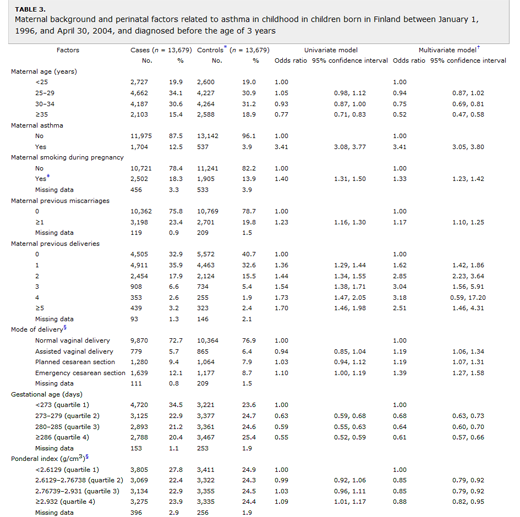
Maternal asthma was the strongest predictor of asthma in children diagnosed before the age of 3 years (odds ratio (OR) = 3.41, 95 percent confidence interval (CI): 3.08, 3.77)… In the multivariate model, maternal age, asthma, smoking during pregnancy, and previous miscarriages as well as previous deliveries, both planned and emergency cesarean sections, gestational age, and ponderal index were associated with the risk of asthma in children diagnosed before the age of 3 years.


full size table here

What is the bottom line?

  • The literature on the correlation between C-section and childhood asthma is conflicting. The correlation may be real, weak or non-existent.
  • The correlation between maternal or paternal asthma is much stronger than the correlation between mode of delivery and childhood asthma.
  • After correction for confounding variables such as parental asthma, smoking history and the presence of absence of fetal distress, the correlation between C-section and childhood asthma is greatly reduced of disappears altogether.
  • The hygeine hypothesis is only a hypothesis. It has not been confirmed in either population studies or experimental studies.
  • To the extent that gut microbiota may be implicated in childhood asthma, the use of antibiotics before and during labor would have a major impact, yet this has not even been studied.

In other words, it is premature to declare that C-sections increase the risk of childhood asthma. The only definitive statement that can be made at this point is that some studies show a correlation, others do not, and that the role of confounders has not been fully elucidated.

Everything you always wanted to know about the MANA Stats EXCEPT the death rates

MANA (the Midwives Alliance of North America) has taken hit after hit over their refusal to release their own death rates.

Last fall, stung by my piece MANA on Time.com What Ricki Lake Doesn’t Tell You About Homebirth, MANA responded:

Our dataset is currently available to researchers, and we welcome applications. There is no stipulation that data must be used for the advancement of midwifery nor is there an agreement promising not to release death rates; this statement is completely false.

It turns out that the data is available to anyone. Indeed, Melissa Cheyney herself, writing in the pages of the newsletter of NACPM (The National Association of Certified Professional Midwives, is responsible for revealing the data. So how many babies died at the hands of CPMs? Funny you should ask that question. That’s the one piece of data that’s missing.

First Cheyney explains the MANA database:

The MANA Stats project currently has over 600 active contributors … and our database contains over 27,000 records and counting… Many contributors have told us that data is power, and we certainly agree! In a political and cultural climate where both threats and opportunities for health reform exist, we see the MANA Stats project at the forefront of providing the robust, comprehensive data needed to advance the midwifery profession …

The analysis of the data from 2004-2007, comprising over 8800 midwife attended homebirths, is quite comprehensive:

Preliminary statistics emerging from the 2004-2007 dataset demonstrate the importance of a midwifery-dominated maternity system and are comparable to other published studies on homebirth outcomes. For example, the rate of low five-minute Apgar scores for all intended homebirths, regardless of actual place of delivery, is 1.37% (118/8611), and the rate of labor occurring before 37 weeks is 1.4% (123/8,758). The spontaneous vaginal vertex birth rate (all births where the mother went into labor intending to deliver at home minus all non-vertex presentations, cesarean sections, forceps and vacuum extraction) is 91.6% (n=8961), the forceps rate is 0.2% (18/8,863), and the vacuum extraction rate is 1.1% (98/8,863). The cesarean section rate for all women who went into labor intending to birth at home is 5.03% (442/8,788), and the rate of low birth weight infants(<2500 grams) is 0.93% (81/8743). In addition, we have also calculated three types of transport rates: intrapartum transports (IP), neonatal transports (NEO), and postpartum transports (PP). The IP rate is 10.6% (933/8,807), the NEO rate is 0.8% (69/8807), and the PP rate is 1.76% (155/8,807)...

Here’s a handy chart to help you keep track of it all.

But wait! There’s something missing. That’s right; it’s the death rate. MANA still refuses to tell us how many of those babies died at the hands of homebirth midwives.

Why?

It can’t be because they don’t have that information; they’ve clearly analyzed the database extensively. It can’t be because the MANA Stats are only available to researchers; they’ve publicly released just about every other facet of the data. I can think of only one reason why they refuse to release the death rate; they don’t want American women to know!

The death rate for those 8800+ midwife attended homebirths is so unacceptably high that Melissa Cheyney and MANA don’t dare tell the truth about it. Instead, they naively hope you won’t notice the omission. How could we fail to notice, though, when the absence of the death rate makes all the other statistics meaningless?

Look! The homebirth C-section rate was only 5%! How many babies died because the C-section rate was so low? Umm, we can’t tell you that.

Look! Less than 15% of women attempting homebirth transferred to the hospital! How many babies died because they or their mothers were not transferred in a timely fashion? Umm, we can’t tell you that.

Look! Less than 1% of babies born at home were transferred to the hospital! How many of those babies were dead on arrival? How many died thereafter? How many suffered permanent brain injuries? Oh, we can’t tell you that … or that … or that.

It puts the mendacious arguments advanced by Jennifer Block and Gene Declercq in an ugly light.

Block quotes Declercq “on why determining the precise risk of home birth in the United States is nearly impossible”:

“It’s all but impossible, certainly in the United States,” says Eugene Declercq … But to really nail it down here in the U.S., he says, we’d need to study tens of thousands of home births, “to be able to find a difference in those rare outcomes.” …

All but impossible to assemble a database of tens of thousands of homebirths? Really? Really??!! Both Block and Declercq almost certainly know that such a such a database ALREADY EXISTS. The MANA database contains “over 27,000 records and counting.”

Melissa Cheyney doesn’t believe that it is impossible to “nail down” the US homebirth C-section rate. She doesn’t think it is impossible to nail down the Apgars scores of babies born at US homebirths. She doesn’t think it is impossible to quantify the neonatal transport rate at only 0.8%. She’s bragging about them!

There is simply no question that MANA’s own data demonstrates unacceptably high levels of neonatal mortality at home. There is simply no question that MANA is hiding that data because they fear (correctly) that if women knew exactly how many babies die at homebirth, they wouldn’t choose it.

So let me offer a public challenge to Gene Declercq:

Now that you know a database of tens of thousands of births already exists, it will be possible for you to “nail down” the death rate at US homebirths. When can we expect you to call MANA and find out the death rate and share it with the rest of us?

Save natural birth; stop the outrageous practice of hatting!

It’s been nearly 5 years since I first pointed out the unstated guideline for homebirth midwives: whatever the scientific evidence shows, do the opposite.

… So much of homebirth advocacy is simple defiance. If obstetricians or scientists show that something works, insist that it doesn’t. If they show that something doesn’t work, insist that it does. Don’t worry about not having any evidence, and don’t worry about issuing harmful recommendations that may hurt babies and mothers. Evidently, those issues pale in comparison to the righteousness and self satisfaction that come from defying authority.

I’m not the only one to have noticed. As Ellen Annandale and Judith Clark, authors of the widely quoted paper, What is gender? Feminist theory and the sociology of human reproduction pointed out:

… the lived experience of midwifery … is revealed only as the largely unresearched antithesis of obstetrics. An alternative is called into existence in powerful and convincing terms, while at the same time its central precepts (such as ‘women controlled’, ‘natural birth’) are vaguely drawn and in practical terms carry little meaning.

In other words, for homebirth midwives, every day is opposite day.

Obstetricians point out that breech increases the risk of neonatal injury and death; homebirth midwives insist it is just “a variation of normal.” Obstetricians (and pediatricians) note that Group B sepsis, a leading killer of newborn infants, can be prevented by IV antibiotics in labor; homebirth midwives insist that putting garlic in the vagina can do the same thing. Labor and delivery nurses encourage women to hold their breath to push more effectively; homebirth midwives insist that “purple pushing” is dangerous and ineffective.

There is really no limit to the deadly defiance of these midwives. Evidently there’s no limit to the ridiculousness, either. The latest “obstetric practice” deemed unnecessary: hatting!

Yes, you read that right. Homebirth midwives have come out against the practice of putting hats on newborns to protect them from loss of body heat. Do animals put hats on their babies? No, they do not; ’nuff said. Of course, animals don’t wear clothes, don’t sleep in beds and don’t live tweet their births, but that is totally different. If you couldn’t live tweet your homebirth, how could you possibly fulfilled your narcisstic need for praise?

Back to the outrage that is hatting. The midwifery opposition may have started with the notorious Gloria Lemay. She’s the Canadian lay midwife with no formal training who has learned nothing from presiding over a number of homebirth deaths or from serving a jail sentence for contempt of court. Of course even Gloria Lemay knows that it makes no sense to tell women the truth that she opposes things merely because obstetricians do them. Therefore, she makes up her own “explanation.”

Babies were not doing well after being born to medicated women and immediate cord clamping. The baby who has started off at such a deficit will lose body heat and be in very rough shape. Helping keep in heat by a hat might be a matter of life and death in this instance where the body is so weakened.

Contrast that to a baby born spontaneously and placed on his mother’s body. . . both of them wrapped together in a warmed blanket skin to skin. The cord is intact, the placenta continues its work of transferring just the right amount of blood back and forth to the baby while he/she adjusts to life in an air environment in a leisurely fashion.

And how exactly does pain medication and cord clamping affect a baby’s core temperature? Lemay doesn’t say. She just points out what we all know: no newborns ever died before the advent of obstetrical anesthesia and early cord clamping. Oops, that’s certainly not true, but no matter. Hatting is nothing less than visible evidence that a woman has given surrendered her autonomy over her sacred birthing experience by disfiguring her baby with a knit hat.

In contrast, after a homebirth:

[The mother] chooses the clothing SHE wants her child to wear; she dresses and grooms her own baby. . . she is in charge and has been born as the mother. No one and no article of clothing has come between her and her total impressions of that baby. Through skin, mouth, nose, eyes and heart she has claimed the baby as her own and the bond is strong.

Bringing medical birth practices to a natural birth is a sign that we lost so much knowledge in the dark years when homebirth/midwifery was wiped out. Now, we can look again at these things and lay them aside as foolish for well women and their infants.

But wait! Shouldn’t the mother lick of the vernix from the baby and eat the amniotic sac? That’s what animals do. Shouldn’t she build a nesting place from leaves and bits of detritus? That’s what animals do. And why put clothes on a baby? Animals don’t clothe their young.

And animals don’t hire homebirth midwives to assist them in labor, so shouldn’t Lemay be counseling women that her services are unnecessary?

Whoa. Let’s not get carried away here. Birth should be completely natural right up to the moment that the money changes hands. After all, is there anything more natural than a con artist who tricks the gullible into handing over their hard earned cash?

This piece is NOT a satire.

Denial: for homebirth advocates it’s not just a river in Egypt

#1 Sterling:

It felt like an eternity, but finally I was crowning… The head eventually was completely out, and there was a shift in everyone’s tone… They frantically moved me from position to position trying to get the baby free. The cord was wrapped around the neck, and his shoulders were stuck. They moved me to my back once more and Lisa got a good grip and pulled the baby from within me. I felt the baby slide out and I saw him lying there on the floor. it was 11 am May 28. He was blue. He was so beautiful. He was a boy…He was not breathing…

I won’t go into the details of our time in the hospital … But I’ll give a quick overview… Sterling was on the ECMO for 1 week, which essentially is a mechanical lung and heart. The doctors and nurses pumped oxygenated blood from the machine, into our baby’s heart through a tube in his jugular vein. The blood circulated through his body and back out into the machine. This allowed his lungs to heal from the infection. his heart had a chamber that collapsed and this treatment allowed his to recover from that. He was in a drug induced stupor for most of his stay. They kept him on a ventilator for a week, then switched it to a less traumatic ventilator. Then eventually to an oxygen tube. He was in the NICU for 1 and a half weeks, and in a recovery room for 5 days.. A total of 3 1/2 weeks in the hospital. He made tremendous leaps there in terms of healing and was a completely normal healthy baby boy when we brought him home. No brain damage no nothing. Except for a few small scars 🙂

Was it because of homebirth? No, that was just an incredible coincidence!

… [T]ake note that the trauma we experienced had nothing to do with our son being born at home. We still support home birth!

#2 Tina’s son:

… I wasn’t ready for homebirth with our daughter, which, unfortunately turned into an experience that was everything I didn’t want (many factors as to why this happened)…so for our next birth, we did all the research and preparation to have the kind of birth we wanted, at home. Sadly, this birth ended with our son being born dead. No amount of resuscitation worked…by the midwives or the paramedics that arrived within a few short minutes (and quickly whisked him away to the hospital)… nothing worked. He just couldn’t be resuscitated.

Was it because of homebirth? No, that was just an incredible coincidence!

I do not blame this on being home…we don’t know why he died. And regardless, death can happen at birth no matter where the baby is born. We were one of the unlucky to have this happen to us, at home. It could have also happened had we been at the hospital…we just don’t know what happened…Anyway I am still a strong supporter of homebirth and I know many many people who’ve had happy homebirth stories. Ours was our midwife’s first tragedy. In over 30yrs of hundreds and hundreds of homebirths, she’s only had this one death. Unfortunately it was us. But I don’t want anyone to be scared by our story…because every other story I know had a happy outcome…and I know A LOT of stories!

#3 Charlie’s story (webcache)

This page is for my daughter, Charlie. She suffered an HIE event in utero which damaged her brain significantly. She has cerebral palsy, seizures, a feeding tube, and many other medical issues…

And:

… YOU were not there, so you cannot comment on what “really” happened. You don’t know! I’ve not lied, or exaggerated the details of her birth. She really was born with a heart rate of 130-140. My midwife really did use the doppler quite frequently in the last stages of the birth. We have the whole thing ON TAPE. We are not deluded into thinking that all was well when it really wasn’t. Charlie TRULY did not give us any signs of distress.

Was it because of homebirth? No, that was just an incredible coincidence!

Shit happens. Shit happens EVERYWHERE. Shit happened to my friend who is a doctor in the hospital she gave birth in…

Bottom line, if a woman loses a baby at home, she is no more at fault than the woman who loses a baby at the hospital.

Three homebirth disasters: a severely injured baby, a permanently brain injured baby and a dead baby. But, really, it had nothing to do with homebirth. It had nothing to do with the fact that each of these babies needed an expert neonatal resuscitation with intubation and homebirth midwives don’t know how to intubate. Absolutely not!! And babies die in the hospital, too!

It’s it all just an amazing coincidence.

Navelgazing Midwife takes on Jennifer Block

Barbara Herrera (Navelgazing Midwife) has some advice for homebirth advocates. Apparently she is disgusted with Jennifer Block’s attempt to divert attention from the facts in Michelle Goldberg’s piece, Home Birth: Increasingly Popular But Dangerous.

She notes that difference between Goldberg’s original piece and Block’s obsession with me:

Out of 39 paragraphs, Dr. Amy Tuteur (the Skeptical OB) is quoted in four and mentioned in a fifth, yet the afterquakes have, almost exclusively, have centered around including Tuteur as a source for Goldberg’s article.

In fact, in The Slate, Jennifer Block’s piece entitled, “How to Scare Women: Did a Daily Beast story on the dangers of home birth rely too heavily on the views of one activist?” contains 16 paragraphs and Tuteur is highlighted in ten of those, not including the obvious reference to her in the title…

So, why am I up at 2am counting paragraphs in tit-for-tat articles? First, because I cannot believe the energy spent on Dr. Amy… so many people arguing for or against her as a source. It’d be amusing if it weren’t such a serious topic. It’s really important for people to know that Dr. Amy isn’t going anywhere and that she will continue to be used as a source protesting Certified Professional Midwives and much of home birth. I know women who begin reading an article or post and if Tuteur is mentioned, abruptly end their reading session. Dr. Amy has been a source in over a dozen articles, from the Los Angeles Times, the New York Times and Time.com; it’s unlikely she’s going anywhere.

As NGM points out, whining about me is not simply a losing battle; it is a losing strategy in any effort to defend the poor safety record of homebirth midwives:

As much as Dr. Amy Tuteur makes some people crazy, she has proven she is not a force to ignore. While I have issues with her delivery and am unsure about all she professes as fact, the woman has things to say that need to be heard and she’s going to be heard, whether we like it or not. Instead of trying to make her go away, how about we find people who can argue with/speak out against what she says in the same articles. And for crying in a bucket, debating statistics is not the way to do it! If you haven’t figured it out yet, the stats’ results are in the eye of the beholder, so finding alternative discussions is crucial. One of my favorite topics is why women want an out-of-hospital birth in the first place. And then it needs to move quickly to choosing safe home birth midwives. I believe until we have clear, fantastic midwifery education and a way for them/us to learn the advanced skills necessary for out-of-hospital births, we’re fighting a losing battle. Dr. Amy has the information about CPMs down to a sound bite; we better have an answer about them/us when asked.

I have an even better idea:

Instead of attempting to counter my recitation of the abysmal homebirth death rates, how about actually addressing the issue.

As one of the commentors on NGM’s piece notes:

I am profoundly uncomfortable with all the Amy-bashing that goes on. Granted, the woman is strident, vocal, and opinionated, but what the heck?, since when are we all supposed to be shrinking violets? I suspect that she makes people profoundly uncomfortable because she zeroes in on all the stress points in midwifery care like a homing missile. Uneven/inadequate training? Check! Lack of accountability? Check! Absence of informed consent, good backup, timely transport? Check, check, check! She pushes people to address issues they’d rather gloss over. And THAT in my opinion is why she is so reviled.

Jennifer Block has made a fool of herself attempting to divert attention from the appallingly high death rates at the hands of homebirth midwives. Her grade school tactics of attacking the messenger instead of a addressing the message merely aids me in my on going attempt to abolish the CPM (certified professional midwife) credential. CPMs are grossly undereducated, grossly undertrained hobbyists who have appalling rates of neonatal death, and to the extent that they address those unacceptable death rates, it is only to find new (and particularly ineffective) ways to hide them.

Jennifer Block, whack-a-mole journalist

78D2AC4D-06E9-4886-93E7-2943AC186810

Jennifer Block is the “whack-a-mole” of childbirth journalism. She periodically pops up in mainstream publications to defend homebirth with a stream of mistruths, half truths, and outright lies. Then, when it is pointed out that she has been deliberately misleading, and sometimes altogether dishonest, she disappears, only to pop up several months later to issue the same falsehoods and disappear again.

For example, in her unprofessional attempt to divert everyone’s attention from the statistics that Michelle Goldberg published in her piece in The Daily Beast, Block doesn’t bother to rebut the data, indulges in ad hominems (most of which are lies, but that’s another story) and quotes two professionals without mentioning that both are prominent in the American homebirth movement (Doesn’t Slate employ editors and fact checkers? Apparently not for this piece.)

Melissa Cheyney is described as an anthropology professor without disclosing that is the Director of Research for the Midwives Alliance of North America (the leading organization of American homebirth midwives); and Gene Declercq whom Block describes as “an epidemiologist,” but whose bio states:

Gene Declercq combines formal training in political science with almost twenty years of experience as a certified childbirth educator to examine policy and practice related to childbirth in the US and abroad… He was a technical advisor to the film documentary, The Business of Being Born…

Now that Michelle Golberg has exposed Block’s “bad faith approach” in a follow up article in The Daily Beast, and I have challenged Block to a public debate, she has made herself scarce. It’s hardly the first time. So once again I challenge her to a public debate, and maybe this time she’ll have the intellectual integrity to participate.

The following is the challenge that I issued to Block in August 2009:

Homebirth advocate Jennifer Block must be grateful to RH Reality Check for getting her off the hook. They deleted the data that I posted so she did not have to address it. Block has decided to respond publicly, this time on Babble.com Who’s winning the homebirth debate?

Well, she didn’t actually respond. How could she? The data is quite clear on the point that homebirth increases the risk of neonatal death. So she did what homebirth advocates love to do, she tried to think up reasons why no one should bother to address the scientific facts:

…So omnipresent has Dr. Amy been on the boards that she began to take on a mythical status among the home birth community. Some activists believed she wasn’t real, that her picture and bio were fake, that she was a mere avatar for some sort of underground ACOG propaganda machine …

But “Dr. Amy” is real. I sat with her, face to face, for nearly three hours at a Starbucks off Route 1 south of Boston a couple years ago. She is not a researcher, not an epidemiologist, and probably not on anyone’s payroll; she is an obstetrician-gynecologist who left private practice more than a decade ago because, she told me, she’d had it with HMOs and wanted to spend more time with her four kids (she let her license lapse in 2003, according to the Massachusetts Board of Medicine). And for some reason, which I never quite got to the bottom of, she believes in every cell that Home Birth Kills Babies (that’s in fact the title of her most recent post on her new site, The Skeptical OB), and no amount of research evidence will convince her otherwise.

Interestingly, Ms. Block, in yet another 3 page screed, doesn’t bother to present any actual evidence. That’s not surprising. There is none.

Here’s my response:

Dear Ms. Block,

Let’s make it very easy for women to compare and contrast the claims:

I challenge you to a public debate on the safety of homebirth in any neutral forum of your choosing, whether print, other media or a public appearance.

We can address these specific points:

1. All the existing scientific evidence (including the Johnson and Daviss BMJ 2005 study) shows that homebirth with a direct entry midwife has nearly triple the rate of neonatal death for comparable risk women in the hospital.

2. American direct entry midwives do not meet the standards for licensing in ANY first world country. They do not meet the standards in the Netherlands, the UK, Canada, Australia, anywhere.

3. The Midwives Alliance of North America, the group that collected the statistics for the BMJ 2205 study) has continue to collect safety statistic from 2001-2008. They are currently hiding those statistics from the public. They should be required to release those statistics so women can decide for themselves if CPMs are safe practitioners.

4. According to the World Health Organization, the US has one of the lowest levels of perinatal mortality in the world, lower than Denmark, the UK and the Netherlands.

I welcome publicly debating you or any other homebirth advocate in any neutral setting. I’m not holding my breath though; neither you nor any other homebirth advocate will agree to a public debate because you know my data is correct and my case is airtight. No one in the world of homebirth advocacy can risk the embarrassment.

How about it, Ms. Block? If you are so sure about what the scientific evidence shows, you should welcome an opportunity to discuss it point by point. Perhaps the folks at Babble.com Slate might be interested in hosting the debate.

After all, don’t women deserve the opportunity to analyze both your claims and my claims and reach their own conclusion about what the scientific evidence shows?

P.S. I’m not holding my breath. If past is prologue, Block wouldn’t dare participate in a public debate. It’s time once again for the mole of childbirth journalism to disappear before she gets whacked.

Addendum: Jennifer Block has proved my point for me.

Instead of responding to Michelle Goldberg’s evisceration of her “bad faith approach” and instead of agreeing to a public debate with me of the scientific data and state, national and international statistics, she has popped up on her own blog … and disabled the comments so she can’t even be questioned or corrected!

Jennifer Block knows she cannot defend her mistruths, half truths and outright lies in any forum where she could be questioned. So like the mole in whack a mole, she drops out of sight and pops up again in a place where no one can challenge her. It’s a tacit admission that she cannot defend her claims.

Dr. Amy