Coroner: Homebirth advocates need more and better education

The Australian coroner’s 106 page report on the inquest into the multiple deaths at the hands of homebirth midwife Lisa Barrett goes beyond rendering findings in the deaths of the specific infants to offering comprehensive recommendations to improve the safety of homebirth. Those recommendations are based in large part on the coroner’s concern over the lack of education of homebirth advocates and homebirth midwives. In particular, he recommends dissemination of accurate information:

a) The risks associated with certain types of birth, including but not limited to, twin births and breech births;
b) How those risks might be affected by a choice to undergo such deliveries within the individual’s home;
c) To dispel the notion that adverse outcomes in homebirthing cases would inevitably have occurred in a hospital setting in any event;

In other words, in confirmation of what I have written many, many times before, most of what homebirth advocates (and some homebirth midwives) think they know is factually false.

The coroner offered a variety of examples of Lisa Barrett holding views that are not supported by scientific evidence, including:

  • idiosyncratic views as to risk.
  • the seemingly unshakeable dogma that an adverse outcome in the homebirth setting would inevitably have occurred in a hospital setting in any event and that the professional services that are available within a hospital would not have altered the outcome.
  • Ms Barrett’s tendency to contradict or deny established evidence-based opinion.
  • Ms Barrett’s general position [on macrosomia] is at odds with the written material that Ms Barrett herself produced in evidence.
  • Much of Ms Barrett’s evidence about the desirability or otherwise of a vaginal delivery of a breech birth in the home setting was premised on a number of questionable views that she steadfastly appears to hold.
  • Neither this article [the PREMODA breech study cited by Barrett] nor any other literature that has been tendered suggests that planned vaginal delivery for a singleton foetus in the breech presentation at term ought appropriately be undertaken in the home. On the contrary, the conclusion reached in the article to which I have referred suggests that in vaginal deliveries, rigorous compliance with conditions before enduring labour is a prerequisite.
  • Ms Hughes asserts that Ms Barrett told her that breech was ‘just a variation of normal.’
  • Ms Barrett holds the view that ‘there’s just as much risk surrounding an elective caesarean for a breech as there is surrounding a vaginal birth for a breech’.
  • Ms Barrett went so far as to say that it would be impossible to tell whether a planned caesarean section would have resulted in the child being born alive. She goes so far as to suggest that the risks associated with caesarean section are higher than the risks of vaginal birth and that the risk associated with caesarean section and the morbidity and mortality of breech is the same in vaginal birth and caesarean section … This opinion is simply manifestly incorrect. It causes me to doubt the genuineness of other assertions made by Ms Barrett …

As a result, the coroner reached the following conclusion:

The evidence in this Inquest has demonstrated that there is a need for education of the general public in respect of the risks associated with certain types of childbirth within the home and in order to dispel what appear to be widely held myths concerning the circumstances in which these births are managed in hospital.

The bottom line is that homebirth midwives like Lisa Barrett misrepresent and minimize the risk of homebirth, misrepresent and minimize the additional risk of conditions such as macrosomia, breech, VBAC and twins. Moreover, they disseminate myths about hospital conditions and policies.

The coroner reached the same conclusions I reached long ago: homebirth advocates are not “educated” about homebirth. Rather they are ignorant of the real risks and instead are indoctrinated with falsehoods and myths, none of which have any basis in science.

Coroner: Homebirth deaths at Lisa Barrett’s hands were entirely preventable

The coroner has just released a 106 page report on his investigation into four separate homebirth deaths presided over by Lisa Barrett. Though the language is measured, the conclusion is scathing. Each of the four deaths investigated by the coroner:

… involved planned homebirths each of which in differing ways are said to have involved an enhanced degree of risk to the unborn infant, being risks that were identified well before the deliveries took place and risks that ought to have been manageable in a more appropriate clinical setting. In other words, it is said that these deaths could and should have been prevented.

The coroner did not believe Lisa Barrett’s contention since giving up her midwifery registration she has been working as a “birth advocate,” not a midwife:

To my mind, Ms Barrett’s evidence that she was a mere birth advocate, not performing the duties and responsibilities of a midwife, has to be rejected.

Moreover, the coroner rejected many of the oft made claims of homebirth advocates. He considered and dismissed the claim that strict regulation of midwives would result in more unassisted homebirths.

I am aware of the contention that the strict regulation of privately practising midwives in the homebirth environment might have the effect of driving those women who are intent on undergoing a homebirth underground as it were, thereby leaving them without professional assistance or support. I have given careful consideration to this issue. It is difficult to gauge the legitimacy of such a contention when regard is had to the fact that the contention is mostly supported by evidence that is anecdotal in nature and, secondly, when it is possible that one of the reasons that women are prepared to undergo homebirths that are attended by enhanced risk, such as the homebirth of twins, is the availability of unregistered privately practising midwives who are not regulated …

He also categorically rejected the classic homebirth claim that the babies would not have survived a hospital birth:

… I refer to the commonly held misconception that appears to be promoted by those who advocate homebirthing in risky circumstances, that adverse outcomes that occur in a homebirth would inevitably have occurred in a hospital. There is also the misconception that twin births in hospital will inevitably involve the second twin, to borrow the expression of Dr Hannah Dahlen, being ‘whipped out within about 3 minutes’. There are other misconceptions that these Inquests have identified.

In fact, he thinks that homebirth advocates, far from being “educated” about the risks of homebirth, believe myths promulgated by other homebirth advocates:

The evidence in this Inquest has demonstrated that there is a need for education of the general public in respect of the risks associated with certain types of childbirth within the home and in order to dispel what appear to be widely held myths concerning the circumstances in which these births are managed in hospital.

In light of the findings in these 4 preventable neonatal deaths, the coroner recommends

1. Prohibiting the practice of midwifery by an unregistered midwife such as Lisa Barrett.

2.Reporting anyone planning a high risk homebirth.

3.Mandating a consultation by an obstetrician before any high risk homebirth.

4. And more education of women contemplating homebirth:

That education in the form of written advice distributed generally to the public be provided in respect of the following matters concerning homebirths:
a) The risks associated with certain types of birth, including but not limited to, twin births and breech births;
b) How those risks might be affected by a choice to undergo such deliveries within the individual’s home;
c) To dispel the notion that adverse outcomes in homebirthing cases would inevitably have occurred in a hospital setting in any event;
d) To dispel the notion that the second born of twins would inevitably be the subject of immediate intervention following the delivery of the first twin;
e) As to the need and desirability of epidural pain relief and whether such is mandatory or not in certain birthing environments within a hospital;

Ironically, Lisa Barrett has done more to strengthen regulation of homebirth than homebirth opponents ever could have managed; she has convincingly demonstrated the dangers of homebirth, the irresponsibility of many homebirth midwives, and their preference for myth over scientific evidence. Perhaps some good may come of her gross malpractice that resulted in the entirely preventable deaths of 4 babies.

addendum: Australian TV report highlights the main findings of the coroner’s report.

Homebirth advocates and hypocrisy

Homebirth advocates, are you warrior mamas or are you wimps? Or are you just hypocrites?

I’d like to know how you explain the following:

You claim that women who have epidurals are “giving in to the pain” yet you can’t possibly endure an IV in your hand during labor.

You claim that pushing for 5 hours is perfectly reasonable, but you can’t bear it if you have a vaginal exam during labor.

You insist that women who really care about their babies should breastfeed to prevent minor illnesses, but think it’s okay to increase your baby’s risk of death by 600% in order to give birth at home.

You can’t believe that women would give up breastfeeding for anything as “selfish” as wanting her own body back, but insist that no one should interfere with your ability to control your own body by delivering at home with an unqualified attendant.

You boast that you can fiercely endure the pain of labor, yet you cannot stand it if anyone asks you if you’d like an epidural.

I hope you can explain these inconsistencies to me, as well as answer the following questions:

Who are you to condemn women for formula feeding, which has a neonatal mortality rate of zero, while at the same time willingly undertaking homebirth, which has a mortality rate 600% higher than comparable risk hospital birth?

Who are you to deem women who want pain relief selfish when you can’t even endure an IV?

Why do you act as if a woman’s right to control her own body ends at the waist, and that she has no right to control her own breasts?

How do you justify such incredible inconsistency?

No doubt my readers can frame many similar examples and questions, but you can start by answering and explaining these. I can’t wait to find how you justify your hypocrisy.

Why do breastfeeding researchers ignore the obvious?

It’s time once again for a periodic festival of official hand-wringing over breastfeeding rates. Researchers are shocked, shocked that women quit breastfeeding at very high rates. And they are shocked, shocked that all their efforts to date to encourage breastfeeding have been essentially useless.

For me, the only thing that is surprisingly is that breastfeeding researchers are so incredibly clueless about why women stop breastfeeding. Or perhaps they are not clueless, they simply refuse to accept the obvious:

The dirty little secret about breastfeeding is that starting is hard, painful, frustrating and inconvenient. And continuing breastfeeding is hard, sometimes painful, and incredibly inconvenient especially for women who work, which in 2012 is most women.

The paper that has precipitated the latest round of hand-wringing is Baby-Friendly Hospital Practices and Meeting Exclusive Breastfeeding Intention by Perrine et al., posted this morning on the website of the journal Pediatrics. According to the study:

Among women who prenatally intended to exclusively breastfeed (n = 1457), more than 85% intended to do so for 3 months or more; however, only 32.4% of mothers achieved their intended exclusive breastfeeding duration. Mothers who were married and multiparous were more likely to achieve their exclusive breastfeeding intention, whereas mothers who were obese, smoked, or had longer intended exclusive breastfeeding duration were less likely to meet their intention. Beginning breastfeeding within 1 hour of birth and not being given supplemental feedings or pacifiers were associated with achieving exclusive breastfeeding intention. After adjustment for all other hospital practices, only not receiving supplemental feedings remained significant (adjusted odds ratio = 2.3, 95% confidence interval = 1.8, 3.1).

That is absolutely, positively, 100% consistent with the fact that breastfeeding is a lot harder in practice than advocates make it sound. Indeed, it is no different that what we would find if we surveyed a group embarking on an effort to run 5 miles a day for 3 months or more. People don’t live up to their intentions because they find it too hard to do so.

But as I said above, no one wants to talk about the difficulties of breastfeeding. Indeed, most advocates, like the authors, don’t even want to mention the truth. Instead they seek convoluted explanations that are not even justified by the evidence. The authors insist, with absolutely no empirical evidence, that women quit because hospitals are not supportive enough.

The authors’ interpretation rest on several critical unexamined assumptions.

1. The authors assume that women who claim they will breastfeed exclusively actually intend to do so.

In 2012, there is so much pressure to breastfeed that it is socially unacceptable to tell researchers that you don’t plan to do so. It never occurs to the authors that patients tell them what they think the researchers want to hear rather than telling them the truth.

This is a well known phenomenon among those who take surveys. According to market research firm Synovate in regard to survey questions:

Safe issues are those that elicit an honest response from most respondents most of the time. Surveys about daily activities such as television viewing and shopping can be considered safe…

Careful issues are topics that moderately elicit an honest response. For example, when it comes to personal finances (except for discussions about charitable contributions) an equal number of people would provide honest answers as not.

In surveys about the consumption of stimulants, alcohol and illegal drugs, the honesty of answers depends on the social acceptability of the substance under discussion. So 58% of Americans would be honest about cigarettes, 37% about alcohol and just 14% about illegal drugs…

N0-go issues are the unmentionables of survey topics.

Synovate learned that at least 60% of all our respondents would lie about sexual relationships, especially when it comes to taboo subjects like marital infidelity and sexual dysfunction.

2. The authors assume that women can make accurate predictions.

It is easy to claim that you are going to breastfeed for a specific duration when you have absolutely no idea what breastfeeding entails. When reality intrudes, mothers change their minds.

3. The authors make the elementary mistake of assuming that correlation equals causation. Just because more babies who received supplemental formula in the hospital were not ultimately exclusively breastfed does not mean that the formula itself contributed in any way to the duration of exclusive breastfeeding.

4. The authors assume that the supplemental feedings a baby received was due to hospital policy, not maternal request. It is highly unlikely that a baby will receive supplemental feedings if the mother insists she does not want them. Therefore, whether or not the baby received supplemental formula has much more to do with the mother’s beliefs than the hospital’s beliefs.

5. The authors assume that patients randomly are assigned to hospitals and that they have no role in choosing which hospital they attend. While that may be the case for some women, those who are particularly motivated about breastfeeding may be more likely to choose baby-friendly hospitals.

6. The authors assume that breastfeeding is easy and problem free. It seems never to have occurred to the authors that women gave up breastfeeding because it was painful, difficult or inconvenient. Amazingly, the authors never bother ask women why they stopped breastfeeding. It is an inexcusable omission.

The authors conclude:

Two-thirds of mothers who intend to exclusively breastfeed are not meeting their intended duration. Increased Baby-Friendly hospital practices, particularly giving only breast milk in the hospital, may help more mothers achieve their exclusive breastfeeding intentions.

The 6 unwarranted assumptions render the authors’ conclusions essentially worthless. Indeed, it is ludicrous that the authors thought they could determine why women stop breastfeeding without even bothering to ask them why they stopped breastfeeding.

Women stop breastfeeding because for many it is painful, difficult and inconvenient. Breastfeeding advocates may not like that answer, but that’s reality. I’ve written about this extensively in the past:

I don’t really understand why breastfeeding activists refuse to acknowledge the reality of breastfeeding. They prefer to sugarcoat it with little maxims like “breast milk is always available,” breast milk is always the perfect temperature,” and “breast feeding saves money.” Those statements are true, but they ignore the very real challenges in initiating and maintaining breastfeeding….

Breastfeeding is a learned behavior. It is not instinctual on the part of the mother and although a baby has the instinct to suckle, latching on properly and actually getting milk requires practice. A new mother and a new baby may get frustrated very quickly when things do not proceed smoothly.

New mothers are often emotionally labile, due to the effect of hormones. A baby screaming desperately in hunger (and all babies begin to screaming desperately within seconds of realizing they are hungry) can upset even an experienced mother. It’s much worse for a new and inexperienced mother who can easily become frantic to satisfy the baby, fearing that the baby is starving…

Initiating breastfeeding is often painful. Cracked and bleeding nipples are every bit as unpleasant as they sound. Countless new mothers tell stories of bursting into tears whenever the baby starts to cry, in anticipation of the pain of nursing…

Maintaining breastfeeding while working is incredibly difficult. During the typical work day, a woman may need to pump twice or more, each session taking 20-30 minutes and requiring a clean and private place to pump, a breast pump, and a refrigerator to store the milk. Professional women may be able to assemble these resources, but the average working woman has neither the facilities, nor the time to pump at work.

The bottom line is that as long as breastfeeding advocates and researchers ignore the reality of breastfeeding, they are wasting everyone’s time and money trying to blame low breastfeeding rates on everything but breastfeeding itself.

Brilliant series on the dangers of homebirth


Click here to watch video.

Finally!!

Finally, a mainstream journalist has tackled the issue of homebirth and found multiple stores of neonatal death and injury.

Louise Knott Ahern has written a brilliant series of articles about The Greenhouse Birth Center, a center that has had an appalling neonatal death rate of 7/1000 during its years of operation. Keep in mind that the CDC reports that the neonatal death rate for low risk white women at term who deliver in a hospital is 0.4/1000. That means that the neonatal death rate at The Greenhouse Birth Center is more than 1300% higher than expected! Were any patients advised of that death rate? Of course not!

How, exactly, can women make an informed decision about the Greenhouse Birth Center if they don’t have this most important piece of information. They can’t, obviously, and that’s just how homebirth midwives and supporters like it.

Homebirth midwives have been engaged in a systematic attempt bury the stories of the appalling rate of neonatal deaths at homebirth. The Board of Direct Entry Midwifery refuses to release the death rate of homebirth in Oregon. The homebirth midwives of Colorado have stopped reporting the number of deaths at homebirth as required by state law after a four year stretch of very high and RISING rates of neonatal death. The homebirth midwives of North Carolina had no less than 5 neonatal deaths in 2011 (as reported in the media) and possibly more that were not reported.

And, of course, the Midwives Alliance of North America (MANA), the group that represents homebirth midwives, REFUSES to release the death rate of the 24,000 planned homebirths in their database because the number is appallingly high.

Homebirth kills babies. Even homebirth midwives know it, but they are doing everything in their power to make sure that American women do not find out.

Bravo to Ms. Ahern for pulling back the curtain on this terrible secret.

Homebirth midwives (Certified Professional Midwives or CPMs) are unfit to practice. They lack the education and training required of ALL other midwives in the first world. They are not eligible for licensure in the UK, the Netherlands, Australia and other countries that publicly support and promote homebirth. In fact, they aren’t even required to have a high school diploma!

CPMs have embarked on an effort to obtain licensing (so they can obtain insurance reimbursement) in all 50 states. Not only shouldn’t they receive state licenses, but the CPM credential should be abolished. It is a pretend “credential” made up by uneducated women to award to themselves in an effort to fool unsuspecting consumers. Canada abolished the CPM several years ago. It is time for the US to do the same.

Kudos to Sara and Jarad Snyder whose brave decision to sue The Greenhouse Birth Center in the wake of the preventable death of their son Magnus was the spur for this expose. Nothing can lessen the tragedy that Magnus’ death represents, but the Snyders’ efforts to uncover the truth and share it with others in order to prevent further tragedies is a loving memorial.

Beware “Big Floss”

We survived almost all of human history without it. Yet in the last 100 years people have allowed themselves to be hoodwinked by a huge corporate conspiracy into believing that we “need” their products. They cite studies and claim we don’t understand science; they ignore ancient folk wisdom and have no respect for our intuition. They peddle their products without regard to the dramatic increase in chronic diseases and weakened immune systems of recent decades. I’m speaking, of course, of “Big Floss.”

It’s time to take our mouths back from corporate domination. It’s time for alternative dentistry.

To hear the corporate “tools” of Big Floss tell it, we need to use their products not simply every day, but many times a day. They’ve created a seemingly limitless array of products that they are forcing, literally, down our throats. Toothbrushes, toothpaste, floss, mouth wash! There appears to be no end to the number and type of products they insist we must buy to fuel their corporate ambitions. And even if we behave like sheep and buy their tainted wares, their allies the dentists insists that we must visit them not merely once a year, but twice.

We’re supposed to believe that we benefit from this meddling with the natural order. Really? So please explain how the human race survived just fine to this point without Big Floss. Clearly we didn’t need toothbrushes to survive and even thrive. So why, suddenly, should we be gullible enough to believe that every person should brush his or her teeth after every meal? Has there been even a single randomized controlled double blind study that proved that brushing saves teeth? No, there hasn’t.

Big Floss insists that it has a product for every person, often more than one. Toothpaste to prevent cavities, toothpaste for kids, toothpaste for dentures. Is there any limit to what they will sell in order to increase their profits? And are we really supposed to believe that four out of five dentists recommend Crest? Where’s the data for that claim?

They tricked people into brushing ever day and using toothpaste each time, but that’s not enough for Big Floss. They say that toothpaste prevents plaque buildup and then they turn around and insist that we need mouthwash, too, to kill the harmful germs that cause plaque. Do we look that gullible? And what’s wrong with plaque anyway? It’s natural and probably exists to strengthen our immune system, which has been weakened by constant exposure to toxins and Frankenfood.

Big Floss is not content with tricking us into buying toothbrushes, toothpaste, floss and mouthwash. They insist that we see a dentist twice a year. If their products are so great, why would we ever need to see a dentist? We wouldn’t, but the unholy alliance of Big Floss and Dentistry has colluded to increase the profits of both. Don’t believe me? The dentist always tells you that you should brush every day, and Big Floss always recommends dental checkups. What more evidence do you need?

It’s time to end our reliance on Big Floss. It’s time for alternative dentistry. Those who truly educate themselves about teeth in nature know that toothbrushes and toothpaste are unnecessary. If our ancestors didn’t need them, we don’t need them, either. We can care for our teeth with a diet of fruit, vegetables and vitamin supplements.

In the rare situation in which more is needed, we can dose ourselves with ancient herbs or pull out rotten teeth the natural way, by tying a string around the both the tooth and the doorknob and giving the door a big shove. Forget novocaine. Why would we dose ourselves with medication to numb the pain of a tooth extraction? Those who really care about their teeth want to savor every natural feeling, not deaden it with chemicals.

And let’s not forget preventive care. If you want to be sure that you have healthy teeth, all you need to do is buy powdered Bio-identical Teeth®. Unlike artificial toothpastes or mouthwashes, powdered Bio-identical Teeth® is all natural, made from human teeth with no fillers or animal products. Because it is “bio-identical” it is more effective than artificial toothpaste could even be.

It’s time to unite and fight the corporate conspiracy of Big Floss. No more toothbrushes, no more toothpaste, and no more visits to the dentist. Let’s live as Nature intended with no artificial colors or preservatives. Let’s care for our teeth naturally for as long as they last.

Brought to you as a public service by the American Pureed Food Industry

This piece first appeared in October 2009.

When minutes matter …

Feel free to use this badge. Copy the code below to wherever you’d like to place it. You can change the dimensions to any size up to width=”422″ height=”284″.

The badge links to The Skeptical OB.


Thanks to Mrs. W for suggesting the phrase “When Minutes Matter, it Matters Where You Give Birth.”

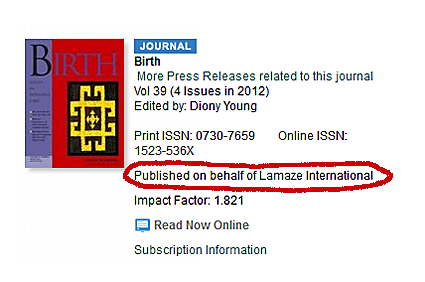
Birth: Issues in Perinatal Care, an industry sponsored journal

How would you feel if a widely quoted journal on environmental issues turned out to be sponsored by the Shell Oil? What would you think about a journal on contraception published by the Catholic Church? Would you believe anything in a journal on the public health impact of gun violence published by Smith and Wesson?

I’m going to go out on a limb and guess that you would immediately discount anything in those journals as biased toward whatever improves the bottom line of the business that finances the publication.

That’s why it is important for everyone to know that Birth: Issues in Perinatal Care is also financed by industry. The specific company that sponsors the journal is Lamaze International and the industry is the large, multi-faceted, multi-billion dollar “natural childbirth” industry.

Who is Lamaze International?

Lamaze International, formerly ASPO/Lamaze, is a nonprofit organization whose mission is to promote, support and protect normal birth through education and advocacy…

The description continues:

Since 1960, Lamaze International has provided the most comprehensive and respected education program for Lamaze teachers available. Lamaze’s membership is comprised of 4,000 childbirth educators, health care providers, and parents. More than 10,000 professionals have earned the LCCE credential, and a significant portion of childbirth education classes are taught by Lamaze Certified Childbirth Educators. Among its many services, Lamaze operates the Lamaze Media Center, which offers a wide selection of books, videotapes, audiotapes, and specialty products related to pregnancy, labor, birth, breastfeeding, and early parenting. Lamaze has also established the Lamaze Approved Provider Program, whereby hospitals, birth centers, group practices and other institutional providers are recognized for meeting Lamaze standards and offering excellence in childbirth education.

I don’t know about you, but what strikes me is that there is nothing in this description about health, safety or scientific evidence. That’s hardly surprising since so called “natural” childbirth has nothing to do with health, safety or scientific evidence. Lamaze International is a business devoted to promoting a specific view of childbirth. It is the Amway of childbirth, selling a seemingly endless variety of products and promoting the purported need for those products by training hordes of marketers masquerading as “educators.”

Don’t get me wrong. Lamaze International is perfectly entitled to promote its products, just like the oil and tobacco industry are entitled to support their products. But the rest of us are not only entitled to discount their publications as biased and self-serving, we would be extremely foolish to do otherwise. Similarly, we are not only entitled to ignore Lamaze International publications as biased and self-serving, we would be extremely foolish to do anything else.

That is why it incredibly disturbing that a publication that purports to be a scientific journal is sponsored by industry, in order to create an aura of scientific legitimacy around industry policies, and without regard to what the scientific evidence really shows.

I don’t expect the folks at Lamaze International to be even remotely concerned about the deception involved in an industry sponsoring it’s own “scientific” journal, just as I don’t expect the tobacco industry, the oil industry, or the gun industry to feel bad about deceiving the public through industry produced propaganda.

However, I do expect journalists and others to be very wary of “papers” produced by those journals, and I do wish that the sponsorship of such journals would be displayed more prominently on the journal itself as well as accompanying every citation of a paper published in such a journal.

“Social” inductions improve outcomes

If there is one thing that natural childbirth advocates are absolutely, positively, 100% certain about, it is that “physiological” childbirth is always best. That’s why they are absolutely, positively, 100% certain that induction of labor for “no better” reason than that the mother wants to be induced is harmful.

Therefore, as the evidence mounts that induction of labor is safer than expectant management, there is no one more unwilling to accept that evidence than natural childbirth advocates. That explains why Henci Goer is looking for any possible reason (even a perverse reason) to ignore the findings from a new paper.

The latest scientific paper on the topic was published just last week in the British Medical Journal. Outcomes of elective induction of labour compared with expectant management: population based study by Stock et al. found:

At each gestation between 37 and 41 completed weeks, elective induction of labour was associated with a decreased odds of perinatal mortality compared with expectant management … in the induction of labour group versus 0.18% … adjusted odds ratio 0.39, .., without a reduction in the odds of spontaneous vertex delivery … adjusted odds ratio 1.26 … Admission to a neonatal unit was, however, increased in association with elective induction of labour at all gestations before 41 weeks … adjusted odds ratio 1.14 … (my emphasis)

This echos the findings of Neonatal Outcomes After Implementation of Guidelines Limiting Elective Delivery Before 39 Weeks of Gestation by Ehrenthal et al published in the journal Obstetrics and Gynecology last fall.

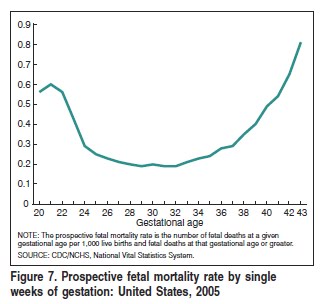
This finding is not unexpected. CDC data shows that the stillbirth rate rises from approximately 3 per 10,000 at 37 weeks to 4.5 per 10,000 at 39 weeks (see graph below).

Early elective induction does increase morbidity (NICU admissions), and proponents of “physiological” childbirth have assumed that we can reduce perinatal morbidity without increasing perinatal mortallity

That assumption in clearly not justified. That’s because low rates of perinatal mortality have been achieved, in part, by exchanging mortality for morbidity. There are fewer deaths when you deliver babies before 41 weeks (even for elective reasons); those babies who otherwise would not have lived experience relatively mild, self limited problems related to borderline prematurity. That appears to be what happened here.

Midwives and natural childbirth advocates are spluttering. It is an article of faith among them that elective induction is bad, bad, bad. As Judith Lothian explains in Saying “No” to Induction:

Saying “no” to induction and to other interventions that are becoming routine takes courage and confidence, as well as the knowledge that women have the right to informed refusal. What women learn from you about nature’s plan for labor and birth, including the beauty of waiting for labor to start on its own and the risks of interfering without clear medical indication, will insure that the women you teach will have the information they need to confidently say “no” to routine induction.

Therefore, it is hardly surprising that they refuse to accept the scientific evidence. Indeed, 1 of the 4 rapid responses to the paper is from a midwifery group desperately trying to deny the findings.

Now Henci Goer has weighed in attempting to criticize the study. Ironically, even if her claims were true, they would argue for MORE inductions of labor, not fewer.

Goer complains that researchers compared women who had purely elective inductions with women who had expectant management. The authors explain how they created the comparison groups.

We categorised the women as having elective inductions if they had no medical indication for induction of labour. The indication for induction of labour is not recorded on Scottish Morbidity Record 02, unlike medical complications of pregnancy. The presence of the following conditions was assumed to confer a medical indication for induction: hypertensive or renal disorders, thromboembolic disease, diabetes mellitus, liver disorders, pre-existing medical disorder, antenatal investigation of abnormality, suspected fetal abnormality or fetal compromise, and poor obstetric history (previous stillbirth or neonatal death). In the absence of any of these conditions being recorded, we considered the induction of labour before 41 weeks to be elective.

Goer asserts, with no data to support the assertion, that the two groups are different:

… [I]nvestigators did not compare similar populations. They isolated a low-risk—I may even say ultra-low-risk—group of women and compared them with everyone else, including women with the high-risk conditions listed above!

In other words, Goer insists that women in the expectant management must have had medical indications for induction and therefore more women in that group SHOULD have been induced.

It’s an absurd argument: If only doctors had induced more women in the expectant management group, the results would be comparable. Duh! That’s the whole point of the paper. Induction improves mortality compared to expectant management!

As a general matter in science, the simplest explanation of findings is usually the best explanation. The authors compared women who were induced without medical indication to those treated with expectant management and found the the induction group had a lower death rate. The simplest explanation is that induction (even social induction) improves outcomes.

Instead Goer reaches for a convoluted explanation: Doctors performed too many inductions in the induction group and not enough in the expectant management group.

Nice try, but not enough. Induction improves mortality rates. How unfortunate for natural childbirth advocates that once again “physiological” childbirth is shown t0 have no advantage over the interventions of modern obstetrics. In fact, “physiological” childbirth actually has a higher rate of perinatal death.

Ina May Gaskin has blood on her hands

Why are reporters so credulous? Why don’t they ask hard question? Why do they fall for smoke and mirrors?

That’s what I’d like to ask the long list of journalists who take Ina May Gaskin at her word and never investigate. Samantha Shapiro is the latest reporter to allow herself to be hoodwinked by Ina May Gaskin in the article Mommy Wars: The Prequel: Ina May Gaskin and the Battle for at-Home Births.

Let’s get something straight: Ina May Gaskin has blood on her hands, and not merely the blood of her own child sacrificed on the altar of homebirth. Gaskin presides over a large multi-faceted business empire comprised of trade, propaganda and lobbying organizations, all with one purpose in mind: allowing uneducated women like herself to provide substandard medical care to pregnant women while ignoring the growing pile of tiny bodies.

In discussing homebirth, there is one question that MUST be asked and answered. How many babies die at the hands of homebirth midwives? As far as I can tell, Shapiro didn’t ask, wasn’t answered, and didn’t bother to investigate on her own.

It’s not like the data isn’t available:

The latest CDC figures (publicly available on the CDC Wonder website) show that planned homebirth with a non-nurse midwife has a mortality rate 600% HIGHER than low risk hospital birth.

Nearly all the existing scientific studies, as well as state, national and international statistics, show that planned homebirth increases the risk of perinatal mortality 3-7+ times higher than low risk hospital birth.

Colorado has had a rate of homebirth death that exceeds that of the state as a whole (including premature babies and women with pre-existing medical conditions) AND has risen in every year since they licensed homebirth midwives in 2006. California has a homebirth death rate that is double that of low risk hospital birth. In Missouri, the risk of intrapartum death at homebirth is nearly 20 times higher than hospital birth. Oregon has received complaints on 19 deaths, nearly 4 times the rate expected in the years the data was collected. And North Carolina is vying to be the homebirth death capital of the US: they had 5 publicly reported homebirth deaths last year for a rate 12X higher than low risk hospital birth.

Studies from the UK show that homebirth increases the risk of poor perinatal outcomes. The data from Australia shows that homebirth increases the risk of perinatal death. The data from the Netherlands shows that low risk birth with a Dutch midwife has a HIGHER death rate than high risk birth with a Dutch obstetrician. There are one or two studies from Canada that demonstrate that homebirth rates can be safe when transfers during labor exceed 40%, a truly massive transfer rate.

The Midwives Alliance of North America (MANA), the organization of American homebirth midwives started by Gaskin, has collected death rates of 24,000 planned homebirths attended by their members. During the years they were collecting that data, MANA told their membership it would be used to promote the safety of homebirth. Once they analyzed the data, they reversed themselves. MANA refuses to release the number of those 24,000 babies who died at the hands of homebirth midwives. It doesn’t take a rocket scientist to figure out that MANA’s own data reveals appallingly high rates of perinatal death.

Shapiro ignores this mass of data. Indeed she never even bothers to look for any data. Instead her piece contains passages that could have been lifted directly from Gaskin’s promotional literature.

To her credit, she acknowledges that Gaskin has no training of any kind, that one of her own children died at homebirth when she refused to seek medical attention for him and that The Farm is a new age cult, but Shapiro gives Gaskin a pass on far more than safety data.

Shapiro does not mention (and perhaps does not know) that Ina May Gaskin is a feminist anti-rationalist. Feminist anti-rationalists dismiss science as a male form of “authoritative knowledge” on the understanding that there are “other ways of knowing” like “intuition.” Many are post modernists who believe that reality is radically subjective, that rationality is unnecessary and that “including the non-rational is sensible midwifery”

According to Gaskin:

… Pregnant and birthing mothers are elemental forces, in the same sense that gravity, thunderstorms, earthquakes, and hurricanes are elemental forces. In order to understand the laws of their energy flow, you have to love and respect them for their magnificence at the same time that you study them with the accuracy of a true scientist.

The invocation of mysterious forces, “energy flow” and intentional biologic processes marks her as a garden variety charlatan. Yet reporters like Shapiro are loathe to question her grasp of medical reality.

How much blood does Ina May Gaskin have to have dripping from her hands before journalists will think to ask about it? How many babies have to die at homebirth before it will cross the minds of Shapiro and her colleagues to investigate Gaskin as the deadly charlatan that she is?

I’m afraid that the only thing that will shake journalists out of their complacency is the death of a celebrity’s baby at homebirth. Sooner or later that is going to happen, and journalists will “discover” that babies have been dying preventable deaths at homebirth all along. Until then, they won’t ask the difficult questions; they’ll simply accept what Ina May Gaskin says and reprint it wholesale.

Dr. Amy