What do those who oppose licensing homebirth midwives actually oppose?

Two weeks ago I wrote about yet another needless, senseless, utterly predictable, totally preventable homebirth death in Oregon. Now the mother has come forward to tell her story.

According to Margarita Sheihk:

I didn’t know that I was in danger…

I didn’t go into this thinking, ‘Oh, there’s going to be a chance that my son’s going to die.

But baby Shahzad did die, during labor, with unlicensed midwives Darby Partner and Laura Tanner in attendance and completely unaware of it.

Now Sheikh says she wants to fight for licensing requirements.

I don’t want the baby’s death to be for nothing … I’m just looking to have things changed here in Oregon so that it doesn’t happen again.

Who’s leading the opposition to licensing midwives? You’ll never guess … Melissa Cheyney, the very person responsible for overseeing the licensing of midwives! That’s right, the individual who chairs the Oregon Board of Direct Entry Midwives, which oversees licensing homebirth midwives, is publicly on record as opposing licensing homebirth midwives.

Why would anyone oppose the licensing of homebirth midwives?

According to Cheyney:

There are many, many issues involved with mandatory licensure and barriers to training, issues of paying the high cost of a license, and just the general concern that making something that was formerly legal illegal doesn’t necessarily make it safer

That incomprehensible response hides the real reason that Melissa Cheyney opposes the licensing of homebirth midwives. The real reason is to avoid the four pillars of responsibility ensured by professional licensing.

  • Educational requirements
  • Practice standards
  • Reporting requirements
  • Accountability

American homebirth midwives are not really midwives. They do not meet the educational and training standards for American nurse midwives, and they do not meet the educational and training standards for midwives in the United Kingdom, the Netherlands, Canada or Australia. In fact, they do not meet the educational and training standards for midwives in ANY first world country.

American homebirth midwives are women who couldn’t be bothered to obtain the college education and training required by midwives in EVERY other industrialized country, but they want to call themselves midwives anyway. So that’s what they did and the state of Oregon has obliged them.

Licensing would very quickly put an end to this game of make believe, by mandating that homebirth midwives meet the very standards that have already decided they cannot or will not meet.

Educational requirements

American nurse midwives are required to hold a master’s level degree in midwifery. A European, Canadian or Australian midwife is required to hold a university degree in midwifery. A homebirth midwife in Oregon has NO educational requirements at all. You might be a 4th grade drop out, but by the laws of Oregon, you are legally entitled to call yourself a midwife.

Practice standards

ALL healthcare providers in first world countries are held to practice standards. That’s how we ensure consumers a minimal level of safe practice. Every practitioner must adhere to these agreed upon standards, based on scientific evidence, and consistent with the education and skill levels of specific types of providers.

Oregon homebirth midwives don’t want to adhere to practice standards. That would certainly restrict them from doing whatever they want to do regardless of their skill level and regardless of the risk status of the patient. They don’t want to adhere to consumer protections, because that would constrain midwives’ actions.

Reporting requirements

Licensed health providers of any kind are subject to a variety of reporting requirements that allow state and national officials to review outcomes and identify unsafe practitioners. In other words, reporting requirements are just another form of consumer protection.

Homebirth midwives have a very serious problem, though. Too many babies die preventable deaths in their care. Instead of discussing, analyzing and taking responsibility for these deaths (like all other healthcare providers), homebirth midwives prefer to bury them … both figuratively and literally.

Accountability

If you are merely pretending to be a midwife, the last thing you want is to be held accountable in the way that real midwives are held accountable. That’s the best part of pretending; there are no consequences. Oh, there are consequences for the patients and their babies: babies die preventable deaths, mothers risk their health and lives. But there are no consequences for homebirth midwives. It’s such a drag to take responsibility for your actions, so they don’t, and the state of Oregon abets them in their desire to shed any and all responsibility.

Licensing requirements are consumer protections, no more and no less. Of course Oregon homebirth midwives oppose licensing requirements. When you think that all you need to do to be a midwife is to call yourself a midwife, licensing requirements could really harsh your mellow. Education, standards and accountability? That’s for everyone else.

And what about the mothers and babies of Oregon?

Let the buyer beware.

Top 10 Worst Pregnancy Blogs

Regular readers are aware that I repeatedly point out that most of what natural childbirth and homebirth advocates think they “know” is factually false. Moreover, the claim of being “educated” about childbirth is the surest sign of ignorance since most of the “education” comes from the websites and books of lay people or other NCB advocates who have no idea what they are talking about.

For example, Babble, itself one of the leading sponsors of a pregnancy blog riddled with errors and lies (Being Pregnant), has created its Top 50 Pregnancy Blogs. The list features some of the most egregious purveyors of mistruths, half truths and outright lies in the pregnancy blogosphere, and that’s quite an achievement because the pregnancy blogosphere is a virtual carnival of lay people spouting mistruths, half truths and outright lies.

I’d like to point out the 10 worst offenders from the Babble list. It was not an easy decision because it often seems like there is an ongoing competition among pregnancy bloggers to offer the most dangerous misinformation.

The 10 worst blogs vary, but they have some common themes. Most are written by lay people who have no education in science, statistics or obstetrics and have literally no idea what they are talking about. The remainder are maintained by childbirth “educators” most of whom also have no education in science, statistics or obstetrics and, amazingly, also have literally no idea what they are talking about. The blogs include outright lies, dangerous “advice” and, in may cases, sheer stupidity.

Without further ado, my list of the 10 Worst Pregnancy Blogs.

My OB Said What?

The website “My OB said WHAT?” is supposed to highlight “stupid” things said by obstetricians. It is a slick, professionally designed smear campaign, clearly requiring a fair amount of money to create and maintain. Yet the owners feel that they have something to hide — their own identities.

Apparently they are hiding their identities because they don’t want it known that a nationally prominent childbirth educator is behind “My OB Said What?” Teri Shilling, former president of Lamaze International.

At least the site makes no pretense of being scientific, evidence based or remotely true.


Science and Sensibility

Science and Sensibility, the blog of Lamaze International, does make a pretense of being scientific and evidence based, hence the name. Unfortunately, it is filled with the mistruths, half truths and outright lies that are the hallmark of NCB advocates. That’s not surprising from an organization that promotes 6 “Healthy Birth Practices,” the majority of which are not supported by scientific evidence.

S&S was previously edited by Amy Romano, CNM. She repeatedly presented her opinions as scientific facts, and routinely misrepresented the scientific literature. S&S is also the home of Henci Goer, who has staked her professional life on the bizarre claim that obstetricians ignore the scientific literature that they create and that only NCB advocates assiduously scour the literature and change their recommendations based on research.

Romano left S&S to join another NCB advocacy organization, and Lamaze was evidently forced to scrape the bottom of the barrel to come up with a new editor, Kimmelin Hull who is even more incompetent and less knowledgeable, and also censors physician comments.

Being Pregnant

What more can you say about a blog that includes a vaccine rejectionist blogger who fantasizes about the death of one of her children?

It is long past time for Babble to assign a technical editor (a doctor) to vet bloggers’ material for factual accuracy. It is wrong to allow women who are have no medical (or even midwifery) qualifications to make unchecked factual claims about pregnancy and childbirth. Babble must accept responsibility for ensuring that its readers are receiving scientifically accurate information about pregnancy and childbirth.


The Unnecesarean

I like Jill Arnold. She seems like a smart woman whose heart is in the right place. The empirical data she provides on C-section rates is accurate and valuable. The opinion pieces? Not so much.

ICAN

Help! Help! C-section is the work of the devil! Or of doctors who want to get to their golf game! That pretty much sums up ICAN.

Poor them. They had C-sections and all they got were healthy babies.

Scour the site and you’ll be hard pressed to find any facts about the dangers of breech or VBAC or the number of babies (and mothers!) saved each year by C-sections.

The Feminist Breeder

It’s pathetic narcissism to live blog your homebirth, but it doesn’t harm anyone. But advising women with group B strep to wash their vagina out with soap instead of using prophylactic antibiotics kills babies, and chiropractic for colic despite no scientific evidence of benefit and multiple deaths in the wake of pediatric chiropractic is glaring evidence that the Feminist Breeder offers patently ludicrous and inaccurate information.


Giving Birth With Confidence

Another Lamaze International Blog, long on opinion, and very, very, very short on scientific evidence.

Erin Ellis Homebirth Midwife

Hmmm, who is more ignorant, Erin Ellis Homebirth Midwife or Danielle Elwood of Momotics? It’s a tough call, but I’m going with Erin Ellis because she represents herself as a midwife, while Danielle spreads her misinformation under the guise of “childbirth educator.”

Erin’s disquisition on obstetric hemorrhage is a textbook example of what passes for “knowledge” among homebirth midwives and their terrible propensity to make stuff up instead of actually learning something. It would be funny if it weren’t so deadly.

Momotics

Danielle Elwood is an example of why childbirth “educators” are dangerous. She is soon to be]Lamaze certified, and trained as a doula with the organization run by Terri Shilling of “My OB Said What.” She censors comments on her personal blog, but can’t do the same on Babble, where I and others have repeatedly pointed out her egregious factual errors.

I am flattered though to find out that I am a huge figure.

… Danielle’s post on the rise of pregnancy-related deaths spurred a heated debate in the comments between Ina May Gaskin and Dr. Amy Tuteur themselves, two huge figures in the birthing community.

Stand and Deliver

What more can you say about a woman proudly who posts a video demonstrating how she nearly killed her own baby at an unassisted homebirth?

The video includes the immediate aftermath of the birth when baby Inga became profoundly blue and lost all muscle tone due to lack of oxygen. Ultimately Rixa was forced to provide mouth to mouth resuscitation and fortunately, the baby responded. When I first watched it, I was so angry I was shaking, but then I realized that Rixa Freeze has done obstetricians a wonderful favor. She has inadvertently produced the ideal teaching video for demonstrating how and why babies die in increased numbers at homebirth.

*****

You’ve got to admit it’s a pretty impressive group of 10, although not for the right reasons. With the exception of a few certified nurse midwives on the Lamaze blogs, not a single one of the authors of these pregnancy blogs has ANY formal training in science, statistics or pregnancy and childbirth. That would be fine if they restricted themselves to presenting their personal experiences, but they are offering completely erroneous “information” unsubstantiated by scientific evidence or even directly contradicted by scientific evidence.

It’s also a very incestuous group. Many of them “trained” with each other, or were certified by each others’ programs. No wonder it’s an echo chamber. There’s nothing inherently wrong with an echo chamber, of course, unless what they are echoing is mistuths, half truths and outright lies.


Edited 8/14: Danielle Elwood is not yet Lamaze certified, but describes herself as soon to be Lamaze certified.

What opponents of untrained midwives are up against

The Oregon Midwifery Council (OMC) is the most important midwife organization in the state. It pays for our lobbyist who fights to maintain midwifery the way we hope it will be. This includes things like ensuring we are autonomous practitioners, maintaining our right to attend VBAC, twins, breeches, post-dates and so many other types of births. The OMC is glad to receive donations to help pay for the lobbyist and further the cause of midwifery in this state. — Alma Midwifery, Portland Oregon

The righteous anger in the wake of the most recent senseless, totally preventable homebirth death in Oregon seems like the only fitting response to the tragedy. That a couple of “birth junkies” exercised their legal right to call themselves “midwives” in the absence of even the most basic education and training and let a baby die is a scandal.

But don’t make the mistake of thinking that because Oregon’s homebirth [direct entry] midwives are so grossly unqualified, uneducated and unprofessional, they are equally ignorant of politics. Nothing could be further from the truth. And those who ache to protect innocent babies from the lethal incompetence of these women need to become equally politically astute.

Consider what you are up against in Oregon. The current situation is a result of a concerted, ongoing effort by state and national homebirth midwifery organizations to allow any “birth junkie” to call herself a midwife, to make consumer protection laws toothless, and to allow “midwives” to collect insurance reimbursement. Although their informal motto is to enable choice for “women,” their real aim is to enable enrichment of uneducated, untrained women who wouldn’t qualify for midwifery licensure in ANY other country in the industrialized world.

I recently reviewed the Oregon statutes governing direct entry midwifery. The Oregon Board of Direct Entry Midwifery, charged with licensing and regulating midwives doesn’t even require a midwife to be licensed. The statutes governing the regulation of homebirth midwifery are designed to protect midwives from consumers. The qualifications for licensing are minimal, the disciplinary penalties for licensed midwives are vague and limited and there are no provisions for regulating unlicensed midwives.

How did this happen? Part of the problem is that homebirth midwifery is a fringe practice and doesn’t draw much attention from lawmakers. To the extent that the Oregon legislature is subject to pressure from consumers on this issue, it is only proponents who call, write letters and attend public hearings. From the point of view of the average Oregon lawmaker, promoting the goals of homebirth advocates is all upside. Homebirth advocates will be happy, and no one else will care.

But the real reason is hidden. State and national homebirth midwifery organizations hire professional lobbyists and, since lobbyists don’t come cheap, they raise money to do so.

A Facebook group supporting the Oregon Midwifery Council makes this clear:

Contribute to the OMC. We desperately need money to pay our lobbyist and to cover other expenses. Join OMC, and donate an extra amount. You can mail a check directly … Or use Paypal from our website …

The Oregon Midwifery Council is not alone, many state and national homebirth organizations have professional lobbyists. Take, for example, the MAMA Campaign, a collaborative effort by the National Association of Certified Professional Midwives (NACPM), Midwives Alliance of North America (MANA), Citizens for Midwifery (CfM), International Center for Traditional Childbearing (ICTC), North American Registry of Midwives (NARM), and the Midwifery Education Accreditation Council (MEAC). They employ Billy Wynne, former Health Policy Counsel of the Senate Finance Committee. His other clients include major corporations like Abbott Labs.

The services of such a lobbyist do not come cheap, costing tens of thousands or even hundreds of thousands of dollars. What has their money bought?

According to the MANA website:

On Friday, November 13th, MAMA representatives met with a top health aide to Senator Maria Cantwell from Washington State. In direct response to MAMA advocacy, Senator Cantwell has included a provision in the Senate Finance Committee bill that will require Medicaid to reimburse licensed birth attendants (which would include state-licensed CPMs) who provide services in licensed birth centers. We were told that the Senator feels strongly about including CPMs in the health care bill … The Senator has heard the call from MAMA loud and clear and committed to finding a way to move the ball forward for CPMs…

As a key member of the Senate Finance Committee, Senator Cantwell has a limited number of initiatives that she can champion herself, but she has offered to fully support any other Senator who will file MAMA’s original provision on the floor of the Senate to require that Medicaid reimburse all CPMs in all settings.

The take home message is that toothless homebirth statutes and virtually non-existent consumer protections do not happen magically. They required a coordinated campaign involving letter writing, attendance at public hearings, and, above all, professional lobbyists.

The single most effective thing that those mourning the unnecessary homebirth deaths in Oregon could do is to raise money and hire a lobbyist to take the stories of these innocent, unprotected, and ultimately dead babies directly to the only people who could put an end to these tragedies, the legislature of Oregon. In the meantime, write to your legislators, attend public hearings, contact local media and encourage your friends to do the same.

Don’t let these deaths go unnoticed, unchallenged and unpunished.

Third North Carolina homebirth death so far this year

The homebirth deaths just keep on coming.

There have been 3 deaths (and one brain damaged baby) in the state of North Carolina so far this year.

The first death, and the brain damaged baby, occurred at the hands of the infamous Amy Medwin, CPM (Homebirth advocates ignore baby, rally for midwife).

You might think that this would be an opportunity for soul searching in the North Carolina homebirth community, but you’d be wrong. The North Carolina Friends of Midwives and the Charlotte chapter of the International Cesarean Awareness Network (ICAN) view this as an opportunity to promote the interests of CPMs. No one knows whether the baby will live or die, but homebirth advocates have already “moved on” to the really important issue, the fate of the midwife.

In fact, though Medwin presided over the death of one baby in January, and the brain injury of another in February, AND been arrested and found guilty of practicing midwifery without a license in North Carolina, there has been no effort in the North Carolina midwifery community to even investigate Medwin’s conduct let alone address it. They held a rally on her behalf instead.

The second death occurred in May. Prior to the homebirth VBA2C (vaginal birth after 2 C-sections), the mother wrote:

… I told DH that we’d be having no more babies unless I was able to plan a homebirth for the next one. I’m full-term with baby #3 and hoping to have an awesome HBA2C story in the next month! No matter how the birth turns out, I appreciate having a care provider who understands that each pregnant mother is an individual who is capable of researching and making her own decisions about “HER” body and child…

The mother got “HER” homebirth, with al midwife:

The mother began labor spontaneously at 41 1/2 weeks, labored for 24 hours and apparently delivered vaginally the day before yesterday.. The baby was born not breathing. Subsequent evaluation revealed meconium aspiration and catastrophic brain damage due to lack of oxygen. The decision was made to take the baby off life support.

Now comes word of a third death, this time at the hands of yet another midwife practicing illegally in North Carolina.

The mother is a diabetic (not gestational) who labored at home and ultimately transferred to the hospital after pushing for many hours. The baby was born by C-section, asphyxiated and brain dead, as well as suffering from overwhelming group B strep sepsis. The baby was taken off life support the next day.

Here’s what I’m wondering. If Russ Fawcett and the North Carolina Friends of Midwives hold a rally to support the midwife involved in the first homebirth death of the year and petition the State Legislature to license midwives like her, what do they do for the midwife involved in the third homebirth death? Send her on an all expenses paid vacation to the Bahamas? Petition the state of North Carolina to erect a statue in her honor?

Obviously it would be too much to ask to them to stop supporting legalization of a second, inferior class of midwife, with less education and training than any other midwives in the industrialized world, even as the evidence of their incompetence continues to mount.

I had a C-section and all I got was a healthy baby

Homebirth and natural childbirth advocates are incensed that anyone might think a healthy baby is compensation for a less than ideal birth “experience.”

The piece by Kathy at Woman to Woman Childbirth Education, At least you have a healthy baby, is typical of the genre bemoaning C-sections and other life saving methods of modern obstetrics.

Many women, on telling stories of how they felt abused or traumatized during birth — or some other negative feeling, like having failed as a woman after having a C-section, or something — have their feelings dismissed with, “at least you have a healthy baby…” [I]t only makes her feel worse, because then she has the added guilt of not being able to “just be happy” that her baby is healthy. Certainly she is happy that her baby is healthy… but can she not also be sad that it came at the cost of severe bodily trauma?

I especially like the picture of the “mutilated” apple. That apple was torn apart and left ruined just to get at the seeds.

Certainly, not every woman who had a C-section is going to feel this way … otherwise there would be at least 31.7% of women last year who were as traumatized in body and spirit as this apple was brutalized …

So, the next time you hear someone process her negative birth experience, and you’re tempted to say, “At least you have a healthy baby,” remember the picture of the mutilated apple, bite your tongue, and if you can’t think of anything else, just say, “I’m so sorry.”

Is a healthy baby merely a “silver lining” after a C-section? Let’s do a little thought experiment and consider the converse. Imagine a courtroom during a malpractice trial, a trail that alleges that an obstetrician did not perform a C-section in time to save a baby’s life. The mother is on the stand and being questioned by the doctor’s lawyer:

Yes, Mrs. Smith, your baby is dead, but at least you had a great birth experience. You didn’t have surgery; you didn’t have an epidural; the baby was born vaginally and put immediately on your chest for bonding. Sure the baby was dead, but consider the experience.

And look at the picture of this mutilated and brutalized apple. Is this what you would have preferred? Dr. Jones has saved you from a psychic wound that would never have healed. You ought to be grateful.

People would be horrified by the lawyer’s complete lack of perspective. The health of the baby and the quality of the “experience” are not remotely comparable, and it is absurd, and even cruel, to suggest they are.

Similarly, the idea that a healthy baby is merely a “silver lining” after C-section is indicative of the complete loss of perspective on the part of homebirth and natural childbirth advocates. The picture of the “brutalized” apple is particularly telling. The implication is that physical perfection is critical, and a surgical incision leaves a woman mutilated and incapable of healing.

There is another, deeper implication that is both unexamined and unjustified. The implication of the picture is that the removal of the seeds could have and should have occurred without changing the apple. The reality in nature is far worse that the “brutalization” of the apple. In nature, the apple must desiccate and die in order for the seeds to live.

The reality of childbirth in nature is far more brutal than a C-section. In nature, the mother often dies while the baby lives. Or the baby must die in order for the mother to expel it and live. Thousands of women and millions of babies around the world die each year for lack of C-sections.

A live baby is not the “silver lining” of a C-section. It is the entire purpose of pregnancy and childbirth.

This piece first appeared in September, 2009.

Melissa Cheyney explains it all

For anyone wondering whether homebirth is safe, that fact that MANA (the Midwives Alliance of North America), the organization that represents homebirth midwives, is hiding their own death rates is glaring red flag. It doesn’t take a rocket scientist to conclude that MANA won’t release the number of deaths among the 23,000 planned homebirths in their database, because the number is unacceptably high.

I have raised this issue repeatedly, and in a variety of forums, with a variety of professional homebirth advocates, and have never received an even remotely reasonable explanation. Now, I’ve been alerted to the explanation offered by Melissa Cheyney, the health of the Oregon Board of Direct Entry Midwifery and, in a massive conflict of interest, the Director of Research for MANA.

I have always maintained that MANA is hiding their death rates because they are unacceptably high, and Cheyney confirms this. The minutes of the August 5, 2010 Board meeting reports that the state of Oregon asked for the ability to retrieve information on Oregon midwives from the database:

Cheyney stated that the MANA board’s official policy is to give state-level accounts to professional organizations as a tool to evaluate areas where more training might be needed for the purpose of self regulation, and to not provide the data to regulatory entities.

In other words, the database is only to be used by MANA itself, and not shared with anyone who could potentially identify unqualified midwives and discipline them. How does MANA justify hiding that information from the very agencies (such as the one she leads) who are charged with protecting the public from unqualified or dangerous providers?

Cheyney explained that MANA suspected that, due to some state regulatory boards having very hostile relationships with midwives, the quality and quantity of data submitted might be adversely affected if regulatory authorities were provided access.

So let me see if I get this straight: If homebirth midwives knew that the number of babies who died at their hands would be reported to regulatory authorities, they might refuse to report the number of babies who died at their hands? And that’s a problem because …? Because homebirth midwives have no intention of being called to account for the babies who died preventable deaths at homebirths.

Amazingly, Melissa Cheyney (the Director of the Board of Direct Entry Midwifery, no less!) not only supports the midwives’ effort to avoid any responsibility for homebirth tragedies, she has publicly admitted that she is willing to collude with the effort to keep this information from regulatory authorities and from the public.

A board staffer asked why, if the goal is to protect midwives as individuals, MANA would not provide aggregate data so that the Board could evaluate the safety of direct entry midwifery in general. Cheyney chose to heed the old aphorism, if you can’t dazzle them with brilliance, baffle them with bullshit.

Cheyney explained that there is a critical review of data entered into the MANAstats database performed by a group of trained individuals. These individuals assist with correcting data collection errors. This review process results in a lapse in time between the aggregate data and true accurate data, which is completed after the aggregate data.

So they can’t provide the aggregate data because it takes time to ensure that the aggregate data is correct? Yup, definitely bullshit.

The state of Oregon, in the form of their Attorney General, should demand immediate access to the MANA database, and other states that license direct entry midwives [homebirth] should follow suit. It is beyond absurd to license a class of health care providers and then fail to follow outcomes. Any state that is considering licensing direct entry midwives should demand, as a condition for even considering licensure, the results from the entire database.

Homebirth kills babies. Every scientific study on US homebirth confirms this, and the statistics collected by the CDC on planned homebirth corroborate this. MANA should not be allowed to hide these deaths from the public or from regulatory agencies. If homebirth midwives want to be acknowledged as professionals, they must act like professionals. They must report outcomes and be accountable for those outcomes. Anything less is a crime.

Oregon statutes: massage vs. midwifery

The recent senseless, totally preventable homebirth death in Oregon is the inevitable result of the licensing laws in the state. The Oregon midwifery laws are nothing more than The Birth Junkie Protection Acts.” Simply put, in contrast to other licensing provisions that exist to protect consumers for poor care, the Oregon midwifery licensing provisions exist to protect providers from legal accountability or any accountability.

Don’t believe me?Let’s compare the licensing provisions for massage therapists to those of direct entry (homebirth) midwives. It’s particularly easy to do since the former are located immediately above the latter in the Oregon Statutes.

Consider the stakes. Massage is generally reserved for non life threatening situations. It is exceedingly rare that massage would be substituted for life saving medical care and it is exceedingly rare that massage would result in life threatening injuries. It dramatic contrast, childbirth, is and has always been, in every time, place and culture, a leading cause of death of young women and the day of birth is the most dangerous day of the entire 18 years of childhood. Therefore, midwifery is always practiced in potentially life threatening situations, and improper practice of midwifery can easily result in neonatal brain damage, death of the baby or even death of the mother.

You might think, therefore, the the Statutes would reflect the differing risks of injury and death. You’d be wrong. The licensing statutes for massage therapists take up 17 pages; the statutes for midwifery take up only 8 pages, less than half the space.

What accounts for the difference? The massage therapy statutes are filled with consumer protections. The midwifery statutes have no consumer protections.

Consider:

Massage

687.021 Practice of massage without license prohibited; injunction against violation. (1) No person shall engage in or purport to be in the practice of massage without a massage therapist license issued by the State Board of Massage Therapists.
(2) It is unlawful to advertise by printed publication or otherwise:
(a) The giving of massage treatments in this state by a person not licensed under [Oregon Statutes]
(b) The use of “massage” in the business name unless the person providing the massage is licensed under [Oregon Statutes].
(3) The Attorney General, the prosecuting attorney of any county or the board, in its own name, may maintain an action for an injunction against any person violating this section. An injunction may be issued without proof of actual damage sustained by any person. An injunction does not relieve a person from criminal prosecution for violation of this section or from any other civil, criminal or disciplinary remedy.

Midwifery

687.415 … Nothing in [Oregon Statutes] is intended to require a direct entry midwife to become licensed …

In other words, to be a massage therapist in Oregon, you need a license and there are stiff penalties for practicing without a license. To be a midwife, you don’t need a license and language is included to make clear that there is NO penalty for practicing without a license.

What about licensing qualifications?

Massage

687.051 Qualifications of applicants …. (1) To be eligible for issuance of an initial license in this state as a massage therapist, the applicant shall:
(a) Furnish the State Board of Massage Therapists with personal references required by rule of the board.
(b) Have attained the age of 18 years.
(c) Furnish the board with educational certificates or transcripts required by law or rule of the board including but not limited to proof of certification in cardiopulmonary resuscitation and the subjects listed in paragraph (d) of this subsection.
(d) Have completed a minimum of 500 contact hours of certified classes in the following subjects: Anatomy and physiology, kinesiology, pathology, hydrotherapy, theory and hands-on practice of massage and bodywork techniques and professional practices, including client communication and boundaries, professional and business ethics and sanitation. The board by rule may set the minimum number of required hours for each subject.
(e) Pass an examination prepared and conducted by the board or its authorized representative establishing competency and ability to engage in the practice of massage. The examination must be administered in the English language or another language approved by the board and may be in written, oral or practical form and may test the applicant for the required level of knowledge and skill in any subject related to massage and bodywork. The board shall accept passage of the National Certification Board for Therapeutic Massage and Bodywork examination or another board-approved national standardized examination as meeting the written examination requirement contained in this paragraph…
(2) An applicant must be a person of good moral character. For purposes of this section, the lack of good moral character may be established by reference to acts or conduct reflecting moral turpitude or to acts or conduct that would cause a reasonable person to have substantial doubts about the applicant’s ability to practice massage in accordance with [Oregon Statutes] and rules of the board.
(3) The board may require that an applicant furnish evidence satisfactory to the board that the applicant can safely and competently practice the profession of massage. The board may consider evidence including, but not limited to, indications of impairment as defined in ORS 676.303 or of behavior, practices or conduct that would be considered unprofessional or dishonorable conduct if engaged in by a person licensed under [Oregon Statutes].

Midwifery

687.420 Standards for licensing … shall include:
(a) Sufficient knowledge in the following areas:
Techniques in taking patient histories; Anatomy and physiology of the female reproductive system; Appropriate use of diagnostic testing; Necessity for referral; Pathology in childbirth; Mechanisms of labor; Aseptic techniques; Postpartum care; Examinations of newborn infants; and Family planning;
(b) Successful passage of written and oral examinations;
(c) Participation in:
25 assisted deliveries; 25 deliveries for which the midwife was the primary care provider; 100 prenatal care visits; 25 newborn examinations; and 40 postnatal examinations;
(d) Current certification in cardiopulmonary resuscitation for infants and adults; and
(e) A written plan for emergency transport.
(2) Any person who desires to become licensed as a direct entry midwife shall submit an application to the Oregon Health Licensing Agency stating the applicant’s qualifications for licensure…

In other words, to become a licensed massage therapist, an applicant must be 18 years old, supply references, take classes, pass an exam, provide evidence of competence in massage practice and provide evidence of good moral character. In contrast, to become a licensed midwife must pass an exam and provide evidence of attendance at births.

What disciplinary measure do the Statutes provide for substandard practice?

Massage

687.081. (1) The State Board of Massage Therapists may discipline a licensee … if the licensee:
(a) Has violated any provision of [Oregon Massage Therapy Statutes].
(b) Has made any false representation or statement to the board in order to induce or prevent action by the board.
(c) Has a physical or mental condition that makes the licensee unable to conduct safely the practice of massage.
(d) Is habitually intemperate in the use of alcoholic beverages or is addicted to the use of habit-forming drugs or controlled substances.
(e) Has misrepresented to any patron any services rendered.
(f) Has been convicted of a crime that bears a demonstrable relationship to the practice of massage.
(g) Fails to meet with any requirement under ORS 687.051.
(h) Violates any provision of ORS 167.002 to 167.027.
(i) Engages in unprofessional or dishonorable conduct.
(j) Has been the subject of disciplinary action as a massage therapist by any other state or territory of the United States or by a foreign country and the board determines that the cause of the disciplinary action would be a violation under ORS 687.011 to 687.250, 687.895 and 687.991 or rules of the board if it occurred in this state.
(2) If the board places a licensee on probation pursuant to subsection (1) of this section, the board may impose and at any time modify the following conditions of probation:
(a) Limitation on the allowed scope of practice.
(b) If the board finds that the licensee is physically or mentally impaired, a requirement for successful completion of appropriate treatment as determined by the board.
(c) Individual or peer supervision.
(d) Such other conditions as the board may deem necessary for the protection of the public and the rehabilitation of the licensee.
(3) If the board determines that a licensee’s continued practice constitutes a serious danger to the public, the board may impose an emergency suspension of the license without a hearing. Simultaneous with the order of suspension, the board shall institute proceedings for a hearing as provided under ORS 687.011 to 687.250, 687.895 and 687.991. The suspension shall continue unless and until the licensee obtains injunctive relief from a court of competent jurisdiction or the board determines that the suspension is no longer necessary for the protection of the public.
(4) In addition to the discipline described in subsection (1) of this section, the board may impose a civil penalty as provided under ORS 687.250. Civil penalties under this subsection shall be imposed pursuant to ORS 183.745.
(5) Prior to imposing any of the sanctions authorized under this section, the board shall consider, but is not limited to, the following factors:
(a) The person’s past history in observing the provisions of ORS 687.011 to 687.250, 687.895 and 687.991 and the rules adopted pursuant thereto;
(b) The effect of the violation on public safety and welfare;
(c) The degree to which the action subject to sanction violates professional ethics and standards of practice;
(d) The economic and financial condition of the person subject to sanction; and
(e) Any mitigating factors that the board may choose to consider.
(6) In addition to the sanctions authorized by this section, the board may assess against a licensee the costs associated with the disciplinary action taken against the licensee.
(7) The board shall adopt a code of ethical standards for practitioners of massage and shall take appropriate measures to ensure that all applicants and practitioners of massage are aware of those standards.
(8) Upon receipt of a complaint under ORS 687.011 to 687.250, 687.895 and 687.991, the board shall conduct an investigation as described under ORS 676.165.
(9) Information that the board obtains as part of an investigation into licensee or applicant conduct or as part of a contested case proceeding, consent order or stipulated agreement involving licensee or applicant conduct is confidential as provided under ORS 676.175.

Midwifery

… [T]he Oregon Health Licensing Agency may impose a form of discipline specified in ORS 676.612 against any person practicing direct entry midwifery for any of the grounds listed in ORS 676.612 [fraud statutes]and for any violation of the provisions of [Oregon Midwifery Statutes]…

In other words, the disciplinary statutes for massage therapy are detailed and comprehensive. In contrast, the disciplinary statutes for midwifery are vague and restricted to fraud or violation of the minimal licensing standards.

In reviewing each of these three areas, licensing requirements, licensing qualifications and disciplinary measures, it is clear that the statutes governing massage therapy are designed to protect consumers from unqualified providers by requiring a license and creating detailed and comprehensive penalties for disciplinary violations as well as legal penalties for practicing without a license.

In contrast, the statutes governing midwifery are designed to protect midwives from consumers. The qualifications for licensing are minimal, the disciplinary penalties vague and limited, and if that weren’t bad enough, no license is even required.

It is time for the state of Oregon to stop protecting homebirth midwives and start protecting consumers. How many more babies have to die before they wake up to their responsibilities?

Licensing the incompetent will not make them competent

Head over to the Oregon Register Guardian to read Dr. Paul Burcher’s guest editorial about the latest needless, senseless, utterly predictable and totally preventable homebirth death.

Dr. Burcher, who reportedly was involved in the care of the patient, appears to think the problem is that, in Oregon, anyone can call herself a midwife:

Less than two weeks ago in Eugene, a woman gave birth at home after a long labor.

Unfortunately, unbeknownst to her and the two midwives attending the birth, the baby had died during labor… The preliminary autopsy shows a previously healthy, full-term baby. What went wrong?

It would be incorrect to place responsibility at the feet of home birth itself, or of licensed direct-entry midwives who attend home births. The two midwives who attended this birth … are not licensed by the Oregon Health Licensing Agency.

The Oregon Board of Direct Entry Midwifery … licenses direct-entry midwives to practice in Oregon. The minimum training and skill requirements to become an LDM include a certified professional midwife credential …

Actually, it would be completely correct to place the responsibility on homebirth and specifically on direct entry midwives (licensed or not) who attend homebirth. Licensing the incompetent will not make them competent.

As I wrote in a comment:

1. Homebirth midwives (certified professional midwives or CPMs or LDMs) are a second, less educated, less trained class of midwives. No other country in the industrialized world has a second class of less educated, less trained midwives.

2. American homebirth midwives have less education and training that ANY midwives in the first world. They are not eligible for licensure in the UK, the Netherlands, Canada or Australia or ANY industrialized country because they don’t meet the basic requirements.

3. Statistics on homebirth collected by the CDC since 2003 show that homebirth with a homebirth midwife has TRIPLE the risk of neonatal death of comparable risk hospital birth.

4. The state of Colorado, one of the few requiring licensed homebirth midwives to submit records directly to the state, has an appalling and RISING rate of homebirth death…

5. The Netherlands, the country with the highest homebirth rate in the industrialized world also has one of the highest perinatal mortality rates in Western Europe…

6. The Midwives Alliance of North America, the organization that represents homebirth midwives, REFUSES to release their own death rates. They have amassed a database of 23,000 homebirths. They have publicly offered the data to those who can prove they will use it for the “advancement of midwifery.” Even those who meet the standard of proof must sign a legal non-disclosure agreement promising not to release the death rates to anyone else. The fact that MANA refuses to disclose the death rates of homebirth midwives is a big red flag.

Dr. Burcher reports:

The details of the labor were reviewed with Melissa Cheyney Ph.D., a medical anthropologist specializing in home birth practices and a member of the Oregon Board of Direct-Entry Midwifery.

That would be the same Melissa Cheyney who, in her role as Director of Research for MANA, refuses to release the death rates for the 23,000 homebirths in their database. While they were busy reviewing the details of this homebirth death, did Dr. Burcher should have asked her how many of those 23,000 babies died at the hands of LICENSED midwives.

Before we license anyone, we should insist on data that shows them to be competent. There is no reason to believe that licensing the incompetent will make them competent.

Infant mortality is the wrong statistic

Professional homebirth advocates routinely trick their followers by preying on their gullibility and lack of basic knowledge of science, statistics and obstetrics.

Consider the following statements:

Ricki Lake:

The fact that we have the second-worst infant mortality rate in the developed world is a statistic that I think people need to know about.

Ina May Gaskin:

We have the highest maternal health care costs, yet our infant mortality rate is high …

Jennifer Block:

…the United States has the most intense and widespread medical management of birth” in the world, and yet “ranks near the bottom among industrialized countries in … infant mortality.

These statements imply that infant mortality is a measure of obstetric care, but it is not. It is a measure of pediatric care and therefore, it is the WRONG statistic to use when discussing maternity care.

According to the World Health Organization, the best measure of obstetric care is perinatal mortality, usually defined as deaths from 28 weeks of pregnancy (stillbirths) through 28 days of life. And according to the World Health Organization, the United States has one of the lowest perinatal mortality rates in the world, lower than Denmark, the UK and the Netherlands.

Professional homebirth advocates don’t want their followers to know the truth, so they deliberately use the wrong statistic to create a false and misleading impression of American obstetric care.

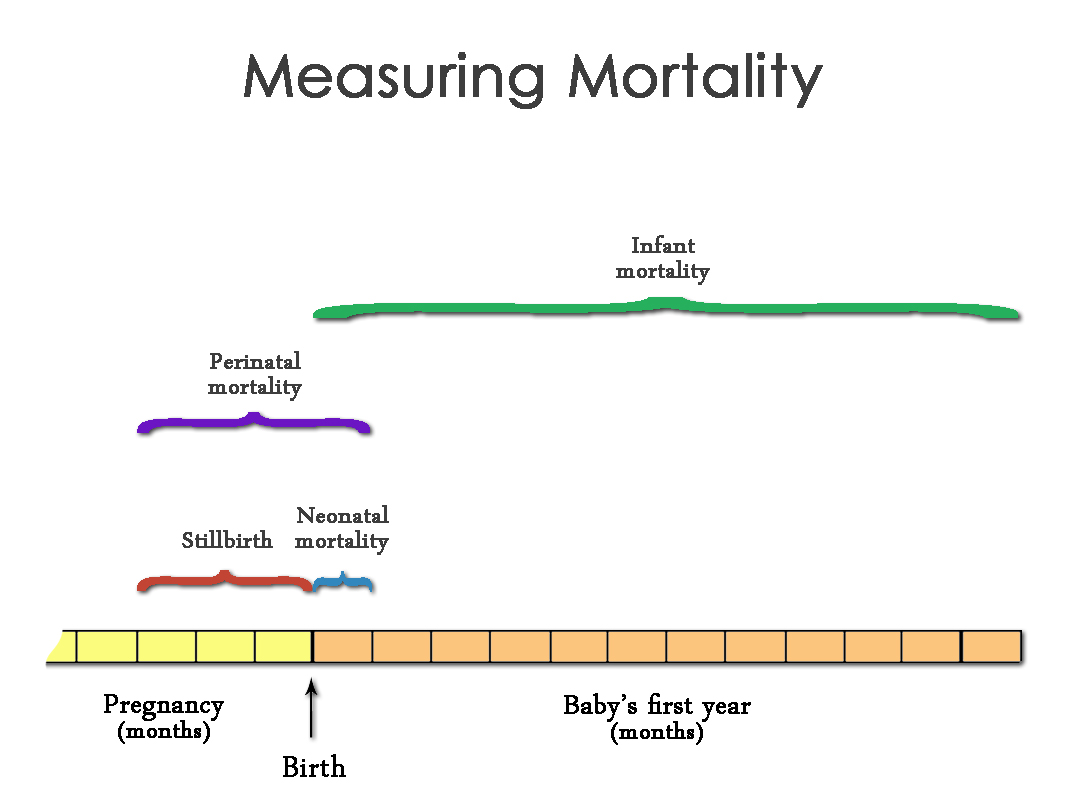
A graphical view of the various measurements of mortality that are commonly used in pregnancy and early childhood shows exactly how professional homebirth advocates misuse statistics.

This illustration shows the last few months of pregnancy and the entire first year of a baby’s life. The first thing to notice is the tremendous difference between perinatal mortality (bounded by the purple bracket) and infant mortality (bounded by the green bracket). Indeed, there is barely any overlap, demonstrating that perinatal mortality and infant mortality measure very different things.

The only thing common to both measures is death from birth to 28 days of life. That is known as neonatal mortality. It captures nearly all deaths in the aftermath of childbirth, but, and this is critically important no deaths during childbirth. Deaths during childbirth, which by any possible account is a critical reflection of obstetric care are recorded as stillbirths.

So infant mortality is missing deaths during childbirth. In addition to leaving out this major component, it adds a tremendous amount of extraneous data in the form of deaths from 1 month of age to 1 year of age. These include deaths from Sudden Infant Death Syndrome (SIDS), childhood diseases and accidents, all irrelevant to the issue of obstetric care. That’s why infant mortality is an excellent measure of pediatric care, but a very poor measure of obstetric care.

So infant mortality and perinatal mortality aren’t remotely interchangeable and it is deliberately deceptive to use infant mortality as a measure of obstetric care.

What about neonatal mortality (bounded by the blue bracket)? Is that a good measure of obstetric care?

It is definitely better than infant mortality because it doesn’t include tremendous amounts of extraneous information, and it is a useful proxy in countries that don’t collect data on perinatal deaths. However, it leaves out a lot of very important information.

Neonatal mortality also does not include deaths during childbirth, arguably a very important measure of obstetric care. In addition, it leaves out late stillbirths. Late stillbirths are also an important measure of obstetric care since most of the interventions associated with late pregnancy and childbirth are designed specifically to prevent stillbirths.

In addition, and this is an exceedingly important caveat, many countries, such as the Netherlands, have attempted to make their neonatal mortality statistics look better by deliberately and deceptively classifying very premature live babies as stillbirths even though they are not dead. That way, very premature babies are automatically removed from both the neonatal and the infant mortality statistics.

This deception allows countries like the Netherlands to have infant mortality rates that are automatically and artificially lower than the real neonatal mortality rates. That’s yet another reason why a direct comparison of infant mortality rates between countries like the Netherlands and the US (which classifies all liveborn babies as alive, regardless of prematurity) are deceptive.

Even the briefest glance at the illustration above makes it exceedingly clear that perinatal mortality and infant mortality are two very different measurements and are not in any way interchangeable. The fact that professional homebirth advocates like Ricki Lake, Ina May Gaskin and Jennifer Block imply that they are interchangeable tells us something very important about homebirth advocacy.

First, professional homebirth advocates do not hesitate to employ deliberate deception in order to impugn modern obstetrics. Second, professional homebirth advocates rely on the fact that their followers lack the most basic knowledge of statistics and therefore will not notice the deception. Finally, professional homebirth advocates demonstrate utter contempt for the truth.

The truth is that American obstetrics provides high quality care as reflected in the fact that American perinatal mortality rates are among the lowest in the world. But the truth doesn’t sell homebirth videos, books and courses, so the truth must be hidden and misleading claims must be substituted.

Homebirth advocates and women contemplating homebirth need to ask themselves a very important question: If professional homebirth advocates have such utter contempt for the truth that they deliberately use the wrong statistics, how can you believe anything they write or say?

Foreskin fetishists get whacked

As predicted, the San Francisco ballot measure banning male circumcision met a quick demise.

As I wrote several months ago:

Those who devote their lives to the preservation of foreskins are hurriedly gathering signatures to put a circumcision ban on San Francisco’s November ballot. The measure would assess fines as high as $1,000 and provide for up to one year in jail for someone who performs a circumcision.

Lloyd Schofield, a self-described “intactivist,” started the successful signature gathering campaign that put the measure on the November ballot. But Superior Court Judge Loretta Giorgi brought an abrupt end to the effort.

Giorgi agreed with the doctors, community groups and Muslim and Jewish families who sued, arguing that a ban was an unconstitutional interference with the free exercise of religion, as well as a violation of state law on medical practice.

As reported in the LA Times:

Judge Loretta M. Giorgi ordered San Francisco’s director of elections to strike the measure from the city’s ballot because she said that it is “expressly preempted” by the California Business and Professions Code.

Under that statute, only the state is allowed to regulate medical procedures, and “the evidence presented is overwhelmingly persuasive that circumcision is a widely practiced medical procedure,” the ruling said.

After a brief hearing, Giorgi also found that the proposed ban would violate citizens’ right to the free exercise of religion, said Deputy City Atty. Mollie Lee, because it targets Muslims and Jews, whose faiths call for circumcising males.

The American Civil Liberties Union lauded the judge’s ruling:

“It’s unusual for a judge to order an initiative off the ballot, but the proposed circumcision ban presented that rare case where the court should block an election on an initiative,” said ACLU Northern California staff attorney Margaret Crosby in a released statement. “Not only is the ban patently illegal, it also threatened family privacy and religious freedom. The court’s order protects fundamental constitutional values in San Francisco.”

The misguided effort to ban circumcision did have one salutary benefit, a striking degree of cooperation between American Jewish and Muslim leaders:

.. Marc Stern, associate general counsel for legal advocacy at the American Jewish Committee, said the Jewish community was “clearly appalled” by the proposed ban.

“This is the most direct assault on Jewish religious practice in the United States,” said Stern. “It’s unprecedented in American Jewish life.”

“We would agree with the Jewish religious and legal scholars regarding the practice, and … to my knowledge, there is no compelling medical reason to ban it,” said Ibrahim Ramey, the human civil rights program director at the Muslim American Society Freedom Foundation. “There are religious sensitivities that are involved and the decision to circumcise ought best be left to the parents of the child, and not a political referendum.”

All in all, Schofield’s effort to ban circumcision was a total failure. The San Francisco courts have gone on record ruling that, in direct contradiction to the claims of foreskin fetishists, male circumcision IS a medical procedure, with medical benefits, and that it is also a religious procedure protected by the First Amendment.

Dr. Amy