Category Archives: favorites

I had a C-section and all I got was a healthy baby

Homebirth and natural childbirth advocates are incensed that anyone might think a healthy baby is compensation for a less than ideal birth “experience.”

The piece by Kathy at Woman to Woman Childbirth Education, At least you have a healthy baby, is typical of the genre bemoaning C-sections and other life saving methods of modern obstetrics.

Many women, on telling stories of how they felt abused or traumatized during birth — or some other negative feeling, like having failed as a woman after having a C-section, or something — have their feelings dismissed with, “at least you have a healthy baby…” [I]t only makes her feel worse, because then she has the added guilt of not being able to “just be happy” that her baby is healthy. Certainly she is happy that her baby is healthy… but can she not also be sad that it came at the cost of severe bodily trauma?

I especially like the picture of the “mutilated” apple. That apple was torn apart and left ruined just to get at the seeds.

Certainly, not every woman who had a C-section is going to feel this way … otherwise there would be at least 31.7% of women last year who were as traumatized in body and spirit as this apple was brutalized …

So, the next time you hear someone process her negative birth experience, and you’re tempted to say, “At least you have a healthy baby,” remember the picture of the mutilated apple, bite your tongue, and if you can’t think of anything else, just say, “I’m so sorry.”

Is a healthy baby merely a “silver lining” after a C-section? Let’s do a little thought experiment and consider the converse. Imagine a courtroom during a malpractice trial, a trail that alleges that an obstetrician did not perform a C-section in time to save a baby’s life. The mother is on the stand and being questioned by the doctor’s lawyer:

Yes, Mrs. Smith, your baby is dead, but at least you had a great birth experience. You didn’t have surgery; you didn’t have an epidural; the baby was born vaginally and put immediately on your chest for bonding. Sure the baby was dead, but consider the experience.

And look at the picture of this mutilated and brutalized apple. Is this what you would have preferred? Dr. Jones has saved you from a psychic wound that would never have healed. You ought to be grateful.

People would be horrified by the lawyer’s complete lack of perspective. The health of the baby and the quality of the “experience” are not remotely comparable, and it is absurd, and even cruel, to suggest they are.

Similarly, the idea that a healthy baby is merely a “silver lining” after C-section is indicative of the complete loss of perspective on the part of homebirth and natural childbirth advocates. The picture of the “brutalized” apple is particularly telling. The implication is that physical perfection is critical, and a surgical incision leaves a woman mutilated and incapable of healing.

There is another, deeper implication that is both unexamined and unjustified. The implication of the picture is that the removal of the seeds could have and should have occurred without changing the apple. The reality in nature is far worse that the “brutalization” of the apple. In nature, the apple must desiccate and die in order for the seeds to live.

The reality of childbirth in nature is far more brutal than a C-section. In nature, the mother often dies while the baby lives. Or the baby must die in order for the mother to expel it and live. Thousands of women and millions of babies around the world die each year for lack of C-sections.

A live baby is not the “silver lining” of a C-section. It is the entire purpose of pregnancy and childbirth.

This piece first appeared in September, 2009.

Dentists medicalizing the tooth experience

I am sick and tired of dentists medicalizing the tooth experience. Having teeth is not a disease, so why do dentists spend all their time worrying about tooth problems? I don’t know about you, but I’m fed up with dentists treating me like my teeth are a disaster waiting to happen.

Our teeth are the product of hundreds of thousands of years of evolution. They are designed to work perfectly without anyone brushing them, applying chemical toothpastes to them or even monitoring them. Do animals brush? I don’t think so. Animals are able to use their teeth without any dental interventions. Why should we act as if human beings are any different?

Cavities, gum disease, periodontal infections? Those are just fancy words that dentists use to convince us that our mouths are broken. And if they fool us into thinking our mouths are broken, they can bill us for all sorts of dental interventions, and use the money to buy BMWs to head to the Club for golf.

First of all, everyone knows that there are three keys to healthy teeth: diet, exercise, and educating yourself about your tooth options. I’ll bet that 99.9% of tooth problems could be prevented by these simple measures. The diet and exercise are self explanatory, but how do you educate yourself about your tooth options?

You get educated by Googling “teeth” and reading every website that is not written by a dental professional. Don’t listen to any dentists. They don’t learn anything about nutrition or exercise in dental school. Even worse, they’ve been co-opted by Big Floss and have a vested interest in making money by scaring you.

We need to return to the “natural” or “physiologic” tooth experience. There are no toothbrushes or dental floss in nature, so we should not ruin our tooth experience by using them to intervene in our mouths. We successfully used our teeth for hundreds of thousands of years before there were any dentists. If our teeth were really as delicate as dentists insist, we would have died out long ago.

Those who have educated themselves about tooth options know that dentists are not to be trusted. They used to tie string around a tooth to pull it out? They were wrong about that, and that means that they are wrong about everything.

I know some of you are thinking that you might want to visit a dentist because you have tooth pain, but that’s because you don’t understand how empowering the pain of teeth can be. Real women and men embrace the pain; only the weak and frightened give in and take Tylenol, or, worse yet, submit to dental work. At the very least, you should try natural measures before going to the dentist. Put herbs on your teeth. Stick your face into a kiddie pool filled with warm water (everyone knows that water soothes pain). Visit your cranio-sacral therapist. Most tooth pain can be treated with a simple spinal alignment.

Whatever you do, don’t let them operate on you. There is rarely any need to have a cavity filled, and gum surgery should be reserved only for use if death is imminent. And if you teeth fall out, don’t get dentures. You might think that dentures will help you eat, but that’s not real eating. Authentic, empowered men and women know that it is better to starve to death than to chew with artificial teeth.

Let’s review:

1. No brushing, no toothpaste, no dental floss. We didn’t use them in nature; we don’t need to use them now.

2. Educate yourself about your tooth options so you can reject the medicalization of the tooth experience.

3. Tooth pain is empowering. Don’t try to blunt it or block it with drugs.

4. Don’t trust your dentist. He is only trying to enrich himself as quickly as possible so he can get back to his golf game.

5. Refuse dental surgery unless the dentist can prove you will die without it.

It is time to end the medicalization of the tooth experience!

Natural childbirth quacktivists

Drumroll, please!

I’d like to introduce a new word to the lexicon: quacktivist.

A quacktivist is a person who proselytizes demonstrably false medical claims with cult-like intensity. The anti-vax folks are quacktivists by definition. Jenny McCarthy is a quacktivist and so is Joe Mercola. Andrew Wakefield is a quacktivist extraordinaire.

Natural childbirth is promoted by its own band of quactivists such as Amy Romano, Barbara Harper and even Henci Goer. There are entire organizations devoted to natural childbirth quactivism like Lamaze and ICAN (the International Cesarean Awareness Network).

How do you recognize quactivists?

Here are a few helpful hints:

1. The natural habitat of a quacktivist is her own blog or book.

2. Quactivists almost never stray outside their natural habitat because they are defenseless in the presence of scientific evidence. They never go to mainstream conferences and they certainly don’t attend scientific meetings because quacktivism is threatened by science

3. Quacktivists invite visitors to their natural habitats, but protect themselves from potentially devastating facts by deleting and banning any commentors who dare to question the quactivist cult.

4. Quacktivists are relentless self promoters. Live blogging your own homebirth, like the Feminist Breeder just did, is a classic quacktivist move.

5. Ignorance is the main nutrition source for quacktivists. They generally lack even the most basic information on science, statistics, immunology or obstetrics.

6. Quacktivists love “bibliography salad.” That’s a mishmash of scientific citations (often copied from a website or book) that the quacktivist has never read, couldn’t understand if she did read it, and doesn’t say what she thinks it says.

7. Quacktivists have a highly evolved defense mechanism. They are evidence-resistant. Show quacktivists that vaccines have dramatically reduced death and disease and they dismiss it out of hand. Explain and demonstrate that death is a natural part of childbirth and natural childbirth quacktivists question your sources. Point out that their arguments are riddled with logical fallacies and quacktivists have no idea what you are talking about.

8. Quacktivists proselytize. Professional quacktivists proselytize because that’s how they make money. They sell books, sell advertising on their websites, solicit free products in exchange for favorable reviews (Rixa Freeze, I’m thinking about you), and sell bogus “remedies.”

9. Natural childbirth quacktivists are very needy. They hold “conferences” that are nothing more than echo chambers because they need to have their beliefs reinforced by others and cannot tolerate questioning or disagreement.

10. Natural childbirth quactivists have a further defining feature. They spend an inordinate amount of time being ostentatiously “sad” for those who don’t believe in natural childbirth quacktivism. That’s not surprisingly, really, when you consider that self-glorification is an intrinsic part of quacktivism of all kinds. Quacktivists believe they are in possession of special knowledge that is being hidden by grand conspiracies involving virtually everyone else on the planet.

How do the rest of us protect ourselves against quacktivists?

The best defense is knowledge, the real kind that is a product of college and graduate education, not the pseudo-knowledge found on websites and beloved of every quacktivist. Keep an eye open for the defining signs of quacktivism. Does the “expert” refuse to leave her website except to go to “conferences” of like minded believers? Does she delete comments because they challenge her claims? Does she offer “bibliography salad” to support her claims? Is she “sad” that everyone else is not like her? If the answer to these question is “yes,” you know you are dealing with a quacktivist.

Dr. Amy is mean to me!

Ceridwen Morris thinks I am mean to her. Who is she and what is she upset about?

Ceridwen blogs for Babble.com on the group blog Being Pregnant. And Ceridwen, like others in her group, routinely makes empirical claims about pregnancy and childbirth that are flat out false. For example, yesterday she wrote a post entitled Why Midwife-Led Care Should Be The Norm. The keystone of her argument is this:

Midwife-led care is the norm in most of Western Europe where statistics for maternal and fetal health are excellent.

There’s just one teesy, weensy problem with this claim; it’s not true.

I commented:

The country that has the most comprehensive system of midwife led care is The Netherlands and it has the WORST perinatal mortality in Western Europe and poor maternal mortality as well. This has been the case for years and the Dutch government has sponsored a variety of studies to find out why Dutch perinatal mortality is so high.

A paper published in the British Medical Journal recently revealed and astounding finding: the perinatal mortality rate for LOW risk women cared for by Dutch midwives is HIGHER than the perinatal mortality rate for HIGH risk women cared for by Dutch obstetricians!

Ceridwen might have responded that (as is obvious) she was unaware of that fact; she might have promised to do more research on the issue to find out how midwife led care really affects mortality rates, but instead she said this:

… You’re mean. You scare women. I’ve read your website extensively and I wish you’d seriously find a way to be productive instead destructive. You cannot criticize the home birth community for a stubborn one-sidedness and a fact-spinning agenda when you are the epitome of that kind of bullying and manipulation. I’m sorry, I’ve been polite before but I’ve had it!! I am not interested in these polarizing debates and anyone with any sense is with me.

And this:

I never mentioned The Netherlands.

And, best of all, this:

Whatever. I’m not [changing] it.

Let’s take a step back and analyze Ceridwen’s credentials for writing about the epidemiology of midwifery care:

Ceridwen Morris is a writer, mother and childbirth educator. She is co-author of It’s All Your Fault and From the Hips as well as several screenplays …

In other words, Ceridwen has no training in obstetrics, midwifery, science, statistics or epidemiology, yet she believes that she is qualified to expound on these topics. As I wrote earlier this year:

A … number of childbirth websites are run or staffed by childbirth educators, which is rather surprising, since they entirely lack the education, training, and experience to provide scientifically accurate, unbiased information…

In fact, you only need 16 HOURS of childbirth education, including indoctrination is the ideology of the certifying organization…

… [L]ess than 2 hours apiece are spent on the massive subjects of labor and birth, obstetrical tests, and C-section and VBAC. That would be fine if childbirth educators limited themselves to giving women basic familiarity with what is likely to happen during pregnancy and labor. Unfortunately, childbirth educators do not limit themselves to what they could reasonably do. Instead, they offer medical advice, criticize obstetric procedures, promote ideology above science, and proselytize for their personal preference. And for those tasks, they are entirely unqualified.

So Ceridwen is grossly unqualified to opine on the statistical “superiority” of midwifery care. But she’s also unqualified in another more fundamental way; she believes that anyone who questions the truth of her claims is being mean to her.

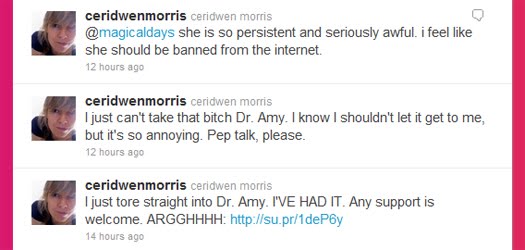
She’s not alone. Like many midwifery advocates, homebirth midwives and even some highly trained midwives, instead of responding to criticism of her empirical claims by defending them (or retracting them) as professionals are supposed to do, she whines that she is being treated unfairly. Her twitter feed is even more revealing on this point:

Very illuminating. She made a false statement, and I’m a “bitch” for pointing it out.

This is an example of a problem that poisons the natural childbirth blogosphere. Natural childbirth advocates believe any challenge is “mean.” They blithely write and post complete falsehoods and rather than regretting the misinformation they spread, they resent the people who point out the lies.

This phenomenon extends to those who are actual professionals of midwifery. There are few if any scientific controversies in midwifery. No one would be so “bitchy” as to point out to another midwife that her claims are false. This is also why it is impossible to expect that homebirth midwives can regulate themselves. The truth is meaningless for these people; the only thing that counts is “support.” Unless they are forced by publicity or legal authorities, they never condemn one of their own no matter how many babies die as a result of ignorance and incompetence.

Rather than addressing Ceridwen, who is frankly too immature to even understand that she is OBLIGATED to correct falsehoods in her own writing, I will address the editors of Babble:

It is time for Babble to assign a technical editor (a doctor) to vet bloggers’ material for factual accuracy. It is wrong to allow women who are have no medical (or even midwifery) qualifications to make unchecked factual claims about pregnancy and childbirth. The bloggers of Being Pregnant should be free to write about their personal experiences, their feelings and their opinions. However, when it comes to empirical facts, claims must be vetted for truthfulness. Clearly bloggers like Ceridwen Morris have no compunction about spreading absolute falsehoods and won’t even correct them when they are pointed out. Babble must accept responsibility for ensuring that its readers are receiving scientifically accurate information about pregnancy and childbirth.

If correlation is not causation, what is?

321CC9B6-62D2-4107-98E3-9C3A58DE7FFF

Even those who can’t tell the difference between a t-test and a chi-square are familiar with a basic principle of epidemiology: correlation does not equal causation. In other words, even if Event A happened before Disease B, it does not mean that A caused B.

For example, in last 100 years deaths from infectious diseases has declined precipitously. During the same time span, the recreational use of marijuana has also increased. Yet no one would suggest that the decline in infectious disease deaths was caused by smoking marijuana.

So if correlation does not equal causation, what does?

To determine if Event A caused Disease B, we need to investigate whether it satisfies Hill’s Criteria. These are 9 criteria, most of which much be satisfied before we can conclude that Event A is not merely correlated with Disease B, but Event A actually causes Disease B.

Who was Hill and why should we care about his criteria?

… These criteria were originally presented by Austin Bradford Hill (1897-1991), a British medical statistician as a way of determining the causal link between a specific factor (e.g., cigarette smoking) and a disease (such as emphysema or lung cancer)… [T]he principles set forth by Hill form the basis of evaluation used in all modern scientific research… Hill’s Criteria simply provides an additional valuable measure by which to evaluate the many theories and explanations proposed within the social sciences.

What are the criteria?

1. Temporal relationship: It may sound obvious, but if Event A causes Disease B, Event A must occur before Disease B. The is the only absolutely essential criterion, but it is NOT sufficient. Lay people often erroneously assume that because it’s the only essential criterion, it is the only criterion that counts. For example, vaccine rejectionists often point to the fact that childhood vaccinations usually occur before the onset of autism, but that does not mean that vaccination causes autism. Consider that learning to walk usually precedes autism, but obviously learning to walk does not cause autism.

2. Strength: This is measured by statistical tests, but can be thought of as similar to the closeness of the relationship. Is Disease B always preceded by Event A? Sometimes? Only rarely? Does Event A always cause Disease B? Sometimes? Only rarely? Lung cancer is not always preceded by cigarette smoking, but it usually is. Cigarette smoking does not always lead to lung cancer, but it does often lead to lung cancer. In other words, the relationship is fairly strong.

In the case of vaccines and autism, vaccines usually precede the diagnosis. However, most children who receive vaccines don’t develop autism. Thus the relationship is weaker.

3. Dose-response relationship: If cigarette smoking causes lung cancer, we would expect that smoking more cigarettes would increase the risk of lung cancer, which it does. In contrast, there appears to be no dose-response relationship between the number of vaccinations and the risk of developing autism.

4. Consistency: Have the findings that purported to show a relationship been replicated by other scientists, in other populations and at other times? If studies fail to consistently show the relationship, causation is very unlikely.

This is a critical point. One experiment or even a few experiments is NOT enough to determine causation. A large number of experiments that consistently show the same result is required. This is particularly important for vaccine rejectionists to note. The fact that a few studies claim to have shown that vaccination causes autism is meaningless when a very high proportion of studies show that there is not even a correlation between vaccination and autism.

5. Plausibility: In order to claim causation, you MUST offer a plausible mechanism. In the case of cigarette smoking, certain components of the smoke are known to cause damage to the cells inside the lungs, and cellular damage has been shown to lead to cancer. In contrast, no one has yet offered a plausible explanation for how vaccines “cause” autism. In fact, no one can even agree on the specific component that is supposedly responsible.

6. Consideration of alternative explanations: This is self explanatory. In the case of vaccination and autism, there is a very simple alternative explanation. Autism cannot be diagnosed before the age of 2 and most vaccines are given before the age of 2.

7. Experiment: If you alter Event A do you still get Disease B. In the case of smoking, if you quite smoking, the risk of lung cancer goes down. In the case of vaccines and autism, if you forgo vaccination, the risk of autism remains unchanged.

8. Specificity: Is Event A the only thing that leads to Disease B? This is the least important of the criterion. If it is present, it is a very powerful indicator of causation. For example, among young women who developed a rare form of vaginal cancer, all of them were found to have been exposed to DES (diethylstilbestrol) while in utero. That is a highly specific effect.

However, even if the relationship is not highly specific, that does not preclude causation. Though there are non-smokers who get lung cancer, it does not change the fact that the other criteria show that smoking causes lung cancer.

9. Coherence: The explanation of action must comport with the known laws of science. If the purported mechanism of causation violates the law of gravity, for example, then it isn’t acceptable. That’s why religious arguments against evolution are wrong. They are “incoherent” since they invoke forces outside science.

What do Hill’s criteria look like in action?

D4DE2D97-AE05-40B3-89B3-FCD048FD61DA

In the case of cigarette smoking and lung cancer, 8 out of 9 Hill’s Criteria are satisfied. In contrast, in the case of vaccines and autism, only 3, possibly 4 criteria are satisfied. This is why we can say that the scientific evidence shows that vaccines do not cause autism.

While it is true that vaccinations usually precede the diagnosis of autism, that is an essential criterion, but not enough. The fact that there is no dose-response relationship, that the few studies that showed a purported relationship cannot be replicated and that studies in which people who were not vaccinated did not have a lower incidence of autism, demonstrates that vaccines do not cause autism.

Ten illogical arguments

In addition to the problem of possessing inaccurate information, homebirth advocates have another, more serious problem, the tendency to construct illogical arguments. It is apparently such a pervasive problem that a brief review of these arguments is in order.

Let’s look at the various types of illogical argument constructed against my core claim “the death rate at homebirth is higher than the death rate at low risk hospital birth.” To make this exercise easier to understand, lets substitute a claim of the same form that is obviously true, so we will not get sidestepped by issues of truth or falsity and can focus only on whether an argument is logical or illogical. This is important because illogical arguments are automatically invalid arguments. We’ll use the claim “there are more black cars in the US than lime green cars.”

I say: There are more black cars in the US than lime green cars.

Don’t say:

I saw a lime green car. – Can you understand how the fact that you personally saw a lime green car tells us nothing about the relative number of black cars and lime green cars in the US? That you saw a lime green car is perfectly consistent with black cars outstripping lime green cars 100 to 1, or even 1,00,000 to 1? Similarly, the fact that babies die in the hospital tells us nothing about whether the death rate is greater at homebirth.

I know ten people and not one of them has a black car. – This is an illogical claim based on an unstated assumption. The assumption is that the small slice you observe accurately represents the whole. However, tiny samples are often unrepresentative. Knowing 10 people who own black cars is perfectly consistent with the number of black cars exceeding lime green cars, BUT it is also perfectly consistent with lime green cars exceeding black cars, so it can’t be used to support a specific claim. Similarly, the fact that you know ten women who had homebirths and not a single baby died tells us nothing about whether the homebirth neonatal death rate exceeds the low risk hospital death rate.

Lime green cars are prettier than black cars. – I hope it is obvious why value judgments about lime green cars tell us nothing about whether there are more or less black cars than lime green cars. Therefore, it should be obvious that claiming that women are more satisfied with homebirth tell us nothing about homebirth death rates.

You say that because you sell black cars. – Whether or not I sell black cars is immaterial; it has absolutely no effect on the number of black cars or lime green cars. This is essentially an accusation that I am lying and offering as “proof” the fact that I have a reason to lie, but a reason to lie is not proof of lying. So don’t tell me that the fact that I am an obstetrician means that I am lying about neonatal death rates.

The people who make black cars have oppressed the people who make lime green cars. – Maybe yes, maybe no, but in either case, it does not affect how many black and lime green cars are on the road. Similarly, whether doctors have oppressed midwives has no bearing on whether the neonatal death rate at midwife attended homebirths is higher than hospital births.

There is a conspiracy against lime green cars. – We are supposed to believe that the number of lime green cars would equal black cars except for a public relations campaign designed to make lime green cars less desirable. It is theoretically possible that there is a conspiracy against lime green cars, but it is far more likely that other factors account for the difference in numbers. And in any case, it doesn’t tell us anything about the relative numbers of black and lime green cars. So when confronted with the fact that homebirth death rates exceed hospital rates, it is illogical to counter with a claim that a conspiracy against homebirth exists.

There would be more lime green cars if the makers of black cars helped out. – That might be true, or it might not. In either case, it tells us nothing about the truth of the claim that black cars exceed lime green cars. And while it might be true that the death rate from midwife attended homebirth would be lower if doctors were more supportive of midwives, it doesn’t change the reality of the current situation.

The Association of Lime Green Car Makers say that there are more green cars than black cars. – Cherry picking certain claims and ignoring all others is likely to lead people to the wrong conclusion. A lobbying group that disagrees with almost everyone else is not a reliable source of information. Similarly, professional NCB advocates and organizations are not reliable sources of information when they disagree with the bulk of the scientific evidence.

The color of cars is influenced by culture. – That is a non sequitur. It does not oppose the claim; it simply attempts to pin responsibility somewhere else and it is irrelevant. That’s why the claim that hospital birth is culturally favored is irrelevant to any argument about homebirth death rates.

There are more important things about cars than the color. – That is what is known as “reframing the debate“. It is a tacit acknowledgment that there are more black cars than lime green cars and a barely concealed effort to divert everyone’s attention. That’s why when someone announces that there are more important things than whether babies live or die, I know they have accepted the fact that homebirth leads to preventable neonatal deaths.

The naked stupidity of vaccine rejectionists

Excuse me for a few moments while I catch my breath. I’ve been laughing so hard that I can’t write.

As anyone who has read this blog knows, I have no patience for vaccine rejectionists. They are uneducated, illogical and immoral. But even I am sometimes amazed at the naked stupidity and gullibility of vaccine rejectionists.

The latest post at Age of Autism should be studied as a classic in the annals of vaccine rejectionist “reasoning.” The blog breathlessly announces that there have been more miscarriage events associated with Gardasil than other vaccines.

As my children would say: Duh!

The folks at AofA seem to think this is surprising and means that Gardasil is dangerous. That’s hilarious!

It’s hardly surprising that Gardasil, the ONLY vaccine given exclusively to women of reproductive age has more miscarriage EVENTS than other vaccines. Was anyone expecting that vaccines given to prepubertal children were going to be associated with miscarriages? What’s next: “puberty causes miscarriages” because there are more miscarriage events after puberty than before?

Here’s what I can’t figure out. Did the geniuses who run AofA actually think this was a “finding”? Or are they so cynical did they just fed it to their readers assuming they’d be too gullible to notice that the claim is absurd?

Moreover, the number of miscarriages in meaningless. The only meaningful measurement is the miscarriage RATE (the number of miscarriages divided by the number of pregnant women who received the Gardasil vaccine). And since the natural miscarriage rate is 20%, that number would need to be substantially higher than 20% to merit any consideration that Gardasil leads to miscarriage. But of course the AofA article does not bother to mention the miscarriage rate, doesn’t even bother to calculate it.

Amazingly, when I commented on the post, the AofA folks actually printed the comment. It was followed by expressions of outrage and lots and lots and lots of words. Yet not a single person could tell us the miscarriage RATE, and some apparently didn’t even understand that they had been fooled.

The only shocking aspect of this post is that some people are stupid enough and gullible enough to think it is meaningful.

What is defensive medicine?

The Defensive Medicine series on The Unnecessarean has tried to be inclusive, offering the perspective of two obstetricians, two lawyers, two sociologists and a lay person. There’s one thing that’s missing from the series, though: an explanation of how defensive medicine works.

According to Wikipedia:

Defensive medicine is the practice of diagnostic or therapeutic measures conducted primarily not to ensure the health of the patient, but as a safeguard against possible malpractice liability. Fear of litigation has been cited as the driving force behind defensive medicine…

Defensive medicine takes two main forms: assurance behavior and avoidance behavior. Assurance behavior involves the charging of additional, unnecessary services in order to a) reduce adverse outcomes, b) deter patients from filing medical malpractice claims, or c) provide documented evidence that the practitioner is practicing according to the standard of care, so that if, in the future, legal action is initiated, liability can be pre-empted. Avoidance behavior occurs when providers refuse to participate in high risk procedures or circumstances.

What about defensive medicine in obstetrics?

Consider the explosion in the rate of C-sections and inductions. They satisfy the requirements of assurance behavior.

Reducing adverse outcomes? Check.
Deterring medical malpractice claims? Check.
Pre-empting liability? Check.

Consider the precipitous decline in the rate of VBAC. That’s avoidance behavior: malpractice insurers have forced providers and hospitals to refuse to participate in VBACs.

There’s an important subtext that undergirds defensive medicine that often goes unrecognized and therefore unanalyzed. Defensive medicine is driven by the fact that we live in a “risk society,” a society that is organized around a new understanding of risk.

There have always been risks, of course, but they have traditionally been viewed as outside the control of human beings. The risk society has arisen because of new beliefs that we can and (especially) that we should control every aspect of risk.

In our risk society, we are obsessed with the risk of auto accidents and outfit our cars with ever more airbags and safety features. We are obsessed with risks to our children, and restrict their play outdoors and their independence, and we are obsessed with illness and death, literally passing laws to control personal habits like smoking.

How does the “risk society” impact obstetrics? We have become obsessed with the perfect child, and we construct ever more elaborate requirements to ensure that everything we do contributes to the perfect outcome.

There have always been risks in childbirth. Indeed, it has traditionally been the leading cause of death of babies, and one of the leading causes of death of young women in every time, place and culture. The “risk society” demands that we do everything possible to reduce those risks to zero.

Lay people often conceptualize risk as a dichotomy: an individual is either low risk (it won’t happen) or high risk (it will happen). But that’s not how risk works. Risk exists on a continuum; the risk varies from individual depending on a complex interaction of numerous factors. What’s the risk that a baby will die of group B strep meningitis? That depends on the presence of GBS in the mother’s genital tract, the exposure of the baby when delivered, and the presence or absence of antibiotics. We can determine the risk of GBS meningitis in large populations, but for the individual woman who carries GBS, we cannot predict the risk that her infant will be infected.

What does this have to do with defensive medicine? Consider that in our risk society we are supposed to reduce our risk to zero. How do we do that? We do that by acting to reduce risk regardless of how small the risk might be.

That represents an entirely new approach. Until the advent of the risk society, we determined which tests and procedures to use by establishing a risk threshold. For example, we know that the risk of stillbirth begins to rise in the last weeks of pregnancy (from about 36 weeks onward). The risk of stillbirth begins to increase precipitous at 42 weeks. So we arbitrarily established the risk threshold for postdates induction at 42 weeks.

Lay people, with their dichotomous view of risk, tend to imagine that there is no risk of stillbirth prior to 42 weeks, and there is a risk of stillbirth after 42 weeks. But the reality is that risk exists on a continuum. Defensive medicine can best be conceptualized at lowering the risk threshold. In the case of induction, the risk of stillbirth starts rising long before 42 weeks. Since the risk society mandates that we reduce risk to zero, doctors feel they have no choice, but to offer postdates induction to women by 41 weeks, or even 40 weeks. That’s really the only way to reduce the risk to zero.

This is a critical point. Lay people imagine that defensive medicine offers no benefits to patients and is undertaken solely to protect doctors, but that’s not a complete picture. Defensive medicine is simply lowering the risk threshold. It benefits patients in that the risk of a particular outcome (like postdates stillbirth) is reduced as far as it can be reduced.

So what’s wrong with defensive medicine? Defensive medicine rests on the premise that we must do things to reduce risk. It completely ignores the risks posed by doing things. But that’s not only a feature of defensive medicine, it is a feature of every aspect of a risk society.

Yes, we make cars safer by putting in more safety features, but we increase the price of cars. Yes, we reduce the risk of kidnapping if we don’t let our children play outdoors, but it’s not good for children to grow up cowering inside their houses. Yes, we reduce the risk of illness when we pass laws regulating private habits, but we also reduce freedom. And when we do more inductions for postdates we lower the risk of postdates stillbirth, but raise the risk of C-section.

In our risk society, though, we apparently don’t care. We consider ourselves required to reduce risk to zero, regardless of the other risks or costs that increase as a result.

Where does that leave us in regard to defensive medicine?

First, we can see that defensive medicine is not the use of tests and procedures on people who don’t need them. It’s lowering the risk threshold for using tests and procedures that we previously reserved for higher risk individuals.

Second, defensive medicine is not really a medical issue, but rather a societal issue. As a society, we need to give up the idea that we can and should reduce all risk to zero. We need to recognize that there are negative consequences to reducing risk, as well as positive ones. Most important, we need to figure out how much risk we are willing to tolerate. Zero risk is not achievable, and the price for attempting to achieve it can be very high.

What does this mean for birth activists?

It means that blaming doctors for defensive medicine not only isn’t working, but it can’t work. It means recognizing that low risk is not no risk and that, therefore, doctors need guidance on what patients believe is acceptable risk. And most of all, it means deciding, as individuals in a risk society, what trade offs we are willing to accept in order to reduce risk.

Who hijacked childbirth?

There have always been midwives.

Ever since our ancestors acquired the ability to walk upright, human childbirth has been fraught with extreme risk to both mother and baby. The first midwives were those who recognized that assistance in childbirth can minimize those risks.

They understood that something as simple as massaging a woman’s uterus after childbirth could prevent life threatening hemorrhage and that different fetal positions like breech posed specific problems that could be overcome with specific maneuvers. Over time they acquired knowledge of the pharmacologic properties of certain plants and gave extracts to women with the intention of starting labor or stopping bleeding.

Above all, ancient midwives were empiricists. Their very existence was predicated on the inherent dangers of childbirth and everything they did was devoted to preventing death and injury. They abjured magic incantations in favor of empirical observation. They noted what worked and what did not and faithfully strove to incorporate those scientific observations into practice.

Despite profound changes in the human condition, midwifery changed very little. Midwifery knowledge grew, of course, and that knowledge was supplemented by appeals to whatever forces were deemed to be in charge at the time (nature, gods, the Church), but the purpose always remained the same. And the faithful adherence to empiricism (as opposed to the often outlandish theories held by doctors up to the 19th century), ensured that midwives provided the best possible care to the women they served.

That was certainly what I understood midwifery to be when I entered medical school, and that view was reinforced by working extensively with certified nurse midwives in the hospital setting. I found them to be highly educated, very experienced and capable of providing a more personalized form of care. But gradually I came to understand that midwifery has been pervaded by distinctive forms of feminist philosophy that rejected the traditional empiricism of ancient midwives in favor of philosophical theories. In fact, I think it is fair to say that childbirth in general and midwifery in particular have been hijacked by radical feminists.

These feminists were part of the second wave of feminists, who moved from insisting that women are equal to men (and therefore have the same rights) to insisting that women are different from men, and that those differences make women superior. Among the second wave feminists were two types of radical feminists that have profoundly changed the way that childbirth is understood. These two groups of feminists are biological essentialists and feminist anti-rationalists.

Broadly speaking, the biological essentialists are characterized by a belief that women are defined by their biology and that their biological differences should be celebrated; the premier biological essentialist in the natural childbirth movement is Sheila Kitzinger. The anti-rationalists are essentialists with a twist. In their view, empiricism and rational thought are the preserves of men, and that women have “different ways of knowing.” The premier anti-rationalist in the childbirth movement is Robbie Davis-Floyd.

The essentialists and the anti-rationalists share quite a few characteristics. Almost exclusively Western, white women of privileged classes, they believe that they speak for all women because all women have the same needs and desires. They simply assume that they represent non-Western women and women of color. They are sociologists and anthropologists. Curiously, they have little or no practical knowledge of childbirth or modern obstetrics, but don’t view that lack of knowledge to as a problem.

You can recognize them by what they say. The biological essentialists are fond of catch phrases like “trust birth” and “pregnancy is not a disease.” They insist that obstetrics has “pathologized” childbirth and they can display a shocking and callous fatalism by dismissing deaths with the dictum that “babies die, that’s just the way it is” or “some babies are not meant to live.”

The anti-rationalists are distinguished, not surprisingly, by their anti-rationalism. They dismiss science as a male form of “authoritative knowledge” on the understanding that there are “other ways of knowing” like “intuition.” Many are post modernists who believe that reality is radically subjective, that rationality is unnecessary and that “including the non-rational is sensible midwifery”

How do professional childbirth advocates line up? To some extent, all are biological determinists who deliberately conflate the is/ought distinction. Since childbirth in nature IS a certain way, it OUGHT to be allowed to proceed in exactly in that way at all times. Natural is understood to be superior and technology is automatically inferior.

The difference between biological essentialists and feminist anti-rationalists is primarily in their view of rationalism. Among the true biological essentialists are Henci Goer and Amy Romano. The biolgical essentialists are represented by organizations like Lamaze and the American College of Nurse Midwives (ACNM). They worship the “natural” on the assumption that biology determines what is best for all women. Nonetheless, they believe that science is non-gendered, valuable and the standard by which claims about childbirth should be judged. They freely quote scientific papers and insist that their views of childbirth are “evidence based” even when they are not. They value empirical knowledge and advanced education.

The non-rationalists reject science as male, and unfairly regarded as authoratative merely because it is male. To the extent that science supports their beliefs, they are willing to brandish scientific papers as “proof,” but explictly reject rationalism when it does not comport with their personal beliefs, feelings and opinions. They do not value empirical knowledge and reject rigorous education.

The grandmother of anti-rationalism among childbirth advocates is Ina May Gaskin and MANA, which is her creation, is the primary organizational exponent of anti-rationalism in childbirth. Radical midwifery theorists like Soo Downe and Jenny Parratt provide the ideological underpinnings of anti-rationalism within midwifery. Also included under the anti-rationalist umbrella are the “freebirthers” like Laura Shanley and Janet Fraser, and the Quiverful movement that rejects rationalism in favor of religious belief.

As far as I (and most women) are concerned biological essentialism and feminist anti-rationalism are two radical theories that have come and gone. Women are not determined by their biology and women differ in their needs and desires even if they share common biology. Anti-rationalism is the preserve of educated social theorists and uneducated laypeople. It is a doctrine of sour grapes. Rationalism does not support their opinions and rather than changing their opinions, they prefer to reject rationality itself. Anti-rationalism cannot account for the fact that some women not only believe in science, but they are scienttists.

Ultimately, the natural childbirth movement is wrong, not merely in its scientific and historical claims, but especially in its underlying philosophy. Most women no longer accept that they are supposed to be defined and determined by their biology. They believe that just because something is a certain way in nature, it does not mean that it ought to be that way today. In nature “some babies aren’t meant to live,” but that doesn’t mean that we should withhold our technological expertise and let those babies die. In nature, women give birth in agony, but that does not mean that women ought to give birth in agony or that it is an “achievement” to do so.

Most women are not, and never were anti-rationalists. They do not view reality as radically subjective; they embrace science and become scientists and doctors themselves. They value knowledge and respect advanced education.

Midwifery has been pervaded and in some sense perverted by the biological essentialists and the anti-rationalists. Childbirth has been hijacked by radical feminist theorists, and it is time for the rest of us to take it back.

Attachment parenting causes autism

image

It is perhaps the ultimate irony that advocates of attachment parenting who reject vaccination because of fear of autism have ignored the possibility that it is attachment parenting itself that causes autism.

Consider the ever growing body of evidence:

1. Both autism and attachment parenting have increased dramatically in the past two decades. The origin of the attachment parenting is credited to Dr. William Sears, who first mentioned it in his book in 1988. Studies show that in the VERY SAME YEAR, the incidence of autism began to rise dramatically. (Environ. Sci. Technol., 2010, 44 (6), pp 2112–2118).

2. Regardless of who practices attachment parenting or how they define it, no one can deny that the practice of attachment parenting ALWAYS precedes the diagnosis. There are no known cases in which attachment parenting practices began after autism was diagnosed.

3. The purported mechanism is thought to be the sensory deprivation caused by baby wearing and extended breastfeeding. During the critical early months and years, when babies should be learning about the world and making millions of neuronal connections, babies exposed to AP are deprived of contact with the outside world (many are constantly carried in a position where they can see nothing but the surface of the mother’s clothing) and their exposure to other individuals such as fathers, grandparents and childcare workers is severely limited.

4. No one has EVER shown that attachment parenting does not cause autism.

5. Even those who strongly reject the notion that attachment parenting causes autism acknowledge that there are MANY children raised with attachment parenting who are subsequently diagnosed with autism.

6. Many of those who deny a link between attachment parenting and autism stand to lose money if attachment parenting is shown to be harmful. Authors, lactation consultants, and sling manufacturers, among others, have a strong economic motivation for discouraging investigation of this link.

It is time to launch a comprehensive investigation of the harmful side effects of attachment parenting in general, and the relationship between attachment parenting and autism in particular. It’s hardly coincidental that the same people who make money from attachment parenting have NEVER bothered to study these harmful effects. They insist that attachment parenting is beneficial, but there is no way they can know for sure.

****

Those who have read this far have probably figured out that this is a satire. I’m satirizing the “thinking” of vaccine rejectionists on the purported relationship between vaccines and autism. The purpose of the satire is to demonstrate that what seems to vaccine rejectionists to be compelling “reasoning” is nothing more than nonsense, and logical fallacies.

I’ve tried to highlight the major rhetorical gambits of vaccine rejectionists. Number 1 is the claim that because both vaccination and autism have risen in recent decades, vaccines must cause autism. That claim is foolish as can be seen when the same observation is made about attachment parenting and autism. Just because the incidence of two phenomena rise at the same time does not mean that one caused the other. And that doesn’t even take into account the fact that rates of vaccination have actually been FALLING while rates of autism have been rising.

Number 2 is the temporal connection. Early childhood vaccination precedes the observation of autistic symptoms, but a lot of things precede the observation of autistic symptoms. That’s because those symptoms typically do not appear until the early toddler years and anything that takes place during infancy (like attachment parenting practices) will precede the observation of symptoms.

Number 3 invokes a spurious mechanism of action. It is certainly plausible, but no evidence is presented that it actually occurs. Vaccine rejectionists play the same tricks with claims about the deleterious effects of “toxins” in vaccines.

Number 4 is the “argument from ignorance.” The argument from ignorance dares the opponent to prove a negative and when a negative cannot be proven (since that is a logical impossibility in most cases), the conclusion is proclaimed that this “shows” that vaccines cause autism.

Number 5 is the “fallacy of the lonely fact.” Since some children have developed autism after their parents practiced attachment parenting, the conclusion is drawn that large numbers of children will develop autism after their parents practice attachment parenting.

Number 6 is the conspiracy theory that undergirds almost every attempt to defend vaccine rejectionism. But when the same “reasoning” is applied to attachment parenting, it is easy to see that the conspiracy theory does not have much explanatory power. There is ALWAYS someone who stands to benefit from any recommendation or practice. That does not mean that those who benefit are actively hiding information on harms and risks from everyone else.

The concluding paragraph is the seemingly innocuous call for “more research.” But we cannot and should not waste time “researching” connections that have no basis in science. If we did, we could spend a lot of time “researching” whether the moon is made of green cheese or whether clouds are made of marshmallows. The call for “more research” is just away to add gravitas to what are often ridiculous claims. We do not need to “research” every wacky idea that vaccine rejectionists devise and our refusal to “research” those ideas without basis in science or logic is not a sign that someone is hiding something.

The key point is that what passes for “reasoning” among vaccine rejectionists is not reasoning at all. It is nothing more than wild accusations, logical fallacies and conspiracy theories. There is no more reason to take seriously the idea that vaccines cause autism than there is to take seriously the idea that attachment parenting causes autism.