Sure my baby died, but look at the benefits to me

One of the most reprehensible aspects of homebirth is the mother’s willingness to risk her baby’s life for a chance to star in her own little piece of performance art. Everyone else, medical personnel, her partner, even the baby are nothing more than bit players at “her” birth. Some women are such narcissists (like Gina Crossly-Corcoran, The Feminist Breeder) that they stage a literal performance by tweeting or live-blogging the birth.

If the baby actually dies, though, that tends to take the mother’s focus off herself, her feelings and her performance. Not always, apparently.

Alicia Crockett’s son Joseph died in the aftermath of a homebirth. Writing on Mothering.com, Alicia explains:

One month ago I gave birth at home to a beautiful 9lb 9oz baby boy named Joseph Phoenix, but he decided that he did not need to stay long in this world and he died the next day…

He decided? Not exactly.

According to a memorial on Flicker:

Joseph Phoenix Crockett was born at 10:05 AM on February 13, 2011. He was not breathing when he was born because his arm had pinched off his umbilical cord as he descended. The hospital re-started his heart but he was already gone, as later tests showed no brain activity…

He did not “decide” to die. He died because of profound hypoxia during labor that went unnoticed and untreated.

Writing on a goofy new age spirituality website Alicia offers this stunning rationalization:

… Five weeks ago, I gave birth to a baby boy, full term who died the next day. There was no sign that anything was wrong during pregnancy or labor…

Here is what I found in my experience:

My son Joseph Phoenix came with a purpose and it was a big and selfless one. He didn’t need to stay long because his sheer existence in my body for nine months and his apperance into our lives fulfilled his purpose and he left…

JP also challenged all my notions about not believing in myself, or being scared to do something in life. For what is the worst thing that could happen to someone? Some would say losing a child, but I survived even that and here I am stronger and more loving than ever. So what is to stop me now? Only myself. I owe him my life in some respects, for my stillborn baby saved me…

So let’s get this straight. Her baby died an entirely preventable death, but that’s okay because he fulfilled his purpose? And what was his “purpose”? Apparently to facilitate HER spiritual growth. That is nothing short of grotesque.

Hundreds of years ago, a great philosopher named Immanuel Kant, made a revolutionary pronouncement, “Always treat people as ends in themselves, never as means to an end.” Kant insisted that each individual has intrinsic moral worth that must never be sacrificed regardless of how many others might benefit from his death or even a violation of his rights.

Alicia Crockett chose putting her birth “experience” ahead of her baby’s health. Instead of taking responsibility for her choice that destroyed her baby’s brain and then killed him, she has absolved herself of culpability by declaring that her baby’s entire existence had no other purpose than to facilitate her personal growth. In other words, her own baby was nothing more than a means to accomplishing one of her ends.

Alicia Crockett made a selfish and immature decision and now that disaster has occurred, she has offered a grotesquely selfish and immature rationalization for the decision that killed her baby.

Homebirth advocates like to characterize homebirth as a “loving” choice. Reading the stories of people like Janet Fraser, Rixa Freeze and now Alicia Crockett, it seems clear that homebirth is often a “self-loving” choice, and the baby is just a bit player in the mother’s grandiose dreams of her own fulfillment.

Disappointed in the journal Nature

Yesterday I wrote about the fact that I comment I posted in response to a Nature News piece on the Wax study was removed. I wrote to Philip Campbell, the Editor of Nature and, as promised, I am updating readers on what has happened.

This was my original comment:

It is rather ironic that while homebirth midwives attempt to discredit the Wax study, they steadfastly refuse to publish the safety data that they have collected.

MANA (The Midwives Alliance of North America) the trade organization for homebirth midwives (certified professional midwives, CPMs) spent the years 2001-2008 collecting a tremendous amount of data. Over the years MANA repeatedly told its members that more extensive safety data was forthcoming, encompassing approximately 18,000 CPM attended planned homebirths. MANA has announced completion of the data collection and publicly offered the data to others.

So why haven’t we seen the death rates for CPM attended homebirths? MANA will only reveal the data to those who can prove they will use it “for the advancement of midwifery” and even these “friends” of midwifery must sign a legal non-disclosure agreement providing penalties for those who reveal the data to anyone else.

In other words, MANA’s own safety data shows that homebirth increases the risk of neonatal death, possibly quite dramatically.

Complaints about the Wax study are a red herring. The organization that represents American homebirth midwives KNOWS that homebirth increases the risk of neonatal death. Their own data is so compelling on this point that they don’t dare release it.

The Midwives Alliance of North American has an ethical duty to release its own neonatal death rates. There is absolutely no justification for keeping this information from the American public. Rather than questioning the Wax study, we should be asking what MANA is hiding and why.

Today I heard back from Tim Appenzeller, Chief Magazine Editor:

Philip Campbell has asked me to respond to your concerns about the removal of your comments. It comes down to this: Anyone posting to our site agrees to our community guidelines http://www.nature.com/info/community-guidelines.html. They specify among other things that comments should not be defamatory. Your posts asserted that MANA is hiding evidence that home birth increases infant mortality. That’s a serious accusation, and after reviewing your posts we decided that our community forum is not the place to explore it.

Here is my reply:

Dear Dr. Appenzeller,

I’m deeply disappointed.

It may be a serious accusation, but it is undeniably true. There is no question that MANA is hiding the death rates from its database of 18,000 planned CPM attended homebirths.

And while I see some merit to your explanation, it seems that it is applied inconsistently. After all, you left the up the comment that defames me:

We all know that Dr. Amy lurks on the internet to add her negative comments to any article or report about home birth. Her agenda is to discredit the CPM credential regardless of the research.

As a CPM with 17 years of home birth experience and like Faith and Susan, actively participating in the MANA Statistics Project, I know the commitment and hard work that we are all doing to provide quality maternal/infant care. Safety is first. Informed Consent is one of the hallmarks of the Midwives Model of Care
.
Dr. Amy will not go away. She will continue to spew her venomous agenda time and time again because blogs and boards and comment sections on the internet is all that she has left. Those of us who work in the home birth community understand this and carry on despite her. Sad that she spends her time in such negativity. It says a lot for how sorry and pitiful her life is.
Kim L. Mosny, CPM

My concern is that Nature is letting consumers dictate what scientific evidence is allowed to appear and what commentary on that scientific evidence is allowed to appear.

The investigation detailed in the original piece appears to be the result of lobbying pressure brought to bear on the American Journal of Obstetrics and Gynecology by homebirth advocacy groups. The merits of the Wax paper should be determined by the scientific community, through open and unimpeded discussion, not by consumer or lobbying pressure. The flagging of my comment and its subsequent removal appears to be part of that same consumer and lobbying pressure. As I said above, I am deeply disappointed that Nature has bowed to it.

Sincerely,
Amy Tuteur, MD

Should homebirth have a black box warning?

The Food and Drug Administration (FDA) created black box warnings to alert physicians and consumers to life threatening risks associated with certain medications. According to About.com:

A black box warning is the sternest warning by the U.S. Food and Drug Administration (FDA) that a medication can carry and still remain on the market in the United States.

A black box warning appears on the label of a prescription medication to alert you and your healthcare provider about any important safety concerns, such as serious side effects or life-threatening risks…

The FDA requires a black box warning for one of the following situations:

* The medication can cause serious undesirable effects (such as a fatal, life-threatening or permanently disabling adverse reaction) compared to the potential benefit from the drug…

Unfortunately, the FDA has no jurisdiction over homebirths, but we can imagine what a black box warning about homebirth might look like.

image

Women contemplating homebirth should know that planned homebirth has nearly triple the neonatal death rate of comparable risk hospital birth.

Since many women are unaware of the two different types of midwives and their drastically different levels of education and training, it would be important to include that in any black box warning.

Trying to capitalize on the success of certified nurse midwives, CPMs have awarded themselves a designation that is bound to create confusion with CNMs. Every effort must be taken to make sure that consumers are aware of the differences in “dose.”

Finally, the Midwives Alliance of North America (MANA), the organization that “manufactures” CPMs is behaving like Big Pharma and refusing to release the results of their own safety studies. Women considering homebirth need to be aware of that fact as well.

If women are to make informed choices about homebirth, they need to be informed. It would be very helpful if we could put a black box warning on homebirth, both to educate women about the risks and to eliminate confusion about what they are actually choosing.

Your post has been hidden

Does the journal Nature censors comments?

It may have censored my comment. It hardly seems consistent with the spirit of inquiry that is the heart of science. But then again, when it comes to homebirth, there are some who would rather not let anyone inquire too closely.

Here’s the e-mail I receive from Nature just about an hour ago, in regard to a comment I posted 3 days ago:

Dear Amy TuteurMD,

The following post you wrote on the Nature News website has been hidden by the moderator in accordance with our terms and conditions.

It is rather ironic that while homebirth midwives attempt to discredit the Wax study, they steadfastly refuse to publish the safety data that they have collected.

MANA (The Midwives Alliance of North America) the trade organization for homebirth midwives (certified professional midwives, CPMs) spent the years 2001-2008 collecting a tremendous amount of data. Over the years MANA repeatedly told its members that more extensive safety data was forthcoming, encompassing approximately 18,000 CPM attended planned homebirths. MANA has announced completion of the data collection and publicly offered the data to others.

So why haven’t we seen the death rates for CPM attended homebirths? MANA will only reveal the data to those who can prove they will use it “for the advancement of midwifery” and even these “friends” of midwifery must sign a legal non-disclosure agreement providing penalties for those who reveal the data to anyone else.

In other words, MANA’s own safety data shows that homebirth increases the risk of neonatal death, possibly quite dramatically.

Complaints about the Wax study are a red herring. The organization that represents American homebirth midwives KNOWS that homebirth increases the risk of neonatal death. Their own data is so compelling on this point that they don’t dare release it.

The Midwives Alliance of North American has an ethical duty to release its own neonatal death rates. There is absolutely no justification for keeping this information from the American public. Rather than questioning the Wax study, we should be asking what MANA is hiding and why.

Your comment has been reported and taken down.

-Nature News Editors

A further irony is that the I wrote the comment in response to a piece by Erika Check Hayden which describes the pressure being exerted on the American Journal of Obstetrics and Gynecology and its parent company Elsevier for publishing the Wax study last summer.

“The 25,000 US women who give birth at home each year received shocking news from the nation’s obstetricians early this year. Babies born at home die within their first month of life at two to three times the rate of children born in hospitals, the American Congress of Obstetricians and Gynecologists (ACOG) declared on the basis of a review1 published in July 2010.

But the study behind the warning is not as definitive as it seemed. Before the ACOG warning, the study generated so much criticism that the journal that published it, the American Journal of Obstetrics & Gynecology, was investigating it…”

From whom did the study generate criticism? The author of the piece doesn’t say. However, we do know that just about every organization that profits from homebirth issued furious press releases denouncing the Wax study and its findings.

I placed similar comments on two other websites, Scientific American, where the piece was rerun, also 3 days ago, and Check Hayden’s blog, where she posted a similar piece last night. My full comment remains on the Scientific American website and is still in moderation on Check’s blog.

Nature News, like many other websites has a “Report this comment” function that allows readers to flag spam or abusing comments. That’s perfect for anyone who prefers to suppress the information in the comment since, rather than leading to a comment review, the “Report this comment” automatically kicks out the comments without having anyone review the report.

Therefore, I have sent the following inquiry to Philip Campbell, the Editor of Nature:

Dear Dr. Campbell,

I am writing to you in your capacity as Editor in regard to a comment that I posted on the Nature News story entitled Home-birth study investigated.

I am concerned that my comment was flagged and removed in conjunction with an effort by the Midwives Alliance of North America (MANA), the organization that represents homebirth midwives, to hide the death rates of American homebirth. My comment appeared in response to a piece that detailed apparently extraordinary pressure brought to bear on the American Journal of Obstetrics & Gynecology and its publisher Elsevier in an effort to discredit a scientific study that showed that homebirth increases the neonatal death rate.

My comment detailed MANA’s attempt to hide its own safety data:

[Full text of the comment]

The software that allows readers to report comments is often set to automatically kick out any flagged comment without regard for content. Therefore, I am writing to ask that my comment be reviewed by a staff member to determine if it violated the Nature News terms and conditions or whether it was flagged by a reader who simply wanted the fact that MANA is hiding its death rates removed from public view.

Thank you for your consideration.

I’ll let you know if there is any response. In the meantime, readers of this blog may want to comment on the “controversy” regarding the safety of homebirth at Nature News, Scientific American or Erika Check Hayden’s blog.

Vaccination and betrayal aversion

How do people analyze risks to determine the best course of action?

Imagine that you were given a choice of two different rental apartments, and you were planning to make your decision based on which offered the most protection from death in a fire. The first apartment had an older smoke alarm and a 2% risk of fire related death; the second apartment had a newer smoke alarm with a 1.01% chance of fire related death. All other factors being equal, those who are fire averse will choose the apartment with the newer technology and the lower risk of death, right? Not necessarily and the reason is a widespread but seldom noted phenomenon, betrayal aversion.

The apartment example is taken from a recent paper by Gershoff and Koehler, Safety First? The Role of Emotion in Safety Product Betrayal Aversion, published in the January issue of the Journal of Consumer Research. The authors note that some risks are apparently more frightening than others.

Consumers often face decisions about whether to purchase products that are intended to protect them from possible harm. However, safety products rarely provide perfect protection and sometimes “betray” consumers by causing the very harm they are intended to prevent. Examples include vaccines that may cause disease and air bags that may explode with such force that they cause death. … [T]his study examines the role of emotions in consumers’ tendency to choose safety options that provide less overall protection in order to eliminate a very small probability of harm due to safety product betrayal…

Gershoff and Koehler’s asked study participants which apartment they preferred, having explained that smoke alarms differ in risk of death, but also in the risk of malfunction:

Some participants were told that in the event of a nighttime fire due to the usual causes, occupants in the apartment equipped with Alarm One had a 2% chance of dying while occupants in the apartment equipped with Alarm Two had only a 1% chance of dying. However, they were also told that the wiring of Alarm Two was such that it sometimes causes electrical fires that increase the risk of dying in a nighttime fire by an additional 0.01%. In other words, Alarm One was associated with a 2% risk of death and Alarm Two was associated with a 1% + 0.01% (betrayal) risk of death.

Most participants of the study chose the apartment with Alarm One even though it had double the increased risk of fire death. That’s because most participants the tiny risk of “betrayal” (product malfunction) much more frightening that the much larger risk of actually dying.

Why did the risk of product betrayal loom so large in the minds of study participants?

It is not surprising that consumers consider the risk of betrayal when choosing among safety devices. The mere possibility of betrayal threatens the social order that enables us to trust the safety infrastructure of our society, causing intense visceral reactions and negative emotions toward the betrayer. Unfortunately, these strong negative emotions toward a potential betrayer may also lead people to take unwise risks…

It is this visceral reaction that causes people to make irrational decisions about vaccinating their children. When parents balance the much larger risk of a child dying from a vaccine preventable disease against the tiny chance of a child being injured by the vaccine, they regard the possibility of product betrayal with out-sized horror. And because they are horrified by the tiny risk, they paradoxically choose the much larger risk. Ironically, they actually think that they are “protecting” their children by embracing the much higher risk of death from disease.

That’s because reaction to risk depends on emotion as well as rational analysis:

Research on how people evaluate risky options points to the importance of … the emotional system. Studies show that people commonly make judgments and decisions under uncertainty based on nonprobabilistic rules, visceral urges … and gut feelings. [The] risk-as feelings hypothesis … argues that feelings such as worry, dread, and fear drive decisions in ways that cannot be reconciled with an analytical assessment of the underlying risks…

Gershoff and Koehler note that betrayal aversion has important implications for public health policy:

… Various government agencies are charged with protecting public safety and general welfare. These agencies frequently issue safety standards on such important matters as seat belt usage in cars, helmet usage on bicycles, and vaccinations for public school children. Policy makers, who generally prefer alternatives that maximize overall safety, need to be sensitive to the possibility that members of the public will find some of those alternatives emotionally repugnant. Indeed, large portions of the public may act in ways that put them at increased risk…

Interestingly, the authors do not suggest that people should be encouraged to dismiss betrayal aversion:

… If the negative consequences of safety product betrayals reach beyond the immediate harm .., then one cannot say that consumers’ safety product preferences should rely on probability of death comparisons alone. A rational person may justly believe that eliminating the collateral damage that betrayals may cause, including the emotional toll and damage to the social order, is worth trading for a small increased risk of death.

That may be true, but many people do not realize that their judgment is shaped by betrayal aversion. If, after careful consideration of the actual risks, some people elect to accept the higher risk of harm from vaccine preventable illness over the much smaller risk of harm from vaccines, they have every right to do so. But in order to carefully consider the risks, people need to realize that their emotional reaction to product betrayal may be clouding their assessment of the magnitude of the risks.

Five anti-vax lies I read on the internet

How do you know if someone is ignorant about vaccination? They claim to have “educated” themselves by “researching” the subject on anti-vax websites on the internet.

Let’s leave aside for the moment the fact that being educated about vaccines involves learning microbiology, immunology and virology, and let’s leave aside the fact that while “reading” and “research” begin with the same two letters, they are not the same thing. The main reason why it is impossible to become educated reading anti-vax websites is that they are filled with pseudo-knowledge, not factual information.

What is pseudo-knowledge? Pseduo-knowledge contains big, scientific words and sounds impressive. It contains actual facts, although they are entirely unrelated to the benefit being touted. It contains completely fabricated claims that have no basis in reality and which, not coincidentally trade on the gullibility of some lay people and it asserts that “we know” things that are flat out false.

Anna Kata, a professor of anthropology at McMaster University, has investigated the reliability of the information in anti-vax websites. Her paper, A postmodern Pandora’s box: Anti-vaccination misinformation on the Internet, appeared in the journal Vaccine in 2010. Kata analyzed the content of the eight most popular American and Canadian anti-vaccination websites (popularity determined by Google) for factual accuracy. These websites were (as of May 2009):

Global Research.ca – http://www.globalresearch.ca
Vaccination – http://www.vaccination.co.uk*
*website (homepage only) now archived at http://web.archive.org/web/
20080610121307/http://www.vaccination.co.uk/
Vaccination Debate – http://www.vaccinationdebate.com*
*website now hosted at http://www.vaclib.org/sites/debate/index.html
Vaccination Liberation – http://www.vaclib.org
Vaccination News – http://www.vaccinationnews.com/
Vaccine controversy –Wikipedia, the free encyclopedia – http://en.wikipedia.org/
wiki/Vaccine controversy
VRAN: Vaccination Risk Awareness Network – http://www.vran.org
WHALE – Vaccine website – http://www.whale.to/vaccines.html

Not surprisingly, Kata found that 100% of the websites contained factually inaccurate information, (aka lies):

Lie #1 Vaccines are poison.

… Every site claimed vaccines are poisonous and cause idiopathic illnesses. Sites stressed that vaccines contain substances poisonous to humans, including anti-freeze, ether, formaldehyde, mercury, and nanobacteria. Pertinent information was not elaborated upon – for instance, that the amount of potentially harmful substances …

Lie #2 Vaccines don’t work.

Questioning whether vaccines actually conferred immunity was also common (on 88% of sites). This included propositions that vaccination weakens the immune system, or that immunity is ineffective because vaccinated individuals still contract diseases. Many websites (88%) pointed to decreases in disease levels occurring before mass immunizations; credit was given only to improvements in sanitation, nutrition, and poverty levels.

Lie #3 Vaccine prevetable illness aren’t that serious.

Half the websites asserted that VPDs are trivial. One website described smallpox as “harmless under proper treatment [. . .] And not considered deadly with the use of homeopathy [. . .] And it certainly didn’t appear to be that infectious, if infectious at all”. Another site maintained that infections such as measles improved a child’s health, pronouncing, “the symptoms do not constitute the disease but the cure”. Serious complications of VPDs were not acknowledged – for example, that in developed countries, 1 in 1000 children with measles develop encephalitis and 1–2 in 1000 die.

Lie #4 It’s a conspiracy.

The conspiracy theory theme was present on every website analyzed. Most sites (75%) made accusations of a cover-up, where regulatory bodies purportedly have information about vaccines they are hiding from the public. Equally as common(75%) were suggestions that vaccination is motivated solely by a quest for profit. Allegations of collusion were present on 63% of websites, where pharmaceutical companies and physicians were accused of benefiting from vaccine reactions as harmful side effects keep them in business. Similarly, 50% of websites were suspicious that governments protect vaccine manufacturers and doctors from possible harms caused by vaccines.

Lie #5 Fantastical allegations.

Many websites (88%) made claims unsupported by evidence, including that: smallpox is not contagious (but rather spread by bedbugs); autism is caused by “stealth viruses”; and polio is caused by sugary foods (as the disease was more prevalent in summer, and thus linked to increased ice-cream consumption). One site questioned whether rabies was a psychosomatic manifestation rather than a viral disease, and recommended against vaccinations when bitten by wild animals.

It’s hardly surprisingly that lay people who imbibe this misinformation are afraid to vaccinate their children. And it is difficult to change the minds of misinformed lay people because they lack the understanding of science, immunology and statistics that is REQUIRED as a foundation to even discuss vaccine effectiveness and safety. Nonetheless, we can come up with a rule of thumb for assessing who is truly knowledgeable about vaccination:

A claim of being “educated” about vaccination by “researching” on the internet is prima facie evidence of thorough-going ignorance.

Katie Tietje: I think I love my son a little bit more.

image

Kate Tietje, writing on Babble, ignited a firestorm of protest with her post Mom Confession: I Think I Love My Son a Little Bit More. Kate proceeded to make things worse with a clumsy attempt at backpedaling on the next day, I’m Not a Perfect Mother. Kate has inadvertently highlighted a very serious parenting problem and the many defense mechanisms parents use to rationalize emotionally abusive behavior. In fact, Kate’s posts appear to be a classic example of the impact of “ghosts in the nursery.”

We’ve all been exposed to pop psychology versions of attachment theory from natural childbirth advocates who misuse it to describe a mother’s initial reaction to her infant or parenting experts who misuse it to put a scientific gloss on their personal theories of parenting. But attachment theory is a real and serious area of professional study, exploring both the formation of parent-child bonds over the course of childhood and disorders of the bonding process.

Psycho-analyst Selma Fraiberg (author of The Magic Years a book about infant and toddler psychological development) first described the theory of “ghosts in the nursery.”

The concept of ghosts in the nursery refers to the relationship between a parent’s early, usually conflicted experiences of the parenting they received during their childhood and their own parenting style. Grounded in the psychoanalytic tradition, this concept suggests that parents may relate to their own children based on vague representations of the parenting that they received during their own childhood.

In other words, a parent’s reaction to her child is often mediated by unresolved issues from her relationship with her own mother.

As psychology professor Kimberly Renk explains, the theory originated with the work of Sigmund Freud:

… [A] parent is able to repeat the past without knowledge that he or she is doing so. Instead of being the child in the scene, parents find themselves exposing their own children to parenting behaviors similar to those they received as children. For parents who are strongly influenced by the parenting they received, the ghosts may have been present for two or more generations and may be causing family members to rehearse continuously the same script over and over.

Fraiberg developed a comprehensive explanation of this phenomenon:

[She] suggested that ghosts from the childhood of many parents are allowed to invade their children’s nurseries when parents identify with an aggressor rather than the helpless child. Indeed, research appears to support the notion of intergenerational origins of exploitive and abusive parent-child relationships… In these instances, the affective state associated with experiencing neglect and abuse seems to be repressed and not part of the actual memory… [T]he parents’ own children may become an outlet for these repressed affective experiences …

Readers reacted viscerally to Tietje’s articles because they recognized that something is deeply and seriously wrong with a mother-child relationship when a mother publicly expresses fantasies of the death of her child as Tietje did. Although most commentors did not name it as such, they interpreted Tietje’s feelings about her daughter (as well as her decision to air those feelings publicly) as a form of emotional abuse.

Tietje herself gave us lots of clues about the ghosts that are impacting her feelings about her daughter even if she can’t see them.

1. Tietje’s identification with her daughter and her distaste for specific characteristics that they share:

And she’s a very independent, challenging little girl. She wants things her way, all the time. And she acts out a lot by being extremely rude and defiant when she’s unhappy. Okay, so, she’s me. I know that. It doesn’t make it any easier. (my emphasis)

2. Tietje acknowledges that she is treating her daughter the way her mother treated her.

… [A]s a few of you guessed, she did favor my brother (and my father favored me). My brother and I both knew it, talked about it. In my teen years, I even kind of understood it. I still didn’t find it fair. She was the adult, after all…shouldn’t she get past that?

3. Despite recognizing that her mother treated her poorly, Tietje seems to be unable to make the connection that she is copying her mother’s behavior. Rather than recognizing that her feelings of dissatisfaction with her daughter originate within herself, Tietje blames those feelings on her daughter or on outside circumstances. It’s her daughter’s birth; it’s her daughter’s a “bad” personality; it’s because her daughter’s “bad” personality contrasts so sharply with her son’s “good” personality. It’s everything and everyone but Tietje herself.

4. Tietje almost connects the dots.

In speaking about her mother Tietje writes: “I still didn’t find it fair. She was the adult, after all…shouldn’t she get past that?”

In speaking about the way that her daughter will view her in the future, Tieje uses almost the exact same words: “But I know that if I don’t do something about this, … and actually be the parent, that she will grow up to accuse me …”

5. But Tieje cannot make the final leap, and when others make it for her, by pointing out that her behavior is inappropriate and cruel, Tietje retreats into a myriad of defense mechanisms:

Insults: “Instead of reading what you know to be a tiny, tiny snapshot into my life and condemning in nasty, insane voices — yes, INSANE — why don’t you understand that you, like everyone, have also had crazy thoughts. And then just walk away. Got it?”

Denial: “This in no way means that we love her less” even though the TITLE of her first piece was “I think I love my son a little bit more.”

Projection: “It probably struck a little too close to home for many of you…you’ve had those same thoughts … found it obscene to see your own worst thoughts out in the light of day …”

Minimization: “I’m not a perfect mother. There, I said it.”

And having been told repeatedly to seek psychological counseling, Tietje insists that the doesn’t need to explore her feelings about herself and her own mother, she needs to work through Bekah’s “bad” birth experience: “I’ve been considering that we (Bekah and I) should go to these “Bonding Before Birth” sessions.”

But Tietje needs to realize that denial is destined for failure. As Renk explains:

… [O]nly when parents are able to remember and experience the pain from their own childhoods are they able to identify with an injured child and prevent the ghosts from reemerging.

Childbirth education is tainted by bias

I just read a paper that claims that childbirth educators are biased. Surprisingly, the paper was published in the Lamaze Journal of Perinatal Education in 2007. Not surprisingly, we’ve heard very little about it.

The paper, Contemporary Dilemmas in American Childbirth Education: Findings From a Comparative Ethnographic Study, was written by Christine Morton, a research sociologist, and her assistant, Clarissa Hsu. The sociologists conclude that while childbirth educators pride themselves on providing “unbiased information”, they provide anything but.

Morton and Hsu ask:

… [D]oes a childbirth education curriculum placing normal, physiological birth at its center meet the needs of today’s birthing women, only 14% of whom have had natural births? The Listening to Mothers surveys provided valuable information on women’s desires, expectations, and experiences during pregnancy, childbirth, and the postpartum period. The most recent findings showed a dramatic drop in childbirth education attendance. We explore possible reasons for this by turning our lens not on pregnant women, but on childbirth educators and the various strategies, practices, and beliefs they present in their classrooms.

Morton and Hsu postulate that childbirth educators operate within their own micro-culture, one that is often at odds with the culture at large and with the actual practice of obstetrics. They explain that within this micro-culture, childbirth educators view themselves as facing 5 “dilemmas.” Each dilemma is the result of the gulf between what childbirth educators want to teach vs. what the scientific evidence shows, what participants want to learn, and what is actually likely to happen within the hospital setting.

There are two “dilemmas” that, in my judgment, are particularly important. The first is described by the authors as “Negotiating Evidence, Beliefs, and Experience Within the Framework of ‘Unbiased Information’ and ‘Choice.’

One might well ask why “negotiation” is required at all. If the goal is to transmit unbiased information that allows women to make their own personal choices, what needs to be negotiated? The answer is quite revealing; what needs to be “negotiated” is the difference between what the childbirth educator believes and what the scientific evidence actually shows.

We found that “unbiased information” was operationalized in class presentations as containing equal measures of science (clinical research evidence), beliefs (individual preference and cultural practices), and experience (everyone is different)…

While childbirth educators felt entirely justified in presenting their personal preferences and cultural assumptions as evidence, fewer and fewer women are interested in the childbirth educators’ ideal. As a childbirth educator noted:

“The reasons women are coming to class are different today.” …[W]omen are no longer coming into classes strongly preferring unmedicated vaginal birth. Listening to Mothers II found that, in 2005, just 37% of women indicated that they attended class to learn more about natural birth.

Paradoxically, as fewer women are interested in “natural” childbirth, childbirth educators feel compelled to slant the presentation to support their own views about various childbirth interventions.

On the one hand:

Independent educators who taught classes for women with an expressed preference for unmedicated, vaginal birth were more likely to acknowledge the health benefits of interventions, when necessary, and to critique the culture of mainstream obstetrics for not following evidence-based practice regarding intervention use. These educators assured class participants that, because of their prior choice of caregiver and their commitment to informed choice, any interventions they might receive would be medically necessary.

On the other hand:

… Educators who taught in organization-based classes faced students with a variety of attitudes and expectations, caregivers, and birth places, and they could not assume shared views regarding medical interventions or methods of pain relief. In these cases, educators provided what they described as “unbiased information”—an equal combination of information comprising typical practice, research findings, and personal experiences.

The authors describe a childbirth educator “teaching” a topic on which she disagreed with hospital practice:

She first evoked philosophy, suggesting it is a matter of opinion or an individual position. She referred to research but included her personal experience, because it was the basis for her disagreement with the class text.

In other words, childbirth educators who surmised that their clients might make choices of which they would not approve, felt free to bias the information presented in favor of their own personal choices.

This leads into the fifth ‘dilemma,’ “Empowerment Versus Birth Advocacy.” It turns out that childbirth educators don’t really want to empower women to make their own choices; they want to convince women to make educator approved choices. Childbirth educators tell themselves that they are promoting women’s choices, but it has yet to occur to them that their personal preferences for a “satisfying birth experience” and “consumer-advocacy” are not universal choices desired by all women.

Nothing better illustrates the gulf than the childbirth educator who admonished her class when they told her that their primary desire was for a healthy baby:

… The educator explained that having a satisfying birth means doing it “your way” and not someone else’s way. She then elicited responses to the question of what all the different “ways” might have in common. When the class responded with “healthy baby,” the educator told a story of a couple who was satisfied with their birth experience despite the disability the baby incurred as a (possible) result of the birth’s management… [B]y using a story about a friend’s experience, she called into question the idea that a “healthy baby” is the only desirable outcome.

In other words, when her clients told her that their highest priority was for a healthy baby, she told them they were wrong.

The authors, noting this and similar examples of the differences between what clients want to learn and what childbirth educators prefer to teach, comment:

The first question involves addressing to what extent childbirth education is inseparable from middle-class values that place a premium on formal education, science, and personal (consumer) choice… [C]hildbirth education will need to find ways to become more accessible and relevant to a wider cultural range of expectant mothers or, instead, be satisfied with being a niche market that caters to a relatively small proportion of the birthing public…

And more pointedly:

Does informed choice lead to a satisfying birth (and how would we measure this characteristic?) … How well does the value of informed choice translate for people who do not come from a White, middle-class background?

The authors dare to ask:

… [D]oes a childbirth education curriculum placing normal, physiological birth at the center meet the needs of today’s birthing women[?]

Childbirth educators don’t ask themselves this question because they think that they are promoting “choice.” However:

Our study demonstrated that childbirth education is a cultural phenomenon, with deeply embedded values held by childbirth educators regarding the nature and importance of information, scientific evidence, and consumer choice. These values shape whether, how, and what type of information childbirth educators provide.

How can we put women’s needs at the center of childbirth education in place of childbirth educator’s desires?

Articulating how culture shapes the presentation, content, and format of childbirth classes is an important step in understanding and advancing the place and relevance of this experience for all birthing women.

Step one must be acknowledging that childbirth education is currently tainted by personal and cultural bias.

You say you want an education

Suppose you want to become educated about pregnancy and childbirth. Whom do you ask to teach you?

To answer this question, I want to offer a parallel example to explore who can and cannot teach you accurate information. Suppose you want to become educated on the topic of aerodynamics. Whom do you ask?

You don’t ask the passengers. Even if they’ve flown many times, even if they can tell you lots of stories about good and bad flights and even if they’ve been involved in a complicated air disaster, they are not qualified to teach anyone about aerodynamics. That’s because you don’t need to know anything about aerodynamics to be a passenger. You just have to board the plane and sit in your seat.

Similarly, if you want to become educated about childbirth, you DON’T ask other lay people. It doesn’t matter how many babies they’ve had; it doesn’t matter what their pregnancy experiences have been; and it doesn’t even matter if they’ve read lots and lots of books about pregnancy and childbirth. You don’t need to know anything about childbirth to have a baby. Therefore, lay people, even if they are “birth junkies” like Rixa Freeze are completely UNQUALIFIED to teach anyone anything about childbirth.

You don’t ask the stewardess. Sure she works for the airline and she is a airplane “professional.” She may even have learned some basics about airplane flight during her stewardess training. However, her primary role is to keep the passengers comfortable. She does not know how to fly the plane in an emergency and she cannot give advice to pilots about how to handle even routine tasks involved in flying.

Similarly, if you want to become educated about childbirth, you DON’T ask a doula. She may consider herself a professional, but her primary role is to keep laboring women comfortable. She doesn’t know how to deliver a baby, or how to diagnose a childbirth emergency. She also doesn’t know how to prevent childbirth emergencies. She may have learned a few basic about childbirth during the very short course that she took to become certified but she is as UNQUALIFIED to offer advice on childbirth as the stewardess is to offer advice on aerodynamics.

You don’t ask the mechanic. He or she may know all about the way that the moving parts of the plane work, and how to tune them appropriately, but the mechanic does not learn much about aerodynamics as part of his training and certainly not enough to teach the topic to someone else.

Similarly, if you want to become educated about childbirth, you DON’T ask a childbirth educator. She may know the procedures and options in her hospital, but that doesn’t mean that she understands how they work, when they are appropriate and who should choose or refuse them. Indeed, to be a childbirth educator, she doesn’t really need to know much about childbirth at all so she is UNQUALIFIED to educate anyone else.

You don’t ask someone who flies model airplanes. It’s far easier to fly a model airplane than a real airplane. Moreover, people who fly model airplanes don’t need any special qualifications to do so. They just buy a model airplane and learn by practicing.

Similarly, if you want to be educated about childbirth, you DON’T ask a lay midwife such as a certified professional midwife (CPM). These women are hobbyists. They deliver babies because they enjoy the thrill. They couldn’t be bothered to get a university degree in midwifery, so they opted for the hobbyist’s post high school certificate. During their “training” they learn nothing about the prevention, diagnosis or management of childbirth complications. Moreover, they lack basic knowledge of obstetrics, medicine, science or statistics. They are thoroughly UNQUALIFIED to teach any about childbirth because they know very little about it themselves.

The bottom line is that you cannot consider yourself “educated” about childbirth unless you were taught by a doctor or a certified nurse midwife (as well as some labor and delivery nurses). No one else is even remotely qualified to teach the subject.

Laypeople, doulas, childbirth educators and lay midwives such as CPMs don’t know enough about childbirth to educate anyone. Claiming to be “educated” about childbirth because you read their books or websites is like claiming to be “educated” about aerodynamics because you talked to a stewardess or airplane mechanic. It’s simply absurd.

Dr. Amy is mean to me!

Ceridwen Morris thinks I am mean to her. Who is she and what is she upset about?

Ceridwen blogs for Babble.com on the group blog Being Pregnant. And Ceridwen, like others in her group, routinely makes empirical claims about pregnancy and childbirth that are flat out false. For example, yesterday she wrote a post entitled Why Midwife-Led Care Should Be The Norm. The keystone of her argument is this:

Midwife-led care is the norm in most of Western Europe where statistics for maternal and fetal health are excellent.

There’s just one teesy, weensy problem with this claim; it’s not true.

I commented:

The country that has the most comprehensive system of midwife led care is The Netherlands and it has the WORST perinatal mortality in Western Europe and poor maternal mortality as well. This has been the case for years and the Dutch government has sponsored a variety of studies to find out why Dutch perinatal mortality is so high.

A paper published in the British Medical Journal recently revealed and astounding finding: the perinatal mortality rate for LOW risk women cared for by Dutch midwives is HIGHER than the perinatal mortality rate for HIGH risk women cared for by Dutch obstetricians!

Ceridwen might have responded that (as is obvious) she was unaware of that fact; she might have promised to do more research on the issue to find out how midwife led care really affects mortality rates, but instead she said this:

… You’re mean. You scare women. I’ve read your website extensively and I wish you’d seriously find a way to be productive instead destructive. You cannot criticize the home birth community for a stubborn one-sidedness and a fact-spinning agenda when you are the epitome of that kind of bullying and manipulation. I’m sorry, I’ve been polite before but I’ve had it!! I am not interested in these polarizing debates and anyone with any sense is with me.

And this:

I never mentioned The Netherlands.

And, best of all, this:

Whatever. I’m not [changing] it.

Let’s take a step back and analyze Ceridwen’s credentials for writing about the epidemiology of midwifery care:

Ceridwen Morris is a writer, mother and childbirth educator. She is co-author of It’s All Your Fault and From the Hips as well as several screenplays …

In other words, Ceridwen has no training in obstetrics, midwifery, science, statistics or epidemiology, yet she believes that she is qualified to expound on these topics. As I wrote earlier this year:

A … number of childbirth websites are run or staffed by childbirth educators, which is rather surprising, since they entirely lack the education, training, and experience to provide scientifically accurate, unbiased information…

In fact, you only need 16 HOURS of childbirth education, including indoctrination is the ideology of the certifying organization…

… [L]ess than 2 hours apiece are spent on the massive subjects of labor and birth, obstetrical tests, and C-section and VBAC. That would be fine if childbirth educators limited themselves to giving women basic familiarity with what is likely to happen during pregnancy and labor. Unfortunately, childbirth educators do not limit themselves to what they could reasonably do. Instead, they offer medical advice, criticize obstetric procedures, promote ideology above science, and proselytize for their personal preference. And for those tasks, they are entirely unqualified.

So Ceridwen is grossly unqualified to opine on the statistical “superiority” of midwifery care. But she’s also unqualified in another more fundamental way; she believes that anyone who questions the truth of her claims is being mean to her.

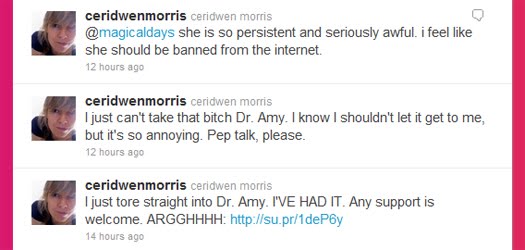
She’s not alone. Like many midwifery advocates, homebirth midwives and even some highly trained midwives, instead of responding to criticism of her empirical claims by defending them (or retracting them) as professionals are supposed to do, she whines that she is being treated unfairly. Her twitter feed is even more revealing on this point:

Very illuminating. She made a false statement, and I’m a “bitch” for pointing it out.

This is an example of a problem that poisons the natural childbirth blogosphere. Natural childbirth advocates believe any challenge is “mean.” They blithely write and post complete falsehoods and rather than regretting the misinformation they spread, they resent the people who point out the lies.

This phenomenon extends to those who are actual professionals of midwifery. There are few if any scientific controversies in midwifery. No one would be so “bitchy” as to point out to another midwife that her claims are false. This is also why it is impossible to expect that homebirth midwives can regulate themselves. The truth is meaningless for these people; the only thing that counts is “support.” Unless they are forced by publicity or legal authorities, they never condemn one of their own no matter how many babies die as a result of ignorance and incompetence.

Rather than addressing Ceridwen, who is frankly too immature to even understand that she is OBLIGATED to correct falsehoods in her own writing, I will address the editors of Babble:

It is time for Babble to assign a technical editor (a doctor) to vet bloggers’ material for factual accuracy. It is wrong to allow women who are have no medical (or even midwifery) qualifications to make unchecked factual claims about pregnancy and childbirth. The bloggers of Being Pregnant should be free to write about their personal experiences, their feelings and their opinions. However, when it comes to empirical facts, claims must be vetted for truthfulness. Clearly bloggers like Ceridwen Morris have no compunction about spreading absolute falsehoods and won’t even correct them when they are pointed out. Babble must accept responsibility for ensuring that its readers are receiving scientifically accurate information about pregnancy and childbirth.

Dr. Amy