Midwives: Ignore homebirth deaths

Homebirth midwives are worried. I keep posting accounts of homebirth deaths. Now you might think they were worried about the number of homebirth deaths, but you’d be wrong. Apparently homebirth midwives Janelle Wahlman of Birthsense and Kitty Ernst are worried that women might be influenced by these accounts. Therefore, they’ve set out to try to neutralize them.

Janelle is shocked, shocked that I might use accounts of homebirth deaths to illustrate the dangers of homebirth. After all, that’s the favored tactic of homebirth advocates to support homebirth. Every homebirth advocacy website and publication is chock to the brim with birth stories about wonderful, “empowering” homebirths. Evidently homebirth midwives want women to read only the stories with good outcomes; the many stories of homebirth death shouldn’t be published at all.

Too late for that. I already posted the story. The only thing left to do is to try to undermine the points that I have made. Unforuntely, it attempting to do so, Wahlman trots out many of the inane logical fallacies that characterize homebirth advocacy. Janelle starts by quoting me:

I understand that a tragic story is a more powerful way to convey risk than any set of statistics will ever be. That’s why I post stories of homebirth deaths, to illustrate that childbirth is inherently dangerous, that childbirth emergencies occur in low risk situations, and that being close to a hospital is often not close enough to matter.

She continues:

Let’s dissect Dr. Amy’s rationale for posting stories of homebirth deaths:

1. To illustrate that childbirth is inherently dangerous. I disagree with this point of view. Certainly, childbirth carries the potential for danger, but when birth is supported in such a way that interventions are avoided unless they are clearly beneficial, birth occurs safely the majority of the time…

She disagrees. She disagrees? Funny, but it isn’t a matter of opinion; it is an empirical fact. The idea that disagreeing means we can discard facts we don’t like is an immature error of cognitive reasoning favored by all believers in pseudoscience.

Second, the fact that childbirth “occurs safely the majority of time” is one of those meaningless truisms favored by homebirth advocates. Driving drunk “occurs safely the majority of time,” too. That doesn’t mean that driving drunk is safe.

2 Childbirth emergencies occur in low-risk situations. True enough. However, if this were really a primary concern of obstetricians, why would they not be present in the hospital, at the bedside of their patients, for the duration of every low-risk labor? …

The “but he did it” defense is well known to mothers everywhere. When confronted with an episode of wrongdoing, many young (and not so young) children attempt to defend themselves by accusing a sibling of doing something similar. Homebirth advocates further embellish this childish “defense” by insisting that no difference exists between home and hospital, since an obstetrician is definitely not present at home and might not be present at the hospital. That conveniently elides the fact that nurses, anesthesiologists and other obstetricians ARE present at the hospital and emergencies can be handles by doctors other than the patient’s personal physician.

3. Being close to a hospital is often not close enough to matter.

Sometimes babies die. Sometimes there are deaths that cannot be prevented, no matter where we give birth. Sometimes there are deaths due to negligence on the part of the midwife or doctor, no matter where the birth occurs.

This is probably the stupidest of the many stupid arguments advanced in support of homebirth. The fact that some babies die is NEVER a justification for the death of a specific infant. The key point about homebirth is that MORE babies die at homebirth than in the hospital. In fact, homebirth TRIPLES the risk of neonatal death. No amount of bleating that “sometimes babies die” justifies increasing the risk of preventable neonatal death.

Kitty Ernst wrote:

As always, [Amy’s blog post] points to the urgent need to get the “teams” working together, assure that who is with the mother is competent and working within a system of care – and stop arguing about the place of birth – AND collect and publish on-going, real-time data on what we all are doing! Once we do that the place of birth will become a non-issue.

No, there’s no need for “teams.” We already know that American homebirth midwives do not meet the most basic standards of education and training. We already know that homebirth with an American homebirth midwife TRIPLES the risk of neonatal death. We already know that homebirth with a CNM DOUBLES the risk of neonatal death. And we already know that MANA (the Midwives Alliance of North America)is withholding their own safety data that almost certainly shows that homebirth dramatically increases the risk of neonatal death.

Here’s what we do need:

We should ban direct entry midwifery.
We must counsel women that homebirth increases the risk of neonatal death.
We should force MANA to reveal their data to the American public.

If American women still want to choose homebirth after that, it’s their right to do so. But hiding homebirth deaths, dismissing homebirth deaths and attempting to justify homebirth deaths as Wahlman has tried to do, is precisely what we DON’T need.

Foreskin intact, heart missing

I understand that a tragic story is a more powerful way to convey risk than any set of statistics will ever be. That’s why I post stories of homebirth deaths, to illustrate that childbirth is inherently dangerous, that childbirth emergencies occur in low risk situations, and that being close to a hospital is often not close enough to matter. There’s nothing wrong with circumcision activists illustrating their concerns with stories of circumcision gone wrong, but there is something wrong with posting this on a mother’s website:

My heart sure doesn’t break for her. On the contrary, she got exactly what she deserved. If every baby who was mutilated died, it might put a stop to the practice. This so-called tragedy is good publicity for outlawing genital mutilation. I hope she feels guilty for the rest of her miserable life & my sympathy for her is ZERO.

This is just one of a long series of vicious comments posted by intactivists on the mother’s website in the hours following her baby’s death. That’s not education; that’s hatred. Anti-circ activists may revel in intact foreskins, but they should also have a heart.

Should circumcisions be banned? Well meaning people may think so, claiming that mothers who circumcise DESERVE dead babies in something else altogether. And bemoaning the fact that only a very tiny fraction of babies die from circumcision complications makes no sense at all. If intactivists oppose circumcision because it is purportedly too dangerous, they should not be wishing that it was more dangerous.

Baby Joshua was born with hypoplastic left heart syndrome, a severe, often fatal, heart defect. He had already survived two heart surgeries and was still in the hospital having a rocky recovery from his second heart surgery. His parents had been requesting circumcision, but it had been postponed repeatedly because doctors did not think he was stable enough to withstand the surgery, and because medications for his heart condition put him at greater risk for bleeding complications.

I can’t imagine why anyone thought that this was a good time to perform a circumcision. A first principle of surgery is that elective surgery should never be performed in the setting of an acute event. For example, it might be convenient to have that tummy tuck at the same time you are undergoing open heart surgery, but no doctor in his right mind would consent to do it because it dramatically increases the risk of complications and death.

There was no religious imperative for circumcision, and, in any case, Judaism is quite clear on the point that circumcision should not be done if the baby is ill or has a bleeding disorder. Long term protection against HIV is not really an issue in a baby struggling to survive a major cardiac defect. Therefore, this was essentially cosmetic surgery. I can’t envision performing cosmetic surgery on anyone recovering from heart surgery.

The baby did suffer bleeding complications and bled enough that a transfusion was being contemplated. Ultimately the baby suffered a cardiac arrest, and while it is not clear that the circumcision led to the cardiac arrest, it certainly didn’t help. Indeed, the stress and blood loss certainly could have been too much for a baby with a compromised heart to handle.

Is this a cautionary tale about circumcision? I’m not sure. It seems to me more like a cautionary tale about performing elective surgery on critically ill newborns. Nonetheless, it is entirely legitimate for “intactivists” to use this as a cautionary tale. It is entirely heartless, however, for them to post hateful comments on the mother’s website.

If this story illustrates anything, though, it is not the perils of circumcision, but rather the perils of posting on the internet. People who maintain personal blogs don’t seem to understand that they are not posting merely to a close circle of friends. Rather, they are posting to the WHOLE WORLD. If they do not want the whole world to be aware of their personal lives and to discuss their personal lives, they should not be posting details on the internet, at least not without password protesting their sites.

I am horrified and frankly incredulous that this tragedy has occurred. I wish it had not happened, but failing that, I wish the mother had not publicly posted it on the internet, exposing herself to the misery of having her personal decisions criticized by everyone from coast to coast.

How many dead babies does it take to convince a homebirth advocate?

You might think a nurse would know better. But evidently not and her infant daughter paid with her life.

… She told me the stories of her home birth experiences with her other 3 children and how she absolutely LOVED the labor experience. Anna knew we would all think she was absolutely insane for saying that, but didn’t care. She really is a free spirit and speaks her mind. She was studying to become a midwife herself and did not have much longer to go before she graduated.

Anna had a midwife. She had been found to colonized with group B strep. She had received a prescription for penicillin but it is not clear whether this was oral penicillin or the IV antibiotics that are needed during labor.

… Anna’s water broke at 9pm. She labored through the night at home… The next day she continued to labor and her midwife came to her house in the late afternoon. The midwife brought with her, the Doppler monitor to assess the babies heart rate. It was at that moment that they discovered the heart rate to be in the 60’s (normal fetal heart rates are about 120-160). This was alarming and Anna quickly got herself onto our unit. There they discovered that yes, the baby’s heart rate was in the 60’s. Without a way to know how long this had been going on they quickly got Anna admitted and began interventions to get the baby’s heart rate back to normal. It did return to normal for a while, but dropped again and would not come up. They rushed Anna back for a c-section in desperate attempts to save the baby’s life.

Anna had had ruptured membranes for more than 18 hours and it appears that she did not have IV antibiotics. She had labored for those 18 hours without checking the baby’s heart rate and by the time it was checked, the baby was having deep bradycardias (abnormally slow heart rate). She transferred to the hospital immediately, and, as we know, homebirth advocates think that is all that is needed to save a baby’s life. Evidently not.

As they cut into her uterus they quickly discovered the meconium the baby had passed as a result of being very stressed out, along with the umbilical cord tightly wrapped around the baby’s neck twice). They finally got the baby out (IT’S A GIRL) and passed her off to the resuscitation team… [S]he’d aspirated (breathed in) a lot of the meconium. Slowly her condition began to deteriorate… Dr’s and nurses struggled to save this baby girl’s life. They got her stable enough to be able to transport to another facility [for] more intensive care…

Within 12hrs of her arrival at the other facility. Anna lost her sweet baby girl. A result of sepsis and DIC, her sweet angel baby was gone forever.

This appears to be an entirely preventable death. While the mother was reveling in her freedom to labor in her own home, her baby was being ravaged by group B strep, AND asphyxiating because of a tight nuchal cord. Despite an expeditious transfer to the hospital, an emergency C-section, and expert neonatal resuscitation, the baby died.

As Anna’s friend, also a nurse, points out:

… I want everyone out there to know that you just don’t know what can happen at any given moment, and even if you live 5 minutes from the hospital, things can still go very very wrong and not turn out ok. Even with all of her knowledge as a RN working in L&D and a midwife in training, Anna could not stop this tragedy from happening.

Even among the tiny group of superstars in the homebirth movement, at least 3 have forfeited their babies’ lives in exchange for their philosophy. Laura Shanley, Janet Fraser and Ina May Gaskin let their babies die rather than seek medical care. And all continue to promote the philosophy that killed their own babies, staunchly insisting that their philosophy won’t kill yours.

How many babies have to die at homebirth before homebirth advocates wake up to the reality that homebirth kills babies?

Homebirth: like riding a motorcycle without a helmet

Who said:

For the record, no one is saying [hospitals] don’t provide safety benefits. They do. But, there is also evidence that there are safety risks…

Or how about:

Instead of confusing the public with [complication] statistics that have no relation to the ability of a [hospital] to provide enough safety to even think about a mandate, many officials don’t quote, or even know, whether [hospitals] have had an effect on the ratio of the number of deaths from [complications] as related to the number of [complications].

And let’s not forget this:

So why all the disinformation? Follow the money trail. The [healthcare] industry can’t control [complications], but they can control the number of [lawsuits]. This all dovetails nicely with the prejudice and propaganda against [homebirth].

Who made those statements? They were made by the folks at Bikers’ Rights Online.

Well, not exactly. The people at Biker’s Rights Online were talking about motorcycle helmets and their ability to prevent death from head injury, not the ability of hospitals to prevent death from childbirth complications. Amazingly, the arguments are exactly the same.

Don’t believe me? Let’s compare the major features of both arguments.

1. They cause more complications than they prevent.

This claim, if it were true, would represent a powerful argument. I’m not familiar with the scientific literature on motorcycle helmets, but the claim that motorcycle helmets cause more injuries and deaths than they prevent seems nonsensical on its face. No mechanism is even suggested whereby motorcycle helmets would cause injuries.

In the case of childbirth in hospitals, the claim is not nonsensical. One can imagine how a hospital might cause more injuries and death than it prevents. However, I am familiar with the literature on childbirth and hospitals, and that is very definitely not what it shows. There are masses of data, examined from every possible perspective, and all of it demonstrates the same thing. Hospitals have prevented millions of injuries and deaths related to childbirth. It is not coincidental that as the homebirth rate dropped from 95% in 1900 to less than 1% in 2000, the neonatal mortality rate dropped by 90% and the maternal mortality rate dropped by 99%.

2. No one has ever studied their safety.

According to Bikers’ Rights Online, “there is little data on the effects of a helmeted body in motion from a bike crash.” That is untrue, but it sounds compelling.

Homebirth advocates love to claim that “no one has ever studied the safety of hospital birth,” but that claim is every bit as fantastical.

3. It’s a conspiracy on the part of a powerful industry to make money.

It’s fun to smear people and entire industries with the accusation that their claims of safety mask a corrupt desire to profit at the expense of individuals. I don’t doubt that some industries are corrupt, and that some companies profit by harming individuals. But to go from the general to the specific requires more than accusations; it requires data, precisely what is missing from this argument.

Bikers Rights Online claims that helmet laws are a conspiracy of the insurance industry, a convoluted conspiracy at that. “The life insurance industry can’t control their car drivers from hitting us, but they can control the number of targets their drivers can hit by backing helmet laws that reduce riding.” In other words, according to Bikers Rights Online, helmets don’t prevent injuries and death, they just deter people from riding motorcycles and so motorcycle fatalities fall. You have to give those folks credit for creativity.

Homebirth advocates aren’t content to smear only one industry. They are even more creative. It’s the doctors! It’s the lawyers! It’s the insurance companies! Evidently millions of professionals have been recruited to prevent homebirths because they are afraid of losing money by losing patients. Or is it losing money by getting sued? Or is it losing money by paying out large malpractice settlements? It doesn’t matter. Someone is profiting from hospital births and that’s why everyone lies and says hospital births are safer. Strangely enough, the fact that the homebirth industry can only profit by convincing women that homebirths are safe is simply ignored.

4. It’s a matter of personal freedom.

It’s my body and I have the right to do with it what I want! The same argument can be made by a motorcyclist and a homebirth advocate. And the same retort can be given: it’s not just you; others will pay for your decision, with money or with their lives.

In the case of motorcycle helmets, there is almost no one who can pay out of pocket for a traumatic brain injury. First the insurance company pays millions, raising the cost of healthcare. Then the government foots the bill for millions more, passing the costs along to taxpayers. The decision to forgo a motorcycle helmet is only a personal decision so long as you intend to pay the costs of your choice. If you expect the rest of us to pay for your care, then we have a right to insist that you make safer choices.

The case of homebirth is more complicated. It is a woman’s right to control her own body, and were she the only one to be harmed by her decision, very few people would care what she chooses. But the baby may live or die based on her decision. Indeed it is approximately 100 times more likely for a baby to die in childbirth than for a mother to die. The rest of us have an interest in protecting that baby. It may not override the mother’s right of autonomy, but just because her decision to avoid a hospital is legally allowed does not mean that it is morally correct.

The folks at Bikers Rights Online call themselves “freedom fighters” as if there were a constitutional right to sustain a traumatic brain injury and have the rest of us pay for it. Homebirth advocates like to think of themselves as freedom fighters, too, explicitly adopting the language of abortion rights activists and insisting that they have a “right to choose.” They do have a right to choose, but what they’re choosing is very similar to riding a motorcycle without a helmet … except in their case, it’s usually the baby who sustains the brain injury, not the person who made the choice.

Jennifer Block: to defend homebirth, hide data

I guess the folks at The Daily Beast felt bad.

Last month, The Daily Beast published a searing indictment of American homebirth. Danielle Friedman, writing for The Daily Beast, pointed out:

While most home birthers rave, even evangelize, about their choice, for a small percentage, the fantasy becomes a nightmare. Beyond the statistics, these women’s stories often go untold. They’re not publicized by home-birth advocates …

This month, they’ve given a professional homebirth advocate the opportunity to respond.

And Jennifer Block responds in the way that any advocate of homebirth responds: leave out the most important information!

Block, like most homebirth advocates, is deeply distressed about the recent international study that shows the planned homebirth has triple the rate of perinatal mortality of comparable risk hospital birth. She trots out all tired arguments that are standard homebirth trope: its a conspiracy! One doctor agrees with her! (although 99+% of doctors disagree). Wacky homebirth advocates like The Feminist Breeder agree with her!

But Block deliberately leaves out the two most important pieces of information about American homebirth:

1. Homebirth DOES triple the rate of neonatal death.

That’s what all the existing studies of American homebirth show and that’s what the US national data show. The CDC has been collecting data on homebirth since 2003. The data is publicly available on the CDC Wonder website and it shows that PLANNED homebirth is the most dangerous form of birth in the US. Homebirth with an American homebirth midwife has triple the neonatal death rate of comparable risk hospital birth. That finding has been replicated in every single year for which data is available.

2. The Midwives Alliance of North America (MANA) refuses to publish the safety data that THEY COLLECTED.

MANA (Midwives Alliance of North America) the trade organization for direct entry midwives spent the years 2001-2008 collecting extensive data. In fact MANA collected the same data in 2000 and handed it over to Johnson and Daviss for the BMJ 2005 study. Over the years MANA repeatedly told its members that more extensive safety data was forthcoming, encompassing almost 20,000 CPM attended homebirths. And MANA has announced completion of the data collection and publicly offered the data to others.

So why haven’t we seen it? MANA will only reveal the data to those who can prove they will use it “for the advancementhomebirth advocates are condemning the publication of existing safety data from other studies while REFUSING to release their own safety data. There is nothing that more powerfully demonstrates homebirth advocates contempt for safety and contempt for the truth.

I have repeatedly challenged Jennifer Block to publicly debate the safety of homebirth (Jennifer Block: How about a debate?). And she has repeatedly ducked, going so far as to claim: “Non-scientists “debating” the science does a disservice to both the science and the women caught in the middle.”

She obviously thinks she know enough science to write a book promoting the safety of homebirth, run a website promoting the safety of homebirth, write articles in magazines and on websites like The Daily Beast promoting the safety of homebirth, but she doesn’t think you know enough to debate the scientific evidence about the safety of homebirth? If she doesn’t know enough to debate the safety of homebirth, how does she know enough to proclaim the safety of homebirth?

It’s not difficult to figure out the answer to that question. She knows enough to proclaim the safety of homebirth when she can ignore the existing scientific evidence and national data. No one knows enough to defend the safety of homebirth if they’re not allowed to hide the truth.

Ina May’s acolytes spew misinformation far and wide

The great irony of the natural childbirth and homebirth movements is that advocates think they are “educated.” As I have said many times in the past, most of what these women think they “know” is factually false. That’s because all their information comes from celebrity natural childbirth and homebirth advocates who misinterpret, misrepresent or flat out fabricate their “facts.”

Recent examples include Henci Goer thoroughly misrepresenting the Friedman Curve while simultaneously illustrating her lack of knowledge of the most basic statistical concepts (Anatomy of a natural childbirth smear), Amy Romano demonstrating a total lack of understanding of both pelvic trauma and basic research (How Lamaze promotes misinformation), and Rixa Freeze, gleefully transmitting what was obviously false information without bothering to source it or check its accuracy (Birth of a natural childbirth lie). But when it comes to misinformation, no one can hold a candle to self proclaimed midwife Ina May Gaskin. Ina May just makes it up as she goes along.

No one in their right mind ought to expect scientific accuracy from a woman who declares (In Spiritual Midwifery):

… Pregnant and birthing mothers are elemental forces, in the same sense that gravity, thunderstorms, earthquakes, and hurricanes are elemental forces. In order to understand the laws of their energy flow, you have to love and respect them for their magnificence at the same time that you study them with the accuracy of a true scientist.

The invocation of mysterious forces, “energy flow” and intentional biologic processes marks her as a garden variety quack. Yet natural childbirth and homebirth advocates continue to believe her anyway.

An article in today’s Guardian, I was pregnant for 10 months, by Viv Groskop, is typical of the junk that emanates from Ina May, and broadcast far and wide. The author of the article went 20 days postdates before giving in to her doctor’s plea to be induced. The author is proud that her baby did not die, and thinks this means something. Of course that’s like refusing to belt your child into the car and then declaring proudly that the baby survived the trip to the grocery store intact. It demonstrates the classic NCB ignorance of relative risk. In their minds, every risk is either 0% or 100%. So if their child survives their foolishness, they think they have “proven” that the risk does not exist.

Having failed to kill her own baby, the author wonders whether induction for postdates is unnecessary.

The US midwifery guru Ina May Gaskin thinks so. She believes that every baby will come in its own time, and she is currently campaigning for 43 weeks – rather than 42 – as the definition of “late”. The dates in themselves, says Gaskin, do not indicate the need for induction.

Ina May’s claim reflects both a lack of basic knowledge (why 40 weeks is considered the standard length of pregnancy) and a touching though deadly naivete that insists that changing the definition of a phenomenon will change its outcome.

The author invokes Ina May’s arguments (all false) for changing the definition of postdates:

Naegle’s rule on length of pregnancy dates back to the 1800’s.
We lack evidence on what happens after 42 weeks since few women go beyond.
The claim that stillbirth risk doubles is based on data from 1958.

Ina May and her acolytes clearly don’t bother with the scientific literature. If they did, they would know that the US looks at the data each and every year and publishes an elaborate (and free) analysis of it. The most recent analysis comes from 2005, not 1958. It’s entitled Fetal and perinatal mortality, United States, 2005 by MacDorman et al.

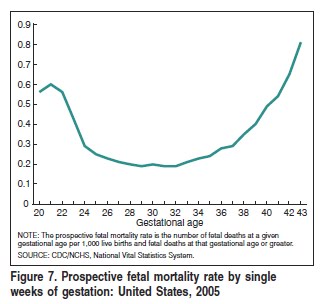
It contains two rather compelling graphs. The first plots stillbirths against gestational age.

As you can see, the stillbirth rate actually begins to rise at 36 weeks. At that point, the risks associated with early delivery outweigh the risk of stillbirth. The stillbirth rate continues to rise after 40 weeks, and begins to rise precipitously even before 42 weeks. So much for the claim that the current recommendations are based on data that is more than 50 years old.

Ina May’s accolyte complains that the induction rate has been rising each and every year. That’s true in the UK and that’s true in the US. But look what has happened during the same period of time.

The graph shows that the stillbirth rate has dropped each and every year, but not all stillbirths, only late stillbirths.

The fetal mortality rate for 28 weeks of gestation or more declined by 29% from 1990–2003, but did not decline significantly from 2003–2005. In contrast, the fetal mortality rate for 20–27 weeks of gestation has changed little since 1990. Thus, nearly all the decline in fetal mortality from 1990 to 2003 was among fetal deaths of 28 weeks of gestation or more.

The increased rate of induction has been accompanied by a decrease in late stillbirths. This is the reason why inductions are recommended. They successfully do what they are intended to do.

The piece in the Guardian is a classic of natural childbirth advocacy. A layperson cheerfully transmits absolute garbage from a celebrity natural childbirth advocate who made it all up. That’s what happens when “educated” natural childbirth advocates “educate” each other.

The roommate from hell

One of the hardest things about parenting is letting go. We know so much more about the world than our children do, how it can be a cruel and disappointing place, that unscrupulous and evil people exist, that dreams can be crushed. For parents, sending a child to college inspires both excitement and fear. It is exciting to launch a child into the wider world, but no one lets a child go without a nagging feeling of fear. Will he be able to manage? Will she find friends? Will they be happy?

In their worst nightmare, no parent could imagine what happened to Rutgers freshman Tyler Clementi. His roommate turned out to be a vicious bully, a young man who deliberately devised and carefully planned a public humiliation that combined homophobia, voyeurism and technology in a mix so potent that Tyler literally jumped off a bridge to his death to escape the pain.

No doubt Tyler Clementi felt anxious about disclosing his sexuality to his roommate, Dharun Ravi. Perhaps he anticipated derision or disgust. Perhaps he anticipated derogatory remarks. But surely he did not anticipate that Ravi would hide a webcam with the intent of videotaping Clementi’s sexual encounters. He couldn’t have imagined that Ravi would broadcast the video around the world in real time. And surely, he never could have dreamt, even in his worst nightmares, that Ravi would Twitter the news, inviting friends and strangers to view the video feed. In order to imagine the crime that was committed against him, he would have had to believe that his roommate was stunningly cruel, indeed depraved.

Where does someone like Dharun Ravi come from? What motivated him to stage an elaborate public humiliation of someone he barely knew? Was it homophobia or was it simply pathological cruelty? It wasn’t because he was drunk or stoned and didn’t understand the ramifications of what he was doing. It was planned in advance and done more than once. And what about next door neighbor Molly Wei? What form of pathology made her willing to participate by using her computer to broadcast the feed to the world? Did she think it was funny? Did it make her feel powerful?

It is tempting to argue that there is nothing new under the sun. Bullying has always existed. Homophobia has always been tolerated and often encouraged. New technologies have merely opened up new vistas for bullies. Yet something about this crime seems different and it isn’t just that webcams and computers were involved. Strip away the technology and we are left with pointless, heartless cruelty. What made Ravi and Wei do it? Did they set off for college with a mental to do list: get good grades, make new friends, torture innocent classmates?

And how do we as parents protect our children from such devastating attacks? Some newspaper reports claim that Tyler Clementi asked to be moved to another room with a different roommate, but Rutgers refused. I have to believe that officials at Rutgers would have honored Clementi’s request if they had understood that he was gay and his roommate was homophobic, but should disclosure of such intimate details really be necessary just to get a room change? How can colleges expect to create a welcoming environment for gay and lesbian students if they require those students to publicly out themselves in order to have their pleas heard by the university?

In the weeks and months ahead, we will undoubtedly get answers to some of our questions about the backgrounds and motivations of Ravi and Wei. But I doubt we will ever find the answer to the question at the heart of this tragedy. What motivated two young adults, who apparently had every advantage our society could offer, to display such startling cruelty toward another human being?

Childbirth prayers

Natural childbirth advocates like to pretend that childbirth is inherently safe, that everyone prior to the modern age appreciated that fact, and that childbirth dangers were created by and large by obstetricians. Not only does that display a profound lack of knowledge about childbirth, it also betrays a profound lack of knowledge about history. Childbirth is and has always been, in every time, place and culture, a leading cause of death of young women, and everyone prior to the advent of “natural” childbirth was quite clear on that fact.

The inherent danger of childbirth is reflected in demographics (maternal mortality rates of 1% or more), law (many women wrote wills prior to the birth of a child) and literature (maternal death was common among both female characters and female authors). And as Professor Delores Platt found, it is also reflected in religion. Pratt has published a paper entitled Childbirth Prayers in Medieval and Early Modern England. As Pratt explains:

… [A] woman on average would have run a 6 to 7 per cent risk of dying in childbed during her procreative years. For the 25-34 age group, however, 20 per cent of deaths were attributed to death in the childbed. Thus, for a certain age group, death in childbirth was a relatively common occurrence… Medieval and early modern women would have witnessed a number of childbirths and one wonders how many deaths they would have witnessed or been aware of… All of these factors created a fear of childbirth and one must situate the use of childbirth prayers within this context.

The origins of English childbirth prayers was diverse, reflecting a variety of culture, but a uniformity of experience. Prayers were drawn from Greek, Roman and Anglo-Saxon traditions, and well as from local oral tradition. As the prayers themselves indicate, fear of death and suffering were fundamental features as reflected in the subtitle of Pratt’s paper: “For drede of perle that may be-falle.”

In an age before obstetricians, childbirth was recognized as agonizing:

Have mercy upon me, O Lord, have mercy upon me thy sinful servant, and woeful hand-maid, who now in my greatest need and distress, do seek thee: behold, with grievous groans & deep sighs, I cry unto thee for mercy.

As life threatening to the mother:

O My Lord God, I thank thee with all my heart, wit, understanding, and power, for thou hath vouchsafed to deliver me out of this most dangerous travail …

And as dangerous for the baby, as indicated by this charm meant to be uttered while stepping over her husband:

Up I go, step over you
with a living child, not a dead one,
with a full-born one, not a doomed one.

Pratt concludes:

… In the medieval and the early modern period pregnancy was feared and the chance of dying was much greater than today. Women, husbands, and the broader community readily embraced and maintained the use of childbirth prayers and associated rituals… Whether due to psychological, social or divine agency, childbirth prayers and rituals helped deal with the stresses and dangers of childbirth…

The philosophy of natural childbirth is replete with misinformation and wishful thinking, but it rests fundamentally on a series of lies: that childbirth is inherently safe, that childbirth pain is the result of cultural conditioning, and that childbirth interventions exist for the benefit of obstetricians and to the detriment of women and children. As this study of childbirth prayers demonstrates, these lies fly in the face of both scientific knowledge and historical understanding.

Birth of a natural childbirth lie

Rixa Freeze should know better. The woman has a PhD. True, it’s not in a scientific discipline, but the social sciences also insist on corroborating a claim before publishing it. But evidently, some claims are so delicious, comport so well with the fantasies of natural childbirth advocates, that the rules of evidence are discarded.

Rixa wrote a post that made an astounding claim: an extraordinary number of women supposedly died of placenta accreta last year in the state of New Jersey alone. The number is so large that it is the equivalent of all the women in the entire country who died of all possible placental complications in any previous year. What’s the source for that claim? Rixa quotes another NCB blogger who quotes a local TV station who misquotes an obstetrician, claiming that he said that 40 women died of accreta in the past year. The doctor says nothing of the kind in the video, and probably told the interviewer that 40 women in NJ HAD a placenta accreta last year. It is unclear if ANY women died as a result. Evidently, TV interviewers for local affiliates are now sources of “authoritative” knowledge.

The misquoted claim should have aroused Rixa’s suspicions since it is so extraordinary. In the last year for which we have complete mortality data, 40 women in the entire country died of placental complications, of which accreta was only a subset. The entire state of New Jersey averages only 12 deaths a year. If the maternal mortality rate of New Jersey had more than tripled and if primary cause of mortality was a relatively rare entity, that should have set off alarm bells throughout the public health establishment. It should be front page news in publications ranging from Morbidity and Mortality Weekly (MMWR) to The New York Times. Yet the claim is made no where else.

No one has reported that New Jersey maternal mortality has risen. No one has reported that the incidence of accreta has risen. And certainly no one has reported that an extraordinary number of women died of accreta in New Jersey last year. But multiple natural childbirth blogs have “reported” this, all citing the video in which the interviewer misquotes the doctor.

I don’t expect the average NCB blogger to know enough about maternal mortality and about science and statistics to question the claim, and to attempt to source it properly. Rixa, though, almost certainly knows better. And if she didn’t know before, she certainly knows now, since I posted that the claim is unsubstantiated and was almost certainly a misquote. Indeed I posted twice, and both times Rixa removed the information. When professionals realize they have made a mistake, they correct the error. But evidently NCB advocates don’t worry about professional ethics. If a lie is appealing, they publish it, and if someone tries to tell the truth, they delete it.

This is an object lesson on why it is impossible to become “educated” about childbirth by reading NCB literature. NCB advocates write bald faced lies, either deliberately or inadvertently. What’s worse is that when evidence comes to light that they have made a false claim, they delete the evidence instead of the claim.

Vote now: did an epidural affect bonding with your baby?

One of the most pernicious lies spread by natural childbirth advocates is the claim that childbirth pain promotes bonding, and pain relief interferes with bonding. This lie originated with Dr. Michel Odent, although he never bothered to supply even the most basic scientific evidence to support it.

The lie serves two purposes. First, it is a backhanded way to scare women into refusing epidurals. Despite reams of nonsense about “natural” ways to reduce pain, NCB advocates are well aware that most of these methods are ineffective. The average woman when encountering agonizing pain is going to want pain relief. How to discourage this normal human response? NCB advocates have hit upon the idea of telling women that epidurals will decrease their ability to properly mother their babies.

The second purpose of this pernicious lie is that it offers natural childbirth advocates yet another way to demean women who make different choices than they make. NCB advocates can tell themselves and each other that refusing pain relief is a loving choice, and that they have a head start over other mothers in developing a relationship with their infants.

Those of us in the real world know that pain in childbirth does not promote maternal-infant bonding, indeed has nothing to do with maternal-infant bonding. I’d like to give you an opportunity to be heard. I’ve posted a poll in the sidebar inviting women to weigh in on whether they believe that pain relief affected bonding with a newborn. Natural childbirth advocates claim to be big believers in “embodied” knowledge, which is a fancy way of saying “personal experience.” The poll will reflect women’s embodied knowledge about pain relief and bonding.

Please feel free to write about your personal experiences in the comment section. If embodied knowledge is indeed authoritative, NCB advocates ought to pay attention to the results of the poll and the stories of personal experiences.

Dr. Amy