Natural childbirth and immature cognitive errors

img_1472

I wrote yesterday about immature errors of cognitive reasoning. I cited a paper by Lindeman and Aarnio explaining that the immature errors of cognitive reasoning characteristic of childhood can extend into adulthood. Such immature cognitive errors are fundamental to natural childbirth advocacy.

Lindeman and Aarnio explain how immature cognitive errors lead to belief in supersition, paranormal events and various form of “alternative” health:

… [M]ental contents … have the attributes of physical or animate entities, resulting in the possibility that a thought can touch objects (psychokinesis) and move by itself (telepathy).

… Moreover, in superstitions a force is an equally important factor as in lay physics but here force is regarded as a living and intentional entity. For example, feng shui teaches us that erroneous furnishings may absorb vital force .., and astrologers suggest that planets have living energy, which pushes and pulls on human beings … Thus, in superstitious thinking biological and physical processes are no longer non-intentional but they are seen as having a purpose, that is, as directed toward certain goals …

Simply put, these immature cognitive errors are:

… category mistakes where the core attributes of mental, physical, and biological entities and processes are confused with each other.

It’s almost as if the researchers were referring to Ina May Gaskin, the widely revered doyenne of natural childbirth advocacy.

In Spiritual Midwifery, Gaskin offered this delicious bit of goofiness:

We have found that there are laws as constant as the laws of physics, electricity, or astronomy whose influence on the process of the birthing cannot be ignored. The midwife or doctor attending births must be flexible enough to discover the way these laws work and learn how to work with them. Pregnant and birthing mothers are elemental forces, in the same sense that gravity, thunderstorms, earthquakes, and hurricanes are elemental forces. In order to understand the laws of their energy flow, you have to love and respect them for their magnificence at the same time that you study them with the accuracy of a true scientist. A midwife or obstetrician needs to understand about how the energy of childbirth flows – to not know is to be like a physicist who doesn’t understand about gravity.

Mysterious forces, check.
Energy flow, check.
Intentional biologic processes, check.

For most adults, such immature cognitive errors are modified by analytical reasoning. Immature cognitive errors may persists when intuition is given priority over analytical thinking. Lindeman and Aarnio explain:

… [A]nalytical processes and rational knowledge do not replace intuitive processes and contents as children mature. Rather, both types of processes and knowledge exist and develop throughout one’s life, and therefore two conflicting beliefs can coexist in an adult’s mind, one more rational and verbally justifiable (e.g. “Death is final”), the other operating more automatically and being more resistant to logical arguments (e.g., “The soul continues to exist though the body may die”).

… [P]revious studies have shown that superstitions are more strongly related to a tendency to rely on intuitive thinking than to analytical thinking, and that the
same magical beliefs that are typical to preschool children are implicitly preserved and activated among adults even though the representations have been devaluated in the face of more rational knowledge.

Natural childbirth advocates are explicit in privileging intuition above analytical thinking. Indeed, according to Robbie Davis-Floyd, a sociologist who has written extensively on natural childbirth and midwifery, intuition is authoritative knowledge In a little jewel of pure gobbledy gook, Davis-Floyd explains that for “postmodern” midwives:

Intuition … emerges out of their own inner connectedness to the deepest bodily and spiritual aspects of their being, as well as out of their physical and psychic connections to the mother and the child. The trustworthiness of intuition is intrinsically related to its emergence from that matrix of physical, emotional, and spiritual connection–a matrix that gives intuition more power and credibility, in these midwives’ eyes, than the information that arises from the technologies of separation… [T]heir deep, connective, woman-to-woman webs, woven so lovingly in a society that grants those connections no authority of knowledge and precious little conceptual reality, hold rich potential for restoring the balance of intimacy to the multiple alienations of technocratic life.

It’s no wonder then that immature cognitive errors thrive in an environment that ascribes such wondrous powers to intuition.

The multiple immature cognitive errors that constitute natural childbirth advocacy can be summed up in the mantra “trust birth.” The notion of trusting birth is central to natural childbirth advocacy; there is an organization devoted to promoting trust in birth, facilitators are trained to teach others to trust birth and there is a yearly Trust Birth Conference.

The charge to trust birth rests on classic immature cognitive errors. Birth, a natural process, is portrayed as a living intentional entity capable of inspiring, expecting and rewarding trust. Implicit in the call to trust birth is the belief that specific thoughts (in this case trust) can bring about specific outcomes (an uncomplicated vaginal birth). It is an exhortation to deliberately ignore analytical reasoning about the reality of childbirth and its inherent dangers,and privilege positive intuitions.


Immature cognitive errors characterize belief in pseudoscience

img_1473

What links belief in tarot cards, UFOs and vaccine rejectionism? Yes, they are all forms of superstitious or magical thinking, but are there characteristics that predict who will believe in such nonsense? That’s one of the questions that psychologists Marjaana Lindeman and Kia Aarnio seek to answer in their paper Superstitious, magical, and paranormal beliefs: An integrative model.

Lindeman and Aarnio postulate that believers in superstition, paranormal phenomena and pseudoscience make similar cognitive errors, errors that can be characterized as a holdover of the immature errors of reasoning made by children still learning about the natural world. They label these errors “ontological confusions.” The authors explain:

According to developmental psychologists, there are three major sorts of knowledge that determine children’s understanding of the world: intuitive physics, intuitive psychology, and with certain reservations, intuitive biology…

Developmental studies show that core knowledge of physical entities includes the notion that the world is composed of material objects, which have volume and an independent existence in space. The core of intuitive knowledge about psychological entities, in turn, consists of knowledge that animate beings are intentional agents who have a mind… In addition, small children understand that the contents of mind, such as thoughts, beliefs, desires, and symbols, are not substantial and objective but non-material and mental, and that they do not have the properties they stand for…

As regards biological phenomena, it seems that at least notions like contamination and healing can be characterized as core knowledge…

The authors argue that belief in superstitions, paranormal phenomena and pseudoscience conflate this knowledge across categories and constitute ontological confusions. Therefore:

… [M]ental contents … have the attributes of physical or animate entities, resulting in the possibility that a thought can touch objects (psychokinesis) and move by itself (telepathy).

… Moreover, in superstitions a force is an equally important factor as in lay physics but here force is regarded as a living and intentional entity. For example, feng shui teaches us that erroneous furnishings may absorb vital force .., and astrologers suggest that planets have living energy, which pushes and pulls on human beings … Thus, in superstitious thinking biological and physical processes are no longer non-intentional but they are seen as having a purpose, that is, as directed toward certain goals …

These cognitive errors can be found in a variety of “alternative” health treatments that are predicated on the belief that thought can alter health outcomes and that touch can convey healing powers. Similar cognitive errors underlie homeopathy (“like cures like”), reiki, acupuncture and healing by touch (invoking healing “forces” or “energies”), belief in herbs (“the natural form of the molecule differs from the synthetic form”), and distance healing and birth affirmations (the belief that thoughts can modify physical events).

Errors in intuitive thinking are usually corrected by giving preference to analytical thinking. While belief in healing “energies” or healing thoughts may have intuitive appeal, such beliefs are clearly contradicted by what we know about physics and biology. But those who give priority to intuition, and those who lack understanding of physics and biology, are far more likely to accept superstitions, paranormal beliefs and belief in pseudoscience.

The authors investigated the beliefs and thinking styles of 250 individuals, divided evenly between those who were superstitious and those who were skeptics.

… Compared with the skeptics, the superstitious individuals assigned more physical and biological attributes to mental phenomena. Thus, they understood such notions as a mind that can touch objects and an evil thought that may be contaminated more literally than the skeptics. Superstitious individuals also assigned more mental attributes to water, furniture, rocks, and other material things than skeptics did and accepted that entities like these may — literally, not only metaphorically — have psychological properties such as desires, knowledge, or a soul…

The results also showed that various manifestations of the beliefs, for example beliefs in astrology, feng shui and paranormal abilities of human beings, were associated with ontological confusions and with higher intuitive thinking … The discriminant analysis indicated that the best measures to distinguish believers from skeptics were ontological confusions, and secondarily intuitive thinking…

Believers in pseudoscience don’t hide their reliance on intuition. Indeed, they are quite clear in giving preference to intuition over analytical thinking and represent intuition as an equally valid way of knowing about the world. Jenny McCarthy bases vaccine rejectionism on her intuition. Many natural childbirth advocates exhort reliance on intuition to justify risky childbirth choices. Yet far from being beneficial, this overt reliance on intuition leads to a plethora of false beliefs including superstition, belief in paranormal phenomena and belief in pseudoscience.

… [S]uperstitious individuals’ knowledge about the world is inaccurate in that their early, as yet undeveloped intuitive conceptions about psychological, biological, and physical phenomena have retained their autonomous power and co-exist side by side with later acquired rational knowledge…

This goes a long way toward explaining why belief in pseudoscience is often evidence-resistant. In addition to the fact that believers in pseudoscience lack knowledge of science and statistics, they often give priority to intuition above analytical thinking. Even after a deficit of empirical knowledge is remedied, advocates of pseudoscience persist in relying on intuition.

Childbirth, parenting and the subversion of expertise

“Trust yourself, you know more than you think you do.”

This is the first line of Dr. Spock’s revolutionary advice book for parents. It was revolutionary in its time because it counseled a new way of looking at parenthood. Prior to Dr. Spock’s emergence on the scene, the prevailing view of “good” parenting involved following the views of parenting experts. For example, mothers were advised to feed infants according to a schedule, not on demand, and to feed them scientifically superior infant “formula” not breastmilk.

Dr. Spock’s views represent a rejection of radical reliance on experts and suggested that parents had their own, equally valid, sources of knowledge: their personal experiences and their understanding of their own infants. In the intervening decades, Dr. Spock’s advice has been taken to its own radical extreme. Indeed, the entire concept of “expertise” has been deliberately subverted. Now, particularly in natural childbirth and vaccine rejectionist circles, parents are not merely encouraged to substitute their knowledge for that of experts; they are encouraged to believe that they are experts. In other words, rather than supplementing expert advice with parental knowledge, some mothers insist that parental knowledge is expert advice.

Subverting “expertise” in this way serves several important functions. By insisting that they are “experts,” natural childbirth advocates, vaccine rejectionists and others can simultaneously embrace the esteem in which science is viewed and reject the actual scientific evidence. Second, they can use their “expertise” to validate their own parenting choices. Third, they can enhance their own self-esteem by elevating mothering to be an expert, albeit unpaid, occupation.

Charlotte Faircloth argues that this new approach to parental expertise reflects contemporary liberal political philosophy:

In contemporary liberalism the responsible moral actor is not one who conforms blindly to expert or even popular recommendations. Rather, as Murphy notes in The Sociological Review (51[4]), “she is expected to subject such recommendations to evaluation and questioning, operating as an informed consumer.” Those who are not reflexive, informed consumers are deemed irresponsible or in need of education.

If that sounds familiar it’s probably because it is one of the mantras of both natural childbirth and vaccine rejectionists movements. The “best” mother is not the one who accepts expert advice, but the mother who “educates” herself by imbibing the beliefs of those who reject expert advice.

But what is laudatory in the political sphere is not necessary valuable in the scientific sphere. The responsible citizen should subject political information to evaluation and questioning and should vote based on her own beliefs, not the recommendations of politicians. When it comes to determining which political candidate best represents her beliefs, the individual is the expert. That’s not the case with science. Determining the whether vaccines are effective requires consulting the literature, not communing with one’s personal intuitions.

The assault on scientific expertise is hardly a secret in natural childbirth advocacy. Robbie Davis-Floyd has devoted her sociology career to demeaning authorative knowledge and replacing it with “embodied knowledge.” In a chapter in Davis-Floyd’s book Childbirth and Authoritative Knowledge, Browner and Press write (Chapter 4):

Recent attention has focused on strategies by the institution of biomedicine to attain medical hegemony in U.S. society… Drawing on Jordan’s concept of authoritative knowledge (AK), this account examines the circumstances under which a group of pregnant women in the U.S. facilitated biomedical expansion by accepting the advice offered by their prenatal care providers. We consider the significance of competing forms of knowledge, particularly” embodied knowledge …”

We define embodied knowledge as subjective knowledge derived from a woman’s perceptions of her body and its natural processes as these change throughout a pregnancy’s course. Jordan’s pioneering work documented how a group of California laywomen used embodied knowledge to accurately diagnose their own pregnant state prior to biomedical confirmation. The women employed a variety of phenomenological indicators as diagnostic criteria including breast enlargement or soreness, nipple tenderness, feelings of extreme “heaviness” or bloating, food cravings, and intolerance to particular foods or smells. Other research found that women in the Colombian city of Cali used these same phenomenological indicators as well as other more idiosyncratic ones such as skin discolorations and pubic itching to diagnose their pregnancies.

Jordan’s conceptualization of AK frames our discussion. She defines AK as rules that carry more weight than others “either because they explain the state of the world better for the purposes at hand (‘efficacy’) or because they are associated with a stronger power base (‘structural superiority’), and usually both.” … In situations of structural inequality, however, one set of rules or form of knowledge often gains authority, devaluing and delegitimating others in doing so…

This account is overtly political, misrepresents medical knowledge, and is downright bizarre. “Embodied knowledge” is nothing more than personal symptoms. Medicine does not deny the validity of symptoms, merely their specificity. A urine HCG pregnancy test represents authoritative knowledge in this setting; embodied knowledge includes “skin discolorations and pubic itching.” There is no doubt that the authoritative knowledge represented by a pregnancy test is far more reliable than any particular symptoms of pregnancy.

If this is their best example, the entire concept of “embodied” knowledge is hardly more than a joke. Physically experiencing symptoms does not constitute “expertise,” does not accurately reflect reality (a woman can experience pregnancy symptoms without being pregnant) and is utterly unreliable. Experiencing pregnancy symptoms does not turn a woman into an expert on pregnancy. If that were the case, we could all be experts on architecture by living in houses.

This subversion of both expertise and knowledge may boost the self esteem of its promoters, but it does nothing to improve the lives of children. Dr. Spock was right; trust yourself, you know more than you think you know. But there’s a caveat: What you know does not represent the sum total of all knowledge on the subject. It’s worth consulting experts and paying attention to expertise. And if you want to be “educated,” you can’t take a short cut by pretending that what you already know is enough. You have to do the hard work of learning science, statistics and the actual subject under discussion, whether it is obstetrics or immunology.

Why don’t obstetricians spend more time enjoying the scenery?

It’s a bit ironic that pilots, the people who spend the most time traveling above the magnificent landscape that is our planet earth, spend very little time appreciating the scenery. That’s because they are trained to always be on guard for unexpected emergencies. While the passenger in a jumbo jet traversing the continent can admire the majesty of the Rocky Mountains, the desolation of the Great Salt Lake or the endless expanse of the Great Plains, the pilot is busy checking the weather, the readouts on his console and completing the endless routines and subroutines to make sure that the flight is on the correct settings, at the correct altitude and nowhere near other planes.

Most of us appreciate the pilot’s attention to detail. It gives us an opportunity to enjoy the magnificence of our continent without worrying whether we will arrive safely at our destination. Can you imagine people berating the airlines that the biggest problem with flying is that the pilots don’t fully appreciate and give themselves over to the magnificence of the scenery? That the pilots waste time trying to prevent emergencies that rarely happen? That pilots ruin the flying experience by refusing to fly over the most exciting natural wonders if risk factors like fog or high winds are present?

It’s hard to imagine people complaining that pilots worry too much about safety, but natural childbirth advocates might be different. After all, their chief complaint about obstetricians, whom they hire specifically to pilot them through the far more dangerous territory of childbirth, is that they fail to appreciate the wonder of childbirth and waste time trying to prevent emergencies that rarely happen. Even worse, they can’t be persuaded to ignore risk factors merely to get a glimpse of childbirth in all its natural wonder.

Coincidentally, the biggest problem faced by pilots and obstetricians alike is nature. Wind, rain and fog are entirely natural, yet they can wreak havoc on a plane flying at altitude or a plane trying to land. Pre-eclampsia, hemorrhage and breech babies are entirely natural, yet they can turn childbirth from a blessed event to a life threatening disaster without warning.

Flying is not a disease, right? Why waste time worrying about and preparing for things that rarely go wrong? Sure pilots are specialists in flying and landing planes in the most treacherous circumstance, but do we really need experts in disasters to superintend every flight? Wouldn’t it make sense to hire pilots who are “experts in normal flight” for most trips? And if those “experts in normal flight” get into trouble because of an unexpected storm, they can always call the tower for additional help, right?

And what’s up with all those delays for mechanical problems? Airplanes have zillions of moving parts. Is it really worth interfering with an airplane just to make sure that every single one of them is working properly. How likely is a plane crash anyway? Why not take off and “trust flight”?

Think of all the money we could save if we hired “experts in normal flight.” And it’s not just because we could pay them less. We’d use far less expensive technology. Do we really need all those fancy dials and readouts in every cockpit?. They’re only useful in a few dangerous situations and those situations don’t occur in most flights. The “experts in normal flight” could prepare for emergencies: they could carry those funny plastic oxygen masks with them. And you could still use your seat cushion as a flotation device in the rare event of a crash landing in water.

Instead of wasting all their time checking and rechecking for things that probably won’t go wrong, the “experts in normal flight” could use their time more productively. They could act as guides, pointing out the natural wonders during the flight, and supporting people in getting the most enjoyment out of the experience. They’d let passengers dispense with seat belts and move about the cabin at will, finding whatever position was most comfortable for the passengers, not the one most convenient for the pilot. They could provide home cooked food and lavish attention on the decor of the plane, making it feel more like home. And in the event of a crash, they could clean up all the blood from the floor and wash the towels.

When you think about it, it’s difficult to avoid the conclusion that airlines insist on pilots fully trained in preventing and managing emergencies merely as an excuse to raise the price of tickets. You can charge a lot more for a flight with a trained pilot. And you can charge a lot more for those fancy dials and meters in the cockpit. You can get away with all those rules that exist merely for the convenience of the pilots. When you convince people that their safety is at stake, they are willing to wear seat belts even though they are probably not necessary. You can convince them to return their seatbacks to the upright position and stow their tray tables on takeoff and landing even though that’s probably not necessary either.

Consumers need to “educate” themselves and take flights back from the airline industry. Let’s demand “experts in normal flight” for the majority of flights. Let’s do away with the equipment that is only useful in emergencies. Let’s insist on pilots who appreciate the wonders of nature and guide our own appreciation instead of obsessing over possible problems. In the meantime, let’s encourage passengers to make their own flight plans, emphasizing their refusal to wear seat belts, their insistence on better food and specifying the desired routes instead of merely acquiescing to the routes suggested by the pilots.

And after the flight (if we survive) we can boast to others about how we took “responsibility” for our own air travel and proclaim that we are empowered passengers.

California Watch misinterprets its own study on cesareans

Nathanael Johnson of California Watch has breathlessly announced the results of his review of California hospital C-sections rates: For-profit hospitals performing more C-sections. Natural childbirth and homebirth advocates are trumpeting the news. Too bad they don’t realize that the study shows exactly the opposite of what Johnson claims. The association between the status of hospitals and their C-section rates is so weak as to demonstrate that there is no connection at all.

According to Johnson:

For-profit hospitals across the state are performing cesarean sections at higher rates than nonprofit hospitals, a California Watch analysis has found.

A database compiled from state birthing records revealed that, all factors considered, women are at least 17 percent more likely to have a cesarean section at a for-profit hospital than at one that operates as a non-profit. A surgical birth can bring in twice the revenue of a vaginal delivery.

That sounds impressive until you consider what constitutes a strong association.To understand why a 17% increase is essentially no increase at all, it helps to compare examples with strong associations.

Take smoking and lung cancer, for example. Smoking increases the risk of lung cancer by more than 2000%. How about homebirths? Homebirth advocates are fond of claiming that the increased risk of neonatal death at homebirth is trivial, but CDC statistics indicate that it is in the range of 200%. In contrast, a 17% increase in C-section rate between for profit and not for profit hospitals is so small as to indicate that there is no relationship at all.

Several years ago Gary Taubes wrote a piece for the New York Times Magazine explaining how lay people can judge the results of epidemiological studies, Do We Really Know What Makes Us Healthy? He was writing in the wake of new revelations about estrogen replacement therapy that showed that the benefits of estrogen had been vastly overstated. He pointed out that the estrogen fiasco was a foreseeable result of using weak epidemiological data to make sweeping pronouncements.

In the process, the perception of what epidemiologic research can legitimately accomplish — by the public, the press and perhaps by many epidemiologists themselves — may have run far ahead of the reality. The case of hormone-replacement therapy for post-menopausal women is just one of the cautionary tales in the annals of epidemiology. It’s a particularly glaring example of the difficulties of trying to establish reliable knowledge in any scientific field with research tools that themselves may be unreliable.

Tabues offered lay people rules of thumb for evaluating claims based on epidemiological data.

So how should we respond the next time we’re asked to believe that an association implies a cause and effect, that some medication or some facet of our diet or lifestyle is either killing us or making us healthier? We can fall back on several guiding principles, these skeptical epidemiologists say. One is to assume that the first report of an association is incorrect or meaningless, no matter how big that association might be… Only after that report is made public will the authors have the opportunity to be informed by their peers of all the many ways that they might have simply misinterpreted what they saw…

If the association appears consistently in study after study, population after population, but is small — in the range of tens of percent — then doubt it. For the individual, such small associations, even if real, will have only minor effects or no effect on overall health or risk of disease. They can have enormous public-health implications, but they’re also small enough to be treated with suspicion until a clinical trial demonstrates their validity (my emphasis).

Let’s apply Taubes’ principles to Johnson’s claim that for profit hospitals perform more C-sections.

1. Assume that the first report of an association is incorrect or meaningless: This is the first report of an association. It was prepared by a journalist and has not been peer reviewed.

2. If the association appears consistently in study after study, population after population: This is the first time that this association has been noted. There have been no similar studies, and, of course, there have been no studies of other populations.

3. If the association appears … is small — in the range of tens of percent — then doubt it: An increase of only 17% is so small as to be almost certainly meaningless.

According to these principles, Johnson’s finding of an increase of 17% actually implies that there is NO association between profit status and C-section rate. And that doesn’t even address the fundamental flaws in the actual analysis. First, the risk status of patients in hospitals may differ between for profit and not for profit hospitals in ways that were not taken into account in the analysis. Second, Johnson himself found that there was no correlation between the volume of high paying vs. low paying patients and the C-section rate. If profit were driving an increased C-section rate, hospitals that have more indigent and non-paying patients should have lower C-section rates, but they do not. Third, and perhaps most important, Johnson did not demonstrate any connection between the profit status of the hospital and the profitability of C-sections. His entire analysis rests on the assumption that hospitals make more money for C-sections, but there is no set rate for reimbursement for obstetric care. Hospitals make contracts with individual insurers that provide different compensation for the same procedures. Depending on the specific contracts, C-sections might be profitable if the patient carries insurance from Company A, but unprofitable if the patient carries insurance from Company B. Profitability depends entirely on whether the compensation for the procedure defrays the costs incurred for that procedure. Depending on the specific reimbursement rate, a C-section could actually be less profitable than a vaginal delivery, because a C-section requires far more resources.

As is only to be expected in any criticsm of C-sections, all the usual critics are involved or weigh in. One of the two experts that vetted Johnson’s analysis was Debra Bingham from Lamaze International, which has loudly and publicly bemoaoned the rising C-section rate. And the “expert” on C-sections who provided the accompanying Q&A is none other than Amy Romano of Lamaze, who has repeatedly demonstrated that she cannot analyze scientific research, misunderstands what she reads, and refuses to correct egregious errors in her written materials.

The bottom line is this: California Watch did NOT demonstrate an association between profit status and C-section rates. In fact, Nathanael Johnson’s analysis for California hospital C-section rates demonstrates exactly the opposite. A 17% increase in C-sections is so small as to be meaningless. In other words, Johnson demonstrated that there is NO association between profit status and C-section rate.

Hurt by a homebirth

In memory

“When most families plan for a home birth, they don’t also plan for a funeral. I certainly didn’t. But that is how my home-birth story ended.”

It’s about time. The mainstream media has finally learned that homebirth can lead to preventable neonatal death.

Danielle Friedman, writing for The Daily Beast, explains:

While most home birthers rave, even evangelize, about their choice, for a small percentage, the fantasy becomes a nightmare. Beyond the statistics, these women’s stories often go untold. They’re not publicized by home-birth advocates …

Of the four stories told in the article, three are from women who have posted on this blog or on Homebirth Debate, Bambi, Liz and Erin Newman Long. All three were healthy and had uncomplicated pregnancies. All three experienced complications that required emergency C-section or expert neonatal resuscitation. And all three lost their babies.

Bambi writes:

I became a hardcore home-birth advocate. You couldn’t argue with me, because as far as I was concerned, I was more educated than you were. When I became pregnant again a few years later, I planned for another home birth.

In June 2008, more than three weeks before my due date, I went into labor. I kept my midwife (a certified professional midwife) in the loop about my progress via the phone. In the wee hours of the morning, we let her know that my contractions had picked up and were getting closer together. But she didn’t immediately come over…

… More than an hour later [after the baby’s birth], she arrived, and said [our daughter] was in perfect health—despite bluish/purple spots on her face, jaundice, an odd sound when she breathed, floppiness, and no rooting reflex. She brushed these symptoms off as the result of my long labor.

Later that morning, I passed Mary to my husband so I could rest. This was the last time I held her alive. An hour later, he woke me because she had stopped breathing. Our new baby girl was lifeless. We performed CPR, while paramedics rushed us to the nearest hospital, less than five miles away, where doctors and nurses tried in vain to resuscitate her.

After taking her handprints, footprints, and a lock of hair, we named her and baptized her. We then took turns being questioned by the police. Shortly after, we left the hospital carrying a brown paper bag with our child’s belongings.

Liz lost her daughter Aquila:

My daughter Aquila was born on my living-room couch last December. She was perfectly formed—eight pounds even, with a head full of dark hair. Tragically, she died minutes before her birth. She had developed an infection called Chorioamnionitis from prolonged rupture of membranes, and during labor, my placenta peeled away from my womb, depriving her of oxygen…

After Aquila’s death, I tried to seek justice for her. Yet no lawyer will take a case against a CPM, because these midwives don’t carry malpractice insurance. There is only one entity for complaints against CPMs in Texas, where I live: the Texas Midwifery Board. While it cited gross negligence, this group merely slapped her hand, as many of its members are friendly with her. My midwife went on to argue the ruling, and it’s still being processed. Meanwhile, future clients of this midwife are potentially at risk.

Erin Newman-Long (Birdie’s Mama) lost her daughter, too.

Visions of giving birth danced merrily within my head, many times a day. I was euphoric to think that, like the millions of women who had given birth in caves, forests, and at home, I, too, could be that primal, natural mama. I was certain that my birth would be ecstatic and perfect as nature intends all birth to be.

Labor day came, and somewhere near the 27th hour of a very “normal” labor, my baby’s heart rate became dangerously low. She was clearly in distress, and there I was AT HOME. Everything around me became a mass of slow motion, and I became silent. Getting out of the damn house seemed to take an eternity, to RUSH me to a place that might be able to SAVE MY BABY…

When we arrived at the hospital in the middle of the night, the door was LOCKED, with nobody waiting to ZOOOOOOOM my giant, laboring body to the hospital’s birth center. Eventually a nurse let us in, and quickly gave a room…

Nurses prepped me for an emergency C-section, and when the doctor arrived, she got my baby out of me in three minutes. But my daughter wasn’t breathing. The pediatrician and nurses tried in vain to bring her to. I later learned that the pediatrician had said, with tears streaming from his eyes, that she looked like she would start to breathe at any moment, that she was still so pink.

All three women expected to have an uncomplicated birth. None ignored warning signs or took unusual risks. All experience complications that were entirely unforseeable and could only be treated by surgery or expert resuscitation. And all three lost babies to complications that could have been promptly and easily treated in a hospital.

Erin Newman-Long sums it up eloquently:

Families who have lost a baby perhaps because of choosing to have a home birth are hidden away, aside from the few (like myself) who have blogged about what happened. My hope is that people who are considering a home birth know the risks of this choice.

What football and evolution have in common

Advocates of alternative health attribute all sorts of fantastical properties to the human body. The body supposedly “knows” how to live a long healthy life; the body is supposedly “designed” to work perfectly. The tenets of natural childbirth philosophy also invoke these fantastical properties. The body “knows” how to give birth; a woman’s body is “designed” to give birth.

On their face these claims are obviously false. The body doesn’t “know” anything and the body is certainly not designed by anyone. It is the product of millions of years of evolution with the many trade offs that evolution requires. At a deeper level, claims about what the body “knows” or is “designed” to do reflect a fundamental misunderstanding of evolution. There is an unstated belief that the human body reflects precision craftsmanship, but evolution is not a precision craftsman. Indeed it has much more in common with a football coach than an individual who works according to a predetermined template.

I became a football fan when one of my sons played PeeWee Football. I hated the experience; I was always worried that my son would get hurt, but I learned the game and loved it. It took me a while to understand the different types of players and the different types of plays. But there was one thing I realized from the very beginning: every football play is designed so that if executed properly, it results in a touchdown.

So every play is literally designed to result in a touchdown but very few actually do. Why? One problem is execution. The quarterback fumbles the hand off to the receiver; the receiver slips while running toward the goal line; a lineman throws an illegal block and the play is called back. All of these represent mistakes. Someone fails to do what he is supposed to do and the play never develops as it was designed to do. It’s not surprising then that it doesn’t result in a touchdown.

Illness and accident are the medical equivalent of botched plays. The individual would have gone on to live a long and healthy life had he avoided the polio virus, had he not fallen and broken his leg, had he never started smoking. There was nothing intrinsically wrong with the body. The problem arose outside and then affected the body.

But most plays in a football game are properly executed and yet many don’t result in touchdowns, either. If every play is designed to end in a touchdown, why are touchdowns so rare? The hand off is made properly, the linemen throw their assigned blocks, the crease opens up, yet the receiver never gets to the end zone. What went wrong?

Usually what “goes wrong” is a big guy from the opposing team getting in the way and tackling the receiver far from the goal line. The play is “designed” to the extent that the team members know exactly what they should do, and indeed, if there was no opposing team on the field, every play would end in a touchdown. But there is an opposing team and the play can never account for what they will do.

Similarly evolution means that while every person is supposed to live out his natural lifespan (a touchdown), the environment can never be predicted in advance. The environment is the opposing team and, as in football, it can change at every play. What confers fitness in one environment, may be a fatal weakness in another.

In football, an individual team member can adjust his role in response to a particular player on the defense, while the rest of the play takes place as designed. That option is not possible in human evolution. The woman with the slightly narrower pelvis that conferred on her the speed to escape animal attackers cannot modify that pelvis at the time of birth. The narrow pelvic dimensions that allowed her to be fleet of foot and escape the tiger that killed her sister may condemn her to death during childbirth when the baby cannot fit through that pelvis.

If individuals did not have to contend with environmental factors they would live out their natural life spans, every women would give birth successfully. But that’s the equivalent of no opposing side on the field; it never happens. Therefore, the claim that people are “designed” to live until old age or that women are “designed” to give birth is about as meaningful as the fact that every football play is designed to end in touchdown. The design does not guarantee success.

In football, most plays fail when they come up against the reality of the opposing team. In evolution, many individuals fail (die) when they come up against the reality of the environment. In football, one side wins when it gets more points than the other side, which is doing its best to keep it from getting any points at all. In evolution, a species wins (survives) when enough of its members live to reproduce successfully despite the problems posed by the environment and the additional difficulties posed by the fact that what is adaptive in one environment can be maladaptive in another.

Claiming that people are “designed” to live out their natural lifespans or that women are “designed to give birth and insisting that things go wrong rarely if ever is like claiming that every football play is designed to end in a touchdown and things rarely if ever go wrong on the field. The play may have been designed perfectly, but when the 350 pound lineman knocks the receiver to the ground, the design is meaningless. Similarly, a woman may be “designed” to give birth, but when the baby doesn’t fit, or her blood pressure rises dangerously, or the placenta does not provide adequate blood flow to the baby, the “design” is meaningless.

How Lamaze promotes misinformation

The folks at Lamaze are at it again. Amy Romano of the Lamaze blog Science and Sensibility has utterly misrepresented a new study. Indeed, the author of the study left a comment on her blog explaining exactly how she misrepresented it. But Amy Romano is not cowed by anything as unimportant as the truth. She’s not going to change her post. Presumably that’s because the original objective had nothing to do with science and everything to do with demonizing epidurals.

The paper in question appeared online at the British Journal of Obstetrics and Gynaecology website. Intrapartum risk factors for levator trauma by Shek and Dietz looks at the effects of childbirth on the levator ani, muscles that support the pelvic contents.

The authors were attempting to determine why vaginal delivery increases the risk of pelvic organ prolapse and related symptoms in older women. Some women sustain visible damage to the levator ani muscles (macrotrauma) resulting in a gap between the muscles that the pelvic organs can fall through. However, many women who have no evidence of mactrotrauma go on to develop pelvic organ prolapse. The mechanism seems to be damage to the substance of the muscle itself (microtrauma) that leads to weakening and stretching of the muscles. That can also lead to widening the gap between the muscles, a weakening that may only be noticeable when the intraabdominal pressure is increased, such as when the woman coughs or sneezes.

Sounds reasonable, right? But not to the folks at Lamaze. Amy Romano makes a series of empirical claims, all of which are demonstrably false.

We put “microtrauma” in quotes because no one has ever defined or determined the prevalence of this “condition”. The researchers invented it themselves!

Levator microtrauma is an example of a surrogate outcome (sometimes referred to as a surrogate endpoint)… [S]ome surrogate outcomes are extremely poor predictors of actual outcomes, and changing clinical practice based on studies that report only surrogate outcomes can be a major threat to patient safety if the therapy introduces other risks…

… [T]here is absolutely no data whatsoever linking the author’s definition of microtrauma to pelvic organ prolapse or other important pelvic floor problems such as incontinence or sexual dysfunction.

Wrong, wrong and wrong. If such claims sound familiar it’s probably because they employ the same language I have used to describe the blather than emanates from natural childbirth advocates: they make up “facts” to suit themselves. Did Romano want to turn the tables? If so, it was a spectacular failure as she simply demonstrated once again that NCB advocates make up “facts” to suit themselves.

What’s the truth? Muscle microtrauma can occur in any muscle, is widely mentioned in the scientific literature and has been mentioned in connection with the levator ani muscles in previous scientific papers. No one knows exactly how the levator ani muscles weaken in the aftermath of childbirth, but microtrauma is a very plausible explanation.

Levator ani microtrauma is not a surrogate outcome since the study was designed specifically to look at all possible ways that the levator may be damaged by vaginal delivery.

Why so much fuss over a study about muscle damage and prolapse? Why the tremendous effort to misrepresent the study by making up false claims? The answer is buried at the end of the study. When looking at a variety of factors that increase or decrease the risk of levator trauma, authors mentioned in passing that epidurals appear to be protective.

Oh, no! Epidurals are bad, bad, bad. Lamaze can’t let anyone get away with reporting any benefits from epidurals so the authors and their research must be discredited at all costs, truth be damned. And some made up medicine must be thrown in:

… Maybe doing away with coached pushing, fundal pressure, episiotomy, and supine positioning might be the better strategy. Maybe postpartum exercises can help reverse changes associated with pregnancy and vaginal birth so they don’t turn into symptomatic pelvic floor problems.

No evidence? No problem.

Dr. Dietz responded:

I’m the senior author of the study discussed by you. After 25 years of research in this field it still depresses me how excited people get when it comes to research that may affect the choices made by women in childbirth. There is way too much ideology and zealotry out there for a rational discussion. Amy Romano, you seem to intuitively know what’s right- saying: “Maybe doing away with coached pushing, fundal pressure, episiotomy, and supine positioning might be the better strategy.” How do you know? Where is the data?

And how do you know what ‘pelvic floor damage’ is? By all means do check my website if you really want to know:

http://web.mac.com/hpdietz1/iWeb/Site/Welcome.html

It seems you’re interested in those issues, and good on you for that. I’d be happy to answer any questions you may have, and I promise not to be prejudiced in any way. We all want the same: healthy mums and healthy babies. Just try and avoid the zealotry please.

Dr. Jeff Livingston wrote to encourage Romano to correct her mistakes:

… I am hoping you make a statement correcting your representation of the study so that we don’t spread false information since all of us are simply promoting science and patient safety through patient education. You have a large audience and I would not want them to get the wrong idea. I like this paper because it was simply thought provoking. I do a lot of pelvic reconstruction surgery. More papers like this looking at the basic science underlying pelvic floor damage will help us improve our understanding and surgical techniques in the future. That is how I will apply the paper in practice. It didn’t really speak to me about labor management.

So will the fact that the author and others eviscerated Ms. Romano’s “analysis” cause her to correct her misrepresentations and falsehoods? No way!

I’m not sure what you think I misrepresented…. But as of now I stand by everything I wrote.

I have written before that a key characteristic of science, as opposed to pseudoscience, is that all possible outcomes are allowed. That’s why “intelligent design” is not science; there is no evidence that would lead it’s advocates to announce that there is no “intelligent designer.” The conclusion is predetermined.

Romano’s analysis of this scientific paper veers perilously close to pseudoscience. It starts with an unalterable conclusion – under no circumstances can epidurals be beneficial. It then precedes to trash the study, making demonstrably false claims about microtrauma, for the SOLE purpose of insuring that no one credits the observation that epidurals may be protective. Finally, with absolutely no data, it asserts that the current recommendations of NCB advocates would surely be protective.

I think Romano owes the authors of the study an apology and a correction. She deliberately mischaracterized their work to fulfill a private agenda of demonizing epidurals.

Midwives need to stop focusing on “normal” birth

Midwife Suzanne Dara reflects on the effort of midwives to divide births into those that are “natural” or “normal” and those that are not. In her paper ‘Normal’, ‘natural’, ‘good’ or ‘good enough’ birth: examining the concepts, she suggests that such efforts are, at best, of little use, and, at worst are actually harmful.

Darra begins by exploring the current effort by midwifery organizations to promote “normal” birth. For example:

[I]n 2005 the International Confederation of Midwives updated their definition of the role of the midwife and they included ‘promotion of normal birth’ as a key part of the role…. The role of the midwife is also commonly defined according to the ‘normality’ or expected normality of pregnancy and birth. The idea of ‘normal’ birth is therefore clearly very much on the agenda for midwives and providers of maternity services, both in terms of providing safe, appropriate maternity care for women and in terms of defining professional roles.

But even those within the midwifery community have begun to question this relentless emphasis on “normal” birth. Darra cites Carolan and Hodnett, ‘With woman’ philosophy: examining the evidence, answering the questions. I have cited them as well when writing about the hegemony of normal birth.

… [T]he term ‘normal birth’ pervades midwifery literature and midwifery textbooks to such a degree that a struggle for hegemony is a legitimate concern. Many publications suggest a contest between medical intervention, paternalism and control on the one hand, and the midwife providing ‘woman-centred’ care and acting as the woman’s advocate on the other. Several discuss ‘protecting’ normal childbirth and reacquainting women with their natural propensity to birth… Throughout there is a suggestion of competing forces: midwives as guardians of vulnerable childbearing women vs. physicians wishing to take over and medicalise pregnancy…

… Overall, childbearing women, considered to be ‘at risk’ for pregnancy and maternal complication, are ever more likely to give birth surgically, and … approximately 15–25% of pregnant women are currently deemed to be at high risk for pregnancy complication in any given year. Additionally, there are many women having babies today who could not have reasonably contemplated pregnancy in the past. Examples include sufferers of diseases such as cystic fibrosis and cardiac disorders, who are now experiencing greater lifespans and better quality of life … The parameters of fertility technology are continually expanding and offer hope of pregnancy to many women who would have previously been considered infertile. For these women, a ‘normal’ birth may not be possible or particularly desirable.

In other words, while midwives may be enchanted with the idea of “normal” birth, it is neither appropriate for or desired by a substantial proportion of women.

Moreover, the term “normal” is not appropriate to describe childbirth. First, it’s use has negative connotations. Although natural childbirth advocates like to pretend that “normal” refers to biological norms, the truth is quite different. “Normal”:

…incorporates value laden connotations of socially expected/accepted forms of behaviour. Norms may refer to … a social standard by which human conduct can be measured and judgements of compliance can be made using this… The definition of normal is further complicated by ideas of normativity, what ‘ought’ to be, which is a more prescriptive idea.

… Political philosopher Hacking cites the word ‘normal’ as being ‘the most powerful ideological tool of the twentieth century’. In positivist terms the application of the word ‘normal’ had and still has some very powerful connotations. For example, in arguably its most powerful application, the diagnosis of mental ‘abnormality’ led to thousands of people being incarcerated in asylums during an extended period in medical/social history. Normality has therefore been the subject of much political, social and philosophical enquiry.

Second, the use of the term “normal” implies a degree of uniformity that simply does not exist:

Armstrong [discusses] the use of the ‘normal healthy subject’ as a measure against which all abnormalities, diseases and illness can be measured. However, he poses criticisms of this perspective, when he notes that of all the people attending a health centre in 1935 only 7% were found to be truly healthy by this form of assessment. Armstrong states that it seems more sensible to discard the idea of the ‘normal’ subject against which all others are measured and that instead one should examine a person or his/her body in context of other subjects, both ‘healthy’ and otherwise. This leaves one with the idea that people and their health are located on a continuum, thus making the definitive idea of the ‘normal’ as no longer useful; instead Armstrong proposes an idea of ‘normal variability’.

So “normal” birth as envisioned by its midwifery supporters exists so infrequently that it is foolish to make it normative, and “normal” birth does not reflect biological norms as much as it reflects socially sanctioned forms of behavior. Therefore, instead of “normalizing birth,” midwives and other providers should focus on humanizing birth. Darra laments that “such an in-depth consideration of ‘humanising’ birth is largely disregarded in the current organisation of care in childbirth, in which ‘normalisation’ is instead the current driving force.” Darra suggests that we start by listening to women.

… Very many studies have explored women’s experiences of childbirth and several refer to the care of the midwife and its impact on their experiences. Other studies refer to women wanting to be in control during childbirth and others refer to feelings of fear and pain. There are, however, very few studies in which women refer to their childbirth as being ‘normal’. One notable exception is Hunter’s (2007) study, in which she interviewed women about their experiences of birth. Women spoke about ‘normality’ in a highly individual way; what was seen as normal by some women was clearly not normal for others …

Darra concludes:

Midwives, other professionals and maternity service providers might, instead of concerning themselves with defining normal birth, … move away from defining and aiming for ‘normal’ birth, towards ‘being with’ women, metaphorically ‘holding’ them. Expert care providers would need to truly listen to what each woman wants at each birth, at all times taking only the measures to provide care for her to achieve that unique birth that she is happy with…

Induction is rising and birth weight is falling … but so is perinatal mortality

A new paper in the journal Obstetrics and Gynecology calls attention to the rising rate of induction and the falling birth weight which appears to be a consequence. Decreased term and postterm birthweight in the United States: impact of labor induction implies that this trend is worrisome:

From 1992 through 2003, mean BW fell by 37 g, mean GA by 3 days, and macrosomia rates by 25%. Rates of induction nearly doubled from 14% to 27%. Our ecological state-level analysis showed that the increased rate of induction was significantly associated with reduced mean BW (r = –0.54; 95% confidence interval [CI], –0.71 to –0.29), mean GA (r = –0.44; 95% CI, –0.65 to –0.17), and rate of macrosomia (r = –0.55; 95% CI, –0.74 to –0.32)…

Increasing use of induction is a likely cause of the observed recent declines in BW and GA. The impact of these trends on infant and long-term health warrants attention and investigation.

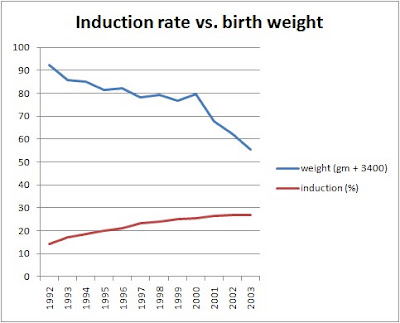
The following graph illustrates the trend of decreased birth weight.

The decrease in birth weight appears dramatic because of the scale of the y-axis, which displays weights from 3400 gm to 3500 gm. Indeed the fall in birth weight over the entire study was less than 50 gm from 3492.3 gm to 3455.3 gm.

As the authors note:

A reduction of 40 g in BW or 3 days in GA may not matter for an individual infant, but represents a substantial change for a population.

But that change is not necessarily bad. for example, as the authors point out, the rate of macrosomia has dropped by 25% in the same time span. Nonetheless, the authors are worried:

Recent systematic reviews and metaanalyses … concluded that labor induction may reduce perinatal mortality but without increasing the risk of cesarean delivery. As observed in this study, increasing and earlier use of labor induction appears to have shortened the duration of gestation and thus reduced both mean BW and rates of macrosomia. Although several studies have reported increased risks of some causes of neonatal morbidity and maternal complications with increasing GA at term, more and more infants are being delivered at early term gestation (37-38 weeks), up from 19% in 1992 to 29% in 2003. Earlier term birth is associated with increased risk of sudden infant death syndrome, and we have recently documented increases in several adverse birth outcomes among early term births, including increased risks of infant mortality and some types of neonatal morbidity. Thus the impact of these recent trends requires further investigation, including large randomized trials, to ensure that the rise in induction is doing more good than harm.

It’s rather surprising then that the authors did not investigate the trend in perinatal mortality during the same period. The main purpose of labor induction is to reduce stillbirth, which will be reflected in the perinatal death rate (death from 28 weeks of pregnancy to 7 days of life). All their data comes from CDC databases and perinatal mortality is available from the same source.

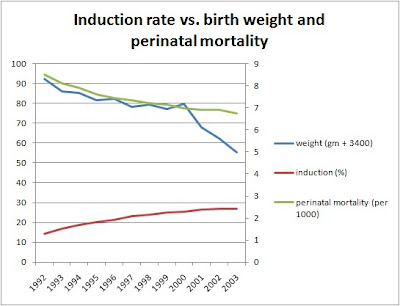
As the following graph shows, perinatal mortality did indeed drop by 21%.

Correlation, of course, is not causation, and it is possible that perinatal mortality has been steadily dropping for other reasons. And as the authors of the paper point out, there are risks associated with delivery at earlier gestation. Nonetheless, the existing evidence suggests that the increasing induction rate has not led to an increase in perinatal mortality. The primary reason for induction is to reduce perinatal mortality and that is exactly what seems to have happened.

Dr. Amy