How natural childbirth educators construct the past

Childbirth educators like to portray themselves as helpmates of expectant women, offering scientific evidence about various childbirth choices, thereby allowing women to make choices that are right for their personal circumstances. The reality of childbirth education is quite different. Childbirth educators have very strong opinions about which choices are “right” and which are “wrong.” And as a thought provoking paper in the Journal of Health Psychology explains, they use a strange an biased view of the past to subtly (and not so subtly) promote their personal opinions.

The paper is entitled ‘Golden Age’ versus ‘Bad Old Days’: A Discursive Examination of Advice Giving in Antenatal Classes. As the authors, Abigail Locke and Mary Horton-Solway explain:

… We identify a pattern of advice giving in which class leaders construct ‘golden age’ or ‘bad old days’ stories variably to contrast the practices of the past (‘then’) with current practices (‘now’). These contrasting repertoires operate against a backdrop of medicalization and societal expectations that are both current and out-dated, providing a constitutive framework to support class leaders’ evaluations and advice on pregnancy, childbirth and infant care.

An objective view of the history of obstetrics over the last 1-2 centuries reveals an ever growing body of knowledge, a greater range of tools to improve outcomes, and an extraordinary improvement in neonatal and maternal survival. Indeed, modern obstetrics has led to a drop in neonatal mortality of 90% and a drop in maternal mortality of 99% in the past 100 years alone. In other words, the advances of obstetrics have occurred in parallel with other advances in medicine, leading to better methods of prevention, better methods of treatment, longer life expectancy and longer periods of disease free life.

Natural childbirth educators ignore the real history of obstetrics and substitute an idiosyncratic and biased “history” of their own. Instead of viewing obstetrics as a progression toward improved outcomes, the recent past is characterized as “the bad old days” and the distant past is constructed as a “golden age.” The authors explain:

In theme one, … the class leader ridicules maternity care and medical practices in times gone by, and sets up a contrast with how medical care has since improved. Extract one shows a typical example of how the extremity and ‘horror stories’ of the past are constructed when the early stages of labour are being discussed.

For example:

The class leader begins a discussion of what to do in the early stages of labour through the comparison of the ‘good old days'(produced in an ironic way) when women in early stage labour were advised to ‘rush’ into hospital when they had their first contraction. A three part list) documents the routine horrors that awaited them ‘enema … pubic shave … pethidine’ in the old days… The listing represents the old fashioned practices as an inclusive package deal that was delivered to all women. The final coda that there were ‘wards full of women … not really with it’ parodies the old days as a humorous but shocking story… By implicit contrast, current practices are evaluated as much improved…

The authors offer a perceptive analysis of this theme:

The ridiculing of out-dated medical practices served to position, and locate, those practices as ‘then’ rather than ‘now’. The ‘then’ practices were constructed as unnecessary, out-dated and at times constructed as ‘horror stories’. In contrast, the class leader did not criticize [her preferred] … policies, rather she invoked the ‘horror’ of the past at precisely the moment when the practices of the present could be called into question.

While the recent past is portrayed as “the bad old days,” the distant past is constructed as a “golden age.” The authors analyze a specific example in which the class leader “explains” a completely made up theory that in the distant past, all babies stated labor positioned head down:

[The class leader} constructs a time when childbirth was more ‘natural’ and it was usually women who did housework. She lists the activities that ‘people’ would do: ‘washing by hand … sweep … make fires’ and the resulting ‘leaning forward’ from all of this activity… [T]here is a linking of these activities and the desired ‘birthing position’ for the baby ‘head down … spine out’. This she contrasts with the common working position of today’s ‘women’) describing how the birthing position of the baby is negatively affected … by pregnant women who ‘sit around a lot at work’… ‘sit back in settees and things.’

This is classic NCB gobbledly gook, a made up theory of what happened in a mythical past that never existed.

Childbirth educators attempt to influence women’s childbirth choices by use of this idiosyncratic view of the past as recent decades of “bad old days” preceded by eons of a “golden age.” The fact that this view of the past bears no relationship to what actually happened, utterly neglecting the dramatic improvements in outcome of the past decades and completely ignoring the appalling levels of neonatal and maternal mortality prior to modern obstetrics, is ignored.

Throughout our data set the class leaders’ advice giving is constructed in two ways through stories of the ‘bad old days’ and ‘golden age’ narratives. Both kinds of account are used variably in the context of making evaluations of good or bad practices, advice giving or offering reassurances about current medical practices…

… [C]ertain practices are constructed as more ‘natural’ and women are implicated in a range of competing moralities and accountabilities about their antenatal and postnatal activities. It is of particular interest how ‘horror stories’ of the past are invoked as a contrast to current medical practices which are positioned as better by comparison. Maternity care is thereby portrayed as greatly improved…

Natural childbirth educators are not unbiased individuals who aim to provide women with accurate information about their childbirth choices. They attempt to position their preferred choices as correct. As this paper details they use bizarre and inaccurate characterizations of the recent and distant past to promote what is nothing more than their personal preferences.
Homebirth (and Dr. Amy) in the news

Homebirth has been in the news a lot lately in the wake of the Lancet editorial Homebirth — proceed with caution:

Women have the right to choose how and where to give birth, but they do not have the right to put their baby at risk… Home delivery is an option for mothers with uncomplicated pregnancies, provided they are advised of the risks involved, have one-to-one midwife care (that includes good resuscitation skills and accreditation by a local regulatory body), and live in a location that allows quick access to obstetric care.

In other words, American women would need to be advised that homebirth with a homebirth midwife (CPM) is unsafe because the midwives do not meet the education and training standards for safety, have no experience with expert neonatal resuscitation, and there is no dedicated transport system that allows quick access to expert obstetric care.

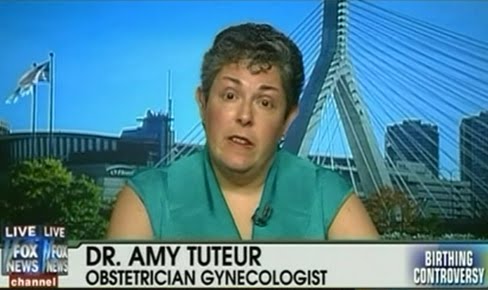
These are among the points that I made when interviewed yesterday on FoxNews Fox & Friends. Also interviewed was Joanne Davis, CNM, PhD who pointed to flaws in the most recent homebirth study. That study may indeed be flawed, but the fact is that ALL the existing evidence on homebirth in the US shows that homebirth increases the risk of neonatal death. Indeed a paper published earlier this year in the Journal of Perinatology analyzed homebirths attended by a certified nurse midwife (CNM) and found that they had double the risk of neonatal death of CNM attended hospital births, even though the hospital birth cohort included high risk patients.

I was also interviewed for a CNN print article Home births: No drugs, no doctors, lots of controversy:

“Going to hospitals and dealing with the doctor is not a pleasant experience,” she said. “We have an awful lot to apologize for. People are fed up with doctors. They need to be nicer, more forthcoming, explain things more.”

But that distrust has turned into a form of “reflexive doubt” that constantly challenges conventional wisdom in a belief that “smart, empowered people don’t listen to their doctors,” said Tuteur.

Some mothers have become increasingly competitive about how natural their births are, she said.

“First it was, ‘I had my baby in a hospital, but I didn’t have an epidural,’ ” said Tuteur, who doesn’t support home births. “Then it was, ‘I had a baby with a midwife at home, not in the hospital.’ The cutting edge is now unassisted birth — ‘I had my baby at home, and I had no one there except for my husband.’ “

And I emphasized to the interviewer that American women need to be aware of the biggest red flag of all: MANA (Midwives Alliance of North America), the trade and lobbying organization for homebirth midwives, has collected neonatal death rates for homebirth since 2001 but they are hiding that data from American women. Even homebirth midwives know that homebirth increases the risk of neonatal death, but they are doing everything they can to make sure that American women do not find out the truth.

Gisele Bundchen, sanctimommy extraordinaire

Sanctimommies of the world, rejoice! You have a new spokesperson, and even though she is a super model, she’s just like you: obnoxious, self-congratulatory and anxious to make all the other mommies feel bad. Gisele Bundchen, model, and wife of Patriot’s quarterback Tom Brady knows what’s best, not just for her baby but for your baby, too.

Bundchen, who gave birth to her first baby less than a year ago, is yet another self appointed expert on what babies need. In fact, she is so sure that she is right that she thinks her personal preferences should be the law of the land. According to Bundchen:

“… Some people here think they don’t have to breastfeed, and I think, ‘Are you going to give chemical food to your child, when they are so little?'” she tells Harper’s Bazaar UK, The Daily Mail reports.

“There should be a worldwide law, in my opinion, that mothers should breastfeed their babies for six months,” she adds.

Gisele, like all sanctimommies, is an expert on how you should raise your children. No, she’s not a pediatrician, a child psychiatrist or a child psychologist, but that doesn’t matter. She knows what food your baby should eat, and dammit, if you don’t know any better we’ll have to make a law to set you straight.

The best part about sanctimommies like Gisele is that they are always ready to share their wisdom with the rest of us. Gisele doesn’t hesitate to point out the deficiencies of other women’s parenting practices (in other words, how your parenting choices differ from hers). She doesn’t hesitate to make dire predictions about what the future holds for your children (“You feed him chemicals? You know he’s never going to be able to …”). She never hesitates to bemoan your lack of understanding of the key issues of childrearing, letting you know that you are not as “educated” as she is.

The ultimate irony is that Gisele is busily criticizing women who don’t breastfeed as if breastfeeding is a matter of life and death. It’s not. The benefits of breastfeeding, while real, are actually quite small. Yet Gisele deliberately exposed her own child to a risk of death by choosing to have a homebirth.

Bottling feeding has no measurable impact on neonatal mortality rates, whereas homebirth in the US triples the risk of neonatal death! Yup, Gisele pretended that her son’s birth was a piece of performance art and she was the star. She valued her “birth experience” over the well being of her son for no better reason than that she could brag about it later. And this is the same woman who thinks she knows what is best for babies?

Sanctimommies are not sticklers for intellectual consistency. If someone were to propose a law that mandated hospital births for all babies and criminalized homebirths, the sanctimommies would be braying that their right to control their own bodies was being violated. Yet they cheerfully propose laws that regulate women’s breasts and fail to see the hypocrisy.

And of course, Gisele, like all sanctimommies, is shocked that other women are offended by her intemperate and self-aggrandizing comments. She never meant to “judge” anyone! How could anyone think that? According to the Telegraph:

In her blog, Bundchen, a 30-year-old Brazilian, insisted she was not trying to judge other mothers who fed their offspring from a bottle

She said: “My intention in making a comment about the importance of breastfeeding has nothing to do with the law.”

… Stung by the criticism, Bundchen said that she understood that “everyone has their own experience and opinions, and I am not here to judge I think as mothers we are all just trying our best”.

Really, people, just because she said that breastfeeding should be mandated by law … that has nothing to do with the law. And just because she derided women for feeding their babies chemicals … that doesn’t mean she is judging anyone.

Sanctimommies can never understand why other women think they are being judged. The classic sanctimommy lament is:

Please do not accuse me of judging those other mothers who don’t love their children as much as I love mine. I’m well aware that different ways of mothering are right for different families. Of course women who are obsessed with their own convenience find that bottle feeding is right for them and their families…

Sanctimommies are judging you and even when they are apologizing for judging you, they are still judging you.

The problem with Gisele (paraphrasing the words of the late, great governor of Texas, Ann Richards) is that she was born on third base and she thinks she hit a triple. She had an easy birth, a healthy baby, and no difficulty breastfeeding. Instead of thanking her lucky stars, she’s trying to claim credit for it. And instead of offering sympathy to women who have difficulties or support to women who make different choices, she offers blame and condemnation. Best of all, she can’t figure out why you think she’s judging you.

Who is Henci Goer?

In yesterday’s post Do obstetricians ignore the scientific evidence? I discussed the current natural childbirth public relations ploy of choice, the claim that there is a vast body of scientific evidence that obstetricians are ignoring. I focused on Amy Romano in her role as editor of the Lamaze blog ironically titled Science and Sensibility and the fact that she lacks an understanding of the true depth and breadth of the obstetric literature, not to mention and inability to critically analyze that literature. But she is not the originator of that public relations ploy. That honor goes to her colleague Henci Goer who has staked her professional life on the bizarre claim that obstetricians ignore the scientific literature that they create and that only NCB advocates assiduously scour the literature and change their recommendations based on research.

So who is Henci Goer? And who believes what she has to say?

According to Goer:

You may be wondering about my credentials to write this book since I am not a doctor — either M.D. or Ph.D — a midwife, or a nurse. I am a certified childbirth educator with a degree in biology from Brandeis University. Beyond that, I am self-taught.

So Henci Goer is not a medical professional and has no experience in the field of obstetrics. That, in itself is not a complete bar to understanding the obstetric literature if it is replaced by a PhD in a hard science or statistics. But, Goer doesn’t have those qualifications, either. In other words, Goer is a teacher of childbirth classes who reads the scientific papers that she likes, but has no independent way of assessing the full depth and breadth of the obstetric literature.

I will say that Goer, in contrast to the other self-appointed “experts” in the scientific literature does have a real grasp of the literature that she reads and a real understanding of statistics. That makes her false claims less understandable. Amy Romano actually believes what she writes. Someone told her it was true and she is repeating it. Henci Goer, on the other hand, knows better.

Goer’s typical modus operandi is the smear campaign. She tries very, very hard not to be pinned down on specifics, but instead hurls insults.
Ask Goer whether the Johnson and Daviss 2005 BMJ study shows homebirth to be as safe as hospital birth, and she will refuse to answer, because she knows that it is a bait and switch. Instead she will launch into a riff about comparing apples and oranges in order to divert attention from the factual question.

Consider Goer’s response to Atul Gawande’s excellent article on the success of modern obstetrics:

Gawande applauds doctors for trying whatever appeals to them without “wait[ing] for research trials to tell them if it was all right.” It is sufficient that obstetric innovators “looked to see if results improved,” although how they would know this without a controlled evaluation of safety and effectiveness, he does not say. Neither does he bring up the obstetric disasters that have followed in the wake of this approach. DES, thalidomide, retrolental fibroplasia (blindness in premature newborns), and misoprostol (Cytotec) inductions come to mind …

Instead of addressing Gawande’s factual claim that modern obstetrics has saved more lives than any other branch of medicine, Goer resorts to the smear. Not only does she favor the smear, but she doesn’t trouble with the truth of her claims, either. The implication is that obstetricians deliberately created tragedies by foisting unrested medications on unsuspecting women. Yet that is a lie.

Thalidomide is a medication was used in Europe during the early 1960’s. It was prescribed as a sedative. Thalidomide taken in the early weeks of pregnancy causes limb defects. Typically, the babies were born with flipper like appendages instead of fully developed arms.

Was thalidomide use promoted by obstetricians? No. Furthermore, thalidomide was never used in the US. An official in the Food and Drug Administration refused to allow the drug to be used in the US because she had read the case reports in the European literature. As a result of the European experience, the FDA instituted studies to see if other medications could cause birth defects. So the reality is that thalidomide was never used by obstetricians and was never even allowed in this country.

How about retrolental fibroplasia? Oxygen supplementation for prematurity was instituted in the 1940’s. Thousand of lives were saved by it. The side effect of blindness (retrolental fibroplasia) was noted almost immediately thereafter in the survivors. It was not until the early 1950’s that it was recognized that the cause was high concentrations of oxygen.So retrolental fibroplasia has nothing to do with obstetricians. No matter, Henci Goer is not bothered by a trivial matter like the truth of her claim.

Goer has attempted to use this smear tactic recently in response to my claims that obstetricians do follow the scientific evidence and it is NCB advocates who don’t even know what the scientific evidence shows. In the comment section of Science and Sensibility, Goer writes:

“Amy Tuteur, MD: Obstetricians are following the evidence, and it is bizarre for NCB advocates, who don’t have a clue as to the entire depth and breadth of the scientific evidence, to suggest otherwise.

Obstetricians are following the evidence? Really? Let’s just list a few routinely and commonly used obstetric management practices about which there is NO controversy in the obstetric research that they are ineffective, harmful, and generally both when used routinely or frequently and in some cases, with any use at all:

* induction for suspected big baby
* artificial rupture of membranes
* no oral intake other than ice chips
* I.V.
* continuous electronic fetal monitoring
* confinement to bed
* active management of labor (treating labor progress slower than average with high-dose oxytocin)
* directed pushing
* pushing on one’s back or in a semi-reclined position
* episiotomy (Episiotomy is on the decline, but it was still used in 1/4 of women having vaginal birth in 2005.)
* immediate umbilical cord clamping
* separating newborns from their mothers shortly after birth
* cesarean surgery (The research literature supports a rate of no more than 15%. At rates higher than this, maternal and perinatal morbidity and mortality rates begin to climb.)

I’m sure I’ll think of others after I submit this, and, of course, this list does not include anything from the much longer list of practices and policies about which there is controversy but a good case can be made against them for routine or frequent use.

Standard Goer smear tactics:

1. Evil is implied but Goer presents no evidence for her claims.
2. Goer deliberately and falsely implies that hospital policies are obstetric policies. Separation of mother and baby is a hospital policy. You can argue against it, but you certainly can’t claim that obstetricians said that scientific evidence showed that mothers and babies should be separated.
3. Goer does not consider herself constrained by the truth. A lie is fine if it serves the cause. Goer knows as well as I do that there is NO scientific evidence that a 15% C-section rate is optimal. The World Health Organization has even admitted that there is no scientific evidence for their recommendation and there never was any scientific evidence for that claim.

Goer presents herself as an “expert” on the obstetric literature, yet no one else seems to agree with her grandiose self-description. She is not called for expert testimony in court cases that turn on the obstetric literature. The government does not invite her to join expert panels on obstetric topics. In fact, the only people who consider Goer an “expert” on the obstetric literature are lay people who have no way to evaluate her self-proclaimed expertise.

Ms. Goer never appears in any venue where she can actually be questioned on her supposed expertise. She knows that her claims would be eviscerated in short order. She just continues to spread misinformation by flattering trusting women into believing that accepting her smears means that they are “thinking.”

Do obstetricians ignore scientific evidence?

Natural childbirth advocates love mantras. They spread through the community, are quoted over and over, and become received wisdom as though by saying something enough times it might make it true. Classic NCB mantras include “pain is caused by fear” and “animals need privacy to birth successfully; so do humans.” And let us not forget the infinitely stupid “trust birth.”

Mantras change with time and in response to cultural values. In an age in which science is greatly respected, the most popular mantra is “obstetricians ignore the scientific evidence.” All the celebrity natural childbirth advocates insists that this is so, and some of them might even believe it. Lamaze has taken the mantra to new heights, by renaming their blog Science and Sensibility, presumably to imply that NCB is based on science and common sense, though it is based on neither.

Barry Beyerstein, a professor of psychology at Simon Fraser University, wrote about the technique of applying a veneer of scientific respectability as a way to improve the status of pseudoscientific beliefs. As Beyerstein explains:

The prestige and influence of science in this century is so great that very few fields outside of religion and the arts wish to be seen as overtly unscientific. As a result, many endeavors that lack the essential characteristics of a science have begun to masquerade as one in order to enhance their economic, social and political status. While these pseudosciences are at pains to resemble genuine sciences on the surface, closer examination of the contents, methods and attitudes reveals them to be mere parodies. The roots of most pseudosciences are traceable to ancient magical beliefs, but their devotees typically play this down as they adopt the outward appearance of scientific rigor. Analysis of the perspectives and practices of these scientific poseurs is likely to expose a mystical worldview that has merely been restated in scientific-sounding jargon.

And that almost perfectly captures the current public relations ploy of choice among NCB advocates. What could sound more impressive that shouting from every hilltop that obstetricians ignore the scientific evidence, while NCB advocates are slaves to scientific rigor? The fact that the claim is a lie is beside the point. NCB advocates neither know the truth, nor care.

Let’s examine the claim on the two levels apparently favored by Lamaze: sensibility and science.

If you say “obstetricians ignore the scientific evidence” fast enough, people won’t stop to consider if it makes sense. But if we do stop to consider it, we might amplify it as follows:

We are supposed to believe that obstetricians (with 8 years of higher education, extensive study of science and statistics, and four additional years of hands on experience caring for pregnant women), the people who actually DO the research that represents the corpus of scientific evidence, are ignoring their own findings while NCB advocates (generally high school graduates with no background in college science or statistics, let alone advanced study of these subjects, and limited experience of caring for pregnant women), the people who NEVER do scientific research, are assiduously scouring the scientific literature, reading the main obstetric journals each month, and changing their practice based on the latest scientific evidence.

See what I mean? That makes no sense at all.

Consider someone like Amy Romano, the CNM who writes Science and Sensibility. It seems like Ms. Romano is a nice person; her heart is definitely in the right place. Nonetheless, she repeatedly presents her opinions as scientific facts, and routinely misrepresents the scientific literature. That’s not surprising since she doesn’t read it and, because of her deficits in basic science knowledge and understanding of statistics, is literally incapable of interpreting it on her own. She needs someone to tell her which papers are “important” and what they supposedly “mean.” She does not review the literature before writing, she just assembles the papers that she likes, never bothers to read them, let alone analyze them. She makes this clear every time she is pressed to substantiate her claims; she can’t do it, so she falls back on refusing to discuss anything with anyone who is “disrespectful” as if challenging her claims is a sign of disrespect.

And what does the scientific evidence on childbirth really show? There is virtually no support for ANY of the central tenets of NCB advocacy. Let’s start with a favorite NCB claim that “lots of scientific papers show that homebirth is safe.” When it comes to homebirth in the US, ZERO scientific papers show that homebirth is safe. Indeed EVERY paper written on the subject shows that homebirth increases the risk of neonatal or perinatal death, even the Johnson and Daviss BMJ paper that claims to show otherwise. National statistics on homebirth collected by the CDC from 2003-2005 (the only years published thus far) show that homebirth with a non-CNM midwife triples the rate of neonatal death, and homebirth with a CNM doubles the rate of neonatal death.

Consider other, easily verifiable claims:

Proper position speeds labor? No, no evidence for that.

Eating in labor gives women “strength” and improves outcomes? No, no evidence for that.

Babies won’t breathe if delivered under water because of the diving reflex? The diving reflex works in cold water, not warm water.

Epidurals are dangerous? No, no evidence for that, either.

Indeed, I am hard pressed to come up with even a single NCB tenet that is based on scientific evidence. Oh, wait. I can think of one: breastfeeding is beneficial for your baby. But even that scientific evidence is misrepresented by NCB advocates, since the benefits are actually quite small.

The bottom line is that the NCB claim that “obstetricians ignore the scientific evidence” is a big lie. NCB advocates seems to think that if they say it loud enough and long enough everyone will believe. Unfortunately for them, both “Science” and “Sensibility” demonstrate that obstetricians follow the scientific evidence and NCB advocates don’t even know what the evidence shows.

Dr. Amy interview on homebirth and natural childbirth

If you’ve ever wondered what I sound like,now is your chance to find out by listening to Podcast Beyond Belief, a weekly podcast produced by a consortium of skeptical parent bloggers. In the latest epidsode, episode 22, they interviewed me for an hour on the topic of alternative birth claims and practices. You can download the podcast here, or you can download it directly from the podcast section of iTunes. Let me know what you think.

Homebirth midwife Melissa Cheyney has a conflict of interest

Recently, I wrote about Melissa Cheyney’s role as the Director of Research for MANA (An open letter to homebirth midwife Melissa Cheyney). She presides over the project that has collected detailed information on approximately 20,000 homebirths since 2001 and she refuses to release the death rates to the general public. Dr. Cheyney, like other MANA board members has demonstrated contempt for patient safety by refusing to release the data.

Dr. Cheyney also has another role. She is Chair of the Oregon Board of Direct Entry Midwives and, as such, is in charge of midwife discipline and determining midwife scope of practice. In her dual roles, she has a serious conflict of interest. It is equivalent of the President of the AMA chairing the Medical Board of his state. In light of this conflict of interest, and in light of her commitment to preserving midwives’ reputations at the expense of patient safety, Dr. Cheyney should resign. Failing that, she should be fired and replaced with someone whose primary commitment is to patient safety.

Oregon is currently involved in controversy, and a lawsuit, over direct entry midwives scope of practice. The genesis of the controversy is a planned homebirth of a double footling breech, an uncommon breech position know to have a very high rate of neonatal death.

You might think that Oregon homebirth midwives would exercise extreme caution in planning a footling breech home delivery in light of a recent midwifery disaster involving a breech. As reported in the Register Guardian:

The call to paramedics came at 8:10 p.m., the instant midwife Anita Rojas realized the head of the breech baby she was delivering was stuck.

Twenty-one-year-old Kelsie Koberstein was swept up by medics in a blur of pain and fear.

Rojas rode in the front of the ambulance, with Koberstein’s mother and best friend rushing behind in their car…

On her back, her legs pushed up as high as they could go, she clutched the hand of a paramedic as if he were her only anchor to reality…

At Sacred Heart Medical Center, the on-call emergency room obstetrician-gynecologists, Drs. Elizabeth McCorkle and Brant Cooper, wasted no time.

As they instructed paramedics over the hospital radio, they learned this birth was going to be as difficult as they come: It wasn’t just a breech birth, but a “footling” – where a foot emerges first.

Just a few centimeters in width, a tiny foot might not open the cervix wide enough to allow the baby’s head and umbilical cord to pass through. If the head becomes trapped, the baby could quickly suffocate.

When medics pulled up to the doors, the doctors leapt into the back, refusing to squander precious seconds bringing Koberstein inside. The doctors had to turn Lucian’s head 180 degrees in order to free him, a move that took at least 20 minutes.

By then it was too late.

The infant was dead.

But undaunted by this disaster, the homebirth midwife embarked upon one of her own. Ultimately, the patient was transferred to the Oregon Health & Science University Hospital and underwent a successful C-section. Hospital employees filed a complaint against the midwife Jesica Dolin, alleging she violated professional standards by attempting a breech delivery.

And who was responsible for investigating that complaint? You guessed it, the Board of Direct Entry Midwifery, chaired by Melissa Cheyney. What happened?

The licensing agency recently withdrew the investigations of five midwives, after [their lawyer] refused to hand over medical records. The licensing agency also withdrew the case against Dolin, who said the withdrawals show the complaints were without merit.

How can we trust that the Board of Direct Entry Midwifery ended the investigation appropriately? How do we know that it was not an attempt to place the reputation of homebirth midwives above the safety of their clients? We don’t. These possibilities are especially disturbing in light of Dr. Cheyney’s dual role.

Dr. Cheyney should resign from the Board, or failing that, be removed by Oregon officials for an irreconcilable conflict of interest. She has already demonstrated her contempt for patient safety by refusing to release MANA homebirth death rates. She should not be responsible for monitoring homebirth practice, where patient safety is supposed to be the highest priority.

C-sections are like breast biopsies

That’s the analogy I used when commenting on Dr. Fogelson’s post The Myth of Unnecessary Cesarean.

Dr. Fogelson writes:

What some members of the blogosphere likes to call “unnecessary” cesareans are misnamed. They are misnamed because the word necessary implies something that cannot be applied to this situation. As was noted in the introduction, necessary means something that is essential, indispensable, or requisite. Specifically to cesarean, necessary would imply that the procedure is required in order to have a favorable outcome for the fetus or mother. The problem with the term is that we don’t know what would have happened if we hadn’t done the cesarean, and as such we have no idea if the cesarean was necessary…

In other words, just because a C-section was unnecessary in retrospect, does not mean that it was unnecessary.

Dr. Fogelson is taking a lot of flack for this view because it forces the unnecesarean crowd to contemplate the fact that they have no cause for resentment and they have misunderstood why they had a C-section.

I commented that it makes sense to think of C-sections as a form of preventive medicine:

Ceseareans are like breast biopsies; most are unnecessary in retrospect. When a woman finds a lump in her breast, the odds that is breast cancer are quite low. When a mammogram detects an abnormality the odds that it is breast cancer are quite low.

Therefore, applying the reasoning that commenters are applying to cesareans would mean that the rate of breast biopsies should be cut dramatically. In most cases, watchful waiting is all that is necessary to demonstrate that the lump or abnormality was not breast cancer.

Think about how much money we could save! All those mammograms and biopsies cost a fortune; just waiting to see what happens costs nothing.

Think about women’s experiences! If we did far fewer breast biopsies, women would not have permanent scars on their breasts. And the recovery would be so much easier. No need for pain medication, dressing changes, etc. if you just watch and wait to see what happens.

Sure some women would die preventable deaths with a policy of watchful waiting but those numbers would be very small when compared to the number of women spared from having unnecessary biopsies.

Of course if you think that a policy of watchful waiting is inappropriate for breast lumps and mammogram abnormalities, considering that most biopsies are unnecessary, why would you think a policy of watchful waiting is appropriate for C-sections simply because many of them are unnecessary in retrospect?

And elaborated:

Preventive care exists to prevent bad outcomes whether those outcomes are colon cancer, heart attacks or neonatal deaths. The overwhelming majority of colonoscopies are unnecessary, most people who undertake steps to prevent a heart attack would not have had one anyway, and most C-section do not save babies’ or mothers’ lives.

Preventive care is not defective or unnecessary just because we find out later that it wasn’t needed. People seem to understand that reasoning when it comes to colonoscopy, mammography, lowering blood pressure, etc., but when it comes to C-sections, some people fail to understand that the reasoning is the same.

In medicine, the reasons for a procedure are known as “indications.” So, for example, the indications for a breast biopsy would be a lump in the breast or an abnormality on a mammogram. There is no expectation when undertaking a breast biopsy that a woman would die without it; indeed there is every expectation that a woman doesn’t even have breast cancer. We expect that most breast biopsies will turn out to be unnecessary in retrospect.

There are a variety of indications for C-section. These include things like breech, non-reassuring fetal monitor patterns, and previous C-section. There is no expectation when undertaking such C-sections that the baby would have died without it; indeed there is every expectation that the baby would have survived a vaginal delivery just fine. But claiming that a healthy baby means a C-section was unnecessary is like claiming that a benign breast lump means a breast biopsy was unnecessary.

Are there any C-sections that are unnecessary? Sure. A C-section done without a medical indication is an unnecessary C-section. If there is no medical reason to believe that the baby (or mother) is in danger, the C-section should not be done. That’s entirely different from a medically indicated C-section that produces a healthy baby.

What does this mean for the unnecessarean crowd? First of all, it means that most women who believe that they have had an unnecessary C-section don’t understand the difference between necessary and unnecessary C-sections. It means that most of their protestations are downright foolish. Can you imagine a woman bewailing the biopsy of a 1 cm. breast lump that turned out to be negative because she later had a 3 cm. breast lump that went away by itself? No, we would recognize that as ridiculous. But boasting that your 8 pound baby could not have been stuck because you later delivered a 9 pound baby vaginally is just as ridiculous.

Most importantly, understanding the difference between an unindicated and unnecessary C-section would take away the justification for the endless self-pity party that the unnecessarean crowd enjoys so much. No one harmed them. No one mistreated them; quite the opposite, they got excellent care.

It’s not surprising therefore, that Dr. Fogelson’s post has met with such vehemence. He’s right, and the angry reaction represents the fear of the unnecessarean crowd that their resentment and self-pity is and has always been entirely unjustified.

What do natural childbirth and Fox News have in common?

For the past few days, Amy Romano of Lamaze has been breathlessly twittering from the “Normal Birth Conference.” Reading her tweets gives us a great deal on insight into why she is constantly (and falsely) claiming that modern obstetrics is not evidence based. The conference is nothing more than an echo chamber. The Normal Birth Conference is just like Fox News. It makes up the “news” to suit its viewers and never challenges the claims of its stalwarts, nor allows anyone else to challenge them.

Amy Romano and her colleagues think they are listening to the “truth” when they hear speaker after speaker, long on ideological fervor and short on scientific accuracy. They’re just like right wing Republicans who think they are listening to the “truth” when they tune into Fox News stalwarts claiming that Obama was “really” born in Africa and therefore ineligible to be president.

It would never cross the mind of Romano and compatriots to demand that alternative points of view be presented for analysis, just like it would never cross the minds of Fox viewers to demand that alternative points of view be presented for balance and as a corrective to the Fox party line. Similarly, it would never cross the mind of Romano and compatriots to attend a real scientific conference about childbirth, since they might learn something they don’t want to know. Ditto the right wing Republicans. It might be very uncomfortable to listen to liberal analyses; they might make too much sense. Better not to hear them at all.

Consider the plenary speakers at the Normal Birth Conference:

Professor Soo Downe
Eugene Declercq, DrPH
Holly Kennedy, FACNM, CNM, PhD
Patricia Janssen, RN, BSN, MPH, PhD

Soo Downe is the goofball midwifery theorist who invoked quantum mechanics to “explain” why it is okay for midwives to ignore scientific evidence. Holly Powell Kennedy has previously “defined” normal birth.

None of the four is a doctor, let alone an obstetrician, but all of the four write and speak extensively about what doctors “believe” and why they are wrong. As far as I could determine, in fact, there is no speaker and no presentation that does not comport with the objective of the conference to promote “normal” birth. Notice that the conference organizers are not interested in investigating risks and benefits, they are only interested in promoting their pre-existing prejudices. The conference organizers were quite explicit about this in their call for abstracts issued prior to the conference. Among the conference objectives:

… To disseminate recent, relevant research on effective strategies to promote normal labour and birth

To provide a foundation for future collaboration in research efforts that examine and document models of maternity care that support of normal labour and birth.

To identify relevant curricula components for maternity care professional education programs specific to normal birth…

Presumably those whose work does not confirm the organizers beliefs in the superiority of normal birth need not apply.

Imagine if obstetricians held a conference to “promote” episiotomies and invited only those whose work supports the use of episiotomies and refused to include anyone who might have a different point of view or might present evidence that did not support use of episiotomies. Everyone would be justifiably outraged because the conference would be explicitly devoted to supporting a particular viewpoint, and not devoted to the scientific evidence.

The great virtue of science, real science, is that it allows for dissent. The sheer numbers of scientists working on any given problem ensures that their will be a diversity of scientific views, approaches and studies. Society benefits because we can synthesize all the existing research to approximate the truth. That is the great failing of echo chambers like Fox News and the Normal Birth Conference. Only a tiny number of preapproved speakers are allows to present a tiny number of preapproved claims, and no one is available to challenge or question those speakers.

The predictable result: beliefs confirmed, reality dismissed.

Dr. Amy