Oops. Upright birth positions increase bleeding and perineal trauma.

Yesterday I wrote about the efforts of Lamaze to control women’s births. The irony, of course, is that the practices that they staunchly advocate are not supported by, and in some cases are even directly contradicted by the scientific evidence. Such is the case with upright birth positions.

It is axiomatic among natural childbirth advocates that maternal position dramatically impacts the course of labor. Yet, there’s no scientific evidence that moving around or changing positions has any impact on labor, let alone a beneficial impact. According to the Cochrane review on position in labor, “There were no differences between groups for other outcomes including length of the second stage of labour, mode of delivery, or other outcomes related to the wellbeing of mothers and babies.”

Indeed it is appears that upright positions, far from being beneficial, actually increase the risk of bleeding and perineal trauma. Dutch author de Jonge (the same de Jonge who conducted the large trial demonstrating the safety of homebirth in the Netherlands) reached this conclusion in the paper Increased blood loss in upright birthing positions originates from perineal damage published in the British Journal of Obstetrics and Gynaecology in 2007.

According to de Jonge:

The main advantage of the supine position is reduced mean blood loss and incidence of blood loss greater than 500 ml compared with other positions…

Measurement error may explain some of the differences found. The same amount of blood loss may appear to be more in upright than in recumbent position. In most studies, estimated blood loss is used as the outcome measure. We wanted to improve upon previous research and establish whether there is an actual increase in blood loss in sitting positions by using more accurate, objective measurements.

If there is a real difference, it is not clear whether this excess in blood loss originates from perineal damage or from the uterus… If there is an increase in blood loss in sitting positions, it is therefore important to establish where this originates from.

The study found:

The mean blood loss in the total group was 508 ml. Blood loss greater than 500 ml occurred in 38.5% and greater than 1000 ml in 9.1% of women. In semi-sitting and sitting position, the mean total blood loss was significantly greater than in recumbent position. A significant linear association was found for the following variables: the risk of blood loss greater than 500 ml and 1000 ml was greater in semi-sitting than in recumbent position and greater in sitting than in semi-sitting position.

In other words, position affected blood loss in a linear fashion. Women who were semi-sitting had a higher blood loss than women who were lying on their backs and women who were upright had a higher blood loss than those who were semi-sitting.

Since the blood loss came from the perineal damage, women who delivered without lacerations were not affected. However, position appeared to have no impact on perineal damage:

The incidence of perineal damage did not differ between position groups. Thirty-one women had a third or fourth degree tear, and the incidence did not differ between the groups (P = 0.656).

The authors speculate that increased blood loss is related to increased hydrostatic pressure in the lower half of the body (the same factor that leads to hemorrhoids and varicose veins in pregnancy):

The increased blood loss in upright positions may be due to various factors. Sitting on the hard surface of a birthing stool or chair may obstruct venous return and therefore lead to an increase in blood loss from perineal damage. On the other hand, upright positions might cause increased hydrostatic pressure both on the arterial and venous side which could contribute to increased bleeding from the uterus and placental site…

It is also possible that increased hydrostatic pressure leads to perineal edema (swelling) and that the edema leads to lacerations and difficulty in controlling the blood loss by suturing.

de Jonge re-analyzed this data in a paper published earlier this year. She and her co-authors investigated why there was no difference in perineal trauma among different positions. What they found lends credence to the original rationale for episiotomies. Women in upright positions had fewer episiotomies, but more perineal tears. The perineal damage was not reduced in the absence of episiotomy either; the incidence of 3rd and 4th degree tears was the same regardless of position. In summary, there was no protective effect on the perineum of upright positioning.

So upright positions in labor have no beneficial effect on the course of labor and no beneficial effect on the incidence of perineal trauma. In fact the only difference directly attributable to upright position is a disadvantage: a statistically significant increase in blood loss.

Is that a reason to discourage upright positioning? de Jonge doesn’t think so and I don’t either. Women should be encouraged to labor and deliver in the position most comfortable for them. For some women that will be lying down, for other women a more upright position is preferable. One thing is not in doubt, however. There is no benefit to upright position in labor, and Lamaze and other natural childbirth organizations should stop pretending there is.


Why does Lamaze think that your birth is their business?

The folks at Lamaze have (inadvertently?) given us insight into their belief that your birth is their business. Sharon Dalrymple, discussing the forthcoming 5th International Normal Labour & Birth Research Conference, taking place next week in Vancouver, bemoans the fact that Lamaze is having a tough time convincing women to do it “their way.” Hence they have embarked on an elaborate public relations campaign:

Lamaze International hired a public relations market research firm to conduct research and identify which messages are the most effective for persuading women to adopt normal birth practices. (my emphasis)

Well, at least she’s honest. Lamaze considers its mission not merely to supporting women who want a birth without interventions, but, in addition, convincing other women to want what they want.

This reminds me of nothing so much as a dominating, interfering mother. You know the type: the mother who believes that every choice her daughter makes is a statement about the value and correctness of the mother’s personal choices. The mother who believes that her daughter’s choices are not merely different, but a personal reproach. The mother who believes that it is her mission in life to convince her daughter to do it her way.

And, as is often the case with the domineering, interfering mother, she starts with the premise that if her daughter only understood the intrinsic wisdom of her mother’s choices, she would copy them. But Lamaze, like many domineering mothers, has a problem. Most women aren’t sure what their mothers are complaining about. In particular, women refused to accept that an intervention free birth is the only “normal” or “natural” way to have a baby:

Indeed, the research showed that the meaning of the words “normal” and “natural” was not interpreted by the women and educators the same way. For example, 36% of women felt that ALL vaginal births are “normal birth”, while 63% of Lamaze Certified Childbirth Educators defined “normal birth” to be a birth without medical intervention. Women and Lamaze childbirth educators are likewise divided when deciding if the terms “natural birth” and “normal birth” are generally similar or generally different in meaning.

Lamaze had been hoping to trade on the cultural assumption that “normal” and “natural” are intrinsically superior and that, therefore, “normal” and “natural” could be used as code words for “best.” Evidently some daughters women are too dense to make the connection so coded appeals must be dismissed in favor of more overt declarations:

Lamaze International found that the words safe and healthy are the most effective words for communicating and promoting the birth practices Lamaze has endorsed for years. Everyone wants a safe and healthy birth. Mothers are particularly motivated to keep their baby and themselves safe and healthy…

Just like a domineering, interfering mother, Lamaze wants you to know that its choices aren’t merely the best choices, they are the safest and healthiest choices. Just like a domineering mother, Lamaze declares: if you really cared about your baby’s health and safety, you’d do it my way.

Not only is this as obnoxious as any interfering mother who proclaims the superiority of her personal choices, it is just as wrong. The practices that Lamaze declares to be the safest and healthiest are nothing more than their personal preferences.

Consider some of the 6 “best” practices that Lamaze promotes:

Let labor begin on its own: There is no scientific evidence that a spontaneous labor is better or safer for babies. Indeed, there is copious scientific evidence that the risk of stillbirth begins increasing before 38 weeks and rises steadily with each day that passes. That risk must, of course, be balanced against any risks of induction to the mother, but, even so, it is factually false to claim that spontaneous labor is safer. Indeed, as the rate of induction has risen in the US, the rate of late stillbirth has fallen dramatically.

Walk, move around and change positions throughout labor: There’s no scientific evidence that moving around or changing positions has any impact on labor, let alone a beneficial impact. According to the Cochrane review on position in labor, “There were no differences between groups for other outcomes including length of the second stage of labour, mode of delivery, or other outcomes related to the wellbeing of mothers and babies.”

Avoid interventions that are not medically necessary: In other words, refuse an epidural; yet there is no scientific evidence that childbirth without pain relief is better, safer, healthier or superior in any way to childbirth with pain relief. No matter. The women at Lamaze think that they are superior for refusing pain medication, so you should refuse it, too.

Dalrymple concludes:

As a result of these and other findings, Lamaze International updated our six evidence-based key practice papers in Fall 2009 to ensure women realize that these practices simplify the birth process with a natural approach that helps alleviate fears and manage pain, with the ultimate goal of keeping labor and birth as safe and healthy as possible for each individual woman. Every woman needs clinicians who promote, support, and protect these six practices.

These practices simplify the birth process? Where’s the evidence for that.

These practices alleviate fears and manage pain? They most certainly do not.

These practices keep labor as safe as possible? All the existing scientific evidence indicates nothing of the kind.

Every woman needs clinicians who promote these practices? Exactly who is Lamaze to tell women what they “need”?

The folks at Lamaze sound just like the domineering, interfering mother who tells her adult daughter: do it my way or else. And as in the case of the domineering interfering mother, the adult daughter should ignore the remonstrances and reproaches, recognizing that they have nothing to do with the daughter’s wellbeing and everything to do with the mother’s self-justification.

The Netherlands, homebirth and the high mortality rate

Homebirth and natural childbirth advocates often approvingly cite the maternity care in the Netherlands. Homebirth rates are the highest in the world (30%, but down considerably and falling every year) and midwives are the mainstay of the system, caring for any woman who does not require the care of a doctor.

What homebirth and natural childbirth advocates fail to realize is that The Netherlands has one the highest perinatal death rate in Europe and a high and rising rate of maternal mortality. Indeed, the Dutch have become so alarmed at the perinatal and neonatal death rates that the government has convened a variety of investigations to determine the cause.

The paper Higher perinatal mortality in The Netherlands than in other European countries: the Peristat-II study, published in a Dutch journal, brought the issue of perinatal mortality into focus:

… In Peristat-II from 22 weeks gestation, after France, The Netherlands had the highest fetal mortality rate (7.0 per 1,000 total number of births). Of all western European countries, The Netherlands had the highest early neonatal mortality rate (3.0 per 1,000 live births). Over the past 5 years the perinatal mortality rate in The Netherlands has dropped from 10.9 to 10.0 per 1,000 total births but this drop has been faster in other countries. CONCLUSION: The Netherlands has a relatively high number of older mothers and multiple pregnancies, but this only partly explains the high Dutch perinatal mortality rate which still ranks unfavourably in the European tables. More research is necessary to gain insight into the prevalence of risk factors for perinatal mortality compared with other European countries. In addition, perinatal health and the quality ofperinatal healthcare deserve a more prominent position in Dutch research programmes.

The government has commissioned researchers at the Erasmus Medical Centre in Rotterdam to oversee the investigation. From the Erasmus MC website:

The Netherlands has a relatively poor position in Europe when it comes to health at the time of birth, in other words, perinatal health. Approximately 10 out of every 1000 children die around the time of birth. In similar other countries this mortality rate can be as much as 30% lower. Of the perinatal deaths in the Netherlands, 70% are stillbirths when counted from the 22nd week of pregnancy. Thirty percent of the perinatal deaths take place in the first week after birth. In Flanders, that is socio-democratically and economically comparable to the Netherlands, the perinatal death rate has been two-thirds of that in the Netherlands for at least 10 years. This means that instead of 1700 cases of perinatal death that occur per year among the 175,000 newborns in the Netherlands, only 1150 cases should occur; an unprecedented large difference. Moreover, within the Netherlands, and particularly in the larger cities such as Rotterdam and The Hague, there are distinct differences between groups of pregnant women.

The ZonMw has commissioned Erasmus MC to carry out the Descriptive study Pregnancy and Childbirth. The aim of the study is to determine knowledge questions and research opportunities to improve the perinatal care in the Netherlands. Aspects studied include patient-related risk factors such as diseases already present, lifestyle and social factors on the one hand and the role of the midwife practices including use of care, risk selection, and quality of care in the Netherlands on the other. The preliminary conclusion is that the unfavorable European position is probably mainly caused by factors in the care system while the differences within the Netherlands and the larger cities are linked to large risk differences between groups on the basis of ethnicity, social deprivation and the neighborhood in which people live. A research agenda has been formulated based on this.

In other words, the government investigation found that one of the main reasons for the high perinatal death rate is the midwife care system including use of care, risk selection, and quality of care.

Not only is perinatal mortality unacceptably high, maternal mortality is high and rising. According to the paper Rise in maternal mortality in the Netherlands, published in the British Journal of Obstetrics and Gynaecology earlier this year:

The overall maternal mortality ratio was 12.1 per 100 000 live births, which was a statistically significant rise compared with the maternal mortality ratio of 9.7 in the period 1983–1992 (OR 1.2, 95% CI 1.0–1.5). The most frequent direct causes were (pre-)eclampsia, thromboembolism, sudden death in pregnancy, sepsis, obstetric haemorrhage and amniotic fluid embolism. The number of indirect deaths also increased, mainly caused by an increase in cardiovascular disorders (OR 2.5, 95% CI 1.4–4.6). Women younger than 20 years and older than 45 years, those with high parity or from nonwestern immigrant populations were at higher risk. Most substandard care was found in women with pre-eclampsia (91%) and in immigrant populations (62%).

Conclusions
Maternal mortality in the Netherlands has increased since 1983–1992. Pre-eclampsia remains the number one cause. Groups at higher risk for complications during pregnancy should be better identified early in pregnancy or before conception, in order to receive preconception advice and more frequent antenatal visits. There is an urgent need for the better education of women and professionals concerning the danger signs, and for the training of professionals in order to improve maternal health care.

In an accompanying commentary, British obstetrician JJ Walker notes that there has been pressure in the UK to adopt the Dutch system of maternity care:

… The fact that there are areas of concern in the Netherlands over rising maternal death ratios, despite their generally high socio-economic profile, as well as the previously documented high level of perinatal mortality, suggests that we should be cautious about moving our pattern of care towards theirs without careful consideration of a potentially adverse effect on maternal and perinatal mortality and morbidity. The UK has improved its safety for both mothers and babies by careful audit and guideline development. Care should be taken not to undo these changes by striving for political correctness.

American homebirth advocates and natural childbirth advocates who point to the Dutch system as a model would do well to heed Dr. Walker’s advice.

An open letter to homebirth midwife Melissa Cheyney

Melissa Cheyney, LM, CPM, PhD
Director, Division of Research
MANA Statistics Project
PO Box 6310
Charlottesville VA 22906

Dear Dr. Cheyney,

Homebirth midwifery organizations have repeatedly called for transparency in American maternity care. Therefore, it is more than a bit ironic that the Midwives Alliance of North America refuses to make public its own statistics on the safety of homebirth with a certified professional midwife (CPM).

Just last year, your predecessor as Director of Research Peggy Garland notified homebirth midwives:

I am pleased to announce the availability of data from the MANA Statistics Project. We have completed review of almost 13,000 records from late 2004 through the end of 2007. This data was collected through the online version of the data form (referred to as the 2.0 version) initially used for the CPM 2000 study, published in the BMJ in 2005.

The form was extensively revised with input from a distinguished panel of advisors. The resulting 3.0 form version went online in May 2009. From that date, all new pregnancies were prospectively logged on the new form. Data on those pregnancies that were not completed by May will be completed on the 2.0 form, the last of which is expected by the spring of 2010. Once those records are completed by the midwives, we expect another 10,000 records will become available for research, spanning 2008-2009. Data is transferred to approved researchers as .sav files, but other formats are possible.

Applications will now be accepted for research access to 2004-2007 data. We are also accepting applications for access to 3.0 form data to be collected for prospective studies. To view and download a Handbook describing the data, the data forms, data review procedures, the policies and procedures governing access, as well as application materials, please go to: http://mana. org/statform. html

As you know, that Handbook details copious restrictions for accessing the data including a legal non-disclosure agreement. If homebirth midwives are truly committed to transparency in maternity care, MANA should immediately release its data to the general public.

I call upon you, in your role as Director of Research to release the MANA data on the safety of homebirth with a CPM. Specifically, please release information on the death rates of both babies and mothers who undertook care with a CPM. There is no possible ethical justification for withholding this data. As long as MANA insists on hiding the data, we have no choice but to assume that MANA’s data shows that homebirth with a CPM increases the risk of perinatal death.

Sincerely,
Amy Tuteur, MD

Quoted in the Times of London

An article entitled Don’t Push It, Who Says C-sections are Bad For You? by Helen Rumbelow, appeared recently in the Times of London. Rumbelow explores the genesis of the World Health Organization “optimum” C-section rate of less than 15% and finds that there is no scientific evidence to support it.

Whenever the [rising C-section rate] is discussed, one fact is wheeled out — the United Nations’ World Health Organisation recommendation that no more than 10 to 15 per cent of babies should be delivered by Caesarean. Everyone from the Royal College of Midwives to the NHS Institute for Innovation and Improvement — the NHS body that enforces best practice — trots out this target…

No one apart from the World Health Organisation has dared to put a target on the safe level of Caesareans — that’s why everyone uses its statistic. So where is the evidence that halving our C-section rate would be safe? Answer: there isn’t any.

Rumbelow interview several obstetricians, including me:

[Amy Tuteur] says that WHO figures actually suggest that a Caesarean rate of 15 per cent is “unacceptably low”. “There are only two countries in the world that have C-section rates under 15 per cent and low rates of maternal and neonatal mortality — Croatia and Kuwait — and neither is known for the accuracy of its data,” says Tuteur. “Even rates up to 32 per cent or more seem to be consistent with excellent outcomes.”

Ms. Rumbelow spoke with Marsden Wagner who presided over publication of the 15% rate as “optimal.”

I tracked down the man who set the target, Marsden Wagner, a retired American paediatrician who was for 15 years the director of women’s and children’s health at the World Health Organisation. Many of the obstetricians that I spoke to said that the 15 per cent statistic “was plucked out of the air”. Wagner denied this, saying that his team looked at the best data available.

Yet Wagner could not provide any such data for Ms. Rumbelow. That’s not surprising since Wagner himself has acknowledged that no data existed at the time the recommendation was issued. As I discussed in my post What’s the right C-section rate? Higher than you think. , Wagner noted that his paper Rates of caesarean section: analysis of global, regional and national estimates (Paediatric and Perinatal Epidemiology, 2007; 21:98–113) is the first to compare international C-section rates with maternal and neonatal mortality.

Since publication of the WHO consensus statement in 1985, debate regarding desirable levels of CS has continued; nevertheless, this paper represents the first attempt to provide a global and regional comparative analysis of national rates of caesarean delivery and their ecological correlation with other indicators of reproductive health.

It is Wagner’s paper, in fact, that I referenced in my quote above. He found that only two countries in the world, Croatia and Kuwait had C-section rates less than 15% and low maternal and neonatal mortality. Indeed, the average C-section rate for countries with low maternal and neonatal mortality is 22%, although rates as high as 32% or higher are consistent with low rates of maternal and neonatal mortality.

The WHO has recently withdrawn the 15% “optimum” C-section rate. Rumbelow writes:

I discovered that the World Health Organisation (WHO) quietly withdrew its target last year.No one noticed, which must have been a relief, because its reason for doing so is embarrassing. In its handbook Monitoring Emergency Obstetric Care, it states that its figure was not based on solid evidence. “Although the WHO has recommended since 1985 that the rate not exceed 10-15 per cent, there is no empirical evidence for an optimum percentage . . . the optimum rate is unknown …”

When Rumbelow informed Marsden Wagner that the WHO has reversed its position, he characteristically offered a conspiracy theory:

Wagner was shocked that the WHO target had been withdrawn. “The authors of this handbook are the WHO physicians who are so damned scared of making physicians angry so they come up with a pathetic waffling statement. There is good international data that going over 15 per cent increases maternal deaths.”

Yet Wagner offers no such “international data”, not surprising, since there isn’t any.

So tell me again why MANA is hiding its own homebirth safety data

It’s funny watching homebirth advocates fall all over themselves looking for reasons not to accept the results of the Wax homebirth study that showed that homebirth triples the neonatal death rate.

Why is it so amusing?

1. First, virtually every homebirth advocate commenting on the study has not read it.

In case you needed proof that homebirth advocacy is “evidence resistant,” homebirth advocates charmingly demonstrate that they work backward from their chosen conclusion and don’t even feel it necessary to actually read what they are disagreeing with.

2. Homebirth advocates love the logical fallacy “argument from authority.”

If I had a nickel for every time I’ve read, “I waiting for Henci Goer’s analysis” (translated: I’m waiting for Henci Goer to tell me what to think), I’d be a rich woman. Since Goer has not yet weighed in, homebirth advocates have had to make do with lesser lights like Dr. Michael Klein and Prof. Patricia Janssen. No reason to read the paper when someone you like has read it and “interpreted” it for you.

3. It’s a conspiracy theory

Homebirth advocates, like all devotees of “alternative” health love conspiracy theories. They never analyze anything on its own merits (very hard to do if you don’t bother to read the study in question and if you don’t understand science and statistics). Instead they immediately insist they are being persecuted for political and economic reasons.

Let’s put things in perspective here. There is absolutely NO DOUBT that homebirth triples the neonatal mortality rate in the US. That’s what all the existing studies show and that’s what the US national data show. Indeed, in some states like Colorado, homebirth is even more dangerous than that. Focusing on pretend conspiracies is much more satisfying for homebirth advocates than offering any alternative data, because there is no data that shows homebirth with a CPM to be safe.

4. Homebirth advocates did not whine and complain when Wax published his last paper about homebirth

The same people who are currently part of the giant “conspiracy” to defame homebirth were quite popular when they published their last paper that showed that homebirth in the US has a lower rate of interventions and certain complications like lacerations. Indeed, homebirth advocates publicized the results. So Wax and his colleagues were heroes when they published data favorable to homebirth, but now part of “conspiracy” to defame homebirth when they publish data that is unfavorable to homebirth.

5. The Wax study used older scientific papers in the meta-analysis.

I find this to be a weakness in the Wax study, but then I have always found the use of out of date studies to be a weakness. In constrast, homebirth advocates seemed to have no problem with the Johnson and Daviss BMJ 2005 study that rested on papers more than 30 years old. You can’t have it both ways. If the use of old papers renders the conclusions suspect in this study, they render the conclusions suspect in the Johnson and Daviss study.

6. But my personal favorite, one that homebirth advocates themselves seem to have forgotten is this. MANA refuses to publish the safety data that THEY COLLECTED.

That’s right. MANA (Midwives Alliance of North America) the trade organization for direct entry midwives spent the years 2001-2008 collecting extensive data. In fact MANA collected the same data in 2000 and handed it over to Johnson and Daviss for the BMJ 2005 study. Over the years MANA repeatedly told its members that more extensive safety data was forthcoming, encompassing almost 20,000 CPM attended homebirths. And MANA has announced completion of the data collection and publicly offered the data to others.

So why haven’t you seen it? MANA will only reveal the data to those who can prove they will use it “for the benefit of midwifery” and even these “friends” of midwifery must sign a legal non-disclosure agreement providing penalties for those who reveal the data to anyone else. It does not take a rocket scientist to figure out that MANA’s own safety data shows that homebirth almost certainly increases the risk of neonatal death, possibly quite dramatically.

CPMs and homebirth advocates are condemning the publication of existing safety data from other studies while REFUSING to release their own safety data. There is nothing that more powerfully demonstrates homebirth advocates contempt for safety and contempt for the truth. The overwhelming priority is letting “birth junkies” pretend to be midwives and if the babies of trusting women die preventable deaths in the process, so be it.

Inductions increase the risk of C-section

It seems rather obvious that medical procedures should be reserved for medical indications. Why? Because almost every medical procedure, even some of the simplest, have small but real risks of complications. And risking complications can only be justified if the medical benefit outweighs the risk.

That rule applies to labor inductions, although many obstetricians have forgotten it. Induction of labor for non-medical reasons, primarily convenience, is attractive, but labor induction is surely a medical procedure. It involves IV administration of a powerful medication as well as intensive monitoring. The complications can include C-section for failed induction, C-section for fetal distress, and rarely even uterine rupture and the death of the baby and the mother.

As childbirth has become ever safer, and as C-sections are so common as to be routine, those risks might seem trivial. A paper published in the current issue of Obstetrics and Gynecology reminds us that they are not. Labor Induction and the Risk of a Cesarean Delivery Among Nulliparous Women at Term, by Ehrenthal et. al. is an important contribution to the scientific literature. The investigators culled the medical records of over 24,000 women who delivered at one large hospital over a period of years. From that group they identified more than 7,804 women having their first baby (nulliparous women) between 37-41 weeks. An astouding 43.6% of women were induced!

… Indications for labor induction as identified by the medical provider were fetal indications in 13.6% of cases, fetal macrosomia in 3.3%, maternal indications in 24.9%, postterm pregnancy less than 41 weeks of completed gestational age in 14.3%, postterm pregnancy 41 or more weeks of gestational age in 18.3%, and 25.6% elective. The overall percentage of elective inductions, if postterm inductions less than 41 weeks were included, was 39.9%…

Since the likelihood that an induction will work is related to the state of readiness of the cervix, the authors were careful to documenent the Bishop score (state of the cervix) for all women.

Among women undergoing labor induction, 40.7% underwent preinduction cervical ripening indicating a Bishop Score less than 6 [an unfavorable cervix]; among women with an elective indication, the proportion was 37%.

These numbers of quite dramatic. More than 43% of women expecting a first baby were induced.Of these nearly 40% were being induced for convenience. More than 1/3 of women undergoing induction for convenience had a cervix that was known to be unfavorable for induction.

The authors looked more closely at the 4,863 women who delivered and had no medical risk factors or pregnancy complications. The overall C-section rate for those women was 25.5%. Being induced doubled the risk of ending up with a C-section, from 13.6% to 25.5%. [note: this section amended to correct percentages that were given incorrectly in the first version].

… Within this low-risk cohort, the risk of cesarean delivery for women with indicated inductions was RR 1.92 (1.61–2.29) and elective inductions was RR 1.84 (1.59 –2.12) when compared with women with spontaneous labor. The odds of cesarean delivery associated with induction for this low-risk group were estimated using logistic regression, and after adjustment for the other risk factors, was adjusted OR 2.03 (1.7–2.4)…

In other words, it was induction itself that increased the risk for C-section, not pregnancy complications or other risk factors. In the case of the indicated inductions the increased risk for C-section is justified by the benefit of reducing perinatal deaths. However, there is no offsetting benefit for inductions without medical indication.

Using a very conservative analysis, the authors estimate that fully 20% of all C-sections done at their institution were the result of inductions for convenience. In other words, if inductions for convenience were banned, the C-section rate would be 20% lower. In their hospital that would mean a reduction in the primary C-section rate for nulliparous women from 25.5% to approximately 20% with no decrease in safety.

As the authors note:

The findings of increased risk related to labor induction are consistent with those from other studies and consistent with findings that labor progression for electively induced labors differs from spontaneous labors, and women with an unfavorable cervix receiving preinduction cervical ripening are those at greatest risk. Multiple studies have found labor induction to be associated with an increased risk among nulliparous, and to a lesser extent multiparous, women…

The take home message is very simple: induction doubles the risk of C-section. That is an acceptable risk when balanced against saving perinatal lives that are threatened by pregnancy complications. It is a totally unacceptable risk when it is undertaken merely for convenience.

Induction of labor is a medical procedure and like all medical procedures, it should be restricted to medical indications. Social inductions should not be allowed. The benefit is trivial and the risk is large.

Largest study ever shows homebirth triples the rate of neonatal death

I’ve been crunching the numbers myself for years. I’ve never been in any doubt about them, but it’s nice to see confirmation in the literature. The largest homebirth study ever done shows that homebirth triples the rate of neonatal death.

Maternal and newborn outcomes in planned homebirth: a meta-analysis will be published in the September issue of the American Journal of Obstetrics and Gynecology. I was fortunate to obtain an advance copy. More than 342,000 homebirths were compared to more than 207,000 hospital births. The data was obtained by pooling 12 major studies from a variety of countries. These studies include the recent DeJonge study from The Netherlands and the Janssen study from Canada. There are also studies from the US, the UK, Australia and Sweden.

The 12 studies were culled from a search of the scientific literature comparing planned homebirth to hospital birth. Only those studies that used the intended place of birth, as opposed to the actual place of birth, are included. That’s important because many homebirth studies look at actual place of birth and thereby include homebirth transfers in the hospital group, skewing the results.

Not surprisingly, the rate of interventions was lower in the homebirth group:

Planned home births experienced significantly fewer medical interventions including epidural analgesia, electronic fetal heart rate monitoring, episiotomy, and operative vaginal and cesarean deliveries. Likewise, women intending home deliveries hadfewer infections, 3-degree lacerations [or greater], perineal and vaginal lacerations, hemorrhages, and retained placentas.

Unfortunately, that lower rate of interventions resulted in a higher rate of neonatal death:

… the overall neonatal death rate was almost twice as high in planned home vs planned hospital births, and almost tripled among nonanomalous neonates. Importantly, these latter observations were consistent across all studies examining
neonatal mortality, regardless of the covered time period…

These findings are troubling:

Of concern, this investigation identified a doubling and tripling of the neonatal mortality rate overall and among nonanomalous offspring, respectively, in planned home compared to planned hospital births. This finding is particularly robust considering the homogeneity of the observation across studies. It is especially striking as women planning home births were of similar and often lower obstetric risk than those planning hospital births. The planned home delivery group commonly exhibited fewer obstetric risk factors such as excessive body mass index, nulliparity, prior cesarean, and previous pregnancy complications.

Why was the neonatal death rate higher in the planned homebirth group?

… 2 cohort studies implicated intrapartum asphyxia in 31% and 52% of planned home delivery perinatal deaths. The past 2 decades have seen a significant decrease in such deaths, with evidence suggesting fewer fetuses experiencing intrapartum anoxia. Speculative explanations for the trend include more liberal use of ultrasound, electronic fetal heart rate monitoring, fetal acid-base assessment, labor induction, and cesarean delivery. Our findings, considered in light of these observations, raise the question of a link between the increased neonatal mortality among planned home births and the decreased obstetric intervention in this group.

I’d like to tell you that this study is rock solid, since it confirms what I have been writing for years. Unfortunately, the study has some serious flaws. First, it includes some data collected more than two decades ago. Second, it includes some papers that looked at very small numbers of births. Third, while it found a dramatically increased risk of neonatal mortality, it found no difference in perinatal mortality. This is not what we would expect if the excess deaths were due to intrapartum stillbirths or failed resuscitations.

The meta-analysis include two large studies from The Netherlands and Canada, both of which showed no difference in perinatal and neonatal mortality rates. The other 10 studies (from the US, the UK, Sweden and Australia) did show increased rates of perinatal and neonatal death. It seems to me that the take home message of the study is not that homebirth is unsafe, but that homebirth can only be safe when practiced by highly trained midwives, fully integrated into the hospital system in countries with strict criteria for homebirth and dedicated transport systems for emergencies. In other words, homebirth is safe in The Netherlands and Canada, but no where else.

Dr. Biter speaks out and says …

Nothing.

Dr. Biter opens up

He provides no documentation for his claims of persecution, does not offer a remotely plausible excuse for resigning and leaving his patients in the lurch, and offers no reason why he is currently soliciting donations ostensibly for a birth center directly into his personal bank account, having never created a foundation to hold the money.

The hospital, of course cannot comment because it is bound by confidentiality of the peer review process. Dr. Biter has no such legal restrictions. If documentation for his claims of the hospital’s actions existed, he could provide it, yet he has provided no documentation. You just have to take his word for it, just like you have to trust that the money you donate to his personal bank account will be used for the birth center. Evidently his self described “fans” are very trusting.

Why won’t my baby’s head fit?

One of the most common reasons for C-section is cephalo-pelvic dysproportion (CPD), a fancy way of saying that the baby’s head is too big to pass through a mother’s pelvis. CPD is far more common in humans than any other primates, because there are competing evolutionary pressures that have acted on the two most important parameters, the size of the mother’s pelvis (a big pelvis is good for childbirth, but bad for upright mobility) and the baby’s head (a big head is good for survival, but bad for childbirth).

Most people imagine that the pelvis is like a hoop that the baby’s head must pass through, and indeed doctors often talk about it that way. However, the reality is far more complicated. The pelvis is a bony passage with an inlet and an outlet having different dimensions and a multiple bony protuberances jutting out at various places and at multiple angles. The baby’s head does not pass through like a ball going through a hoop. The baby’s head must negotiate the bony tube that is the pelvis, twisting this way and that to make it through.

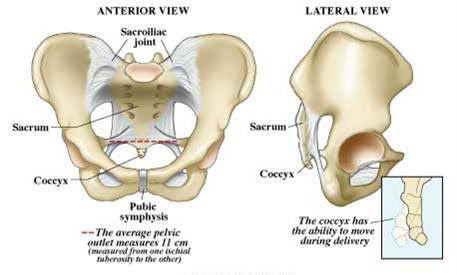
You can see what I mean in the illustration above (from Shoulder Dystocia Info.com). There are bony protuberances that jut into the pelvis from either side (the ischial spines) and the bottom of the sacrum and the coccyx, located in the back of the pelvis, jut forward. How does the baby negotiate these obstacles? During labor, the dimension of the baby’s head occupies the largest dimension of the mother’s pelvis. But because of the multiple obstacles, the largest part of the mother’s pelvis is different from top to middle to bottom. Therefore, the baby is forced to twist and turn its head in order to fit.

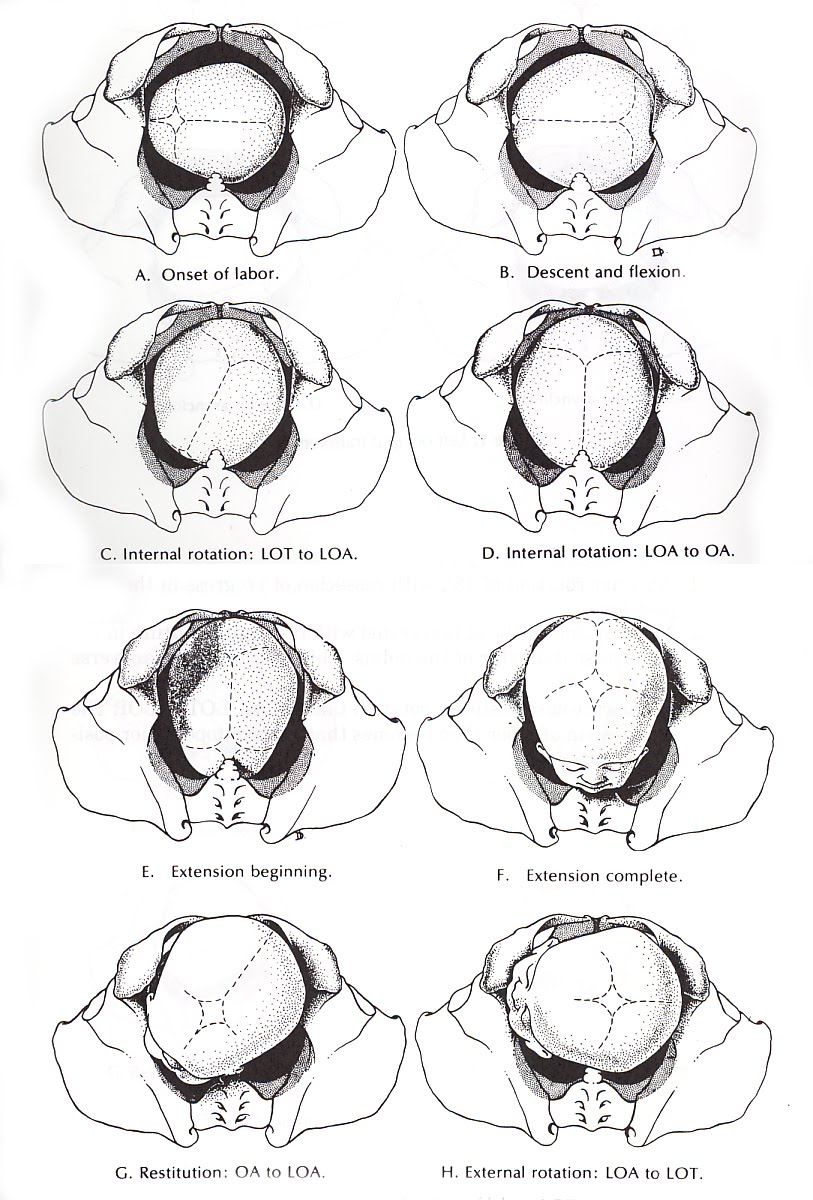
This illustration (from the textbook Human Labor & Birth) shows what happens. We are looking up from below and the fetal skull is passing through the mother’s pelvis. The lines on top of the skull demarcate the different bones of the fetal skull.

You can see that at the beginning of labor, the baby’s head is facing sideways; in the middle of labor, the head in facing toward the mother’s back; and after the head is born, it switches back to sideways and the shoulders come through the pelvis.

What does it mean when the baby’s head gets stuck? It can mean a number of different things. The pelvic inlet could be too small so the baby’s head never even drops into the pelvis. The ischial spines could stick too far into the pelvis and stop the head. The sacrum and coccyx could be angled too far forward and that could stop the head.

Clearly there is a great deal of potential for a mismatch between the size of the pelvis and the size of the baby’s head. Over time, baby’s have evolved so that the bones of the skull are not fused and can slide over each other, reducing the diameter of the head. This is called “molding” and accounts for the typical conehead of the newborn. But there is a limit to the amount of molding that the head can undergo and ultimately, the baby may not fit through.

The illustration above shows the baby’s head entering the pelvis in the optimal position, but babies don’t always cooperate. If the head is in anything other than the ideal position the fit will be even tighter. That’s why babies in the OP position (facing frontwards) and babies with asynclitic heads (the head titled to one side) are much more difficult to deliver vaginally. Their heads no longer in the smallest possible diameter. It’s like trying to put on a turtleneck face first of over your ear instead of starting from the back of your head. It’s much more difficult.

Although this is a more detailed explanation than that typically offered, it is still a simplified explanation. It does demonstrate, though, that many different variables are involved in whether a baby’s head will fit: the diameter of the pelvic inlet, the length and angle of the ischial spines, the angle of the coccyx, the position in which the fetal head enters the pelvis, the ability of the fetal head to mold to accommodate itself to the available dimensions.

Considering how many variables are involved, it’s not surprising that many babies simply do not fit. The real miracle is that most babies do fit. That was good enough to get the population to this point, despite the deaths of many babies and mothers childbirth. It’s no longer good enough, though because we want to save every baby and every mother. That’s why C-sections exist.

Dr. Amy