
Yet another C-section study that purports to show the risks but ends up showing that aren’t particularly risky

iStock_000019747710XSmall

The conventional wisdom in 2013 about obstetrics is that C-sections are “bad.” This conventional wisdom is not shared by most obstetricians, but it has spread to academia where conferences are held on how to decrease the C-section rate to some theoretical ideal. Earlier this week I wrote about a new study in the policy journal Health Affairs. That paper was deeply misleading and ignored important data. Now comes another C-section study that sets out to show that C-sections have unacceptable risks, but actually demonstrates the opposite. Moreover, the study suffers from a serious flaw, which if remedied would lower the purported risks even further still.

The study is Consequences of a Primary Elective Cesarean Delivery Across the Reproductive Life by Miller, Hahn and Grobman. The goal of the study is admirable and important:

There is a paucity of data regarding the reasons a woman may request a primary cesarean delivery. Fear of childbirth and its associated morbidity have been cited as prominent contributing factors toward such a request. These concerns have been supported by some experts, who have suggested that a planned cesarean delivery is less morbid than a trial of labor when weighing in the rates of an unplanned cesarean delivery…

One of the limitations of the available data is its focus on short-term outcomes related only to the initial pregnancy. However, the decision about route of delivery in one pregnancy has ramifications through subsequent pregnancies given the increased morbidity associated with multiple abdominal surgeries and uterine scars. Yet the comparative morbidity across multiple pregnancies related to the initial approach to delivery remains uncertain. A properly powered observational study that would provide such data would require many thousands of women given the relatively low frequency of adverse events that occur with either delivery approach. The logistic difficulty of this makes such an observational study unlikely to be performed. Thus, we designed a decision analysis to provide a framework for understanding the risks over the reproductive lifespan associated with either trial of labor or elective cesarean delivery for an initial delivery.

So far so good. The authors want to find out the risks of a maternal request C-section across the subsequent reproductive lifespan. It’s too hard to do an actual study of what the risks really are, so they plan to create a theoretical model to estimate them. Now comes the serious problem: there is no data on the risks of maternal request C-sections, so they plan to use elective C-sections as a proxy for maternal request C-section. But in the medical context, elective does NOT mean unindicated, it means non-emergent. So many “elective” C-sections are performed for medical reasons in no way represent unindicated C-sections. The authors show some awareness of this problem:

This model included women at term with a singleton gestation in the vertex presentation and no contraindication (eg, placenta previa) to a trial of labor.

In other words, the model took into account absolute contraindications to vaginal delivery, but not other indications for “elective” C-sections. Therefore, the results are likely to dramatically overstate the risks of a maternal request C-section.

Nonetheless, the findings are remarkable for just how safe C-sections have become. Moreover, the authors did not repeat the dreadful mistake of the Health Affairs piece and did include some neonatal outcomes making it possible to compare the risks of C-sections to the risks of vaginal delivery.

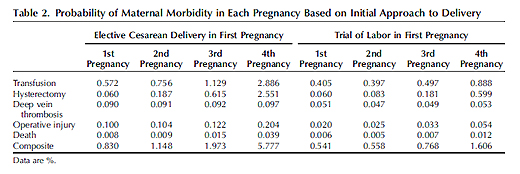
Let’s look at maternal morbidity first, which is summarized in the table below.
C-sections maternal morbidity

What jumps out at me is just how low the risks really are. The death rate for a non-emergent primary C-section is 8/100,000 as compared to a death rate for vaginal delivery of 6/100,000, for a difference of only 2/100,000. And that difference is likely to be a dramatic overestimate in the case of a truly elective (vs. non-emergent) C-section.

It is true that the risk rises with ever subsequent C-section. For the 4th C-section, the death rate is 39/100,000 as compared to 12/100,000 for a 4th vaginal delivery, for a difference of 27/100,000. Once again this is likely to be a vast overestimate. In addition, 85% of American women have fewer than 4 children, so this difference applies to a small subset of women.

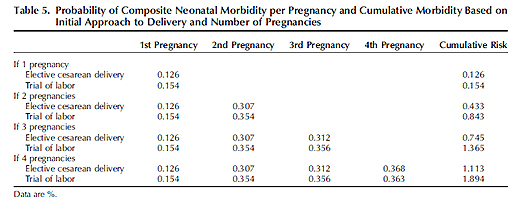
Now let’s look at the outcomes for babies, which can be found in the table below.
C-sections neonatal morbidity

In contrast to the results for mothers, the authors unfathomably chose to ignore the neonatal death rate, surely the single most important piece of data in evaluating neonatal outcomes. They chose to restrict neonatal outcomes to cerebral palsy and brachial plexus injuries. C-section results in a neurologic injury rate for a first C-sections is 12.6/1000 as compared to 15.4/1000 demonstrating that C-section has a protective effect for babies. Although the protective effect disappears by the 4th C-section, the difference is only 5/100,000.

The omission of neonatal death rates is inexcusable. It’s not as if that information is unavailable. Although, to my knowledge, no study has been done to specifically look at the differences in neonatal mortality as the number of C-sections rise, there are  studies that demonstrate that C-section is protective, such as Neonatal Morbidity and Mortality After Elective Cesarean Delivery by Signore and Klebanoff that showed that if 1 million women underwent C-section at 39 weeks instead of waiting for onset of labor and attempting vaginal delivery, 692 more babies would be saved, 517 cases of intracranial hemorrhage and 377 brachial plexus injuries would be prevented.

Even in the absence of mortality data, the authors acknowledge that C-sections are protective:

…this model demonstrates that elective first cesarean delivery may allow one to avoid the infrequent intrapartum neonatal events that occur during trials of labor and that may be associated with longterm neurodevelopmental impairment…

Neonatal outcomes chosen included those known to be affected by route of delivery. Insofar as elective cesarean delivery is often scheduled at 39 weeks of gestation, some have suggested that stillbirth rates could be reduced by using a strategy of elective cesarean delivery. Elective cesarean delivery at 39 weeks at gestation would, indeed, reduce the incremental increase in stillbirth associated with expectant management of pregnancy after this point…

The authors conclude:

… Our analysis cannot determine that one approach is “better” than another, particularly because some outcomes (eg, incontinence) remain poorly characterized and because such a determination would need to include preferences accorded to different routes of delivery by women. Nevertheless, this analysis can provide information that may be helpful in counseling and emphasizes that although an initial cesarean delivery may result in only a marginally increased risk of maternal morbidity and a marginally decreased neonatal risk compared with a trial of labor, the difference in maternal morbidity throughout reproductive life become increasingly larger, whereas the difference in perinatal outcomes becomes increasingly smaller.

The bottom line is that even multiple C-sections may have modest risks and for women planning only one or two children, the benefits of elective C-section may actually outweigh the risks.

  • Captain Obvious

    Written by a CPM…
    Twin vaginal birth summary

    http://www.pregnancybeat.com/twin-study-planned-cesarean-no-safer-than-vaginal-delivery/

    1) As long as the first baby is not breech. The second twin still inherits the greater risk.
    2) As long as the doctor has qualified expertise of twins and second twin breech deliveries. As well as neonatal resuscitation.
    3) As long as the hospital has appropriate set up, such as in house anesthesia and neonatology and operating room access.
    4) Doesn’t sound like twins is a variation of normal for under qualified CPM to try to deliver at home!

    Studies have demonstrated that diamniotic dichorionic twins have better outcomes if delivered by 38 weeks, after 39 weeks outcomes are worse. For monochorionic diamniotic twins delivery should even be around 37-38 weeks, as outcomes for these twins tend to do worse if delivered later. So there is a safe window to deliver twins as many will deliver preterm and some may need to be induced.

    • AmyM

      Urgh. I had my twins (mono/di) vaginally, but only because both were head down, I went into labor spontaneously at 36wk, both tolerated the labor well, and I had pitocin on board after hours of erratic contractions. Also, my twins were delivered in the OR, in case a sudden Csection was needed (so anesthesia was not a problem). After reading this blog for so long, sometimes I think if I had to do it over again, I’d get the Csection.

      I was very worried about recovering from a section while trying to care for infant twins, and I’ll never know how that really would have been. At any rate, the babies were fine, the morbidities were on me: PPH leading to anemia, a small tear, and some (albeit minor) stress incontinence (due to the pressure of twins, and of delivering them on my bladder, is what my OB told me.) Odds are, a Csection would have gone well, and I might have avoided all of those things (well, the tear for sure). Certainly the babies would have fine in that case too. Also,their birthday would have been a day earlier, since labor was so long.

      Ultimately, we were just happy that everyone was alive and healthy, and I wouldn’t have felt like a failure for having a Csection if that’s the way it had played out. My boys are 4 now, and aside from small stature (which they likely would have had anyway since husband and I are both very small), they do not seem to be suffering from anything as a direct result of slight prematurity or vaginal birth.

  • AllieFoyle

    How is it ethical for a study with those results to have an abstract and conclusions so biased against c-sections? Clearly, this one goes in the “c-sections bad” pile, but when you actually look at the data, it really shows no such thing.

    Their results seem to show that your chances of having living, healthy babies, even with as many as four pregnancies is better with CS. Your chances of suffering from one of the indicators of maternal mortality (that they address–there are lots that they don’t, including pelvic floor problems) increases with each CS, but is low in either case, and no attempt is made to separate the increased morbidity due to the condition necessitating the CS from the CS itself.

    If I were having a baby right now and planning a small family, this would actually be the kind of evidence that would push me toward requesting a CS. The irony is that it will actually probably be used to limit women’s access to choosing it. Disgusting.

  • Sue

    I propose a new convention in the discussion of cesarean surgery – no maternal outcomes to be quoted without concurrently describing neonatal outcomes. Sue’s rule. (Um…sorry…GUIDELINE)

  • lacrima

    I would like to extend my thanks to Dr Amy and commenters. I started coming here when I fell pregnant with 2nd child (now 34 weeks). I had to make some decisions regarding my birth options and, partly due to this blog, I am totally at peace and looking forward to my upcoming ERCS. My care providers are happy to try for a VBAC, but as it turns out, I’m not at all interested. It’s difficult to find any information online which doesn’t focus on the “too posh to push” garbage or cater to the VBAC-at-all-costs neo-Luddist NCB propaganda. I’m an intelligent and educated woman and I prefer to make my decisions based on evidence, rather than morality, money or faith.
    Thanks, everyone :-)

  • yentavegan

    12 years ago, when i was pregnant with dd5 i was 41 years old and the pregnancy had passed the 40 week mark. My NST came back normal but I was antsy and became concerned that I would get a herpes flare up during labor. So I called my ob/gyn and said I want to have this baby today. She asked me if i wanted to be induced and I said NO, I want a c/sec. Without hesitation she called the hospital and arranged for the c/sec later that afternoon. My decision, my baby.
    Was the c/sec medically indicated?, Probably not. Did my ob/gyn have to jump through hoops to get it authorized? Apparently not.. and speaking from experience, the healing process for a planned c/sec was much easier than the healing from the vaginal births of my 9 + pound other kids.

  • anonymous

    OT: Would any doctors reading be comfortable commenting on acupuncture during infertility treatment? I am struggling because I asked my RE, the director of a major university’s fertility program, about acupuncture in connection with IVF. He spoke highly of an acupuncturist who is affiliated with a fertility clinic that provides in-house acupuncture and tradiational Chinese medicine together with conventional western fertility treatment. This acupuncturist seems highly trained and well-regarded, but also charges well over twice the going rate for acupuncture aimed at a western audience (as opposed to acupuncture in the Chinese-American immigrant community). I am beside myself with anxiety and skepticism about spending so much money ($6500 for four months care) on what seems like such an unproven treatment. The goal on RE’s part seems to be more relaxation than belief in added blood flow to pelvis. Somehow the decision whether to do the acupuncture has brought out all my despair and negativity about infertility. I am so enraged by the pricing that I am seriously considering avoiding acupuncture altogether now even as I wonder if my reaction is itself proof of a need for me to change my negative thinking.

    • Dr Kitty

      I think acupuncture is helpful to those who believe strongly it is going to be helpful.
      If you don’t, it may be better to spend your money on other things you already know you find relaxing.

      My own position is that I don’t believe in the underlying philosophy of acupuncture and am therefore very skeptical about it being anything other than a sophisticated placebo. So when my GP offered me acupuncture for my hyperemesis I declined, on the basis that it would likely be a waste of both of our time.

      If you believe in the underlying philosophy it shouldn’t matter if it is the pricey guy or the guy who caters to the recent immigrants if they are putting the needles in the same places, if you don’t believe in the philosophy behind it, then what you are paying for the nicer office and the additional belief that you’ll get what you pay for.

      • anonymous

        Thank you, Dr. Kitty.

      • Dr Kitty

        Sorry, what I mean to say is that you need to work out whether you are more ok with paying the money and have it not work, or not paying the money and have it not work.

        If you’ll beat yourself up more over not having tried it then go for it, if you’d be more upset that you wasted the money then don’t.

        I don’t really think that this is about evidence of effectiveness in your case, this is about being able to live with whatever decision you make if it doesn’t play out as you hope.

        • anonymous

          Thank you again, Dr. Kitty. My problem is that my interest in going is largely fear based (how terrible will I feel if I didn’t try it, and IVF doesn’t work vs. how terrible will I feel if pay all this money and it still doesn’t work). So it’s all very negative. I guess I will just have to see how I feel in the next few days.

          • anonymous

            In other words, just as you stated it. :)

          • thepragmatist

            See my above post. You do not control your infertility. It is not your fault. It is truly out of your hands and that is something to grieve. I don’t deal with infertility but I am physically disabled by something that is partly untreatable as far as I can see. I have felt the guilt and desperation. The truth is: your infertility is not in your power to control and trying sham quackery will just empty your pockets. If you conceive through IVF, it will ALWAYS be because of the IVF, not because of anything else. If you want to relax, go to the spa and have a nice afternoon. But if you do not conceive through IVF, it is just the unfortunate reality and there is grief there at fate’s cruel and senseless hand, but in NO WAY would that be your fault for not going to a treatment that has no proven efficacy. I have been desperate before for answers and treatments, and I know that it feels like you must do everything in your power to fix it and to get what you need so very badly. And some point, you must let the guilt and need to control it go because it is very truly out of your hands now. I hope the IVF works for you. I wish you the best of luck.

            And Dr. Kitty, with all respect to you, see my above post. I really do like you so very much from posting here, so my apologies for my anger in it! I’ve been harmed by “alternative medicine” that my very nice doctor with no doubt the best of intentions recommended. Not only did it prevent me from finding the care I now receive (science-based FTW!) and answering the issues I had, but it harmed me, too, directly.

          • Dr Kitty

            I get where you’re coming from, totally.

            I do get a little wary of dispensing advice, on the Internet, as a doctor, which contradicts that advice of someone’s actual doctor.

            IRL I don’t refer for acupuncture or homeopathy and if someone asks about any of that CAM stuff I say something like “objective evidence does not show that to be effective, and but it is your money and you are free to spend it as you wish.Don’t take any herbs without checking with me about your tablets first.”

          • anonymous

            I want to thank everyone on this thread. Your willingness to take the time to respond has touched me and it also helps me feel less panicky about making a decision. I also felt angry at my doctor for “opening the door” so to speak to what feels like such a hard decision, but he only mentioned it after I asked him. As mentioned before, he did talk in terms of relaxation and put yoga and massage in the same category. That said, I end up agreeing with a lot of what you are saying, thepragmatist. Perhaps what I will do is go see the person in Chinatown recommended by some friends of mine who are Asian American and into natural healing, and not ingest any herbs or tea or endangered animal soup. Then I can be relax and still be solvent. :)

          • ratiomom

            I’m a bit late to the party here, but my n=1:
            I dealt with my stress during my IVF by turning to my old friend Pinot Gris before the pickup and between pickup and transfer. After the embryo was in, chocolate and fast food comforted me. No health foods, supplements or alternative medicine in any way, shape or form. Lots of stress and anguish about the stress causing rejection of the embryo.
            The result: one healthy baby girl on the first try.

            It’s either going to work, or it isn’t. Nothing you can do will influence that. (don’t do hot tub or sauna though. Raising your body temperature IS bad for the embryo)
            Save your money for another round of IVF just in case.

          • anonymous

            Thank you, ratiomom! :)

          • thepragmatist

            Thanks. That’s another thing that really pisses me off: my first MIL was a licensed herbal therapist and a serious one at that. She taught me a lot about herbal medicine, and the industry too. The medicine, while sometimes effective (milk thistle for example is commonly used in dogs) can be toxic in some circumstances or react badly with conventional medicine. And usually, it is not standardized (meaning you do not get the same amount in each dose) and the quality varies wildly. We have had deaths in Canada that resulted in the suspension of certain remedies: kava kava (which I absolutely adored in tea for its sedating effects) was pulled from the shelves, and ephedra, too, for example. But not before people died, and still no regulations. If these people want to be considered “medicine” then they should be treated as such. There are herbal remedies that someone with compromised liver function shouldn’t touch. There are some that would negatively affect the heart. But average people do not realize these “natural” medicines are no better than their conventional counter-parts: worse even, because they have far less safety data and the industry, at least in NA, is not regulated or standardized. Also, if we do find something that IS effective, we usually synthesize it or adopt it, if it meets the rigor of the scientific method. I have not come to these conclusions lightly. I have had a lot of exposure to SCAM “science”. Tons.

          • fiftyfifty1

            If you were my sister, friend or patient, my medical advice would be not to do it. There is absolutely no medical or physiologic reason that accupuncture could help. As for the “it will help you relax” reasoning, I don’t agree with that either. It seems to me to just be an extension of the myth that being “uptight” is what causes or contributes to infertility. This has been proven NOT to be true. Anxiety levels and mood were NOT found to be correlated with success of fertility treatments when it was studied.
            That said, you DO deserve stress relief. Anybody going through a stressful time in their life deserves some TLC. Not because it will help you get preggers (Because it won’t. Either you will or you won’t based on forces outside your control) but because what you are going through would stress anybody out. So if you have a little extra time and/or money, treat yourself to something that feels nurturing to you. Or maybe don’t. I know myself that when my stress levels are highest, I can’t even enjoy nurturing. I just try to endure until things get better. But either way, however you cope (or don’t cope) it won’t affect the outcome of the IVF.
            I agree that we as doctors shouldn’t recommend this stuff. I think fertility docs recommend this because it gives patients something to DO, rather than just feel helpless. And because they don’t want to be accused of not being “holistic”. But I think that sort of reasoning backfires. Instead it gives the message that “the outcome is under your control”. And also the damaging message that “your body is un-natural, that’s why you need this ‘holistic’ help.”
            I really wish I had a way to make this better for you. It is really unfair and a bummer that you are having to go through infertility. I wish you all the very best!

          • Box of Salt

            fiftyfifty “I know myself that when my stress levels are highest, I can’t even enjoy nurturing.”

            Thank you for expressing this. I thought that was just me.

          • KarenJJ

            I’m was a Nervous Nelly with regards IVF and infertility and I wanted to make sure I had everything in order and was doing everything thing I can and had researched everything that I might possibly need to know.

            I drove my husband nuts while I was doing IVF and he ended up asking me to take a break from the computer and find something to do to take my mind off everything. I had a full time job which helped but during the evenings I found it hard to switch off.

            In the end I made a patchwork baby quilt. I wanted to make something baby-ish and I planned to either use it for the baby, or if the IVF failed then I would give it to a friend. I’m the least crafty person I know and my 4yo does a better job with scissors than I do (I bought a kit so that they were already cut up!) but laying it out and stitching it together made me feel like I was ‘doing’ something. In the end I did get to use it for my babies (although I didn’t actually finish it for a good year or so and I ended up paying someone to do the rest for me) so I’m glad that I did it.

            So I definitely agree to do what you need to do to stay sane, but acupuncture isn’t going to do that for everyone. I, for one, hated it. $6,500 is a pretty good holiday there :)

    • AmyM

      Not a doctor, but I did IVF (successfully) and never did acupuncture. My RE never even mentioned it, though there was a pamphlet for a yoga class for infertile women. Not sure if they thought the yoga actually did anything for infertility or if it was meant as more of a relaxation with a support group kind of deal. I’ve taken lots of yoga classes, but it was just regular yoga (stretching and balancing mostly), nothing to do with reproducing.

      • KarenJJ

        Another n=1 here. I did with my first pregnancy. It was IVF and I was so nervous that I did acupuncture and TCM leading up to it. I hated it but I fell pregnant first round of IVF and had a good pregnancy. My IVF clinic was not enormously supportive of it and I was told by my specialist and the nurse that the previous evidence in favour of acupuncture looks to have been overstated (this was about 5 years ago).

        HOWEVER – 2 years later I got diagnosed with an immune system issue, spent 4 weeks on a drug trial with medication that controlled the inflamation that was causing the problems and – BOOM – one accidental pregnancy with no acupuncture, no TCM, no IVF, no special lubricant, no special positions or resting afterwards or any of the nutty things I’d tried in desperation.

        Thankfully it was a wanted pregnancy and it resulted in a very healthy and happy baby.

        So if I was doing IVF again, I personally would not bother with it and would save my money. Having been infertile I do understand wanting to do everything that you can to help things, but for me I doubt that the acupuncture or TCM actually did much.

    • BCMom

      My daughter did acupuncture after each embryo transfer, (recommended by her RE also but only for relaxation purposes) but it was a one off right after the transfer procedure each time. She finally did get pregnant on the sixth attempt, so I don’t know that the acupuncture really played any kind of role as she had five failed attempts prior to that. Her rationalization about it was it couldn’t hurt and it didn’t cost much, so she went for it but if she had had to pay $6500 on top of the $50,000 they had already spent, there would have been no way she could have afforded it. Knowing the devastation my daughter experienced after each failed attempt, it almost seems like taking advantage of a hopeful mother-to-be and a way of exploiting her vulnerability and hopes for financial gain. Women who are trying to conceive will do just about anything if they think it will increase their chances of success , I can just imagine the angst this is causing you and I feel terrible for the dilemma it is causing you.

      • thepragmatist

        You’ve got it right on the head. Exploitation and unwitting physicians who think it “can’t hurt”. But it can hurt! It can hurt by divesting a person of money, it can hurt by causing physical harm, and it hurts in a broader sense by giving hucksters legitimacy. It also hurts because it diverts attention from effective treatment. While that patient is wandering in woo, potentially getting deeper and deeper into it, she could’ve been spending the same time and energy on finding a treatment with efficacy. And if it is to give the patient something to do to feel better, perhaps just letting the patient grieve the reality is for the best, so she can heal and start moving forward. The best doctors I have are the ones who acknowledge when there is nothing left for anyone to do, but that they will do what is needed so I suffer as little as possible and have the best quality of life and not give up on me. The best doctors I’ve had are the ones who let me sit in the grief of what is happening in my body so that I can learn to live with it better. If there is nothing more to be done, or only time will heal it, or it is something that science cannot treat yet, it is far better to focus on quality of life issues that can be improved upon without need for “treatment” beyond a compassionate physician/patient relationship and palliative measures to reduce suffering. I value that far more than wishful thinking or distraction. Give me what you can to make it hurt less (for me, it’s a physical disability causes much pain) and stay abreast when new science gives us more answers. In the interim, grieve with me and let me feel it, and tell me you will not give up and that it is not my fault and do not lead me down a path that could lead to more suffering or false hope. That is what I REALLY need to hear: that it was not my fault and I could stop blaming myself. That is when the real healing started for me. When I could finally stop blaming myself, looking for answers everywhere, and look it in the face for what it is. That doesn’t mean I’m not doing what I can with what fate has given me. But that I have given up on thinking there will some sudden cure, or that it is in my hands. Didn’t create it and cannot cure it, so rather than waste time chasing what does not exist, I would rather be treated honestly and compassionately. And when the time comes that we can treat what is wrong with me, then treat it. I have two specialists who are very good at this.

    • thepragmatist

      What doctors recommend non-science based medicine to me, I feel rage. I
      think I get where you are coming from. Where’s the proof? There is none.
      Go stick some stick sewing needles in your leg and get your
      husband/partner to rub your shoulders while you think of a flowing
      river. That will have the same benefit. Angry for you and everyone
      bilked out of money by “Traditional Chinese Medicine”.

      Doctors who read here: would you prescribe your patient an expensive placebo in the hopes it makes them “feel better” or a drug because they think it might work, but you know it doesn’t having any legitimacy? So why is it okay for science-based physicians to legitimize quackery even if it may make the patient “feel better” because of confirmation bias, or the placebo effect, or both? Because when physicians step into supporting this (often with the best of intentions, thinking it will not harm, so who cares), they do not understand that they are supporting the ideological creep of anti-science into mainstream medicine. Or what is really going on in those sessions! I am so frustrated, constantly, when the medical community suggests non-science based treatments to me. I’ve been to them all. And back again. And been harmed by them.

      I wish the medical community would fight back, especially against Traditional Chinese Medicine (which is unethical because of its destruction of wildlife and uses unproven, sometimes harmful, treatments and medicines) and naturopathy with their expensive, unproven treatments (especially of children!). Acupuncture is a sham, as is evidenced by a stroll through the literature. So to every single science-minded physician! Stop! Traditional Chinese Medicine hurt me and I am still paying for it. Recommended by my very conservative-seeming doctor. I trusted my GP, and he was probably just innocently thinking, “Well, what could it hurt?” I have no doubt it made my condition worse and got in the way of me getting REAL treatment that would help.

      Stop opening the door for people to be bilked and harmed by quackery. Take a stand and when a patient asks, tell the truth. There is no proof. If you have no answer for your patient, don’t send them to a quack, tell them there is no answer but you will try to find one. For relaxation, there is always a massage and a nice bath. What is ethical about sending people for treatment that does not have proven efficacy? Because it will make them feel good? So would eating chocolate cake and having a nice night out with their husband. For less money too. This is something that really steams me: the support of non-science by science-based medicine even when they know better. Your patient considers you an authority, so when you tell us that something may help, we believe you! And meanwhile, these people who you refer to tell your patients not to trust you and undermine real treatment! Am I the only one who feels this way?

      • theNormalDistribution

        I wholeheartedly agree.

        I just had a conversation with my mother-in-law about a friend of hers who has a severe anxiety disorder and anorexia. Said friend just stopped taking her medication on advice of the acupuncturist she was seeing. The acupuncturist was recommended by her psychologist.

        My mother-in-law is an intelligent, well educated woman and she tries to be skeptical, but we live in an area where “alternative”, “holistic” or “integrative” medicine are supported by both popular culture *and* the medical community. That kind of influence holds a lot of sway, even when people are presented with the numerous reasons why things like homeopathy and acupuncture are not only ineffective, but dangerous. My mother-in-law just kept insisting that naturopaths (the usual acupuncture practitioners around here) have years of education, so there must be something to what they do. NOOOOO!

        • The Bofa on the Sofa

          I have one question about “traditional chinese medicine”: Why the hell does ANYONE think this is a good idea?

          Did you know that, in 1930, a chinese farmer had a life expectancy of under 25 years (men did – women were under 24 – presumably death in childbirth).

          These were the chinese natives, presumably the ones who were all over the local practices (as opposed to those in modernized cities). Gotta say, it’s not a great testament to the success of “traditional” chinese medicine when the elders are 30 years old. Note this was well before the famines caused by The Great Leap Forward, so it’s not due to communist policies (and remember, Mao was a huge proponent of restoring TCM because it was cheap).

          This is so totally “noble savage” crap.

          • anonymous

            I can only say for myself that I am struggling with the ideas critiqued by GuestII above. I am afraid that TCM (the acupuncture part) might be needed to relax in just the “right” way to potentiate implantation. Dumb, but there it is.

          • theNormalDistribution

            Rest assured that acupuncture is not *needed* for anything. Ever.

          • anonymous

            Thanks, tND. :)

      • Isramommy

        The “Traditional Chinese Medicine” thing really irks me too, for a couple of reasons. First, I absolutely concede that different herbs and plant remedies in traditional medicines may have benefits to certain conditions. Fine. So study those herbal remedies in a lab, do large scale studies/trials, and develop accurately measured and consistent pharmaceutical doses for those compounds that do work. I’m sure there are Chinese pharmaceutical companies well-equipped to do that research, and that is the only sort of “Chinese medicinal” remedies I’d want to accept.

        Second, the whole “it’s a traditional Chinese remedy so it must work!” thing comes just a bit too close to the Nobel Savage meme for my comfort. You see that a lot in alternative medicine/ncb, and I find it off putting and patronizing of other cultures.

        And finally on a purely practical level, if we’re talking about Chinese herbs actually imported from China, well, I wouldn’t ingest anything manufactured/grown there. Have you seen the air, water and ground soil pollution levels they have? There have been plenty of reports on contaminated crops, not to mention the scandals with Chinese manufactured pet foods, toothpaste and baby formulas being adulterated with melamine and other toxic chemicals. The children’s toys with lead and cadmium based paints? I’m not sure herbs potentially laced with heavy metals, banned pesticides or renal toxins are a great idea for a pregnant or TTC woman.

      • anonymous

        Thank you for sharing your personal experiences here and below. I appreciate your candor and courage very much.

    • Box of Salt

      anonymous, I’m not a doctor, but if his recommendation for that particular acupuncturist was to help you relax, I’d say that ship has already sailed in the wrong direction, and if I were you I’d skip it. And allow making that decision to reduce your stress instead.

      • anonymous

        Haha too true!

    • Josephine

      As someone who’s been through infertility, I’d say save your $6500 and go get a massage once a month and take yourself out for lunch afterwards (that’s, what, probably $200/month max, versus $6500 over four months). Save your cash.

    • Guestll

      Disclaimer: not a doctor. Former fertility patient, 3 IVFs. My RE, considered to be one of the best in the country when it comes to AMA women, recommended that I not bother with acupuncture. Why? The evidence is mixed. Some studies show a benefit, some don’t, and one particular study showed that acu was negatively correlated with IVF success. Point being, there’s no solid evidence that it works. Save your money. And $6500 is a heck of a lot of money — when I was looking into it three years ago, I would have been spending about $200 per month on a practitioner with a “specialty” in fertility.

      My anecdote – I got pregnant from all three IVFs, miscarried two of those pregnancies (aneuploid) and delivered one healthy baby.

      My other anecdote – my one visit to the “fertility specialist” acupuncturist, it went like this. I showed her my temperature/cervical mucus charts. She said, “Your eggs have poor energy.” I replied, “What is the energy of an egg?” She had no answer. Never went back. I was desperate, but yeah…no.

      • Guestll

        One more anecdote — at that visit mentioned above, I told the acupuncturist that my period was 4 days late. She felt my pulse and said, authoritatively, that I was not pregnant.
        Went home and peed on a test. Blaring positive. I was indeed, with twins – our one spontaneous conception. Ended in a miscarriage down the road but yeah, again…no.
        Still reeling over the $6500. What does this encompass, may I ask?

        • anonymous

          Well, I got clarification on the pricing, so it’s actually more like $5,000. But it involves a $300 initial 90 min appointment, $150 1 hour apointments weekly, with 2 appoinments during the IVF drug stimulation phase, and 4 appointments scheduled around the IVF transfer. Apparently there is lots of counseling, some meditation, the acupuncture, and a diet that eliminates “toxins,” including a no-gluten aspect. I think it is kind of like unlicensed talk therapy with some dieting and acupuncture along with it. Lots of talk about “making room” for a baby in your mental life, being “fertile” in your approach to life (and not just literal conception). I really don’t want to out my doctor here, but let’s just say it’s a major American city known for its wealthy population and high cost of living. I am a bit over weight at the moment, though I’m only one pound out of my proper BMI. I have started exercising more and am curbing sugar, but the whole non-gluten thing just seems so dumb. Not to mention the $5,000. My doctor may have thought I am wealthier than I am since my husband works in a high-paying field. But we have a lot of student loans so it’s deceptive.

          • anonymous

            They also tell you to get all the non-natural household cleaners out of your house. I am gleaning a lot of this info from the testimonials on their website.

          • Guestll

            If you need support, there’s plenty out there for fertility patients. There are therapists who specialize in treating infertile women/couples, there are online groups where you can talk to other people (usually women) going through similar experiences…your insurance may or may not cover therapy, but it’s something to consider if you feel as though you need help.

            I have a problem with the notion of “making room for a baby in your mental life” and being “fertile” in your approach, as an approach to treatment — because it assumes that you have some kind of personal responsibility for something that is not your fault. If ONLY you were more receptive, if ONLY you were more “fertile” in your approach (and WTF does that mean, it’s bullshit) — like you can overcome PCOS or age or blocked tubes or poor morphology with these techniques.

            The realm of fertility treatment, just like cancer treatment, is prone to this garbage, because success rates overall are still not very good. IVF was designed to bypass tubal issues, and it’s pretty much a slam-dunk if you’re a 25 year old woman with juicy ovaries and zero other issues. But increasingly, that is not the average fertility patient. To wit, the average fertility patient in my big city clinic is a 37 year old woman who has tried for one year and has never been pregnant. Her odds of taking home a baby are around 1 in 3.

            Success with IVF depends on a number of factors, but the primary factor is the age of the woman. With that in mind, I found a reproductive endocrinologist with a great deal of experience in treating women in my age bracket. It’s really important that you feel that your physician has your best interests at hand. That’s not to say that you have to like them — my RE has a crappy bedside manner — but that you trust them…and it doesn’t seem to me like your RE is inspiring a whole lot of faith in you.

          • anonymous

            I appreciate all the points you have made here.

            I do want to clarify that I do trust my RE totally. As I mentioned in my previous post, he is the director of a major university-based program. In every other way, he and the other doctors have advised my husband and me against doing expensive things that lack evidence (such as back to back IUIs). Without getting into the specifics of my treatment, they allowed us to approach our treatment in a way that they knew would lose them several thousand dollars in fees. They allowed us to do this even though it also caused them inconvenience so that we could save money.

            My RE may think I belive in acupuncture already. As others speculated, he may think it can’t hurt me and might make me feel better. I know for sure he wants me to feel better. He may have observed that other patients were cheered up by their interactions with this acupuncturist. I think he does not realize how much I can’t afford the specific acupuncturist in question.

            I do wish he had not recommended it, but it doesn’t make me distrust him overall. I do not know how much he may believe that having a better mindset improves the outcome, and that is why this is freaking me out so much. I probably will not be able to ask him about this again until the IVF but I will ask other nurses and doctors I see in the coming weeks to get a better understanding of their position on this.

  • Isramommy

    OT but, I want to ask those in the know… I hear about pain free births with epidurals and I really want to know, why can’t I have one of those? With both of my children my epidurals worked great through labor but the pushing stage was absolutely excruciating. With my son I went pain free from 3 cm to crowning in less than 90 minutes and then was suddenly s-c-r-e-a-m-i-n-g in pain. I asked the midwife to “fix” the epidural but she said there was no time, and she was probably right since baby was out in less than 15 (very, very painful) minutes. To be fair, the birth was a bit difficult and “expedited” with fundal pressure and an episiotomy because his heart rate tanked a bit, but I still don’t understand why the epidural should seem so ineffective during that last, critical part of the delivery. Did I have inadequate anesthesia? Thoughts?

    • AmyM

      I am curious too…I had a similar situation. Epidural so I felt no pain during contractions, though I could feel the contractions (felt like a tightening or squeezing). Then pushing….which SUCKED. I remember in my head I was thinking “The only way out is through, the more I push the sooner this will end” but yeah, I hadn’t expected that. The part that hurt the most was when they used a vacuum for Baby A–that’s when I tore, and that’s when I really screamed.

      But, Baby was out safely and suffered no ill effects. (Because he was being monitored and when they didn’t like what started showing up on the monitors they did something about it before it was a catastrophe. The way interventions are supposed to be used.) (Not aimed at you Isramommy—merely those who think intervention is a dirty word and should only be used to get dead babies out.)

      • Isramommy

        I get you AmyM. Our situation was similar with the monitor going bad quickly and the midwife calling in an ob and doing whatever it took to get baby out. Our boy had APGARS of 9 and 10 despite the very clear concern during the final minutes of delivery- I remember between pushes the midwife was rubbing his scalp trying to see a response on the monitor, and both midwife and ob were almost threatening in their insistence that I had to push harder, work harder, get the baby out NOW.

        All in all, my son’s birth was lovely and positive, despite the pain at the end (though I’d prefer to do without the pain next time). The non-interventionists would probably frame it as “birth rape”- an ob climbing on the bed and pushing my stomach as I screamed at her to get off (I was out-of-my-head irrational in pain) while the midwife cut an episotomy without asking consent. But it’s exactly how I’d expect and want my hcp to behave in that situation. I don’t know exactly what the monitor showed, but the professionals were clearly worried. They got my baby out healthy despite those concerns. That’s what matters and that’s why I was in the hospital in the first place.

    • theadequatemother

      Unfortunately the sacral nerve roots (S1-5) sometimes exit the spinal cord in a way that makes them very difficult to freeze with an epidural. Contraction pain is carried by T10-L1-2 and that is very easy to freeze with an epi. We usually place them around L3 too and the medicine spreads up more easily than down.

      • Isramommy

        That makes sense to me, thank you. I guess my sacral nerves must fall into that category. Is there anyway to do the epidural differently if you know a woman has previously had inadequate relief for the pushing stage? Or can a patient request additional types of relief (some sort of more local nerve block?) if previous experience shows the epidural isn’t enough?

        Also, just curious (if you don’t mind me asking so many questions), do you ever run into that sort of problem with women getting a spinal for a c-section, or is that too different to be comparable?

        • theadequatemother

          One could always try a higher dose of local anesthetic in the epidural…or more fentanyl. But options for epidural tinkering in this scenario are limited. Higher local anesthetic doses increase the risk of instrumental delivery, higher narcotic doses increase the risk of systemic effect.

          The problem doesn’t occur for spinals. in a spinal the dose goes into the csf and bathes the spinal cord at the level of L4 (actually, the conus medullaris at that level)…so there is no sacral sparing effect. A CSE during transition would probably last for pushing and give you better analgesia but if given more than 1 hr prior to the second stage really has no benefit.

          Sorry.

          • Isramommy

            Thank you very much for the explanation.

      • AmyM

        Thank you! That makes sense.

  • Sterrell

    Anyone seen this? It’s an all-inclusive list of “anti-natural childbirth trolls.” I mean, wowza. There are some genuine whoppers on there.

    http://veillifted.wordpress.com/the-master-list-of-trolls/

    • Bombshellrisa

      This leaves me furious

    • ratiomom

      Someone spent a LOT of time making that page. If they have to hide themselves behind censorship and selective deafness on this scale, it becomes very clear that what they have to say might not be the truth.
      I’m also disgusted by the way they write huge bios on certain people, but there’s never a single word of explanation behind the loss moms’ names. Must-not-acknowledge-dead-babies!

      • Elizabeth Abraham

        Oh no, there’s explanation! Evidently, we screwed with Margarita Sheikh by being accepting and sympathetic over her loss. That’s how we brainwashed her.

        Eight days in labor with a crazy midwife who hid her cellphone? Nothing to do with it.

        • ratiomom

          Woops, my bad. I skimmed over it too quickly (it’s just so freaking long!) and saw nothing next to Sara Snyder’s name.

          • AllieFoyle

            They consider those women trolls? I just can’t…

    • http://www.facebook.com/profile.php?id=100002171364303 Anj Fabian

      Yup. It’s made the rounds.

      The discussion has been fairly limited:
      Are you on the list?
      Can we submit our own bios? (For those who feel slighted by lack of bios.)
      Psychological profiling of who would do this, why, and what they would get out of the effort.

      Conclusions:
      It’s deliberately provocative because the creator wants to get a reaction. Don’t react.

      • TiffanyEpiphany

        Yes, I agree with your conclusions.

        A thought I had as I was skimming the list was this: Usually the more secure a person is in their opinions and beliefs, the less they have to attract any and all attention to themselves unnecessarily.

        Another thought: The people who are considered “anti-homebirthing/NCB” may have had a personal experience that has catapulted them into that position. (For some, they may have experienced loss, for others, their loss was prevented.) It’s personal–and should be. The only thing I’ve seen from the “pro” crowd (not to suggest that there are merely 2 sides, but just to highlight the extreme stances) is unhealthy fear, mis-information, and denial.

        The contrast really speaks for itself.

      • Elizabeth Abraham

        huh.

        Interestingly, I am on the list, no bio – “Elizabeth Ann/ LDavis/Lauren Davis/Meepy Cat/BlueShoes/momadance”

        I congratulate these sluethers on finding my Ravelry account, but I wonder what Lauren Davis and Momadance did to make people think we’re all one person.

        • http://www.facebook.com/lizzie.dee.71 Lizzie Dee

          It will be fun if their “research” is as unreliable here as everywhere else.

          I note that they are inviting additions to the bios – should imagine Dr. Amy’s should get pretty long, and provide a helpful list of the various pathetic accusations they like to come up with.

          Don’t know if it would be possible to track down whoever wrote the cruel bio of Bambi – and juxtapose it with the claims to universal love and support they pretend to offer.

          I would also like to address Tiffany’s point about the role of “personal experience” – as ghastly women like those responsible for this list like to imply that only bitter losers speak out against them and no-one who trusts birth in the approved fashion could ever join their ranks. Other, more positive forms of personal experience rooted, as Tiffany says, in fear and denial or blind luck and ignorance can be just as influential. And bad experiences do not automatically make one bitter – just as likely to make one wiser, in the way that knowledge rooted in reality does, more compassionate to the suffering of others, and a lot more aware of the risks that the naive or ideologically blind continue to run.

          • ratiomom

            IMHO, there are 2 types of ‘woo-zealots’:

            1. A lot of these hard-core NCB women have suffered a lot of physical and emotional pain and inconvenience for, and invested massive efforts in their natural birth/BFing/parenting style. They cannot allow anyone else to doubt the validity of the ideology, because that would mean that their own sacrifices were pointless. They are very invested in validating their own choices by promoting them to others.

            2.On the other hand, there is the NCB industry. There is a small branch of the economy dependent on women entering into and staying within the NCB movement. Midwives, doulas, lactation consultants, writers, alternative therapists, manufactureres and sellers of alternative medicines, birth and breastfeeding accessories,… Just look at the list of advertisers on MDC. All these NCB-professionals have a big financial stake in defending the ideology tooth and nail. Honestly, I don’t see that many differences with the loathed ‘big pharma’.

          • Bombshellrisa

            What they said about Bambi was just wrong. It’s not just Bambi and her family that Brenda Scarpino has harmed.

          • fiftyfifty1

            I’m proud of Bambi. You have to be doing something right to draw such over-the-top ire. Keep up the good work Bambi!

          • thepragmatist

            I am proud and heart-broken. Heart-broken for the bullying of a family that has already suffered to see that midwife stopped, after the ultimate in suffering. Like it wasn’t enough already. And they call us cruel!

      • KarenJJ

        Who is the creator?

        It would be ironic if, while they are listing the public names and profiles of people that disagree with them, they are hiding their own identities.

        Can we suspect a certain feminist?

        • Bombshellrisa

          “If you have a story about a run in with internet trolls or tormentors in the birth community, please feel free to message us and share your story” Hmm, should we share our most prolific troll story with them? It would not be what they were thinking of, but somehow I feel like these people would deserve him.

          • http://twitter.com/SlackerInc Alan

            :P

        • http://www.facebook.com/lizzie.dee.71 Lizzie Dee

          Seems a bit too cold and calculating for that particular activist, but who knows?

          I don’t think it is meant to provoke – more to intimidate. A version of “We know where you live…” Anonymous character assassination – how brave and supportive. What YOU can expect if you step out of line.

          What they said about Bambi is beyond shameful and may even convince some of their supporters that they are vicious when crossed. Maybe Brenda Scarpino wrote that one, and Bambi has her worried.

    • Sterrell

      Yeah, I didn’t make the list. Single tear. But, I am pretty manic about what I put online. I was thinking about this the other day because I live *very* close to GCC (20 minutes) and I couldn’t imagine if I met her in real life. Reconciling her online persona with a real person would be crazy. I’d be all, “Hey… how’s your husband’s sperm count? Did you ever find that mysterious Utah caller? How’s the libido problems since your husband got nipped?” WAY too much personal info that any random person can find!

    • The Bofa on the Sofa

      What the hell? How did I not make the list? Jeez, at one time I was accused of actually being Dr Amy herself, how can I not be on the list of her minions?

      (did you ever realize that if you try to type “her minions” fast, it comes out a lot like hermione? It’s like one of Viktor Krum’s pronunciation variations)

      • LukesCook

        The author of the list doesn’t seem to have drawn heavily from this site, it seems to be more a facebook-based thing.

        • The Bofa on the Sofa

          That would explain it, I guess.

          • Victoria

            It really does – they only used one source? Sounds very NCB to me.

    • I don’t have a creative name

      This strikes me as EXACTLY something a rabid NCB’er would do. Keep a master list of anyone who has ever disagreed with them about anything, be cruel in their descriptions, particularly of those who have been hurt by their movement, and spend massive amounts of time trying to squelch any disagreement.

      Yep.

    • AllieFoyle

      They have Margarita Sheik listed as a troll? They really have no shame.

    • DirtyOldTown

      Wow, a list of people who have publicly made public statements in several public places. That’s some excellent detective work there. It’s almost like watching CSI, only slower, and with less smash cuts.

    • Guest

      Also – “birth trolling”: that sounds like something I may be interested in. Do I need a certificate or qualification of some kind, or do I just need a bridge?

      • DirtyOldTown

        That wuz me.

  • Lisa from NY

    What about scar tissue? Effects on bladder?

  • thepragmatist

    And again… a curious thing… the missing death rates, right? Because homebirth is SAFE for BABIES! And natural birth SAFE! A c-section KILLS babies! But, wait! Nobody will actually, you know, present any evidence… because what if the truth is that our technology has finally transcended our bodies and indeed, c-section is safer for babies, and vaginal birth is dangerous and far less controllable. So with all the moralizing around birth, who would be most selfless mother then? Us MRCS moms are called selfish and accused of harming our babies and costing society: but indeed, it does not appear true, does it?

    I am starting to feel like there is, indeed, a very strong agenda here to hide the mortality rates. When I decided to have a MRCS, I was told I was selfish to deprive my baby of a natural birth and to put him at risk. I felt pitted against my baby. Nobody can prove that a c-section at term is dangerous for the baby, and I think that probably, the authors here found something they really don’t want to admit: that planned c-section was the safest mode of delivery for babies. At least in the first pregnancies.

    If women knew that planned c-section was safer for their babies, perhaps even significantly safer, I imagine there would be many, many women who would want c-sections. And it would turn some dogma upside down. I feel like there is a real agenda to keep this from women. Not only are planned c-sections safe for mom, but they are safer for the baby. How can the NCB community say they are so selfless and martyr themselves if, indeed, it’s just not true? One day, the technology will be SO safe that it will just be impossible to deny it anymore. And then what? I find it very interesting. By the time our children or grandchildren are grown, will they look back on that barbaric time when women gave birth through their vaginas with disgust? I’m only half joking… Only time will tell.

    • http://www.facebook.com/lizzie.dee.71 Lizzie Dee

      I too find it interesting, Pragmatist. But I feel a bit dismayed at the idea that anything to do with birth is about “who is the most selfless mother?” Not sure that is a competition I would much want to win. Birth is dangerous, and the only thing that should matter is how to get a baby born with the least damage all round. Selflessness can come later – and not too much of it, as I don’t think it serves much of a purpose except in extreme circumstances.

      That aside, I agree with you – the hullabaloo over the CS rate is extraordinary. The number of times I have read “It is over 30%! Soon it will be 100%,..and then you will be sorry!. Really? Why? And is it all that likely, seeing as doctors (in my experience) are not all that keen on doing them, and the majority of women are not keen on having them? Like you, I have wondered: But what if it turns out it is MUCH BETTER FOR THE BABY? Wouldn’t that just set the cat amongst the pigeons? It may be major surgery – and so not that wonderful for the mother, but it seems to me like rather an easy start for an infant in good condition and even better for one who is beginning to struggle to maintain an oxygen supply. What kind of insanity is it that insists this is traumatic for a baby, compared with having it head squeezed for hours?

      I think you are also right that there is a very strong, ages old, agenda for vaginal birth. It is natural! Enjoyable for some, it seems, and so exciting! The baby made it out alive…the miracle of birth.

      It would be lovely if strong and honest intelligences had a good look at this – but not too likely, I don’t think. Those who deplore the CS rate don’t really need to fear 100%. I will settle for our daughters and granddaughter having accurate, reliable information suitable for grown-ups to make rational choices and a lot less of the mystifying. Some better technology that might provide a window into the womb, and ways of dealing with the few serious complications that DO make surgery a risk. (Such miraculous technologies in other disciplines – why is birth still relying on guess work? Because it turns out OK most of the time?)The baby will ALWAYS be the miracle, regardless of its mode of delivery.

      • http://www.facebook.com/lizzie.dee.71 Lizzie Dee

        Just in passing, my daughter said to me the other day that the “miracle of birth” came to her one day when her youngest was three, when she looked at this bundle of life, intelligence and curiosity, and said to herself “I made a person!” That IS something to be proud and amazed about, and our creative energies should go into making the best we can out of raising that person, not fretting over which orifice it came out of.

      • thepragmatist

        Oh, I was just saying that bit about selflessness because that is the first thing NCB/APers will accuse you of when you step outside the ideological prison they’ve built: selfishness for your baby. So yes, it would be the cat’s meow, no? :) As you say… it would bring me a lot of pleasure to see them have to eat crow. Then what could they say??? Really? Hence the fixation on maternal mortality now. And so what if that disappears in the next few decades? Ha, then what? What if the risks of vaginal birth just outstrip the risk of a relatively minor surgery? As the technology improves, perhaps one day c-section will be so safe as to be able to say this… and then what? My creative brain can’t help but love it.

    • DiomedesV

      My understanding is that in parts of China, MRCS is the dominant mode of birth, or at least very common. Perhaps when families knows that they are constrained and can have only 1 or at most, 2 children, they opt for C/S because of its comparative safety for the baby.

      • Isramommy

        If I only planned to have one, I would certainly have had a c-section.

      • Hypatia

        It’s also because of the anesthesia. If sections are the only way to guarantee pain relief, it becomes a popular choice.

      • Dr Kitty

        Part of the childbirth package in China often includes immediate insertion of a threadless contraceptive coil as soon as the placenta is delivered.

        I know our gynaes here have had fun trying to remove those devices when Chinese immigrants want more children. Sometimes they get imbedded into the uterine wall, probably at the site where the placenta detached.

        • Haelmoon

          Those darn fallo-rings! I find them very hard to get out, and often end up in the OR to get them out. However, there are times I wish we had something similar here, an IUD that is easily inserted at c-section with a low explusion rate.
          In terms of elective c-sections, I work in a very woo-filled region. However, we also have a lot of older, first time mothers. Often, as they approach term, we start to have discussions about timing of delivery, and ultimately mode of delivery. I point blank tell them that the safest delivery for this pregnancy is an elective c-section at term. However, if they want more babies after this, that must be taken into consideration, especially after two c-sections. However, I do sit down for 30+ minutes with this 40+ first time moms, review the risk of stillbirth beyond 40 weeks, the risk of induction, the high risk for c-section in their age range, even with spontaneous labour, more to with the often unfavourable cervix, and at the end of the discussion, half of them elect for c-sections and the rest devided between the au natural route and some want an induction, at least an attempt for a vaginal delivery. However, most of these women will only have one, maybe two pregnancies, I really just don’t care how they are delivered, as long as the baby is not put at any undo risk.

          • thepragmatist

            Good on you for offering truly informed consent. I wish there were more of you out there. I am so happy that my OB/GYN has the courage to do the same. And boy does she suffer for her science-minded, compassionate mind in our woo-filled, ignorant community. I think the worst insult there is when they characterize her as anti-woman. But doesn’t it seem like misogynists always do that?

    • Mrs. W

      My favourite study on this shows almost just that – slightly increased risks for the mother and LOWER risks for the baby. http://highwire.stanford.edu/cgi/medline/pmid;19941705

    • auntbea

      When you put it that way, vaginal birth really does seem awfully barbaric. Like when the Egyptians used to pull people’s brains out their noses.

    • AllieFoyle

      Yes, yes, yes, and yes. I remember those horrible panicked weeks before my baby was born when I knew I desperately wanted a CS but had been made to feel that it was a horrible, ridiculous, selfish thing to want. No mother wants to do anything that might hurt her baby, and making women feel that CSs are more dangerous for the baby when the opposite is actually true is just disgusting manipulation.

  • Desiree

    What am I missing on table 5? The cumulative risks for vaginal deliveries 2-4 aren’t the sum of the rows like the c-section cumulative risks are. Why not?

    • auntbea

      Ha! You’re right! Did they just add wrong?

  • Amy

    With a death rate as low as 8/100,000, did they look at /why/ those 8 women died? Same with the vaginal birth deaths, were there any deaths that maybe weren’t related to the mode of delivery? Shouldn’t they just count the deaths that are directly attributable to the risks of a c-section when discussing a difference in the death rates between that and vaginal delivery?

    *I have not taken statistics since 2007, and am not a doctor, so that might be a dumb question, but I am curious!*

    • auntbea

      Presumably, if there are chance deaths not related to the mode of delivery (like, say, I don’t know, pneumonia), these types of deaths would be roughly the same in either group and the comparison would cancel them out. However, if the reason that women were getting c-sections was *because* they were in profoundly ill-health, then yes, the death rate in the c-section group would be higher without c-section having anything to do with causing the death.

  • jessiebird

    The more I read this blog, the more I feel grateful to my son for being two weeks late with no signs of coming and 4300 grams. I really wanted a natural, unmedicated birth (until I felt the contractions). Three days of induction yielded one centimeter of dilation. C-section for me and I was a little sad, but now I think I might have dodged a bullet. Granted, 2nd baby ended up with IUGR and seven weeks in the NICU and I with complete placenta previa and a classical incision…all because of first c-section? I’ll never know but I think I’ll just be grateful my biggest problem now is trying to pare down the belly fat that seems harder to lose after the 2nd c-section. I’m glad my “might have been” is “I might have had a natural birth” rather than my son “might have lived” or I “might have been continent if I’d only had that c-section.”

    • Mrs. W

      The more I read this blog – the more I feel robbed of the CS that wasn’t for the birth of my daughter….

  • Anka

    I have nothing intelligent to add, just want to say thanks for mentioning c-sections that are medically indicated AND planned (like the one I’m likely to have as a first-time mother). None of these studies vilifying c-sections and the people who have them or perform them ever seem to consider that as a possibility.

  • theadequatemother

    I too, think this study is a step in the right direction.

    It’s only a model and by fiddling with the input you could easily make it more or less favorable to MRCS. My difficulties with this paper are the following:

    - the glaring ommission of pelvic floor morbidity (therapy and products for incontinence, pelvic floor surgeries, effect on sexual function and satisfaction)
    - the glaring omission of intrapartum/ peripartum mortality
    - a curious way of weighting risk! There is no discussion of the fact that half of the maternal morbidity relates to transfusion risk yet the authors state that the increase in maternal morbidity is not offset by a reduction in neonatal morbidity. I would think most reasonable women would accept a blood transfusion as less morbid than HIE or a brachial plexus injury.
    - no attempt to model the liklihood of one of the 4 trials of labour ending in a c/s and the subsequent risk that has for future pregnancies…unless I missed something but it was my impression that the vaginal birth model exclused vbac…dropping women who had an emergency c/s from the lifetime maternal morbidity model inflates the superiority of vaginal birth

    • Captain Obvious

      Two new subspecialties of OB/GYN emerged over the last decade. It used to be 1) reproductive endocrinology and infertility, 2) maternal fetal medicine, and 3) gyn oncology. Now because of pelvic floor disorders 4) urogynecology and 5) pelvic floor reconstruction fellowships and subspecialties exist. I don’t see to many women who have had CS attend their clinics.

      • Captain Obvious

        Also the increase in pelvic floor retraining physical therapists. Using biofeedback, E stim, vibration therapy and massage, dilators, vaginal weights and kegel strengthening exercises. Women with urinary or fecal incontinence or pain during sex can get help prior to surgical options.

        • fiftyfifty1

          My understanding is that fecal incontinence has NOT been shown to respond to kegels or other exercises. At least that is what the fecal incontinence specialist told me 7 years ago.

    • antigone23

      As someone who suffered extensive pelvic floor damage, pain, and sexual problems from my vaginal birth that still have yet to be fully resolved two years later, i wish more attention were given to this issue. I’m sure the risk is low, but to ignore it in a study of maternal morbidity seems like a huge oversight. And even after going through this, I broached the topic of an elective csection for a future pregnancy with my ObGyn and was refused due to the “high risks of csections,” even though the large amount of scar tissue I have increases my chances of retearing everything. So much for all ObGyns chomping at the bit to pressure women into csections.

      • Mrs. W

        Antigone23 – please find another OBGYN…

      • Laural

        I got a similar line from my obgyn when I inquired about a csection to prevent more damage to my poor pelvic floor. She told me studies said that csection do not prevent prolapse, that the pressure from pregnancy does the damage. I find that, well, counterintuitive. I would agree that this is a huge quality of life issue and deserves further study.

        • http://breastfeedingwithoutbs.blogspot.com/ Breastfeeding Without BS

          I think the protection of an emergency CS is very limited compared to a vaginal delivery, but planned cesareans are a different matter.

        • http://www.facebook.com/miriam.anixter Miriam Anixter

          It’s one thing to say that prolapse and urinary incontinence can occur in the absence of vaginal delivery. It is quite another to say that vaginal delivery has no role.

        • DiomedesV

          I have asked three OBs this question. I went into the appointment having read some literature on this–I am a researcher–and my impression is that the literature indicates… basically nothing. There doesn’t seem to be much of an effect, but many studies lump elective and emergent C-sections. All the studies seemed small, and thus likely to be underpowered, and also don’t tend to go out more than a few years. I told my usual OB, a male, my impression of the literature, and he agreed with me, but said that he considered it enough of a concern to warrant an elective C/S. Also, he said that his experience had been that patients who already had pain problems did better with C/S than vaginal birth. Keep in mind that he had treated me previously for pelvic floor problems, so he knew my history.

          I then asked two separate female OBs at the same practice, and both of them were strictly opposed, including the OB who ultimately performed the surgery. It really does seem to come down to the provider, but the pressure to reduce C/S rates does not help, that’s for sure.

          In my experience, pregnancy did have negative effects on my pelvic floor, enough so that I was worried that I wasn’t saving myself any pain. But a year later, I’m very happy with my surgery. It took about 6 months, but I was back to pelvic floor pre-pregnancy, which in itself was an improvement over the last 3 years.

          It’s frustrating dealing with a pelvic floor problem. Almost everything online acts like all you need to do is Kegels. That might help women with a little bit of stress incontinence but it’s insufficient for women with greater problems.

          • DiomedesV

            And just as an aside into the culture surrounding C/S: in the end, my baby was transverse, so there was no question. Which reason do you think I give for the C/S when people ask? Of course, I cite the transverse lie (and it turns out I likely have a uterine anomaly). But when people express sympathy, I always say that 1) it wasn’t that bad, and 2) I think that birth is simply a question of where you want your stitches.

            But I admit I wasn’t at all displeased about the transverse lie.

          • DiomedesV

            Also, the studies I discussed with my OB were specifically looking at pain during intercourse after vaginal or CS. I did not look specifically into prolapse, although I probably should have. Looks like there really is a strong protective effect of CS on prolapse.

        • Becky05

          No, there’s actually good evidence that the risk of prolapse is much worse with vaginal deliveries. http://xa.yimg.com/kq/groups/20899393/1614076400/name/risks.pdf

          And this is a brand new study that shows a difference in “prolapse symptoms” versus actual objective prolapse:
          http://www2.cfpc.ca/local/user/files/%7B9364D15F-F0B0-4374-A719-2D7EE9E9C363%7D/bjo12075.pdf

          In terms of incontinence, only cesareans, especially only unlabored cesareans, is protective against stress incontinence but not urge incontinence. Pregnancy does stress the pelvic floor itself, but not as much as a vaginal birth.

        • AllieFoyle

          I think there is definitely a conspiracy of silence about the role that vaginal delivery plays in pelvic floor problems. Yes, you can still have pelvic floor problems even in the absence of a vaginal delivery, but that doesn’t mean that it isn’t clearly a major contributor (if not THE major contributor).

          There’s also a disgusting and disappointing lack of interest in learning about and improving these problems, IME. Until they get to a point where they can do better than what they’re able to do now, they have no business telling women they shouldn’t be able to choose a delivery mode that minimizes the damage.

      • fiftyfifty1

        I chose an elective c-section due to the damage caused by my vaginal birth. My OB laid out the risk, the benefits and the unknowns. She left the choice entirely up to me (with the exception that if I had been planning a large family she would not do it. Since I wasn’t, she had no problem). Best choice I ever made. Recovery for me turned out to be a total breeze. Nothing compared to the terrible vaginal recovery.

        Find a new OB and get a second opinion. Is there something about your past medical history or your future reproductive plans that make C-section a poor choice? If so, your doc should be able to explain why this is. Otherwise the choice should be yours.

      • DiomedesV

        You need to find another OB and ask for a second opinion. I got a completely different response to that question from my OB. I really hope things work out much better for you this time.

      • Charlotte

        The more I hear about my friends’ problems after their vaginal births, the more I feel like I dodged a bullet with my two emergency c-sections.

    • AllieFoyle

      Why do none of these comparisons ever make a nod toward fairness by including the common sequelae of vaginal birth? Yes, c-sections result in higher morbidity when you only ever consider the kind of morbidity that occurs with that type of birth. If you only included vaginal lacerations and incontinence things would look very different.

  • ratiomom

    Thank you, Dr Amy, for providing a counterweight to the barrage of NCB websites touting the benefits of ‘healing’ VBACs or even HBACs without any scientific or even rational arguments.

    I’m always mortified at how cavalier the NCB community is about the risks of pelvic floor injury and subsequent incontinence after vaginal childbirth. Being incontinent for urine and/or feces is a HUGE determinant of the quality of life of women, for the rest of their lives. But you never even see it mentioned on any of these websites. It’s as if the desire to laugh without wetting yourself is considered petty or selfish, and certainly less important than having the baby emerge from the only approved orifice…

    • Amy Tuteur, MD

      I the NCB position on maternal request C-section hypocritical. Consider the case of the Florida woman told she would be forced to come to the hospital for a C-section to save the life of her baby. As reproductive rights advocates have pointed out, the woman is capable of understanding and evaluating the risk of postponing the C-section. Yet many of those same advocates would insist that women are NOT capable of evaluating the risks of having a C-section that her doctor didn’t recommend and that, therefore, maternal request C-sections should be banned.

      • Mrs. W

        I absolutely agree with you on this.

      • ratiomom

        True. They give lip service to supporting women’s right to choose, but all the support instantly dries up when a woman chooses something they don’t agree with.

      • thepragmatist

        Thank you so much for this very clear position, Dr. Amy. There are few voices out there supporting MRCS. I am so happy with mine. I am so glad you covered this study. Thanks!

      • T.

        I have found the same problem in regard of willing sterilization procedures. I am apparently old enough to decide to have a child, but not old enough to decide not to have one. Both are quite life-altering decisions yet one is approved and one is not.

      • thepragmatist

        They actively work to have it banned, like they try to lie and over-inflate the risks of “interventions” while completely disregarding the risks of vaginal birth. And in our community, midwifery lie to their patients, say that a MRCS is not available, and then expect OB/GYN to back them up. And they have the audacity to talk about choice in birth or being “with women”? The hypocrisy is rife.

        • AllieFoyle

          The hypocrisy is the worst. It would be one thing if they said upfront that they just really dig vaginal birth and want to make sure it happens all the time, but when they act like they’re interested in women’s rights and then do things to restrict the ability of women to choose what is actually in their best interest? Ugh, rage-inducing.

    • Jessica

      Pelvic floor injury following birth is almost a joke among a lot of women – the burden you bear by having children, haha, I pee when I sneeze. I gave birth almost nine months ago, and in some ways I am dismayed that the consequences of vaginal birth were glossed over. The nurses told me I had a third degree tear and the OB said it was just a second degree tear; my sexual function has been just fine and I healed rather quickly. So I was glad I was able to avoid the C-section I desperately wanted to avoid. So imagine my surprise when migraine-induced vomiting a couple of months ago caused me to wet my pants just as it had when I was pregnant. Or that the tampons I used pre-pregnancy not only sort of hurt, but feel like they keep slipping out of place. Maybe weaning, weight loss, and Kegels will help. I have hope because my mother, 62 years old with three vaginal births, doesn’t complain of incontinence or pelvic floor damage.

      But I don’t think these are trivial complaints, and I truly feel for the women with more severe damage whose complaints or fears about pelvic floor injury are minimized, especially in regard to sexual pleasure.

      • Amy

        I have had two vaginal births and often get up multiple times when trying to go to bed before I feel like my bladder is totally empty, even though sometimes nothing comes out! It’s really annoying…and although I can’t say that I would go back and choose elective C-section if I could do it over, I would like to have at least been told about the longer lasting effects of a vaginal birth.

        • Jessica

          That’s exactly how I feel. I had significant anxiety over the thought of surgery, in part due to concerns that post-operative healing could be more complicated as an obese woman, but geez, let’s not pretend that vaginal birth can’t cause lasting damage to a woman’s body.

      • auntbea

        Did you check with your dr. about that weird sensation? I thought I was healed. And I was not.

        • Jessica

          I assumed that if I hadn’t healed it would have been discovered at my annual exam/Mirena follow up last month, but maybe not. I haven’t had any complaints since the first few weeks postpartum – sex is good, doesn’t hurt, no artificial lube necessary. I am still breastfeeding and JUST got my first postpartum period, so I don’t know if it’s unhealed damage or just low hormones/permanent changes to the body. I will call if it doesn’t improve though.

          • theadequatemother

            TMI alert!

            I had the same problem with tampons. I was convinced I had a prolapse and was referred to the pelvic health clinic. Turns out I just had some tight tissue and internal pelvic muscle imbalances. ..like a charliehorse in the obturator internus (pretty sure we glossed over that muscle in med school!). Pelvic physio has made a world of difference in 2 months wrt tampon problems, discomfort during sex and stress urinary incontinence.

            Pelvic physio is not covered under most provincial insurance plans in Canada and is not covered under my extended health (they only cover physio if you were injured by an EXTERNAL force!). Another way that vaginal birth is made to look cheaper…

          • AmyM

            Me too…I know part of it is my bcp, which is continuous for 3mos, causing very light periods when I do stop it for a few days. But even on a heavier day, I find tampons incredibly uncomfortable and I used them with ease before children. I did ask my OB about it a couple of years ago, wondering if the topography had changed down there, and all she said was that my uterus was even more retroverted than before pregnancy.

            Continuing with the TMI, while sex in general is fine, certain positions that were find pre-children are now very uncomfortable. I don’t know what changed exactly but there is a difference. My boys were born vaginally but I only had a tiny first degree tear, so that (the tear) is not likely to be the culprit.

          • fiftyfifty1

            Yep yep yep to all of the “The old gray mare she ain’t what she used to be” comments. I never used pads pre vag birth. Now I never use tampons. They are uncomfortable, and my drooping uterus hammers them out when I walk, and there is so much leak-around that there is no point anyway. Vaginal birth can cause A LOT of damage. I am quite certain my damage occurred during the birth itself not pregnancy. Up until the day I gave birth I was continent.

      • CitrusMom

        I remember a woman at our pool when I was a teenager who had 4 kids talking about the peeing when sneezing issue. My mom, who at this point had *6* kids, told me later that that wasn’t typical and I shouldn’t worry! I wonder whether she really never had this after all that?! I am now pregnant with 3rd and have this issue but hoping it goes away after birth. My mom is gone so can’t ask her…

      • Poogles

        I’ve had stress incontinence since before I hit puberty (the earliest memory I have of it, I was probably 8?), and my mom always acted like it was no big deal, and made jokes about it “Ha, ha! You have to cross your legs when you sneeze, just like Mommy!”
        I definitely don’t find it humorous – I wish I knew what it was like to be able to sneeze, laugh, cough, go jogging, do jumping-jacks or any other number of things without leaking.

        One of many reasons I will request an elective CS if/when I become pregnant – if there is even a slight chance I can avoid making this worse, I’m gonna take it.

      • GiddyUpGo123

        I had fourth degree tearing with my first delivery and third degree tearing with the second. For my third birth I chose an elective c-section. I was terrified of ending up with incontinence. I think it was one of the best choices I’ve made in regard to my health because the two babies I had by c-section were each progressively larger than the two I had the old-fashioned way. I honestly think if I hadn’t had those c-sections I’d probably be wearing adult diapers right now. I’ve said before, I would take almost any c-section complication in exchange for not being able to hold my poop in public. And having had both “experiences,” I don’t think the c-sections were a whole lot worse than vaginal deliveries. Plus I got to spend an extra two days in the hospital, which I was grateful for–you don’t get that kind of help at home. At least not in my house. :)

        • Megan Keyser

          Your post really hit home with me. I am having my second child any day now. With my first I pushed for four hours and he wasn’t budging, so they did a vacuum extraction. I had a third degree tear and it took 6 months to even feel somewhat “normal” and be able to wear tampons and have sex. Fast forward to now, I have hit incredible resistance to having an elective c-section to avoid damage. They did leave it up to me, thankfully, but both the doctor and midwives say it’s likely I wouldn’t tear again and that it has nothing to do with size, that I can use massage and different positions, etc. etc. Even peers around me don’t seem to understand what it is to have a third degree tear or how traumatizing it is. I knew tearing could happen before I had my baby, but I had NO IDEA that the extent could be so bad. My son was 8 lbs. 9 oz. and I’m a petite 5’1″. If this baby is bigger, I want an elective c-section to minimize damage because I believe I’d have a better recovery. When I tell some women this, they act like I’ve just said the most heinous and shocking thing they’ve ever heard. I just want to say I am incredibly grateful for this blog and grateful for all the people who comment, I finally feel like my thoughts and feelings are validated.

          • GiddyUpGo123

            I’m sorry you’ve had resistance to the idea, that actually makes me a little angry because it goes right back to what Dr. Amy is always saying … that NCB-leaning providers like to say that women have the right to control their own bodies as long as the decisions those women make coincide with NCB philosophies. My OB didn’t actually offer me the c-section–I was really nervous about tearing again so I was going to ask for an induction at 39 weeks. Then I read somewhere that women who have had serious tears should be given the option for an elective c-section in later deliveries, so I just sent my OB an email to ask him if he would consider doing one. The very next morning he called to tell me he’d scheduled one for me. “Ask and you shall receive” is what he said.

            So I was met with no resistance to the idea whatsoever … although when we were scheduling my second c-section for baby number four, I remember one of the nurses grumbling about why a woman who had two vaginal deliveries could possibly go on to need a c-section, which was obnoxious on two levels: because A) it’s none of your goddamned business and B) because having two uncomplicated vaginal deliveries in no way guarantees that nothing will ever go wrong with subsequent deliveries.

            My story does highlight the fact, though, that you should discuss your history with your OB and read credible information on the subject so that you will actually know that you can ask for these things. My OB had a very busy practice so I don’t think he remembered that I had had tearing with those earlier births, nor did he notice it in my charts, which is why he didn’t offer the c-section to me in the first place. If I hadn’t come up with the idea on my own I might have just settled for the induction, and then who knows where I would be right now …

    • AllieFoyle

      There’s an undercurrent of victim-blaming as well in those NCB circles. If you had a problem after birth they still find a nasty way to imply that it’s your own fault in some way: you didn’t do enough kegels, you got an epidural, you pushed too soon, yadda yadda. Of course, kegels can only strengthen weak muscles, not repair structural damage. If your urethra or rectum are damaged, or you have significant prolapse from damaged connective tissue or torn muscles, kegels are not going to do a bloody thing.

  • The Computer Ate My Nym

    Also, confidence intervals? Or some sort of statistical calculation of error?

    • Aunti Po Dean

      yep not a p value in sight!

  • http://twitter.com/SlackerInc Alan

    I am convinced, and more sanguine than ever about my wife’s “elective” C-section last year, which was in opposition to the OB’s exhortation of trial labour in pursuit of a VBAC even though it was obvious how huge the baby was. I am wondering though why neither this paper nor your analysis addresses the issue of *maternal* mortality. This was the primary substantive concern raised by the head of ACOG (along with the more nebulous lament that we are changing the culture of birth, which I do not believe should be inherently concerning if outcomes are improved), so it seems the most germane to the question of whether or not to try to lower the C-section rate.

    • LukesCook

      “Death” was included as a category of maternal morbidity.

      • http://twitter.com/SlackerInc Alan

        Whoops, indeed it was – and also discussed in the paragraph immediately following that box. I think the first time I read this I scrolled along and, taking my eye away for a second, managed to scroll to the second box, thinking it was the first.

        Or in the immortal words of Emily Latella: “never mind”. LOL

  • Dr Kitty

    It looks at maternal morbidity over reproductive lifetime.
    Women can expect to live 30-40 years after their menopause.
    A model which excludes prolapse and incontinence rates in later life and the need for surgical treatment is still an incomplete model.

    Would you trade having vaginal birth now for avoiding anterior and posterior repair, tension free vaginal tape and colposuspension down the line?

    • Ceridwen

      I would. But my insurance won’t give me a choice in the matter unless I can afford to pay for the whole thing.

      • Amy

        That down vote is for your insurance company, not you :-(

    • AllieFoyle

      Anecdotally, I think women now are less likely to wait years and years before looking for medical solutions, especially after being told lies about how much better vaginal delivery is. Those repair operations aren’t always that far down the line.

  • The Computer Ate My Nym

    This model included women at term with a singleton gestation in the
    vertex presentation and no contraindication (eg, placenta previa) to a
    trial of labor.

    This sentence in the methods section summarizes my biggest difficulty with this trial: they never really say what their inclusion criteria are. They say that they are eliminating patients with contraindications to labor, but don’t give specific details of which contraindications were cause for exclusion except for the single example of placenta previa. Therefore, it’s hard to know what population the results should be applied to and thus what the clinical implications really are.

  • Expat in Germany

    My take-away is that over 4 pregnancies, tripling the risk of maternal morbidity through c section halves the risk of perinatal morbidity. Over fewer pregnancies, the discrepancy is smaller. But since birth is 100 times riskier for the baby than it is for the mother, why all the hullabaloo about reducing c section rates again? Plus, the study didn’t count pelvic floor injuries in the maternal morbidity column for vaginal birth, so that’s not really a fair comparison.

    • AmyM

      True, but they did acknowledge the pelvic floor injuries, so that’s a step in the right direction.

    • theadequatemother

      plus neonatal morbidity included non-recoverable conditions like cerebral palsy and brachial plexus injury while maternal morbidity included things that are likely to get better and not bother you so much from a functional persepctive like needing a blood transfusion or having a hysterectomy.

  • Mrs. W

    Which is precisely the point Pauline Hull and Magnus Murphy have been trying to make for years. So why does maternal request cesarean remain difficult to access in many first world countries? Further, just as many women request CS as HB so why is the evidence base on maternal request so scant?

    Absolutely love this post!

    • LukesCook

      Money and moralizing.

    • Victoria

      I am hoping that we can get to a time when ‘plans or hopes for delivery’ could include a discussion of the risks and benefits of MCRS as well as vaginal delivery. I wish that I had had this information the first time round – instead all I was exposed to was how to avoid a cesarean like it was the worst thing that could happen.

  • DiomedesV

    Actually the study strikes me as pretty good, although the omission of neonatal morbidity is unacceptable. And that data is available, and I would think even easier to get than neonatal morbidity.

    Still, much better than the study in Health Affairs. Very informative, good post.

    • DiomedesV

      Sorry, meant “mortality”