All posts by Amy Tuteur, MD

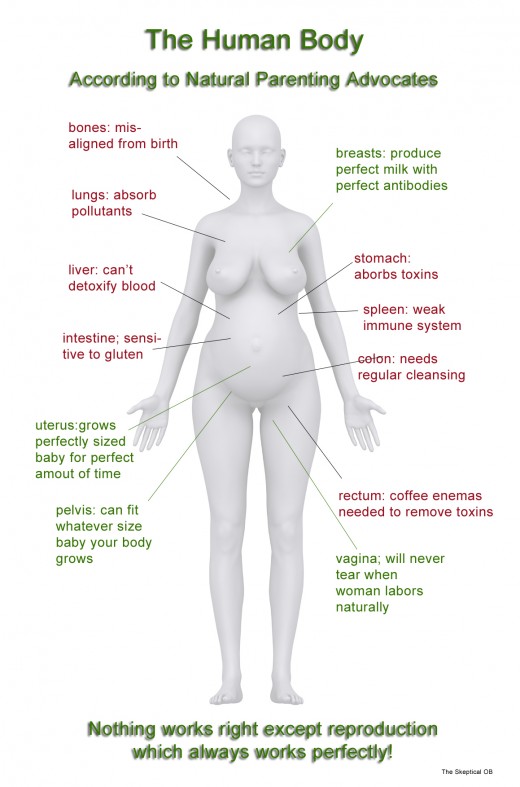
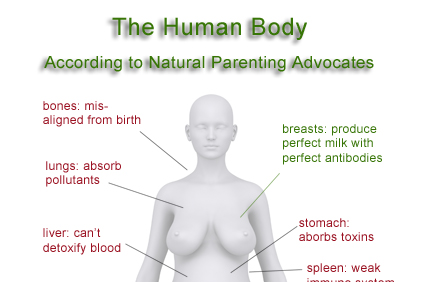
The human body according to natural parenting advocates

Pregnant woman in anatomical position anterior view with clippin

In the world of natural parenting, every day is opposite day.

Whatever the doctor says is wrong and that leaves advocates in a paradoxical situation. On the one hand, nothing in the human body works right: it absorbs toxins, is sensitive to gluten, has a weak immune system, and must be treated on a regular basis with supplements, cleanses, coffee enemas, homeopathy, cranio sacral therapy, reiki, etc. etc. etc.

On other hand, anything connected with reproduction always works perfectly. The uterus grows the perfect size baby for the perfect amount of time; the baby fits through the pelvis without difficulty; and the breasts produced the perfect amount of milk without pain or problems, complete with all the antibodies that a baby needs.

See what I mean?

Pregnant woman in anatomical position anterior view with clippin

Does it make sense that a body that is so weak that it can’t even detoxify itself and is incapacitated by a whiff of gluten can grow a perfectly sized baby for the perfect amount of time and nourish it through breastmilk for years on end?

It doesn’t make sense to me, but perhaps natural parenting advocates can enlighten us:

What’s the evidence that the human body works perfectly in every aspect of pregnancy, childbirth and breastfeeding, but fails miserably at simply surviving day to day?

I can’t wait to read your responses!

Contemporary motherhood’s big lie: if you aren’t suffering, you must be doing it wrong

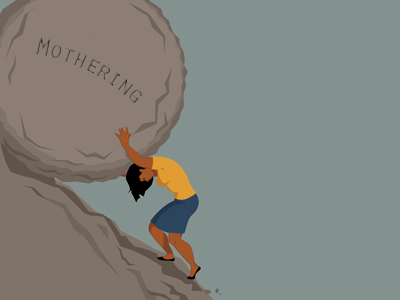
Mothering boulder

Motherhood, Screened Off by Susan Dominus appeared in The New York Times several days ago. Ostensibly it is a piece about pushing aside technology to reconnect with our children. Dominus suggests that our use of technology has rendered previously transparent adult actions opaque to children and that is a problem.

My mother’s address book is one of the small visual details of my childhood that I can perfectly conjure, although I am sure no photograph of it exists… I knew when she was looking for someone’s phone number, which seems unremarkable, except that my own children do not know when I am searching for a phone number, because all they see is me, on my iPhone, intently focused on something mysterious and decidedly not them.

It is that loss of transparency, more than anything, that makes me nostalgic for the pre-iPhone life. When my mother was curious about the weather, I saw her pick up the front page of the newspaper and scan for the information. The same, of course, could be said of how she apprised herself of the news. I always knew to whom she was talking because, before caller ID, all conversations started with what now seems like elaborate explicitness (“Hi, Toby, this is Flora”).

Dominus is embarrassed to be caught using her iPhone during her twin sons’ soccer practice:

[pullquote align=”right” color=”#8c7e75″]Children do not require the caress of the maternal gaze every waking moment of their lives.[/pullquote]

…[A] woman a few feet away turned to me. “Look at us,” she said, with a sheepish smile, gesturing at a row of parents hunched over their devices. “Our kids are out there practicing, and we’re all on our phones.”

I flushed. I was guilty as charged! But I was almost as quickly indignant: I was wrongly accused! True, I was on my phone, and if my kids looked up they would have seen the same thing the woman did: someone slightly bored, distracting herself with some mindless electronic pursuit… I had unwittingly cast myself as a familiar, much-maligned character: the mom who is blind to the daily pleasures of parenting, focused instead on some diversion which, by virtue of its taking place on that phone, is inherently trivial.

I took something different away from the piece. I read it as an example of our contemporary obsession with artisanal parenting, the belief that our children are products that are rendered “high quality” by small batch production using traditional, labor intensive methods. Any moment spent not nurturing, teaching or connecting with our children is a moment wasted.

Simply put, if you aren’t suffering, you must be doing mothering wrong.

In the world of artisanal parenting (often called natural parenting), traditional and traditionally painful and inconvenient processes are required to produce artisanal children. The mother takes no shortcuts, and avoids all conveniences thereby producing superior children. Greater suffering = higher quality. Unmedicated childbirth is therefore “better” since it is a traditional method involving lots of maternal suffering. Breastfeeding is supposedly “best” since it involves lots of maternal time, effort, discomfort and inconvenience. Attachment parenting (baby wearing, family bed, no sleep training) is purportedly better because every moment of every mother’s day ought to involved a child strapped to, sucking from or draped across her body.

Adult activities must be transparent to children, hence the author’s lament that her children don’t know what she is doing when she is using her phone. Adult activities must be justifiable to children, hence the author’s worry that although she is physically at their soccer practice (where she is not needed and presumably not a focus of their concern), they might look up and see her on her phone and won’t realize that she is engaged in something meaningful (reading literature) rather than performing tasks or amusing herself.

I was impatient when my mother’s attention was occupied elsewhere. But my 9-year-old children, when they see me on my phone, feel something more intense, something closer to indignation. They are shut out twice over: They see that I am otherwise occupied, but with what, they have no idea.

I have started to narrate my use of the phone when I am around my kids. “I’m emailing your teacher back,” I tell them, or, “I’m now sending that text you asked me to send about that sleepover,” in the hopes that I can defang the device’s bad reputation, its inherent whiff of self-absorption.

Parents have private lives, private pursuits and need private time and that is a fundamental lesson every child ought to learn. Children are not entitled to a moment by moment accounting of adult activities.

What’s really the problem with a little maternal self-absorption?

It means the mother is not suffering enough!

My husband thinks no amount of narration will change the way our kids feel about the phone. The problem, he says, is that whenever I grab it, they know that I am also holding a portal, as magical as the one in Narnia’s wardrobe and with the same potential to transport me to another world or to infinite worlds. I am always milliseconds away from news of a horrific mass stampede near Mecca or images of great medieval art or a Twitter dissection of the pope’s visit. How far am I going, they might reasonably worry, and how soon will I be back? Perhaps they sense how vast the reach of the device is and how little they know of what that vastness contains; at any moment, the size of the gap between them and me is unknowable.

And it’s wrong for 9 year old children to be deprived of their mother’s rapt attention for an unknowable amount of minutes, because … why?

It means the mother is not suffering enough!

Recently, one of my sons has had trouble falling asleep… And so I lie in the dark next to him, as patiently as I can, willing myself to breathe deeply so that he will do the same. All the while I am fighting the ever-swelling urge to locate my phone, so that I can do something productive, feel that feeling of getting somewhere, at last, while my children sleep, wholly guilt free.

How dare a mother want to accomplish something that is helpful to her and not directly helpful to her child?

She’s clearly not suffering enough.

The ultimate irony of contemporary artisanal parenting is what is imagined as the “way things were” before technology could not be farther from the truth. When mothers had less technology at their disposal they had LESS time for nurturing, teaching or connecting with their children. And … here’s the kicker … they weren’t worried about nurturing, teaching or connecting with their children on a moment by moment basis; they were too busy simply trying to survive.

Prior to the advent of technology, children spent MORE time outside the direct purview of their mothers. They went outdoors for hours at a time to play with other children. They did chores (real chores, not making their bed) necessary to the family’s existence; in other words, they worked for their keep.

The truth is that children are not artisanal products whose quality is proportional to the time their mother spent suffering while ignoring her own needs.

They do not require the caress of the maternal gaze every waking moment of their lives.

They do not need constant maternal interaction; indeed they can be stifled from constant maternal interaction.

What children need is knowledge of their mother’s love and concern; her suffering merely reflects our conceit that children are our products and by suffering we can make them what we want them to be.
The issue is not breast vs. bottle but process vs. outcome

SuperMom

Only baby haters don’t breastfeed?

That’s the provocative title of piece in yesterday’s Daily Telegraph:

Only baby-haters don’t breastfeed…or alternatively: Bottle is better and my boobs aren’t round my knees. No other topic divides women as instantly and viciously as breastfeeding

Ask any woman who’s had a baby what her views on breastfeeding are, and you’re likely to get an impassioned defence of, or argument against doing it. Rarely has there been a topic that so instantly divides people, with women of all ages taking up militant stances whenever the subject arises – which is regularly, as supposedly scientific research throws up or debunks yet another fact/myth about its benefits.

So the news that breastfeeding does not, apparently, improve a child’s intelligence will see the battle lines drawn once again.

That’s deeply unfortunate because the truth is that the issue is not breast vs. bottle, but process vs. outcome.

[pullquote align=”right” color=”#a35d25″]No process, natural childbirth, breastfeeding or attachment parenting, guarantees a healthy, happy, intelligent, successful child.[/pullquote]

First the bad news:

There is no process, whether it is natural childbirth, breastfeeding or attachment parenting, that guarantees a healthy, happy, intelligent, successful child.

It doesn’t matter if you have an unmedicated vaginal birth, breastfeed and “baby wear” your child.”

Now the good news:

There is no process, whether it is natural childbirth, breastfeeding or attachment parenting, that guarantees a healthy, happy, intelligent, successful child.

That means that it doesn’t matter if you have every obstetrical intervention possible, bottlefeed and never “baby wear” your child.”

Why?

There is no law of human causation. Human beings are not widgets; we cannot demonstrate with any reliability that certain inputs will produce desired outputs.

That goes double for creating the traits which we admire in the US in the early 21st Century. Human biology evolved to create the fittest people for a hunter gatherer existence. Long term health, individual happiness and the ability to do well on the SATs and earn lots of money, qualities that we prize today, were not relevant for most of humanity for most of the time.

It is nothing short of absurd to insist that breastmilk evolved the ability to prevent obesity or the chronic disease of old age in industrialized countries, heart disease and diabetes. It is nothing short of absurd to claim that breastfeeding is the first and necessary step to getting into an Ivy League University and snagging a coveted place at Goldman Sachs.

The breast vs. bottle debate has nothing to do with babies and what is good for them and everything to do with mothers and how they compete with each other. It takes decades to find out how your children turn out (“the outcome”), but women want to compete with each other in the meantime. Therefore, they compete on “the process” insisting that it predicts the outcome.

They compete on unmedicated childbirth, implying that it contributes to future success of the baby as an adult. They compete on breastfeeding implying that it contributes to future success. These notions are ridiculous. For most of human existence, all children were born vaginally after unmedicated labor (or died in the process). That didn’t ensure that all people were equally intelligent, wealthy or successful. For most of human existence, all children were breastfed (or died of dehydration or malnutrition). That didn’t ensure that all people were equally intelligent, wealthy or successful.

The bottom line is that no matter how much certain people wish it were so, breast milk does not have magical properties that ensure success. It it merely one of two excellent sources of infant nutrition with formula being the other source.

It makes no difference whether or not you breastfeed.

Call us when your child grows up and we can assess the outcome of your parenting process. Don’t fool yourself into believing, or try to convince the rest of us into believing, that the process has anything to do with the outcome.

Homebirth midwives: incompetent and unaware of it

iStock_000015262592XSmall

One of the biggest problems in American homebirth is that homebirth midwives don’t know what they don’t know. Their background in obstetrics, science and statistics is very limited; so limited, in fact, that they have no idea how little they know compared to those who have far more education and training in these subjects. The tendency to overestimate their knowledge and abilities is called as the Dunning-Kruger effect.

The classic paper on this phenomenon is Unskilled and Unaware of It: How Difficulties in Recognizing One’s Own Incompetence Lead to Inflated Self-Assessments published in the Journal of Personality and Social Psychology in 1999. The paper reports on a variety of experiments that were used to evaluate individuals’ actual performance compared to predicted performance.

For example, study subjects were given a test of basic logic:

[pullquote align=”right” color=”#c9defd”]Those who know the least are also the least capable of understanding how little they know.[/pullquote]

…Participants … completed a 20-item logical reasoning test that we created using questions taken from a Law School Admissions Test (LSAT) test preparation guide. Afterward, participants … compared their “general logical reasoning ability” with that of other students from their psychology class by providing their percentile ranking. Second, they estimated how their score on the test would compare with that of their classmates, again on a percentile scale. Finally, they estimated how many test questions (out of 20) they thought they had answered correctly…

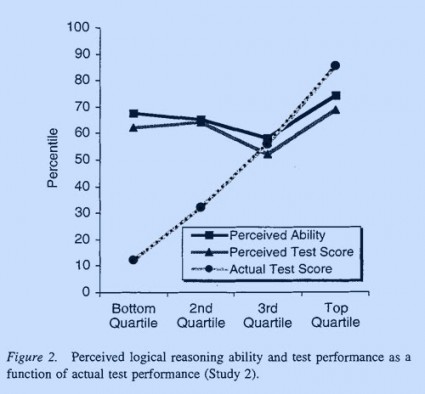
The results are displayed in the following graph:

Logic test graph

The dark lines represent the test subjects’ rating of their logical reasoning ability and the score they predicted they would get. The dotted line represents the actual score. The graph demonstrates that the ability to correctly predict one’s score is directly related to the actual score. Those who scored poorest on the test of logic grossly overestimated their ability; those who did slightly better slightly overestimated their performance; and those who scored moderately well were accurate in predicting their own performance.

In other words, those who knew the least were also the least capable in understanding how little they knew.

The authors also found that improving the subjects knowledge of logic led to more realistic personal assessments. They divided a new group of test subjects in two. One half received a lesson in logic before the test; the other half received a lesson in an unrelated subject. Those who received the lesson in logic were much more likely to accurately predict performance on the test.

… Before receiving the training packet, these participants [in the lowest quartile] believed that their ability fell in the 55th percentile, that their performance on the test fell in the 51st percentile, and that they had answered 5.3 problems [out of 10] correctly. After training, these same participants thought their ability fell in the 44th percentile, their test in the 32nd percentile, and that they had answered only 1.0 problems correctly…

No such increase in calibration was found for bottom-quartile participants in the untrained group.

As the authors explain:

Participants scoring in the bottom quartile on a test of logic grossly overestimated their test performance — but became significantly more calibrated after their logical reasoning skills were improved. In contrast, those in the bottom quartile who did not receive this aid continued to hold the mistaken impression that they had performed just fine.

Why hadn’t the study participants realized their own deficiencies in basic logic simply by interacting over the course of their lifetime with other people who knew more basic logic?

… [S]ome tasks and settings preclude people from receiving self-correcting information that would reveal the suboptimal nature of their decisions. [And], even if people receive negative feedback, they still must come to an accurate understanding of why that failure has occurred.

That’s why homebirth midwives have no idea how little they know. Because homebirth midwives never encounter anyone in their training besides other homebirth midwives, they have no opportunity to observe that many other health professionals have a much larger knowledge base and a much greater skill set. When disasters occur at homebirth, midwives fail to understand that they were responsible and simply dismiss tragedies with the all purpose adage that “some babies die.”

Moreover:

… [I]ncompetent individuals may be unable to take full advantage of one particular kind of feedback: social comparison. One of the ways people gain insight into their own competence is by watching the behavior of others… However, [our study] showed that incompetent individuals are unable to take full advantage of such opportunities. Compared with their more expert peers, they were less able to spot competence when they saw it, and as a consequence, were less able to learn that their ability estimates were incorrect.

This problem is greatly aggravated in homebirth midwifery because homebirth midwives are literally taught to view anyone who does things differently as objects of contempt. Doctors are supposedly greedy, incompetent and ignore scientific evidence. This attitude is best illustrated by the perjorative appellation of certified nurse midwives as “medwives.” Though CNMs have far more education and training than homebirth midwives, homebirth midwives prefer to pretend that CNMs spent that extra time being “socialized” (i.e. brainwashed) in “techno-medicine.”

The authors conclude:

… [W]e present this article as an exploration into why people tend to hold overly optimistic and miscalibrated views about themselves. We propose that those with limited knowledge in a domain suffer a dual burden: Not only do they reach mistaken conclusions and make regrettable errors, but their incompetence robs them of the ability to realize it.

Similarly, homebirth midwives hold overly optimistic views about their knowledge base and their clinical skills. Not only do they reach mistaken conclusions and make deadly errors, but their incompetence robs them of the ability to understand just how incompetent they are.


This piece first appeared in January 2011.

Jill Duggar Dillard is not a real midwife; she’s a CPM, a counterfeit professional midwife

Rooks quote

Cosmopolitan Magazine reports Jill Duggar Adds an Impressive New Job to Her Résumé.

According to her husband, Derrick Dillard:

It’s official; my wife is a midwife!

Not exactly.

Jill Duggar Dillard did not become a midwife. She became a counterfeit midwife. She was awarded an ersatz credential (CPM, certified professional midwife) designed to fool the public into believing that lay people who can’t be bothered (or can’t hack) the education and training needed to become a real midwife are “midwives” nonetheless. The CPM really means “counterfeit professional midwife.”

The CPM credential is a public relations ploy, not a medical credential and it is a testament to its effectiveness as a public relations ploy that most Americans don’t realize it is a counterfeit midwifery degree. It is not recognized by the UK, the Netherlands, Canada or Australia because it doesn’t meet the international standards for midwifery education and training. Indeed, the US is the only country in the industrialized world that has a second class of counterfeit midwives in addition to real midwives (certified nurse midwives).

Consider:
[pullquote align=”right” color=”#e7c7a1″]Why are the minimum standards so low, especially in comparison to counterparts around the world?[/pullquote]

It’s hard to become a doctor.

It takes four years of college, followed by four years of medical school, followed by 3-5 years of internship and residency. That’s challenging.

Imagine if you couldn’t be bothered (or couldn’t handle) the necessary preparation but wanted to masquerade as a doctor anyway. I don’t mean simply pretending that you are a doctor when you are not, but rather awarding yourself a counterfeit MD degree (CMD) that involved only a correspondence course and trailing around after another counterfeit MD for a while. Would a CMD be a real medical doctor? Of course not; but with a “CMD” after your name, you might be able to fool the gullible and less knowledgeable into thinking that you were a real doctor and into paying you as if you were.

It’s hard to become a certified nurse midwife. CNMs are the best educated, best trained midwives in the world. They have an undergraduate degree in nursing, a master’s degree in midwifery, and extensive hospital training in diagnosing and managing birth complications. European, Canadian and Australian midwives are also well educated and well trained; they have an undergraduate degree in midwifery and extensive hospital training in diagnosing and managing birth complications.

Imagine that you couldn’t be bothered (or couldn’t handle) the necessary preparation but wanted to masquerade as a midwife anyway. You could simply take a correspondence course, attend a few dozen deliveries outside the hospital, pay money for an exam and voila: you are a CPM. Actually, you don’t even have to complete even those minimal requirements. You can simply submit a “portfolio” of births that you have attended, pay the money and take the exam, and voila, you too are a CPM.

The CPM (any similarity to CNM is unlikely to be coincidental) was created by a group of lay midwives who promptly awarded it to themselves. How do they justify calling themselves midwives, and charging thousands of dollars for their services, when they have no midwifery training? They insist that they don’t need real midwifery training because they are “experts in normal birth.”

That makes as much sense as a meteorologist who’s an “expert in sunny weather.”

No one needs an expert in normal birth; if the birth is uncomplicated a taxi driver can do it and legions of taxi drivers have done it successfully and for free. The only reason to have a professional birth attendant is to prevent, diagnose and manage complications. CPMs cannot do that because they aren’t real midwives, they’re counterfeit.

Judith Rooks, CNM MPH, a highly respected leader in the world of real midwifery was interviewed in 2013 about the CPM credential.

She noted that the CPM is a way to avoid the rigorous midwifery training required everywhere else:

…[M]any young women who want to become midwives seem to think it is too much bother, time or money to complete an actual midwifery curriculum and think it is enough to just apprentice themselves to someone for a minimal number of births, study to pass a few tests, and become a CPM that way.

Rooks gets to the heart of the matter:

The lingering questions then become why are the minimum standards so low, especially in comparison to counterparts around the world? Why is it acceptable for midwives to aim for the cheapest, quickest route instead of striving to be their best? Why are the “certifying” bodies (ie NARM/MANA) keeping the bar so low…as in only requiring a high school diploma as of 2012 instead of requiring a college level education to deliver our babies?

Why are the minimum standards so low? Because the CPM isn’t an academic credential; it’s a public relations ploy designed to falsely reassure women that CPMs meet the same international standards as midwives in the Netherlands, the UK, Canada, Australia and all other first world countries. It’s been an incredible success as a public relations ploy, but it is been a horrific failure by the measure that really counts: safety.

EVERY study conducted on American homebirth (including studies by homebirth midwives themselves) has shown that homebirth (planned, with a licensed midwife) has a death toll up to 800% higher than comparable risk hospital birth.

That’s just what we would expect if we were to replace real midwives with counterfeit midwives.

The CPM ought to be abolished, but until it is, it is literally a matter of life and death that women understand that CPMs like Jill Duggar Dillard aren’t real midwives, they are counterfeit midwives. They are women who couldn’t be bothered (or could not manage) to meet the international standards for midwives.

If some women want to hire counterfeit midwives, they are free to do so, but they must never forget they are hiring lay people masquerading as midwives, not real midwives and their babies may pay the price.

The cult of homebirth kills babies; 5 deaths in the last few weeks

Homebirth reaper

In many respects, American homebirth is a cult. There is an extensive misinformation campaign promising spiritual benefits; the widespread deleting and banning in homebirth groups means that women are trapped in echo chambers; deaths and disasters are hidden; and women are encourage to ever more dangerous births by a chorus of “supporters” who disavow responsibity when a baby dies. That goes double for the cult of unassisted birth (no midwife).

[pullquote align=”right” color=”#888888″ ]Encouraged by a private Facebook group to avoid medical care and disregard doctors? Please think again.[/pullquote]

That’s why so many babies die at homebirth.

Just a few weeks ago I wrote about 7 homebirth deaths  in one week, one the result of undiagnosed congenital anomalies that might or might not have been treatable in a hospital. There have been at least an additional five homebirth deaths since:

1. Baby Girl Penelope. The mother was planning a UBA2C (unassisted birth after 2 C-sections). She went past 40 weeks (by her own estimation) and ruptured membranes at 43 weeks.

Right through nearly 44 weeks, multiple people encouraged her including Ruth Rodley. You may remember Ruth as the group administrator who callously dismissed the 7 dead homebirth babies in one week as “hickups.”

image

At 44 weeks she noticed decreased fetal movement. At the hospital the baby was found to be dead.

Penelope’s mother was receiving support from at least two groups run by homebirth advocates … until her baby died. Then she was accused of being a “troll” and making up her story.

2. Baby Girl Miranda Ruby. She died during an attempted UBAC. Her mother had a history of 3 previous successful VBACs. This time her uterus ruptured and her baby died. She is blaming the castor oil. It happened 7/26 in addition to the previous 7 deaths that I wrote about occurring during that week.

image

I have so much regret and shame. Just when I think I couldn’t possibly known this would happen I beat myself up about it all over again. I can never have more babies myself no not that anyone could replace our beautiful Miranda Ruby.

In the wake of Miranda Ruby’s death, she received the following expressions of “support:” One commentor told her that it was her decision to take castor oil that caused her uterus to rupture and killed her baby; another commentor insisted that there was probably something wrong with the baby that would have killed her later anyway. Both are terrific examples of the way that denial keeps homebirth advocates from learning anything from even the most disastrous outcome.

3. A baby died in UC attempt in Winston NC. Seen in a local homebirth group. No further details are available at this time.

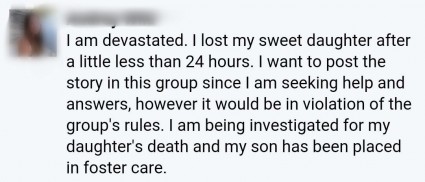
4. Baby Girl. Her mother runs a Facebook group called Rewilding Mama. She had no prenatal care. Water broke at 37 weeks on 8/30, and the baby was born 2 or 3 days later. She died the next day. The mother is being investigated by Child Protective Services.

image

I am devastated. I lost my sweet daughter after a little less than 24 hours… I am being investigated for my daughter’s death and my son has been placed in foster care.

5. Baby boy. Mother was planning HBA3C. She was 42.2 and the perinatologist had recommended to delivery weeks before; she stopped going to appointments. She was being encouraged by a small VBA3C Facebook group. The mother noticed decreased movement and went in; the baby was dead and the mother opted for repeat C-section.

image

There was also a case of hypoxic ischemic encephalopathy (HIE, brain damage) as a result of attempted homebirth.

Baby Jarrett. Attempted homebirth in Georgia with cord prolapse and oxygen deprivation. The baby was transferred to Tallahassee for cooling therapy. Parents were told that prognosis was grim and permanent brain damage (HIE) would likely result.

image

Thinking about homebirth? Encouraged by a private Facebook group to avoid medical care and disregard doctors? Please think again. I really don’t want to write about you and your dead or brain damaged baby in future installments of homebirth deaths.

Unassisted birth advocate Meg Heket has a revelation

image

Will wonders never cease?

Homebirth advocates are scrambling to address the hideous death rate at homebirth.

First Midwives’ Alliance of North America executive Melissa Cheyney, CPM acknowledged that MANA’s own data shows that home VBAC (HBAC) has an appalling death rate, far higher than she expected. Of course, she has known about this for 5 years and only got around to mentioning it now.

This information was acknowledged by Jen Kamel of VBACFacts, and by the Lamaze blog Science and Sensibility. Henci Goer, in her inimitable style, clarified in the comments that it’s only a few dead babies.

I would add, too, that the increased likelihood of vaginal birth at home should weigh into the equation in this population. Women with no prior vaginal birth may be at slightly increased risk of perinatal loss with planned HBAC compared with women planning hospital VBAC, but they also may be much more likely to birth vaginally, thereby avoiding the serious and life-threatening risks of accumulating cesareans for the mother, baby, and any future pregnancies.

See the advantages of letting your baby die at homebirth?

[pullquote align=”right” color=”#C30507″]To support group members without honestly counseling them about the risk of death does not absolve Heket and Rodley of responsibility for dead babies.[/pullquote]

Now unassisted birth advocate Meg Heket has had a revelation. Heket, you may recall, is the sister of Janet Fraser (My dead baby was not as traumatic as my birth rape). She is also a co-administrator with Ruth Rodley of a number of homebirth and unassisted birth groups. No doubt you remember Ruth. She’s the one who, in the wake of 7 homebirth deaths in 1 week, referred to the death of a baby as “a little hickup.”

Stung by the response to her heartless comment, Ruth subsequently offered this:

image

I would like to publicly apologise to all the ladies from groups helped admin who lost their babies. I am very sorry for your loss and I’m sorry if what I did or said contributed to this. You have lost someone precious to you and I am sorry.

In the month since those 7 deaths, there were 5 additional homebirth deaths as well as a case of baby who suffered brain damage at homebirth. Even Meg Heket is shaken up.

image

image

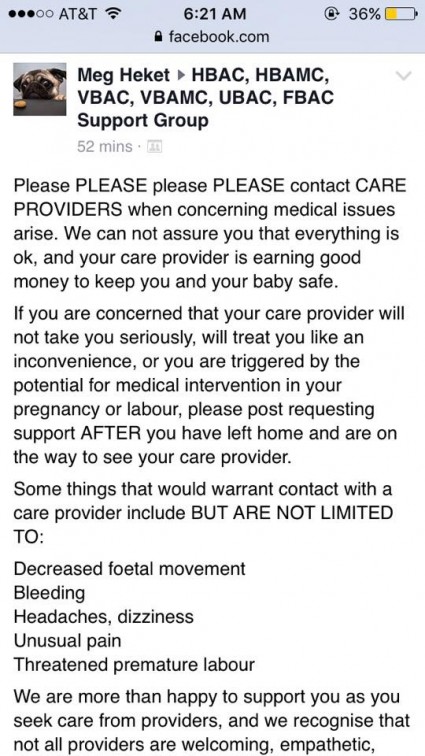
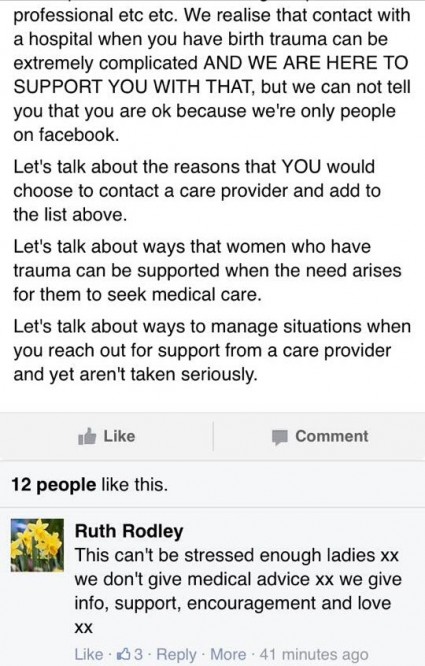
Please, PLEASE, please, PLEASE contact CARE PROVIDERS  when concerning medical issues arise. We cannot assure you that everything is okay…

… we cannot tell you that you are ok because we’re only people on facebook.

Who could have thought that Meg was giving medical advice when she posted this comment and similar comments?

image

So say it with me now “when I go to the dr tomorrow I will NOT NOT NOT have any VEs”

Don’t get me wrong; I’m thrilled that Heket and Rodley are now offering disclaimers. But they should not think that washes off the copious amount of blood that is already on their hands. Many babies have died already, not merely from their medical advice, which they dole out at the drop of the hat; they’ve died from their “encouragement” as well. Most importantly, babies have died because Heket and Rodley have steadfastly refused to acknowledge that unassisted birth and home VBAC are deadly stunts with appalling death rates.

If we are to take seriously their pious, self-serving claims that they don’t want to bear responsibility for the endless stream of homebirth deaths that occurs in their groups, they must publicly acknowledge that they cannot support anyone who doesn’t understand that unassisted birth and home VBAC unequivocally and dramatically raise the risk of perinatal death.

Unassisted birth and home VBAC are stunts on the order of bungee jumping off a cliff. If an adult is informed of the death rate of cliff bungee jumping and wants to do so anyway, he or she has made an informed decision. If a woman is informed of the high death rate of unassisted birth and home VBAC and wants to undertake one anyway, she has made an informed (though often selfish and heartless) decision. But to “support” and “encourage” these stunts without honestly counseling women about the risk of death does not absolve Heket and Rodley of responsibility for the deaths that result.

Heket and Rodley are not alone, of course. There is an ever growing pile of tiny dead bodies and people like Melissa Cheyney and Henci Goer (not to mention Ricki Lake and Ina May Gaskin) bear responsbility for those deaths. They are drenched in blood and no amount of disclaimers will change that.

Are the breastfeeding cheeseburger ads part of a stealth Nestle anti-breastfeeding campaign?

breast cheeseburger

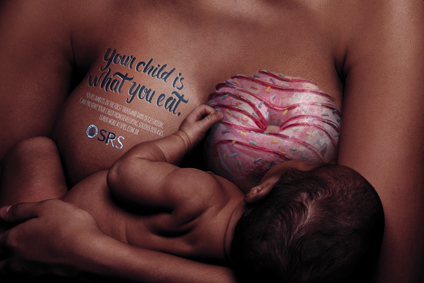
If you thought that these ads were powerful, disturbing and upsetting, wait until you hear this: the ads may be part of a stealth Nestle campaign to promote formula feeding.

breast Coke

breast donut

Ostensibly, Sociedade de Pediatria do Rio Grande do Sul has embarked upon a campaign to convince breastfeeding women that:

Your child is what you eat. Yours habits in the first thousand days of gestation can prevent your child from developing serious diseases.

My first thought on viewing the images was that scaring breastfeeding mothers is a terrible way to promote breastfeeding.

That may be the point. It turns out that these images may actually be part of a stealth ANTI-breastfeeding campaign promoted by Nestle.

I was alerted to this possibility by Baby Milk Action UK which describes itself as “as part of a global network [that] acts to stop misleading marketing by the baby feeding industry.”

The campaign raises a number of red flags:

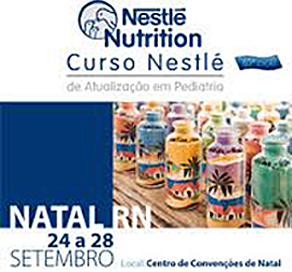
1. The ads are sponsored by Sociedade de Pediatria do Rio Grande do Sul, an organization that receives substantial funding from Nestle. Each year the Sociedade sponsors a refresher course in pediatrics that prominently features Nestle.

[pullquote align=”right” color=”#415461″]There is no scientific evidence that eating junk food affects the quality of breastmilk.[/pullquote]

Curso Nestle

Nestle has a checkered history in Brazil. According to this physician’s blog (Google translated from Portugese):

Going back a little in time, around the 1950s, Nestlé came to Brazil selling the idea that her milk was better and more nutritious than breast milk. In the decade of the 50/60 contests were common “children’s strength” where the mother sent a picture of the chubby baby in front of a pyramid Nest milk cans (that I saw personally, no one told me). Quickly breastfeeding turned “poor thing”. Only I nursed who could not buy milk nest.

Also happened to representatives of the brand go to hospitals and distribute free samples of their milk for families, doctors and nurses.

In Africa, this has had a devastating effect and became a big scandal: the mothers received free samples of infant formula, and then weaned their children could not afford to buy more milk, or sanitize bottles. Hundreds of children died of malnutrition and gastroenteritis as a result of “generosity” Nestlé.

Any resemblance to the strategy used by drug traffickers is no coincidence.

This position paper (Google translated from Portugese) describes Nestle’s current strategy:

…The case describes the way as Nestlé has been developing integrated communication infant feeding, associating your image science, by investing in Research and Development products, channels of open dissemination of research on pediatrics and nutrology, the establishing partnerships, sponsorship and promotion of events aimed at professionals these areas, potential influencers together to buyers Mothers milk powder infants, and its strategic adaptation to environmental influence of regulatory procedures established by the National Health Council since 1988. The case presents itself as problem situation the efforts made ​​by Nestle in an attempt to influence the class medical, important opinion leaders on children’s products and thus their position brands with security associations, care and quality…

2. The ad campaign appears to be very high quality and likely very expensive. While it is certainly possible that a pediatric society would expend a large amount of money on an ad campaign, it seems like an unusual use of funds.

3. The ads are in English and were rolled out in an English language publication, the Daily Mail:

A disturbing new advertising campaign warns expectant mothers about the effects their food and drink intake can have on their unborn children – by showing young babies suckling on breasts that have been painted to look like a variety of unhealthy treats.

The alarming ads, created for Brazil’s Pediatric Society of Rio Grande (SPRS), also feature the ominous tagline: ‘Your child is what you eat,’…

Designed by Brazilian-based agency Paim, the ads are a startling reminder that mothers can potentially harm their young babies with their poor diets.

The article suggests that the Daily Mail received the information on the campaign directly from the ad agency, and not from the SPRS. Indeed, the ads do not appear on the SPRS website.

According to José Pedro Bortolini, one of the creators of the campaign, the ads will appear in Portugese. Bortolini, commenting on the Milk Action website, claims:

This campaign WAS NOT sponsored by Nestle in anyway whatsoever. It was comissioned by the Pediatric Society of Rio Grande do Sul (a state in Brazil) to raise awareness about the first 1000 days of a child, from the gestation to the first two years of his life. The brief was to promote a healthy diet of a mother can bring benefits to the baby.

4. Nutrition in the first 1000 days? Where have I heard that phrase before? Oh, I know. It’s part of Nestle’s formula marketing campaign.

The First 1,000 Days: NestlŽ leadership in Infant Nutrition.

What an amazing coincidence!

5. The images have no basis in fact. Your breastfed baby is NOT what you eat. There is no scientific evidence of any kind that eating junk food affects the quality of breastmilk. The Daily Mail article notes:

A recent study by Robert Waterland, an Associate Professor of Pediatrics and Molecular and Human Genetics at Baylor College of Medicine, found that healthy diets of pregnant mothers can result in babies developing a gene variant that suppresses tumors.

But the investigators in that study looked at Gambian women and compared those who conceived when food was plentiful with those who conceived when it was scarce. The study was about the impact of starvation in pregnancy. It had nothing to do with breastfeeding at all, which raises the question as to why it is mentioned in connection with this ad campaign.

6. The images are meant to scare breastfeeding women from breastfeeding. As a commentor on the Milk Action website noted:

Let’s be honest here, if you wanted to promote healthy diets an lifestyles you’d have painted broccoli and apples on the breasts and made it a positive ad…

The ads don’t encourage breastfeeding; they discourage breastfeeding for fear of harming a child’s health if the mother doesn’t have a perfect diet.

Taken together, these 6 points support the disturbing possibility that these ads are not an effort to promote breastfeeding, but a stealth effort to promote formula feeding.

If it turns out that this is the case, the ads are not merely powerful, disturbing and upsetting; they are reprehensible.

The photo of lactating military moms doesn’t normalize breastfeeding; it demeans the soldiers’ achievements

military breastfeeding

Lactivist are waxing rhapsodic about a photo of military moms breastfeeding.

The picture was conceived by photographer Tara Ruby, a former member of the Air Force who was on active duty between 1997 and 2001…

In a Facebook post displaying the picture, Ruby said her aim for the photo was to normalize breastfeeding in the military.

“To my knowledge a group photo to show support of active-duty military mommies nursing their little’s has never been done,” she said on Facebook.

How do breastfeeding stunts like these normalize breastfeeding? They don’t. They demean women and make it even harder than it already it to gain respect for their real achievements.

[pullquote align=”right” color=”#5d5a31″]Would a group photo of male soldiers whipping out penises and urinating in public normalize urination?[/pullquote]

For most of human existence, women’s worth was restricted to three body parts, breasts, uteri and vaginas. Their intellects, talents and character were ignored. Only men were deemed to have the intellectual capacity to make scientific discoveries, the talent to paint great art and the character to lead nations. It has only been in the past 100 years and only in privileged parts of the globe that women have been “allowed” to find intellectual and professional fulfillment.

Unfortunately, the dominant mothering ideology, natural parenting, encompassing natural childbirth, breastfeeding and attachment parenting, rests on reducing women once again to these same three body parts, breasts, uteri and vaginas. In the world of natural parenting, women are judged, and judge each other, by whether their children exited the uterus through the vagina, whether they feed their children at the breast, and whether they maintain constant physical proximity to those children. In other words, their intellects, talents and character are rendered invisible.

I am old enough to have experienced the undiluted sexism that pervaded medicine when I began my training. Women were routinely subjected to male surgeons who pressed their bodies against them during surgery, judged them by their appearance, and demeaned them as not being “real” doctors capable of the same achievements and talents as men. It was a constant struggle for female doctors in training to gain and maintain respect for their intelligence, surgical skills and ability to innovate.

The sexists among doctors would have liked nothing better than to reduce women doctors to a group photo of lactating breasts, so as to deprive them of the admiration and respect for their achievements that was their due.

No doubt it’s worse in the military where women are still limited in their ability to protect their country by serving in combat and are still subject to rampant sexism and sexual violence. They are forced to claw for the respect that is their due.

A photo of female soldiers that reduces them to lactating breasts undermines their ability to demand and gain respect for their military achievements. It’s the equivalent of a wet camo T-shirt contest that purports to normalize breasts. It no more normalizes breastfeeding than a group photo of male army soldiers whipping out penises and urinating in public normalizes urination.

The biggest problem that women face today is that they don’t receive the same pay, recognition and respect for the same work. In an age where women’s breasts are still groped in the workplace, the idea that this problem is somehow eclipsed by the “need” to normalize breastfeeding with a public display of lactating breasts is deeply sexist and retrograde. Many of us have spent far too long being judged by body parts to let women once again be judged by their breasts.

Melissa Cheyney and MANA lied for years about the death rate at home VBAC; how can they ever be trusted?

Concept of lies. Lie detector with text.

Last week the healthcare news was dominated by a new study investigating treatment of high blood pressure:

The NIH was so eager to get the news out that it decided to stop the study early, evaluate the preliminary results and make recommendations to doctors…

Preliminary results showed a third fewer cardiac events such as heart attack, stroke, and heart failure and a quarter fewer deaths in those with the lower blood pressure, according to the NIH.

The study was ended early because the number of lives saved was so impressive that investigators felt it would be unethical to keep that information to themselves for an additional year. Many might die if patients and their doctors were unaware of the new data.

Contrast that with Melissa Cheyney’s acknowledgement of the hideous death rate at home VBAC also known as HBAC (homebirth after Cesarean) in the MANA Stats study. The data was collected between 2004-2009 and the terrible results were known in 2010. Cheyney, the Director of Research for the Midwives Alliance of North America (MANA), and MANA executives have known for 5 YEARS that home VBAC kills babies who didn’t have to die, but they hid that information and repeatedly acted as if it did not exist.

[pullquote align=”right” color=”#e85b5b”]When homebirth midwives weigh profit against infant lives, profit wins and babies die.[/pullquote]

I wrote recently that Cheyney had acknowledged the high death toll of home VBAC.

She didn’t merely acknowledge that the death toll at home VBAC is 330% higher than hospital VBAC, she admitted that she expected it:

This is expected in a setting where decision-to-cesarean delivery time in the event of a uterine rupture is presumably greater than the 18- to 30-minute interval at which evidence suggests neonatal risk increases.

Cheyney amplified her admission in a piece for the Lamaze blog Science and Sensibility:

…[I]t is also important to think about the likelihood of an intrapartum transfer, distance from the hospital, and a variety of other factors that are unique to each person. I actually think that looking at the cases that did not have good outcomes can be very informative. They help us to see who might be a reasonable candidate for an HBAC and who might not be. For example, in our dataset there were five deaths overall—three during labor … So for the combined intrapartum and neonatal mortality rate, the total is 4.75 out of 1000.

When we look at these cases more closely, we see that two of the cases were very likely uterine ruptures, based on the heart tone patterns that the midwife was able to distinguish at home. The three other ones were deaths that were totally unrelated to the TOLAC [trial of labor after Cesarean] status of the mother. One involved known risk factors related to giving birth to a twin, the second one was a surprise breech with an entrapped head, and the third one was a cord prolapse.

In other words, not only is HBAC dangerous, but twins and breech are NOT variations of normal, they are potentially deadly.

Indeed, Cheyney admits that “trusting birth” isn’t enough:

I think these findings have ramifications for everyone who’s considering a home birth, not just women who are considering a home birth after a cesarean, because one of the most interesting things that we’ve found is that that risk within our sample varies considerably by obstetric history and parity…

But Cheyney has known about these findings since 2010 (I first heard leaks of the findings in early 2011). Unlike the NIH blood pressure study that was ended early to save lives, Cheyney and MANA hid their data, and let countless additional babies die. They did not share the information with the public until August 2015.

In February 2014, I asked Cheyney in an open letter, how she could sleep at night knowing that she was hiding and misrepresenting the death rate at homebirth. I warned her:

You are going to lose this battle to hide accurate information from American women. Maybe not in the near future, but definitely in the not too distant future. It is inevitable that people are going to ask MANA why you hid those death rates in the first place…

Cheyney lost the battle to hide the VBAC death rates and finally acknowledged them. In so doing she provided not one, but two valuable pieces of information:

1. Cheyney, MANA and its executives hid critical information from women for 5 years, depriving them of the opportunity to make informed decisions and letting babies die preventable deaths as a result.

2. Cheyney, MANA and its executives demonstrated that they have no compunction about misleading women in order to increase their employment opportunities and profits. They hid the death rate in order to convince women that home VBAC was safe, so they could attend home VBACs. If they can hide deaths at home VBAC for 5 years, we cannot trust anything they say about the safety of homebirth. Indeed, the MANA Stats paper from which the VBAC deaths were abstracted actually shows that homebirth itself has a death rate 450% higher than comparable risk hospital birth, but Cheyney and MANA lied about that in the paper itself and in comments they made on their website.

I told everyone for the last 5 years that Melissa Cheyney and MANA were aware of the hideous death rate at homebirth and were hiding that information. Now they’re admitting it, but that doesn’t mean that they’ve stopped hiding deaths and misleading women.

It only means that you can never trust them to tell you the truth. When they weigh profit against infant lives, profit wins and babies die.