All posts by Amy Tuteur, MD

How breastfeeding researchers fool themselves — and what we can do about it

image

The journal Nature published an outstanding piece on one of the most serious problems in scientific research today: a great deal of research is so flawed that it cannot be reproduced. It’s a problem that strikes at the heart of science, since the gold standard for establishing the truth of research results is that other scientists using the same methods will find the same results. Irreproducible research is research that is worthless; it proves nothing and often misleads.

How scientists fool themselves – and how they can stop by Regina Nuzzo offers a comprehensive explanation of why so much of today’s research is not reproducible: simply put, scientists have a great personal stake in the outcome of research, and this personal bias leads to shoddy science.

[pullquote align=”right” color=”” class=”” cite=”” link=””]The bias is simple, pervasive and distorts a great deal of breastfeeding research.[/pullquote]

This personal bias differs in important ways from classic financial conflicts of interest. No money changes hands; there is no quid pro quo, and there are no university or journal rules to protect against such personal bias. Indeed, the researchers themselves are often unaware of the bias because is subconcious.

Breastfeeding research, though not mentioned in the piece, is a classic example of the personal bias that renders much of the reasearch in the field misleading and deceptive. Breastfeeding reseachers believe deeply and fervently that breastfeeding, being natural, must be better than any substitutes. Therefore, they slice and dice the data until it supports their bias. They fall prey to the errors that Nuzzo describes in her piece.

image

1. Hypothesis myopia:

One trap that awaits during the early stages of research is what might be called hypothesis myopia: investigators fixate on collecting evidence to support just one hypothesis; neglect to look for evidence against it; and fail to consider other explanations…

This probably the most serious problem in breastfeeding research and distorts most of the existing research that claims to show important health benefits. The conclusions are predetermined and the data are arranged to support the conclusion. Critically, the researchers fail to consider alternative explanations for observed outcomes. In the case of breastfeeding research, it is typically manifested as a failure to correct for confounding variables.

We know that women who choose to breastfeed exclusively differ in important ways from women who do not. Any “benefits” of breastfeeding may reflect those differences, not breastfeeding itself. For example, women who choose to breastfeed exclusively are, on average, wealthier, better educated, and have better access to health insurance. Each of these three variables have been shown to lead to improved health outcomes for their children. The alternative explanation for most of the research that purports to show major health benefits of breastfeeding is that those benefits aren’t caused by breastfeeding, but are the inevitable result of the relatively privileged status of the mothers.

2. The Texas sharpshooter fallacy:

Seizing on random patterns in the data and mistaking them for interesting findings.

This is also known as “p hacking”:

“You just get some encouragement from the data and then think, well, this is the path to go down,” says Pashler. “You don’t realize you had 27 different options and you picked the one that gave you the most agreeable or interesting results, and now you’re engaged in something that’s not at all an unbiased representation of the data.”

In 2012, a study of more than 2,000 US psychologists suggested how common p-hacking is. Half had selectively reported only studies that ‘worked’, 58% had peeked at the results and then decided whether to collect more data, 43% had decided to throw out data only after checking its impact on the p-value and 35% had reported unexpected findings as having been predicted from the start, a practice that psychologist Norbert Kerr of Michigan State University in East Lansing has called HARKing, or hypothesizing after results are known.

In the case of breastfeeding studies, researchers often analyze large datasets looking at multiple outcomes. Then they pick the outcomes that have statistically significant differences and announce them as “findings” without acknowledging that any large dataset looking at multiple outcomes is bound to have random statistically significant differences that are coincidental and don’t represent real outcomes.

3. Asymmetric attention:

The data-checking phase holds another trap: asymmetric attention to detail. Sometimes known as disconfirmation bias, this happens when we give expected results a relatively free pass, but we rigorously check non-intuitive results…

This happens all the time in breastfeeding research and especially in its analysis. Professional breastfeeding advocates report findings on the benefits of breastfeeding without analyzing the data. In contrast, when a study is published that does not support a cherished tenet of lactivism, such as the belief that breastfeeding raises IQ, professional breastfeeding advocates immediately try to tear it apart.

How can we avoid falling prey to these cognitive biases?

The most important corrective to cognitive biases is recognizing that they exist. We must recognize that most scientists who do breastfeeding research believe that breastfeeding must be superior. They often fail to consider alternative explanations for their findings, but we don’t have to fall into the same trap. The first question to ask of any breastfeeding study is whether it accounted for confounding variables. If it didn’t, then the results are meaningless.

Second, we must analyze the data in the study ourselves to see if it justifies the conclusions. We need to ask whether the authors’ conclusions relate to the subject they intended to investigate or are just a random finding. For example, researchers may set out to determine if there is a difference in IQ between breastfed and non-breastfed babies, fail to find one and then write a paper about a random difference in fine motor coordination. That suggests p hacking, desperately searching for any difference, not the one that was supposed to be under study.

Finally, we must pay close attention to the results of studies that support our pre-existing biases. We must analyze them with the exact same rigor that we would bring to analyzing studies that don’t support what we believe.

Contemporary breastfeeding researchers often fool themselves into finding “benefits” of breastfeeding but that doesn’t mean that we have to let them fool us, too.

The new CDC report on breastfeeding puts the cart before the horse

image

The new CDC report on breastfeeding, Improvements in Maternity Care Policies and Practices That Support Breastfeeding — United States, 2007–2013, has been getting a lot of press.

According to the report

…[P]ractices supportive of breastfeeding are improving nationally; however, more work is needed to ensure all women receive optimal breastfeeding support during the birth hospitalization.

Implications for Public Health Practice: Because of the documented benefits of breastfeeding to both mothers and children, and because experiences in the first hours and days after birth help determine later breastfeeding outcomes, improved hospital policies and practices could increase rates of breastfeeding nationwide, contributing to improved child health.

There just one serious problem: The documented benefts of breastfeeding in the US are trivial and there’s no evidence at all that experiences in the first hours and days after birth determine later breastfeeding outcomes.

[pullquote align=”right” color=”#555555″]US breastfeeding rates have no impact on child health.[/pullquote]

The authors of the report have made a very serious error that undergirds everything they have written. They’ve confused correlation for causation.

Simply put, breastfeeding in the US is associated with higher socio-economic status (higher income, greater education, better access to healthcare). Therefore, the fact that breastfed children have better health outcomes is more likely to be the result of higher socio-economic status (and there are reams of papers demonstrating this fact) than with breastfeeding (on which the evidence is weak, conflicting and plagued with confounders.)

Suppose I did a study comparing two groups of children to determine if breastfeeding increases children’s height. Imagine further that I found the children from Group A, which contains a high proportion of exclusively breastfed infants, turn out to be several inches taller at age 5 than the children from Group B, who never received breastmilk.

image

Did breastfeeding make the children in group A taller? We can’t say unless we have more information.

image

Now we can see that the mothers in group A are actually taller than the mothers in group B. It is likely genetics that made the children in group A taller, not breastmilk.

In the case of breastfeeding, the mothers in the US who breastfeed (group A) are more likely to be privileged than the mothers who don’t (group B). It is that privilege that makes their children healthier, not breastfeeding. Breastfeeding does not cause better health outcomes, both breastfeeding and better health outcomes are the result of privilege.

The same phenomenon applies to experiences in the first hours and days. Babies whose mothers are strongly committed to exclusive breastfeeding (group A) are going to have different experiences than babies whose mothers are not as committed (group B). The babies in group A are more likely to be breastfed within the first hour, for example, and are far less likely to receive supplementation with formula. Those experiences don’t cause an increase in breastfeeding rates, they reflect mothers’ commitment to breastfeeding which is the cause of differential rates of breastfeeding months later.

Why do the CDC researchers put the cart (the conclusions) before the horse? It’s probably because of white hat bias, the tendency to reach socially approved conclusions. In 2015, “everyone knows” that breastfeeding is good for babies so white hat bias leads breastfeeding researchers to ignore the privilege (greater income, greater education, better access to healthcare) that leads women to breastfeed and ascribe the benefits to breastfeeding itself.

It is this fundamental error that is responsible for a curious outcome of breastfeeding promotion. Despite millions of dollars spent promoting breastfeeding, and a dramatic rise in breastfeeding initiation, there has been no improvement in indicators of child wellbeing. There’s been no drop in infant mortality, no increase in life expectancy and no change in IQ. As far as I am aware, there is not a single return on our massive investment in breastfeeding promotion.

And that’s just what you would expect if researchers confused correlation for causation. Increasing breastfeeding rates won’t change indicators of child health because breastfeeding doesn’t lead to healthier babies; privilege does. We are literally wasting millions of dollars on promoting a practice that has a trivial impact on health, and feeling virtuous for doing so.

Don’t get me wrong. Breastfeeding is a good thing; I breastfed four children because I believed breastfeeding to be a good thing. But scientific evidence is far more important than feeling virtuous and the scientific evidence is pretty definitive: the benefits of breastfeeding in the US are trivial, and there’s no evidence at all that so called “baby-friendly” hospital practices have any impact on breastfeeding rates.

Let’s stop wasting money, not to mention stop pressuring women into making a choice with trivial benefits and stop judging hospitals by that choice. Breastfeeding rates have no impact on child health.

If anyone, including the CDC researchers, believe otherwise they must provide scientific evidence that breastfeeding impacts child health, not the wishful thinking of white hat bias that leads them to put the cart far before the horse.

Jill Duggar Dillard learns it is harder to become a real missionary than a fake midwife

image

Imagine that. The Southern Baptist Convention has higher qualifications for becoming a missionary than the Midwives Alliance of North America has for becoming a “midwife.”

According to Inquisitr:

Jill Duggar and Derick Dillard are rejected as missionaries by the Southern Baptist Convention (SBC) and the International Mission Board (IMB) for lack of qualifications…

What qualifications are needed to become a missionary?

[pullquote align=”right” color=””]Why are the requirements for a missionary more rigorous than the requirements for a CPM?[/pullquote]

To be a funded missionary of the SBC and IMB requires a bachelor’s degree from an accredited university and between 20 – 30 graduate hours of designated courses, such as: Biblical Studies, Theology, Church History, Missions, Evangelism, Discipleship, Preaching, Interpersonal Relationships, etc.

Although Derick Dillard has an undergraduate degree in accounting, he has never taken a college-level religion course and has no graduate credit hours. Jill Duggar has never been to college at all. To qualify as the spouse of a Baptist missionary, she must complete at least 12 college credit hours by taking these courses at an accredited college…

There’s no shortage of people able to meet these qualifications:

churches. The SBC employees over 4,800 missionaries and 300 new missionaries were added just this year.

In contrast, Duggar Dillard has never been to college at all, but that hasn’t stopped her for earning the CPM, certified professional midwife credential. As a I wrote recently, CPMs aren’t real midwives, they’re counterfeit midwives.

The CPM is not a medical credential and it is a testament to its effectiveness as a public relations ploy that most Americans don’t realize it is a counterfeit midwifery degree. It is not recognized by the UK, the Netherlands, Canada or Australia because it doesn’t meet the international standards for midwifery education and training. Indeed, the US is the only country in the industrialized world that has a second class of counterfeit midwives in addition to real midwives (certified nurse midwives).

Imagine that you couldn’t be bothered (or couldn’t handle) the necessary preparation but wanted to masquerade as a midwife anyway. You could simply take a correspondence course, attend a few dozen deliveries outside the hospital, pay money for an exam and voila: you are a CPM. Actually, you don’t even have to complete even those minimal requirements. You can simply submit a “portfolio” of births that you have attended, pay the money and take the exam, and voila, you too are a CPM.

Indeed, the educational requirements for the CPM were “strengthened” back in 2012 to mandate a high school diploma.

That raises an important question. Why are the requirements for becoming a teacher of religion far more rigorous than the requirements for a midwifery credential which involves life or death decisions?

The answer is that the Southern Baptist Convention has quality standards for missionaries. Merely wanting to be a missionary isn’t enough. In contrast, the Midwives Alliance of North America has no safety or quality standards for their pretend credential. Their avowed aim is to allow any woman who wants to deliver babies to call herself a “midwife” regardless of what education she does or does not have.

The ultimate irony is that while trusting God is not enough to call yourself a missionary, “trusting birth” is deemed to be adquate for calling yourself a “midwife.”

Sure my baby died at homebirth, but that was just a coincidence!

image

It’s remarkable really. Homebirth had nothing to do with the fact that the baby died. It’s just an amazing coincidence.

Yes, I know that my obstetrician, my mother-in-law and my best friend warned me that the baby could die at homebirth, but that has absolutely nothing to do with the fact that the baby did die. It was just a coincidence.

You know what’s really amazing? Those naysayers who predict that homebirth might lead to the death of the baby often cite specific causes of death. Sure, that’s exactly how the baby ultimately died, but it was just a coincidence.

[pullquote align=”right” color=”” class=”” cite=”” link=””]Just because the baby unexpectedly fell out dead into my midwife’s hands, they want to blame the death on homebirth.[/pullquote]

It’s kind of eerie, when you think about it.

The naysayers insist that women shouldn’t attempt a VBAC at home because the uterus might rupture and then the baby will die. And lo and behold, the uterus ruptures and the baby dies. Fortunately, we know that was nothing more than a coincidence.

The naysayers claim that a single footling breech might have a cord prolapse and die. What do you know, the cord prolapses and the baby dies. But that was just a coincidence.

The naysayers like to scare women by claiming that if you had a shoulder dystocia in the past, the same thing may happen again in the next pregnancy. Amazingly, the baby dies at home of shoulder dystocia. Who could have seen that coming?

The naysayers don’t understand that breech is just a variation of normal. They say that the baby is at risk for head entrapment and death. Then, almost as if they predicted it, the baby’s head is trapped and the baby dies. What a coincidence.

The naysayers believe that listening to the baby’s heart rate instead of monitoring it with continuous electronic fetal monitoring will put the baby at risk for developing fetal distress without anyone realizing. Now, just because the baby unexpectedly fell out dead into my midwife’s hands, they want to blame the death on homebirth when it was nothing more than a coincidence.

The naysayers think that it isn’t enough that my midwife carries the same, the very same, the exact same resuscitation equipment at the hospital. They warn that the baby may die for lack of an expert to perform a resuscitation. Sure that’s exactly what happened, but we all know that’s a coincidence.

It’s remarkable really. Coincidence upon coincidence.

Wait, what? You think it wasn’t a coincidence that the baby died of the exact same thing that the naysayers warned against.

You are mean!

You are disgusting!

Just because they wrote their stories on blogs and message board available to hundreds of millions of people doesn’t mean that the story isn’t deeply private.

These women are grieving!

You know what? You remind me of that judge who refused to show clemency to the man who murdered his parents. The guy was an orphan! If that doesn’t deserve sympathy I don’t know what does.

How do I know these were just coincidences?

I spent years educating myself by reading everything that other laypeople have written about childbirth. I’m not like those ignorant sheeple who think that just because an obstetrician went to college (you don’t need a degree to catch a baby), and went to medical school (where they learn mostly stuff that doesn’t have to do with birth) and delivered thousand of babies (but not even one totally naturally, outdoors, in the ocean, with dolphins), they might actually know more than me.

Oh, and don’t forget:

Babies die in the hospital, too. In fact MORE babies die in the hospital than at home. And interventions kill babies, and it is much safer for a woman who had 3 previous C-sections to rupture her uterus at home while trying to deliver a 10 pound single footling breech without continuous fetal monitoring and end up with a hysterectomy and 10 transfusions than to have an elective repeat C-section!

Sure the baby died in that case, too, but that was just a coincidence.

Death rate from homebirth higher than from SIDS

image

It’s a scourge that haunts the nightmares of new parents and prospective parents.

I’m talking, of course, about SIDS (sudden infant death syndrome), which takes the lives of approximately 2000 infants each year. SIDS is so frightening because apparently healthy infants die suddenly for no discernible reason.

But the death rate from SIDS is only a fraction of the death rate for American homebirth. The SIDS death rate is 0.4/1000. In contrast, the best data we have (from Oregon in 2012) shows that PLANNED homebirth with a LICENSED homebirth midwife has a death rate of 5.6/1000 approximately 1300% higher. Deaths at homebirth are frightening because apparently healthy infants die during labor or immediately after for reasons that are not discernible to homebirth midwives. The reasons are all too apparent to obstetricians and to the pathologists who perform autopsies on these dead babies.

[pullquote align=”right” color=””]Apparently healthy infants die unexpectedly during homebirth or immediately thereafter.[/pullquote]

Homebirth advocates, to the extent that they acknowledge the increased death rate, dismiss it as trivial (“14X a small number is still a small number”). Yet no one dismisses the SIDS death rate as trivial. Why the difference? It’s because homebirth advocates have difficulty with the concepts of absolute and relative risk. Therefore, comparisons can be helpful in getting homebirth advocates to understand the terrible extent of the problem.

Everyone knows that SIDS is a tragedy. No one tries to dismiss it by claiming that babies who die of SIDS were “meant” to die. Similarly, babies who die at homebirth represent an equally terrible tragedy that is much more likely than the tragedy of SIDS. And the babies who die at homebirth were no more “meant” to die than those who die of SIDS.

We have made remarkable strides in combatting SIDS, even though we don’t yet understand the cause. We’ve found that putting babies to sleep on their backs can cut the rate of SIDS by two thirds. Once we became aware of what we could do to prevent SIDS, we instituted massive public health campaigns to warn every parent and caregiver and thousands of babies are saved each year as a result.

Every study of American homebirth and every dataset, including the data from the Midwives Alliance of North America (MANA) shows that homebirth with an American homebirth midwife (CPM or LM) has a dramatically higher rate of death than comparable risk hospital birth. In contrast to SIDS, we do understand the reasons for this: American homebirth midwives are counterfeit midwives, laypeople who awarded themselves a credential that doesn’t meet international midwifery standards and is not recognized by the UK, the Netherlands, Australia or any other industrialized country.

Midwives can save lives; counterfeit midwives cannot. They claim to be “experts in normal birth,” but no one needs experts in normal birth. We need birth attendants who can anticipate, prevent and manage complications in childbirth. CPMs and LMs cannot do those things and babies die preventable deaths as a result.

Do you view SIDS is a health problem? Then you ought to consider homebirth a much bigger health problem because it has a death rate 1300% higher than the death rate from SIDS.

Thinking about homebirth? Think again.

Why do homebirth advocates worry more about the infant gut microbiome and the antibodies in colostrum than brain damage?

Wounded Brain

I have written about it more times than I care to count.

VBA3C homebirth: ruptured uterus, brain damaged babVBA3C homebirth: ruptured uterus, brain damaged baby
You risked your baby’s brain function for this?
Another homebirth, another brain injured baby, but the midwife was awesome
Unassisted birth: surprise second twin suffers brain damage
Conflicted: successful VBAC, brain damaged baby
He’s a spastic quadriplegic as a result, but she’s glad she had a homebirth
Another unassisted birth, another brain damaged baby

Lest you think that brain damage at homebirth is merely an anecdotal experience, consider that investigators have found that homebirth increases the risk of hypoxic brain injury by more than 1700%.

I read about another such “beautiful birth” just yesterday:

[pullquote align=”right” color=”#e3b03e”]No one can possibly care more about the microbiome or breastmilk than about brain damage, can they?[/pullquote]

The midwife quickly realised Poppy hadn’t turned herself and was shoulder dystocia …

They had to do an episiotomy (with no pain relief..!) Luckily it worked and nearly 4 minutes after her head was born the rest of her came out. She was blue, floppy and unresponsive but had a strong heart rate…

Poppy suffered birth asphyxiation and HIE (Hypoxic ischemic encephalopathy) she was taken to neonatal intensive care where she was placed onto a 72 hour cooling treatment where they wrap a fluid filled mat around the baby and keep them at 34 degrees to give the brain and organs time to repair themselves after being starved of oxygen. She had probes and wires just about everywhere monitoring every aspect of her.

Does Poppy’s mother have any regrets? Of course not. What’s a little brain damage (HIE) compared to a birth experience!

People often ask me if I regret my homebirth because of the circumstances but it has only made me feel like the homebirth was even more right for us. I laboured well at home and was relaxed and in my own environment, I think the panic that would have happened at the hospital would have freaked me out and I’d not have been so productive in pushing. The shoulder dystocia could have happened anywhere and the outcome of treatment would have been the same.

What happened to baby Poppy’s brain when she was deprived of oxygen?

As her brain sensed a decrease in oxygen and an increase in carbon dioxide, she tried to raise her blood pressure to get more blood to her brain. Epinephrine flooded her bloodstream and blood was diverted from inessential organs to the brain, heart and adrenal glands.

A baby can do this for only a limited amount of time and blood pressure begins to fall.

This leads to intracellular energy failure. During the early phases of brain injury, brain temperature drops, and local release of neurotransmitters, such as gamma-aminobutyric acid transaminase (GABA), increase. These changes reduce cerebral oxygen demand, transiently minimizing the impact of asphyxia.

What happens at the level of individual brain cells?

… During cerebral hypoxia-ischemia, the uptake of glutamate the major excitatory neurotransmitter of the mammalian brain is impaired. This results in high synaptic levels of glutamate and EAA receptor overactivation … and kainate receptors… Accumulation of Na+ coupled with the failure of energy dependent enzymes such as Na+/ K+ -ATPase leads to rapid cytotoxic edema and necrotic cell death…

EAAs accumulation also contributes to increasing the pace and extent of programmed cell death through secondary Ca++ intake into the nucleus. The pattern of injury seen after hypoxia-ischemia demonstrate regional susceptibility that can be largely explained by the excitatory circuity at this age (putamen, thalamus, perirolandic cerebral cortex). Finally, developing oligodendroglia is uniquely susceptible to hypoxia-ischemia, specifically excitotoxicity and free radical damage. This white matter injury may be the basis for the disruption of long-term learning and memory faculties in infants with hypoxic-ischemic encephalopathy.

The damage doesn’t end when oxygen levels are restored to normal.

During the reperfusion period, free radical production increases due to activation of enzymes such as cyclooxygenase, xanthine oxidase, and lipoxygenase. Free radicals can lead to lipid peroxidation as well as DNA and protein damage and can trigger apoptosis. Finally, free radicals can combine with nitric oxide (NO) to form peroxynitrite a highly toxic oxidant.

…[A] second wave of NO overproduction that can be prolonged for up to 4-7 days after the insult.

This excessive NO production plays an important role in the pathophysiology of perinatal hypoxic-ischemic brain injury. NO neurotoxicity depends in large part on rapid reaction with superoxide to form peroxynitrite.[11] This, in turn, leads to peroxynitrite-induced neurotoxicity, including lipid peroxidation, protein nitration and oxidation, mitochondrial damage and remodeling, depletion of antioxidant reserve, and DNA damage.

In other words, even a limited period of oxygen deprivation can lead to a cascade of cell death and further brain damage from the extremely toxic products of cell destruction.

What does that mean for the baby?

In severe HIE it can mean:

  • Stupor or coma is typical; the infant may not respond to any physical stimulus except the most noxious.
  • Breathing may be irregular, and the infant often requires ventilatory support
  • Generalized hypotonia and depressed deep tendon reflexes are common
  • Neonatal reflexes (eg, sucking, swallowing, grasping, Moro) are absent
  • Disturbances of ocular motion, such as a skewed deviation of the eyes, nystagmus, bobbing, and loss of “doll’s eye” (ie, conjugate) movements may be revealed by cranial nerve examination
  • Pupils may be dilated, fixed, or poorly reactive to light
  • Irregularities of heart rate and blood pressure are common during the period of reperfusion injury, as is death from cardiorespiratory failure

Less severe HIE has less severe consequences, but no one should think that a baby who appears to recover has emerged unscathed.

What does infant cooling therapy do? By lowering the metabolism of brain cells it appears to limit cell death and the release of the toxic products of cell death. It can’t reverse brain damage that has already occurred, but it can limit the continuing damage that inevitably occurs when oxygen levels return to normal.

That’s what happened to baby Poppy, yet her mother seems to think that this is a trivial outcome.

Here’s what I want to know, and perhaps homebirth advocates can explain it to me:

You’re the folks who worry about C-section changing the infant gut microbiome and you are horrified if a baby deprived of the antibodies in colostrum because her mother does not want to breastfeed. Why do you think that is important but oxygen deprivation and brain damage are no big deal?

This raises the ugly possibility that homebirth isn’t about babies and what’s beneficial for them, but about mothers and their bragging right and midwives and their autonomy.

No one can possibly care more about the infant gut microbiome or breastmilk antibodies than about infant brain damage, can they?

I’m a conscientious objector in the Mommy Wars

Successfully raising children

It’s one the greatest internecine conflicts of the past 50 years.

No, I’m not talking about capitalism vs. communism, nor Democrat vs. Republican. I’m talking about the battle for mothering supremacy, the Mommy Wars.

I just finished reading a declaration of intent in one of the latest battles, and I disagree profoundly. When it comes to the central premises of the Mommy Wars, I’m a conscientious objector.

Manic Pixie Dream Mom, who writes for the Today Parenting Team, declares Bring on the Mommy Wars!

And after all the effort to stop the mommy wars, after all the kumbaya we-can-all-get-along every blogger’s been pushing lately, I’m ripping up the fragile truce. I’m done. I’m sick of the mealy-mouthed we-all-have-to-support-each-other.

Because I don’t support some of you, and I’m tired of pretending.

Don’t hold back; tell us how you really feel:

[pullquote align=”right” color=”#009bd1″]The Mommy Wars are premised on the idea that there is one right way to raise every single child.[/pullquote]

We all got into this parenting thing with various ideas. We picked those ideas because we think those are the right ideas…

That means that, by definition, we decided some ideas were wrong. Maybe not wrong in all circumstances, but wrong. For example, I think cry-it-out is barbaric unless it’s necessary for the sanity of the family, and then only as a last resort. Maybe we think some things are always wrong: for me, that’s circumcision. I’m sick of pretending to support moms who made a choice I think is contrary to human rights and dignity. I don’t support you…

But that doesn’t mean I have to shout you down. As women, we’re programmed to be butthurt when other women disagree with us. That doesn’t fly. We need to learn to live with disagreement, however uncomfortable. I can not support your choices without being rude or thinking you’re a howling idiot. I can think you’re wrong, and we can still be friends

Learning to live with disagreement is a good thing, but it is premised on the idea that there is one right way to raise every single child and that’s absurd.

Consider the following scenario:

When you attend a wedding, are you dismayed to find that other women are not wearing the exact same thing that you are wearing? Do you criticize them secretly or to their faces for not choosing the same color outfit that you chose, in the same style, with the same accessories? Of course not.

There are several reasons for this.

  • First, everyone recognizes that different things look good on different people because some styles are flattering for one body type and not for another; some colors are attractive with some skin tones and not with others. Women are different from each other and what looks good on you won’t necessarily look good on another women.
  • Second, individuals have different tastes; some are modest and prefer covering up, while others may want to flaunt a daring decolletage. Some women prefer frilly, while others feel more comfortable with simple, pared down styles. Some women love red, while others hate it.
  • Third, no one thinks that what she wears to any given event indicates whether or not she is a worthy woman.

In other words, we don’t expect every woman to show up at a wedding wearing the exact same outfit because women are individuals with individual needs, desires and preferences.

Mothering is like clothing in that regard, there is no “one size fits all” for every single mother or even for every child of the same mother. The parenting styles that women choose reflect their needs, desires and preferences and (hopefully) the needs, desires and preferences of each individual child.

It makes no more sense to insist that is best for every mother to choose the family bed her children than for every mother to wear a black pencil skirt to every meeting. And it makes no more sense to judge women by their parenting choices than to judge them by their clothing choices.

Manic Pixie Dream Mom concludes:

But it means that yes, if you find extended breastfeeding creepy, by all means, say so in the politest of terms. This should be the civilest of wars, fought with scientific evidence and eloquence. No personal attacks. No “you’re ruining the baby.” This is the only way we can discuss different ways of parenting without degenerating into “I’m okay, you’re okay” or “I’m right, and you’re a bitch.” It’s how you actually change minds – and foster honesty.

You can separate the practice from the person. You can see the failure to circumcise not as a moral judgement, but as a parenting choice. You can view cry-it-out as a choice rather than a sign of someone’s character. And we can all agree to be polite and kind about it.

But that presumes that it is one mother’s business how another mother raises her child. That’s the fundamental premise of the Mommy Wars. And that’s why I’m a conscientious objector. I would suggest that instead of viewing things like extended breastfeeding and circumcision not simply as parenting choices that you can disagree with politely, but as parenting choices that are none of your business.

Don’t “bring on” the Mommy Wars, just do your best to raise your own children in the way that you think is right for them and for your family. We don’t need to learn to “live with disagreement.” We need to mind our own business. Raising your own children is hard enough without some mothers feeling entitled to pontificate on how other women raise theirs.

To paraphrase the great Jewish scholar Hillel:

Successfully raising children requires loving them and letting them know it. All the rest is commentary.

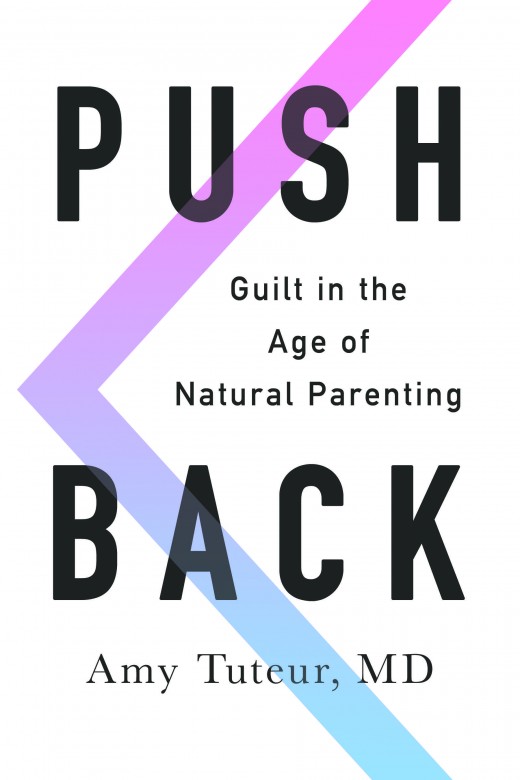
Cover of my new book

Here’s the cover for my forthcoming book, to be published by HarperCollins on April 5, 2016.

The book “debunks the myths of natural parenting, exposes the movement’s anti-feminist roots, and shows why its practices don’t line up with the science, all with the aim of freeing new mothers of the pervasive and unnecessary guilt so many of them feel today.”

Available for pre-order in hardcover and for kindle.

image

Lifesaving midwifery discoveries of the 20th Century

Midwifery discoveries

There weren’t any.

That’s right. The 20th Century saw one of the greatest public health advances of all time, the steep drop in both perinatal and maternal mortality. Childbirth went from being an occasion for women to write their wills to a “birth experience.” Childbirth is not inherently safe; it is inherently dangerous. It only looks safe because the myriad innovations of modern obstetrics and neonatology have made it safe. Discoveries included antibiotics, blood banking, epidurals, incubators, respirators, surfactant, and Rhogam among others. Not a single one was invented or discovered by a midwife.

Could we do better? I suspect that every obstetrician and neonatologist believes that we can save even more lives and is assiduously working toward that end. What are midwives doing to improve perinatal and maternal mortality rates? Not a blessed thing.

Is it any wonder then that midwives downplay or deny the inherent dangers of childbirth? Well educated, well trained midwives can provide excellent care for women, but only so long as they respect the fact that childbirth is fraught with risk for both baby and mother and it is only the liberal use of the innovations of obstetrics and neonatology that leads to safe outcomes.

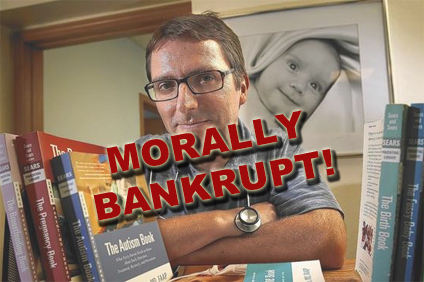
Breaking news! Dr. Bob Sears files for moral bankruptcy!

bob sears morally bankrupt

Dr. Bob Sears is a charter member of what I like to call The Quack Pack, a group of physicians who peddle pseudoscience in exchange for popularity and financial remuneration.

I’ve written about his ethics, or lack thereof, on many occasions.

In his book on an “alternative” vaccine schedule Sears wrote:

I also warn [parents] not to share their fears with their neighbors, because if too many people avoid the MMR, we’ll likely see the diseases increase significantly.

In other words, hide in the herd, but do not tell the herd you’re hiding; otherwise, outbreaks will ensue…

His grandiosity is really quite impressive. He likens his patients to victims of the Holocaust.

[pullquote align=”right” color=”#9f0b0b”]Dr. Bob has worked tireless to advance the cause of … Dr. Bob.[/pullquote]

Scarlet “V” anyone? No, not scarlet. Let’s make it yellow. And not a V – a star would be better. That way everyone can know at first glance who is safe to be around and who is not.

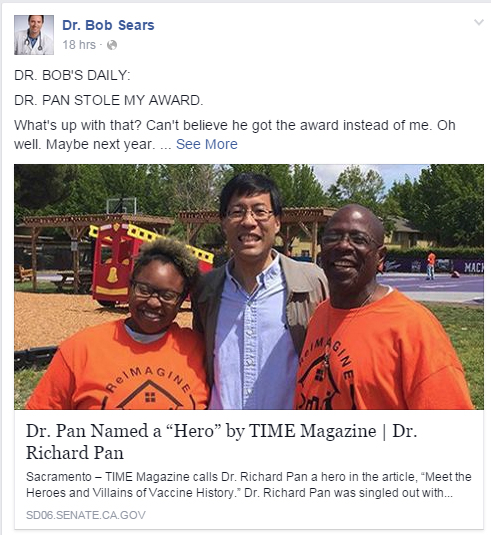
He’s just cashed out and filed for moral bankruptcy with this:

Dr Bobs award

DR. PAN STOLE MY AWARD.
What’s up with that? Can’t believe he got the award instead of me. Oh well. Maybe next year.

What’s up with that?

Well, let’s see. Dr. Pan has worked tirelessly to advance the cause of children’s health personally, professionally and through his government service. Dr. Pan has undoubtedly saved many lives already and will save far more in the future. As a result of that work, he faces a recall campaign instigated by anti-vax activists.

In contrast, Dr. Bob has worked tireless to advance the cause of … Dr. Bob.

A scathing piece in this week’s Economist notes:

Precisely because most children are immunised, he tells parents that it is probably safe to skip or delay jabs for their offspring. This strategy amounts to “hiding in the herd”, he says delicately, as he sips a late-afternoon coffee near his surgery. Put another way, his patients worry more than most about possible side-effects from vaccinations, above all the (thoroughly discredited) claim that vaccines cause autism. Dr Bob—as he is known to fans of “The Vaccine Book”, his best-selling guide to “selective” immunisation—does not say that worried parents are right. He just thinks that, on balance, they can safely indulge their anxieties by “taking advantage of the herd all around them.” When pushed, he makes “no claim” that the alternative vaccine plans that he offers (involving fewer jabs, or jabs administered over a longer period than most doctors recommend) are safer. He concedes that if everyone refused vaccinations, some diseases would roar back.

In other words, when pressed by someone who might actually know something about vaccines:

  • Sears acknowledges that vaccines work
  • Sears acknowledges that there is no evidence that his alternative vaccine schedule is safer
  • Sears acknowledges that anti-vaxxers are “free riders” because they enjoy the benefits of herd immunity without the risks of vaccination

What’s heroic about that?

Nothing. It’s actually morally bankrupt, the exact opposite of the selfless, caring spirit associated with heroism.

Does Dr. Sears actually think he deserves an award for heroism?

I doubt it. He’s just riling up the ignorant faithful the same way he has been riling them up and profiting from them for years.