All posts by Amy Tuteur, MD

New Dutch study shows homebirth increases the risk of death — and not just for the poor

iStock_000039571552_Small

You may have read about a new Dutch study of homebirth that shows that homebirth increases the risk of neonatal death.

You may have also read the spin, that the risk of homebirth is confined to poor women. This piece in The Washington Post is typical:

The infant mortality rate is also higher in the Netherlands than in European countries with similar medical resources. But as more Dutch mothers have switched in recent years to delivering their babies in hospitals, rather than their homes, doctors have noticed a drop in newborn deaths.

So far, so good.

Researchers wanted to understand why, between 1980 and 2009, the country’s infant mortality rate fell from 4.25 deaths per 1,000 births to 2.42 deaths per thousand births. Over the same period, the share of deliveries in maternity wards swelled from about 61 percent to 73 percent. On the surface, it appeared the home method may simply be riskier for babies.

But the story isn’t that simple. What happened to the women during their home births depended a lot on their income, and relatedly, their access to routine medical care before and after pregnancy, according to a study published this month in the American Economic Journal: Applied Economics

… [A] poorer woman who preferred a home birth was more likely to encounter tragedy. The 28-day infant mortality rate for them more than doubled, from about 2 deaths per 1,000 births to 5 deaths per 1,000 births.

[pullquote align=”right” color=”#66a018″]The rise in hospital births explains roughly 46–49% of the reduction in infant mortality in the Netherlands between 1980-2009.[/pullquote]

One possible interpretation of the findings of the study is that the danger of homebirth is restricted to poor women, but there is another, far more likely interpretation of the data: homebirth is safe ONLY when nothing goes wrong. Any unforeseen complications double the risk that the baby will die.

The paper Saving Lives at Birth: The Impact of Home Births on Infant Outcomes by Daysal, et al. was written by economists. The math in the paper is probably perfect; however, some of the medical assumptions are problematic.

The basic statistics are incontrovertible: homebirth increases the risk of neonatal death and the recent increase in hospital birth in The Netherlands has been associated with a fall in mortality rates.

According to Daysal, et al.:

Historical data show that 7-day (28-day) mortality declined from 4.25 (5.35) deaths per 1,000 births in 1980–1985 to 2.42 (3.18) deaths in 2005-2009, while the share of hospital births increased from 61.25 percent to 72.06 percent. In addition, using a decomposition … we find that most of the mortality decline between 2000–2008 comes from newborns over 2,500 grams, who are more likely to be low-risk and thus eligible for home births.

This is a critical point. Not only has the neonatal death rate decline in proportion to an increase in hospital birth, but that decline occurred in babies of normal size, suggesting that these were term babies.

Indeed:

Back-of-the-envelope calculations suggest that the rise in hospital births explains roughly 46– 49 percent of the reduction in infant mortality in the Netherlands between 1980 and 2009.

In this paper, the authors looked at all births in The Netherlands from 2000 to 2008. The key finding:

We find that giving birth in a hospital leads to substantial reductions in newborn mortality. We provide suggestive evidence that proximity to medical technologies may be an important channel contributing to these health gains.

That seems pretty definitive, so why is the mainstream media hedging about maternal income?

The study found that the increase in deaths was confined to postal codes with low median incomes. In other words, most of the deaths occurred in poor areas. But that DOESN’T mean that the proximate cause of those deaths is poverty.

In the first place, the authors looked only at addresses, not at actual maternal income. Second, maternal income is likely a proxy for the incidence of complications. It is well known that lower socio-economic status in pregnancy is associated with greater risk of complications. Therefore, a more realistic conclusion is not that homebirth is dangerous for poor women only, but rather that homebirth is dangerous if anything goes wrong. Homebirth is safe only if nothing goes wrong. Once a complication develops, the risk of neonatal death rises dramatically if the baby is anywhere but a hospital.

In fact:

The lack of an impact on the 5-minute Apgar score suggests that the general health of low-risk babies born in a hospital is similar to those born at home shortly after birth. Hence, any mortality reductions from a hospital birth are likely due to the medical care provided after delivery. A hospital birth may reduce infant mortality through various channels, such as the availability of better facilities and equipment, potentially better hygiene or the proximity to other medical services.

As I’ve written many times before, hospitals are like seatbelts; most of the time you don’t need them but wearing them all the time dramatically lowers the risk of death.

The take home message from this paper is NOT that homebirth is safe for wealthy women. The take home message is that homebirth is safe ONLY when nothing goes wrong.

Homebirth is gambling with your baby’s life. You’re gambling that there won’t be any unexpected complications. But if there are complications, your baby is more likely to pay for your gamble with his or her life.

I’m a feminist. That’s how I know natural childbirth has nothing to do with feminism.

Natural childbirth is not feminist

Mariah Sixkiller claims she is a birth feminist.

Birth feminists simply believe in a woman’s right to make empowered choices about her birth experience. We believe a Mom should have evidence-based information about all her birth options, which all too often does not happen. We believe a Mom should be supported through her decision-making process and into the birth experience itself, which all too often does not happen. And we believe every Mom is entitled to her own choice, without judgment, whatever it may be, which all too often does not happen.

Natural childbirth advocates have hijacked “feminism” in the same way that political conservatives have hijacked the flag, and homophobes have hijacked “family.” None of them believe in choices; they believe in one correct choice. None of them believe in evidence; they misuse the term to promote a predetermined agenda. And none of them refrain from judging those who make anything other than pre-approved, officially sanctioned choices.

But I’m an actual feminist. That’s how I know that natural childbirth has nothing to do with feminism.

Sixkiller writes about her vaginal birth after cesarean (VBAC):

[pullquote align=”right” color=”#da0c0c”]I’m an actual feminist. That’s how I know that natural childbirth has nothing to do with feminism.[/pullquote]

When the time came, in February 2012, I labored for four days with no medicine. I have never worked harder or experienced a more unbelievable thrill than meeting my son that day. I felt relief, pride, strength, and elation. I felt empowered by the birth, and it changed my life for the better. My post-partum experience was amazingly positive—a sharp contrast with my first post-partum experience. And to this day, I look at my middle child with wonder and appreciation for the experience we had together—the time I gave him his life, and he gave me mine back.

I’m a feminist and that’s not feminism. That’s narcissism.

Sixkiller’s piece in The Daily Beast is publicity for Ricki Lake’s latest venture in promoting the subjugation of women to their biology, Mama Sherpas: Midwives Across America It’s yet another effort to extol the virtues of women’s pain, suffering, and ignorance of science.

As I wrote recently for Time.com regarding Lake’s effort to demonize the birth control pill:

She’s part of a natural parenting movement that is anti-hospital birth, anti-epidural and anti-formula — technological innovations that have made the legal, political and especially the economic liberation of women possible. Opposition to the Pill is the next logical step of that philosophy…

The technology of the 20th Century — hospital birth, epidurals, infant formula and especially the Pill — freed women from being slaves to their biology.

Opposition to the birth control pill is opposition to women’s emancipation.

I’m a feminist and I can tell you opposition to women’s emancipation is not, and can never be, feminist.

I’m a feminist. That’s why I spent years becoming an OB-GYN, so I could understand every aspect of childbirth and provide women with safe, satisfying births.

I’m a feminist. That’s why I object to the insistence of natural childbirth advocates to reducing birth to the ways that a mother uses her vagina, uterus and breasts.

For most of human history, women were reduced to only 3 body parts: vaginas, uteri and breasts. How they used them represented the sum total of their value to men. In contemporary natural childbirth advocacy, how women use their vaginas, uteri and breasts represent the sum total of their value as mothers.

I’m a feminist. That’s why I support the use of pain relief for the excruciating pain of childbirth.

I’m a feminist. That’s why I encourage women to get their medical information from medical experts, not from washed up talk show hosts.

I’m a feminist. That’s why I recognize that how you give birth to your child (or even IF you give birth to your child) has nothing to do with your love for that child.

I’m a proud, committed, enthusiastic feminist.

That’s why I recognize that natural childbirth has nothing to do with feminism … and everything to do with manipulating women into accepting the profoundly misogynistic notion that women’s worth is determined by their vaginas, uteri, and breasts, instead of their intellect or the content of their character.

An open letter to BJOG about homebirth huckster Melissa Cheyney

the truth or your story

To the Editors of the British Journal of Obstetrics and Gynecology,

Thank you so much for response to my tweets about the recent publication of Safe for Whom? by Melissa Cheyney et al. and your suggestion to submit a Letter to the Editor.

BJOG tweets

The format for Letters to the Editor is too restrictive, so I decided to share my concerns in this open letter.

Simply put, dear Editors, what were you thinking?

[pullquote align=”right” color=”#dd2332″]Melissa Cheyney has lied, denied, decried and defied efforts to inform the public of the hideous death toll at homebirth.[/pullquote]

Did you actually solicit an opinion piece from a LAY midwife, indeed the lay midwife who has single-handedly done more to hide the growing toll of tiny bodies of babies who succumb to American homebirth than anyone else? Melissa Cheyney has lied, denied, decried and defied efforts to inform the public of the hideous death toll at homebirth.

Did you know that Cheyney, like all American “certified professional midwives” (CPMs) is grossly undereducated, grossly undertrained and fails to meet the standards for ALL other midwives in the industrialized world?

Did you know that the CPM credential was fabricated from whole cloth by lay people who couldn’t be bothered to get a real midwifery degree, but wanted to hijack the excellent reputation of American certified nurse midwives by awarding themselves similar letters after their names?

It appears that you are unaware that Cheyney, in her role as the Chair of the Oregon Board of Direct Entry Midwifery, steadfastly REFUSED to release the homebirth mortality rates in her possession for fear that regulatory authorities might wish to investigate the death rate and discipline the midwives involved in the deaths:

Cheyney explained … due to some state regulatory boards having very hostile relationships with midwives, the quality and quantity of data submitted might be adversely affected if regulatory authorities were provided access.

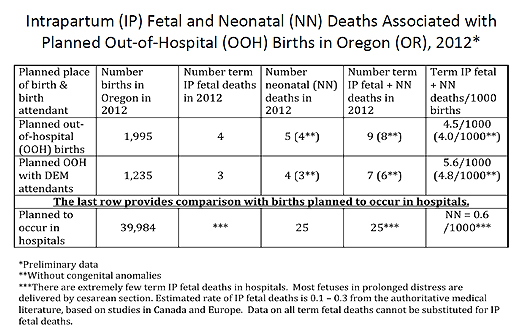
The state of Oregon subsequently hired Judith Rooks, CNM, MPH, a known supporter of homebirth, to calculate the Oregon homebirth death rate in 2012. Rooks presented her findings in this chart:

Oregon homebirth death rates 2012

Rooks regretfully acknowledged:

Note that the total mortality rate for births planned to be attended by direct-entry midwives is 6-8 times higher than the rate for births planned to be attended in hospitals. The data for hospitals does not exclude deaths caused by congenital abnormalities.

Many women have been told that OOH births are as safe or safer than births in hospitals…

But out-of-hospital births are not as safe as births in hospitals in Oregon, where many of them are attended by birth attendants who have not completed an educational curriculum designed to provide all the knowledge, skills and judgment needed by midwives who practice in any setting.

These were the statistics that Melissa Cheyney tried to hide.

Did you know that in her role at Director of Research for the Midwives Alliance of North America (MANA), the trade union that represents homebirth midwives, Cheyney REFUSED for 5 years to release the mortality rates from a MANA survey of nearly 20,000 homebirths from 2004-2009, hiding them until 2014 when the pressure became too great.

Undoubtedly you know that Cheyney ultimate published the results in Outcomes of Care for 16,924 Planned Home Births in the United States: The Midwives Alliance of North America Statistics Project, 2004 to 2009. Did you read the paper? If you had, you would have found that comparing Cheyney’s death rate at homebirth of 2.06/1000 with the CDC death rate for low risk white women (ages 20-44, at term, with babies that are not growth restricted) of 0.38, we find that homebirth has a death rate 5.5X higher than hospital birth. In other words, the death rate at homebirth is 450% higher than comparable risk hospital birth.

Moreover, the death rates in certain subgroups were astronomical:

(5 fetal/neonatal deaths in 222 breech presentations), TOLAC (5 out of 1052), multiple gestation (one out of 120), and maternal pregnancy-induced comorbidities (GDM: 2 out of 131;
preeclampsia: one out of 28

You can also be sure that the authors understood that their data showed that homebirth has a horrifically high death rate, because they try to hide the number of deaths for the past 5 years, released the data only under pressure, and then proceeded to draw a conclusion entirely at odds with what their own data showed. In addition, you can also conclude that homebirth is NEVER appropriate for breech, twins or VBAC. Finally, you come away from the paper with the horrifying realization that MANA has absolutely no idea what its own members are doing. There is no systematic attempt to determine if they are safe practitioners.

Is it any wonder then that Cheyney, who has spent years hiding the death toll at homebirth in her own state and across the country dismisses even the idea of homebirth safety by asking “safe for whom”?

And is it any wonder that Cheyney tries to reframe the conversation to ignore the death rate altogether:

Let us move beyond this polarising debate on whether homebirth is safe …

It was grossly inappropriate to solicit a commentary on homebirth safety from Melissa Cheyney, a lay midwife who has spent her career lying about the death toll of American homebirth.

BJOG should retract Cheyney’s latest effort at obfuscation and apologize to its readers for soliciting her opinion in the first place.

Sincerely,
Amy B. Tuteur, MD

What gun violence denialists have in common with other science denialists

Assault rifle bent

Another day, another gun massacre.

In Louisiana last night:

A “drifter” sat silently in a movie theater for 20 minutes before shooting 11 other patrons in an incident that was over in matter of seconds, witnesses and police in Louisiana said early Friday.

[He] 59, was seated in the theater “just like everybody else” before firing 13 rounds, killing two people and wounding nine others with a .45 caliber handgun, Lafayette Police Chief Jim Craft told reporters. Houser later took his own life.

The proximate cause is obvious to everyone in the world but gun aficionados; the proximate cause is the easy access to guns brought to us by a corrupt legislative process orchestrated by the National Rifle Association and its mounds of cash.

[pullquote align=”right” color=”#86081d”]Gun rights advocates are denialists just like anti-vaxxers are denialists, and they are every bit as dangerous to public health.[/pullquote]

Americans favor gun restrictions [edited to replace “strict gun control”]. Gun restriction is associated with decreased gun violence. Yet, the NRA opposes gun control and their cash contributions to legislators trump the will of the American people, the victims of American gun violence, and common sense itself. The truth is that the NRA is a group of gun violence denialists who have an amazing amount in common with science denialists of all stripes from creationists, to climate change denialists, to anti-vaxxers, to purveyors of “alternative” remedies.

Don’t believe me? Consider this definition of denialism offered by Andrew Dart in an chapter from Building your Skeptical Toolkit:

Denialism … is driven by ideology rather than evidence. Now denialists may claim they care about the evidence and will happily display any that supports their point of view, but in most cases they reject far more evidence than they accept. Furthermore, denialists will cling to evidence no matter how many times they have been shown that it is flawed, incorrect or that it does not support their conclusions; the same old arguments just come up again and again. Denialism also tends to focus on trying to generate a controversy surrounding the subject at hand, often in the public rather than scientific arena, and does so more often than not by denying that a scientific consensus on the matter even exists.

Pretty much nails gun violence denialism, right?

1. Denialists start with a conclusion and work backwards.

It doesn’t matter how much evidence you show to climate change deniers, creationists or anti-vaxxers. They’ve embraced a conclusion and they’re sticking to it, regardless of what the evidence actually shows. Similarly, there’s no evidence that you could show gun violence denialists that would cause them to even question their beloved conclusions about guns, let alone change those conclusions.

2. Denialists love denial.

Who you gonna believe, the NRA or your lying eyes?

Like the climate change deniers who will still be in denial as the water rises above their heads, and the evolution deniers who insist that dinosaur bones were planted by God to test our faith, or the anti-vaxxers who can still claim with a straight face that vaccines don’t prevent disease, gun violence denialists are still denying the dangers of easy access to guns as the pile of dead bodies mounts beside them.

3. Denialists love conspiracy theories.

As Dart explains:

So the vast majority of the scientific community and an overwhelming mountain of evidence is aligned against you, what are you going to do? Well you could always claim that there is a conspiracy to suppress the truth …

The favorite conspiracy theory of gun violence denialists is that the government wants to take away people’s guns in order to stage a fascist takeover.

Conspiracy theories, whether blunt or subtle, are nothing more than evasions of the actual evidence that easy access to guns leads to massive numbers of gun deaths, as well as the absence of any evidence of any kind that gun control is the first step to a fascist take over the of the US.

4. Denialists love cherry-picking.

Cherry picking is the act of selecting papers and evidence that seem to support your point of view, whilst at the same time ignoring the far greater body of evidence that goes against your position.

Gun violence denialists claim that research shows that easy access to guns makes us “safer,” when the evidence is all around us that in countries with easy access to guns life is more dangerous for everyone, particularly innocent people.

5. Denialists love echo chambers.

They seek support and validation for their views at NRA conventions and on Fox News and refuse to directly address the concerns of victims of gun violence and public safety experts.

The inevitable conclusion is one that anyone who cares about scientific integrity and intellectual honesty should keep in mind:

It is not the topic that makes someone a denialist, it is how they the handle evidence that contradicts their cherished, immutable beliefs, in this case, the rising tide of the blood of innocent people injured and killed in gun rampages. Do they deny the evidence that is right in front of their eyes. Do they invoke outlandish conspiracy theories? Do they cherry pick the data and only present those findings that agree with them? And do they congregate in echo chambers that always validate and never question their beliefs?

Gun rights advocates are denialists just like anti-vaxxers are denialists, and they are every bit as dangerous to public health.

How could Modern Alternative Mama determine whether natural remedies actually work?

Katie Tietje pharmacology sharper

As I wrote yesterday, Katie Tietje (Modern Alternative Mama) claims that natural remedies work to cure disease.

She provided no evidence for that claim, but that doesn’t mean that it is impossible.

Let’s look at what Katie would need to know in order to determine whether natural remedies work:

The study of drug efficacy and safety is pharmacology. Pharmacology can be roughly divided into two areas: pharmacodynamics, how the substance acts on the body, and pharmacokinetics, how the body acts on the substance.

[pullquote align=”right” color=”#762b1d”]What are the pharmacodynamics and pharmacokinetics of natural remedies?[/pullquote]

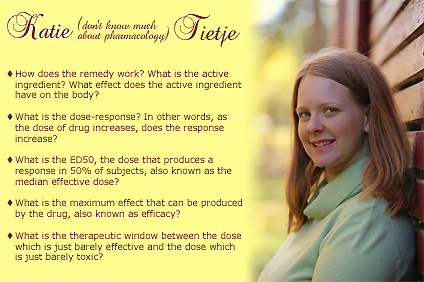
Here are some basic questions that must be answered to find out how the drug works on the body:

  • How does the drug work? What is the active ingredient? What effect does the active ingredient have on the body?
  • What is the dose-response? In other words, as the dose of drug increases, does the response increase?
  • What is the ED50, the dose that produces a response in 50% of subjects, also known as the median effective dose?
  • What is the maximum effect that can be produced by the drug, also known as efficacy?
  • What is the therapeutic window? For every drug, there exists some concentration which is just barely effective and some dose which is just barely toxic. Between them is the therapeutic window where safe and effective treatment will occur.

Here are some basic questions that must be answered to find out how the body interacts with the substance:

  • What is its half life?
  • What is its bioavailability?
  • How is it removed from the body?
  • Does it have effects on other parts of the body besides its stated therapeutic effect?

What does Katie Tietje know about the pharmacology of the natural remedies that she recommends? Generally nothing. She doesn’t know the mechanism of action, the dose response or the side effects. Therefore, she has no evidence that the natural remedies that she peddles are either safe or effective.

Determining drug efficacy and safety is complex. It is absolutely imperative to study the pharmacodynamics and pharmacokinetics of a substance before anyone can claim that it is effective or safe. In the case of Katie Tietje’s natural remedies, these questions have not even been asked, let alone answered.

10 Reasons why you shouldn’t use natural remedies

iStock_000047959348_Small

Katie Tietje (nom de quack Modern Alternative Mama) continues to grace us with her own charming brand of scientific illiteracy. Because, really, who doesn’t consider someone with no scientific knowledge and no medical training to be an excellent source of medical advice?

Recently she offered 10 reason for using natural remedies. Paradoxically they are actually reasons why you SHOULDN’T use natural remedies.

To wit:

1. Natural remedies don’t work.

I’m a skeptic. The definition of a skeptic is not someone who is skeptical in the colloquial sense. A skeptic is someone who demands proof. If natural remedies actually worked, there would be studies that show that they actually work, but there aren’t any. And it’s not because no one has looked.

According to Mielczarek and Engler in Measuring Mythology: Startling Concepts in NCCAM grants:

[pullquote align=”right” color=”#565592″]Since herbs are natural, they must be safe. Kind of like heroin, cocaine and tobacco.[/pullquote]

Using data from the NIH website,we studied all NCCAM funding awards from 2000 to the present. We found no discoveries in alternative medicine that justify the existence of the center; Congress has mandated into the health care bill the tax burden of paying for myths and commercial interests.

Billions of taxpayer dollars have been spent on testing botanicals, yoga, magnets, and distance healing as interventions for serious medical problems such as diabetes, HIV/AIDS, and cancer…

Did Americans really need to spend millions of dollars to learn that“distance healing” cannot cure brain cancer or HIV/AIDS; shark cartilage does not affect the survival rates of cancer patients; vitamin E and selenium do not mitigate prostate cancer; magnets are not useful for fibromyalgia or carpal tunnel syndrome; and clinical trials using coffee enemas combined with heavy vitamin supplementation for patients with pancreatic or prostate cancer are unsafe?

2. They’re not safe.

Tietje operates on the delightful misapprehension that because herbs are natural, they must be safe. Kind of like heroin, cocaine and tobacco.

3. You get what you pay for.

According to Tietje:

Here’s another cool thing — herbs are very affordable. They’re often $1/oz. or less (and an ounce of dry plant material is a lot). Even prepared remedies are often $20 – $30 for a small bottle, which usually will last for months to years. Herbal remedies can be stored longer than most OTC medicines, and can be taken by multiple family members…

Amazingly, they cost no more than food because that’s all they are.

4. Altie-shills like Tietje make them easy to buy.

This is not an advantage for anyone except altie-shills like Katie who profit from selling ground up leaves to gullible people.

5. You can pretend that they are customized just for you.

That’s not especially compelling when they don’t work in any formulation, regardless of whether the formulation was customized for you.

6. A sure sign of quackery is a treatment advertised to cure many different unrelated types of pathology.

Katie says:

Ginger can be used for colds, flu, inflammation/pain, upset stomachs, cancer, and more! Lavender can be used for burns, promoting relaxation, headaches, and more. Herbs are so versatile that it’s possible to have only a few common ones around and still be able to treat many different things.

And if you believe that, I have a bridge in Brooklyn that I’d like to sell you.

7. Anyone who believes that curing cancer is a do it yourself project is a fool or worse.

According to Katie:

I love knowing that if someone isn’t feeling well, I have what I need in the kitchen to whip up something to make them feel better in minutes. That’s just awesome.

No, that’s just moronic.

8. It makes no difference that you control the ingredients when none of the ingredients are efficacious.

9. If it sounds too good to be true, it is.

Such as:

I know — when you’re brand new to natural remedies, it can seem really intimidating. But I promise, they are easy. Most only require a few ingredients, and come together in just a few minutes. Even the ones that take longer really only need time to sit — not active time from you.

But Katie saved the best reason for last.

10. Katie can profit from your gullibility!

See!

In about a month, Natural Remedies For Kids is coming. It’s a beautiful, full-color guide to making and using your own natural remedies (and despite the title, they’re for the whole family). It’s also my first traditionally published book. 🙂

See, I once was totally intimidated, too. I wished I had an experienced mama to come alongside me and show me how to get started. That’s why, after 6+ years of experience with using and preparing natural remedies, I wrote this book!

You’ll learn all about the basic preparation methods — teas, decoctions, infusions, tinctures, salves, lotions, and more. Plus, which herbs to start with in your natural medicine cabinet.

My advice? When contemplating buying and using natural remedies, keep in mind that famous ancient saying:

A fool and his money are soon parted.

Those are truly words to live by.

She used WHAT as a dildo??!!

iStock_000014733676_Small copy

I no longer practice medicine, but I sometimes miss it.

One of the reasons is that the amazing thing about practicing medicine is that every time you think you’ve finally seen everything, you see something new. Not just something that you’ve never seen before, either, but something that you could not have even imagined.

Consider a case that came to my attention when I was an attending physician. A young woman came to the evening urgent care clinic at our health center one evening complaining of severe genital pain; so severe, in fact that she could only walk with her legs widely spaced a part.

That walk is a classic sign of a Bartholin’s gland abscess, a fairly common infection of the glands at the outer edge of the vagina. Bacteria can take up residence in the gland and cause an abscess. Even though the abscess is small, it is extremely painful. The wide stance walk is almost a guarantee of the diagnosis. The triage nurse explained the likely diagnosis to the patient and the fact that the abscess could be easily treated. Rather than looking relieved, the patient appeared embarrassed.

[pullquote align=”right” color=”#e80000″]She was right. I couldn’t believe it.[/pullquote]

A physician’s assistant (PA) saw the patient, took the history, which was unremarkable, and started the exam, which was very remarkable. The patient did not have an abscess; she had what appeared to be shallow, but extensive burns around and extending into her vagina. The physician’s assistant was so flustered that she excused herself to call me.

I could not leave the hospital to go to the clinic, because I had a patient in labor who would deliver soon, so I had to rely on the PA’s description. The description certainly fit with that of burns, but I had never seen burns of that kind in any area. Yes, I had seen chemical irritations of various kinds, but it didn’t seem like an injury of this sort was likely to be caused by a new bath soap or detergent.

The PA insisted that the patient’s history was unremarkable, and I insisted that she had not gotten the complete history. It wasn’t her fault; the patient simply didn’t want to reveal what happened. I suggested to the PA that she question the patient about domestic violence, since I had certainly seen vaginal injuries related to violence in the past. I also pointed out that it was important to explain to the patient that we needed to know what happened in order to treat her appropriately.

I was dreading the return phone call, and I imagined all sorts of horrible things that might have happened, but I failed to imagine what really did happen. When the PA called again, she was laughing.

“You’re not going to believe this,” she said, “but the patient accidentally did this to herself with a dildo.”

She was right. I couldn’t believe it. What could the patient have used? I’d heard of all sorts of things in the past: fruit, candles (unlit), and glass bottles, among others, but nothing that could cause burns.

“She used a deodorant stick!”

The patient had used the actual stick of deodorant, which she had pried out of the container (for who knows what reason) and the burns she had were serious chemical burns. We treated her by washing the area to remove any trace of the chemicals and applying the salve typically used for treating burns from gynecologic laser surgery. Oh, and lot’s of pain medication, too, for obvious reasons.

Her treatment plan included her medications, an appointment for follow up, and a recommendation: should she feel the need to use a dildo in the future, she should avoid deodorant, or at least leave it in the container with the cap still on.

Harper Lee, Watchman, and elder abuse

iStock_000001427033_Small

The books are flying off the shelf.

The hangers-on are making a fortune.

And the reputation of the author — elderly, frail, suffering from memory, vision and hearing loss — has been destroyed.

Simply put, the publication of Harper Lee’s Go Set a Watchman (the discarded first draft of her iconic novel To Kill a Mocking Bird) appears to be a spectacular case of elder abuse.

I find it both appalling and inexplicable that critics are debating the merits of Watchman and asking whether Atticus Finch, the beloved main character of Mockingbird, is actually a racist and what that means for literature and for us. Frankly, to the extent that we enrich those who plundered Ms. Lee’s legacy for their own benefit, we are complicit in that abuse.

[pullquote align=”right” color=””]Does anyone truly believe that Harper Lee had the capacity to decide to publish a first draft manuscript that she swore for 50 years she would never publish?[/pullquote]

In the the 50 years since the publication of To Kill A Mockingbird, Lee both acknowledged the existence of a first draft and steadfastly refused to publish it. Presumably it would have passed to whatever library or institute that Lee has chosen to bequeath her personal papers and could have been made available for academic study to provide insights into how a great author creates a great work. Yet after the December death of her closest living relative and caregiver, her sister, the manuscript was suddenly “rediscovered” and Lee suddenly “agreed” to its publication.

To put these events in perspective, imagine if an 88 year old individual had designated a Rembrandt in her possession to be donated to a famous museum after her death. Imagine if she had publicly acknowledged the planned donation and publicly insisted that she would never sell the painting for profit. Then suddenly, at age 88, after the death of her closest living relative and caretaker, suffering from memory, vision and hearing loss she “changes her mind” and gives the painting to her new caretakers to sell, despite the fact that she does not need the money.

We would (hopefully) recognize that the new caretakers were committing elder abuse, which encompasses exploitation:

… taking, misuse, or concealment of funds, property, or assets of a senior for someone else’s benefit.

In the case of a previously written bequest, there would be a museum who would file suit to execute the owner’s original wishes. The entity that stood to benefit from the original intention would take legal action to uphold the original bequest. Unfortunately, in the case of Lee’s first draft, there was no entity besides Ms. Lee who stood to benefit from her original intention and, therefore, no one with any stake in following her original wishes.

There were those who tried, however.

According to The New York Times:

Now the State of Alabama has been drawn into the debate. Responding to at least one complaint of potential elder abuse related to the publication of “Watchman,” investigators interviewed Ms. Lee last month at the assisted living facility where she resides. They have also interviewed employees at the facility, called the Meadows, as well as several friends and acquaintances…

With an investigation involving Monroeville’s most famous resident underway, friends and acquaintances who have come forward in recent weeks have offered conflicting accounts of Ms. Lee’s mental state, with some describing her as engaging, lively and sharp, and others painting her as childlike, ornery, depressed and often confused. Several people said that her condition varied depending on the day.

Ms. Lee — known to many as Nelle, her legal first name — had a stroke in 2007 and has severe hearing and vision problems. But friends who visit her regularly say she can communicate well and hold lengthy conversations if visitors yell in her ear or write questions down for her to read under a special machine. (A black marker is kept in her room for this purpose.)

But, of course, whether or not she can communicate well tells us nothing about whether she is competent to make decisions. Many elderly people communicate just fine with telemarketers who swindle them.

Lee’s literary reputation is on the line:

A lot is at stake, including the legacy of one of the country’s most beloved authors. Many wonder whether “Watchman,” which was rejected by a publisher in the mid-1950s and then rewritten as “Mockingbird,” will turn out to be a flawed, amateur work when it is released in July, and a disappointing coda to a career that has been defined by one outsize hit.

Jason Karlawish, M.D., a professor of medicine and medical ethics, weighed in at Philly.com:

How would we know that Lee was capable of making the decision to publish a novel she long ago swore not to publish?

Cases such as hers are an immense public-health problem. Changes in older adults’ cognition and need for help with daily tasks, together with accumulated lifetime wealth, make them easy prey for those who want to exploit or abuse them…

For Lee, publishing Watchman will reshape her carefully lived legacy. Is she, in some sense, mistakenly killing her own mockingbird?

The answer to this question engages decades of scholarship at the intersections of ethics, law, medicine, and psychology. We no longer use broad generalizations about a person, such as whether her decision was “reasonable,” or whether she has dementia. Instead, capacity is grounded in an assessment of an adult’s abilities to make a specific decision.

Karlawish points out that being able to communicate does not indicate capacity to make major life decisions.

Classic cases include the older adult who always avoided financial risks, but who now wagers large sums at casinos, or sends bank account information to strangers to collect a share of an alleged lottery payout, or who revises a will to support a new and much younger and needy partner. Or, in the case of Lee, who swore that her first novel was her last novel, but who now has changed her mind.

People do change, and they truly can have new values. In some cases, however, these changes reflect impairments in brain function. The classic causes are conditions that damage the frontal lobes, such as from an uncommon dementia called frontotemporal lobar degeneration, or a type of traumatic brain injury.

Studies of older adults’ decision-making in risky situations, or their capacity to distinguish between trustworthy and untrustworthy sources show that some older adults perform poorly on these tasks and as a result are liable to make poor decisions…

Does anyone truly believe that Harper Lee had the capacity to decide to publish a first draft manuscript that she swore for 50 years she would never publish? Does anyone actually believe that Lee underwent the fundamental change in values that would be required to support that decision? Or was the “decision” to publish Watchman akin to the “decision” to share bank account information with strangers to collect an alleged lottery payment?

It seems to me that Harper Lee’s “decision” to destroy her legacy by publishing a discarded first draft of her literary masterpiece is a spectacular example of the all too common phenomenon of elder abuse. And by buying the new book and analyzing it for “insights” on the real Atticus Finch, we have made ourselves complicit in Lee’s tragic exploitation.

Shouldn’t women be having speculum orgasms?

Sexual woman in bed

Debra Pascali-Bonaro and Christiane Northrup, inquiring minds want to know:

If, as you claim, women have orgasms at the moment of birth, shouldn’t they be having orgasms during speculum exams?

As Dr. Northrup explained:

“When the baby’s coming down the birth canal, remember, it’s going through the exact same positions as something going in, the penis going into the vagina, to cause an orgasm.

Right, and when a speculum is inserted in the vagina (and again when it is removed), it is going through the exact same positions as the penis going into the vagina. So why don’t women have speculum orgasms?

Could it be because you can’t profit from the idea?

Most people (myself included) dismiss orgasmic birth as a lucrative figment of your imaginations, complete with the hucksterism attendant on all form of quackery. And certainly, Pascali-Bonaro’s website Orgasmic Birth does nothing to disabuse them. You can’t even get to the home page without being barraged with a plea for your email address:

You deserve to give birth with Dignity, Love and Pleasure! Learn how to move from Pain to Power. Subscribe now to receive my Pleasurable Birth Tips PDF & Free Weekly “Keys to Unlock Your Pleasure” enews!

[pullquote align=”right” color=”#af937b”]If women women can have birth orgasms, shouldn’t they be having speculum orgasms too?[/pullquote]

According to you, orgasmic birth is the best kept secret. Indeed, it’s so secret that it has only been described in Western, white, well off women who have read the natural childbirth literature within the past 40 years. It is so secret that it apparently never happened before then in all of recorded human history, and so secret that it never happened among African and Asian women. And it is so secret that for all of recorded human history childbirth was routinely described as excruciating and agonizing.

Who knows the secret? Ina May Gaskin, of course.

In the film, world-renowned midwife Ina May Gaskin helps us to understand the normal rhythms of labor and women’s ability to have ecstatic birthing experiences…

Women can experience birth as sensual and pleasurable, and can enter a natural state of ecstasy. New research shows that the intimate experience of birth affects a woman’s life profoundly. Babies are also affected emotionally and physically, and over the long term, by their birth experience.

Gaskin is the lay midwife who wrote this:

Sometimes touching her very gently on or around her button (clitoris) will enable her to relax even more. I keep both hands there and busy all the time while crowning … doing whatever seems most necessary.

And this:

Sometimes I see that a husband is afraid to touch his wife’s tits because of the midwife’s presence, so I touch them, get in there and squeeze them, talk about how nice they are, and make him welcome.

As well as this:

I might want to have a cunt one day and a twat the next. On the third day I might decide that pussy is my favorite word.

These quotes, taken from the 3rd and 4th editions of Gaskin’s book Spiritual Midwifery, sound immature, foul mouthed, and sexually inappropriate.

What is the purported key to having an orgasmic birth?

The key to having an orgasmic birth is spending money on lay midwives like Gaskin and their natural childbirth associates.

What a coincidence!! Who could have seen that coming?

But if birth has been described, in every time, place and culture as excruciating and agonizing, how could any woman possibly have an orgasm at the moment of birth, when the vaginal opening is being stretched to 10 times its resting size, often tearing as a result?

Pascali-Bonaro is graciously willing to talk by phone to you or me for the low, low price of $195 an hour.

Or, if you book before July 31, you can join Pascali-Bonaro at her woman’s retreat on Italy’s Amalfi Coast from August 30th to September 6th ($3500 if you book after July 31).

But I prefer to ask Pascali-Bonaro and Northrup publicly:

If women women can, as you claim, have birth orgasms, shouldn’t they be having speculum orgasms too?

Anyone who claims there is an ideal C-section rate is lying … including the World Health Organization

long nose

Suppose I told you that research shows that the ideal C-section rate — the lowest rate compatible with the lowest rates of perinatal and maternal death — is 75%.

You’d balk, right? That couldn’t possibly be true.

Suppose I told you that research shows that the ideal C-section rate is 15%?

Most people, particularly non-obstetricians, would probably nod their heads in agreement. That sounds about right to them, confirming what everyone already “knows,” that that C-section rates in industrialized countries are “too high.”

Now let me tell you the truth:

There is no more evidence for an ideal C-section rate of 15% than there is for an ideal C-section rate of 75%. Indeed, there’s no evidence at all for ANY ideal C-section rate, a fact that has been acknowledged by the World Health Organization. Buried deep in its handbook Monitoring Emergency Obstetric Care, you can find this:

Although the WHO has recommended since 1985 that the rate not exceed 10-15 per cent, there is no empirical evidence for an optimum percentage … the optimum rate is unknown …

[pullquote align=”right” color=”#c94242″]There no evidence for an ideal C-section rate of 10-15% because no industrialized country with low levels of perinatal and maternal mortality has a C-section rate of 10-15%.[/pullquote]

So why did the World Health Organization recently reaffirm its commitment to a C-section rate no higher than 10%?

The answer is white hat bias.

As I explained recently, white hat bias was first described in reference to obesity research, including purported preventive effects of breastfeeding on subsequent obesity. White hat bias is a form of confirmation bias, the natural tendency of people to accept information that confirms what they believe. Confirmation bias is why Tea Party members watch Fox News. They want to have their beliefs, prejudices, and wishes always confirmed, never challenged.

White hat bias is confirmation bias in service of what are seen as laudable goals:

‘White hat bias’ (WHB) [is] bias leading to distortion of information in the service of what may be perceived to be righteous ends… WHB bias may be conjectured to be fuelled by feelings of righteous zeal, indignation toward certain aspects of industry, or other factors.

White hat bias leads scientists, doctors and public health officials to substitute what they fervently believe for what the actual scientific evidence shows. For example, obesity researchers, doctors and public health officials routinely claim that normal to low BMI is “healthiest.” But the scientific evidence shows, and has always shown, that people with higher than normal BMI, overweight but not morbidly obese, are the people who live the longest. So why don’t scientists, doctors and public health officials advise people that being slightly overweight is healthiest? Because white hat bias leads them to ignore the scientific evidence in favor of what they deeply believe: being overweight must be bad for your health.

Their motives are pure. They ignore what the scientific evidence shows because it doesn’t comport with what they are absolutely, positively certain must be true. Moreover, they believe, with some justification, that the current US epidemic of morbid obesity (which isn’t healthy at all) is the result of corporations placing profits ahead of creating healthy food options.

But if science teaches us anything it’s that what we believe may be very different from the truth. Paraphrasing Thomas Henry Huxley: The highest duty of scientists lies in submitting to the evidence however it may jar against their inclinations.

The problem of white hat bias in regard to C-sections is, if anything, worse than the problem of white hat bias in obesity research. Everyone “knows” that the C-section rate is too high despite the fact that the existing evidence for this belief is circumstantial at best. It goes something like this: if historically high C-section rates don’t lead to historically low mortality rates, there must be too many C-sections. In other words, since perinatal and maternal mortality rates haven’t dropped remarkably as the C-section rate has increased remarkably, those increases C-sections were unnecessary.

The belief that there is an ideal C-section rate, and that it is considerably lower than the C-section rates in contemporary industrialized countries is white hat bias at its most basic, resting as it does on other deeply held beliefs: The cost of health care is too high; we need to find a way to rein it in. Midwives are cheaper than obstetricians; we need to find a way to employ more of them and less obstetricians. C-sections are surgery; we should always avoid surgery whenever possible. But regardless of the pure motives of many of those promoting an idea C-section rate, their beliefs are a reflection of their biases and thoroughly ignore the scientific evidence.

As it happens, I also believe that the C-section rate is too high. I say this as a clinician who had a 16% C-section rate (and 0% forceps rate) during my years of private practice. But there’s a difference between what I might believe and what the scientific evidence actually shows.

There is simply NO EVIDENCE that a C-section rate of 10-15% is ideal because NO industrialized country with low levels of perinatal and maternal mortality has a C-section rate of 10- 15%! Indeed, the average C-section rate for countries with low rates of perinatal and maternal mortality is approximately 22%.

That’s an exceedingly inconvenient fact for those arguing that an ideal C-section rate of 10-15% will yield low levels of perinatal and maternal mortality. It’s just like the inconvenient fact in obesity research that those who are healthiest don’t have normal BMIs, but are actually overweight. However, as Neil de Grasse Tyson has noted:

The good thing about science is that it’s true whether or not you believe in it.

That applies equally to scientists as well as to purveyors of pseudoscience.

There is no scientific evidence for an ideal C-section rate and certainly no evidence for a C-section rate of 10-15%. Anyone who tells you otherwise, including the World Health Organization, probably has his, her or its heart in the right place, but that doesn’t make it true. It makes it white hat bias.