All posts by Amy Tuteur, MD

Who benefits from shaming formula feeders? Hint: it’s not those mothers or their babies.

Lactivists shaming you

Shame is integral to the contemporary lactivism movement.

Indeed, it is so integral that there’s actual a blueprint on how lactivists can shame other mothers. Entitled Watch your language it was written by lactation consultant Diane Wiessinger and published in the Journal of Human Lactation in 1996. It is a primer on how to mobilize language to shame women who bottle feed.

Wiessinger identifies the problem for those wishing to shame mothers. Merely telling them that “breast is best” leaves open the possibility that you can still be a good mother if you formula feed (also known in Wiessinger’s parlance as artificial feeding):

When we … say that breastfeeding is the best possible way to feed babies because it provides their ideal food, perfectly balanced for optimal infant nutrition, the logical response is, “So what?” Our own experience tells us that optimal is not necessary. Normal is fine, and implied in this language is the absolute normalcy and thus safety and adequacy-of artificial feeding…

So what if that’s the truth and women deserve accurate information in order to make informed decisions? We shouldn’t allow the truth to get in the way of manipulation:

Artificial feeding, which is neither the same nor superior, is therefore deficient, incomplete, and inferior. Those are difficult words, but they have an appropriate place in our vocabulary.

Actually, they are ugly, shaming words and Wiessinger is just getting started:

Because breastfeeding is the biological norm, breastfed babies are not “healthier” artificially-fed babies are ill more often and more seriously. Breastfed babies do not “smell better”; artificial feeding results in an abnormal and unpleasant odor that reflects problems in the infant’s gut.

[pullquote align=”right” color=”#ef6aa7″]The shaming of mothers for the ostensible benefit of babies benefits only those who profit from the shame.[/pullquote]

Wiessinger has the temerity to insist:

When we fail to describe the hazards of artificial feeding, we deprive mothers of crucial decision-making information. The mother having difficulty with breastfeeding may not seek help just to achieve a “special bonus”; but she may clamor for help if she knows how much she and her baby stand to lose. She is less likely to use artificial baby milk just “to get him used to a bottle” if she knows that the contents of that bottle cause harm.

Since when is deliberately inducing shame a form of decision making information? It has never been before, and it isn’t now.

Why would anyone undertake shame as a deliberate effort to promote breastfeeding. For Weissinger, it isn’t about babies or mothers it’s about promoting a “breastfeeding culture.”

We cannot expect to create a breastfeeding culture if we do not insist on a breastfeeding model of health in both our language and our literature.

And:

All of us within the profession want breastfeeding to be our biological reference point. We want it to be the cultural norm; we want human milk to be made available to all human babies, regardless of other circumstances. A vital first step toward achieving those goals is within immediate reach of every one of us. All we have to do is…watch our language.

Maybe that’s what those who profit from lactivism want, but it’s not what those in the health professions want. We want babies to be healthy, fed to satiety and not left to cry in hunger. We want mothers to be healthy and not in pain or struggling to manage a fraught breastfeeding relationship while dealing with new motherhood.

Over the past 20 years Wiessinger’s dream of using shaming language to browbeat women into breastfeeding has succeeded. The breastfeeding initiation rate has reached a 100 year high. And the impact on infant health has been … negligible to non-existent.

In contrast, the impact on maternal mental health has been profound. Simply put, there is an epidemic of guilty mothers who are ashamed that they cannot breastfeed exclusively.

The authors of a recent paper, Shame if you do – shame if you don’t, explain:

The message frequently summarised as ‘breast is best’ reflects scientific knowledge on the nutritional and immunological benefits of breast milk for infants as well as carrying moralistic dimensions. In many cultures, breastfeeding is synonymous with ‘good mothering’. When mothers make a decision not to breastfeed, they may experience guilt, blame and feelings of failure. Taylor and Wallace, in their theoretical framework aimed at understanding maternal responses to infant feeding, argue how formula feeding mothers may experience shame (as opposed to guilt) through ‘failure’ to live up to ideals of womanhood and motherhood…

Shame is considered to incorporate affect (e.g. fear, anger, humiliation, self-disgust, anxiety, low self-esteem, depression), cognitions (e.g. feelings of rejection, inferiority and inadequacy) and actions (e.g. withdrawal and isolation or retaliation). Although shame is often used interchangeably with guilt, these are considered to be two distinct emotions. Shame is believed to occur when there is a breach between the cognitive evaluation of the ideal self and that of the actual self. The self-evaluation giving rise to shame emerges through an awareness of a deficiency or feelings of not being good or good enough: a global negative feeling about the self in response to a goal not reached, or some shortcoming…

Just what Wiessinger was hoping for!

Interestingly, the sense of shame was precipitated or intensified by exposure to those who were supposed to provide breastfeeding support:

The quote[s] below suggests that what professionals may view as a positive approach may in fact augment the experience of shame due to the inherently judgemental nature of language used:

I got fed up of people telling me I was doing a good job. […] I wanted somebody to help me and actually find a solution to the problem I was facing. I think it is underestimated how vulnerable you feel and how much of a failure you feel and that is not really the right thing to say to people.

Some of the women who formula fed from the early post-natal period or after a period of breastfeeding also reported marginalisation through a lack of support:

When you bottle-feed you don’t get as much help. I did try so hard [to breastfeed] I kept blaming myself that I couldn’t do it. […] it was too painful and however much I tried I couldn’t get him on, and wasn’t feeding properly. […] But when you decide ‘I don’t want to do it anymore’, it seems the support goes out the window. […] It did get me very very down, it felt like they turned against me because I was bottle-feeding.

Restrictions or inhibitions on discussing substitute feeding methods (both on the post-natal ward and in the community) left women feeling dejected and isolated:

Bring the choice back for god’s sake, when breastfeeding doesn’t work, bottle feeding is a good alternative. I didn’t have a clue what I should be using.

The enforced dependency of mothers on the medical model was also in evidence when women experienced incapacity to breastfeed, perceived or otherwise:

They wouldn’t allow me to cup feed her, so I had to wait for a midwife to be free […]. I did ask as it was distressing that I couldn’t feed my child.

In The concept of shame and how understanding this might enhance support for breastfeeding mothers, Leeming and Marshall note:

Previous discussions of the potential for breastfeeding promotion to cause distress for women who do not breastfeed or who struggle to do so have tended to assume that the problem is guilt. In response to this a frequently made point has been the importance of recognising that apparent ‘failures’ to breastfeed are not best understood as the mother’s omission or ‘choice’ but instead as a consequence of the many barriers to breastfeeding in Western societies… However, as Taylor and Wallace point out, women’s emotional responses may be more complex than has sometimes been assumed and for many mothers who struggle with breastfeeding or turn to formula milk, shame may be as much if not more of an issue than guilt.

… When we are ashamed we experience ourselves as inferior or flawed before a more powerful critical ‘other’, whether this is an actual person we perceive as devaluing us or a sense of a generalised ‘other’ in front of whom we are inadequate and lesser. With shame the focus is on a sense of a damaged and unable self, rather than on specific actions. Therefore an example of shame would be a mother whose distress about feeding difficulties arises from the possibility to her that these difficulties mean she is fundamentally flawed or inadequate as a mother, and possibly exposed as such before critical others…

So if babies don’t benefit in any measurable way from breastfeeding promotion through shaming and mothers are actually harmed by it, who does benefit?

Lactivists benefit and they benefit in a variety of ways.

First, lactation consultants benefits by increased employment and income. If every women is shame into attempting breastfeeding, and shamed if she attempts to stop, and shamed if she combo-feeds with formula, and shamed when she is seen bottle feeding, there will be greater need for lactation consultants.

Second, lactivists benefit in the same way that those inflicting shame on others always benefit, by enhanced self-esteem through feeling superior to the shamed.

Finally, lactivists benefit by enjoying ugly behavior that is usually forbidden but is actually encouraged in the case of formula feeding. There is simply no limit to the cruelty of lactivists toward women who don’t or don’t want to breastfeed, and no limit to the delight that lactivists experience in sanctioned cruelty to other mothers.

Wiessinger’s blueprint for lactivists, promoting careful choice of shaming language in order to browbeat women who choose formula is an ugly document, and the result, inevitably, has been a rise in ugly feelings of shame among those mothers.

So now the rest of us need to ask ourselves if we have been duped into harming women for the benefit of a lactation consultants and lactivists who have been preying on them. Wiessinger was on the mark when she pointed out that “breast is best” leaves open the possibility that you can still be a good mother if you formula feed and that our personal experiences tell us that optimal is not necessary. We need to make it clear, in the strongest possible terms, that formula is an excellent substitute for breastmilk, that you can definitely be an excellent mothers if you formula feed, and that the shaming of mothers for the ostensible benefit of babies benefits only those who profit from the shame.

12 natural pregnancy lies that Modern Alternative Mama hopes you’ll believe … so she can keep selling you stuff

ostrich MAM copy

You want to become educated about pregnancy? Whom should you believe, an obstetrician with 4 years of college, 4 years of medical school, 4 years of hands on obstetric training delivering hundreds of babies, multiple years of clinical practice, having read hundreds or thousands of obstetric papers from the scientific literature or altie-shill Katie Tietje, Modern Alternative Mama, a legend in her own mind, a layperson who shills for “natural” products by fear mongering about obstetrics? Only a fool could imagine that Katie Tietje has any idea what she is talking about.

Like many altie-shills, Katie is most concerned about making money for herself and her friends. There is tremendous financial incentive for her to ignore preventive testing and care, ignore risks, and demonize doctors who want to reduce risk. The key factor for homebirth/natural childbirth altie-shills is the ongoing ability to bill women and sell them products. Acknowledging that risk factors necessitate obstetrician care and puts patients beyond Katie’s ability to shill products to them, so they must be ignored.

Katie and other homebirth/natural childbirth altie-shills behave like ostriches. They know that they can make more money by putting their heads in the sand and ignoring warning signs, so that’s what they do.

[pullquote align=”right” color=””]Altie-shills behave like ostriches. They know that they can make more money by putting their heads in the sand and ignoring warning signs, so that’s what they do.[/pullquote]

Case in point, Katie’s latest example of her profound ignorance: 12 Mainstream Pregnancy Lies You Likely Believe and her ostrich like bahavior.

Don’t see it? scroll down from the multiple products for which Katie is shilling and you’ll find it next to the additional products for which Katie is shilling. Those who think her blog is anything other than marketing for her shill products are touchingly naive.

Alti-shill Katie demonstrates her special recipe for combining money grubbing with mistruths, half truths and out right lies.

Let’s debunk Katie’s lies one by one, shall we?

1. Internal exams are beneficial and necessary.

They are if you believe that knowledge is power and that preventive medicine is better than treating emergencies.

How will you know if a cord has prolapsed if you don’t do vaginal exams? You’ll know when, in the classic tradition of homebirth, the baby drops dead into the hands of the clueless midwife.
How will you know if a baby is breech or a face presentation that is undeliverable? You’ll know when the baby’s head gets stuck and the baby suffers brain damage.
How will you know if a labor has stalled? You won’t know, silly! That’s a trick question since homebirth midwives don’t want to know. They would rather wait until a mother is exhausted and a baby is in distress and necessitating a C-section rather than transfering to the hospital when timely use of Pitocin can effect a vaginal birth.

2. Ultrasound Measurements Are Accurate

Ultrasound is used to measure two different things, gestational age and weight. In the first trimester, ultrasound is extremely accurate (+ or – one week gestational age). As the baby grows individual variation plays an ever larger part; although all pregnancies start out exactly the same size (one cell), at birth babies can normally weigh anywhere from 6- 11 pounds. Not suprisingly, ultrasound for gestational age is less accurate in the second trimester (+ or – two weeks gestational age) and the third trimester (+ or – three weeks gestational age).

Ultrasound for fetal weight is known as estimated fetal weight because it is always an estimate. Once again the same principles that apply to gestational age apply to estimate fetal weight. It is highly accurate in early pregnancy, much less accurate (+ or – 2 pounds) at term, but it still provides valuable information that allows mothers to make informed decisions.

3. GD Testing is Accurate and Necessary

Testing for gestational diabetes IS accurate and IS necessary. The glucola test is a very accurate screening test for gestational diabetes, and the 3 hours glucose tolerance test IS accurate in diagnosing gestational diabetes.

4. You Can’t Breastfeed While Pregnant

You can breastfeed when pregnant, but it’s unnatural. Tandem nursing does not occur in humans or animals anywhere in nature.

5. Repeat C-Sections are Safer Than VBACs

Repeat C-sections ARE safer … for babies, but they are slightly more dangerous for mothers.

The issue that mothers contemplating VBAC need to decide is whether they wish to carry the risk by electing a repeat C-section or whether they wish to place the risk on the baby by attempting a vaginal birth.

6. “Baby is Too Big” is a Reason to Induce Early

Macrosomia is a serious medical problem. It increases the risk to the baby of brachial plexus injury, fractured clavicle, brain damage and death. Because of the limitations of ultrasound at term, it is difficult to perfectly predict macrosomia. That doesn’t mean that we should just give up and let the baby get injured. That’s a decision best left to the mother and in order to make that decision she needs the same information that the doctor has. Estimated fetal weight is an important piece of information needed to make that decision.

7. Elective Induction is Safe

Elective induction IS safe. It lowers the perinatal mortality rate and does not raise the C-section rate.

8. Eating Junk Food is Safe or Beneficial for Weight Gain

Who ever said that it was?

9. Herbs are Dangerous in Pregnancy and Should be Avoided

9. Herbs ARE dangerous in pregnancy and should be avoided.

10. Vaccines in Pregnancy are Safe and Well-Tested/Necessary

Not all vaccines in pregnancy are safe, but pertussis and flu vaccines are safe, well-tested and life saving.

11. “Your Fluid is Low” is Accurate

Low fluid (oligohydramnios) is a risk factor for poor neonatal outcome when accompanied by other signs of poor fetal growth.

12. Going “Overdue” is Dangerous

If you think death qualifies as a bad outcome, going overdue is. There’s simply no question about it.

Look again at the 12 recommendations. Fully 9 of them are about ignoring risks (from prolonged labor, undiagnosed breech, undiagnosed cord prolapse, gestational diabetes, ruptured uterus, macrosomia, postterm pregnancy, herbs, and oligohydramnios) so that homebirth/natural childbirth altie-shills can continue to bill them for services and products. It is rather obvious that these “lies” are fear mongering to promote the financial health of altie-shills, mothers and babies be damned.

Katie insists that because screening tests and risk factors are not 100% predictive, they are useless. That’s the equivalent of saying that there’s no point in looking both ways before crossing the street if your vision isn’t 20/20. Sure, your ability to see approaching vehicles is less than 100% accurate if you don’t have perfect vision, but that doesn’t mean that the imperfect information is useless.

Anyone who gets their pregnancy information from a clown like Katie Tietje is both profoundly ignorant and profoundly gullible.

Breastfeeding and white hat bias

American style cowboy hat

Rank the following in order of dangerousness:

  • Term infants exposed to A have a death rate of 5.6/1000.
  • Term infants exposed to B have a death rate of 0.5/1000.
  • Term infants exposed to C have an excess death rate of 0.

They’re already ranked in order of dangerousness, right?

What if I pointed out to you that in all cases the death rates are low so it doesn’t really matter? Would that change your assessment of dangerousness? Probably not.

What are we looking at?

  • A is planned homebirth with a licensed homebirth midwife.
  • B is vaginal birth after C-section.
  • C is infant formula.

If homebirth is more dangerous than VBAC and VBAC is more dangerous than formula feeding, why do advocates of natural parenting promote homebirth and VBAC as safe and formula feeding as dangerous?

Because they are biased.

According to Wikipedia:

Bias is an inclination of temperament or outlook to present or hold a partial perspective, often accompanied by a refusal to consider the possible merits of alternative points of view. People may be biased toward or against an individual, a race, a religion, a social class, a political party, or a species. Biased means one-sided, lacking a neutral viewpoint, not having an open mind.

Those who promote natural parenting are biased in favor of allowing nature to take its course and against technology. They lack a neutral viewpoint and don’t have an open mind. They are innumerate, lacking awareness of or interest in the real dangers of various natural and technological choices. Their bias leads them to label formula feeding as dangerous and homebirth as safe even though there has never been a single reported death associated with properly prepared formula, but dozens of babies who die each year from homebirth.

That’s personal bias on the part of natural parenting advocates, but breastfeeding science is also afflicted with many other kinds of bias.

The actual research on the benefits of breastfeeding is surprisingly weak, filled with conflicting studies and plagued by confounding variables. That is well known by anyone who reads and analyzes the breastfeeding literature. But breastfeeding science suffers from another form of bias that is less well known: white hat bias. Indeed breastfeeding research was identified as a paradigmatic example of white hat bias in the seminal commentary by Cope and Allison, White hat bias: examples of its presence in obesity research and a call for renewed commitment to faithfulness in research reporting.

What is white hat bias?

‘White hat bias’ (WHB) [is] bias leading to distortion of information in the service of what may be perceived to be righteous ends… WHB bias may be conjectured to be fuelled by feelings of righteous zeal, indignation toward certain aspects of industry, or other factors. Readers should beware of WHB and … should seek methods to minimize it.

Cope and Allison note that researchers have been so anxious to establish a connection between formula feeding and obesity that they have ignored or misrepresented what the scientific evidence actually shows.

Certain postulated causes have come to be demonized (… formula feeding of infants) and certain postulated palliatives seem to have been sanctified. Such demonization and sanctification may come at a cost…

Whether WHB is intentional or unintentional, stems from a bias toward anti-industry results, significant findings, feelings of righteous indignation, results that may justify public health
actions, or yet other factors is unclear. Future research should study approaches to minimize such distortions in the research record. We suggest that authors be more attentive to reporting primary results from prior studies rather than selectively including only part of the results, to avoiding PB, and to ensuring that their institutional press releases are commensurate with the studies described…

In other words, breastfeeding researchers are so sure that breastfeeding is beneficial, and are so angry at the infant formula industry that they exaggerate findings that place breastfeeding in a positive light and ignore findings that the benefits of breastfeeding in industrialized countries are actually trivial (approximately 8% of breastfed infants have one fewer cold or diarrheal illness in the first year).

White hat bias is bias in the service of what are perceived to be righteous ends, but it’s bias nonetheless and it’s wrong. When breastfeeding research is presented in biased fashion, we deprive women of the right to make informed decisions about infant feeding choices, and we substitute the beliefs of lactivists for the actual data.

Breastfeeding is great. I breastfed four children without too many difficulties and I (and they) enjoyed it. But it’s simply one of two excellent ways to nourish infants, and anyone who attempts to convince you otherwise is likely to be righteously but regrettably biased.

Motherhood and the tyranny of the N-words

letter n

Words have power.

Therefore, I am rather surprised at the vehemence with which some people in our multi-day Twitter conversation are defending the use of the word “normalizing” in reference to breastfeeding. Perhaps they simply don’t realize the viciousness with which many mothers wield the two ugliest N-words in contemporary parenting discussions: normal and natural.

Both are used to justify elevating some mothering choices over others, e.g. normal birth, natural childbirth, normalizing breastfeeding, etc.

Obstetrician and bioethicist Anne Drapkin Lyerly explains the problem in her paper Ethics and “Normal Birth”:

… “normal” indicates something that is normative or morally preferable—a state we ought to strive for. The result is a “fundamental tension” between normal as an “ordinary healthy state” and a “state of perfection toward which communities can strive.” In this way, the “normal” birth becomes (in hearts and minds) the good birth, potentially leaving women who use technology to conclude that they have somehow failed …

In other words, there is a fundamental ambiguity between normal as “common” and normal as “morally preferable.”

[pullquote align=”right” color=”#0e533c”]Better to be precise and kind than inadvertently vicious and shaming.[/pullquote]

When natural childbirth advocates and lactivists use the word “normal,” they mean “morally preferable” or normative:

… an ideal standard of or model, or being based on what is considered to be the normal or correct way of doing something.

The word “natural” is used in the same way, and it, too, embodies a fundamental ambiguity between natural as “the absence of technology” and natural as “a state of perfection that can only be marred by technology.” The second use is embodied in the naturalistic fallacy that undergirds so much of alternative health and quackery, the belief that because something is a certain way in nature, it ought to be that way always.

When birth activists promote natural birth or normal birth, they are using the N-words as normative and morally preferable. Natural childbirth is presented as better, safer and healthier than birth with technology. It’s not merely natural, it’s normal, too, the way that birth is supposed to be. Anyone who deviates from natural childbirth has failed her child in a fundamental way.

When lactivists promote normalizing breastfeeding they are also using an N-word to signify normative and morally preferable. Breastfeeding is routinely presented as “best” just in case calling it natural and normal did not convey that good mothers breastfeed exclusively. Anyone who deviates from breastfeeding exclusively has failed her child in a fundamental way.

Birth and breastfeeding advocates are aware that describing childbirth and breastfeeding in these ways is vicious, creating two classes of mothers, good mothers and bad mothers. They want to use these terms viciously but they don’t want to be accused of doing so. Therefore, they exploit the fundamental ambiguity to create plausible deniability. No, no, no, they don’t mean that normal birth is better; they just mean that it is the common way to give birth. No, no, no, they’re not trying to shame formula feeding mothers, they’re simply pointing out that breastfeeding is the normal and natural way to feed an infant.

We shouldn’t let them get away with it.

Words have power and birth and breastfeeding activists use the power of normal and natural to denigrate women who use technology (epidurals in particular) in birth or technology (infant formula) to nourish their babies. Then they capitalize on the ambiguity of those words to claim, with straight faces no less, that they weren’t trying to make anyone feel bad, when that was precisely what they were aiming to do.

Let’s not let them get away with it.

When used in the context of mothering, N-words are explosive and destructive, so let’s not use them. I implore people to think carefully before employing the words normal or natural to describe either childbirth or breastfeeding. We should strike the term “normalize” entirely from any discussions about mothers.

We should support unmedicated vaginal birth for those who seek it, but we should never call it normal or natural, and we should never try to normalize it.

We should support breastfeeding for those who choose it, but we should never call it normal or natural, and we should never try to normalize it.

Words have power, and those who believe they are using the N-words to signify “common” or “expected” should keep that ambiguity in mind. Otherwise, they are contributing to the vicious effort by some mothers to denigrate other mothers. Better to be precise and kind than inadvertently vicious and shaming.

Stop “normalizing” breastfeeding!

26371423_s

Apparently I hit a nerve.

I wrote a post last night comparing admonitions to breastfeed with admonitions to continue unwanted pregnancies.

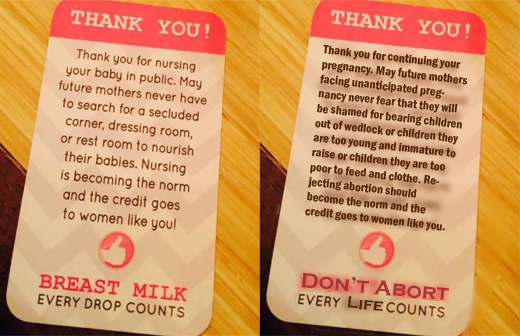
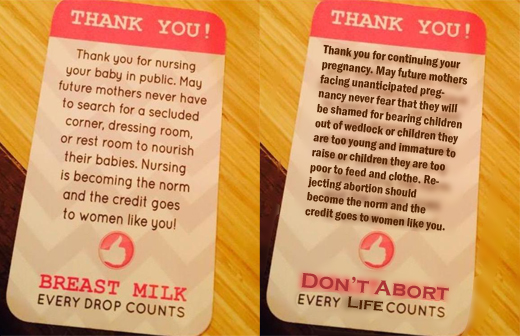
I used the following images to illustrate my point:

Every drop don't abort

On Twitter, journalist Tara Haelle commented on the image on the left. She promoted it as “normalizing” public breastfeeding and I’m confident that she is entirely sincere in that belief. But I see it as promoting breastfeeding as “best.”

As I explained, I suspect that many women would be offended by a group that felt itself entitled to comment on women’s pregnancies and whether or not they choose to continue them. The not-so-subtle hectoring at the bottom, “every life counts,” reflects the group’s religious beliefs and the belief that they are entitled to police pregnant women’s bodies.

The piece generated dozens of tweets, many of them furious that I had dared to equate “pro breastfeeding” with “pro life.” However, not a single person could explain what was wrong with the analogy beyond the fact that they found it unflattering to their cause. Haelle herself emphasized once again that she was only trying to “normalize” public breastfeeding.

[pullquote align=”right” color=”#f9a42f”]Normalization is the construction of an idealized norm of conduct and then rewarding or punishing individuals for conforming to or deviating from the ideal.[/pullquote]

But we shouldn’t be trying to “normalize” breastfeeding (public or private) in the first place.

Why not? Because “normalization” is just a fancy way to discriminate and shame.

Consider:

Uganda wants to “normalize” traditional sexuality, thereby marginalizing gay people.

Many residents of the Old South want to “normalize” the Confederate flag, sending sending subtle and not so subtle messages about race, slavery and citizenship.

Anti-choice advocates struggle to “normalize” continuing unwanted pregnancies because they oppose abortion.

Therefore:

When lactivists seek to “normalize” breastfeeding, they want to marginalize and shame formula feeders.

This harks back to the definition of “normalization.” As Wikipedia explains:

… The concept of normalization is found in the work of Michel Foucault … As Foucault used the term, normalization involved the construction of an idealized norm of conduct – for example, the way a proper soldier ideally should stand, march, present arms, and so on, as defined in minute detail – and then rewarding or punishing individuals for conforming to or deviating from this ideal. In Foucault’s account, normalization was one of an ensemble of tactics for exerting the maximum social control with the minimum expenditure of force …

Lactivists use the term normalization to construct an idealized norm of conduct – breastfeeding – and then rewarding or punishing individual women for conforming to or deviating from this ideal. Normalization is a tactic for exerting maximum social control with minimum effort.

Lactivists seek to make breastfeeding normative, meaning:

… an ideal standard of or model, or being based on what is considered to be the normal or correct way of doing something.

But in first world countries, where the benefits of breastfeeding are trivial, making breastfeeding normative means imposing some women’s norms on other women. It means telling women what they should be doing with their breasts, instead of leaving that decision to them.

Contrary to the claims of lactivists, women choose not to breastfeed or stop breastfeeding for a host of reasons that lactivists refuse to acknowledge: breastfeeding can be difficult, painful and inconvenient for mothers and it can lead to failure to thrive in some babies. It has nothing to do with formula marketing, nothing to do with lack of encouragement in hospitals, and nothing to do with lack of knowledge.

Simply put, women decide to not to breastfeed or to stop breastfeeding for intrinsic reasons, not extrinsic reasons. Normalizing breastfeeding makes as much sense as normalizing heterosexuality. There is not a gay person alive who isn’t aware that heterosexuality is normative and no marketing tactics or lack of education leads them to be gay. Similarly, there’s hardly an American woman alive who isn’t aware that breastfeeding is “best” and no marketing tactics or lack of education leads them to choose formula. It is extraordinarily demeaning to pretend otherwise.

When lactivists normalize breastfeeding, they are subtly and not so subtly sending the message that women who choose formula are abnormal. That’s what they intend to do.

There’s no reason for the rest of us to join them in their campaign of shame and intimidation.

What’s the difference between promoting breastfeeding and promoting continuing unwanted pregnancies? Nothing.

22448979_s

Promoting breastfeeding is about policing women’s bodies in the exact same way that promoting continuing unwanted pregnancies is about policing women’s bodies.

It is a sad fact of history that men have spent a tremendous amount of time policing women’s bodies. And an even sadder fact is that women have often been the prime enforcers in this effort.

Consider female virginity. From shaming to chastity belts to genital mutilation, society has considered a woman’s virginity a husband’s property. It is a practice designed by men, for men, to preserve men’s privileges, yet women were often willing enablers.

[pullquote align=”right” color=”#a3dfe9″]Under the guise of what’s best for babies, lactivists feel entitled to tell women how to use their breasts.[/pullquote]

You might think that the time of women as enforcers of policing other women’s bodies has passed. You’d be wrong. There are now entire movements devoted to policing women’s bodies: one of them is the anti-choice movement.

Another is the lactivist (breastfeeding advocacy) movement.

Consider:

Under the guise of what’s “best” for babies, anti-choice advocates feel entitled to tell other women how handle their pregnancies.

Under the guise of what’s “best” for babies, lactivists feel entitled to tell other women how to feed their infants.

Why do the same women who believe fervently that women have the right to control their own bodies, and that no one should be condemned for choosing abortion ignore the fact that women have the right to control their breasts and shame them for formula feeding?

Does the right to control one’s own body get expelled with the placenta? I don’t think so.

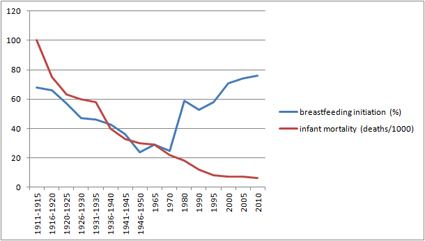
The benefits of breastfeeding are trivial as the chart below demonstrates.

breastfeeding and infant mortality

It’s a chart showing the impact of widely fluctuating breastfeeding initiation rates (70% dropping to 22% rising to 75%) in the last century on infant mortality. As you can see, breastfeeding has had no impact on the single most important measure of infant health.

Public health campaigns ought to be reserved for major public health risks and benefits. A public health campaign against smoking makes sense because lowering the smoking rate saves lots of lives. A public health campaign promoting vaccination makes sense because increasing vaccination rates saves lots of lives. A public health campaign to promote breastfeeding makes no sense because in first world countries the benefits are so small.

So why do we have public health campaigns to promote breastfeeding when the benefits are trivial?

Because there is an entire industry that makes money only when women breastfeed: the lactation consultant industry.

And because some women simply cannot mind their own business. Under the guise of what’s best for babies, they feel entitled to tell women how to use their breasts.

On Twitter, journalist Tara Haelle posted the image about breastfeeding on the left side. She promoted it as “normalizing” public breastfeeding and I’m confident that she is entirely sincere in that belief. But I don’t see that image as normalizing public breastfeeding; I see it as promoting breastfeeding as “best.”

Every drop don't abort

I created the image about pregnancy on the right to explain to Tara why I feel the way I do.

I suspect that many women would be offended by a group that felt itself entitled to comment on women’s pregnancies and whether or not they choose to continue them. The not-so-subtle hectoring at the bottom “every life counts” reflects the group’s religious beliefs and the belief that they are entitled to police pregnant women’s bodies.

I don’t think we would consider it “normalizing” pregnancy.

We should be equally offended by a group that feels itself entitled to comment on women’s infant feeding choices and how they are using their breasts. The not-so-subtle hectoring at the bottom that “every drop counts” reflects lactivists’ personal beliefs and the belief that they are entitled to police the bodies of new mothers.

What’s the difference between promoting breastfeeding as superior and promoting continuing unwanted pregnancies as superior to abortion?

Nothing that I can see.

Postpartum Oppression

image

We’ve all heard of postpartum depression, a form of clinical depression that occurs after childbirth. It is a serious medical issue and is probably precipitated by the wide fluctations in hormones after childbirth, compounded by lack of sleep and other features of mothering a newborn. Postpartum depression is a medical condition that requires medical attention.

There’s another phenomenon, far more widespread, causing misery to many more women. I suggest we call it postpartum oppression. Its cardinal symptom is a suffocating sense of inadequacy provoked by the guilt and shame of failing to meet the arbitrary guidelines of the dominant mothering ideologies, natural childbirth and attachment parenting.

Consider this recent piece featured on news.com.au, Modern mums are anxious, stressed about babies: new study:

…[R]esearch shows mothers are feeling ashamed, marginalised and guilty because they can’t meet the strict messages of breast feeding and sudden infant death campaigns.

They feel even more inadequate when told to use their maternal instinct to solve mothering issues when they are confused by conflicting information.

And they are battling to live up to an idealised image of how motherhood “should” be.

Furthermore:

)Over simplified public health messages that breast is best … overstate the risk of not doing this and can make mums feel anxious.

Public health campaigns, health professionals and others could reduce this anxiety by providing realistic, understandable, numerical information to assist decision making, they say.

“Nobody doubts that the message that promotes breast feeding is a good thing, but breastfeeding might not be easy to do and for some it is extremely difficult. Women who make an informed choice not to go ahead can be made to feel guilty and ashamed,” says Dr Rowe.

Women who decide to bottle feed can be discharged from hospital without any bottles, with no instructions on mixing formula, which can make them feel unsupported and marginalised, she says.

It’s not just pressure to breastfeed that leads to postpartum oppression; pressure to have an unmedicated vaginal birth, and irresponsible speculation on the purported dangers of C-sections are major contributing factors. These triggers for postpartum oppression share several characteristics:

  • They are arbitrary measures of motherhood formulated by privileged white women and reflecting their preferences and prejudices.
  • They grossly exaggerate the benefits of breastfeeding and vaginal birth and flat out lie about the purported benefits of unmedicated childbirth.
  • The condemnation of C-sections is based on hyperbole, hysteria and bad research on the purported dangers of C-sections.
  • A cadre of childbirth paraprofessionals, midwives, doulas, childbirth educators, and lactation consultants profit from these arbitrary standards.
  • They are profoundly anti-feminist, reducing mothering to the ways that women use their breasts, vaginas and uteri, and minimizing the much greater impact of maternal love, learning and character.

In contrast to postpartum depression, which occurs spontaneously and is to be regretted, postpartum oppression is deliberately inflicted by some women (generally Western, white and relatively privileged) on other women (including women of color and women of lower socio-economic classes.) Even though it is a woman-made problem, it is responsible for considerable suffering.

The primary mode of transmission of postpartum oppression is the internet.

Dr Rowe says mother anxiety was being made worse because of the internet which encouraged worried parents to try and find more information when much of it was not evidence based.

“The solution is to try and find a trusted source of information and limit yourself to that,” says Dr Rowe.

Health professionals and those in contact with mothers needed to unpack simplified public health messages and reassure and support mothers in the choices they made, she said.

They should address the inaccurate stereotype that mothering is instinctive, which can paint a highly idealised image of how motherhood ‘should’ be.

“Mothering is a set of learned skills and you learn on the job,” Dr Rowe says.

The deliberate infliction of postpartum oppression has created a crisis of confidence among new mothers and a pervasive sense of guilt and shame. It is a perversion of existing scientific evidence; an arbitrary standard foisted by privileged women on those less privileged; it enriches childbirth paraprofessionals at the expense of their patients, and it is profoundly anti-feminist, grounding successful mothering, as it does, in women’s reproductive organs and effectively ignoring everything else about them …

and it has got to stop!

On our anniversary, a love letter to my husband

image

Years ago, our daughter gave us a very fine compliment.

Discussing her day over dinner one night, she reported that her high school “Issues” class was studying marriage. The teacher had told the students that a successful marriage has three elements: friendship, intimacy and passion.

“That’s you guys,” she said, looking toward her father and me. “I raised my hand,” she continued, “because I had lots of examples to share.”

I was thrilled, both because of the compliment, and because she has been observing what her parents tried to teach to her and to her brothers. My first, greatest, and longest lasting joy in life is my husband.

My children, of course, are my heart. They are as much a part of me as an arm or leg. Their joys are my joys; their sorrows are my sorrows (generally multiplied by a factor of two) and their fears are my fears (generally multiplied by a factor of ten). But my husband is the source of most of the good things in my life, and has been for the 34 years we have been married, and even before.

As the “Issues” teacher said, the basis of a successful marriage is friendship. According to the late, great Ann Landers, “Love is friendship that has caught fire.” That is indeed what happened in our case. We met sophomore year of college as part of a large group living in the same dorm. When I started making my interest known, it was his fear for our valued friendship that made him hesitate. However, after throwing myself at him (there is no more glamorous way to describe it), I wore down his resistance.

Yet as our relationship grew, the friendship remained at the very core. He has been at my side through medical school, residency, work, the births of four children, the struggles we have shared with our children over their challenges, not to mention countless Little League games, Back-to-School nights, and dance recitals. Fifteen years ago when I stepped out of the MRI scanner and told him that I had brain tumor, his first words were, “I wish it were me.”

There is no one I would rather be with, talk to, read with, or watch football with. We are about a micron apart on the political spectrum, but have managed to have countless heated discussions about it, nonetheless.

Intimacy is also a vital quality for a successful marriage. I can share anything with my husband, including every fear and every embarrassment. He is always in my corner. I can also expect good advice. Although I’d like to tell you that he agrees with everything I do, the truth is a bit different. He’s not afraid to gently chide me, or counsel me to approach a situation differently. He’s a much nicer person than I am; in fact, he’s the nicest person I know, so that makes his advice and criticism easier to take.

There are additional components beyond the three that the “Issues” teacher discussed. Commitment and compromise are vital. A lifetime together involves a lot of momentous decisions, and the ability to compromise is necessary to smooth the way. For example, my husband thought he wanted two children, and I wanted four. So we compromised on four and he is very happy that we did.

That issue aside, there have been a lot of compromises: about careers, about work hours, about whose needs will be met when. If you can’t compromise, a marriage can be sunk. And when compromise seems very distant, commitment to the relationship, to making sure that everything works out, and to hanging on even when it seems like it might not, can tide you over to better times.

Everyone knows about the passion part of marriage. What I didn’t know 34 years ago was that the passion only increases. The boy I married because I liked, loved and was attracted to him is now the man who held my hand in labor, who tenderly nurtured our children, who supported me through my personal crises and who has become a respected and admired professional. I still like him, I certainly love him, and I am more attracted to him than ever, but even that does not adequately express the passion I feel for him more than 34 years after he captured my heart.

I am the luckiest woman alive, and I know it. He made all of my dreams come true, including the most the most important one. He showed me that true love is real.

The lyrics from the old standard, I Remember You,  convey my feelings best:

When my life is through,
And the angels ask me to recall
The thrill of them all.
I will tell them I remember you.


Adapted from a piece that first appeared in February 2009.

The unbearable obtuseness of being a Tim Hunt apologist

image

You cannot make this stuff up.

Hunt apologist Louise Mensch published a post on her blog Unfashionista entitled Royal Society’s ‘Diversity Committee’ Pre-Judged #TimHunt. Now UCL Should Give Him Due Process.

In an effort to defend Hunt’s indefensible comments about women in science, Mensch asks us to consider the impact of the outcry on …. his wife.

[pullquote align=”right” color=”#000000″]Who among Hunt’s apologists offered due process to Connie St. Louis before attempting to eviscerate her reputation? [/pullquote]

Imagine the scene: you are a distinguished female scientist, a Professor and an employee of the college you work for, University College, London. You have a blameless employment record and have served your employer – and its students – with distinction for many years.

Suddenly you receive a call from a senior representative of your employer, pressurizing you about the actions of your spouse – actions you have nothing to do with, and do not understand as yet, because he is unable to speak for himself, as he is traveling back home from the far side of the world.

Your employer’s representative gives you a message for your spouse; he must resign, or he will be sacked. Your employer places you in the middle of its workplace drama with somebody else, a drama which, as a female scientist, you had nothing to do.

What a terrible, stressful suggestion – from your place of work – pass on its threat of public humiliation, without due process, to your beloved husband, an old man of 72, whom they are not allowing to come home and speak to them first…

I’d call that sexist … bloody sexist.

Mensch gets an “A” for effort in twisting herself into a pretzel to defend Hunt. How dare anyone hold Hunt accountable for his misogynistic comments? It’s gender discrimation against his wife and it’s ageist since Hunt is an “old man.”

She also gets an “A” for obtuseness and chutzpah.

Consider this example:

Imagine the scene: you are a distinguished female journalist. a You have a blameless employment record and have served your employer – its students – with distinction for many years.

You attend a conference honoring women where a prominent male speaker makes misogynistic remarks. Like any journalist when presented with a story, you report it.

Suddenly you are subjected to a vicious campaign from apologists for misogynists, involving public abuse and destruction of your repuation.

Your abusers gives you a message; you must retract your comments or the abuse will continue.

Other women are also sent a message: prepare yourself for a vicious campaign of character assassination and abusive public comments if you dare to hold a prominent man to account by reporting on his misogynistic views. Your critics place you in the midst of a vitriolic campaign just because you, as a female journalist, dared to report what you had heard.

What a terrible, stressful situation.

That would be the situation in which the journalist Connie St. Louis finds herself. That’s gender discrimination, too, right? That seems never to have crossed Mensch’s mind.

The bulk of Mensch’s rambling, unfocused piece is devoted to her contention that Hunt did not receive due process.

On June 9th, before Sir Tim Hunt had been able to speak to his university, University College London, or any statement from him had been broadcast, three Professors – two with affiliations to UCL and one to the Royal Society were – without even speaking to Sir Tim – plotting to deprive him of his honours without due process of any kind. It is VERY IMPORTANT TO NOTE that they did so BEFORE his comments to Radio 4’s “Today” Show were broadcast.

Let’s leave aside for the moment that due process is a concept from American law and does not have an analog in British law. The idea that it is wrong to rush to judgment without knowing all the facts is certainly a worthy ideal. Which raises several important questions:

Why did Hunt’s apologists rush to defend him before they knew all the facts?

Why did Hunt’s defenders fabricate mitigating details about Hunt’s statements without checking the facts?

Who among Hunt’s apologists offered due process to Connie St. Louis before attempting to eviscerate her reputation? None, right?

What due process has been available prior to publicly heaping abuse on Hunt’s critics? None, right?

Both Mensch’s curious concern for due process for Tim Hunt but no one else and her absurd framing of this episode as gender discrimination against Hunt’s wife while turning a blind eye to the vicious misogyny directed at St. Louis and other Hunt critics is emblematic of the obtuseness of Hunt’s critics. Simply put, Hunt apologists would rather talk about anything else but Hunt’s inexcusable remarks.

What ever happened to taking responsibility for mistakes and accepting the consequences for those mistakes? Hunt made a serious mistake; why are his apologists straining to deny Hunt’s responsibilty and to reject accountability for misogyny?

The manufactured outrage of Mensch and other Hunt apologists is a de facto embrace of gender discrimination and no amount of obtuseness on their part conceals that regrettable fact.