All posts by Amy Tuteur, MD

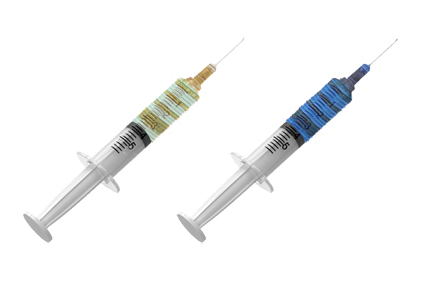
Is this vaccine white & gold or blue & black?

gold blue vaccines copy

By now every sentient being with access to the internet has seen #TheDress.

#TheDress is an optical illusion that relies on varying perceptions of different observers.

The fact that the brain is constantly constructing a model of what the world really looks like is also true for color vision. The fundamental challenge in the perception of color is to identify an object despite changing illumination conditions—how bright or dim the ambient lighting is. The mixture of wavelengths that reaches our eye will be interpreted by the brain as color, but which part is due to the reflectance of the object and which part is due to its surrounding illumination?

In other words, an individual’s perception of the color of the dress is influenced by his or her perception of the ambient light in the photograph. Those who see the dress as blue & black interpret the photo as overexposed, and their brains adjust the colors accordingly. Those who see the dress as white and gold, interpret the ambient light as natural light, and no color adjustment is made.

What can the dress teach us about pseudoscience in general and anti-vaccine advocacy in particular? Quite a bit as it turns out.

1. Context is critically important

Different people look at the same image and see different things, because they perceive the context differently. Those who assume the context is an overexposed photo conclude that the colors in the photo (white and gold) are washed out and adjust them accordingly; the white becomes blue and the gold becomes black. Those who see the context as a normally exposed photo conclude that the colors in the photo are true and no adjustment is made; the white remains white and the gold remains gold.

Context is important in vaccine safety, too.

For example, back in 2011, the pseudoscience blog Age of Autism breathlessly announced that there had been more miscarriage events associated with the HPV vaccine Gardasil than other vaccines. The folks at AofA concluded that Gardasil causes miscarriages and is therefore dangerous.

It’s hardly surprising that Gardasil, the ONLY vaccine given exclusively to women of reproductive age has more miscarriage EVENTS than other vaccines. Was anyone expecting that vaccines given to prepubertal children were going to be associated with miscarriages?

Moreover, the number of miscarriages in meaningless. The only meaningful measurement is the miscarriage RATE (the number of miscarriages divided by the number of pregnant women who received the Gardasil vaccine). And since the natural miscarriage rate is 20%, that number would need to be substantially higher than 20% to merit any concern that Gardasil leads to miscarriage. But of course the AofA article does not bother to calculate the miscarriage rate or to compare it to the natural miscarriage rate.

Anti-vax activists drew a false conclusion because they didn’t understand the context. A vaccine given to small children is never going to be followed by a miscarriage because small children don’t get pregnant. And a miscarriage that occurs after receiving a vaccine tells us nothing about whether the vaccine caused the miscarriage because 20% of women in early pregnancy routinely miscarry.

2. When important pieces of information are missing, the brain will attempt to fill in, sometimes with disastrous results.

The reason that different people see #TheDress as different colors is because the context cannot be determined from the photo itself. There is nothing else in the photo that can help us determine if it is properly exposed or over exposed. In contrast, if there were a zebra in the background of the picture and its colors appeared to be gold and white, we would know that the photo was dramatically over exposed and everyone’s brains would adjust the colors of the dress to blue and black. Because we can’t determine the context, some people’s brains make the erroneous assumption that the light in the photo is natural light and that dramatically affects their perceptions of the colors they see.

In the absence of knowledge of immunology, chemistry and statistics, many anti-vax advocates fill in the missing knowledge with erroneous assumptions. For example, when they heard that mercury was originally in vaccines, they assumed that mercury compounds are exactly the same as elemental mercury; since elemental mercury is dangerous, they assumed that mercury compounds in vaccines were dangerous, too. Had they known more basic chemistry, they would have recognized that elemental sodium is also dangerous (it can explode if it comes in contact with water), but is perfectly safe in the compound sodium chloride, table salt.

Moreover, most anti-vax advocates don’t understand that just because B follows A in time does NOT mean that B is caused by A. The fact that many children were diagnosed with autism in the months after receiving the MMR vaccine led anti-vax advocates to conclude that the MMR causes autism. But autism diagnoses are almost always made after a child learns to walk and that does not mean that walking causes autism.

The human brain likes stories with simple cause and effect and may create those stories when reality is far more complicated.

3. Reality exists independent of what you believe.

#TheDress is blue & black. It may look different to some observers when viewed in an over exposed photo, but the dress itself is still blue & black. Just because it seems to some parents that vaccines injured their children does not mean that any vaccine injury was sustained. Reality exists regardless of whether you perceive it correctly.

4. You can’t always rely on what you see.

This is the most important take away from the photo of #TheDress. You can’t accurately judge the color of the dress unless you know the context and if you don’t know the context, you should be wary of making assumptions about the context. Similarly you cannot judge the safety of vaccines unless you have a solid understanding of basic immunology, chemistry and statistics. You can make assumptions in the absence of that knowledge, but you are more likely to be wrong than to be correct.

Vaccines are one of the greatest public health advances of all time. They have saved tens, perhaps hundreds of millions of lives. They have hurt some children in the process, but the risk of being harmed by the disease is 1000X greater than the risk of being harmed by the vaccine designed to prevent the disease. It doesn’t matter if you perceive vaccines as dangerous. If you lack knowledge of basic immunology, chemistry and statistics, you lack the context to draw accurate conclusions about vaccine safety and your intuition is worthless. After looking at the photo, many people intuit #TheDress as white and gold, but they’re wrong. It’s blue and black; it was always blue and black; and it will always be blue and black no matter that some people cannot perceive the colors correctly.

Vaccines are safe; they were always safe; and they will continue to be safe no matter that some people cannot perceive their safety accurately.
Modern Alternative Mama’s flight from Facebook: the dawn of a new day for science on the internet

science chasing

The internet is the oxygen of contemporary pseudoscience movements.

Pseudoscience movements like anti-vaccine advocacy existed prior to the internet, of course but they were stunted, enfeebled shadows of what they later became. Why? Because prior to the internet, it was easy to tell the difference between science, which appeared in textbooks, journals and at professional conferences, and pseudoscience, which was transmitted by mimeographed newsletters shared among the true believers.

The internet allowed purveyors of pseudoscience, as well as charlatans and con men, to inexpensively create an image identical to that of actual science. Just about any internet tool that is available to those attempting to teach laypeople about science is equally available to those attempting to profit from pseudoscience. A layperson is hard pressed to tell the difference between the two. Moreover, widely available web services like Facebook allow for easy communication of pseudoscience between the true believers and the uninitiated. A shared post on Facebook looks the same to a layperson whether it came from a legitimate source or a pseudoscience clown.

That’s why Modern Alternative Mama’s announcement that she is fleeing from Facebook is a victory for science. Of course, just as Katie Tietje has spewed nonsense about vaccines, childbirth and anything else you can think of, she’s spewing nonsense about why she’s leaving Facebook. She claims it’s about privacy, in a post disingenuously titled If Privacy Matters to You, It’s Time to Leave Facebook but it’s really about the inability to hide from dissent on Facebook.

We all know that what we say on there in groups and on pages could be shared. Sure. We know if our profiles are public, then friends or even employers could look us up and see what we do with our time. It’s the internet, and it’s forever.

But.

Did you know that even if you are posting in a private or secret group, Facebook can read and even use that information? They can (and do) share it with marketing partners. And if you post a picture of your kids and set it to show to “close friends” only, Facebook owns that image and could use it in advertising. Without letting you know first — because you agreed to it when you signed up.

If anyone believes that’s why Katie is leaving Facebook, I have a bridge in Brooklyn that I’d like to sell you.

The real reason is this:

Discussing any controversial topic, especially vaccines (which I tend to do often) is fraught with landmines — namely, trolls, who like to bully and harass people who don’t believe what they believe. I try to avoid talking about them, because the general line of thought goes that if you ignore them they’ll go away. Here’s the thing: they won’t. It’s not about attention, it’s not even about me. It’s about their mental instability and need to bully those who aren’t like them, and no strategy (ignoring, retaliating, etc.) will ever make them stop.

I know plenty of you are fed up with that, too. You just want a safe space, like it used to be, to ask questions about natural living and connect with like-minded parents. (emphasis in the original).

Ever notice how pseudoscience cranks like Katie, and others (Gina Crossly-Corcoran immediately springs to mind) behave like men’s rights activists who scream “discrimination” whenever they are called to account on their abusive tactics, or racists who scream “racism against white people” whenever they are called to account about their prejudice, Katie, and her ilk scream “trolls, bullies” whenever any dares to point out that their nonsense is contradicted by science.

As in politics, so it is in science: sunlight is the best disinfectant. Katie Tietje’s beliefs are like ice cubes; they can’t withstand the glare of the truth. So Katie needs to find someplace dark and private, and most importantly, needs to be able to ban any hint of actual scientific evidence, because otherwise her nonsense will be eviscerated.

Poor Katie just wanted a “safe space” where she could transmit her nonsense free from anyone’s attempt to interject actual science.

Now, there is such a place.

It’s called MeWe, and it’s a new social media site. They take privacy seriously — you own all your content, not them. They also don’t allow bullying, trolling, or harassment. They won’t allow people to target pages or groups and be nasty to them. They won’t allow them to start hate groups. And every group can choose their privacy settings, so that they have to approve all new members before they join (which keeps trolls out, if you screen members carefully). Plus, if someone is nasty, you can ban them — and they actually stay banned.

This creates a safe space for like-minded people who just want to have a real discussion about all things natural living. One of the main guys over at MeWe is actually a “natural dad” himself, and I’ve spoken to him about some of this — it’s for real. It’s not going to end up like Facebook. (emphasis in the original)

Right, it’s not going to end up like Facebook; it’s going to end up bankrupt.

Because of Facebook’s blatant violation of privacy and obvious censorship of natural communities, I’m moving my operations over to MeWe.

It’s going to take a few weeks to actually get the word out to everyone, and help everyone get set up over at MeWe. We are screening members because we want a solid, positive community. But after awhile, I’ll delete my presence on Facebook. I just can’t be a part of that business anymore. I disagree too strongly with what they are doing.

Awesome! Katie can slink off under a virtual rock where only the faithful who affirmatively choose to subject themselves to her nonsense will be able to hear her.

But if you think she’s permanently retiring from Facebook, think again. She’ll be back because she wants to proselytize; that’s why she joined Facebook in the first place. Over at MeWe she might as well not exist. Only the choir will follow her there and what fun is that?

I’m not the only blogger to do this. Many of my natural-living colleagues are jumping ship and heading over to MeWe, too. See, they care as much about privacy as I do, and the ability to reach their fans without censorship.

Way to go, Katie! Take all the other “natural living clowns” who “care about privacy” with you when you go, and the internet will be a better place.

Careful, don’t let the door hit you on the way out.

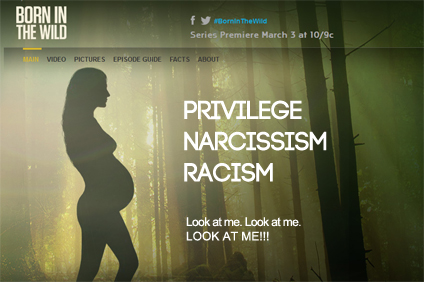
Lifetime’s Born in the Wild: an affront to countless women whose babies are born (and die) in the wild

Privilege narcissism racism

Outdoor homebirth is about to get a reality TV show. It’s a marriage made in heaven!

Homebirth advocates are narcissists and reality TV is made for narcissists who are so desperate for attention that they are willing to be ridiculed and/or humiliated on TV.

The only surprise is that it took this long.

Homebirth advocates like to pretend to themselves and others that this is how birth happens in nature (no, across all times, places and culture, birth was not outdoors and not attended by men), that birth is so deeply personal and “sexual” that a couple must experience it alone (really, then why are you broadcasting it for all the world to see?) and that it is safe. The entire practice would be nothing more than a punch line were it not for the fact that homebirth kills babies, increasing the risk of death anywhere from 3-9X higher than comparable risk hospital birth.

Homebirth is an affectation of the privileged and is also, in its own self-absorbed, narcissistic way, startlingly racist and classist. Homebirth advocates like to imagine that women in nature, particularly women of color, did not fear childbirth, simply squatted down by the Congo River to give birth, and immediately returned to their fabulously healthy paleo lifestyle.

It is an affectation of the privileged because you have to have easy access to hospital birth in order to give meaning to refusing it.

It is racist and classist because the producers of Born in the Wild could have gone to a myriad of destinations including parts of Africa and South East Asia to see what birth in the wild REALLY looks like. But those women are black and brown, and fear childbirth because they die in agony and in droves. Instead they filmed privileged white women in the faux “wild” complete with a medical team stage left, as well as a detailed transfer plan and hospitals on notice.

According to the World Bank, the life time risk of maternal death is the probability that a 15-year-old female will die eventually from a pregnancy related cause. In the US where modern obstetrics is available the risk of death due to pregnancy and childbirth over a lifetime is 1 in 1800. In contrast, a teenager in Cameroon has a 1 in 34 chance of dying of a pregnancy related cause over her lifetime and women in Chad have a 1 in 15 chance of dying.

You can bet that those women aren’t crowing about the virtues of birth in the wild.

Consider this rural Indian woman who braved a raging river in her 9th month of pregnancy in order to give birth in a hospital:

Yellavva used dried pumpkins and gourds as bouyancy aids to swim nearly a kilometre from her river island village to safety in southern Karnataka state.

She … wanted her baby born safely – there is no medical centre in her village and she did not want to give birth at home…

When Yellavva crossed the river last Wednesday, she says its swirling waters were rising 12 to 14 feet and even experienced swimmers would have hesitated to get into the water at the time.

“I was scared. But it was for my child that I got the determination to get over all my fear and cross the rising river waters,” she told BBC Hindi.

Yellavva was helped by her father, brother and cousins who swam with her.

“My brother went in front. I was next. My brother and cousins had tied dried hollowed pumpkin and bottle gourds around me so I was afloat,” she said.

Her brother Lakshman, who held on to the rope tied to the gourds and pumpkins, said: “My father was right behind her. Normally, the distance is a little more than half a kilometre. But, it took us about an hour to get her across. As we reached mid-point, the current was very very strong.”

The heavy current pushed them far downstream, making the distance they swam nearly one kilometre.

Birth in the wild (the real wild, not the made up fantasy of the TV show) is so deadly to babies that this desperate women risked her life, and her family risked their lives to give one baby the best chance of survival.

In contrast, Born in the Wild tells the stories of privileged, well off narcissists who RISK their babies’ lives for bragging rights and a chance to appear on TV. Born in the Wild is a racist, classist slap in the face, to the millions of women who have no choice but to give birth in the wild, and face the astronomical neonatal and maternal mortality that entails.

Born in the Wild is nothing more than an ugly and dangerous stunt.

Perfect for reality TV!


Parts of this piece first appeared in June 2014.

Henci Goer arrives to rescue the homebirth sheeple!

sheep in spring

You could practically hear the collective sigh of relief from the homebirth world.

The NYTimes solicited the medical opinions of 4 obstetricians to explain the increased risk of death at homebirth. But look, up in the sky, it’s Superbirther; faster than a snake in the grass, more powerful than an actual education, able to ignore mountains of scientific evidence in a single bound.

Henci Goer has arrived to give homebirth advocates permission to ignore actual scientific experts in favor of … herself!

The message of the obstetricians was clear and consistent:

Drs. Grunebaum and Chervenak: “In the United States, those who support home birth as safe are propagating junk science.”

Dr. Caughey: “Even in Europe, the fetal and neonatal risks are higher with home birth.”

Dr. Jennings: “The ability of a physician to rapidly provide care can be the difference between life or death for both mother and baby.”

Now Henci Goer “fact checks” the New York Times homebirth debate, and the sheeple in the homebirth community rush to embrace it. There is no independent thinking in the homebirth community; there are only celebrity homebirth advocates who spew nonsense and credulous homebirth advocates who lap it up.

Who is Henci Goer and what are her qualifications to critique Drs. Grunebaum, Chervenak, Caughey, and Jennings?

Actually she has no expert qualifications. As she herself has written:

You may be wondering about my credentials … since I am not a doctor — either M.D. or Ph.D — a midwife, or a nurse. I am a certified childbirth educator with a degree in biology from Brandeis University. Beyond that, I am self-taught.

So Henci Goer is not a medical professional and has no experience in the field of obstetrics. That, in itself is not a complete bar to understanding the obstetric literature if it is replaced by a PhD in a hard science or statistics. But, Goer doesn’t have those qualifications, either. In other words, Goer is a teacher of childbirth classes who reads the scientific papers that she likes, but has no independent way of assessing the full depth and breadth of the obstetric literature.

In response to a someone questioning the basis for her self-described expertise, Goer offered this cringe worthy response:

… I have a library of books and a collection of several thousand papers, including books and papers on how to analyze and interpret medical research; and I have been writing and speaking about what the consensus of maternity care research establishes as best promoting safe, healthy birth for over 20 years. That being said, my preeminent credential is illustrated by this anecdote: Penny Simkin was once called on the carpet by an anesthesiologist, irate that she had written a handout listing the potential trade-offs of epidural anesthesia when she was not a doctor (although he did not dispute her accuracy). “What are your credentials?” he demanded. “I can read,” she mildly replied. So can I.

Curiously, though Goer presents herself as an “expert” on the obstetric literature, no real experts agree with her grandiose self-description. She is not called for expert testimony in court cases that turn on the obstetric literature. The government does not invite her to join expert panels on obstetric topics. In fact, the only people who consider Goer an “expert” on the obstetric literature are lay people who have no way to evaluate her self-proclaimed expertise.

Ms. Goer never appears in any venue where she can actually be questioned on her supposed expertise. She knows that her claims would be eviscerated in short order. She just continues to spread misinformation by flattering homebirth sheeple into believing that accepting her nonsense means that they are “thinking.”

I am surprised by this piece, however. In the past, Goer has carefully avoided basing her claims on indefensible propaganda, but this time she goes all in, quoting a comment by the American College of Nurse Midwives and the MANA “study” on their own dismal homebirth death rate that she surely knows is an amalgamation of mistruths, half truths and outright lies. I view this as a sign of her increasing desperation. She knows that the evidence on the increased perinatal/neonatal death rate at homebirth is remarkably robust, has been repeatedly reproduced (including by Judith Rooks, CNM MPH in Oregon showing that PLANNED homebirth with a LICENSED homebirth midwife has a death rate 800% higher than comparable risk hospital birth), and is reflected by a growing number of homebirth deaths in the news. There was a time when her critiques were plausible, even if they were wrong. Now she’s been reduced to relying on drivel produced by her allies, most of whom are poorly educated laypeople such as herself.

But, of course, this has never been about the truth; this is about obscuring the truth.

Goer is painfully honest about her intentions:

Hopefully, I’ve helped to provide a defense for those who may find themselves under attack as a result of the NY Times article.

Because that’s what’s at stake for her and her colleagues, defending themselves and their profits from scientific evidence and expert opinion. Henci Goer makes her livelihood by promoting homebirth; she literally cannot afford to acknowledge the truth of the scientific evidence. The babies who die as a result of homebirth are apparently acceptable casualties of homebirth advocates’ strenuous efforts to protect their incomes.

Would you take obstetrics advice from an attorney? Me, neither.

iStock_000031387378Small

A friend sent me a link to a new blog post on Fearless Parenting.

Once I stopped laughing after reading it, I was struck by the fact that, as is often the case, no sooner do I write a post then a homebirth advocate rushes to illustrate it. Yesterday I wrote about 10 things that homebirth and anti-vaccine advocacy have in common and immediately Attorney Valerie Borek steps up to prove my points. It’s almost as if she read my piece!

Borek, a member of the Birth Rights Bar, would like you to know why she chose homebirth (Top Ten Reasons Why This Attorney Chose a Home Birth).

What are Borek’s qualifications to write this piece? According to her LinkedIn profile, her skills include:

  • Wills
  • Legal Writing
  • Legal Research
  • Litigation
  • Research
  • Trials
  • Estate Planning
  • Bankruptcy
  • Personal Injury

Do you see obstetrics anywhere in there? Me, neither.

But homebirth advocates imagine that having a baby makes them experts on childbirth … kind of like the fact that I filed a lawsuit makes me qualified to be a lawyer. Oh, wait, it doesn’t.

Borek disingenuously claims:

So this post isn’t a debate about safety. It’s a declaration of liberty and freedom of choice. (links and strike-through in the original)

Borek sprinkles her piece with citations, proving that homebirth advocates love bibliography salad of cherry picked and misleading citations. (it’s almost as if she read my piece!!) Moreover, she cites Midwifery Today, an immediate signal of extreme gullibility.

What are her reasons?

1. She wanted to be sure she would know who would be at the baby’s birth.

So did lots of homebirth mothers whose midwives didn’t show up in time or didn’t show up at all. The idea that your homebirth midwives will be there to catch your baby is one of the many myths of homebirth advocacy.

2. Pregnancy is not a disease.

Neither is a gunshot wound but that’s cared for in a hospital, too, Ms. Borek. What’s your point?

3. She is capable of maximizing the health of her baby!

That would be the magical thinking I noted yesterday. (It’s almost as if she read my piece!!)

4. Money

Ms. Borek, having a homebirth to save money is like defending your capital murder charge pro se. It is foolish in the extreme and dramatically increases the risk that someone is going to end up dead.

5. “My Man Doesn’t Belong in the Waiting Room… It was such a joy to have him attend appointments with the midwife.”

Maybe you should have a seat, Ms. Borek, because I have news that will leave you stupified: husbands attend obstetricians appointments, too.

6. She wanted to be heard.

An obstetrician would have heard her loud and clear, so that was not the problem. She wanted to be validated and petted, told that she was educated, empowered and a warrior mama. Only a homebirth midwife would do that.

7. She wanted to feel the pain because she credulously believed the made up crap about hormones, pain relief and bonding.

Clearly she received her information from echo chamber websites that delete non-conforming scientific data and ban commentors with actual expertise.

8. “I Assume My Baby Wouldn’t Like the Polar Plunge.”

I bet her baby wouldn’t have liked suffocating to death, either, but she seems to have had no problem exposing her/him to that much more serious risk. In addition, Borek believes that peace on earth begins with birth. Certainly worked that way for Hitler, Torquemada, Henry VIII, and Attila the Hun, right?

9. “A Momma Is Being Born Too.”

And that doesn’t happen in the hospital?

10. “Because I Can.”

That would be the libertarian streak that invokes rights and ignores responsibilities that I wrote about yesterday. (It’s almost as if she read my piece!!)

All that to say that Ms. Borek chose homebirth for the same reasons that most homebirth advocates do so; she knows nothing about obstetrics, believes nonsense made up by homebirth midwives and other laypeople, is impressed by the sloganeering that manages to be simultaneously inane and meaningless (“Pregnancy is not a disease.”), and was clueless that she was putting her baby at substantially increased risk of death.

She had every right to do so, but that doesn’t change the fact that she risked her baby’s life even more than if she had driven around with her baby unbuckled in the back seatof her car. The fact that the baby survived is due to luck, not magical thinking, and certainly not an accurate assessment of the risks.

Let me see if I can come up with an analogy that Ms. Borek might understand:

Ms. Borek, would you take legal advice (sprinkled with citations from outdated, irrelevant and reversed legal cases) from an obstetrician?

Me, neither

10 things that homebirth and anti-vaccine advocacy have in common

Naked Muscular Man Covering with a Box Isolated on White

At the end of their piece in yesterday’s NYTimes Room for Debate feature on homebirth, Drs. Grunebaum and Chervenak make a particularly apt comparison:

We are now seeing the damage done to children from the propagation of junk science about vaccines. It is imperative we, as a society, do not make the same mistake when it comes to birth.

With the advent of the recent Disneyland measles outbreak, it has become painfully apparent that the anti-vax position is and has always been spectacularly wrong.

The Disneyland measles outbreak was not the first incidence of the resurgence of vaccine preventable diseases; multiple children (generally infants) have been sickened, hospitalized and have died since pertussis (whooping cough) has come roaring back. But for some indefinable reason, the Disneyland measles outbreak became the tipping point. Similarly, literally dozens of babies are dying preventable deaths at homebirth each year, but though we are approaching a tipping point (as indicated by the framing of the NYTimes’ question Is Homebirth Ever a Safe Choice?) we probably won’t reached it until a prominent celebrity’s baby dies at homebirth.

Homebirth and anti-vaccine advocacy are ideological twins.

Indeed, it is rather startling to consider what homebirth and anti-vaccine advocacy have in common:

1. Both are based on pseudoscience

Both homebirth and anti-vax advocacy rely on ignoring, twisting or confounding the existing science. Advocates present bibliography salads of cherry picked and misleading citations written by discredited authors or subsequently reversed or retracted.

2. Both ignore the consensus of experts

Vaccination is promoted by nearly all the immunologists, pediatricians and public health officials around the world, yet anti-vax activists imagine they know better than the experts. American hospital birth has been declared safest by obstetricians, neonatologists and pediatricians, but homebirth advocates imagine they know better than the experts.

3. Both are based on the belief that “if I haven’t seen it, it doesn’t exist”

Anti-vax advocates pretended to themselves and others that there was no reason to worry about vaccine preventable diseases since they were so rare, never acknowledging (or possibly even realizing) that they were rare BECAUSE OF vaccines, not in spite of them. Similarly, homebirth advocates pretend to themselves and others that childbirth complications are both rare and easily foreseen in time for hospital transfer, never acknowledging (or possibly even realizing) that they seem rare BECAUSE OF obstetricians and hospitals, not in spite of them.

4. Both are propagated through echo chamber websites that delete non-conforming scientific data and ban commentors with actual expertise

This is a hallmark of pseudoscience. For both anti-vax and homebirth advocacy, a truly educated consumer is their worst customer, so intense efforts are made to to delete scientific evidence and ban commentors who might raise suspicions about the validity of anti-vax and homebirth claims. Advocates are spoon fed what they are supposed to believe and they can’t be allowed to question what they’ve been fed.

5. Both rely heavily on conspiracy theories.

According to anti-vax advocates, we’re supposed to believe that vaccines are a massive world wide conspiracy involving nearly every immunologist, pediatrician and public health official. Indeed immunologists, pediatricians and public health officials are so devoted to maintaining the conspiracy that they actually give their own children vaccines despite the fact that they secretly know that vaccines are useless and dangerous. Similarly, according to homebirth advocates, we’re supposed to believe that modern obstetrics is nothing more than an economic conspiracy to deprive midwives of their livelihood, and to cause childbirth complications so that obstetricians can pretend to be heroes.

6. Both rely on magical thinking, the belief that thoughts can control events

No one conveys that reliance on magical thinking better than homebirth advocates who declare (with straight faces, no less) that the safest place to give birth is where the mother feels safest.

7.Both believe the mystical power of food to ward off disease and complications

Both actually believe, with absolutely no scientific evidence, that eating “right,” and taking supplements and herbs can ward off both vaccine preventable illnesses and childbirth complications. The highest mystical power, however, is reserved for breastmilk, which apparently can do everything from preventing pertussis and measles (it can’t) to treating eye and ear infections by squirting it into eyes and ears.

8.Both have a libertarian streak that invokes rights and ignores responsibilities

The battle cry of anti-vaxxers and homebirth advocates it, “I don’t want to and you can’t make me.” Preventing the illness and death of others is irrelevant in this libertarian conception of citizenship.

9. Both are about parental ego

Both anti-vax and homebirth are forms of parental tribalism where parents distinguish themselves from other parents whom they deride as “sheeple.” Both are concerned with parental “empowerment,” not science. Anti-vax is not about vaccines and not about children; it’s about the need for some parents to view themselves as special, smarter and savvier than all the rest. Homebirth is not about birth and certainly not about babies; it’s about the need for some mothers to view themselves as special, smarter and savvier than the all the rest.

10. Both harm or kill children, not the adults making the choice

Not coincidentally, the greatest risk of harm of these adult choices devolves on innocent children who probably would have made different choices (to preserve their own lives) had they been given the opportunity.

It took years, and dozens of preventable deaths, as well as hundreds preventable illnesses and hospitalizations to finally reach mainstream recognition that anti-vax advocacy is dangerous pseudoscience. How many years, and how many preventable deaths will it take for mainstream recognition that homebirth is the ideological twin of anti-vax, based on faulty science and every bit as deadly?

NYTimes asks: Homebirth is never safest, but can it be safe enough?

Image converted using ifftoany

Hallelujah!

I knew that it was only a matter of time, but sometimes it seemed as if it would take forever for the mainstream media to absorb the scientific evidence that has been around for decades: homebirth results in the deaths of babies who didn’t have to die.

The NYTimes, in its Room for Debate feature, acknowledges this increased risk in today’s featured question: Is Home Birth Ever a Safe Choice? The participants in the debate include Drs. Amos Grunebaum, Frank Chervenak and Aaron Caughey, as well ACOG representative Dr. John Jennings, Tekoa King, CNM and Marinah Valenzuela Farrell, CPM.

The pull quotes say it all.

Drs. Grunebaum and Chervenak: “In the United States, those who support home birth as safe are propagating junk science.”

Dr. Caughey: “Even in Europe, the fetal and neonatal risks are higher with home birth.”

Dr. Jennings: “The ability of a physician to rapidly provide care can be the difference between life or death for both mother and baby.”

In other words, homebirth leads to the preventable death of babies.

How do King and Farrell respond?

Tekoa King, CNM: “In Britain, women are actually advised to have children at home or in a birth center, rather than a hospital, when the pregnancy is low-risk.”

Marinah Valenzuela Farrell, CPM: “Certified professional midwives and certified nurse midwives should be licensed to practice independently in all 50 states.”

The contrast is striking. The obstetricians are concerned with babies’ lives; the midwives are concerned with money.

Here’s how I’d answer the question “is homebirth ever a safe choice?

Homebirth is NEVER the safest choice, so women contemplating homebirth need to ask themselves what risk to the baby’s life is acceptable to them.

The risk of death of a baby at homebirth is far higher than the risk of death of a baby in a car accident, so an appropriate analogy would be to ask “Is failing to buckle your infant into a carseat ever a safe choice?” The answer, of course is that it is never the safest choice, but apparently some parents believe that it is safe enough.

For me, personally the risk of not buckling a baby into a carseat, though tiny, it still too high. The risk of death of a baby at homebirth, which is much higher, is obviously completely unacceptable to me, but other women may feel differently.

Women have a right to make that choice for themselves provided that the choice is an INFORMED choice. That means understanding what homebirth midwives like King and Farrell were forced to acknowledge: homebirth increases the risk of death. Midwives who tell you otherwise are repeating the lies propagated by celebrity homebirth advocates and purveyors of junk science like the Midwives Alliance of North America (MANA), the organization that represents homebirth midwives. Their own data shows that homebirth increases the risk of death by 450%.

Most obstetricians believe that no increased risk to the baby is ever justified.

Most homebirth midwives believe that increasing THEIR income is an acceptable reason to risk the life of YOUR baby.

The obstetricians follow the Hippocratic injunction, Primum non nocere, first do no harm.

The midwives follow their own injunction, the experience of homebirth justifies putting babies at risk of death.

It may be ugly, but at least it’s honest.

What breastfeeding and the failed cholesterol recommendations have in common: weak science

weak

Oops! Their bad.

Remember how the government said fat and cholesterol were dangerous to your health? Never mind.

As Nina Teicholz explains in an NYTimes Op-Ed (The Government’s Bad Diet Advice):

For two generations, Americans ate fewer eggs and other animal products because policy makers told them that fat and cholesterol were bad for their health. Now both dogmas have been debunked in quick succession.

First, last fall, experts on the committee that develops the country’s dietary guidelines acknowledged that they had ditched the low-fat diet. On Thursday, that committee’s report was released, with an even bigger change: It lifted the longstanding caps on dietary cholesterol, saying there was “no appreciable relationship” between dietary cholesterol and blood cholesterol. Americans, it seems, had needlessly been avoiding egg yolks, liver and shellfish for decades. The new guidelines, the first to be issued in five years, will influence everything from school lunches to doctors’ dieting advice.

She asks the obvious question: how did experts go so wrong?

The answer is that the government placed too much reliance on population based studies:

But even the most rigorous epidemiological studies suffer from a fundamental limitation. At best they can show only association, not causation. Epidemiological data can be used to suggest hypotheses but not to prove them.

Instead of accepting that this evidence was inadequate to give sound advice, strong-willed scientists overstated the significance of their studies.

Aaron Carroll addresses the same issue in today’s Upshot column in the NY Times:

For decades, many dietary recommendations have revolved around consuming a low percentage of your daily calories from fat. It has been widely thought that doing so would reduce your chance of having coronary heart disease. Most of the evidence for that recommendation has come from epidemiologic studies, which can be flawed.

Use of these types of studies happens far more often than we would like, leading to dietary guidelines that may not be based on the best available evidence.

And although we have finally learned the error of our ways regarding fat and cholesterol, we are aggressively making the same mistake when it comes to the diet of infants.

The evidence on which breastfeeding recommendations are based is no better than that on which the cholesterol recommendations were based.

The science is extremely weak, contradictory and plagued by confounding variables. Despite this, we are promoting breastfeeding as every bit as important to good health and long life as limiting dietary cholesterol and fat. Indeed, we are going farther, with government attempts to cajole and shame women who choose to formula feed, and dangerous hospital policies like the oxymoronic Baby Friendly Hospital Initiative which, in direct defiance of everything we know about babies suffocating and falling out of hospital beds, promotes 24 hour rooming in of infants, giving exhausted, potentially sedated new mothers little choice but to keep their babies in bed with them.

There were many scientists and physicians who questioned the dietary fat and cholesterol guidelines over the past decades, arguing that the scientific evidence simply did not justify sweeping dietary recommendations, but their voices were drowned out by those who insisted that we could improve the health of the American public by telling them what to eat. Everyone “knew” restricting fat and cholesterol was good for you, and scientific evidence that didn’t comport with what everyone “knew” was ignored.

The exact same thing is happening at this very moment with breastfeeding recommendations. Everyone “knows” that breastfeeding makes children smarter, healthier, thinner, less likely to developed the chronic diseases of old age. Except that’s NOT what the scientific evidence shows. The scientific evidence shows that for full term infants in first world countries, the ONLY health benefits are a minor reduction in incidence of colds and diarrheal illness in the first year of life. That it.

As Carroll notes:

It is frustrating enough when we over-read the results of epidemiologic studies and make the mistake of believing that correlation is the same as causation… In reviewing the literature, it’s hard to come away with a sense that anyone knows for sure what diet should be recommended to all Americans.

I understand people’s frustration at the continuing shifts in nutrition recommendations. For decades, they’ve been told what to eat because “science says so.” Unfortunately, that doesn’t appear to be true. That’s disappointing not only because it reduces people’s faith in science as a whole, but also because it may have cost some people better health, or potentially even their lives.

He’s right.

We’ve made a terrible mistake with dietary recommendations promoting low fat and low cholesterol diets; we went far ahead of what the science showed and we ignored any science that did not support what we “knew”.

We’re making the exact same mistake by promoting breastfeeding recommendations based on weak science.

If we learn anything from the fiasco on fat and cholesterol recommendations it should be this:

Our recommendations on breastfeeding should reflect what the scientific evidence actually shows, not what we think we “know.”

These 3 graphs will make you question everything you’ve been told about breastfeeding

image

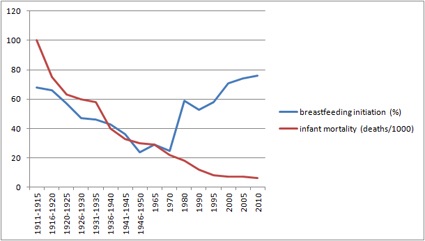
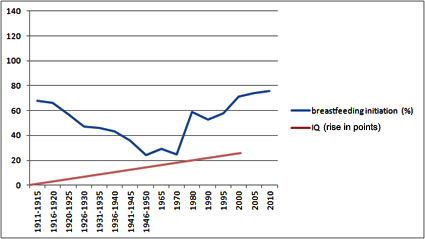
Below you will find the truth about infant formula and its impact on infant mortality, life expectancy and IQ as breastfeeding initiation fell from nearly 70% om 1910 to only 25-30% from the late 1940’s to the early 1970’s and rose again to over 75% in recent years:

image

image

breastfeeding and IQ

As you can see, despite claims of spectacular theoretical benefits, in practice breastfeeding had no impact on infant mortality, life expectancy or IQ.

The next time anyone chastises you or attempts to make you feel guilty about formula feeding, show them this. And the next time you are inclined to beat yourself up about not breastfeeding, take a long look: in first world countries, the benefits of breastfeeding are trivial. Infant formula is an excellent, nutritious food source that provides a strong foundation for health, IQ and long life.


References:

Achievements in Public Health, 1900-1999: Healthier Mothers and Babies, MMWR October 01, 1999, 48(38);849-858.

Life expectancy in the United States. Shrestha, Laura B. Congressional Information Service, Library of Congress, 2005.

The Resurgence of Breastfeeding at the End of the Second Millennium, Wright A, Schanler R, J. Nutr. February 1, 2001 vol. 131 no. 2 421S-425S.

Trends and differentials in breast feeding: an update. Hirschman C, Butler M. Demography. 1981 Feb;18(1):39-54.

Lactivist desperation to prove superiority reminds me of eugenics

BB0.tif

If there’s one thing that proponents are absolutely sure of it is that they are superior. That belief is enhanced by the accompanying conviction that science will demonstrate their superiority.

No, I’m not talking about eugenicists, though I could be. I’m talking about the contemporary lactivist movement. Every time I write about blog post about the incontrovertible fact that infant formula is an excellent, nutritionally complete way to feed a baby, lactivists swoop in like a murder of crows, all cawing loudly, “The Science! The Science!”

Lactivists bear an uncomfortable resemblance to eugenicists, not because they are racists, but because of the way they categorize the world into us vs. them. Moreover, like eugenicists, they abuse science in the service of their unscientific beliefs.

Consider:

1. Both start with a conclusion and then search for proof.

Eugenecists claim that it is self-evident that the white “race” is superior. Their “science” is an attempt to prove that superiority and to quantify it. There is absolutely no possibility that their research efforts will ever conclude that all men (and women) are created equal.

As Prof. Elof Carlson explains:

The eugenics movement arose in the 20th century as two wings of a common philosophy of human worth. Francis Galton, who coined the term eugenics in 1883, perceived it as a moral philosophy to improve humanity by encouraging the ablest and healthiest people to have more children. The Galtonian ideal of eugenics is usually termed positive eugenics. Negative eugenics, on the other hand, advocated culling the least able from the breeding population to preserve humanity’s fitness. The eugenics movements in the United States, Germany, and Scandinavia favored the negative approach.

Grantly Dick-Read, the father of the natural childbirth movement, was deeply influenced by the positive eugenics movement, and made his claims in an effort to convince white women of the “better” classes to have more children. In contrast, American eugenicists were more concerned with using “science” to justify discrimination against other racial and ethnic groups.

Beginning in the 1900s, scientists began to develop different methods for measuring intelligence. These tests were used often to justify racial and ethnic discrimination. The results of these intelligence tests were influential in shaping U.S. immigration policy that limited immigrants from Southern and Eastern Europe, and in justifying race-based segregation in public education, and U.S. conscription during World War I. Previously, the scientific debate centered largely on perceived differences in racial intelligence based on cranial size.

Similarly, lactivists claim that it is self-evident that breastfeeding is superior to formula feeding. Their “science” is a surprisingly desperate attempt to prove that purported superiority. It makes children smarter! It prevents obesity! The microbiome! Epigenetics! There is absolutely no possibility that their analysis of the data will EVER conclude that there is no measurable difference between breastfed babies and formula fed babies, let alone concluding that formula feeding leads to smarter, healthier children.

2. Both feel the need to discriminate.

Eugenicists refuse to accept any of that namby-pamby claptrap about equality. It is critically important to locate themselves within some group that is better than other groups.

Despite the fact that breastfeeding is a practice that affects only your own child, lactivists care deeply whether other women are breastfeeding or formula feeding. Why? Because it is critically important for them to locate themselves within a group of mothers who are better than other mothers; they insist that their children are superior to other women’s children.

3. They are desperate for scientific confirmation of their deeply held beliefs, so they can turn around and use “the science” as a cudgel to beat those who don’t agree.

Eugenicists used and misuse science to support supposedly “morally neutral” race based discrimination.

This is akin to the phenomenon that sociologist Charlotte Faircloth explains in ‘What Science Says is Best’: Parenting Practices, Scientific Authority and Maternal Identity.

Arguably, ‘science’ here is not about understanding, but belief. The use of ‘evidence’ has reached the level of the quasi-religious; … they are held to be beyond the possibility of doubt and revered as truth…

When ‘science’ says something is healthiest for infants, it has the effect, for [lactivists], of shutting down debate; that is, it dictates what parents should do.

Lactivists use and misuse science to support supposedly “morally neutral” claims of superiority. The truth is the opposite; shouting, “The Science!” is a way to moralize a personal choice that has no impact beyond the individuals and families of the person making that choice.

For lactivists, appeals to “the science” are a rhetorical strategy, and a rather cynical one at that. Many of very same people who often ignore the scientific evidence on the dangers of homebirth, who openly spurn the World Health Organization recommendations on vaccination, and who dismiss the scientific evidence on circumcision by insisting it is only relevant in the developing world choose to misinterpret and misuse the scientific evidence on the limited benefits of breastfeeding. Indeed, they often justify vaccine refusal by insisting, falsely, that breastfeeding is better at preventing vaccine preventable illness than vaccines themselves.

Fortunately, most of us have come to recognize eugenics for what it is, a way to codify and justify racial hatred. “Science” that attempts to prove the superiority of the white race should be viewed with deep distrust. It’s not that it couldn’t be true; it’s just that the authors are desperate to believe that it is true for reasons that have nothing to do with science.

Similarly, we need to view scientific papers that claim to demonstrate the superiority of breastfeeding with skepticism. It’s not that it couldn’t be true; it’s just that there are many people desperate to believe that it is true for reasons that have nothing to do with science. In industrialized societies with clean water breastfeeding does have real benefits, but they are trivial. The myriad of extraordinary claims made on behalf of breastfeeding are strikingly similar to typical pseudoscience claims: it prevents every possible disease; it prevents obesity; it prevents chronic diseases of old age; it makes children smarter; it makes for a superior intestinal microbiome; it gives babies better DNA! The more claims that are made, the more spectacular they are, the more divergent they are, the more all encompassing they are, the less likely it is that these claims are true.

When lactivists shout, “The Science!” it’s worth remembering that eugenicists shouted “The Science!” too.

We need to recognize lactivists’ cynical use of “the science” for what it is: a way to justify bullying and humiliating women do refuse to mirror lactivists’ own choices back to them, nothing more and nothing less.