All posts by Amy Tuteur, MD

Anti-vaxxers, the real welfare queens

Anti vax welfare queen

Oops, my bad!

Until recently I would have told you that welfare queens were a figment of the right wing (and often racist) imagination, but I’ve learned that they are real. They’re not women of color on welfare, though, they are white, relatively well off anti-vaxxers.

What is a welfare queen?

According to this piece on National Public Radio (NPR):

In the popular imagination, the stereotype of the “welfare queen” is thoroughly raced — she’s an indolent black woman, living off the largesse of taxpayers.

In other words, a welfare queen is an entitled person who expects the benefits of working (money) without the burdens (doing the actual work).

As NPR notes:

The term is seen by many as a dogwhistle, a way to play on racial anxieties without summoning them directly.

Hence the reference to welfare queens far exceeds the actual number of people who meet the definition.

The REAL welfare queens in our society are almost exclusively white and relatively well off; they are the anti-vaxxers.

Why are they welfare queens?

They are entitled people who expect the benefits of vaccination (herd immunity) without the burdens (vaccinating their own children). Simply put, they don’t bother to vaccinate; they just depend on everyone else to protect them.

But how can those who don’t vaccinate expect to get the benefits? And why are there any burdens to those parents who do vaccinate their children?

Both questions are answered by understanding how vaccines work. Contrary to popular belief, vaccine do NOT work by conferring 100% immunity on 100% of people who are vaccinated. They work by reducing the ability of the bacteria or virus in question to spread from person to person. Imagine that little Ainsley comes in close contact with 10 children per day. Now imagine that Ainsley develops diphtheria. Who is likely to catch diphtheria from Ainsley? If 99% of children are vaccinated and the vaccine is 95% effective, the odds are low that any of the 10 children she comes in contract with could get diphtheria. Thus, the outbreak of diphtheria ends with Ainsley (though it may end poor Ainsley’s life).

Now imagine that only 50% of children are vaccinated against diphtheria. That means that half the children are likely to be susceptible, and therefore diphtheria is almost certain to be transmitted. And since the children who catch diphtheria from Ainsley are going to expose additional children who aren’t vaccinated, the disease begins to spread like wild fire.

In other words, in 2015 if Ainsley’s mother doesn’t vaccinate her against diphtheria and she never gets diphtheria, it’s NOT because she was breastfed, eats organic food and has a strong immune system. It’s because herd immunity ensures that she’s never exposed to diphtheria.

Why are there burdens for those who do vaccinate their children? Because vaccines have risks. Doctors, scientists and public health officials have always been honest about these risks and they are quite dire. They include the risk of permanent brain damage and even the risk of death. That’s why the idea that doctors or Big Pharma are hiding the risk of vaccine caused autism is so absurd. They tell you that vaccines could KILL your child; why would they lie about autism?

The risk of brain damage and death from vaccines is tiny, but it is real and it DOES happen. We continue vaccinating our children because the risk of not vaccinating them dwarfs the risks of vaccinating them by 1000X or more.

Vaccinating your children is like going to work. Sure it has benefits (money), but it also has burdens (risks to your children). Anti-vaxxers are entitled free-riders. They enjoy the benefits of herd immunity, but leave the burdens to everyone else.

If that’s not a welfare queen, I don’t know what is.

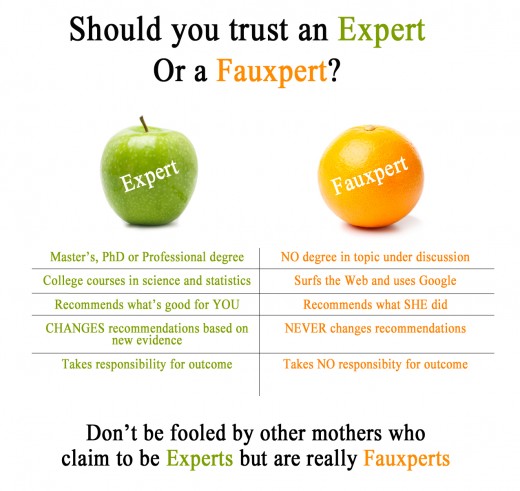
Should you trust an expert or a fauxpert?

apples vs oranges

Elissa Strauss nails it!

Her new piece, Want to ask Facebook about your daughter’s binky? Go ahead., has added a new term to my lexicon: fauxpert.

As in: Internet discussions about natural childbirth, homebirth, breastfeeding and vaccination are dominated by fauxperts, self-appointed, self-proclaimed mommy experts.

Strauss is talking about the age old strategy of mothers seeking advice from other mothers, adapted for the internet age into mothers seeking advice on the web, particularly on Facebook. As Strauss notes, there’s nothing wrong with asking your internet friends for parenting advice:

Facebook parenting is fine, a totally reasonable behavior for any parent with a question about their kid and an internet connection. The only important thing parents need to remember is the difference between an expert and a friend — even of the Facebook variety.

Because:

The internet has borne many fruits, most sweet and a few rotten. Among the putrid is the way it has convinced countless regular folks to act as experts. These fauxperts tend to be the ones with the super strong opinions, those who try to convince us all that co-sleeping will turn our kids into dependent monsters or that crying-it-out will turn our kids into insecure monsters. There are also those who believe that home-births risk lives, and those who think epidurals get in the way of mother/baby bonding. And then there are the anti-vaccinations fauxperts, whose preaching has yielding far more insidious results.

What to do?

There’s no need to stop sharing, but mothers (and fathers) need to understand the difference between scientific evidence and personal anecdotes. Scientific evidence presents the experience of thousands, even millions of individuals, is arrived at by the community of scientists as a whole, independently verified, and can tell you the likelihood of various outcomes. Personal anecdotes tell you one mother’s experience, unverified, reviewed only by that mother, which may or may not apply to your child and you.

So how can you tell the difference between an expert and a fauxpert?

I’ve created this handy chart to help you:

Experts vs fauxperts

Let’s look at the differences.

1. An expert has formal education in the topic at hand, while the fauxpert has none.

This has several important implications. It means that the expert has been exposed to a wide variety of evidence and viewpoints. He or she tends to be familiar with ALL the scientific evidence, not merely cherry picked studies that the fauxpert has never read and wouldn’t understand if she did read. It means that the expert is fully conversant with any major controversies in the field, has thought a lot about them, has read both sides, and has come to a decision. The fauxpert generally views the controversy as a dichotomy between those with more formal education than the fauxpert and the fauxpert, who claims to have more personal experience.

2. An expert understands both science and basic statistics and can reach an independent opinion about the existing scientific evidence. A fauxpert has to take the word of someone else.

An expert is giving you an expert opinion. A fauxpert is giving you the opinion of someone she likes (generally herself) with all the attendant drawbacks of relying on empirical claims just because you like who said them.

3. An expert recommends what’s good for YOU. A fauxpert recommends what’s good for HER.

Experts rarely have a one-size-fits-all recommendation. Even in the case of vaccination for childhood diseases, which ALL experts (pediatricians, immunologists, public health officials) recommend, there are exceptions and every effort is made to find out if your child is one of the exceptions. That’s why you are asked about your child’s allergies, previous reactions to vaccinations, and family history of vaccine reactions. The fauxperts generally have one-size-fits-all recommendations; you should do what the fauxpert did, regardless of how your circumstances differ from those of the fauxpert.

4. Experts change their recommendations based on new scientific evidence. Fauxperts never change recommendations regardless of what the scientific evidence shows.

For example, over the years obstetricians have changed their recommendations about epidurals based on advances in technique, changes in medication, and newer scientific evidence. Natural childbirth fauxperts were opposed to epidurals 30 years ago, and they’re opposed to epidurals now even though the scientific evidence shows pretty clearly that current epidurals have no harmful effects on mothers, babies, or childbirth. It makes no difference to fauxperts what the evidence shows because fauxperts rely on unchanging belief systems, not science.

Experts also acknowledge when they are wrong. Consider this year’s flu vaccine. The experts, the same people who counseled everyone to get the vaccine, publicly announced that this year’s vaccine has only limited effectiveness. In other words, although they initially thought they had put together the most effective possible vaccine, they were wrong and they admit it. Protection for the flu virus that is most prevalent this year is not included in the vaccine. Therefore, although you should still get the vaccine, you should understand that it is not as effective as in years past. When was the last time a fauxpert acknowledged that he or she was wrong about a fundamental claim?

5. Experts take responsibility for their recommendations. Fauxperts wash their hands of you, or even blame YOU when THEIR recommendations cause more harm than good.

It’s difficult to overstate the importance of this point. Experts pay a price if they are wrong. You can take action against them, and they are well aware of that. It is in THEIR best interest, financial, professional and personal, to give YOU state of the art recommendations based on the latest science. Nothing ensures accuracy like having skin in the game.

In contrast, fauxperts take no responsibility for their recommendations. If they are wrong, YOU pay the price and they just keep giving out the same bad advice. They win if you listen to them, regardless of whether listening to them harms or kills you or your child. Sure, they dress it up by pretending that you are taking responsibility for your health, but you are taking the SAME amount of responsibility for your health when you listen to your doctor. The difference is not in your level of responsibility; it’s in theirs.

So feel free to ask other mothers, on Facebook or anywhere else, how they handle parenting their children. You may find that their experience gives you helpful suggestions about ways to manage your parenting dilemmas.

But never forget, they are not experts, merely fauxperts.

The real reason why lactivists oppose the Similac video

Guilt dollars

Unless you’ve been living under a rock, you’ve probably seen or heard about the thought provoking Similac video shown below, The Sisterhood of Motherhood:

Lactivists have rushed to point out that the video is a marketing tool.

Duh!

Everything done by industry is a marketing tool. In this case, the video serves the same purpose as those enigmatic Matthew McConaughey car commercials. It’s meant to promote brand awareness.

You might think that lactivists are appalled by the Similac video because it might undermine breastfeeding. That’s part of their ire, but that’s not the main reason. The real reason why lactivists are incensed by the Similac video is because it is meant to reduce the guilt that new mothers suffer.

Isn’t reducing new mothers’ guilt a good thing?

Well, yes, if you care about babies and mothers. But if you care about the breastfeeding industry, it’s bad, bad, bad. Why? Because the breastfeeding industry, from lactation consultants to the folks at the oxymoronically named Baby Friendly Hospital Initiative, profits by monetizing guilt. Simply put, assuaging maternal guilt about formula feeding threatens the bottom line.

Consider the fee schedule for Baby Friendly Hospital accreditation. What? You thought the designation was free? Don’t be naive!

BFHI fee schedule

A hospital must pay $11,700 for the designation.

Moreover:

If a facility takes longer than one year in any phase, an additional fee, equal to the fee for that phase, will apply.

If a facility takes less than a year to complete any phase, it may move on to the next phase by submitting the appropriate materials and next phase fee. Phase fees are not pro-rated…

If a facility does not pass its on-site assessment, additional fees will apply for re-assessments.

No refunds will be issued for any fees paid.

And as the BFHI notes:

Fees paid by hospitals and birthing centers seeking the Baby-Friendly designation are the primary source of funding support for Baby-Friendly USA, Inc.

How about lactation consultants?

They charge $120-$300 per HOUR for their services.

Breastfeeding, for those in the industry, is big business and keeping those profits coming means inducing guilt in new mothers and then monetizing that guilt.

Even though the guilt doesn’t mean big bucks for lactivists who aren’t working in the industry, it is still worth its weight in gold. How else can you convey your superiority as a mother except by making other mothers feel guilty that they haven’t met the standards that you have set?

The inimitable Feminist Breeder had this to say:

“Don’t judge moms” is a great message overall, but sleezy when being used specifically to sell a product solely designed to separate you from your own milk.

English to English translation: “Don’t judge moms” is a great message overall, but horrible when it undermines my claims to superiority.

As usual, Suzanne Barston, The Fearless Formula Feeder has her eye on the ball. Writing about critics of the video, she notes:

But, see, you’re proving the point.

You’re proving that the perceived judgment among women isn’t all in our heads; that it isn’t something the formula companies and media have created, but rather capitalized on. Those are two very different animals. Of course formula companies are going to talk about judgment and choice and empowerment and all those other triggering terms in the infant feeding debate. Because it resonates…

Formula companies see the need, because women who formula feed are made to feel ashamed of their choice…

This is where she hits in out of the park:

This isn’t a war, even, because that implies some sort of mutual disagreement. It’s one side bullying another, refusing to hear the other side’s point of view, denying the other side’s right to exist. For that side, the only peaceful resolution involves accepting a totalitarian regime, no middle ground. And since there’s no way to argue against someone when they shut down your right to be heard, it’s a losing battle.

Lactivists opposed the Similac video, not because of who made it, but because it attempts to assuage guilt.

Follow the money. Lactivists monetize guilt; hence their horror when someone tries to alleviate it.

How to rationalize your baby’s near death at homebirth

iStock_000001981813Small

Cognitive dissonance is very uncomfortable. That’s why when a birth worker’s own child is nearly killed by homebirth, the mother desperately struggles to maintain her belief in the safety of homebirth. It’s hard to acknowledge that you were wrong; it’s so much easier to delude yourself into rationalizing the disaster.

And when it comes to the capacity for self-delusion, homebirth advocates have few rivals.

Consider doula Nacia Walsh’s story of the homebirth of her emaciated, compromised baby, How My Homebirth Saved My Daughter’s Life. Nacia is not merely ignoring the fact that her homebirth midwives nearly killed her baby, but is delusionally praising them for “saving” the baby. Be sure to check out the birth photo of the baby who looks like a 3rd world victim of starvation.

Over the course of the last two months of my pregnancy my midwives noticed my blood pressure was slowly creeping up, but considering I had no other symptoms of preeclampsia (severe headaches, vision changes, retaining water, rapid weight gain) they decided to just keep an eye on things.

But incipient pre-eclampsia was not the only danger that Nacia and her midwives ignored. At 37 weeks:

I was checked for dilation but nothing seemed to be happening except that my abdomen was measuring smaller than the previous week.

This could’ve meant she had “dropped” into my pelvis or that my fluid was low. So they decided it would be best if I had an ultrasound to determine the cause.

To my relief the technician said that the amount of amniotic fluid was well above range, but that the baby was measuring quite small for her gestational age. She predicted she was about 5.1 lbs at 37 weeks 2 days and suffering from IUGR (intrauterine growth restriction).

Intrauterine growth restriction occurs when the placenta begins to fail. The baby no longer is getting enough nutrients or oxygen. The baby stops growing because it is literally starving. Ultimately, the baby will die of suffocation in utero.

In short, the baby she is carrying seems very small to Nacia (her intuition!). The ultrasound shows that the baby is indeed very small, so small that she is suffering from intrauterine growth restriction, which means that the baby is at risk for stillbirth and the risk increases with every passing day. Moreover, Nacia’s blood pressure is increasing, providing the explanation for why the placenta is failing.

In the real world, this would be a reason to induce labor. In the delusional world of homebirth midwives and homebirth advocates:

I was somewhat nervous about her being so small, but figured ultrasounds are notoriously inaccurate so I wasn’t too concerned. Because of my blood pressure and her size, the midwives put me on modified bed-rest that evening so that I could lower it to a normal range and give the baby the time she needed to gain a little more weight.

So Nacia and her midwives ignored not only the objective signs that the baby was profoundly compromised, they ignored Nacia’s own intuition about the baby’s size. Anyone with two functioning brain cells could figure out that a baby who is currently starving to death is not going to gain any weight, especially when the baby is simultaneously being starved for oxygen. Those midwives weren’t waiting for the baby to gain weight; that was never going to happen. They just didn’t want to lose control over Nacia as a patient so they hoped that labor would start before the baby died.

Nacia did go into labor spontaneously, and not surprisingly, since baby Anica was slowly starving and suffocating, she was born seriously compromised.

As I wiped tears from my eyes and I looked down at her in my arms, I realized she was so tiny. Her body had very little fat and she had a blueish tint.

As the midwife swooped around to the front of the tub to check her vitals, the doppler read that her heart rate was only 100 beats per minute, which is a dangerously low two minutes after delivery.

What the midwife did then was only a momentary blur to me, but to my fearful husband must have felt like an eternity. She leaned over to my listless little girl and gave her 4 life-saving breaths. Her lungs inflated and pinkish color slowly began to creep into her doll-like body.

That’s like claiming that you owe your baby’s life to the person who threw her into the lake, watched her founder and sink, pulled her out when she was near death and resuscitated her. Sure pulling her out of the lake saved her life, but not throwing her in in the first place was what put her at risk.

How much did the baby weigh?

Then came the all important weigh-in. The midwife placed her in a sling scale and the number was read. 4.6lbs.

Our hearts sank.

Never would I have guessed my nearly full-term baby would be the size and weight of a preemie.

She didn’t have to guess; she had already been TOLD that her baby was emaciated, but she ignored that.

And how did the homebirth at the hands of the midwives who nearly killed the baby save the baby’s life?

Born in a hospital or birthing center she would have been whisked away to a NICU with limited interaction, skin-to-skin, and breastfeeding until she was at least 5lbs, which would have meant at least two weeks of stressful hell for her and our family.

Really, Nacia? And how exactly does any of that prevent stillbirth? It doesn’t, does it?

And how would any of that have saved Anica’s life if she had been slightly more compromised and required an expert resuscitation with intubation? It wouldn’t have, would it?

You would have buried your baby is a heartbreakingly tiny white box.

This story had a happy ending and everyone got what they wanted. Nacia got her homebirth. Her midwives got to keep her as a patient and pretend that they were heroes. The only one who suffered was the baby and no one cares about her.

Nacia dodged a bullet and not only is she in denial about that, she’s so deluded that she’s praising the very people who fired the gun.

A question for anti-vax parents

Going to Disneyworld copy

Anti-vax parents, you’re part of a group that has an amazing track record. You’re batting 1000!

In the more than 200 year history of anti-vaccine movements, you’ve never been right even once!

Now, in light of the latest anti-vax fiasco at Disneyland, I have a question for you:

Since you have once again been proven utterly, spectacularly wrong about vaccinations, immunity, measles and everything else, will this cause you to re-evaluate your ability to parse and understand the scientific data about vaccination?

I’m guessing no.

Prove me wrong!

Is contemporary midwifery losing touch with reality?

reality

Yesterday I wrote about recent research in midwifery that is either horrifying or horrifyingly stupid. It ranged from a paper on midwives’ clinical reasoning that concluded that a substantial proportion of midwives don’t use clinical reasoning, to a paper on midwives’ self-confidence that showed that it depended on the good opinion of their colleagues, not on objective outcomes, to a napalm grade stupid piece on midwives and knitting.

I noted that the papers cover disparate areas, but were united by the fact that the focus is not on patients and not on outcomes and that they are not quantitative, merely descriptive. Most importantly, they are not based on objective measures, but rather, on the midwives’ feelings about … themselves. In the world of philosophy, midwives would be described as devotees of metaphysical solipsism.

Wikipedia describes metaphysical solipsism as:

“the philosophical idea that only one’s own mind is sure to exist. As an epistemological position, solipsism holds that knowledge of anything outside one’s own mind is unsure; the external world and other minds cannot be known and might not exist outside the mind. As a metaphysical position, solipsism goes further to the conclusion that the world and other minds do not exist.”

In other words, the only thing that matters to many contemporary midwives, particularly midwifery theorists, is what they think and feel. They behave as if mothers and babies don’t have an independent existence. Their only purpose is as props for the midwife’s self-image. There is no objectivity, only the midwife’s subjective experience. To the extent that mothers and babies fail to follow the midwife’s plan to glorify herself or be lauded by her friends (by having a serious complication or dying), it’s always the patient’s fault or “meant to happen.” It is never the midwife’s responsibility since her only responsibility is to feel good about herself.

There is no objective reality, only the midwife’s feelings. Even the mother’s feelings are irrelevant since her mind and feelings don’t actually exist outside of the midwife’s mind. Baby dies? That doesn’t matter; all that matters is what the midwife thinks about the death. If she thinks it isn’t her fault, then it isn’t, because all that matters is what she thinks. Mother is dissatisfied by the midwife’s care? So what? She needs to adjust her thinking to comport with the midwife’s beliefs. There are no safety standards for homebirth midwifery? Who cares? Safety standards are predicated on an objective reality and contemporary midwifery is primarily concerned with the midwife’s subjective experience.

The authors of the paper on midwifery clinical reasoning implicitly acknowledge this focus when they report that their study was conducted using post structural, feminist methodology. What’s that?

Wikipedia comes to our rescue again.

A major theme of post-structuralism is instability in the human sciences, due to the complexity of humans themselves and the impossibility of fully escaping structures in order that we might study them…

The movement is closely related to postmodernism… Some commentators have criticized post-structuralism for being radically relativistic or nihilistic; others have objected to its extremity and linguistic complexity. Others see it as a threat to traditional values or professional scholarly standards.

Feminist post-structuralism:

emphasizes “the contingent and discursive nature of all identities”

Or as MJ Barrett writes:

Poststructural theorizing questions that which is assumed to be normal or common sense. Embedded within discourses of postmodernity, poststructural theorizing helps make visible the constitutive force of discourses and their relations with subjection and desire. It is a “mode of analysis [that] shifts attention from individualism to subjectivity, from text to discursive practices, and from signifier to signifying practices… Discourse and the ways in which it produces subjects, is a central focus of poststructural theorizing, and as such, so is an analysis of power.

What does this have to do with midwives’ clinical reasoning? Nothing, so far as I can tell, but it sounds really cool. Most importantly, it rationalizes turning the focus of midwifery away from what happens to women and babies toward midwives’ feelings. Hence we have midwifery papers like Including the nonrational is sensible midwifery written by one of the authors of the paper on midwifery clinical reasoning:

For example, when a woman and midwife have agreed to use expectant management of third stage, but bleeding begins unexpectedly, the expert midwife will respond with either or both rational and nonrational ways of thinking. Depending upon all the particularities of the situation the midwife may focus on supporting love between the woman and her baby; she may call the woman back to her body; and/or she may change to active management of third stage. It is sensible practice to respond to in-the-moment clinical situations in this way… Imposing a pre-agreed standard care protocol is irrational because protocols do not allow for optimal clinical decision-making which requires that we consider all relevant variables prior to making a decision. In our view all relevant variables include nonrational matters of soul and spirit.

Because it’s all about the midwife’s feelings:

Being open to the nonrational in midwifery practice makes room for midwives to self-reflexively acknowledge aspects of themselves, such as their fears, in a way that does not interfere with their practice. During birth, making room for the nonrational broadens both midwives’ and women’s knowledge about trust, courage and their own intuitive abilities including the changing capabilities of bodies. And by including the nonrational midwives can then most honestly be with the woman’s own fears as she opens her embodied self to her own unique process of childbearing.

What’s the problem with metaphysical solipsism?

It is often considered a bankrupt philosophy, or at best bizarre and unlikely… It also goes against the commonly observed tendency for sane adult humans in the western world to interpret the world as external and existing independently of themselves.

So midwives have adopted a bizarre and unlikely philosophical construct in order to rationalize their relentless insistence that the most important aspect of contemporary midwifery is the midwife’s feelings about herself. Not only are perinatal and maternal outcomes irrelevant, but babies and mothers have no existence independent of what midwives think about them. How very convenient!

Is contemporary midwifery losing touch with reality? It seems that way, especially when it comes to midwifery theory. It might be more accurate to say that contemporary midwifery refuses to acknowledge reality, which is that midwives have a fiduciary obligation to place the wellbeing of babies and mothers above their own interests. Instead they have a adopted a form of metaphysical solipsism, which places the midwives’ feelings and the midwives’ subjective experience, above all else.

Healthy babies and mothers are no longer the objective of many midwives; they’re merely the props in the midwife’s world, which is apparently the only world that counts.

The sad results is that it’s the midwives’ world. Babies and mothers just live (or die) in it.

Midwifery research: dumb and dumber

image

Recent midwifery research runs the gamut from horrifying to horrifyingly stupid.

Consider:

Midwives’ clinical reasoning during 2nd stage labour: Report on an interpretive study by Jefford and Fahy

Clinical reasoning was once thought to be the exclusive domain of medicine – setting it apart from ‘non-scientific’ occupations like midwifery. Poor assessment, clinical reasoning and decision-making skills are well known contributors to adverse outcomes in maternity care. Midwifery decision-making models share a common deficit: they are insufficiently detailed to guide reasoning processes for midwives in practice. For these reasons we wanted to explore if midwives actively engaged in clinical reasoning processes within their clinical practice and if so to what extent’. The study was conducted using post structural, feminist methodology…

Conclusion

Over half of the participants demonstrated the ability to use clinical reasoning skills. Less than half of the midwives demonstrated clinical reasoning as their way of making decisions. The new model of Midwifery Clinical Reasoning includes ‘intuition’ as a valued way of knowing. Using intuition, however, should not replace clinical reasoning which promotes through decision-making can be made transparent and be consensually validated.

Factors affecting midwives׳ confidence in intrapartum care: A phenomenological study by Bedwell et al.

[M]idwives are frequently the lead providers of care for women throughout labour and birth. In order to perform their role effectively and provide women with the choices they require midwives need to be confident in their practice. This study explores factors which may affect midwives׳ confidence in their practice…

Findings

[T]he principal factor affecting workplace confidence, both positively and negatively, was the influence of colleagues. Perceived autonomy and a sense of familiarity could also enhance confidence. However, conflict in the workplace was a critical factor in reducing midwives׳ confidence. Confidence was an important, but fragile, phenomenon to midwives and they used a variety of coping strategies, emotional intelligence and presentation management to maintain it.

Conclusion and implications

[T]his is the first study to highlight both the factors influencing midwives׳ workplace confidence and the strategies midwives employed to maintain their confidence. Confidence is important in maintaining well-being and workplace culture may play a role in explaining the current low morale within the midwifery workforce. This may have implications for women׳s choices and care. Support, effective leadership and education may help midwives develop and sustain a positive sense of confidence.

Passing yarns forward: unravelling the dimensions of knitting and birth by midwife Sarah Wickham

To the best of my knowledge and that of the MIDIRS Reference Database, it was a male surgeon, Michel Odent (1996, 2004) who first made the very practical art of knitting a topic for debate within the midwifery literature. Perhaps it was such an unremarkable, everyday activity to the midwives who were doing it that it didn’t warrant special mention or consideration…

In this first article, entitled Knitting needles, cameras and electronic fetal monitors, Odent (1996) focused on Gisele’s knowledge of physiology and on the importance of privacy and darkness. In simple terms, a woman may feel less observed by a midwife whose attention appears to be focused on knitting …

Later, Odent (2004) returned to this topic in print and cited further research showing that repetitive tasks are an effective means of reducing tension. He has also proposed that, from the perspective of a birthing woman, the knowledge (which can be gained through the audible clicking of the needles, even if she doesn’t actually watch her midwife) that her midwife is knitting can be reassuring (Odent 2008, personal correspondence). If the midwife is knitting, then she or he cannot be too worried about what is happening. Knitting helps keep midwives’ adrenaline levels low, ensuring a sense of security all round.

These three papers cover disparate areas, but are united by several characteristics that are depressingly common in midwifery research. First, the focus is not on patients and not on outcomes, but on midwives themselves. Second, they are not quantitative, merely descriptive. Finally, their conclusions are alarming. Apparently, a substantial proportion of midwives don’t use, and don’t know how to use, clinical judgment, midwives’ confidence is not based on performance, but rather the opinions of colleagues, and there is no limit to the stupidity of certain practicing midwives.

If this is what passes for research among midwives, and if these are their conclusions, they shouldn’t be allowed to care for houseplants, let alone patients.

What the National Rifle Association has in common with homebirth midwifery

image

Another day, another senseless gun tragedy:

She had just put her 9-month-old down for a nap, turned on cartoons for the older kids and was headed for the dishwasher when she heard a strange “pop” come from the bedroom of the Missouri home.

Alexis Wiederholt, 26, said that as she rushed to investigate the noise, her 5-year-old son appeared and said something that didn’t make any sense to her in the moment.

“I’m sorry, Mom. I shot Corbin.”

Weiderholt ran past to the pack-and-play where Corbin, her always-smiling youngest, should have been resting peacefully.

“I walked in and there was my baby, lying there, bleeding,” the young mother told NBC News, her voice cracking as she described the Monday morning scene.

“I had just hugged him in my arms five minutes before that.”

What had happened?

In what police have said was a tragic accident, the 5-year-old had gotten hold of his grandfather’s .22 caliber Magnum revolver and fired a shot that struck Corbin in the head, mortally wounding him.

As she grieves for her baby and worries about the future of her eldest son, whose name is being withheld by NBC News, Wiederholt said her loss should be a warning to others to protect children from firearms.

How many babies have to die before we stand up to the National Rifle Association, the organization that thinks gun “rights” are more important than whether people, even babies, live or die? The NRA, the premier American lobbying organization, opposes any and all safety standards for guns.

Sound familiar?

It should. It’s a lot like the homebirth midwifery organizations that I write about. What do they have in common:

1. It’s always somebody else fault.

It doesn’t matter who dies, how many die, at whose hands they die, and as a result of which guns they die, the NRA and gun advocates insist that the guns weren’t at fault; the people were. Just like homebirth advocates, who can rationalize death at homebirth by insisting that it wasn’t the fact that the baby was born at home that led to the death, it was a “rare” complication that no one could have foreseen, gun advocates are forever insisting that it wasn’t the guns that killed those innocent people, it was one of those “rare” irresponsible gun owners.

2. Lies about the risks and benefits.

Just as homebirth advocates are forever jabbering that hospital interventions kill as many (or more!) babies as homebirth, gun advocates are forever jabbering that guns save as many (or more!)people from bad guys as innocents who are killed accidentally or on purpose by gun violence. Both groups are lying. While guns may rarely protect someone from the putative bad guy breaking into a home, that those rare instances are is dwarfed by the number of innocents killed is the supreme understatement.

And when was the last time citizen ownership of guns prevented a totalitarian government takeover (ostensibly the purpose of the right to bear arms)? Never.

3. The world’s slipperiest slopes.

Mention safety standards to homebirth advocates, and they reflexively howl that the next step will be banning all homebirths. Mention safety restrictions to gun advocates, and they reflexively howl that the next step will be banning all guns.

4. But, but, but … my rights!!!!!!

Homebirth advocates insist that women have an unrestricted “right” to homebirth. Gun advocates insist they have an unrestricted right to guns. It’s in the Constitution, doncha know? Well the right to free speech is in the Constitution, too, and we put restrictions on that (you can’t yell “fire” in a crowded theater if there is no fire) SPECIFICALLY to protect innocent people. Political rights aren’t absolute, not for free speech and not for guns.

Curiously, this rights talk never extends to the right of homebirth mothers to receive medical care that isn’t deadly, or the right of innocent children to avoid death from gun violence.

But, but, but … I want it!!!!

Homebirth midwives like practicing without safety restrictions. It’s more fun that way! Gun rights advocates like amassing mini armories. It’s fun!

Guess what? It’s not all about you and what you think is fun. Society owes its protection to the weakest and most vulnerable among us, our children. That means we owe them homebirth safety regulations, and we owe them gun restrictions so that we prevent not only homebirth deaths, but gun tragedies like we have witnessed in the last few weeks (the 5 year old killing his 9 month old brother; the 2 year old shooting his mother to death in the store) and tragedies like we have witnessed in the last few years, including the never ending parade of school slaughters.

How many babies have to die before we stand up to special interest groups like homebirth midwives and the National Rifle Association, which put their “rights” to entertain themselves above the right of children to grow up?

Does homebirth midwifery have more than its share of sociopaths?

image

I’ve been writing about homebirth for nearly two decades, so you’d think that I’d be used to not merely the appalling stories of neonatal and maternal death, but also the bizarre behavior of homebirth midwives in response to those deaths. But I still am startled every time I encounter another homebirth midwife (or physician) who, in the wake of a death, exhibits no remorse, views any attempt to hold her accountable as “persecution,” and learns nothing from the experience even if she is condemned, sued or arrested.

I’ve begun to wonder whether homebirth midwifery (particularly as practice in the US) has more than its share of sociopaths.

What is a sociopath?

WikiHow has an illustrated guide to spotting a sociopath. It’s a bit tongue in cheek, but the basic characteristics are all there.

1. Someone is dead or severely injured and the homebirth midwife has no remorse.

Look for a lack of shame. Most sociopaths can commit vile actions and not feel the least bit of remorse… If the person is a true sociopath, then he or she will feel no remorse about hurting others …

Most obstetricians, midwives and obstetric nurses are devastated by an obstetric death. There is tremendous grief, anxiety and soul searching. Could we have saved that baby or mother if we had done something different? Did we make a mistake? Providers may give up obstetrics in the wake of a death. If they feel they are responsible, some will go so far as to commit suicide.

Many homebirth midwives respond in the exact opposite way. They can give a long exposition about their legal woes without once mentioning the fact that a baby is dead, let alone mentioning the name of the baby or the circumstances of the death.

There is no soul-searching, no root-cause analysis. The death is dismissed with a callous, “Some babies are meant to die.” or “Babies die in the hospital, too.”

I’ve never seen a clearer expression of homebirth midwives’ bone chilling lack of concern for dead babies than this quote from Geradine Simkins, former President of the Midwives Alliance of North America (MANA), the organization that represents homebirth midwives, in From Calling to Courtroom; A Survival Guide for Midwives:

You know, babies die; it’s part of life. And only those entrenched in the bio-technical model think that that it doesn’t, or shouldn’t happen. I have traveled extensively in other countries, mostly developing nations, and people understand this reality elsewhere. I once arrived at the house of a midwife in another country the morning a baby had died in a homebirth. I found that the family had embraced the midwife and was so grateful to her—because the mother did not die. They were understandably sad about the baby, but families expect that a baby might die. A mother dying is considered beyond tragic. It’s a matter of perspective.

2. The homebirth midwife refuses to accept any blame and lashes out at any attempt to hold her responsible.

According to WikiHow:

When a sociopath does something wrong, he or she is likely to accept none of the blame and to blame others instead.

Or worse, she is likely to cry “persecution,” setting up Facebook pages and fundraising campaigns to solicit support and money.

Want to get money from other homebirth advocates? Just let a baby die!

A homebirth midwife who is alleged to have presided over the death of a very premature baby after insisting that homebirth would be fine, interfered with an ambulance crew trying to rescue a hemorrhaging mother, lied on medical records, and MAY HAVE MULTIPLE DEAD BABIES BURIED ON HER PROPERTY, is the beneficiary of a fundraising campaign.

An unlicensed homebirth midwife who was arrested for presiding over a homebirth death AND prostitution received enough donations to “free” her that she could make bail, and then violated the terms.

There appears to be no death so appalling and no circumstance so egregious that homebirth advocates will not rally to support the midwife … not the parents.

3. Homebirth midwives do not learn from their mistakes.

According to WikiHow:

Sociopaths do not learn from their mistakes and repeat the same ones again and again.

Homebirth midwives learn nothing from a disaster or death, refuse to accept any blame and lash out at any attempt to hold them responsible. Inevitably, some will go on to preside over additional deaths. The average obstetrician may lose 1 or 2 term babies in a 40 year career encompassing thousands of births. There are quite a few homebirth midwives who have lost 2 or 3 babies in less than a decade, encompassing 100 or 200 births, if that.

Professional homebirth midwifery organizations have LITERALLY no safety standards, so there is no teaching about safety. There’s no reason to have safety standards when safety is not important.

4. Homebirth midwives have no compunction about lying to protect themselves.

From WikiHow:

Sociopaths are perfectly comfortable going through their lives telling a series of lies. In fact, true sociopaths are uncomfortable when they are telling the truth. If they are finally caught in a lie, then they will continue to lie and backpedal to cover up the lies.

Indeed From Calling to Courtroom includes advice on lying in specific situation.

In the future my motto is, “No witnesses”. If I ever have to cut an episiotomy to save a baby’s life, I would ask everyone to turn their backs and turn off all video cameras. I would say to the mother, “I’m sorry, I had to TEAR you to deliver your baby quickly” (ok, so you tore her with scissors). I do not carry Pitocin anymore. For those midwives who do carry Pitocin, I would advise them to never admit it to anyone who has the ability to testify (that is, anyone except your husband). If a midwife ever feels the need to inject Pitocin or administer any kind of drug, such as Methergine, she should refer to such substances as “minerals.”

5. Homebirth midwives are emotionally manipulative.

According to WikiHow:

Sociopaths understand human weakness and exploit it maximally. Once determined, they can manipulate individuals to do just about anything. Sociopaths prey on weak people and often stay away from equally strong people; they look for people who are sad, insecure, or looking for a meaning in life because they know that these people are soft targets.

What tactics do homebirth midwives use to emotionally manipulate clients?

They ignore professional boundaries, encouraging clients to think of them as close personal friend. They encourage distrust of and lying to other medical providers, family and friends. They try to isolate clients from anyone who might question the midwife’s skill, competence or risk taking. They hold clients in psychological thrall having them look to her and only her for praise, affirmation and advice.

There are just the highlights of sociopathy, but even a quick perusal suggests that homebirth midwifery (and doctors who support homebirth midwifery) has more than its share of sociopaths. These are people who preside over deaths and serious injuries of babies and mothers, but express no remorse, refuse to accept any responsibility, consider efforts to hold them accountable to be “persecution,” lie repeatedly to protect themselves, emotionally manipulate clients and refuse to learn from their deadly mistakes.

Many aren’t just medically incompetent; they’re criminally negligent. And until homebirth midwifery organizations institute safety standards and stop pretending that babies who die were “meant to die,” they will continue wreaking havoc, leaving countless tiny bodies and broken, grieving parents in their wake.

Deleted from Birth Pages, a new Facebook group

Media blind - censorship concept

The world of natural childbirth is remarkably totalitarian.

It is filled with websites, blogs and Facebook pages that enforce ideological conformity by deleting dissenting comments and banning anyone who does not agree with the claims of natural childbirth advocates. I’ve created a new Facebook group, Deleted from Birth Pages to serve as both a repository and a public forum where those who have been deleted and banned can share screencaps of comments and discussions that have been expunged.

Women who are researching natural childbirth and homebirth are being hoodwinked into thinking that everyone agrees with natural childbirth and homebirth advocates. At Deleted from Birth Pages, they can learn the truth, both about the duplicity of many claims and about the amount of deleting and banning that goes on to prevent them from learning the truth.

It is a public group, so everyone is welcome; anyone can post screencaps or report being banned, and there are no restrictions on comments.

Please share your screencaps!

Don’t forget: when you post a comment that you think will be deleted from a birth page, be sure to screencap it at the time that you post it. Dissenting comments often disappear in the blink of an eye.

In addition, feel free to dig out old screencaps and post them, too. It doesn’t matter so much when they occurred since one of the points we want to illustrate is how very, very often it happens.

When a comment (or entire thread) is deleted from a birth page, post the thread on Deleted from Birth Pages, and we can continue the discussion there. All are encouraged to participate.

My hope is that Deleted from Birth Pages will become an important source of information for women researching the truth about natural childbirth and homebirth.