All posts by Amy Tuteur, MD

Phil Plait, supporting Mayim Bialik to promote science is like supporting Bill Cosby to promote education

Bialik

I love, love, love Phil Plait of Bad Astronomy. I’m especially fond of his full throated condemnation of anti-vaxx pseudoscience.

And I’m deeply sympathetic to the position he’s found himself in. I, too, have written about specific issues and found myself attacked for a tangent that had little to do with the main point. Unfortunately, I can’t agree with his defense of his error in promoting Mayim Bialik as an actress with a passion for science. Bialik, is a fierce proponent of attachment parenting, and especially its pseudoscience offshoots. She is a leading avatar for homebirth, anti-vaxx and homeopathy. Yes, she does have a PhD in neuroscience and she plays a scientist on TV, but that makes her more dangerous not less.

What did Plait do?

A while back I was skimming my Twitter stream, and saw .. a fun graphic created by Elise Andrew of I F’ing Love Science …

The picture is titled “Actresses with a passion for science” and shows five such women: Hedy Lamarr, Lisa Kudrow, Mayim Bialik, Natalie Portman, and Danica McKellar. I know how important it is to have good role models for kids, and how girls need more support in getting into STEM (Science, Technology, Engineering, and Math) fields. Like it or not, actors and other famous people bear weight, so showing famous actresses who love STEM in my opinion is a pretty good thing.

So I retweeted the picture, adding “Love this” to it.

Then things got interesting.

Within minutes I started seeing responses about Dr. Bialik. Yes, “doctor”; she has a PhD in neuroscience. The thing is, she also holds a number of beliefs with which I and many others disagree, some of them very strongly. For example, she’s a spokesperson for a group called Holistic Moms—they support homeopathy, a provably worthless and arguably dangerous bit of “alternative medicine”. They are also strongly anti-vaccination, and Bialik herself supports anti-vaxxers (she has stated she has not vaccinated her own children, a position I am strongly opposed to).

I knew all this when I retweeted the picture. I’ll admit, I hesitated before doing so, specifically because of this. Is promoting this picture also promoting anti-science beliefs? Looking at the responses on Twitter, a lot of people think so. I see their point, but I also don’t think this is quite so black-and-white.

Why not?

Clearly, she can be a positive role model for science. However, we must have a care. The same people who might be inspired by her pro-science message might look into her more and find that she holds some less-supported beliefs, some that are anti-science.

So is using her in that montage of pictures a good thing or a bad thing? I would argue it’s neither, but the good outweighs the bad. The facts are that she is a scientist, she is an actress, and the picture was about actresses who are scientists. In point of fact, celebrities can be influential, and it’s a good thing that people see science supported by celebrity.

I disagree, but that’s a matter of opinion.

Here, though, is where Plait went off the rails:

But of course we should also be careful not to put celebrities on too high a pedestal. Yes, Bialik has beliefs unsupported by science. But so does everyone…

I doubt that claim is even true, but that’s not the worst part. Many celebrities may have beliefs unsupported by science, but, in my view, they cross a very bright line when they profit from promoting pseudoscience. Simply put, Mayim Bialik shills for Big Placebo. She’s very far over that bright line.

When anyone (especially a celebrity) profits from promoting pseudoscience, the bad emphatically outweighs the good.

Plait claims:

Bialik has done a lot to raise awareness of science and women’s contributions to it. Celebrating her (and the other four actresses) for that is great, and that was the sole purpose of the picture, and it’s appropriate to praise her there.

No one could be more committed to women in science than I am, but women aren’t in such desperate straits that we should be reduced to praising pseudoscience shills. Moreover, including a shill like Bialik insults the intelligence of young women thinking about careers in science. If you wouldn’t use Dr. Oz, another celebrity shill for Big Placebo, to promote a career in medicine, you shouldn’t be using Mayim Bialik to promote women’s careers in science. The graphic would have been equally powerful, indeed more powerful, if Bialik had been left out.

Plait concludes:

That’s what I meant about this not being black-and-white. We’re all shades of grey, and if you really only want to praise someone who is absolutely the perfect icon of science in every way, well, good luck finding them. You’ll be looking a long time.

As for me, I will continue to support science the best I can, and also support women in science. That’s the bigger picture here, and one we should all bear in mind.

But supporting a woman who shills for Big Placebo is not supporting women in science. It’s like saying its still okay to support Bill Cosby as a role model for young men because he’s a celebrity who got a PhD in education.

This is not about supporting science. This is about appropriate role models, and Mayim Bialik is not an appropriate role model for women in science. To insist that she is demeans both science and women.

What’s an ethical response to homebirth, Dr. Burcher? Start by telling the truth.

Got ethics ?

Homebirth advocates have been praising and sharing a recent piece by obstetrician Paul Burcher entitled What’s an Ethical Response to Home Birth?

Unfortunately, in offering an answer to the question, Dr. Burcher fails in his most important ethical responsibility. He hasn’t told the whole truth. Since he has held back (or, less likely, is unaware of) important facts, his answer is deeply misleading.

Who is Dr. Burcher ?He is an Associate Professor of Bioethics and Obstetrics and Gynecology at Alden March Bioethics Institute at Albany Medical College.

He previously worked as an obstetrician-gynecologist in Eugene, Oregon, where served as the back up physician for Melissa Cheyney, CPM. Cheyney, as you may recall, had some ethical challenges of her own. She was an embodiment of the ethical problem of “conflict of interest” while she held simultaneous positions as Director of Research of the Midwives Alliance of North America (MANA), the trade organization of homebirth midwives and Chair of the Oregon Board of Direct Entry Midwifery. In her first position she was privy to a large amount of data showing the disastrous outcomes of homebirth in Oregon, which she deliberately refused to share with the state of Oregon.

Burcher collaborated with Cheyney on a commentary in Birth:Issues in Perinatal Care (a journal published on behalf of Lamaze International), A Crusade Against Home Birth that encapsulating in a few words the self-pity, conspiracy theories and mendacity that are at the heart of homebirth midwifery.

Dr. Burcher bases his own piece on a nifty bit of mendacity.

An observational study from The Netherlands that evaluated more than 500,000 births in homes and in hospitals showed no increase in adverse outcomes of any kind with home birth in low-risk women.5 So home birth, in ideal conditions where midwives and physicians work together as a team and where transport to hospitals in an emergency is highly efficient, appears as safe as hospital birth…

But as Dr. Burcher knows (or ought to know if he is keeping up with the scientific literature), that’s not what the paper shows at all. Dr. Burcher neglects to mention two critical pieces of information.

1. The Netherlands, the country with the highest rate of homebirth in the industrialized world, has one of the worst perinatal mortality rates in Europe.

2. The perinatal mortality rates for Dutch midwives caring for low risk women (home or hospital) is HIGHER than that for Dutch obstetricians caring for HIGH risk women. That is a scathing indictment of midwifery in the Netherlands. The paper that Burcher cites doesn’t show that homebirth is safe; it shows that midwives are dangerous.

Dr. Burcher does acknowledge that homebirth in the US has a higher death rate than comparable risk hospital birth:

I would agree … that home birth in America probably incurs a small increase in absolute risk of poor outcomes for newborns delivered at home.

Notably, Dr. Burcher doesn’t dare cite  Outcomes of Care for 16,924 Planned Home Births in the United States: The Midwives Alliance of North America Statistics Project, 2004 to 2009 by Cheyney and MANA purporting to show the safety of American homebirth. Apparently, even he knows that it actually shows that homebirth increases the risk of perinatal death.

The heart of Burcher’s argument is this:

What, then, are our professional obligations as obstetricians working in hospital settings to women who choose to stay home with a midwife for their birth? At the risk of sounding glib by answering a question with a question, do we enhance the safety of childbirth for all women by shunning home birth or by treating midwives collegially? I believe the correct answer is the latter, and since maternal-child safety was one of the founding reasons for ACOG’s existence, I believe we have an ethical obligation at a minimum to accept transports from home with the respect and professional dialogue we afford our colleagues …

That, of course, tells us nothing. Physicians already have an ethical responsibility to care for all patients regardless of how they end up in the emergency room. Dr. Burcher’s glibness is not in answering a question with a question, but rather in the choice of the question he asks.

The real question is “What is an ethical response to a group of laypeople with inadequate education and training, masquerading as midwives behind a fake credential, who have hideous perinatal death rates?”

I would argue that physicians’ ethical obligations are exactly the same as when we are presented with patients who have been harmed by other quacks and charlatans, whether they are peddling cancer “cures,” homeopathy, or cut rate plastic surgery. First, we care for the victims of their incompetence. When patients who have end stage cancer presents after avoiding conventional treatment that might have saved them, we treat them with every ounce of compassion and skill we have at our disposal. But that doesn’t stop us from going after the cure peddlers, or refusing to serve as their regular back up. Failure to put dangerous providers out of business is an ethical lapse, not a virtue. Similarly, when patients who have horrific infections from cut rate plastic surgery present in the emergency room, we treat them with every ounce of compassion and skill we have at our disposal. But that doesn’t stop us from reporting the cut-rate unlicensed providers to the police and regulating agencies or refusing to serve as regular back up for those who prey on the hopes and fears of other human beings. Failure to put dangerous providers out of business is an ethical lapse, not a virtue.

The ethical response of physicians to homebirth ought to be exactly the same. When a patient is transferred into the emergency room from a homebirth, obstetricians are ethically obligated to treat her with every ounce of compassion and skill we have at our disposal. But that shouldn’t stop us from going after these fake “midwives”,” reporting them to the authorities, and demanding strict regulation and harsh penalties for violating those regulations. Failure to put dangerous providers like homebirth midwives out of business is an ethical lapse, not a virtue.

Dr. Burcher, however, reaches a different conclusion:

…[I]t is my assertion that our professional responsibility must include supporting all of the birth options women have and to make each as safe as possible. The Netherlands has shown that safety comparable to a hospital is achievable. We should strive to replicate their results.

Not exactly.

Maybe Dr. Burcher wants to replicate the terrible perinatal outcomes in the Netherlands, but most obstetricians, myself included, do not.

How natural childbirth advocates justify shaming other mothers

eleanor roosevelt marian anderson

Shame is integral to contemporary natural childbirth advocacy.

It’s based on an entirely arbitrary standard devised by racist, sexist old white men, and perpetuated by well off Western, white women who have enshrined their privilege by making their personal preferences normative.

I’ve often satirized the passive-aggressive shaming that is so beloved of natural childbirth advocates (I’m so not judging you), but today I’d like to address it head on. Blogger Mama Birth has provided the perfect opportunity with her recent post passive-aggressively justifying passive-aggressive shaming in I Can’t Make You Feel Ashamed of Your Birth (Unless You Really Are Ashamed of It).

Fair’s fair, so I should acknowledge excellence when I see it: Mama Birth’s piece is a truly exquisite example of the genre, kind of like a double back flip in diving, simultaneously shaming women who don’t have unmedicated vaginal births AND blaming them for feeling ashamed!

Mama Birth recognizes that criticism of natural childbirth shaming is gaining traction:

Shaming is a hot topic in the birth world though, isn’t it? If you are dumb enough to have an opinion and share it then you are undoubtedly going to be accused of shaming somebody who did otherwise. If you state that formula is a poor substitute for breast-milk or mention that the cesarean section is a perverse form of birth control … or (gasp) talk about how much you loved your natural birth, then stand back. Because what happens next is you will be accused of shaming people.

But Mama Birth refuses to take responsibility for shaming others since it is THEIR FAULT if they feel ashamed, not hers:

Never-mind that the people who you have forced into feeling guilty because you had an opinion are full fledged adults who you have never actually met—never mind that! You got in their head, you twisted their emotions, you are now in charge of their brain…

Sure, it would be really nice and convenient if every time we felt bad it was actually somebody else’s fault. Then nothing would be our fault. And if we did screw up, the bad feelings that went along with it would not be our responsibility.

See, it’s not Mama Birth’s fault that you feel ashamed when she shames you. Your bad feelings are not her responsibility.

Let’s extrapolate to some real world situations:

If everyone took Mama Birth’s advice, people of color should blame themselves for feeling bad about being subjected to racist treatment. It’s not racists’ fault that African-Americans feel victimized by racist taunts; it’s their fault for taking those racist slurs to heart.

And:

No one should be criticizing homophobia, since, according to Mama Birth, no one can make you feel ashamed for your sexual orientation unless you are really ashamed of it.

And:

We could be free once again to refer to the developmentally disabled as “retards.” Sure they and those who love them might be offended, but objecting to the epithet “retard” just shows that those people are ashamed that they or their loved ones are retards.

Isn’t that convenient? Racists don’t have to feel bad about their racism, homophobes are free to feel good about their homophobia and natural childbirth advocates can continue to revel in shaming other mothers. Don’t blame the racists, homophobes or Mama Birth. It’s all the fault of the victims!!

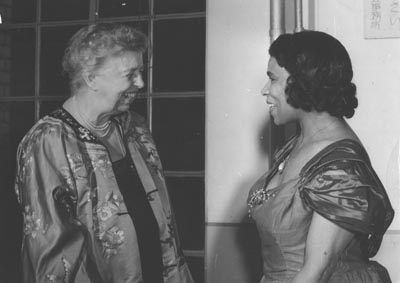
Mama Birth quotes Eleanor Roosevelt in support of her creative interpretation of shaming. Roosevelt said:

No one can make you feel inferior without your consent.

It’s a rather ironic quotation for two reasons. First, all her biographers, as well as many who knew her while alive, would argue that Eleanor Roosevelt was oppressed for most of her life by a deep and abiding sense of inferiority, having been constantly shamed by those she loved most.

Second, Roosevelt was NOT excusing those who shamed others. When in 1939 African American contralto Marian Anderson, one of the most celebrated opera singers of her generation, was denied permission by the Daughters of the American Revolution (DAR) to use its Constitution Hall for a concert, Mrs. Roosevelt did not advise Ms. Anderson that “no one can make you feel ashamed of your race unless you really are ashamed of it.”

What did she do?

On February 26, 1939, Mrs. Roosevelt submitted her letter of resignation to the DAR president …

On February 27, Mrs. Roosevelt addressed the issue in her My Day column, published in newspapers across the country. Without mentioning the DAR or Anderson by name, Mrs. Roosevelt couched her decision in terms everyone could understand: whether one should resign from an organization you disagree with or remain and try to change it from within. Mrs. Roosevelt told her readers that in this situation, “To remain as a member implies approval of that action, therefore I am resigning.”

Mrs. Roosevelt’s resignation thrust the Marian Anderson concert, the DAR, and the subject of racism to the center of national attention. As word of her resignation spread, Mrs. Roosevelt and others quietly worked behind the scenes promoting the idea for an outdoor concert at the Lincoln Memorial, a symbolic site on the National Mall overseen by the Department of the Interior…

On April 9th, seventy-five thousand people, including dignitaries and average citizens, attended the outdoor concert. It was as diverse a crowd as anyone had seen—black, white, old, and young—dressed in their Sunday finest. Hundreds of thousands more heard the concert over the radio. After being introduced by Secretary Ickes who declared that “Genius knows no color line,” Ms. Anderson opened her concert with America. The operatic first half of the program concluded with Ave Maria. After a short intermission, she then sang a selection of spirituals familiar to the African American members of her audience. And with tears in her eyes, Marian Anderson closed the concert with an encore, Nobody Knows the Trouble I’ve Seen.

The DAR’s refusal to grant Marian Anderson the use of Constitution Hall, Eleanor Roosevelt’s resignation from the DAR in protest, and the resulting concert at the Lincoln Memorial combined into a watershed moment in civil rights history, bringing national attention to the country’s color barrier as no other event had previously done.

The natural childbirth movement is approaching a cross-roads. The culture of shame that they perpetuate is being revealed in all it’s ugliness. Natural childbirth advocates can respond like Eleanor Roosevelt and provide powerful examples rejecting the use of shame in promoting their message …

… or they can follow the lead of Mama Birth and blame the shamed for their own shame.

Guest post: A lactation consultant on breastfeeding and shaming

iStock_000017419308Small

A guest post from frequent commenter NoLongerCrunching:

I am a lactation consultant (IBCLC) with 13 years of experience helping breastfeeding mothers, from initiation to weaning. I did not put my name on this article because I do not want to be ostracized by my colleagues by writing for “she who must not be named.”

I believe deeply in the value of the lactation consultant profession, but I am afraid for its future. Why? Because when we are given feedback by mothers who have had negative experiences with LCs such as Emily Wax Thibodeaux’s story Why I don’t breastfeed, if you must know, recent guest writer Anne’s post A mother shares her experience with lactivism, guilt and postpartum depression, and Suzie Barston’s (the Fearless Formula Feeder) story, many of us respond with one of the following (paraphrased quotes I have heard on IBCLC groups and around the office):

• “That would never happen in our hospital.” (spoiler alert: yes it would)

• “Mothers may feel criticized when I say they need to do more breastfeeding/pumping/skin-to-skin but I am just giving accurate information and am not responsible for how she takes it.”

• “The mother needs someone to blame for her breastfeeding failure; she should have followed my recommendations.”

• “The person who said that must not have been an IBCLC. We are always getting blamed for what nurses or lower-level breastfeeding advocates say.”

And of course let’s not leave out the sighs, eyerolls, and head shaking.

Many mothers whose babies are showing clear signs of needing supplementation are afraid to introduce formula, because there has been so much speculation about the harm of “just one bottle”. The attitude in the “baby-friendly” hospital is to treat formula as risky and only to use it when the baby is in trouble or about to be. (Some might argue that any formula has risks; however, the theoretical risk of a little supplemental amount is almost certainly clinically irrelevant in the long term.) Ironically, sometimes early supplementation can save the breastfeeding relationship, because when the baby does not get enough calories, he will become lethargic at breast, causing poor stimulation of the mother’s milk supply, which then becomes a downward spiral of more lethargy at breast and eventually a permanently lowered supply. This has been shown by research, but read the comments to see the resistance of lactation professionals to this possibility. If the study results are true, wouldn’t it result in babies being breastfed longer, which is what we are working for? We are talking about the possibility of a few 10 ml formula feedings resulting in potentially hundreds of ounces of breastmilk going into those babies. Not to mention the months or years of cuddly nursing sessions mother and baby will enjoy.

By brushing off these women’s experiences and research that contradicts our mindset, we are losing an opportunity to learn how we can be better lactation consultants. No one benefits from an adversarial relationship — not the mothers, not the babies, and not the lactation consultant profession. I have gone to many a hospital room only to be pulled aside by the nurse and told that the mother does not want to see any LCs. She would rather struggle alone than face someone whose level of compassion she cannot be sure of.

The only acceptable response to a woman who says an LC has shamed her is to believe her. She needs empathy about how devastating it must feel to be criticized about your first actions as a mother. Hearing her experience can remind us that part of our job is to leave our patients feeling confident that they can meet their baby’s need for food and comfort, and they have a doable plan to meet their breastfeeding goals. In the words of Linda Smith, IBCLC and lactivist extraordinaire, the three rules of breastfeeding support are “1. feed the baby, 2. the mother is right (if she is wrong, refer back to #2), and 3. it’s her baby.” Our patients should feel that we will not be disappointed in them if they call from home saying “I was unable to follow the plan we developed, so can we go back to the drawing board?”

If an LC carries judgment in her heart, vulnerable new mothers can sense her disapproval quite acutely; these patients will not feel comfortable telling her they did not follow the plan and they need a different one. Sadly I hear colleagues often talk about these mothers as if they are lazy, selfish, or uncommitted to their babies’ health. Yet often they have had days of grueling labor (sometimes ending in so-called major surgery) and have gotten fewer than 3 consecutive hours of sleep over the past 3 days. Remember that sleep deprivation is used as a torture technique. If these mothers have been breastfeeding, then supplementing, then pumping, they are expending the same amount of time as a mother of triplets. Doing this every 3 hours gives them at best a 2-hour break. Cuddling with the baby takes a backseat. Sleeping to replenish their energy takes a backseat. The mother spends time hooked up to a milking machine while dad or grandma gets to experience the joy of seeing the baby go from hungry to the bliss of a full tummy.

Instead of reacting with frustration towards these mothers, we need to listen to them and tailor our recommendations to what they tell us honestly they can do. And the only way a mother will trust us enough to be honest is to never breathe a whiff of judgment, which is impossible if you are secretly judging her.

Depending on what the mother says is feasible to do, the plan may or may not result in a full milk supply, (infrequent or insufficient milk removal usually results in low production); however, partial breastfeeding is almost always more satisfying to a woman who wanted to breastfeed than feeling the need choose between just giving up and going to exclusive formula feeding, or facing what Anne described as being “miserable beyond belief” and potential severe PPD. When we start with what mothers tell us they can do, we can usually develop a plan that results in frequent effective milk removal and the baby transitioning to exclusive breastfeeding, while still allowing the mother to enjoy her new baby. The mother should be given all the options and be confident that we will support whatever decision she feels is best.

Another thing about helping a mother develop a good milk supply: Which is more likely to result in a higher level of oxytocin and prolactin: an environment where the mother feels cared for, safe, and respected — or an environment filled with subtle disapproval and pressure to doubt her instincts, potentially increasing the stress hormones cortisol and adrenaline?

What can mothers do to evaluate whether their LC is silently judging them?

First of all, realize that you are not crazy; if you are picking up subtle judgmental vibes, you are probably right. Second, if you are feeding, cuddling and listening to your baby’s cues, you are doing mothering right. Your success as a mother is not measured in how many milliliters of breastmilk you produce, whether you can achieve a perfect latch, whether you are glowing like a Madonna when you breastfeed. Third, make your own needs as high a priority as the baby’s needs, because you matter as a human being, and because a happy mother is the heart of a happy family.

I desperately hope my profession can move closer to being more mother-friendly, rather than single-mindedly focused on getting as many mothers as possible to exclusively breastfeed. Whether or not they leave our care exclusively breastfeeding is not in our control; what is in our control is how we treat the mothers who are struggling, even the mothers who do not follow our advice. Although there is pressure in the hospital environment to justify our jobs by percentage of babies exclusively breastmilk-fed at discharge, we have an ethical responsibility to make sure the baby gets enough calories and to make sure the mother feels like she is capable of meeting her baby’s need for food. By “enough calories,” I do not mean a stingy amount to keep the baby hungry for breastfeeding; I mean enough so the baby shows satiety cues at each and every feeding. Another try at breastfeeding is coming around the bend; in the meantime, doesn’t the baby deserve to feel satisfied? Doesn’t the mother deserve to see her baby full and happy?

Most of my patients desperately want to breastfeed and are very grateful for professionals that help them feed in the way they want to. But in order for this profession to have a future, which will enable us to help future mothers feed at they choose, we need to take a hard look at ourselves. We need to let go of judging mothers in our hearts. We need to let go of any attachments we may have toward an outcome that mirrors our own feeding choices. We need to follow the excellent advice of IBCLC Chris Musser, to seek first to understand.

Dear New York Times, since when is treating women’s pain an “intervention”?

iStock_000000320602XSmall

Proving yet again that newspapers should not opine on medical issues, The New York Times tackles the safety of midwifery in Are Midwives Safer than Doctors?

Let’s leave aside for the moment the fact that the Editors don’t really understand the new UK recommendations and their back story, and let’s focus the misogyny directly regurgitated from the propaganda of the natural childbirth movement.

Doctors are much more likely than midwives to use interventions like forceps deliveries, spinal anesthesia and cesarean section.

Oops! Spinal anesthetics are used for planned surgeries; the Editors are apparently referring to epidurals.

An epidural, the single most effective method for relieving the agonizing pain of childbirth, is an interventions?

Since when, dear Editors, is treating pain an intervention? Oh, right, when it’s women’s pain. No one ever thinks treating men’s pain is an intervention, do they?

The truth is, however, that adequately treating women’s pain, in childbirth or from any other cause, is a feminist issue.

Let’s look at some empirical facts about labor pain:

1. Childbirth is excruciatingly painful. Indeed the pain of childbirth is so impressive that ancient cultures imagined that the only possible explanation was divine punishment of women for their transgressions.

2. Severe pain should be treated. No one would ever suggests that cancer pain be ignored or that pain from a broken bone should go untreated.

3. Medical professionals have an obligation to treat pain. Every human being is entitled to the medical treatment of pain if that’s what he or she desires.

But all too many midwives, prisoners of the philosophy of natural childbirth, view birth as a piece of performance art, wherein a woman demonstrates her intrinsic worth by attempting to recapitulate childbirth as they imagine it occurred “in nature” (minus all that death, disability, subsequent incontinence, etc., of course); that means no relief for excruciating pain.

In other words a woman’s need for pain relief is rendered invisible.

How do natural childbirth advocates do it?

  • Blaming the woman for her own pain – if she did it “right,” childbirth would not be painful.
  • Blaming the woman for not using “natural” methods of pain relief – regardless of their questionable value in providing adequate relief.
  • Blaming the woman for not embracing the pain as an “empowering” aspect of her biological destiny.
  • Blaming the woman for not understanding that childbirth is “good” pain, even though it is biologically identical to all other forms of severe pain.
  • Treating women’s need for pain relief as an “intervention,” although, to my knowledge not a single form of pain relief for men is ever considered an intervention.

Simply put, according to natural childbirth dogma, a woman’s pain in labor is irrelevant.

There is a long and disreputable history of ignoring women’s pain.

The Girl Who Cried Pain: A Bias Against Women in the Treatment of Pain, Journal of Law, Medicine & Ethics, 29 (2001): 13–27, provides a disturbing description of the ways in which the pain of women is systematically devalued, disbelieved and undertreated.

Given that women experience pain more frequently, are more sensitive to pain, or are more likely to report pain, it seems appropriate that they be treated at least as thoroughly as men and that their reports of pain be taken seriously. The data do not indicate that this is the case. Women who seek help are less likely than men to be taken seriously when they report pain and are less likely to have their pain adequately treated…

The study by McCaffery and Ferrell of 362 nurses and their views about patients’ experiences of pain found that while most of the nurses (63 percent) agreed that men and women have the same perception of pain, 27 percent thought that men felt greater pain than women. Only 10 percent thought that women experienced greater pain than men in response to comparable stimuli. This result has no justification in the literature … The same study also found that almost half of the respondents (47 percent) thought that women were able to tolerate more pain than men as compared to 15 percent who felt that men were able to tolerate more pain than women…

These erroneous attitudes are particularly prevalent in regard to childbirth:

Bendelow found that “the perceived superiority of capacities of endurance is double-edged for women — the assumption that they may be able to ‘cope’ better may lead to the expectation that they can put up with more pain, that their pain does not need to be taken so seriously.” Crook and Tunks point to the influence of the psychoprophylaxis movement in the United States with its implicit assumption that it is good to experience childbirth without the aid of analgesia. As a result, some women who have “gone through psychoprophylaxis classes, feel guilty if they relent at the last minute and ask for an epidural”; according to the authors, “these attitudes imply that we have a value system endorsed by some parts of our population that suggest women should be encouraged to keep a stiff upper lip.”

Most natural childbirth advocates appear to be unaware of the deeply sexist and racist history of the philosophy of natural childbirth. Grantly Dick-Read, the found of the philosophy, was a eugenecist who was preoccupied with visions of “race suicide” with primitive people overwhelming white people of the “better” classes. He thought that upper class women could be diverted from their insistence on greater political and economic rights back into the home where they belonged if only they didn’t fear the pain of childbirth. Therefore, he told women that the pain of childbirth was all in their heads; he lied in claiming that primitive women (i.e. black women) experienced painless childbirth because they were unafraid of it. In other words, the pain of childbirth is all in women’s heads. Never mind that is was a spectacular lie with a sexist, racist purpose. Contemporary natural childbirth advocates are still spouting the same misogynistic clap trap, counseling women that childbirth pain is a result of fear.

The end result is that, women’s pain is discounted and ignored, and treating women’s pain is derogated as an “intervention.”

But, dear Editors, women’s pain is should NOT be discounted and ignored. The treatment of women’s pain is never an intervention; it is feminism at its most basic.

Claiming that treating childbirth pain is an intervention is both brutally misogynistic and hideously cruel.

Please correct your mistake as soon as you possibly can.

Monetizing fear: Food Babe shows how it’s done

image

PT Barnum famously said that you can’t go broke underestimating the intelligence of the American public and blogger Vani Hari (Food Babe) is demonstrating the truth of that adage. Her artful manipulation of her Food Babe Army would warm Barnum’s heart.

Like Barnum, Hari depends for her money on the gullibility and lack of sophistication of her followers. They are so naive that they seem to have no awareness that Food Babe is a business, and they’ve been duped into buying an endless array of its useless products.

Maybe Vani’s followers are having trouble seeing Food Babe for the business that it is. Perhaps we should identify what Hari does by giving a nickname to her business; I suggest “Vansanto.”

Barnum at least had to put on his circus and that costs money. Monsanto at least has to create poducts that actually do something. “Vansanto” doesn’t have to do anything to rake in the dough. Hari, the “chief executive” of Vansanto, has figured out how to monetize fear, and that’s free, especially when you create it yourself.

I could spend a lot of time debunking Hari’s claims one by one, but I suspect that wouldn’t be very effective, because her followers lack the knowledge of basic science needed to understand them in the first place. But even those who never learned chemistry should have learned cynicism. They should be able to recognize a marketing ploy when they see one.

“Vansanto” is no more committed to your health and wellbeing than Monsanto is. Both are businesses that make money by promoting and selling products. Monstanto sells a range of products some of which have tremendous value, some of which have serious side effects and all of which fill Monsanto’s coffers.

“Vansanto” promotes and sells a range of products all of which have no intrinsic value since don’t do anything besides line Vani’s pockets. They only have value when you’ve been convinced to fear the less expensive, often far more effective, conventional alternative. That’s where Vani’s true brilliance comes in. She knows that her claims don’t have to make sense and don’t even have to be true; they just have to create fear and Vani is very, very good at doing that.

What’s amazing is that The Food Babe Army is oblivious to what seems pathetically obvious to me. Vani Hari creates fear in order to monetize it. “Vansanto” is no different from Monsanto in that regard. It is an enterprise that exists to create value and profit for its shareholders regardless of whether its products help or harm people.

Maybe members of the Food Babe Army could explain to me why they can’t see this. Is there a single member of the Food Babe Army that hasn’t been convinced to buy either a product that Vani sells, or to forgo buying a conventional product for one that Vani recommends? Is there a single member of her Army who isn’t supporting her with their own money? Can’t you see its about the money, not the food? Can’t you see that there’s no real difference between “Vansanto” and Monsanto except that one makes money for her and the other doesn’t?

Don’t you see that Vani Hari sparked your fear and you are now willing to pay her to make the very fear that she created go way? That doesn’t mark you as educated; it marks you as gullible, and profitable, fools.

Homebirth is a selfish, unsustainable use of resources

image

Homebirth advocates, help me out here.

I’m having a problem understanding your math. It’s just arithmetic, so it really shouldn’t be so hard, but I can’t figure it out.

It s widely claimed that there is a midwife shortage in the UK. There aren’t enough midwives to safely care for the women giving birth in hospitals. That’s certainly how the Royal College of Midwives (RCM) rationalizes any and all poor care leading to the preventable deaths of mothers and babies.

Here’s where the arithmetic comes in:

1 midwife in the hospital can take care of multiple laboring women (let’s say 3 for arguments sake, though it is probably more)

but 1 laboring woman at home is supposed to be attended by 2 midwives

If I’m doing the addition correctly that means that 2 midwives can care for 6 women in the hospital, but only 1 woman at home … AND midwives are in short supply.

So, isn’t homebirth a selfish, unsustainable use of scarce resources?

Doesn’t every midwife who heads out to marinate in her own delicious autonomy at homebirth deprive 3 women of hospital based midwifery care?

And how can a selfish, unsustainable use of scarce resources possibly be cost effective?

It can’t, can it? And all the hopping up and down by the RCM and NICE claiming that homebirth saves money is a blatant falsehood since it doesn’t take into account the salaries of all the extra midwives who would have to be hired to provide homebirth services, right?

Let’s put it another way:

If it takes 6 midwives to properly care for 18 laboring women in the hospital, but there are only 5 midwives available, how can it possibly be cost effective, sustainable, or even remotely safe to send 2 of those 5 midwives to a homebirth, leaving just 3 midwives to care fo 18 patients?

The RCM and NICE are like Marie Antoinette who, when told that poor people had no bread, supposedly declared, “Let them eat cake!” Only in their case, when confronted with the fact that a woman often can’t get 1 midwife to care for her in the hospital (whose labor wards are routinely refusing to accept patients when understaffed), declare that she should have stayed home so 2 midwives would come to her.

In a system like the UK, homebirth is selfish, usustainable, saves no money, and compromises the care of everyone except the woman who has a fully staffed homebirth. The only people who appear to benefit from this faulty arithmetic are midwives. Who would have guessed?

Toxins, motherhood and “shopping your way to safety”

image

Regular readers of this blog know of my ongoing interest in natural parenting as both a function of privilege and a marker highlighting privileged status. It seems that many people have a need to signal their privileged status to others by adopting lifestyles and routines that require substantial steady incomes to support.

It’s pretty obvious when it comes to conspicuous consumption of expensive cars, designer clothes, and monstrously large homes. It is less obvious, though no less important, in never ending task of avoiding “toxins” involving the purchase of organic foods, supplements, homeopathic remedies, etc. etc. It turns out to be very expensive to avoid “toxins.”

The concept of natural parenting as a visible marker of privilege raises an interesting and ironic possibility. Is natural parenting, often viewed as a rejection of contemporary consumer culture, merely a niche form of the very same consumer culture that is purportedly being rejected? In other words, just as the women who feed their children McDonald’s take out, let them play with plastic toys, and allow them to watch TV are obviously responding to rampant consumerism, are natural parenting advocates who hire doulas, treat everything with homeopathic remedies, and wear their babies in slings unwittingly responding to the exact same consumerism they claim to deplore, albeit consumerism carefully targeted specifically, at them?

Is natural parenting about health or is it just a giant marketing tactic created to sell worthless products to gullible people? Do purveyors of natural parenting goods and service promote “shopping your way to safety”?

Rutgers sociologist Norah MacKendrick raises this disturbing possiblity in her paper More Work for Mother; Chemical Body Burdens as a Maternal Responsibility published in the September issue of Gender and Society.

… This article advances … the effort to mediate personal exposure to environmental chemicals through vigilant consumption as a new empirical site for understanding the intersections between maternal embodiment and contemporary motherhood as a consumer project. Using in-depth interviews, I explore how a group of 25 mothers employ precautionary consumption to mediate their children’s exposure to chemicals found in food, consumer products, and the home. Most of the mothers in the study situate their children’s chemical “burdens” within their own bodies and undertake the labor of precautionary consumption as part of a larger and commodity-based motherhood project…

MacKendrick firmly situates attachment parenting [intensive mothering] as a consumer choice:

The ideology of intensive mothering infuses spaces of consumption by urging mothers to buy with the best interests of the child in mind. Consumption is therefore entangled with other routine activities that parents—and mothers in particular— view as integral to securing a child’s future outcomes. Indeed, women’s transition to motherhood is marked by the consumption of specific material goods. As a form of daily provisioning, foodwork is gendered labor, as women do most of this work …

Mothers create elaborate rituals around shopping for and purchasing items that they believe are necessary to avoid “toxins.” For example:

Megan, a middle-class woman with an infant, has a complex precautionary consumption routine … She consults books, magazines, and websites to find information about chemical avoidance and organizes her shopping list according to what items should be
organic and nontoxic (e.g., meat, dairy, produce, cleaning products). …

So Megan peruses magazines and websites (filled with ads for products she might purchase), then makes specific product choices in areas ranging from food to cleaning products. What’s the difference between Megan and the woman who peruses Vogue and then makes specific product choices among designer options? Nothing, really.

And, of course, like most natural parenting, the conspicuous consumption is traditionally gendered.

Megan explains that her husband “is on board with it, but he definitely doesn’t initiate. It just wouldn’t enter his realm of thought.” When he does the grocery shopping, she “send[s] him out” with a list of specific brands of items to buy for their child, as she
would not trust him to make the “right” choices. This contrast of her knowledge against her husband’s relative ignorance rationalizes the gendered division of precautionary consumption within her household.

Living a privileged life in a privleged neighborhood is almost a necessity:

Megan lives in a neighborhood with stores selling free-range chicken and discount organic foods. During our interview, she shows me a baby chair that she bought at a local store, and speaks enthusiastically about the natural wood and organic cotton. Megan clearly feels that shopping in a precautionary way is enjoyable. She talks positively about the range of choice of organic goods in her neighborhood: “It’s great . . . it’s a foodie
neighborhood for sure…” When Megan frames precautionary consumption this way, we see the privileges afforded by her social class position, where buying green commodities is easy,
enjoyable, and affordable.

Moreover, shopping your way to safety offers women an unmerited sense of superiority, as another mother demonstrates:

Cara considers precautionary consumption as an expression of vigilant mothering that protects against health problems: “I want it to be organic, to be as pure as possible—you know, they can put a lot of crazy ingredients in there . . . that’s why all these kids are medicated, they’re eating all this crappy stuff and then they can’t behave themselves and what’s it doing to them?” Her approach to precautionary consumption evokes both
a natural mothering and an intensive mothering ideology… By pointing to “all these kids,” Cara furthermore situates herself in relation to a hypothetical, careless parent who fails to connect a child’s ingestion of chemical additives to behavioral problems.

While Megan and Cara claim, and probably even believe, that they are protecting their children’s health by avoiding “toxins,” they’ve actually been tricked into paying top dollar for products they doesn’t need, don’t make their children safer, advertise their privilege, and provide no additional value for the additional expense. They are no different from the less privileged women they look down upon for responding to the consumerist culture in which we live. They, too, has been manipulated into buying stuff in response to aggressive marketing campaigns, just different ones.

Simply put, “toxins” aren’t a health threat, they’re a sophisticated marketing tactic designed to trick privileged women who imagine themselves as “educated” into buying an endless array of consumer products in an orgy of conspicuous consumption that they don’t need, don’t work, and merely enrich charlatans.

In praise of princesses

image

Warning, warning, warning: personal opinion ahead!

A recent piece in Slate by David Auerbach made me very angry:

When my 4-year-old told me the other day that she was “ready for princesses,” part of me died. Not just because the day had finally arrived when that virulent meme had infected her, but also because of how utterly powerless I was to contain it. Let me be clear: These weren’t progressive princesses … This kind of princess forced my programmer wife and me to do what we swore we’d never do to our child, which is deny our daughter a book….

Just what we need: another sanctimonious parent teaching another girl that her own feelings are worthless, that femininity is incompatible with ambition, and girls are inferior to boys.

To understand what I mean, imagine a parent uttering the following:

When my 4-year-old told me the other day that he was “ready for firetrucks,” part of me died. Not just because the day had finally arrived when that virulent meme had infected him, but also because of how utterly powerless I was to contain it. Let me be clear: These weren’t progressive fire prevention technologists; they weren’t white collar professionals who invent flame retardant fabrics or teach materials engineering at MIT. These are blue collar firemen, lacking a college education, and downwardly mobile compared to my programmer wife and me, and that forced us to do what we swore we’d never do to our child, which is deny our son a book.

When you picked yourself off the floor where you’d fallen from laughing so hard, you’d probably point out a few facts of life to me: 1. a four year old’s interest in firemen does not mean that he will become a fireman as an adult (not that there’s anything wrong with that). It does not mean that he is imbibing the message that a college education is not needed to get a good job. It does not mean that he is learning to value physical strength over intellectual achievement.

It means nothing. Lots of little boys are fascinated with firemen, claim to want to be firemen when they grow up, and it never amounts to anything, because 4 year olds grow and change, learn a great deal more about the world and themselves, and generally leave childhood ambitions behind.

What’s the difference between the little boy who loves firemen and the little girl who loves princesses? The little boy’s preferences are masculine and that’s A-ok; the little girl’s preferences are feminine and that’s disappointing and must be stopped. Perhaps even more importantly, the little boy’s preferences are seen as authentic, but the little girl can’t be trusted to know her own little four year old mind. His desires are trustworthy; hers are the product of a “virulent meme.”

Why do so many progressives insist that women and girls are disproportionately afflicted with false consciousness? Why are they teaching women and girls not to trust their own desires, to suppress their wishes and to reject their femininity as incompatible with approved accomplishments like being a programmer (nothing against programmers; my eldest son and my daughter-in-law are both programmers)?

I have news for progressive parents: There’s nothing wrong with princesses. There’s nothing wrong with dresses. There’s nothing wrong with pink. It’s an age appropriate phase for 4 year old girls. If you hadn’t noticed, they’re different from 4 year old boys, NOT inferior, different, and those differences should be respected, NOT dismissed as the product of indoctrination, or, worse, inferior to the preferences of 4 year old boys.

Why is that most 4 year old sons of programmers who yearn to be firemen don’t end up as firemen? Because they imbibe the values of their parents that higher education is admired by their parents and considered necessary for a fullfilling life and a renumerative career. The fireman ambition was just a phase, not a trajectory.

The same thing applies to 4 year old girls and princesses. They too imbibe the values of their parents about education, about the respect that should be accorded to women, about the relative roles of husband and wife within their family, about their parents’ views on the limits or lack of limits on a girl’s ambition. The princess ambition is just a phase, not a trajectory.

The prospects facing women in industrialized countries are better than they have been in the past, but are still limited by less pay for equal work, gender discrimation and harrassment, lack of access to reproductive control options and other systemic failures. None of it is in any way related to 4 year old girls who love princesses.

We should be teaching our daughters that femininity is perfectly compatible with ambition and achievement. Banning princesses teaches the opposite, that femininity should be a source of shame, that they can’t trust their own feelings, and that making daddy and mommy look good to their progressive peers is more important than following your dreams wherever they may take you.

Skeptics take note: natural childbirth is the gateway to woo

iStock_000013939244Small

Why don’t skeptics confront childbirth woo?

The same people who vociferously defend the efficacy and safety of vaccines, who fight against climate deniers, who battle valiantly against creationists, generally give childbirth pseudoscience a big, fat pass. Google the words skeptic and vaccines and you’ll find tens of thousands of sites and articles. Google skeptic and evolution and you will find even more. Google skeptic and childbirth, and you’ll find very few articles, most of them written by me.

My experience on Reddit, which has an active community of skeptics, indicates that far from questioning the pseudoscience of the natural childbirth and lactivism industries, skeptics have fallen for the same marketing tactics that have fooled so many women. Post or comment on an item questioning the science behind natural childbirth advocacy and you’re just as likely to be accused of “hating” midwives as you are to be supported in deconstructing their faulty, anti-scientific claims. This is unfortunate for skepticism, for women and especially for children, the victims of so many different forms of pseudoscience, (anti-vax, supplements, chiropractic, chelation therapy for autism, etc.)

Since most skeptics are men, I suspect that part of the reluctance to deconstruct and denounce the absolute nonsense spewing forth from many midwives, doulas, childbirth educators, lactivists, and birth and breastfeeding bloggers stems from the fact that they aren’t especially interested in childbirth and breastfeeding. Nonetheless, they ignore childbirth pseudoscience at their own peril.

Why?

Childbirth woo is the gateway to all other forms of health woo.

Combating childbirth pseudoscience would go a long way toward reducing the influence of quackery of all types, particularly anti-vaccination.

Ask any healthcare executive, and he or she will tell you that women are the undisputed healthcare decisions makers in any family. That’s why marketing of health plans and hospitals is often directed to them.

Women have long been the undisputed family health care decision-makers, making approximately 80% of family health care choices. According to a recent Kaiser Family Foundation report, they also choose their children’s doctors (85%), take them to appointments (84%), and ensure they get recommended care (79%).

In short, they are the researchers, networkers, and hands-on care advocates. They are also social network power users. So they’ve taken their health activities online in “peer-to-peer health care”, which allows them to seek and share health advice from others at Information Superhighway speed and scale.

Their influence, already paramount within a family, extends to other families through the internet.

Women’s health care influence has moved beyond the family. … [N]early 70% of women use social networking sites, where they influence the health care decisions of the women in their online communities and those of their families. In a recent report, nearly half of consumers said social media-derived information would affect their health care decisions.

For most young adults, childbirth is their first experience with the healthcare system. And when a young woman finds out that she is pregnant, she heads to the internet for information. What does she find?

She finds a space dominated by a multi-million dollar natural childbirth industry busily hawking books, workshops, courses, movies (e.g. The Business of Being Born), childbirth education classes, hynobirthing tapes, doula services and placenta encapsulation “specialists.” It is a typical pseudoscience world of internal legitimacy with faux experts adorned with faux credentials, conferences, and journals (Birth: Issues in Perinatal Care, which masquerades as a peer review scientific journal, is actually published on behalf of Lamaze International, though you’d be hard pressed to find evidence of that connection on line). The natural childbirth and lactivism industries have created a vast echo chamber where it is possible to navigate literally hundreds of interconnecting sites without ever coming across actual scientific evidence. In other words, for many (? most) young women, their first experience of medical science is mediated by quacks.

This has important implications not only for childbirth choices, but for all health choices down the line.

Because the primary product of the natural childbirth industry is distrust of medical providers. Doctors, scientists and public health officials are supposedly all in the pockets of Big Medicine and Big Pharma. Anyone who questions the myriad near magical properties of breastmilk (“squirt it in your baby’s eye to treat conjunctivitis”) is in the pocket of Big Formula. The foundational message of the natural childbirth industry is that doctors, scientists and public health officials don’t care about your health or your baby’s health. They will actually actively try to hurt you to line their own pockets.

Sound familiar? It should. It’s the bedrock claim of all “alternative” health, especially vaccine rejection.

As a recent “Dear Prudence” column on Slate demonstrated, the natural childbirth industry is often the initial purveyor of the anti-vax message. The natural childbirth community is a particularly fertile area from which to recruit parents wavering on the issue of vaccination, especially after they have been primed by the message that doctors, scientists and public health officials are trying to hurt babies, not help them.

Childbirth is not a peripheral area in healthcare pseudoscience, it is ground zero. It is the gateway to the mirror world of pseudoscience, where experts are supposedly trying to harm you, high school graduates consider themselves qualified to opine on complex health issues and everyone has an online store.

I implore fellow skeptics to take note.