All posts by Amy Tuteur, MD

Through ignorance and ideology lactivists hurt women and babies

Adrienne 1

The stories about your experiences with natural parenting and guilt have started arriving in my inbox and they are by turns amazing and distressing and often both. One story struck me so profoundly that I asked permission of the author, Adrienne, to share it with you. It is an object less in how lactivists in their ignorance and commitment to the ideology that “every woman can breastfeed” cause harm to both mothers and babies. Thank you, Adrienne, for your submitting your eloquent and powerful story. I’ve excerpted your story below, but posted it in its entirety here. I hope that by reading it lactivists, lactation consultants, obstetricians and nurses can learn to be more knowledgeable and compassionate.

I found out I was pregnant with my first child in January of 2008. Despite being only 19 years old at the time I knew from the start that I wanted to breastfeed her. I asked my doctor about my breasts, they aren’t like other women’s breasts. One is long and tube shaped (kind of like a golf ball in the end of a tube sock); the other is prepubescent flat; my areolas are huge in proportion to the rest of my breasts. I was told that all breasts make enough milk, no matter what the size or shape.

My labor with her wasn’t how I had imagined. Never in my wildest dreams did I think it would be so hard. At the 21 hour mark I got my epidural; I had been begging for the epidural since hour 8 or 9 but was told I couldn’t have it because they didn’t want to “stall” my labo. She was born “sunny side up” and I tore badly and hemorrhaged. I barely remember seeing her for the first time, let alone holding her or breastfeeding her. She was supplemented with formula from the start and after a few weeks I gave up, thinking that I wasn’t successful at breastfeeding because I just didn’t try hard enough (I really didn’t try that hard at all).

The hospital staff and my OB were extremely supportive of me. My daughter’s doctor was a different story. During her 8 week appointment he asked me if I was still breastfeeding. I told him I had stopped breastfeeding two weeks prior when I had a second hemorrhage. He was aghast. He told me “you should go back to breastfeeding, it’s not too late, just cut out the bottles! You’ll love it, she’ll love it, and putting her needs over your feeling tired is what being a mom is all about”. I was crushed.

My daughter grew normally and rarely got sick until just after her first birthday. She started getting recurrent infections and would frequently lose weight (10-15% of her body weight at times). She was tested for every condition under the sun. Every test came back normal. During this time I received a few comments along the lines of “if you had breastfed her, her immune system wouldn’t be so weak”. These comments NEVER came from her care team, the staff at the children’s hospital .

In December 2012 I found out that I was expecting my second child. This time I was 100% committed to breastfeeding, I convinced myself that my son wouldn’t go through what his older sister went through, that if I breastfed him he wouldn’t get sick the way she did. My pregnancy with my son was complicated. I went into preterm labor at 29 weeks. Thankfully, the doctors and nurses were able to stop my contractions. I went into preterm labor several more times, but my son stayed put until 39+4.

Labor with my son, Harrison, was the complete opposite of labor with my daughter. My labor was 4 hours, start to finish. I didn’t hemorrhage this time and I immediately had skin-to-skin time, he latched like a champ and breastfed for the first time about 20 minutes after he was born. I just knew that this time things would be different, and I would be able to give him the strong immune system that I didn’t give my daughter.

Before we were discharged the pediatrician told us that had lost just under 10% of his weight and was mildly jaundiced. He assured me that he probably lost the weight because he was jaundiced and to wake him up to feed every 2 hours, round the clock.

We went home on a Saturday and the public health nurse came for a weight check the following Monday. He had lost another two ounces. She assured me that it can be normal for jaundiced babies to take a while to gain back to their birth weight and that my milk was just late coming in. He was having enough wet and dirty diapers (barely) so she said to just stay the course.

A few days later I was concerned because he looked more jaundiced to me so I took him to his doctor. They tested him and his bilirubin levels were in the 280s (μmol/L). His doctor gently suggested that I think about supplementing Harrison’s feeds with formula. I pleaded with his doctor to let us try a little longer and his doctor reluctantly agreed, but I had to bring Harrison back to retest his bilirubin levels every second day.

During this time I was completely convinced that I was doing something wrong. I saw the lactation consultant almost every second day trying to perfect his latch, I pumped after every feed, I chugged water like it was going out of style, I took supplements, I tried everything and nothing worked. Still, I plowed forward, blind to the fact that my son was suffering because of my desire to exclusively breastfeed him.

At his three week appointment he was still 4oz below his birth weight, he was dehydrated and his fontanel was sunken, he never cried (he didn’t have the energy), and his bilirubin levels were still in the 280s. He was starving. His doctor sat me down and said that I had to either start supplementing immediately or we needed to admit Harrison for IV hydration. I cried harder than I ever had before as I gave him that first bottle.

I started looking online for a reason why and I stumbled across the blog “Diary of a Lactation Failure”. Suddenly it all made sense. I had every marker for IGT [Insufficient glandular tissue, explanation and pictures here]. Every single one. I went back to the lactation consultant and asked if I had IGT; yes, she had thought that for quite some time. To her credit she was amazingly supportive. She told me that supplementing didn’t mean that I couldn’t have a breastfeeding relationship with my son. She gave me the tools to make a homemade SNS [supplementary nursing system], and recommended domperidone. I was on the maximum dose, but it didn’t do much to increase my supply. I also found the IGT and Chronic Low Milk Supply support group on Facebook, that resource has been the most helpful of all!

During those three weeks I was told by everyone (except for the hospital lactation consultants) that I should be pumping more, that I just needed to put him to the breast more often, that it was because I gave him a paci, that it was because I had an epidural, that whatever I do, I should NOT supplement. Everywhere I turned the message was the same: I just wasn’t trying hard enough. I felt guilty for starving my son while trying to exclusively breastfeed him and I felt guilty for supplementing with formula.

I had joined a few mainstream breastfeeding support groups on Facebook; the “support” I received was downright abusive at best and dangerous at worst. If I asked a question about how to maximize supply with IGT, they’d tell me to go somewhere else, that I was “fear mongering”, and that I didn’t belong in their group if I supplemented with formula. Their scary advice was suggesting that I take donor milk from strangers on the internet, because surely that was better than the “poison” I was feeding him. Several women suggested that I make my own formula using goat’s milk, chicken broth, raw egg, and some other ingredients, because apparently a recipe given to me by an untrained stranger on the internet containing raw egg was better than formula.

Now I realize that the people propagating the idea that if you have been unsuccessful at breastfeeding then you’re simply not trying hard enough are dead wrong. If only those women could have spent 24 hours on my schedule. My son had to be fed every two hours. After breastfeeding without, and with, the SNS I would pump for 20 minutes. Then I would clean my pump parts and prepare the SNS for the next feed. Each feeding session took about 1.5 hours; I only had thirty minutes between each session to sleep

I kept up that rigorous schedule for months. I felt like it would have been selfish for me to back off, that it didn’t matter how tired I was (emotionally, mentally, and physically). One day when my son was six or seven months old, my daughter broke down crying. She asked why I never spent any time with her anymore and why I didn’t love her anymore. My desperation to exclusively breastfeed had not only hurt my son, but it had hurt my daughter; not only had I been blind to my son’s suffering, I had also been blind to my daughter’s.

The message from lactivists is that breastfeeding makes you a good mom and not breastfeeding makes you an inferior mom; this message that made it difficult for me to see the damage I was causing to my children in my quest to exclusively breastfeed my youngest. If breast really is best, then it shouldn’t hurt the baby you are trying to feed or your older children. So, if it was hurting my children, maybe breast isn’t always best after all. Maybe what is best is dependent on the situation.

This realization was incredibly liberating for me. I stopped pumping the day my daughter broke down, and everyone was a lot happier for it. I still breastfed and I still used the SNS, but I also began bottle feeding my son so that I could share feeding responsibilities with other family members. I was able to give my daughter the time she deserved and I was able to give myself the time I deserved. The realization that exclusively breastfeeding (or relentlessly striving for exclusive breastfeeding when circumstances beyond your control make it impossible) wasn’t what was best for my family opened me up to the idea that maybe it isn’t always what is best for other families either.

I have learned so much from trying to breastfeed and the struggle to come to terms with the fact that my body just can’t make enough milk. I have learned that I am irreplaceable as my children’s mother because no one can love them like I do, no matter how much milk I do or don’t make. I learned that a mother’s reasons for choosing formula or breastfeeding are absolutely none of my business, and I don’t get to judge whether or not their decision is “valid”.

I have also learned that, while breastfeeding is natural and wonderful, it is not perfect. Breastfeeding doesn’t always work perfectly and that’s ok too. My breastfeeding relationship with my son may not be “perfect”, but it is perfect for us.


Adrienne 6

The most important gift a mother can give her children is loving them for who they are, not how they make her feel about herself

first steps

I’ve speculated before on the unique challenges facing contemporary advocates of natural parenting. When your identity revolves around parenting choices for babies and small children, what happens when those children grow up, and, inevitably, away from their mothers?

Choices like unassisted birth aren’t parenting choices; they’re parental identity choices. Unassisted birth doesn’t benefit babies. Indeed this video of an unassisted homebirth inadvertently demonstrates how and why homebirth increases the risk of neonatal death. They are forms of performance art and babies are just bit players in the mothers’ starring performances.

For unassisted birth advocate and lactivist Rixa Freeze, her extended series of performance art pieces is coming to an end.

So tell me I have something to look forward to. Because I thinking of growing older and aging and getting wrinkles and health problems (okay, maybe some of this is a long way off!) and my kids getting bigger and none of it seems interesting. What I’m trying to say is: having newborns and babies has been, for me, the Best Thing Ever and I don’t know if anything else can make up for the loss of that part of my life.

I understand “baby lust.” My husband originally wanted two children and I wanted four … so we compromised on four.

Despite all the physical work and the lack of sleep, infancy is a magical time. With each of my four children it was simultaneously the same and different. The same because it’s always like watching a flower bloom, unfolding and acquiring greater beauty every day; but different because each child is unique and although they start off looking very similar, their emerging personalities prefigure the fact that they are very different individuals.

What I learned, however, is that each stage has its own magic. There’s nothing else like watching a toddler acquire language, learning to say, “I love you!” as well as “You’re not the boss of me!” There’s nothing else like the primary school years when you are your child’s hero and teacher, introducing new ideas and skills, and watching your children run with them. There’s no joy like the joy of watching your child embrace the family traditions you loved as a child; no joy like your child hitting a Little League home run, dancing at a ballet recital, winning a formal debate; no joy like a child opening a longed for holiday gift that you were able to provide. Of course, there’s no worry like the worry that your child is being teased at school, no disappointment like a child who isn’t chosen for the travel team, no fear like the fear when they drive independently for the first time.

They are people, separate individuals with skills, talents, hope, fears, and dreams, not walking, talking validations of your own parental choices.

In my view, the most important gift a mother can give her children is loving them for who they are, not how they make her feel about herself.

The role of a mother is not use her children as a form of identity, a validation of her personal choices, a piece of performance art redounding to the greater glory of the mother herself. When you decide to have children, you are no longer the star; you are a supporting character, an important one to be sure, but not the main character. One of the greatest problems with the current incarnations of natural childbirth, lactivism and attachment parenting is that the children aren’t even characters; they’re just props. And when they can no longer serve as props, the mother cannot see any joy or purpose in them.

Mothering, when done right, is a series of losses. First you lose the “inside baby” when the baby is born. You lose the incredible physical closeness when they learn to crawl, then walk, then run on their own. When they head off to school, you lose the comfort that you know everything that ever happens to them. As they grow older, you lose the ability to make everything better, to solve any problems, meet any need. Eventually you lose being needed itself; they become independent adults. A good mother always works herself out of a job.

Unfortunately for Rixa, her identity appears to be bound up with unassisted homebirth and breastfeeding. She is apparently having trouble figuring out who she is if she can no longer define herself by them.

One of the hardest parts of being a mother is recognizing that your child is a separate person and does not exist to validate you or your choices. Ideally, a mother should acknowledge that from the very beginning, but Rixa should know that it is never too late to start.

New UK homebirth guidelines: midwives win, babies lose

Baby crying

If only babies could vote, the world would be a very different place.

Babies can’t vote, nor can they agitate for political goals; midwives and politicians can. Hence the otherwise inexplicable decision to change the UK homebirth guidelines to promote the economic well being of midwives and the National Health Service (NHS) ahead of babies lives.

Why is it inexplicable? Because homebirth is no safer than it ever was, yet according to the BBC:

The National Institute for Health and Care Excellence (NICE) said home births and midwife-led centres were better for mothers and often as safe for babies…

… [T]he new guidelines state 45% of women are at extremely low risk of complications and may be better off giving birth elsewhere…

It said women should be offered the choice of a home birth, an obstetric unit in hospital, a midwifery unit next to a hospital or a midwifery unit in the community.

That’s not what NICE said back in 2006:

Birth outside a [physician] led unit is consistently associated with an increase in normal vaginal births, an increase in women with an intact perineum and an increase in maternal satisfaction. The quality of evidence available is not as good as it ought to be for such an important health care issue, and most studies have inherent bias. The evidence for standalone midwife led units and home births is of a particularly poor quality.

The only other feature of the studies comparing planned births outside [physician] units is a small difference in perinatal mortality that is very difficult to accurately quantify, but is potentially a clinically important trend. Our best broad estimate of the risk is an excess of between 1 death in a 1000 and 1 death in 5000 births. We would not have expected to see this, given that in some of the studies the planned hospital groups were a higher risk population.

At the time, there was evidence that the government, which had already been promoting midwife led units and homebirth in an effort to save money, tried to pressure NICE to change its report before publication. According to an article in the July 2, 2006 issue of The Sunday Telegraph:

NICE’s draft guidance, which included a recommendation for all pregnant women to be told of a “trend towards a reduction in perinatal mortality” in hospitals, was submitted to the Department of Health nearly a fortnight ago.

Several days later – and ahead of its publication on June 23 – it was altered by Andrew Dillon, chief executive of NICE, after concerns were raised by the Department of Health. To the fury of his own experts, who felt that their message was being diluted, the wording was changed to: “There may be a risk of lower perinatal mortality” in hospital.

A source told The Sunday Telegraph: “There was an angry phone call between Andrew Dillon and representatives of the guideline development group.

“Concern over the safety of mothers and babies in midwife-led units was watered down. Many of the group felt this was totally unacceptable, but, because they are bound by confidentiality clauses, they cannot speak out publicly.”

Even then, it did not stop the government from forging ahead with promoting money saving over the well being of babies.

Five years later, in July 2011, I wrote a piece about the issue for The Times of London after Anthony Falconer, President of the Royal College of Obstetrician Gynecologists claimed that pregnant women “should no longer think of hospital as the default option when giving birth.”

At the time, there was no evidence that homebirth in the UK was as safe as hospital birth, and no evidence that homebirth saved money. There still isn’t, but that hasn’t stopped the political pressure and in the interim, the government came up with a fig leaf, The Birthplace Study.

Did the Birthplace Study show that homebirth in the UK is safe. No, it did not.

… [T]here was a significant excess of the primary outcome in births planned at home compared with those planned in obstetric units in the restricted group of women without complicating conditions at the start of care in labour. In the subgroup analysis stratified by parity, there was an increased incidence of the primary outcome for nulliparous women in the planned home birth group (weighted incidence 9.3 per 1000 births, 95% confidence interval 6.5 to 13.1) compared with the obstetric unit group (weighted incidence 5.3, 3.9 to 7.3).

That’s especially disturbing when you consider that the eligibility requirements for the Birthplace Study were much stricter than the actual eligibility requirements for homebirth as currently practiced in the UK.

Fast forward to yesterday, when a new NICE report was issued. A cynic might imagine that the result was pre-ordained since the chair of the group, obstetrician Susan Bewley, is a long time homebirth advocate.

And, indeed, Bewley concluded what she has concluded before:

Susan Bewley, Professor of Complex Obstetrics at King’s College London, who chaired the group responsible for developing the updated recommendations said: “Midwives are highly capable professionals and can provide amazing one-to-one care to pregnant women in labour, whether that’s in a woman’s own home, a midwife-led unit or a traditional labour ward.

“Some women may prefer to have their baby at home or in a midwife-led unit because they are generally safer – that is their right and they should be supported in that choice. But, if a woman would prefer to have her baby in a hospital because it makes her feel ‘safer’, that is also her right. Giving birth is a highly personal experience and there is no ‘one size fits all’ model that suits all women.

“What’s important is that women and their families are given the most up-to-date information based on the best available evidence so that they can make an informed decision about where the mother gives birth to her child.”

You can find the complete 839 page report here.

On what evidence did Bewley and colleagues rely to declare that homebirth is safe?

Fifteen studies (reported in 16 papers) were included in this review (Ackermann-Liebrich et al., 1996; Birthplace in England Collaborative Group, 2011; Davis et al., 2011 and 2012; de Jonge et al., 2009; de Jonge et al., 2013; Dowswell et al., 1996; Hutton et al., 2009; Janssen et al., 2002; Janssen et al., 2009; Lindgren et al., 2008; Nove et al., 2012; Pang et al., 2002; van der Kooy et al., 2011; Woodcock et al., 1994; Blix et al., 2012).

One of the studies is a pilot randomised controlled trial conducted in England (Dowswell et al., 1996). Three of the included studies are prospective cohort studies; these were conducted in England (Birthplace in England Collaborative Group, 2011), Switzerland (Ackermann-Liebrich et al., 1996) and Canada (Janssen et al., 2002). The remaining 11 studies are retrospective cohorts carried out in 8 different countries: England (Nove et al., 2012), The Netherlands (de Jonge et al., 2009 and 2013; van der Kooy et al., 2011), Sweden (Lindgren et al., 2008), USA (Pang et al., 2002), Canada (Hutton et al., 2009; Janssen et al., 2009), Australia (Woodcock et al., 1994), New Zealand (Davis et al., 2011 and 2012) and Norway (Blix et al., 2012).

How many of these studies involved a prospective trial in the UK? One and ONLY ONE, and by amazing coincidence, it is the Birthplace Study.

All of the above is just a long form version of a simple story. The government of the UK has been promoting homebirth as a cost saving measure since the mid-2000’s when there was no evidence that homebirth in the UK was safe or cost effective. They commissioned the Birthplace Study to slice and dice the data to provide a fig leaf, and lo, and behold, in 2014, with a long time homebirth advocate chairing the group, and relying only on the Birthplace Study, they finally produced the result that dovetailed with the government’s recommendations.

So the bad news is that the well being of babies has been sacrificed to political expediency. There is good news, though.

The good news is that the NICE guidelines appear to have zero practical significance. Despite the fact that the government has been promoting homebirth for nearly 10 years, the homebirth rate has fallen 20% in the past 4 years and now stands at 2.3%.

The new NICE guidelines are penny wise and £ foolish. They provide intellectual cover for the government, and they pander to midwives, but they don’t help babies or mothers, and they won’t save money.

The primary problem that the UK maternity system faces is an appalling level of care that results in a high stillbirth rate and an seemingly endless series of scandals where babies die in hospitals because of midwives’ promotion “normal birth” over babies’ well being. The NICE homebirth recommendations may generate favorable press for homebirth advocates, but they have no practical significance beyond proving, as if further proof were needed, that political power leads to bad healthcare decisions.

Mothers, fathers, midwives and doctors: please share your experiences with natural parenting and guilt

email compose

It’s no secret that I think the commentors on The Skeptical OB are the best, brightest, wittiest and most insightful on the internet.

That’s why I’d like to make you part of my forthcoming book Guilt Trap: New Motherhood and the Natural Parenting Industry to be published by the Dey Street imprint of Harper Collins in 2015. I’d be honored to have you share your experiences with natural parenting (natural childbirth, breastfeeding and attachment parenting) and guilt. The book is, after all, for you and others like you.

Do you feel badly about having had a C-section? Did friends trying to convince you that it was “unnecessarean”? Are you wondering if you or your baby missed out on something important because the baby did not exit your vagina? This book is for you.

Did you have pregnancy complications like pre-eclampsia that necessitated interventions? Did you have an induction? Did your baby experience fetal distress? This book is for you.

Were you planning on avoiding an epidural but ended up getting one anyway? Are you worried that you exposed your baby to harmful drugs by getting an epidural? Are you ashamed that you “gave in” when the pain became unbearable? This book is for you.

Were you committed to breastfeeding but found it very difficult? Did you struggle with pain and other issues? Was your milk supply not adequate to meet your baby’s needs? Did you have trouble combining breastfeeding and work? This book is for you.

Did you watch your wife or partner struggle with guilt and disappointment over not meeting the prescribed goals of the natural parenting industry? Were you concerned that she lost sight of the miracle of a healthy baby in favor of the arbitrary prescriptions of an industry that did not seem to care at all about her mental health and wellbeing? This book is for you.

Are you a midwife, obstetrician, neonatologist, pediatrician or anesthesiologist who has felt concern or fear when a mother rejects conventional obstetric or pediatric practice in favor of something she read on the internet? Have you felt frustration that your patients have been primed by the propaganda of the natural parenting to distrust you? Have you found yourself trying to save the life of a mother or baby because the mother rejected the preventive care that you and your colleagues offered? This book is for you.

Your voices should be heard!

If you are interested in sharing your perspective, you can submit it to guilttrap5@gmail.com.

I can’t guarantee that your story will appear in the book, but I can guarantee that it will be considered for inclusion by my editors and me. We want Guilt Trap to reflect the myriad ways that women have struggled against the guilt, shame and disappointment promoted by the natural parenting industry and the many ways that providers have struggled against the mistruths, half truths and outright lies of that industry.

Of course, Guilt Trap is also for anyone, male or female, concerned with women’s rights and freedoms and the effort to force women back into the home, not by a frontal assault on women’s equality in the political, economic, and intellectual spheres, but by way of a parenting Trojan horse concealing the age old desire to judge women by the function of their reproductive organs inside purported “concern” over the well being of their children. French philosopher Elizabeth Badinter argued that “the baby is the best ally of masculine domination.” I would amend that to reflect the fact that babies have no interest in promoting the control of one gender over another: Natural parenting proponents are the best allies of retrograde, sexist attitudes.

When you submit your perspective, please let me know if you would like to be named in the book or would prefer first name only, initials or being entirely anonymous.

Once again, the email address for submissions is guilttrap5@gmail.com. Submissions from everyone are welcome, whether or not they read or comment on The Skeptical OB. If you know of any friends who might like to contribute, please share the email address.

I will be deeply grateful for any and all participation.

My birth flight plan

passenger seats

Hi, folks! Ima Frawde here. Today I’m sharing the birth flight plan I use whenever I fly from my home at The Firm to various venues across the country where I share my wisdom with the masses.

Feel free to customize the plan to meet your specific flight needs.

Here it is:

I am looking forward to my flight on Joe’s Airline (conveniently located next to Joe’s Bar and Grill) from The Firm in Tennessee to visit my acolytes in Portland, Oregon next week. My previous plane flights have been uneventful, so I am not anticipating any problems. I ask that the following wishes be respected during this flight:

* I plan to bring my flight doula for support. I ask that ALL other passengers and unnecessary staff be turned away until I have had time to arrange the plane to my satisfaction.

* Once the flight has taken off, please address me through my doula so as to avoid breaking my concentration on the scenery.

* I refuse perineal shaving or an enema before take off.

* The flight environment is very important to me. For that reason I ask that the cabin lights be kept dim, noise be avoided and the cockpit door closed for privacy. I will bring my own music that should be streamed throughout the plane, and I plan to wear my own clothes during the flight, though I may strip them off and remain naked if I feel the need.

* I request the least invasive or restrictive versions of typical airline procedures. I deal best with the temporary discomforts of flight by moving freely throughout the cabin (including the cockpit). Please notify me if seatbelt use becomes necessary and I will return to my seat to let the flight attendant buckle my seatbelt no more than 45 seconds before an impending crash.

* A full first class meal is necessary for me to maintain my strength during the flight.

* I wish to fly via the Grand Canyon even thought it is not on the way to Oregon and respectfully request that the flight not be rushed to meet artificial deadlines like on time arrival. Birds do not worry about on time arrival during their flights, and neither should we.

* I will not consent to any delays caused by mechanical problems. I’ve done my research and it shows that many mechanical problems are just variations of normal and not a cause for diverting the scheduled take off of the flight.

* If serious mechanical problems develop, I wish to try non-technological methods (walking, breast stimulation, castor oil, sexual intercourse) for making the plane fly before resorting to technological methods.

* Please do not offer warnings of any kind. I am educated and I know that if the pilot says that there is not enough fuel to safely make it to Oregon if we detour over the Grand Canyon during the flight, he is just playing the “dead passenger card.” No doubt he has a tee time at a local golf course in Portland; I will not be rushed just so he can get there sooner.

* I refuse an episiotomy.

* No one is allowed to handle my checked suitcase except my doula or myself. We will retrieve it from the cargo bay ourselves and if the baggage handler feels that he must unload it, he should unload the doula or me from the cargo bay while one of us is holding it.

* The luggage tag should not be cut under any circumstances. I wish to practice delayed tag cutting to allow my suitcase the maximum benefit from continued tag association.

* Please be advised that I am a paying customer and the customer is always right. The pilots, the flight attendants, the mechanics and the baggage handlers are here to serve me.

* If for any reason the pilots feel that they cannot comply with my demands, my doula will fly the plane.She doesn’t have a pilot’s license, but neither do birds and they seem to fly without any problems

Thank you for taking the time to help us achieve our birth flight plan. Our lawyer will be meeting us at the arrival gate ready to sue you if anything goes wrong.

Is The Alpha Parent Allison Dixley being shunned by professional lactivists?

iStock_000016338463Small(1)

On Friday I wrote about the breathtaking, unrelenting viciousness of Alpha Parent Allison Dixley’s new book Breast Intentions. True to form, Dixley doubles down on her own blog with today’s post, The Formula Feeder Doth Protest Too Much.

She starts off with the conceit of narcissists everywhere: if you aren’t cheering what she likes, you are treating it with contempt.

If you’re been alive for the fast five or so years, you may have noticed something peculiar: the emergence of a new zeitgeist of contempt for breastfeeding. Even a cursory look at the lifestyle section of many online newspapers reveals a contemporary back-catalogue now groaning under the weight of the collective bitching of a vocal minority of failed breastfeeders.

In this post I question the motives of these failed breastfeeders, let’s call them ‘formula apologists’ – the folk who make it their raison d’etre to criticise breastfeeding – that is, to criticise its promotion and its significance.

No, instead of questioning them, let’s take a look at the science. Although everything that Dixley writes rests on the premise that formula feeding harms babies, the evidence shows something very different.

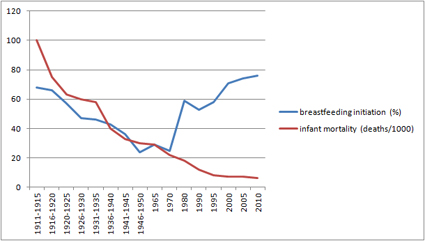
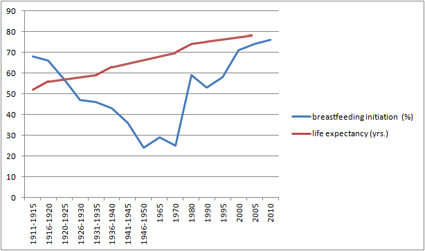
I shared these graphs last year, and they make the case quite powerfully.

breastfeeding and infant mortality

breastfeeding and life expectancy

breastfeeding and IQ

Over the past 100+ years US breastfeeding initiation rates have dropped precipitously and begun to rise again, but there appears to have been no impact on infant mortality, life expectancy or IQ. Sure breastfeeding provides benefits in industrialized countries, but those benefits are trivial.

So Dixley’s unrelenting viciousness toward women who can’t or don’t want to breastfeed rests on precisely NOTHING. It’s as though her entire blog were devoted to demonizing women who don’t buy the same type of car that she drives. She’s vicious because she is desperate to have her own choice mirrored back to her, not because her choice actually matters. And she utterly misrepresents that nature of the choice, the science behind breastfeeding, and the reasons why people oppose her.

It’s easy for her to go after women who chose to formula feed as trying to excuse their “failure” to breastfeed, but she can’t seem to account for the fact that someone like me, who easily and successfully breastfed four children would vociferously reject both her claims about breastfeeding and her vicious way of making them.

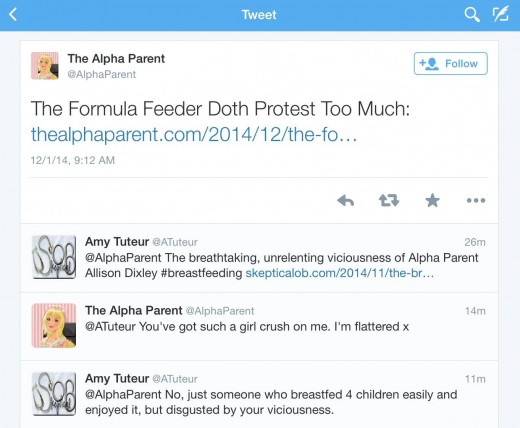
Dixley Twitter 12-1-14

It’s hardly surprising that I don’t support Dixley, given my claims that lactivism, like most of natural parenting is not based on scientific evidence and that the emphasis on time intensive parenting that requires the presence of the mother 24/7/365 is retrograde and sexist. But then I got to thinking about who does support Dixley, and besides her followers who are equally desperate to have their own choices mirrored back to them, she is supported by … NO ONE.

With her message of the vital importance of breastfeeding to the health and well being of children, you might expect that she would garner the support of professional lactivists. I could find no evidence that Dixley’s stance is supported by any professional breastfeeding organizations, any lactivism programs, or, any major authors in the field whether they write for lay people or for other professionals.

Dixley’s new book, Breast Intentions, has no blurbs from other lactivists, pediatricians or public health experts. Thus far, a week after it has been published in the UK, the book has received no professional reviews. As of this morning, there hasn’t been a single positive comment on Amazon UK or Amazon.com.

It’s as if (to appropriate the crude language of Dixley herself) the book is like “a fart trapped in an the elevator,” a repulsive eruption of which everyone is doing their best to ignore, in the hope that it will simply fade away.

When considering Dixley’s writing, both on her blog and in her book, readers would do well to keep in mind that her opinions are her own and are not supported by any breastfeeding organizations, lactivism programs or healthcare professionals. If professional lactivists shun Dixley and her viciousness, and they do, everyone else should, too.

The breathtaking, unrelenting viciousness of Alpha Parent Allison Dixley’s book Breast Intentions

iStock_000013866130Small

You don’t have to be Freud to recognize that someone who dubs herself The Alpha Parent, and doesn’t have her tongue firmly implanted in her cheek, has self-esteem issues. And we’re all quite familiar with the sanctimoniousness of lactivists. But even I have to admit to surprise at the brutal, toxic and abusive nature of Allison Dixley’s new book Breast Intentions; How women sabotage breastfeeding for themselves and others.

I can’t say I wasn’t warned. On her Facebook page, Dixley heralded the publication of the book with this:

Dixley

Forget pussy-footing around “feelings.” Get some of this in your eyeballs. My new book Breast Intentions, available worldwide on Tuesday!”

I bought it, laid my eyeballs on it, and quite honestly was filled with … glee. As so often happens, no one does a better job at destroying the credibility of lactivists and exposing their true agenda than lactivists themselves. Dixley has staked her breasts as the two hills she’s willing to die on and no one could be happier than me.

The publisher, Pinter and Martin, has helpfully posted the full introduction to the book on line, so everyone can understand that Breast Intentions is a cri de coeur, trumpeting Dixley’s conviction that women who don’t breastfeed their infants should be consigned to a living hell of soul sucking guilt. Every page of the book, including the introduction oozes with contempt.

It starts on the very first page, in only the second paragraph:

Many women having babies today were formula-fed as infants. And the world around them is dominated by perceptions of infant feeding that can only be described as regressive: as a species, we have moved from the uncostly, self-regulating and environmentally friendly breast to the unquenchable industrial teat – a capitalist’s dream.

And Dixley knows just whom to blame: mothers!

The argument that individual women aren’t responsible for their failure to breastfeed appears plausible, comprehensible and consistent with the timeless and persistent world-view of women as the weaker sex…

Yet this response to a normal bodily function is needlessly reactive and awkwardly paternal. A blame-free breastfeeding culture infantilises women, framing them not as active agents capable of controlling their destiny and achieving their goals, but as passive wallflowers at the mercy of forces they are powerless to defy.

Dixley comes across like a nightmare version of a mother-in-law. Sure she’s blaming you for your failure as a mother, but it’s for your own good! She’s not going to “infantalize” you by demonstrating any of those sissy virtues like compassion and understanding.

Sociological theories would have us believe the answer lies in factors beyond the mother’s control – fetishism of the breast, formula-company advertising, vague notions of ‘lack of support’ and ‘a disabling social environment’ – in other words, we are led to believe that individual mothers are not responsible for the outcome of their attempts at breastfeeding. This assumption is defeatist and disempowering.

At times, Dixley’s prose reads like parody:

‘Social support’ is the buzzword of this apologetic era and dominates breastfeeding discourse. Yet social support is a broad umbrella term that can be conceptualised in so many different ways that it becomes redundant as a definition. Even so the term persists, hanging around like a fart trapped in an elevator. And, like a fart, the ‘support’ rhetoric functions as a comforting if elusive scapegoat, nifty at deflecting attention from other salient issues …

Dixley makes it clear that she is not one of those wishy-washy lactivists who euphemize their condemnation of women who can’t or won’t breastfeed as “support.” Their support reeks like a fart in an elevator. Dixley believes that what is needed is exhortations laced with casual cruelty, because the goal ought not to be to understand women who can’t or don’t wish to breastfeed, but rather to condemn them in the most vicious possible terms.

Dixley does use humor, though inadvertent:

The philosopher Nietzsche warned that we are most clueless about what is closest to us… Emotions drive our behaviour, yet we have a relatively ignorant understanding of them. If we want more women to choose breastfeeding in the ‘real world’, then we need to understand more about ‘real women’ – that is, women influenced by emotion.

You don’t say, Allison!

Neitzche also said:

You have your way. I have my way. As for the right way, the correct way, and the only way, it does not exist.

But introspection is the last thing on Dixley’s mind (obviously!).

In Breast Intentions you may read things you would prefer not to. Indeed, there is a darker, more malignant side to the breast vs formula debate, particularly concerning women’s relationships with each other. This book exposes the unforgiving and angry constituents of the maternal character, revealing a mother’s capacity to deprave as well as to nurture. In exploring the mechanics involved in deception, guilt, envy, contempt, defensiveness and sabotage, the book penetrates emotions that often feel too ugly or too unacceptable to talk about, particularly in such a feminine domain. Yet this dark and opaque side of motherhood is one we leave untreated at our peril.

I agree, Allison.

Your deception, envy, contempt and defensiveness positively “reek” from every sentence that you write. And believe me when I say that I don’t view YOUR feelings as too ugly or unacceptable to talk about in a feminine domain. Indeed, I believe that the ugly emotions that you display, and the casual cruelty that hides your fundamental insecurity, are precisely what we SHOULD be talking about when we talk about contemporary breastfeeding advocacy.

Let me emphasize that I speak about your viciousness from the perspective of someone who breastfed four children until they weaned themselves, and I enjoyed it. But just because I did it doesn’t make me a better mother than anyone else who loves her children with her whole heart, indeed her entire being, as most women do. And that means it doesn’t make you a better mother, either, no matter how desperately you cling to that fiction.

Breast Intentions is breathtakingly, relentlessly vicious because Allison Dixley is breathtakingly, relentlessly vicious. She is the poster girl for everything that is wrong with professional lactivism, and I couldn’t be more delighted.

This year the holidays came early to The Skeptical OB; I suspect that Breast Intentions is the gift that will keep on giving.

The antediluvian sexism of the lactivist movement

bearing and breastfeeding babies

Lactivism, like all natural parenting, suffers from three serious flaws:

1. It perverts the scientific evidence to support pre-approved conclusions
2. It is an industry that relentlessly markets its own services
3. It is deeply sexist and retrograde

Don’t believe me? Consider this latest attempt by lactivists to move the goal posts, appearing in the Pacific Standard, The Unseen Consequences of Pumping Breast Milk. Sounds ominous, doesn’t it … and it’s meant to.

Exclusive pumping is becoming more popular among American moms, often seen as a way moms can “have it all.” Meanwhile, the effects on maternal and infant health—and workplace policies—are rarely discussed.

You thought that breastfeeding made you a good mother? Fool! The only good mother is one who sacrifices her career and her income to stay home 24/7/365 with her baby.

Problematically, the rise of pumping also implies that moms don’t need as much time at home to spend with their babies—they can simply pump, store, and go back to work. What most moms may not know is that beneath the perceived convenience of pumping, there are potential consequences both for workplace norms and for the health of themselves and their infants. There’s an assumption that bottle-feeding breast milk to a child is equivalent to breastfeeding, but that may not be the case.

Oh, the horror! Women don’t have to be with their babies 24/7/365 in order to provide them with the benefits of breastmilk. That can’t be right; there must be some way we can make women who work feel that they are not giving their children the very best, and not so incidentally, proclaim the overweening sense of superiority of lactivists. Hence the claim that feeding a baby pumped breast might MAY not be the same as breastfeeding.

It’s a trifecta! Lactivists have managed to pervert the scientific evidence, market their own services and advance their antediluvian sexism all in a single claim.

Let’s take a look at the scientific evidence, but before we do, let’s examine what we would need to see in order to conclude that pumped breastmilk is inferior to the breastmilk of women who love their babies enough to stay home instead of putting their own trivial, selfish need for income and/or career on hold.

That’s going to be hard to do since in industrialized countries the benefits of breastfeeding are trivial, amount to nothing more than a fewer episodes of colds and diarrheal illness among infants in the first year. You’d have to show that the babies whose mother fed them breastmilk exclusively and never pumped were appreciably healthier than those who received pumped breast milk.

Are there any studies that demonstrate this? Of course not, since it isn’t true.

What evidence does the author of this piece marshal to support her assertion?

There’s a commentary in a public health journal that makes the bizarre claim that:

Milk expression may also be problematic for mothers, and it may be particularly problematic for infants if they are fed too much, fed milk of an inappropriate composition, or fed milk that is contaminated. (my emphasis)

The authors then proceed to offer NO EVIDENCE that this is happening.

Nonetheless, they offer the truly obnoxious suggestion that:

To characterize women’s behavior related to milk expression, it may be necessary to develop a new vocabulary for breastfeeding so as to distinguish milk extracted from the breast by the baby from that extracted by a pump for feeding to the baby at a later time.

Wouldn’t want those selfish, self-absorbed, career- women who are pumping to imagine that they are providing “real” breastmilk, would we?

Then there is a commentary in The Journal of Human Lactation entitled New Insights into the Risk of Feeding Infants by Bottle discussing a study published elsewhere.

[T]hose who received human milk by bottle only gained 89 g (P = .02) more than their breastfed only counterparts, respectively.

So babies fed breastmilk from a bottle reportedly gained of 3 ounces/month more than babies who received breastmilk directly from the breast. That’s not very impressive when you consider that the babies’ weights were based on maternal recall and may not be accurate.

That’s it. No other data was presented to support the claim that there is any difference between breastmilk from a bottle and breastmilk from a breast. That doesn’t stop lactivists:

“Promotion of breast-milk feeding as identical to breastfeeding is misleading,” says Virginia Thorley, a lactation consultant and honorary research fellow at the University of Queensland in Australia. “The new challenge is to use language accurately, and tell mothers the truth that feeding their milk to their babies by bottle is less than equivalent to breastfeeding.”

Thorley has written extensively on the potential perils of “normalizing” the separation of breast milk from breasts. She says that bottle-feeding of breast milk has a place in specific circumstances, such as when a baby is unable to adequately stimulate the mother’s milk supply, or in cases like Boss’, where a baby is unable to nurse directly. And while she agrees bottled breast milk is better than infant formula, “breastfeeding is about more than the milk.” Babies don’t just breastfeed for nutrition; they nurse for comfort, closeness, soothing, and security.

And what “perils” might those be. Thorley doesn’t mention any, but we can guess. One peril is that women who pump instead of breastfeed might not need the services of a lactation consultant. Lactation consultants have a habit of making claims that result in profit for themselves. They grossly exaggerate the benefits of breastfeeding; they grossly exaggerate the “risks” of formula feeding. They attempt to punish women who will never be their clients by banning formula gift bags, locking up formula in hospitals, and denigrate women who can’t or won’t breastfeed.

The chief peril, of course, is that “normalizing” the separation of breast milk from breasts actually normalizes working while mothering. And we all know that “good” mothers never work. “Good” mothers give up income, career and self-actualization in favor of staying home, having babies (vaginally, without pain medication, of course!), breastfeeding (no pumping allowed), baby wearing, and welcoming them to the family bed. “Good” mothers judge themselves and others by the functions of their breasts, vaginas and uteri. Their intellect and their character are irrelevant.

The piece concludes with a flourish of the viciousness for which lactivism has become known:

The three infant-feeding options available—formula, pumped breast milk, and breastfeeding—likely fall on a continuum of good, better, best… For parents who have the luxury of truly choosing any feeding method, it’s fine to choose exclusive pumping in the same way that it’s fine to choose formula, as long as they understand the differences in health outcomes. The problem is that for exclusively pumped milk, moms need to understand there’s still a lot we don’t know.

“I feel like I both succeeded and failed. Many moms can’t or won’t exclusively pump for as long as I did, but I still feel like I failed at breastfeeding,” Boss says. “I realize I did the best that I could. And that’s all our kids can ask from us.”

There is NO EVIDENCE that feeding babies pumped breast milk is in any way inferior to breast milk directly from the breast, but the dirty little secret of lactivism is that it has nothing to do with babies or even with breastfeeding. Lactivism is all about lactivists and their desperate need to feel better than other mothers, about hating and hurting women who make choices different than theirs, and it rests on an antediluvian, sexist conviction that a woman’s place is in the home, bearing (vaginally! without pain medication!) and nourishing babies, and ignoring their own wishes and needs.

The fact that such shaming aligns with their never ending attempts to market their services is purely coincidental.

Early results from the “bribe a woman to breastfeed” trial

iStock_000018897915XSmall

I first wrote about the “bribe a woman to breastfeed” trial a year ago.

Bribing women will create a culture where breastfeeding will be seen as the norm?

Earth to lactivists: if you have to bribe someone to do it, you are sending the exact OPPOSITE message. You are sending the message that it is difficult, expensive and distasteful. Otherwise you wouldn’t be offering bribes.

The early results are in and lactivists are calling them promising, but if this is what “promising” looks like, I’d hate to see failure.

According to the BBC:

Initial results of a controversial scheme offering shopping vouchers to persuade mothers to breastfeed have shown promise, researchers say.

Mothers in three areas of Derbyshire and South Yorkshire where breastfeeding rates were low – between 21% and 29% – were offered vouchers of up to £200…

Of the 108 eligible for the trial scheme, 37 (34%) earned vouchers for breastfeeding at six-to-eight weeks…

Of the mothers eligible for the scheme, 58 signed up.

So let’s see if I get this straight. They raised the breastfeeding rate from approximately 25% to 34%. If 108 women were eligible, that means they raised the number of women breastfeeding from 27 to 37; 10 additional women breastfed for 6-8 weeks who might not have done so.

How much did it cost? At £200 ($300) per participant, it cost $11,100.

In other words, the government spent $1100 PER WOMAN to increase the breastfeeding rate and the bulk of that $1100 went to women who were planning to breastfeed anyway.

Dr Clare Relton, from Sheffield University’s School of Health And Related Research public health section, is running the scheme, part of a four-year research project.

She said: “The UK has one of the worst breastfeeding rates in the world – yet it gives better health outcomes to mums and babies, and saves the NHS money.

“We think this idea has the potential to increase breastfeeding rates in the UK, but we don’t have enough information yet.

“So we are conducting a large-scale trial [4000 women] to help us find out how acceptable and effective the scheme is – and whether it would a good use of public money in the future.”

How much will it cost the government to reproduce these “promising” results on a large scale?

Out of 4000 women, we would expect 2148 women to sign up and 1,360 women to successfully breastfeed for 6-8 weeks, compared to 1000 women who would have breastfed anyway. At £200 ($300) per participant, it would cost the government $408,000! Of that amount, fully $300,000 would go to women who were planning to breastfeed anyway.

There is no possible way that an investment of more than $400,000 can be justified by getting 360 additional women to breastfeed for 6-8 weeks. The pediatric health savings from such short term breastfeeding are likely to be negligible, if they exist at all.

This scheme is all the more odious when you consider that the government is struggling to pay for obstetric care. According to SkyNews:

Between April and September 2012, more than a quarter (28%) of maternity units were forced to close their doors to patients for at least half a day because of a lack of space or a shortage of midwives.

Of these units, 11% closed for the equivalent of a fortnight or more, the report found.

The result?

A fifth of maternity services funding is spent on insurance against malpractice, according to a review by the National Audit Office (NAO).

The report found the NHS in England spent £482m on clinical negligence cover in the last year – the equivalent of £700 per birth.

The most common reasons for maternity claims are mistakes during labour or caesarean sections and errors resulting in cerebral palsy, the review said.

For $408,000 you could hire a few more midwives. Which is likely to have a greater impact on perinatal health? Hiring the midwives, of course.

So why are lactivists pushing a program that costs a fortune and has few, if any demonstrable health benefits? It’s because it is yet another way for them to get women to validate lactivists by having their own choices mirrored back to them. In addition, it is a fabulous way for them to demonstrate their contempt for women who bottle feed.

I’m not the only person who has questioned the wisdom of bribing low income women to breastfeed.

As Eliane Glaser points out in The Guardian, It’s class, not whether a baby is breastfed, that determines life chances:

The scheme’s supporters cite the power of financial reward to trump social conditioning, but that undermines the claim that the women are acting as free agents. If the women are regarded as entirely self-determining, then the conclusion must be that their reason for not breastfeeding is a negligent lack of inclination.
Advertisement

Thus what appears to be a straightforward transaction sends a set of troubling messages to the women in the study and beyond. It begs the question of why middle-class mothers are so in tune with what’s best for baby that they don’t need incentivising. And it reinforces the guilt felt by mothers who have problems breastfeeding, or for whatever reason choose not to do it. The implication for them is that the controversy generated by the voucher scheme must be worth it. Not only is breast best; formula must be actually harmful.

Her critical points:

But the scientific evidence is not what it seems. The only really consistent finding is that breastfeeding reduces a baby’s chance of getting a stomach bug. The protection only lasts for as long as you breastfeed. And it’s not clear whether the protection comes from something in the breast milk or from not using dirty bottles. The other supposed benefits are derived from contradictory and disputed evidence, suggesting that what is at stake in a country such as the UK with access to clean water, is not so much medical outcomes as an idealised version of motherhood that serves to stigmatise working-class women…

The more that social and educational background is taken into account, the smaller the differences between breast and bottle become. Crudely speaking, researchers see that children who were breastfed turn out better and regard breast milk as the determining factor, when it might well be because they’ve been given organic kale and flute lessons. When Clare Relton, who led the voucher scheme, defends it by saying that “not breastfeeding is a cause of inequality”, she is putting the cart before the horse. Class determines whether or not you breastfeed, but being breastfed doesn’t make you middle-class. (my emphasis)

The bottom line is that bribing women to breastfeed is extraordinarily expensive, offers no demonstrable health savings, ignores the real reasons for difference in health among social classes, and reinforces the stigmatization of women who don’t validate lactivists by mirroring their own choices back to them.

If that’s success, I’d hate to see failure.

Ricki Lake has blood on her hands … and now she’s going to add more

iStock_000017655723XSmall

Dear Ms. Lake,

According to The New York Times:

One of the most talked about and provocative documentaries about childbirth is having its own rebirth.

“The Business of Being Born,” the 2008 film by the former talk show host Ricki Lake questioning the American medical system’s approach to childbirth and presenting the benefits of home birth, will be rereleased digitally in late January, becoming available globally for the first time. The updated version of the documentary, which also spawned a DVD series and a book, will include interviews with celebrities like the actress and model Stacy Keibler who were swayed by the film and, like Ms. Lake, gave birth at home.

I’ve noticed that you have been quick to claim credit for a rising number of homebirths:

The impact of the documentary was monumental. The blogosphere blew up (I can handle a few people yelling at me if it means my message is being heard!) Every day women stop me on the street to share stories of their safe, successful, meaningful births. Many say they felt “in the dark” about their options until seeing The Business of Being Born …

I wonder if you’re also willing to accept blame … for the babies and mothers who have died because they believed your nonsense.

What do you say when women stop you to share stories of their dead babies, babies who died because their mothers saw your movie and believe that homebirth was safe and empowering? What do you say when they share their stories of a ruptured uterus, a breech baby with a trapped head, a severe shoulder dystocia? What do you say when they tell you how their “midwife” encouraged them to labor for days and push for hours, all the while unaware that the baby had died from the stress of labor?

What do you tell them, Ms. Lake? How do you explain why you ignore the large and growing amount of data and statistics that show that homebirth leads to the preventable deaths of babies who didn’t have to die?

I know, and perhaps you know, too, that in January 2014 the Midwives Alliance of North America (MANA), the organization that represents homebirth midwives, published their landmark “study” (actually a non-representative survey of less than 30% of their members completed 5 years ago) claiming that homebirth is safe but ACTUALLY showing that homebirth increases the risk of perinatal death by 450%.

Hospital vs

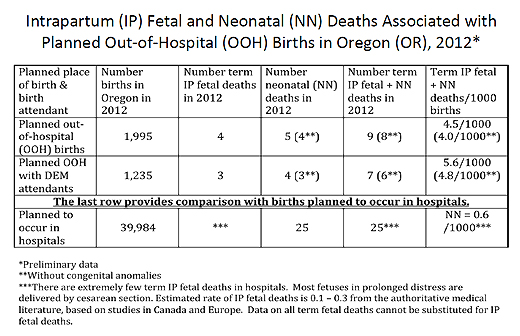
In March 2013, Oregon released an analysis of homebirth deaths prepared by Judith Rooks, CNM, MPH that showed that PLANNED homebirth with a LICENSED Oregon homebirth midwife had a death rate 800% higher than comparable risk hospital birth.

Oregon homebirth death rates 2012

In June 2013, Grunebaum et al. demonstrated that homebirth increases the risk of a 5 minute Apgar score of zero by nearly 1000%.

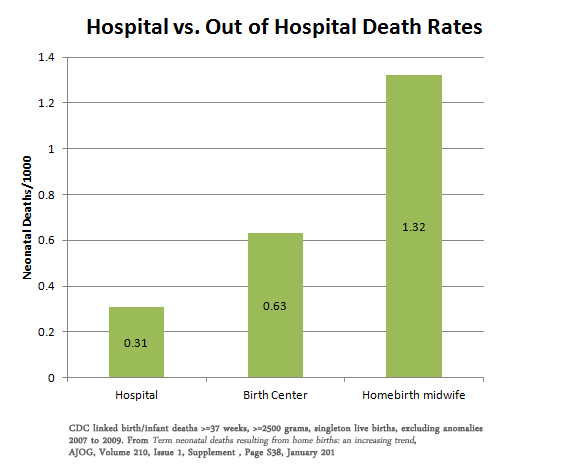
In February 2014, he presented data showing that homebirth has a 4X higher risk of neonatal death than comparable risk hospital birth:

Hospital vs Out of Hospital Death Rates

In January of 2014, Wasden et al. demonstrated that the risk of anoxic brain injury is more than 18 times higher at homebirth than comparable risk hospital birth.

And those are just the highlights. Other papers and datasets were also published and all, without fail, showed that homebirth has a death rate 3-9 X higher than low risk hospital birth.

Let’s be honest, Ms. Lake, the homebirth industry ignores safety in order to make money and you are the leading example, as you mentioned in explaining why you made BOBB in the first place:

She said that she made the film because she was contemplating her legacy after the September 11th attacks, and that her only goal was not to lose money.

Indeed, you turned homebirth into an industry, both for yourself and others. There’s an entire industry of homebirth midwives [unlike real American midwives (CNMs), homebirth midwives (CPMs, LMs, DEMs, lay midwives lack the education and training of all other midwives in the first world], doulas, childbirth educators, birth pool rental services, etc. profiting by risking babies lives, and just like you, Ms. Lake, they take no responsibility for the death and destruction they leave in their wake.

Ms. Lake, you ought to set some of your profits from YOUR business of being born (books, DVDs, etc) into a no-fault compensation fund for those parents who have lost babies at a homebirth. I’m not sure how much money would be available for each family, since, unfortunately, there is a large and growing number of such families, and I don’t know if would be enough to cover the millions of taxpayer dollars that are going to be spent caring for the babies who were left brain damaged by homebirth. Nonetheless, it seems to me that it is the least you could do.

But if you don’t plan to take responsibility, and I’m not holding my breath because I would turn awfully blue, the very least you could do is amend your film, books and website to reflect the increased death rate of homebirth. I don’t doubt that you were unaware of the dangers of homebirth when you started, but you can’t be unaware now. It doesn’t take any specialized knowledge to count the growing number of dead babies, babies who died preventable deaths because their mother listened to you. But if you don’t correct the mistruths, half truths and outright lies in the original issue of BOBB, any money you make now is just blood money.

Sincerely (and with a great deal of sadness and anger),

Amy Tuteur, MD