All posts by Amy Tuteur, MD

Did the homebirth rate really rise?

iStock_000006518803XSmall

Ahhh, the power of the press release.

Evidently the folks in the PR office of the “journal” Birth: Issues in Perinatal Care have been working overtime. They’ve sent out thousands of press releases touting the latest study by MacDorman and colleagues purporting to show the the rate of homebirth in the US has risen 20% (from a teeny, tiny number to a bigger teeny, tiny number) during the years 2004-2008.

The public relations campaign that is promoting the paper implies that there has been a meaningful and substantial increase in the rate of planned homebirths in the US as a direct result of women rejecting hospitals and hospital based interventions. Is that what the paper shows? Not exactly, not least because it doesn’t even bother to distinguish between planned and unplanned homebirths.

Marian MacDorman et al., authors of the paper, United States Home Births Increase 20 Percent from 2004 to 2008, claim:

In 2008, there were 28,357 home births in the United States. From 2004 to 2008, the percentage of births occurring at home increased by 20 percent from 0.56 percent to 0.67 percent of United States births. This rise was largely driven by a 28 percent increase in the percentage of home births for non-Hispanic white women, for whom more than 1 percent of births occur at home. At the same time, the risk profile for home births has been lowered, with substantial drops in the percentage of home births of infants who are born preterm or at low birthweight, and declines in the percentage of home births that occur to teen and unmarried mothers. Twenty-seven states had statistically significant increases in the percentage of home births from 2004 to 2008; only four states had declines.

But even a brief glimpse at the methods used by the authors to calculate the rate of homebirths reveals that numbers quoted are nothing more than “guesstimates” based on proxies for real data.

In order to accurately determine the number of planned homebirths in the US, we’d need to know the number of women who planned to have a homebirth and successfully did so, the number of women who planned to have a homebirth and ultimately delivered in the hospital, as well as the numbers of babies who were born dead during homebirth. That’s not what the authors looked at.

MacDorman and colleagues looked at birth certificates to determine whether a birth occurred inside or outside of a hospital. In fact, the authors used the exact same technique used in part of the Wax study, a technique bitterly criticized by homebirth advocates specifically because it failed to distinguish between planned and unplanned homebirths.

So what did the authors actually find? They discovered that in 2004 there were 23,150 births that took place outside the hospital and in 2008 there were 28,357 births. Then the authors made a leap of faith, or rather several leaps of faith. MacDorman et al. ASSUMED the ratio between planned and unplanned homebirths remained the same from 2004 to 2008. They ASSUMED that the rate of hospital transfer during planned homebirth remained the same from 2004 to 2008. They ASSUMED that the death rates of planned homebirth remained the same from 2004 to 2008.

Those are big assumptions to make about a dataset composed of very small numbers (relative the to overall number of births). It is entirely possible that some portion of the purported “increase” that they observed reflected NOT an increase in the number of planned homebirths, but an increase in the number of unplanned homebirths. It is equally possible that some portion of the purported “increase” that they observed reflected NOT an increase in the number of planned homebirths, but a decrease in the number of hospital transfers. It is equally possible that some portion of the purported “increase” that they observed reflected NOT an increase in the number of planned homebirths, but a decrease in the number of homebirth deaths. And, of course, it is very possible that a substantial proportion of the purported “increase” in planned homebirths actually reflects some combination of the three.

The authors are anything but subtle in their motivation for publishing this study. They announce their motivation in the abstract:

Conclusion:  The 20 percent increase in United States home births from 2004 to 2008 is a notable development that will be of interest to practitioners and policymakers.

In other words, this is an attempt to convince policy makers that the rate of planned homebirth is rising and that, therefore, there is a demand for more homebirth practitioners.

If that wasn’t clear enough, the “journal” Birth released the article on-line four months before actual publication. How ironic is that? Homebirth advocates, the very same people who bitterly criticized the early on-line publication of the Wax study and denounced it as an attempt to influence public policy respond by attempting to influence public policy with an article published online even farther in advance.

Of course, the MacDorman paper fails utterly to address the most serious concern about homebirth, the increased risk of perinatal death. The authors enthusiastically boast that the rate of “homebirth” has risen without bothering to find out how many babies died in the process.

That’s fairly typical in the world of homebirth advocacy. And increase in homebirth rates is a cause for celebration. Who cares how many babies died as a result?

Complaining that obstetricians “play the dead baby card”

From a recent thread on Mothering.com claiming that doctors play the “dead baby card” with women who are postdates.

I felt exactly as you did around 36 weeks pregnant with my VBAC attempt. I had already switched DRs around 20 weeks to a group of Family Practice doctors that are probably the most VBAC friendly in the area… I watched Business of Being Born and really started feeling like the only way I’d get a VBAC was with a homebirth midwife. Unfortunately, DH was NOT on board with that idea and I felt like it was “too late” to make such a drastic switch. I really should have listened to my instincts… The switch in their attitude around 41 weeks was shocking. When I wouldn’t agree to an induction I was told I was risking fetal death and they couldn’t be responsible for that – basically the next week was spent scaring me into a bunch of testing where they found a reason to induce me and even with the help of a doula, I wasn’t able to avoid ending up with another failure to progress c-section. I later learned that their license and hospital privileges can be called in to question when they “let” a woman go to 42 weeks. Obviously, there utmost concern remained with what was best for them …

After that experience and the regret of not trusting my instinct, I told DH that we’d be having no more babies unless I was able to plan a homebirth for the next one. I’m full-term with baby #3 and hoping to have an awesome HBA2C story in the next month! No matter how the birth turns out, I appreciate having a care provider who understands that each pregnant mother is an individual who is capable of researching and making her own decisions about “HER” body and child…

The mother began labor spontaneously at 41 1/2 weeks, labored for 24 hours and apparently delivered vaginally the day before yesterday.. The baby was born not breathing. Subsequent evaluation revealed meconium aspiration and catastrophic brain damage due to lack of oxygen. The decision was made to take the baby off life support.

The baby is dead.

Midwife lets baby die, breaks law, pleads guilty to felonies; I think I’ll hire her

According to a recent piece in The Washington Post, certified professional midwife Karen Carr boasted in the wake of her guilty plea in connection with the entirely preventable death of a baby in her care, her phone is ringing off the hook with women wanting to hire her.

It can’t be because of her safe midwifery practices; it can’t be because she abides by the law; and it certainly can’t be because the trail of dead babies in her wake demonstrates that homebirth is safe. So why hire her? And why hire her now?

Such seemingly inexplicable behavior is reminiscent of the response of cults when their predictions prove entirely false.

In a fascinating article in Mother Jones (The Science of Why We Don’t Believe in Science), the author offers the classic tale of psychologist Leon Festinger’s research on a doomsday cult after its prediction for the end of the world proved false:

… [T]he aliens had given the precise date of an Earth-rending cataclysm: December 21, 1954. Some of Martin’s followers quit their jobs and sold their property, expecting to be rescued by a flying saucer when the continent split asunder and a new sea swallowed much of the United States. The disciples even went so far as to remove brassieres and rip zippers out of their trousers—the metal, they believed, would pose a danger on the spacecraft.

Festinger and his team were with the cult when the prophecy failed…December 21 arrived without incident. It was the moment Festinger had been waiting for: How would people so emotionally invested in a belief system react, now that it had been soundly refuted?

At first, the group struggled for an explanation. But then rationalization set in. A new message arrived, announcing that they’d all been spared at the last minute. Festinger summarized the extraterrestrials’ new pronouncement: “The little group, sitting all night long, had spread so much light that God had saved the world from destruction.” Their willingness to believe in the prophecy had saved Earth from the prophecy!

… In the annals of denial, it doesn’t get much more extreme than the Seekers. They lost their jobs, the press mocked them, and there were efforts to keep them away from impressionable young minds. But while Martin’s space cult might lie at on the far end of the spectrum of human self-delusion, there’s plenty to go around…

In other words, in the wake of evidence that their fundamental beliefs were false, cult members responded by ignoring the evidence and attempting to explain how the fact that their beliefs were shown to be false, actually proved them to be true!

Sound familiar? It sounds distressingly like the response of homebirth advocates whenever their fundamental beliefs are shown to be false. If the Karen Carr disaster demonstrates nothing else, it demonstrates that homebirth practitioners are reckless, that intuition (of both mother and midwife) is useless, and that far from being as safe as hospital birth, homebirth increases the risk of neonatal death. How have homebirth advocates responded? Many have responded by insisting that the demonstration of Karen Carr’s incompetence proves that she is competent, so competent, in fact, that they want to hire her.

Homebirth involves a cult-like belief in its safety despite any and all evidence to the contrary. Homebirth advocates crown “prophets” like Ricki Lake and Henci Goer, when there is no reason to believe their “prophecies” about anything, let alone homebirth. They repeat outright lies over and over again, even after the evidence demonstrates that they are repeating lies. And the more spectacular the demonstration that they are utterly wrong, the more they insist that being proven wrong actually proves that they have been right all along.

Hiring Karen Carr as your midwife is like insisting that the fact that the world did not end on the predicted day actually indicates that the prophecy was correct. It demonstrates a disturbing willingness to ignore reality in a desperate effort to justify an uneducated and obviously inaccurate system of belief.

No, homebirth advocates, babies don’t die in the hospital, too

In the wake of the Karen Carr homebirth debacle, homebirth advocates have trotted out a classic homebirth lie: “Babies die in the hospital, too.”

It’s time to set the record straight. No, homebirth advocates, otherwise healthy babies DON’T simply drop into the obstetricians hands unexpectedly dead. Otherwise healthy babies DON’T unexpectedly drop dead for lack of appropriate medical equipment and emergency personnel. The babies whose mothers would be eligible for homebirth (full term, no medical complications of pregnancy, no pre-existing medical conditions) hardly ever die during or after a hospital birth.

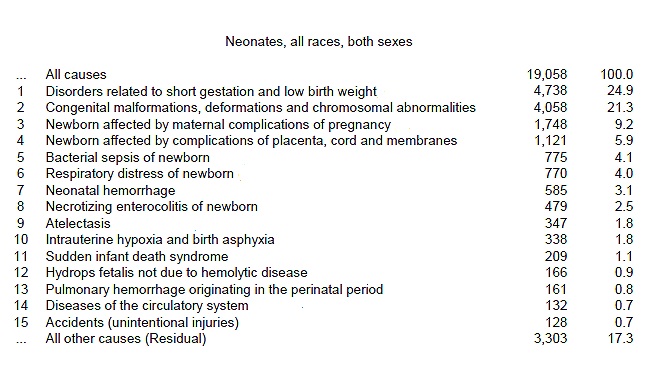
The following chart, adapted from Infant, neonatal, and postneonatal deaths, percent of total deaths, and mortality rates for the 15 leading causes of infant death by race and sex: United States, 2007 makes that clear. The chart shows neonatal death rates by cause.

image

As you can see from the chart, more than 50% of all neonatal deaths are due to prematurity and its complications (respiratory distress, necrotizing enterocolitis) and congenital anomalies. These babies, of course, are not otherwise healthy full term babies.

Consider the other major causes:

Maternal complications of pregnancy- not homebirth candidates
Complications of placenta and membranes (i.e. placenta previa, abruption, chorioamnionitis) – not homebirth candidates.

Together, these causes account for 68% of all neonatal deaths.

The fact is that neonatal death in otherwise low risk women in the hospital setting is quite rare. The best estimate that we can make based on CDC data is a neonatal death rate of 0.4/1000 in low risk, white women at term. That figure actually includes congenital anomalies, which account for nearly 50% of term deaths. In other words, the death rate for otherwise healthy babies is in the range of 0.2/1000 or 2 deaths for every 10,000 births.

Considering that there are approximately 10,000 CPM attended homebirths per year in the US, we would expect only two homebirth deaths per year. Yet in 2009 there were 4 neonatal deaths in the state of Colorado alone in 2009!

Otherwise healthy babies do not die in the hospital, too. Yes, “some” babies die, but those are born prematurely or born to women who would never have been candidates for homebirth.

Existing scientific studies and state and national data estimate that homebirth triples the rate of neonatal death, but that considerably under-counts homebirth deaths, which often appear in the hospital statistics, not the homebirth statistics. The real risk of homebirth is larger, possibly much larger.

Is it any wonder that MANA (the Midwives Alliance of North America) is hiding their homebirth death rates? Those death rates, which also under-count homebirth deaths, must be appalling indeed.

Dr. Amy calls in to the Kojo show

Yesterday, Washington DC based radio show hosted by Kojo Nnamdi explored the issue of homebirth:

A midwife in our region recently pled guilty to two felony counts in the death of a baby delivered at home. The case re-ignited a longstanding debate about “natural” versus “medicalized” birth. The American College of Obstetricians and Gynecologists note increased risks for both baby and mother in home deliveries. Natural birth proponents point to complications from hospital interventions that are often avoidable. We’ll explore the debate.

The guests included Mairi Breen Rothman, CNM; obstetrician David Downing, Brynne Potter, CPM, on Board of the North American Registry of Midwives (NARM); and Dr. George Macones of the American College of Obstetricians and Gynecologists (ACOG).

The discussion was exquisitely polite, with the participants talking past one another in an effort to get in their own talking points. No one questioned anyone on anything he or she said. Alerted about the show by a faithful reader, I called in. (You can read the complete transcript here.)

Nnamdi

Here is Amy in Boston, Mass. Amy, you’re on the air. Go ahead, please.

Amy

Hi. I have a question for Brynne Potter about certified professional midwife. I’m wondering why the Midwives Alliance of North America, which is the sister organization of NARM, is hiding the death rates for the 23,000 certified professional midwife-attended home births that they have collected in their database.

Potter

OK. Well, I can sort of speak — I can certainly speak to that that the MANA dataset that, I think, Amy is referring to is a private dataset that is not CPM’s exclusively. It’s not certified nurse midwives exclusively. It is simply a voluntary collection of data that is not specific to death rates, but specific to all information. And that information is available. Researchers can apply for that information. But mandated reporting — and I’m really speaking back to what Dr. Downing was just saying — mandated reporting review of outcomes really takes places on a state level under licensure and regulation.

And I completely agree with him that one of the benefits of licensure in all 50 states is having the option to create integrated systems in which perinatal review can happen that includes home birth. And it’s not just a review of bad outcomes, it’s a review of all outcomes. And an opportunity to really know what’s going on and what’s happening with birth isn’t just going to be a benefit to be able to analyze how we can make birth safer, but to optimize what systems of care are gonna give women the most choices.

Nnamdi

But I have to be more specific here, Brynne, because Amy specifically accuses your alliance of hiding the death rate of home birth. How do you respond to that?

Potter

Well, first of all, it’s not — she’s referring to the national midwifery organization, the Midwife she’s referring to the national midwifery organization, the Midwives Alliance of North America…

Nnamdi

Oh, I’m sorry

Potter

…that I don’t represent. So I can’t really speak to a specific about some assumption of hiding. What I would say is that MANA’s — I know MANA stands ready to meet the needs of any reporting mandate. It is a private data set in which isolated cases of death would only be isolated cases similar to this case that we’re talking about today. We wouldn’t be able to make any extrapolation of a trend to homebirth. The only place we can do that is from the CPM2000, which was a cohort study that mandated all CPMs to report in prospectively all of their data for one year. And that study was published in the British Medical Journal, and it is absolutely in line with outcomes of all other published studies around homebirth, which is…

What can we learn from Potter’s attempt to avoid answering the question?

1. Potter was familiar with the existence of the database and the refusal of MANA to release the death rates.

2. She asserted that MANA is not obligated to release the death rates because the database is private. It is not; it’s been offered publicly, but that’s irrelevant in any case. MANA knows the death rates of CPM attended homebirth and is keeping that information from American women.

3. Potter implies that the fact that participation in the database was voluntary means that the results are unreliable. I agree that the database almost certainly under-counts the number of deaths at CPM attended homebirth. The real number must be appalling if MANA refuses to release its best case scenario death rates.

4. She tries to claim that it doesn’t matter because mandated state reporting would be more accurate. That’s true; of course, in states like Colorado with mandatory reporting of homebirth deaths, the death rates are extraordinarily high.

5. Potter claims that she cannot address the issue because she is on the board of NARM, the sister organization of MANA, not MANA itself; yet despite that, she is completely familiar with MANA’s stance and can’t offer any justification.

6. She offers the Johnson and Daviss BMJ 2005 paper which is based on the MANA statistics of 2000. She neglects to mention that the paper is a bait and switch comparing homebirth with hospital birth in years extending back to 1969. She conveniently neglects to mention (perhaps she does not know) that the death rate for CPM attended homebirth in 2000 was triple the death rate for low risk hospital birth in the same year.

Potter deserves credit for deftly refusing to answer the direct question and offering a variety of different obfuscations. She would not have gotten away with it if I had been allowed to respond.

Nonetheless, she (and MANA) would have been better served if she had simply pretended that she didn’t know that MANA was hiding the death rates from 23,000 CPM attended homebirths. In essence, she publicly acknowledged the existence of the database, publicly acknowledged MANA’s refusal to release the death rates, and publicly acknowledged that the database almost certainly under-counts the number of babies who died at the hands of CPMs

Of note, she didn’t offer anything remotely approaching a justification for hiding the death rates of CPM attended homebirths from the public.

How narcissist Gina celebrates her child’s birthday

iStock_000016276403XSmall copy

One of the hardest tasks of parenting is recognizing that your child does not exist to validate you.

That means acknowledging that your child is a separate person, with talents, interests and needs that do not have to mirror yours.

It means that your son does not exist to achieve your dream of baseball stardom. It means that your daughter’s learning disability should not be ignored for fear that others will label her and thereby you as not perfect. And it means that your child should never, under any circumstances, be identified by whether or not HIS birth was the birth of of YOUR dreams.

Just in case you were still wondering whether Gina Crosley-Corcoran is really a narcissist, even after she lives blogged her homebirth and only allowed her sycophants to comment on it (Feminist Breeder doesn’t kill baby; supporters dazzled), Gina helpfully demonstrates that in her mind, it really is all about her.

The title of her current post is Happy 3rd Birthday to my 1st VBAC Baby, a post with all the subtlety of a sledgehammer:

Today is Julesy’s 3rd Birthday. 3 years ago today, my son gave ME one of the greatest gifts he could have, and that was MY first successful vaginal birth. Of course, I had my gorgeous, red-headed, perfectly healthy baby boy, and that was the ultimate prize — but the way he came into the world was a special gift in itself.(my emphasis)

What is wrong with this woman? Her 3 year old did not give her anything. Without ever consulting her child, she chose to risk HIS life by attempting a VBAC. Fortunately, it was successful, but the reality is that she put HIS life at risk in attempting to fulfill HER dream.

My son’s VBAC allowed me to have MY recent homebirth with MY choice of providers. If I’d had a second cesarean, it would have been very hard to find a provider willing to attend even a hospital VBA2C, and downright impossible to find any licensed provider in this state willing to attend a home VBA2C. I sincerely doubt I would have even tried to have a VBA2C if I hadn’t been able to vaginally birth the last time. My son’s VBAC very much meant that I’m sitting here with only one cesarean scar right now, instead of three. That’s huge. And for that huge gift, I will forever be grateful to that child for working with me the way he did. (my emphasis)

These paragraphs couldn’t have more “I’s” and “me’s” if it had been about her. Oh, wait, Gina thinks is about her.

No doubt this will come in really handy for her child’s therapist when he is an adult. It’s one thing to tell your therapist that your mother is a narcissist, that she sees everything through the prism of her own needs. It is another thing altogether to be able to provide permanent documentary evidence that she couldn’t even celebrate your birthday without repeatedly referencing herself, her needs, and whether they were or were not met.

Consider this definition of a narcissistic parent:

The narcissistic parent regards his or her child as a multi-faceted [s]ource of [n]arcissistic [s]upply. The child is considered and treated as an extension of the narcissist. It is through the child that the narcissist seeks to settle “open scores” with the world. The child is supposed to realise the unfulfilled dreams, wishes, and fantasies of the narcissistic parent…

As the therapist will be able to explain, Gina considers this child as the one who allowed her to “settle the score” when deprived of a vaginal delivery with her first child. And by “giving her” a hospital VBAC, the child allowed her to have a homebirth and allowed her to take her self-obsession to masses, live blogging what most people consider to be an intimate moment.

I have a personal message for Gina. She may ignore it, but no doubt she will read it:

Gina, take a long, hard look at yourself and the way that you treat your children. It’s okay to want attention; it’s okay to have needs and try to get them met. However, it is not okay to view your children through the prism of those needs, particularly the desperate needs you seems to have for attention and for validation.

Your son did not “gift you” with a VBAC, and your daughter did not “gift you” with a homebirth. And most importantly, your eldest child did not fail to “gift you” with the validation that you crave. They were born, through no agency of their own and with no intention to meet or not meet your needs.

It is wrong, wrong, wrong to expect your children to serve your needs. Adults should look to other adults for attention. And when it comes to validation, adults should enter therapy if they feel they lack the inner resources to provide their own validation.

Talk to your husband, talk to your friends, talk to a therapist. Don’t talk to your children about your needs and absolutely, positively do not create a permanent, written record of whether or not they met your needs (which is not their job, in any case).

Your children are not here to meet your needs. You are here to meet THEIR needs. Their number one emotional need is to be valued for who they are, not what they’ve done for you lately.

And next year, when your son celebrates his 4th birthday, see if you can celebrate with him, instead of celebrating yourself at his expense. His birthday is about him, not about you. The sooner you learn that, the better for all your children.

Baby’s position wasn’t the problem; problem was the baby’s head became stuck.

Homebirth midwife Karen Carr forgot Mark Twain’s famous admonition: “It is better to keep your mouth closed and let people think you are a fool than to open it and remove all doubt.”

It wasn’t enough to let her actions speak for her after they led to the entirely preventable death of a baby at homebirth. It wasn’t enough to let her actions speak after she had plead guilty to felony charges in exchange for avoiding a manslaughter trial. Apparently, she felt she had more to say, so she gave an interview to The Washington Post. You can read the interview here: Midwife Karen Carr, convicted in Alexandria baby’s death, is under investigation in Md.

Ms. Carr’s observations on homebirth and the deaths over which she has presided (there have been more than one) have ignited a firestorm of protest. In the nearly 300 comments to data, most readers have expressed their horror at Carr’s cavalier attitudes toward neonatal death at homebirth.

Carr’s guilty plea to felony charges came in the wake of presiding over the death of a breech baby who’s head became stuck for more than 10 minutes before Carr even bothered to call 911.

The baby’s position wasn’t the problem, Carr said; the problem was that the baby’s head became stuck.

That is the obstetric equivalent of insisting that ‘it wasn’t the fact that I pushed him off a ten story building that killed him; the problem was that he hit the ground.”

It’s nothing more than a brazen attempt on Carr’s part to avoid responsibility for the choices that SHE made and the actions that SHE took. The mother had been counseled by every other medical provider to have a C-section precisely to avoid the “problem” of a trapped head and the neonatal death that is the nearly inevitable result.

According to prosecutors, it was this unwillingness to accept responsibility that led to Carr’s indictment. Apparently she still hasn’t learned a thing from the baby’s death and her acknowledgment of legal responsibility. As Alexandria prosecutor Krista Boucher points out:

The lack of integrity and veracity demonstrated by the defendant’s taking advantage of a plea arrangement to her benefit, standing before the court under oath and affirming that she was pleading guilty because she was in fact guilty, and then turning right around and claiming that she did nothing wrong, is extremely disturbing… It evidences the same arrogance that got her into trouble in the first place, and it does not bode well for her future clients.

Don’t worry, though. Carr has been “traumatized” by what happened. No, not by the baby’s death; don’t be ridiculous!

“I was very traumatized by attending that birth,” Carr said, hands clasped. “It really shook my faith in the process in a way that nothing ever has done. It was just — a very desperate, heartbreaking situation to be in.”

Her faith in the process? Of course. It is axiomatic in the homebirth community that the key to a safe, successful outcome is to simply “trust birth.” Carr “trusted birth” and it killed a baby. How traumatic for her.

It apparently never occurs to her that her “trust” was utterly misplaced. Birth is not inherently safe; it is inherently dangerous. Only an uneducated fool would think otherwise.

Anyone familiar with the world of homebirth advocacy will recognize that these are not merely Carr’s bizarre personal opinions. Carr is accurately reflecting the views and philosophy of Ina May Gaskin, American homebirth’s Fool-In-Chief. Carr is a walking, talking exposition of the “Midwifery Today” school of thought, complete with the trail of dead babies in her wake. She is a perfect example of what happens when we allow high school graduates to give themselves pretend degrees in midwifery and foist themselves on an unsuspecting public.

If we learn anything from this tragic episode, it should be this: American homebirth midwives (CPMs) are grossly under-educated, grossly under-trained and arrogant in their ignorance. They should not be licensed anywhere, because they are unfit to care for pregnant women and their babies.

What else is MANA hiding about homebirth?

I have written repeatedly about the fact that the Midwives Alliance of North America is hiding the death rates for certified professional midwife (CPM) attended homebirths. Not only does this deliberately deprive American women of critical data about the safety or lack thereof of CPMs, but it also deliberately deprives women of critical safety data about the typical claims of homebirth midwives.

When MANA is forced to release these statistics, as they will eventually be required to do, here are some questions that we can expect to have answered.

What are the death rates for breech deliveries attended by CPMs?

Homebirth midwives like to insist that breech “is a variation of normal,” that obstetricians are no longer appropriately trained in the delivery of the breech infant, and that homebirth midwives have the education and experience needed to safely deliver breech babies. MANA is in possession of the data that will answer the question, and, I suspect, demonstrate beyond a shadow of a doubt that homebirth breech delivery has appalling death rates.

What are the death rates for postdates deliveries attended by CPMs?

Homebirth midwives like to say that “babies are not library books,” due on a certain date. They conveniently elide the mass of scientific evidence that shows that the stillbirth rates begins to rise even before the due date and continues to rise dramatically after 42 weeks gestation. There is a growing body of scientific evidence that even earlier induction for postdates at 41 weeks is effective in preventing stillbirth. MANA is in possession of data that will address the question of expectant management of postdates pregnancy, and, I suspect, demonstrate beyond a shadow of a doubt that postdates homebirth results in an extraordinarily high perinatal death rate.

What are the rates of intrapartum stillbirth for CPMs?

In the hospital setting, intrapartum stillbirth in a term infant is an exceedingly rare event. Is it as rare at homebirth? It is axiomatic in the homebirth community that electronic fetal monitoring is literally worse than useless, failing to improve outcomes but increasing C-section rates. MANA is in possession of data that will address the question of whether intermittent monitoring at homebirth is safe, and I suspect that the MANA data will demonstrate and appalling level of intrapartum stillbirth.

What is the rate of uterine rupture and perinatal death at homebirth VBAC?

It is an article of faith in the homebirth community that VBAC is safe and that virtually any woman, regardless of how many C-sections she has had in the past and regardless of previous obstetric outcomes, is an excellent candidate for VBAC. MANA is in possession of data that will address the issue of uterine rupture at homebirth VBAC, and, I suspect, will show that homebirth VBAC results in disaster and death in an unacceptably high number of cases.

The MANA database is a treasure trove of information, not merely on the safety of homebirth with a CPM, but on the safety of a variety of empirical claims made by homebirth midwives. Of course, if the data shows, as I suspect, that those empirical claims are utter nonsense, it would hardly serve the “advancement of midwifery” to release them.

In fact, I’d be willing to bet a considerable sum that the MANA database represents a major blow to homebirth midwifery. When the data are released, and there is no doubt that eventually they will be released, it will show that MANA is deliberately withholding the death rates because they will establish, once and for all, that homebirth midwives are grossly undereducated, grossly undertrained, and purveyors of preventable perinatal deaths.

Mothering.com: Another day, another dead homebirth baby

I finally read something on Mothering.com with which I agree. Unfortunately, it was written in the wake of yet another one of the dozens of homebirth deaths I’ve read about on MDC in the past few years.

This is from Loocy:

A beautiful, perfect baby girl is dead. A previously joyful mother and father are grieving.

Read this thread again. If those of you who told the OP that the first midwife was a fearmonger and should be ditched ASAP, that the OP needed to disregard professional assessments and ‘trust her body’ can read your words now and still hold your sniffy, holier-than-thou, sanctimonious opinions – you are odious. Vile. And dangerous.

What got Loocy so upset? She was upset by the fact that a mother with newly elevated blood pressure (130/100), was encouraged to dismiss her midwife and find another who would ignore the possibility of pre-eclampsia.

On 4/17, the mother wrote:

… After a last minute rescheduling to a much more stressful time of day, I came up with a higher than normal BP reading at my regular visit with my midwife, and she immediately changed gears into “worry mode” – she felt like a totally different person than the woman we hired, and it seemed like a lot of freaking out for a difference of 10 diastolic points.

She ORDERED me to take 3 days off of work and RELAX…

Then she sent an e-mail saying that we needed to take her care much more seriously

The story veers off into personal drama. Evidently the midwife did not feel safe in the presence of the mother’s partner and insisted that henceforth the mother must come to her office. Getting back to the medical issues, at a subsequent appointment:

She took my BP again, decided she didn’t like the number, and that she needed to refer me to high-risk OB in a hospital – she told me they’d most likely put me on medication and possibly induce me, but that I could always refuse the induction…

I went AMA and didn’t go to the hospital

Needless to say, she was encouraged in her defiance by most of the commentors. Interestingly, it was another midwife, Nashville Midwife, who interrupted the rah, rah, you go mama cheering to point out:

… Elevated blood pressure in pregnancy is serious, whether or not the liver is involved. The main risks of PIH are stillbirth, placental abruption, kidney damage, and stroke.

And sure enough, the baby died this past weekend, apparently during a 4 day labor. The mother can’t figure out how this happened:

I went through 4.5 days of labor, the last day very intense with painful contractions one on top of the other. Labor was progressing, and we were hoping for a mother’s day baby, but we (and our midwives) were starting to get worried that labor was lasting so long. It seemed like the head was presenting in a non-flex position and I still had a cervical lip (but was soft and fully effaced) – those factors were making labor slightly difficult, but other than that, the baby was still positioned well and had a healthy heartbeat around 2pm.

We decided to transfer to the hospital … the senior-most OB staff were unable to find any indication of fetal heartbeat and informed us that there was no way to resuscitate or otherwise fix the situation.

Defiant, even though her actions led to the preventable death of her baby, the mother boasts:

I gave birth to a beautiful little stillborn girl later that night – pushed her out in about 25 minutes even though the medical staff insisted it would take no less than two hours.

And, inevitably:

I checked myself out of the hospital AMA this morning (they wanted an extra 24 hours of observation beyond any treatment) …

Because what could those medical people know? No doubt if she had followed her original midwife’s advice to see an obstetrician, he would have played the dead baby card …

… and, tragically, he would have been right.

Here’s the original comment thread.

Chiropractic for colic: the stupid goes on and on

As I mentioned yesterday, Gina Crosley-Corcoran, The Feminist Breeder, aggressively demonstrated her astounding willingness to believe nonsense by washing out her vagina with soap in an attempt to prevent her daughter from acquiring Group B strep sepsis.

Unfortunately, as is often the case with homebirth advocates, that willingness to believe nonsense extends to infant care. She has “diagnosed” her daughter’s breastfeeding difficulties as “colic” and is dragging the baby off to a chiropracter for “treatment.” What’s wrong with Jolene?

… She has two modes: asleep, and mad. There’s pretty much no in-between. If she’s ever awake and NOT mad, it’s only a matter of mere minutes before her face screws up and the screaming starts. She pretty much hates side-laying nursing, too…

Here’s what I’m seeing: She starts nursing, soon she chokes and pulls away, and by the end of the session, she’s angry. She often starts crying in pain (obvious pain) with my boob still in her little mouth. My god – can you imagine how sad that sound is? Sometimes she just wakes up crying, and sometimes, she just fusses for hours on end for no apparent reason…

Hmmm. What could it be? I know, her spine is out of alignment! That makes sense … Oh, wait, it makes no sense at all. Why on earth does anyone believe such complete and utter nonsense?

It’s not like hasn’t been investigated. Chiropractic spinal manipulation for infant colic: a systematic review of randomised clinical trials (2009) by Ernst reviewed the world literature:

Collectively these RCTs fail to demonstrate that chiropractic spinal manipulation is an effective therapy for infant colic. The largest and best reported study failed to show effectiveness. Numerous weaknesses of the primary data would prevent firm conclusions, even if the results of all RCTs had been unanimously positive…

This is hardly surprising, since there is no plausible mechanism for spinal manipulation to have any impact on colic. How is it supposed to work? How does it supposedly work? According to Biodynamic Craniosacral Therapy Association of North America:

… [A]ll healthy, living tissues subtly “breathe” with the motion of life – a phenomenon that produces rhythmic impulses which can be palpated by sensitive hands. The presence of these subtle rhythms in the body was discovered by osteopath Dr William Sutherland over 100 years ago, after he had a remarkable insight … that cranial sutures were, in fact, designed to express small degrees of motion. He … eventually concluded it is essentially produced by the body’s inherent life force, which he referred to as the “Breath of Life.” Furthermore, … the motion of cranial bones he first discovered is closely connected to subtle movements that involve a network of interrelated tissues and fluids at the core of the body; including cerebrospinal fluid (the ‘sap in the tree’), the central nervous system, the membranes that surround the central nervous system and the sacrum.

That makes sense … NOT!

Okay, it’s nonsensical, but what’s the harm? Plenty, it turns out.

The Dutch Medical Journal reported on a case of infant death at craniosacral therapy.

A brief review of the literature reveals that this is not the first such tragedy. According to Adverse Events Associated With Pediatric Spinal Manipulation: A Systematic Review published in the journal Pediatrics, there have been at least two other infant catastrophic injures, a 3 month old boy who died as a result of a subarachnoid brain hemorrhage, and a 4 month old boy render quadriplegic after treatment for what turned out to be a spinal tumor.

In other words, not only is craniosacral “therapy” absurd; it can kill. So why are lay people like The Feminist Breeder embracing such a ridiculous, ineffective and potentially deadly therapy? It can’t be because “nature” was filled with chiropracters bending people’s spines to solve their medical problems.

The Feminist Breeder is taking her infant daughter off to the chiropracter for the exact same reason she washed her vagina out with soap to prevent Group B strep neonatal sepsis:

It fulfills the MOST important criteria for a natural childbirth “treatment”; it is a form of defiance of authority. And if that isn’t a good enough reason for an NCB advocate to subject her baby to a nonsensical, ineffective and potentially deadly “treatment,” what is?