All posts by Amy Tuteur, MD

Stupidity at ICAN 2011: a top ten list

When it comes to good old fashioned stupidity, it’s hard to top the folks at ICAN (International Cesarean Awareness Network). Their biannual pity party conference was held this past weekend and I avidly followed their Twitter feed.

It’s been a very difficult task (there were so many contenders) but I’ve composed a list of the ten most stupid comments that issued from the conference:

#10 Robin Elise Weiss

Geraldine Simkins [President of the Midwives Alliance of North America] is singing a song she made up about birth activism. #ican2011 awesome!

#9 Baby Dickey

I don’t want #ICAN2011 to end tomorrow! Surrounded by women comfortable in their skin, like-minded and scarred like I am.

#8 Barefoot Birth

So happy ya’ll love our ‘Keep Your Politics Out of my VAGINA shirts!’ @ the #ican2011 conference!

#7 Unnecesarean

Goal is safe vaginal birth, not active management of labor.
[No, Jill, the goal is a healthy baby and a healthy mother.]

#6 birthing kristen

1st birth plan is written when we are children: stories we hear about birth, way stories are framed & presented.

#5 Deep South Doula

Tell your children the “magical story” of their birth. Birds chirping, soft snow, peaceful ~ etc Not…”you almost killed me”.

#4 Doula Mari

what are you doing to help raise awareness about skyrocketing uterine mutilation?

#3 Deep South Doula

Share your experiences especially positive ones. No one can debunk your experience like they can facts and figures.

#2 Monica Ruiz-Melendez

Birth story needs to be told as a hero’s journey… It’s important for women who’ve been shattered by birth to go out and collect the pieces of their Self and piece it together.

And the #1 most stupid comment from ICAN 2011:

#1 kell gill

If you can grow it, you can birth it.

Henci Goer is afraid of me

That inimitable, self-taught, birth “professional” Henci Goer is afraid of me and has been afraid of me for years.

Why is she afraid? Because, unlike many NCB and homebirth advocates, who have no idea that they have no idea what they are talking about, Henci Goer knows that I can, have and will continue to eviscerate her claims. It’s old news (2007) that Goer refuses to debate me:

What led up to Henci Goer’s refusal to debate?
Poor Henci Goer, still afraid

And it’s old news (2008) that she refuses to let me comment on her website:

Pathetic
Henci Goer’s theory of information access

And, of course, like EVERY other celebrity NCB advocate approached by Academic OB-GYN Dr. Nicholas Fogelson, she refused to participate in a debate with me, proposed and moderated by Dr. Fogelson (August 2010).

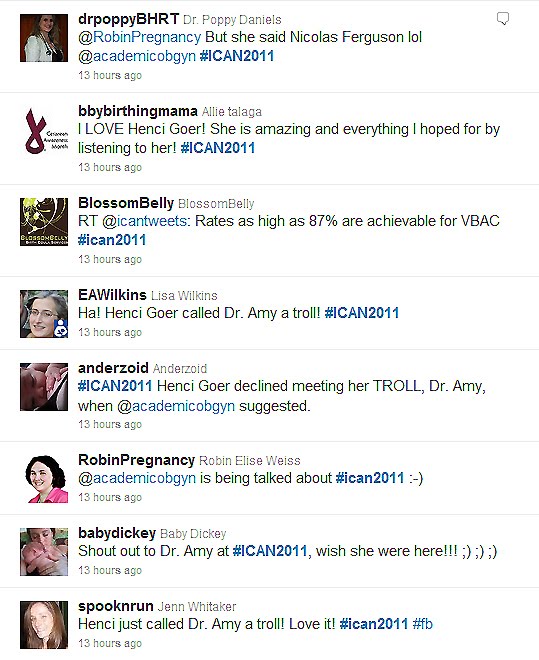
Evidently last night at the ongoing ICAN (International Cesarean Awareness Network) 2011 conference, someone asked Goer why she refuses to debate me. And being the “professional” that she is, she responded with a super-duper professional excuse. Don’t take my word for it though. Look at the Twitter feed:

The answer seems to delight Goer’s accolytes, but I doubt that it satisfies anyone else. To anyone who isn’t an NCB partisan, Goer’s fear of debate must seem inexplicable. Goer expresses her views with confidence and appears to have a mastery of the scientific evidence. If she is sure that she is right, wouldn’t she welcome an opportunity to debate me, especially a debate hosted and moderated by Dr. Fogelson, a professional she appears to respect?

Last summer, when Dr. Fogelson approached me about a debate, I responded promptly in the affirmative, but warned him that no one from the NCB side would dare agree. They are well aware that their claims would be eviscerated in short order, and I suspect that no one is more aware of this than Henci Goer. She knows that I can quickly and easily expose every lie, mistruth and half truth that comes from her mouth or her pen and she won’t, indeed she can’t, risk it.

Henci Goer’s fear of debate does not surprise me. The only thing that I wonder about is how long her accolytes will be delighted and diverted by insults. Sooner or later, someone is bound to ask her why she is obviously so afraid. What will she say then?

Being published doesn’t make it true

Lay people are often bewildered by the fact that doctors and scientists disagree with each other. The Wax study says homebirth increases the risk of neonatal death. The Johnson and Daviss BMJ 2005 paper says homebirth is as safe as hospital birth. What’s the truth?

When faced with conflicting scientific claims, lay people often conclude that the truth is simply a matter of what you prefer to believe. Even worse, they occasionally conclude that there is no truth or that the truth is unknowable. It might help, though, to consider a real life example. We know that there are newspapers and news organizations will often report conflicting accounts of political disagreements. And we know that just because we read something in the newspaper, it is not necessarily so.

Reading a scientific paper is similar to reading a newspaper article. A Democratic leaning newspaper may have an article with the headline that Obama was born in Hawaii. A radical Republican newspaper may have an article with the headline that Obama was born in Africa. That does NOT mean that Obama’s place of birth is indeterminate or that we cannot know where Obama was born.

The abstract of a scientific paper is the equivalent of the headline in a newspaper. It tell you the conclusion that the author wants you to draw. It does NOT mean that the conclusion is true, anymore than a newspaper headline means that the article underneath it is true.

The body of the scientific paper is the equivalent of the body of the newspaper article. It offers facts and draws conclusions based on those facts. Even articles with false claims will offer facts. The radical Republicans offer facts for their claim that Obama was born in Africa: his middle name is “Hussein;” his father was born in Africa; there are not many black people in Hawaii. The Democratic newspaper offers facts: it might show a picture of Obama’s Hawaii birth certificate with the official seal; it may have obtained access to Obama’s hospital record from the day he was born.

So we have two articles with two different conclusions and two different sets of facts. Does that mean that we cannot know where Obama was born? Of course not. It is a fact that Obama’s middle name is “Hussein” and it is a fact that his father was born in Africa, but that is actually irrelevant in determining where Obama was born. The birth certificate and the hospital record prove that Obama was born in Hawaii.

In other words, knowing which type of data is most important makes all the difference in determining what is a reasonable conclusion.

Similarly, an abstract of one paper may say that homebirth increases the risk of perinatal death, and the abstract of another paper, like the Johnson and Daviss BMJ 2005 paper, may say that homebirth has the same rate of perinatal death as hospital birth. That does NOT mean that abstract accurately reflects the data in the paper or that the claims made in the abstract are true. It is ONLY by READING the entire paper and applying the principles of statistics that we can know which paper is true. There is NO other way.

When you read the Johnson and Daviss BMJ 2005 paper, you learn that Johnson and Daviss never compared homebirth with a CPM in 2000 to low risk hospital birth in 2000. They compared homebirth with a bunch of out of date hospital statistics extending back to 1969. Yes, it is a fact that homebirth was safer than those hospital statistics, but the conclusion of the paper (that homebirth is as safe as hospital birth) is not supported by that fact. Moreover, a little independent research will show that the comparable hospital death rate in 2000 was actual 1/3 of the death rate for homebirth. So Johnson and Daviss NEVER showed anything about the safety of homebirth regardless of what their abstract says.

Contrary to the beliefs of many lay people, you don’t pick your conclusion and choose your experts accordingly. And just because experts disagree does not mean that there is no way to know whether homebirth increases the rate of perinatal death. But one point is incontrovertible. In order to interpret scientific evidence, you MUST read the actual scientific papers and you must analyze the data within them. Just because someone writes a scientific paper that supports your preferred conclusion does not make it true.

Death by confounding

If there is one thing that natural childbirth and homebirth advocates are absolutely, positively, 100% certain about, it is that interventions increase bad outcomes. They are particularly adamant on the issue of C-sections, declaiming at every possible opportunity that C-sections increase the risk of neonatal and maternal mortality. In fact, they’ve turned their belief into a virtual cult, the ‘cult of the unnecessarean’.

As with so many things, they are flat out wrong, and as with so many issues, their perverse certainty in the face of a mountain of evidence to the contrary stems from a lack of understanding of statistics.

Statistics is more than just number crunching. Statistics also teaches us how to choose the particular numbers to crunch. When NCB and homebirth advocates talk about interventions and death rates, their math is right, but they’ve used the wrong numbers to start with. Specifically, their claims about interventions and death rates are wrong because of confounding bias.

According to Ghaemi and Thommi in Death by confounding: bias and mortality:

The confounding factor is associated with … what we think is the cause … and leads to the result. The real cause is the confounding factor; the apparent cause, which we observe, is a bystander. An example of this relationship is the statement: coffee causes cancer. Even though large epidemiological studies show that those who drink coffee are more likely to have cancer (2), this is resulting from the fact that the coffee drinkers are more likely to be cigarette smokers (3), which is the cause of cancer in those persons. Coffee is the apparent cause, whereas cigarette smoking, the real cause, is the confounding factor.

In the case of C-sections and mortality rates, what NCB advocates think is the cause (C-sections) is a bystander. The real cause is the confounding factor. What is the confounding factor in this case? It is the underlying problem that lead to the C-section in the first place.

A detailed explanation can be found in the chapter on Maternal Mortality and Severe Maternal Morbidity in the book Reproductive and Perinatal Epidemiology:

In 2000-2002, the MMR among women in the United Kingdom who delivered by the vaginal roule was 4.8 per 100,000, compared with … 17.2 per 100,000 among women who delivered by the cesarean route… [I]nference regarding the safety of the mode of delivery based on the above rules would be seriously compromised because the association is confounded by the indication for cesarean delivery. As the CEMACH [Confidential Enquiry into Maternal and Child Health] report stated “For the large majority of deaths that followed caesarean section. however, there were serious prenatal complications or illness that, in many cases, precipitated the caesarean section…”

Confounding bias occurs in other medical and obstetrical situations:

It is the underlying phenomenon that explains why death rates among patients in an intensive care unit are higher than among patients in the non- intensive care setting, … why perinatal mortality rates are higher among hospital births compared with home births, and why perinatal mortality rates among women cared for by obstetricians arc typically higher than those cared (or by nonobstetricians.)

Ghaemi and Thommi offer a humorous real life example to illustrate how confounding bias leads to “solutions” that are utterly ineffective.

… The physicist Richard Feynman described it well in analogy to the curious behaviour of natives of the South Sea Islands. During the Second World War, the natives had grown accustomed to receiving goods dropped by cargo planes. After the war, the soldiers left, and the cargo droppings stopped. The natives then created a ‘cargo cult’ whereby they built runways, put fires along them and constructed huts for ‘controllers’ to summon the planes. Everything was set up the way it looked when the planes used to come; but the planes did not come.

Sadly, NCB and homebirth advocates are just like the South Sea Island natives. They compare mortality rates of vaginal births and C-sections and are anxious to produce the mortality rates associated with vaginal births. They have created the ‘cult of the unnecessarean’ whereby they demand lower C-section rates, insist that most C-section are unnecessary and actually refuse C-section in the belief that this will reduce mortality rates. Everything is set up to imitate the lower mortality rates associated with vaginal delivery, but the lower mortality rates do not occur.

The South Sea Island natives can be excused for their futile actions because the source of the confounding bias (the reason for the original cargo drops) was literally beyond their understanding. They had no idea that the there was a war going on, that the cargo was intended to fight it, and that there was no further reason to drop cargo when the war ended.

NCB and homebirth advocates have no such excuse. It should be obvious, or at the very least understandable, that direct comparisons between interventions and mortality rates are futile. Without understanding the reasons for the C-sections and taking those reasons into account, the data is worse than useless.

Let’s sue vaccine rejectionists for damages

Bioethicist Arthur Caplan thinks it is time for vaccine rejectionists to put their money where their mouth is. They should be legally and financially responsible for the damage and death caused by their decisions.

Anti-vaccine zealots say that whatever one’s reason for opposing vaccination for themselves or their kids, America must respect their choice. They yell about freedom, individual rights and liberty. A lot of Americans apparently agree with this view…

… But shouldn’t they be held accountable for that choice when it hurts others?

Caplan invokes the recent instance of a New Mexico woman who traveled through four US airports while infected with measles, but a better example might be the measles outbreak in San Diego in early 2008. As I wrote in How vaccine rejectionists hurt the rest of us, an unvaccinated 7 year old boy returned from a foreign vacation incubating the measles.

Ultimately 73 children, including intentionally unvaccinated children and children too young to be vaccinated, were quarantined for 21 days each because of significant exposure to measles.

… The outbreak was brought into the community by an intentionally unvaccinated child and initially spread by other intentionally unvaccinated children. Even though the outbreak was easily contained, one quarter of children who became ill were too young to be vaccinated, and the taxpayers spent $125,000 containing an outbreak that was entirely avoidable.

Caplan believes that the parents of the 7 year old boy should be legally liable for damages. He invokes two giants of American jurisprudence:

… Supreme Court Justice Oliver Wendell Holmes who said, “The right to swing my fist ends where the other man’s nose begins.” He was paraphrasing the great British philosopher John Stuart Mill who argued in a classic 1860 essay that the sole justification for interfering with another person’s liberty was to prevent harm to others….

… If you infect my newborn or my grandmom because you put your liberty over your duty to help protect the weak and the vulnerable and chose not to get vaccinated then you are responsible for the harm you do and you ought to be liable for it.

Vaccine rejectionists should be happy to accept legal responsibility. They are supposedly sure that vaccinations are unnecessary because diseases like measles disappeared “naturally” and no longer pose a health threat. If that’s the case, they have absolutely nothing to worry about.

On the other hand, the responsibility for hundreds of thousands, possibly millions of dollars in damages, might provoke a reassessment of the “risks” of rejecting vaccination. When the risks spread beyond danger to others, to danger to their own wallets, they may have an epiphany and decide that accepting vaccination makes far more financial sense.

Caplan concludes:

I don’t really don’t care to give lawyers more business but if the only way to get those who put other lives at risk by selfishly or stupidly not vaccinating is to sue them then so be it. If the lady from New Mexico is a Typhoid Mary spreading measles throughout America as she goes her merry uninoculated way then she ought to pay for those she disables, sickens or kills.

Let’s sue vaccine rejectionists for damages. Then we will learn if they are ready to put their money where their mouth is.

Doctors: the original lactivists

Lactivists, like many purveyors of “natural” health, love to rewrite history. Just like the vaccine rejectionists love to pretend that vaccines were invented to treat diseases that “weren’t dangerous” or “were disappearing by themselves,” lactivists like to pretend that infant formula was invented despite the fact that there was no need for it, and an unholy alliance of formula makers and physicians subsequently tricked women believing in non-existent benefits.

As Rima Apple explains in Mothers and medicine: a social history of infant feeding:

… In attempting to uncover the roots of our present circumstances, historical studies often portray women as passive in the face of medicine expertise, (male) physicians as engaged in conscious manipulation of (female) patients, or both. Although such analyses illuminate certain aspects of today’s situation, they ignore many important dynamics. This is especially the case for an issue of historical and contemporary importance — infant feeding.

That’s because the real history of infant formula belies the lactivist fantasy that breastfeeding is easy, and that women unsullied by formula advertisements want to breastfeed and are “empowered” by doing so. The development of formula was not precipitated by pharmaceutical companies, rather it was precipitated by the reality that substantial numbers of women couldn’t or wouldn’t breastfeed their babies. Far from “creating” a need for formula, physicians, having failed to convince women that breastfeeding was a matter of life and death, were desperate to find a safe, nutritious substitute food for infants who were dying in droves. In other words, lactivists have it precisely backwards.

In fact, the first true lactivists were physicians. As Jacqueline Wolf explains in the chapter Saving Babies and Mothers: Pioneering Efforts to Decrease Infant and Maternal Mortality, in the book Silent Victories: The History and Practice of Public Health in Twentieth Century:

The custom of feeding cows’ milk via rags, bottles, cans and jars to babies rather than putting them to the breast became increasingly common in the last quarter of the nineteenth century progressed… In 1912, disconcerted physicians complained bitterly that the breastfeeding duration rate had declined steadily since the mid-nineteenth century “and now it is largely a question as to whether the mother will nurse her baby at all. A 1912 survey in Chicago … corroborated the allegation. Sixty-one percent of those women fed their infants at least some cows’ milk within weeks of giving birth.

The unwillingness of mothers to breastfeed crossed every strata of society:

This custom of artificial feeding crossed class lines as upper-, middle-, and working-class women alike- prompted by different social. economic, and cultural pressures- all participated in the practice. Upper-class women relied heavily on servants for infant care and that dependence often precluded breastfeeding… New expectations for marriage based on companionship rather than economics shaped middle-class women’s infant feeding practices as the bond with their husbands became more important than their relationship with their children… Working-class mothers found their infant feeding practices dictated by economics. Women who worked outside the home often had to leave their infants with grade-school daughters and artificial food. The burgeoning number of Little Mothers’ Clubs. after-school organizations that trained thousands of young girls to better care for the infant siblings left in their charge, reflected this growing practice…

This refusal to breastfeed, or to breastfeed exclusively, let to soaring rates of infant mortality because cows’ milk was contaminated.

… The late.nineteenth.century urban milk supply killed tens of thousands of infants each year. Unpasteurized and unrefrigerated as it journeyed from rural dairy farmer to urban consumer for up to 72 hours. cows’ milk was commonly spoiled and bacteria-laden. Public health officials dramatically charged that in most U.S. cities, milk contained more bacteria than raw sewage…

In an effort to save infant lives, physicians and public health officials embarked on two parallel campaigns, the first designed to increase rates of exclusive breastfeeding, the second aimed at teaching women to pasteurize milk. The emphasis was placed on breastfeeding:

The medical community deemed human milk so vital to infants’ health that doctors even feared that providing clean cows’ milk to babies might be counterproductive since it tended to exacerbate low breastfeeding rates. At a 1910 meeting of the Chicago Milk Commission. a medical charity that provided certified/pasteurized milk at no cost to consumers via dozens of neighborhood milk stations, one doctor complained that the Commission’s widely advertised milk made it easy for a mother “to shirk her obligations” and avoid breastfeeding. An exasperated Chicago Medical Society. which managed its own certified milk operation. likewise decried plummeting breastfeeding rates and editorialized in 1909. “We even incline to the opinion that the babies and children would get along very nicely if the entire [cows’] milk supply, whether pasteurized or not, were shut off entirely and permanently.’

But women did not want to go back to breastfeeding. Public health campaigns to increase breastfeeding rates were dismal failures; only one major city, Minneapolis, managed to increase breastfeeding rates enough to have an impact on infant mortality. Everywhere else, infant mortality due to contaminated cows’ milk did not begin to decrease until a substantial proportion of the milk supply was pasteurized.

Ultimately, cows’ milk was replaced by infant formula, which more closely matches the composition of human milk, is sterilized and is very convenient to buy, store and use. The bottom line, though is that breastfeeding rates did not decline in response to the availability of breast milk substitutes. Breastfeeding rates declined substantially long before the advent of formula and even before the advent of safe breastmilk substitutes.

The efforts of contemporary lactivists to raise breastfeeding rates are doomed to failure for the same reason that the efforts of the original lactivists, doctors, were doomed to failure. For many women, breastfeeding is difficult, uncomfortable and inconvenient. Instead of finding breastfeeding to be empowering, most women find bottle feeding to be both empowering and liberating.

Those who cannot remember the past are condemned to repeat it

Vaccine rejectionists would do well to heed the words of Spanish philosopher George Santayana:

Those who cannot remember the past are condemned to repeat it.

Although most vaccines were introduced less than a century ago, vaccine rejectionists have already managed to forget the toll taken by vaccine preventable diseases. By ignoring history, they are preparing to repeat it. With the exception of smallpox, vaccine preventable diseases are still out there and still capable of killing large numbers of children. And vaccine rejectionists, through a combination of breathtaking ignorance and mind boggling gullibility, are creating the conditions for new and deadly epidemics.

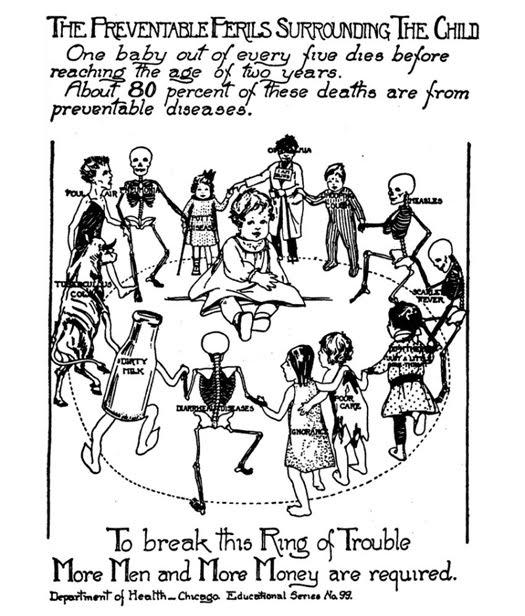
The following poster, prepared by the Chicago Department of Health at the turn of the last century should serve as a useful aid to historical reality.

As the poster indicates:

One baby out of every five dies before reaching the age of two years. about 80 percent of these deaths are due to preventable diseases.

The “preventable perils” surrounding each baby included

whooping cough
measles
scarlet fever
diphtheria
tuberculosis
pneumonia and
diarrheal diseases

In the intervening century, vaccines have been developed for whooping cough, measles, diphtheria, some forms of pneumonia and some forms of diarrheal disease. Any or all of these diseases could return if vaccination rates drop low enough. If the vaccine rejectionists have their way, that is precisely what will happen.

Sharyl Attkisson puts the BS in CBS

According to CBS reporter Sheryl Attkisson’s piece Vaccines and autism: a new scientific review:

For all those who’ve declared the autism-vaccine debate over – a new scientific review begs to differ. It considers a host of peer-reviewed, published theories that show possible connections between vaccines and autism.

The best comment so far, offered by autismnewsbe, which is probably Autism News Beat, the website that debunks anti-vax propaganda:

Attkisson puts the BS in CBS.

That’s because Attkisson has utterly misrepresented the review itself and the conclusions that it draws.

The paper in question is Theoretical aspects of autism: Causes-A review by Helen V. Ratajczak, published in the current issue of The Journal of Immunotoxicology. As the title indicates, Ratajczak reviews the plethora of theories on the the cause of autism. The review contains NO data, because it isn’t reviewing the scientific evidence, merely the theories themselves.

This point is forcefully made by Dr. Brian Strom, who has served on Institute of Medicine panels advising the government on vaccine safety:

… [T]he prevailing medical opinion is that vaccines are scientifically linked to encephalopathy (brain damage), but not scientifically linked to autism. As for Ratajczak’s review, he told us he doesn’t find it remarkable. “This is a review of theories. Science is based on facts. To draw conclusions on effects of an exposure on people, you need data on people. The data on people do not support that there is a relationship. As such, any speculation about an explanation for a (non-existing) relationship is irrelevant.”

In fact, Ratajczak herself acknowledges this in the conclusion to the paper:

Autism has been documented to be caused by genetic defects and/or inflammation of the brain. The inflammation could be caused by a wide variety of environmental toxicants, infections and co-morbidities in individuals genetically prone to the developmental disorder. (emphasis mine)

There are three important points to glean from Ratajczak’s conclusion:

1. The paper itself is a collection of the UNPROVEN musings of a variety of people over several decades.

2. Autism has a documented genetic basis.

3. Ratajczak could find no proof for ANY of the theories that she reviewed.

Contrary to Attkisson’s “BS,” this doesn’t reopen the debate, it merely reviews it and acknowledges that there is no proof for ANY anti-vax theory.

Cesareans are not widgets

For NCB advocates, anything that happens in obstetrics must be squeezed, manipulated and molded into the approved story line: evil obstetricians subject women to unnecessary interventions for personal gain.

Hence an NCB website and an NCB advocate on Babble published the exact same analysis on the very same day. They even gave it the same words, All About the Benjamins, the title of the piece on The Unnecessarean and the first line of Danielle Ellwood’s screed on Babble, charmingly entitledOB/GYN’s Admit Money Drives C-Section Rates?

Both pieces discuss a newspaper article on Tennessee’s plan to reduce TennCare (Tennessee Medicaid) reimbursement rates for C-sections:

Under Gov. Bill Haslam’s proposed spending plan for next year, hospitals and obstetricians would get only half of what they now receive for C-sections. The change is projected to save $14.9 million, accounting for more than one-third of the overall cuts to TennCare.

“In my opinion, the state is just trying to save money on the backs of hospitals and doctors,” said Dr. Frank H. Boehm, professor of obstetrics and gynecology at Vanderbilt. “I don’t think there is any big medical reason to do this.”

Danielle Ellwood on Babble responds with the typical inane NCB claptrap:

But what gets me most about it all is, finally there is a group of OB/GYN’s coming out and saying what many have been suggesting in the birth community for ages… money drives the number of c-sections that take place. An extremely doctor friendly procedure that takes 45 minutes, and of course they are home for dinner, when compared to long on call hours with laboring mothers, missing birthday parties, and golf games.

Her predictably offensive response merely reflect the fact that she is ignorant of the basics of healthcare economics. She, like most NCB advocates, thinks that economics of healthcare are just like the economics of widgets. However, if the last 25 years of health care reform efforts have taught us anything, it is that healthcare is not a widget.

In economics, “widget” stands for a unit of economic production. Producers sell widgets, consumers buy widgets and there are economic rules that govern the sale and purchase of widgets. When producers find they can command a greater price for one form of widget than an other, they will begin producing more of the higher priced widgets.

Imagine that you knit scarves and you sell them on E-bay. The scarves come in two colors, puce and turquoise. After a few weeks, you notice that the puce scarves get few bids and ultimately sell for an average of $10, but the turquoise scarves get lots of bids and sell for an average of $12. In light of that information, you begin making lots more turquoise scarves and many fewer puce scarves. That’s not surprising; economics tells us that if you can get more money for one form of widget than another, you will preferentially produce the widget that commands a higher price.

But Cesareans are not widgets and do not behave like widgets. Why? Widgets are interchangeable; medical procedures are not. It makes no difference to the manufacturer what the scarves look like on the people who choose them. The manufacturer has no obligation to determine that the customer choose the scarf color that harmonizes best with her wardrobe. If the customer is willing to pay more for a turquoise scarf, the manufacturer will preferentially produce turquoise scarves.

In contrast, medical procedures and not interchangeable and it matters a very great deal whether the procedure is the best procedure for the patient in question. If a laparoscopic appendectomy is reimbursed at $1000 and a laparoscopic gall bladder removal is reimbursed at $1200, we do not expect that the surgeon will preferentially perform a gall bladder removal every time a patient complains of severe abdominal pain. If the appendix is inflamed, surgeon will always remove the appendix and never remove the gall bladder regardless of the fact that he would be paid more for gall bladder removal. That’s because the surgeon has a legal and ethical responsibility for the outcome.

Cesareans aren’t widgets, either. Just because a C-section is reimbursed at a slightly higher rate than a vaginal delivery does not mean that obstetricians will preferentially perform C-sections. They can’t and they don’t forget their legal and ethical responsibility to perform the procedure most likely to produce the best outcome regardless of reimbursement rates.

Imagine for a moment that TennCare decided to cut reimbursement rates for gall bladder removals in half, making appendectomies of TennCare patients far more profitable than gall bladder removals. Would we expect to see an increase in appendectomies among TennCare patients and a decrease in gall bladder removals? Of course not. The most likely outcome is that doctors will refuse to take care of TennCare patients. They are not free to substitute the more profitable procedure for the less profitable procedure because of legal and ethical constraints. The most likely outcome, therefore, is that doctors will refuse to take care of TennCare patients because if they do, they know they will lose money.

Similarly, despite the gleeful predictions of NCB advocates, if TennCare cuts reimbursement for C-sections in half, it will have no impact on the C-section rate. The virtually inevitable outcome is that obstetricians will refuse to care for TennCare patients.

I know that NCB advocates really, really, really want to reduce C-section rates. But given what we know about health care economics, it is nonsensical to expect that cutting C-section reimbursement will reduce C-sections. The only thing it will reduce is poor women’s access to medical care.


Lactivists and the distortion of risk

This piece originally appeared on Homebirth Debate in April of 2008. Since then Joan Wolf has expanded the cited paper into a book, entitled “Is Breast Best?: Taking on the Breastfeeding Experts and the New High Stakes of Motherhood,” published in December 2010.

Joan Wolf, of Texas A&M University, provides a spot-on description of breastfeeding activism. Writing in the Journal of Health Politics, Policy and Law, August 2007, in an article entitled Is Breast Really Best? Risk and Total Motherhood in the National Breastfeeding Awareness Campaign, she describes the lactivist as moral scold:

In Chicago, a counselor at a federal Women, Infants, and Children clinic laments the tragedy of teenage mothers choosing to go to school instead of breast-feeding their babies. The director of the neonatal intensive care unit at District of Columbia General Hospital tells mothers of infants with runny noses that the babies would not be sick if they breast-fed. And an anthropology professor argues that formula producers, “just like tobacco companies, produce a product that is harmful to people’s short and long-term health”. Such rhetoric is commonplace in the world of breast-feeding advocacy, and it is staked on an overwhelming consensus that breast-feeding is the optimal form of nutrition for babies.

Yet while breastfeeding has indisputable advantages, the medical advantages are quite small. In light of the known scientific evidence, Wolf questions the ethical obligations of those who wish to promote breastfeeding. Is their moralizing justified by the scientific evidence? Is the scientific evidence being presented accurately? Do public health officials have ethical obligations to be truthful?

… Debates among scientists and scholars engaged in public health research provide good reason to question government-sponsored breast-feeding promotion and even stronger grounds to challenge a risk-based campaign. Perhaps the most problematic dimension of the National Breastfeeding Awareness Campaign (NBAC) was the science on which it was based. Medical journals are replete with contradictory conclusions about the impact of breast-feeding: for every study linking it to better health, another finds it to be irrelevant, weakly significant, or inextricably tied to other unmeasured or unmeasurable factors. While many of these investigations describe a correlation between breast-feeding and more desirable outcomes, the notion that breast-feeding itself contributes to better health is far less certain, and this is a crucial distinction that breast-feeding proponents have consistently elided. If current research is a weak justification for public health recommendations, it is all the more so for a risk-based message that generates and then profits from the anxieties of soon-to-be and new mothers. Yet in its emphasis on the dangers of not breast-feeding, the NBAC consciously attempted to manufacture fear in order to increase breast-feeding rates. It did so, moreover, in ways that exploited widespread popular misunderstanding of “risk” and deep seated normative assumptions about the responsibility that mothers have to protect babies and children from harm…

Wolf begins the article with a 9 page comprehensive analysis of the existing scientific literature. The analysis reveals that the purported medical benefits of breastfeeding are actually quite small, and that the studies themselves suffer from serious methodological problems. Wolf believes that the incremental nature of the benefits and the lack of a firm scientific foundation mandate caution in creating public health initiatives to promote breastfeeding.

… [T]he first tenet of the APHA Code of Ethics states that “public health should address principally the fundamental causes of disease and requirements for health” and explains that “this Principle gives priority not only to prevention of disease or promotion of health, but also at the most fundamental levels”. Drunk driving and smoking are underlying causes of traffic fatalities and lung cancer, and public health campaigns to reduce them would seem in keeping with the standard set by the APHA. But the evidence for breastfeeding is not nearly as powerful. Even if breast-feeding research were unassailable — if the studies were meticulously designed and carried out, confounding convincingly eliminated, and plausibility established — the associations would still not be strong enough to make the case that not breast-feeding is a fundamental cause of the health problems cited by the NBAC. By most measures, in fact, the campaign did not meet the evidentiary standards for ethical public health practice set by multiple institutions.

Wolf argues that despite the limited medical benefits, and despite the inconclusive scientific evidence on which it is based, breastfeeding activists have embarked upon a campaign to encourage breastfeeding by deliberately misrepresenting the “risks” of bottle feeding and by deliberately playing on the public’s known inability to understand risk.

Risk, however, is grossly misunderstood. Research suggests that cognitive limitations, skewed media coverage, and misconstrued personal experience distort the process of risk calculation, even among the well informed, and that “people systematically violate the principles of rational decision-making when judging probabilities, making predictions or otherwise attempting to cope with probabilistic tasks”…

Directed at pregnant women, for whom “risk” is weighted with particular emotional freight, the NBAC capitalized on public misapprehension of risk. Even if infant-feeding studies were more compelling, for example, the campaign drew dubious risk analogies. In the television spots, logrolling or riding a mechanical bull pregnant and not breast-feeding were portrayed as comparably dangerous acts or threats to a baby’s safety. Many of the campaign’s most outspoken proponents, including USBC chair Amy Spangler, likened bottle-feeding to tobacco use: “[W]e don’t hesitate to tell parents what smoking does to themselves and their children,” she said. “Why should we not tell people the consequences of not breast-feeding?”. Commenting on the NBAC, a pediatrician on ABC’s 20/20 also contended that not breast-feeding and smoking carried similar risks. Yet this kind of reasoning is specious. All risk is not the same, and even if breast-feeding research were methodologically sound, the risks of formula-feeding would be infinitesimal compared to those for smoking…

The tactics of breastfeeding activists are in direct conflict with codes of ethics for public health:

Conversations among practitioners and ethical codes established by epidemiologists virtually always stipulate that great care should be taken to present research results honestly and without distortion. This is part of the “implicit contract between epidemiologists and the members of society”. According to the Ethics Guidelines of the American College of Epidemiology (ACE), for example, “epidemiologists should strive to ensure that, at a minimum, research findings are interpreted and reported on accurately and appropriately . . . The significance of the findings should neither be understated nor overstated. Epidemiologists should put the strengths and limitations of their research methods into proper perspective”. For researchers, this might mean foregrounding caveats that are normally found in the last paragraphs of published studies. For public health practitioners, it might require that campaign messages be carefully balanced and that those designed to scare people be limited to interventions for which the evidence is strong and the negative outcome serious and likely, conditions that do not obtain in not breast-feeding. Once the NBAC framed infant feeding as a matter of sickness versus health or danger versus safety, it was practically impossible to portray not breast-feeding as risky and to present the nuances of research findings. Whereas in ethical public health practice a campaign is designed to represent the research, the message subordinated the science in the NBAC.

The bottom line is that breastfeeding activists, in an effort to promote breastfeeding, have engaged in unethical practices designed to scare and trick women into breastfeeding. Rather than providing women with all the scientific evidence to make their own decisions, breastfeeding activists have determined that THEY are the appropriate arbiters of what women should do and now concentrate on browbeating women or deceiving them to do it.