All posts by Amy Tuteur, MD

Childbirth education is tainted by bias

I just read a paper that claims that childbirth educators are biased. Surprisingly, the paper was published in the Lamaze Journal of Perinatal Education in 2007. Not surprisingly, we’ve heard very little about it.

The paper, Contemporary Dilemmas in American Childbirth Education: Findings From a Comparative Ethnographic Study, was written by Christine Morton, a research sociologist, and her assistant, Clarissa Hsu. The sociologists conclude that while childbirth educators pride themselves on providing “unbiased information”, they provide anything but.

Morton and Hsu ask:

… [D]oes a childbirth education curriculum placing normal, physiological birth at its center meet the needs of today’s birthing women, only 14% of whom have had natural births? The Listening to Mothers surveys provided valuable information on women’s desires, expectations, and experiences during pregnancy, childbirth, and the postpartum period. The most recent findings showed a dramatic drop in childbirth education attendance. We explore possible reasons for this by turning our lens not on pregnant women, but on childbirth educators and the various strategies, practices, and beliefs they present in their classrooms.

Morton and Hsu postulate that childbirth educators operate within their own micro-culture, one that is often at odds with the culture at large and with the actual practice of obstetrics. They explain that within this micro-culture, childbirth educators view themselves as facing 5 “dilemmas.” Each dilemma is the result of the gulf between what childbirth educators want to teach vs. what the scientific evidence shows, what participants want to learn, and what is actually likely to happen within the hospital setting.

There are two “dilemmas” that, in my judgment, are particularly important. The first is described by the authors as “Negotiating Evidence, Beliefs, and Experience Within the Framework of ‘Unbiased Information’ and ‘Choice.’

One might well ask why “negotiation” is required at all. If the goal is to transmit unbiased information that allows women to make their own personal choices, what needs to be negotiated? The answer is quite revealing; what needs to be “negotiated” is the difference between what the childbirth educator believes and what the scientific evidence actually shows.

We found that “unbiased information” was operationalized in class presentations as containing equal measures of science (clinical research evidence), beliefs (individual preference and cultural practices), and experience (everyone is different)…

While childbirth educators felt entirely justified in presenting their personal preferences and cultural assumptions as evidence, fewer and fewer women are interested in the childbirth educators’ ideal. As a childbirth educator noted:

“The reasons women are coming to class are different today.” …[W]omen are no longer coming into classes strongly preferring unmedicated vaginal birth. Listening to Mothers II found that, in 2005, just 37% of women indicated that they attended class to learn more about natural birth.

Paradoxically, as fewer women are interested in “natural” childbirth, childbirth educators feel compelled to slant the presentation to support their own views about various childbirth interventions.

On the one hand:

Independent educators who taught classes for women with an expressed preference for unmedicated, vaginal birth were more likely to acknowledge the health benefits of interventions, when necessary, and to critique the culture of mainstream obstetrics for not following evidence-based practice regarding intervention use. These educators assured class participants that, because of their prior choice of caregiver and their commitment to informed choice, any interventions they might receive would be medically necessary.

On the other hand:

… Educators who taught in organization-based classes faced students with a variety of attitudes and expectations, caregivers, and birth places, and they could not assume shared views regarding medical interventions or methods of pain relief. In these cases, educators provided what they described as “unbiased information”—an equal combination of information comprising typical practice, research findings, and personal experiences.

The authors describe a childbirth educator “teaching” a topic on which she disagreed with hospital practice:

She first evoked philosophy, suggesting it is a matter of opinion or an individual position. She referred to research but included her personal experience, because it was the basis for her disagreement with the class text.

In other words, childbirth educators who surmised that their clients might make choices of which they would not approve, felt free to bias the information presented in favor of their own personal choices.

This leads into the fifth ‘dilemma,’ “Empowerment Versus Birth Advocacy.” It turns out that childbirth educators don’t really want to empower women to make their own choices; they want to convince women to make educator approved choices. Childbirth educators tell themselves that they are promoting women’s choices, but it has yet to occur to them that their personal preferences for a “satisfying birth experience” and “consumer-advocacy” are not universal choices desired by all women.

Nothing better illustrates the gulf than the childbirth educator who admonished her class when they told her that their primary desire was for a healthy baby:

… The educator explained that having a satisfying birth means doing it “your way” and not someone else’s way. She then elicited responses to the question of what all the different “ways” might have in common. When the class responded with “healthy baby,” the educator told a story of a couple who was satisfied with their birth experience despite the disability the baby incurred as a (possible) result of the birth’s management… [B]y using a story about a friend’s experience, she called into question the idea that a “healthy baby” is the only desirable outcome.

In other words, when her clients told her that their highest priority was for a healthy baby, she told them they were wrong.

The authors, noting this and similar examples of the differences between what clients want to learn and what childbirth educators prefer to teach, comment:

The first question involves addressing to what extent childbirth education is inseparable from middle-class values that place a premium on formal education, science, and personal (consumer) choice… [C]hildbirth education will need to find ways to become more accessible and relevant to a wider cultural range of expectant mothers or, instead, be satisfied with being a niche market that caters to a relatively small proportion of the birthing public…

And more pointedly:

Does informed choice lead to a satisfying birth (and how would we measure this characteristic?) … How well does the value of informed choice translate for people who do not come from a White, middle-class background?

The authors dare to ask:

… [D]oes a childbirth education curriculum placing normal, physiological birth at the center meet the needs of today’s birthing women[?]

Childbirth educators don’t ask themselves this question because they think that they are promoting “choice.” However:

Our study demonstrated that childbirth education is a cultural phenomenon, with deeply embedded values held by childbirth educators regarding the nature and importance of information, scientific evidence, and consumer choice. These values shape whether, how, and what type of information childbirth educators provide.

How can we put women’s needs at the center of childbirth education in place of childbirth educator’s desires?

Articulating how culture shapes the presentation, content, and format of childbirth classes is an important step in understanding and advancing the place and relevance of this experience for all birthing women.

Step one must be acknowledging that childbirth education is currently tainted by personal and cultural bias.

You say you want an education

Suppose you want to become educated about pregnancy and childbirth. Whom do you ask to teach you?

To answer this question, I want to offer a parallel example to explore who can and cannot teach you accurate information. Suppose you want to become educated on the topic of aerodynamics. Whom do you ask?

You don’t ask the passengers. Even if they’ve flown many times, even if they can tell you lots of stories about good and bad flights and even if they’ve been involved in a complicated air disaster, they are not qualified to teach anyone about aerodynamics. That’s because you don’t need to know anything about aerodynamics to be a passenger. You just have to board the plane and sit in your seat.

Similarly, if you want to become educated about childbirth, you DON’T ask other lay people. It doesn’t matter how many babies they’ve had; it doesn’t matter what their pregnancy experiences have been; and it doesn’t even matter if they’ve read lots and lots of books about pregnancy and childbirth. You don’t need to know anything about childbirth to have a baby. Therefore, lay people, even if they are “birth junkies” like Rixa Freeze are completely UNQUALIFIED to teach anyone anything about childbirth.

You don’t ask the stewardess. Sure she works for the airline and she is a airplane “professional.” She may even have learned some basics about airplane flight during her stewardess training. However, her primary role is to keep the passengers comfortable. She does not know how to fly the plane in an emergency and she cannot give advice to pilots about how to handle even routine tasks involved in flying.

Similarly, if you want to become educated about childbirth, you DON’T ask a doula. She may consider herself a professional, but her primary role is to keep laboring women comfortable. She doesn’t know how to deliver a baby, or how to diagnose a childbirth emergency. She also doesn’t know how to prevent childbirth emergencies. She may have learned a few basic about childbirth during the very short course that she took to become certified but she is as UNQUALIFIED to offer advice on childbirth as the stewardess is to offer advice on aerodynamics.

You don’t ask the mechanic. He or she may know all about the way that the moving parts of the plane work, and how to tune them appropriately, but the mechanic does not learn much about aerodynamics as part of his training and certainly not enough to teach the topic to someone else.

Similarly, if you want to become educated about childbirth, you DON’T ask a childbirth educator. She may know the procedures and options in her hospital, but that doesn’t mean that she understands how they work, when they are appropriate and who should choose or refuse them. Indeed, to be a childbirth educator, she doesn’t really need to know much about childbirth at all so she is UNQUALIFIED to educate anyone else.

You don’t ask someone who flies model airplanes. It’s far easier to fly a model airplane than a real airplane. Moreover, people who fly model airplanes don’t need any special qualifications to do so. They just buy a model airplane and learn by practicing.

Similarly, if you want to be educated about childbirth, you DON’T ask a lay midwife such as a certified professional midwife (CPM). These women are hobbyists. They deliver babies because they enjoy the thrill. They couldn’t be bothered to get a university degree in midwifery, so they opted for the hobbyist’s post high school certificate. During their “training” they learn nothing about the prevention, diagnosis or management of childbirth complications. Moreover, they lack basic knowledge of obstetrics, medicine, science or statistics. They are thoroughly UNQUALIFIED to teach any about childbirth because they know very little about it themselves.

The bottom line is that you cannot consider yourself “educated” about childbirth unless you were taught by a doctor or a certified nurse midwife (as well as some labor and delivery nurses). No one else is even remotely qualified to teach the subject.

Laypeople, doulas, childbirth educators and lay midwives such as CPMs don’t know enough about childbirth to educate anyone. Claiming to be “educated” about childbirth because you read their books or websites is like claiming to be “educated” about aerodynamics because you talked to a stewardess or airplane mechanic. It’s simply absurd.

Dr. Amy is mean to me!

Ceridwen Morris thinks I am mean to her. Who is she and what is she upset about?

Ceridwen blogs for Babble.com on the group blog Being Pregnant. And Ceridwen, like others in her group, routinely makes empirical claims about pregnancy and childbirth that are flat out false. For example, yesterday she wrote a post entitled Why Midwife-Led Care Should Be The Norm. The keystone of her argument is this:

Midwife-led care is the norm in most of Western Europe where statistics for maternal and fetal health are excellent.

There’s just one teesy, weensy problem with this claim; it’s not true.

I commented:

The country that has the most comprehensive system of midwife led care is The Netherlands and it has the WORST perinatal mortality in Western Europe and poor maternal mortality as well. This has been the case for years and the Dutch government has sponsored a variety of studies to find out why Dutch perinatal mortality is so high.

A paper published in the British Medical Journal recently revealed and astounding finding: the perinatal mortality rate for LOW risk women cared for by Dutch midwives is HIGHER than the perinatal mortality rate for HIGH risk women cared for by Dutch obstetricians!

Ceridwen might have responded that (as is obvious) she was unaware of that fact; she might have promised to do more research on the issue to find out how midwife led care really affects mortality rates, but instead she said this:

… You’re mean. You scare women. I’ve read your website extensively and I wish you’d seriously find a way to be productive instead destructive. You cannot criticize the home birth community for a stubborn one-sidedness and a fact-spinning agenda when you are the epitome of that kind of bullying and manipulation. I’m sorry, I’ve been polite before but I’ve had it!! I am not interested in these polarizing debates and anyone with any sense is with me.

And this:

I never mentioned The Netherlands.

And, best of all, this:

Whatever. I’m not [changing] it.

Let’s take a step back and analyze Ceridwen’s credentials for writing about the epidemiology of midwifery care:

Ceridwen Morris is a writer, mother and childbirth educator. She is co-author of It’s All Your Fault and From the Hips as well as several screenplays …

In other words, Ceridwen has no training in obstetrics, midwifery, science, statistics or epidemiology, yet she believes that she is qualified to expound on these topics. As I wrote earlier this year:

A … number of childbirth websites are run or staffed by childbirth educators, which is rather surprising, since they entirely lack the education, training, and experience to provide scientifically accurate, unbiased information…

In fact, you only need 16 HOURS of childbirth education, including indoctrination is the ideology of the certifying organization…

… [L]ess than 2 hours apiece are spent on the massive subjects of labor and birth, obstetrical tests, and C-section and VBAC. That would be fine if childbirth educators limited themselves to giving women basic familiarity with what is likely to happen during pregnancy and labor. Unfortunately, childbirth educators do not limit themselves to what they could reasonably do. Instead, they offer medical advice, criticize obstetric procedures, promote ideology above science, and proselytize for their personal preference. And for those tasks, they are entirely unqualified.

So Ceridwen is grossly unqualified to opine on the statistical “superiority” of midwifery care. But she’s also unqualified in another more fundamental way; she believes that anyone who questions the truth of her claims is being mean to her.

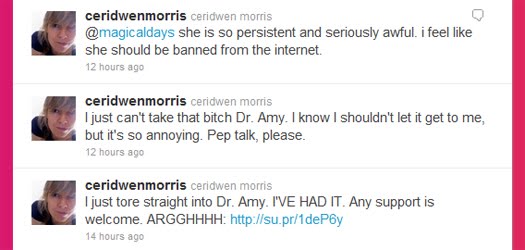
She’s not alone. Like many midwifery advocates, homebirth midwives and even some highly trained midwives, instead of responding to criticism of her empirical claims by defending them (or retracting them) as professionals are supposed to do, she whines that she is being treated unfairly. Her twitter feed is even more revealing on this point:

Very illuminating. She made a false statement, and I’m a “bitch” for pointing it out.

This is an example of a problem that poisons the natural childbirth blogosphere. Natural childbirth advocates believe any challenge is “mean.” They blithely write and post complete falsehoods and rather than regretting the misinformation they spread, they resent the people who point out the lies.

This phenomenon extends to those who are actual professionals of midwifery. There are few if any scientific controversies in midwifery. No one would be so “bitchy” as to point out to another midwife that her claims are false. This is also why it is impossible to expect that homebirth midwives can regulate themselves. The truth is meaningless for these people; the only thing that counts is “support.” Unless they are forced by publicity or legal authorities, they never condemn one of their own no matter how many babies die as a result of ignorance and incompetence.

Rather than addressing Ceridwen, who is frankly too immature to even understand that she is OBLIGATED to correct falsehoods in her own writing, I will address the editors of Babble:

It is time for Babble to assign a technical editor (a doctor) to vet bloggers’ material for factual accuracy. It is wrong to allow women who are have no medical (or even midwifery) qualifications to make unchecked factual claims about pregnancy and childbirth. The bloggers of Being Pregnant should be free to write about their personal experiences, their feelings and their opinions. However, when it comes to empirical facts, claims must be vetted for truthfulness. Clearly bloggers like Ceridwen Morris have no compunction about spreading absolute falsehoods and won’t even correct them when they are pointed out. Babble must accept responsibility for ensuring that its readers are receiving scientifically accurate information about pregnancy and childbirth.

GBS garlic Hall of Shame

After reading Wren’s story on the 1st anniversary of his birth and death, people have been wondering what they might do to spread the word that garlic for Group B Strep (GBS, the leading infectious cause of neonatal death) is ineffective and indeed has NEVER been tested. For my part, I’ve assembled a GBS Hall of Shame: homebirth midwives and advocacy organizations who blithely risk the deaths of babies to promote a bogus “treatment.”

The following homebirth midwives actively promote the GBS-garlic quackery. And if you cannot trust them to tell (or even to know) the truth on something so utterly basic as the fact that no one has even looked to find out whether garlic prevents the transmission and development of GBS, you probably cannot trust them to know the truth about a lot of other aspects of childbirth.

Barbara Herrera of Navelgazing Midwife

Bellies and Babies

Empowering Birth Blog

Rixa Freeze of Stand and Deliver

Gentle Birth.org

Joy in Birthing

Joyous Birth

Lori the Midwife’s Space

Midwifery/Comadrona

Midwifery Today

Mothering Magazine

Natural Childbirth.org

Dr. Momma at Peaceful Parenting

These are just the most influential members of the GBS Hall of Shame. There are countless other homebirth midwives, doulas and childbirth educators who also counsel garlic for GBS. And of course, everyone refers back to the blithering of Judy Slome Cohain.

These members of the GBS Hall of Shame have put the lives of countless babies at risk for no better reason that to defy medical authority. They have recommended a “treatment” that is not only unproven, it has never even been tested. They have routinely and deliberately misinformed women about the dangers of Group B Strep, and the effectiveness of antibiotic treatment.

To these women I say: You should be ashamed of yourselves and you should IMMEDIATELY alter you websites to reflect accurate scientific information.

I wonder, do you have any words in defense of your reprehensible behavior?

Wren’s story on the 1st anniversary of his birth and death

Wren’s story, as told by his father Josh, has been posted on Hurt by Homebirth, today as his Dad requested, on the first anniversary of his birth and death. Just hours after his beautiful and uncomplicated homebirth, and without his parents even being aware that he was ill, Wren died of Group B Strep (GBS) pneumonia.

Months later … we finally got the definitive answer from the autopsy (the police required an autopsy). Wren had died from pneumonia due to an invasive Group B Streptococcus infection. Everything else about him was perfect.

By the time we received the report we had a pretty good idea that’s what it was. You see, in our very first checkup at the OBs GBS showed up in Tweeny’s urine sample. They prescribed some oral antibiotics and she took them. Later, as we were approaching the time to take our 35-37 week GBS test, our midwives recommended Tweeny start putting a garlic clove in her vagina nightly to try and kill the bacteria. Tweeny followed the regimen faithfully.

But what Wren’s parents didn’t know at the time is that homebirth midwives and natural childbirth advocates recommend garlic even though it has NEVER been tested.

Josh explains:

We’ve learned a lot about GBS since then. Here are the things that went wrong in our case:

If GBS ever shows up in your urine during a pregnancy, you must get the antibiotic IV when you go into labor, end of story. It means you are heavily colonized and far, far, far more likely to infect your baby during childbirth.

There is no scientific evidence of any sort that garlic or any other homeopathic remedy will offer any protection from a GBS infection…

We focused all our worries and attention on the pregnancy and the delivery itself. We subconsciously believed that if we just got Wren out and he was healthy, we were home free. Unfortunately, GBS-infected babies will show no signs of the infection for several hours after birth. They’ll have lusty cries and high apgar scores and be perfectly normal. There’s nothing genetically wrong with them, they just get sick. And you need to treat a sickness with medicine.

There is so much to worry about when you’re pregnant, and unfortunately, most of it is out of your control. Preventing GBS is one of the few things that is. All you have to do is get the test, and if you’re positive (and 30% of women are), get the antibiotic IV as soon as you go into labor, and you’ve just (provably) decreased your baby’s chance of getting infected and dying by 99.8%…

Wren’s story made me wonder how and why homebirth midwives (CPMs and some CNMs) recommend an untested “treatment.”

As far as I can tell, it can be traced back to a single article that appeared in Midwifery Today International Midwife in 2004, by the infamous Judy Slome Cohain (who has also claimed that epidurals are akin to drug abuse.) Amazingly, Cohain’s recommended garlic regimen rests on nothing more than a conspiracy theory.

Garlic kills GBS, but because no profit can be made from its use, no research exists on the use of garlic to prevent GBS in newborns. Women are encouraged to consider following the protocols described in this article at 35 weeks and culturing for GBS at 36 weeks, as a proactive way to research the use of garlic to prevent newborn GBS disease.

Cohain acknowledges that garlic for the prevention of GBS disease in the newborn has NEVER been tested, not even once. In fact, her protocol for use of vaginal garlic is just a way for women to “research” whether garlic works. But that’s not how she and others have promoted it. It’s been promoted as a “treatment,” not as an untested personal theory of one individual. In other words, women have been encouraged to risk their babies’ lives based on nothing more than Judy’s defiance of medical authority.

Wren’s father came to a painful conclusion:

It eventually dawned on me that real smoking gun in this situation was our decision to do a home birth. My wife had gotten interested in home birth partly through seeing “The Business of Being Born” and because she didn’t like going to hospitals. She really just liked the comfort of being at home. I was skeptical about the risks at first, but after we went to a couple different providers around Los Angeles, I came up with a mental model that made me comfortable with the idea: home births were like whole foods!

His regret is palpable. Anyone contemplating homebirth should heed his powerful words:

Overall, I just feel like a fool. My entire focus throughout the pregnancy was on the labor, the delivery, Tweeny’s experience, and maybe the first few minutes after birth. Once he had ten fingers, ten toes, and a lusty cry, I figured we were in the clear.

I was wrong, and our poor defenseless baby boy Wren paid for my ignorance. I thought I had everything figured out, I thought we would glide right through it all, I thought we were so cool.

I learned so much on March 9th, 2010. But it wasn’t worth the price.

Homebirth disasters: just imagine

Two days ago, I commented that unassisted birth advocate Rixa Freeze has inadvertently produced the ideal teaching video for demonstrating how and why babies die in increased numbers at homebirth. (See the video here). The video includes the immediate aftermath of the birth when baby Inga became profoundly blue and lost all muscle tone due to lack of oxygen. Ultimately Rixa was forced to provide mouth to mouth resuscitation and fortunately, the baby responded.

Many people commented to tell me that Rixa herself was spinning the near disaster as though it was nothing serious and that she had educated herself to handle the situation calmly and with ease. Rixa seems to imply that what happened to Inga is the worst emergency that can happen at homebirth and all you have to do is take a neonatal resuscitation course and you will be adequately prepared to save your baby’s life.

The reality is quite different. It’s not the worst situation; not even close. And in viewing the video and using our imaginations, we can conjure very different outcomes in which other women attempting to emulate Rixa precipitate disaster instead.

Just imagine that the baby was born alive but without a pulse.

The mother would have to get herself out of the tub, find a hard surface on which to place the baby, begin CPR and continue mouth to mouth until an ambulance arrived. It would take time to start effective CPR and a lot of time for the ambulance to arrive. The chance of the baby surviving? Very low.

Just imagine if the baby had gotten stuck?

There’s the mother, straining and pushing away in the fecally contaminated tub and the head emerges … then nothing happens. How long would it be before the mother realized that the shoulders were stuck? How would she get herself out of the tub with a baby’s head wedged between her inner thighs? Homebirth advocates like to pretend that the Gaskin maneuver would save the day, but the scientific evidence shows that the Gaskin maneuver is no more effective than any other position for releasing a shoulder dystocia. Who would apply the maneuvers that are the ONLY way to resolve a severe shoulder dystocia? How long would the mother wait, with the baby’s head between her legs, and the baby’s brain being deprived of oxygen until help arrived? Chance of the baby surviving? Even lower.

Just imagine if the baby had been breech with a trapped head?

Once again the mother would be pushing and straining away in the fecally contaminated tub and the baby’s body would emerge but the head would be stuck behind the public bone. Once again she would have to lever herself out of the head with a baby’s body hanging between her legs. No amount of position change is going to resolve the trapped head. A trained attendant would need to apply the correct maneuvers and be vert lucky in order to save that baby. Chance of the baby surviving? Miniscule.

There are many more scenarios that we can imagine, and almost none of them would have ended happily.

Lately a typically goofy mantra has been circulating in the NCB Twitterverse: “Babies know how to be born.” Really? The same babies who aren’t smart enough to take a breath are smart enough to be born? And if the babies “know” how to be born, they also “know” how to die, and they are pretty good doing so, generally when you least expect it.

Rixa and her minions are not going to change their minds. How could they? It would mean admitting that they risk their babies’ lives for a piece of performance art, and they will never admit it.

Nonetheless, the video remains a priceless teaching tool for anyone wondering what it looks like when something goes wrong at a homebirth. Parents contemplating homebirth should watch the video and consider these questions:

Would you be able to live with yourself if your baby did not survive despite your (or the midwife’s resuscitation efforts?

Do you really want to risk the horror of trying to get out of the birth pool with a baby’s head or body between your legs?

Having watched how quickly baby Inga became hypoxic, cyanotic and floppy, do you really think there is enough time to get to a hospital before the baby becomes brain damaged?

Just imagine, and then decide.

Introducing Skeptimommy

Skeptimommy [skep-ti-mom’-ee] noun

Faster than a speeding toddler. More powerful than pseudoscience. Able to leap logical fallacies in a single bound. Look, up in the sky. It’s a bird! It’s a plane! No, it’s Skeptimommy!

Introducing a social network for skeptical parents, Skeptimommy: Parenting Powered by Science! Skeptimommy is a place to connect with those looking to educate themselves about the science behind parenting choices. Most importantly, though, parents will be able to interact with other like minded parents through discussions, chats and to create their own groups organized around specific topics like natural childbirth and vaccination.

It’s not only about serious issues, though. Participants have their own pages and can share their own thoughts and stories, as well as pictures and videos. And unlike a Facebook group, they can preserve their anonymity if they desire.

Membership is open to anyone and I welcome those who disagree to create pages to express their views and take part in discussions and every other aspect of the network.

Skeptimommy is a work in progress. I’m just learning its features and capabilities as well as how to manage it and code for it. I apologize for any glitches or mistakes in advance. I welcome any and all feedback. If you want features that aren’t present, let me know and I will try to add them. Ultimately, this is a place for the people who use it, so Skeptimommy will be very responsive to your imput. Let me know what you think.

Watch how and why homebirth increases the risk of neonatal death

57354FB3-1908-4D76-839C-035AD450153C

When obstetricians counsel patients about the dangers of homebirth they usually stress three points. The first is that a life-threatening emergency can happen with no warning. The second is that a normal birth is a retrospective diagnosis. The third is that the baby will be dead long before there is time to get to the hospital. Predictably most homebirth advocates will dismiss all three reasons. It would be so helpful if obstetricians could show patients what might happen. Now we can.

Homebirth and unassisted birth advocate Rixa Freeze has done what is de rigeur for homebirth advocates: she recorded her labor and birth in excruciating detail and than offered publicly it for the world to admire. I had no intention of watching it, but several people e-mailed me and urged me to do so.

The video includes the immediate aftermath of the birth when baby Inga became profoundly blue and lost all muscle tone due to lack of oxygen. Ultimately Rixa was forced to provide mouth to mouth resuscitation and fortunately, the baby responded. When I first watched it, I was so angry I was shaking, but then I realized that Rixa has done obstetricians a wonderful favor. She has inadvertently produced the ideal teaching video for demonstrating how and why babies die in increased numbers at homebirth.

Before you click away to watch the video, let me set the scene. Rixa is a healthy woman who prides herself on the care she takes with diet and nutrition. She had a completely uncomplicated pregnancy and a short, uncomplicated labor. She was as perfect a candidate for homebirth as there could be. There was absolutely no reason to assume that the baby would have any problems.

You can find Inga’s birth part 2 (surprise unassisted birth) in the pull down menu on Rixa’s YouTube page.

I realize that I could embed the video here, but frankly, it makes me sick and I’d prefer not to even catch a glimpse of it. The relevant portion of the video begins at 7:50 and resolves by approximately 10:01.

In a long post that included endless detail about the labor, Rixa dismisses her daughter’s near death experience in a few brief sentences:

Soon after the birth, Inga lost muscle tone and color. I quickly realized that I needed to perform mouth-to-mouth. Fortunately, I became certified in neonatal resuscitation several years ago, so I knew what to do. It was tricky getting the angle right, since the cord was short. I gave her five breaths. After each breath, she coughed and perked up a bit more.

But by posting the video, Rixa helpfully and inadvertently demonstrates that several important claims of homebirth advocates are nothing but nonsense:

1. Delaying cutting the cord does NOT prevent neonatal hypoxia. The circulation through Inga’s umbilical cord appears to have shut down promptly (possibly because the cord went into spasm when exposed to air). She was born relatively well oxygenated, failed to breath and quickly became profoundly hypoxic, cyanotic and floppy. One minute Apgar score appears to be either 1 or 2 ( 0 for muscle tone, 0 for grimace, 0 for skin color, 0 for respiration and 1-2 for heart rate).

Moreover, if you want the baby to get the benefit of delayed cord clamping the baby must be LOWER than the placenta. Otherwise, because of gravity, the baby may be transfusing the placenta. So to the extent that any blood transfer was taking place while Inga was becoming cyanotic, Inga was probably sending blood away from herself and back to the placenta.

2. Skin to skin contact cannot keep a wet baby warm and it is critical to keep a hypoxic baby warm. By refusing (or forgetting) to dry off and wrap the baby, Rixa and her husband made a bad situation worse by adding cold stress to hypoxic stress.

From Neonatal Resuscitation:

Preventing heat loss during the resuscitation is essential…

Several factors lead to increased heat losses in the newborn infant. The neonate has a large skin surface area–to–body weight ratio, which increases heat and fluid evaporative loss. The fluid loss from the skin … results in massive heat loss… Animals ordinarily attempt to decrease heat loss by decreasing exposed surface area (ie, “curling up”). This reduction in exposed surface area is accomplished by assuming a flexed position; however … depressed infants are unable to accomplish flexed positioning…

The video makes this quite clear. Inga is wet and cooling and as she becomes hypoxic, not only can’t she curl up to conserve heat, she basically becomes unconscious and is as exposed as she can possibly be.

Why is this a problem?

Infants who experience heat loss … use more oxygen. Increased oxygen consumption can be dangerous in infants who are experiencing respiratory compromise. The addition of cold stress in infants who are poorly oxygenated potentially can lead to a change from aerobic to anaerobic metabolism… [C]old stress can lead to both metabolic acidosis and hypoglycemia. Infants with asphyxia have thermoregulatory instability, and hypothermia delays recovery from acidosis.”

3. ANY baby, no matter who the mother is, how healthy she thinks she is, how well she thinks she ate, how fabulous her labor is, can fail to breathe at birth. In other words, a life-threatening emergency can develop from one second to the next without any warning at all.

4. There needs to be someone available who knows how to perform neonatal resuscitation. In this case, starting the resuscitation was enough, but that was purely a matter of LUCK. It easily could have ended very differently.

The only problem appears to be that Inga, who tolerated labor well, and was therefore uncompromised at birth, nonetheless failed to breathe. She only need a little, non-technical help to get started. But Inga could have been born already compromised by lack of oxygen during labor. In that case, she would have required a lot more help. She might have needed real and prolonged positive pressure ventilation, she might have needed CPR, she might have needed intubation. Had she been born requiring any of those things (and none of them were available) she likely would have died.

Fortunately, there was only one complication, a neonatal complication Had there also been a maternal complication, a disaster may have ensued. If Rixa began hemorrhaging, it is possible that she would have been able to perform even the minimal resuscitation necessary. In that case, her husband would have had to choose between attending to the baby or attending to her. That’s not a choice any husband and father wants to face.

5. Had the baby not responded in short order, there NEVER would have been enough time to get to trained medical professionals and save the baby’s brain and life. This is an outstanding illustration of how fast a baby can begin to die even if that baby was not suffering from low oxygen before birth.

All in all, Rixa and her husband, in an effort to brag to the world, have produced a fine teaching video on why and how babies die at homebirth.

A disaster can arise literally from one second to the next. In a true life threatening emergency there isn’t nearly enough time to get to the hospital. And an uncomplicated birth is a retrospective diagnosis. There was every reason to believe that this would be an uncomplicated birth, but it wasn’t. Though Rixa seems to be in complete and utter denial about how close she came to losing Inga, anyone else can see the truth.

Fortunately, Inga did come around relatively quickly. Even though her 1 minute Apgar was only 1-2, her 5 minute Apgar was fine. It is unlikely that she sustained any permanent damage in what turned out to be a 2 minute hypoxic episode. That’s the best part of this video and it was purely a matter of LUCK.

Hopefully, after viewing the video no one, not even a homebirth advocate, will be able to dismiss the very real dangers of homebirth: a life-threatening emergency can happen with no warning, a normal birth is a retrospective diagnosis, and in a life threatening emergency, the baby will be dead long before there is time to get to the hospital.

Childbirth, rationalization and re-enchantment

One of the reasons I enjoy writing about childbirth issues is that every time I fear I have exhausted the topic, I find a new aspect to study. Particularly interesting to me is the sociology of childbirth. That’s why I was delighted to find the paper Selling the Ideal Birth: Rationalization and Re-enchantment in the Marketing of Maternity Care. It is written by Markella Rutherford and Selina Gallo-Cruz, the same women who wrote the piece on midwives and marketing.

This piece, which is a chapter in the book Patients, Consumers and Civil Society edited by Chambre and Goldner, also focuses on marketing, in this case, the marketing of mainstream maternity services by hospitals. In analyzing their results, Rutherford and Gallo-Cruz apply the principles first enunciated by Max Weber, the famous German sociologist and political economist.

For Weber the disenchantment of the world lay right at the heart of modernity… It is the historical process by which the natural world and all areas of human experience become experienced and understood as less mysterious; defined, at least in principle, as knowable, predictable and manipulable by humans; conquered by and incorporated into the interpretive schema of science and rational government. In a disenchanted world everything becomes understandable and tameable …

Weber describes this process of disenchantment as “rationalization.”

On the one hand, there is secularization and the decline of magic; on the other hand, there is the increasing scale, scope, and power of the formal means–ends rationalities of science, bureaucracy, the law, and policy-making.

In the face of rationalization, some have embarked on a process of re-enchantment:

… [(Re)]enchantment will be taken to refer to [a tendency] which insists that there are more things in the universe than are dreamed of by the rationalist epistemologies … [and] which rejects the notion that calculative, procedural, formal rationality is always the ‘best way’. Among other things, the first encompasses everyday explanatory frameworks of luck and fate; long-established or ‘traditional’ spiritual beliefs; ‘alternative’ or ‘new age’ beliefs; and ‘weird science’.

Sound familiar? Rutherford and Gallo-Cruz think so:

In many ways, the contemporary scene of childbirth services can be characterized as one of cyclical rationalization, re-enchantment, and rationalization. In the first half of the 20th century, childbirth was subject to intense rationalization and birth was culturally transformed from a potentially risky even to a pathogen-like state to be medically managed and controlled.

In other words, the technocratic model of birth gained ascendancy. Neonatal and maternal mortality dropped dramatically as a result. But:

As is often the case, rationalization came with dehumanizing consequences … The birth experience was stripped of many of its subjective qualities… [A] techno-scientific approach to birth often denied — and at least downplayed — the sense of mystery, spirituality and aesthetic beauty that have accompanied childbirth throughout most of human history. Scientific rationalization, in Weber’s words, meant that the birth experience was “disenchanted.”

That’s certainly the way that natural childbirth and homebirth advocates see it.

However, the natural birth movement attempts to re-enchant birth by allowing nature — unpredictable and uncontrollable — to have free reign and by recapturing the subjective experience of birth with its sensuality and mystery. This is most clearly seen in the emphasis by homebirth advocates on the spiritual and/or symbolic meaning of birth

Moreover:

[I]t is also seen in the emphasis on the birthing mother’s individual empowerment as well as the important of birth being a shared family experience, as these themes reassert the power of human autonomy and interpersonal connection over the dehumanizing aspects of birth in the technocratic model.

I agree with Rockford and Gallo-Cruz … up to a point. Their description is accurate, but they are not necessarily describing reality, but rather the way that natural childbirth advocates have rewritten history. The “sense of mystery, spirituality, and aesthetic beauty” which supposedly accompanied childbirth “throughout human history” is mostly a figment of NCB advocates’ imagination. Childbirth was viewed as inherently dangerous and agonizing, and most of the spirituality around it was concerned with placating a higher power in order to ensure the survival of mother and baby.

And the claim that birth was “culturally transformed from a potentially risky even to a pathogen-like state to be medically managed and controlled” is yet another bit of wishful thinking. Birth was not culturally transformed is was actually transformed, Previously it had been viewed as extremely risky, not simply potentially risky. Childbirth prayers and the admonishment to pregnant women to write their wills attest to the historical fear of death in childbirth.

Finally, the supposed transformation of childbirth into a “pathogen-like state” reflects the fact that natural childbirth advocates never ask obstetricians how they view pregnancy; they substitute their own fantasies. That’s because natural childbirth advocates have no idea how dangerous childbirth really is and seem to be unable to grasp the fact that childbirth appears safe because of the “technocratic model of birth.”

In other words, faced with discomfort at the rationalization of childbirth, NCB advocates have chosen not to to re-enchant it, but to enchant it to a state that never actually existed. Rutherford and Gallo-Cruz are correct in the emphasis that they place of the process of rationalization and re-enchantment, because that process does drive the demands of NCB advocates. But they neglect to subject to scrutiny the empirical claims on which the process is based.

NCB advocates think that they are attempting to re-enchant birth because they believe that it was “better” that way. The reality is altogether different and quite harsh. The women who lived prior to the advent of modern obstetrics demanded and welcomed the rationalization of childbirth and they did so for a very simple reason: they abhorred the pain and death that had always accompanied it.

Epidural hysteria

2F262349-30C7-4CAB-99A6-D7F054C0781B

Judy Slome Cohain doesn’t know anything about pharmacology, but that doesn’t stop her from making hysterical, unsubstantiated allegations about epidurals.

Two million American women will take an epidural trip this year during childbirth. In most cases, they’ll be ill-informed as to possible side effects or alternate methods of pain relief. In many ways, epidurals are the drug trip of the current generation. Similar to street drug pushers, most anesthesiologists in the delivery rooms maintain a low profile, avoid making eye contact and threaten to walk out if they don’t get total cooperation. Women get epidurals for one of the main reasons so many women smoked pot in the 1970s—their friends are doing it.

Gee, Judy, why don’t you tell us what you really think about epidurals and the women who choose them?

Today, health authorities tout epidural analgesia as the safest, most effective method of pain relief available for childbirth. You could not pull that off on my generation. We lost enough creative artists—Janis Joplin, John Belushi, Jim Morrison and Lenny Bruce—to injectable pain killers. We are aware of the potential of painkillers that are injected into your body—let alone into the delicate spinal cord—by someone else …

While we can figure out why Judy is hysterical: she is desperate to convince women to forgo the most effective form of pain relief in labor, her utter ignorance of chemistry and biology may not be as apparent to the lay people who read her garbage article. Judy is very, very confused. She does not know the difference between intravascular injections and epidural injections. And she apparently thinks the placenta is a sieve, allowing direct transmission of everything in the mother’s blood stream. Judy needs a lesson in pharmacology.

The basics:

1. To get to the baby, a medication needs to get to the mother first. Specifically, the medication must enter the mother’s blood stream. A medication can enter directly through intravenous administration, but if the medication is injected elsewhere, only some of it will find its way to the mother’s bloodstream. Epidurals are injected into the epidural space and that means that considerably less medication (local anesthetics and/or opiods like fentanyl) ends up in the mother’s blood stream.

2. Dose counts. In her frantic rush to indict epidurals, Cohain conveniently forgets to mention that the effect of a medication depends on the dose. Janis Joplin, John Belushi, Jim Morrison and Lenny Bruce OVER-dosed on medication. They were not using the drugs in question for approved uses, either.

3. The placenta is not a sieve. Cohain imagines that whatever is in the mother’s blood stream always and easily crosses the placenta. The reality is quite different. The chapter of the Obstetric Anesthesia Handbook entitled Perinatal Pharmacology has a brief explanation:

Substances in the maternal circulation can cross the placenta by one of four mechanisms. The majority of substances are subject to passive diffusion, in which the compound flows across lipid membranes down a concentration gradient… Some substances are subject to facilitated diffusion, in which a carrier protein in the lipid membrane aids passage of the substance … Glucose crosses from the maternal to fetal circulation in this way. Active transport refers to an energy-requiring process in which a transporter molecule moves the substance … Amino acids appear to cross from the maternal to fetal circulation in this way, co-transported with sodium… Finally, some large molecules, such as immunoglobulins, are transferred via pinocytosis …

And even molecules that theoretically can pass freely across the placenta (passive diffusion), there are additional factors that modify how much gets across. These include utero-placental blood flow, maternal protein binding, and lipid solubility, among others.

The bottom line is that what is gets to the baby is far smaller than the amount of medication injected into the mother’s epidural space. Therefore, if an epidural does not sedate the mother, it certainly won’t sedate the baby.