All posts by Amy Tuteur, MD

Breastfeeding professionals and the practice of testimonial silencing

6DE75E44-689A-416B-AF4E-63B6EEE3D452

When I was a third year medical student, a surgery resident on my team hit on me.

It was exceedingly unpleasant and rather surprising since I made it clear that I was happily married. That didn’t deter him from making a suggestive phone call at 2 AM waking me from sleep in the on call room adjacent to his.

The next morning I reported his behavior to the Director of Surgery who immediately declared: “That didn’t happen!”

[pullquote align=”right” cite=”” link=”” color=”” class=”” size=””]Imagine if the scientific literature were filled with papers referring to sexual harassment as “perceived sexual harassment”.[/pullquote]

When I insisted that yes, indeed, it had happened, he announced that he was sending me to a psychiatrist to find out what was wrong with me; henceforward I would be viewed as a trouble maker.

The Director was engaged in a form of epistemic injustice known as testimonial silencing.

Every day breastfeeding professionals do the same thing to women who experience breastfeeding complications.

According to the Wikipedia article about epistemic injustice:

The term was coined by Miranda Fricker in 2007 …

In Fricker’s 2007 book Epistemic injustice: power and the ethics of knowing, she defines two kinds of epistemic injustice: testimonial injustice and hermeneutical injustice… [T]estimonial injustice occurs when someone’s knowledge is ignored or not believed because that person is the member of a particular social group … A hermeneutical injustice occurs when someone’s experience is not understood (by them or by others) because there are no concepts available that can adequately identify or explain that experience.

My report of sexual harassment was not believed because I was a woman. I was immediately pathologized as a liar and labeled a troublemaker.

Breastfeeding professionals routinely treat women with breastfeeding complications exactly the same way. They aren’t believed; they are pathologized and they are viewed as trouble makers.

Tactics of testimonial silencing include: erasure from breastfeeding literature, refusal to believe, pathologizing, claiming “lack of support,” disparaging women’s stories and banning from social media feeds.

1. Breastfeeding professionals erase women who experience physiological complications from the breastfeeding cannon.

Although breastfeeding complications are common — insufficient breastmilk alone is experienced by up to 15% of women in the days after birth — the breastfeeding literature routinely ignores reality in favor of fantasy, claiming falsely that breastfeeding complications are rare.

It’s the equivalent of insisting that sexual harassment in the workplace is rare. If you’ve been taught that sexual harassment uncommon, you are unlikely to look for it, recognize it or know how to deal with it. Your first response may be: “That didn’t happen.”

The same thing applies to breastfeeding professionals and complications. When you are taught they are rare, you are unlikely to look for them, recognize them or know how to deal with them when they occur. The first response when faced with breastfeeding complications is often: “That’s not what’s happening.”

It would be difficult to overemphasize the impact of the erasure of breastfeeding complications from the breastfeeding literature. It serves as the proximate cause as well as the justification for the testimonial silencing that follows.

2. Women aren’t believed.

Imagine if the scientific literature were filled with papers referring to sexual harassment as “perceived sexual harassment”. The implication would be that women who report sexual harassment at work cannot be believed; they must have “misperceived” the interaction. Only others can judge what “really” happened because a woman’s judgment is not reliable.

The breastfeeding literature is filled with papers referring to insufficient breastmilk as “perceived insufficient milk.” The implication is that women who report insufficient breastmilk cannot be believed; they must be “misperceiving” their babies cries of hunger. Since women’s judgment can be dismissed out of hand as unreliable, only breastfeeding professionals can judge what “really” happened.

3. Women are pathologized.

The first response of breastfeeding professionals to women who report complications is to pathologize the reporters. At best, reporters are pathologized as incorrect in their assessment and not trying hard enough to make breastfeeding work. At worst, they are pathologized as lazy, selfish women who are looking for an excuse not to breastfeed.

Since breastfeeding complications are supposedly so rare as to have been nearly erased from the professional literature, those who report them must have sinister motivations in making claims that can’t be true.

4. “Head patting”

There are many ways to ignore and undermine women’s claims while pretending to take them seriously. In the case of breastfeeding complications, head patting takes the form of claiming “lack of support.” Breastfeeding complications are routinely dismissed by insisting that women just need more breastfeeding support.

Tell lactation professionals that breastfeeding is painful and they’ll insist that it wouldn’t be painful if you had received support.

Tell lactation professionals that your nipples are cracked and bleeding and they’ll claim that wouldn’t have happened if you had received more support.

Tell lactation professionals that you don’t produce enough breastmilk and they’ll tell you that you would be producing enough if only you had the correct support.

5. Disparaging women’s stories of complications.

You can’t make this tactic any clearer than Prof. Amy Brown did in her horrible piece Here’s Why You Should Ignore Those Breastfeeding Horror Stories:

Try not to pay too much attention to breastfeeding horror stories. People like to share stories – it makes them feel better – without thinking about the consequences for you.

Women claim they experienced breastfeeding complications? Just ignore them!

6 Banning from social media feeds.

Amy Brown is a master of another tactic of testimonial silencing, banning those who report breastfeeding complications from her social media feeds. She is hardly alone in making her social media “complication free.” No doubt she and her colleagues would justify it as deleting and banning trolls. But what does it say about them that they view women who have suffered and whose babies have suffered as nothing more than trolls? It’s no different from labeling women who report sexual harassment as trolls.

Social media banning completes the practice of testimonial silencing begun by the erasure of women with breastfeeding complications from the scientific literature.

Women are no longer willing to go along with the testimonial silencing of sexual harassment. In my case, the dean of my medical school believed me, although he told me that the best he could do was to get the resident transferred to another surgical team without any acknowledgement of what had happened.

It was hardly a good result, but I never forgot that when institutional forces were trying to silence me, someone in authority believed me and fought for me.

Women who experience breastfeeding complications are no longer willing to go along with the testimonial silencing — erasure, refusal to believe, pathologizing, claiming “lack of support” disparaging women’s stories and banning from social media feeds — at the hands of breastfeeding professionals.

I hope they know that I believe them and will continue to fight for them.

Breastfeeding rhetoric is designed to silence and coerce women

F36D49DE-DE91-43D8-92C0-FDE936376834

BFUSA presents breastfeeding as natural yet requiring medical and administrative oversight, mothers as empowered but uniquely vulnerable, and medical staff as responsive to mothers but driven by objective goals and unquestioned medical evidence. BFUSA policies frame mothers as capable of, and entitled to, individual choice but then undermine this “choice” by repeatedly pointing to the ways in which a mother’s infant-feeding practice impacts not just her, but her baby and society as a whole.

I’ve written a great deal about the ways in which the Baby Friendly Hospital Initiative is coercive and violates women’s fundamental right to bodily autonomy. Cornerstones include forced lectures on benefits, prohibitions on formula supplementation and pacifiers, and mandated 24/7 rooming in of babies. It rests on power differentials, duress and false claims about the benefits and risks of breastfeeding.

[perfectpullquote align=”right” cite=”” link=”” color=”” class=”” size=””]Lactation professionals treat women who can’t or don’t want to breastfeed, not as individuals with valid concerns, but as deviants who jeopardize lactivist goals.[/perfectpullquote]

But I had never fully appreciated the way in which rhetoric has been mobilized with the specific aim of silencing and oppressing women until I read Reframing Efficiency through Usability: The Code and Baby-Friendly USA by Oriana Gilson. It appears in the forthcoming book Women’s Health Advocacy: Rhetorical Ingenuity for the 21st Century.

The chapter is larded with jargon (I’ve tried to excise as much as I can in the following quotes), but it is worth the effort to read it and explore the themes.

In this chapter, I consider rhetorics of efficiency … to analyze how the policies and guidelines of BFUSA [Baby Friendly USA] rhetorically situate certain bodies as bearing responsibility for the public health…

Gilson is challenging the insistence by BFUSA that their claims are morally neutral, arguing that they ignore the reality of breastfeeding by blaming women.

Engaging issues of silencing … [feminist scholars] address how “medical evidence” can silence patients … I argue that … power-diffused rhetoric is needed within breastfeeding policies. Such a move would not only support … opening space for … communities previously unacknowledged – but would also provide space for diverging medical evidence to be incorporated and understood … This approach moves beyond a singular objective truth that negates the possibility for diverse user voices to weigh in and be recognized. With the aim of … making apparent the benefits and constraints of “choice” in breastfeeding policies, I draw on feminist rhetorics and disability studies scholars as they situate the rhetorical construction of binaries as both false and materially oppressive;

Lactation professionals in general and BFUSA in particular use the rhetoric of “medical evidence” to silence and coerce women who can’t or don’t want to breastfeed. “Medical evidence” is used to justify ignoring women’s voices and women’s experiences, creating the false binaries of educated and loving breastfeeding mother vs. uneducated and lazy formula feeding mother. The very name of the Initiative, “Baby Friendly,” is a rhetorical strategy designed as a blatant false binary; if breastfeeding is “baby friendly” then women who don’t breastfeed can’t possibly be good mothers.

What are the rhetorics of efficiency to which Gilson refers?

Concepts of efficiency are rhetorically and culturally situated … and ultimately privilege particular bodies, evidence, and practices over others. I suggest that the rhetorical construction of efficiency (both explicitly and implicitly) in BFUSA policies fail to adequately acknowledge that what is framed as most efficient – for baby, family, and society – relies on a disproportionate investment of time, energy, and self on the part of certain bodies.

In this case, the privileged bodies are those of white, well educated, well off, married women. The cost to women in lost income, lost career opportunities and lost time are viewed as irrelevant.

Hence breastfeeding advocates relentlessly promote economic models of how much money could be saved if more women breastfed. These models, besides being unvalidated and therefore false, never include the costs — economic and personal — to women, because they are predicated on the notion that women’s time is worthless and women’s bodies exist to serve others.

BFUSA policies aim to bring bodies into alignment through traditional, patriarchal rhetorics designed to persuade – to intentionally and consciously convert or change another. In doing so, the policies engage traditional rhetorics of efficiency – promoting a single practice performed by a normative body as objective and good – and explicitly or implicitly ignore or undermine varied embodiments and alternative approaches which are instead framed as jeopardizing the success of policy goals…

BFUSA treats women who can’t or don’t want to breastfeed, not as individuals with valid concerns, but as deviants who jeopardize BFUSA’s goals. Instead of invoking best practices in medical communication — listening, sympathizing and respecting differing viewpoints — BFUSA seeks to “educate” women, pressure them and force them to breastfeed.

These would be unacceptable tactics even if there were substantial benefits to breastfeeding. The truth is that the benefits of breastfeeding term babies in industrialized countries are contested:

This … ignores the considerable body of work that calls into question the extent and scope of beneficial health outcomes directly linked to the practice of breastfeeding versus other indicators (for instance, socioeconomic status or family dietary habits), and reflects what some argue is breastfeeding advocates’ tendency to conflate correlation with causation.

Therefore we have policies that:

•ignore or undermine competing and/or nuanced views in order to further an image of the policies and guidelines as grounded in objective fact;
• stress measurable outcomes (for instance, target numbers or set goals) over responsiveness to individual users;
• rely on reductive rhetorics of “choice” that downplay inequities and situational constraints, and instead point to individual motivation or ignorance as the barriers to successful outcomes; and
• hold mothers responsible for individual, infant, and public health.

Breastfeeding rhetoric is designed to silence and coerce women. Babies and mothers are suffering as a result.

Ever more desperate efforts to find ever more arcane “benefits” of breastfeeding

Middle age blonde therapist woman wearing white coat over isolated background suffering from headache desperate and stressed because pain and migraine. Hands on head.

Breastfeeding research is a flawed paradigm in which statistically illiterate methods, meaningless “benefits” and ideological censorship dominate the literature.

It’s the inevitable result of the fact that lactation professionals made extravagant claims about the benefits of breastfeeding more than a decade before they bothered to check if those claims were true. By now it’s become obvious even to them that their original predictions about lives and healthcare dollars saved and diseases and conditions prevented have utterly failed to materialize. We are constantly treated to ever more desperate efforts to find ever more arcane “benefits” of breastfeeding.

[pullquote align=”right” cite=”” link=”” color=”” class=”” size=””]Breastfeeding did NOT prevent infant hospitalizations for respiratory or GI infections.[/pullquote]

A new paper, Breastfeeding Status and Duration and Infections, Hospitalizations for Infections, and Antibiotic Use in the First Two Years of Life in the ELFE Cohort, is a perfect example.

Spoiler alert: the authors found that breastfeeding didn’t have the anti-infective benefits claimed for it. But that’s not how they presented their findings. Because of ongoing pressure for ideological conformity in breastfeeding research, they concluded:

Predominant breastfeeding for <1 month was associated with higher risk of a single hospital admission while predominant breastfeeding for ≥3 months was associated with a lower risk of long duration (≥4 nights) of hospitalization.

Which is just another way to say breastfeeding does NOT reduce the risk of infant hospitalization.

Let’s see what the authors found and examine how they had to slice and dice the data to arrive at the misleading conclusion.

They start by rehearsing the claims made for breastfeeding benefits:

The World Health Organization (WHO) recommends exclusive breastfeeding for 6 months, or at least the first 4 months of life. These recommendations were mainly based on the protective effect of breastfeeding against infectious morbidity and mortality. In fact, breast milk components, such as immunoglobulin A (IgA) or maternal leukocytes, can both supplement and promote the newborn’s immature immune system and therefore lead to protective effect against infections.

More precisely, recent literature has shown that breastfeeding is related to a reduced rate of hospital admission for diarrhea and respiratory infections as well as a protective effect on otitis media in children up to 2 years old. Of note, otitis media studies were mostly from high-income countries, whereas results on diarrhea and respiratory infection studies were mostly found in settings from low- and middle-income countries. In high-income countries, the preventive effect of breastfeeding on respiratory tract infections is less consistent across studies. In the cluster-randomized trial on promotion of breastfeeding (PROBIT), which took place in Belarus in the 1990s, breastfeeding was related to a reduced risk of gastrointestinal infections in the first year of life.

This is an excellent summary. Contrary to the claims of lactation professionals, the existing research shows that breastfeeding reduces the risk of ear infections in high income countries and respiratory infections and diarrheal illnesses in low income countries.

The authors set out to investigate whether breastfeeding in a high income country (France) reduces the risk of serious respiratory and gastrointestinal infections by looking at the impact of breastfeeding on pediatric hospital admissions.

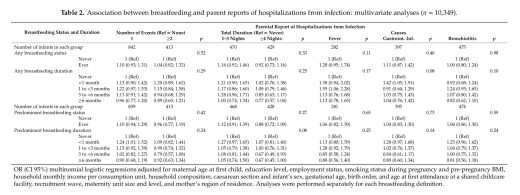
Here’s what they found:

AB97EDB2-85CC-4B25-9EB4-BBF0C922B480

There was NOT EVEN ONE statistically significant association between breastfeeding and hospitalization for fever, gastrointestinal infection or respiratory infection.

Oops!

It’s hardly surprising. No one has ever been able to show that breastfeeding reduces the risk of hospitalization in term infants.

But given the mandated ideological conformity in breastfeeding research, no one was going to publish that inconvenient fact. Therefore, the authors began data dredging, slicing and dicing the data to come up with any association, no matter how arcane.

They looked at parent reported “events” of respiratory infection, ear infection and antibiotic use.

Finally they found a few statistically significant results:

3111A960-4D30-4865-A258-5B7BA880747B

Compared to never-breastfed infants, infants who were predominantly breastfed for <1 month were at higher risk of being hospitalized …

Oops!

How did the authors deal with that finding? They excluded early hospitalizations.

Why? They provide no compelling reason.

Compared to never-breastfed infants, infants who were predominantly breastfed for at least 3 months were at lower risk of long duration (≥4 nights) of hospitalizations…

And:

Compared to never-breastfed infants … any breastfed for <1 month infants were at higher risk of hospitalization from gastrointestinal infections.

Oops!

So they sliced and diced the data even more and finally came up with something:

…[P]redominant breastfeeding for over 3 months was related to lower risk of at least 4 nights of hospitalization up to 2 years, while any breastfeeding for over 3 months was related to higher risk of 1 or 2 bronchiolitis events in the first 2 years of age. Finally, both any and predominant breastfeeding durations were negatively associated with frequency of antibiotic use.

What does this mean? Absolutely nothing because it is an example of data dredging (aka p-hacking).

According to Wikipedia:

Data dredging (also data fishing, data snooping, data butchery, and p-hacking) is the misuse of data analysis to find patterns in data that can be presented as statistically significant when in fact there is no real underlying effect. This is done by performing many statistical tests on the data and only paying attention to those that come back with significant results, instead of stating a single hypothesis about an underlying effect before the analysis and then conducting a single test for it.

Why are these results meaningless?

Conventional tests of statistical significance are based on the probability that a particular result would arise if chance alone were at work, and necessarily accept some risk of mistaken conclusions of a certain type … When enough hypotheses are tested, it is virtually certain that some will be statistically significant but misleading, since almost every data set with any degree of randomness is likely to contain (for example) some spurious correlations…

In other words if a significance level of 0.05 is used (as in this paper), there’s a 5% chance that statistically significant conclusions will be spurious. In a large dataset with only a few statistically significant associations, that virtually ensures that those associations are not valid. Hence data dredging is considered a misuse of data analysis.

The authors of the paper claim:

Even in the context of a high-income country with short breastfeeding duration, we highlighted a lower risk of infectious morbidity related to breastfeeding duration, especially for duration of hospitalization and antibiotic use.

But the truth is they found nothing of the kind.

This is just the latest example of statistically illiterate methods, meaningless “benefits” and ideological censorship that render invalid most of the scientific literature on the benefits of breastfeeding.

Natural mothering and the subversion of women’s empowerment

F893FC0B-279C-4D76-9708-1D4704D3E256

On the face of it, it makes no sense.

  • How can women be empowered by rejecting the lifesaving technologies of modern obstetrics in favor of “natural” childbirth?
  • How can women be empowered by refusing pain relief and laboring in agony?
  • How can women be empowered by breastfeeding exclusively for years at a time?
  • How can women be empowered by re-immuring themselves in the home, devoted only to the care of their children?

They can’t. Indeed, the raison d’etre of natural childbirth, breastfeeding promotion and attachment parenting — as articulated by their founders — was specifically to disempower women by convincing them to forgo political and economic emancipation.

[pullquote align=”right” cite=”” link=”” color=”” class=”” size=””]The irony of natural mothering: the women with the least power imagine themselves as the most “empowered.”[/pullquote]

So how can women claim to be empowered by natural mothering?

It’s not merely a failure to understand the term, it reflects a subversion of the meaning of empowerment. Empowerment has been reduced to consumer choice. Thus natural mothering ideologues can camouflage women’s disempowerment as “empowering.”

As Oana Crusmac explains, empowerment has been subverted. It no longer means “the acquisition of power” but rather “self-expression through consumer choice.”

The self-expression right … comes along with the encouragement to “embark on projects of individualized self-definition exemplified in the celebration of lifestyle and consumption choices.” …

But it is not choice per se that is being promoted, but specific, highly restricted and restrictive choices.

Hence you can be “empowered” by choosing homebirth, but not by choosing maternal request C-section.
You can be “empowered” by choosing to forgo pain relief, but not by choosing an epidural.
You can be “empowered” by surrendering your freedom to exclusive breastfeeding, but not by claiming your freedom and using formula.
You can be “empowered” by being so bound to your children that you literally “wear” them, but you can’t be empowered by a high paying job or a satisfying career.

And who decides which choices are empowering? Those who seek to disempower women.

…The autonomy promoted by postfeminism is determined by the fact that “patriarchy has produced desires in women to want the very things that patriarchy needs them to choose.” Hirschmann refers to this subversive elaboration of women’s autonomy as ‘oppressive socialization’ that leads to their false impression that they act freely and autonomously when in fact, women are not the ones which set their preferences and goals.

In this subversion of empowerment, women can only be “empowered” by choosing re-domestication.

As Kumarini Silva notes in Got Milk?: Motherhood, Breastfeeding, and (Re)domesticating Feminism:

…[W]omen are discouraged from making connections with and to other women … that will make a systemic shift for the equitable distribution of recourses and rights. Instead, young women … are encouraged to disarticulate from the systems that question or make visible their own oppressions. In place of the very real work of making these connections and building on them, we are increasingly asked to celebrate various ‘faux feminist’ symbols that permeate (popular) culture.

Indeed:

…When motherhood is discussed within this broader celebratory context of women’s progress and ‘arrival,’ it tends to ignore larger, deeply historical, systemic inequalities associated with race, class, gender, and sexuality that sustain narratives of idealized motherhood. This disarticulation, between the past and present, speaks to the ways in which feminism and feminist discourses become co-opted in the neo-valorizing of motherhood as a domesticated practice.

Breastfeeding is the paradigmatic example.

Silva asks:

Breast is best: for whom?

It’s been touted as best for babies and mothers. But is that the real reason why breastfeeding is now promoted aggressively?

Silva asks us to consider that the explanations typically offered are revealing in ways its proponents perhaps did not intend:

One such example from 2003 is from a brief introduction to the journal Obstetric and Gynecology by Dr John T. Queenan… Queenan noted that during ‘World War II, while men were off to war, women entered the workforce in droves. During the war and in the good times that followed, fewer and fewer American women practiced breastfeeding. Formula feeding was on the rise as breastfeeding fell to an all-time low of 25 percent in 1971.’ … In his description and summary, Queenan seems to imply that women’s transition from private spaces to public spaces, in the form of professional work (and war efforts), jeopardized the ‘important gift’ of mothering vis-à-vis breastfeeding.

“Good” mothers stay home:

…[W]hat is assumed here is a common connection made between women’s transition to the workforce (and the ‘good times’), and the decline in ‘good mothering,’ including breastfeeding. While not explicit, it speaks to the myriad of ways that women’s work outside the home continues to be positioned as ‘bad’ for the welfare of the infant, the family, and, consequently, even the nation state…

That’s why we are endlessly bombarded with unvalidated mathematical models that predict economic benefits of breastfeeding that never actually come to pass:

…[B]reastfeeding becomes … a way of helping the country, and doing one’s part, as a woman. But unlike the past, instead of joining the workforce and earning a living wage, women’s participation in the economy, in this instance, is reduced to her breasts. While breastfeeding is touted as a boon for the nation’s economy, and the family, there is little-to-no conversation about the connections between these macro-economics and the micro economy of women’s lives.

What would it look like if women were truly empowered in their mothering choices?

Both homebirth AND maternal request C-sections would be viewed as empowering.
Both unmedicated AND medicated births would be viewed as empowering.
Both breastfeeding AND formula feeding would be viewed as empowering.
Both stay-at-home mothering AND working mothering would be viewed as empowering.

Instead we have the ultimate irony of natural mothering: women with the least power imagine themselves as the most “empowered”!

Trust penises!

0B103911-DF6C-4C36-B47A-5F4BF3706E36

Mr. Jones, so nice to meet you.

Allow me to introduce myself, Ima Frawde, IBCEC. What are the letters for? International Board Certified Ejaculation Consultant, of course. I support men who have ejaculation dysfunction at the low introductory price of $200 per hour. I’m here to help you with your erectile dysfunction.

Examine you? No, I’m not going to examine you. I know what’s wrong without examining you; I learned during my training that so called “erectile dysfunction” is always caused by the man who claims he is suffering from it. Different ejaculation consultants may have different opinions about a variety of issues, but on one thing we are all agreed: there is no such thing as “not enough” erectile function.

Just think about it. If erectile dysfunction were real, the population of the world would have died out long ago and we wouldn’t be here. We’re here, so that proves my point!

[pullquote align=”right” color=””]There is no such thing as “not enough” erectile function.[/pullquote]

What is causing your problem? Well, there are a number of possibilities.

1. You are not trying hard enough.

Some men simply don’t care about giving their wives the best sexual experience possible. Let’s face it, sexual intercourse can be a challenge and most husbands are just too lazy to meet the demands of regular activity. When the going gets tough, they give up and give in, opting for vibrators and other sex toys. Sure their wives may seem satisfied with vibrators, but over time those same wives will experience a decrease in IQ. If you really cared about your wife, Mr. Jones, you’d try harder. Lololol, get it? Try harder?

2. You are deformed, but that’s not an excuse.

Sigh, you have a circumcised penis, and we all know who’s to blame for that. Your ignorant parents never realized that circumcision causes erectile dysfunction. Sure you might not have noticed it for the first 65-70 years of life and it might not have started until after you had your first heart attack and began insulin for diabetes, but it is just as much the cause as if you were circumcised yesterday. Too bad for you.

3. Decreased blood flow? Don’t be silly.

You might have heard that erectile dysfunction can be caused by diseases that decrease blood flow to all organs, not just the penis, but it’s not true. That’s just a lie made up by Big Pharma in an effort to sell Viagra. There is no such thing as “not enough blood flow”! Your body is perfectly designed to have an erection and if you only gave it enough time, everything would be fine.

4. So what if your wife is crying because you can’t have intercourse; she’ll just have to wait.

Erectile dysfunction is a matter of supply and demand. If you don’t try to have sex often enough, you’ll never have enough blood flow. You have to keep trying to have sex over and over and over again each day and eventually there will be enough blood flow for erections on demand.

5. You’re doing it wrong.

Positioning is very, very important to prevent erectile dysfunction. If you held your wife the right way, she’d be able to “latch on” to your penis properly and you would then get an erection. So basically this is all your fault.

Oops, time’s up. You can pay with a check, although cash under the table is always appreciated. I’ll be back later in the week for another session. Just remember what I told you: you are not trying hard enough; you are deformed; there is no such thing as decreased blood flow; your wife is just going to have to deal with her disappointment; and, don’t forget, you are doing it wrong.

What? Of course it is your fault! Stop whining that there’s something wrong just so you have an excuse to stop having intercourse. We all know that is what is really going on.

You feel worse now?

No need to thank me; I’m just doing my job as an IBCEC, International Board Certified Ejaculation Consultant.

Midwifery and breastfeeding ideologues have hijacked evidence based medicine

Treasure chest with gold coins on a beach

Midwives and lactation professionals use the term “evidence based medicine” so often, you might think they actually practice it. You would be wrong.

That’s because evidence based medicine is often hijacked by ideologues and industry.

Dr. David Sackett, credited with popularizing the phrase and concept, explained it in an influential 1996 paper, Evidence based medicine: what it is and what it isn’t:

[pullquote align=”right” cite=”” link=”” color=”” class=”” size=””]Evidence based medicine was never meant to be a tyranny. It is NOT supposed to produce one size fits all recommendations.[/pullquote]

Evidence based medicine is the conscientious, explicit, and judicious use of current best evidence in making decisions about the care of individual patients.

John Iaonnidis explains how EBM has been hijacked hijacked:

As EBM became more influential, it was also hijacked to serve agendas different from what it originally aimed for.

Industry immediately recognized the possibilities of hijacking EBM:

Influential randomized trials are largely done by and for the benefit of the industry. Meta-analyses and guidelines have become a factory, mostly also serving vested interests. National and federal research funds are funneled almost exclusively to research with little relevance to health outcomes… Risk factor epidemiology has excelled in salami-sliced data-dredged papers … and has become adept to dictating policy from spurious evidence…

Diabetes care serves as a cautionary example.

In 2009 a large-scale study of tight blood sugar control showed that, contrary to guidelines, tight control actually increased the death rate for adult onset diabetics. How could EBM have been so wrong?

It quickly became apparent that the guideline for tight control was approved over the protests of many diabetes experts. Second, there was a third party that would benefit from a guideline for tighter control: the drug companies that sold insulin, and they promoted such a guideline. Third, the National Committee for Quality Assurance, a supposedly impartial organization that sets the standards used by insurers to determine whether a treatment qualifies for payment, had received money from the drug industry.

When industry stands to benefit from evidence based guidelines, they use their influence to promote guidelines that benefit themselves. They start with the guideline result they want — greater use of their products — and then produce the “evidence” to support it. Then they market it as “evidence based” medicine.

Sadly, ideologues can hijack evidence based medicine in exactly the same way.

Midwives and lactation professionals start with the guideline results that they want — greater use of their services — and proceed to produce the “evidence” to support it. Then they market it as “evidence based” medicine.

How?

Influential midwifery research is done by and for the benefit of the industry of midwives, doulas and childbirth educators and published largely in journals dedicated to promoting them. They start with the results they want — women should be pressured to have unmedicated vaginal births — and proceed to produce the “evidence” to support it. Moreover, they conduct research on low risk women who have few complications and then extrapolate extravagantly — and absurdly — claiming that it was the midwifery care that led to low risk of complications. Then they market their claims as “evidence based” medicine.

Influential breastfeeding research is done by and for the benefit of the breastfeeding industry and published largely in journals dedicated to promoting breastfeeding. They start with the results they want — breastfeeding has major health benefits — and proceed to produce the “evidence” to support it. They conduct small trials riddled with confounding variables and then extrapolate absurdly to make extravagant claims that are never validated and never come to pass. Then they market their claims as “evidence based” medicine.

Midwifery and breastfeeding ideologues have hijacked research to create “evidence” designed to serve their own interests.

They’ve also violated a central tenet of evidence based medicine.

Sackett explained:

Good doctors use both individual clinical expertise and the best available external evidence, and neither alone is enough. Without clinical expertise, practice risks becoming tyrannised by evidence, for even excellent external evidence may be inapplicable to or inappropriate for an individual patient. Without current best evidence, practice risks becoming rapidly out of date, to the detriment of patients.

Evidence based medicine was never meant to be a tyranny. It is NOT supposed to produce one size fits all recommendations since even excellent evidence may be inapplicable to or inappropriate for an individual patient.

Evidence based medicine is not “cookbook” medicine. Because it requires a bottom up approach that integrates the best external evidence with individual clinical expertise and patients’ choice, it cannot result in slavish, cookbook approaches to individual patient care.

Promoting “normal birth” is a slavish, cookbook approach to patient care. Unmedicated vaginal birth is NOT best for every mother. When providers ignore that fact, babies and mothers die.

“Breast is best” is a slavish, cookbook approach to patient care. Breast is NOT best for every baby. When providers ignore that fact, babies die.

In a subsequent paper, Ioannidis likens evidence based medicine to a treasure ship hijacked by pirates.

…[T]he pirates have hijacked the EBM ship because it is a superb, worthy vessel loaded with goodies that are deemed to have high value. No pirates with some profiteering mind would have ventured to
capture a sinking tub that had no treasure.

Those who care about babies and women must fight back.

…We should do our best to throw overboard the pirates who have captured the ship and then stay the course to more rigorous, more unbiased evidence that matters for patients and healthy people.

It will not be easy:

Finance-based medicine, conflicts of interest (financial and other), just-bring-more-money approaches to research, questionable research practices, … salami slicing, spurious reward systems, methodological illiteracy and innumeracy, “basic science” hype, and overall stark ethical poverty are becoming increasingly common …

But it is a worthy task. Babies and mothers are depending on us to take back evidence based medicine from midwifery and breastfeeding ideologues who have hijacked it.

Breastfeeding and the canonization of false facts

true and false choice

“Breast is best.”

Except that it’s not.

How did an ideological claim, never proven with scientific evidence, get accepted as a “fact”?

Nissen and colleagues explain the canonization of false facts:

Science is a process of collective knowledge creation in which researchers use experimental, theoretical and observational approaches to develop a naturalistic understanding of the world. In the development of a scientific field, certain claims stand out as both significant and stable in the face of further experimentation. Once a claim reaches this stage of widespread acceptance as true, it has transitioned from claim to fact. This transition, which we call canonization, is often indicated by some or all of the following: a canonized fact can be taken for granted rather than treated as an open hypothesis in the subsequent primary literature; tests that do no more than to confirm previously canonized facts are seldom considered publication-worthy; and canonized facts begin to appear in review papers and textbooks without the company of alternative hypotheses.

A claim doesn’t have to be true to be canonized.

Consider:

[pullquote align=”right” cite=”” link=”” color=”” class=”” size=””]Breastfeeding professionals are like the surgeons who continued doing radical mastectomies after lumpectomy was shown to produce the same outcome.[/pullquote]

Breast cancer is best treated with radical mastectomy.
Acid causes ulcers.
Episiotomies prevent vaginal tears.

Even though these claims were considered medical “facts” for decades, they were never true. It took years of near heroic work (often while enduring widespread scorn) for doubters to overturn conventional wisdom.

It’s only a matter of time before “breast is best” is added to the list.

The process is under way as we speak as hospitals grapple with tens of thousands of newborn readmissions each year at the cost of hundreds of millions of dollars. The process is furthered by the growing body of papers detailing harms of aggressive breastfeeding promotion including in hospital suffocation of newborns in mothers’ hospital beds as well as skull-fracturing falls from those beds in the wake of closing well baby nurseries. But what will almost certainly seal the de-canonization of “breast is best” is that almost none of the predicted benefits of breastfeeding have come to pass. With the exception of premature infants, breastfeeding has never been shown to save lives, prevent severe disease, or reduce healthcare costs.

If the claims were never true, why was it so hard to convince the believers that they were never true?

White hat bias

The current era of breastfeeding promotion reflected disgust with Nestle’s unethical marketing of formula in Africa. Early breastfeeding promotion efforts in the 1980’s did NOT assert that breast was best, merely that breast was better than formula prepared with contaminated water. The International Code of Marketing of Breastmilk Substitutes was designed to restrain and punish formula companies.

In a very real sense, breastfeeding promotion had its origins in an ideologically motivated boycott of formula manufacturers. That anti-corporatist zeal persists to this day but the demonization of formula manufacturers has transmuted into the demonization of formula itself.

The professionalization of breastfeeding support

In the mid-1980’s, La Leche League realized that it could monetize the advice and support it had been providing for free for decades. The lactation professional was born. While there is certainly nothing wrong with women earning money to promote breastfeeding, it created a group whose economic health was directly tied to the spread of its promotion efforts. It is hardly surprising then that the moralization of breastfeeding followed swiftly upon its monetization. Although breastfeeding professionals have been scathing in their criticism of allowing formula companies to market within hospitals, they have not ended marketing efforts, merely replaced them with their own product: breastfeeding.

Publication bias

As Nissen et al. explain:

Publication bias arises when the probability that a scientific study is published is not independent of its results…

Publication bias is pervasive. Authors have systematic biases regarding which results they consider worth writing up… Journals similarly have biases about which results are worth publishing.

What kinds of results are most valued? Findings of statistically significant differences between groups or treatments tend to be viewed as more worthy of submission and publication than those of non-significant differences. Correlations between variables are often considered more interesting than the absence of correlations. Tests that reject null hypotheses are commonly seen as more noteworthy than tests that fail to do so. Results that are interesting in any of these ways can be described as “positive”.

Publication bias in breastfeeding research means that it is extremely difficult to publish a study that doesn’t conclude breast is best. This bias is exacerbated by the existence of journals whose purpose is to promote breastfeeding. Those journals — the primary sources for scientific information about breastfeeding — rarely publish any studies that dare to question the canonization of false facts about breastfeeding.

Sloppy research methods

As I have noted many times, most breastfeeding research is appallingly bad. It is weak, conflicting and riddled with confounding variables. The central claims are based on the massive extrapolation of small studies as well as unvalidated mathematical models, both of which assume causation whenever correlation is observed. Almost none of it has been consistently reproduced by follow up investigations.

That doesn’t mean that breastfeeding professionals are lying. They truly believe that breast is best, just like generations of surgeons who believed radical mastectomy is best and like generations of internists who believed that acid caused ulcers. There is no shame in canonizing facts that turn out to be false. The only shame is refusing to consider the possibility that you are wrong when new data don’t confirm your beliefs.

That’s where breastfeeding professionals are now. They are like those surgeons who continued doing radical mastectomies after lumpectomy was shown to produce the same outcome. They may believe in their own righteousness but the result is unnecessary suffering.

“Breast is best” is a false fact. Let’s stop pretending otherwise.

What should we do when underperforming big ideas — breastfeeding saves lives — become entrenched?

Big Idea And Innovation Concept

I’m frustrated.

Every year tens of thousands of babies are hospitalized for breastfeeding complications at the cost of hundreds of millions of dollars. Meanwhile, despite 20 years of aggressive breastfeeding promotion and rising breastfeeding rates, the benefits we have been promised, from lives and money saved to conditions and diseases reduced, have failed to appear. Meanwhile researchers keep publishing papers claiming ever more arcane benefits even though their predictions consistently fail to come true.

[pullquote align=”right” cite=”” link=”” color=”” class=”” size=””]In breastfeeding research and practice, NO mechanisms exist to sunset failing initiatives; effort is devoted toward increasing funding for them.[/pullquote]

What should we do when underperforming big ideas — like the claim that breastfeeding saves lives and money — become so entrenched that they can’t be challenged, even by reality?

I found some answers in a paper by John Ioannidis and colleagues, What Happens When Underperforming Big Ideas in Research Become Entrenched?.

They were writing about different issues: gene therapy, stem cell therapy and electronic health records (EHRs):

For several decades now the biomedical research community has pursued a narrative positing that a combination of ever-deeper knowledge of subcellular biology, especially genetics, coupled with information technology will lead to transformative improvements in health care and human health…. [We] show that this approach has largely failed; and propose a wholesale reevaluation of the way forward in biomedical research.

They start with the primacy of the narrative:

In 2016 approximately $15 billion of the $26 billion of extramural research funding sponsored by the National Institutes of Health (NIH) could be linked to some version of search terms that include gene, genome, stem cells, or regenerative medicine. These topics have also increased geometrically in their representation among published articles… Apparently a large number of scientists either believe in the potential of these topics or feel compelled to work on them, recognizing that these topics constitute a major locus of important science, financial support, recognition, and prospects for a successful career.

Yet the extravagant predictions about curing most disease including cancer have not come to pass.

For example:

The complex and adaptive nature of most tumors thwarts the optimistic projections for molecularly targeted therapy for cancer. A randomized trial of targeted therapy based on molecular profiling … showed no improvement in progression-free survival… So far, just 2.5% of screened patients have been assigned to a trial intervention group… [T]he rarity of the targeted mutations means that this approach will help only a minority of patients with cancer.

This is hardly the only “big idea” whose benefits have failed to materialize. Stem cell research has been particularly disappointing, and the implementation of electronic health records (EHR) has had a disastrous impact physician morale without the promised improvement in patient care.

Sound familiar? The benefits of the big idea about breastfeeding — that increased rates will lead to diseases prevented and lives and money saved — has not merely failed to materialize, breastfeeding promotion turns out to have significant harms to infants, mothers and the bottom line. Demonstrating that breastmilk does reduce the risk of necrotizing enterocolitis (NEC) in preterm babies merely highlights the fact that breastfeeding can have substantial benefits in specific situations while simultaneously having no benefits for most.

How do those who promote big ideas respond when their claims cannot be substantiated?

They have two choices:

The first is to continue with calls for more funding, more complex measurements, and more sophisticated instrumentation. The second is to reevaluate and reset the current focus.

Thus far breastfeeding professionals continue with calls for more funding and more complex measurements, while claiming ever more arcane “benefits” (the microbiome! epigenetics!)

What if we were to re-evaluate?

When NIH funds translational or preclinical research with specific deliverables promised (as in the case of personalized medicine, and stem cell therapy), independent assessors should regularly appraise whether these deliverables were achieved and, if so, at what cost, and with what effect. Assessors must be objective, independent of the funding source, and have no professional stake in whether a particular line of research is deemphasized. The deliverable criterion should include public health benefit achieved by these initiatives (ie, measurable reductions in mortality and morbidity). Criteria such as number of publications, citations, prizes, and recognition are irrelevant as these are simply self-rewarding artifacts of the system…

How would that work for breastfeeding?

Independent assessor should regularly appraise whether the claimed benefits of increased breastfeeding rates — conditions prevented, lives and dollars saved — are actually achieved, at what cost, and with what iatrogenic complications for babies, mental health complications for mothers and costs to treat those complications.

Criteria such as the number of publications or the support of authoritative healthcare organizations should be recognized as irrelevant since they are simply self-rewarding artifacts of a system that continues to promote entrenched ideas long after they have been disproven.

The fundamental question:

Has aggressive breastfeeding promotion improved quality of life and life expectancy, by how much, for how many, and for whom?

Despite extravagant predictions, the benefits of breastfeeding have been limited to preterm babies. Breastfeeding cannot be shown to have prevented major disease, saved lives or extended life expectancy. And it can be shown to have caused tens of thousands of hospitalizations per year at the cost of hundreds of millions of dollars.

Ioannidis and colleagues declare:

Mechanisms should be in place to sunset underperforming initiatives.

In breastfeeding research and practice, NO mechanisms exist to sunset existing initiatives; instead massive effort is devoted toward increasing funding for them. Why? Because careers, reputations and economic support for lactation professionals and breastfeeding researchers rests on maintaining the fiction that breastfeeding has major benefits and no risks when the reality is that it has few benefits and significant risks.

The history of medicine is a history of a some excellent big ideas among a much greater number of underperforming big ideas. There’s no shame in the fact that many big ideas turn out to be bad ideas. The only shame is in refusing to recognize it.

Women can’t reclaim their agency from doctors by ceding it to midwives and lactation consultants

6908054C-53CC-426D-BA4A-ADE136FCB6DA

How did the natural childbirth and breastfeeding industries go so wrong?

Why do I receive emails and Facebook messages from desperate women nearly every day detailing their guilt, self-abnegation and torment over “failing” to give birth vaginally or to breastfeed?

Why, when I talk about my writing with friends and acquaintances, do women years removed from childbearing burst into tears about their struggles?

[pullquote align=”right” cite=”” link=”” color=”” class=”” size=””]Doctors shouldn’t pressure or shame you … and neither should midwives or lactation consultants.[/pullquote]

The philosophies of both natural childbirth and lactivism were created as ways to re-domesticate women, so they would not seek legal and economic equality. Their retrograde beginnings were hidden when they reached the mainstream and their the goal of reclaiming women’s agency from paternalistic doctors resonated widely. Instead of doctors deciding that women should be asleep during birth, deprived of emotional support from partners and subject to unnecessary procedures like shaving and enemas, women insisted that it was their right to be conscious, to be accompanied by partners and to accept or reject procedures based on informed consent. Instead of being convinced to forgo breastfeeding or forced to give up breastfeeding due to lack of breastfeeding support, women insisted that it was their right to receive encouragement and support in nourishing their infants in the way they thought best.

What went wrong?

Both natural childbirth and lactivism went off the rails when they insisted that the only way women could reclaim their agency from paternalistic doctors was to hand it over to paternalistic midwives and lactation consultants.

What would childbirth and lactivism look like if women themselves were in charge of the decision making? It would look very different than it does today.

  • All possible choices would be represented because women have a broad spectrum of needs and desires.
  • Birth plans would just as readily include maternal request C-sections as unmedicated vaginal births.
  • Pain relief would have a prominent place in birth plans since most women find they need pain relief.
  • Women would choose how to feed their infants based on what worked for them, and they would NEVER be shamed for bottlefeeding.
  • Free formula gifts would be available to those who want them.

In other words, every safe childbirth or feeding decision made by mothers would be respected by professionals and by other mothers. Decision making would be bottom up: women would make the decisions and inform providers of their choices.

Instead, in the process of women reclaiming their agency from doctors, midwives and lactation consultants swooped in to steal it from them. Within natural childbirth and lactivism, decision making is top down. Midwives, doulas and childbirth educators decide what a “good” or “normal” birth should look like and they force that decision down women’s throats. How? By hectoring and shaming dressed up with the twin lies of being “better for baby” and “evidence based.” Lactation consultants decide how babies should be fed and force that decision down women’s throats. How? By hectoring and shaming dressed up with the twin lies of being “better for baby” and evidence based.”

The Baby Friendly Hospital Initiative (BFHI) is the paradigmatic example of how natural childbirth and lactivism reflect top down decision making and deprive women of their own agency.

The name itself — Baby Friendly Hospital Initiative — is a deliberate slap in the face to women, implying that women who can’t or don’t wish to breastfeed don’t care about their babies. It reflects the professional lactivists’ beliefs that they know better than women what is best for them and their babies, and it is the apogee of mother shaming.

It’s appalling that any hospital allows such an organization anywhere near emotionally fragile new mothers. The medical community has regrettably empowered a group of zealots — lactation professionals — with top down decision making authority over infant feeding. They’ve allowed these zealots to frame the issue of breastfeeding as “baby friendly” when it may be anything but. They’ve allowed them to ignore the needs of mothers. And they’ve allowed them to promote shaming woman as an acceptable tactic for manipulating them.

These zealots deprive women of agency. The assumptions behind the BFHI are that women cannot be trusted to make decisions for their infants, must be hectored into breastfeeding, any alternative must be made as inconvenient as possible, and that bottlefeeding or combo feeding mothers can and should be deprived of valuable infant formula gifts.

Similarly, national health systems that rely on midwives as gatekeepers to care have done the same thing. In the case of childbirth, it’s about saving money. Midwives cost less because they are less educated, less trained and provide less care. But many are zealots, promoting an ideology of “normal birth” above the needs and desires of women. In the UK, for example, these zealots have been empowered to deny desired pain relief, desired and (sometime necessary) C-sections and to shame women who won’t abide by their ideological dictates.

These midwifery zealots deprive women of agency. The assumptions behind contemporary midwifery ideology is that women can’t be trusted to make decisions about birth. They must be hectored or even tricked into giving birth the way that midwives prefer.

Lactivists rationalize their abysmal and disrespectful treatment of new mothers as “better” for babies, just as midwives justify their insistence on unmedicated birth as a standard by claiming that is is “better” for babies and mothers … just as doctors justified shaving and enemas as “better.”

But women can’t reclaim their agency from doctors by ceding it to midwives and lactation consultants.

It’s YOUR baby and YOUR body. You are entitled to YOUR choices in birth and infant feeding.

Doctors shouldn’t pressure you or shame you … and neither should midwives or lactation consultants.

How we know natural mothering is about re-domesticating women: there’s no natural fathering.

938A3AC2-73A8-4759-A38A-E5C3D6531E4F

A lot of angry women have parachuted onto my Facebook page to berate me on my claim that the philosophies of natural mothering — natural childbirth, lactivism and attachment parenting — were promulgated for the express purpose of re-domesticating women.

It’s not my opinion; it’s empirical fact. Grantly Dick-Read (a fundamentalist and eugenicist) made it clear that his philosophy of natural childbirth was designed to pressure women into having more children. La Leche League was explicit in its purpose on founding (by religious traditionalists); the philosophy of “mothering through breastfeeding” was created to keep mothers of small children from working. William Sears (a religious fundamentalist), the man who created the philosophy of attachment parenting, initially made no secret of the fact that he believed his philosophy was vouchsafed by God as His preferred method for organizing the family.

[pullquote align=”right” cite=”” link=”” color=”” class=”” size=””]Where is the claim “good” fathers demonstrate their love for their wives and children by killing game animals and dragging them home?[/pullquote]

Their goal: to re-domesticate women, particularly those women who dared to have jobs and careers, exercising economic power that was previously the purview of men.

The unwitting agents: midwives, doulas, lactation consultants and attachment parenting “experts” who convince women that mothering requires staying home, sacrificing and suffering.

The threat: Advocates of natural mothering claim — with no evidence of any kind — that if women refuse to submit to the ideologies of natural childbirth, lactivism and attachment parenting, their children won’t bond (i.e. won’t love them).

And it’s working!

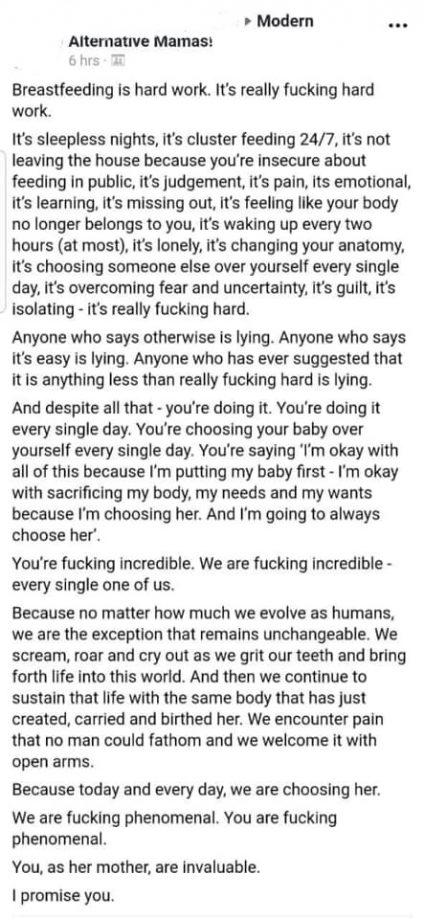
Consider this Facebook post:

3B82645C-2AEC-46C8-B4C3-C8AC51B209E1

Breastfeeding Is hard work. It’s really fucking hard work.

It’s sleepless nights, It’s cluster feeding 24/7. It’s not leaving the house because you’re insecure about feeding in public, it’s judgement, it’s pain, it’s emotional, it’s learning, it’s missing out, it’s feeling like your body no longer belongs to you, it’s waking up every two hours (at most), it’s lonely, it’s changing your anatomy, It’s choosing someone else over yourself every single day, It’s overcoming fear and uncertainty, it’s guilt, it’s isolating -it’s really fucking hard.

Staying home ✔
Sacrificing ✔
Suffering ✔

Cluster feeding? Not leaving the house? Pain? Missing out? Never sleeping more than two hours? Lonely? Isolating?

All of that could be easily averted with formula. That’s why it’s so important to convince women that formula is bad. We wouldn’t want mothers feeling happy, well-rested, able to engage with the world, right?

But there’s another way you tell that the ideology of natural mothering is intended to re-domesticate women: there’s no natural fathering.

There has been no comparable attempt to return fatherhood to the supposedly superior lifestyle of our ancestors with which we evolved. There’s no effort to keep men in pain, away from technology, out of the workplace and tied to their children.

  • Where is the claim “good” fathers demonstrate their love for their wives and children by killing game animals and dragging them home?
  • Why aren’t men escorted out of the delivery room because traditional societies do not allow fathers at childbirth?
  • Where are restrictions on what men can consume, justified by the desire to keep their sperm safe for maximum fertility?
  • Why aren’t fathers competing over who is the more natural father?

Obviously any large social movement, like the movement to re-domesticate women within industrialized societies, is complex and multifactorial. Nonetheless, a significant impetus is to return to the good old days … good for men, possibly good for children, but not good at all for women.

That’s why there are mommy wars, but no daddy wars.

But, but, “the science”!

If the last two decades have shown us anything it is that “the science” is weak, conflicting and riddled with confounding variables. We cannot pin down the answer to something as basic as whether it is good or bad for children if their mothers work and the reason we cannot pin it down is that there is no one answer. It depends; it depends on the individual mother, and individual child and the life circumstances of the family.

It’s just like breastfeeding, where “the science” is also quite fuzzy no matter how much lactivists insist otherwise. That’s because the greatest danger of not breastfeeding comes from contaminated water used to prepare it and that’s not a problem in first world countries. Is breastfeeding better for term babies than formula feeding? It depends; it depends on the individual mother, the individual baby and the life circumstances of the family.

The weak “science” of breastfeeding and the weak “science” on working mothers is stronger by far that any science on natural childbirth or attachment parenting. That’s because there is no science at all to support either of those two components of natural mothering.

What does science show about fathering in nature? No one knows, because virtually no one is looking.

In part that reflects the importance of mothers during pregnancy and early infancy, but, I would argue, it also reflects the fact that we use mothering to control women while there is no comparable effort at all to control men through fathering.

As a society we need to step back and ask ourselves why we are placing such pressure on new mothers and why we are demanding that women accede to the imperatives of natural mothering (and shame them for not doing so), while paying no attention to fathering.

Is this really about what’s best for children? Is this really about “the science”?

No, it’s just the thoroughly modern way to re-domesticate women.