All posts by Amy Tuteur, MD

Ina May Gaskin and the racism of natural childbirth advocacy

IMG_2281

In the wake of a lecture by Ina May Gaskin, sponsored by the Texas Birth Network, birth workers Tasha Portley, R.N, M.S.N, C.C.M, C.P.ST, Erricka Bailey, CD, Jasmine Banks, L.A.C have created the petition Demand ICAN and TBN Trust BLACK Women.

Yesterday during a session at the Texas Birth Network “Birth Roundup” registered nurse Tasha Portley asked Ina May Gaskin about the impact of racism on the births of Black women.

Gaskin responded with anecdotal stories about Black women who lost their lives as a result of provider negligence, and blamed the Black women for not being more informed of their life-threatening symptoms. Moreover, Gaskin stated that “drug overdose” and the use of illegal drugs was the cause of the massive amount of Black maternal death rates. She also mentioned that communities “don’t pray as much as we used to” as a reason contributing to maternal death rates.

Sadly, this is just the latest effort in which natural childbirth advocates in general and Ina May Gaskin in particular engage in medical colonialism, expropriating the tragedies of Black women to advance a philosophy created by and for Western, relatively well-off white women.

[pullquote align=”right” cite=”” link=”” color=”” class=”” size=””]Natural childbirth advocates in general and Ina May Gaskin in particular engage medical colonialism.[/pullquote]

It goes all the way back to Grantly Dick-Read, the founder of the natural childbirth movement, who was a racist and a eugenicist, who claimed:

…[P]rimitives experienced easy, painless labours. This was because in primitive societies the survival value of childbirth was fully appreciated and labour was regarded as nothing more than “hard work” in the struggle for existence. In civilised societies on the other hand a number of cultural factors conspired to distort woman’s natural capacity for painless birth, producing in woman a fear of childbirth that hindered normal parturition …

That racism is manifested in predominantly three ways:

1. The fantasy that white natural childbirth advocates are re-enacting birth among indigenous women

2. The exploitation of high rates of Black perinatal and maternal mortality to critique modern obstetrics without acknowledging that Black women need access to more technology, not less

3. The profoundly disturbing trend of white homebirth midwives learning their trade on the bodies of women of color in developing nations.

Natural childbirth is a philosophy of privilege. Political scientist Candace Johnson explores this phenomenon in The Political “Nature” of Pregnancy and Childbirth. Johnson asks:

[W]hy do some women (mostly privileged and in developed countries) demand less medical intervention in pregnancy and childbirth, while others (mostly vulnerable women in both developed and developing countries) demand more …? Why do the former, privileged women, tend to express their resistance to medical intervention in the language of “nature,” “tradition,” and “normalcy”?

And answers:

It is a rejection of privilege that simultaneously confirms it…

The fantasy of Third World women’s natural experiences of childbirth has become iconic among first world women, even if these experiences are more imagined than real. This creates multiple opportunities for exploitation, as the experiences of Third World women are used as a means for first world women to acquire knowledge, experience and perspective on ‘natural’ or ‘traditional’ birthing practices, while denying the importance of medical services that privileged women take for granted.

Reality is brutally different, as Jazmine Banks explains:

…The constant denial of the lived experiences of Black women is ignored while Black women continue to die because of maternal health disparities. Maternal health disparities means Black and brown women are dying from PREVENTABLE causes. Tasha asked Ina May Gaskin about the impact of racism within maternal health disparities- and good ole Ina did exactly what racists do: BLAME BLACK WOMEN FOR THEIR OWN DEATH AND SUFFERING, while refusing to acknowledge the ways in which systemic racism embedded in the birth community impacts women of color.

Today Tasha and Erricka are demanding that their community and allies stand with them and other Black women who wish to build better births for ALL. Help them by signing their petition, sharing their stories, and trusting them. #InaAintShit #TrustBlackWomen

The petition demands include:

1. Immediately acknowledge how harmful Ina May Gaskin is to the birth community. Publicly denounce Ina May Gaskin and those who support her racist ideology.

2. Refuse to attend/participate in events that feature Ina May Gaskin. Gaskin is being paid to teach a narrative that is violent to Black women and people of color.

3. Apply pressure to organizations who continue to support Ina May Gaskin and those who support her racist ideology.

4. Publicly commit to funding the work of Black women in the birth community.

5. Create a plan of accountability that includes anti-racist training for your chapters…

We DEMAND that ICAN, TBN, and the birth community TRUST BLACK WOMEN and build better births for ALL of us.

It seems to be the least that these organizations can do, yet some white individuals are still in denial, engaging in gaslighting as these comments make clear.

…[D]espite you putting Ina may on the spot about race and oppression during a discussion regarding maternal mortality (which is relevant to every woman, color, shape and size) and what you are now trying to do to her publicly- she still cares about your birth, your health, and your baby.

Including Gaskin’s son Samuel:

My mother cares about everyone of every race, gender and sexual orientation.. if you are interpreting her words in a malicious manner I’m sure you are misunderstanding her.

Really, what has Gaskin done about the problem of Black maternal mortality besides exploit it?

The ugly truth is that Gaskin and other natural childbirth advocates care about the deaths of women and babies of color only to the extent that they can use them for their own ends, not because they care that they are dead and not because they have any intention of lobbying for an increase in high risk obstetricians to treat the problem.

If you agree, please sign the petition.

Why I’m marching for science

33133813 - the word science written on sticky colored paper

I’m looking foward to partipating in the March for Science in Washington, DC this Saturday. I’m bringing my March for Science T-shirt, my rain gear and my passionate commitment to the value of science in improving the human condition. Therefore, I was disappointed to read Arthur Lambert’s piece in STAT, Why I’m not attending the March for Science.

[pullquote align=”right” cite=”” link=”” color=”” class=”” size=””]Promoting the objectivity of science is NOT politicizing it.[/pullquote]

Lambert is a postdoctoral researcher at the Whitehead Institute for Biomedical Research in Cambridge, MA. He’s spent most of the last 15 years devoted to science. So why isn’t he marching?

… I think that the march is a bad idea. It threatens to undermine the objective nature of scientific research that is so critical to its integrity…

And there’s no denying this march is political. It is a mistake to position the scientific method against the Trump administration or any other one, for that matter. That would serve only to undermine a central premise of the march: that scientific knowledge is apolitical…

Yes, science is apolitical. Many of us are marching precisely because we believe that and we want to register our disapproval of those who censor it, suppress it, twist it and deride it for political or religious ends.

According to its website:

The March for Science champions robustly funded and publicly communicated science as a pillar of human freedom and prosperity. We unite as a diverse, nonpartisan group to call for science that upholds the common good and for political leaders and policy makers to enact evidence based policies in the public interest.

The March for Science is a celebration of science. It’s not only about scientists and politicians; it is about the very real role that science plays in each of our lives and the need to respect and encourage research that gives us insight into the world.

Scientific knowledge is not the province of the Democratic Party or the Republican Party. It is not the province of any religion or no religion at all. It crosses borders, ethnicities and economic classes. It is truly apolitical, areligious and exists outside of economic philosophies. As astrophysicist Neil de Grasse Tyson has famously noted:

The good thing about science is that it’s true whether or not you believe in it.

But scientific knowledge is perceived as a threat by certain groups. Historically we have seen that most often in the case of religion. Galileo was condemned by the Catholic Church because his findings threatened the religious belief that the Earth is the center of the universe. Charles Darwin has been condemned, and remarkably continues to be condemned, by those whose religious beliefs are (as they see it) incompatible with the massive amount of scientific evidence supporting evolution.

When Galileo stood up for the helio-centric universe, he was not politicizing science even though he angered the politicians of his day; his critics politicized science. When Darwin stood up for evolution, he was not politicizing science even though he angered the politicians of his day and some of the politicians of our day; his critics politicized science.

How do we know? We merely have to look at the definition of political. The definition, according to Merriam-Webster, is:

1 a of or relating to government, a government, or the conduct of government
b of, relating to, or concerned with the making as distinguished from the administration of governmental policy
2 of, relating to, involving, or involved in politics and especially party politics
3 organized in governmental terms political units
4 involving or charged or concerned with acts against a government or a political system political prisoners

Neither astronomy nor evolutionary biology have anything to do with government, parties or political systems. Nonetheless, politicians and religious authorities insisted on using the instruments of government and religion to censor, suppress, twist and deride the scientific evidence that forms the basis of astronomy or evolutionary biology. The science is apolitical yet politicians insist politicize it.

Similarly, neither climate science, reproductive biology, nor vaccine science have anything to do with government, parties or political systems. Nevertheless, politicians keep insisting on using the instruments of government to censor, suppress, twist and deride the scientific evidence that forms the basis of these disciplines. The science is apolitical yet politicians insist on politicizing it.

Sure, the Republican Party has recently been far more aggressive in politicizing science than the Democratic Party but that doesn’t mean that efforts to affirm science as apolitical are anti-Republican or pro-Democratic. If history has shown us anything at all it is that science can threatened cherished religious and political values across the spectrum. Unable or unwilling to cope with the resulting cognitive dissonance, many find it far easier to use the tools of politics to censor, suppress, twist and deride the distressing scientific facts.

We are marching to stop the politicization of science and it seems to me deeply unfortunate to confuse promoting the objectivity of science with politicizing it. That view serves to delegimize science — inadvertently, I hope — by claiming its proponents are engaged in the same misuse of science as many political and religious authorities.

It’s a claim of false moral equivalence … and it is objectively wrong.

Eco-chic: constructing class identity through food choices

set of organic fresh eco labels

Yesterday I wrote about the ways in which maternal foodwork reinforces privilege:

Those engaged in intensive maternal foodwork may claim — and may even believe — that they are improving their children’s health, but the primary purpose of intensive foodwork is to demonstrate privilege.

In other words, rather than rejecting consumerism, women who embrace intensive foodwork (organic food, homemade baby food, and even breastfeeding), represent niche consumerism, the consumerism of the privileged.

[pullquote align=”right” cite=”” link=”” color=”” class=”” size=””]Are the stories we tell about “good” mothering — breastfeeding, homemade baby food and organic produce — just another way to assert privilege, ensuring that ONLY privileged women can qualify as “good” mothers?[/pullquote]

As Cairns et al. write in The Caring, Committed Eco-Mom: Consumption Ideals and Lived Realities of Toronto Mothers:

…The realm of eco-consumption is also shaped by dynamics of social class, given the considerable financial and cultural capital required to achieve the performance of the discerning, environmentally-conscious consumer… [W]e argue that eco-consumption is one contemporary form of caring consumption that North American mothers are encouraged to perform – a resource- and knowledge-intensive mothering project that operates as a gendered form of class distinction.

In other words, the difference between feeding children McDonald’s and products from Whole Foods isn’t so much a difference in healthfulness, it’s merely a convenient shorthand for class distinctions and aspirations. It’s not a coincidence that poor women and women of color are more likely to choose McDonald’s and well-off, white women are more likely to shop at Whole Foods. It’s just one of the many ways that well-off white women use to flaunt their privilege and distinguish themselves from poor women and women of color.

The authors explore “caring consumption,” a form of consumerism beloved of natural parenting advocates:

…[E]co-mothering is idealized as a pleasurable consumption project easily attained alongside other maternal commitments, such as protecting family health. North American lifestyle magazines offer a seemingly endless array of “‘simple’ and ‘easy’ ways for women to ‘go green’” while fulfilling caretaking responsibilities.

But far from being easy or pleasurable:

… [T]here are three key points of tension that characterize the lived experience of mothers who strive to fulfill the Eco-Mom ideal… tensions in how 1) information, 2) time and 3) money factor into mothers’ consumption choices. These tensions make eco-consumption problematic for the Canadian mothers in our study, as they require investments in resources that vary by class …

Access to information, time and money vary dramatically by economic and social class. Ultimately eco-consumption is yet another way that the privileged leverage their privilege to display their privilege.

The authors explore these constraints individually.

Information:

Many mothers described engaging in ongoing research to better understand the health and environmental implications of their food shopping…

Access to knowledge is mediated both by cultural capital (e.g., knowing which sources to read and trust) and financial capital (e.g., using smart-phone applications to guide one’s purchases).

And yet:

Lamenting how “complicated” shopping has become, Matilda remarked, “I don’t think my mom sat there and thought, ‘it is local, is it organic, is it ethical, am I supporting factory farms?’ I mean, she just went and bought food.”

Of course she didn’t. She probably didn’t have time or the money to do that.

Time:

In addition to the challenge of navigating a sea of contradictory knowledge claims, the mothers in our focus groups experienced time as a major constraint in their efforts to live up to Eco-Mom ideals…

…[M]others in our study described spending significant time devising meal plans and shopping lists. They then ventured to multiple vendors in order to access food that satisfied their standards for health and ethics, and also suited family members’ diverse preferences.

Indeed, mothers fetishize inconvenience as yet another way to distinguish themselves from mainstream women who aren’t privileged:

In addition to the time requirements of planning and specialty shopping, eco-mothering also demands that women eschew ‘convenience’ foods designed to make feeding children easier, such as pre-packaged lunch items.

Ultimately, though, it comes down to money:

Fulfilling the Eco-Mom ideal presumes the regular purchasing of expensive items such as organic produce and grain-fed, hormone-free beef, and women spoke openly about how one’s class position enabled or constrained these practices…

Others critiqued the status displays associated with the Eco-Mom ideal … [E]co- food is often sold in classed spaces (like farmers’ markets), catering to values that are more readily practiced by privileged consumers.

Breastfeeding has similar time and financial constraints to eco-mothering. It requires privilege to have the time, financial spousal support, maternity leave and/or a job that allows for frequent pumping breaks without which women cannot sustain exclusive breastfeeding. Poor women and women of color are much less likely to have such privilege and that makes the contemporary emphasis on exclusive breastfeeding doubly problematic. Not only do these women lack the time and money to engage in exclusive breastfeeding, they are berated by privileged women precisely because they lack privilege.

The authors conclude:

…[E]co-mothering operates as an elite mode of caring consumption by reproducing and reinforcing class and gender distinctions… The idealized version of caring consumption emphasizes that mothers find care work satisfying, empowering, and effective. In practice, eco-mothering  … was often confusing, tiring, expensive, and typically a gendered burden…

Each point of tension, moreover, was intensified by dynamics of social class, serving to further underscore the ways in which eco-mothering acts as a distinctly classed form of caring consumption that mothers strive to perform.

What’s the take home message?

Privileged women need to ask themselves whether the stories we tell about “good” mothering — breastfeeding, homemade baby food and organic produce — are just another way to assert privilege, ensuring that ONLY privileged women can qualify as “good” mothers.

Reinforcing privilege through maternal foodwork

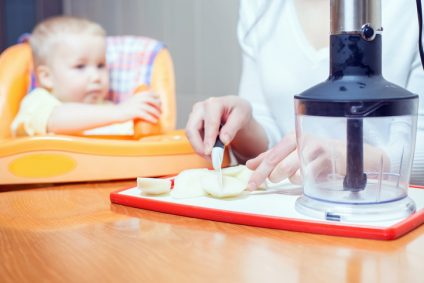
Mother cooking in blender pure for baby

One of the most important aspects of being privileged — whether that is through race, class or the size of your bank account — is to make sure everyone else knows that you are privileged. That’s just as true about motherhood as in any other area. It can be accomplished through conspicuous consumption (extraordinarily expensive strollers, designer baby clothes, live-in help) but in recent years a more subtle form of demonstrating privilege has become popular. Maternal foodwork is an example of this new way to demonstrate privilege.

[pullquote align=”right” cite=”” link=”” color=”” class=”” size=””]Organic food is a form of conspicuous consumption, albeit less flashy than designer clothing.[/pullquote]

As Joslyn Brenton explains in The limits of intensive feeding: maternal foodwork at the intersections of race, class, and gender:

…[M]others today confront increasing social pressure to embody perfection through their foodwork… Extending Hays’ concept of intensive mothering, rich descriptions of feeding children reveal how mothers in this study are discursively engaged with what I call an ‘intensive feeding ideology’ – the widespread belief that good mothering is synonymous with intensive food labour…

Intensive foodwork is yet another expression of the intensive mothering ideal:

… that defines good mothers as those who invest intense emotional and physical labour, as well as significant financial resources, into maximising their children’s potential. This ideology remains the gold standard to which all mothers are held, regardless of their resources…

In a foodscape that encourages mothers to take individual responsibility for keeping children safe and healthy, middle-class mothers in particular may see engaging in expensive and time-consuming food strategies, such as purchasing and preparing organic food and making foods from scratch, as a demonstration of good mothering. Such acts are associated with a deep maternal love and commitment to protecting children’s symbolic purity.

Those engaged in intensive maternal foodwork may claim — and may even believe — that they are improving their children’s health, but the primary purpose of intensive foodwork is to demonstrate privilege.

Intensive feeding encompasses a combination of activities, including shopping at multiple grocery stores for the healthiest foods; finding ways to stretch the family budget to buy organic food; navigating nutritional information and expert feeding advice; negotiating food with children; and teaching children how to develop a taste and preference for particular foods.

Hence women are preparing their own baby food:

Homemade baby food, argues sociologist Amy Bentley, ‘signifie[s] a type of conspicuous consumption, an elite economic and cultural status conferred by virtue of having the option of extra time and energy to make baby food from scratch’.

It’s not healthier than commercially prepared baby food; it’s a demonstration of privilege. And it allows women who practice intensive foodwork to look down upon women who don’t.

For mothers who embrace the ideology of intensive feeding, it is not simply one of many feeding strategies. It is articulated as the strategy well-educated mothers would naturally opt for. Mothers striving for this ideal felt they were outliers compared to other parents, whom they constructed as less educated and less willing to put in the time needed to raise healthy children.

Though it is not discussed in this paper, breastfeeding represents the apogee of intensive maternal foodwork. Breastfeeding requires significant time, significant effort, the ability to remain out of the workforce for months/years or to hold a high status job that is compatible with privately pumping breastmilk multiple times per day. That’s why most of the supposed advantages of breastfeeding disappear when data are corrected for maternal educational and socio-economic status. Breastfeeding doesn’t improve infant health; being privileged enough to be able to breastfeed improves infant health.

Purchasing organic food is another example of the way that maternal foodwork reinforces privilege. Organic food is not healthier than conventionally grown food, but it is far more expensive. It is just a form of conspicuous consumption, albeit less flashy than designer clothing.

Not surprisingly, black mothers may associate intensive maternal foodwork with “whiteness”:

…[M]any black mothers implicitly associated healthy eating with white spaces – like expensive grocery stores – or white foodways, such as the kind of self-deprivation that leads to disordered eating commonly associated with white middle-class women…

When women feed their families they are often reproducing … dominant norms about white middle-class femininity and motherhood. These narratives of foodwork demonstrate that feeding strategies are about far more than health; they are intimately linked to race, class and gender hierarchies…

The author concludes:

Current discourse surrounding health and ethical consumption often promotes expensive ways of eating, and is also ‘linked to ways of performing Euro-Canadian whiteness’. To the extent that embodying these feeding practices defines good mothering, intensive feeding marginalises not only poor mothers, but all mothers of colour, regardless of class…

Intensive foodwork doesn’t make a woman a better mother, just a privileged one.

Social media leaves natural parenting advocates both ignorant and indignant

Social media

Social media is the lifeblood of the natural childbirth and lactivists movements; advocates have been fattened on alternative “facts” and therefore rendered ignorant of the truth and indignant at anyone who dares to correct them.

Consider this Facebook comment from Scarlett Lynsky:

IMG_2220

Amy Tuteur- Professional Troll, Woman with a Vendetta. Angry at anyone who breastfeeds or gives birth without medication and anyone who supports them. Just, like, a life of angry trolling on the internet. I hope you get happy someday, Amy, because this is a weird life you’ve chosen.

It’s a perfect illustration of the ignorance, indignation and inability to tell the difference between disagreement and criticism that characterize both lactivism and natural childbirth.

[pullquote align=”right” cite=”” link=”” color=”” class=”” size=””]It is infinitely more gratifying to imagine that breastfeeding makes some mothers superior, but the doesn’t make it true no matter how relentlessly social media insists.[/pullquote]

What provoked it? I dared to correct the faux “facts” of lactivist Lucy Martinez Sullivan’s in her HuffPo piece The National Scandal Of Newborn Deaths And Why Support For Breastfeeding Moms Matters.

I posted this meme:

IMG_2208

The real scandal here is the way that Martinez Sullivan exploits the tragedies of poor women and women of color to promote full employment for lactation professionals.

The biggest risk factors for infant death in the US are race and class. There is no evidence that breastfeeding make much of an impact on infant mortality and no reason to think it would. Sure, breastmilk can reduce the incidence of necrotizing enterocolitis and thereby lower the death rate for very-low birthweight infants, but that accounts for only a small fraction of infant deaths. Over the past 100 years, breastfeeding rates have dropped dramatically and then risen again; there has been no impact on infant mortality by either of those trends. No one can point to any term infants whose lives have been saved by breastfeeding.

I don’t know if Martinez Sullivan is ignorant of this reality or merely willing to exploit it for her own ends, but I do know lactivist organizations as well as natural childbirth organizations use social media to create a carefully curated faux “reality” and then lash out at those who dare to point out that it isn’t reality at all.

That’s George Will’s point in The ‘alternative facts’ epidemic goes way beyond politics. Quoting Tom Nichols author of The Death of Expertise: The Campaign Against Established Knowledge and Why It Matters, he notes:

Our devices and social media are … producing people who confuse “Internet grazing” with research and this faux research with higher education …

As Carolyn Stewart writes in The American Interest:

We recuse ourselves from reality via the device in our hand, which rewards us for ignoring reality with a series of dopamine-releasing mini-tasks. From Candy Crush and Twitter to work emails, these activities hook us on a seeking-reward feedback loop that is infinitely more gratifying than staring at the commuter sitting across from you. These cyber preoccupations allow us to customize our surroundings, and accustom us to regulating and controlling the information that comes our way. This has several effects: an expanded sense of what falls under our personal social domain, an increased expectation of control over that domain, and a greater sensitivity to input that deviates from our preferences.

Lactivism and natural childbirth webpages, Facebook pages and Twitter feeds encourage lactivists and natural childbirth advocates to believe they have “done their research,” are in possession of “knowledge,” and are battling for the dissemination of knowledge to others. The reality is that they have read propaganda, are in possession of propaganda, and are battling for the dissemination of propaganda to others.

As Will explains:

In today’s therapeutic culture, which seems designed to validate every opinion and feeling, there will rarely be disagreement without anger between thin-skinned people who cannot distinguish the phrase “you’re wrong” from “you’re stupid.”

The Facebook comment above perfectly illustrates the inability of lactivists and natural childbirth advocates to distinguish between “you’re wrong” and “you’re stupid.”

Lucy Martinez Smith wrote a piece that flagrantly ignores facts about breastfeeding in an effort to promote full employment for breastfeeding professionals like herself. Breastfeeding is not perfect; it doesn’t save the lives of term babies; and it has little if anything to do with the tragedy of US infant mortality.

But Scarlett Lynsky heard none of that. She simply cannot tell the difference between “breastfeeding doesn’t save lives” and “you are angry at anyone who breastfeeds and anyone who supports them.” Considering that I breastfed four children, that’s obviously nonsensical, but the a steady diet of social media seems to erode the ability to think logically.

Pointing out that breastfeeding is not lifesaving is NOT the same as saying that breastfeeding is hateful. But social media has so warped the senses of lactivists and natural childbirth advocates that they believe they are entitled ignore facts or create new ones to keep the hits of dopamine coming.

Not surprisingly, it is infinitely more gratifying to imagine that breastfeeding makes some mothers superior to others. But the doesn’t make it true no matter how relentlessly your customized social media environment insist that it does.

Heads up, lactivists! Nature doesn’t care if your baby lives or dies.

IMG_2218

Breastfeeding is excellent.

If lactivists confined themselves to that message, they’d be on solid ground. Instead they insist that breastfeeding is perfect. Since nothing in nature is perfect, their aggressive efforts to promote breastfeeding are leading to injuries and deaths. And in attempting to justify those injuries and deaths, blithering idiots write pieces like This is Why I am Fed Up with “Fed is Best.”

[pullquote align=”right” cite=”” link=”” color=”” class=”” size=””]Nature does not intend that every baby will survive.[/pullquote]

According to Lauren Lewis:

As a childcare provider, mama, and breastfeeding advocate, I LOVE me some fact-based research. So if your argument is that the slogan “fed is best” is more supportive than “breast is best”- know that it just isn’t factually correct. Saying that “Fed is Best” takes away the message behind “Breast is best” the exact same way that “All lives matter” takes away from “Black lives matter”- it is completely missing the point of the campaign in the first place.

So much stupidity in so little space.

Let’s start with the “Black lives matter” reference. “Black lives matter” is an elliptical sentence. An elliptical sentence is one that is missing important information, but that information can be understood from context.

“Mary runs faster than John” is an elliptical sentence. The full sentence would be “Mary runs faster than John runs.” The full sentence uses the verb runs twice; the elliptical sentence uses it only once but the second use is understood from context.

“Black lives matter” is elliptical. The full sentence is “Black lives matter as much as white lives.” Those who invoke “all lives matter” as if that counters “black lives matter” are deliberately ignoring the fact that it is an elliptical sentence in order to score political points.

Similarly, “Fed is Best” is also elliptical. The full sentence is “Fed is best compared to inadequate amounts of any specific food.” Breast is best is also an elliptical sentence. It stands for “breastmilk is better than formula,” but the truth is that adequate amounts of formula beats inadequate breastfeeding every time.

The author of the piece betrays more than just a misunderstanding of grammar. Like many lactivists, she doesn’t understand either physiology or evolution, either.

Lactivists like the author engage in motivated reasoning. If breastfeeding isn’t the perfect way to feed each and every baby, then they can’t be sure that they are perfect mothers. But by insisting on the perfection of breastfeeding lactivists betray more than their insecurities. But what they fail to understand is that “Nature” does not intend that every baby will survive.

Infant mortality rates in nature are astronomical. Babies die from congenital anomalies, prematurity, dehydration, starvation, vaccine preventable diseases and accidents among other causes. Genetic and chromosomal abnormalities are astoundingly common. Fully 20% of pregnancies end in miscarriage, almost all because of genetic defects. “Nature” could care less. If only 80% of fertilized eggs are perfect, why would breastfeeding be perfect?

Approximately 12% of babies are born prematurely, and until very recently, most premature babies died. “Nature” didn’t care. If only 88% of babies know when to be born, why would breastfeeding be perfect?

Smallpox is an entirely natural virus. The human immune system can naturally make antibodies to smallpox but, in the absence of vaccination, 20%-30% of people will die before they can produce enough antibodies. There have been repeated smallpox epidemics through history and “Nature” didn’t do anything to stop them. If immunity isn’t perfect, why would breastfeeding be perfect?

It wouldn’t, obviously.

Yet, the author believes this nonsense:

The biological norm is what keeps babies alive.

Actually, the biological norm results in massive numbers of dead babies. It’s all the same to “Nature” if a mother gives birth to 10 babies and 7 die then if a mother gives birth to only 3 babies who live.

The author quotes the World Health Organization:

Saying that “Fed is Best” takes away the message behind “Breast is best” the exact same way that “All lives matter” takes away from “Black lives matter”- it is completely missing the point of the campaign in the first place.

Sadly, even the WHO sometimes comes up with absolute bullshit. The WHO claims are based on statistical modeling, not actual population data. For most of human history all babies were breastfed and infant mortality was very high. Breastfeeding is not protective against most of what kills babies. Moreover, many of the countries in the world with highest infant mortality rates have breastfeeding rates approaching 100%.

The author ends with typical lactivist lie:

Lactation Consultants, Doulas, midwives, breastfeeding advocates — even lactivists — are NOT SHAMING parents who choose to promote the benefits of breastfeeding. We are just trying to help parents who WANT to breastfeed.

Who does she think it stupid enough to believe that?

Curiously, the author is right about one thing.

She insists that “Fed is minimum.” Well, yes, fully fed is the minimum that every mother ought to provide. If your baby is not fully fed, regardless of whether you are breastfeeding, you haven’t even reach the minimum that your baby needs. In that circumstance breast isn’t merely inferior; it can be deadly.

Breastfeeding — like pregnancy, childbirth and the immune system — has a naturally high failure rate. Nature doesn’t care whether an individual baby lives or dies just like it doesn’t care if an individual pregnancy ends in miscarriage. Nature makes it up in volume.

“Fed Is Best,” it’s shorthand for the truth:

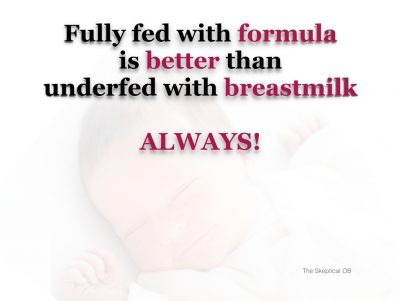
Fully fed with formula is better than underfed with breastmilk — ALWAYS!

Lactivists criticize the Fed Is Best Foundation because they’re desperate to shoot the messenger

IMG_2204

The lactivist attack on the Fed Is Best Foundation is a perfect example of shooting the messenger.

According to Wikipedia:

“Shooting the messenger” is a metaphoric phrase used to describe the act of blaming the bearer of bad news.

In this case, the bad news is that the relentless efforts to promote breastfeeding are leading to babies being injured or killed by accidental starvation.

[pullquote align=”right” cite=”” link=”” color=”” class=”” size=””]What’s the difference between formula companies letting babies die from contaminated water to increase market share and lactivists letting babies die from insufficient breastmilk to increase market share?[/pullquote]

From the lactivist point of view, the bad news brought by the Fed Is Best Foundation has three components:

  • Breastfeeding is not perfect.
  • Infant starvation is common.
  • The Baby Friendly Hospital Initiative (BFHI) hurts and even kills babies.

The Fed Is Best Foundation functions as an industry whistle blower and as in any industry, lactation industry leaders are desperate to suppress and discredit anyone who threatens maketshare. It is a sad irony that the lactation industry has become exactly what it despised about the formula industry. As its attacks on the Fed Is Best Foundation make clear, market share is more important than babies’ lives.

And even greater irony is that they use exactly the same tactics as Nestle, the avatar of the contemptible formula industry used:

  • Exaggerating benefits
  • Ignoring Risks
  • Claiming the imprimatur of “science”

Nestle also tried to shoot the messenger and the result should give pause to the critics of the Fed Is Best Foundation. Nestle brought libel charges in Germany:

Nestlé had a fast response to this event and decided to sue the publisher of a German-language translation of War on Want. The multinational corporation did not want to accept the allegations. After a two-year trial, in 1976 the court found in favor of Nestlé because they could not be held responsible for the infant deaths in terms of criminal law. The defendants were only fined 300 Swiss Francs (if adjusted to inflation, over US$400). The judge found the 30 members of TWAG guilty of libel.

It won the libel battle, but it lost the public relations war.

The first Nestlé boycott in 1977 has been led by Infant Formula Action Coalition (INFACT) and had a large negative impact on Nestlé’s revenues… The boycott campaigners set a goal to improve total infant nutrition and health of babies throughout the Third World countries as well as to resolve this issue on a global basis.

The boycott against Nestlé’s products and the infant formula manufacturers generated the largest support of the consumer movement in North America, and its impact has still been felt in the industry around the world. The Nestlé boycott has been lasting for 7 years in 65 countries and ended in 1984 after the world’s leading organizations took a variety of restrictive actions against Nestlé. The company lost more than $5.8 million in revenues.

By relentlessly attempting to discredit the Fed Is Best Foundation, the lactation industry seems determined to repeat Nestle’s mistake: win the battle yet losing the public relations war. That’s despite the fact that the lactation industry has an advantage that Nestle did not have.

Nestle could not afford to acknowledge the risks of their product. The water in third world countries was often contaminated, and the poverty of the purchasers led to them to dilute the product thereby harming their babies. Informing women of these risks would have dramatically reduced the number of women purchasing formula.

In contrast, acknowledging the risks of breastfeeding would not mean a drop in market share for the lactation industry. Women could still breastfeed and supplement with formula when necessary. But breastfeeding is more than just a business decision for the lactation industry; it is a lifestyle decision. Acknowledging that other mothers may have valid reasons for using formula might diminish lactivists’ sense of superiority regarding their own ability to exclusive breastfeed. That is apparently an intolerable sacrifice.

But the lactation industry, like Nestle before it, is fighting against the truth and will inevitably lose:

Breastfeeding has real risks and refusing to acknowledge them discredits lactivists, lactation consultants and the breastfeeding organizations like La Leche League and the BFHI.

Shooting the messenger, in this case the Fed Is Best Foundation, calls the credibility of the lactation industry into question. Attempting to silence an industry whistle blower often precipitates a public relations debacle.

Most importantly, heartless behavior — letting infants scream in hunger, suffer injuries from dehydration and low blood sugar, and even die — is profoundly immoral. That’s what Nestle did and they paid the price. Surely the lactation industry can learn the lesson that letting babies die in order to preserve market share is not merely deeply unethical, but unprofitable, too.

Kimberly Seals Allers, don’t bury dead babies twice

IMG_1778

Baby Landon Johnson died a preventable death from insufficient breastmilk, but he is making a big difference nonetheless.

Landon’s story has lit a fire under the breastfeeding industry. Oh, not to make sure that other babies don’t die, too. Be serious! The lactation industry has mobilized all its resources to prevent cognitive dissonance and loss of income.

[pullquote align=”right” cite=”” link=”” color=”” class=”” size=””]Ignoring a baby’s preventable death from insufficient breastmilk by claiming it is is rare is as immoral  ignoring a child’s preventable death from asthma by claiming it is rare.[/pullquote]

Lactation consultant Kimberly Seals Allers is simply the latest. She wrote Setting the Record Straight: Breastfeeding Saves Lives, Doesn’t Cost Lives; Beyond the Recent Headlines.

The subtitle is:

Getting beyond the headlines to the truth about recent stories of “breastfeeding-related deaths.”

Why is Landon’s death in quotes? Because Seals Allers, like other professional lactivists, are trying to bury him twice, (first from breastfeeding risks and second by being erased  from consciousness by lactivists).

Pro-tip: When a patient dies a preventable death it is heartless and unethical to pretend that death never happened.

Seals Allers writes:

Most importantly, we must not allow the media or any organization’s desire to sensationalize a rare occurrence turn into a dangerous, broad-based message that exclusive breastfeeding kills. That is categorically untrue and extremely irresponsible. In fact, decades of global research proves that exclusive breastfeeding consistently saves lives.

Let’s parse that paragraph:

1. Reporting a preventable death is not “sensationalizing” it and it is immoral to imply otherwise.

Health professionals should promote outcomes, i.e. healthy babies, a process, i.e. breastfeeding. Landon died because lactivists lied — to each other and to mothers. Lactivists have idealized breastfeeding to the point that it bears no relationship to reality.

Breastfeeding isn’t perfect because it’s natural; it’s imperfect precisely because it’s natural. Ignoring babies screaming from hunger by claiming insufficient breastmilk is rare because women were “designed” to breastfeed is no different from ignoring a child who is wheezing by claiming asthma is rare because children are “designed” to breathe. It reflects ignorance of physiology at best and heartlessness at worst.

2. Breastfeeding does kill.

The benefits of breastfeeding in industrialized countries are trivial, a few less colds and episodes of diarrheal illness across the entire population of infants in the first year. Indeed, around the world, the countries with the highest rates of infant mortality have breastfeeding rates approaching 100%.

The incidence of insufficient breastmilk (particularly in babies’ first most vulnerable days) is 15% or more. If breastfeeding disappeared tomorrow, no team baby’s life would change appreciably. If formula disappeared tomorrow, tens of thousands of American babies would die each and every year, let alone babies from other countries.

3. Decades of research does NOT prove breastfeeding saves lives.

It would be more accurate to say that decades of extrapolation from small studies predicts that breastfeeding might save lives in theory, BUT there’s no population based data that shows that breastfeeding saves the lives of term babies in reality.

I can point to studies that report hundreds of infant injuries and deaths from insufficient breastmilk and smothering in or falling from mothers’ beds in so-called “Baby Friendly” hospitals while Seals Allers can’t identify term babies who died as a result of properly prepared infant formula. Neither can Melissa Bartick, MD, the author of many of the studies that predict that breastfeeding saves hundreds or thousands of lives.

One paragraph, three bald-faced lies. No doubt Seals Allers believes what she is writing, but that doesn’t make it any less spurious or any less deadly.

Seals Allers also subscribes to the immature “reasoning” of lactivists that if you don’t praise breastfeeding, you must be trying to undermine it and whines that her feelings and those of her colleagues are being hurt by those who want to prevent the deaths of babies from breastfeeding

But I’m deeply concerned by the aggressive and mean-spirited comments posted by the founders on blogs and social media. People are being viciously attacked or blocked simply for expressing counter opinions and sharing important facts. There’s high school-ish name calling that’s downright nasty (please stand by and watch this comments section) and other tactics clearly designed to silence and control women. Is this the best way forward? Adopting tactics of aggression and using cyber bullying is not the modus operandi of a well-intentioned education campaign that merely seeks to caution mothers. With so much at stake, we owe it to our babies and ourselves to question the true intent here.

Oh, the irony. I can’t imagine a more vicious form of cyber bullying than denying both the deaths of babies and the lives experiences of hundreds of thousands of women as Seals Allers does in the very piece she has written.

Kimberly Seals Allers, if breastfeeding saves hundreds of thousands of lives each year, show us the changes in infant mortality as breastfeeding rates rise and fall that support that claim.

Show us a the scientific evidence that hundreds of term babies die in the US as a result properly prepared formula. Can’t do that, right?

Show us the scientific evidence that tens of term babies babies die in the US as a result of properly prepared formula. Can’t do that either, right?

If you can’t, stop trying to bury babies like Landon twice. It’s a tragedy that he was buried in a tiny coffin because lactation professionals reassured his mother he was doing fine at the same time that he was actually dying. Don’t compound that tragedy by trying to erase his death and ignore the lesson that we ought to learn from it:

Breastfeeding, like vision and like breathing, have very substantial failure rates. Pretending otherwise may ease your cognitive dissonance, but it condemns hundreds of babies to painful, preventable deaths.

The grossest form of birth art yet

Disgust

There is no limit to the self-idolatry that is contemporary natural childbirth advocacy.

It’s no longer enough to boast about your unmedicated vaginal birth, let your baby’s placenta rot off instead of cutting the cord, or photograph yourself smeared with postpartum blood.

[pullquote align=”right” cite=”” link=”” color=”” class=”” size=””]The mother is the painter and blood and excrement is create the palette. [/pullquote]

Apparently, if you are a birth goddess, even your excrement is worthy of veneration. That appears to be the message of “birth sheets,” a new form of birth art.

Birth sheets capture a new, messy, weirdly beautiful side of childbirth appears on BabyCenter.

Australia-based artist Suzie Blake doesn’t think her collection of women’s birth sheets should be as controversial as it is. She doesn’t see why birth secretions are being perceived as gross. In fact, the project is meant to elevate women and fight against the notion that anything having to do with birth should be revolting to anyone. It’s also intended to be a beautiful new way to capture childbirth.

Here’s an example:

[Example removed at the request of the “artist.” You can see examples here.]

According to Blake’s website, birth sheets are:

The indexical trace of childbirth in which mother is painter and blood is the palette.

Speaking to BabyCenter, she explains:

“Birth is raw and animalistic. It’s powerful and messy and unhinged. It’s hard work and it’s sweaty and bloody. It’s not this perfect, clean, white, sanitized experience we’re sold through cinema. If women keep believing that the things that their bodies do are disgusting and gross they will never be liberated and the perpetual cycle of body hating will continue,” Suzie told us.

Ultimately, she feels that women should appreciate what their bodies can do, instead of focusing on what they look like. She adds, “Why is it perfectly ok for the media to flood us with brutal images of war? Why is it ok for us to see extreme and bloody violence in cinema? Why is it ok for men to show us their experiences of blood, which usually relate to death, but when a woman reveals the blood excreted during birth it’s somehow more shocking, or ‘gross?’”

Call me old-fashioned, but I believe the miracle of birth is the baby, not the blood and excrement.

But the baby is a separate person; birth art, like most of natural childbirth advocacy, is the mother boasting about and worshipping herself.

As Melissa Willets, author of the BabyCenter piece points out:

…I love the birth sheet idea! It’s another memento of what we go through to bring a life into the world. I don’t see how it’s different from a placenta print, or an umbilical cord clipping, or photos taken by a birth photographer.

Of course you do. It’s yet another opportunity to celebrate the awesome “achievement” of doing exactly the same thing as all of the billions of mothers over the course of human history have done. Who wouldn’t be proud of their excrement in that situation?

Oh, right, people who recognize that the goal of childbirth is a new human being, not another opportunity to boost your own self-esteem.

Natural childbirth is the designer handbag of birth

IMG_2190

I just read a great piece on Ravishly, Natural Childbirth Is Great But Let’s Stop Pretending It’s A Matter Of Choice.

I agree with a lot that the author has to say:

Labor is excruciating.

[pullquote align=”right” cite=”” link=”” color=”” class=”” size=””]Natural childbirth is an affectation just like a designer handbag.[/pullquote]

…There was no warning, no gentle increase of pressure, just sudden stabbing pain, followed by incredible pain, followed by a pain that obliterated all of my other senses until I was just a small, pulsing ball of pure, radiating pain. And then the contraction ended, and I could think and see and speak again. And then, without warning, the pain would return. My mom stood over me, rubbing my back, encouraging me to “relax, breathe, relax,” but I couldn’t. My body was a muscle fully contracted. I couldn’t anticipate the pain so I couldn’t ease into it. It consumed me.

Epidurals are miraculous.

Take the worst pain you’ve ever felt. Double, triple, quadruple it. Reset your entire pain scale so that instead of 1-10 it now goes 1-1,000. And then stop it completely. Replace it with a gentle tickling sensation. The epidural took the pain away and, as my body continued to labor, I took a nap.

Choice is a luxury.

Natural childbirth is all about choosing to suffer in agony. If that’s what you want, you should go for it. But don’t pretend it’s some sort of achievement to refuse effective pain relief. It’s a privilege that most women who have ever existed never had and would have given a great deal to have.

But I take issue with the author’s fundamental premise expressed in the title. There’s nothing great about natural childbirth. It’s not healthier, safer or better in any way than childbirth with pain relief

It’s not an achievement, either, unless you think that root canal without pain relief or refusing pain relief after breaking your leg is an achievement.

It’s no more of an achievement than having good vision without glasses, breathing without asthma or eating without being gluten intolerant.

It’s what nature intended? Nature intended that an astronomical number of babies and women will die in childbirth. That doesn’t making dying in childbirth an achievement, does it?

Natural childbirth is a choice just like a designer handbag is a choice. There’s nothing intrinsically better about a handbag that has a designer label than one that doesn’t. A designer handbag doesn’t carry more items or carry them better. I like designer handbags and occasionally buy one, but I recognize that they are an affectation. The entire point of a designer handbag is that others recognize that you have a designer handbag.

They are also a big money maker for designers. They are often no more expensive to fabricate than non-designer handbags. They command a premium in the marketplace because of snobbery, not because of value.

Natural childbirth is also an affectation. There’s nothing intrinsically better about unmedicated childbirth than childbirth with an epidural. It isn’t more likely to result in a vaginal birth, and it doesn’t decrease the C-section rate. Natural childbirth is an affectation primarily among Western, white, relatively well off women. The entire point of natural childbirth as a philosophy is bragging to yourself and others that you “did it.”

Pro-tip: if it’s not an achievement when a 15 year old Afghan child has an unmedicated vaginal birth because she had no choice, it’s hardly an achievement when a well off 35 year old white woman does it because she has the luxury of every possible choice.

Natural childbirth is a big money maker for the natural childbirth industry — midwives, doulas, childbirth educators — and they market natural childbirth as aggressively as designers market their handbags and in the same way. The focus of marketing efforts in both cases is to convince women that purchasing the products (books, courses and services in the case of the natural childbirth industry) marks them as superior to other women.

If you want to spend hundreds of dollars on a designer handbag, I won’t stop you. But don’t tell me that it marks you as better than other women. If you want to buy the goods, services and philosophy of the natural childbirth industry, go for it. But don’t pretend that it marks you as better than other women.

Natural childbirth, like a designer handbag, is a choice — not a good choice, not bad choice, and certainly not a great choice — nothing more.