All posts by Amy Tuteur, MD

Natural childbirth and lactivism reflect our deepest fears and prejudices

Word Fear spelled from single dice letters, with reflection on bottom

You must read Heather Kirn Lanier’s extraordinarily beautiful, haunting essay about giving birth to a child with an unexpected disability, SuperBabies Don’t Cry.

Although it is long, I encourage you to read it in full. The writing is lyrical, the emotions are raw and the love of a mother for her child infuses nearly every sentence. The reason that I am writing about it, though, is that Lanier explores the ways in which natural childbirth and lactivism reflect our deepest fears and prejudices.

[pullquote align=”right” cite=”” link=”” color=”” class=”” size=””]Natural childbirth and lactivism are based on fear of anything less than perfection.[/pullquote]

Lanier’s experience puts flesh on the bones of many major themes I have explored in my own writing about childbirth and natural parenting.

Natural childbirth and lactivism are concerned with creating a perfect product, not a person.

When I was pregnant, I tried to make a SuperBaby. I did not realize I was doing this… But looking back, my goal was clear. I ate 100 grams of protein a day. I swallowed capsules of mercury-free DHA. I gave up wheat for reasons I forget… I spoke to my SuperBaby, welcoming it into my body so that it would feel loved and supported. I avoided finding out my SuperBaby’s sex so I wouldn’t project gender roles onto her/him/them. I slept on my left side because I’d read it was best for my baby’s and my circulation…

Natural childbirth promotes magical thinking.

Preparing for an unmedicated waterbirth, Lanier used Hypnobabies.

My baby will be born healthy and at the perfect time, a woman’s voice uttered as I descended into a dreamy soup of electronica chords and affirmations. My body is made to give birth nice and easy. I look forward to giving birth with happiness. My baby is developing normally and is healthy and strong. The words were supposed to become lodged into my subconscious. I see my bubble of peace around me at all times now. I focus on all going right…

But magical thinking doesn’t work.

It was immediately apparent to healthcare providers that there was something wrong with Lanier’s 4 pound 12 oz daughter Fiona.

Too tired from my 36 hours of unmedicated natural easy comfortable excruciating childbirth, I didn’t concern myself.

I focus on all going right…

My baby is developing normally and is healthy and strong.

But after a shift change, when a new nurse entered my room (someone who hadn’t just seen me squeeze a person from my vagina without medication), she asked a question that felt like a slap: “Did you take drugs while pregnant?”

No, nurse, I wanted to say. I took superfoods. I took reiki. I took electronica chords and affirmations.

This is the moment when I realized perhaps I hadn’t made a SuperBaby after all….

Fiona has a serious chromosomal abnormality.

Lanier is an insightful person and she reflects on why she had thought she could produced a SuperBaby. She notes that her stepfather was a chiropractor:

When one of my family members became ill, we consulted Louise Hay’s little blue book, Heal Your Body: The Mental Causes for Physical Illnesses and the Metaphysical Way to Overcome Them. “Both the good in our lives and the dis-ease are the results of mental thought patterns that form our experiences,” Hay writes… “We’ve learned,” Hay writes, “that for every effect in our lives, there’s a thought-pattern that precedes and maintains it.” The bulk of Heal Your Life is a list of ailments in alphabetical order. You can find everything from hemorrhoids to tuberculosis to AIDS, and beside each ailment is an emotional cause.

Lanier thought she had already come to grips with the fact that physical diseases aren’t caused by psychological problems when her stepfather died of melanoma that failed to respond to all of her stepfather’s beliefs. But, she notes, the “culture of pregnancy,” which encourages women to believe that if they follow the right rules and think the right thoughts, they will be rewarded with a SuperBaby. Fiona’s birth disabused her of that thinking once and for all.

Natural childbirth and lactivism are ableist.

With my woo-woo belief that the mind could control the body, I’d pushed disability away. I’d done this by subscribing to the belief that disability always had an avoidable cause. I’d believed I could control the body because I could not stomach the truth: that the body is fragile, ephemeral.

Natural childbirth and lactivism are based on fear … of anything “less” than perfection.

I had not realized this about myself. I had not realized this about my parents. I did not see our adamant devotion to vitamins and affirmations and organics as fear-based, as an attempt to control the uncontrollable. I also did not see it as political. I saw it as morally good. I was making a SuperHuman. What was wrong with that?

By insisting on the perfection of bodily processes, natural childbirth and lactivism reflexively blame women for anything that goes wrong.

Here’s the thing. If you buy into a false narrative that the body is controllable, that illness can always be prevented, then by proxy you are left with a disturbing, damaging, erroneous conclusion: the belief that a person’s disability is their fault.

But there is another choice:

The world is a terrifying place. We manage it by believing we can control it. And when it hasn’t been controlled—when it doesn’t bend to our wills—we either look for something to blame, or we surrender.

Instead of pretending that childbirth is inherently safe and easily controlled with birth affirmations, we ought to surrender to the fact that it is inherently dangerous.

Instead of believing that our thoughts have the power to deliver a healthy baby, we should accept the necessity of medical interventions.

Instead of pretending that breastfeeding is inherently perfect and that claims of insufficient breastmilk or other difficulties are just ways for lazy mothers, brainwashed by the formula industry to justify their selfishness, we should accept the necessity that formula feeding is the best and healthiest choice for many infants.

Instead of pretending that our job as new mothers is to guarantee SuperBabies, we should surrender to the fact that our job as new mothers is to love our babies — not as perfect products — but as new, unique, possibly flawed people.

New Cochrane Review shows that cutting tongue-ties does not improve breastfeeding

IMG_2179

I’ve written before that we’re in the midst of a curious epidemic of “broken” baby tongues.

Lactivists insist that women are mammals and mammals are “designed” for breastfeeding. They insist that breastmilk is the perfect food. They appear to believe that there is no such thing as not enough breastmilk. Simply put, no woman’s breasts are ever “broken”; if there’s a problem with breastfeeding it must be because … the baby’s tongue is broken (tongue-tie or ankyloglossia).

[pullquote align=”right” cite=”” link=”” color=”” class=”” size=””]Should you really cut your baby’s tongue when bottles of pumped breastmilk or formula may solve the problem with far less pain?[/pullquote]

What is tongue-tie?

If you look carefully at the photo above, you will see that underneath the infant’s tongue there is a small vertical membrane that connects the tongue to the floor of the mouth. Tongue tie occurs when the membrane (the frenulum) is abnormally shortened and or thickened, restricting the movement of the tongue itself. Since the motion of the infant tongue is critical in breastfeeding, it’s easy to see how tongue-tie can cause problems breastfeeding.

The epidemic of tongue tie is surprising since the natural incidence of tongue-tie has been estimated as 1.7-4.8%

But releasing (snipping) the tongue tie is big business. The surgical fee for frenectomy/frenotomy is $850. I presume that $850 is what the doctor bills; what he or she is actually paid probably varies by insurance company.

How effective is surgery for tongue-tie in reducing breastfeeding problems?

Not very.

That has been confirmed in a variety of papers, but now The Cochrane Review has weighed in and they find that cutting babies’ tongues does not improve their ability to breastfeed.

Randomised, quasi-randomised controlled trials or cluster-randomised trials that compared frenotomy versus no frenotomy or freno- tomy versus sham procedure in newborn infants.

What did they find?

Five randomised trials met our inclusion criteria (n = 302). Three studies objectively measured infant breastfeeding using standardised assessment tools. Pooled analysis of two studies (n = 155) showed no change on a 10-point feeding scale following frenotomy (mean difference (MD) -0.1, 95% confidence interval (CI) -0.6 to 0.5 units on a 10-point feeding scale). A third study (n = 58) showed objective improvement on a 12-point feeding scale (MD 3.5, 95% CI 3.1 to 4.0 units of a 12-point feeding scale)… No study was able to report whether frenotomy led to long-term successful breastfeeding.

Yet frenotomy has become a big business.

Consider this study in British Columbia, Temporal trends in ankyloglossia and frenotomy in British Columbia, Canada, 2004-2013: a population-based study.

The population incidence of ankyloglossia increased by 70% (rate ratio 1.70, 95% confidence interval [CI] 1.44-2.01), from 5.0 per 1000 live births in 2004 to 8.4 per 1000 in 2013. During the same period, the population rate of frenotomy increased by 89% (95% CI 52%-134%), from 2.8 per 1000 live births in 2004 to 5.3 per 1000 in 2013. The 2 regional health authorities with the lowest population rates of frenotomy (1.5 and 1.8 per 1000 live births) had the lowest rates of ankyloglossia and the lowest rates of frenotomy among cases with ankyloglossia, whereas the 2 regional health authorities with the highest population rates of frenotomy (5.2 and 5.3 per 1000 live births) had high rates of ankyloglossia and the highest rates of frenotomy among cases of ankyloglossia.

They concluded:

Population rates of frenotomy in British Columbia exhibited a substantial spatial variation by regional health authority, as did rates of frenotomy among cases of ankyloglossia. This is concerning insofar as it reflects arbitrariness with regard to the diagnosis of ankyloglossia and in the use of a potentially unnecessary surgical procedure among newborns. The controversy with regard to the use of frenotomy has been framed as a conflict between lactation nurses, breastfeeding support groups and mothers who have experienced difficulties in breastfeeding versus pediatricians who are focused on the evidence for the efficacy of frenotomy. The latter position is also informed by a culture that has increasingly rejected minor surgical intervention (e.g., tonsillectomy, ear tubes) for babies and children with the understanding that most conditions improve spontaneously.

In other words, breastfeeding advocates are increasingly insisting that breastfeeding difficulties are due to tongue-tie and can be cured with painful surgery on babies while pediatricians can’t find evidence that such surgery actually works.

Mothers should be extremely dubious about any surgery recommended by the lactation industry. Instead of acknowledging that pain in breastfeeding is distressingly common and that breastfeeding may not be right for every mother and every infant, babies are being cut on the theory that breastfeeding is always perfect and, therefore, it is babies who are “broken.”

Only further research will answer these questions definitively, but until then mothers should seek second opinions on tongue tie surgery from someone other than lactation consultants and the doctors who perform the surgery.

Mothers should ask themselves if the benefits of breastfeeding outweigh the risks of surgery:

Should you really cut your baby’s tongue when bottles of pumped breastmilk or formula may solve the problem with far less pain?

Lactivist Prof. Amy Brown takes a page out of the anti-choice playbook

29043743 - my body my choice message printed on apper hanging on clothesline

When it comes to infant formula, I’m prochoice.

Sure, I breastfed my own four children; I had relatively few problems, I enjoyed it and I had four fat, happy babies. I chose to use my breasts for breastfeeding, but that tells me nothing about what other women ought to do with their breasts.

[pullquote align=”right” cite=”” link=”” color=”” class=”” size=””]Brown is no more interested in making formula cheaper than antichoice activists are interested in making abortion safer.[/pullquote]

Similarly, I have never had an abortion and that tells me nothing about what other women should do if they experience an unwanted pregnancy.

Lactivists, like antichoice advocates, feel differently. Antichoice advocates want to make sure that NO woman can have an abortion, except perhaps in extremely limited circumstances like rape and incest. Lactivists want to make sure that NO woman can feed her baby with formula, except perhaps in extremely limited circumstances such as when a baby ends up half dead from insufficient breastmilk.

Both lactivists and antichoice advocates recognize that the majority of people don’t agree with them. That’s why they’ve resorted to stealth tactics — restrictions that are designed to prevent formula feeding or abortions, masquerading as health initiatives.

Consider this bit of nonsense from lactivist Prof. Amy Brown. She may have set a new standard in hypocrisy with her latest piece in HuffPo.uk entitled Don’t We Deserve Fairer Priced Formula Milks? She’s writing about the bill proposed by Scottish MP Alison Thewlis meant to further restrict formula marketing.

What this bill is seeking to do is to introduce a source of fair and accurate information about formula milks, outside of those who are trying to sell a product. It aims to reduce its cost, by preventing false claims and reducing advertising charges. Overall it plans to hold manufacturers accountable for their claims.

Bullshit!

Claiming that the Thewlis bill is designed to lower the cost of formula is like antichoice activists claiming that the restrictive Texas abortion access law was designed to improve the safety of pregnancy termination.

Proponents say that the Texas law will give women who have abortions better access to emergency treatment should complications arise, while providing greater oversight of their doctors. But many mainstream health care groups, who analyzed the law on its medical merits, say the measures are unnecessary and could even compromise patient well-being.

Two provisions of the 2013 law are before the court, which will hear arguments in the case on Wednesday. One requires doctors to have admitting privileges at a hospital within 30 miles of the abortion clinic. The other requires all abortion facilities to meet the specifications of ambulatory surgical centers, which have more staff and equipment, and are more expensive to manage.

The Supreme Court rejected their argument.

“There was no significant health-related problem that the new law helped to cure,” Breyer wrote. “We agree with the District Court that the surgical-center requirement, like the admitting-privileges requirement, provides few, if any, health benefits for women, poses a substantial obstacle to women seeking abortions, and constitutes an “undue burden” on their constitutional right to do so.”

The Thewlis bill is similar. It is meant to increase the obstacles for woman who can’t or don’t want to breastfeed. And that’s not surprising; Brown is on record as vociferously opposing the use of formula. She is the author of Why Fed Will Never Be Best: The FIB Of Letting Our New Mothers Down. The title is in keeping with what appears to be the cardinal rule of lactivism — never miss an opportunity to shame women who can’t or don’t breastfeed.

The Texas bill, as terrible as it was, had a justification that was plausibly related to women’s health. Brown’s claim doesn’t even have that.

Both she and Thewlis insist that restricting formula marketing will make formula cheaper. On which planet would that happen? Making an product cheaper involves economies of scale. The more product a company sells, the less it costs to make. That’s why companies of all kinds spend money on marketing. They know that it increases sales and therefore increases profits. There is no evidence of any kind that restricting formula marketing will have ANY positive impact on the price.

Are Brown and Thewlis so ignorant that they don’t know that? Or are they merely sly, attempting to limit access to formula without admitting it?

That would be bad enough, but the truth is even worse. Brown and Thewlis support policies that are designed to make formula MORE EXPENSIVE. In the UK, discounting formula is banned.

[T]he relevant EU regulation bans “any … promotional device to induce sales of infant formula directly to the consumer at the retail level, such as … discount coupons” … [T]he law bans “multi packs (bulk packs), loyalty/reward card schemes, free formula, price reductions, discounts or mark downs and buy one get one free” offers.

Brown is no more interested in making formula cheaper than antichoice activists are interested in making abortion safer. And, like antichoice activists, Brown is willing to say anything — no matter how disingenuous, nonsensical or untrue — to restrict women’s choice of formula.

Are homebirth advocates as stupid as Melissa Cheyney and MANA imagine?

Dictionary definition of word stupid

Melissa Cheyney is the Donald Trump of homebirth midwifery. Both think they can trick their followers and get away with it.

Trump has nothing on Cheyney and the Midwives Alliance of North America (MANA) when it comes to treating their followers with contempt. They appear to think that their followers are both stupid and gullible.

The only thing that is more amazing than their contempt is the fact that it is justified. It doesn’t matter how often Cheyney and MANA (or Trump) obfuscate, their followers slurp it up and then lick the floor looking for more.

[pullquote align=”right” cite=”” link=”” color=”” class=”” size=””]In a more than 3000 word piece ostensibly explaining the relative risks of homebirth, Melissa Cheyney refuses to tell women the actual risks.[/pullquote]

Last week I wrote Cheyney and MANA have finally acknowledged the hideous homebirth death rates that they’ve been hiding for years. The paper is Perspectives on risk: Assessment of risk profiles and outcomes among women planning community birth in the United States published in Birth: Issues in Perinatal Care, the journal owned by Lamaze International.

How hideous are they?

IMG_2167

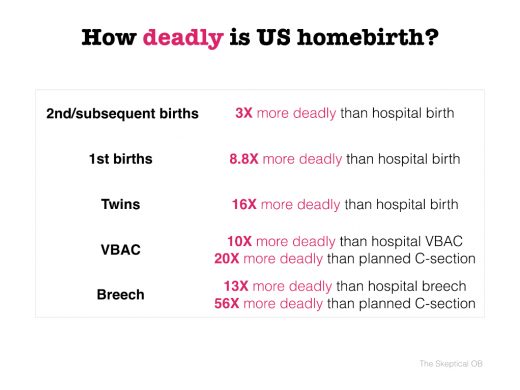
As you can see, in every category — with risks or without — homebirth increases the risk of fetal/neonatal death substantially and often enormously.

Even uncomplicated births to women who have given birth before are 3X more deadly than hospital birth; first births are 8.8X more deadly. It only gets worse from there, culminating in breech homebirths that are 56X more deadly than a planned C-section.

The REAL risks are almost certainly higher because these risks are based on a small subset of MANA members who voluntarily reported their outcomes.

So Cheyney and MANA have publicly acknowledged their hideous death rates, but — and this is the truly astounding part — they have so little respect for the intelligence of homebirth advocates that they think they can hide these death rates from them.

MANA has published Understanding Relative Risks In The Community Birth Setting: An Interview With Researcher Melissa Cheyney. There is not a single number in the piece. In a more than 3000 word piece ostensibly about the relative risks of homebirth, Melissa Cheyney refuses to tell women the actual risks.

Instead, she attempts to baffle them with bullshit.

Following the tactics of Trump, the piece starts with a brazen effort at misdirection:

Community birth (planned home and birth center births) has been demonstrated to be a safe option for low-risk women.

Yes, but NEVER in the US.

There has never been a single study — not even one — that has showed American homebirth to be as safe as comparable risk hospital birth.

According to Cheyney:

We started with the premise that given the larger literature on planned home and birth center births with trained midwives in high-resource countries, home birth clearly can be safe and for some outcomes safer than hospital births for a certain segment of the population. The Dutch, UK, and Canadian studies have clearly shown us this.

That sounds so familiar. It’s almost exactly what I wrote in my New York Times Op-Ed on homebirth Why is American Home Birth So Dangerous.

…[T]here are places in the world where home birth is relatively safe, like the Netherlands, where it is popular at 16 percent of births. And in Canada, where it appears safest of all, several studies have demonstrated that in carefully selected populations, there is no difference between the number of babies who die at home or in the hospital.

In contrast, home birth in the United States is dangerous…

According to Cheyney:

This caused us to question whether we were asking the right questions. Instead of asking, is home birth safe?, we argued that we should be asking, safe for whom?, under what circumstances?, and using whose definition of safe? This study was born out of a commitment to maternal autonomy and informed, shared decision making.

A commitment to informed decision making? How can American women be informed if Cheyney refuses to tell them the actual risks?

Instead:

I would group findings into three categories.

For example:

…[T]here is a third category, which was associated with much higher than anticipated fetal and neonatal mortality and morbidity: women presenting with a breech infant, multiparous women with a history of cesarean but no vaginal birth, and preeclampsia. The breech and preeclampsia findings were not surprising to us, but one of the outcomes we are really grappling with is the risk associated with a labor after cesarean in the community setting when there has been no previous vaginal birth. That is higher risk than we anticipated going into the study.

How much higher? Cheyney won’t say and then offers this:

The practitioner will always need to nuance these findings in their discussions with an individual family. Practitioners can begin by giving families a broad sense of the risk landscape. But then the conversation will have to narrow back in, not only to the mother’s individual risk profile, but also to her value system. It is her body, and until the baby is born, she has full autonomy in decision making. She will need to make choices about her care that fit with her worldview and her value system, because she is the one who will live in that body and raise that baby afterwards.

But how can she make an informed decision if she doesn’t know the actual risks?

My favorite quote, though, is this one:

…[W]hat studies like this do is they offer us the opportunity to be self-critical and reflective. They enable us to turn the lens inward and look at our practice as midwives and say, “Where do we need to improve?”

That’s hilarious — or it would be if American homebirth midwives weren’t presiding over so many deaths.

Cheyney’s study shows beyond any doubt that American homebirth midwives are grossly undereducated, undertrained and deadly. American homebirth is not safe and can never be safe until we abolish the second, inferior class of midwives known certified professional midwives (CPMs). We must mandate that — as in The Netherlands, the UK and Canada — no one should be allowed to call herself a midwife unless she meets the international standards of midwifery.

Only the stupid and the gullible could draw any other conclusion. So the only question that remains is whether American homebirth advocates are that stupid and that gullible.

Insisting that “breast is best” is like insisting that “heterosexual is best”

64277031 - hands holding cardboard on bokeh background with text: love wins

I’ve written many times that I consider lactivism in general and the Baby Friendly Hospital Initiative to be unscientific, harmful and often unethical. Why? Because insisting that “breast is best” is no different than insisting that “heterosexual is best.” Both reflect prejudice, not science.

Although lactivists like to invoke “science” to support their claim that breast is best, their reasoning has much more in common with religion than science.

[pullquote align=”right” cite=”” link=”” color=”” class=”” size=””]Both imply that a choice was made when there was never any choice at all.[/pullquote]

Consider:

1. Lactivists claim that women are “designed” to breastfeed. Science tells us that women aren’t “designed” at all; they are products of evolution. It is religion that insists on a designer and a design.

2. Lactivists claim that breastfeeding is nearly always perfect because it is natural. If science teaches us anything, it is that ‘natural’ is not a synonym for perfection. Hurricanes and earthquakes are entirely natural and generally quite harmful.

3. Lactivists claim that the fact that “we are still here” means that breastfeeding always works. That’s just a riff on the claim that breastfeeding is perfect, implying that our survival depends on perfection. Science teaches us that only the fittest survive, not everyone; and that survival is perfectly compatible with failure, imperfection and variation.

It’s easier to see the religious nature of these arguments when you realize that they are the exact same arguments that are often made to justify discrimation against gay people.

1. Homophobes insist that people are “designed” to have sexual relations with the opposite sex.

2. Homophobes insist that heterosexuality is best because it is natural.

3. Homophobes insist that heterosexuality is perfect because “we are still here,” implying that we wouldn’t be here if homosexuality were also natural. Science teaches us that population growth does not require that every individual have offspring.

Homophobia is rooted in a religious belief that homosexuality violates God’s “design.” Lactivism is rooted in the near religious belief that formula feeding violates nature’s “design.”

For many homophobes, their antipathy to gay people is rooted in the religious belief that sexuality is a choice. For many lactivists, their antipathy to women who don’t breastfeed is rooted in their belief that there are no women who are unable to breastfeed, only those who are unwilling. In other words, it’s a choice.

Many homophobes are advocates of gay conversion therapy, based on the idea that with enough “support,” gay people would become heterosexual. It is axiomatic for lactivists that women who can’t or don’t breastfeed are suffering from lack of support. According to their reasoning, if only women were only supported more, they would always be able to breastfeed.

Many homophobes blame contemporary culture for promoting homosexuality. Loose sexual morals, acceptance of difference, and the injunction against discriminating against gay people combine to make homosexuality an acceptable and therefore attractive choice. In the absence of a permissive culture, homosexuality would be non-existent. Nearly all lactivists blame contemporary culture for promoting formula feeding. In their view, acknowledging that insufficient breastmilk is common, pain is common, inconvenience is common combine to make formula feeding an attractive choice. In the absence of formula industry marketing, formula feeding would be non-existent.

It is easy to recognize the self-serving moralism of homophobes. It is harder to recognize the self-serving moralism of lactivists, but it is no less serious and harmful. The difference is that, through education, we have become sensitized to the ugly reasoning behind homophobia. Homophobia is inevitably about some people feeling superior to others.

Unfortunately, because of relentless efforts to promote breastfeeding as an unmitigated — and always perfect — good, we can’t always appreciate the ugly reasoning behind lactivism. It is inevitably about some mothers feeling superior to others.

Claiming that “breast is best” is like insisting that “heterosexual is best.” It implies that what is common must therefore be superior; it refuses to acknowledge individual variation; and most egregiously it invokes choice where there is often no choice.

Hopefully most of us recognize that claiming that “heterosexual is best” is nothing more than prejudice. It is love that makes a relationship, not corresponding sexual organs.

It’s time to recognize that “breast is best” also reflects prejudice. Motherhood is powered by love, not breastmilk.

Science journalist Tara Haelle throws a tantrum

Child Screaming and Throwing a Fit Isolated on White

After more than a decade blogging about natural childbirth, breastfeeding and anti-vaccine advocacy, I’ve become pretty inured to the vitriol directed my way.

I understand threatening the livelihoods of the birth industry and the breastfeeding industry isn’t going to win friends, and I appreciate that cognitive dissonance is hard for women who have staked their self-esteem on imagining that their adherence to the ideology of natural parenting marks them as superior mothers. I’m not blogging to make friends; I’m blogging to reassure women that mothering is about much more than the function of a woman’s reproductive organs.

[pullquote align=”right” cite=”” link=”” color=”” class=”” size=””]Had I wanted to publicly make a fool of her, I couldn’t have done a better job than she just did herself.[/pullquote]

Every now and then, though, I am surprised by the vociferous response of a critic. That’s the case with Tara Haelle’s tantrum.

This is what Haelle posted on a Facebook page in response to my recent piece about MANA’s acknowledgement of their hideous death rates:

IMG_2158

Oooh boy. Tuteur is not a credible source. She is a nasty woman whose tone actually DOES represent some aspect of her beliefs, even if it’s not as overstated as the tone comes across. Yes, she had a LOT of editing to get rid of the tone in her book, as she did in a NYT editorial. She’s a hateful, nasty woman with one of the worst cases of confirmation bias I’ve ever seen.

In short, she *is* against all home birth in the U.S., period. She looks askance at home birth in other countries, though she’ll deny that. She exploits women’s stories without permission and has illegally run an online medical advice service. The circumstances concerning her not having a license to practice anymore are uncertain and not necessarily nefarious, but she hasn’t had a license to practice in over 15 years and hasn’t practiced at all in over 25. She likely practiced for under 5 years and definitely under 10, and her belief in the evidence stalled when her practice did. She intentionally misreads certain studies and refuses to accept new data that comes out.

She believes that all doulas are suspect and that doula care does nothing to improve outcomes among women. She trusts very few midwives, regardless of where they work. She also believes that the C section rate is not too high (despite ALL evidence and expertise to contrary). She has personally attacked me and MANY MANY others, including my coauthor (in a particularly vicious way where she went after my coauthor’s kid) and Dr. Neel Shah, a Harvard OBGYN who teaches there and has been working assiduously to reduce C section rates safely.

Tuteur offers pretty much NOTHING to the discussion of home birth or birthing in general, she’s a nasty woman whose death I will not grieve, I have zero respect for her, and I have reduced respect for anyone who spreads her work after they learn who she really is and what she really does. And all of that is me with restraint.”

“And I’m almost certain all of that will get back to her because she has plenty of minions and flying monkey spies who look specifically for this kind of thing from me and others so they can screenshot it and send it to her, and I know this post is public. So this will be one more thing she gets to bitch about with me to her audience of sycophants. I don’t waste any more oxygen on her, which is why she’s blocked on all social media channels, as are several of her minions.

What precipitated this outburst of immaturity? As far as I can tell, it’s because I have publicly disagreed with Haelle on several issues and Haelle simply cannot abide that. She has a problem, and it’s one that afflicts all too many health journalists: she doesn’t have enough science knowledge to argue with me, so she’s reduced to ad hominem attacks.

Haelle is hardly alone in practicing health journalism by calling upon experts to interpret the scientific research for her. Most of the time that works quite well since often the science is settled. It doesn’t work at all for the subjects of childbirth and breastfeeding because there is a wide gulf between the science and the “conventional wisdom” espoused by the birth and breastfeeding industries.

Haelle offers the conventional wisdom in her writing and in the area of vaccines, for example, that is good enough. It’s basically useless, however, in addressing what I write about since the thrust of my writing is a paradigm shift: childbirth and breastfeeding, far from being perfect because they are natural, are inherently flawed precisely because they are natural.

Childbirth is inherently dangerous and any philosophical argument or public health campaign that doesn’t take that into account is likely to be deadly. Breastfeeding has a significant failure rate and any philosophical argument or public health campaign that doesn’t take that into account is likely to be deadly.

I also offer a philosophical argument of my own: most of what passes for natural childbirth and breastfeeding advocacy is deeply retrograde and fundamentally sexist. It’s a not so subtle way of reducing women to their reproductive organs and relegating them back to the home. It’s not a coincidence that natural parenting always represents more work for mothers.

Haelle is miffed because I have publicly disagreed with her and rebutted some of her empirical claims. She’s frustrated because she doesn’t know enough science to argue with me and is reduced to name dropping (e.g. Neel Shah who is apparently still smarting because he wrote an opinion piece about homebirth in the New England Journal of Medicine and I pointed out that he had no idea that there were two different types of midwives in the US).

It’s ironic that Haelle produced this wall of text in response to my piece about the latest MANA data. It makes her criticism look particularly foolish because it lacks substance of any kind. Haelle doesn’t bother to address the data in the my piece. I doubt she even read the piece before she commented.

In the few public arguments I’ve had with her, she hasn’t rebutted a single statistic that I’ve presented. Generally, she has stalked off when I rebutted her claims with empirical evidence.

She thoroughly misrepresents my positions such as my views on the C-section rate. I have repeatedly stated that the C-section rate is almost certainly too high, with the important caveat that while we know that many C-sections are unnecessary, we don’t know which specific C-sections are unnecessary in advance.

She wouldn’t grieve my death? That’s the statement of a petulant child, not an adult, and certainly not an adult who claims to be practicing journalism.

Grow up, Tara. Stop obsessing about your feelings and start addressing facts. If you can’t stand when it is pointed out that you are wrong, do more research and make sure you’re right. And thanks — had I wanted to publicly make a fool of you, I couldn’t have done a better job than you just did yourself.

Author of “Birth Muthas” responds to Milli Hill’s attempt to censor her

Not talking about something or censored concept

This is a guest post from Cath Janes, the author of Birth Muthas, published in Standard Issue Magazine in response to Milli Hill’s gaslighting extravaganza The myth of the painful birth – and why it’s not nearly so bad as women believe.

Janes was shocked when Hill demanded that Standard Issue Magazine offer her the right of reply and even more shocked when the magazine gave in. Here is her response.

I’d been in blissful ignorance of Milli Hill until ten days ago, when I saw that she had written in The Telegraph about how “In an average eight hour labour, a woman can expect to be ‘in pain’ for only around 23 per cent of the time”. So when I was asked, by online mag Standard Issue, to respond in my usual truthful voice, I happily did. That was when Milli Hill made sure I would never be unaware of her again.

[pullquote align=”right” cite=”” link=”” color=”” class=”” size=””]”In all of my years as a journalist and editor for national magazines and broadsheets I had never heard of this happening before.”[/pullquote]

Well, Hill certainly wasn’t thinking positively on the day my piece was published. Very publicly, on Twitter, she began calling me unprofessional, claiming I had misrepresented her, demanding the piece be pulled and asking why I hadn’t given her the right of reply when I wrote it. It was stunning, not least because in all of my years as a journalist and editor for national magazines and broadsheets I had never heard of this happening before. An inherent right of reply to an opinion piece? The only upside was the dozens of messages I received from editors and journalists, all equally as stunned as I.

Standard Issue pulled my piece off its website upon Hill’s request, giving her 24 hours to write a right of reply which would be published alongside mine when it went back up. Except there was one difference; what was very obviously an analogy about injured troops had been removed at Hill’s demand and THAT is what you can read in my full piece here. I stand by that analogy with every fibre of my childbirth-broken soul. That’s because it was, I repeat, analogous and in no way descriptive. I don’t think I could state that any more clearly than I did in the piece and I do here now.

That Standard Issue decided to accede to Hill after the requested piece was published is one thing. As furious as I am about it, and as much as I have never heard of this happening before, I understand that Standard Issue has to operate in the way it feels is best for itself. We have parted ways because I no longer want to write for it and I now know of several other women who don’t want to write for it any more too.

What is quite another thing are Hill’s actions. For all of her claims that I had misrepresented her, her reply to my Standard Issue piece was hardly worth the wait. In fact it caused substantial hilarity amongst the many women who were following this debacle and I know that because they contacted me in support.
I’ve always been searingly honest about my experience of childbirth and the resulting PND, PTSD and career-ending breakdown. You can read in my piece about how the lack of honesty about what really happens during birth contributed significantly to this. I too believed I would get through my otherwise average labour with brilliant support and positivity and, more to the point, so did the hundreds of women who have since contacted me via social media and parenting forums. For balance, though, two women have told me that they feel there may be something in Hill’s theory even though they believe it to be flawed.

I’m a feminist who believes that women should always be empowered but only if that is underpinned with honesty. That is why I disagree so vehemently with Hill. I believe that to tell women that they are not feeling any pain at all for 77% of an average birth is to mislead them. Yes, the maths may be correct (for Hill has done the maths) but in terms of the emotions of panic, exhaustion, worry, fear and shock and the physical reactions of vomiting, breathlessness, tearing, cutting, bleeding and defecating it is not. Maths should never explain away the deeply personal process of giving birth and it should never be used to lull women into a false sense of security.

I’m not alone in feeling Hill’s ire or seeing her attempt to explain herself. She asked the Telegraph to change the headline that accompanied her original piece and has now told me that she didn’t expect Standard Issue to publish what she had written for them either. It’s good to know that I’m not alone. What isn’t good is that through her misguided, repeated and defamatory insistence that I have been unprofessional I have had to block her from my social media and private email accounts and am now considering legal action. The fact is that Hill and I will never agree on this issue and, in the belief that debate is good, I am fine with that. Whether she is good with her critics’ opinions being expressed is another thing. I’ll let you know after this too has been published.

Melissa Cheyney and the Midwives Alliance of North America finally acknowledge their hideous death rates

Grieving family with an infant's coffin --- Image by © Leah Warkentin/Design Pics/Corbis

I told you so!

I’ve been writing about homebirth for more than a decade. For most of that time, the Midwives Alliance of North America (MANA) and Melissa Cheyney, the Director of Research for MANA have insisted that their data show that homebirth is safe.

[pullquote align=”right” cite=”” link=”” color=”” class=”” size=””]In every category — with risks or without — homebirth increases the risk of fetal/neonatal death substantially and often enormously.[/pullquote]

In the meantime, the publicly available data on CDC Wonder has made it possible for me to demonstrate that homebirth deaths rates have been 3-7X higher than comparable risk hospital birth. Amos Grunebaum, MD and colleagues have published several papers using the same data and confirming my analysis. The most comprehensive analysis of homebirth death rates was performed by Judith Rooks, CNM MPH for the state of Oregon. Rooks found that homebirth midwives had a perinatal death rate 800% higher than comparable risk hospital birth!

Now, MANA and Cheyney have finally relented and published their own data that shows that PLANNED birth at home or in a birth center (generally just a rented home without special equipment) in the US has death rates EVEN WORSE than we imagined.

The new paper is Perspectives on risk: Assessment of risk profiles and outcomes among women planning community birth in the United States to be published in Birth: Issues in Perinatal Care, the journal owned by Lamaze International.

The authors used the data generated by their own members:

Data on n=47 394 midwife-attended, planned community births come from the Midwives Alliance of North America Statistics Project. Logistic regression quantified the independent contribution of 10 risk factors to maternal and neonatal outcomes. Risk factors included: primiparity, advanced maternal age, obesity, gesta- tional diabetes, preeclampsia, postterm pregnancy, twins, breech presentation, his- tory of cesarean and vaginal birth, and history of cesarean without history of vaginal birth. Models controlled additionally for Medicaid, race/ethnicity, and education.

Ostensibly, the authors were attempting to determine appropriate criteria for allowing or risking out homebirths and birth center births.

They found:

The independent contributions of maternal age and obesity were quite modest, with adjusted odds ratios (AOR) less than 2.0 for all outcomes: hospital transfer, cesarean, perineal trauma, postpartum hemorrhage, low/very-low Apgar, maternal or neonatal hospitalization, NICU admission, and fetal/neonatal death. Breech was strongly associated with morbidity and fetal/neonatal mortality (AOR 8.2, 95% CI, 3.7-18.4). Women with a history of both cesarean and vaginal birth fared better than primiparas across all outcomes; however, women with a history of cesarean but no prior vaginal births had poor outcomes, most notably fetal/neonatal demise (AOR 10.4, 95% CI, 4.8-22.6).

The author’s definition of “modest” are quite different than mine. They found that for almost all outcomes, homebirth had a nearly 100% increase in fetal/neonatal death. Breech babies had a death rate 700% higher and attempted VBAC had a death rate more than 900% higher than that baseline death rate at homebirth (which is already higher than the hospital death rate).

Two charts provide the most important information.

The first shows absolute death rates:

IMG_2144

The death rate for first babies was 3.43/1000 and the death rate for second or subsequent babies was 1.03/1000. Compare that to CDC data that shows a hospital death rate of 0.36/1000 overall and 0.44 for first babies. In other words, homebirth had a neonatal death rate more than triple (200% increase) that of hospital birth for women having second or subsequent babies and 780% higher for first time mothers.

The second chart shows the increased risks of various pregnancy complications compared to the already elevated risk of homebirth demonstrated above:

IMG_2140

For example, attempted VBAC increases the risk by more than 10 fold. Twins increases the risk more than 3 fold. Breech increases the risk more than 8 fold. Postdates nearly triples the risk. Pre-eclampsia increases the risk more than 10 fold.

In every category — with risks or without — homebirth increases the risk of fetal/neonatal death substantially and often enormously.

What conclusions do Cheyney and colleagues reach?

The outcomes of labor after cesarean in women with previous vaginal deliveries indicates that guidelines uniformly prohibiting labor after cesarean should be reconsidered for this subgroup. Breech presentation has the highest rate of adverse outcomes supporting management of vaginal breech labor in a hospital setting.

In other words, they attempt to minimize their own findings, despite the fact that they are uniformly terrible and often hideous. And these findings almost certainly UNDERESTIMATE the true death rate at homebirth in two critical ways: first, they compare complicated homebirths with uncomplicated homebirths, undercutting the impact of the fact that even uncomplicated homebirths have higher death rates than comparable risk hospital birth; second, this data is only a subset homebirths attended by members, voluntarily submitted by those members. The real death rates at homebirth are almost certainly even higher.

The bottom line is this: after years of denying that homebirth has a dramatically increased risk of fetal/neonatal death, Melissa Cheyney and MANA have finally admitted the truth. There is not a single category in which homebirth is a safe as hospital birth and in many cases, homebirth increases the risk of fetal/neonatal death by nearly 1000%!

Every American woman has a right to have a homebirth because she has the right to control her own body. But homebirth advocates should stop pretending that homebirth is safe. It is never as safe as hospital birth and generally far more deadly.

The tribal epistemology of lactivism and natural childbirth advocates

17023684 - abstract word cloud for tribe with related tags and terms

I’ve written before about the tribalism of natural parenting advocates.

According to sociologist Jan Macvarish:

The idea of ‘parental tribalism’ … [is] descriptive of a tendency among individuals to form their identities through the way they parent, or perhaps more precisely, through differentiating themselves from the way some parents parent and identifying with others …

[pullquote align=”right” cite=”” link=”” color=”” class=”” size=””]For lactivists and natural childbirth advocates the only thing that matters is whether a scientific paper supports their “side.”[/pullquote]

And I’ve written about the parallels between Trumpworld and the world of lactivism and natural childbirth. Both rest on a foundation of ignorance and lies.

But rarely have I read such an apt description of the “tribal epistemology” of lactivism and natural childbirth:

Information is evaluated based not on conformity to common standards of evidence or correspondence to a common understanding of the world, but on whether it supports the tribe’s values and goals and is vouchsafed by tribal leaders. “Good for our side” and “true” begin to blur into one.

The author, David Roberts of Vox, is referring to right wing talk radio aficionados but it applies equally to the world of natural parenting.

Most lactivists and natural childbirth advocates have no idea how to read a scientific paper, what constitutes scientific evidence or how to analyze statistics. As a result, they are forced to rely on leaders to spoon feed them the information that supports the tribe’s values and goals. Lactivists have no idea what the scientific evidence shows about breastfeeding; they only know what people like Melissa Bartick tell them. They have no idea what the scientific evidence shows about childbirth until Henci Goer or someone similar “interprets” it for them.

Sadly for both the thought leaders and acolytes the only thing that matters is whether a scientific paper supports their “side.” Everything else is ignored.

Listen to Rush Limbaugh’s assessment of the worldview of conservatives and liberals:

We live in two universes. One universe is a lie. One universe is an entire lie. Everything run, dominated, and controlled by the left here and around the world is a lie. The other universe is where we are, and that’s where reality reigns supreme and we deal with it. And seldom do these two universes ever overlap.

As Roberts explains:

In Limbaugh’s view, the core institutions and norms of American democracy have been irredeemably corrupted by an alien enemy. Their claims to transpartisan authority — authority that applies equally to all political factions and parties — are fraudulent. There are no transpartisan authorities; there is only zero-sum competition between tribes, the left and right. Two universes.

In the view of lactivists, the core institutions of medicine and science have been irredeemably corrupted by the formula industry. Their claims to authority — through rational thought and scientific evidence — are deemed fraudulent. There is no unbiased scientific evidence, there is only a zero-sum competition between breastfeeding supporters and the formula industry.

In the view of natural childbirth advocates, the core institutions of obstetrics and medicine have been irredeemably corrupted by the institutions and practices of “technocratic” birth. Their claims to authority — through rational thought and scientific evidence are deemed fraudulent. There is no unbiased scientific evidence, only a zero-sum competition between midwives and doulas on the one hand and obstetricians on the other.

Extrapolating from Robert’s views of tribal epistemology in politics, we can assert that on one side is what we might call the classic theory of science as a search for knowledge. In this view, science is a kind of structured contest. Factions and parties battle over scientific evidence, implications and policies, but the field of play on which they battle is ring-fenced by a set of common institutions and norms like journals and conferences, both open to all.

In contrast, lactivists and natural childbirth advocates insist that science itself, its rules and referees, are captured by the other side (the formula industry, the hospital birth industry), operating for the other side’s benefit. Any claim of scientific authority is viewed with skepticism, as a kind of ruse or tool through which industry and medicine seek to dominate lactivists and natural childbirth advocates.

As a result, both the lactivist world and the natural childbirth world operate as the equivalent of right wing talk radio. They are filled with ignorance, misrepresentation of both scientific evidence and physicians, and bitterness. Rather than trying to compete with physicians, scientists and industries through journals and conferences, lactivists and natural childbirth advocates have withdrawn into a world of their own, complete with their own conferences and journals from which mainstream scientists and physicians are excluded.

Ironically, lactivists and natural childbirth advocates love to assert that they have educated themselves about breastfeeding and childbirth, but they are no more educated about either than Fox News viewers are educated about politics. Neither has anything to do with increasing knowledge; both are concerned above all with promoting tribalism.

Where does that leave us? It leaves us with a medical system that could benefit from the interests and concerns of lactivists and natural childbirth advocates at precisely the moment when, sadly, lactivists and natural childbirth advocates have become divorced from both scientific evidence and reality.

Alison Stuebe’s no good, very bad analogy between formula and tobacco

IMG_2127

Sometimes I wonder if lactivists think what they say before they say it.

Consider this tweet from Dr. Alison Stuebe of the Academy of Breastfeeding Medicine.

IMG_2122

Parallels between big tobacco tactics and big formula tactics – look how doubt it being peddled to mother

That tweet is offensive on so many levels that it is difficult to know where to begin.

[pullquote align=”right” cite=”” link=”” color=”” class=”” size=””]I hereby invite Dr. Stuebe to debate me.[/pullquote]

1. The comparison of formula to tobacco is grossly irresponsible. Whereas tobacco is always dangerous and never saves lives, formula is almost never dangerous and saves tens of thousands of babies’ lives each and every year.

2. It is meant to be vicious. The tweet not so subtly implies that women who choose to formula feed are knowingly and willfully harming their babies.

3. It implies that women who don’t breastfeed are dupes. This is not merely an insult to women who choose formula, but it is a denial of their moral agency. This is how lactivists justify ignoring the reasons women give for choosing formula since those women “didn’t choose” to use formula, they were tricked into it.

4. It is an attempt to libel the Fed Is Best Foundation. The implication is the Foundation — which is drawing attention to the very real and deadly risks of relentless breastfeeding promotion — is in the pocket of the formula industry. If Dr. Stuebe has evidence of this, she ought to present it. Otherwise, she ought to stop libeling the Foundation.

5. It is, ironically, projection. Perhaps Dr. Stuebe is not aware that in the wake of the Surgeon General’s report declaring that tobacco smoking causes lung cancer, the tobacco industry tried to deny and induce doubt about the scientific evidence. Now, in the wake of mounting scientific evidence that relentless promotion of breastfeeding is leading to infant injury and death, it is the breastfeeding industry that is trying to deny and induce doubt about the scientific evidence.

How can we address the attempts of the breastfeeding industry to demean women who can’t or don’t wish to formula feed?

I have a suggestion:

I hereby invite Dr. Stuebe to debate me on the issue of the risks of breastfeeding.

We can conduct an debate in print simultaneously on my blog and the Academy of Breastfeeding Medicine blog so that everyone can be sure that both sides are accurately transmitting the views of the other.

I propose that we address three issues:

  • The risks of breastfeeding, complete with actual incidence figures.
  • The moral agency of women who can’t or don’t breastfeed and their right to be respected.
  • Accusations of collusion between those highlighting the dangers of breastfeeding and the formula industry.

How about it, Dr. Stuebe? Surely you can step outside the lactivist echo chamber to engage briefly with those you criticize.