Category Archives: Uncategorized

The philosophy of natural childbirth is sadistic

STOP PAIN

Nearly a month ago, the website Feminist Current featured a powerful, thought provoking piece entitled Eve’s punishment rebooted: The ideology of natural birth by philosophy graduate student C.K. Egbert.

There’s something pornographic about the way we depict childbirth. A woman’s agony becomes either the brunt of a joke, or else it is discussed as an awesome spiritual experience… [W]e talk about the pain of childbirth — with few exceptions, the most excruciating, exhausting, and dangerous ordeal within human experience — as valuable in and of itself. Hurting women is sexy.

The euphemistically termed “natural childbirth” is often justified on the basis that it is a woman’s choice, that pregnancy and birth is a “natural process,” and that it is best for the woman and baby (both for medical reasons, and because a woman won’t feel attached to her child otherwise). Put into context, these arguments ultimately boil down to “women’s suffering is good.” …

When people tout “natural birth” as an “empowering choice” (sound familiar?), they conveniently ignore all the women who have been harmed by these practices and for whom giving birth was (completely understandably and legitimately) one of the worst experiences of their lives. Natural birth advocates, just like many in the pro-sex movement, don’t seem to be concerned about the harm that women suffer through this practice or finding ways of preventing this harm from occurring. Women can choose, as long as they choose to suffer and see themselves as liberated through suffering.

Egbert is brutally honest about the philosophy of natural childbirth. Responding to the claim that natural childbirth is “better,” she notes:

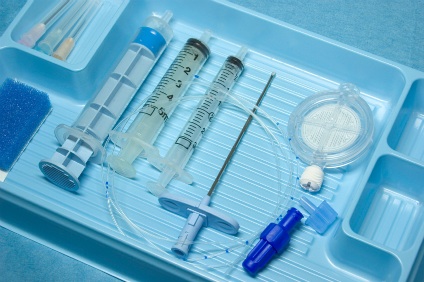
What about the argument for women’s health? We probably wouldn’t give much credit to an argument that we should strap patients to the operating table and refuse them anesthetic during surgery, even though general anesthetic is usually the most dangerous part of surgery. Rather than eliminating palliative care, we seek safer and more effective means of performing surgeries and administering anesthetic. Natural birth advocates are not concerned with women’s welfare, because they are not advocating for safer and more effective forms of pain management; they argue they should be eliminated, because women’s suffering is itself a good. And while feminists applaud efforts to give women support and comfort during the birth process (e.g., emotional support, more home-like birthing environments, etc.), this is compatible with providing women pain medication. Once again, the danger of anesthetic only becomes an issue — rather than a normalized part of medical treatment — only when and because it can be used to hurt women. (my emphasis)

Not surprisingly, there was tremendous push-back from natural childbirth advocates, but Egbert skillfully defended her thesis in the comments section.

But this isn’t about the best way to give birth. It’s about what significance we give to women’s suffering and pain, and how that relates to women’s subordination in general.

Exactly, and in the world of natural childbirth advocacy, women’s pain and suffering is “sexy” and “empowering.”

That’s not surprising when you consider that the philosophy of natural childbirth was created by old, white men who tried to convince women that the pain of childbirth was in their heads, not their bodies. And the philosophy of natural childbirth has been perpetuated by white women (midwives, doulas and childbirth educators) who enjoy wielding power over other women and glory in humiliating them for failing to mirror their own choices back to them. The tragedy is that many women are complicit in their own subjugation and claim to be “empowered” by it, because they are so used to being judged and bullied that they believe it is for their own good.

Simply put, the philosophy of natural childbirth is deeply retrograde and profoundly anti-feminist.

I’ll even go a step further. The philosophy of natural childbirth is sadistic in that its promoters derive pleasure from inflicting pain, suffering, or humiliation on others and actively prevent others from seeking relief for their pain.

The originators of the philosophy of natural childbirth were sadists when it came to women’s pain. They felt that it was irrelevant, unworthy of treatment, and annoying to doctors. The philosophy of natural childbirth could best be encapsulated as, “Shut up and give birth without bothering us.”

The contemporary avatars of the philosophy of natural childbirth are often sadists when it comes to women’s pain. They consider it irrelevant, unworthy of treatment, and resent effective pain relief as “weakness” and “unhealthy,” when it is neither.

The midwives and doulas who chivvy women into refusing pain relief, who “delay” calling the anesthesiologist when a woman requests an epidural, who promote inadequate forms of pain relief (waterbirth) and praise women as warrior mamas (i.e. “good girls”) for enduring labor without pain relief are sadists. They believe that women’s pain and suffering aren’t worthy of their compassion and concern. They believe that women are improved by agonizing pain, and diminished by relief.

The philosophy of natural childbirth is not based on science; it is based on fundamental beliefs about the irrelevance of women’s suffering, beliefs about the ways that women “should” use their bodies, and value that natural childbirth providers place on their (the providers’) autonomy and having their own personal choices mirrored back to them.

The philosophy of natural childbirth is about glorifying and enjoying women’s agony, and that, of course, is nothing more than sadism.


For more of my thoughts on the subject, you can listen to the Feminist Current Podcast Is ‘natural’ better when it comes to birth? An interview with Dr. Amy Tuteur.


Why I do what I do

empathy word

An email from a reader, reprinted with permission:

I had my first child, a daughter, via C-section in early March. A few weeks later, I came across your website while Googling “does a C-section make me a bad mom” during a tear-filled late-night feeding session.

From adolescence, I had been taught that to have a C-section is to have “failed” as a woman. I had been taught that women should give birth at home, even if their previous birth was a C-section. I had been taught that midwives were the only acceptable providers of care because doctors would only want to schedule women for C-sections so that they could get to their golf game or not stay up late. I had been taught that not breastfeeding your child was tantamount to abuse, and that like having a C-section, formula feeding was done only by lazy moms who couldn’t be bothered. I had been taught that C-sections were almost never medically indicated, and that I should expect to spend my entire pregnancy and labor fighting off a scalpel-happy doctor who wanted to tie me to my bed during labor and delivery. I had been taught that if a C-section was actually medically necessary, it was a terrible tragedy that a mother could only recover from after many years of unhappiness and a HBAC. I had been taught that every mother could breastfeed if she just tried hard enough.

When my OB, who, incidentally, is quite supportive of natural childbirth, told me at my 39 week appointment that my daughter had flipped and was transverse footling breech and that we needed to schedule a C-section, I understood. She wasn’t eligible for an external version, and I knew intellectually that a C-section was the correct decision. We went in for the C-section, my husband was at my side throughout, and my daughter was placed on my chest to nurse within minutes of her birth. It was a beautiful, beautiful birth. The staff and doctor couldn’t have been kinder, my daughter was beautiful, and my husband and I were both thrilled.

Two days later, my daughter had lost over 10% of her body weight. She screamed inconsolably between multiple-hour-long nursing sessions which never left her satisfied; she’d fall into an exhausted sleep for perhaps twenty minutes, then wake up to scream and nurse for hours again. The nurses told me this was normal, the lactation consultants told me over and over again that I just needed to keep offering her the breast (I hadn’t showered in over 72 hours because she was on the breast all the time, but somehow she wasn’t being offered the breast enough?) and that I should pump when she wasn’t nursing to build up my supply. By the third day, our very pro-breastfeeding pediatrician told me to supplement so that she could gain enough weight back to go home. Now, my husband and I live an hour from the hospital. I was told that my choices were to a) supplement with formula and then bring her home when I was discharged or b) get discharged and leave her at the hospital to be fed until she gained enough weight back. Of course I chose to supplement! Insanely, the LC I saw later that day, after my daughter had fallen into her first contented, deep sleep following (shockingly enough) her first real feed, was visibly disappointed that I’d “given up” by feeding my daughter formula after she’d nursed and screamed for hours that afternoon. In my opinion, what nursing relationship we might ever have would be rather better if we were in the same house instead of being separated by an hour’s drive, but that didn’t seem to be the opinion of the LC.

Fast forward a few weeks. I was still supplementing via a tube system (a wretched device if I ever met one), was pumping anytime my daughter hadn’t nursed for an hour, was inhaling fenugreek, blessed thistle, oatmeal, and Mother’s Milk Tea like it was chocolate…and was producing very, very little milk. I was exhausted from never getting more than an hour or two’s sleep and was miserable from the yeast infection I’d gotten in my breasts, around my incision, and in my vagina from the combination of the tube system (impossible to sterilize, and harboring yeast) and showering maybe once every two or three days due to nursing incessantly. My OB very gently told me that I, and no one else, could make the decision on how to feed my baby, and that it was ok to stop nursing when I wanted to stop nursing.

It was at about this time that I started Googling “does a C-section make me a bad mom” over…and over…and over again during those late-night feeding sessions. I was so tired. According to everything I’d ever been told, I was a failure as a mother. I loved my daughter, but I wanted to cry every time she cried because I knew she’d want to eat and it would hurt so badly to feed her. I wanted to cry because I had “failed” to have the right kind of birth, because I couldn’t even feed her properly, because I was so ashamed to have been so stupid as to have a baby when I couldn’t take care of her properly. I loved her so much, and was sure I was failing her so badly. Never mind that we both would have died without the C-section. Never mind that since I wasn’t producing enough milk, I was making formula at 2 AM so that my daughter wouldn’t be hungry. Never mind that I got up with her a half-dozen times a night when she cried, that I walked the floor and sang to her for hours to try to console her and get her to sleep, that I danced with her to my favorite songs during her fussy evenings, or that I took her for strolls around our neighborhood to show her how beautiful the world is in spring. No: I had a C-section and I wasn’t exclusively nursing. Therefore, I must be a failure as a mother.

I found your site, and spent the next week or two’s worth of late-night feeds reading it. Yes, you’re blunt, even harsh in tone sometimes. Having read a lot of your posts and articles, though, I can understand why: you’re passionate about a subject that is worth being passionate about! Also, your “Ode to C-section Mothers,” which was the article I first saw on your website, really helped me readjust my thinking. Having a C-section doesn’t make me a bad mother. Not being able to nurse exclusively doesn’t make me a bad mother. These were very new ideas to me, which is really sad if you think about it.

After countless plugged ducts, a breast abscess and mastitis, I stopped nursing a few weeks ago and feel better about life than I had since my daughter was born. My daughter is thriving, is way ahead of her milestones, is growing like a weed, and has a happy, healthy mother who knows that it doesn’t matter how her baby got here or how her baby’s fed: what matters is that she is here, she is fed developmentally-appropriate food, and she has two parents who love her. She isn’t, despite the claims of the more insane birth activists and lactivists, going to grow up obese, stupid, allergic to every substance known to man, and sociopathic to boot because she came via C-section or was only partly nursed for a few months.

There’s a lot of emotion on both “sides” of parenting, and you address both that and the science behind birth and feeding with a rational tone and scientific facts rather than the usual mishmash that surrounds anything having to do with the medical aspects of parenting. (I actually had someone send me a link to a “study” that “proved” that autism is caused by Pitocin. Riiiight.) With future kids, I’ll discuss with my OB whether I’ll have a RCS or try for a VBAC. I’m not sure at this point which I’ll do. Either way, if I have a healthy baby at the end of it, I’ll be a happy camper. Period. As he very wisely told me towards the end of this pregnancy, “I understand your desire for a natural childbirth, and support it. However, remember to keep it in perspective. It’s much, much better to wish you had a certain type of birth experience than it is to wish that something hadn’t happened to you or the baby.” Smart man. Would you believe that no one had even suggested that to me before? Talk about priorities.

Thank you so much for your hard work and dedication. I’ll keep reading your blog, and I’ve pointed a number of other moms in your direction, too. I’m sorry for this ridiculously long novel of an email, but hope it’ll encourage you to keep doing what you’re doing. You really do make a difference.

How ICAN could dramatically increase the VBAC rate with one simple step

image

ICAN, the International Cesarean Awareness Network, is the premier organization promoting vaginal birth after Cesarean (VBAC). ICAN has taken the lead in advocating for VBAC in nearly every circumstance, opposing VBAC restrictions put in place by hospitals and malpractice insurers, and arguing that principles of bodily autonomy mean that women should be able to force doctors to attend VBACs even when they believe them to be unsafe.

Presumably there is nothing that ICAN wants more than to increase the rate of VBAC in the US, which has dropped precipitously from the 1996 high of approximately 28% to the current rate of only 10%. ICAN has correctly identified the strict ACOG guidelines for VBAC as one reason for the decline, as well as fears of malpractice suits, and so called “defensive medicine.”

But ICAN could fix all that, making it possible for any woman seeking a VBAC to have one regardless of where she lives or what her doctor recommends. What could ICAN do? ICAN could indemnify the doctors and hospitals when they supervise a VBAC.

What does it mean to idemnify? According to Merriam-Webster:

to protect (someone) by promising to pay for the cost of possible future damage, loss, or injury

In this case, ICAN would be promising doctors and hospitals to pay for the cost of possible lawsuits and legal cases that arise from VBACs. Doctors would face no risk from attending VBACs because ICAN would function as a form of insurance, paying them when a woman sued in the wake of serious complications from VBAC.

From ICAN’s point of view, it would be a win-win. On the one hand, they would relieve doctors and hospitals of the fear of malpractice suits and the crushing burden of multi-million dollar verdicts for babies who sustain brain damage or die during attempted VBACs. On the other hand, the financial burden for ICAN would be minimal if VBAC is truly as safe as they insist.

ICAN and its members appear to despise doctors who practice defensive medicine. In one simple step they would relieve doctors and hospitals of the need to practice defensive medicine. They could inform grateful doctors and hospitals to worry no more. From now on, ICAN would agree to be responsible for footing the cost of any lawsuits and subsequent judgments. Imagine the relief of providers who foolishly imagine VBACs to involve indefensible dangers to babies and mothers. Imagine the relief of mothers who would never face so-called “VBAC bans” again.

The best part is that there could be no greater demonstration of ICAN’s belief in the safety of VBAC than its willingness to pay for the outcomes. If VBACs are as safe as ICAN claims, if complications are as rare as ICAN insists, and if defensive medicine is as despicable as ICAN implies, it should cost nearly nothing.

So how about it ICAN? All you need to do is indemnify doctors and hospitals for the outcomes of VBACs and the VBAC rate would soar.

If you truly believe in the safety of VBACs, you should have no trouble putting your money where your mouth is, right?

What would VBAC activists have done for Jennifer Goodall if her baby had died? Not a damn thing.

image

Yesterday I wrote about Jennifer Goodall, the Florida woman who wanted to attempt a VBAC after 3 previous C-sections, and the misinformation used by VBAC activists to support her decision.

Not a single organization or article that supported Goodhall had accurate statistics on the real risk that Goodhall faced. Most substituted statistics that applied to women who have had one previous C-section not three. All implied that Goodall was basing her decision on scientific evidence when that was completely false. All implied that the risk of C-section for Goodall and her baby was higher than the risk of attempted VBAC which was also completely false.

Fortunately, Goodall did what she should have done in the first place. She went to a different hospital prepared to handle her (ill advised, unsupported by medical evidence) attempt at vaginal birth. Not surprisingly, she failed in her attempt, confirming the concerns of the original hospital. The patients who face the greatest risk of rupture, death of the baby, hysterectomy and death of the mother are women who are unsuccessful in a VBAC attempt.

Lots of organizations were eager to use Goodall’s situation to advance their organizational agenda. They professed themselves to be deeply concerned for and deeply supportive of Jennifer Goodall. But what would they have done if Goodall’s uterus and ruptured and her baby died? Not a damn thing!

The support of Jennifer Goodall extended only up to the moment until she suffered a complication from attempted VBAC and ceased to be politically useful to them.

Consider the case of the International Cesarean Awareness Network (ICAN), one of the organizations that sponsored a Change.org petition supporting Goodall’s desire to attempt a vaginal birth. The petition was filled with erroneous, inapplicable statistics (including the thoroughly discredited “optimal C-section rate withdrawn by the World Health Organization) and grossly deceptive misrepresentations of the position of obstetric organizations.

ICAN encouraged Goodall, supplied the inaccurate statistics on which she appears to have based her decision and supported her 100%. Considering how they encouraged her to risk her baby’s life and her own life, it’s worth asking what they planned to do to help her if the decision they were encouraging turned out to be deadly.

Here’s ICAN’s disclaimer, indicating just how far they are willing to go in taking responsibility for the medical information and encouragement they offer:

In no event will ICAN be liable to you or anyone else for any decision made or action taken by you or anyone else in reliance upon the information contained on or provided through the website.

Specifically:

… Use of this website is at your own risk… The website is presented by ICAN for the sole purpose of disseminating general health information for public benefit. Always seek the advice of your midwife, physician, nurse or other qualified health care provider before you undergo any treatment or for answers to any questions you may have regarding a medical condition. The website and any information provided on the website are not intended to constitute the practice of or furnishing of medical, nursing, or professional health care advice, diagnosis, consultation or treatment or services in any jurisdiction.

ICAN is on record as being unwilling to stand behind their own information, acknowledges that they are in no position to assess and advise anyone of the specific treatment that is best for them, and emphasizes that only the providers actually caring for a woman are capable of offering her an accurate assessment of the risks she faces and the treatment course that is advisable in her specific cases.

The biggest irony, though, is that by putting a disclaimer on their website, ICAN is doing PRECISELY what it claims to abhor among obstetricians. ICAN is behaving defensively. The most important thing that they want you to know about their website and the information that they offer is that they will not take any responsibility to ensure that it is accurate or to prevent harms that arise from people using it. If your baby dies or you die because you actually believed what ICAN told you, too bad for you for being gullible enough to believe a website that doesn’t even stand behind its own information.

The folks at ICAN have the unmitigated gall to rail against “defensive medicine” when a hospital wants to make sure that neither a mother nor her baby die, while simultaneously practicing defensive medicine by disclaiming their own advice and support.

What would ICAN and other VBAC activists done for Goodall if her baby had died? Less than nothing, pointing to the legal language they’ve draped over their site specifically absolving themselves for ensuring the accuracy of their information, let alone whether their information was applicable to the woman who used it.

So here’s my question for anyone contemplating VBAC against an obstetrician’s advice:

Who is likely to be more concerned with whether you and/or your baby live or die, the obstetrician and hospital who are prepared to take responsibility for the outcome, or the organization and activists that are happy to support you for their own political benefit and equally happy to dump you if you actually trust them?

How RH Reality Check got the Florida VBAC case wrong

image

I’m already on record as a strong supporter of a woman’s right to refuse a C-section:

Our right to bodily autonomy is one of the most important rights that we have. Simply put, a woman (or a man) has a right to refuse medical or surgical treatment, regardless of whether or not the refusal might lead to death. In the case of a pregnant woman, that means that she has an absolute right to refuse a C-section regardless of whether the C-section is life saving for either her or her unborn baby.

Therefore, I believe that Jennifer Goodall, the Florida mother who wanted to attempt a VBAC (vaginal birth after cesarean) after 3 C-sections has an absolute right to make an informed medical decision to refuse a repeat Cesarean. It doesn’t matter that the refusal might lead the death of her baby or even her own death.

Nonetheless, I am extremely disappointed that mainstream media outlets got the case wrong in two important ways. First they neglected the fact that the medical decision must be an INFORMED decision. Second, they presented faulty statistics on the safety of VBACs. Specifically, every article I have seen presented the statistics for a VBAC after one previous Cesarean, instead of the statistics for a the far more dangerous VBAC after 3 Cesareans that was being contemplated by Goodhall.

The piece in RH Reality Check is a case in point.

Editor-in-Chief Jodi Jacobson writes:

Goodall is now 41 weeks pregnant and has told her lawyers she is terrified to enter a hospital. Given this and the weight of medical evidence in Goodall’s favor regarding the safety of the delivery she wanted to have, it is unclear whether the hospital or the courts are considering “best medical judgment” and in whose interest they are acting.

What would we need to know to determine “best medical judgement”? We’d need to know the specific outcome rates that Goodall is facing. First, we’d need to know quite a bit about Goodall herself. What were the reasons for her previous C-sections? How many times (if any) had she tried and failed to have a vaginal birth? How old is she? How much does she weigh? How big were her previous babies and how big is this baby estimated to be? These factors have a DIRECT impact on the chance of success for Goodall’s attempt at vaginal birth, as well as the risk that her uterus might rupture, the risk that her baby might die, the risk that she might lose her uterus, and the risk that she herself might die.

We’d also need to know the specific statistics for women attempting a VBAC after 3 Cesareans. Those statistics differ appreciably from the statistics for women attempting a VBAC after 1 Cesarean. The chance of success is considerably lower after 3 C-sections that after one, and the chance of a fatal outcome is considerably higher.

But Jacobson pulls a bait and switch. She starts with the standard misinformation spread by VBAC activists:

Medical and public health bodies have long criticized the high rate of cesarean sections in the United States. The World Health Organization points out that at the current rate of 30 percent of all deliveries, cesarean sections in the United States far exceed what should normally be between 5 to 10 percent of all deliveries…

Wrong! Jacobson is apparently unaware that the WHO recommendation was WITHDRAWN 5 years ago, with the WHO acknowledging that there was NEVER any evidence to support that recommendation. Indeed, the average C-section rate in countries with low rates of perinatal and maternal mortality is 22%.

Jacobson continues by misrepresenting the position of every medical source she quotes (out of context). According to Jacobson:

ACOG agrees. “The current cesarean rate is undeniably high and absolutely concerns us as ob-gyns,” ACOG President Richard N. Waldman said in a statement. “[ACOG’s] VBAC guidelines emphasize the need for thorough counseling of benefits and risks, shared patient-doctor decision making, and the importance of patient autonomy. Moving forward, we need to work collaboratively with our patients and our colleagues, hospitals, and insurers to swing the pendulum back to fewer cesareans and a more reasonable VBAC rate.”

But that has NOTHING to do with Goodhall since she is a poor candidate for VBAC, not a good candidate.

Even more egregious:

“The risks associated with a vaginal delivery are lower than the risks associated with a C-section overall, as long as you can deliver the baby at a facility equipped to handle a C-section in case of emergency,” Roger W. Harms, an obstetrician at the Mayo Clinic in Rochester, Minnesota, and medical editor-in-chief of MayoClinic.com, said in a statement. And the recovery time is faster. Undergoing a cesarean surgery for the fourth time carries a 1 in 8 chance of major complications. In short, VBAC deliveries are safer for both the pregnant person and the fetus and lead to fewer complications.

But the obstetrician is NOT talking about women like Goodhall or situations like hers. He’s talking about women who have had one previous C-section NOT three, and it is utterly misleading for Jacobson to quote him out of context. Jacobson writes that these facts did not escape Goodall, without mentioning (and probably without understanding) that these fact DO NOT APPLY to Goodall.

While Jacobson quotes the risk of having 4th Cesarean, she utterly fails to mention (and probably doesn’t know) the risk of attempting a VBAC after 3 C-sections, the only valid comparison. The risk of a bad outcome in that setting is as high as 3.5% or more.

In other words, Jacobson’s entire piece is premised on the notion that VBAC is safer than elective repeat C-section and that Goodhall’s doctors are wrong in their assessment of the risk. But that’s simply false. There is no obstetrician or obstetric organization that would recommend a VBA3C as safe. So it is Goodall and her supporters who are WRONG in their assessment of the risk.

And that brings us back to Goodhall’s right to make an informed medical decision to refuse C-section regardless of the potentially deadly consequences. Goodall’s decision is not informed because it appears to be based on her understanding of the risks that apply to women who have had one previous C-section, not the much larger risks that apply SPECIFICALLY to her.

No one knows what Goodall would decide if she were in possession of accurate information and it is morally incumbent on those who are supporting her decision to opt for a vaginal birth to provide ACCURATE information so she can make an informed decision. The hospital, therefore, is caught between a rock and a hard place. Goodall claims (and probably believes) that she is making an informed decision, but her doctors know that she is making a decision based on erroneous information. In other words, her decision is anything but informed.

In the end, the issue was rendered moot when Goodall chose to go to a different hospital where someone agreed to honor her wishes. She labored without progress and ended up with the C-section that she had wanted to avoid, further emphasizing the fact that she was never a good candidate for a VBAC.

The issues raised in the Goodall case are extremely important, and therefore it is deeply unfortunate that they have been muddled by misinformation about the real risks involved. It is also deeply disappointing that journalists like Jacobson based their commentary on faulty medical information and the twisting and misrepresentation of the statements of obstetricians and obstetric organizations.

Jacobson may think that her piece advances the cause of reproductive freedom, but she more than most ought to understand that misrepresenting risks, taking quotes out of context, and misrepresenting professional organizations is wrong. It’s unethical when abortion opponents do it. It’s no better when proponents of reproductive freedom employ the same tactics. In her defense, Jacobson may have literally no idea that she is presenting inaccurate information, but as a journalist, she should have checked before repeating the propaganda of VBAC activists.

Can’t rebut the facts about homebirth deaths? Smear the messenger.

image

Some days it’s harder than others to get out the message that homebirth kills babies who didn’t have to die. And some days, like today, it’s so easy that it’s like a battle of wits against unarmed opponents.

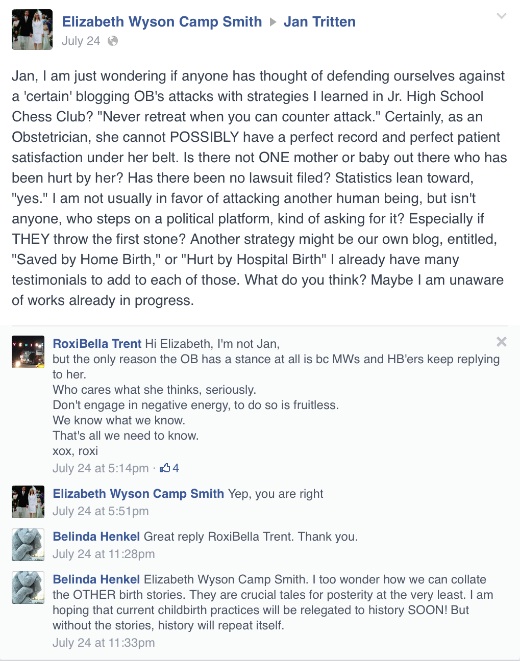
Consider this gem found on Jan Tritten’s Facebook page:

image

You remember Jan, don’t you? She’s the Editor of Midwifery Today and she crowd sourced a life or death decision for a 42+ week baby with no amniotic fluid on ultrasound while the baby died.

She republished the post from Elizabeth Wyson Camp Smith above after it was submitted to her wall.

The money quotes?

I am wondering if anyone has thought of defending ourselves against a ‘certain’ blogging OB’s attacks with strategies I learned in Jr. High School Chess Club? “Never retreat when you can counter attack.”

And:

I am not usually in favor of attacking another human being, but isn’t anyone who steps on a political platform kind of asking for it?

I’m going to go out on a limb here and guess that Elizabeth’s chess career ended in junior high school, since she obviously did not understand what she was told. Let me explain it to Elizabeth in small words that she can understand:

Elizabeth, when they told you to counterattack they meant with chess moves, not by smearing the other little chess player. That’s because to win a chess game, you have to actually play chess. You don’t win if you make up lies about the other players.

Now, Elizabeth let’s extrapolate (sorry, that’s a big word) figure out what that means in this situation. It means that if you want to defend yourself against my claims that homebirth kills babies who didn’t have to die, and that homebirth midwives are dangerous laypeople who made up a pretend “midwifery” credential and awarded it to themselves, you need to rebut (sorry, another big word) show that those claims are untrue.

It does not mean, as you apparently think it does, that you should smear me. When you do that, it’s like you are smearing the other chess player and you can never win that way. In fact, you would probably be disqualified (oh, dear, another big word) lose and maybe even get thrown out of the match.

It’s hard for me to figure out who is the bigger dope here, Elizabeth, who doesn’t appear to have the reasoning capacity to care for a house plant, or Jan Tritten, who just keeps making a bigger fool of herself as time goes by.

The bottom line, though, is easy to figure out. Neither Elizabeth nor Jan can summon any evidence that homebirth is safe, and any evidence that homebirth midwives are anything other than ignorant and dangerous. They no longer even try. They have reached the point of desperation where it seems easier to them to try to discredit me than to discredit my factual claims.

Epidurals may reduce the risk of postpartum depression

image

The mainstream media has been reporting on a new study that shows that epidurals may decrease the risk of postpartum depression.

According to CBS News:

New research published in the journal Anesthesia & Analgesia found that women with acute pain during birth had a 2.5-fold increased risk for chronic pain as a new mother and a 3 times greater risk for postpartum depression…

Research suggests managing a woman’s pain during childbirth is critical to helping her gain footing as a new mother. Less pain during childbirth is associated with shorter post-labor recovery time, which enables a mother to bond, care for and nurse her baby much more effectively.

The study, Epidural Labor Analgesia Is Associated with a Decreased Risk of Postpartum Depression: A Prospective Cohort Study, appears in the August issue of Anesthesia and Analgesia. The study has some significant limitations including small sample size and different cultural expectations of the participants. Moreover, as we know, correlation does not prove causation.

Nonetheless, this is not the first study that has raised the possibility that epidurals decrease the risk of postpartum depression and/or PTSD. It’s not difficult to imagine a method of action.

First, there is a known connection between pain and depression.

Second, trauma can lead to depression.

Third, as Dr JaneMaree Maher of the Centre for Women’s Studies & Gender Research at Monash University in Australia notes in her article The painful truth about childbirth: contemporary discourses of Caesareans, risk and the realities of pain:

… Pain will potentially push birthing women into a non-rational space where we become other; ‘screaming, yelling, self-centered and demanding drugs’. The fear being articulated is two-fold; that birth will hurt a lot and that birth will somehow undo us as subjects. I consider this fear of pain and loss of subjectivity are vitally important factors in the discussions about risks, choices and decisions that subtend … reproductive debates, but they are little acknowledged. This is due, in part, to our inability to understand and talk about pain.

As she explains:

… [W]hen we are in pain, we are not selves who can approximate rationality and control; we are other and untidy and fragmented. When women give birth, they are physically distant from the sense of control over the body that Western discourses of selfhood make central …

So epidurals, as the most effective form of pain relief, give women control over their own bodies and control over the way in which they behave. This allows women to represent themselves to others in the ways in which they wish to be seen, instead of pushing them into a “non-rational” space.

In other words, the excruciating pain of labor is traumatic, not simply because of the agony, but because being in agony makes it almost impossible to advocate for oneself, to make important decisions, and to exert control over your care.

Imagine if labor were painless, or nearly so. Would it be as traumatic? Would it render women unable to advocate for themselves or exert control over their care? Of course not. A woman who is not in excruciating pain can have reasoned discussions with her providers about her preferences, which is particularly important if an unanticipated complication arises.

Natural childbirth advocates are not entirely wrong in pointing out that a lack of supportive care and a lack of feeling in control contribute to birth trauma and PTSD, but they are looking at downstream effects of the real problem, pain. The support is needed to cope with the pain; the feeling of not being in control is because of the pain.

Natural childbirth advocates may actually be promoting psychological complications of childbirth. By insisting that relieving labor pain is a moral weakness and a danger to the baby (both of which are completely untrue), they encourage women to forgo relief of the excruciating pain and increase the risk that women may develop long term psychological sequelae like postpartum depression and PTSD.

How ironic! I can’t wait to see how natural childbirth advocates are going to spin this one.

10 even worse reasons to have a homebirth

image

Mommyish just posted a piece entitled 10 Terrible Reasons To Have A Home Birth by Bethany Ramos. It’s partly serious and partly tongue in cheek, and accompanied by lots of animated GIFs.

Ramos’ reasons include:

You hate you doctor
You don’t trust modern medicine
You want a memorable birth “experience”
You don’t want to have a C-section
They used to do it in the 1800’s!

It seems not to have occurred to Ramos that these are actually among the top reasons that women choose homebirth.

But there are even worse reasons to have a homebirth, and they include the following:

1. You think it’s safe.

It isn’t. Homebirth kills babies who didn’t have to die. Indeed ALL the existing research on American homebirth, as well as state and national statistics, show that homebirth with a nurse midwife doubles the risk of neonatal death, and homebirth with a non-nurse midwife has a death rate 3-9X higher than comparable risk hospital birth

2. You think homebirth midwives are real midwives

Most homebirth advocates have no clue that CPMs (certified professional midwife) are actually laypeople who carry a certification made up and awarded to themselves. They are a second, inferior class of “midwife” ineligible to practice in any other first world country because they lack the education and training of real midwives.

3. You trust birth

Homebirth advocates appear to be unaware that childbirth is inherently dangerous. It is, and has always been, in every time place and culture, a leading cause of death of young women and THE leading cause of death of children. There’s nothing trustworthy about birth and only a fool would trust it.

4. You actually think that because homebirth midwives carry resuscitation equipment they know how to use it

Hospital personnel train incessantly on how to manage emergency situations. They’ve performed hundreds or even thousands of resuscitations and probably did one within the past week. Most homebirth midwives have never performed a successful resuscitation.

5. You live only 10 minutes from the hospital

Can you hold your breath for 10 minutes? Neither can your baby if he or she is in distress.

6. You are afraid of hospital acquired infections

The major infectious threats to babies (and mothers) live within the mother’s vagina. These include group B strep and herpes.

7. You think waterbirth is “natural” even though primates don’t give birth in water

Yup, all indigenous peoples give birth in plastic kiddie pools in their living rooms.

8. You actually believed the nonsense and propaganda in The Business of Being Born

BOBB is a one sided, inaccurate piece of propaganda produced by a woman who has no training in midwifery, obstetrics or science. Most of the people presented as “experts” in the film are experts only in their own minds. No one with actual training in science or obstetrics pays any attention to them (if, indeed, they are even aware these “experts” exist).

9. You think that breech, twins, VBAC, gestational diabetes, pre-eclampsia and group B strep colonization are “variations of normal”

Apparently it has not yet occurred to you that homebirth midwives reclassify all high risk situations as “variations” of normal in order to retain control over high risk women and profit from them.

10. You had no idea that Ina May Gaskin is a layperson who lives in a cult and has no training in midwifery; that Henci Goer is a layperson with no training in science, medicine or midwifery; and that Ricki Lake is the Jenny McCarthy of birth

You probably also think that reading books, blogs and websites written by laypeople for other lay people constitutes “research.” It doesn’t. Only reading and analyzing the full breadth of the scientific literature on homebirth and obstetrics is actual research. Anything else is only kidding yourself.

The bottom line is that most women who choose homebirth do so for reasons that range from terrible to even worse. That’s because they have no idea of the risks of childbirth, no idea of that homebirth “midwives” are just lay people, no idea that watching a documentary is not “research.” and no idea that homebirth kills babies who didn’t have to die.

What do natural childbirth advocates like Milli Hill have in common with climate change denialists?

John Oliver climate change

Sadly, we live in a world where people feel free to ignore scientific fact when it conflicts with their philosophy. There are large numbers of people who feel free to ignore the scientific fact of evolution because it conflicts with their philosophy that the Bible is literally true; there are large numbers of people who feel free to ignore the scientific fact of climate change because it conflicts with their economic philosophy of zero legislation to protect the environment; and there are large numbers of people who feel free to ignore the scientific fact that childbirth is inherently dangerous. We call those risk deniers “natural childbirth advocates.”

Comedian John Oliver parodied the mainstream media’s efforts to portray the denial of scientific fact as a “debate” with one commentor on the side of science and the other on the side of denial. Below, you can watch the full hilarious clip of what a real debate on scientific fact should look like:

Let’s examine some of Oliver’s points, points he made about climate denialists, but which, in my judgment apply equally to natural childbirth and midwifery denialists of childbirth risks.

1. In regard to those who deny scientific fact:

Who gives a shit? You don’t need people’s opinion on a fact. You might as well have a poll asking: ‘Which number is bigger, 15 or 5?’ or ‘Do owls exist?’ or ‘Are there hats?

Similarly, when natural childbirth and midwifery advocates like Milli Hill insist that childbirth is not inherently dangerous, our response ought to be”

“Who gives a shit what Milli Hill thinks? You don’t need midwives’ or their advocates’ opinion on a fact.”

2. On scientific consensus:

As the Guardian explained,

The body of scientific evidence supports human-caused global warming: 97% of peer-reviewed scientific papers taking a position on the subject over the past 20 years are in agreement about this.

Similarly, a large body of scientific and historical evidence supports the inherent dangerousness of childbirth. Childbirth is and has always been, in every time, place, and culture (including our own) a leading cause of death of young women. Moreover, according to recent paper in the British Journal of Obstetrics and Gynecology, The dangers of the day of birth:

Even with modern obstetric practice the risk of a baby dying on the day of its birth in the UK is greater than the average daily risk of death until the 92nd year of life. We have shown that this risk is comparable with many other high-risk activities, and results in many life years lost.(my emphasis)

The scientific consensus among obstetricians, the people who are experts in all form of childbirth, not just “normal” birth, is overwhelming.

3. False journalistic balance:

The media nevertheless continues to treat the subject as a ‘debate’, often with 1 person representing the 97% consensus and 1 person representing the less than 3% fringe minority.

Similarly, the mainstream media treats midwifery and natural childbirth claims about the risks of childbirth as a debate with 1 person (an obstetrician) representing the overwhelming scientific consensus on childbirth risk and 1 (a midwife or lay natural childbirth advocate like Hill) representing the fringe denialists.

4. The real debate should be how we respond to scientific fact.

The ‘debate’ should center on what to do about climate change; it’s not about the science.

There is no “debate” on the fact that childbirth is and has always been a leading killer of women and THE leading killer of children. The debate should center on how we manage the very real risks.

I wrote last week about the way in which natural childbirth advocate Milli Hill and Royal College of Midwives Head Cathy Warwick are actively misrepresenting the risks of childbirth.

Hill subsequently acknowledged on Twitter that childbirth might be more dangerous than she claimed, but then asserted:

I don’t say birth is not risky. Life is risky. Picking your nose is risky. But birth risks are overemphasised to women’s detriment.

Hill’s casual dismissal of the risk of death (and permanent injury) in childbirth is just another example of natural childbirth denialism.

As astrophysicist Neil de Grasse Tyson has said in regard to climate change denialists:

The good thing about science is that it’s true whether or not you believe in it.

I will say the same to Hill and other natural childbirth advocates.

Childbirth is inherently dangerous whether you believe it or not. There is no debate about it. The only thing up for debate is how best to handle the deadly risks of birth.

Did midwifery merely replace the patriarchy with the matriarchy?

image

I’ve written extensively about the misogynistic views of Grantly Dick-Read, the father of natural childbirth. Dick-Read was deeply concerned that white women of the “better classes” were forsaking childbearing for political and economic rights. He viewed childbirth pain as one of the reasons, and strove to convince women that the pain of childbirth was in their heads, arguing that “primitive” women have painless births, an utter lie.

The philosophy of Lamaze birth began in the postwar Soviet Union when leaders tried to make a virtue of necessity. As Paula A. Michaels relates in her excellent book Lamaze: An International History, they could not afford to purchase the pain relieving mediciations available in the West, so they conjured a method of abolish the pain of childbirth by psychological conditioning. Soviet obstetricians believed that women were weak and had been “conditioned” to believe that childbirth was painful. Therefore, through patterned breathing and other exercises, they could be conditioned in Pavlovian fashion to have no pain at all. Lamaze was imported into France for political reasons. It was first used at hospitals run by the Communist Party of France as an example of the superiority of Soviet science over American science.

Therefore, both major forms of natural childbirth were based on deeply sexist and retrograde views of women, and scientific claims that were never true. They also shared another important characteristic, one that is rarely acknowledged among contemporary natural childbirth advocates. The practice of natural childbirth was deeply and deliberately paternalistic. It explicitly depended on the laboring mother trusting the doctor to take charge of childbirth. By convincing the mother that the pain of childbirth was in her head, doctors hoped to shame women into being more docile patients. Indeed, Lamaze and his Soviet and French colleagues graded women on their performance in labor. Women could be given and were given failing grades for exhibiting signs of pain.

Interestingly, neither Dick-Read nor Lamaze opposed the use of pain relief in labor. However, it was the doctor who decided, based on a woman’s performance, whether or not she needed or deserved pain relief. At no point were laboring women asked about their preferences or needs.

As Michaels notes:

… American obstetrician shared the value that European doctors put on psychoprophylaxis as a means to impart — as Soviet obstetricians liked to put it — discipline. The laboring woman who willingly and quietly relinquished control of the process to her obstetrician, while playing an active roll in assisting him to deliver her baby, was characterized as successful.

So the philosophy of natural childbirth is and has always been deeply sexist, unscientific, and patriarchal. How, then, did it come to be seen as feminist? The primary reason is that in contemporary incarnations, women, in the form of midwives, doulas and childbirth educators, replaced men as the people who manipulated women into behaving in ways that were convenient for them.

Simply put, natural childbirth has exchanged the matriarchy for the patriarchy.

That doesn’t mean that contemporary female arbiters don’t believe completely in their view of childbirth. Grantly Dick-Read, Lamaze and the other male originators of natural childbirth philosophy also deeply believed that what was convenient for them, a docile patient who refused pharmacological pain relief, was in the best interests of women. But natural childbirth, in its current incarnation, is still about convincing women that what’s actually in the provider’s best interest is in the woman’s best interest.

It is in the interest of midwives, doulas and childbirth educators to convince women not merely that they can control the pain of childbirth by preparation, but that experiencing the pain of childbirth is in itself a necessary, valuable and healthier choice. Contemporary natural childbirth is, in large part, about what midwives can and cannot do. If a midwife can do it, it is an acceptable practice. If a midwife can’t do it, it is an “intervention.” Hence epidurals, fetal monitoring and inductions are “interventions,” while waterbirth, cranio-sacral therapy, and herbal supplements are not.

But most importantly, and most apparent in countries where midwives are gate keepers of maternity care, it is the midwife who determines whether a patient needs pain relief and whether she gets it, not the patient. It is the midwife who determines whether a woman’s performance in labor is successful, not the patient. Both midwives and doulas appear to view pharmacologic pain relief as evidence of “giving in” and failure on the part of the mother. Both midwives and doulas appear to believe that they are more capable of judging whether a laboring woman “needs” pain relief than the woman herself. They have perfected delaying tactics (“You don’t really need it.””You’re doing great.” “You’re almost there.”), shaming tactics, and don’t hesitate to resort to simple obstruction by refusing to call for an anesthesiologist when the patient requests it.

The mantra of natural childbirth is “choice” but the meaning of choice within the world of natural childbirth is deeply circumscribed. When midwives, doulas and childbirth educators use the word choice, they don’t mean all possible choices that a woman might make. They mean one choice and one choice only, the choice to have a “normal” birth.

Midwives have replaced the obstetric patriarchy with the matriarchy. Some wield their power for the mother’s benefit, but more often that power is wielded for the midwife’s benefit. Midwives want to have complete control over childbirth and to that end, they lie to women about the risks of interventions, the dangers of refusing interventions, and the purported value of forgoing pain relief. Midwives do exactly what they abhorred about obstetricians, insisting that they know better than the patient herself what’s good for her.

Natural childbirth advocates have not overthrown the “authoritative knowledge” of obstetricians, they’ve simply promoted themselves to the role of the authorities.