Category Archives: Uncategorized

The new ACOG report on primary C-section isn’t a game changer; it doesn’t change much at all

iStock_000024425495Small copy

Why do professional natural childbirth advocates have such difficulty relating the results of scientific papers honestly?

First, following the lead of the executives of the Midwives Alliance of North America (MANA), Judith Lothian attempted to hide the fact that their data showed that homebirth increases the risk of perinatal death by a whopping 450%.

Now she’s come up with an equally misleading “interpretation” of the new ACOG report, Safe Prevention of the Primary Cesarean Delivery.

According to Lothian, the new report “change[s] the game.”

Sharon Muza, Editor of the Lamaze blog Science and Sensibility introduces the piece with her own bizarre spin:

I hope that readers of Science & Sensibility (and anyone working in the field of maternal infant health) are sitting down. Be prepared to be blown away. ACOG and SMFM have just released a joint Obstetric Care Consensus statement that has the potential to turn maternity care in the USA on its end. I feel like this blog post title could be “ACOG and SMFM adopt Lamaze International’s Six Healthy Birth Practices.” (Okay, that may be a little overenthusiastic!) I could not be more pleased at the contents of this statement and cannot wait to see some of these new practice guidelines implemented. Judith Lothian, PhD, RN, LCCE, FACCE summarizes the statement and shares highlights of this stunning announcement.

There’s just one teensy, weensy little problem. The report says very little that is new.

I ought to know. Nearly 30 years ago, I trained with Dr. Friedman himself (creator of the eponymous Friedman Curve). There very little in the new report that is different from what Dr. Friedman said back then and the standards that he set for our department.

Let’s take a look at the actual report itself, and you will see what I mean.

The report starts with a caveat:

The information … should not be construed as dictating an exclusive course of treatment or procedure.

ACOG isn’t changing the game, because ACOG starts with the premise that the correct treatment plan for an individual patient is best determined by the doctor caring for her in consultation with the patient, not by reports.

Let’s look at the recommendations in the report:

1. “Prolonged latent phase (eg, greater than 20 hours in nulliparous women and greater than 14 hours in multiparous women) should not be an indication for cesarean delivery”

Prolonged latent phase has NEVER been an indication for C-section.

Most women with a prolonged latent phase ultimately will enter the active phase with expectant management. With few exceptions, the remainder either will cease contracting or, with amniotomy or oxytocin (or both), achieve the active phase.

That’s the same thing that Dr. Friedman said decades ago, and that’s the way that I was trained to practice.

2. …“[A]s long as fetal and maternal status are reassuring, cervical dilation of 6 cm should be considered the threshold for the active phase of most women in labor . Thus, before 6 cm of dilation is achieved, standards of active phase progress should not be applied.”

I was taught the the active phase typically begins at an earlier dilatation, especially for women having their second or subsequent child. However, I was also taught that the diagnosis of active labor should be made not by assessing dilatation, but by assessing the strength and frequency of contractions. It was recognized 30 years ago, and even before, that some women will not reach active phase until later than other women and that NO decision for C-section can be made before active labor begins, regardless of dilatation.

3. “Further, cesarean delivery for active phase arrest in the first stage of labor should be reserved for women at or beyond 6 cm of dilation with ruptured membranes who fail to progress despite 4 hours of adequate uterine activity, or at least 6 hours of oxytocin administration with inadequate uterine activity and no cervical change.”

This is the one thing that is different and its different because authors recapitulated what Dr. Friedman did and found that in current practice, vaginal delivery can be achieved by waiting longer.

Dr. Friedman never set out to create hard and fast rules about labor. Quite the opposite. Dr. Friedman did the research that led to the curve because he was angry that obstetricians would make decisions based on nebulous criteria (e.g. “that woman looks like a Cesarean to me”). Dr. Friedman set out to define parameters that generally led to successful vaginal delivery. Before the Friedman curve, obstetricians DID perform unnecessary C-sections in latent phase; they DID perform unnecessary C-sections for supposed “arrest” of labor or “arrest” of descent when they simply hadn’t waited long enough to see what would happen. Dr. Friedman NEVER said that anyone who deviated from the curve needed prompt C-section or couldn’t ultimately have a vaginal delivery. He just defined the way that most successful labors progressed. If a woman deviated from the curve substantially, her chances of vaginal delivery were substantially lowered, but not zero or even close to zero.

Over the succeeding generations, the way that most successful labors progress has changed. Therefore, the recommendations OUGHT to change to reflect that.

Have some obstetricians converted the original Friedman curve into hard and fast rules? Yes, some have, but that was NEVER Dr. Friedman’s intention.

4. “… [B]efore diagnosing arrest of labor in the second stage and if the maternal and fetal conditions permit, at least 2 hours of pushing in multiparous women and at least 3 hours of pushing in nulliparous women should be allowed . Longer durations may be appropriate on an individualized basis (eg, with the use of epidural analgesia or with fetal malposition) as long as progress is being documented.”

Nothing new there, either. I routinely cared for women who pushed 3 or 4 hours, and as long as they were making progress, there was no need for any intervention.

5. “Operative vaginal delivery in the second stage of labor by experienced and well trained physicians should be considered a safe, acceptable alternative to cesarean delivery.”

Nothing new there. Forceps and vacuum have always been used and are still being used. Both have a greater potential to harm the baby, though, and that is a critical factor in determining how to proceed.

6. There are new methods for detecting and categorizing fetal distress, but the basic principle remains the same. If there is evidence of fetal distress, a C-section is the appropriate response.

7. “Studies that compare induction of labor to its actual alternative, expectant management awaiting spontaneous labor, have found either no difference or a decreased risk of cesarean delivery among women who are induced. This appears to be true even for women with an unfavorable cervix.”

Contrary to the claims of natural childbirth advocates, induction does NOT increase the C-section rate.

8. “Before a vaginal breech delivery is planned, women should be informed that the risk of perinatal or neonatal mortality or short-term serious neonatal morbidity may be higher than if a cesarean delivery is planned…”

C-sections are safer than vaginal delivery for breech babies.

9. “To avoid potential birth trauma, the College recommends that cesarean delivery be limited to estimated fetal weights of at least 5,000 g in women without diabetes and at least 4,500 g in women with diabetes …”

This is not news. The research on which these recommendations are based was performed when I was in training.

10. “Perinatal outcomes for twin gestations in which the first twin is in cephalic presentation are not improved by cesarean delivery. Thus, women with either cephalic/cephalic-presenting twins or cephalic/noncephalic-presenting twins should be counseled to attempt vaginal delivery.”

That’s what I was taught and that’s how I practiced.

11. The recommendation for C-section in the presence of active genital herpes is unchanged.

12. ACOG offers a nod to NCB proponents by recommending doulas.

I don’t see much that is new in this paper. In fact, I see much that harks back to Dr. Friedman’s initial recommendations and to the way he taught his residents and ran his department.

The one substantive change is the emphasis on waiting longer in active phase for making a diagnosis of arrest. That is likely to have an measurable effect on the C-section rate. The rest is old news.

Of note, ACOG is strongly in favor of fetal monitoring and recommends no alterations at all in standard labor and delivery care. ACOG mentions no support for 5 of Lamaze’s “Six Healthy Birth Practices.” ACOG offers no support for the notion that childbirth is inherently safe, that epidurals should be avoided, that interventions are “bad,” or just about anything else that is the hallmark of contemporary natural childbirth advocacy.

The new report reinforces one of the chief virtues of obstetrics. As a scientific discipline, it is always open to new evidence, always looking to improve outcomes, and always willing to change practice to reflect the latest research. Unlike natural childbirth and homebirth advocacy organizations, obstetrics doesn’t depend on unchanging beliefs, does not value process over outcome, and makes no value judgments about the “best” way to give birth.

If Lamaze wants to pretend, contrary to all the evidence, that they have changed minds at ACOG, it isn’t going to hurt any mothers or babies. The only thing their pretending hurts is their own credibility.

What does contemporary midwifery have in common with Stalinist Russia?

image

Jessica Grose, writing in this week’s edition of The New Republic, reviews a new book about the history of the Lamaze movement. The piece, entitled Why We’re So Obsessed with ‘Natural’ Childbirth; A new history of Lamaze explains the origins of the mythology reviews the book Lamaze: An International History by medical historian Paula A. Michaels.

Grose’s review explores many of the themes I have written about over the past few years:

The typical birth narrative that you read online is a tale of harrowing disappointment. The mother had “spent months—if not years—dreaming” about her baby and her pain-medication-free birth… But, by dint of fate and unhappy circumstance, these moms are forced by medical professionals—sometimes even midwives or doulas—to have C-sections or epidurals. They are “treated disrespectfully or without compassion at that most vulnerable time.”

As Grose notes, however, reality is quite different from the dystopian fantasies of natural childbirth advocates.

Indeed, it’s my experience that even at big, impersonal city hospitals, the language and protocol surrounding maternity care is sensitive and catered to a woman’s desires.

Grose also notes the pernicious influence of the father of the natural childbirth philosophy, Grantly Dick-Read:

… Dick-Read promoted some insanely retrograde ideas—that birth pain is psychological; that women of the upper classes should be the ones having lots of babies—but other parts of his philosophy sound like they could have been cribbed from crunchy mommy blogs. Birth, Dick-Read wrote, is “an ecstasy of accomplishment that only women who have babies naturally [i.e., without anesthesia] appreciate.”

In other words, NCB was created by a misogynist eugenicist as a way of convincing women of the “better” classes to have more children. NCB is not feminist, no matter how much its contemporary avatars, midwives and doulas, try to pretend that it is.

The leading exponent of contemporary natural childbirth philosophy is Lamaze International, and the history of the Lamaze movement is also surprisingly retrograde. Before it was popularized by a French obstetrician, the philosophy of Lamaze natural childbirth was created with the encouragement of the Stalinist government to paper over the horrific quality of Russian maternity services. Simply put, the Russian government couldn’t afford obstetric anesthesia, so they set out to convince women that non-pharmacologic methods of pain relief were both equally effective (which they knew was a spectacular lie) and “better,” a value judgment they felt compelled to promote rather than acknowledge the dire state of Russian medical care.

What is most striking to me is that the Lamaze method, just like Dick-Read’s philosophy, was a deliberate attempt to manipulate women into accepting the future that men wanted for them, or in the case of the Russian government, the only future they could afford to provide.

And in a nearly seamless transition, the philosophy of Lamaze has been adopted by midwives, doulas and childbirth educators for the same cynical reason is was invented in the first place. What does contemporary midwifery have in common with Stalinist Russia? Neither can provide effective pain relief for childbirth, so both resorted to hoodwinking women into thinking that pain relief is unnecessary, and that unmedicated childbirth is an accomplishment.

In other words, contemporary midwifery and Stalinist Russia tried to make a virtue of necessity. They couldn’t (in the case of the Russians) and still can’t (in the case of contemporary midwifery) provide effective pain relief. The Russians couldn’t afford it and the midwives don’t know how to do it and can’t bill for it. In both cases, women are manipulated into making a virtue out of necessity, literally.

There is nothing inherently better, healthier or safer in any way about giving birth without pain relief and there never was. The Russians made it up because they couldn’t provide pain relief, and contemporary midwives promote it because they can’t provide pain relief, either.

Effective pain relief for severe pain is a basic human right. Those who make a virtue of denying women pain relief or shaming them for wanting it and enjoying it should be recognized for what they are: selfish and manipulative individuals who praise what they can profit from and demonize anything they can’t.

Breathing in excrement is just a variation of normal!

image

Sometimes I really fear for the future of midwifery.

It has gone from being a noble profession, saving countless lives and always struggling to save more, to a bunch of clowns drumming up business and always struggling to drum up more.

The amount of stupidity and wishful thinking spewed by these fools is epic. Case in point: a post from the hilariously misnamed blog Midwife Thinking entitled The Curse of Meconium Stained Liquor.

Now you or I might think that the curse is that when excrement is inhaled into a baby’s lungs, it can result in severe respiratory illness and death. But for this midwifery clown, the “curse” is the potential loss of business. But never fear; the all purpose tool wielded by people who profit from homebirth is always available: it’s just a variation of normal!

Letting me repeat that: rather than lose business, Rachel Reed, Midwife (Not) Thinking, simply announces that breathing in excrement is just another variation of normal.

The motivation of the midwife is apparent from the very first paragraph:

Dear unborn baby,

Please consider holding your poo in until after you are born. The big people on the outside get very stressed about your poo and will want to change the way you are birthed if they find any evidence that you have failed to keep it in. Your mother will be told that you are in danger, and will be strapped to a CTG monitor. This will: reduce her ability to help you through her pelvis by moving; prevent her from using water to relax; and increase your chance of being born by c-section. Your mother will also have her time limits for labour tightened up. This may lead to labour being induced or augmented which will put both of you at risk of further interventions. You will be expected to get through your mother’s vagina quickly and if you take too long you will be pulled out with medical instruments…

Imagine that, those evil obstetricians will compromise the birth process for no better reason than to maximize the birth outcome: a healthy, live baby.

But Rachel Reed knows better. She has her priorities in order: it’s more important to have an intervention free labor than for a baby to be able to breathe or even survive.

Rachel is all over this:

MAS is the major concern when meconium is floating about in the amniotic fluid. It is an extremely rare complication – around 2-5% of the 15-20% of babies with meconium stained liquor will develop MAS (Unsworth & Vause 2010). Of the 2-5% of the 15-20%, 3-5% of babies will die. OK enough %s of %s – basically it is very rare but can be fatal.

Apparently both math and logical thinking are hard for Rachel, so let me make it easy for her. One in 5 babies will have meconium in the amniotic fluid. Of those 1 in 20 will become seriously ill (respiratory distress, mechanical ventilation, prolonged NICU stay, risk of death). Of those, nearly 1 in 20 will die. In other words, 1% of babies will have end up with a life threatening illness. That’s not rare. And that illness will kill 5% of those ill babies. That’s not rare, either.

Or, put another way, once a mother learns there is meconium in her baby’s amniotic fluid, there is a 1 in 20 chance of serious complications. And if her baby does experience severe complications, there’s a very real chance that he or she will die. In the US, that means that there are 25,000-35,000 cases of meconium aspiration syndrome (MAS) per year, and approximately 1500 deaths.

I would have thought that anyone with more than two functioning brain cells would recognize that excrement in the lungs is a bad thing, but not Rachel Reed. As far as she’s concerned, it’s not a big deal because:

Meconium is a mixture of mostly water (70-80%) and a number of other interesting ingredients (amniotic fluid, intestinal epithelial cells, lanugo, etc.).

You know what else is 70% water? Battery acid, and I suspect that even Rachel Reed would recognize that battery acid is very harmful.

It’s the other stuff in meconium (intestinal cells, hair, etc.) that makes it dangerous when it ends up in the lungs. What does it do?

This lecture for medical students explains how meconium damages a baby’s lungs:

Decreased alveolar ventilation related to lung injury, ventilation-perfusion mismatch and air-trapping.
• Pneumothorax or pneumomediastinum in 15-30% of cases
• Persistent pulmonary hypertension (PPHN) in severe MAS(increased pulmonary vascular resistance with right-to-left shunting)
• Fetal acidemia
• Chemical pneumonitis
• Surfactant inactivation caused by meconium’s disruption of surface tension

So meconium makes it much for difficult for a baby to expand his lungs, to absorb oxygen and can even lead to a hole in the lung causing it to collapse.

But meconium is not merely an irritant, it is a symptom of another serious problem, lack of oxygen getting to the baby during labor. The baby responds to the severe stress of lack of oxygen with a response similar to “fight or flight”: it defecates.

So there are two reasons to deliver a baby expeditiously once it has defecated in the amniotic fluid. First, the meconium itself is harmful to the baby’s lungs and the more meconium is sucked into the lungs, the worse the harm is likely to be. Second, a baby who has passed meconium is often a baby in distress, and the longer that oxygen deprivation lasts, the more severe the consequences are likely to be. Hence the desire to use whatever interventions are necessary to deliver the baby expeditiously.

This is not rocket science, but apparently it is too hard for Rachel to understand. She offers her bizarre take on meconium aspiration:

So you would think that the sensible thing to do if a baby has passed meconium (for whatever reason) is to create conditions that are least likely to result in hypoxia and MAS. This is where I get confused because common practice is to do things that are known to cause hypoxia, for example:

Inducing labour if the waters have broken (with meconium present) and there are no contractions or if labour is ‘slow’ in an attempt to get the baby out of the uterus quickly.
Performing an ARM (breaking the waters) to see if there is meconium in the waters when there are concerns about the fetal heart rate.
Creating concern and stress in the mother which can reduce the blood flow to the placenta.
Directed pushing to speed up the birth.
Having extra people in the room (paediatricians), bright lights and medical resus equipment which may stress the mother and reduce oxytocin release.
Cutting the umbilical cord before the placenta has finished supporting the transition to breathing in order to hand the baby to the paediatrician.”

The stupid, it burns. It’s the equivalent of approaching the situation of a child drowning in a lake by claiming that the best response is to avoid interventions like rescuing the child and, instead, wait patiently for its body to float to shore. It’s the equivalent of claiming that the “stress” of a frantic rescue with bright lights (oh, the horror!) is more damaging than the lack of oxygen in the child’s lungs.

Rachel’s entire piece is a monument to the stupidity and venality of homebirth midwives, but some parts are more idiotic than others. My personal favorite:

Avoid an ARM during labour so that any meconium present is not known about until the membranes rupture spontaneously …

That statement is a perfect illustration for a new motto for homebirth midwives:

Ignorance is power!

If that’s the case then midwife Rachel Reed is very powerful indeed.

Dr. Amy interviewed on Point of Inquiry

image

I was interviewed by journalist Lindsay Beyerstein on the subject of homebirth and the recent publication of statistics by the Midwives Alliance of North America.

You can find the interview here:

http://www.pointofinquiry.org/amy_tuteur_md_-_the_skeptical_ob/

It’s a long interview. There’s just as much after the commercial break as before.

Thanks to Point of Inquiry and Lindsay Beyerstein for the opportunity to share my thoughts!

Homebirth advocates: if it makes me happy then it must be true

image

Would you hire an architect who told you that you could save lots of money building your new house by ignoring all those pesky building codes?

Probably not. As much as you’d like to save money, you recognize that choices have consequences and the consequences of ignoring building codes might be dire.

What if, in response to your concern that such a house might fall down, trapping and killing your family, the architect responded that some houses are just meant to fall down and some families are meant to be buried alive under tons of debris?

Would you be reassured?

How about if the architect told you that your house wouldn’t fall down as long as you believed in yourself and your choice to ignore building codes?

You’d probably be angry that the architect was treating you like a gullible fool.

In other words, you would be capable of rejecting a plan that sounds too good to be true, even if it might make you happier to believe that you didn’t need to spend money to follow those pesky building codes.

That’s the nature of adult reasoning. You don’t determine if a claim is true by whether or not it makes you happy. You apply reason, and conclude that many claims are not true even thought it would make you happy if they were true.

Unless, of course, you are a homebirth advocate.

Homebirth advocates have a toddler level approach to the world: what makes them happy must be true, and if anyone tells them it’s not true, they fall to the floor, weeping, declaring that they hate the truth teller for being so mean.

If you think about it for even a nanosecond, you realize that is how homebirth advocates “reason.” They always want to do what is easiest and least scary for them, so they simply pretend that what is easiest and least scary for them must be true.

Hospitals are scary. Homebirth advocates prefer to believe that hospitals kill countless babies with dread “interventions,” so staying home must be better. And homebirth midwives are happy to support them in their delusion.

C-sections are scary. Homebirth advocates prefer to believe that no woman needs a C-section unless whatever is happening is so scary (massive bleeding, cord falling out of the vagina, a baby with no heart rate), they are more afraid of bleeding to death or having a dead baby than they are of the C-section. And homebirth midwives are happy to encourage this type of thinking.

Obstetricians are mean because they won’t tell you what you want to hear simply because you want to hear it. They won’t praise you for being “educated” when you are actually ignorant. They won’t tell you that you are a “warrior mama” just because you managed to do what most of the mothers who ever existed have already done (or died trying to do). Homebirth midwives make women much happier because they never tell them anything they don’t want to hear.

Dead babies are scary. They prefer to believe that the chance that their own babies might die is barely higher than zero. Therefore, obstetricians are “playing the dead baby card” rather than trying to obtain informed consent when they tell them about risks as well as benefits.

Needles are scary. Therefore epidurals are “risky” and natural childbirth is “safer.”

Childbirth complications are scary. Therefore, they simply don’t exist; breech, twins, VBAC, etc. are nothing more than variations of normal.

Science is scary, and hard. Therefore they create their own “journals” where any crap they dream up will be published because the criterion for acceptance is not scientific rigor, but rather the ability of the paper to make homebirth advocates happy.

Scientific meetings are scary. People might ask questions! They might point out flaws! They might disagree! Therefore, professional homebirth advocates can never speak in any venue where the audience has not been vetted to remove anyone who might make homebirth advocates unhappy.

The truth is scary. Therefore, homebirth advocates, delete and ban to create “safe spaces” for themselves where they will never be confronted by anything that might make them unhappy. Indeed, there is not a single homebirth website that I am aware of, or a single professional homebirth advocate who does not whitewash her website, not merely to remove uncomfortable facts, but to pretend they don’t exist at all.

Debate is super duper scary. That’s why professional homebirth advocates will never be caught in any debate that isn’t rigged before hand. Being made to look like a fool is always a distinct possibility for professional homebirth advocates and that wouldn’t make them happy, would it?

So homebirth advocates, and women contemplating homebirth, need to ask themselves:

Are they adults who can accept the fact that homebirth kills babies who didn’t have to die?

Or are they toddlers who prefer to pretend that whether or not something makes them happy determines if it is true?

Oooh, Dr. Amy is “meen”

image

In the ongoing discussion about my tone, no one has picked up on what seems most noticeable to me, the dramatic difference between the way that laypeople talk about me and the way that professional homebirth advocates talk about me. Rarely does a week go by that some lay homebirth advocate does not refer to me as mean and explain why no one should listen to me.

What do professional homebirth advocates do? They don’t talk about me at all … which is pretty remarkable if you think about it. They fell all over the Wax study and will tell you in great detail what is wrong with it, but they don’t mention my posts because they CAN’T rebut them. There is nothing factually wrong with what I write and they know it. They don’t dare mention me because they know how very persuasive the truth can be.

Not a single one will publicly debate me because they know they will be eviscerated in short order. They ban me and delete me and they ban and delete anyone who has learned the truth from me, regardless of how nicely those other people tell the truth.

This, to me, is the ethical scandal at the heart of professional homebirth advocacy. Sure there are some professional homebirth advocates who are buffoons, like Jennifer Margulies or Judy Slome Cohain. They don’t understand science and they have toddler level reasoning abilities: if something makes them happy, they believe it. But people like Melissa Cheyney, Wendy Gordon, and Aviva Romm, KNOW that they are hiding hideous homebirth death rates and they simply don’t care. If they put half the energy they use to hide the truth into improving homebirth safety, there would be no need for this blog in the first place.

Professional homebirth advocacy has no safety standards of any kind, because it is not about caring for babies. It is about improving the employment opportunities and reimbursement rates for high school graduates who want to “play” midwife but find it too hard to get a real midwifery degree.

Am I “meen”? I wouldn’t call it that. I would say that I am very, very angry… and I let it show. I feel I have a responsibility to speak out against what I see as the moral corruption at the heart of homebirth advocacy, the willingness to bury dead babies twice. First to put them in little coffins in the ground because homebirth “midwives” can’t be bothered to care as much about safety as about reimbursement. Second, to bury them from the public conscience so as not to affect the economic bottom line of homebirth midwives.

That’s why I came down so hard on Aviva Romm. I deliberately maneuvered her into a position where she had to choose between lying or running away. She chose to run away, and leave those little dead bodies scattered wherever they may fall. It is more important for her to preserve her credibility within the crunchy community, and keep selling quack books about quack subjects, than to speak the truth. Frankly, that willingness to place profits over truth makes me nauseated.

I started this blog because I couldn’t abide the lies from homebirth and natural childbirth advocates, but I keep at it, because I feel I have a responsibility to babies and mothers. Who will speak for babies like Wren Jones, who died of group B strep sepsis on the day he was born, because his parents would hoodwinked by a “midwife” who told them to treat a dangerous bacterium with cloves of garlic in the vagina? Who will speak for Magnus Snyder, who died after a protracted struggle to live because the “midwives” who cared for his mother relished the thought of delivering a breech baby for the first time and were more concerned with their “opportunity” than a baby’s life. Who will speak for Abel Andrews, who cannot speak for himself because the “midwives” who cared for him didn’t know how to perform a resuscitation and left him with a severe brain injury?

I can tell you damn straight who won’t speak for them. Melissa Cheyney won’t speak for them. Wendy Gordon won’t speak for them. Aviva Romm won’t speak for them.

So I ask you, who will speak for Wren, Magnus, Abel and hundreds of others if I don’t? Who will open everyone’s eyes to the suffering and deaths of babies at homebirth if I can’t? Who will rhetorically grab everyone around the throat and force them to look at what they would prefer to ignore if not me?

Am I “meen”? Maybe, but if that’s what it takes to get mothers, homebirth advocates and legislators to look at the truth, I’m proud of it.

Aviva Romm is in a bind over the hideous MANA death rates

Bound hands

Earth to homebirth advocates:

Have you noticed that you are being treated like gullible fools?

It appears that everyone in the universe knows that the MANA homebirth statistics paper shows that homebirth with a non-nurse midwife has a horrific death rate except for you.

Melissa Cheyney, Wendy Gordon and other MANA executives presented the data but simply told bald faced lies about what it means. They figured you are so gullible that you’d willingly lap up the lies and pretend they were truth.

MANA itself cannot find a single obstetrician, neonatologist, pediatrician, epidemiologist, or ethicist who is not directly affiliated with the homebirth movement to support their claims. But they imagine you are too stupid to notice.

Lamaze is so convinced the study is a piece of utter crap that their “references” to support it are The Daily Beast and The Huffington Post, as well as their own blog, Science and Sensibility.

GBWC link round up

No problem. They figure you guys are such morons that you will Facebook and tweet these links as if they are actual reference.

Now Aviva Romm, MD finds herself in a bind about these MANA statistics.

Dr. Romm is no fool. She received a prize for graduating at the top of her class at Yale Medical School. No doubt she values her reputation for academic achievement and isn’t about to risk it by lying to support MANA in their own prevarications. So when I asked her point blank about analyzing the MANA paper and the Grunebaum abstract, she dithered:

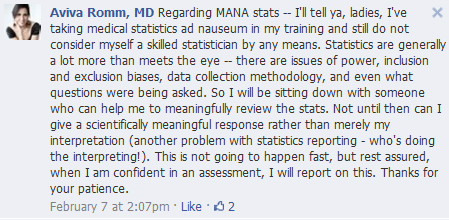
Aviva Romm 2-7-14

Awww. Statistics are too hard for Aviva. And if you believe that, I have a bridge in Brooklyn I’d like to sell you.

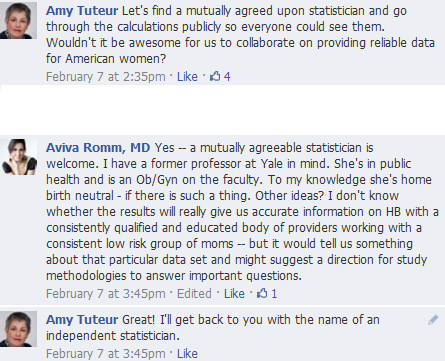
I jumped on her “inability” to analyze the statistics for herself (although I restrained myself from pointing out that if she doesn’t understand statistics, how does she know homebirth is safe?):

Tuteur-Romm 2-7-14

It’s not easy to find someone willing to go along with this little charade since, as a variety of math and stats people pointed out to me, there are no statistics involved in the analyses. It’s all elementary school math.

Fortunately, a math PhD did come through and volunteered to analyze the papers. I promptly notified Aviva on Facebook and Twitter and prepared to be ignored. No professional homebirth advocate can afford to be part of an independent analysis of the data because they KNOW the MANA paper shows that homebirth has a perinatal death rate at least 450% higher than comparable risk hospital birth. I never believed that Aviva would go through with an independent analysis and the only reason I suggested it is to show other homebirth advocates the truth … that American women are being taken for chumps and fools by people who know that homebirth kills babies and don’t want them to find out.

After being ignored for more than 24 hours I sent a tweet this morning and got a prompt reply, weaseling out of the agreement, just as expected.

Tuteur-Romm 2-14-14

Actually, Aviva, the title of the piece is Stupid is the new black and, in case you haven’t noticed, I’m not interested in papering over the preventable deaths of babies at homebirth with faux “courtesy” even if you are.

And I hardly think that lying about whether you can analyze the MANA paper, which you KNOW shows that homebirth kills babies, was showing me courtesy in the first place.

So thank you, Dr. Romm, for doing exactly what I always expect you quacks like you to do. No self-respecting quack homebirth advocate would ever be caught in a position where she couldn’t delete the truth. It’s nice to know that for professional homebirth advocates, their ability to fool the gullible public is more important to them than whether innocent babies live or die.

So professional homebirth advocates will continue to lie about deaths at homebirth. The only outstanding question is whether lay homebirth advocates will continue to believe them.

Homebirth midwives (CPMs) don’t give a damn about safety

Sweet small baby

It’s no secret that I am strenuously working for the abolition of the CPM (certified professional midwife credential). And it’s no secret that I am confident that the bogus “credential” will be abolished eventually. The only outstanding question is how many babies will die at their hands before they are put out of business.

Why should the CPM credential be abolished?

I have given many reasons in the past including the fact that CPMs have less education and training than ANY other midwives in the first world and the fact that they would be ineligible for licensure in the Netherlands, the UK, Canada, Australia or any other industrialized country. In fact, if you’d like to know all of the many reasons, you can watch the video in the sidebar of this blog.

Today, though, I want to give the simplest possible answer, one that legislators, doctors, public health officials and even homebirth advocates can understand:

CPMs don’t have any safety standards of any kind.

  • The American Congress of Obstetricians and Gynecologists have published 152 Clinical Bulletins to establish parameters for safe practice for all obstetricians.
  • The American College of Nurse Midwives has published 11 Clinical Practice Bulletins to establish parameters for safe practice for all real midwives.
  • The Midwives Alliance of North America (MANA) has published ZERO bulletins to establish any parameters, safe or otherwise.

Can you think of any other group of professionals that has never published a single guideline for safe practice? I can’t.

MANA is not a professional organization. It is a special interest lobby and special interest lobbies don’t concern themselves with safety.

It would be bad enough if MANA and CPMs ignored safety, but the truly chilling fact is that MANA and CPMs actually OPPOSE parameters for safe practice.

Consider the recent paper published by MANA executives, Outcomes of Care for 16,924 Planned Home Births in the United States: The Midwives Alliance of North America Statistics Project, 2004 to 2009. Let’s leave aside for the moment the fact that the authors lied about the fact that their data show that homebirth increases the risk of perinatal death by at least 450% and probably a whole lot more.

Let’s look at the appalling death rates that the authors didn’t lie about.

For example:

Of 222 babies presenting in breech position, 5 died either during labor or the neonatal period.

So the homebirth death rate for breech was 20/1000 compared to approximately 0.8/1000 in the hospital. That’s a breech death rate 25X higher (2400%) than the hospital.

MANA has known about this astronomical death rate for 5 years. What have they done to mitigate it? NOTHING!

At no point during those 5 years did the executives at MANA let women know about the extreme risk posed by breech homebirth.

At no point during those 5 years did MANA publish a clinical practice bulletin to inform their own members about the extreme risk posed by breech homebirth.

In fact, homebirth midwives continued to lobby to extend scope of practice to INCREASE breech homebirths.

And even today, in the face of publication of the exact magnitude of the extreme risk posed by breech homebirth, homebirth midwives and their allies are CONTINUING to lobby against an efforts to restrict breech homebirth.

Typical of these efforts in this Change.org petition:

The Arizona State Legislature is considering adopting a new bill that would make it illegal for home birth midwives to attend breech, VBAC, and multiple births (SB1157)…

A recent study published in the peer-reviewed Journal of Midwifery and Women’s Health shows that current science supports home birth for breech and VBAC patients.

I don’t know if the author of the petition is a liar or a fool, but the study showed that science (current or otherwise) does NOT support breech homebirth because the death rate is an appaling 20/1000.

Where is MANA and its executives in this attempt to void any safety regulations in Arizona? They are nowhere to be found. Even though MANA knows that its OWN DATA shows breech homebirth has a hideous mortality rate, they are silent.

The CPM should be abolished because CPMs are not health professionals; they are business women who don’t give a damn about safety and care only about their bottom line. They have literally NO standards for safe clinical practice, which is unfathomable for a purported health care organization, but entirely predictable in an economic lobbying organization.

The CPM credential is a public relations ploy designed to trick legislators and laypeople into believing that homebirth midwifery a profession. It’s not and the sooner the CPM is abolished, the sooner the deaths at their hands will end.

4,000 women are missing from the MANA statistics paper; where did they go?*

the missing piece

Geradine Simkins, President of the Midwives Alliance of North America, July 2008.

MANA estimates approximately 20,000 cases will be in the database by the end of 2008.

Peggy Garland, MANA Director of Research, November 2009:

I am pleased to announce the availability of data from the MANA Statistics Project. We have completed review of almost 13,000 records from late 2004 through the end of 2007…

… [W]e expect another 10,000 records will become available for research, spanning 2008-2009.

Melissa Cheyney, August 2011:

The MANA Stats project currently has over 600 active contributors … and our database contains over 27,000 records and counting …

MANA Stats webpage, now:

The MANA Statistics Registry (“MANA Stats”) has gathered has over 24,000 records in the initial (“2.0”) dataset (2004-2009) …

Here’s part of the explanation, accounting for approximately 4,000 women:

Development and Validation of a National Data Registry for Midwife-Led Births: The Midwives Alliance of North America Statistics Project 2.0 Dataset, January 2014:

In 2004, the Midwives Alliance of North America’s (MANA’s) Division of Research developed a Web-based data collection system to gather information on the practices and outcomes associated with midwife-led births in the United States…

The 2004 to 2009 MANA Stats 2.0 dataset includes data from a total of 24,848 courses of care. The sample for the analyses reported here is restricted to 20,893 pregnancies in which women were planning a home or birth center birth at the onset of labor. These pregnancies included 66 sets of twins for a total sample of 20,959 newborns. Excluded from our sample are 521 women who were not planning a home or birth center birth at the onset of labor, 3434 women who transferred care to another provider prior to the onset of labor for either medical (eg, a complication requiring obstetric specialty care) or nonmedical (eg, woman moved during pregnancy) reasons…

The geographic distribution of the births included 35.7% in the Pacific states (Alaska, California, Hawaii, Oregon, Washington); 23.4% in the West (Arizona, Colorado, Idaho, Montana, Nevada, New Mexico, Oklahoma, Texas, Utah, Wyoming); 14.8% in the Midwest (Illinois, Iowa, Indiana, Kansas, Michigan, Minnesota, Missouri, North Dakota, Nebraska, Ohio, South Dakota, Wisconsin); 10.8% in the Southeast (Alabama, Arkansas, Florida, Georgia, Louisiana, Mississippi, North Carolina, Kentucky, South Carolina, Tennessee, Virginia, West Virginia); 10.0% in the North Atlantic states (Delaware, New Jersey, New York, Maryland, Pennsylvania, Washington, DC); and 5.3% in New England (Connecticut, Maine, Massachusetts, New Hampshire, Rhode Island, Vermont). [my emphasis]

Outcomes of Care for 16,924 Planned Home Births in the United States: The Midwives Alliance of North America Statistics Project, 2004 to 2009, January 2014:

The complete November 2004 through December 2009 MANA Stats 2.0 dataset (N = 24,848) includes records from all women receiving at least some prenatal care from contributor midwives. For the purposes of this analysis, we excluded women who transferred care to another provider prior to the onset of labor, women who at the onset of labor had a planned birth location other than home, and women who did not live in the United States. Thus, our final sample for this analysis consisted of all planned home births (N = 16,924).

We already know from the companion paper that 20,959 newborns were left after excluding 521 women who were not planning a home or birth center birth at the onset of labor and 3434 women who transferred care to another provider prior to the onset of labor. Moreover, according to the companion paper, 100% of the women in the studies lived in the US. How, then, could nearly 4000 additional women be excluded for not living in the US?

Unless MANA accidentally misrepresented the number of women in the study or the number of women excluded, they appear to have left out nearly 20% of the patients in their database.

Why?

And what would that data show if it were included?


* A commentor pointed out that the difference may be that the first paper includes birth center births, while the second paper excluded them. That would make sense. However, it doesn’t explain why they claim to have excluded women who lived outside the US even though the first paper indicates that all the women lived in the US.

If the women excluded from the second study were women who gave birth at birth centers, a comparison between outcomes would have been useful. It’s curious that they didn’t include it.