Category Archives: Uncategorized

A statistics professor analyzes the new paper from the Midwives Alliance of North America (MANA)

MANA stats paper

You may remember that Dr. Aviva Romm was in a bind over the hideous death rates in  the latest paper from the Midwives Alliance of North America, Outcomes of Care for 16,924 Planned Home Births in the United States: The Midwives Alliance of North America Statistics Project, 2004 to 2009. When I asked her point blank about analyzing the MANA paper and the Grunebaum abstract, she dithered, claiming that statistics are too hard to understand.

I offered to find a statistics expert to analyze the papers for us, and Romm provisionally agreed. Then Brooke Orosz, PhD, a professor of statistics, volunteered to do the analysis and, as expected, Aviva Romm backed out. No professional homebirth advocate can afford to be part of an independent analysis of the data because they KNOW the MANA paper shows that homebirth has a hideous perinatal death rate.

Even though Dr. Romm has pulled out of the deal, Prof. Orocz has generously agreed to analyze the MANA paper. You can find the complete analysis here. I have slightly shortened it below.

The article, “Outcomes of Care for 16,924 Planned Home Births in the United States: The Midwives Alliance of North America Statistics Project, 2004 to 2009, by Melissa Cheyney, PhD, CPM, LDM, et al. The authors claim that this study demonstrates that midwife-led planned home birth can reduce interventions with “no significant increase in early or overall neonatal mortality.”

This document will analyze the following questions:

1) Was mortality elevated?
2) Was neonatal morbidity higher?
3) Was maternal mortality and morbidity higher?

All of these questions require an appropriate comparison group, and selection of this group is where difficulties arise. It is not appropriate to compare the home birth outcomes to all hospital births in the USA, as the home birth sample is considerably lower-risk.

The biggest difference is gestational age. Most neonatal deaths in the USA occur in severely premature babies, and very few of the MANA STATS home births involved premature or low birth weight babies, likely because most women who planned home birth and then developed preterm labor rapidly transferred to hospital care.

In addition, the MANA STATS mothers had fewer preexisting health problems, such as chronic hypertension…  (2) The racial makeup of the MANA STATS mothers was quite different from that of the USA as a whole, 92% White and only 3.1% Black or Native American women, who are at higher risk. Very few MANA STATS mothers carried twins, and none carried higher-order multiples.

1) Neonatal and Intrapartum Mortality

In order to find a suitable comparison group, I consulted the CDC’s Wonder Database of linked birth-infant death certificates. The MANA STATS group was predominately but not uniformly low-risk, so I chose to use as few conditions as possible.

…  99.2% of MANA STATS babies were over 2500 grams, so I eliminated low birth weight babies from the comparison group. Although the MANA STATS group was also low-risk in other ways, I did not add any further restrictions.

I then compared MANA STATS numbers to CDC numbers using an alternate hypothesis of increased death rates against a null hypothesis of equal or lesser death rates. Due to the small numbers, I computed p-values directly, with the binomial formula, rather than a normal distribution.

For babies born in a hospital during the period 2007-2010, weighing at least 2500 grams, whose mothers received some prenatal care, the neonatal death rate was 0.71 per thousand. When deaths due to congenital anomalies are excluded, the rate drops to 0.40. The neonatal death rate for MANA STATS babies was 0.77 excluding congenital anomalies (13 deaths out of 16,950 births) and 1.30 including congenital anomalies (22 total neonatal deaths). The neonatal death rate excluding anomalies was significantly higher in the MANA STATS group (p=0.01). In addition, the number of neonatal deaths attributed to congenital anomalies was higher than expected, although the statistical significance of this difference was marginal (p=0.04).

Additionally, there were 22 intrapartum deaths recorded in the MANA STATS data. Finding an appropriate comparison group is particularly difficult, as the CDC and many other health authorities do not record intrapartum deaths separately from other stillbirths.

The WHO  estimates the intrapartum stillbirth rate across North America as 0.3 per thousand. It is likely that the true number of intrapartum stillbirths among low-risk infants delivered in the hospital is considerably lower. However, in the absence of any other solid data, I will use the value 0.3 per thousand as a maximum reasonable estimate. The intrapartum death rate for MANA STATS sample was 1.30, which is significantly higher. (p<.0001, highly significant.)

So, for a comparable group of infants born in the hospital, with congenital abnormalities excluded, the combined neonatal and intrapartum death rate is at most 0.7 per thousand. The combined neonatal and intrapartum death rate for the MANA STATS group, with congenital abnormalities excluded, was 2.06 per thousand, which is significantly higher. (p<.0001, highly statistically significant.)

In other words, the expected number of deaths from causes other than congenital anomalies was at most 12, and the actual number of deaths was 35 (44 with anomalies included). It is clear that home birth substantially increases the risk of neonatal death and of intrapartum death.

Mortality by Subgroup:

In the conclusion, the authors state “However,the safety of homebirth for higher-risk pregnancies, particularly with regard to breech presentation (5 fetal/neonatal deaths in 222 breech presentations), TOLAC (5 out of 1052), multiple gestation (one out of 120), and maternal pregnancy-induced comorbidities (GDM: 2 out of 131; preeclampsia: one out of 28) requires closer examination because the small number of events in any one subgroup limited the effective sample size to the point that multivariable analyses to explore these associations further were not possible.” [emphasis Orosz]

I strongly disagree with the italicized portion, particularly with regard to breech birth, the highest-risk subgroup. Out of 222 births, there were 5 deaths. This is a combined death rate of 22.5 per thousand, a number made even more shocking by the fact that breech position does not increase the risk of death at all among babies born in the hospital.

Disturbingly, the breech data were incomplete, as the authors explained: “There are 4 singleton pregnancies, 3 of which were breech presentations, for which all birth outcomes data are unavailable. These women began labor at home and then transferred to the hospital prior to birth. The midwives of record were contacted, and in each case the midwife did not accompany the mother, nor did the mother return to the midwife for postpartum care.” This missing data means that the breech death rate could in fact be as high as 36.0 per thousand, or 3.6%, which is similar to the breech birth death rate in the USA circa 1950.

Had those breech infants been born in the hospital, there is at least an 86% chance that all of them would have survived, probably higher, and a 99% chance that no more than one would have died. Instead, at least five and possibly eight babies died.

In addition, no information was available regarding neonatal or maternal morbidity in the breech birth group. Vaginal breech birth has been shown elsewhere to increase the risks of hypoxic brain injury and low APGAR in the infant as well as the risk of hemorrhage and perineal laceration in the mother. In short, breech position is a severe and unmanageable risk factor at home birth.

The TOLAC death rate was 5 out of 1052, that is, 4.75 per thousand. This is significantly larger than the hospital comparison rate of 0.7 per thousand even when controlling for multiple comparisons. (p=.006)

In fact, the combined death rate of every subgroup was higher than the hospital comparison rate, and the difference was highly statistically significant on all but the smallest subgroups. The lowest-risk subgroup was also the largest subgroup, that of multiparous women with no prior history of cesarian section. The combined neonatal and intrapartum death rate was 1.24 per thousand, (15 out of 12,088) less than twice the hospital comparison rate.

2) Neonatal morbidity.

Only 245 infants (1.5%) had a recorded 5-minute APGAR of less than seven. Nationwide, 1.1% of babies above 2500 grams had a low APGAR as per CDC birth data, so the rate among the MANA STATS babies is significantly higher (p<0.0001 per binomial test) but not drastically higher.

However, APGARs were unavailable for 401 newborns. This missing data is concerning, as newborn health is a key outcome, and the only recorded variable with a greater number of missing data points was maternal education. If all 401 of those newborns in fact had low APGARs, the true rate of low-APGAR births would be 3.8%, which is three and a half times the national average.

Alarmingly, of the 245 infants with low recorded APGARs, 69 were transferred to the hospital intrapartum, but only 66 were transferred postpartum, meaning that over 100 low-APGAR infants did not receive prompt medical attention.

3) Maternal Morbidity and Mortality

15.5% of the mothers in the MANA STATS group experienced a postpartum hemorrhage over 500ml, with 4.8% losing over 1000mL. Nationally, only 3.3% of vaginal births resulted in a postpartum hemorrhage exceeding 500 ml, with few exceeding 1000ml, and only 2% of cesarian births involved a PPH exceeding 1000 ml.(3) These nationwide numbers do NOT control for preexisting maternal risk factors, which are more prevalent in the hospital group as previously noted. Clearly, home birth substantially increases the risk of PPH.

Over 1,000 women attempted a vaginal birth after Cesarian. The number of uterine ruptures and hysterectomies was not reported.

The MANA STATS data recorded one maternal death during the study period, which is not inconsistent with the national maternal death rate. No conclusion can be drawn about the effect of home birth on maternal mortality.

Conclusion:

The mothers in the MANA STATS cohort experienced fewer childbirth interventions than comparable-risk women giving birth in the hospital.

However, the rate of intrapartum stillbirth or neonatal death was considerably higher, and the difference was particularly alarming among high-risk subgroups such as breech and VBAC. The incidence of low APGAR was significantly higher and may have been much higher. The risk of postpartum hemorrhage was substantially higher.

Women considering home birth should be aware of these risks. Furthermore, the risk of death is increased for babies in breech presentations, and infants born to first-time mothers or mothers with a prior history of cesarian birth.

Update to the #notburied twice campaign

notburiedtwice

Today’s main post is going to be about a review of the recent Midwives Alliance of North America (MANA) paper by a professor of statistics. However, I don’t want Jan Tritten, Midwifery Today, MANA, Melissa Cheyney or anyone else sign with relief at the thought that we’ve moved on and they can just pretend that yet another dead baby never existed; hence this update.

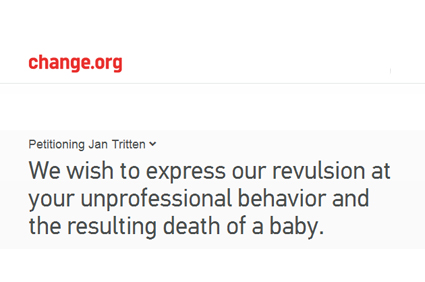
Thusfar, 369 people have signed the petition that is being sent directly to Jan Tritten, the midwife who crowd sourced a life and death decision with her Facebook friends:

Jan Tritten,

We wish to express our revulsion at your unprofessional behavior and the resulting death of a baby.

If you have not signed yet, please consider doing so in memory of the baby who died a preventable death.

In response to the #notburiedtwice campaign, the homebirth midwifery community seems to have moved into full “deny responsibility” mode. They are quite good at it; after all, they have lots of practice.

Midwifery Today has responded with this gems:

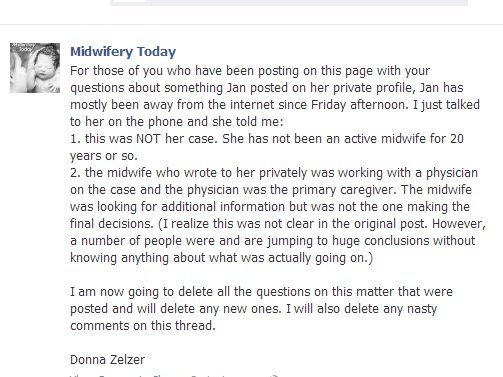
Midwifery Today 1

And then a more considered attempt at avoiding accountability of any kind:

Midwifery Today 2

  1. It wasn’t Jan’s patient! Irrelevant. Health care providers aren’t waitresses who can walk right by declaring, “Not my table.”
  2. There was a physician involved! Really? Jan specifically stated that she did NOT have to transfer care to a physician.
  3. We’re going to delete everything and bury this dead baby twice, once in a tiny coffin in the ground and then again by deleting his existence! Not this time, you’re not.

We haven’t heard a lot from the larger homebirth community, but they are out there and they are worried.

Doula Cole Deelah offers a not so subtle warning to anyone thinking of breaking ranks for something as a trivial as a dead baby.

Birth workers

English to English translation:

If we don’t protect Jan Tritten from accountability when a baby dies, who will protect us from accountability when we let babies die?

Unwittingly quite revealing, no? Homebirth midwives don’t hold each other accountable in the death of a baby because they don’t want to be held accountable when they let babies die. Instead they will hold rallies for the midwife, scream “persecution,” and try to delete from public consciousness the fact that the baby ever existed .

But this time, we’re not going to let them. This baby will be #notburiedtwice.

Let’s hold them accountable!

Social media concept

This morning I wrote about the tremendous amount of web traffic to the story of the baby who died while Jan, Tritten, the Editor of Midwifery Today crowd sourced the medical decision on his mother’s care with her Facebook friends. The response is a testament to the power of social media: blogs, Facebook and Twitter.

I also wrote about the fact that the homebirth community is silent on this baby’s death (like the deaths of all the babies that have died at their hands) and their plan appears to be to do nothing about it, investigate no one, hold no one to account.

Let’s not let them bury this baby twice, once in a tiny coffin in the ground and then again by erasing him from public consciousness. To prevent that, let’s leverage the power of social media to finally hold homebirth midwives to account.

I’ve been banned from just about every homebirth website and Facebook page, but they can’t ban everyone, can they?

I propose a Facebook and Twitter campaign to grab the attention of the people whose current plan for handling this baby’s death appears to be to do nothing, wait for people to forget, and then get back to business as usual.

Let’s send Facebook messages, Tweets and emails to:

Jan Tritten
Jan Tritten’s Facebook page
@JanTritten on Twitter

Midwifery Today
Midwifery Today’s Facebook page

The Midwives Alliance of North America (MANA)
MANA’s Facebook Page
@MANACommunity on Twitter

and
Melissa Cheyney, CPM in her role as Head of the Board of Direct Entry Midwifery in the state of Oregon (where Jan Tritten lives).
Email: melissa.cheyney@oregonstate.edu (She does not appear to have a separate email address at MANA or the Board of Direct Entry Midwifery)

What should you write? I leave that up to you, but for those who aren’t sure, I have a suggestion:

Can you tell us what you plan to do to investigate the death of the home birth baby whose care Jan Tritten crowd sourced on Facebook?

Short, simple, polite and to the point.

These midwives and organizations can ban and delete me, but they can’t ban and delete everyone. In memory of the baby who died a preventable death, let them know how you feel.

If enough of us get involved, perhaps we can prevent the tragedy that befell this baby from happening to any other babies.

A baby is dead. Do you hear what I hear?

iStock_000015132439Small copy

On Friday I wrote about the death of a baby that occurred while Jan Tritten, Editor of the homebirth “journal” Midwifery Today, crowd sourced Facebook for suggestions for management of postdates with no amniotic fluid, but unruptured membranes.

Since then nearly, there have been approximately 25,000 visits to the post, and it is being discussed on a variety of message boards, Facebook pages and Twitter streams by lay people, doctors, skeptics and pretty much anyone else but homebirth midwives themselves. 329 people have signed the petition expressing revulsion.

Let’s listen for the reaction from the professional homebirth community. Do you hear what I hear?

That’s right … NOTHING!

Where is the Midwives Alliance of North America? Shouldn’t they be promising a public investigation of Jan Tritten for possible negligence and possible malpractice, not to mention serious unprofessionalism for crowd sourcing a life or death situation in real time?

Where is Melissa Cheyney, CPM, Director of the Board of Direct Entry Midwifery of Tritten’s state of Oregon? Shouldn’t she be promising a public investigation of Jan Tritten, as well as a root cause analysis to determine how to prevent future deaths?

Where is Ricki Lake, spokesperson for all things homebirth? Ricki was out there front and center defending an obstetrician who lost his hospital privileges and subsequently his right to practice because of egregious errors in the care of patients. Why hasn’t she come to Tritten’s defense?

Where is Aviva Romm, MD who recently confided this:

I will also readily admit that there are quite a few not so great home birth midwives contributing to not so great birth outcomes. In fact, in reaction to the problems found in medicalized birth settings, there’s a bit of a midwife ‘wild west’ out there – anyone can get “the calling,” attend some births, and call herself a midwife. Caveat emptor! It’s not black and white. A poorly planned home birth or a less than competent midwife (or physician, though most home births are attended by midwives), in the rare event of a complication, can be disastrous…

Ya think? So what are you going to do, Dr. Romm, when one of your homebirth buddies lets a baby die as the results of her grossly unethical actions? Will you be publicly condemning her? How about warning women to stay away from her. Or are you just going declare “caveat emptor” and let the tiny dead bodies fall where they may?

Where are the bloggers from the Lamaze blog Science and Sensibility? Will we be treated to cries of indignation from them, calls for investigation, calls for analysis of what went wrong?

Where are the homebirth bloggers, like Birth Without Fear, Monica Bielanko of Babble, Tracey Cassels of Evolutionary Parenting, The Feminist Breeder, etc.? When will they be discussing this tragedy and trying to learn from it?

Where is Jan Tritten? According to her pathetic attempts at backpedaling, this was supposed to be an opportunity for learning. Why did she delete the case just when we could have learned the most? When will be hearing from her on just what she learned from this tragedy and what other homebirth midwives can learn as well?

I’m going to go out on a limb and guess that we are going to hear from all these professional homebirth advocates and organizations at the exact same time …. NEVER!

And why will we never hear them demand an investigation, release the results, and condemn the mistakes?

Because homebirth midwives don’t care about safety. They only care about homebirth midwives.
The Midwives Alliance of North America has literally ZERO safety standards. Not only do they have no safety standards, they are quite explicit about this horrific stance. As far as MANA is concerned, it is up to each homebirth midwife to decide for herself what is safe. An official stance like that only makes sense if you are a lobbying organization, working tirelessly for the economic benefit of your members. What about the life and health of mothers and babies? They can fend for themselves and “own” the decisions that led to the deaths or permanent injuries of their babies or themselves.

But all is not lost. There is a way that the rest of us can learn from this preventable tragedy.

To any women contemplating homebirth, I ask you to imagine yourself in the situation of this mother:

  • In the face of imminent disaster, her midwife assures her that doing nothing is the best course.
  • In the face of imminent disaster, her midwife is so clueless that she is soliciting medical advice from her Facebook friends.
  • When your baby dies she insinuates that it is your fault for listening to her.
  • When confronted by others about her role, she pretends that your baby, his life and death, was posted on Facebook for the edification of everyone in the known world except you.
  • And then she deletes even that, to cover up her own role in his death.
  • Finally, as you make funeral arrangements, the homebirth community will rally around the midwife, not you. They will never investigate her actions; they will do everything possible to protect her.

Now ask yourself:

Is this what you want for yourself and your precious baby? A woman who calls herself a midwife, though lacking the most basic education and training, who cares more about her experience than whether your baby lives or dies?

As Dr. Romm, pointed out, “anyone can get “the calling,” attend some births, and call herself a midwife.” So take Aviva’s advice, caveat emptor, and choose hospital birth. Whatever the failings of the hospital may be, at least the professionals there care about whether you and your baby live or die.

Caught in ethical violations, Jan Tritten and other homebirth midwives are backpedaling as fast as they can

iStock_000031838858Small copy

Sometimes I think the best argument against American homebirth midwifery is merely to expose their utter lack of ethics, their willingness to lie for their own ends, and the sheer stupidity involved in posting inappropriate behavior to the internet and then trying to deny what people can see right in front of their eyes.

At of this moment, 229 people have signed the petition to Jan Tritten, Editor of Midwifery Today, expressing revulsion as her grossly unethical, unprofessional behavior that resulted in the preventable death of a baby. The petition is being promoted even in some surprising places such as on the Facebook page of a homebirth midwife.

But Tritten still thinks she can absolve herself of moral responsibility in this baby’s death and she’s going about it in the most moronic possible way. Did she write that she was caring for this patient? Oh, she had nothing to do with the care of this patient. She was just writing in the voice of another midwife. I’ll let you decide.

Here’s what Jan originally wrote:

Jan Tritten 1

What would you do? Primip with accurate dates to within a few days who has reassuring NST at 42.1weeks, as well as reassuring placenta and baby on BPP, but absolutely zero fluid seen. 42.2 re-do of BPP and again, mom has hydrated well, but no fluid seen. Baby’s kidneys visualized and normal, and baby’s bladder contained normal amount of urine. We’re in a state with full autonomy for midwives and no transfer of care regulations past 42 weeks. Absolutely no fluid seen…what do we truly feel are the risks compared to a woman whose water has been broken and so baby/cord has no cushion there either. Cord compression only? True possibility of placenta being done although it looks good? Can anyone share stories/opinions? …

Here’s what she says now:

Tritten Screen_Shot

The questions on this page are messaged privately to me and put up anonymously. They are not my cases. This is to help mothers, midwives, doulas and physicians in their work. It is to opinions from many different practitioners and parents.

Really? Could have fooled me.

I see no indication anywhere that this was anything other than a case in which Jan was deeply involved, in real time, and was grossly unprofessional in crowd sourcing a life and death decision on Facebook. Jan can deny it as much as she wants, but her own writing says something very different, and very damning than what she is saying now in an attempt to save herself from public opprobrium, and worse.

For the time being, until Jan prevents actual evidence, not weasel words, I am taking her initial writing as the truth. She was involved in this case and she was morally, if not also legally, culpable in this baby’s death.

But Jan is hardly the only one back pedaling as fast as she can.

“Wanda Smith Midwife” was mentioned in passing on the my original post for her “advice” offered to Tritten:

Wanda Smith Midwife absolutely no experience with “0″ fluid, but have had two go quite over with very low fluid (under 5), one was 18 days over, quite uneventful home birth, and one was 19 days over with heavy mec and true knot, that did give a us a little trouble, but she stilled birthed vaginally (my emphasis)

But Wanda Smith Midwife suddenly remembered that her actions in both those cases violated midwifery regulations in Virginia where she practices.

Thinking quickly, this genius came up with the following:

Ladies may this be seen by everyone. I was the first to respond to the original post. Like many on this thread, I made an assumption. I assumed that this mom was in hospital or was being referred in. I assumed the midwife was seeking stories for outcomes, NOT seeking advice as to stay at home with an obvious dangerous situation. My answer was not thorough, and I am horrified by how I look by reading the docs blog. I gave two cases, one 18 days over and one 19 days over, both with a low AFI = not ZERO AFI. Each case was transferred into the hospital, because each had reached the end scope of my practice guidelines. Though each passed BPP guidelines, with an 8 out of 8. AFI was low but still WNL. We (Parents, OB, & Midwife) made decisions according to combined data, post dates pregnancy & LOW AFI, to induce labor with continuous EFM. My births had excellent outcomes. I have never been and will never be a do or die home birth midwife, and those that interview me know and I state, “if you are a do or die home birther, I am not the midwife for you.” Please, please do not assume that all midwives are uneducated, can’t read US reports, don’t know when to refer, don’t attend peer review, and don’t have practice guidelines. I also am not making the assumption that any midwife is sitting around waiting for internet responses instead of being proactive. None of us know exactly what happened to cause this death. It is tragic for everyone. I certainly will never respond on public forum again, for multiple reasons. (my emphasis)

Lying about it now just makes it worse, Wanda.

You wrote the following on the Facebook page associated with your own website, Gentle Birth Roanoke:

With JOY and tremendous ADMIRATION for one strong momma Gentle Birth Roanoke welcomes “SNOWbaby” Henry. He was born this morning at 9:14 am and weighed 8 lbs. 6 ozs. at 18 days over his due date. His wonderful parents are so pleased to be resting after two days of labor and hosting their midwife team overnight. Thankful for prayers, snowplows, and kind citizens who made it possible for us to safely get to and from this birth. w/Dawn & Cindy = pictures of our travels to follow. (my emphasis)

And the doula wrote about the birth, too.

Wanda Smith Midwife

Coincidence? I think not, but even if it were, it shows that Wanda Smith has violated the terms of her midwifery license.

Jan (and Wanda), I cannot thank you enough. You are working hard to demonstrate the fact that American homebirth midwives are not medical professionals. They have no safety standards. They violate the terms of their licenses and they lie about, too. Personally, I think that the worst thing about the lies is not that they are offered, but that homebirth midwives are as dumb as posts, imagining they can lie about what anyone can read for themselves and no one will notice.

Bad news, ladies: The days of getting your birth junkie highs while not giving a damn about the health and safety of your patients are coming to an end. Keep talking; keep violating your own practice standards; keep letting babies die and not offering a shred of remorse about your own involvement. You are doing my job for me.

People are disgusted and they are signing the petition to let you know.

Jan Tritten, stop the pathetic, self serving attempts to deny responsibility for the preventable loss of an innocent baby’s life; it’s sickening. Instead, start apologizing and begging forgiveness from the family you have harmed.

To anyone distressed by Jan Tritten’s behavior in the preventable death of a baby

Tritten petition

Yesterday approximately 10,000 people followed a Facebook thread where Jan Tritten, editor of Midwifery Today, crowd sourced a life or death obstetric decision at the exact same time that the baby suffocated to death. Judging by my private email, Facebook and Twitter accounts, many homebirth advocates and homebirth midwives were deeply distressed by the incident, Jan’s behavior, the baby’s death, Jan’s response, the desperation of some homebirth midwives to absolve Jan from accountability, and, of course, Jan’s deletion of the entire thread.

I could offer reams of statistics about the hideous death rate at homebirth, and I often do, but no one does a better job of demonstrating the ignorance, incompetence and gross lack of professionalism than homebirth midwives themselves. Jan Tritten exquisitely and painfully demonstrated my adage that homebirth midwives bury babies twice; first in little coffins in the ground, and once again by trying to erase their lives and senseless deaths from public consciousness.

There were some minor consolations to the thread. Homebirth midwives and advocates spent hours arguing and interacting with me, and others similarly outraged by Tritten’s behavior. No one was turned to stone, became radioactive or was otherwise permanently harmed by engaging with me. I daresay that some people actually learned some things.

To any homebirth midwives and homebirth advocates who were willing to engage or even just read along I offer this: You are welcome to post here anytime, with any questions, or even just to argue. Your comments will not be deleted. They will be addressed. We may be on opposite sides of the debate, but we’re on the same side when it comes to saving the lives of babies.

To them and to everyone else, I also offer this: A petition to express our outrage and revulsion at Tritten’s decision to crowd source a life or death decision on Facebook, the death of the baby, the utter absence of any attempt to hold anyone to account, and the immediate deletion of the thread that exposed Tritten’s grossly unprofessional behavior.

You can find the petition at Change.org.

It is addressed to Jan Tritten:

We wish to express our revulsion at your unprofessional behavior and the resulting death of a baby.

And goes on to explain:

Jan Tritten, Editor of Midwifery Today, crowd sourced a life or death decision on Facebook, and a baby died.

American homebirth midwives are the only healthcare providers who have literally no safety standards and, therefore, no accountability. Recent publications, including statistics from the Midwives Alliance of North America (MANA), the organization that represents homebirth midwives, reveal that homebirth increases the risk of death of the baby by 450% of more. High risk homebirths (breech, VBAC, twins) had even higher death rates.

Despite these hideous death rates, no homebirth midwifery organization or executive has made any recommendations to improve safety. Indeed, homebirth advocates in both Arizona and Hawaii are currently arguing to enlarge scope of practice to include the EXACT SAME high risk conditions that homebirth midwives have demonstrated in their own paper to be utterly unsafe at homebirth.

It is time for the leaders of American homebirth midwifery, including Jan Tritten in her role as Editor of Midwifery Today, to acknowledge the death toll of homebirth, to investigate why these deaths are occuring and to hold the midwives involved to account.

Please take a moment to sign the petition. Tritten will receive an email each time someone signs.

We had tremendous success with our petition to force MANA to release its homebirth deaths rates. Perhaps we can have equal success at preventing more homebirth deaths.

Jan Tritten crowd sources a life or death decision and the baby ends up dead

Jan Tritten 1

Jan Tritten is the Editor of Midwifery Today, the “journal” of homebirth midwives.

I’ve never had anything other than contempt for her, but now she’s taken it to a new level.

All the while she was busy crowd sourcing a life or death decision for a 42+ week baby with no amniotic fluid on ultrasound, the baby was dying.

What would you do? Primip with accurate dates to within a few days who has reassuring NST at 42.1weeks, as well as reassuring placenta and baby on BPP, but absolutely zero fluid seen. 42.2 re-do of BPP and again, mom has hydrated well, but no fluid seen. Baby’s kidneys visualized and normal, and baby’s bladder contained normal amount of urine. We’re in a state with full autonomy for midwives and no transfer of care regulations past 42 weeks. Absolutely no fluid seen…what do we truly feel are the risks compared to a woman whose water has been broken and so baby/cord has no cushion there either. Cord compression only? True possibility of placenta being done although it looks good? Can anyone share stories/opinions? …

Many of the suggestions are appalling:

Wanda Smith Midwife absolutely no experience with “0” fluid, but have had two go quite over with very low fluid (under 5), one was 18 days over, quite uneventful home birth, and one was 19 days over with heavy mec and true knot, that did give a us a little trouble, but she stilled birthed vaginally

Christy Birthkeeper Fiscer Fluid level readings can, and often are highly inaccurate at this point… yet often used now as indication for intervention. Can you FEEL fluid during palpation, or does baby have a “plastic wrapped” feel?

Erika Laquer Try a very good acupuncturist and midwife-friendly

Zuki Abbott-Zamora I would respect leaving things alone, and just because you cannot ‘see’ fluid does not mean there is none. I have seen babies come with as little as a tsp of fluids and be just fine.

Mary Bernabe Leave her be. I’ve had 3 bbs like that and all were just fine. Didn’t know till the birth though. All 3 were out of water births so I know for sure there was no fluid. Bbs did great and so did moms. Placentas were normal and healthy looking. She’ll go into labor when it’s time.

Has she tried stevia to possibly increase the fluid?

Lynn Reed what Zuki said:) Trust mom’s instincts too & who made up the 42 week law? Midwives or OBs scared of litigious times & distrust of mom’s owning their births

Jennifer Holshoe try a 1m dose of Natrum Muriaticum homeopathic to balance fluid levels. I have seen it work with one dose

There were other, reality based suggestions as well, including the recommendation to transfer care and induce.

And while Tritten and the rest of the midwifery stooges were contemplating reasons for ignoring the obvious signs of imminent death, the baby actually died.

Jan Tritten 2

Very sad? Very sad??!!

How about horrifically tragic and utterly preventable?

How about the completely avoidable result of mind boggling ignorance?

How about medical malpractice and criminally negligent?

Homebirth midwives are dangerous, witless fools and babies die as a result.

The CPM “credential” must be abolished and Jan Tritten is a perfect example of the desperate need to do so as soon as possible.

The question I’d like to ask Melissa Cheyney, Wendy Gordon and the other executives of the Midwives Alliance of North America

iStock_000014005359Small copy

If I were able to address Melissa Cheyney, Wendy Gordon and the other executives of the Midwives Alliance of North America face to face (not likely, since they would run screaming from any possibility of appearing in the same venue as anyone with actual medical knowledge), I’d ask them one simple question:

How do you sleep at night?

How do you sleep at night when you know that you are deliberately concealing the hideous death rates of babies born at the hands of homebirth midwives?

I wonder how you rationalize it.

Are you like the executives at Merck who apparently rationalized hiding the deadly side effects of Vioxx by thinking of the profits to be made from unsuspecting patients?

Or do you think that the ends justify the means? Is it more important to you to protect that ability of self-proclaimed “midwives” to get their birth junkie fix, and get paid for it, than to protect the babies who die preventable deaths at homebirth?

Or maybe you simply pretend those dead babies don’t exist, so you don’t have to think about them. That tactic, as reprehensible a view as it is for any health provider to choose, would make me feel better about you than if I thought that you were merely callously ignoring them.

Have you convinced yourself that it is okay to lie about deaths at homebirth in both scientific papers and MANA publications because you believe in your heart of hearts that all the data that you and many other researchers have accumulated on homebirth deaths is actually wrong? That if you just keep collecting statistics long enough you will finally prove what you already “know,” that homebirth is safe?

I suppose that one thing that makes it easier for you folks is you insistence on surrounding yourselves with flunkies who are eager to agree with whatever lie you dream up. And it certainly makes it easier if the only people you have to convince about the safety of homebirth are people incapable of understanding the data for themselves.

I imagine that if you actually deigned to appear in a venue where you could be questioned by other medical professionals, not only would your claims be thoroughly eviscerated, but you might come face to face with the reality of what you have been facilitating, the deaths of babies who didn’t have to die. Maybe that would dent your resolve to keep hiding and lying.

Your latest gambit, the MANA statistics paper, does not seem to be working out very well.

I suspect that you thought that if you just hid the hospital death rate, you could convince everyone that the hideous homebirth death rate was actually an indication of safety. I guess you thought that they would promptly forget that you had been hiding those same numbers for 5 years, an indisputable indication that even you recognized the death rates as hideous. Maybe you figured you could send a few flunkies out to lie about the CDC Wonder database or anything else that it might be convenient to lie about. And no doubt you were relying heavily on the basic ignorance and seemingly endless gullibility of most homebirth advocates, professional or otherwise

But it hasn’t really worked, has it? Sure the gullible are willing to believe, but you knew that would happen. The problem is that no one else believes you. It was your misfortune to finally publish your data at the same time that other obstetricians published theirs. And although you hid the hospital death rate, they didn’t, thereby making it available to the public. And, unfortunately for you, the obstetricians found almost the same death rate at homebirth as you did; but they put it into the context of the hospital death rate making your claims look foolish at best and deliberately mendacious at worst.

You are going to lose this battle to hide accurate information from American women. Maybe not in the near future, but definitely in the not too distant future. It is inevitable that people are going to ask MANA why you hid those death rates in the first place. It is inevitable that people are going to ask MANA why you have no safety guidelines of any kind. It is inevitable that insurance companies will demand evidence of your competence before reimbursing you, and you won’t be able to provide it. In other words, it is inevitable that your hiding and lying is going to catch up with you.

Should you have a shred of conscience, you might want to contemplate this:

Since you’re going to be exposed as incompetent frauds eventually, might it make sense to create standards now to elevate your level of practice above that of incompetent frauds? Might it makes sense to abolish the ridiculous “portfolio” process that allows homebirth “midwives” to sidestep any real education or training? Does it make sense pay attention to preventable deaths of babies rather than bury those babies twice, once in the ground and then again in the public consciousness?

I guess it could all be summed up in one simple question:

Do you care more about whether babies die or do you care more about your wallet?

Your choice. Do let us know what you decide.

Which obstetrician was the first to oppose arbitrary limits on the length of labor?

OLYMPUS DIGITAL CAMERA

Can you guess who wrote this?

The usual diagnostic criteria in use nowadays invoke arbitrary standards of total duration of labor, beyond which abnormality may be considered to exist… Thus, for example, labors lasting longer than 24 hours are usually deemed to be abnormal and, therefore, to warrant consultative evaluation. This practice gained general acceptance, not so much because the criterion of duration is diagnostic (which I hasten to insist it is not), but rather because there is a relation between prolonged labor and increased fetal morbidity and mortality… [N]ot all labors which exceed these uncritical limits subject the fetus to comparable risk. The single guideline of duration, therefore, must be considered as much too coarse and insufficiently definitive to permit us to specify precisely which patients are at risk … (my emphasis)

How about this?

The physician is confronted by a wide range of normality in terms of patterns of contractility. At one extreme is the patient with negligible contractions; her cervix is dilating unobtrusively while we try to determine whether or not she is in labor… At the other extreme is the woman who suffers contractions of great intensity and frequency that may continue for many hours before cervical dilatation becomes apparent… Yet both are normal variants and the physician with enough experience will recognize their inherent differences. (my emphasis)

Or this?

Continued progress should be expected if patients with protraction disorders are properly managed in a conservative manner. The prognosis remains good as long as progress continues. There appears to be only a very small increase in risk to mother or infant from these conditions, provided no ill-advised measures for stimulation or-even more important- for traumatic delivery are undertaken. Expectancy is very strongly recommended. (my emphasis)

Or this?

Arrest of dilatation or of descent is a most serious abnormality and carries an especially poor prognosis for vaginal delivery. Many patients with these patterns ultimately require cesarean section because of disproportion. Where pelvic relations are adequate, the prognostic outlook for vaginal delivery is much better. One can determine the prognosis more carefully … if one compares the rate of progression … with the rate that occurs after treatment [with Pitocin] for the arrest… The more rapid the postarrest slope, the more likely is vaginal delivery. Patients whose postarrest slope is more than 2 cm./hr. greater than the prearrest slope should all be expected to deliver vaginally. None should require cesarean section unless it is indicated for some other reason, such as fetal distress… (my emphasis)

All of these statements come from a 1972 paper, An objective approach to the diagnosis and management of abnormal labor, by Dr. Emanuel Friedman of the eponymous Friedman Curve.

Surprised? You shouldn’t be. The new ACOG report on preventing primary C-sections is not a rejection of the Friedman Curve, but rather revisits first principles of the Curve is and how Dr. Friedman thought it should be used.