Category Archives: Uncategorized

Wendy Gordon’s latest smear attempt

image

You have to give MANA (the Midwives Alliance of North America) credit. Their motto appears to be: if at first you don’t succeed, lie, lie, again.

Clearly MANA is very worried in the wake of publication of the Grunebaum study that shows that homebirth increases the risk of a 5 minute Apgar score of 0 by nearly 1000%. Therefore, they’ve sent Wendy Gordon, CPM (and placenta encapsulation specialist!) to do what she can to discredit it.

No matter that it comports with the data from Oregon that shows that PLANNED homebirth with a LICENSED homebirth midwife has a death rate 9X higher than comparable risk hospital birth or that MANA has found that its own members have such hideous death rates that they have been desperately hiding them for years.

This is not about the truth, obviously. This is about tricking American women into ignoring horrific homebirth death rates, so any research that demonstrates the danger of homebirth must be discredited.

Wendy’s first attempt didn’t go so well. She was caught (by me) in a bald faced lie. MANA did not attempt to deny it, but, as it typical for them, they didn’t correct it, either. Apparently the entire attempt was not as successful as MANA would have liked. How can I tell? Within less than 24 hours, MANA felt the need to censor comments since the comments raised questions that MANA could not or would not answer.

Wendy’s second attempt, on the Lamaze blog Science and Sensibiity, tries to avoid the pitfalls of the first attempt. Instead of including the bald faced lie about the accuracy of Apgars on birth certificates, she simply linked to it.

She’s also made the smear considerably more vague, starting with the title itself, Flaws In Recent Home Birth Research May Mislead Parents, Providers. A more accurate title might be We hope that vague, unsubstantiated “flaws” that we’ve made up might be used to mislead others about the real dangers of homebirth.

The Grunebaum paper is well done and extremely difficult to undermine. There is simply no question that the data shows that homebirth raises the risk of a 5 minute Apgar score of 0 by nearly 1000%. The authors’ decision to use the 5 minute Apgar score of zero is truly inspired. Other research shows that homebirth has an appalling rate of intrapartum death, and not just any intrapartum death, but totally unexpected (“the heart rate was normal right up until the baby was born”) death. This is almost certainly due to failure to monitor babies appropriately during labor. The decision to use the 5 minute Apgar score of 0 means that we are looking at severe intrapartum compromise, almost certainly resulting in death.

Though the lay press has reported the results as an increased rate of stillbirth, and though the findings almost certainly do reflect an increased rate of stillbirth, the key point is that they reflect INTRAPARTUM stillbirth, not stillbirth before labor begins. How do we know that? Babies who die before labor begins don’t get birth certificates and they certainly don’t have 5 minute Apgar scores assigned, because Apgars are given only to babies believed to be alive prior to the moment of birth.

But rather than acknowledging that the decision to use the 5 minute Apgar score of 0 is one of the primary VIRTUES of the study, Gordon insinuates that it is a flaw.

When we examine a little more closely what it means to have a 5-minute Apgar score of zero, we might find that it does include some babies who died shortly after birth. We might also find a number of babies who had lethal congenital anomalies, who would not have survived no matter where they were born or who attended the birth; there may be important differences between home and hospital populations with regard to whether these anomalies were detected prenatally and whether parents changed their birth plans because of it.

The babies might have had anomalies! Duh! Of course they “might” have had anomalies. That doesn’t mean those anomalies were incompatible with life if the babies had access to lifesaving technology.

There may be important differences between home and hospital populations regarding anomalies! But there is NO EVIDENCE that there are important differences, so attempting to dismiss the findings on that basis has a whiff of desperation about it.

Wendy claims:

A rigorous study that actually examined deaths would have excluded births with outcomes that had nothing to do with place of birth or attendant.

No, rigor does NOT require excluding births with outcomes that have nothing to do with place of birth or attendant (“the baby would have died in the hospital, too”). Why? Because we are looking at the DIFFERENCE between outcomes BASED ON place of birth and attendant. If we subtracted all the deaths that “would have happened in the hospital, too,” the DIFFERENCE between home and hospital could be EVEN GREATER than if we didn’t subtract outcomes that were independent of place of birth or attendant, because the hospital death rate would be ZERO, since all the deaths in the hospital group “would have happened in the hospital, too.”

Either Wendy is hoping that homebirth advocates have poor basic logic skills or she herself has poor basic logic skills.

Here’s another whopper:

On the other hand, even a small percentage of misclassified outcomes in the home birth category have a dramatic impact. Because the number of home births in the U.S. is small, the inclusion of prenatal stillbirths, congenital anomalies and unplanned, unattended home births in the “home midwife” category is likely to have an appreciable effect on the negative outcomes examined here.

Is there any evidence that ANY of the 5 minute Apgars of 0 at homebirth were not 0? Is there any evidence that homebirth midwives signed birth certificates of patients who had unplanned homebirths? No, of course not. There’s isn’t a shred of evidence that even one midwife is accidentally recording that the baby she delivered had a 5 minute Apgar of 0 when it did not. Claims like these positively reek of desperation.

And yet another whopper:

I wrote my initial reaction to Grunebaum et al’s study last week when their press release came out. I expressed concerns about the low reliability and validity of birth certificates for drawing conclusions about rare outcomes. Grunebaum’s own data shows that over 10% of “home midwife” deliveries had no information on the birth certificate about the mother’s parity and had to be excluded from their calculations, while only 0.2-0.5% of hospital or birth center deliveries were missing parity data; this strongly suggests that something is amiss with the “home midwife” data.

No, Wendy didn’t express her concerns, she LIED about the reliability of Apgars scores on birth certificates, and supplemented that lie with a deliberate misrepresentation of a paper on birth certificate reliability that shows THE OPPOSITE of what she claimed it showed. Her misrepresentations were publicly pointed out in the comment section and she NEVER DENIED them.

Wendy is so desperate to smear the paper that she cheerfully smears homebirth midwives along with it. They are such slobs that they didn’t include parity on the birth certificate. I don’t doubt that midwives are sloppy in their record keeping, but that doesn’t mean that they sloppily wrote that the 5 minute Apgar score of the baby they just delivered was 0.

Wendy can’t resist logical fallacies, either. She trots out a loaded question just like the classic “have you stopped beating your wife?”, a “question” based on a foregone conclusion that may be completely false.

The fact that these authors were clearly warned about the low quality of their data regarding both low Apgar scores — and especially seizures — but chose to push ahead with publication without addressing them, suggests other motivations.

The authors were never warned about the low quality of their data since their data is high quality. To the extent that they were warned about anything, they were warned that homebirth advocates were fully prepared to LIE about the quality of the study’s data. True to the warning, Wendy is lying about it now.

Give it up, already, Wendy. At this point, you are just destroying your own reputation and that of MANA. The Grunebaum paper is a high quality paper that presents accurate data on an excellent metric (the 5 minute Apgar score of zero). It comports with the CDC data, the Oregon data, and the fact that MANA has refused for years to release their own death rates.

Homebirth kills babies who didn’t have to die. I know it, you know it and MANA knows it. Your desperate attempts to hide the truth from American women don’t smear the papers you criticize; they smear the organization that you represent.

There’s nothing wrong with medicalizing childbirth

image

Aloha from Hawaii! Above is the view from the pool where I am writing this post.

I’m here for the ACOG district conference and I’ve been reviewing my notes for my talk on Friday. I’m struck by the fact that everything I plan to talk about — homebirth and, to a lesser extent, natural childbirth — is premised on a fundamental and erroneous belief, that there is a problem that exists with childbirth and that homebirth and natural childbirth can fix it.

The problem is that childbirth has been (dare I say it) …. medicalized. Oh, the horror!!

It’s horrible because … wait a second … what’s horrible about medicalizing childbirth?

The underlying belief of natural childbirth advocates is that childbirth has some kind of pristine essence that should not be changed in any way except, possibly, in the most dire emergency. The major efforts of professional homebirth and natural childbirth advocates are forcefully directed toward “problematizing” any medicalization of childbirth and then offering homebirth and natural childbirth as the solution to this “problem.”

But childbirth is a function just like any other bodily function and we don’t consider medicalizing other bodily functions to be a problem, so why should medicalizing childbirth be considered a problem?

For example:

Women routinely and deliberately medicalize fertility by using a variety of different forms of birth control. Most women highly value the ability to regulate their own fertility and very few people are singing the praises of having 10 children as a result of “unhindered” fertility.

Both men and women routinely medicalize aging. Instead of letting their blood pressure rise “unhindered” and end up with cardiovascular disease, they routinely visit doctors and take medications to lower the nearly inevitable high blood pressure that comes with the natural stiffening of aging arteries. And no one seems to have a problem “medicalizing” eyesight by using glasses to compensate for the entirely natural deterioration of near vision that occurs as a result of aging.

Or how about something even more basic still? We routinely medicalize body odor by regular bathing, using soap, shampoo and even deodorant. No one seems to think that is a problem. either.

In fact, I’m hard pressed to think of anybody complaining about “medicalization” of any other bodily function, so why complain about medicalizing childbirth?

Why? Because homebirth and natural childbirth completely depend on creating this faux “problem” in order to save us from it. They are committed to romanticizing childbirth, ignoring history, and ignoring science, all the while pretending that they are promoting “evidence based” practice.

Nothing could be further from the truth. Natural childbirth is based on no evidence of any kind. The white men who promulgated it simply made it up to comport with their personal views about the role of women in the world (specifically that the world would be a better place if women stopped agitating for political and economic rights, and, instead, stayed home and had babies as “nature intended”).

Indeed, homebirth and natural childbirth advocates implicitly recognize that scientific evidence is not on their side by routinely deleting comments that contain real scientific evidence and banning commentors whose knowledge of science extends beyond the “alternate world of internal legitimacy” created by the “journals,” conferences and “credentials” conjured into existence by themselves.

Nature is neither benign nor perfect. We seem to be able to recognize that in every other area of human health. No one complains that middle aged people who use reading glasses are “medicalizing” the vision experience. We don’t problematize reading glasses. No one complains that the elderly medicalize the cardiovascular experience by taking steps to control their blood pressure. We don’t problematize blood pressure medications. And no one is complaining that we have medicalized the body odor experience by bathing regularly with soap and shampoo.

So the next time you encounter homebirth and natural childbirth advocates fretting about medicalized childbirth, consider that there appears to be nothing wrong with medicalizing any other bodily process. The faux “problem” of medicalized childbirth isn’t a problem at all; it is simply the way that homebirth and natural childbirth advocates justify their existence.

And consider, too, that when you recognize that there is nothing wrong with medicalizing childbirth, there is no reason to feel guilty about giving birth whatever way works best for you.

Why do lactivists ignore what women tell them?

image

Imagine going to the doctor because you hadn’t been feeling well for several days.

Dr. Knowitall: What seems to be the problem?

You: Well, Doctor, I have a pain in my lower right side and it’s been getting worse. I’m afraid I might have appendicitis.

Dr. Knowitall: No, you don’t.

You: Pardon me. I don’t have appendicitis?

Dr. Knowitall: No, you don’t have pain in your lower right side.

You: No, really I do have pain and my pain is getting worse.

Dr. Knowitall: You just think you have pain because you’ve been culturally conditioned by surgeons to expect that you will develop appendicitis.

You: But, Doctor, my pain is so bad that I can’t lie flat on your exam table.

Dr. Knowitall: Sigh. Obviously the pain is your fault. You must be walking wrong.

You: Look, you can see me walk. I’m not walking wrong; I’m walking just like everyone else, but I have pain in my lower right side, and I’m constantly nauseated.

Dr. Knowitall: If you just trusted your body, you wouldn’t be nauseated. Appendicitis is extremely rare, so you don’t have pain or nausea.

You: But I’m vomiting, too.

Dr. Knowitall: Please, it’s obvious that you are selfishly looking for an excuse to have surgery. If you were educated like I am, you would understand that it is absolutely critical for you to avoid surgery under any but the most extreme circumstances. Do you have any idea of the risks of surgery? You could end up brain damaged, with allergies and autism.

*****

Sounds ridiculous, right? Who would continue to consult a doctor who refused to believe you when you described your symptoms, or, worse yet, blamed you for your own pain? Most people would be outraged.

Yet lactivists feel no compunction about behaving like know-it-alls and doing the exact same thing. Tell them you have pain when nursing and they “know” that you don’t. Insist that you have pain and they’ll insist that you are breastfeeding your baby all wrong.

Tell them that your baby is screaming with hunger and they’ll tell you that it’s normal. They “know” you’ve been culturally conditioned to believe that you aren’t making enough milk.

Tell them that your baby has gained no weight in the 4 weeks since birth and they “know” that you are lazy and looking for an excuse to stop breastfeeding. Just pump in between feedings to increase your milk supply.

Tell them that you can’t pump enough to nourish your baby while you work and they’ll tell you that you are depriving your baby of multiple IQ points and sentencing him to a lifetime of allergies, obesity, diabetes and cancer.

No one would tolerate a doctor who refused to accept the patient’s description of her own symptoms. Why do lactivists think they are entitled to dismiss the symptoms of women having difficulty breastfeeding?

Would anyone think a doctor could diagnose and treat ANYTHING if she refused to listen or completely dismissed what patients were telling her? Why do lactivists think they can improve breastfeeding rates if they refuse to listen and completely dismiss what women are telling them?

Why? Because they don’t care about improving breastfeeding rates nearly as much as they care about hectoring mothers who don’t model their own choices back to them.

If lactivists really cared about increasing breastfeeding rates, they’d stop talking and start listening, but instead they just keep yammering away.

Homebirth midwifery and the problem of informed consent

image

It’s hardly surprising that homebirth midwives have a serious problem with obtaining informed consent. That’s because selling homebirth midwifery services implicitly depends on being dishonest about the risks of homebirth: minimizing them, lying about them or omitting disclosure altogether.

Simply put, if homebirth midwives had to honestly disclose risks, they’d have very limited employment opportunities.

Therefore, homebirth midwives have devised a variety of strategies to avoid obtaining informed consent.

1. Delay

Melissa Cheyney and the Oregon homebirth midwives are masters of this strategy. They simply didn’t obtained informed consent for homebirth and when forced by the legislature to begin doing so, they stalled, and stalled and stalled again.

As I wrote two years ago, the legislature mandated informed consent by June, 2011:

… [I]t is remarkable that Oregon homebirth midwives have still not begun obtaining consent for these high risk situations, arguing repeatedly that they need “more time” to create consent forms. Homebirth midwives petitioned for and were granted an extension until October 15, and as the date drew near, they petitioned to postpone the requirement for informed consent until January 1, 2012. That request was formalized on 9/26/11. A little over a week later, having postponed compliance with the requirement for 6 months, Oregon homebirth midwives petitioned to postpone it a further 6 months.

The idea that they needed any extension at all is bizarre. The increased risks posed by VBAC, breech, twins and postdates pregnancy are well known and have been quantified for years. For example, obstetricians have been obtaining informed consent for VBAC for at least 20 years. The Board of Direct Entry Midwifery could easily assemble and print the information in one day.

But Oregon homebirth midwives depend on their friends in the legislature to protect them from even the most basic requirements for consent. I’m not sure that they have yet begun obtaining consent for high risk situations.

2. “More research is needed.”

Homebirth midwives will do just about anything to avoid acknowledging risks. Hence the inane claim by MANA executive Jeannette McCulloch, in a recent post on the blog of the Midwives Alliance of North America, that “no one knows” how to tell the difference between low risk and high risk.

More research is needed into what constitutes low-risk for home birth. It is critically important that mothers and their care providers have accurate, evidence-based information so that they can make true informed consent. Risk factors that need further examination include breech, multiples, post-dates, and a variety of different VBAC circumstances.

That’s funny. MANA’s official stance is that:

…[F]or low-risk women with a skilled midwife in attendance, home birth is a safe option for newborns with lower rates of interventions and complications for mothers.

Well, which is it MANA? Does “research show” that homebirth is safe for low risk women or do we need more research to figure out just what low risk really means?

Now you or I might think that statements like these represent confusion on the part of MANA about what constitutes low risk, but that’s not true. The EXPLICIT policy of MANA is that each homebirth midwife can “decide for herself” what constitutes low or high risk. That makes no sense at all until you remember that the entire point of MANA is to provide intellectual cover for homebirth midwives, who are nothing more than lay people, to do whatever they want to do.

Standards apparently are only for real medical professionals, not for homebirth midwives.

3. An “informed consent” form that doesn’t obtain informed consent

Some homebirth midwives, like Mountain View Midwives in Charlottesville, VA, have come up with an informed consent that doesn’t obtain informed consent:

Each
 woman 
must 
weigh 
for 
herself 
the 
risks 
of 
birthing 
outside 
an 
emergency
facility 
against 
the 
risks 
of 
in‐hospital
 birthing,
 where
 the
 risks
 of
 unnecessary
 interventions,
 emergency‐mentality,
 and
 hospital
 born
 infections
 present
 their
 own
 dangers.
 
 Babies
 (and
 very
 rarely,
 mothers)
 do
 sometimes
 die
 in
 spite
 of
 the
 best
 care
 and
 great
 love.
 
 It
 happens
 at
 home
 and
 in
 the
 hospital.

Evidently the folks at Mountain View Midwifery don’t know what informed consent actually is. They have written a release, not an informed consent. This is probably going to come as a huge surprise to them, but medical care is not the same as going to a water park or going skiing. In those situations, the park or the ski slope is not required to enumerate all possible risks of swimming or skiing. They simply need you to acknowledge that you are willing to proceed at your own risk.

Informed consent is something else entirely.

The first and most important element of informed consent is:

… [D]isclosure by the [provider] to the patient of adequate clear information about the patient’s diagnosis; the alternatives available to treat the patient’s problem, including surgical and nonsurgical management; the benefits and risks of each alternative, including nonintervention … and a frank explanation of those factors about which the medical profession, and the individual [provider] in particular, are uncertain and cannot provide guarantees…

In other words, informed consent REQUIRES enumeration and disclosure of risks SPECIFIC to the individual patient’s diagnosis and proposed treatment.

Those are the three major ways in which homebirth midwives avoid obtaining informed consent for their services, but the real issue is not how, but why. The reason homebirth midwives are strenuously resisting informed consent requirements is that their financial success depends on HIDING the risks of homebirth. They are frightened to the core of informing patients of the risks of homebirth, because they know that the risks are real, substantial (particularly in the case of high risk situations), and frightening. Better to just hide them and wash their hands of all responsibility for the disasters that occur why they enjoy their birth junkie hobby.

The key to homebirth advocacy is NOT an informed patient. It’s a gullible patient who doesn’t know the real risks, but has been flattered into thinking that she is “informed.”

If breastfeeding is so awesome, why do lactivists have to spend so much time convincing us of its awesomeness?

image

Lactivists, help me out here.

If breastfeeding is everything you say it is, why do you have to write lengthy screeds touting its virtues?

You know what’s awesome? Chocolate is awesome. It appears that there is no need for blogs explaining its awesomeness to doubters. That’s the thing about awesomeness. It doesn’t need to be explained.

You know what else is awesome? Sex is awesome. I don’t notice too many people in need of convincing that sex is pleasurable. People figure it out for themselves without help.

In fact, if you need the purported awesomeness of something explained to you, perhaps it isn’t that awesome after all.

Consider this post, old, but filled with so many mistruths, half truths and falsehoods, that it is worthy of discussion as masterpiece of the genre, What Formula Is Not, by Martha Neovard.

It is also a masterpiece of inanity.

It leads with this witless gem:

Formula is not sterile

Actually formula is sterile. But let’s leave that aside for a moment. Apparently Martha has no clue that breastmilk is not sterile. It can pass pathogens as dangerous as HIV. Martha also is appears clueless that breasts are not sterile. They are covered with the millions of bacteria that live everywhere on human skin.

Then Martha offers this bit of idiocy:

Formula is not convenient

Not convenient for what? No doubt it’s not convenient for birth goddess/natural mother cred among your crunchy peers, but it’s damn convenient for a lot of other things.

Formula is convenient for mothers who want to/have to work. Formula is convenient for mothers who wish to share feeding with fathers or grandparents. It’s not merely convenient, but actually lifesaving for women who don’t make enough milk to supply their babies’ needs. It’s also convenient, and in many cases can preserve a breastfeeding relationship, for women who have agonizing pain while nursing or while nursing often.

Pro-tip for Martha: if something isn’t convenient, women figure it out for themselves. If you need to “explain” it to them, it suggests that you are not correct in your assessment of its convenience.

Formula will not save you from “breastfeeding problems” like mastitis, engorgement, breast pain, and leaking.

Regardless of whether you breastfeed or not, your milk will still come in, you will still get engorged, you may still get mastitis, and you will still need to buy breast pads and special bras. You will leak like mad. That milk has to go somewhere, and since the baby isn’t easing your pain, there will be several days to weeks of suffering while you wait for your milk to “dry up”…

Martha clearly believes that truth is overrated. While engorgement can be a breastfeeding problem, most breastfeeding problems have nothing to do with engorgement. If you choose not to breastfeed, it is extremely unlikely that you will get mastitis; you might need a few breastpads but you won’t need special bras. That’s just a lie. Moreover, if you choose not to breastfeed, you WON’T experience the breastfeeding problems that lead so many women to quit. You won’t get excruciatingly painful, bloody nipples. You won’t get exhausted by nursing every 2 hours. You won’t have to carry the entire responsibility for feeding your baby yourself. And most important, you will never have to listen to your baby scream from hunger because he or she is not getting enough milk.

Formula batches and ingredients are not approved by the FDA … No one inspects individual batches, no one even regulates the ingredients to ensure the same cocktail is made up for every can, or every batch.

Apparently Martha’s motto is “if at first you don’t succeed” lie, lie again. Those claims are bald faced lies. Formula is extremely heavily regulated at every stage of the manufacturing process and even after the formula is sold

You can find some of the regulations here:

(1) The results of tests conducted to determine the purity of each nutrient …

(2) The weight of each nutrient added;

(3) The results of any quantitative tests conducted to determine the amount of each nutrient certified or guaranteed …

(e) The manufacturer shall maintain all records necessary to ensure proper nutrient quality control in the manufacture of infant formula products. Such records shall include the results of any testing conducted to verify that each nutrient required by section 412(i) of the act or § 107.100 of this chapter is present in each batch of infant formula at the appropriate concentration. This requirement pertains to ingredients, in process batch and finished product from the time of manufacture through its expiration date.

(f) The manufacturer shall maintain all records necessary to ensure required nutrient content at the final product stage. Such records shall include, but are not limited to, testing results for vitamins A, B1 (thiamine), C, and E for each batch of infant formula. “Final product stage” means the point in the manufacturing process prior to distribution at which the infant formula is homogenous and not subject to further degradation from the manufacturing process.

(h) The manufacturer shall maintain all records pertaining to the microbiological quality and purity of raw materials and finished powdered infant formula…

(k) The manufacturer shall maintain procedures describing how all written and oral complaints regarding infant formula will be handled. The manufacturer shall follow these procedures and shall include in them provisions for the review of any complaint involving an infant formula and for determining the need for an investigation of the possible existence of a hazard to health.

Oops. It seems that Martha didn’t do her research.

You can read the rest of Martha’s “revelations” for yourself, but I do want to note one claim beloved of lactivists:

Formula Is Not Safe Or Easily-Available During Natural Disasters

I don’t know why this impresses lactivists so much. Breastmilk is not available at all if a mother is killed during a natural disaster or if a mother succumbs to a serious illness.

Let’s get back to the original issue.

If breastfeeding is so awesome, Martha, why do you have to explain its awesomeness? Maybe it’s because lactivists like Martha are well aware that for many women breastfeeding isn’t awesome at all. Otherwise, they wouldn’t be writing screeds that chivvy, lie to and guilt women into breastfeeding as Martha is trying to do.

Why do lactivists spend so much time proclaiming the awesomeness of breastfeeding? Because they are really proclaiming the awesomeness of themselves. See how dedicated lactivists are! See how educated lactivists are! See how selfless lactivists are!

Sorry Martha, but breastfeeding doesn’t make you awesome. It doesn’t make you anything other than a woman who chose to breastfeed her children because YOU think it is awesome.

Why isn’t that enough for you? If breastfeeding really is awesome, why do you need to spend so much time convincing other women of its awesomeness?

The new MANA blog: the gift that keeps on giving

iStock_000002533013XSmall

I don’t know that I’ve every chortled before, but I’m chortling now. The new blog of the Midwives Alliance of North America (MANA), the organization that represents homebirth midwives, is a dream come true for me. I’m nearly giddy over the possibility of an endless stream of stonewalling and misrepresentation. If the first post is anything to go by, this is going to be a goldmine!

I wrote about the post two days ago pointing out the mistruths, half truths and outright lie in the piece. The comments by MANA executive Jeannette McCulloch trying to defend the piece are so delicious, I think they merit this follow up post.

Consider:

1. I submitted the following comment to the blog:

The heart of Gordon’s piece is this:

“What we know about using information drawn from birth certificates is that they are pretty good for capturing information about things like mother’s age and whether she is carrying twins. They are not very accurate when it comes to rare outcomes like very low Apgar scores, seizures, or deaths (Northam & Knapp, 2006).”

But the Northam & Knapp article, SPECIFICALLY says the OPPOSITE!

“Birthweight, Apgar score, and delivery method agreed 91.9% to 100%. The high-percent agreement supports the reliability of those variables …”

So the heart of Gordon’s argument is completely untrue. And Gordon referenced the mistruth with a citation that showed the opposite of what she claimed it showed.

There was no denial of my claim despite the fact that I basically said that Wendy had included a bald-faced lie in her piece. How could anyone deny it? If you can read, you can see that Wendy misrepresented the findings of the study.

There was no correction. Why correct it when the intent was to mislead? I guess they figure their own followers are not smart enough to understand the comments, so they can simply pretend they don’t exist.

2. When it was pointed out that failure to list place of birth on the birth certificate means that the study being discussed, the one that showed that homebirth increases the rate of stillbirth by nearly 1000%, likely UNDERCOUNTS the real rate of homebirth stillbirth, McCulloch responded with this bit of misleading information:

… [Wh]ile a small percentage of intended home birth deaths are wrongly attributed to hospital deaths using birth certificate data, a much larger percentage of home births with no injury to mother or baby are wrongly attributed to hospitals as well.

So what?

There were 200 times as many hospital births as homebirths, so even if a massive proportion of homebirth attempts ended in a live hospital birth, it would have NO IMPACT on the overall rate of hospital birth death or hospital live birth. However, since the number of women attempting homebirth is only 1/200th of that attempting hospital birth, and since death is a relatively rare outcome, leaving a few deaths out of the homebirth group would make a very big difference in the homebirth death rate.

In other words, the hospital birth death rate is basically unaffected by the liveborn homebirth transfers, while the homebirth death rate is considerably lowered by removing the deaths that occurred after transfer.

The study shows that homebirth increases the stillbirth rate by nearly 1000% and that’s an underestimate of the true rate.

McCulloch offered no denial and no correction.

3. The very best comment from McCulloch so far is the latest one, just another in an endless string bizarre excuses for not releasing their own death rates:

Thanks for your questions relating to the topic of MANAstats and how and when that data is available. We hope the following will help answer all of your questions. Please read this first before asking a question about MANAstats release, as we’re going to limit new comments on the subject to questions not answered here…

Midwives, mothers, and others interested in conducting research with MANA Stats data but who do not have academic affiliations and thus no access to IRB or ethics boards are invited to access the dataset through the DOR’s ConnectMe program. This program connects individuals with researchers for support and mentorship and provides the IRB access needed to allow non-academics to access the data while still maintaining ethical protection of research subjects. All academic journals require that researchers go through ethics or IRB review before conducting research, so this process also insures that applicants to the data set will be able to take their work through to publication if they so choose.

But NO ONE is asking to do research with the MANA death rate; they simply want to know what it is.

MANA has had no problem releasing other statistics from the database. As early as April, 2011, they went public with the C-section rate for the database and in July of 2012 they released all of these statistics from the database.

MANA stats 2004-2007

Obviously they could release the death rate, but they won’t.

Let’s be honest here: is there anyone in the US homebirth community who believes those death rates are anything other than hideous? I doubt it. Yet by refusing to release the death rate, MANA can maintain the illusion of plausible deniability and continue to fool unsuspecting women who are contemplating homebirth.

It’s only taken one post, and MANA has already resorted to “moderating” comments because they know the facts are not on their side.

As far as I’m concerned, this is just awesome. The first post contained an outright lie, which MANA does not deny, but does not correct, either, and is filled with obvious attempts to mislead readers.

Bravo, MANA! And thanks. When it comes to my campaign to abolish the CPM credential I am willing to give credit where credit is due: I couldn’t do it without you, MANA. Keep up the good work!

5 Questions to ask about every birth blog

hands counting

So you’re pregnant and you’ve decided you want to educate yourself about childbirth. Or perhaps a friend or family member has called your decisions to give birth in a hospital, use an obstetrician and get an epidural into question, claiming that you’ll change what you want when you read what she recommends.

There are a plethora of birth blogs out there. How can you be sure that you are getting accurate information and truly educating yourself when so many are filled with mistruths, half truths and outright lies?

I’d like to suggest 5 simple criteria by which you can evaluate every birth blog (or message board or book).

1. Is the blog ideologically driven?

Does the blog start with a conclusion — e.g. natural childbirth is best, epidurals interfere with bonding, women who do it “my way” are the strongest, most empowered and best educated — and work backward from there? If so, you can be sure that the blog is not evidenced based (even, or especially, if it says that it is).

2. Is the blog based on the latest scientific evidence?

How can you tell? Does the author read the latest scientific papers in full, analyze them and encourage you to analyze them? That’s a good sign. Or does the author append an impressive looking list of scientific papers and ask you take her word for what they say? If so, odds are that she herself hasn’t read the papers and doesn’t know what’s in them. She just copied the list from another birth blog or book.

3. Are dissenting comments allowed and addressed?

This is critical. Someone who knows that the scientific evidence supports their claims welcomes dissent as an opportunity to clarify and to educate. Everyone else is afraid of dissent. Therefore, you can be 100% certain that you cannot educate yourself about childbirth by reading any blog or message board when only some of the comments are published, when only praise and agreement are published, when critical comments are published but ignored, when criticism is addressed by saying “don’t listen to so and so,” or when people with actual medical training are banned from commenting at all. Be especially wary about websites that claim to delete and ban “unsupportive” comments. If you are truly trying to educate yourself about childbirth, you are looking for evidence, not for support.

4. Is the site vetted by an obstetrician?

If not, it’s bound to be incomplete and possibly filled with inaccuracies as well. No one knows more about childbirth safety than obstetricians. After all, everyone agrees that they are the ones who have the most knowledge, the most training and the most experience in identifying, preventing and managing childbirth complications. No one else even comes close. So if anyone else besides and obstetrician tells you that something is “safe,” you can’t be sure that is true.

5. Are there circumstances under which the writer will acknowledge that new evidence shows that she was wrong?

This is a corollary to #1. If a website is ideologically driven, there is no way the author will ever acknowledge that the central premise is wrong. For example, a creationist website will NEVER conclude that God doesn’t exist. An anti-vax website will NEVER conclude that a vaccine, any vaccine, is safe and effective. Similarly, if you can’t imagine the author ever acknowledging that new scientific evidence shows that homebirth isn’t safe or that new scientific evidence shows that epidurals are safe and effective, you can’t get accurate information from that website.

Let’s use these criteria to evaluate a few influential birth blogs.

We can start with the Lamaze blog Science and Sensibility, since Lamaze is one of the most influential birth organizations out there. How does S&S measure up?

Is the blog ideologically driven? Absolutely. The blog will always support the central tenets of natural childbirth regardless of what the evidence shows.

Is the blog evidence based? The blog does offer analysis of scientific papers, but it never presents any papers which undermine its ideological stance except to criticize them. It ignores any papers or statistics that conflict with its ideological bias if the papers are well done or the statistics are incontrovertible, since the authors don’t want you to know about them. Of course, it’s impossible for anyone who doesn’t scan the obstetric literature on a regular basis, to know what’s left out, but there are telltale signs. As far as I can determine, S&S, over the many years it has existed, has never presented unfavorable papers or data except to criticize it. Another way to tell, is to see if I and other obstetricians are discussing papers and data that appear to be missing from S&S. Unfortunately, that happens all the time.

Does the blog allow and analyze dissenting comments. When it comes to Science and Sensibility, the answer is a big, fat NO. None, but the mildest dissent is tolerated and commentors who are able to accurate quote the scientific literature are not allowed to do so. The authors of S&S are well aware that they are presenting a skewed picture of the scientific evidence, so they go to great lengths to be sure that you won’t find out.

Is the site vetted by an obstetrician? Of course not.

Are there any circumstances under which the authors will acknowledge they were wrong? I’ve been reading S&S for years, I haven’t haven’t noticed a single one.

Based on these criteria, you can be 100% certain that you CANNOT become educated by reading Science and Sensibility, since it is ideologically driven, presents an incomplete picture of the existing scientific evidence, and will not allow dissent.

How about the website of the Midwives Alliance of North America (MANA) and the statements of their many spokespersons (Melissa Cheyney and Wendy Gordon, among others)?

Is it ideologically driven? Yes, 100% of what is on the website is based on the unalterable conviction that homebirth is safe in all but the rarest of circumstances.

Is the blog evidenced based? Absolutely not. It bears no relationship to the existing scientific evidence and routinely quotes “sources” that aren’t scientific papers at all. Not only does MANA hide the scientific evidence discovered by others, MANA hides its OWN scientific evidence, if it doesn’t show homebirth to be safe. That’s why years after they have collected the data, and long after they have publicly released the C-section rate, the intervention rate, the transfer rate and every other rate for the 27,000 homebirths in their database, they still are HIDING their own death rate.

Is the site vetted by an obstetrician? Surely you jest!

Are there any circumstances under which the authors will acknowledge they were wrong? Never. It doesn’t matter whether homebirth is safe or not; it won’t matter how many babies die; it won’t matter how many homebirth midwives are tried for manslaughter, MANA will never acknowledge that homebirth is unsafe.

The bottom line is that if you really want to become educated, you have to get your information from a scientifically accurate source.

When you come across a birth blog (or message board or book) ask yourself the 5 questions:

1. Is the blog ideologically driven?
2. Is the blog based on the latest scientific evidence?
3. Are dissenting comments allowed and addressed?
4. Is the site vetted by an obstetrician?
5. Are there circumstances under which the author will acknowledge that new evidence shows that she was wrong?

I’ll let you analyze the blogs and books and message boards for yourself, but I will make a prediction:

You will not find a single popular natural childbirth or homebirth blog that is able to fulfill the criteria.

You and I might quibble about certain details of each site, but every single one bans dissent. And if dissenting opinions aren’t freely published, if the authors are afraid to let you hear them and decide for yourself, then you can’t become educated by the site; you can only become indoctrinated.

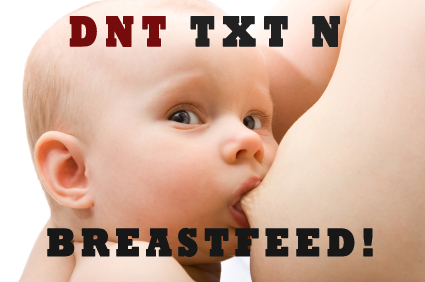
Sanctimommy alert: DNT TXT N BREASTFEED!!!

Breastfeeding

Ohmigod! Ohmigod! Ohmigod!

Lactivists have just discovered that some mothers text while they breastfeed!

The horror!!!!!

You see, a sanctimommy’s work is never done. She has to constantly move the goal posts and make up ever more outrageous stunts and ever more stringent “standards” to maintain that fragile sense of superiority over other mothers. Don’t worry though, she’s up to the task.

Think you’ve met the goal by exclusively breastfeeding your baby until she is 7 years old? Think again. Not if you’ve marred the pristine process of breastfeeding by daring to text while you breastfeed.

Today’s piece in the Lamaze blog Science and Sensibility, Texting While Driving And Texting While Feeding The Baby, Two Sides Of The Same Coin?, is a masterful piece of self-parody. There are lots of lessons here for sanctimommy wannabees.

Lesson 1: Always lead with a question that equates violation of sanctimommy principles with killing someone.

If you’re going for the guilt, and lactivist sanctimommies are always going for the guilt, it’s best to compare other mothers’ behavior to a heinous crime.

Lesson 2: Ask a stupid question.

The question could have made sense if it compared texting while driving to breastfeeding while driving. Both can result in serious injury or death. But breastfeeding while driving appears to be a protected sanctimommy activity, so you can’t criticize that. Texting while breastfeeding, that’s a hideous affront to gods of breastfeeding.

Lesson 3: Always assert that offenders are destroying their relationship to their babies.

Don’t worry. It doesn’t have to be true.

The fact is that mothers and babies now have a third party in their relationship—technology.

That’s right; texting introduced technology into the mother-baby dyad. It was perfectly pristine before that since there was no house, no central heating, no clothes, nothing but moss and hemp and naked skin before that, amirite?

Lesson 4: Always, always, always misuse existing research to make your point.

Now back to the frantic thumbs and feeding the baby. Here’s what research is showing—that as we humans text, a few interesting things happen physiologically Our breathing becomes rapid, shallow, or non-existent (we hold our breaths until we must breathe). Our pulse increases. Our temperature goes up. Sound familiar? Many of us will recognize the physical symptoms of “fight or flight”, or the human body in the sympathetic state. To be super basic about it, there is a massive release of several hormones in our body that prepare us to act to save ourselves. And it’s contagious. We share our hormonal responses, breathing and heart rate with others who are near us.

That’s a pretty big heap of bullshit. What, you didn’t know that texting destroys our normal hormonal balance (since it is so very similar to fleeing from a predator)?

Lesson 5: Be sure to include citations that have absolutely nothing to do with the issue under discussion.

Never forget, misrepresentation is key.

Lesson 6: Don’t let the main purpose get away from you. Remember, its always about making women feel bad and showing them how YOU would do it.

Mothers, if you find yourself catching up while you are feeding your baby, take intentional, slow, deep belly breaths while you do it. Keep yourself out of “fight or flight” and in the state so appropriately dubbed “feed and breed” or “rest and digest”. Your body can actually only be in one or the other state at any given time.

More hilarious bullshit.

Lesson 7: Be sure to promote an arbitrary standard that is utterly incompatible with reality.

If you are a professional—take a moment to teach the mothers you work with, in prenatal visits, private sessions, groups, or classes, this simple lesson: that humans breathe too fast and shallow, and that our temperatures, pulses, and breathing rates rise when we are texting or using technology while trying to do something else that shifts frequently and requires a lot of attention. Teach them to intentionally take slow cleansing breaths while nursing. Talk about taking some of the time while nursing to tend to their emotional health and connection with each other.

Maybe they can do that on Planet Boob where most of the lactivists hide out, but here in the real world, most nursing women have OTHER CHILDREN. Those other children must be supervised even though the baby has to eat.

Perhaps lactivists cage their older children while nursing the baby, but most women don’t feel that is appropriate. Most women in the REAL WORLD, are trying to ensure that the older children do not kill each other, do not give each other haircuts with kindergarten scissors and do not take the opportunity to wreak havoc in other parts of the house, while they are simultaneously nursing the baby. Some of us poor benighted souls even have to think about such menial tasks such as — dare I say it — what to make for dinner.

Maybe on Planet Boob all the older children respect nothing more than the need for a pristine breastfeeding relationship between the mother and the new baby, but in the real world, older children couldn’t care less. I can recall spending many nursing sessions reading to the older children or talking to them about the day at pre-school, simultaneously keeping them in view, engaging them and soothing feelings of jealousy toward the baby. I wonder if that produced fight or flight hormones and destroyed my relationship with my babies? I doubt it.

Raising children is not about gazing adoringly into their eyes 24/7. It’s about meeting everybody’s needs (not just the baby’s) every single day.

DNT TXT N BREASTFEED? You have got to be kidding.

Here’s my response:

KP YR SNCTMNY 2 YRSLF.

Don’t be afraid; the worst thing that can happen is a dead baby

iStock_000002298811XSmall

Ha, ha, ha, ha, ha. The possibility of his baby’s permanent brain injury or death at homebirth is just a big joke to this father.

Serge Bielanko wrote Don’t Be Afraid, It’s Just a Home Birth, and he apparently thinks its simply hilarious that people are warning him about the increased rate of death at homebirth.

The fact is, we aren’t really scared of anything.

Why not? She could die. Everyone could die. I could die. I’m not sure how, to be honest, but there’s got to be a way that I could perish during our home birth, right?

Oh well.

Oh well.

Why be afraid of harming your own baby when you could be afraid of something really important?

You want to know what I am scared of?

Snakes.

Freaking snakes and ferris wheels…

Fear is stupid, mostly. It’s really just an excuse to be excused.

Fear is stupid? Yeah, putting your baby is a car seat while driving to the grocery store is just plain stupid. Why fear a potentially fatal car accident? And it’s not like the risk of a baby dying at homebirth is greater than the risk of a baby dying in a car accident. Oh, wait, the risk of a baby dying at homebirth IS higher. Who cares, right?

Bielanko is inadvertently insightful about the homebirth industry:

People manipulate fear and overt scare tactics for financial gain and power. It isn’t exactly a new phenomenon on this planet, but here in America it is. People want you scared, because when you’re scared you’re jittery, and when you’re jittery, well, to be frank, you’re a damn fool.

And fools follow other fools. And fools spend money.

People foolishly believe that they should be afraid of doctors and hospitals, because homebirth midwives tell them they should be afraid. That makes them, in Bielanko’s own words, “damn fools” who spend money … on homebirth midwives.

The piece is filled with what passes for “reasoning” among the homebirth crowd:

In the beginning I was uncertain, as anyone would be. I needed to investigate it, to look into the whole phenomenon of midwives and the long, storied culture of home birthing and I needed to figure it all out on my own. Then, gradually, it dawned on me that this is how people have been having babies since the beginning of time.

No, really? Perhaps it will eventually dawn on Bielanko that women and babies were dying in droves at those homebirths, but that’s probably too much to hope for.

But don’t worry, like George W. Bush who famously evaluated Vladimir Putin and declared: “I looked the man in the eye. I found him to be very straight forward and trustworthy … I was able to get a sense of his soul,” Bielanko has evaluated the midwife:

Monica and I have looked hard into the eyes of a midwife, checking her out with our awkward leery Larry David stares and squints and looks. Now we trust her. Now we have collectively tuned out the white noise of trembling fear that’s always slashing away at the radio silence of your decisions gone public, forever threatening to try and torpedo any good and decent day.

Personally, when I evaluate a health care provider look at her education, her training, her professional credentials and the disciplinary actions (if any) against her. But, hey, that’s just me.

We have looked hard at having a baby in our home. How awesome is that? How awesome is it that we think it’s awesome?

It certainly could be awesome, as long as the baby and the mother don’t need immediate medical attention. In that case, it could be a nightmare, the baby slowly suffocating to death in the womb, or in the immediate aftermath of birth, all because his parents thought it would be “awesome” to give birth far away from the medical professionals who could perform an emergency C-section or an expert neonatal resuscitation.

Odds are high that there will be no problems. That’s would be awesome. But if something goes wrong, this father’s casual dismissal of the possibility of disaster will probably haunt him for the rest of his life.

That wouldn’t be awesome at all.

Another day, another bunch of lies from the Midwives Alliance of North America

iStock_000000335618XSmall

Hey, MANA, how long do you think lying about homebirth deaths is going to work? Don’t you think women are going to notice the growing pile of tiny dead bodies? Do you really think you can continue to mislead American women as you have done in the past?

The latest mendacity from MANA is this piece of junk, Understanding Outliers In Home Birth Research.

It is written by Wendy Gordon, CPM, a member of the MANA Division of Research.

You may remember Wendy Gordon, CPM, LM, MPH, Assistant Professor, Bastyr University Dept of Midwifery (and placenta encapsulation specialist!). She’s been arguing with me in print for years, and she hasn’t been correct yet.

What’s Wendy up to now (besides withholding the death rates of the 27,000 homebirths in MANA’s own database)?

Wendy is upset that a recent study showed that homebirth increases the stillbirth rate by 1000%. I wrote about the paper when it first appeared online ahead of print in June.

The authors found:

Home births (RR 10.55) and births in free-standing birth centers (RR 3.56) attended by midwives had a significantly higher risk of a 5-minute Apgar score of zero (p<.0001) than hospital births attended by physicians or midwives. Home births (RR 3.80) and births in free-standing birth centers attended by midwives (RR 1.88) had a significantly higher risk of neonatal seizures or serious neurologic dysfunction (p<.0001) than hospital births attended by physicians or midwives. (my emphasis)

What does Wendy have to say? You guessed it, she advises homebirth advocates to ignore the new paper. The heart of her argument is this:

This research, which claims to be the largest study of its kind, relies on data from birth certificates (known as “vital records”). What we know about using information drawn from birth certificates is that they are pretty good for capturing information about things like mother’s age and whether she is carrying twins. They are not very accurate when it comes to rare outcomes like very low Apgar scores, seizures, or deaths (Northam & Knapp, 2006).

Too bad for Wendy that the Northam & Knapp article, says the OPPOSITE!

Birthweight, Apgar score, and delivery method agreed 91.9% to 100%. The high-percent agreement supports the reliability of those variables …

So the heart of Gordon’s argument is a bald faced lie. And Gordon referenced the lie with a citation that showed the opposite of what she claimed it showed.

In order to discredit the study that shows a nearly 1000% increase in stillbirth, Wendy Gordon and MANA apparently feel they have no choice but to deceive their followers, since telling the truth would require accepting the validity of the paper. Homebirth kills babies. MANA knows it; their OWN data tells them so.

So, homebirth advocates, I have some questions for you:

How can you trust that homebirth is safe when those you look to to inform you about the scientific literature lie about?

How can you trust that homebirth is safe when the organization that represents homebirth midwives is hiding their own death rates?

How can you trust that homebirth is safe when the most comprehensive study ever done of homebirth (and analyzed by a midwife) found that PLANNED homebirth with a LICENSED midwife has a death rate approximately 800% higher than comparable risk hospital birth, and even MANA can’t figure out how to criticize it?

The ONLY people who think homebirth is safe are those who make money from it. Everyone else, including the authors of the paper that showed a 1000% increase in stillbirths at homebirth, knows better.


Correction: In Gordon’s piece, DOR stands for Division of Research, not Director of Research. Therefore, Wendy is a member of the DOR, not the director. I’ve changed the text to reflect that.