Category Archives: Uncategorized

Lactivists: better for babies to die than for mothers to “lose confidence”

Milkscreen

Which would be worse?

Is it worse for a baby to suffer severe, unremitting hunger, become dehydrated, lose weight and possible die? Or is it worse for a mother to “lose confidence” in her ability to successfully breastfeed a child who is actually doing well?

The overwhelming majority of people would consider a starving, suffering child to be worse and a preventable child death to be the worst outcome imaginable. But not lactivists. Oh, no, for them, there is nothing more important than convincing women to breastfeed whether it is good for their baby or not. That’s why they wanted to ban a new product, UpSpring Baby Milkscreen Home Test to Calculate Breast Milk Production, a product that they have no intention of ever using, but want to be sure that no one else can use it either.

What is the Milkscreen Calculator? According to the product website:

Am I Making Enough Breast Milk for My Baby?

This is a common question breastfeeding moms ask. Many moms believe that they are not producing enough breast milk to satisfy their babies. Some moms are right, and some are wrong. Now there is a scientific way to know whether your breast milk supply is low or not: Milkscreen Calculator home test.

Are they shilling for formula manufacturers? Apparently not:

If I find out I have low breast milk supply after testing, should I supplement with formula?

NO! Most women can easily overcome a lower breast milk supply with natural methods to increase their supply. Milkscreen Calculator’s report will provide these tips if you need them, and will also recommend that you visit a Lactation Consultant to get the personal attention you need.

So what’s the problem? It can’t be that low supply doesn’t exist. We know that it happens far more often that previously thought. According to the paper Breastfeeding-Associated Hypernatremia: Are We Missing the Diagnosis?:

The incidence of breastfeeding-associated hypernatremic dehydration among 3718 consecutive term and near-term hospitalized neonates was 1.9%, occurring for 70 infants…

Conclusion. Hypernatremic dehydration requiring hospitalization is common among breastfed neonates…

The problem can’t be that the test is inaccurate. Lactivists didn’t bother to assess accuracy; they didn’t bother to assess any of their claims.

What is the problem? According to a blog post, Milkscreen Breastfeeding Assessment Test under fire, featured on the Facebook page of Mothers Against Milkscreen Breastfeeding Assessment Test:

And this doesn’t even cover the message the product is sending to new moms. Women are given formula samples at the hospital, inundated by coupons in their mailbox, questioned by well-meaning but misguided grandparents, and often harassed into supplementing with formula by medical professionals who don’t have a proper breastfeeding education. And now, Milkscreen has added insult to injury by with this product that asks if you’re making enough milk for your baby. (my emphasis)

Insult? Lactivists think it is insulting to suggest that some women do not produce enough milk to adequate nourish their babies?

That betrays the real focus of those who oppose the test. It has nothing to do with accuracy. It has nothing to do with safety. It has to do with THEIR feelings. They are not worried about babies failing to receive enough breastmilk; they are worried that their own choices are not being validated with anywhere near the fervor they demand.

The latest information from the Facebook page is that company has decided to stop selling the product indefinitely. That’s unfortunate, because we should never give in to bullies and, make no mistake, the lactivists are bullies. They are opposing a product they would never use, making claims that they never bothered to substantiate, for a reason that they have make no attempt to verify. It is more important to them that other women mirror and validate their own choice to breastfeed than whether the babies of those women are adequately nourished.

I have no idea whether Milkscreen is an accurate product or not. If it could be shown to be inaccurate or misleading, it should be removed from the marketplace, regardless of who is insulted or not. However, I have a big problem with censorship and that is exactly what the opponents of Milkscreen are trying to do. They are trying to deprive women of information that they might need because if women had that information they might make decisions of which the lactivists don’t approve.

Frankly, I think the makers of Milkscreen have made a big mistake. You can’t buy publicity like they are getting from opponents and the market for the product is everyone else in the world besides the opponents. I suspect that they would sell more Milkscreen kits now than they ever imagined in their wildest market assessments.

And lactivists are busily celebrating yet another Pyrrhic victory in the war that they are losing. By revealing themselves (yet again) to be hysterical fanatics who really don’t care whether babies suffer and starve just so long as everyone is mirroring their choices, they have make breastfeeding seem like a radical choice instead of an excellent way (but not the only excellent way) to nourish a baby.

Attachment parenting: who pays, who profits, who’s excluded and who avoids responsibility altogether?

iStock_000007784000XSmall

Attachment parenting, also known as intensive mothering, is the dominant parenting philosophy today. By dominant I don’t mean that’s its the most widely practiced; instead it is the parenting ideology favored by elites: Western, white, relatively well off married women who view themselves as moral exemplars for their less fortunate sisters of a different color and economic class. From the front page of Time Magazine (Are You Mom Enough?) to the playgrounds and message boards of the internet, we are busily judging other mothers and how they comport with this ideology.

Let’s leave aside for the moment the fact that there is no scientific evidence of any kind that attachment parenting is “better” and consider how this ideology affects society. Who profits, who pays, who’s excluded and who avoids responsibility altogether?

Who profits?

According to a recent position paper, Governing Motherhood: Who Pays and Who Profits?, written by Phyllis Rippeyoung and published by the Canadian Centre for Policy Alternatives, the profit is restricted to self proclaimed parenting experts like Dr. William Sears and family:

… In addition to the more than 30 books the various family members have co-authored, they also have developed, branded, or marketed numerous other supplements, snacks, beverages,
and baby care items with the Dr. Sears stamp of approval. Their celebrity status has also garnered son Dr. Jim Sears a seat on Dr. Phil’s spin-off TV-show The Doctors, while all of the Sears family members working in the field of medicine have been interviewed on major leading television networks. Further, patriarch Dr. William’s speaking appearances can be booked through the All American Speakers agency for a fee somewhere in the range of $10,000–$20,000 (All American Speakers 2010–11).

The Sears also have at least two websites from which they profit. In addition to the advice and products offered on their Ask Dr. Sears website, they also include endorsements for such products as goat’s milk, Dr. Sears’ “favorite” salmon, vitamin enriched juice, and a program to teach children to read at home. They also have a website for the Dr. Sears Wellness Institute. This “scientifically based, family approved” wellness institute, headed up by Drs. William and Jim Sears, claims to “provide high quality professional certifications, scientifically-based educational programs, and resources that empower individuals and families to live happier, healthier, longer lives by making positive Lifestyle, Exercise, Attitude, and Nutrition (L.E.A.N.) choices.” Here, parents and caregivers can take e-courses for $59.99 or find out where to get (or how to become) a certified “L.E.A.N.” coach.

Simply put, attachment parenting is a big business.

Who pays?

Mothers pay … in a myriad of ways.

1. Lost earnings

… They are paying not only for these books, courses, coaches, supplements, and other devices all created to make children healthier, but they are also paying with lost earnings. Although the Ask Dr. Sears website notes that mothers can successfully combine “attachment parenting” with paid employment, he suggests that women consider some “alternatives to spending the entire day away from your baby.”

2. Lost time for themselves

We are only in the earliest stages of measuring the impact of the dominant mothering ideology on women’s mental health. One of the first investigations, Insight into the Parenthood Paradox: Mental Health Outcomes of Intensive Mothering, found this:

The belief that mothers are the most capable parent (Essentialism) was associated with higher levels of stress and lower levels of life satisfaction. In prior research, mothers have expressed difficulty selecting an alternate caregiver because they felt that no one else, including the child’s father, could provide the same degree of love, commitment, and skill. If women believe they are the most capable caregiver, they may limit help from others, a practice known as maternal gatekeeping. This may account for the lower levels of social support reported by women who endorsed essentialist attitudes …

Believing that parents’ lives should revolve around their children (Child-Centered) was related to lower levels of satisfaction with life. According to Tummala-Narra, when women feel they must subsume their needs to the needs of their child, they lose a sense of personal freedom, which may result in women experiencing negative mental health outcomes (e.g., lower levels of life satisfaction).

3. Guilt

Attachment parenting is a philosophy of privilege. It is completely inaccessible to women who are poor, work at low wage menial jobs and lack the support of a partner who earns enough to make attachment parenting financially feasible. Now, in addition to struggling to provide their children with the basic necessities of living, they are denigrated for being unable to provide their children with the requisite emotional support.

Who’s excluded?

Fathers are excluded.

Despite its name, attachment parenting renders fathers peripheral in the exact same way as the oft mocked lifestyle choices of the 1950’s. The father exists to provide financial support; the mother exists to provide her presence, her labor and her emotional support.

Who avoids responsibility altogether?

Attachment parenting purports to mimic mothering in indigenous cultures, but actually differs in the most fundamental way. In many traditional cultures, “it takes a village to raise a child” whereas in attachment parenting only the mother can do it. While grandmothers, “aunties” and friends play important roles in child rearing in traditional cultures, attachment parenting imagines each mother has having sole responsibility for her child’s emotional health as well as her own. Proximity of the child to the mother is fetishized (baby wearing, family bed) and sharing parenting tasks with anyone else, even the father or grandmother, is implicitly discouraged.

In regard to the Sears’ website, the position paper notes:

… parents are encouraged to make individual decisions that make the most sense for their own families, rather than the collectivity of children and families as a whole.

The only role for government imagined by many attachment parenting proponents is to pressure women into practicing the tents of attachment parenting or at the very least, shame them for not doing so:

This individualizing of responsibility for child welfare has also been seen among breastfeeding proponents, as most explicitly illustrated in an editorial by Dr. Ruth Lawrence, a founder of the Academy of Breastfeeding Medicine. In her essay, “The Elimination of Poverty One Child at a Time,” she argues that breastfeeding is the panacea for health and cognitive inequalities between poor and non-poor children. She ends the piece by writing that breastfeeding may be the only gift that poor mothers have to offer their children.

Although neglectful and abusive parenting has been shown to explain multiple forms of inequalities in child outcomes, I have been unable to find any research assessing whether breastfeeding, baby-sling wearing, co-sleeping, or the other attachment parenting practices advocated by the Sears Family or others will actually reduce either poverty or the consequences of growing up poor, one child at a time or otherwise. In research I have recently completed (Rippeyoung forthcoming), I assessed the relative impact of breastfeeding versus the family educational environment on reducing gaps in child verbal IQ between the poor, the near poor, and the non-poor … [A]lthough breastfeeding is correlated with higher test scores for children, it does less to reduce the gaps between poor and non-poor children than does reading to one’s children and increasing the mother’s education. However, even if we were to equalize all of these factors, a large and significant gap in the scores remains. This research indicates that individual solutions to low test scores will not solve the problems of inequalities in school readiness.

The author concludes:

If policy makers are truly interested in improving child health and welfare, more needs to be done to address the problems faced by families comprehensively and structurally; not only in terms of training individual mothers to behave in particular, culturally defined ways…

I couldn’t agree more.

Elimination communication: housebreak your baby

image

I first wrote about this nearly 3 years ago, but it was only recently discovered by the mainstream media. I think it might be time for a review.

Freud would have a field day with these people.

I’m talking about proponents of EC, elimination communication, the goofiest obsession of the many goofy obsessions of the natural childbirth and attachment parenting crowd. They began obsessing about excrement when cloth diapers came back into vogue, arguing that cloth diapers are better for babies and better for the environment. It turns out that neither of these claims are true. Indeed, those busily preening themselves for their prescience in rejecting disposal diapers forgot to include the environmental impact of sanitizing reusable cloth diapers, an impact that may be worse than the problem of landfills containing used Pampers and Huggies.

As is typical of the oneupsmanship characteristic of the NCB and AP types, fretting over what will catch your baby’s excrement is now passe. Proving your maternal superiority now means rejecting diapers altogether in favor of rigorously and continuously observing your baby for any signs of imminent excrement release and immediately holding him or her over a pot to catch the excrement. As Diaper Free Baby explains:

Full time EC’ing families are committed to trying to stay aware of as many of baby’s eliminations as they can. To this end, they may choose not to use diapers or other waterproof backup, as this can muffle a parent’s awareness of when a baby is about to or has already eliminated, and catches may be easier with trainers or underpants.

Full-time EC’ers figure out what works to help them catch eliminations when they are out and about, traveling, or EC’ing at night. They recognize that, like other aspects of parenting, EC progress is not always linear, but they recognize the value of process over results, and have a full toolbox of options to choose from to adjust to each of baby’s developmental milestones and stages.

“EC parents speak out” (not surprisingly since EC is all about them, not about their babies). According to “Rachel, mom to Simon, began EC at birth”:

By the time Simon was three and a half months old he had proven to us that EC is more than just ‘parent training.’ He started signaling his need to pee by making his own imitation of our ‘sss’ cue! We were delighted to be in such two way communication with him.

Evidently Rachel had trouble recognizing smiling and cooing as two way communication.

Sarabeth, mom to Ben, began EC at 2 1/2 months” says:

Doing EC with Ben has completely changed our relationship for the better. Before we started EC, it seemed like he often cried for no reason. With EC, I finally have an important tool to help meet his needs, and he is 100% happier.

There’s nothing like a relationship based on excrement, is there?

And “Megan, mom to Noe, began EC at 8 months”:

Responding to your baby’s elimination patterns provides many wonderful opportunities for you and your baby to communicate and to become more in-tune.

Poor Megan must be sorely lacking quality communication with her baby if she thinks excrement is a highlight.

How does a parent practice EC? First she must assiduously observe her baby to determine when he or she is preparing to “eliminate”:

… [Y]our own intuition will naturally develop around your baby’s elimination. Listening to and trusting your intuition is an important part of parenting. With a little time and practice, it can also become a very reliable tool for anticipating your baby’s elimination… [T]here are a few concrete ways you will know your intuition is telling you that your baby needs to eliminate. For example:

* a sudden thought along the lines of “She needs to pee.”
* wondering or questioning, “Does he need to go?”
* “seeing” or “hearing” the word “pee” or cueing sound (see below)
* “just knowing” that your baby needs to pee
* feeling the urge to pee yourself
* feeling a warm wet spreading over your lap or other area while baby is dry

Then mother and baby must assume the position:

When you think your baby needs to eliminate, hold her in a gentle and secure manner over your preferred receptacle. This could be the toilet, sink, potty, bucket, diaper, tree, or any other appropriate place… Generally, she will be more or less in a deep squat, cradled in your arms with her back to your tummy. The main thing is to keep her secure and to think about your aim.

Once your baby is comfortably in position, make a specific cueing sound to “invite” your baby to pee or poop. In most places where EC is practiced culturally, caregivers use a watery sound such as “psss”. This sound, along with a particular position, is used to signal or stimulate the baby’s elimination. When you are starting out, make your cueing sound every time you notice your baby peeing. Within a few days, your baby will associate the sound with the act of eliminating. By practicing EC consistently, your baby will learn to release her bladder at will upon hearing the cueing sound and/or being held in the potty position.

In other words, EC is a form of operant conditioning. The parent attempts to condition the baby to urinate or defecate in response to specific visual and auditory signals. If that sounds familiar, it’s probably because it is. It’s the same way that pets are housebroken. In essence, EC is nothing more than “housebreaking” a baby.

EC is about, by and for parents. The parent wants the baby to urinate and defecate in a pot and attempts to condition the baby to do so. It stands in explicit contrast to a child centered approach to toilet training that elicits the child’s understanding and point of view. In fact, “elimination communication” is a misnomer. It does not involve communication of any kind, since the child is incapable of expressing his views on the subject. It treats children like dogs. Show the dog/baby what you expect, disregard what the dog/baby might prefer, bestow approval or disappointment on the dog/baby until he or she learns to do it your way.

In one way EC is about communication, but not in the way its proponents assert. Adopting EC communicates that the mother thinks her child’s bodily functions can be used as weapons in the war of maternal superiority. It communicates that the mother considers that her need to be au courant within her mothering community takes precedence over her child’s developmental needs. It communicates that the mother thinks that housebreaking her baby is an appropriate form of parenting.

EC explicitly ignores a child’s needs. Instead of allowing a baby to follow the rhythms of its own body, EC implies that urination and defecation must be closely regulated, with the constant parental scrutiny that implies. It conditions the child to believe that even her bodily functions are property of her parents and that urination and defecation must be performed on demand, at the risk of parental disapproval.

Ultimately, it demonstrates the astounding gullibility of certain women and their desperation to claim superiority over other mothers. Proponents of EC are busily housebreaking their babies with the same techniques that they would use for a dog and bragging to each other about it.

No limit to the stupidity at Midwifery Today

wise and stupid in letterpress wood type

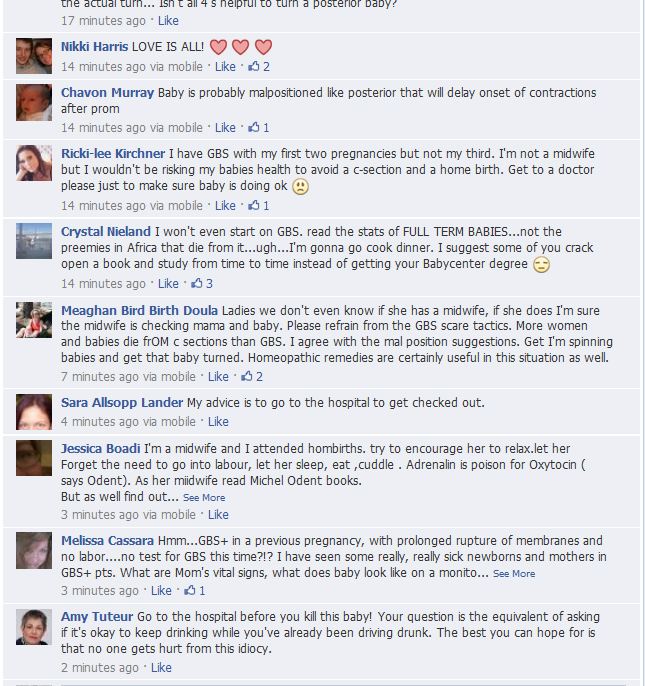
Over on that festival of stupidity known as the Midwifery Today Facebook page, I found this:

Midwifery Today

From Stephanie-jean *****

My best friend is currently attempting a hbac and is a at road block. Her membranes ruptured 56 hours ago. She was group b strep positive in her last pregnancy, but was not tested this time. All over our research would suggest that 95% of women will go into labor on their own within 72 hours of prom. She is looking to hear other women’s experiences with hbac with prom. She really wants to avoid a repeat c-section as she had a really traumatic c-section the first time. All advice, support, and baby waves is highly appreciate!

My comment (soon to be deleted no doubt):

Go to the hospital before you kill this baby! Your question is the equivalent of asking if it’s okay to keep drinking while you’ve already been driving drunk. The best you can hope for is that no one gets hurt from this idiocy.

Midwifery Today 4-18-13

Step 1: ignore homebirth deaths

OOPS sign with clipping path

Hi, folks! It’s Ima Frawde, CPM. It’s time for some honest talk about homebirth deaths.

No, silly, not how to prevent them! How to hide them.

I admit it; it’s been a very bad year for homebirth midwifery. Licensed Oregon homebirth midwives have a death rate at planned homebirth of 9X term hospital birth. Colorado homebirth midwives have a perinatal death rate 2.5X higher than hospital births (including premature births!). Australian homebirth midwives have a death rate 5X higher than term hospital birth. Even our vaunted friends, the midwives of the Netherlands, are facing scrutiny because their low risk death rate (home and hospital) is nearly 3X higher than high risk birth attended by obstetricians.

What’s a midwife committed to making 100% of her income peddling quackery to do?

Don’t worry, I have a 5 step plan for hiding addressing homebirth deaths.

Step 1: Ignore the homebirth deaths.

Use the homebirth midwives of Oregon and Colorado as your guide. Collect your statistics, analyze them on the off chance that they might show that homebirth is safe (in which case we’ll publish them). Then ignore them. If you ignore them and act like it’s no big deal that lots of babies are dying preventable deaths at homebirth, our supporters will too.

Step 2: Stop collecting statistics.

Let’s follow the example of homebirth midwives in North Carolina, Maryland and a variety of other states by refusing to collect mortality statistics. Very clever, huh? If we refuse to count the homebirth deaths, no one else can, either.

Step 3: Pretend that some deaths can and should be dropped from the statistics.

Congenital anomalies? That’s not our fault; remove them from the homebirth statistics, but keep them in the hospital comparison group. Intrapartum deaths? Hide them in the stillbirth rate.

Step 4: Baffle them with bullshit.

Invoke quantum midwifery and pretend that the Heisenberg Uncertainty Principle means that no one can truly “know” how many babies died because, like Schrodinger’s Cat, they can be dead and alive at the same time. Invoke chaos theory because it sounds cool.

Step 5: Pretend that this is a human rights issue.

Sure a bunch of babies are dead who didn’t have to die. But it’s my right to make money a woman’s right to “choose” that’s at stake here. Lie, and insist that any attempt to reduce homebirth deaths is an effort to outlaw homebirth midwifery. Glorify those midwives who have presided over homebirth deaths (especially those who have presided over lots of deaths) and insist that any attempt to hold them accountable makes them into martyrs.

There’s actually one more step, but it’s a secret among us midwives:

Step 6: Rely on the ignorance and gullibility of homebirth advocates.

Let’s face it, you can tell those nitwits mamas anything and they’ll believe it. As we know, anyone who actually thinks trusting birth is an effective strategy is willing to accept whatever nonsense we dish out. Fortunately!

And if a bunch of babies die in the process,  remember: just like you can’t make an omelet without cracking some eggs, you can’t protect “normal birth” without killing some babies. S#it happens; get over it.


This piece is satire.

Australian midwives boast about terrible homebirth death rate

iStock_000010467288XSmall

Setting a new standard for cluelessness, Australian midwives are proudly presenting the results of a publicly funded homebirth program, a program that has a homebirth death rate 5X higher that of term hospital birth.

I received a iPhone photo of the poster that include this chart (sorry for the fuzziness):

Australian homebirth study

The accompanying message says it all:

I am attending the national PSANZ (Perinatal society of Australia and new Zealand) congress here in Adelaide and thought of you when I saw this poster

The authors seem to be blissfully unaware that their “rates” are anything but low given that this is a carefully selected low risk group at term. These deaths do not include those from rogue homebirth midwives such as LB nor freebirths. The publicly funded homebirth program has strict criteria including exclusion of women with any risk factors such as multiple births, preterm births, VBACS, breech. The births are managed by 2 properly trained midwives who also work in hospital and so quick referral and transfer is a given. !!!

Things that I noticed (I’m sure you will see more!!) are …

6 deaths in low risk pregnancies at term!!!!

0.7 % of IUGR missed

2.7% of the babies ended up in the nursery!!!!!! 9 babies had SIGNIFICANT morbidity

In the abstract they have the following conclusion further demonstrating their absolute ignorance:

“This study evaluates a substantial proportion of women choosing to have a publicly-funded homebirth in Australia. However, the sample size does not have sufficient power to determine safety. More research is needed on the safety of different birthplaces within Australia”

Interestingly they left this conclusion off the poster! Perhaps they didn’t want to embarrass themselves.

The poster is Publicly-funded Homebirth in Australia: outcomes after 5 years by Catling-Paull et. al. (Here’s the full size iPhone photo of the poster.)

According to the authors:

Homebirths account for a very small number of births in Australia. In 2010, only 0.5 per cent of all women … chose homebirth.

Currently, there are at least 15 publicly-funded homebirth programs [run by 13 directors] in Australia …

The programs accommodate women who are at low risk of medical or obstetric complications. Midwives are usually selected to work within the programs after … advanced obstetric emergency training, cannulation and suturing skills.

What did they find?

During the 5 years of the study, there were 1807 women who intended, at the start of labor, to give birth at home. 83% had a homebirth, 52% in water (I have no idea why they mention this except to check women’s performances against the midwifery ideal.) The transfer rate was 17%. The C-section rate was 5.4% and the neonatal death rate was 2.2/1000. That’s more than 5X the rate of 0.4/1000 found in a 2009 report on birth in South Australia.In addition, 2 babies suffered hypoxic ischemic encephalopathy (brain damage due to lack of oxygen).

And that probably undercounts the deaths and complications because reporting was voluntary and only 9 of 13 program directors responded. Nonetheless, the authors conclude:

There was a low rate of caesarean section, postpartum haemorrhage and third degree perinatal tears as well as low rates of stillbirth and early neonatal death in this sample of women and babies.

It’s absolutely mind boggling that Australian midwives appear to be completely unaware that the neonatal mortality rate for term births in Australia is approximately 0.4/1000. They are boasting about a death rate of 2.2/1000, nearly 5X higher than the expected death rate.

The findings of the study are not surprising. They confirm what we already know: homebirth increases the risk of neonatal death by a factor of 3 or more. The only surprising thing about the study is that the authors are cheerfully ignorant about the meaning of what they found.

Corrected to reflect the fact that I mixed up stillbirths and early neonatal deaths, thereby reporting the death rate at Australian homebirth as lower than it is.

Yesterday I glimpsed heroism — and preparedness

In one single video, you can see senseless horror and sublime heroism.

I have lived in Boston my entire life and the terrorist bombing at the finish line of the Marathon stuck me particularly hard. I wasn’t there, nor was anyone I know personally, but that was merely chance. Just about everyone I know has been among the supporters lining the route in one year or another, so it was particularly harrowing to see video of the bombing.

But in the same video, I glimpsed something else: heroism.

It takes extraordinary heroism and bravery to run TOWARD the site of the bombing when everyone else is running away in fear. Yet, dozens, if not hundreds, of police, medical personnel and ordinary citizens did precisely that without even the slightest hesitation. The professionals, and perhaps some of the ordinary individuals, recognized that where one bomb has detonated, another might soon explode. Nonetheless, they ran to help, ripping down fencing and barriers in their eagerness to reach the victims.

In addition to their bravery and selflessness, their extraordinarily heroic response owes a great deal to something else: preparedness. Every single one of the professional first responders have drilled for just this eventuality. That training was reflected in the way that they immediately took control of the situation, summoned an army of medical personnel, a fleet of ambulances, and a battalion of police and SWAT teams.

What is truly remarkable in the chaos of the immediate aftermath is that there wasn’t much chaos. In only moments, victims who could be moved were ferried to further medical assistance and those who couldn’t be moved were treated on the spot. Ambulances pulled up and raced away in an orderly fashion. Hospitals called in their trauma teams; operating rooms were thrown open and surgeries were started. Race officials stopped the race in an orderly fashion and began ferrying runners away from the site. Political officials opened help lines to reunite people with loved ones and to solicit tips in solving the crime. Some early responders had the presence of mind to immediately begin testing air quality to be sure that no radioactivity or biologic agents had been released in the bombing.

It was a tribute to heroism and to training.

What were the chances that there would be a bombing at the finish line of the Boston Marathon? Very, very low, yet thousands of people had trained for thousands of hours for an event that was extremely unlikely to happen, just in case it did. Why? Because in emergencies, minutes count. They make the difference between saving a life and watching someone bleed to death on the ground.

Imagine if instead race officials had trusted that a rare event would never happen. Imagine if race officials had made no plans beyond calling 911 in the event of a disaster and summoning medical help then. Imagine if police and EMTs had not been trained in responding to rare crises. It’s not difficult to imagine that the carnage would have been far worse.

Up until the moment the crisis occurred, everyone on the scene was concentrating on creating the best possible experience for the runners, the family and friends, and the ordinary spectators. But they pivoted on a dime into crisis mode and because they did, even greater carnage was averted.

There’s a lesson here for anyone who purports to care for other people: It’s not enough to create a great experience when everything goes right. It’s not enough to call 911 when things go wrong. It’s not acceptable to pretend that there’s no point in preparing for rare disasters or that the people who do prepare and train relentless for these rare disasters are fear mongering.

Lives were lost yesterday in Boston, but lives were also saved because of the heroism of individuals … and because they were prepared.

Dutch midwives struggle to avoid accountability for high perinatal death rate

Who me

Ank de Jonge thought that she had succeeded in showing that homebirth in the Netherlands is safe. She was the lead author on the paper Perinatal mortality and morbidity in a nationwide cohort of 529 688 low-risk planned home and hospital births back in 2009. The study showed that homebirth with a midwife in the Netherlands is as safe as hospital birth with a midwife. That triumph was very short lived.

A subsequent study, Perinatal mortality and severe morbidity in low and high risk term pregnancies in the Netherlands: prospective cohort study, was a stunning indictment of Dutch midwives. The study was undertaken to determine why the Netherlands has one of the worst perinatal mortality rates in Western Europe and the results were unexpected, to say the least.

We found that delivery related perinatal death was significantly higher among low risk pregnancies in midwife supervised primary care than among high risk pregnancies in obstetrician supervised secondary care.

…[T]he Dutch obstetric care system is based on the assumptions that pregnant women and women in labour can be divided into a low risk group and a high risk group, that the first group of women can be supervised by a midwife (primary care) and the second group by an obstetrician (secondary care), and that women in the primary care group can deliver at home or in hospital with their own midwife… This also implies that the high perinatal death rate in the Netherlands compared with other European countries may be caused by the obstetric care system itself, among other factors. A critical evaluation of the obstetric care system in the Netherlands is thus urgently needed.

The validity of these observations have been acknowledged by Dutch midwives:

In 2011 Dutch midwifery is under a microscope. Maternity care in general in The Netherlands has come under scrutiny by governments, media, the public and care providers themselves after two consecutive European Perinatal Statistical Reports ranked The Netherlands among those with the highest rates of perinatal and neonatal mortality compared to other members of the
European Union (and Norway)…

… We have learned that infants born to women of low risk whose labour started in primary care with midwives had higher rates of perinatal death associated with delivery compared to those beginning labour in secondary care…

Obviously, the next step is to determine why Dutch midwives have unacceptably high rates of perinatal mortality, both at home and in the hospital. But some midwives, de Jonge among them, are still struggling to avoid responsibility for the terrible perinatal mortality rates, let alone improve them. de Jonge’s latest effort is a paper in the journal Midwifery Perinatal mortality rate in the Netherlands compared to other European countries: A secondary analysis of Euro-PERISTAT data.

The conclusion is bizarrely disconnected from the actual findings of the paper. The findings of the study do NOT absolve Dutch midwives and does not address homebirth in any way. Regardless, de Jonge inexplicably concludes that the findings mean that no changes in homebirth policy is necessary.

How did de Jonge analyze her data and what did she find? de Jonge, like many Dutch midwives, has suddenly discovered that perinatal mortality rates consist of premature babies as well as term babies. Reasoning that premature babies are cared for by doctors, de Jonge set out to show that the poor perinatal mortality rate of the Netherlands can be ascribed to poor care of premature babies. That’s not what she found.

Microsoft Word - Figure 2 high resolution

As you can see from the chart, the Netherlands has one of the worst perinatal mortality rates in Western Europe (All mortality rates are expressed as compared to the Dutch perinatal mortality rate.) Only Latvia and France have higher rates.

What happens when you break the data down by gestational age and compare mortality rates for term pregnancies?

Microsoft Word - Figure 3 high resolution

After restricting the analysis to term births, de Jonge found that the Netherlands has one of the worst perinatal mortality rates in Western Europe, although now they have the sixth worst rate, instead of the third worst rate.

In other words, de Jonge CONFIRMED that there is a serious problem with perinatal mortality in the Netherlands including the perinatal mortality rate at term. She CONFIRMED that there is significant evidence that Dutch midwives bear responsibility for the Netherlands poor perinatal mortality rate. But, bizarrely, that’s not what she concludes. She writes:

The relatively high perinatal mortality rate in the Netherlands is driven more by extremely preterm births than births at term. Although the PERISTAT data cannot be used to show that the Dutch maternity care system is safe, neither should they be used to argue that the system is unsafe. The PERISTAT data alone do not support changes to the Dutch maternity care system that reduce the possibility for women to choose a home birth while benefits of these changes are uncertain.

Of course the PERISTAT data can be used to show that the Dutch maternity system is not nearly as safe as it could be. Absent demonstrating that the population of Dutch pregnant women differs substantially from that of pregnant women in other European countries, that is the inevitable conclusion. And although perinatal mortality at term is “less terrible” than perinatal mortality overall, that is hardly a defense of Dutch midwifery. We already know that the reason that Dutch perinatal mortality at term is as high as it is because Dutch midwives caring for low risk women have higher perinatal mortality rates than Dutch obstetricians caring for high risk women.

In fact, we know from the BMJ study cited above that the perinatal mortality rate of Dutch midwives is more than double that of Dutch obstetricians. If the perinatal mortality rate of Dutch obstetricians (caring for HIGH risk women) was compared to the rest of Europe, Dutch obstetricians would have the second lowest rate in Western Europe!

de Jonge has CONFIRMED the poor perinatal mortality ranking of the Netherlands. She has CONFIRMED that Dutch midwives have poor perinatal mortality rates. She CONFIRMED that the data DO support changes to the Dutch maternity care system. She NEVER LOOKED at homebirth, and therefore she cannot draw ANY conclusions about Dutch homebirth, let alone the conclusion that homebirth is safe.

Most importantly, in my view de Jonge CONFIRMED that Dutch midwives refuse to accept accountability for their poor perinatal mortality rates. They are not the among the best in Europe. They are among the worst. The sooner they acknowledge reality, the sooner they can start making the improvements that are needed to save babies’ lives.

The appalling callousness of the Arizona homebirth researchers

whatever in letterpress type

Imagine the following “analysis” released by the manufacturer of thalidomide, the drug that caused severe limb deformities in the children whose mothers took it while pregnant:

Thalidomide for morning sickness may be equally safe if not safer for women than other treatments. Unfortunately, thalidomide increases safety concerns for the child.

Such appalling callousness and nonchalant dismissal of the pain and suffering that thalidomide caused would suggest that the manufacturer was far more concerned with touting thalidomide than with the safety of babies.

Amazingly, the researchers responsible for the report Outcomes of Home vs. Hospital Births Attended by Midwives: A Systematic Review and Meta-analysis appear to have a similarly callous view of homebirth deaths.

As I discussed in yesterday’s post (New analysis from Arizona shows — yet again — that homebirth triples the neonatal death rate), the authors of the analysis, after demonstrating that homebirth increases the risk of neonatal death by a factor of three reach a bizarre conclusion:

The findings suggest that homebirths attended by midwives may be equally safe if not safer for women with low-risk pregnancies.

Reader Lynnette Hafken, MA, IBCLC was so disturbed by the obvious disconnect between what the authors found and what they concluded, she wrote to the lead author John Ehiri, PhD, MPH, MSc (Econ.) for clarification. Ehiri thanked her for pointing out this “oversight” and informed her that the authors had added an additional sentence to the 34 page paper.

The conclusion now reads:

The findings suggest that homebirths attended by midwives may be equally safe if not safer for women with low-risk pregnancies. Unfortunately, home births attended by midwives increase safety concerns for the child.

Unfortunately? Unfortunately??!!

Frankly, I am shocked by the appalling callousness of dismissing preventable deaths of babies in such a brutally short and dismissive sentence.

The KEY ISSUE in any analysis of homebirth is its safety for babies. It’s not the only issue, but all others pale into insignificance next to it. The conclusion of the analysis ought to be:

Homebirth attended by midwives increases the risk of neonatal death by a factor of 3. Homebirth has no deleterious impact on the health of mothers and may reduce morbidity. Women should be counseled to weigh the increased mortality to babies against the decreased morbidity to mothers before choosing homebirth.

The fact that the authors reduced preventable neonatal deaths to an “unfortunate” side effect of homebirth suggests to me that authors were far more concerned with touting the safety of homebirth (regardless of what their own data showed) than with the safety of babies.

If Dr. Ehiri would like to contest my assertion that the authors have callously and deliberately ignored the immense pain and suffering associated with neonatal death, he can write to me at the email address listed at the top of the sidebar. I will publish his response/explanation in full.

But I have a better suggestion for Dr. Ehiri and colleagues:

Remove the absurd and offensive claim that “homebirths attended by midwives may be equally safe if not safer for women” and replace it with the language I suggested, giving primacy to the fact that homebirth increases the risk of neonatal death by a factor of 3 and offers only a small reduction in maternal morbidity as a result.

Even the drug company that promoted thalidomide didn’t dare tout its safety and effectiveness after it was shown that it caused horrible birth defects as a result. Surely Ehiri and colleagues could demonstrate as much sensitivity in promoting homebirth.

New analysis from Arizona shows — yet again — that homebirth triples the neonatal death rate

iStock_000001980983XSmall

It’s a remarkably robust finding, repeated in a wide variety of scientific papers and both national and state statistics: homebirth increases the risk of neonatal death by a factor of 3 or more.

The latest example is an analysis prepared by faculty at the College of Public Health of the University of Arizona, Tucson and the Arizona Public Health Training Center for the Arizona Department of Health Services entitled Outcomes of Home vs. Hospital Births Attended by Midwives: A Systematic Review and Meta-analysis.

The authors, 5 professors of public health and 1 doctor, explain why the analysis was commissioned:

Most recently, the licensed midwife community has utilized the democratic process to their advantage to pass legislation to allow for an overhaul of the regulations overseeing homebirths and their profession in the state. Pursuant to HB 2247, AzDHS has formed a Midwife Scope of Practice Advisory Committee, which will evaluate evidence based literature and data to make informed decisions regarding regulation over licensing procedures, scope of practice, and education requirements for licensed midwives in Arizona by July 2013. Of particular salience will be changes in regulations overseeing licensed midwife attendance at births for mothers undergoing a vaginal birth after cesarean (VBAC), breech birth presentation, and multiple fetuses…

In light of Arizona homebirth practitioners’ and clients’ interest in midwives’ scope of practice in the US and elsewhere, we seek in this meta-analysis to compare and contrast direct entry midwives’ outcomes for homebirths with their outcomes in hospital or health care facility settings. The current
limited and conflicting evidence on the outcomes of homebirths versus hospital births with midwives in attendance generates both a need and justification for a review of the available evidenced-based literature.

What did they find?

Nine studies were included in the meta-analysis of child health outcome of births attended by midwives in homes or in hospitals. We analyzed 8 outcomes of child health (neonatal deaths, prenatal deaths, Apgar

Pooled results indicated that homebirths attended by midwives were associated with increased risks for neonatal deaths [pooled OR (95%CI): 3.11 (2.49, 3.89)]. There were no significant differences in outcome of home or hospital births attended by midwives for the other child health measures.

How about maternal outcomes?

… [W]omen who delivered at home with midwives were more likely to have spontaneous delivery and intact lacerations/perineal tear [pooled ORs (95%CIs): 1.64 (1.35, 2.00) and 1.94 (1.25, 3.01) respectively.

Women who delivered in hospitals under the supervision of midwives were more likely to experience assist ed delivery, caesarean sections, forceps, episiotomy, and lacerations/perineal tear (3-4 degrees) [pooled ORs (95%CI s): 0.58 (0.40, 0.84); 0.55 (0.49, 0.60); 0.54 (0.33, 0.9 0); 0.56 (0.41, 0.77) and 0.48 (0.32, 0.72) respectively. Results of the meta-analysis also revealed that homebirths attended by midwives were associated with decreased risk for postpartum hemorrhage >500ml and retained placenta [pooled ORs (95%CI s 0.60 (0.44, 0.81) and 0.58 (0.40, 0.86) respectively.
Homebirths were also not associated increased risk for vacuum extraction, cervical tear, blood transfusion and prolapsed cord.

The authors conclude:

These results suggest that homebirth is a suitable alternative to the traditional hospital setting, as it reduces medical interventions and has been found to have positive maternal health outcomes. However, homebirths should only be recommended to women who are classified as low-risk, as this data demonstrates an increased risk of neonatal mortality among homebirths

For reasons that are unclear to me, the authors state:

The findings suggest that homebirths attended by midwives may be equally safe if not safer for women with low-risk pregnancies.

I find that statement surprising for two reasons. First, that is not what their own data showed. Second, claiming that is “may be” equally safe acknowledges that possibility that it may NOT be equally safe.

Regardless, there is one inescapable conclusion of the analysis; homebirth increases the risk of neonatal death by a factor of 3 or more.

For mothers, homebirth poses a much lower risk of interventions and the complications that may arise from those interventions. But that advantage is purchased at the price of increased risk of neonatal death, demonstrating yet again that much of obstetrics is preventive medicine, designed to prevent neonatal deaths … and that’s exactly how it works. Give birth at home and you are twice as likely to avoid interventions, but three times as likely to end up with a dead baby as the result.