Category Archives: Uncategorized

No, homebirth did not save your baby, either

iStock_000016753734XSmall

As I’ve written many times in the past, there is an apparently irresistible impulse to one-upsmanship among homebirth advocates.

So, for example:

A says, “I had natural childbirth.”
and B says, “Oh, yeah, well I had PAINLESS childbirth”
and C says, “Well, ladies, I can top that. I had an ORGASM during childbirth!”

Evidently the latest iteration is this:

A says, “I had a low risk homebirth and my baby didn’t die”
and B says, “Oh, yeah, well I had a high risk homebirth and my baby didn’t die”
now C says, “Well, ladies, I can top that. I had a high risk homebirth and IT SAVED MY BABY’S LIFE!”

It’s gotten to the point where these women are completely delusional. Last week I wrote about the homebirth advocate who claimed Thank goodness I chose homebirth for the shoulder dystocia that nearly killed my baby.

A woman whose son suffered a severe shoulder dystocia, was born lifeless, waited 25 minutes for an ambulance and had to endure cooling therapy to preserve his brain function and may have sustained developmental impairment is actually crowing that it was the decision to give birth at home that saved his life.

The following story, found on Mothering.com, may actually top it.

The mother had an uncomplicated homebirth, but then had a retained placenta. She was transferred to the hospital for a manual removal of the placenta.

Despite having 6 ultra high-tech ultrasounds in the 2nd and 1 in the 3rd trimesters, 3 OBGYNs (including 1 who hated homebirths and looked for any reason to disqualify you) had ALL missed my son’s life-threatening Velamentous Cord Insertion (VCI).

VCI is when the cord inserts itself into the fetal membranes instead of the placenta. It leaves the blood vessels exposed and most of the time the vessels explode, causing stillbirth. Basically, the cord and placenta are inside-out.

Here, you’re hospitalized immediately after VCI is diagnosed. You get a special CSection at 35 weeks, or whenever labor starts, whichever is first. The CSection is done special to prevent accidental nicking of the exposed vessels.

All 3 OBGYNs agreed that homebirth saved my son’s life. They said that, had I birthed in a hospital, they would have done a CSection for “failure to progress” and wouldn’t have paid close enough attention to realize the VCI, thus killing my son.

Let’s parse these claims:

What is VCI?

The International Vasa Previa Foundation has a page devoted to velamentous cord insertion. All vasa previa involve velamentous cord insertion, but not all VCI are vasa previa. As the mother accurately explained, VCI describes a condition where the blood vessels of the umbilical cord travel across the fetal membranes before inserting into the placenta, instead of inserting directly into the placenta as is typical. Vasa previa happens when the blood vessels of the VCI overly the cervix and are therefore exposed and subject to tearing as the cervix dilates. A ruptured vasa previa causes the baby to exsanguinate within a few minutes.

Is VCI dangerous if there is no vasa previa?

Velamentous cord insertion in the absence of vasa previa usually does not cause problems. If the VCI is above the lower uterine segment, there is little danger that the exposed blood vessels will rupture. You can find an excellent picture of VCI here.

How easy is it to diagnose velamentous cord insertion?

Velamentous insertion has been diagnosed by ultrasonography with a sensitivity of 67% and specificity of 100% in the second trimester;

In one third of cases, VCI is not visible on ultrasound.

What is the treatment if VCI is diagnosed by ultrasound?

If detected, fetal growth may be monitored with ultrasonography in the third trimester. Consider an elective cesarean delivery to avoid a vasa previa rupture or fetal distress if the velamentous insertion is in the lower segment.

In other words, the mother has the story precisely backwards! C-section PREVENTS injury from VCI. It doesn’t cause it.

The idea that a homebirth saved this baby’s life is ludicrous on its face. First, the danger of VCI that does not cross the cervix or lower uterine segment is actually quite small. Second, C-section is the life saving TREATMENT for a worrisome VCI because it reduces the risk of perinatal death to near zero.

I suspect that the mother heard (or pretended to hear) exactly the opposite of what she claims.

No one told her that homebirth saved her baby’s life; they told her that homebirth could have killed her baby. No one told her that C-section would have put her son at risk because C-section does not kill VCI babies; is a treatment for VCI.

They almost certainly told her that she had dodged a bullet. Had the VCI ruptured during homebirth, her baby would have died. This mother is apparently so desperate for extra special bragging rights for her homebirth that she isn’t simply practicing denial. She has actually inverted the admonition of the hospital personnel into praise for herself and her decision. That impulse verges on the delusional.


How reluctance to use interventions killed the heir to the British throne and the princess who bore him

Royal Gold Crown

The announcement of the first pregnancy of Kate, Duchess of Cambridge and future British queen has created a stir in the birth world. Many birth activists have suggested that Kate could set an example by having a home birth and avoiding interventions. Even the British, apparently, forget their own history. In one of the greatest tragedies of the British monarchy, another princess who would have become queen died precisely because everyone around her was afraid of birth interventions.

Princess Charlotte of Wales was the only child of George IV, and grandchild of George III, the king who presided over the American Revolution. Although George III had many sons, and they had dozens of illegitimate children between them, Charlotte was the only legitimate grandchild and was set to inherit the throne. Charlotte was wildly popular, seen as a breath of fresh air compared to her dissolute father and uncles. Her wedding to Prince Leopold, later King of the Belgians, in 1816 was greeted with widespread celebration. That the marriage was a love match, after Charlotte had refused her father’s preferred candidate, added to the feeling of joy. When months later the Palace announced her pregnancy, the public was thrilled.

According to Wikipedia:

Charlotte’s pregnancy was the subject of the most intense public interest. Betting shops quickly set up book on what sex the child would be. Economists calculated that the birth of a princess would raise the stock market by 2.5%; the birth of a prince would raise it 6%. Charlotte spent her time quietly, spending much time sitting for a portrait by Sir Thomas Lawrence.[89] She ate heavily and got little exercise; when her medical team began prenatal care in August 1817, they put her on a strict diet, hoping to reduce the size of the child at birth. The diet, and occasional bleeding, seemed to weaken Charlotte…

Much of Charlotte’s day to day care was undertaken by Sir Richard Croft. Croft was not a physician, but an accoucheur, or male midwife, much in fashion among the well-to-do.

Croft had calculated a due date of October 19, but Charlotte did not go into labor until November 3. Charlotte’s labor was protracted. Although she was fully dilated after 24 hours, she pushed for hour after hour. Today a diagnosis of arrest of descent would have been made and Charlotte would have undergone a C-section or a forceps delivery. She would have given birth to a healthy baby and perhaps complained about her “unnecessarean.”

Of course C-section was not an option then, but Croft had forceps and knew how to employ them. Nonetheless, he hesitated. Forceps were an intervention and could injure the baby, and Croft knew he would be blamed. He allowed Charlotte to push for 24 hours. Reportedly, for the last 6 hours of pushing, the baby’s head (more likely swelling on the top of the baby’s head) was visible. Finally, Charlotte’s son was born — dead. He had died sometime during the long labor. Less than 6 hours later, Charlotte herself was dead, reportedly dying from hypovolemic shock after a postpartum hemorrhage due to uterine atony, almost certainly a direct result of the extremely prolonged labor.

The country was plunged into mourning:

Henry Brougham wrote of the public reaction to Charlotte’s death, “It really was as though every household throughout Great Britain had lost a favourite child.” The whole kingdom went into deep mourning; linen-drapers ran out of black cloth. Even the poor and homeless tied armbands of black on their clothes. The shops closed for two weeks, as did the Royal Exchange, the Law Courts, and the docks. Even gambling dens shut down on the day of her funeral, as a mark of respect. Wrote The Times, “It certainly does not belong to us to repine at the visitations of Providence … there is nothing impious in grieving for that as a calamity.” Mourning was so complete that the makers of ribbons and other fancy goods (which could not be worn during the period of mourning) petitioned the government to shorten the period, fearing they would otherwise go bankrupt.

It is horrifying to contemplate Charlotte’s suffering and more horrifying still to realize that dozens of women around the world die each day for exactly the same reason: protracted labor ending with a stillborn baby and a fatal postpartum hemorrhage. And they die for the exact same reason Charlotte did, lack of interventions, though in their case, the interventions are unavailable, not unused.

Croft, who had hesitated to intervene with forceps, committed suicide several months later.

The “triple obstetric tragedy”—death of child, mother, and practitioner—led to significant changes in obstetric practice, with obstetricians who favoured intervention in protracted labour, including in particular more liberal use of forceps, gaining ground over those who did not.

The death of Princess Charlotte changed the course of British history. The race was on among her uncles, middle aged men, to produce a legitimate heir. That race was ultimately won by the Duke of Kent, whose wife gave birth to the baby girl they named Victoria. Victoria came to the throne in 1837 and reigned for more than 60 years, giving her name to the entire era.

It was said that Leopold never got over his loss, both the loss of his beloved wife and the loss of his access to the British throne. To regain the influence he would have had in Britain, he groomed his nephew, Albert of Saxe-Coburn-Gotha to marry his niece Victoria. The rest, as they say, is history. Albert’s (and therefore Leopold’s influence) changed Europe through his children and grandchildren including Kaiser Wilhelm of Germany, and Alexandra, Czarina of Russia, murdered in the Revolution of 1914. Indeed, his descendants are still on the throne of England to this day. The current Queen Elizabeth is Albert’s great, great, granddaughter.

I suspect that those who are hoping that Kate, the Duchess of Cambridge, will strike a blow for intervention free birth, are doomed to disappointment. The monarchy has “trusted” birth in the past and had cause to profoundly regret that decision.

An ode to C-section mothers

iStock_000014344937XSmall

Actress Kate Winslet was actually so embarrassed about having a C-section for her first child that she lied about it:

When she celebrated the birth of her first baby, she hailed the joys of natural childbirth.

But now, four years on, Kate Winslet has admitted she lied – her daughter Mia was delivered by emergency Caesarean section.

The actress said she wanted to have her naturally and only lied because she believed she was a ‘failure’ for not being able to do so…

She told the U.S. magazine Gotham: ‘I’ve never talked about this – I’ve gone to great pains to cover it up. But Mia was an emergency C-section.

‘I just said that I had a natural birth because I was so completely traumatised by the fact that I hadn’t given birth. I felt like a complete failure.’

I am well aware that many women feel like failures for having a C-section, but I’ve never understood it. Personally, I think C-section mothers should be extra proud of themselves. When offered the choice between risk to their unborn baby, and risk to themselves, they chose taking on the risk in an effort to protect the baby. If that isn’t the essence of motherhood, I don’t know what is.

Consider C-section for breech birth. We tell women that breech vaginal delivery increases the risk of death or serious disability. Why? To the extent that childbirth is “designed,” it is meant to occur with the baby in the head down position. The fetal head is “designed” to bear the stress of banging against the maternal bony pelvis every 2 minutes for hours at a time, is “designed” to distribute the force of uterine contractions most effectively to the cervix in order to open it, is “designed” to change shape (known as molding) to conform to the mother’s pelvis so it can fit through, and is “designed” to be the biggest part of the baby, so that if the head fits, the body almost certainly will follow easily.

Obviously, none of those tasks is fulfilled by the breech. Instead, being born in the breech position makes the baby uniquely vulnerable to permanent injury or death. The head can become trapped because it is bigger than the rest of the body; the entire body can slip through and the head can be jammed up against the mother’s pelvis, it’s oxygen supply obliterated as the umbilical cord is compressed by being trapped between the baby’s body and the bones of the mother’s pelvis. This, not surprisingly, can result in permanent brain damage and/or death.

Make no mistake, the absolute risk that the baby will die from a vaginal breech birth is small, less than 1%, but to me that makes it all the more remarkable that most women carrying breech babies will choose C-section. Faced with the small, but real risk of the baby’s death, most mothers will opt for abdominal surgery with the pain, potentially harder recovery and increased risk of infection or bleeding. In other words, women who choose C-section for breech want to protect their babies from any risk, no matter how small, at the cost of pain and potential suffering to themselves.

The same thing goes for women who consent to C-section for fetal distress. In 2013, the diagnosis of fetal distress is imperfect at best. We know that almost all babies who experience lack of oxygen during labor will give evidence of that on electronic fetal monitoring. In contrast, many babies who appear to be in distress may actually be fine. When a woman consents to a C-section for fetal distress, she is saying in essence: I don’t know whether my baby is truly experiencing oxygen deprivation, but I don’t want to take any chances. Cut me and help the baby; if I’m wrong, it’s a price I’m willing to pay to be sure that my baby is okay.

In other words, its a sign of devotion, not a sign of failure.

Kate Winslet is not alone in her embarrassment, but there is absolutely no reason she or any other mother should ever be embarrassed by having a C-section.

As a mother of four children, let me say “Bravo!”

I never had to face the choice that many C-section mothers do, but I hope that I would have reacted as selflessly as they do.

Can we have a round of applause for C-section mothers? They certainly deserve it!

Lawsuit

iStock_000009143046XSmall

Moments ago I filed a lawsuit against Gina Crosley-Corcoran in Federal Court in Massachusetts that includes claims that Gina unlawfully sent false notices (called “takedown notices”) under the Digital Millenium Copyright Act (DMCA) and for tortious interference with my contracts with webhosts.

I did not make this decision lightly. A lawsuit is a serious matter, is extremely expensive, and no one can predict what will ultimately happen over the months or even years that a lawsuit can require. I regretfully came to the decision that it was necessary for several reasons: Gina’s various declarations that made clear to me that her real intentions had nothing to do with some supposed copyright and everything to do with “taking down” my site and interfering with my right to free speech, Gina’s recruitment of others to send what would almost certainly be frivolous DMCA notices alleging copyright violation, and the apparent hounding of my webhosts by Gina and/or her followers.

The statute that Gina relied on in sending her takedown notices (the DMCA) recognizes that it is easy to file frivolous notices. For that reason, the statute includes the following language:

Any person who knowingly materially misrepresents under this section —

(1) that material or activity is infringing …

shall be liable for any damages, including costs and attorneys’ fees, incurred by the alleged infringer … who is injured by such misrepresentation, as the result of the service provider relying upon such misrepresentation in removing or disabling access to the material or activity claimed to be infringing …

In practice, courts have awarded as much as $100,000 plus attorney’s fees for filing misrepresentations under the DMCA act.

The thrust of my legal complaint is this:

As a threshold matter, there is no infringement because Dr. Amy only posted the Finger Photograph after Defendant Crosley-Corcoran publicly and expressly granted Dr. Amy permission to do the same…

On information and belief, Defendant Crosley-Corcoran had actual subjective knowledge of The Skeptical OB’s treatment of the Finger Photograph and that it did not infringe any copyrights on the dates Defendant Crosley-Corcoran sent Bluehost.com and DaringHost the takedown notices regarding the Finger Photograph. With this knowledge, Defendant Crosley-Corcoran acted in bad faith when she sent the takedown notices, knowingly and materially misrepresenting that she had concluded that The Skeptical OB was infringing. In this regard, Defendant Crosley-Corcoran’s public expressions of support on Facebook and elsewhere for The Skeptical OB’s recent service disruptions reveal her lack of bona fides as well as her true intentions with respect to The Skeptical OB.

I have sued only Gina. I have absolutely no desire to sue anyone else who may have submitted a frivolous DMCA complaint or has given Gina authority to file one on her behalf. However, I will avail myself of any remedies the law accords me, should I deem it necessary.

It is highly likely that I will have to move my site to yet another host. As I have said before, The Skeptical OB will be here next week, next month and next year. Nevertheless, having to move hosts again — thanks to Gina’s malicious attacks — is a burden neither I, nor my readers, should have to undergo.

Make no mistake, however, there has never been any chance that The Skeptical OB would disappear. There may continue to be service disruptions until the matter is sorted out, but my writing will continue to appear in the marketplace of ideas that is the Web. Homebirth increases the risk of neonatal death, and apparently there is no limit to what homebirth advocates will do in an effort to suppress that vital truth, in the process denying women the opportunity to make medical decisions after informing themselves of ALL the risks.

I am deeply grateful for the expressions of support, both public and private, that I have been receiving. I am truly moved and encouraged by your words.

Why reading the abstract of a scientific paper isn’t enough

iStock_000008730651XSmall

Imagine you are standing in a group at a cocktail party discussing the latest thriller from Dan Brown, author of The Da Vinci Code.

One of your companions remarks:

“I loved The Da Vinci Code, but I was so disappointed by Brown’s most recent book The Lost Symbol. The writing was poor, the story was unbelievable even by the standards of blockbuster thrillers, and I found myself not caring about the outcome.”

And you reply:

“But it is an intelligent, lightning-paced story with surprises at every turn–Brown’s most exciting novel yet.”

Several people express surprise, and one ventures to ask if you read the same book he did. You reply, truthfully, that you never read the book at all. You know that it is lightning-paced, that there are surprises at every turn and that it is Brown’s most exciting novel yet because that’s what it says on the back of the book jacket.

Everyone laughs because you’d have to be a fool to think that reading the blurbs on the book jacket is equivalent to reading a book. The blurbs are written by the author and the publisher in an attempt to get people to buy the book; they represent the hope of how people will feel after reading the book, not the reality of how people really do feel after they’ve read the book.

The same principle applies to scientific papers. There is no substitute or shortcut for reading the paper itself. The abstract may or may not be an accurate assessment of what the data in the paper actual shows. The abstract is the equivalent of a blurb. It is written by the authors themselves and represents the hope of what other scientists will think once they’ve read the paper, NOT the reality of what scientists really think about the quality of the paper, the reliability of the evidence and whether the evidence supports the conclusions.

That’s why natural childbirth and homebirth advocates need to understand they aren’t accomplishing anything by quoting an abstract of a paper as “proof” of a claim, beyond marking themselves as ignorant of the way that science works.

Homebirth advocates regularly parachute in to the blog to “inform” me of the findings of Johnson and Daviss’ 2005 paper in the British Medical Journal purporting to show that homebirth with a CPM (certified professional midwife, a non-nurse midwife) is safe are making the same impression of the guy at the cocktail party who declares that he knows Dan Brown’s newest book is terrific because that’s what it says on the back.

There’s a reason why scientific journals publish entire papers, not just abstracts and that reason goes to the heart of what a scientific paper is. The publication of a scientific paper is not the end of the discussion; it is merely the beginning. Just because a paper is published in a peer reviewed scientific journal does NOT mean that the paper is true. It merely means that the authors’ data and conclusions are worthy of being included in the discussion. The entire paper is presented for the specific purpose of allowing the readers who have appropriate background and knowledge of statistics to decide for themselves whether the authors’ claims are true.

Consider the Johnson and Daviss paper. The abstract claims that the authors’ demonstrated that homebirth with a CPM in 2000 was as safe as hospital birth. To do that, though, the authors would need to compare the death rate at homebirth in 2000 with the death rate for low risk hospital birth in 2000. When you read the actual paper, you find that the authors did nothing of the kind. They compared homebirth with a CPM in 2000 to a bunch of out of date papers about hospital birth extending back to 1969. So not only did the authors fail to supply data that proved their claim, the only way they could make homebirth death rates look acceptable was to compare them with hospital death rates from decades before when the overall death rate was much higher.

I know that most lay people do not understand that quoting the abstract of a paper you have not read is the equivalent of quoting the blurbs on a book jacket to support your claim that the book is excellent. Professional homebirth advocates play off that lack of understanding to fool women into believing that abstracts show that homebirth is safe. In other words, they trade on their target audience’s gullibility and lack of knowledge of science and statistics to persuade them that “studies show” that homebirth is safe and that obstetricians do not practice “evidence based medicine.”

That’s why I offer this simple rule:

Quoting a scientific abstract of a paper you have not read is not proof of anything other than the fact that you don’t understand science. If you wish to be taken seriously in any debate about homebirth, you MUST read, understand and analyze the paper itself. Anything else is the equivalent of claiming that a book is great because that’s what it says on the cover.

What if we treated erectile dysfunction like we treat breastfeeding difficulties?

Recently Time Magazine asked Is the Medical Community Failing Breastfeeding Moms? In the piece an obstetrician mused on the difference between the way we treat breastfeeding issues (“well-meaning lactation consultants urge them to try harder”) and erectile dysfunction, which got me thinking …

Mr. Jones, so nice to meet you.

Allow me to introduce myself, Ima Frawde, IBCEC. What are the letters for? International Board Certified Ejaculation Consultant, of course. I support men who have ejaculation dysfunction at the low introductory price of $200 per hour. I’m here to help you with your erectile dysfunction.

Examine you? No, I’m not going to examine you. I know what’s wrong without examining you; I learned during my training that so called “erectile dysfunction” is always caused by the man who claims he is suffering from it. Different ejaculation consultants may have different opinions about a variety of issues, but on one thing we are all agreed: there is no such thing as “not enough” erectile function.

Just think about it. If erectile dysfunction were real, the population of the world would have died out long ago and we wouldn’t be here. We’re here, so that proves my point!

What is causing your problem? Well, there are a number of possibilities.

1. You are not trying hard enough.

Some men simply don’t care about giving their wives the best sexual experience possible. Let’s face it, sexual intercourse can be a challenge and most husbands are just too lazy to meet the demands of regular activity. When the going gets tough, they give up and give in, opting for vibrators and other sex toys. Sure their wives may seem satisfied with vibrators, but over time those same wives will experience a decrease in IQ. If you really cared about your wife, Mr. Jones, you’d try harder. Lololol, get it? Try harder?

2. You are deformed, but that’s not an excuse.

Sigh, you have a circumcised penis, and we all know who’s to blame for that. Your ignorant parents never realized that circumcision causes erectile dysfunction. Sure you might not have noticed it for the first 65-70 years of life and it might not have started until after you had your first heart attack and began insulin for diabetes, but it is just as much the cause as if you were circumcised yesterday. Too bad for you.

3. Decreased blood flow? Don’t be silly.

You might have heard that erectile dysfunction can be caused by diseases that decrease blood flow to all organs, not just the penis, but it’s not true. That’s just a lie made up by Big Pharma in an effort to sell Viagra. There is no such thing as “not enough blood flow”! Your body is perfectly designed to have an erection and if you only gave it enough time, everything would be fine.

4. So what if your wife is crying because you can’t have intercourse; she’ll just have to wait.

Erectile dysfunction is a matter of supply and demand. If you don’t try to have sex often enough, you’ll never have enough blood flow. You have to keep trying to have sex over and over and over again each day and eventually there will be enough blood flow for erections on demand.

5. You’re doing it wrong.

Positioning is very, very important to prevent erectile dysfunction. If you held your wife the right way, she’d be able to “latch on” to your penis properly and you would then get an erection. So basically this is all your fault.

Oops, time’s up. You can pay with a check, although cash under the table is always appreciated. I’ll be back later in the week for another session. Just remember what I told you: you are not trying hard enough; you are deformed; there is no such thing as decreased blood flow; your wife is just going to have to deal with her disappointment; and, don’t forget, you are doing it wrong.

What? Of course it is your fault! Stop whining that there’s something wrong just so you have an excuse to stop having intercourse. We all know that is what is really going on.

You feel worse now?

No need to thank me; I’m just doing my job as an IBCEC, International Board Certified Ejaculation Consultant.


This piece is satire.

What do The Feminist Breeder and Rush Limbaugh have in common? A fear of free speech.

iStock_000007427085XSmall

From “the can’t-take-the-heat dept“:

Radio personality Rush Limbaugh apparently has decided he can’t handle criticism well, so he’s abusing the DMCA to take down a video critical of him. The video does use Limbaugh video, but it seems like a pretty clear case of fair use. And, if we go by the standard established in the Lenz v. Universal case, those issuing a takedown are supposed to first consider fair use. If Limbaugh failed to do so, he could run into trouble.

But, more to the point: WTF? Why do people keep abusing the DMCA solely to silence free speech that criticizes them, at the same time they claim to be supporters of the First Amendment…

Long-time readers of this blog know that I have one abiding commitment: to tell the truth about and expose the lies of self-proclaimed homebirth “midwives”, and to protect babies who don’t have to die. In carrying out that commitment, I will not be silenced by the fanatics and crazies who claim they’re going to “shut me down”; as you can all see, I’m still here.

The latest in the long line of fanatics and crazies is Gina Crosly-Corcoran, the self-styled “Feminist Breeder.” She’s been crowing on her site about how she’s going to shut down me and The Skeptical OB, and she’s even raising money for a “legal defense fund” to do it. Let me just say this: If you come back to this blog a month, or 6 months, or a year from now, I’ll still be here. And to you who are giving Gina money, a suggestion: I’d consider whether it is being wisely spent.

In the course of all of this, you may at times see a picture or an entry removed from one blog post or another — temporarily. The law (somewhat foolishly) allows people to complain to web hosts (without offering any evidence), and web hosts then have to (temporarily) take items down. But I believe in the “long game.” And in that game, you won’t see my blog changing its ways at all.

One final note: You’ll never see me trying to “shut down” the fanatics and crazies on the other side. I believe – as they clearly don’t — in free speech and transparency. Unlike the fanatics and crazies, I will rarely delete a negative comment unless it is abusive to other commentors. I will let my words – and theirs – compete in the marketplace of ideas. But that’s because I’m not afraid of what they have to say — while they are clearly afraid of me.

So keep watching this page. I’ll be happy to give anyone odds that I’ll still be blogging the next time you look.

New CDC statistics, same old increased homebirth death rate

iStock_000014092681XSmall

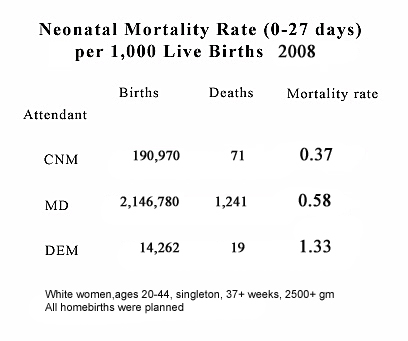
In 2003 the US standard birth certificate form was revised to include place of birth and attendant at birth. That makes it possible to compare neonatal death rates at home vs. in the hospital. The latest set of statistics (2008) have been released by the CDC and can be found on the CDC Wonder website. The statistics from the latest year show what the statistics have shown every year: homebirth with a non-nurse midwife increases the risk of neonatal death.

The beauty of the CDC Wonder database is that you can set the parameters to find specific information and control for various risk factors. Therefore, it is possible to look specifically at white women (almost all homebirths are to white women) ages 20-44, singleton pregnancies, at term (37+ weeks), not suffering from intrauterine growth restriction (2500+ gm). Moreover, because the data are based on who signed the birth certificate, we know that all out of hospital births with a non-nurse midwife were PLANNED births.

This year’s data is shown below:

homebirth mortality CDC 2008

The table shows that the neonatal mortality rate for PLANNED homebirth attended by a non-nurse midwifes (CPM, LM) is 3.5 time higher than comparable risk hospital birth attended by a CNM (certified nurse midwife). In fact, the rate of homebirth death is more than double that of MDs and their statistics include all high risk births.

Keep in mind that these statistics dramatically undercount the real rate of homebirth death. Why?

1. All homebirth transfers are included in the MD numbers. That means that any deaths that occurred after the mother was transferred to the hospital are in the MD group and not in the homebirth group where they belong. This is important because we know that many homebirth deaths occur because even being “10 minutes from the hospital” is not close enough to save a baby in a life threatening emergency.

2. Intrapartum deaths are not included in these statistics at all, because those babies don’t get birth certificates. All those homebirths where dead babies drop into the hands of unsuspecting homebirth midwives (“the heart rate was just fine a minute ago”) are not noted here.

So the real rate of homebirth death could be double or more the death rate of these CDC statistics.

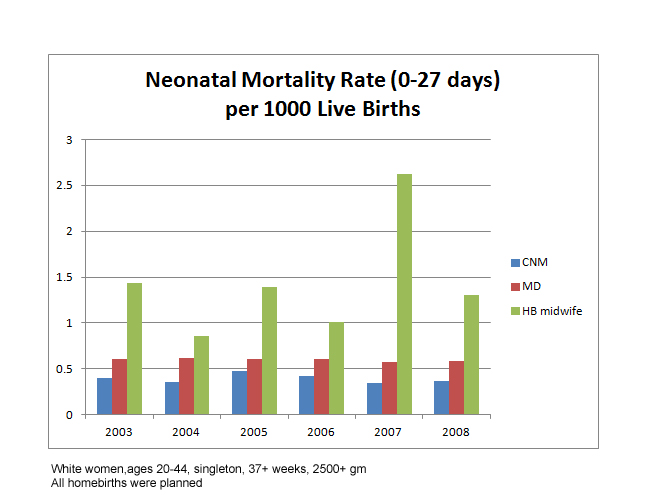
The dramatic increase in homebirth death rates has been remarkably consistent over the years.

CDC statistics homebirth 2003-2008

The consistency over a 6 year period demonstrates beyond doubt that homebirth increases the risk of neonatal death.

No wonder the Midwives Alliance of North American (MANA) continues to hide their death rates. How many of the 27,000 babies in their database of outcomes from 2001-2008 died at the hands of homebirth midwives? They won’t say, but the rate is probably comparable to, or likely even higher than the CDC data.

Homebirth with an American homebirth midwife kills babies. There is simply no question about it. Even the Midwives Alliance of North America knows that this is true. It’s time that American homebirth advocates stopped lying about the safety of homebirth and start doing something to reduce the number of preventable neonatal deaths.

A field guide to natural childbirth quacktivists

iStock_000005384385XSmall

A quacktivist is a person who proselytizes demonstrably false medical claims with cult-like intensity. The anti-vax folks are quacktivists by definition. Jenny McCarthy is a quacktivist and so is Joe Mercola. Andrew Wakefield is a quacktivist extraordinaire.

Natural childbirth is promoted by its own band of quactivist. There are entire organizations devoted to natural childbirth quactivism like Lamaze and ICAN (the International Cesarean Awareness Network).

How do you recognize quacktivists?

Here are a few helpful hints:

1. The natural habitat of a quacktivist is her own blog.

2. Quacktivists almost never stray outside their natural habitat because they are defenseless in the presence of scientific evidence. They never go to mainstream conferences and they certainly don’t attend scientific meetings because quacktivism is threatened by science

3. Quacktivists invite visitors to their natural habitats, but protect themselves from potentially devastating facts by deleting and banning any commentors who dare to question the quacktivist cult.

4. Quacktivists are relentless self promoters. Live blogging your own homebirth is a classic quacktivist move.

5. Ignorance is the main nutrition source for quacktivists. They generally lack even the most basic information on science, statistics, immunology or obstetrics.

6. Quacktivists love “bibliography salad.” That’s a mishmash of scientific citations (often copied from a website or book) that the quacktivist has never read, couldn’t understand if she did read it, and doesn’t say what she thinks it says.

7. Quacktivists have a highly evolved defense mechanism. They are evidence-resistant. Show quacktivists that vaccines have dramatically reduced death and disease and they dismiss it out of hand. Explain and demonstrate that death is a natural part of childbirth and natural childbirth quacktivists question your sources. Point out that their arguments are riddled with logical fallacies and quacktivists have no idea what you are talking about.

8. Quacktivists proselytize. Professional quacktivists proselytize because that’s how they make money. They sell books, sell advertising on their websites, solicit free products in exchange for favorable reviews, and sell bogus “remedies.”

9. Natural childbirth quacktivists are very needy. They hold “conferences” and “work shops” that are nothing more than echo chambers because they need to have their beliefs reinforced by others and cannot tolerate questioning or disagreement.

10. Natural childbirth quacktivists have a further defining feature. They spend an inordinate amount of time accusing those who don’t agree with them of being mean. That’s not surprisingly, really, when you consider that self-glorification is an intrinsic part of quacktivism of all kinds. Quacktivists believe they are in possession of special knowledge that is being hidden by grand conspiracies involving virtually everyone else on the planet.

How do the rest of us protect ourselves against quacktivists?

The best defense is knowledge, the real kind that is a product of college and graduate education, not the pseudo-knowledge found on websites and beloved of every quacktivist. Keep an eye open for the defining signs of quacktivism. Does the “expert” refuse to leave her website except to go to “conferences” of like minded believers? Does she delete comments because they challenge her claims? Does she offer “bibliography salad” to support her claims? Does she insist that anyone who disagrees with her is attacking her? If the answer to these question is “yes,” you know you are dealing with a quacktivist.


Adapted from a piece that first appeared in April 2011.

Pregnancy isn’t a disease … but neither is a gunshot wound and both kill

iStock_000021271577XSmall

I realize that homebirth advocates tend to lack basic knowledge of science, statistics and human physiology. I also realize that they are gullible and easily manipulated by others into believing they are “achieving” something by having a homebirth. That’s why they are so eager to acceept complete and utter falsehoods about childbirth. Nonetheless, there are some falsehood that are so obviously idiotic that I have trouble understanding how anyone could believe them.

Case in point, one of the beloved tropes of the homebirth and natural childbirth movements:

Pregnancy is not a disease.

Evidently this is supposed to invoke the following bit of logic:

Doctors treat disease; therefore, doctors are unnecessary in pregnancy.

There’s just one teensy, weensy problem. Doctors don’t treat “disease” per se; they treat all the human conditions that can result in death, disability, pain and loss of function. Some of those things are diseases, but many are not.

Doctors treat gunshot wounds and they are not diseases, but they can easily result in the death of the wounded person.
Doctors treat car accidents and they are not disease, but they can easily result in the death of the affected individual.
Doctors treat broken bones, and broken bones are not typically caused by disease.
Doctors treat allergic reactions, and they are not diseases.
Doctors will treat you if you are poked in the eye in an effort to save your sight, but getting poked in the eye is not a disease.
Doctors will treat you if you have severe menstrual cramps, but menstrual cramps are not a disease.
Doctors will treat you if you want to control your fertility, but fertility is not a disease.
Doctors will treat you if you want to interrupt and end a pregnancy, but pregnancy is not a disease.

I could go on and on, but I think you get the idea. It is a matter of common knowledge that we turn to doctors for help, sometimes lifesaving help, with many things that are not diseases. Therefore, the fact that pregnancy is not a disease in no way obviates the need for doctors to be involved with it.

What do pregnancy and childbirth have in common with the list of non-diseases treated by doctors.

1. Pregnancy and childbirth routinely kill babies and mothers. Indeed, in every time place and culture, pregnancy and childbirth are a leading cause of death of young women.
2. Childbirth routinely leads to injuries of both babies and mothers. A baby suffocating to death from shoulder dystocia does not have a disease, but it is worthy of treatment.
3. Fecal incontinence from a 3rd degree perineal tear is not a disease, but doctors know how to prevent and treat it.
4. Postdates pregnancy is not a disease, but it does kill babies.
5. Postpartum hemorrhage is not a disease, but it kills many women each year, even in first world countries.
6. Neonatal hypoxia (lack of oxygen to the baby) in labor is not a disease, but it permanently injures and kills babies.
7. Labor pain is not a disease, indeed pain itself is not a disease, just the body’s response to a variety of different stimuli, but that does not mean it isn’t worthy of treatment by doctors.

Again, I could go on and on, but I’m sure you get the idea by now. Claiming that pregnancy is not a disease and therefore should be allowed to proceed unhindered is like claiming that tripping and breaking your femur is not a disease and should be allowed to heal unhindered. In other words, it is pure nonsense.

So the next time someone advocates for natural childbirth or homebirth because “pregnancy is not a disease,” feel free to respond:

“Gunshot wounds aren’t a disease either. What’s your point?”