Category Archives: Uncategorized

Birth: Issues in Perinatal Care, an industry sponsored journal

How would you feel if a widely quoted journal on environmental issues turned out to be sponsored by the Shell Oil? What would you think about a journal on contraception published by the Catholic Church? Would you believe anything in a journal on the public health impact of gun violence published by Smith and Wesson?

I’m going to go out on a limb and guess that you would immediately discount anything in those journals as biased toward whatever improves the bottom line of the business that finances the publication.

That’s why it is important for everyone to know that Birth: Issues in Perinatal Care is also financed by industry. The specific company that sponsors the journal is Lamaze International and the industry is the large, multi-faceted, multi-billion dollar “natural childbirth” industry.

Who is Lamaze International?

Lamaze International, formerly ASPO/Lamaze, is a nonprofit organization whose mission is to promote, support and protect normal birth through education and advocacy…

The description continues:

Since 1960, Lamaze International has provided the most comprehensive and respected education program for Lamaze teachers available. Lamaze’s membership is comprised of 4,000 childbirth educators, health care providers, and parents. More than 10,000 professionals have earned the LCCE credential, and a significant portion of childbirth education classes are taught by Lamaze Certified Childbirth Educators. Among its many services, Lamaze operates the Lamaze Media Center, which offers a wide selection of books, videotapes, audiotapes, and specialty products related to pregnancy, labor, birth, breastfeeding, and early parenting. Lamaze has also established the Lamaze Approved Provider Program, whereby hospitals, birth centers, group practices and other institutional providers are recognized for meeting Lamaze standards and offering excellence in childbirth education.

I don’t know about you, but what strikes me is that there is nothing in this description about health, safety or scientific evidence. That’s hardly surprising since so called “natural” childbirth has nothing to do with health, safety or scientific evidence. Lamaze International is a business devoted to promoting a specific view of childbirth. It is the Amway of childbirth, selling a seemingly endless variety of products and promoting the purported need for those products by training hordes of marketers masquerading as “educators.”

Don’t get me wrong. Lamaze International is perfectly entitled to promote its products, just like the oil and tobacco industry are entitled to support their products. But the rest of us are not only entitled to discount their publications as biased and self-serving, we would be extremely foolish to do otherwise. Similarly, we are not only entitled to ignore Lamaze International publications as biased and self-serving, we would be extremely foolish to do anything else.

That is why it incredibly disturbing that a publication that purports to be a scientific journal is sponsored by industry, in order to create an aura of scientific legitimacy around industry policies, and without regard to what the scientific evidence really shows.

I don’t expect the folks at Lamaze International to be even remotely concerned about the deception involved in an industry sponsoring it’s own “scientific” journal, just as I don’t expect the tobacco industry, the oil industry, or the gun industry to feel bad about deceiving the public through industry produced propaganda.

However, I do expect journalists and others to be very wary of “papers” produced by those journals, and I do wish that the sponsorship of such journals would be displayed more prominently on the journal itself as well as accompanying every citation of a paper published in such a journal.

“Social” inductions improve outcomes

If there is one thing that natural childbirth advocates are absolutely, positively, 100% certain about, it is that “physiological” childbirth is always best. That’s why they are absolutely, positively, 100% certain that induction of labor for “no better” reason than that the mother wants to be induced is harmful.

Therefore, as the evidence mounts that induction of labor is safer than expectant management, there is no one more unwilling to accept that evidence than natural childbirth advocates. That explains why Henci Goer is looking for any possible reason (even a perverse reason) to ignore the findings from a new paper.

The latest scientific paper on the topic was published just last week in the British Medical Journal. Outcomes of elective induction of labour compared with expectant management: population based study by Stock et al. found:

At each gestation between 37 and 41 completed weeks, elective induction of labour was associated with a decreased odds of perinatal mortality compared with expectant management … in the induction of labour group versus 0.18% … adjusted odds ratio 0.39, .., without a reduction in the odds of spontaneous vertex delivery … adjusted odds ratio 1.26 … Admission to a neonatal unit was, however, increased in association with elective induction of labour at all gestations before 41 weeks … adjusted odds ratio 1.14 … (my emphasis)

This echos the findings of Neonatal Outcomes After Implementation of Guidelines Limiting Elective Delivery Before 39 Weeks of Gestation by Ehrenthal et al published in the journal Obstetrics and Gynecology last fall.

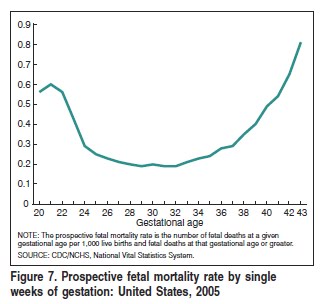
This finding is not unexpected. CDC data shows that the stillbirth rate rises from approximately 3 per 10,000 at 37 weeks to 4.5 per 10,000 at 39 weeks (see graph below).

Early elective induction does increase morbidity (NICU admissions), and proponents of “physiological” childbirth have assumed that we can reduce perinatal morbidity without increasing perinatal mortallity

That assumption in clearly not justified. That’s because low rates of perinatal mortality have been achieved, in part, by exchanging mortality for morbidity. There are fewer deaths when you deliver babies before 41 weeks (even for elective reasons); those babies who otherwise would not have lived experience relatively mild, self limited problems related to borderline prematurity. That appears to be what happened here.

Midwives and natural childbirth advocates are spluttering. It is an article of faith among them that elective induction is bad, bad, bad. As Judith Lothian explains in Saying “No” to Induction:

Saying “no” to induction and to other interventions that are becoming routine takes courage and confidence, as well as the knowledge that women have the right to informed refusal. What women learn from you about nature’s plan for labor and birth, including the beauty of waiting for labor to start on its own and the risks of interfering without clear medical indication, will insure that the women you teach will have the information they need to confidently say “no” to routine induction.

Therefore, it is hardly surprising that they refuse to accept the scientific evidence. Indeed, 1 of the 4 rapid responses to the paper is from a midwifery group desperately trying to deny the findings.

Now Henci Goer has weighed in attempting to criticize the study. Ironically, even if her claims were true, they would argue for MORE inductions of labor, not fewer.

Goer complains that researchers compared women who had purely elective inductions with women who had expectant management. The authors explain how they created the comparison groups.

We categorised the women as having elective inductions if they had no medical indication for induction of labour. The indication for induction of labour is not recorded on Scottish Morbidity Record 02, unlike medical complications of pregnancy. The presence of the following conditions was assumed to confer a medical indication for induction: hypertensive or renal disorders, thromboembolic disease, diabetes mellitus, liver disorders, pre-existing medical disorder, antenatal investigation of abnormality, suspected fetal abnormality or fetal compromise, and poor obstetric history (previous stillbirth or neonatal death). In the absence of any of these conditions being recorded, we considered the induction of labour before 41 weeks to be elective.

Goer asserts, with no data to support the assertion, that the two groups are different:

… [I]nvestigators did not compare similar populations. They isolated a low-risk—I may even say ultra-low-risk—group of women and compared them with everyone else, including women with the high-risk conditions listed above!

In other words, Goer insists that women in the expectant management must have had medical indications for induction and therefore more women in that group SHOULD have been induced.

It’s an absurd argument: If only doctors had induced more women in the expectant management group, the results would be comparable. Duh! That’s the whole point of the paper. Induction improves mortality compared to expectant management!

As a general matter in science, the simplest explanation of findings is usually the best explanation. The authors compared women who were induced without medical indication to those treated with expectant management and found the the induction group had a lower death rate. The simplest explanation is that induction (even social induction) improves outcomes.

Instead Goer reaches for a convoluted explanation: Doctors performed too many inductions in the induction group and not enough in the expectant management group.

Nice try, but not enough. Induction improves mortality rates. How unfortunate for natural childbirth advocates that once again “physiological” childbirth is shown t0 have no advantage over the interventions of modern obstetrics. In fact, “physiological” childbirth actually has a higher rate of perinatal death.

Ina May Gaskin has blood on her hands

Why are reporters so credulous? Why don’t they ask hard question? Why do they fall for smoke and mirrors?

That’s what I’d like to ask the long list of journalists who take Ina May Gaskin at her word and never investigate. Samantha Shapiro is the latest reporter to allow herself to be hoodwinked by Ina May Gaskin in the article Mommy Wars: The Prequel: Ina May Gaskin and the Battle for at-Home Births.

Let’s get something straight: Ina May Gaskin has blood on her hands, and not merely the blood of her own child sacrificed on the altar of homebirth. Gaskin presides over a large multi-faceted business empire comprised of trade, propaganda and lobbying organizations, all with one purpose in mind: allowing uneducated women like herself to provide substandard medical care to pregnant women while ignoring the growing pile of tiny bodies.

In discussing homebirth, there is one question that MUST be asked and answered. How many babies die at the hands of homebirth midwives? As far as I can tell, Shapiro didn’t ask, wasn’t answered, and didn’t bother to investigate on her own.

It’s not like the data isn’t available:

The latest CDC figures (publicly available on the CDC Wonder website) show that planned homebirth with a non-nurse midwife has a mortality rate 600% HIGHER than low risk hospital birth.

Nearly all the existing scientific studies, as well as state, national and international statistics, show that planned homebirth increases the risk of perinatal mortality 3-7+ times higher than low risk hospital birth.

Colorado has had a rate of homebirth death that exceeds that of the state as a whole (including premature babies and women with pre-existing medical conditions) AND has risen in every year since they licensed homebirth midwives in 2006. California has a homebirth death rate that is double that of low risk hospital birth. In Missouri, the risk of intrapartum death at homebirth is nearly 20 times higher than hospital birth. Oregon has received complaints on 19 deaths, nearly 4 times the rate expected in the years the data was collected. And North Carolina is vying to be the homebirth death capital of the US: they had 5 publicly reported homebirth deaths last year for a rate 12X higher than low risk hospital birth.

Studies from the UK show that homebirth increases the risk of poor perinatal outcomes. The data from Australia shows that homebirth increases the risk of perinatal death. The data from the Netherlands shows that low risk birth with a Dutch midwife has a HIGHER death rate than high risk birth with a Dutch obstetrician. There are one or two studies from Canada that demonstrate that homebirth rates can be safe when transfers during labor exceed 40%, a truly massive transfer rate.

The Midwives Alliance of North America (MANA), the organization of American homebirth midwives started by Gaskin, has collected death rates of 24,000 planned homebirths attended by their members. During the years they were collecting that data, MANA told their membership it would be used to promote the safety of homebirth. Once they analyzed the data, they reversed themselves. MANA refuses to release the number of those 24,000 babies who died at the hands of homebirth midwives. It doesn’t take a rocket scientist to figure out that MANA’s own data reveals appallingly high rates of perinatal death.

Shapiro ignores this mass of data. Indeed she never even bothers to look for any data. Instead her piece contains passages that could have been lifted directly from Gaskin’s promotional literature.

To her credit, she acknowledges that Gaskin has no training of any kind, that one of her own children died at homebirth when she refused to seek medical attention for him and that The Farm is a new age cult, but Shapiro gives Gaskin a pass on far more than safety data.

Shapiro does not mention (and perhaps does not know) that Ina May Gaskin is a feminist anti-rationalist. Feminist anti-rationalists dismiss science as a male form of “authoritative knowledge” on the understanding that there are “other ways of knowing” like “intuition.” Many are post modernists who believe that reality is radically subjective, that rationality is unnecessary and that “including the non-rational is sensible midwifery”

According to Gaskin:

… Pregnant and birthing mothers are elemental forces, in the same sense that gravity, thunderstorms, earthquakes, and hurricanes are elemental forces. In order to understand the laws of their energy flow, you have to love and respect them for their magnificence at the same time that you study them with the accuracy of a true scientist.

The invocation of mysterious forces, “energy flow” and intentional biologic processes marks her as a garden variety charlatan. Yet reporters like Shapiro are loathe to question her grasp of medical reality.

How much blood does Ina May Gaskin have to have dripping from her hands before journalists will think to ask about it? How many babies have to die at homebirth before it will cross the minds of Shapiro and her colleagues to investigate Gaskin as the deadly charlatan that she is?

I’m afraid that the only thing that will shake journalists out of their complacency is the death of a celebrity’s baby at homebirth. Sooner or later that is going to happen, and journalists will “discover” that babies have been dying preventable deaths at homebirth all along. Until then, they won’t ask the difficult questions; they’ll simply accept what Ina May Gaskin says and reprint it wholesale.

Should doctors trust patients?

doctor and patient

Yes, you read that right. Doctors often wonder if they can trust their patients.

Most patients want a trusting relationship with their doctor and they assume that the only issue is whether the doctor is trustworthy. However, a lot of the problems in the contemporary doctor-patient relationship stem from the fact that doctors cannot be sure they should believe their patients. Patients insist that they are educated, that they want to manage their care and that they want treatment plan A. Yet when treatment plan A does not work out, they are unhappy with the doctor. He or she should have explained it better or been more aggressive or refused to go along with their plan.

Don’t believe me? Here’s an excerpt article by a professional journalist detailing her years of infertility treatment, Not giving up hope for a biological baby:

My first doctor in Santa Monica, Calif., was thoughtful and attentive, with an Ed Harris sort of look and a kindly, if somewhat passive, approach. The fertility practice he was part of had wonderful nurses, a sleek, minimalist aesthetic and a reputation for a celebrity clientele.

My second doctor was in Arizona, a blowhard with pictures of his success stories (i.e., babies) insensitively plastered on the walls of his tacky Southwest-décor office. (Please don’t make infertile women look at photos of other people’s kids, I wanted to scream.) After keeping me waiting for 45 minutes, his first words on hearing my history with the L.A. doc were that I should have done a single round of IVF instead of the seven inseminations — I would have been more likely to get pregnant, he said. Very helpful, I thought, since I can’t actually turn back time. I disliked him immediately.

But who do I think was the better doctor for me? Probably Dr. Arizona. The truth is, in retrospect, I should have had a doctor who was much more aggressive. Though I had no history of any sort of physical problem, I believe I should have started drugs much sooner, and my L.A. doctor should have tried to make a case for IVF rather than simply swallow my (admittedly defiant) declarative that I would not do anything high-tech…

I said I’d never do IVF. Never. That was when I was 37, when it wasn’t so much that I had hope as that I had no doubt that this would work. It wasn’t even a question in my mind…

So the patient ignored the advice of her doctor and told him that she would not follow his recommendation ever, under any circumstances. Instead she asked for, and received, the treatment that she wanted.

She was wrong. Now she knows that, but her doctor knew that at the time. In retrospect, does she blame herself? No, her doctor should have been “much more aggressive” and he should have argued with her rather than “swallow” her clear, unambiguous refusal to accept his treatment plan. At no point does it occur to Ms. Parch that this is her fault and that she bears sole responsibility for what happened.

These situations happen quite often. Patients make demands or refuse treatments because they believe that they are “educated” about their options and they are in the best position to decide what is most likely to work. Now just imagine the same situation playing out with a baby’s life at stake. The doctor recommends a C-section or an induction and the patient refuses. Should the doctor just accept that refusal? What happens when the baby is harmed or dies? Typically what happens is that the patient blames the doctor in exactly the same way that this journalist blames her doctor. She refuses to accept responsibility for the results of the decision that she made.

Patients complain that doctors do not respect their decisions, but how can you respect a decision if the patient refuses to take responsibility for it?

This piece first appeared in September 2009.

Surprise! Banning deliveries before 39 weeks isn’t such a great idea after all.

I’ve written repeatedly about the foolishness of a “hard stop” policy banning elective deliveries (by induction or scheduled C-section) before 39 weeks. In Oops, reducing early elective delivery leads to more deaths, I reported on a paper that demonstrated that:

… The reduction in early elective delivery reduced NICU admissions, reduced both the induction rate and the C-section rate, and … presumably reduced costs. However, these benefits were achieved at a very steep price. The stillbirth rate increased from 2.5 to 9.1 per 10,000 term pregnancies. Instead of 3 stillbirths between 37-39 weeks among 12,000 patients, there were 11 stillbirths between 37-39 weeks among a similar number of patients after reduction in early elective deliveries.

You didn’t need a crystal ball to realize beforehand that a reduction in early elective delivery will INEVITABLY lead to an increase in perinatal deaths. Based on everything we know about stillbirth at term, any reduction in morbidity due to delivery before 39 weeks will INEVITABLY be accompanied by increasing mortality.

It appears that even the prime movers behind a “hard stop” policy banning early elective deliveries have finally realized their mistake. In a paper aptly entitled Oversight of elective early term deliveries: avoiding unintended consequences, authors Clark, Meyers and Perlin recognize that they embraced a “hard stop” policy without thinking through the consequences. Of note, the authors are employees of the Hospital Corporation of America, and a major motivation behind the policy was an effort to reduce short term costs.

… The position of the Hospital Corporation of America, as a primary driving force behind these changes, and our experience with such care improvement efforts in well over 1 million deliveries during the past 5 years suggest some areas of significant concern in the implementation of this policy and a number of practical remedies. A review of these issues may assist interested parties in helping patients reap the benefits of this practice change, while avoiding the associated perils.

The first problem with the policy is that many people have deliberately misinterpreted it as a ban on any deliveries before 39 weeks. The authors are at pains to clarify that the policy ONLY applies to a subset of early deliveries, those undertaken for purely social purposes:

It cannot be over emphasized that the campaign to reduce early term deliveries applies only to purely elective procedures. In this discussion, elective refers only to those scheduled deliveries that are performed without a valid medical indication. Many clinical conditions exist in which the well-described risks of early term or even preterm delivery are outweighed by the benefits of delivery to mother or child… Our concern is that a misinterpretation both of our policies and of the nature of our specialty’s opposition to purely elective early term deliveries may result in inappropriate reluctance to deliver women who are at risk for serious complications…

Bans on early elective delivery are meant to reduce perinatal morbidity, but NOT at the expense of increasing perinatal mortality:

… Accepting the risk of such morbidity in select individual cases in which the dangers of continuing the pregnancy because of valid medical complications is significant is often the best choice. Thus, it is incumbent on any entity that promotes a reduction in early term delivery to make it clear that the target practice is early term delivery without medical indication, not generic early term delivery, and that occasional indicated early term or preterm delivery remains an important part of good obstetric care (my emphasis).

The authors had previously recognized the importance of early delivery in a variety of situations, and had attempted to create criteria to differentiate between indicated and unindicated early deliveries. They now recognize that their criteria are not based on hard data.

… How close must the blood pressure be to 160/110 mm Hg level to justify delivery at 37 weeks gestation or even before? How poorly controlled must the diabetes mellitus of a noncompliant patient be to justify delivery at 38 weeks’ gestation? In the absence of hard data to guide the clinician, physician judgment and informed consent will continue to play a major role in such cases. Any facility that uses the “hard stop” approach must have in place the availability of an easy-to-access chain of command 24 hours a day to resolve such issues.

And:

… [I]t is critical to realize that, because the Joint Commission definitions for indicated early term deliveries are based on diagnosis-related group (DRG) codes and because many valid indications for early term delivery exist that do not have such a code, the rate of “elective” early term delivery for any institution will never be and should never be consistently zero. There is no code for a multiparous woman whose most recent labor lasted 10 minutes and who lives 1 hour from the hospital. Yet, when that patient is seen at 37-38 weeks’ gestation with a cervix that is dilated 4 cm, delivery is clearly indicated, not elective. Similarly, there is no DRG code for “history of a classic cesarean section delivery,” yet such women should be delivered routinely at <39 weeks' gestation. Numerous other examples exist.

In other words, “soft” indications, comprising borderline cases and based on the clinical judgment of the obstetrician, are real indications. I’m glad that the authors acknowledge this, but their recommendations for addressing it are poor. There should no barriers to clinicians exercising their judgment, and calling for permission is a barrier. Rather, clinicians should have to justify their decisions retrospectively, presenting evidence to other obstetricians as to why they felt the early delivery was indicated.

Finally, the authors address the “elephant in the room,” the insurance companies who push for short term savings at the expense of infant lives:

… Although a retrospective review of early term deliveries with nonpayment for those without a valid indication has been proposed, the aforementioned discussion suggests that this is a particularly bad idea, with the potential to promote bad practice and catastrophic outcomes… [N]o evidence exists to validate the appropriateness of off-site, post-hoc reviews to determine payment when dealing with deliveries that possibly were elective… Knowledge of the potential for such oversight error and its associated financial penalties establishes for the clinician and facility a perverse incentive to delay delivery when delivery may be in the best interest of the mother and baby, with potentially catastrophic results…

The authors insist that they still support a “hard stop” policy:

… The observations presented here do not represent any weakening of our commitment to the elimination of elective deliveries at <39 weeks' gestation.

However, their caveats belie their claim and they ought to change their terminology to reflect that. They should make it clear that they are talking about purely social indications by explicitly naming the policy a ban on purely social indications for early deliveries. Elective early deliveries for ANY other indication, including soft indications, are necessary, often life saving, and should not require permission.

What’s the difference between smoking in pregnancy and homebirth? Smoking is safer.

I have a question for homebirth advocates.

Imagine this scenario:

A woman, after reviewing the evidence from both sides, after carefully considering the increased risks, and after deciding that she is willing to accept the responsibility for the outcome, decides to … smoke cigarettes during pregnancy.

This situation happens all the time. In 2012, just about everyone knows that cigarette smoking increases the risk of pregnancy complications. However, smokers will accurately point out that most women who smoke during pregnancy do not have smoking related complications, that smoking provides both pleasure and concrete benefits such as relaxation and increased concentration, and that women are entitled to make healthcare choices about their own bodies. In addition, there are scientists who assert, and who have testified under oath, that the harms from smoking have been dramatically exaggerated.

So if a woman claims to have made a knowledgeable decision to smoke cigarettes during pregnancy, and is aware of the potential consequences, does that mean it’s okay for her to smoke during pregnancy? Would you support her in that decision? Would you admire her for doing her own “research” and refusing to simply follow her doctor’s advice? Would you consider her brave and clever for listening to tobacco executives instead of her doctor? Why not? After all, the increase in perinatal mortality attributable to smoking in pregnancy is less than increase in perinatal mortality attributable to homebirth.

According to Adverse health effects of prenatal and postnatal tobacco smoke exposure on children, Hofhuis et al., Arch Dis Child 2003;88:1086–1090:

Smoking during pregnancy may be responsible for … a 150% increase in overall perinatal mortality.

Compare that to the overall increase in perinatal mortality attributable to homebirth of anywhere from 200% – 600% (latest CDC figures).

Consider the arguments:

The absolute number of deaths is relatively small since the US perinatal mortality rate is relatively low.

A woman has a right to control her own body. If she’s willing to accept the increased risk associated with smoking for both herself and her baby, no one should prevent her from doing so and no one should condemn her for her decision.

Smoking provides benefits like relaxation, pleasure and increased concentration on a day to day basis. Giving up smoking would mean hardship for 9 full months, whereas, for those who find hospitals unpleasant, giving birth there lasts a day or two at most.

Doctors don’t know everything. They play the dead baby card all the time when it comes to smoking and pregnancy, yet the overwhelming majority of women who smoke during pregnancy have babies who are completely healthy.

Tobacco is natural. It’s a plant just like the herbs given out like candy by homebirth midwives.

There’s more to pregnancy and birth than a live baby. The mother’s experience is important, too.

The bottom line is that every argument advanced in support of homebirth can be used to justify smoking in pregnancy. So I’m looking forward to homebirth advocates explaining to me why risking a baby’s life by smoking during pregnancy is anathema, but risking a baby’s life at homebirth is something to brag about.

6 homebirth deaths, endless regrets

It’s not surprisingly that as homebirth edges into the mainstream, we are seeing an increasing number of homebirth deaths, almost all of which are preventable. But even I am shocked at finding 6 homebirth loss mothers in one place. Their stories are a cautionary tale for anyone who likes to pretend that homebirth is safe or that homebirth midwives are remotely qualified.

Consider:

1. Dejah

… The decision to have a homebirth is not one I made lightly.

A part of me wants to focus on the politics of homebirth, to whip out a bullet list of why I chose homebirth for my second pregnancy. Why it was the safest choice for me, and why my care was better than anything I could have received in an OB’s office.

And another part of me wants to describe what I felt during the car ride to the hospital – the 10 minutes-away-We’ll-get-there-in-plenty-of-time-if-any-issues-arise hospital – after my baby’s heartrate dropped suddenly during labor…

And I want to describe what it like upon returning home from the hospital after my daughter, Sunrise, was stillborn, to the place where everything had been set up for her arrival. It felt like a tomb…

But most of all, I want to describe the look that I noticed when people learned my daughter was stillborn. It was a look that said, “Of course your child died. You planned a homebirth.”

2. Laura

I can identify with what you are going through. We chose a birthing center with midwife care for the birth of our first child. I have a million reasons why I made that decision, but now they seem less important than they once did. We were transferre to the hospital, and at this point we still thought everything would be okay. It wasn’t. I will always wonder if we’d been in the hospital the whole time if they would have noticed her drop in heartrate faster, and gotten her out faster, and if she’d be okay. I feel like everyone is judging me and my decision, as though I wouldn’t have made the best possible choices for my child. But this birthing center and midwife had never lost a baby before my daughter.

3. Merry

I chose a vba3c for Freddie. I knew the risks and I knew they were slight. I didn’t rupture, I was monitored, he seemed fine, there was no meconium, no heartbeat drop, no signs of distress. No obvious cord trauma even. But he was critically low on oxygen when he was born and didn’t breathe…

4. Lisa

… [M]y daughter was born at home, [but] the complications that arose following her birth were devastating and I came home without my daughter too, to the room that she was born in, with everything there… but her. I have also seen the ugly face of homebirth advocacy that wants to make us the exception, and an excusable exception…

5. Megan

Today last year my son Titus died in the last minutes of childbirth at home due to a severe shoulder dystocia. He was stuck very bad and his chord was being pinched. The midwife could not get him out in time. The ambulance and emt’s were there in minutes but he could not be resesitated. I rarely tell people we had a home birth because in their minds it is my fault. After we lost our son, my own father called and used the words, “I tried to warn you.” I even got a nasty letter from my grandma. People have no idea how this adds to our grief. I blame myself every minute of everyday and I do not need people to add to that burden. I woke up this morning on his first birthday in the bed I labored and gave birth to him in, but never nursed him or held him alive…

6. Jeanette

My youngest daughter was born at home after a perfectly normal, robustly healthy pregnancy, and a pretty darn fab labour and delivery, but she collapsed shortly after birth and died in the hospital six hours after she was born. Everyone involved agreed that she would have died no matter where or how she was born, (and we had an official investigation including detectives and the coroners office.)

Still, though, despite that, there are those that have said that they would never consider a home birth because of what happened to Florence, there are even family members who have mentioned to us how unsafe they thought home birth was. People still think we messed up…I don’t know how to correct them, and I’m hurt and insulted by them.

Florence’s birth was perfect, and it gives me peace to know she was born at home, caught by her Daddy and loved. I just wish it could’ve been for a longer life time.

And this:

Jocelyn

… While homebirth was not an option for me (it is illegal for midwives to attend homebirths in my state), I very much desired a natural birth with my first child, a son, Everett. I read and researched, and decided that avoiding induction was my best choice for avoiding an induction [sic], and to that end, was 40 weeks 5 days when I learned my sweet boy had died inside of me. I felt (and still feel sometimes) so foolish and stupid for letting my pregnancy go so long. I had been so confident in my body’s ability to birth my child; I felt humiliated and like a failure when he died. If I had just induced at 39.5 weeks like so many others do, my boy would probably be here today …

In each case, “trusting birth” led to a dead baby. For women contemplating homebirth, ask yourself:

Is my birth “experience” worth the life time of this kind of searing pain, heartache and endless regrets?

Six ordinary women accepted the mistruths, half truths and outright lies that characterize homebirth advocacy and paid for their gullibility with their babies lives. A seventh believed that it was more important to avoid a C-section than to have an induction and her baby died, too.

Choose homebirth, and that could be you.

Correction: I received an email that Merry’s son Freddie was born in a hospital. I was able to find her blog and read the birth story. As far as I can determine, she chose a provider and hospital willing to support her decision for a vaginal birth:

This is the story of Freddie’s birth, one of the most amazing experiences of my life. It is also, sadly, the story of the first of his 11 days of life. His birth was, I believe, a successful VBA3C. You have to decide for yourself whether successful is the right word…

What I will never know, what is really cruel, is I don’t know whether he would be alive if I’d had my ‘easy option’ elective section a week earlier. That is very hard. I’ve been told that had that been my first labour, there would have been no question of anything but a natural delivery – but he wasn’t my first and I had a choice. And maybe, I don’t know, maybe I made the wrong choice. I just don’t know. I don’t think so but I can’t ever know.

Whom to trust on medical issues: doctors or everyone else?

I recently came across an excellent paper on the vaccine-autism debacle. The paper is Sick With Fear, Popular Challenges to Scientific Authority in the Vaccine Controversies of the 21st Century. The paper was recently presented at a conference on health policy and won a prize for original research. Amazingly, it was written by an undergraduate.

The paper is terrific on many levels, but the part I found most interesting was Watkin’s explanation of why people are more likely to accept medical information from lay people than from actual medical experts. She’s talking about the vaccine-autism misinformation, but it applies equally to natural childbirth and homebirth, indeed almost every aspect of pseudoscience in medicine:

When dealing with such elusive issues, who can one trust? Doctors? The government? Friends? What is interesting about the vaccine-autism controversy of the last 30 years is the public’s faith in anecdotes and word-of-mouth. Searching for confirmation of their fears, Americans willingly believed the fear mongering of stricken mothers and celebrities, and ignored the mountain of research published in the scientific community…

Why? Watkins suggests that it has to do with Americans’ lack of understanding of science, primarily the result of:

… the poor quality of science education in America. American science education is embarrassingly weak: according to the Third International Mathematics and Science Study, American students rank below their counterparts in 17 other countries, and the National Science Teachers Association reported in 2003 that barely a quarter of high school graduates scored high enough on the ACT to succeed in a first-year college science course…

That leads to the “othering” of scientists:

Without satisfactory science education, the scientific community becomes inaccessible and elite. In America, there is a great deal of “othering” of scientists and experts because Americans are not educated enough to feel confident in scientific circles. Americans were willing to turn against the scientific community in the vaccine controversy because there was already distance established between experts and average Americans… (my emphasis)

Moreover, the average person, lacking understanding of science, relies heavily on journalists:

Because the majority of Americans are scientifically illiterate, news outlets are how most people learn about scientific breakthroughs. News outlets, however, do not always bear the duty to report the facts responsibly…

The quest for journalistic “balance” has contributed to the widespread misunderstanding of scientific issues:

[A] flaw in the relationship between science and journalism is the philosophy that there are always two sides to a story. Scientific evidence formed a bounty of evidence against the claim that vaccines cause autism. Regardless, Rolling Stone still published Kennedy’s article on the “other side” of the controversy in 2005 (an article so flawed that Salon.com, who posted it online in tandem with Rolling Stone, removed it from their archives in 2011). In cases like the vaccine debate, there is only one side. The stories of mothers’ woes and vague suspected corruption are not valid arguments to counter experimental data and research. By representing “both sides,” the popular media led the public to think there was room for doubt about the issue.

These same problems contribute to the widespread, but totally erroneous beliefs in the purported superiority of natural childbirth and the purported safety of homebirth. Far from being “educated,” the average NCB or homebirth supporter doesn’t understand enough science to accurately evaluate the information. Most advocates don’t know any obstetricians personally and are therefore easily susceptible to conspiracy theories about them. Finally, irresponsible journalists (like those at Consumer Reports) present the “other side” of the overwhelming scientific evidence in support of the liberal use of interventions in modern obstetrics.

The story of NCB and homebirth in the US, like the story of the vaccine debacle, is not about science. It’s fundamentally about ignorance of science, bias against scientists, and a mainstream media that is more concerned about writing “balanced” articles than about presenting the truth.

What to reject when you’re expecting? Consumer Reports

image

What’s next Consumer Reports? An evaluation of the Prius by the oil industry? How about an exposition on lung cancer by the tobacco industry? Maybe a review of breast implants by the silicone manufacturers of America?

Any of those would be appropriate after the “evaluation” of modern obstetric practice by the natural childbirth industry.

The recent piece What to reject when you’re expecting was copied wholesale from the promotional literature of the multi-billion dollar natural childbirth industry whose primary product is doubt about modern obstetrics.

The piece is filled with mistruths, half truths and outright lies, but what else can you expect when you ask industry to write about the competition? Just about every word in the piece is factually false, with the possible exception of “and” and “the.”

Consumer Reports should be profoundly embarrassed, not merely because they repeated lies, but because of the “sources” they used.

Consider their “general resources”:

Baby Friendly USA – a lactivist group.
Centering Healthcare Institute-a group that promotes multiperson medical appointments .
Childbirth Connection – the premier lobbying organization for the natural childbirth industry.
Health4Mom – a consumer site.
March of Dimes- an organization struggling to maintain its relevance in a world where polio is being driven out of existence.

Notice anything missing? There’s nothing from OBSTETRICIANS. You remember them: the people who actually provide obstetric care.

And that’s why the piece is filled with misinformation. There are so many egregious errors that it is impossible to detail them all.

Consider the first paragraph:

Despite a health-care system that outspends those in the rest of the world, infants and mothers fare worse in the U.S. than in many other industrialized nations. The infant mortality rate in Canada is 25 percent lower than it is in the U.S.; the Japanese rate, more than 60 percent lower. According to the World Health Organization, America ranks behind 41 other countries in preventing mothers from dying during childbirth.

1. Infant mortality is the wrong statistic. It encompasses deaths from birth to one year of age and is a measure of pediatric care. According to the World Health Organization, perinatal mortality (late stillbirths+deaths from birth to 28 days) is the best measure of obstetric care, and according to the WHO, the US has one of the best perinatal mortality rates in the world. [Neonatal and Perinatal Mortality Country, Regional and Global Estimates, World Health Organization, 2006]

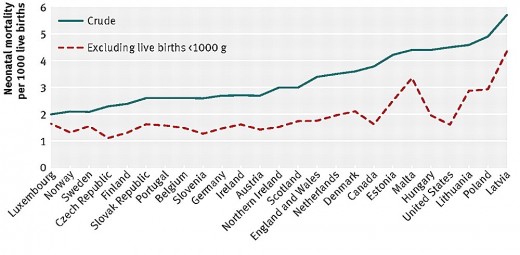
2. Inter country comparisons of infant and neonatal mortality are invalid because many countries exclude premature babies from their statistics. This is a deliberate attempt to artificially improve mortality statistics because the gullible, like the folks at Consumer Reports, aren’t even aware of the manipulation.

Here’s a handy chart that illustrates the manipulation:

image

The top line represents crude neonatal mortality rates ranked in rising order. The bottom line represents corrected rates. Note that after correction, instead of the US having the highest rate of neonatal mortality, it has one of the lowest rates. [Influence of definition based versus pragmatic birth registration on international comparisons of perinatal and infant mortality: population based retrospective study, BMJ 2012;344:e746]

3. Most of the purported “increase” in US maternal mortality is accounted for by expanding the definition of maternal deaths to include more conditions and a longer post deliver time period (up to a year). Those changes in definition occurred in 1999 and 2003. [Changes in Pregnancy Mortality Ascertainment: United States, 1999–2005, Obstetrics & Gynecology: July 2011, Volume 118, Issue 1, pp 104-110]

image

4. African descent is one of the biggest risk factors for infant/neonatal/perinatal mortality as well as maternal mortality. Most of the countries that do better than us on international rankings are “whiter.” Japan, for example, has the lowest proportion of women of African descent among the countries that purported rank higher than us in mortality statistics, while the US has the highest of any first world country.

In other words, the entire premise of the article, that the US outspends other countries but has poorer obstetric outcomes is flat out false. But that’s not surprising. The natural childbirth industry has been parroting this falsehood for years. What is surprising, and disappointing, is that Consumer Reports fell for a series of self-serving lies.

Unassisted birth: surprise second twin suffers brain damage

Is there anything more selfish and self absorbed than planning an unassisted homebirth? It’s hard to imagine that there is.

This mother, like all mothers who plan a UC (unassisted childbirth) is criminally negligent, and ought to be charged.

According to the local paper:

The Wood brothers from Rensselaerville both work EMS for the Albany County Sheriff’s Office. They were the first and second people to arrive at a home after a call came in about complications during a home birth early Monday morning.

Brian Wood, the unit coordinator, says the mother and her husband had a planned home birth. The mother first delivered a healthy baby girl, but shortly afterwards the mother was on her way to the bathroom when she started to deliver a second baby. She told EMS she didn’t realize she was pregnant with twins.

That baby was not breathing and had sustained other complications during delivery. Records from the sheriff’s office show the baby was born without a heart beat.

The mother shared the story on Mothering.com under the absurd title, 4th UC, unexpected twins (warning: transfer). A baby was born without a heartbeat and appears to have suffered permanent brain damage and this self absorbed narcissist thinks the traumatic part of her story is the hospital transfer.

Short story – this was my 7th pregnancy, after three UCs and three miscarriages. It’s been a tough pregnancy, with a lot of early bleeding. I found a local midwifery firm to do a “non-diagnostic” ultrasound at 24 weeks to rule out twins. They could only find one. As I run a small store and am constantly with lots of people, there was lots of remarks about my size. In hindsight, I probably should have tried to get another ultrasound.

No, in hindsight, and in foresight, she should have had prenatal care from an obstetrician or certified nurse midwife.

I’d been having gentle prelabor for about a month, when I decided last Sunday that this was the real thing. Once we got home, though, it wasn’t really progressing, and I felt comfortable enough to go to bed. Slept for about two hours, finally got up again around 2:30, clearly in active labor…

About 45 minutes later … I sat down on the toilet and my water broke. I reached down and caught a small butt, with two legs to quickly follow. One more push and my daughter was out, pink and crying. Yelling for my bewildered husband, I headed to our living room. Easiest birth ever …

Sure, that’s because she trusted birth and trusted her mommy intuition. Wait, what?

… I was a bit surprised that my placenta didn’t arrive. An hour passed, then an hour an a half and the afterpains I thought I was feeling magnified. Finally, again on the toilet, I tried pushing a little and something popped and lots of clear fluid poured out. Starting to worry a bit, I reached up and felt another butt, then legs slipped out. And then stopped. I screamed for my husband that there was another baby. I tried again to push his head out, but nothing happened. I changed positions, while my husband called 911, and tried pushing again…

The ambulance arrived:

My son was not breathing, and not responsive, but was pink and looked good. I started rescue breathing – and the paramedics arrived. Literally, I think it was no more than 10 minutes from the time we realized we had another baby coming and their arrival. They immediately got a heartbeat, and intubated him…

The mother was transported to the hospital, too, for excessive bleeding, and promptly signed herself out AMA (against medical advice).

… This has to be one of the worst experiences – so see your newborn covered in tubes, on a ventilator, unresponsive. We were grateful that he was stable, at least.

How about guilty it was all your fault?

Because of the prompt response on the skill of the emergency responders, the baby will soon be well enough to go home, but he is not unscathed.

We had a discharge plan for Friday – they had taken him off the Phenobarb and everything had been completed except for a final EEG. As it turned out, the EEG was deemed abnormal, so they have him back on Phenabarb, and have renewed their insistence that he is at risk for seizures…

So, I’ve been spending lots of time with his twin camped out in NICU, nursing and pumping for him. I agreed to bottle feed for several feedings a day, with a formula supplement added to help him gain weight. Anything to get him home…

He’s still a lot sleepier than his sister, which concerns me…

Now she’s concerned? It would have been a lot more helpful, and far less traumatic for everyone if had put her babies’ wellbeing ahead of her bragging rights and delivered with an obstetrician or CNM in a hospital.

Like most mothers who have, through their own negligence and ignorance, allowed their own babies to be injured or killed at homebirth, she is aggressively ignoring the important things and obsessing about the trivial. She’s more concerned about the sedation from the phenobarb than the seizures from the brain damage. She’s more concerned about his ability to breastfeed than about the handicaps he is likely to face.

The worst part, though, is that it is so unnecessary. We live in a time and place where birth injuries can be prevented and yet some women are so blindingly stupid and self absorbed that they think their “birth experience” is more important than their babies’ brain function or even their very lives.