Category Archives: Uncategorized

Pediatric ER Doc: homebirth 5 minutes from the hospital isn’t close enough

The following is a guest post written by a pediatric emergency medicine physician practicing in the United States:

I am a Pediatric Emergency Medicine doctor. I am also the mother of two children. I work in a hospital that has a pediatric emergency department that treats only children and is distinct from a general ED that sees all ages. My job is to take care of any and every ill kid that comes through the door.

I’ve taken care of my share of brain damaged children who were deprived of oxygen at birth (from a variety of causes). I also attended hundreds of births, including a few in the Emergency Department. When something is going wrong or anticipated to go wrong during a birth, the OB or midwife calls the Pediatrician (common examples are meconium stained fluid or fetal distress) to care for the baby on its arrival. The problem with birth is that, when things go wrong, they can go wrong VERY VERY fast. Everything can be rosy one minute and then all hell can break loose even with a very low risk birth and a completely healthy mother.
Unlike many doctors, I don’t believe that all homebirths are necessarily a bad idea. I believe that adults should be able to make their own decisions regarding their medical care, even if I disagree with them. HOWEVER, I believe that the parent(s) need to know and understand the risks of birth at home. And those risks include death, severe injury, death, catastrophic injury, and did I mention death? This is not a scare tactic. This is reality.

One common thought is that being “five minutes” from a hospital means that you can go from realizing there is a problem to baby out and alive in five minutes. Many people talk about emergency caesarian section as if it is 5 minutes from “decision to incision” (aka: the baby is out in 5 minutes). I have seen and participated in the “sprint down the hall” c/s before and they go FAST (as quickly as 60 seconds from cutting the mother’s skin to baby out and on the resuscitation table). However, that is with a mother who is already IN the hospital. This would be a more likely scenario at a few different hospitals from the “decision”:

Pre-hospital care:

If you’ve called EMS, assume that it will take 10 minutes for them to get to your house, 5 minutes to “scoop and run”, and another 5 minutes to get to the ER (flashing lights and screaming siren the entire way). Your average Paramedic is fast and efficient. They will likely start an IV en route and in a healthy young adult with normal veins, it is easy to do. But some ambulances do not have paramedics and only EMTs. This is much more common in rural areas and volunteer squads. An EMT usually cannot (per protocol) start an IV or give medications (I volunteered as an EMT prior to becoming a physician), but they can provide oxygen via a face mask. So the ambulance option is approximately 20 minutes if you are “five minutes away”.

Arrival at the hospital:

1. Large teaching hospital ED (common in a large metropolitan area): If you’ve called EMS, they may have called in to let us know what to expect and we have called a “Code White” (OB emergency) and the OBs are sprinting to the ED. But sometimes the radio connection is spotty and this message is not relayed. If you drive yourself or take a private vehicle, it is maybe 5 minutes to load the car, then 5 minutes to drive (so only 10 minutes), but we have no advance warning and the OB team will not be there waiting for your arrival.

You arrive in the ER. If we are aware that you are coming, an entire team descends upon you in our resuscitation room, placing IVs, hooking up monitors, trying to get the story and your history. Someone will need to diagnose the problem. Likely someone uses the portable U/S machine to check your baby (unless he/she is crowned or head out, then we try to get the baby out and/or go to the OR). I’d estimate that this would take AT LEAST 10 minutes. If we have no warning (private vehicle), you will go to the triage area first (yes, even if you are bleeding and screaming in pain). Likely, you will be whisked back to the resuscitation bay, but it adds yet more time to the clock.
Keep in mind that we do not know you or your history (past medical problems, allergies, medications, etc). The goal of the ED team is to save YOU. Your baby is secondary because if you die, the baby will likely die as well. Even the best team is going to take an additional 10 minutes after you arrive to have you prepped and in the OR for an emergency c/s (that’s with a rapid intubation and general anesthetic and an OR that is prepped and ready to go). So let’s say best case scenario from “decision” to “baby” is 45min and likely much longer.

2. Large teaching hospital OB ED: Some hospitals have a separate “Obstetrics ED”. In our ED, we stabilize the mother and transfer her to this part of the hospital. That is IF YOU ARE STABLE. A baby who is crowned or partially out is NOT stable and the mother stays in the ED. In the OB ED, similar things happen as above except that all the docs are OBs and (sometimes) Peds. Their OR is specific to the delivering mother. They see emergencies like this more often, so I’d estimate that they’d be able to do everything within 30min of your decision to transfer in an absolute best case scenario (staff waiting at the door, fully staffed and open OR, Peds team in place, etc).

3. Community hospital ED – the VAST majority of the hospitals in the US: only an ED doc is on duty (sometimes a Pedi ED doc if there is a separate Pedi ED, but VERY unlikely). The OB and the Pediatrician take emergency call from home and are usually required to live within 30 minutes of the hospital. Several of my Pediatrician friends work at community hospitals like this.

After you arrive (15-30min) from your “decision”, the OB and Pedi are called. An ED doc does NOT do a c/s (unless mom is already dead, called a “peri-mortem c/s”). I probably could try, but that would ONLY be if you were dead and your baby was alive. Even then, I doubt I would be able to do it and keep my job.
Assume that the ED doctor has been able to deliver your baby, keeping in mind that most of them have only delivered a few dozen in their lives, likely during training years or decades prior. Often there is only one ED doctor at a time working, so the focus is split between you and the baby. ED doctors can intubate (put a breathing tube in) anyone, but s/he may not have intubated a newborn since s/he was in school. And newborns are VERY different than adults and even children. I’ve put breathing tubes in babies weighing less than one pound, but I’m still at least 15 minutes away.
Most ED doctors are trained in PALS (pediatric advanced life support), but NRP (neonatal resuscitation program) is usually not required. It is not even required of me, and I only see children (unlike a general ED doctor). Most ED nurses are EXCELLENT, but they haven’t done NRP either… So you have maybe one hour between decision and OB/Ped arrival. And that doesn’t include time to transfer to a high level NICU (not found at most community hospitals).

So let’s say very very conservatively that it will take at least 30min from “decision” to “baby” (and more likely up to an hour or more). My question is: how long can your baby hold his or her breath?

We ask mothers the wrong questions

On this Mother’s Day, as the mother of 4 children who are in college (one just about to start), graduate school and out in the workforce, I am struck by the fact that we are obsessed with the wrong questions. We ask of other mothers:

Do they breastfeed?
Did they have natural childbirth?
Did they have vaginal deliveries?
Do they use cloth diapers?
Do they have a family bed?
Do they “wear” their babies?

I can assure you that my children could not care less about any of these aspects of their childhoods. They have never asked, never praised or complained, never expressed any interest at all.

In truth, we already know how meaningless these questions are. Think of your own mother. Is your relationship loving, fraught or both? Does the quality of your relationship have anything, anything at all, to do with how she parented you when you were an infant? Or does it depend on how she treated you when you were a child, a teenager, an adult? Do you even know if and how long she breastfed you, if she used cloth diapers, whether she “wore” you? Do you care? Or do you care far more about whether she accepts you for who you are, and does not try to change you into who she is?

Let’s stop asking questions about our mothering that don’t matter and start asking the questions that do matter:

Do you love your children?
Do you let them know it?
Do you accept them for who they or do you try to change them into who you want them to be?
Do you acknowledge and praise their interests, strengths and talents or do you try to channel them toward your interests and talents?
Do you recognize their learning and personality challenges and help them meet them?
Do you spend the time and effort to properly discipline your children so they show kindness and consideration to others?
Do you expect (and provide support if necessary for) them to reach their full academic potential?
Do you provide support and encouragement for them to pursue the sports and hobbies that they want to pursue?
Do you get to know their friends?
Do you accept their choices in lifestyle, marriage, parenting, even when those choices differ from yours?
Do you recognize that they are people, different and separate from you and treat them with the respect that all people deserve?

Let’s stop asking the wrong questions and start asking the right ones. It makes absolutely no difference to our children how we answer the wrong questions (that’s why they are the wrong questions), but it makes all the difference in the world how we answer the right ones.

Are you Mom enough?

Time Magazine asks if you are Mom enough,

There’s only one way to find out …

Ask your children when they are adults.

In the meantime, I propose a new rule for attachment parents:

Don’t boast about the wisdom of your parenting choices until your children grow up and we can judge the results for ourselves.

Don’t want to be a birth visionista? How about a shamanic midwife?

Last week I shared the exciting possibility of becoming a birth visionista.

It’s a school for birth visionaries! So I thought, as I’m sitting there taking a shower, I’m like, “I wanna do a bootcamp! I wanna do a bootcamp for all of you birth workers who wanna be visionaries and want to step into that. You are a birth visionary already, you probably know it. But are you really, really incorporating that into your everyday birth worker life? That’s what I’m gonna be asking you, that’s what I’m going to be asking you to reflect on, and also begin to learn empowerment tools.

But perhaps the $697 fee to become a Fear to Freedom™ Birth Facilitator is a little steep for you. Don’t worry, you can attend The School of Shamanic Midwifery instead!

The School of Shamanic Midwifery (SSM) is a Women’s Mysteries School for midwives and doulas, a gathering of wise women, a year long Earth based ‘religious’ experience. It will awaken in you a deeper connection to the cycles – the way of life – and enable in you a range of ancient and traditional skills and tools to serve women and the birth process…

That’s right. Jane Hardwicke Collings, an Australian independent midwife:

… is herself a homebirth mother, a grandmother and a teacher of the Women’s Mysteries. She gives workshops called “Moonsong” – about the ancient wisdom of the cycles and “Pregnancy – The Inner Journey”. She is author of “Ten Moons – the Spiritual journey of Pregnancy, Preparation for Natural Birth” and “Thirteen Moons and Spinning Wheels” – the how to chart your menstrual cycle journal and handbook. She is currently working on her forth coming book “Birthing With The Goddess”.

I don’t know about you, but I’ve often felt the need for a handbook explaining how to chart my menstrual cycle. How thoughtful that Jane has shared her menstrual cycle journal with us! I’m looking forward to learning whether Jane prefers tampons or pads.

And how thoughtful of Jane that she has set up a Red Tent (get it? a RED tent):

The Red Tent is the special space co-created by Being Woman festival and the School of Shamanic Midwifery (SSM) for women who are in the bleeding phase of their menstrual cycle to retreat to, to rest, to renew, to be in their private inward space, supported by the Priestesses from the School of Shamanic Midwifery…

This sacred space is deeply needed by every woman as she comes to her ‘moon time’, and is gifted by her blood an exquisite embodied oppportunity to release all that is old and no longer serving her highest good. When we allow ourselves to ‘go with our flow’ and each dark/new moon let go of the old so that we may then dream up the new, we reclaim our inherent power for transformation and self-renewal – empowering us to create the lives that we desire.

Come and join us in the Red Tent… your Priestesses await you!

Ooh, priestesses! That’s way better than being a visionista.

How can The School for Shamanic Midwifery help you in your “birth work”? You can take the BirthKeeperIntensive course:

is an experiential workshop for BirthKeepers – doulas, midwives, doctors, folk who have made it their work to be a birth activist and a holder of the sacred wisdom of birth.

BKI has been designed to help you understand your hidden agenda, the unique gifts your bring to your work and to teach you shamanic tools and processes to add to your own medicine bundle in serving and facilitating the transformation possible around birth.

We will do shamanic drum journeys, rituals, ceremonies and craft. We will sit in circle, BirthKeepers united on a mission

“to heal the Earth, one birth at a time.”

See how it’s written in red (get it? RED words? like blood?).

And the best part? It’s only A$400.00, [Teas catered, BYO lunch, payment by paypal available].

Oh, dear. Can’t afford the ticket to Australia to take the course? No problem. You can buy one of Collings’ albums:

A Shamanic Drum Journey for Pregnancy to Meet Your Baby, and Drumming for Labour has been created to enable mothers and mothers to be to meet with and commune with their baby inside, if they are pregnant, and their “soulbaby” if they are planning pregnancy. The benefits of this process are explained and accompanied by women’s stories. Also included is a drumming track that can be played on repeat during labour for the benefits that will provide.

But for those for whom money is no object, there’s this:

The next Four Seasons Journey (2013) will be based in the Southern Highlands of NSW, 1.5 hours south of Sydney. This year long journey will run from November 2012 – November 2013. Fee: $3500.

No doubt, it’s worth every penny. But don’t forget:

Places limited. Book early to avoid disappointment.

“Just watched a newborn die in front of my eyes.”

There’s been another homebirth death in North Carolina:

I’m a police officer and just went to a call involving a family doing a home birth. There were complications so the family called 911. I was the first on scene and started doing compressions on the baby. EMS arrived a few minutes after and took over. I sat and watched, feeling helpless. I have a 9 month old at home and all I could think of was my little girl.

Proving yet again, as if more proof were needed, that if there is a life threatening emergency at homebirth, the baby will simply die for lack of expert care.

The gift we can give each other for Mother’s Day: Support not shame.

Mother’s Day is this Sunday and most of us anticipate hand made cards from our children and perhaps a present from our spouse. However, there is a gift that we could give to each other each and every day, and Mother’s Day would be a great day to start.

What is that gift? Replace words of shaming with words of support.

I’ve been thinking a lot lately about the concept of shame, especially in relation to the package of mothering choices known as attachment parenting. It seems to me that attachment parenting as the dominant contemporary mothering ideology has not done much for children, but it’s done a lot of harm to women by making them feel ashamed. Mothers have always felt guilty of course, but shame is a relatively new emotion in relation to mothering.

According to the article For Shame: Feminism, Breastfeeding Advocacy, and Maternal Guilt published in the feminist philosophy journal Hypatia. Quoting a variety of mothers who feel like “failures” because they could not breastfeed successfully, the authors explain:

What these examples have in common is that they indicate something other than just guilt (though all of these women may, in fact, feel guilty). [They] all say they feel like failures. In all of these cases, the mothers’ emotions go beyond guilt, or the feeling that a particular action, or lack thereof, has broken a rule and caused harm. Rather, they judge themselves as deficient: bad mothers, failures. Such negative global self-assessments suggest what scholars have identified, in contrast to guilt, as shame, which “involves the distressed apprehension of oneself as a lesser creature” or “a painful, sudden awareness of the self as less good than hoped for and expected…”

We can give mothers and incredible gift by not shaming them in the first place. Here are a few examples:

1. Epidurals

Support: I’m so glad you got relief from the pain.

Shame: You wouldn’t take drugs the entire nine months of pregnancy; why did you take them in labor?

2. C-section

Support: I’m so glad that your baby is okay.

Shame: Your C-section was unnecessary. If you had been more educated about birth, you would have known that.

3. Breastfeeding

Support: Breastfeeding is difficult. You shouldn’t blame yourself. The important thing is that your baby is thriving.

Shame: There is no such thing as “not enough” milk. And if you were in pain when you were breastfeeding, you were doing it wrong.

4. The family bed

Support: The best sleeping arrangements differ for different families and even for different children within the same family.

Shame: What do you mean you need private time with your husband? Your baby is only young once; you’ll be married to your husband for decades.

5. Baby wearing.

Support: It’s great if a sling works for you, but the baby really doesn’t care as long as she is with you.

Shame: Your baby won’t feel loved if you don’t “wear” him. And without skin to skin contact, babies suffer from stunted emotional development.

6. The all consuming nature and isolation of caring for small children

There are lots of different way to shame women about this issue: Isn’t being with your baby more important than making money? I love my baby enough to do without material things.

Or, what do you mean you need time for yourself? There is nothing that you could be doing that is more satisfying than meeting your baby’s needs.

Or, I can’t believe you leave your baby with a sitter just so you can go to yoga class for an hour.

There are lots of different ways to replace shaming with support for mothers who feel isolated and temporarily overwhelmed with parenting duties, but my personal favorite is this:

Bring the baby over to my house and I’ll watch him while you take a little time for yourself.

Homebirth advocates take another page out of the tobacco playbook

In the late 1960’s, a tobacco company executive circulated a memo among his colleagues. He was attempting to counter the large and growing body of research that demonstrated that smoking caused lung cancer and other serious illnesses.

Doubt is our product since it is the best means of competing with the “body of fact” that exists in the mind of the general public. It is also the means of establishing a controversy. Within the business we recognize that a controversy exists. However, with the general public the consensus is that cigarettes are in some way harmful to the health. If we are successful in establishing a controversy at the public level, then there is an opportunity to put across the real facts about smoking and health. (my emphasis)

The memo is startling for its insight. Simply put, tobacco companies did not have to refute the scientific evidence about smoking and cancer; merely creating doubt in the mind of the American consumer was all that was necessary to maintain or increase demand for cigarettes.

Homebirth advocates have taken a page out of the tobacco playbook. They don’t have to refute the large and growing body of scientific evidence that homebirth increases the risk of perinatal death; merely creating doubt about the evidence, as well as doubt about motives of obstetricians and hospitals is all that is necessary to maintain or increase the demand for homebirth.

In reviewing the book Doubt is Their Product: How Industry’s Assault on Science Threatens Your Health, a journalist explains the process, now used by pseudoscience aficionados from creationists to climate denialists:

They can always get it published somewhere. And if they can’t, they can just start their own peer-reviewed journal, one likely to have an exceedingly low scientific impact but a potentially profound effect on the regulatory process.

All of science is subject to such exploitation because all of science is fundamentally characterized by uncertainty. No study is perfect; each one is subject to criticism both illegitimate and legitimate — and so if you wish, you can make any scientific stance, even the most strongly established, appear weak and dubious. All you have to do is selectively highlight uncertainty, selectively attack the existing studies one by one, and ignore the weight of the evidence…

How does it work in practice?

1. Never mention the large and growing number of studies that demonstrate that homebirth increases (often spectacularly) the risk of perinatal death.

2. Never mention state or national statistics that also show that homebirth increases the risk of perinatal death. If someone else mentions them, declare that it hasn’t been published in a peer review journal; don’t tell anyone that government collected statistics don’t have to be published in a peer review journal since they are raw data.

3. Criticize one or two bad studies and imply that they are representative of the entire scientific literature. The go to studies for homebirth advocates are Pang and Wax. Don’t mention that the rest of the scientific literature shows the same thing.

4. Start your own journal to publish the “studies” that reputable journals refuse to publish. It is a little known fact that Birth: Issues in Perinatal Care, is owned by Lamaze.

5. Hide internal data that shows that homebirth increases the risk of death. One day, an enterprising state attorney-general is going to subpoena the safety data on 24,000 homebirths gathered by the Midwives Alliance of North America (MANA). The we will have confirmation that MANA executives like Melissa Cheyney have known all along that homebirth increases the risk of neonatal death.

6. Point out that obstetricians have been wrong in the past, even though that has no bearing on whether they are wrong about this issue.

Tobacco executives wanted only to cast doubt on the link between smoking and lung cancer. Homebirth advocates, on the other hand, want to cast doubt on the entire field of obstetrics. Prof. of Marking Craig Thompson detailed their methods and goals back in 2005 in a paper about their primary tactic, inculcating reflexive doubt.

Thompson is talking about natural childbirth advocates, of which homebirth advocates are a subset:

… Advocates of natural childbirth seek to inculcate reflexive doubt by countering two commonsense objections to their unorthodox construction of risk: (1) medicalized births would have never gained a cultural foothold if they were so risk laden and (2) the medical profession would not support obstetric practices that place laboring women at risk.

… [T]he cultural dominance of medicalized childbirth is explained as the historical artifact of a fin de siecle struggle between midwives and physicians, where the latter group held a decided economic and sociocultural advantage… [and used it] to displace midwives (both socially and legally) as the authoritative source of childbirth knowledge…

… [M]any obstetric interventions that were once deemed to enhance the safety of birth or to improve postpartum outcomes, shaving of the women’s pubic region; … lithotomy position; enemas; … have all been discarded as ineffective, unnecessary, and in some cases, potentially harmful. The natural childbirth community invokes this historical legacy to argue that many contemporary obstetric interventions are likely to meet a similar fate

Homebirth advocates recognize that they don’t have to prove that homebirth is safe, and they couldn’t do that if they tried. All they have to do it sow doubt about the existing scientific evidence that homebirth increases the risk of perinatal death.

And why not? If it’s good enough for tobacco executives in promoting their product, it’s good enough for homebirth advocates in promoting theirs.


[edited to include the full title of the journal Birth: Issues in Perinatal Care. The Journal of Perinatal Education, a journal for childbirth educators, is also owned by Lamaze.]

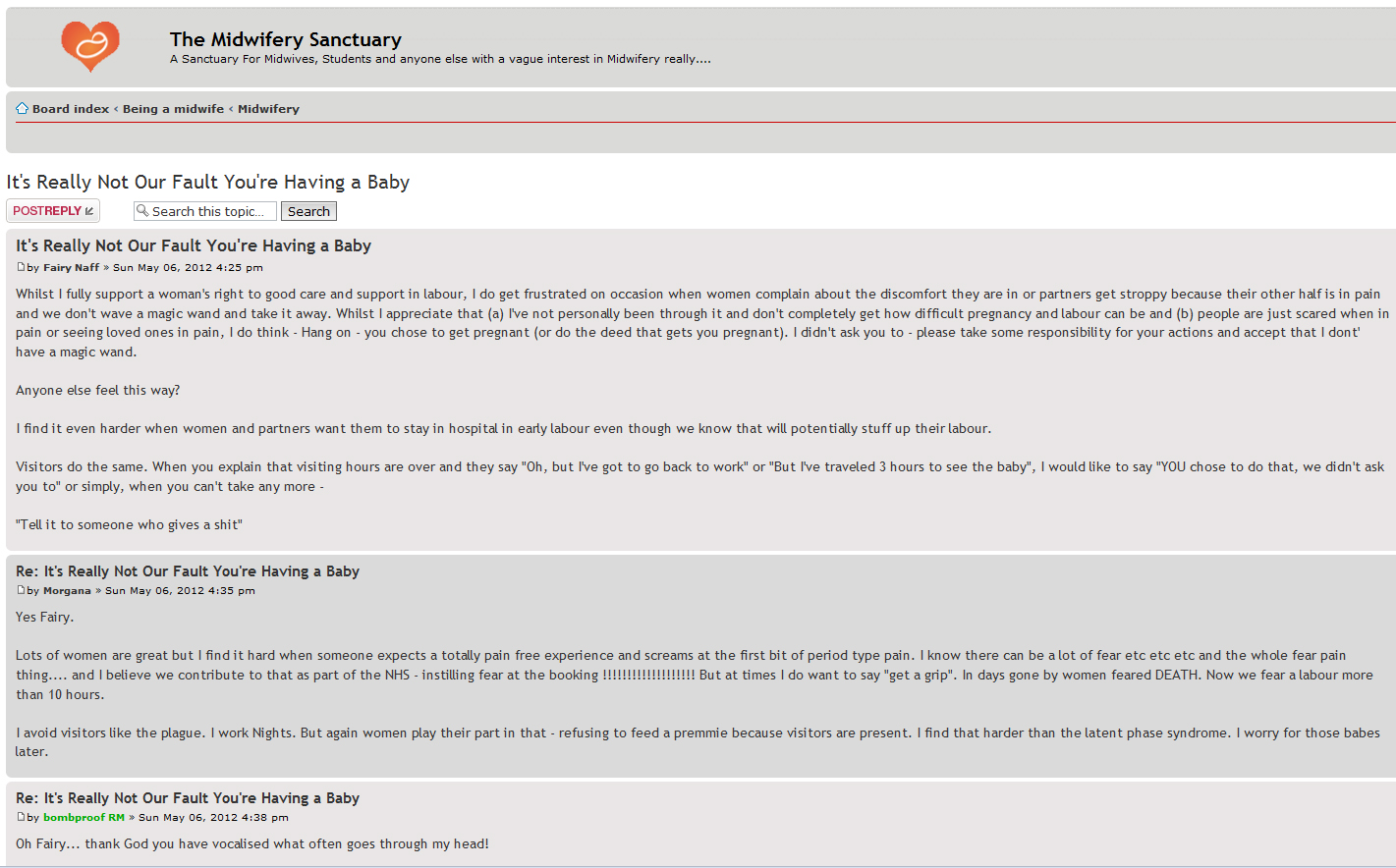
How does your midwife really feel?

How do UK midwives feel about their patients. If you believe those who post at The Midwifery Sanctuary, they feel tremendous contempt for women who need pain relief.

Click for full size view

Fairy Naff:

… I appreciate that (a) I’ve not personally been through it and don’t completely get how difficult pregnancy and labour can be and (b) people are just scared when in pain or seeing loved ones in pain, I do think – Hang on – you chose to get pregnant (or do the deed that gets you pregnant). I didn’t ask you to – please take some responsibility for your actions and accept that I dont’ have a magic wand.

Morgana:

Lots of women are great but I find it hard when someone expects a totally pain free experience and screams at the first bit of period type pain. I know there can be a lot of fear etc etc etc and the whole fear pain thing…. But at times I do want to say “get a grip”. In days gone by women feared DEATH. Now we fear a labour more than 10 hours.

bombproof RM:

You hit the nail on the head when you say that you want women to take responsibility for what has happened/is happening to them…

My one biggest bug-bear is the woman who demands to be utterly, 100% sensation-free during childbirth. Not just pain-free, but totally numb. Then when the epidural fails, or works but doesnt relieve pressure, or wears off and needs topping up.. she is shocked.

And Im thinking (a) whoever told you that childbirth was pain free?? You must have KNOWN that this was an unrealistic explanation …

Back to Fairy Naff:

Haha – I can see this thread turning into a rant fest for midwives and students struggling to maintain a patient and caring facade!!! …

… When a woman is in pain and wants an epidural, you can tell her all the risks and disadvantages in the world and all she’s thinking is “yeah, yeah – just get on with it and take the pain away” …

Last night I took over care of a primip who, if she had gone home in the latent phase after SROM-ing instead of insistng on staying, might well have progressed better. Instead the fear and frustration mounted in her and her family, who wanted someone to take the pain away for hours and hours and hours and couldn’t understand why we didn’t…..she’ll have had a section by now, on top of her epidural and resultant interventions….and when it comes to her 2nd baby she’ll sit in front of a consultant and demand an elective section because she can’t face the same experience.

And it may have been her own “fault”…

According to Hobo RM, when describing her birth experience such a patient will say:

“…I went in and this midwife examined me and said I was only a cm, well I knew at that point something wasn’t right because I was in so much pain, anyway they tried to send me home, but I stood my ground because I just knew something wasnt right. They then wouldn’t let me on to delivery suite and made me go for a walk if I wasn’t going home, I managed about 10 minutes and I was in absolute agony, plus I was exhausted because I’d been contracting now for 10 hours and they wouldn’t give me a bed to lie down on. I went back to the midwife and she refused to examine me again and told me again to go home!

I’m going to put in a complaint about her. So this other midwife had a chat to the doctors (thank god for sensible people) and they said I could come onto delivery suite as they could see I was obviously in pain and something wasn’t right. I demanded an epidural straight away and although my midwife on delivery suite was nice she was a bit young and had obviously never had kids as she said that I wasn’t in proper labour yet …

I demanded my epidural, I was exhausted and crying and in pain and I couldn’t do it anymore, they finally agreed I was allowed (my body my choice anyone???) and the blessed anaesthetist came in and worked their magic… I could see the midwife wasn’t happy as she had to keep stepping over them but I desperately needed them both there for support.

Anyway they examined me again in four hours and I was still only 3cms so they asked if they could start the drip as apparently my contractions were still too far apart, well I’d only been on the drip 2 hours when the epidural started to wear off and I was in agony again, of course by this time the baby was in distress because my labour had gone on for too long and nothing was happening.

The midwife finally got the doctors in and they decided I needed an emergency section because the baby was tired. Imagine if I’d gone home when they told me to? Me and my baby could have both died???”[paragraphs created for readability]

Hedgehog:

Last week I had two women who looked at me with sad puppy eyes when I told them (in latent phase) that they could definitely NOT have an epidural on the antenatal ward! One had had 3 previous normal births and the other one had had an IVF pregnancy. The para 3 mystified me, but the IVF pregnancy – I can’t understand if you have gone through the long, heartbreaking months/years of trying to conceive, investigations, referral and finally fertility treatment, you are not then patient enough (there was definitely a lack of patience more than fear) to let labour happen, when it finally happens, at its own pace?

skanky:

I nearly posted something last week about a girl at work but thought you would think I was being cruel and a shit wannabe. Anyway she is a primip, 6 months. I stupidly asked if she had thought about the birth. She informed me she was planning on going to hospital for an epidural straight away, when I said that may not be possible and she should be aware of other reliefe like water ect she said it doesn’t matter as she ‘has a plan’, god only knows what that is.

Then it progressed to her saying she would demand a CS anyway as it’s less painful…..other carers chirped in what bollocks that was with the recovery etc, I then said some people find breast-feeding difficult after CS, cue ‘fuddle off, I’m not a fuddle animal’ I managed not to blow her simple little mind with the fact we are animals….

Barbara RM:

I have been getting tired of this can’t do attitude many women have. Labour ward is full of it. I don’t mind a bit of a moan if u are getting on with it but if your moaning is actually stopping u from moving it really gets my goat.

This appalling level of contempt appears to be a direct result of the emphasis on “normal birth.” Midwives are evaluating patients on their “performance” and their views are ugly indeed.