Category Archives: Uncategorized

What’s the difference between scientific research and midwifery research?

Midwives have a large and ever growing problem with scientific research. The stark reality is that scientific research demonstrates that most of what is exclusive to midwifery is unsupported by scientific evidence and much of it (including all of homebirth midwifery) is irrational.

Hence, there is a large and ever growing divided between midwifery research and scientific research. Scientific research seeks to learn, specifically to learn how the human body works and how to maximize healthy outcomes. Midwifery research, in contrast seeks to justify, specifically to justify a primary role for midwives in the delivery of obstetric care.

Midwives make no bones about it. Consider the chapter, RCTs and everyday practices … a troubled relationship, in the leading textbook on midwifery “evidence,” Promoting Normal Birth – Research, Reflections and Guidelines, edited by Sylvie Donna.

RCTs are randomized controlled clinical trials, generally considered the gold standard of scientific research. Why is the relationship between RCTs and everyday midwifery practices troubled? Because RCTs (like most methods of clinical research) don’t support the practices exclusive to midwifery. Therefore, scientific research, which seeks to learn. must be discarded in favor of midwifery research, that exists only to justify midwifery.

The author of the chapter, Jette Aaroe Clausen, makes it clear that midwives have nothing against scientific evidence per se. If it supports midwifery practice, it’s fine, but she rails against the “hegemony” of science when it does not support practices exclusive to midwifery.

… It is now take for granted that evidence always improve midwifery care. Evidence has gained a hegemonic status in midwifery and obstetrics …

Clausen approvingly quotes Murray Enkin, a supporter of midwifery and evidence based medicine, who apparently has recommended that there must be a parting of the ways:

… The power of randomised trials, particularly as they feed into official health care guidelines, is enormous. They are a form of advice unlike ordinary advice; because of pressure to conform, there may be no option to refusal. The ‘scientific evidence’ has achieved a mythical status; it is excessively powerful rhetoric, a tool that has so easily become a weapon.

No one can accuse midwifery advocates of hiding their motivation. Truth isn’t even mentioned, because midwifery advocates are uninterested in what is true. The reference to scientific evidence as a weapon is particularly revealing. Midwives used to promote scientific evidence as a tool that could be used to undermine obstetrics. But it turns out that scientific evidence undermines midwifery instead and therefore it is nothing more than a weapon against aims of midwifery advocates.

Clausen goes on to illustrate this “problem” with an excruciatingly stupid attempt to justify monitoring the fetal heart rate with the Pinard stethoscope over the far more accurate Doppler. I won’t bore you with a complete recounting of a justification that can only be charitably described as idiotic, but I will offer a few choice quotes for your entertainment. Interestingly, both the Pinard vs. the Doppler have absolutely nothing to do with the role of RCTs in midwifery and obstetrics, but I guess if you are writing a thoroughly nonsensical chapter arguing for ignoring scientific evidence, using an example that has nothing to do with the subject at hand has a certain “logic.”

And no, the following quotes are not satire:

‘Listening to the stomach’ and ‘listening to the fetal heart’ are often understood as synonymous acts.

How can we describe the relationship between the midwife and the Pinard? Verbeek describes the relationship between the experienced midwife and the Pinard as an embodiment relationship, i.e. she becomes a ‘Pinardmidwife.’

[M]any midwives use ‘listening to the stomach’ as a way of bringing the mother child relationship to the foreground.

In fact, the Pinard can be used as more than a medical device or a connecting tool. Some midwives use the silence of the Pinard to keep the unborn baby inside the woman’s body …

The Pinard invokes a private and intimate connection to the unborn baby because only one person can hear the fetal heart sound … whereas the [Doppler] invites multiple listeners to share the sound.

What does this have to do with RCTs? Nothing. What does this have to do with scientific evidence? Nothing. What is the purpose of this bizarre exposition within a chapter purporting to discuss the deficiencies of the RCT? Beats me, but Clausen thinks she has accomplished something:

I have now illustrated the relationship between everyday midwifery practices and randomized trials. Randomised trials are not innocent experiments… Since some randomized trials come to carry tremendous authority they carry the potential to destroy local productive practices… As one standard prevails, other standards cease to exist.

Ahh. We have come to the heart of the matter. Scientific evidence in general, and randomized clinical trials in particular have the potential to destroy the authority of the midwife. As her “standards” of practice are revealed to be based on what enhances her role rather than what promotes safety, she is being displaced.

In case that wasn’t clear enough for you:

… [T]he use of randomised trials trials and the promotion of evidence based midwifery come at a price. Evidenced-based medicine is strongly connected to positivist science, and within this framework, everyday midwifery practices can easily be framed as irrational and unfounded …

What’s the problem with scientific evidence in general and RCTs in particular? Simply put, they make midwives look like fools.

Homebirth and cognitive biases

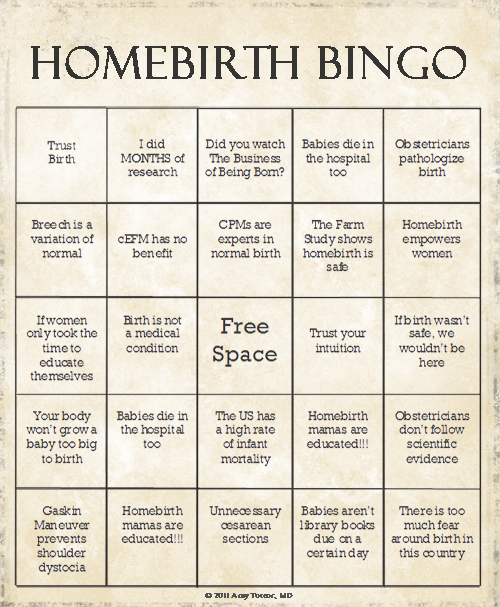
One of the most bizarre aspects of homebirth advocacy is the insistence that “babies die.” Why do homebirth advocates blithely offer this cold blooded claim, at odds with everything they profess to believe about the trustworthiness of birth, in the wake of every homebirth death?

They are desperate to resolve the cognitive dissonance between what they believe about birth (“trust birth”) and the homebirth disasters that result because birth is inherently dangerous and homebirth midwives are woefully incapable of preventing, diagnosing and managing homebirth disasters. Most people, in the face of scientific evidence, would alter their beliefs to conform with the evidence. However, many homebirth advocates are so desperate to believe in the safety of homebirth that they direct their efforts, instead, to bolstering their beliefs. To do that, they employ a variety of cognitive biases.

According to Michael Shermer, in The Believing Brain, subtitled in part How We Construct Beliefs and Reinforce Them as Truths allow people to confirm beliefs in the face of evidence that those beliefs are not true.

Cognitive biases come in very handy in homebirth advocacy. As the number of homebirths resulting in dead babies begins to climb, homebirth advocates fall back on cognitive biases that allow them to maintain belief in the safety of homebirth in the face of evidence that homebirth is not safe. There are many different types of cognitive biases.

1. Confirmation bias

Shermer describes confirmation bias as “the mother of all cognitive biases.” Confirmation bias is:

the tendency to seek and find confirmatory evidence in support of already existing beliefs and ignore or reinterpret disconfirming evidence.

Ever wonder why birth stories play such an important role in homebirth advocacy? This is why. Every story with a successful outcome serves to confirm the belief that homebirth is safe. The “best” stories, of course, are those in which women were warned of possible bad outcomes, but had a good outcome. Sure the woman was told that a VBAC after two previous C-sections could result in a ruptured uterus and a dead baby. But look! She had a healthy baby! Not only did she teach those doctors a lesson, she provided other homebirth advocates with a story that confirms their belief that homebirth is safe.

2. Hindsight bias

Birth stories with happy outcomes are a form of hindsight bias. Homebirth advocates love to make fun of the “fear-mongering” doctors who warn against dire outcomes. What better way to do it than to take a story that you already know will have a happy ending, and disparage the warnings of the doctors who had no way of knowing what the outcome would be?

3. Self-justification bias

Shermer defines self-justification bias as:

the tendency to rationalize decisions after the fact to convince ourselves that what we did was the best thing we could have done. Once we make a decision … we carefully screen subsequent data to filter out all contradictory information related to that decision … One of the practical benefits of self justification is that no matter what decision we make … we will be satisfied with the decision, even when the objective evidence is to the contrary.

Self justification bias leads a mother who has been warned repeatedly that she is not low risk to “why me?” in the wake of her baby’s death. That’s why Annie Bourgault, who was advised to have a C-section for malpositioned twins, “doesn’t understand” why one of her babies died. The reason, obviously, is that she made a bad decision, but she will not accept that reality. Instead, she insists that there was no way to know in advance that this would happen.

“Babies die” is a form of self-justification bias. The implication is that the baby would have died in the hospital anyway or in the variation “babies die in the hospital, too” would have died from some other, iatrogenic, cause in the hospital. This allows the mother to console herself that her decision to have a homebirth was correct, despite the dead baby that is objective evidence to the contrary.

These cognitive biases demonstrate why it is critical that the ever growing number of birth stories that end in disaster are not suppressed and are easily available for any woman to read. If every story of homebirth on the web ends with a happy outcome, it will merely confirm the beliefs of homebirth advocates without acknowledging the reality of homebirth dangers.

Birth stories that end in the death of the baby don’t confirm the homebirth advocacy assertion that trusting birth is all that is needed for a good outcome. They show that the hindsight bias of the happy stories is just that, bias. The outcome easily could have been disastrous. Most importantly, they provide objective evidence that homebirth is not safe.

Yes, homebirth advocates will use the self-justification bias that “babies die” to insist that the death was inevitable, but those who are not ideologically committed to the belief that homebirth is safe will see it for the self-justifying tactic that it is.

Postdates + long labor + CPM = dead baby

The whole “trust birth” thing continues to work out very poorly for homebirth midwives, the mothers they serve, and most of all the babies who die preventable deaths because of their lack of education and training.

At this point, it appears that homebirth death stories are becoming so common that mothers report on them without anger and even without surprise. Consider the homebirth death that occurred yesterday in the Santa Cruz area under the care of “Rebecca, CPM.”

The mother was not sure of her due data, but believed it to be sometime in late August or early September. So this baby was postdates, but as we know “babies aren’t library books do on a certain date;” we just have to trust birth.

And the labor was extremely long, beginning at 1 AM, progressing to 3 cm 18 hours later. That falls within the definition of prodromal labor, but progress continued to be extremely slow. She was 5 cm at 3 PM and 9 CM at 7 AM the next morning. In other words, it took 6 hours to go from 3 to 5 cm, and was only 9 cm 16 hours after that. Fortunately, they weren’t in the hospital where doctors would have overreacted and probably performed a C-section nearly 12 hours earlier. No, no C-section for them. They were trusting birth.

At that point, though, the CPM’s “trust” began to flag. According to the mother:

Around 7am Rebecca told us that we needed to go into the hospital. Although we were getting the heart beat it was in a hard place to get (very low near my left hip.)

As Rebecca almost certainly understood, the baby’s position was not low enough for the heartbeat to be heard right above the hip. She probably suspected that she had been listening to the mother’s heart beat, not the baby’s. Mom and Dad headed off to the hospital, but, curiously, Rebecca did not accompany them.

Even though she was anxious to get far away from what she suspected was an utter disaster, she had the decency to call the hospital and explain that she was unsure about the baby’s heart rate. Though she never bothered to inform the parents, the hospital staff knew they had an emergency on their hands.

Once we got to the hospital, we were rushed into a room right away. Rebecca had called and let them know why we were coming in. The nurse had trouble getting the baby’s heart beat on the external monitor. The doctor came in to break my water bag and do an internal monitor. She broke my water bag and said, “Meconium thick.” This was my first idea that something was wrong. Then she put in the internal monitor. There wasn’t a heartbeat. I knew then that our baby had died. Of course they checked to make sure everything was plugged in, and got an ultrasound, and a second ultrasound. Then the doctor turned to us and told us that our baby had died…

At some point during the 54 hours of labor, the baby stopped getting adequate oxygen. The baby expelled meconium repeatedly, suggesting that she suffered for hours. An electronic fetal monitor would have made it clear that the baby was oxygen deprived, but they didn’t want that, because they were trusting birth. As is all too common at homebirth, the baby died after a long struggle and the CPM not only had no idea that the baby was struggling, but she had no idea that the baby was dead.

To summarize, a postdates mother was allowed to labor for 54 hours with grossly inadequate monitoring of the baby and the baby died a completely preventable death. Why? Because the parents trusted a CPM, an ignorant, undereducated, undertrained, self proclaimed “midwife” who blithely sat by completely clueless while a baby’s life ebbed away.

The mother’s ordeal was not over; she continued with her plan for a “natural” birth, though she did agree to pitocin. The baby was very large and the shoulders got stuck. Since the baby was already dead, there was no urgency, but the fact that it took doctors 40 minutes to extricate her is a testament to the size of the baby.

The mother is still in shock (it appears to have happened within the past few hours) and shows no awareness that this could have been avoided entirely. This morning, instead of nursing her precious daughter, she is planning a funeral. The CPM who presided over this preventable disaster is nowhere to be found.

Trust birth?

Sure, as long as you aren’t concerned about whether your baby is born alive or dead.

Melissa Cheyney: feeling the heat, but still not telling the truth

Melissa Cheyney has been under intense pressure since the debacle of publishing an op-ed in the Register-Guard touting Oregon’s strict licensing standards while failing to mention that no license is required (Melissa Cheyney, have you no shame). She came across as dishonest and duplicitous. She had to do something.

According to OregonLive:

For years, Melissa Cheyney, a licensed midwife and Oregon State University medical anthropologist who chairs the state Board of Direct-Entry Midwifery, has not taken a position on mandatory licensing even as she’s studied mortality rates and pushed for better reporting of birth outcomes.

Now, however, she thinks it’s time to make licensing required. Sheikh’s options to hold her midwives accountable are limited because the state can’t investigate unlicensed midwives, says Cheyney, and “I can’t really accept that anymore.”

While the women of Oregon can be pleased that Cheyney and colleagues have dropped their official opposition, no one should become complacent. Licensing can protect consumers ONLY if the requirements for education, practice standards, reporting and accountability are strict. Let us hope that Cheyney and colleagues will have not dropped their opposition to mandatory licensing because they plan to fall back to the position of opposing any meaningful requirements for obtaining a license.

I’m not optimistic because Cheyney, who already oversees the licensing authority, continues to lie. She says whatever she thinks she has to say (she hasn’t taken a position on the issue, she never opposed it), without considering that teeny, tiny problem that she has already been quoted publicly saying exactly the opposite.

A March 2011 Lund Report, available on the web to anyone who cares to look, reported on the bill sponsored by Rep. Mitch Greenlick (D-Portland) that would require a license in Oregon for direct entry midwives. In the article, Cheyney publicly opposes the requirement:

“I don’t think licensure guarantees safety…”

In 2008, Cheyney did a study [on Oregon midwives]. “I looked at [birth outcomes] for licensed and unlicensed midwives, and there was no big difference,” she said.

Cheyney is opposed to the bill for several reasons. She pointed to the new administrative rules governing direct entry midwives that the Board adopted in January. These rules “protect a mother’s right to choose while also protecting her safety,” she said.

More importantly, Cheyney is concerned that requiring licensure could actually have an adverse effect on home birth safety by “driving midwives underground, and not voluntarily participating in peer review and other things they currently do.”

Does Cheyney think Oregon women are stupid? Cheyney herself, and the organizations she chairs (Board of Direct-Entry Midwifery) has been one of the biggest roadblocks to mandatory licensing. She is on record, in a variety of publications over a number of years, as opposing mandatory licensure as both unnecessary and restrictive.

In her role as chair of the state Board of Direct-Entry Midwifery, Cheyney has loudly and publicly opposed ANY regulation on midwifery of any kind. She worked tirelessly to enshrine the ridiculous lack of standards into statute:

687.415 … Nothing in [Oregon Statutes] is intended to require a direct entry midwife to become licensed …

In her role as Director of Research for MANA (a direct conflict of interest with her role as Chair of the Board of Direct-Entry Midwifery), Cheyney has withheld every scrap of information on homebirth death rates. Cheyney oversees the records collected by MANA on 23,000 midwife attended homebirths. Though MANA told its membership that the data on outcomes was being collected specifically to be used to demonstrate the safety of homebirth to lawmakers, Cheyney has persistently refused to release the death rates to the public. The data is available, but only to those who can prove (through an elaborate vetting process) that they will use the data for the “advancement of midwifery” and sign a legal non-disclosure agreement prohibiting them from sharing the death rates with anyone else.

Cheyney also refused a request by Oregon legislators to release only the Oregon death rates. The publicly available minutes from the Board Meetings have Cheyney on record “explaining” why she will not release the information:

Cheyney explained that MANA suspected that, due to some state regulatory boards having very hostile relationships with midwives, the quality and quantity of data submitted might be adversely affected if regulatory authorities were provided access.

Hmmm, she refuses to report the death rates because if homebirth midwives knew that the number of babies who died at their hands would be reported to regulatory authorities, they might stop reporting the number of babies who died at their hands?

A board staffer asked why, if the goal is to protect midwives as individuals, MANA would not provide aggregate data so that the Board could evaluate the safety of direct entry midwifery in general.

Cheyney explained that there is a critical review of data entered into the MANAstats database performed by a group of trained individuals. These individuals assist with correcting data collection errors. This review process results in a lapse in time between the aggregate data and true accurate data, which is completed after the aggregate data.

So they can’t provide the aggregate data because it takes time to ensure that the aggregate data is correct? No excuse for hiding the death rates is acceptable, but that isn’t even a remotely plausible excuse.

I’m on record as recommending that Cheyney resign or be removed as Chair of the Board of Direct-Entry Midwifery:

Dr. Cheyney should resign from the Board, or failing that, be removed by Oregon officials for an irreconcilable conflict of interest. he has already demonstrated her contempt for patient safety by refusing to release MANA homebirth death rates. She should not be responsible for monitoring homebirth practice, where patient safety is supposed to be the highest priority.

But I am beginning to reconsider. No, not because anything has changed. Melissa Cheyney still has an irreconcilable conflict of interest and always places the protection of homebirth midwives over the health and safety of Oregon women and babies. I’m reconsidering because Cheyney is quickly becoming the poster child for the hypocrisy, mendacity and duplicity of homebirth midwives.

Cheyney displayed utter contempt for the women of Oregon in writing an op-ed piece entitled “Oregon has some of the strictest guidelines on midwifery” without mentioning that none of those guidelines are mandatory. She was skewered for that behavior. Under intense public pressure she has backed off her vociferous opposition to mandatory licensing, but once again, she cannot resist displaying contempt for Oregon women by lying about her previous opposition. She should be skewered for that display as well.

Melissa Cheyney embodies much of what is wrong about homebirth midwifery in Oregon: placing the interests of midwives above the safety of patients; hiding information about the dangers of homebirth; and mendaciously misrepresenting the lack of patient safeguards and her role in opposing those safeguards.

At this point, she makes the task of highlighting the dangers of homebirth much easier. Women may not understand the details of various regulatory measures, but everyone understands retracting previous positions and then lying about it.

The pathetic attention whoring of homebirth advocates

You can’t make this stuff up.

I’ve written many times about the narcissism of homebirth advocates. There are people like Janet Fraser and Annie Bourgault who probably meet the diagnostic criteria for narcissistic personality disorder, given that they let their babies die at homebirths and feel not one whit of remorse.

Then there are the garden variety narcissists like Gina Crosley-Corcoran, the Feminist Breeder, who apparently misses the attention and fan devotion of her years in an all girl band, and resorted to spreading her legs for a live streaming homebirth so any Tom, Dick or Harriet who cared to click could watch.

But it’s getting harder and harder for homebirth narcissists to get their fix of attention and adulation. Live blog your homebirth? It’s been done. Live tweet your homebirth? Ditto. Livestream your homebirth. Ho hum. Simply letting a camera crew take crotch shots is just not the attention getter that it used to be.

What to do? Hire a publicist and spend some serious bucks. Professional publicists are really, really expensive, though, so to save money, you can advertise on Freelancer.com. That’s what Nancy Salguiero is doing:

I am looking for someone to contact all major media networks, tv, radio, and newspaper, by phone to get coverage for a news story and follow up with sending them info via email and having them contact me for the story. I am streaming my home birth live online any day and want to get as much coverage leading up to it as possible.

Who is the pathetically desperate Nancy Salguiero? She’s a chiropracter AND a birth coach. According to her website which promises to empower you through birth and beyond:

… I am a mom to two wonderful children and have a third on the way. My belief and passion in birth started when I was in Chiropractic College. I attended a seminar on birth trauma and why children need chiropractic care. This is where I learned what was happening to moms and babies through our current birth environment and was outraged. I also learned the potential that we all have to go through this process without this unnecessary interference, leaving moms empowered and allowing babies to gently and safely make their way into the world.

What is an empowered birth?

For me an empowered birth is one where I am the one who makes the decisions for me and my baby. Where I am in an environment of love, support, and respect for the power within my body to successfully birth my baby.

Love, support, respect and … an audience, because nothing says love, support and respect like an audience of strangers watching your crotch.

Best of all, Nancy is doing this for you. Here, let her tell you in her own incredibly verbose way:

And look at all the helpful information she tweeted today just for YOU:

That’s right. Seven tweets and 3 are informing YOU of her upcoming homebirth and one is press release to give YOU (and the media, of course) more information about her upcoming homebirth. If that’s not concern for you, what is?

I’m afraid her desperate attempts to assuage her pathetic need for attention is doomed to failure. Livestreaming a homebirth is so yesterday. Nancy needs to up the ante if she wants media attention. My helpful suggestions:

Homebirth in the killer whale tank at SeaWorld (homebirth with dolphins has been done to death).

Or:

Homebirth outside in a hurricane to demonstrate the power of birth AND the power of nature.

Or, if Nancy really wants to be authentic, daring and get lots of attention:

Homebirth in Afghanistan … far from midwives, hospitals and all those icky interventions like sterile stuff.

It’s natural. It’s normal and Afghan women (are forced to) do it everyday. I don’t know about you, but I’d watch Nancy if she did that.

Jen, lay nuclear physicist

Hi, I’m Jen Jones, LP, MA, PsD, a lay nuclear physicist.

I know what you’re thinking: a real nuclear physicist needs a PhD (instead of a PsD), must have spent years at a super expensive school like MIT and has to work in a place like Los Alamos in New Mexico where they built the atomic bomb. That’s what most nuclear physicists want you to think. The truth is that you can be a lay nuclear physicist, train by apprenticeship and work at home.

Atoms are totally natural. They have been around for the entire 6,000 years that the world has existed. Human beings have ALWAYS been made of atoms. Smash ’em together and you get energy. What more does anyone need to know?

Lay nuclear physicists are experts in uncomplicated atoms, like hydrogen and helium. We leave those super duper fancy elements made with interventions (like Einsteinium, Californium and Fermium) to the MIT crowd. They use unnatural interventions to make new atoms. They refuse to let a natural process unfold over tens of thousands of years because they have to get to their golf games.

Lay nuclear physics is a calling for me. As I researched atoms for my high school physics class (which I flunked), I found what I can only describe as “signs” that the universe intended that I be a lay nuclear physicist.

First there was the Heisenberg uncertainty principle. People who know me say I’m a bit of a ditz; I have so much trouble making up my mind. That uncertainty principle describes me to a T.

Then I found out about Schrodinger’s cat and I am totally a cat person.

Finally, I learned that there is a thing called “chaos theory.” If you’ve ever seen my kitchen, you know that I am an expert in chaos.

I learned all this stuff on Google, and other people could, too, if they bothered to educate themselves.

You probably think you have to know math to be a nuclear physicist, but that is so not true. There’s only one equation, and it has only one number in it: E=mc2. How hard is that for someone like me who was always good at the alphabet?

What does it mean? If you were educated like me, you would know that is means that energy equals mass (that’s physics-speak for weight) times the speed of light (how fast it takes you to flip a light switch) squared (that’s the same as “times 2”). I was never very good at higher math (the 5 times tables and above), but I’m really good at “times 2.” Anyways, E=mc2 tells you how much more energetic you could be if you smashed atoms together as fast as you can switch on a light.

I’m incredibly proud of my credentials, so proud in fact that I had them monogrammed on my towels. I have an LP (lay physicist) PLUS I did advanced apprenticeship for my MA (mastering the alphabet), and (I’m most proud of this) my PsD (doctor of pseudoscience).

I bet you think it took me lots of hours a week for many years to get all these degrees. Nope, I really couldn’t give it much time since I’m a MAMA (that’s not a degree; it just means mom). Fortunately, you can get any of these credentials through self-study. Then you apprentice with another lay nuclear physicist. Those requirements are pretty rigorous. You have to watch her at least 20 times to learn how to turn on a light as fast as possible. Then you have to be the primary person to turn on the light another 20 times.

And that’s not all. You have to do independent research, at home of course. My project? Well everyone knows that energy comes from busting atoms apart (that’s “fission” in physics-speak). My project was to make my husband more energetic so he would do more chores around the house. He’s pretty lazy, doesn’t have a job and just sits around guzzling beer all day. I gave him more energy by repeatedly whacking his head with a big stick. Smashing the atoms in his head with the stick gave him so much energy that he has moved out and all the way across the country.

My friend has been trying to make her husband even more energetic than mine using atomic fusion (that’s physics-speak for smashing atoms together to make make bigger atoms). She tried squishing her husband’s head in a vise to see if she could make the atoms in his head fuse. It didn’t work; he died. But hey, people die when nuclear physicists are around (they don’t call them atom bombs for nothing).

The key to being a great lay nuclear physicist is to EDUCATE yourself and not just blindly except what those pinheads at MIT have to say. You have just as much right to do research with your own atoms as they have to do research with theirs.

Education never stops. Even though I have all those fancy degrees, I’m going to a special seminar at Los Alamos next month to learn more. No, not at the nuclear facilities in Los Alamos; I’m going to a Farm outside of Los Alamos where the greatest lay nuclear physicist of them all, Ima Frawde, will lead us in meditating on the beauty of Schrodinger’s cat. Best of all: we’ll be getting new letters to put after our names, CLNPE, certified lay nuclear physicist educator. I’ll have to re-monogram all the towels, but it will be so worth it.

What does it mean to promote normal birth?

Promoting normal birth is always and only about promoting midwives.

When I first read the phrase “promoting normal birth” I was confused. Why would a healthcare professional be promoting any set of procedures or any particular approach to a health issue? I thought it was the job of health professionals to promote safety.

You won’t find any real medical professional who insists that he or she “promotes” laparoscopy over laparotomy. An ethical medical professional recommends whatever is safest for the patient, not whatever is most lucrative. There are no real medical publications claiming to promote one form of treatment or even one philosophy over another. Real medical publications promote health and promote safety, not the opportunity to line one’s pockets.

I’ve come to understand, as I wrote yesterday, that normal birth has nothing to do with normal and nothing to do with birth. The definition of normal birth is simple and straightforward: If a midwife can do it, she calls it normal. If she lacks the skill to provide the needed care, she insists that the birth is not normal even if it results in a healthy mother and a healthy baby. “Normal birth” and “midwives” are interchangeable. In other words, “normal birth” is nothing more than a marketing term.

Once you realize that, it is a lot easier to understand the books and websites that promote normal birth. For example:

An article by childbirth educator Judith Lothian entitled Promoting, Protecting, and Supporting Normal Birth should be read as Promoting, Protecting, and Supporting Midwifery Employment.

The tag line of Lamaze International, Lamaze International envisions a world of confident women choosing normal birth, really means Lamaze International envisions a world of confident women choosing midwives.

The Royal College of Midwives maintains a Campaign for Normal Birth (A Campaign for Midwives) declaring that “promoting normal birth key to cost savings” (Promoting midwives a key to cost savings.)

Birth International advocates “Reclaiming Midwifery Care as a Foundation for Promoting ‘Normal’ Birth.” Of course they do. “Normal birth” really means midwifery full employment.

You can look high and you can look low, but wherever you look, midwives or their advocates are behind every attempt to promote “normal birth” (i.e. market midwifery). Indeed, the leading textbook of the radical midwifery theorists is Promoting Normal Birth – Research, Reflections and Guidelines best understood as Promoting Midwives – Research, Reflections and Guidelines.

The editor Sylvie Donna has the grace to be abashed at the use of the word “promoting.” She starts the introduction with the following:

You may have wondered, on first seeing this book, why the title includes the word ‘promoting.’ Why should normal birth be promoted particularly? The answer is simple. Other forms of birth — those involving plenty of interventions, especially cesareans — get plenty of promotion, simply because they may appear to be the easiest option for caregivers or the least frightening ones for pregnant women…

Even on its face, it’s a pretty inane explanation, but it is far worse when you substitute what is really meant:

You may have wondered, on first seeing this book, why the title includes the word ‘promoting.’ Why should midwives be promoted particularly? The answer is simple. Other forms of birth — those involving plenty of interventions (most of which midwives cannot do), especially cesareans (which midwives definitely cannot do) — get plenty of promotion, simply because they may appear to be the easiest option for caregivers or the least frightening ones for pregnant women…

So midwives need to market themselves or they risk being eclipsed by obstetricians who know more and can do more. And the fact that what obstetricians know and do can calm the fears of pregnant women? Irrelevant. It is more important to promote midwives then to meet the needs of women.

“Normal birth” is a way to sanitize what is really nothing more than midwifery marketing. Insisting that women hire midwives because midwives want employment isn’t particularly persuasive. Insisting that women hire midwives because only they can provide them with a “normal” birth (who wants an abnormal birth?) sounds a lot better. The key, of course, is to invest “normal” birth with a cachet beyond the word normal. That’s where all the stuff about birth warriors, empowerment and experience comes in.

After all, what’s so special about a midwife attended birth? Nothing. That’s why women must be jollied into believing that they have done something worthy of praise by hiring a midwife. Ooh, you’re strong. You can do it mama. You can kick birth’s butt. And you are giving your baby the safest most loving choice. Less pain, less joy.

Uh-huh. Midwives certainly don’t think pregnant women are particularly intelligent if they believe that most women will fall for such an obvious means of self promotion. And, indeed, most women don’ fall for it. British women resent the fact that access to obstetricians is severely curtailed. Dutch women go to other countries to give birth rather than settle for the midwife led care (and higher perinatal mortality rate) that is a feature of the Netherlands. And the majority of American women, regardless of the availability of midwives, choose obstetricians. Indeed, there are not enough practicing obstetricians to accommodate all the patients who want them.

Promoting normal birth is about one thing, and one thing only: promoting midwives. It has nothing to do with what is safest. The words safe or safety don’t even appear in the entire introduction to the book, which is fitting since safety is entirely irrelevant to the project of promoting midwives. As far as I can tell, using Google to search inside the book, the word safety doesn’t even appear until page 177 and then only to be used pejoratively (“An obsession with safety is characteristic of our age …”).

What does this mean for pregnant women? They should understand that there is no such thing as “normal birth.” It is nothing more than a marketing term used to dress up the self-serving promotion of midwifery by midwives. There’s no reason to feel bad about not having a “normal birth” since the only harm is to a midwife’s pocketbook, not to the health and safety of their babies or themselves.

What is normal birth?

There’s an old saying that to a hammer, everything is a nail. It means that if you only know how to do one thing, you will insist that is what needs to be done.

Consider, for a moment, the possibility that there was a handyman, Bob, who only knew how to use a hammer. Whenever he was called to a job, he brought his trusty hammer and banged in the nails. Imagine that a new handyman, Steve, comes to town and he knows how to use a hammer AND a screwdriver. He can do twice as much as the original handyman and as time goes by, more and more people call Steve, since many of their projects involve nails and screws.

Bob, the original handyman, now faces a difficult choice. What should he do about jobs that involve screws? There are several tacks that he could take:

He could always learn to use a screwdriver, but that might be difficult for Bob. What else might he do?

He could insist that screws can be pounded in.
He could insist that screws are an unnecessary use of technology; anything that can be made with screws could also be made with hammers.
He could insist that Steve invented screws just to take business away from him.
He could insist that Steve recommends screws for a project when nails would have been just fine.

Or he could “go nuclear”:

He could insist that only things assembled with nails are normal.

All of these strategies share one thing in common. They imply that being able to use a screwdriver is unnecessary regardless of the situation.

This is not a real world situation, of course; it is an analogy. Midwives are the people with hammers. Normal (or natural) birth is nails and screws are anything that obstetricians can do that midwives can’t.

There has a been a lot of debate in midwifery circles about what exactly constitutes normal birth.

As anthropologist Margaret MacDonald explains in a recent piece in the Lancet, The cultural evolution of natural birth:

Natural birth has long held iconic status within midwifery and alternative birth movements around the world that have sought to challenge the dominance of biomedicine and the medicalisation of childbirth… The recent transition of midwifery in several Canadian provinces from a social movement—for which “reclaiming” natural birth was a critical goal — to a regulated profession within the formal health-care system is a unique opportunity to track changes in how natural birth is understood and experienced. Midwifery in Canada has much in common ideologically with independent or direct-entry midwifery in the USA and with radical and independent midwifery in the UK and so insights about changes in Canada have implications for maternity caregivers in a range of health systems.

But normal birth actually involves lots of technology. There is nothing natural about checking blood pressure, listening the fetal heart with a Doppler or recommending chiropractic. Other technological interventions have also become a part of normal birth:

… For example, a woman asks to have her membranes artificially ruptured after several hours of labour to “get things going” and gives birth vaginally at home… The presence of medical interventions within the realm of natural birth is a relatively common kind of border crossing.

Midwives will also recommend herbs or over the counter medications like castor oil to stimulate labor and prevent a term pregnancy from extending into a higher risk postdates pregnancy. In fact:

[If an intervention] can bring back the clinical normalcy of the labour pattern and keep it within the midwifery scope of practice, it is generally regarded as a good thing by midwives and clients alike … (my emphasis)

That is the key point. Anything is acceptable as long as it can keep the birth within the scope of midwifery practice. Normal birth has nothing to do what is normal and almost nothing to do with birth. It’s all about midwives keeping patients for themselves.

Just like Bob the handyman, a midwife faces a difficult choice when confronted with a patient who needs advanced technology like a C-section. She also has several choices, remarkably like the choices from which Bob can choose.

She could insist that the patient can give birth safely without a C-section.
She could insist that C-sections are an unnecessary use of technology.
She could insist that obstetricians recommend C-sections just to take business away from midwives.
She could insist that obstetricians routinely recommend C-sections when vaginal birth would have been just fine.

Or she could “go nuclear”:

She could insist that only vaginal birth is normal.

Homebirth midwives and midwifery theorists in the UK and Australia use all these strategies. What women need to understand is that midwives define normal birth by what is good for THEM, not what is good for women or safe for babies, and certainly not by what is actually normal.

A baby is breech and the midwife can’t do either a version or a C-section for breech. She insists that breech is a variation of normal.

A baby is postdates and the midwife can’t do a postdates induction with pitocin. She insists that babies aren’t library books and they don’t have to be born on a specific date and for good measure, she insists that pitocin causes ADHD, autism, or whatever condition you might fear.

A woman experiences severe pain during labor and a midwife cannot administer an epidural. She insists that the pain is beneficial, that the epidural has too many “risks” and that pain relief hurts the mother’s ability to bond with her baby. (Interestingly, in the UK where midwives can administer Entonox by mask, Entonox is considered compatible with normal birth.)

I could go on and on, but you get the idea. Anyone working with a homebirth midwife or any midwife captured by radical midwifery theory needs to ask herself: Are my midwife’s recommendations motivated by what it good for me and safe for my baby? Or are my midwife’s recommendations motivated by what will allow her to maintain control of me as a patient?

All women researching birth need to ask themselves: Does “normal birth” actually mean anything, or is it just a way for midwives to make what they can do seem most desirable?

Personally, I think the answer is clear. Normal birth has nothing to do with normal and nothing to do with birth. The definition of normal birth is simple and straightforward: If a midwife can do it, she calls it normal. If she lacks the skill to provide the needed care, she insists that the birth is not normal even if it results in a healthy mother and a healthy baby.

We’d rightly be suspicious of a handyman who insisted that only things assembled with nails are normal. We should be equally suspicious of a midwife who insists that only things that are in the scope of her practice represent normal birth.

A question for waterbirth advocates

A simple question for waterbirth advocates:

Would you completely immerse your head (eyes open, of course) in the fecally contaminated bloody water of a birth pool in the aftermath of a birth?

I have a second question:

If you wouldn’t for a moment contemplate immersing your head in a pool of water with feces floating in it, why do you think it is a good idea to force your baby to do so?