Category Archives: Uncategorized

Infant mortality is the wrong statistic

Professional homebirth advocates routinely trick their followers by preying on their gullibility and lack of basic knowledge of science, statistics and obstetrics.

Consider the following statements:

Ricki Lake:

The fact that we have the second-worst infant mortality rate in the developed world is a statistic that I think people need to know about.

Ina May Gaskin:

We have the highest maternal health care costs, yet our infant mortality rate is high …

Jennifer Block:

…the United States has the most intense and widespread medical management of birth” in the world, and yet “ranks near the bottom among industrialized countries in … infant mortality.

These statements imply that infant mortality is a measure of obstetric care, but it is not. It is a measure of pediatric care and therefore, it is the WRONG statistic to use when discussing maternity care.

According to the World Health Organization, the best measure of obstetric care is perinatal mortality, usually defined as deaths from 28 weeks of pregnancy (stillbirths) through 28 days of life. And according to the World Health Organization, the United States has one of the lowest perinatal mortality rates in the world, lower than Denmark, the UK and the Netherlands.

Professional homebirth advocates don’t want their followers to know the truth, so they deliberately use the wrong statistic to create a false and misleading impression of American obstetric care.

A graphical view of the various measurements of mortality that are commonly used in pregnancy and early childhood shows exactly how professional homebirth advocates misuse statistics.
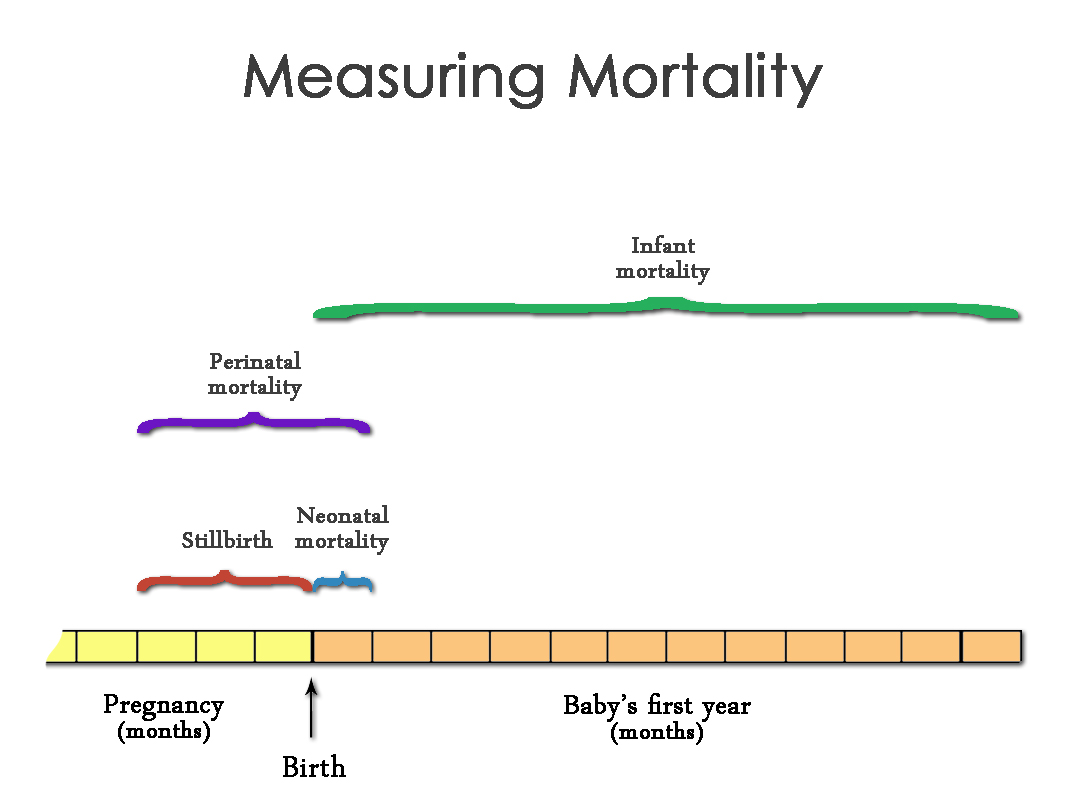
This illustration shows the last few months of pregnancy and the entire first year of a baby’s life. The first thing to notice is the tremendous difference between perinatal mortality (bounded by the purple bracket) and infant mortality (bounded by the green bracket). Indeed, there is barely any overlap, demonstrating that perinatal mortality and infant mortality measure very different things.

The only thing common to both measures is death from birth to 28 days of life. That is known as neonatal mortality. It captures nearly all deaths in the aftermath of childbirth, but, and this is critically important no deaths during childbirth. Deaths during childbirth, which by any possible account is a critical reflection of obstetric care are recorded as stillbirths.

So infant mortality is missing deaths during childbirth. In addition to leaving out this major component, it adds a tremendous amount of extraneous data in the form of deaths from 1 month of age to 1 year of age. These include deaths from Sudden Infant Death Syndrome (SIDS), childhood diseases and accidents, all irrelevant to the issue of obstetric care. That’s why infant mortality is an excellent measure of pediatric care, but a very poor measure of obstetric care.

So infant mortality and perinatal mortality aren’t remotely interchangeable and it is deliberately deceptive to use infant mortality as a measure of obstetric care.

What about neonatal mortality (bounded by the blue bracket)? Is that a good measure of obstetric care?

It is definitely better than infant mortality because it doesn’t include tremendous amounts of extraneous information, and it is a useful proxy in countries that don’t collect data on perinatal deaths. However, it leaves out a lot of very important information.

Neonatal mortality also does not include deaths during childbirth, arguably a very important measure of obstetric care. In addition, it leaves out late stillbirths. Late stillbirths are also an important measure of obstetric care since most of the interventions associated with late pregnancy and childbirth are designed specifically to prevent stillbirths.

In addition, and this is an exceedingly important caveat, many countries, such as the Netherlands, have attempted to make their neonatal mortality statistics look better by deliberately and deceptively classifying very premature live babies as stillbirths even though they are not dead. That way, very premature babies are automatically removed from both the neonatal and the infant mortality statistics.

This deception allows countries like the Netherlands to have infant mortality rates that are automatically and artificially lower than the real neonatal mortality rates. That’s yet another reason why a direct comparison of infant mortality rates between countries like the Netherlands and the US (which classifies all liveborn babies as alive, regardless of prematurity) are deceptive.

Even the briefest glance at the illustration above makes it exceedingly clear that perinatal mortality and infant mortality are two very different measurements and are not in any way interchangeable. The fact that professional homebirth advocates like Ricki Lake, Ina May Gaskin and Jennifer Block imply that they are interchangeable tells us something very important about homebirth advocacy.

First, professional homebirth advocates do not hesitate to employ deliberate deception in order to impugn modern obstetrics. Second, professional homebirth advocates rely on the fact that their followers lack the most basic knowledge of statistics and therefore will not notice the deception. Finally, professional homebirth advocates demonstrate utter contempt for the truth.

The truth is that American obstetrics provides high quality care as reflected in the fact that American perinatal mortality rates are among the lowest in the world. But the truth doesn’t sell homebirth videos, books and courses, so the truth must be hidden and misleading claims must be substituted.

Homebirth advocates and women contemplating homebirth need to ask themselves a very important question: If professional homebirth advocates have such utter contempt for the truth that they deliberately use the wrong statistics, how can you believe anything they write or say?

Foreskin fetishists get whacked

As predicted, the San Francisco ballot measure banning male circumcision met a quick demise.

As I wrote several months ago:

Those who devote their lives to the preservation of foreskins are hurriedly gathering signatures to put a circumcision ban on San Francisco’s November ballot. The measure would assess fines as high as $1,000 and provide for up to one year in jail for someone who performs a circumcision.

Lloyd Schofield, a self-described “intactivist,” started the successful signature gathering campaign that put the measure on the November ballot. But Superior Court Judge Loretta Giorgi brought an abrupt end to the effort.

Giorgi agreed with the doctors, community groups and Muslim and Jewish families who sued, arguing that a ban was an unconstitutional interference with the free exercise of religion, as well as a violation of state law on medical practice.

As reported in the LA Times:

Judge Loretta M. Giorgi ordered San Francisco’s director of elections to strike the measure from the city’s ballot because she said that it is “expressly preempted” by the California Business and Professions Code.

Under that statute, only the state is allowed to regulate medical procedures, and “the evidence presented is overwhelmingly persuasive that circumcision is a widely practiced medical procedure,” the ruling said.

After a brief hearing, Giorgi also found that the proposed ban would violate citizens’ right to the free exercise of religion, said Deputy City Atty. Mollie Lee, because it targets Muslims and Jews, whose faiths call for circumcising males.

The American Civil Liberties Union lauded the judge’s ruling:

“It’s unusual for a judge to order an initiative off the ballot, but the proposed circumcision ban presented that rare case where the court should block an election on an initiative,” said ACLU Northern California staff attorney Margaret Crosby in a released statement. “Not only is the ban patently illegal, it also threatened family privacy and religious freedom. The court’s order protects fundamental constitutional values in San Francisco.”

The misguided effort to ban circumcision did have one salutary benefit, a striking degree of cooperation between American Jewish and Muslim leaders:

.. Marc Stern, associate general counsel for legal advocacy at the American Jewish Committee, said the Jewish community was “clearly appalled” by the proposed ban.

“This is the most direct assault on Jewish religious practice in the United States,” said Stern. “It’s unprecedented in American Jewish life.”

“We would agree with the Jewish religious and legal scholars regarding the practice, and … to my knowledge, there is no compelling medical reason to ban it,” said Ibrahim Ramey, the human civil rights program director at the Muslim American Society Freedom Foundation. “There are religious sensitivities that are involved and the decision to circumcise ought best be left to the parents of the child, and not a political referendum.”

All in all, Schofield’s effort to ban circumcision was a total failure. The San Francisco courts have gone on record ruling that, in direct contradiction to the claims of foreskin fetishists, male circumcision IS a medical procedure, with medical benefits, and that it is also a religious procedure protected by the First Amendment.

Who to believe: Ricki Lake or the American Academy of Pediatrics?

How safe could homebirth and waterbirth be when pediatricians, those who know the most about the health and safety of babies, are opposed?

It is an article faith among homebirth advocates that homebirth is as safe or safer than hospital birth. It is an article of faith among many of them that waterbirth is a safe and gentle method of entering the world. It is an article of faith among natural childbirth advocates that NCB is better for babies. It’s all rather astounding when you consider that pediatricians have gone on record that birth in a hospital or an associated birth center is the SAFEST place of birth.

The Guidelines for Perinatal Care published by the American Academy of Pediatrics (AAP) and American Congress of Obstericians and Gynecologists (ACOG) state that:

the hospital, including a birthing center within the hospital complex, or a freestanding birthing center, provides the safest setting for labor, delivery, and the postpartum period. The use of other settings is not encouraged. Further, any facility providing obstetrical care should have the services listed as essential components for a level I hospital. This includes the availability of blood and fresh-frozen plasma for transfusion; anesthesia, radiology, ultrasound, electronic fetal heart rate monitoring and laboratory services available on a 24-hour basis; resuscitation and stabilization of all inborn neonates; nursery; and other services that are not available in the home setting.

It’s difficult to be clearer than that. There is no hedging or equivocation. Pediatricians insist that hospital is the SAFEST SETTING and that homebirths should be discouraged. Why? Because safety demands electronic fetal heart rate monitoring, personnel and equipment for neonatal resuscitation and a nursery staffed by nurses who can monitor even well babies.

The AAP is, if it is possible, even more strongly oppoesed to water birth. The American Academy of Pediatrics Committee on the Fetus and Newborn released a comprehensive report in 2005 that waterbirth is not safe for babies. The report, Underwater Births, states:

The safety and efficacy of underwater birth for the newborn has not been established. There is no convincing evidence of benefit to the neonate but some concern for serious harm. Therefore, underwater birth should be considered an experimental procedure that should not be performed except within the context of an appropriately designed RCT [randomized controlled trial] after informed parental consent.

So pediatricians are OPPOSED to homebirth and especially to waterbirth on the grounds that they are unsafe. What about natural childbirth?

With the exception of fringe professionals like the Drs. Sears, pediatricians find no particular benefit to natural childbirth. It’s not safer, healthier or better in any way for babies. That’s because there is no evidence that pain relief in labor is harmful to babies, no evidence that electronic fetal monitoring is harmful to babies, and no evidence that vaginal delivery is safer for babies. In fact, the bulk of the existing evidence suggests that C-section is unequivocally the safest method of birth for babies.

It’s a trifecta! Pediatricians oppose homebirth, they oppose waterbirth, and they can find no benefit to natural childbirth.

But, hey, who are you going to believe when it comes to the safety and well being of babies? Pediatricians, whose sole concern is the safety and wellbeing of children, or Ricki Lake, Henci Goer, Jennifer Block and Barbara Harper, women who lack basic educations (or, in some cases, ANY education) in science, statistics or pediatrics whose sole concern selling DVDs, books, courses and anything else that will generate a profit?

It’s difficult to be more definitive than that: there is no evidence of benefits and the possibility of serious harm.

Another needless, senseless, utterly predictable, totally preventable homebirth death

Dear God in Heaven, when are these people going to wake up to what is right in front of them? Homebirth kills babies who didn’t have to die.

The latest needless, senseless, utterly predictable and totally preventable homebirth death is currently being discussed on the Birth Without Fear Facebook Page, which links to the original story and a picture of a beautiful baby who looks to be sleeping but who is actually dead.

I had the most simplest pregnancy, and the healthiest baby boy, decided at 8 months to ditch my OBGYN and go with a midwife and home birth to welcome my son into this world as calming and peacefully as I could. I did chose to go with an unlicensed midwife, as licensing is not required in the state of Oregon, but the greatest mistake of all was not seeing the warning signs for myself. his being my first born I put all my trust and faith into two midwives, who in the end made some bad decisions and proved to be quite negligent. After a full 8 days of labor I delivered my son at home with no heart beat. After all I had done to prepare him for his peaceful arrival, instead of living he rests peacefully….

Well she showed that obstetrician didn’t she? She “ditched” him for an unlicensed midwife AND labored for 8 days AND at no point called for an ambulance to take her to the hospital where her her baby could have been saved with an “unnecesarean.” Now she’s a birth warrior … with a dead baby.

And of course, there is the usual willful blindness on the part of many commentors including Nichol Miller-Doula:

I had a dear friend have a similar situation happen, baby lost at birth and the community rallied around her w/o blame seeking and I believe it helped her. I just hate to see this tragedy spread to ruin the lives of women who may have not been willfully negligent, to cause legislation that would disallow women choices in birth, or create situations where our currently birth friendly state becomes less so.

If I could I would ask doula Nichol Miller:

Exactly how many babies have to die before you get the point that homebirth is dangerous. You’ve already heard of two. Does it need to be 20? 50? What will it take for you to figure out the obvious?

Do you really think that our priority should be the feelings of the midwives as opposed to their competence?

How many dead babies is it worth to make sure that women have choices?

And what choices are we talking about anyway? The choice to let your baby die at the hands of grossly undereducated, grossly undertrained, utterly incompetent unlicensed women who “enjoy” birth?

By my informal count, this is the 8th preventable homebirth death that I have written about so far this year, and that doesn’t count the deaths on Hurt by Homebirth. That means that there have already been twice as many homebirth deaths as should occur in the entire country in an entire year!

The old adage is true:

There are none so blind as those who will not see.

Dutch homebirth rate continues to fall

Homebirth advocates point to the Netherlands as an example of a country where homebirth is popular and safe, but Dutch women think otherwise. The Dutch homebirth rate, which has been falling for decades, continues its decline.

As reported in Dutch News:

Professor Jan van Lith of Leiden University’s teaching hospital told the paper media reports about the high perinatal death rate in the Netherlands were driving women to chose hospital births. The increase in demand for pain relief is also playing a role, he said.

In other words, Dutch women find the hospital (and obstetrician care) to be safer and more comfortable.

It’s not merely that perinatal death rates in the Netherlands are relatively high. The truly amazing fact is that Dutch midwives caring for low risk patient at home or in the hospital have HIGHER death rates than Dutch obstetricians caring for high risk women in the hospital.

That was the finding of the study Perinatal mortality and severe morbidity in low and high risk term pregnancies in the Netherlands: prospective cohort study published in a November 2010 issue of the British Medical Journal. The study was undertaken to investigate why the Netherlands has one of the highest perinatal mortality rates in Europe. The results of the study were nothing short of astounding:

Of the 60 antepartum stillbirths, 37 occurred in primary care and 23 in secondary care…

Twenty-two intrapartum stillbirths and 14 delivery related neonatal deaths occurred. Infants of pregnant women at low risk had a significantly higher risk of delivery related perinatal death (relative risk 2.33, 1.12 to 4.83), compared with infants of women at high risk whose labour started in secondary care under the supervision of an obstetrician. Infants of women who were referred to secondary care during labour had a 3.66 times higher risk of delivery related perinatal death than did infants of women who started labour in secondary care (relative risk 3.66, 1.58 to 8.46)…

That means that low risk women under the care of a midwife had more than DOUBLE the chance of perinatal death than high risk women being cared for by obstetricians.

This finding puts the results of the Dutch homebirth study into an entirely different light. Homebirth advocates are quick to cite Perinatal mortality and morbidity in a nationwide cohort of 529 688 low-risk planned home and hospital births as evidence that homebirth is safe because mortality rates at midwife attended births were the same whether they took place at home or in the hospital. But as several commentors pointed out at the time, the mortality rate in both locations (approximately 1/1000) was much higher than would have been expected for a low risk birth. For comparison, consider that low risk midwife attended hospital births in the US have a mortality rate of only 0.4/1000.

So what the Dutch homebirth study REALLY showed is that Dutch midwives have higher than expected rates of perinatal mortality at home AND in the hospital. Hardly an endorsement of either homebirth or midwifery.

Interestingly, health insurance companies report that the decrease in homebirth has not increased health care costs because women are willing to pay an out of pocket fee in return for the perceived increase in safety, not to mention the option of effective pain relief in labor.

This ought to be an object less for homebirth advocates. In the country with the highest rate of homebirth in the industrialized world, neither homebirth nor midwifery provides the lowest risk. That is only found in the hospital under the care of obstetricians. Dutch women know this and the popularity of homebirth has declined dramatically as a result.

Conned by Dr. Wonderful

When I was in training, someone told me that lay people judge doctors by the three A’s:

Affability
Availability
and last and definitely least
Ability

I was reminded of that while read that Barbara Herrera, Navelgazing Midwife, is shocked, shocked to learn that Robert Biter, MD, aka “Dr. Wonderful,” was not what he seemed.

So, I guess I’m eating huge troughs of crow right now. Embarrassed that I supported someone who seemed so genuine, who really seemed to care about women’s rights in birth. And while he might believe he does, when one sets up another human being for the possibility to die from neglect, I have a really hard time understanding where that person… Dr. Biter … is coming from.

Herrera acknowledges:

… [E]ven as we marched for him in front of the hospital that booted him, stories began emerging about his lackadaisical care, his stretching of the boundaries of safety in homebirths and eventually, I sat and listened as new moms relayed stories that made my toes curl …

Funny. That’s not how I remember it. Herrera was chief among the many women (including Ricki Lake and Rixa Freeze) competing to defend his behavior. As I wrote at the time in Why do natural childbirth advocates participate in their own humiliation?:

Barb Herrera, Navelgazing Midwife, has just written an astounding post that sets a new standard in enabling a “Dr. Wonderful”. You can read the piece here. Barb acknowledges that Dr. Biter is currently facing 6 malpractice lawsuits; she confirms that Dr. Biter was reinstated only so that he could resign and avoid the consequences of a suspension; she glosses over the fact that Dr. Biter, her friend and colleague, never bothered to tell her about those lawsuits or the truth about the reasons for his suspension; she proudly declares that Dr. Biter is giving his approval to what she writes on his behalf. And then … she ignores that information in order to continue to support the man that just abetted her public humiliation.

This is not the first time that something like this has happened. Dr. Stuart Fischbein is still receiving the support of natural childbirth advocates even after his conviction for sexual exploitation of a patient.

Why do NCB advocates routinely participate in their own humiliation, defending indefensible behavior on the part of male obstetricians?

It’s because judge doctors by the three A’s. They fixate on affability and willingly close their eyes to everything else. It’s because NCB emphasizes process at the expense of outcome; the Dr. Wonderfuls are more than willing to collude in such beliefs because their outcomes are often less than ideal. It’s because NCB advocates are desperate for praise and affirmation. They will unquestioningly accept the behavior of any male obstetrician who unquestioningly accepts their unscientific, untested methods of practice.

There is a lot that Herrera and her cohorts could learn from this shameful, completely avoidable episode:

1. When obstetricians with unorthodox methods have unsuccessful outcomes, NCB advocates should ask themselves whether the unorthodox methods are to blame, not conclude that the unorthodox methods have made them targets of unwarranted suspicion.

2. When a Dr. Wonderful loses his privileges, they should wait to find out why, not automatically assume that it is personal retaliation.

3. They should find out the malpractice history of the Dr. Wonderful. Any obstetrician who faces 6 lawsuits after less than 10 years of practice should raise alarm bells.

4. When a Dr. Wonderful is convicted of sexual exploitation, they should drop him like a rock.

5. They should never give money to a Dr. Wonderful who solicits from his patients.

6. They should never give money to charity set up by a Dr. Wonderful if the money is to be deposited in his personal bank account.

7. NCB and homebirth advocates need to look within themselves and figure out why they are so easily conned by any male obstetricians who flatter them, and why they cannot recognize that flattery for what it is, a transparent effort to drum up business and hide professional and personal transgressions.

Finally, NCB and homebirth advocates need to start judging practitioners, whether obstetricians or midwives, by their professional abilities, and recognize that affability is not the best way to choose a provider.

Five more things you shouldn’t say to Dr. Amy

It’s hard to fight a battle of wits with those who are unarmed.

I wrote Twelve things you shouldn’t say to Dr. Amy … unless you want to appear very foolish to save people time, trouble and embarrassment.

Most of what natural childbirth and homebirth advocates think that “know” is factually false. That’s why they continually parachute in to “inform” me about one or more of those 12 false claims and then are chastened to find that the claims aren’t true and that they have been hoodwinked.

Evidently I’ve done a good job choosing the claims. Despite more than 700 comments on the post and countless pages of comments about the post on other blogs and message boards, I haven’t yet seen anyone challenge the accuracy of my claims.

I had hope to save them embarrassment, by allowing them to find out that they had been duped without having to publicly reveal their gullibility, but they are bound and determined to ignore Mark Twain’s famous admonition: “It is better to keep your mouth closed and let people think you are a fool than to open it and remove all doubt.”

Now they parachute in to offer comments so blisteringly inane that it is difficult to believe that anyone could be so poorly informed, not only about science and statistics, but about what constitutes a logical argument or a meaningful rebuttal.

It’s time to get back to basics. In addition to the 12 erroneous factual claims, I’d like to offer a few more things that you shouldn’t say to me unless you want to show that you have literally no idea how to construct a logical argument.

1. You are mean.

That is not an argument or a rebuttal; therefore, it has no place in any discussion of the false factual claims. It is a logical fallacy known as an ad hominem, an attack on the person, not the argument.

2. You are really mean.

For reasons that I cannot begin to comprehend, NCB and homebirth advocates actually think this is an impressive retort when it has been pointed out to them that “you are mean” is not an argument. It’s not an argument or rebuttal, either.

3. Dr. Amy is no longer licensed.

This is a more subtle version of the ad hominem, but it has a slightly different implication. It implies that if I did hold an active license, I would not write what I do. It is both ludicrous and a little pathetic.

It’s ludicrous because the implication is that obstetricians who are licensed disagree with me, and the reality is that I represent mainstream (if not slightly liberal) obstetric thought.

It’s slightly pathetic because the fact that celebrity NCB and homebirth advocates have NEVER had a license to practice obstetrics (or in many cases, have no license or even education in practicing anything) seems never to have even crossed the minds of those who triumphantly point out that my license is not active.

4. I’m glad you’re not my doctor.

Me, too! But that isn’t an argument.

And, my personal favorite:

5. The commentors on your blog who agree with you are really just you in disguise.

I love this one, because it demonstrates so clearly and so succinctly how illogical and uneducated NCB and homebirth advocates often are.

It’s illogical because the accuser has obviously made it up, without making any effort to determine if it is true. It is a window into the “thought process” of NCB and homebirth advocates. They make up stuff that appeals to them without reference to the copious evidence and data that they could access if they bothered, but they don’t bother.

Ironically, it is very easy to determine whether someone is posting as someone else, particularly on this blog. First, you can check the comment history of any individual by clicking on their current screen name. If they have posted other comments from the same computer under other screen names, you can see it. Second, you can often see the IP address (the unique signature of the individual computer) after the screen name. If the comment comes from a different IP address, it comes from a different computer.

Evidently, figuring that out is hard; throwing unsubstantiated, bizarre accusations is easy.

The bottom line is that if you plan to contribute one of these 5 things to the discussion, don’t bother. They don’t constitute an argument or a rebuttal. To the extent that they mean anything, they are just a tacit admission that my factual claims are true and that you can’t find any evidence otherwise.

Is it time for a VBAC Court?

We understand the problem: the VBAC (vaginal birth after cesarean) rate is too low. It’s time for a bold solution. We need a “VBAC Court.”

VBAC is a safe option for most women, and almost 3/4 of women who opt a VBAC will deliver vaginally and avoid another C-section. But we also know that approximately 0.8% of women attempting VBAC will end up with a ruptured uterus, a catastrophic complication that threatens the life of both baby and mother. And we know that 10% of these babies will die or experience severe neurologic impairment.

In other words, 0.08% of babies will die or be profoundly brain damaged. It is a small risk, on the order of many other risks accepted in pregnancy. Why are the other risks accepted, and the risk of VBAC increasingly considered unacceptable by malpractice insurers, hospitals and obstetricians (who are often at the mercy of malpractice insurers and hospitals who set the rules under which they work)?

There are two main reasons:

1. We KNOW that some babies will die or be left brain damaged. Only 0.08% of babies (80/100,000) sounds like a small number until you consider how many women are suitable VBAC candidates. Nearly 400,000 women have repeat C-sections each year. Not all are candidates for VBAC, but most are. With a liberal VBAC policy, therefore, we KNOW that more than 200 babies will die or be rendered brain damaged each and every year.

2. In each and every one of those deaths, attempted VBAC will be the definitive proximate cause of death or injury. Therefore, there is no way to legally defend these cases. And despite the fact that women sign elaborate informed consent agreements prior to attempting a VBAC, when disaster occurs, many sue and claim that they didn’t really understand the risk, and they win.

Not surprisingly, malpractice insurers, hospitals and obstetricians do not want to deliberately take on the KNOWN risk that some proportion of babies WILL inevitably die or be left brain damaged by a VBAC, and they will be left open to major lawsuits and multimillion dollar payouts.

It sounds like an insoluble problem until you consider that it is not the only problem of this type. It is almost exactly the same dilemma faced by vaccine manufacturers. They make a product that saves lives on a massive scale, but we KNOW that a tiny percentage of children who receive vaccines WILL die or be rendered neurologically impaired. The parents will sue and they will win because, the vaccine is the proximate cause of the death or disability. Vaccine manufacturers announced that they would simply stop producing vaccines because of inevitable lawsuits.

The government stepped in and created the Vaccine Court.

Though it is knows as the “Vaccine Court,” it is, in reality, the Office of Special Masters of the U.S. Court of Federal Claims. Its creation rests on the premise that some deaths from vaccines are inevitable and that lawsuits are a cumbersome, inefficient means of addressing that reality. The Vaccine Court is a form of no-fault insurance. It allows parents and children to receive compensation for death and injuries without filing a lawsuit. It allows vaccine manufacturers to continue supplying vaccines without defending lawsuits over the vaccine reactions that we KNOW will result in a small amount of deaths each year.

The Vaccine Court is part of the Vaccine Injury Compensation Program:

On October 1, 1988, the National Childhood Vaccine Injury Act of 1986 created the National Vaccine Injury Compensation Program (VICP). The VICP was established to ensure an adequate supply of vaccines, stabilize vaccine costs, and establish and maintain an accessible and efficient forum for individuals found to be injured by certain vaccines. The VICP is a no-fault alternative to the traditional tort system for resolving vaccine injury claims that provides compensation to people found to be injured by certain vaccines…

The Vaccine Court works. Each year tens of millions of dollars are paid out to the few families affected by vaccine related death or neurologic injury.

It’s time for a VBAC Court, for the exact same reasons that the Vaccine Court was created. VBAC, like vaccination, is public health good. A liberal VBAC policy would reduces unnecessary surgeries, surgical complications, and health care costs. A VBAC Court, by instituting a no fault program for the VBAC related deaths and injuries that we KNOW will occur, will indemnify hospitals and doctors against lawsuits in the same way that the Vaccine Court indemnifies vaccine manufacturers against lawsuits. VBACs will be readily available, just as vaccines are now readily available.

Frankly, I see no other solution to the problem. Malpractice insurers, hospitals and doctors cannot and will not take on the massive liability posed by VBAC. There is currently no way to accurately predict which women will suffer a uterine rupture during VBAC and there is no accurate prediction method on the horizon. Future developments may reduce the number of babies who die or are left neurologically impaired by VBAC, but that number will never be zero.

If we want to increase the VBAC rate — and patients, doctors and health insurers very much want to increase the VBAC rate — we have no choice but to institute a no fault compensation plan.

It’s time for a VBAC Court.

Midwives responsible for nearly 1/3 of UK direct maternal deaths

In memory

It’s one of the dirty little secrets of midwifery care in countries in which midwives provide primary obstetrical care. Midwives are often responsible for a disproportionate share of deaths.

As I noted in A stunning indictment of midwives in the Netherlands, a study in the BMJ in November 2010 produced a deeply shocking result:

We found that delivery related perinatal death was significantly higher among low risk pregnancies in midwife supervised primary care than among high risk pregnancies in obstetrician supervised secondary care. This difference was even greater among the cases that were referred from primary to secondary care during labour… (my emphasis)

Now the latest triennial review of maternal deaths in the UK reveals that midwives are responsible for a major proportion of maternal deaths. Indeed, the problem is so worrisome, that an entire chapter is devoted to the role of midwives in maternal deaths.

The report, Saving Mothers’ Lives: Reviewing maternal deaths to make motherhood safer: 2006–2008, was compiled by the Centre for Maternal and Child Enquiries. Chapter 13 is devoted to the role of midwifery in maternal deaths.

During this triennium, a total of 261 women died from Direct or Indirect causes. In 31 of the 107 Direct deaths (29%), the midwifery assessors considered midwifery care to be substandard, as well as in 27 of the 154 (16%) Indirect deaths. This gives a rate of 22% overall for the 261 women who died of Direct and Indirect causes …

As a general matter, maternal deaths in developed countries occur overwhelmingly among women who are high risk patients. Midwives, of course, care only for low risk patients. Therefore, it is unexpected and disturbing that nearly 1/3 of women who died from direct pregnancy complications were under the care of midwives, and more than 15% of deaths from indirect causes (pre-existing medical conditions) occurred under a midwife, who, by the rules of the UK system, should not have been caring for the patient in the first place.

Why are midwives presiding over so many maternal deaths? Midwives failed to:

• Carry out, record and act upon basic observations for both women at low and higher risk of complications.(emphasis in the original)
• Recognise and act on symptoms suggestive of serious illness, including sepsis …
• Provide pregnant women and new mothers with information about the prevention and signs and symptoms of possible genital tract sepsis …
• Assess the mother’s risk adequately throughout the continuum of pregnancy and the postnatal period, re-assessing as needed if circumstances change.
• Refer and escalate concerns to a medical colleague of appropriate seniority…

In other words, midwives, charged with the care of low risk women and referral of high risk women, did not act upon evidence of complications.

In a remarkable passage, the authors note:

It was evident from some of the situations reviewed for this Report that midwives need to develop clear boundaries between advocacy and collusion. There were instances where midwives should have taken a supportive but challenging approach to ensure that women received appropriate care that was in the best interests of themselves and their babies.

Midwives colluded with patients in pretending that high risk situations were not high risk.

Midwives failed to refer low risk patients who became high risk. For example:

A woman in the postnatal period … reported having felt unwell for a week with symptoms of breathlessness and pain on breathing; she also had swelling in one leg and calf and thigh pain. She was advised by the midwife to attend hospital or a walk-in centre. Some hours later she arrived at the Emergency Department where she collapsed, was intubated, ventilated and transferred to the Intensive-Care Unit. A diagnosis of pulmonary embolism/deep vein thrombosis was made. She went on to have several cardiac arrests later that day. She continued to deteriorate and died some days later.

In addition:

… Similar lessons can be learned from some of the 25 Indirect deaths where the women were booked for midwife-led care. Some of these women who died had co-morbidities that were either missed by the midwife or deemed to be unimportant.

That bears repeating: 25 mothers died of pre-existing medical conditions that the midwives failed to diagnose or understand!

The authors note:

There were many examples of failure to make or act upon basic observations. For instance, a woman with several risk factors for pre-eclampsia arrived at hospital with a fully dilated cervix and promptly gave birth. She was given Syntometrine and, over the next few hours, was observed to have at least four abnormal features symptomatic of pre-eclampsia. These were not acted upon until she suffered a cerebral haemorrhage as a result and died.

The authors point out that these deaths could have been prevented by “getting the basics right.”

Midwives are the experts in the care of healthy, low-risk women. They have a clear duty, however, to be equally skilled in the recognition of early signs of problems and to make prompt referral for appropriate senior medical input.

The chapter concludes:

If there is a single ‘take-home’ message for midwives it is this: listen to the woman and act on what she tells you.

I would go one step further and point out that the relentless “promotion of normal birth” has distorted midwifery. The only thing that should be promoted is the health of mothers and babies. It is grossly inappropriate to promote a process at the expense of outcome. When you privilege process over outcome, as contemporary midwifery theory does, women and babies die.

The legal constraints on VBAC

malpractice

Lay people often imagine that doctors are entirely independent. They can do whatever they want in the way of medical care, whenever they want in whatever way they want. Nothing could be further from the truth. Doctors are constrained by practice guidelines, insurance company policies and legal sanctions. No where is that more apparent than in the case of vaginal birth after Cesarean, known as VBAC.

VBAC activists like to portray obstetricians as agents of evil who arbitrarily deprived women of the option for VBAC because it was “easier” or “better” for them. The reality is that obstetricians are just as unhappy as patients over the tremendously diminished access to VBAC and they have been working to figure out how to provide easy access to VBAC and comply with practice guidelines, hospital policies and legal penalties. Hence the 2010 NIH conference on VBAC and the recent publication of an entire issue of Clinics in Perinatology devoted to recapping and expanding upon the issues raised at the conference.

The chapter VBAC: A Medicolegal Perspective by Bonanno et al. is one of the best and most concise explanations of the problem that I have read:

What are the fundamental reasons why many hospitals and physicians are no longer performing VBACs? The answer is undoubtedly risk of adverse outcomes and subsequent litigation…

What kinds of adverse outcomes?

As James R. Scott, MD, aptly put in his editorial for the recent conference publication, “VBAC is essentially a uterine rupture issue.” The greatest morbidity from TOLAC for mothers and infants clearly arises from uterine rupture. According to the recent conference statement, the risk of uterine rupture for women who undergo a trial of labor at term is 778 per 100,000 (0.778%), compared with 22 per 100,000 (0.00022%) for women who undergo a repeat cesarean at term…

For patients who have a uterine rupture, what is the likelihood of neonatal death or neurologic injury? Approximately 6% of all uterine ruptures will result in perinatal death…

Okay, but obstetrics is filled with decisions that may lead to the death or neurologic injury of babies. What is different about VBAC?

the primary reason for litigation in obstetrics is the neurologically compromised child, which seems to hold true for VBAC cases. A major difference from the non–VBAC-related cases of neurologically impaired infants is that the proximate cause for the adverse neurologic outcome in most VBAC cases is generally uterine rupture.

In other words, in most cases of neonatal death or injury, there are a variety of possible causes, some that could have been avoided by the obstetrician, others that are out of the obstetricians’ control. In the case of VBAC, however, the cause is always the decision to attempt a VBAC instead of performing an elective repeat C-section. There is no possible legal defense for an obstetrician or hospital. The malpractice insurer simply has to hand over the money, sums that may run into the millions of dollars.

What is the bottom line for providers of TOLAC [trial of labor after Cesarean]? They could potentially be involved in a lawsuit in which a large settlement is paid, even if the standard of care was met.

The simplest choice for obstetricians, hospitals and malpractice insurance providers would have been to ban VBAC outright. No attempted VBACs mean no preventable uterines ruptures means no lawsuits that are impossible to defend. But obstetricians did not want to stop offering VBAC, so they hedged them around with practice guidelines meant to ensure safety and reduce the potential for lawsuits even if a bad outcome occurred. The compromise position was to require that obstetricians and anesthesiologists be “immediately” available when any VBAC patient was in labor. The reasoning is based on the fact that the standard requirement that obstetricians and anesthesiologists be “readily available” for emergency C-section, subsequently defined as within 30 minutes, is not fast enough to prevent neonatal death and disability from uterine rupture.

Why the difference in standards? Because the decision to attempt VBAC is 100% elective and, therefore, uterine rupture during VBAC is a 100% preventable complication. Yes, massive abruption, cord prolapse and severe fetal distress can be equally devastating, but none are preventable, and therefore, the decision to assume those risks is not elective at all.

Okay, but since the decision belongs to the patient, doesn’t and,the reside with the patient. Evidently not.

…In the setting of adequate informed consent, in which the standard of care was met for the management of a patient undergoing TOLAC, and for which all events were sufficiently documented in the medical record, will providers still be subject to successful lawsuits? Unfortunately, the answer is yes.

Where does that leave us? The authors draw the sad, but inescapable conclusion:

The ultimate solution to the VBAC dilemma will clearly not be found within the current system. Medical courts, tighter regulation of medical experts, dispute resolu- tion, and no-fault regulation have all been described as potential ways to make the system more efficient, more equitable, and ultimately more supportive of families who need financial support regardless of whether the injury was a result of medical negligence…

In other words, the solution will not be found by blaming, pressuring or demonizing obstetricians. Obstetricians didn’t cause the problem; doctors can’t fix it.