Category Archives: Uncategorized

Homebirth Consensus Summit is a farce even before it begins

Silly me! When I first read about the Homebirth Consensus Summit, I thought it was a conference to reach a consensus about homebirth.

After all these years, I should have known better. Homebirth advocates wouldn’t dare to hold a conference where all the data would be presented and varying viewpoints aired. At such a conference, the copious data showing that homebirth increases the risk of neonatal death would be presented. Awkward!

At such a conference the CDC statistics showing that homebirth with an American homebirth midwife (CPM) triples the rate of neonatal death would be presented. Really awkward!

At such a conference, the pathetically inadequate requirements for CPM licensure might come up. Really, really awkward!

What to do? Hold a conference where only the only people who can participate must agree with the consensus beforehand. Phew, dodged that bullet.

On the Summit website, buried among the obfuscations, the real goal of the Summit is apparent, as well as the way that the Summit sponsors plan to get to that goal.

The Home Birth Consensus Summit will assemble a diverse multidisciplinary group of individuals with the goal of discussing a common agenda for the provision of home birth services in the United States. (my emphasis)

And if that’s not clear enough:

The point is not to debate the “rightness or wrongness” of homebirth. The goal is to establish what the whole system can do to support those who choose homebirth, and provide the care, safety net, consultation, collaboration and referral necessary to make homebirth the safest and most positive experience for all involved-moms, babies, families, communities, health care workers, hospital personnel, administrators, payors, and so on.

The rightness or wrongness of homebirth? What does that mean? It is doublespeak for the safety of homebirth. They couldn’t simply say, “The point is not to debate the safety of homebirth” because that would leave open the possibility that it isn’t safe. Awkward!

So anyone who wants to create a consensus around the provision of homebirth care is welcome? No, of course not. Only those vetted for agreement with the predetermined outcome of the Summit could possibly be allowed to attend.

The invitation selection process has been an iterative process with many rounds of vetting, internally and externally. Many individuals were nominated … Short lists were created by multidisciplinary subcommittees chaired by the Vision Team members who were most familiar with representatives of certain stakeholder groups. Each subcommittee went through a detailed vetting and weighing process and considered the balance of perspectives, ethnicities, gender, age, geography and other factors… We also prioritized those who were likely to respect the process by fully engaging in open-minded dialogue.

So the only participants can be those who were invited and you can only be invited if the “Vision Team” knows you, knows what you are going to say and and knows that you won’t bring up any issues that the team would prefer to hide. Anything else would be awkward.

It’s pretty clever when you think about it. The “Vision Team” wanted to hold a meeting about homebirth without mentioning the safety of homebirth. Since safety is the single most important issue, that is quite a challenge. The only way to make sure that it provides the predetermined “consensus” is to have only invited participants who are undergo “many rounds of vetting” to be absolutely, positively sure that they won’t provide any information isn’t pre approved, any perspective that isn’t pre approved, and above all else, any of that pesky data that homebirth advocates don’t want women to see.

Anything else could be very, very awkward.

A new meme in natural childbirth

The media is to blame for the pain of childbirth!

That’s the new meme in the world of natural childbirth and it is getting a great deal of play. Childbirth is not inherently painful; its depictions in popular media like TV shows and movies tricks women into believing that childbirth is painful. Hence the otherwise inexplicable preoccupation on NCB blogs with how childbirth is portrayed in specific TV shows and movies.

The meme has received positive attention from all the usual suspects: the Lamaze blogs, Rixa Freeze, Midwifery Today, and even RH Reality Check. Australian midwife Lisa Barrett has been doing an ongoing series called “Absurd Birth Scenes” exploring each TV show or movie in depth.

On the surface, it sounds intriguing, cutting edge and thought provoking. In reality, it is the same dreary sexism masquerading as midwifery theory. You know those silly women! They can’t be trusted to perceive their own pain. It’s all in their heads. They’re all hysterical … and we know that hysteria, a form of emotional reaction based on distorted thinking, starts in the uterus.

That must be it, since no one is exploring how any other form of severe pain is an illusion fostered by the media. I haven’t noticed any documentary movies (direct to DVD or otherwise) that investigate how it doesn’t really hurt to have an anvil dropped on your head and we only think it does because it appears to hurt Wile E. Coyote in Looney Tunes.

And no one suggests (or would dare suggest) that men’s pain is an illusion fostered by the media. I haven’t seen any theories that men getting kicked in the groin don’t really experience severe pain but only think they do because of the way that America’s Funniest Home Video’s portrays getting hit in the groin by a baseball.

This is just the modern iteration of Grantly Dick-Read’s profoundly racist and sexist claim that primitive (i.e. black) white have painless childbirth. Childbirth pain is an artifact of cultural indocrination. The new version is that primitive women (i.e. those who aren’t exposed to Western media) have painless childbirth. Childbirth pain is (you guessed it) an artifact of media indoctrination.

The concept received its ultimate exegesis in the direct to DVD film Laboring Under an Illusion. The title explicitly claims that childbirth pain is nothing more than an illusion. According to the movie website:

Anthropologist Vicki Elson explores media-generated myths about childbirth. As a childbirth educator for 25 years, she observes daily how our culture affects our birth experiences.

An anthropologist? Not really. Just a childbirth educator who studied “the anthropology of childbirth pain” at the University of Massachusetts.

There is an area of study known as the “anthropology of pain” but the anthropology of childbirth pain differs from it in one major respect. In all other areas of pain anthropology, it is the experience and meaning to the sufferer of pain that is studied. No anthropologist suggests that the pain itself does not exist.

For example, there are studies of the anthropology of the pain of female genital mutilation: how and why women and men in cultures that practice FGM believe that the pain is necessary. And there are studies about the anthropology of the pain associated with extreme sports: how and why women and men are willing to endure the extreme pain of marathon running, for example. However, there are no studies that I could find that argued that female genital mutilation is not inherently painful, or that the pain described by marathon runners does not really exist.

Childbirth pain is real. It’s meaning may be culturally mediated, but the pain itself is no more culturally mediated than the pain of being kicked in the testicles. The primary purpose of this ridiculous claim is to justify the existence and high fees of “childbirth educators” and the self-aggrandizing rhetoric of natural childbirth advocates. Many lie about the pain, lie about what works to ease the pain, and lie about the benefits and risks of pain relief in labor. It is ultimately nothing more than self-serving posturing. More lies = more money; more lies = more admiration (or at least self-admiration).

The original theory of “natural” childbirth espoused by Grantly Dick-Read was a racist and sexist lie. This updated theory of childbirth pain is the same sexist lie with the racism stripped out. Both are premised on the same claims: women’s perceptions of pain cannot be trusted; the pain is all in their heads; if only women were “educated,” they would not have pain in childbirth. It was a disgusting and demeaning theory then; it is a disgusting and demeaning theory now.

Midwifery: last bastion of evidence-free practice?

Is midwifery one of the last bastions of evidence-free practice?

That’s what Edzard Ernst wants to know. Who is Ernst? As I wrote last year when discussing the evidence double standard in “alternative” health:

Edzard Ernst MD, PhD, FMedSci, FSB, FRCP, FRCPEd … is the bete noire of “alternative” health. His credentials are impeccable. He was the first Professor of Complementary Medicine in the UK. Born and trained in Germany, he began his career at a homeopathic hospital. His belief in “alternative” health was so complete, he set out to show that its various remedies are both safe and effective.

But what he found apparently shook him to the core. His 700 published papers represent a lifetime of research that led him to conclude that only 5% of “alternative” medicine is backed by scientific evidence. The other 95% has either not been studied or has been definitely shown to be ineffective, unsafe, or both. Not surprisingly, Dr. Ernst is now viewed as “the scourge of alternative health.”

Writing in a British medical journal last week, Prof. Ernst notes:

… Numerous surveys have shown that, in most countries, including the UK, midwives employ CAM liberally and usually without the supervision or knowledge of obstetricians. Recently published data from Sweden add to this picture.

Ernst pointed to a recent study in the journal Midwifery, Martensson et al., national survey of how acupuncture is currently used in midwifery care at Swedish maternity units. Midwifery 2011; 27:87-92.

The study found that 60% of Swedish midwifery units prescribe acupuncture for “milk stasis” and afterpains; more than 80% prescribe it for retained placenta; and fully 97.8% prescribe it for both relaxation and pain relief in labor.

Ernst explains:

There is some trial data supporting the use of acupuncture for reducing the types of pain listed above. Yet this evidence is far from being uniformly positive and is therefore not convincing. With all other conditions listed above, there is no good evidence at all.

Prof. Ernst bemoans the willingness of midwives to prescribe “alternative” remedies in the absence of supporting evidence, but this is hardly surprisingly when you consider that almost every recommendation exclusive to midwifery was instituted in the absence of scientific evidence or in direct contravention to scientific evidence that shows it doesn’t work.

This behavior is not restricted to the grossly undereducated and grossly undertrained American homebirth midwives (CPMs). Obviously it is only to be expected among a group that shuns formal learning and practice standards in favor of “intuition.” Unfortunately, as the Swedish study shows, better trained midwives (particularly those in the UK and Australia, havens of midwifery “theory”) have no problem ignoring scientific evidence or issuing recommendations in the absence of evidence.

Not only do they ignore scientific evidence, they clumsily try to justify their behavior. Consider the paper Including the nonrational is sensible midwifery, by Parratt and Fahy:

… Our thesis is that midwives and women need to take conscious account of nonrational knowledge and power during the childbearing year. We argue that pure rational thinking limits possibilities by excluding the midwife’s embodied ways of knowing along with the ways of knowing embodied by the woman. The inclusion of women’s and midwives’ nonrational ways of knowing in childbearing situations opens us up to knowledge and power that provides for a more complete, and therefore a more optimal, decision-making process.

English to English translation:

Science is hard. We don’t want to learn it and we certainly don’t want to follow it.

In other words, midwifery does appear to be the last bastion of evidence-free practice.

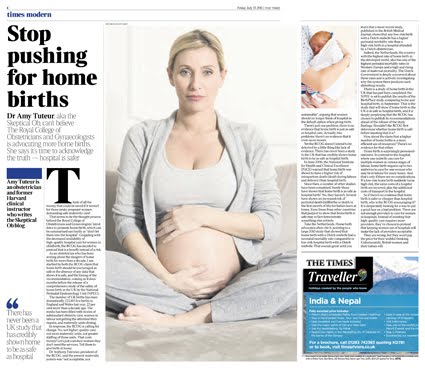
My article in today’s Times of London

Yesterday the UK Royal College of Obstetricians and Gynecologists (RCOG) issue sweeping plans for an overhaul of women’s health care.

The impetus for the recommendations sounds lofty. According to a Letter to the Editor in yesterday’s Times of London, Anthony Falconer, President of the RCOG, writes:

Within women’s health there is too much variation in outcomes from cancer to stillbirth, as well as a lack of choice… Today, we publish a report that sets out strong recommendations to ensure that our women’s services are world-class and well commissioned. Women’s healthcare should focus on preventing illness rather than firefighting after women become sick.

In maternity, we need to co-ordinate services so that women receive the best care in the right place. Many women need only simple interventions, which can be done out of hospitals. This will mean more midwifery-led units and fewer consultant units so that the most specialist care can be concentrated and available around the clock.

In an interview, Falconer insisted that pregnant women “should no longer think of hospital as the default option when giving birth.”

The real impetus is rather more grim. There is not enough money to staff and equip health facilities. Services are going to be taken away, but rather than admit to de facto rationing, the RCOG is trying to dress it up as a series of benefits instead of a series of losses.

The Times of London asked me to write a piece in response to the RCOG’s recommendation to increase the rate of homebirth. You can find the article here, but it is unfortunately only accessible to subscribers.

The problem is certainly real:

The number of UK births has risen dramatically, 723,165 live births in England and Wales last year, 22 per cent more than a decade ago. The media has been filled with stories of substandard obstetric care, women in labour not getting the attention they require, and maternity units closing.

But the reaction is not appropriate:

In response, the RCOG is calling for change. No, not higher-quality care; not more maternity units, not greater staffing of those units. That costs money! Let’s just convince women they don’t need the services. Tell them to give birth at home.

There are two important reasons why it is inappropriate. First, there is no evidence that homebirth is as safe as hospital birth in the UK. In fact:

There is a study of home birth in the UK that has just been completed: the NPEU is set to publish the results of the BirthPlace study, comparing home and hospital birth, in September. That is the study that will show if home birth in the UK is as safe as hospital birth, and it is deeply perplexing that the RCOG has chosen to publish its recommendations ahead of the release of the study findings. Shouldn’t the RCOG first determine whether home birth is safe before insisting that it is?

Second, there is no evidence that homebirth saves money. Homebirth is more personnel intensive:

In contrast to the hospital, where one midwife can care for multiple women in various stages of labour, home birth requires two midwives to care for one woman who may be in labour for many hours. And that’s only if there are no complications. If a low-risk home birth suddenly turns high-risk, the same costs of a hospital birth are incurred, plus the additional costs of transport to the hospital.

So why is the RCOG encouraging homebirth?

It is desperately looking for a way to put a good face on a bad problem. There are not enough providers to care for women in hospitals. Instead of insisting that high-quality care requires more providers, they’ve chosen to pretend that keeping women out of hospitals will make the lack of providers acceptable.

They are wrong, but they won’t pay the price for their wishful thinking. Unfortunately, British women and their babies will.

She still doesn’t get it

Last week I wrote a post about the sheer stupidity of Erin Ellis’ claims about postpartum hemorrhage. Erin has now written her reply and it seems that she hasn’t learned anything.

To recap, Erin claimed that there is a lower incidence of postpartum hemorrhage outside of the hospital because:

Midwives honor the biological importance of the hormonal bubble after birth and do not intervene unless the mother or baby needs help.

As I pointed out, postpartum hemorrhage has nothing to do with bubbles, hormonal or otherwise. Here’s what we know about postpartum hemorrhage:

1. It is common in nature; in fact, it is the LEADING cause of maternal mortality world-wide.
2. It is typically caused by failure of the uterus to contract effectively or by pieces of the placenta that have broken off and remained in the uterus.
3.It is far better to prevent postpartum hemorrhage than to treat it.
4.Active management is much more effective than watchful waiting in preventing postpartum hemorrhage.

I advised Erin that she should delete her grossly inaccurate post before she misleads even more women than she has done already. Instead of removing the post, Erin has written a reply. Her reply demonstrates that she has learned absolutely nothing.

Did she acknowledge that postpartum hemorrhage is common in nature? No.
Did she explain that most partpartum hemorrhages are caused NOT by interventions by uterine atony and retained pieces of placenta? No.
Did she acknowledge that, far from causing hemorrhage, routine interventions dramatically reduce the risk of hemorrhage? No, she didn’t do that either.

What did she do? She complained that she was misunderstood.

I use hemorrhage to illustrate the larger point that events in typical hospital births — and their outcomes — cannot automatically be extrapolated to out-of-hospital settings.

Don’t worry, Erin, I didn’t misunderstand what you were trying to do. I pointed out that what you were trying to do was based on claims that are flat out false.

You specifically used the example of postpartum hemorrhage to make the point that interventions cause hemorrhage and endogenous hormones (you remember the “hormonal bubble,” right?) are all that is necessary to prevent it. You were trying to make the point that most postpartum hemorrhages that occur are caused by intervention, but you are flat out wrong about that.

Erin, you apparently feel aggrieved but you ought to feel embarrassed. You write:

I will not, however, publish vindictive comments that reflect more of a personal attack than honest questioning or critical discourse.

No one asked you to publish any comments. I didn’t submit any comments to your blog. I asked you to publish correct information and to remove the inane garbage that you originally posted.

And, if you remember, I also asked you to get an obstetric textbook and read the FACTS about postpartum hemorrhage. Clearly, you didn’t even bother.

The pathetically minimal certification requirements for homebirth midwives

Want to know why the certification process for homebirth midwives (certified professional midwives, CPMs) is a joke? Just take a look at the certification requirements.

You can read all about it here.

What kind of background education is required for certification? Anything goes!

.. including programs accredited by the Midwifery Education Accreditation Council (MEAC) … apprenticeship education, and self-study… If the midwife is preceptor-trained … s/he must complete the NARM Portfolio Evaluation Process (PEP).

Seriously? Self-study is considered a valid means of acquiring a degree?

Who can be a preceptor and attest to the adequacy of the candidates educational background? Anything goes!

The NARM Portfolio Evaluation Process (PEP) involves documentation of midwifery training under the supervision of a preceptor. This category includes entry-level midwives, internationally educated midwives, and experienced midwives.

Anyone who calls herself “midwife” is automatically accepted as a qualified “preceptor.” Moreover, there is no effort to check a preceptor’s report of a candidates competency:

The preceptor holds final responsibility for confirming that the applicant provided the required care and demonstrated the appropriate knowledge base for providing the care.

That means that the only real requirement for becoming a CPM is taking the test. It doesn’t matter what your educational background is. It doesn’t matter how you got your clinical training. They aren’t even going to check whether you actually met the minimal clinical requirements. They’ll take your preceptors word for that and your preceptor can be anyone else who has passed the test.

Surely, the portfolio process is exercised by only a small number of women who have special circumstances? Wrong.

Consider this unbelievably scary statistic offered by the North American Registry of Midwives (NARM):

Of the more than 5000 births included in the CPM 2000 study published by the British Medical Journal, 99% were attended by midwives who received the CPM credential through the NARM Portfolio Evaluation Process.

In fact:

The majority of CPM candidates continue to become credentialed through NARM’s Portfolio Evaluation Process and all indications are that consumer demand will continue to drive aspiring midwives to seek the apprenticeship, community-based midwifery educational model that PEP validates.

So although there are midwifery schools, most certified professional midwives have never bothered to attend.

Compare that to the educational requirements for European, Canadian and Australian midwives. They must have a 3-4 year university degree, as well as home AND hospital based clinical training supervised by a variety of different instructors. Compare that to the educational requirements for American certified nurse midwives (CNMs). They have a masters’ level degree that involves even more education and clinical training.

The certification requirements for an American homebirth midwives (CPMs) are nothing more than a joke. Anyone can become certified so long as she pays the money and takes the test. There are essentially no barriers to certification, so any birth junkie can not only call herself a midwife, she can pay for a nice certificate to fool others into believing that she has completed an actual program of education and training, even if she has not.

How did this strange set of circumstances come about? As Robbie Davis-Floyd explains in Pathways to Becoming a Midwife: Getting an Education, A Midwifery Today book. Eugene, Oregon: Midwifery Today, 1998.

[Homebirth midwives] do not accept the argument that formal, standardized education is necessary to provide safe and competent practitioners.

That’s fine; they don’t have to “accept,” it, but that doesn’t mean that the rest of us should follow suit. Whether or not homebirth midwives accept it, formal, standardized education IS necessary to provide safe and competent practitioners.

Homebirth in The Boston Globe

It has been quite a week for homebirth stories in the mainstream media. There have been three major stories including a long piece in The Boston Globe Sunday Magazine entitled Her home-birth battle. It tells the story of Jenifer Holloman, a woman who had had a C-section 24 years ago, who chose homebirth with lay midwife Deborah Allen for her second child for the usual reasons:

She was studying to be a midwife, she wanted to maximize her chances for having a vaginal birth this time around, and she believed maternal care in the United States had become overmedicalized. Still, there was another, even more important reason Holloman says she and her husband, a carpenter, were interested in home birth. They didn’t have insurance, couldn’t afford the $179 monthly premiums for Commonwealth Care …

Holloman ruptured her membranes on February 7, 2009, and didn’t begin labor until February 10 at 1:45 AM. By waiting longer than 24 hours for her labor to begin after memebranes ruptured, Holloman and her midwife chose to accept a dramatically increased risk that the baby would develop a serious infection.

Holloman abandoned herself to her contractions and recalls that through the lens of her single-minded focus, time seemed all but suspended. But not for Beetz [her husband]. “As the day wore on, I got more and more concerned,” he says. “On numerous occasions I asked Deb, ‘Is this normal?’ She’d say, ‘Yeah, it’s normal.’ I started getting texts and calls. People were starting to worry. I was starting to worry.”

By late afternoon on the 10th, Holloman entered the final phase of labor. Each time she pushed, Beetz says, he thought he was about to meet his baby. But each time, there was nothing. “At 5:30, I was nervous,” he says. “At 7:30, I was really nervous. At 8, I was terrified, and I didn’t know what to do.”

Then they could no longer hear the baby’s heartbeat.

… Allen moved her and tried to find the heartbeat again. The medical charting all but stops by this point, but according to what Holloman and Beetz recall, Allen told them that the monitor must not be working. She reached in her bag for new batteries and changed them. Still no heartbeat. Allen picked up the phone and called the hospital…

Nonetheless, they didn’t actually leave the house for at least an hour, according to Holloman and Beetz, and they drove themselves to the hospital… Holloman says Allen first suggested they take a car instead of an ambulance, and then that they stay home. “I remember looking at her and saying, ‘Deb, I want a full medical intervention,'” Holloman says… “I picked up the telephone and called Cape Cod Hospital myself. I said: ‘My name is Jenifer Holloman. I am having an obstetrical emergency. I’m coming in.'”

By that point, the baby had been dead for hours.

At her request, Holloman was put under general anesthesia so she wouldn’t be awake when the baby was pulled from her via C-section. When she awoke, she found out she had had a boy. They named him Emmet… After Holloman awoke, she pulled up the list [of family and friends] on her laptop and sent out an e-mail announcing the death of their son.

… When Holloman was released from the hospital, she and her husband went home to the place their baby had died. “Everywhere I looked, all I could see was that I didn’t have my son,” says Beetz. Still, they rarely left the house, because venturing out was just as painful. Everywhere they went people asked for the baby. The lady at the bank, the people in the supermarket, visitors at the farm. They started doing their shopping a half an hour from home, where no one knew them.

“It was the longest, saddest year of my life,” recalls Holloman.

The official cause of Emmet’s death was infection with group B strep (GBS). Obstetricians routinely test women for the presence of GBS because it is the leading infectious cause of death of newborns. Women who are found to be positive for group B strep are routinely treated with antibiotics in labor, and, not surprisingly, cannot be allowed to wait hours after rupturing membranes for labor to start, since that further increases the risk that a deadly infection will develop.

Homebirth midwife Deborah Allen never did a test for group B strep, failed to recommend hospital care when membranes had been ruptured more than 24 hours and ignored Holloman’s low grade fever and chills.

In the wake of her baby’s death, Holloman evinces a touching faith that things would have been different had Deborah Allen been a licensed certified professional midwife (CPM). If only homebirth midwives were legal and regulated in Massachusetts, everything would have been different.

“A better-trained midwife would never have allowed what happened to transpire,” Holloman says. She and Beetz wanted their case to be investigated by an entity that could, if appropriate, sanction Allen and prevent her from delivering more babies. Holloman went to the police, the district attorney, the attorney general, the Department of Public Health, the Board of Nursing, and the Board of Medicine. “No one could do anything. They told us she’s neither fish nor fowl in the eyes of the law,” Holloman says. Last year, she and Beetz filed a lawsuit in Superior Court against Allen alleging negligence. “We didn’t want to sue anyone,” Holloman says. “This is the last house on the left for us.”

Her faith is entirely unjustified. Within the past several months alone, two certified professional midwives in two different states presided over homebirth deaths. Rather than an investigation by local CPMs, both midwives were treated to fundraisers by their peers to pay the legal costs incurred by their arrests.

Holloman has testified at the State House in support of the bill [that would license homebirth midwives] and has lobbied representatives directly. Two weeks after Holloman made one of these visits in late 2009, her neighbors … brought her some sad news. Their niece, who also resides in Massachusetts, had just lost her baby in a home birth. She had also been attended by a lay midwife.

Holloman might be even less optimistic if she learned that the Midwives Alliance of North America the organization that represents CPMs KNOWS that homebirth with a CPM leads to preventable neonatal deaths. They have refused to release the death rates of the 23,000 planned homebirths in their database. Rather than investigating substandard care, they are actively hiding it.

Holloman clings to the notion that it was not homebirth but rather the homebirth midwife that deserves the blame for Emmet’s death.

… She says she asks herself whether she isn’t telling herself some sort of vital lie, but does not believe she is; she doesn’t think home birth caused her son to die, but rather the care she received from Allen…

There is no doubt that Holloman received substandard care, but substandard care is standard for homebirth midwives. Homebirth midwives (CPMs) should not be licensed; they should be abolished. That’s what Canada has done, putting it in line with all other countries in the industrialized world.

And nothing changes the fact that homebirth increases the risk of neonatal death. All the existing scientific evidence says so and all the state and national statistics confirm it. The only people who appear to be unaware of the dangers of homebirth are homebirth advocates themselves.

Homebirth and Dr. Amy in the LA Times

On the heels of the AP’s completely one sided piece about homebirth comes a piece in the LA Times that explicitly tries for balance. The effort to present both sides starts with the title, At-home birth has pros and cons.

I am quoted in the article:

“All the existing scientific evidence, as well as state and national statistics, make it ultra-clear that home birth increases the risk of death,” says Dr. Amy Tuteur, a Boston-based physician and former clinical instructor in obstetrics at Harvard Medical School who opposes home births. “What I had seen of it during my years of practice were only disasters.”

And:

The problem with home birth, Tuteur adds, is that the distance to the nearest emergency room can sometimes mean the difference between life and death. “Saying, ‘trust birth’ is like saying ‘trust the weather,'” she says, referring to a slogan occasionally used in natural-birth groups.

The article also notes that:

Much of the opposition to home births is directed at certified professional midwives, not nurse midwives. Critics say the certification for such professional midwives is inadequate for those without a prior nursing background. (Certified professional midwives counter that their training is as rigorous as that of nurse midwives and that their programs are specifically geared toward low-risk home delivery.)

It would have been helpful if it explained that certified professional midwives (CPMs) have less education and training that ANY midwives in the first world, and would be ineligible for licensure in the UK, the Netherlands, Canada, Australia or ANY industrialized country.

And they didn’t include the quote from me that I consider most compelling:

The Midwives Alliance of North America (MANA), the organization that represents homebirth midwives refuses to release the death rate of the 23,000 planned homebirths in their database. If their data showed homebirth to be safe, they’d be shouting it from the rooftops. The fact that they won’t reveal how many of those 23,000 babies died at the hands of homebirth midwives indicates that even MANA knows that homebirth is unacceptably dangerous.

The piece includes the usual suspects extolling the putative virtues of homebirth and repeats some of the usual mistruths favored by homebirth advocates, including the claim the Johnson and Daviss BMJ 2005 showed that homebirth is as safe as hospital birth, without mentioning that Johnson and Daviss didn’t compared homebirth to hospital birth in the same year. That data (available publicly years before the BMJ paper was written) wasn’t used because it showed that homebirth had a mortality rate nearly triple that of hospital birth in he SAME year.

The power of the article is to be found in the brave testimony of Liz Paparella, a frequent commenter on this blog:

In 2009, Austin, Texas, mom Liz Paparella’s fourth child was stillborn on her living room couch because her midwife failed to take Paparella to the hospital when she began bleeding during labor.

“I never thought it was more dangerous to have a baby at home than at the hospital,” says Paparella, who had given birth successfully at home two times previously. “In birth, the risk can change from low to high in a matter of minutes.”

Homebirth kills babies … babies who didn’t have to die. All the scientific evidence, and state and national statistics are clear on this point. Most importantly, MANA, the organization that represents homebirth midwives refuses the release the death rates for the 23,000 planned homebirths in their database.

The leaders of homebirth midwifery KNOW that homebirth has an unacceptably high rate of perinatal death. Unless and until they release that information, it is impossible for any American women to make an educated decision about homebirth.

The napalm grade stupidity of Erin Ellis homebirth midwife.

It would be funny if it weren’t so deadly.

I’m referring to the napalm grade stupidity of ‘Erin Ellis homebirth midwife.’ Erin wrote a blisteringly ignorant post entitled “If I were at home, I would have died” — The trouble with extrapolating hospital birth events to homebirth.

It is a textbook example of what passes for “knowledge” among homebirth midwives and their terrible propensity to make stuff up instead of actually learning something.

Erin “explains” that obstetric hemorrhage only occurs in the hospital, and rarely at home. That would come as news to the 140,000 women who die of obstetric hemorrhage each year, almost all of whom come from developing countries, and most of whom give birth at home. Postpartum hemorrhage is the leading cause of maternal mortality world wide. In fact, around the world, 1 woman dies of postpartum hemorrhage every 4 minutes.

Erin, of course, is entirely oblivious to this grim reality. In Erin’s fantasy world, women don’t hemorrhage at homebirth because:

Midwives honor the biological importance of the hormonal bubble after birth and do not intervene unless the mother or baby needs help.

Here’s the problem Erin: postpartum hemorrhage has nothing to do with hormonal “bubbles.”

Let’s look at the epidemiology of postpartum hemorrhage:

The increased frequency of PPH in the developing world is more likely reflected by the rates given above for expectant management because of the lack of widespread availability of medications used in the active management of the third stage. A number of factors also contribute to much less favorable outcomes of PPH in developing countries. The first is a lack of experienced caregivers who might be able to successfully manage PPH if it occurred. Additionally, the same drugs used for prophylaxis against PPH in active management of the third stage are also the primary agents in the treatment of PPH. Lack of blood transfusion services, anesthetic services, and operating capabilities also plays a role…

In other words, in direct contrast to Erin’s assertion, postpartum hemorrhage is MORE likely in the ABSENCE of interventions.

The key factor in preventing death from postpartum hemorrhage is actively working to prevent the hemorrhage in the first place. That means giving medication like pitocin BEFORE hemorrhage starts. It means giving more pitocin, or more powerful uterine stimulants like ergotrate, if hemorrhage is not prevented. It means blood transfusions and it means surgical intervention.

What causes postpartum hemorrhage? Erin has no clue; she thinks:

When you hear someone say ‘I would have died if I had a homebirth’ or ‘my baby would have died’ please remember that these are very emotionally charged declarations. In many cases, unnecessary interventions have caused the complications that women and babies suffer from.

It is unlikely that Erin would babble such utter nonsense if she had ever bothered to learn the basics of postpartum hemorrhage. Postpartum hemorrhage is so common, and its causes so well known, that there’s a mnemonic, the four T’s: tone, tissue, trauma, and thrombosis.

Tone stands for uterine atony, the failure of the uterus to fully contract after delivery. Tissue stands for retained placenta, which makes it impossible for the uterus to contract fully after delivery. Trauma is lacerations, and thrombosis refers to the clotting disorders that often accompany pregnancy.

Atony is the most common cause of postpartum by far.

Uterine atony and failure of contraction and retraction of myometrial muscle fibers can lead to rapid and severe hemorrhage and hypovolemic shock. Overdistension of the uterus, either absolute or relative, is a major risk factor for atony. Overdistension of the uterus can be caused by multifetal gestation, fetal macrosomia, polyhydramnios, or fetal abnormality …; a uterine structural abnormality; or a failure to deliver the placenta or distension with blood before or after placental delivery…

Unlike other areas of the body, uterine bleeding does not stop by clotting. The bleeding comes from the blood vessels of the uterus that are wide open and exposed after the placenta detaches from the uterine wall. The ONLY way to stop uterine bleeding is for the uterus to contract forcefully to clamp the blood vessels closed. Uterine atony can occur in any woman, but it is more common if the uterus has been distended either by the baby before delivery, or with blood after delivery.

It is also more common in women who have labors that are very short or very long. Long labors are often a sign of poor uterine contractility, and in developed countries, such labors are stimulated with pitocin. Not surprisingly, the same women who needed pitocin to achieve contractions strong enough to deliver the baby, will need pitocin to achieve uterine contraction strong enough to halt uterine bleeding after the baby is born.

The second most common cause of postpartum hemorrhage is “tissue,” pieces of the placenta that have broken off and remained inside the uterus. The uterus cannot contract effectively if there is anything in the uterine cavity. Contrary to the fantasies of homebirth midwives like Erin, retained pieces of the placenta is extremely common in “nature,” and with traditional birth attendants.

The common causes of postpartum hemorrhage are rounded out by lacerations and by clotting disorders, either pre-existing or triggered by pre-eclampsia or other conditions.

How can postpartum hemorrhage be prevented? Hint: it’s not by facilitating a “hormonal bubble.”

High-quality evidence suggests that active management of the third stage of labor reduces the incidence and severity of PPH. Active management is the combination of (1) uterotonic administration (preferably oxytocin) immediately upon delivery of the baby, (2) early cord clamping and cutting, and (3) gentle cord traction with uterine countertraction when the uterus is well contracted (ie, Brandt-Andrews maneuver).

The value of active management in the prevention of PPH cannot be overstated. The use of active versus expectant management in the third stage was the subject of 5 randomized controlled trials (RCTs) and a Cochrane meta-analysis…

How effective is active management in preventing postpartum hemorrhage? There is an 80% reduction is cases of postpartum hemorrhage requiring treatment.

… The results indicate that for every 12 patients receiving active rather than physiological management, one PPH would be prevented. For every 67 patients so treated, one patient would avoid transfusion with blood products.

Let’s summarized what we (but evidently not Erin) know about postpartum hemorrhage:

1. It is common in nature; in fact, it is the LEADING cause of maternal mortality world-wide.
2. It is typically caused by failure of the uterus to contract effectively or by pieces of the placenta that have broken off and remained in the uterus.
3.It is far better to prevent postpartum hemorrhage than to treat it.
4.Active management is much more effective than watchful waiting in preventing postpartum hemorrhage.

The stupidity of homebirth midwives like Erin Ellis is downright appalling. She apparently knows nothing about the leading cause of maternal death. That’s bad enough. What’s worse is that she is unaware of her ignorance. And what’s even worse than that is that in her arrogance and ignorance she actually presumes to educate laypeople on a topic that she knows nothing about.

Erin, if you read this, and I’m sure you will, do the world a favor and take down your idiotic post. Oh, and before you do ANYTHING else, get a textbook and read about obstetric hemorrhage. Your ignorance and stupidity are nothing short of appalling … and potentially deadly.


Leanne Italie: What ever happened to journalistic values?

Associated Press reporter Leanne Italie has written a valentine to homebirth by ignoring two fundamental principles of journalism. She saw no need for balance and no need for fact checking. Had she bothered with either, she would have written a very different piece.

Just about everything in the piece is wrong, starting with the title Home birth on the rise by a dramatic 20 percent. Leanne, better check out a statistics book; 20% of a tiny number is not only not a “dramatic” rise, it is trivial.

Let’s look at the issue of balance, on the pro-homebirth side I count 8 proponents of homebirth, on the anti-homebirth side I count ZERO. So Leanne, tell us, you thought that it was okay to ignore opponents because … you couldn’t find their e-mail addresses? … you could only find one obstetrician who would say what you want? … you couldn’t care less about the truth?

Leanne interviewed the usual suspects:

A homebirth midwife.
Three women who gave birth at home, including two who were high risk, because they did not want to listen to or did not want to pay for medical expertise.
Robbie Davis-Floyd, anthropologist and feminist anti-rationalist who asserts that intuition is just as accurate as medical knowledge.
An obstetrician who prefers to ignore the dangers of homebirth.
And … Johnson and Daviss, still trying to promote their deeply disingenuous and entirely inaccurate BMJ 2005 paper. And still refusing to come clean about the fact that they are both professional homebirth advocates.

I don’t know if the homebirth rate is rising or not, Leanne, but if women have to rely on fluff like yours, it’s no surprise that they gullibly believe that homebirth is safe. Reporters like you don’t bother to address the fact that homebirth kills babies…

That ALL the existing scientific evidence (INCLUDING the Johson and Daviss paper, as well as state and national statistics) show that homebirth triples the rate of neonatal death.

That there are women who have lost babies to prentable cause at homebirth and are desperately trying to get the word out that homebirth kills babies.

That the Midwives Alliance of North America (MANA), the organization that represents homebirth midwives, is HIDING the death rates of the 23,000 planned homebirths in their database.

Leanne, being a reporter and all, doesn’t that make you a teensy bit suspicious? If MANA’s data showed that homebirth was safe, they’d be shouting it from the rooftops. Instead, they absolutely refuse to tell us just how many of those 23,000 babies died at the hands of homebirth midwives. Let me guess. You didn’t call MANA to ask them about those death rates because you didn’t bother to find out that they collected that data and, of course, your interviewees didn’t bother to clue you in.

Well, Leanne, if you care, you can still salvage something of your journalistic reputation by trying to set the record straight. You can reach me at DrAmy5 at AOL dot com. I’d be happy to:

Explain what the research really shows.
Inform you of the appalling death rates of homebirth in states like Colorado that collect accurate statistics.
Put you in touch with MEDICAL EXPERTS who could detail exactly how and why homebirth leads to preventible neonatal deaths.
Introduce you to women who lost their precious babies at homebirth and are desperately trying to inform other women of the real risks.

You wrote a piece that ignored the very real dangers of homebirth, and as a result, more babies may die preventable deaths. Did you really want to write a puff piece or did you end up writing a puff piece by accident? Either way, you ignored two fundamental principles of journalism: fact checking and balance.

Want to write a balanced and factually based piece about homebirth? Don’t hesitate to let me know. I’d be happy to show you the other side of homebirth, the side that the people you interviewed are desperately trying to hide.