Category Archives: Uncategorized

Henci Goer’s credentials : “I have books … I have papers …”

46529537-84C9-46E4-BB3D-F556CD51E245

Who knew?

Evidently, the only thing you need in order to call yourself an expert is a few books. How do I know? Henci Goer says it’s so. In response to a someone questioning the basis for her self-described expertise, Goer offers this painfully stupid response:

… I have a B.A. in biology from Brandeis University; I have a library of books and a collection of several thousand papers, including books and papers on how to analyze and interpret medical research; and I have been writing and speaking about what the consensus of maternity care research establishes as best promoting safe, healthy birth for over 20 years. That being said, my preeminent credential is illustrated by this anecdote: Penny Simkin was once called on the carpet by an anesthesiologist, irate that she had written a handout listing the potential trade-offs of epidural anesthesia when she was not a doctor (although he did not dispute her accuracy). “What are your credentials?” he demanded. “I can read,” she mildly replied. So can I.

Yippee! I didn’t know that I was an expert in so many things. I love history and have lots of books and papers. I’m a historian! I have both fresh and saltwater fish and lots of books on how to care for them. I’m an ichthyologist! I love roses and peonies and own a variety of books on their cultivation. I’m a botanist! Ooooh, I am so impressed with myself.

Of course I do feel a bit foolish to find out that I all I needed was a bunch of books and papers on obstetrics to consider myself an expert on all aspects of childbirth. I wasted four years and tens of thousands of dollars on medical school. I did get a couple of cool letters to put after my name (MD), but was that really worth when all it takes to be an expert is owning books? And when I think of the thousands of hours I worked during internship and residency, the thousands of patients I cared for, the thousands of deliveries I attended, I could kick myself. The hands on experience was totally unnecessary.

And what was the point of actually providing obstetrical care for women when I was working as an obstetrician? Who knew that taking responsibility for the care of a myriad of obstetric complications, as well as hundreds of women who had uncomplicated deliveries was a total waste of my time. I could have read about it in a book. That’s just as good; Henci Goer says so herself.

Most of all, though, I am thrilled to learn that Henci Goer considers me the pre-eminent American expert on homebirth and its many dangers. There is simply no doubt that I own more books, more papers, more journal subscriptions relating to natural childbirth and homebirth than any other American, including her and no one has been writing as long or as extensively on the topic as me. Plus, I am a really, really good reader; I have the SAT scores to prove it.

It’s undeniable, folks, that I am the true expert in all aspects of pregnancy and birth, and everyone should be listening to me. Not because of my extensive background in science, statistics and medicine. Not because I have delivered thousands of babies and been involved in the care of thousands more. Not because I actually AM an expert in pregnancy and childbirth, but because I own lots and lots and lots of books and papers on the topic.

Thank you, Henci, for your endorsement of my expertise. Your reasoning is idiotic, but I’m willing to overlook that in this instance. How do I know that you have endorsed me as an expert?

Isn’t it obvious? … I can read.

Judging other mothers

Natural childbirth advocacy is another weapon on the ongoing battle of competitive mothering. This article by Faulkner Fox, Judging Mothers, How and Why Feminists Can Stop, offers an interesting and amusing perspective. I don’t agree with her Marxist analysis, but she lays out the problem quite well:

The woman who wrote to me, whom I’ll call Joan, said that her 20-month-old had been playing in the sandbox before stopping to ask her mother for a snack. Ever the prepared mother, Joan pulled out a Stonyfield Farms organic strawberry yogurt in a tube.

Immediately another mother, whom Joan did not know, piped up from a nearby bench: “How can you give that to your daughter? It’s so full of sugar. What I do,” she continued, “is use a syringe to extract 1/2 of the sweet yogurt from the tube, then I use a second syringe to inject plain yogurt back into the tube. That way my daughter has the same yogurt as the other kids, but I know that it’s not too sweet.”

Fox’s suggestions for possible responses are hilarious:

Let’s consider for a minute – just for fun – what an appropriate response could be in this situation…

Here are a few choices I came up with:

a) Thanks so much! Can I borrow your syringe?

b) Would you like the name of my psychiatrist? Zoloft has done wonders for me.

c) Do you realize that the President of the United States {at the time, George W. Bush] is an often incompetent, but still incredibly dangerous, warmonger? Why not use your yogurt time to fight any number of unethical and nonsensical policies that harm mothers, children, and everyone else? Here’s the phone number for the National Organization for Women. Or,

d) the all-purpose response to strange statements – for feminists, as well as anyone else: Huh? Say What?

Fox deftly frames the problem:

When another mother makes a statement that feels like a judgment on our mothering – and Joan certainly took this yogurt-doctoring advice as a judgment rather than an innocent food hint – how do we answer back? … Why do mothers judge each other, sometimes on the pettiest details, in the first place? Why do mothers – at least in my experience and according to my observations – judge one another at a much higher frequency than other members of the population judge one another?

Fox’s assessment:

I believe that at least some of the time, even the tiniest judgments we make are really ways of asking these two questions: 1) Is that mother selfless enough? And more personally, 2) is that mother sacrificing as much as I am? If not, I’m not sure I like her, and I’m not sure I can refrain from saying something critical to her – just to see if I can get her to feel anxious, the way I feel anxious.

In other words, women concern themselves with the details of other women’s mothering because they are insecure and can feel more secure by demeaning another mother. That’s what’s going on when natural childbirth advocates feel compelled offer other women unsolicited advice on “what worked for them”. That’s what’s going on when NCB advocates feel compelled to tell their birth stories to women who didn’t ask to hear them. They are insecure and they can feel better about themselves by explicitly or implicitly demeaning other mothers. There are two serious problems here. One is that some women are deliberately hurting other women. The other is that natural childbirth is not objectively superior in any way.

This post first appeared 4 years ago on Homebirth Debate.

Dr. Klein is shocked

Dr. Michael Klein is shocked, shocked at how willingly women are to follow their obstetricians’ advice. As an article in yesterday’s LA Times details:

Doctors, led by Dr. Michael Klein of the Child & Family Research Institute and University of British Columbia, surveyed 1,318 healthy pregnant women. They found many seemingly unprepared to make their own decisions regarding childbirth options, such as whether to have natural childbirth or a Cesarean section…

“[E]ven late in pregnancy, many women reported uncertainty about benefits and risks of common procedures used in childbirth,” Klein said in a news release. “This is worrisome because a lack of knowledge affects their ability to engage in informed discussions with their caregivers.”

Klein’s findings have been appear in the paper Birth Technology and Maternal Roles in Birth in this months’ issue of Obstetrics and Gynecology Canada. Klein’s distressing conclusion? Many women appear to follow the advice of their obstetricians.

Contrast that with women’s relationship with other professionals. Are women seemingly unprepared to make their own decisions regarding legal options such as whether or not to sue a business colleague? Do they demonstrate uncertainty about the benefits and risks of common legal actions? Actually … they do. That’s why they consult lawyers in the first place.

Okay, law is a highly specialized profession, so that accounts for the fact that women fail to do their own “research” and “educate” themselves on all their legal options, but what about something more straightforward like building a house?

Are women seemingly unprepared regarding architectural options like structural steel roof framing vs. conventional framing? Do they demonstrate uncertainty about the benefits and risks of common structural options like the locations of walls or the framing of windows? After all, what could be more basic than walls and windows. Every women who lives in a house (and that’s most women) are directly affected by their walls and windows. And yet … most women merely rely on the advice of their architects.

Alright, women rely on the advice of their lawyers and architects, but surely they have a different approach when the decisions involve their own body.

Consider the decisions women face regarding breast cancer treatment. It is difficult to imagine when women are more vulnerable, and when their decisions directly affect their autonomy as when they are newly diagnosed with breast cancer. Do women demonstrate uncertainty about the benefits and risks of various treatment options like surgery vs. radiation, or radiation vs. chemotherapy? Um … yes, they do.

But surely they are fully versed in the many benefits and risks of specific chemotherapy drugs. Wait, they’re not? But no doubt they understand exactly when, where and how radiation should be delivered to the breast. They don’t? Surely, they don’t merely rely on the advice of their oncologist to make such an important decision? Actually, they do.

Okay, maybe that’s because cancer is so complicated. Consider something far simpler like eye care. Every woman has eyes, and their eyes are designed to see perfectly. It’s not like they are dependent on the decision of an optometrist as to whether they do or do not need eye interventions like glasses? Oh, they are?

Well, at least they understand the myriad risks of wearing contact lenses. They are undoubtedly familiar with all the rare eye injuries and diseases whose incidence is increased by contact lenses, right? How could they allow an intervention like the placement of plastic IN THEIR EYE unless they were fully cognizant that in rare cases, it could increase the risk of BLINDNESS?I Wait! What? They don’t know about these things and they acquiesce to wearing contact lenses because their optometrist recommends them? That’s shocking.

Of course it’s not as shocking as the fact that women rely on the advice of their obstetricians. Think about how different childbirth is than these other examples. It’s not surprising that women rely on their lawyers because they are legal experts, and it’s hardly surprising that women rely on architects because they are experts in the construction of houses. And surely it only makes sense for women to rely on the advice of an oncologist when they have cancer, because oncologists are experts in cancer and obviously, they are going to take the advice of optometrists on eye care because optometrists are experts in diagnosing and treating vision problems.

But why, oh why, do women rely on the advice of obstetricians when obstetricians are merely … experts in childbirth??!!

Dr. Klein is right to be terribly shocked and disturbed at this completely unreasonable, wholly inexplicable phenomenon that has no parallel in any other aspect of a woman’s life.

The sexist origins of natural childbirth

In light of our ongoing discussions about the racist and sexist origins of natural childbirth philosophy, I thought I would recap a post that I wrote for Homebirth Debate in early 2007. What I find fascinating is how natural childbirth grew out of the racial prejudices at the heart of colonialism and the sexist outcry against women’s emancipation, specifically women leaving the home to go to work.

Grantly Dick-Read’s fabrication of the notion that “primitive” women did not have pain in childbirth was a product of the eugenics movement, which was obsessed with the idea that “inferior” women were having more children than their “betters”. In a fascinating article,The Race of Hysteria: “Overcivilization” and the “Savage” Woman in Late Nineteenth-Century Obstetrics and Gynecology, Laura Briggs argues that the comparisons between “overcivilized” white women and “primitive” women who gave birth easily was not merely the product of racism, but reflected the anxiety that men felt about women’s increasing emancipation.

This anxiety over women’s increasing education, independence and political involvement was expressed in medicine generally, and in obstetrics and gynecology particularly, by the fabrication of claims about the “disease” of hysteria and the degeneration of women’s natural capabilities in fertility and childbirth compared to her “savage” peers. Simply put, the result of women insisting on increased education, enlarged roles outside the home and greater political participation was that their ovaries shriveled, they suddenly began to experience painful childbirth and they developed the brand new disease of “hysteria”, located in the uterus itself.

Briggs writes:

Hysteria, we learned from feminist historical scholarship in the 1970s, was never just a disease. It was also the way nineteenth century U.S. and European cultures made sense of women’s changing roles. Industrialization and urbanization wrought one set of changes, while the women’s rights movement brought another. Together, these included higher education for women, their increasing participation in a (rapidly changing) public sphere, paid employment, and declining fertility. These cultural changes were accompanied by a virtual epidemic of “nervous weakness” largely among women, causing feminist historians to begin asking whether the diagnostic category of hysteria was simply a way of keeping women in the home.

What was “nervous weakness”?

Nervousness was often characterized as an illness caused by “overcivilization,” which located it in a scientific and popular discourse that defined cultural evolution as beginning with the “savage,” culminating in the “civilized,” but also containing the possibility of degeneration — “overcivilization.” In this literature, “savage” or “barbarian” was applied to indigenous peoples, Africans, Asians, Latin Americans, and sometimes poor people generally. As a disease of “overcivilization,” hysterical illness was the provenance almost exclusively of Anglo-American, native-born whites, specifically, white women of a certain class. Second, the primary symptoms of hysteria in women were gynecologic and reproductive—prolapsed uterus, diseased ovaries, long and difficult childbirths — maladies that made it difficult for these hysterical (white) women to have children.

Furthermore:

“[O]vercivilized” women avoided sex and were unwilling or incapable of bearing many (or any) children, “savage” women gave birth easily and often, and were hypersexual. This is the discourse that was slightly later termed “race suicide.”Late nineteenth-century gynecological and obstetrical literature did more than simply naturalize opposition to white women’s political struggles by insisting that contraceptive use, abortion, education, and participation in the professional workforce could cause nervous illness. It also reconceptualized these forms of white women’s struggle for social and political autonomy from white men as a racial threat.

In Brigg’s analysis, pain in childbirth served a very important function in this racist and sexist discourse: it was the punishment that befell women who became too educated, too independent and left the home. The idea that “primitive” women had painless childbirth was fabricated to contrast with the painful childbirth of “overcivilized” women. It is striking how reminiscent this is to the biblical interpretation of pain in childbirth. In both cases, painful labor is explicitly a punishment for women who “forget their place” and act independently.

When Grantly Dick-Read and his peers claimed that “primitive” women had painless labors, they were not describing a real observation; they were issuing a warning to women of a certain social class: if you dare to step beyond the roles that we have prescribed for women, you will be punished with painful labor.

In light of this, it is more than ironic that some contemporary women are still insisting that childbirth is not inherently painful, that indigenous women have painless childbirth, and that if you “prepare” for childbirth properly, your birth will be painless, too.

Where are the female obstetricians?

I admit that decades after I first learned about natural childbirth and homebirth I am still shocked that anyone believes in it.

Natural childbirth was invented by a racist, sexist white male (Grantly Dick-Read) who wanted to encourage women of the “better classes” to stop fearing labor and have more children. It has been perpetuated by a cadre of Western, white, male physicians (Lamaze, Bradley, Odent) who subscribe to the notion that pain is women’s heads, or failing that, should make them feel “authentic.”

The “grandmother” of midwifery is Ina May Gaskin, a hippie from a bizarre commune who has no training in anything, AND let her own baby die rather than seek medical care for him. The foot soldiers in the NCB and homebirth armies are women who have no formal education in science, medicine or obstetrics and seem to think that is no problem. They are women without college degrees who enjoy attending other women’s births as a hobby and who couldn’t be trusted with any professional responsibility, let alone one that involves life and death.

The current “thought leaders” in the NCB and homebirth world are all Western, white men like Marsden Wagner and Michael Klein.

Did you notice that there is rather important group missing from the movement? I did, because I’m one of that group: women obstetricians.

Women obstetricians routinely favor high levels of interventions for themselves. They are open to C-section on maternal request and often have C-sections for maternal request. They love pain medication and freely use epidurals when they have children of their own.

Why aren’t they on board with NCB and homebirth, like some of their male colleagues? Let me count the ways.

1. They have personally experienced the pain of labor.

2. They have personally experienced the pain of labor.

3. They have personally experienced the pain of labor.

And having personally experienced the pain of labor, they recognize Dick-Read, Bradley, Lamaze and Odent for the sexist blowhards that they are.

There are additional reasons:

They have a wealth of knowledge about childbirth and its dangers. They have more experience and skill in handling childbirth than any CNM, CPM, doula or childbirth educator. They know that most of the NCB/homebirth trope is nothing more than made up nonsense.

They do not believe their personal value resides in their breasts and vagina. They recognize that their value lies in their intelligence, insight, professional accomplishments and actions in the world. They are empowered by knowledge, not by what passes through their vagina.

They don’t risk their children’s lives to prove a point because they have nothing to prove. Their accomplishments speak for themselves; they don’t have to create faux “accomplishments” out of bodily functions over which they have no control in any case.

I find it quite ironic that while women without formal training in science and male doctors with strong ideas about how women should react to pain prattle on and on of being “educated” about childbirth and interventions, they don’t seem to notice that women obstetricians, the people with the MOST education and personal experience of childbirth, are not on board.

Who the hell is Marsden Wagner to tell me how I ought to give birth?

Who the hell is Henci Goer to tell me that obstetricians ignore scientific evidence?

Who the hell is Michael Klein to tell me how much pain in labor I ought to endure?

Wake up NCB and homebirth advocates! Women obstetricians are not on board. We don’t need men to tell us how we should experience childbirth and we don’t need women who could barely finish high school to tell us their pretend “facts” about childbirth.

If we don’t believe their inanities, why should anyone else?

Cochrane Childbirth Reviews riddled with statistical errors

Lay people love Cochrane pregnancy and childbirth reviews. They always include plain language summaries, are systematic reviews or meta-analyses that are easy to understand, and are generally written by volunteers, many with an natural childbirth ax to grind.

Doctors are not nearly so enamored of Cochrane pregnancy and childbirth reviews. Although they agree in principle with the aims of the Cochrane project (synthesizing scientific evidence), the reviews are limited by the fact that papers included in a review are often poorly done, underpowered and differ markedly from each other in what results are measured and how they are measured. Moreover, Cochrane Childbirth reviews are often written by self-selected volunteers with an ax to grind, and therefore suffer appear to start with the conclusion and work back to include only papers that support it.

As a general matter, systematic reviews and met-analyses suffer serious limitations, some of which can be overcome with appropriate statistical analysis. However, as a new paper on the Cochrane Childbirth Reviews reveals, most are riddled with serious errors of statistical analysis that render their conclusions suspect or even useless.

Statistical methods can be improved within Cochrane pregnancy and childbirth reviews by Riley, Gates, Neilson, and Alfirevic was published in this month’s issue of the Journal of Clinical Epidemiology. Coincidentally, I recently referenced Alfirevic as the author of the Cochrane Review on electronic fetal monitoring (EFM), the review that he acknowledged was underpowered to determine if EFM saves lives.

The intrinsic problems of systematic reviews have been summarized elsewhere as follows:

• There are numerous ways in which bias can be introduced in reviews
and meta-analyses of controlled clinical trials.

• If the methodological quality of trials is inadequate then the findings
of reviews of this material may also be compromised.

• Publication bias can distort findings because trials with statistically
significant results are more likely to get published, and more likely to
be published without delay, than trials without significant results…

• Criteria for inclusion of studies into a review may be influenced by
knowledge of the results of the set of potential studies…

These limitations can be summarized by the pithy phrase “garbage in, garbage out.” A meta-analysis or systematic review is only as good as the quality of the papers reviewed.

The Cochrane Childbirth Reviews suffers from these problems and more:

There are deficiencies in the use of statistical methods within the Cochrane Pregnancy and Childbirth Group (CPCG) reviews. The issue of publication bias is
rarely addressed; the process of measuring, investigating, and accounting for heterogeneity is often limited or inadequate; and random-effects analyses are
not correctly interpreted. The large number of metaanalyses per review also raises the concern of multiple testing. These problems need to be urgently
addressed…

Improved use of statistical methods is urgently needed within Cochrane reviews. Although we have only assessed CPCG reviews in the article, our findings have general implications for all Cochrane reviews… The Cochrane Collaboration must seek to engage more statisticians and methodologists within individual reviews …

The problems identified in the Cochrane Reviews were not limited to a small subset of the reviews. For example, in assessing publication bias, the authors note:

Just 6 (7%) of the 75 reviews stated in their Methods section how they would assess publication bias; only 7 (9%) described a publication bias assessment in their Results or Discussion section or justified why publication bias assessments were not possible; and only 3 reviews described a publication bias assessment plan in their Methods section and subsequently reported an assessment in their Results or Discussion section…

The authors acknowledge that errors such as these seriously limited the validity of Cochrane pregnancy and childbirth reviews:

… It is clear that CPCG reviews must now consider the issue of publication bias in more detail, both when planning their review and when interpreting their results. This is particularly important for their primary analyses, as else misleading or overly strong conclusions may be made…

Unless and until these issues are addressed, Cochrane pregnancy and childbirth reviews will continue to dazzle lay people with incorrect conclusions, and be dismissed by doctors as poorly done and riddled with statistical errors.

No, breech is NOT a variation of normal

iStock_000009993652XSmall

Natural childbirth and homebirth advocates have a distressing habit of seizing on lies and repeating them over and over again to convince themselves and others that they are true. One currently popular lie is that “breech is a variation of normal.”

Here’s a little hint: If it dramatically increases the risk of death, then it is NOT a variation of normal. And breech presentation dramatically increases the risk of death. Contrast that with true variations of normal like left-handedness vs. right-handedness, which have no bearing on health or life expectancy.

To understand why breech presentation dramatically increases the risk of death, it is helpful to review some basic principles of childbirth. At term, the baby’s head is usually the largest part of the baby. That means that if the head fits, the rest of the baby should follow without difficult (shoulder dystocia is an exception). Moreover, the bones of the fetal skull are not fused and can slide past each other, allowing “molding” of the fetal head letting it squeeze through the pelvis. In the breech presentation, the head is still the biggest part of the baby, but now it is coming last and there is no chance for it to mold to squeeze through the pelvis. There is a high risk that the head will be trapped, often resulting in the death of the baby.

Breech babies and their mothers differ in substantial ways from the rest of the population. Breech babies are far more likely to have congenital anomalies, particularly anomalies like hydrocephalus that increase the size of the fetal head. In other words, the baby ends up breech because the head is too large to properly fit in the pelvis. Mothers who carry breech babies often have uterine anomalies that distort the shape of the uterus. In other words, the baby ends up breech because the bottom of the uterus cannot accommodate the fetal head.

The risks of labor differ substantially for breech babies. Typically, the head fills the cervix as it is dilating, making it impossible for the cord to prolapse (fall out), a condition that routinely ends in death. In contrast, the breech, being smaller, does not fill the cervix, making cord prolapse far more likely. In addition, in contrast to vaginal delivery where the baby’s arms are pressed to its sides, the arms of a breech baby may end up over its head. One or both can end up behind the head crossing the neck. This is known as nuchal arms. A baby with nuchal arms cannot be delivered because the diameter of the head plus the arm(s) is too big to fit through the pelvis. Unless the provider can move the arm(s) from behind the head, the baby will die.

In addition, there’s more than one kind of breech. To say that the baby is in the breech presentation means only that the bottom of the baby is coming first. The bottom may refer to the buttocks or the feet (more dangerous). The breech baby may have its chin to its chest or it may be facing upward (more dangerous).

Indeed, in studies that purported to show the safety of vaginal breech delivery, all the babies in the complete or footling breech presentations are excluded. All babies with extended heads (looking up) are excluded. All large babies are excluded. All women with a small pelvis are excluded. So much for “breech” being a variation of normal.

How dramatically does breech presentation increase the risk of perinatal death? The experience in Norway, before and after the C-section rate for breech had risen precipitously, is representative of the risks. According to Secular trends in peri- and neonatal mortality in breech presentation; Norway 1967–1994 by Albrechtsen et al.:

… The extended peri- and neonatal mortality rate in breech presentation births declined during the study period from 9.2% in 1967–76 to 5.5% in 1977–86 and to 3.0% in 1987–94. The highest relative risk of mortality in breech presentation versus the total birth population was observed in intrapartum death and in mortality less than 24 hours after delivery…

During the study period, the overall rate of perinatal mortality declined due to advances in obstetrics and neonatology. In addition, the C-section rate rose dramatically. Both contributed to the overall decline in mortality from breech delivery. But as the following graph shows. C-section for breech uniformly led to better outcomes.

4E1079FE-90D0-45C2-986D-9BE2D474BB67

The bottom line is that, any way you look at it, breech is NOT a variation of normal. Breech babies have a higher incidence of congenital anomalies and their mothers have a higher incidence of uterine anomalies. Breech babies are at much higher risk for cord prolapse and encounter complications like nuchal arms and trapped heads that simply do not occur in head first deliveries. Most importantly, any baby in the breech position has a dramatically higher risk of death.

A variation that kills babies is not a variation of normal.

Electronic fetal monitoring gives much more information

late decellerations

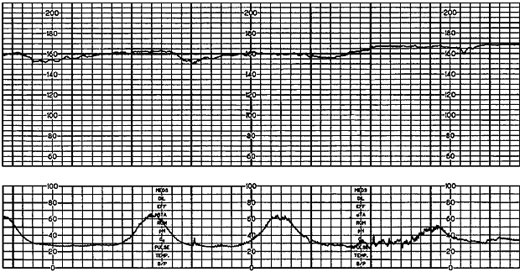
This tracing shows a baby in serious trouble.

Surprised? You might be if you thought that a fetal heart rate tracing supplied the same information as intermittent ausculation (listening) with a doppler. But electronic fetal monitoring provides a wealth of information that cannot be obtained by listening, and that allows for a more comprehensive view of fetal well being.

What information does this tracing provide? To understand, you need to know what we are looking at. We are looking at two different graphs created simultaneously by the fetal monitor. The top graph shows the fetal heart rate; the bottom graph shows the uterine contractions. The information in the top graph can only be understood in relation to the information in the bottom graph.

Let’s start with the basics:

* The baseline fetal heart rate is approximately 160 beats per minute. This is a normal fetal heart rate. Therefore, if you were listening briefly at most points during which this tracing were created, you would think that the baby was doing fine.

* There is decreased variability. We know from looking at millions of tracings that the normal fetal heart rate will created a jagged line. This is known as “variability.” As the circulatory needs of the fetus change from moment to moment, the heart rate adjusts from moment to moment. When the baby’s brain is deprived of oxygen, the heart rate will lose variability, and the line will look smoother. This heart rate tracing has lost its variability; this baby is in trouble.

There is no way to determine variability while listening, so intermittent auscultation would not alert you to this ominous development.

* There are no accelerations. A well oxygenated baby will move from time to time. That will be reflected in temporary increases in the heart rate (accelerations) lasting for fractions of a minute or more. Without a written tracing, it is difficult to determine if there are accelerations.

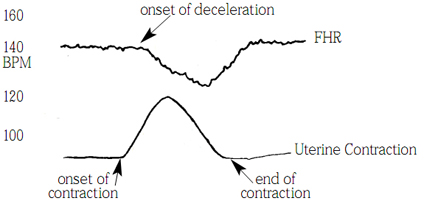
* There are subtle late decelerations. A deceleration is a brief decrease in heart rate. Their significance is not in how deep they are, but in where they are located in relation to the contraction. They are categorized as early (before a contraction), variable (at the peak of a contraction), or late (staring during a contraction but continuing after the contraction has ended).

The following illustration provides a clearer view of a late deceleration. Notice how the decrease in heart rate starts during the contraction and continues after the contraction has ended:

late decel anatomy of

Late decelerations are an indication that the baby is not getting enough oxygen through the placenta to “hold its breath” during a contraction when the supply of oxygen is temporarily cut off. Repetitive late decelerations are an unequivocal sign of fetal distress.

It is important to note that the depth of the deceleration has nothing to do with the severity of oxygen deprivation. Subtle late decelerations, such as those in the tracing at the top, are nonetheless extremely ominous.

Can you hear a late deceleration with intermittent monitoring? That depends entirely on when you listen, how long you listen, and whether there are contractions during time when you are listening. The subtle late decelerations in the tracing above might be very difficult to appreciate by listening alone. That’s because the heart rate changes only by 5-10 beats per minute and only for a period of 15-20 seconds.

Notice what you don’t see:

You don’t see a bradycardia, a sustained period of abnormally low heart rate. That’s because bradycardia is often a terminal event. Most babies can tolerate long periods of significant oxygen deprivation before they die, and they may not have any bradycardias until immediately before death. On this tracing, there is never a single moment when the heart rate is outside of the normal range, but the baby is nonetheless suffering from serious oxygen deprivation.

This is almost certainly what is happening in hours before a dead baby drops into a homebirth midwife’s hands. The midwife may be intermittently listening to the baby’s heart rate, but unless she is listening for long enough AND frequently enough AND exactly at the right times AND can distinguish subtle changes in heart rate, she will be blissfully unaware that a baby is dying right in front of her.

Homebirth advocates and their midwives who insist that the baby’s heart rate was “fine” until just before delivery are completely wrong. The baby’s heart rate was not fine; they just couldn’t tell what was happening because they only listened intermittently.

Homebirth advocates and their midwives who insist that no one could have predicted that the baby would need an expert resuscitation are completely wrong. The baby was not fine; they simply couldn’t tell one way or the other.

Homebirth advocates and midwives who insist that the same thing would have happened at the hospital are completely wrong. The pattern would have been picked up, probably hours before the baby’s death, and a C-section would have been done. The baby would have been born healthy and screaming and the mother and midwife would have been fuming about the “unnecessary” C-section.

Homebirth advocates and midwives who insist that intermittent monitoring is just as safe as electronic monitoring are completely wrong. If you can’t pick up subtle changes in heart rate, you can’t diagnose and treat fetal distress early, before the baby’s brain has been permanently damaged.

Look at the tracing above again. Ask yourself:

Could you (or anyone) hear that heart rate pattern?

If not, then you can understand how very easy it is to listen intermittently to a “normal” heart rate, and then unexpectedly have a dead baby drop into your hands.

Electronic fetal monitoring halves early neonatal mortality

The American Journal of Obstetrics and Gynecology has just published a “Report of Major Impact” that demonstrates that electronic fetal monitoring saves lives.

Electronic fetal heart rate monitoring and its relationship to neonatal and infant mortality in the United States by Chen et al. is the largest study ever done on electronic fetal monitoring (EFM). The authors reviewed 1,732,211 singleton live births (elective C-sections and congenital anomalies were excluded. Of these births); 89% involved EFM while 11% did not. They found:

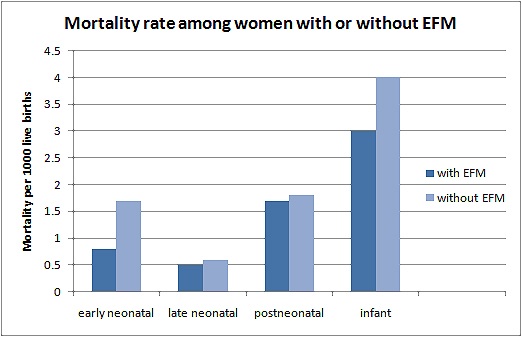
The corrected early neonatal, late neonatal, postneonatal, and infant mortality rates for all subjects were 0.9, 0.5, 1.7, and 3.1 per 1000 births, respectively… The risk of corrected mortality rate was different between those with vs without EFM during the early neonatal period (0.8 vs 1.7 per 1000 births, respectively; P ‹ .001), but not in late (0.5 vs 0.6; P ‹ .402) or postneonatal periods (1.7 vs 1.8; P ‹ .296).

In other words, EFM cut the rate of early neonatal death in half (death from birth to 7 days), but had no impact on late neonatal death (from 7-28 days of life) or postneonatal death (from 1 month to 1 year of age). This is exactly what you would expect to find if EFM prevents peripartum death from hypoxia (lack of oxygen). The results are represented graphically below.

image

There were secondary findings as well:

… Use of EFM was associated with an increased likelihood of operative vaginal delivery for all indications, as well as for fetal distress. In addition, use of continuous monitoring was associated with an increased risk of primary cesarean delivery for fetal distress …

…[U]se of EFM was associated with a lower likelihood of 5-minute Apgar score ‹4…

The secondary analysis also indicates that the rate of neonatal seizure was significantly lower only among high-risk women who had EFM…

What are the differences between this study and the Cochrane review that purported to show that EFM increases operative delivery rates without improving neonatal survival? The Cochrane review, encompassing 37,000 women, was simply too small.

The combined sample size of 12 RCTs is insufficient to determine whether EFM can significantly lower neonatal mortality. Alfirevic [the author of the Cochrane review] noted that to test the hypothesis that continuous monitoring can prevent 1 death in 1000 births, more than 50,000 women need randomization…

Moreover, as the Cochrane review authors themselves noted, of the 12 RCTs included in the analysis, only 2 were high quality studies.

Chen et al. conclude:

According to the Cochrane review and the most recent ACOG recommendation, the use of fetal heart rate monitoring increases operative delivery rate without a concomitant decrease in longterm neonatal outcomes. Thus, understandably there has been continued angst about using fetal heart rate monitoring during labor. The main implication of our study is that now there is reassuring evidence for the use of EFM; its use is linked with … a significant decrease in early neonatal and infant mortality … [F]etal heart rate monitoring can be used in daily practice with some assurance.

A conclusion of the study is the large sample size necessary to demonstrate improvement in neonatal outcomes. One reason the … Cochrane review did not demonstrate benefit of EFM is small sample size of published reports. Alfirevic et al acknowledged that over 50,000 women need to be randomized to demonstrate improvement in mortality. The issue of sufficient sample size … remains unachievable in modern day obstetrics… Thus, when the outcomes are uncommon and randomized trials are not plausible, we should consider evidence from “reality-based medicine,” for it, along with this study, demonstrates improvement in mortality
with EFM.

Of note, this study, which contains only live births, almost certainly underestimates the benefit of EFM. EFM appears to save lives by decreasing the risks of hypoxic brain injuries associated with low Apgar scores (‹4). The study did not include intrapartum deaths (Apgar 0), where the benefits of EFM are similar or even larger.

The bottom line is that the largest study of electronic fetal monitoring to date shows that EFM cuts the rate of early neonatal death in half. That is a dramatic benefit.

A healthy baby is not the most important thing

Homebirth advocates have countless fallback positions.

A homebirth advocate says: I’m having a homebirth because it is safe or safe than hospital birth.

Present the copious evidence that homebirth triples the rate of neonatal death and the homebirth advocate falls back to: I’m having a homebirth because even if it isn’t safest, it is safe enough.

Show her that homebirth has a truly unacceptable rate of neonatal death and she falls back even further: My intuition tells me that homebirth is safe enough for me.

The ultimate fallback position, when all the information is on the table, is this: A healthy baby is not the most important thing.

What are we to make of this?

First, it not true. For the vast majority of women (99+%), a healthy baby is the most important thing. That’s why they go to the hospital in the first place. It certainly isn’t for the fabulous food and the wonderful decor. It’s for the obstetric interventions that make childbirth dramatically safer and much more comfortable.

It’s not true even for most homebirth advocates because it misrepresents what the she believes. The average homebirth advocate is completely ignorant of the real risks, so she thinks there are no risks. The few who recognize the risks use their “intuition” to predict that they are not going to have life threatening complications; they are going to have a healthy baby regardless of whether they give birth at home or in the hospital. What they really mean is: Since I’m going to have a healthy baby regardless, a healthy baby is not the only important thing.

To a certain extent, these homebirth advocates are right. A healthy baby may be the most important thing, but that doesn’t mean that it is acceptable to be treated poorly as long as you go home with a healthy baby.

There is a tiny group, a fraction of a fraction of a percent, that really does believe that a healthy baby is not the most important thing. That tiny group can be further divided into two distinct subsets. One subset truly does not care about the baby. They may be ambivalent about the pregnancy or even in denial. They may have lives disordered by substance abuse and be incapable of thinking beyond feeding their habit. It is simply not important to them whether the baby lives or dies; in fact, it may be better for them if the baby dies.

The other subset contains women for whom the experience of childbirth is literally more important than the child. Most proponents of unassisted childbirth (UC) fall into this category as well as a few homebirth advocates. The baby is secondary to the self-image they are building.

Some will admit that they got pregnant or would like to get pregnant not to have a baby, but merely to have a birth. Some will proudly announce that they love the child of unassisted birth more than their other children if they have them. They are narcissists in the true sense of the word. Nothing, not even the life or death of their own child, is as important to them as their own self-image. Everyone in the world, even their own infants, are just props in the drama that is their life story.

They talk the talk and they walk the walk. Their number includes UC advocates Janet Fraser and Laura Shanley, as well as Ina May Gaskin, the doyenne of homebirth midwifery. All of them have let their own child die; Shanley and Gaskin actually watched their premature infants struggle for hours before finally succumbing. Then they went on to make careers out of the belief system that killed their own children. It’s difficult to imagine anything more narcissistic than that.

For some women, a healthy baby is not the most important thing, but those women deserve our pity and our condemnation. For everyone else, a health baby IS the most important thing and nothing else even comes close.