Category Archives: Uncategorized

Miracle baby? There’s nothing miraculous about a baby who dies because of out of hospital birth.

B5A0BE62-D613-43D9-BA55-401F7CD21BFF

The media loves a heartwarming story, but calling Baby Boy Accurso a “miracle baby” isn’t merely misguided; it’s grotesque.

People Magazine claims ‘Miracle’ Baby Dies Just 18 Days After His 37-Year-Old Mom Suddenly Died During Childbirth:

Just 18 days after his mother suddenly died during childbirth, a newborn died on Friday after his family had to make the unbearable decision to take him off life support, the family’s pastor confirmed…

Matthew Sr. continued, noting that while it was an agonizing decision, he still considered his son a “living miracle,” as he managed to defeat the odds and open his eyes, breathe on his own and pump blood through his heart.

But the death of a baby and mother isn’t a heartwarming miracle story; it’s a tragedy possibly precipitated by the mother’s choice to give birth outside the hospital.

[pullquote align=”right” cite=”” link=”” color=”” class=”” size=””]The death of a baby and mother isn’t a heartwarming miracle story; it’s a tragedy possibly caused by the choice to give birth outside the hospital.[/pullquote]

What People Magazine fails to appreciate is that Baby Accurso’s death was almost certainly preventable and his mother’s death may have been preventable, too.

Chiropractor Matt Accurso Sr. has eagerly, repeatedly and at great length shared his “miracle” spin on what is possibly a preventable double tragedy that did not have to happen, but he’s been surprisingly short on the details of the birth itself.

4F80E886-007B-4D2E-8AA4-A157C22DDA54

…Matthew is a living miracle…

Without an ounce of oxygen he made it in an ambulance to an emergency room, through an emergency c-section and into a NICU. Matthew then defied all odds and opened his eyes, breathed on his own, pumped blood through his strong heart …

I cannot be sure, but it sounds like a home or birth center birth gone wrong. There was another detail that strongly suggested to me that this was possibly a homebirth. According to the local TV station’s first report of the story:

Though the CDC report [on maternal mortality] said more than half of those deaths are preventable, Accurso’s family said it was a very rare and unpreventable medical emergency that took her life.

Before an autopsy, it is almost impossible to know the definitive cause of a maternal death and whether or not it was preventable. Final results from an autopsy can take weeks to firmly establish the details. Yet this father insisted he already knew, though he provided no evidence from medical personnel or tests. In my experience, that is often a sign of defensiveness over choosing an out of hospital birth that results in death.

What kind of unpreventable medical emergencies result in the death of the mother?

These include a ruptured uterus as a result of a previous C-section, amniotic fluid embolus, stroke or heart attack. All can be unpreventable and deadly, but there’s an important caveat: death is NOT inevitable; most can be treated in hospitals with varying degrees of success. Even amniotic fluid embolus, the most deadly among these events, has a 40% survival rate in a hospital. Moreover, the baby’s life can typically be saved by immediate C-section.

In other words, it’s not clear that the death of this mother and her baby was either unpreventable or inevitable. In fact, the details of the story suggest that the baby almost certainly could have been saved.

Lauren Accurso stopped breathing at home. Had she been in the hospital, she could have been intubated immediately and possibly there would have been minimal disruption of oxygen to her brain and her baby’s brain. A C-section could have been performed quickly and the baby might not have sustained any brain injury, in contrast to the devastating brain damage that occurred during the time it took to reach the hospital.

Lauren Accurso died because she reached the emergency room AFTER her life might have been saved. Had the same precipitating event taken place in the hospital, there was a very real chance of saving her life.

There is nothing “miraculous” about the fact that the baby survived as long as he did. It was entirely due to medical professionals. It was the result of tremendous, ongoing efforts of ambulance personnel, emergency room physicians and nurses, obstetricians, neonatologists and a massive amount of high tech medical care. The fact that it didn’t succeed wasn’t their fault. That lies in the choice to give birth far away from lifesaving medical professionals and their technology.

Hospitals are like infant car seats. Most of the time they aren’t needed because most driving trips do not involve an accident. But when an accident occurs they are invaluable.

Would anyone call it a miracle if a mother fails to put a baby in a car seat and that baby is subsequently ejected through the windshield onto the pavement? I doubt it. Would anyone call it a miracle if the baby survives to arrive at the hospital profoundly brain damaged? I doubt it. Would anyone call it a miracle if the baby eventually dies from the brain damage sustained by not being in a car seat? I doubt it.

So why are we pretending that this very likely preventable death is anything other than a horrific tragedy?

Natural mothering and the irreducible conflict between scientific evidence and radical individuality

AB99CEEE-C8C5-4E12-95BE-608D7C03621C

Natural mothering advocates have a serious philosophical problem and infants and children have become the collateral damage.

On one hand natural mothering ideologues are wedded to one size fits all precepts as the foundational “evidence based” recommendations around childbirth, infancy and childhood:

[pullquote align=”right” cite=”” link=”” color=”” class=”” size=””]The victims of the conflict are our babies and children.[/pullquote]

  • Unmedicated vaginal birth is “best” for all mothers and all babies
  • Breastfeeding is “best” for all mothers and all babies
  • Natural immunity is “best” for all children and all diseases

But that inevitably leads to problems when the scientific evidence shows something quite different:

  • A minimal C-section rate of 19% is needed to achieve low perinatal and maternal mortality
  • Insufficient breastmilk affects up to 15% of first time mothers in the days after birth
  • Natural immunity can only be achieved with astronomical child mortality rates

That means that relentlessly promoting unmedicated vaginal birth puts newborns at risk of brain injuries and deaths. Aggressive promotion of breastfeeding is leading to the iatrogenic hospitalization of tens of thousands of newborns each year. And anti-vaccination ideology has led to the resurgence of deadly diseases that threaten the most vulnerable among us: infants, immunocompromised and elderly.

That’s when natural mothering advocates fall back on the claim of “radical individuality” to justify ignoring mainstream medical recommendations.

  • Studies that show homebirth to have a higher death rate than hospital birth can’t be applied to individuals
  • Studies that show that insufficient breastmilk has an incidence of 15% can’t be applied to individuals
  • Studies that lead to an optimal vaccination can’t tell us the vaccination schedule that an individual child might need

Why not?

As natural childbirth advocates Henci Goer and Amy Romano wrote in their book Optimal Care in Childbirth:

… [Scientific studies] aggregate populations and include and exclude participants based on predetermined criteria. This means that, however valid the results may be for the study population, they cannot be generalized with certainty to populations with different characteristics under different circumstances, or even to individuals within the study population.

Or as Romano wrote on the Lamaze International blog Science and Sensibility:

…[T]here is no such thing as a good or bad healthcare decision. There’s only such a thing as a good or bad healthcare decision for a certain person. Evidence cannot guide practice without the other piece of the equation – the person to which the evidence is to be applied.

So how do natural mothering advocates justify one size fits all recommendations purportedly based on scientific evidence while simultaneously insisting that no scientific study can yield recommendations for individuals? The simultaneous use of incompatible strategies falls squarely into the category of “motivated reasoning.”

As Wikipedia explains:

When people form and cling to false beliefs despite overwhelming evidence, the phenomenon is labeled “motivated reasoning”. In other words, “rather than search rationally for information that either confirms or disconfirms a particular belief, people actually seek out information that confirms what they already believe”. This is “a form of implicit emotion regulation in which the brain converges on judgments that minimize negative and maximize positive affect states associated with threat to or attainment of motives”.

But there’s more here than an evidence double standard. Natural mothering advocates square the circle with a specific kind of motivated reasoning: the conspiracy theory.

When you stop and think about it, it is clear that the philosophy of natural mothering is based on conspiracy theories:

  • Natural childbirth ideology routinely invokes an economic conspiracy among obstetricians who have marginalized midwives in an effort to increase market share.
  • Lactivism routinely invokes an economic conspiracy among formula companies to profit by increasing market share
  • Anti-vax ideology routinely invokes a massive world-wide conspiracy that seeks to increase Big Pharma profits by mandating vaccines and indemnifying manufacturers

The paper Conspiracy Endorsement as Motivated Reasoning: The Moderating Roles of Political Knowledge and Trust investigates political conspiracies, but it has a lot to tell us about medical/mothering conspiracies.

The authors start by defining conspiracy theories:

[C]onspiracies compose the belief that actors, usually more powerful than the average citizen, are engaging in wide-ranging, “black-boxed” activities to which individuals can attribute an insidious explanation to a confusing event.

The economic conspiracies at the heart of natural mothering ideology firmly fit within this definition. The confusing event is that the scientific evidence does NOT support the claims of ideologues.

How can that be? According to the ideologues, this is the result of deliberate actions on the part of the conspirators.

[E]ndorsing [conspiracy theories] that attribute nefarious intent to political opponents can serve an ideological worldview-confirming function by reinforcing one’s political views through impugning opposing viewpoints…

It may look like the scientific evidence supports a high C-section rate but the doctors who produce the scientific evidence have a financial conflict of interest that leads them to promote the use of technology in birth.

It may look like the scientific evidence support the principle that Fed not Breast is best, but the research is secretly funded by formula companies to promote the use of formula.

It may look like the scientific evidence shows beyond any reasonable doubt that vaccines are safe, effective and do NOT cause autism, but the researchers are secretly in the employ of Big Pharma; they are paid to produce these results.

Theories of radical individuality in this view are not merely self-dealing on the part of ideologues —midwives, doulas, lactation consultants and anti-vax advocates. They are the only way open to those brave enough to confront the conspirators.

There’s one serious problem with this view, however. There’s no empirical evidence to support it.

There is simply no empirical evidence that scientists and physicians are engaged in any effort to promote the economic fortunes of obstetricians. Conflict of interest disclosure mean that breastfeeding researchers who receive formula industry funding must disclose it and most researchers on the risks and complications of breastfeeding have no such relationships. And while there is all too much evidence of Big Pharma take immoral and sometimes illegal steps to produce research that bolsters particular products (for example, Merck and Vioxx), there is no empirical evidence that Big Pharma had any need to pay anyone to prove that vaccines are safe and effective because they are safe and effective.

The bottom line is that there is an irreducible conflict between the scientific evidence about childbirth, breastfeeding and vaccines and the claim that the evidence can’t be applied because of radical individuality. Natural mothering ideologues are fighting a losing battle, invoking fantastical conspiracy theories as a form of motivated reasoning. In the meantime, the collateral damage to infants and children has been enormous.

Is contemporary midwifery just another form of quackery?

BDB4BE64-8598-4679-8D45-F372BFBCF2C3

Is contemporary midwifery the ugly stepsister of obstetrics?

Everyone knows the story of Cinderella. Enslaved by her stepmother, bullied by her stepsisters, Cinderella manages (courtesy of her Fairy Godmother) to attend a ball where she meets the Prince. Rushing to leave, she loses her petite glass slipper. The bereft Prince vows to find her again by searching for the woman who can wear the shoe.

Cinderella’s stepsisters know the shoe is not theirs; no matter. When the Prince’s aide attempts to put the shoe on Drizella, she jams her much bigger foot into it and announces, to obvious disbelief, that it fits. She is so desperate to claim the reward, that she will say whatever it takes, even if it is obviously nonsense.

[pullquote align=”right” cite=”” link=”” color=”” class=”” size=””]Claiming personal experience is a form of scientific evidence is the rhetorical equivalent of jamming a big foot into a tiny shoe, and declaring, “It fits!”[/pullquote]

Similarly, contemporary midwives are so desperate to claim the reward of financial compensation and professional autonomy that they will say whatever it takes, even if it is obviously quackery. To wit, the new medical anthropology paper by Andrea Ford, Advocating for evidence in birth: Proving cause, effecting outcomes, and the case for ‘curers’ that I wrote about on Friday. Ford attempted to rebut my longstanding critique that midwifery is not based on scientific evidence by insisting that personal experience is scientific evidence. It’s the rhetorical equivalent of jamming a big foot into a tiny shoe, and declaring, “It fits!”

For example, according to Ford it doesn’t matter whether spicy food can be proven to induce labor so long as the midwife and patient believe it can. In this way, midwifery theorists assert with a straight face that what the patient believes has happened is “scientific evidence” on the same footing with objective evidence of what actually happened.

Though Ford imagines she is rebutting my criticism of modern midwifery, she is both corroborating and bolstering it. She is demonstrating that contemporary midwifery theory is quackery because the foundational principle of quackery is that personal experience is evidence.

I first explained this exactly ten years ago. I quoted the paper The Persuasive Appeal of Alternative Medicine:

The person-centered experience is the ultimate verification and reigns supreme in alternative science… Alternative medicine makes no rigid separation between objective phenomena and subjective experience. Truth is experiential …

In other words:

  • You don’t have to listen to experts; everyone is an expert in her own body.
  • It doesn’t matter what studies show; the only thing that matters is how you feel about scientific claims.
  • Your personal experience isn’t irrelevant to determining causation or cure; it is the central, perhaps the only, thing you need to know to make a determination.

These are the guiding principles of quackery, whether it is homeopathy, anti-vaccine advocacy or bogus cancer cures. The goal is to undermine the standard of reasoning so that rational debate is impossible.

As this paper on pseudoscience notes:

…[I]n discussions about alternative medicine one often hears the claim that each person or patient is “radically unique”, thus frustrating any form of systematic knowledge about diseases and treatments. Of course, advocates of unproven medical treatments use this argument as a way to deflect the demand for randomized and double-blind trials to substantiate their therapeutic claims. If each patient is radically unique, there is no point in lumping patients together in one treatment group and statistically comparing them with a control group… The argument is so convenient that it has been borrowed as a … strategy by countless alternative therapists …

It is offered as a way of making pseudoscientific claims invulnerable against both empirical evidence and rational argument. That is precisely what Ford is doing in her paper.

Again referencing philosopher Isabelle Stengers, Ford writes:

…[W]hat if evidentiary practice were expanded to include the non-rational? Stengers also has a category into which midwives who do not seek belonging via rationality might fall, a third category of ‘curers’ who ‘are not haunted by the idea of being able to disqualify others, but rather who have cultivated an “influencing practice”’ Such curers are not concerned with being rational (as a charlatan is), much less with proving (as a doctor-scientist is); Stengers asks if modern medicine does not indeed have something to learn from them.

One of the older midwives I spoke with during fieldwork, who was a pillar of the local birth community and the natural birth movement in the 1970s, explained to me that ‘pre-stats’ she and her cohort just had a feeling that home birth was ok, they didn’t feel the need to prove it, nor to consolidate a best practice, as ‘the nature of midwifery appeals to independent minds, and there will be diverse opinions… We practice from our own innate wisdom, not protocols’…

You know you’re in a bad place when you insist that charlatans are more concerned with being rational than midwives are! Ford seems oblivious that she is situating midwifery securely within quackery.

The sad reality is that midwifery theorists from Soo Downe, to Sheena Byrom, to Hannah Dahlen are the basest form of quacks. That’s doesn’t mean they don’t believe what they say; many quacks believe they are making people healthier when they are actually making them sicker, as well as making themselves wealthier and more influential. But they are quacks nonetheless and they are harming women and babies.

Why have we allowed this to happen?

Because midwifery, like most forms of quackery, is cheaper than evidence based medicine and saving money is more important to government and hospital bean counters than saving lives. It’s as if the Prince determined that searching for Cinderella was too expensive and it was cheaper to settle for the ugly stepsister instead.

That’s not a happy ending … but there can never be a happy ending when you insist quackery is deserving of the same respect as science.

Let’s punish men for abortions!

0E58AA4F-5788-476D-BAAA-BAB38320507B

Apparently many conservatives believe that women should be punished for having abortions. I have a better, more just, more effective suggestion:

Punish men for abortions!

[pullquote align=”right” cite=”” link=”” color=”” class=”” size=””]Given their deep commitment to ending abortion, anti-choice politicians should welcome the plan to punish men with imprisonment and fines.[/pullquote]

After all, it’s the man’s fault; there’s no way a woman can find herself with an unwanted pregnancy without a man being responsible for it.

Christina Cauterucci at Slate wrote about the anti-choice beliefs of Trump supporters.

In an online survey, 39 percent of 2,000 self-identified Donald Trump voters reported that they thought women should be punished for seeking abortions if the procedure is ever banned in the U.S. A full 60 percent of those polled said abortion should be illegal; 18 percent of all the poll’s Trump voters said it should be illegal without exceptions for rape, incest, or to save a pregnant woman’s life…

Anti-choicers are enraptured with the notion of punishment for abortion:

Anti-choice legislators pass laws requiring women to listen to state-sponsored misinformation and wait days between requesting an abortion and getting one, revealing a fundamental mistrust of women’s capacity to make their own decisions. Laws in many states make women travel to clinics more than 100 miles away for multiple appointments, separated by days, costing them unnecessary time and money. Restrictions on when women can get abortions force some women to carry to term fetuses with no chance of surviving outside the womb. Women are charged with felonies and incarcerated in the U.S. for trying to induce abortions on their own.

But that’s so inefficient!! Why punish a woman for an unwanted pregnancy when she didn’t want it in the first place? It makes so much more sense to punish the man who made it happen.

Think of the advantages:

It is far simpler: All it takes is a simple paternity test on the products of conception. Quick! Easy! Painless!

It is foolproof: Let’s face it, there are lots of things that women can do to avoid being punished for having an abortion. The biggest problem with state abortion restrictions — requiring unnecessary ultrasounds, forcing women to listen to lies about abortion, or mandating two clinic visits instead of one — is that they can be evaded if a woman travels to another state. But if all she has to do is name the father and bring back the products of conception for testing, we can punish the appropriate man every time!

It is true justice: Women don’t create unwanted pregnancies; men do. Punishing women for having abortions is like punishing women for getting stabbed. Ethics demands that we punish the man who did the stabbing not the victim, right? By the same reasoning, ethics demands that we punish the man who caused the unwanted pregnancy, not the woman who is, in truth, the victim of the unbridled sexual appetites of a man.

It will be much more effective: Women who get pregnant through rape or incest can’t avoid getting pregnant, but the men who commit those crimes could certainly avoid them if they chose. How better to prevent rape and incest in particular, and unwanted pregnancies in general, than holding the perpetrators to account?

How would we punish the men we identify in this way?

A long prison term is the obvious choice, at least ten years at minimum!

On their way to prison they should be forced to walk a public gauntlet of abortion protesters and be subjected to vicious criticism. What’s good for the goose is good for the gander, right?

Beyond that, their names should be published so that everyone they know should witness their shame; a large fine in on release from prison wouldn’t be remiss, either!

I know it sounds harsh, but if we are really committed to ending unwanted pregnancies that result in abortion, this would go a long way toward making men take responsibility for their irresponsible behavior.

To kick off the campaign, I suggest that all male anti-choice politicians, publicly confess to any abortions they have been responsible for in the past and submit their DNA to be used in the event that they cause future unwanted pregnancies.

Anti-choice male politicians should publicly acknowledge their part in unwanted pregnancies (if any), serve the prison time and pay the fines, setting an edifying example in the process.

Given their profound commitment to ending abortion, anti-choice politicians should greet the plan to punish men for abortions with unrestrained enthusiasm.

Of course, if they reject such a plan we’ll be left to conclude that anti-choice politicians don’t want to prevent abortions; they just want to punish women for having sex.

Medical anthropology paper tries to rebut my criticism of modern midwifery, but unwittingly bolsters it

454B30BB-C1A0-4744-86E4-2340F7552AAA

Midwives have a problem with scientific evidence.

It wasn’t always that way.

[M]idwives were initially enthusiastic about basing clinical practice on scientific evidence. That’s because they had long told each other that midwifery was “science based” while obstetrics was not… It has been quite a shock to midwives and childbirth educators to learn that most of their own practices have never been scientifically validated. Even worse, from the point of view of ideology, their critique of modern obstetrics flies in the face of the existing scientific evidence… Thus began the attack on scientific evidence.

I wrote those words almost ten years ago. In the intervening years I have detailed how the problem has only gotten worse. Now a new medical anthropology paper tries to rebut my criticism of modern midwifery’s cavalier dismissal of scientific evidence that doesn’t support their pre-determined conclusions. Ironically, the author ends up substantiating my claims. She demonstrates what I have been writing recently: contemporary midwifery is more religion than science.

[pullquote align=”right” cite=”” link=”” color=”” class=”” size=””]Personal experience is evidence, just not scientific evidence; it is religious evidence.[/pullquote]

Andrea Ford of the University of Chicago has written Advocating for evidence in birth: Proving cause, effecting outcomes, and the case for ‘curers’ a forthcoming paper in Medicine Anthropology Theory.

At least two conceptions of ‘evidence’ circulate in current maternity care: it is used in biomedical ‘evidence based obstetrics’ and also by people seeking to reform conventional obstetric practices. Inspired by recent fieldwork in California, this article uses the history and philosophy of science to tease apart implicit differences in what ‘evidence’ is understood to be, distinguishing biomedical evidence based on controlled experiments used to prove cause, from reformist use of evidence foregrounding patient outcomes…

Ford believes I am an avatar for “traditional” biomedical evidence in contrast to midwives who have a “reformist” view of evidence:

The popular blog The Skeptical OB, written by obstetrician Amy Tuteur, is an exaggerated foil … that exemplifies this confrontation. She was notorious among some reformists for her often-vitriolic rhetoric and insistence on the moral corruption of ‘the natural childbirth industry’. Tuteur directly confronts evidence usage in at least fifteen posts, calling the idea that obstetrics is not evidence based a ‘smear campaign’… She calls reformist [midwifery theorists] usage of evidence a double standard, in which evidence is embraced when it aligns with prior ideological commitments (or profits) but dismissed when it doesn’t.

Kudos to Ford for accurately representing my views rather than caricaturing them. Unfortunately, she’s far less successful when she attempts to rebut them.

Tuteur is attempting to arbitrate which ‘side’ is using evidence correctly, which is quite different from my objective in considering its rhetorical and practical function as a boundary object that can be claimed by people with different aims and assumptions, enabling people to feel like they are speaking the same language even without consensus.

But I’m not trying to arbitrate who is using evidence correctly. I am simply noting that obstetricians use scientific evidence, while midwives are reduced to pretending beliefs are scientific evidence. Of course Ford cannot admit that; she prefers to claim that midwives seek to replace “proving” with “curing.”

In my fieldwork, reformists [midwifery theorists] seemed generally enthusiastic to explain why particular outcomes occurred, but they do not attempt to prove why scientifically — that is, experimentally. I found narrations of causality to be common; for example, that nipple stimulation releases oxytocin and oxytocin causes contractions, therefore nipple stimulation will effect the onset of labor.

Such explanations are not arbitrary personal claims (‘anecdata’, as one disparaging commenter on one of Tuteur’s evidence posts phrased it), but neither are they objectively-randomized quantitative proofs. They are rational, not experimental. Controlled trials, by contrast, are experiments, seeking to prove cause by eliminating all but one potentially-causal factor, and randomization is the closest approximation to researcher objectivity, so RCTs are the ‘gold standard’ for trustworthy experience.

For Ford, it doesn’t matter whether nipple stimulation can be proven to induce labor so long as the midwife and patient believe it can. In this way, midwifery theorists can assert with a straight face that what the patient believes has happened is “scientific evidence” on an equal footing with objective evidence of what has actually happened.

…[R]eformist activism [midwifery theory] has redirected the focus of ‘good research’ onto outcomes prioritizing the patient’s perspective …. seeking empirically good outcomes no matter their rationale …

Ford imagines that I and other obstetricians fear substituting objective evidence with belief. She references philosopher Isabelle Stengers:

She warns that if proof and cure are independently valued and sought, doctors will cry out for some way to identify charlatans so medicine is not just arbitrary — in this case, practicable by lay midwives, citizen scientists, intuitive mothers, a nurse with a website. Tuteur’s blog, The Skeptical OB, falls in line with this prediction.

Medicine should “lose the fiction” that …

the suffering body ‘should’ be able to tell the difference between real medicine and fake — for example, between labor induced by an intravenous drip of pitocin, and that which coincides with nipple stimulation, eating spicy food, and walking up stairs, all of which are non-medical techniques to influence labor’s onset …

Ford misunderstands my objection.

Personal experience is evidence, just not scientific evidence. Personal experience is religious evidence. It is a variation on the argument from religious experience.

The argument from religious experience is the argument from experiences of God to the existence of God. In its strong form, this argument asserts that it is only possible to experience that which exists, and so that the phenomenon of religious experience demonstrates the existence of God. People experience God, therefore there must be a God …

Ford’s midwifery version could be articulated as follows:

It is only possible to experience that which exists so if a patient or midwife “experiences” a labor being induced by nipple stimulation or spicy food, that demonstrates that nipple stimulation and spicy food must be a forms of labor induction.

Viewing “evidence” in this way speaks to the fact that midwifery has become more religion than science.

As I wrote just last week: Consider midwives like Sheena Byrom and Hannah Dahlen. They “believe in” the superiority of unmedicated vaginal birth. Their “belief in” the power and perfection of natural childbirth exists prior to and independent of scientific fact. It is both immutable and non falsifiable.

Ford would have us conclude that the fact that Byrom and Dahlen (and some of their patients) believe unmedicated vaginal birth is superior is proof that it is superior in exactly the same way that religious experience is “proof” that God exists.

This ‘personal care’ reflects an orientation around the birthing person’s perspective, which is the fundamental difference between curing and proving.

But it’s not the difference between curing and proving; it’s the difference between religious belief and scientific evidence.

The ultimate irony is that while Ford thinks she is rebutting my criticism of modern midwifery, she is both corroborating and bolstering it.

What’s the difference between a child dying because “God” & a baby starving because “breastfeeding”?

/file_thumbview_approve.php?size=2&id=22029290

Even as his 11 year old daughter lay dying, he refused to seek medical care:

Prosecutors contended he should have rushed the girl to a hospital because she couldn’t walk, talk, eat or drink. Instead, Madeline died on the floor of the family’s rural home as people surrounded her and prayed.

It wasn’t until Dale Neumann’s daughter stopped breathing that they called an ambulance.

[pullquote align=”right” cite=”” link=”” color=”” class=”” size=””]Every day a hundred babies are admitted to the hospital for dehydration and starvation because of a near religious faith in breastfeeding.[/pullquote]

Neumann was convicted for murder in the easily preventable death of the girl from diabetes. Neumann freely admitted that he put faith in God before medical care.

Neumann, who once studied to be a Pentecostal minister, testified on Thursday that he believed God would heal his daughter and he never expected her to die. God promises in the Bible to heal, he said.

“If I go to the doctor, I am putting the doctor before God,” Neumann testified. “I am not believing what he said he would do.”

Most of us read stories like these convinced that we would never sacrifice a child on the altar of religious faith. Yet every day a hundred babies are admitted to the hospital for dehydration and starvation because of a near religious faith in breastfeeding.

Yesterday a popular Facebook page, Breastfeeding Mama Talk, posted this horror playing out in real time, implying there was more than one reasonable choice.

I need advice please mommas. I just had my last baby. He will be one month on the 19th. He is my fifth…
-My little man was born weighing 7.1 pounds…
-But at his 2 week check up he lost weight and weighed 6.10. The dr told me I had to switch to formula. I said not yet…
-They had us back a week later (today) to weigh him. He’s only gained one ounce, 6.11.
The Dr is really pushing formula now. He is saying my baby is malnourished and not getting enough calories for sufficient brain development.

I know he’s watching [? nursing] fine and I’m making plenty of milk. I don’t understand why he isn’t gaining the weight. I’ve been crying all day. I feel like it’s still so early to just say, “Switch to formula!”, but I don’t want to be starving my baby. I don’t know what to do…

The doctor sent the mother home with this note:

F2C4FD75-B45A-4718-AD46-9243F7E94CB7

Baby is malnourished — he should be at birthweight by 2 weeks of age. He is not getting enough calories to promote brain growth. Please supplement with formula every 3-4 hours.

Let’s leave aside for the moment the fact that the doctor is not asking her to switch to formula but to supplement with formula. The doctor is literally begging the mother to feed the baby before he suffers brain damage or dies… The mother claims she doesn’t know what to do.

Why is she hesitating? Because breastfeeding has become her religion. As I wrote recently, natural mothering advocates surrender personal agency in the same way they do in religious fundamentalism.

Rather than “Let go. Let God.”, lactivists encourage each other to “Let go. Let Breastfeeding.” The attributes of God are ascribed to Nature. It is perfect, all powerful and infinitely adaptable. It literally cannot fail.

The faith healing father viewed his daughter’s diabetes as a crisis of his faith in God. He believed that if he maintained his faith, God would cure his daughter’s diabetes. This mother appears to view her son’s starvation as a crisis of her faith in breastfeeding. She still believes that if she maintains her faith, breastfeeding will cure her son’s malnutrition.

Make no mistake, her son is literally starving, possibly to death. Beyond the first few days, an infant should NEVER lose weight. Weight loss means a baby is cannibalizing his own body in order to keep vital organs supplied with glucose so the cells of those organs can survive.

Babies’ brains grow fastest in their first year; who would risk even the slightest chance that his or her brain is being deprived of the fuel it needs to grow? Those who have a near religious faith in breastfeeding.

By posting to a breastfeeding Facebook page, she is consulting her community of faith; only those who define themselves by their complete and utter trust in breastfeeding can possibly understand the anguish she faces in potentially betraying her deepest beliefs.

How did we get to this terrible place where mothers are compromising their babies’ brains and lives for no better reason than to be able to claim they breastfed “exclusively”? How did we get to the point where a hundred babies are being admitted to the hospital each day for dehydration and starvation even though the treatment — formula — is close at hand? Why is exclusive breastfeeding the LEADING cause for newborn hospital readmission?

We got here because lactation professionals, the priestesses of breastfeeding, have lied and continue to lie about the limited benefits. They have lied and continue to lie about the risks of breastfeeding. They have used public funds and manipulated hospitals and doctors to promote a near religious faith in breastfeeding.

Lactation professionals believe in the perfection of breastfeeding every bit as much as Mr. Neumann believed prayer would cure his daughter’s diabetes. And they are every bit as wrong — DEAD wrong.

We prosecuted Mr. Neumann for letting his daughter die. He has the right to believe whatever he wants, but no right to sacrifice his child’s life for his belief. Similarly, lactation professionals have the right to believe whatever they want to believe, but no right to sacrifice our children’s lives and brain function to demonstrate fealty to their beliefs.

Enough is enough! How many babies have to starve before we relinquish our medically inappropriate, near religious faith in breastfeeding? In truth even one baby harmed is one too many!

New paper on neonatal dehydration confirms Fed Is Best Foundation is right, lactivists dead wrong

F3FFD524-4590-473D-81EE-94D90B7156D7

Imagine if I told you that tens of thousands of babies were being hospitalized each year for a common problem and yet we weren’t merely doing nothing about it; we were actively promoting more harm. You’d be outraged, wouldn’t you?

Prepare to be outraged.

Tens of thousands of babies are being hospitalized each year, some sustaining permanent brain damage, and a few even dying, because of a common problem — insufficient breastmilk. We aren’t merely doing nothing about it; lactation professionals are actively promoting more harm by lying about the existence of the problem, its frequency, its diagnosis and its prevention.

[pullquote align=”right” cite=”” link=”” color=”” class=”” size=””]The most reliable sign of neonatal dehydration is weight loss, NOT wet diapers.[/pullquote]

A new paper, Neonatal Hypernatremic Dehydration, should cause soul searching and policy changes among lactation professionals everywhere. I’m not holding my breath.

It should also give pediatricians and obstetricians renewed impetus to push the deadly Baby Friendly Hospital Initiative out of hospitals. I have far more hope that they will do the right thing and put scientific evidence ahead of ideology.

The paper demonstrates yet again how so much of what passes for “knowledge” among lactation professionals is actually lies.

1. Insufficient breastmilk is common.

Dehydration/excessive weight loss is defined as a loss of more than 10% of birth weight prior to the end of the first week of life, and is thought to occur in up to 15% of exclusively breast-fed infants.

Lactation professionals owe the Fed Is Best Foundation a deep and profound apology. The Foundation was created to highlight both the frequency and the dangers of insufficient breastmilk. Founders Christie del Castillo-Hegyi, MD and Jody Seagrave Daly, RN, IBCLC recognized years ago — through bitter personal and professional experience respectively — that lactation professionals were lying to themselves and each other about the dimensions and harms of the problem. Yet rather than receiving the thanks of the lactation profession, they have been defamed and demeaned by the very people who were causing all the harm.

2. The incidence of clinical neonatal dehydration is high.

Up to one-third of these infants will also be hypernatremic, and the reported incidence of hypernatremic dehydration in term neonates requiring admission ranges from 1% to 5%, with higher rates reported in developing countries.

Despite published statistics, the true incidence of hypernatremic dehydration is difficult to define, as some retrospective studies have included only term neonates, whereas others have included late preterm (>35 weeks gestation) neonates. None have included neonates with predispositions to feeding problems, such as cleft palate, Trisomy 21, neurodevelopmental, or craniofacial disorders.

3. The consequences of neonatal dehydration can be devastating.

Serum sodium level greater than 160 mEq/L is a risk factor for morbidity and mortality. The most commonly cited complications include seizures, bradycardia, vascular thrombosis, disseminated intravascular coagulation, renal failure, intracranial hemorrhage, pontine myelinosis, cerebral edema, and death. Seizure is the most common complication and usually occurs during correction of the hypernatremia, as do the other common complications.

4. Neonatal appearance and the number of wet diapers are NOT reliable indicators of dehydration.

Hypernatremia results in hypertonic intravascular contents, which causes fluid shifts from the cells to the intra-vascular space. Thus, the neonate may appear less hemodynamically compromised, resulting in underestimation of the degree of dehydration by as much as 5%. This also increases the chances an affected infant will present late for medical care.

It’s hard to over-emphasize the importance of this point.

As with many serious neonatal conditions, newborns can look fine right up until the moment they collapse; they have compensatory mechanisms that work until they fail abruptly and completely. In the case of dehydration, infants compensate for the low blood volume caused by dehydration by pulling water out of cells into the bloodstream. As a result, they can keep perfusing their kidneys — and keep urinating — even as they may be dying.

Many lactation professionals and lactivists owe both Jillian Johnson and Christie del Castillo-Hegyi deep and profound apologies for publicly doubting that their babies were dehydrated and for blaming medical staff for failing to recognize the “signs” of dehydration. If you wait to diagnose dehydration until a baby is no longer urinating frequently, you could easily wait past the point of brain damage to the point of death.

5. The most reliable sign of dehydration is weight loss.

Mild hypernatremia should not be considered a benign occurrence, and breast-fed infants with greater than 7% weight loss or significant jaundice should be evaluated for hypernatremic dehydration and the possible need for oral or parenteral fluid supplementation.

This is precisely what the Fed Is Best Foundation has been saying for years. As a result they’ve been vilified by the lactation professionals who are still lying to themselves and each other about the depth and breadth of the problem.

Though this paper doesn’t mention it, lactation professionals have compounded the problem and raised the risk by banning formula supplementation. Multiple scientific papers have shown that judicious formula supplementation is not merely compatible to subsequent exclusive breastfeeding, it actually improves the rate of subsequent exclusive breastfeeding. Moreover, it dramatically decreases the risk of newborn hospital readmission. Infants allowed unrestricted access to formula had a 76% lower incidence of hospitalization.

This new paper on neonatal dehydration illustrates three critical points.

First, the lactation profession as based on ideology, not science. It was ideology that led lactation professionals to claim that breastfeeding, uniquely among all bodily processes, was perfect. Science always showed the opposite.

Second, while the benefits of breastfeeding term babies range from theoretically possible to completely non-existent (no one has yet been able to show a single term baby whose life has been saved by breastfeeding), the risks are very real with literally tens of thousands of babies suffering so much that they must be readmitted to the hospital for treatment.

Third, the public discussion of breastfeeding has been controlled by lactivists to the detriment of babies and mothers. Type “breastfeeding” into Google each and every day as I do to see the latest articles and you will find a myriad of pieces bemoaning the “horror” of some woman somewhere being shamed for public breastfeeding. Yet there is rarely if ever any article in the mainstream media about the dangers of insufficient breastmilk, a problems that is affecting more than 1% of exclusively breastfeeding newborns DAILY.

There is one very obvious thing to do if we wish to help these babies and mothers, prevent tens of thousands of hospitalization a year and dramatically reduce the risk of permanent brain damage or death: allow new mothers unrestricted access to infant formula. If we care about babies, we will do it. If we only care about breastfeeding, we will continue to let babies suffer.

There is also one less obvious thing to do: eject the Baby Friendly Hospital Initiative from hospitals. There is no place in any hospital for an organization whose primary commitment is to its own ideology instead of to patients. It has indisputably harmed hundreds of thousands of babies and mothers. It’s time to end the harm.

Natural mothering as religion: proselytizing and the condemnation of nonbelievers

D7DDE725-4BD7-470E-812E-57A30C5A1921

On Friday I asked if natural mothering is really a religion, albeit one that replaces God with Nature.

I wrote about two features common to the stories natural mothering advocates tell about themselves, conversion experiences and submission to a higher power.

[pullquote align=”right” cite=”” link=”” color=”” class=”” size=””]For natural mothering advocates, belief in the perfection of Nature is a matter of faith, not reason.[/pullquote]

How to they know that what they believe is true? The same way religious believers know: they “feel it.”

As Chris Bobel notes in The Paradox of Natural Mothering:

It is clear that the reasons for natural mothering are often literally beyond reason. Rather than being rooted in an epistemology derived from the intellect, this type of “knowing” is intuitive, even instinctual and therefore defies explanation, the natural mothers imply. Decisions are not ultimately based on thinking, but on feeling.

Scholars of religion might refer to the distinction as “belief in” vs. “belief that.”

Epistemologists have not usually had much to say about believing ‘in’, though ever since Plato’s time they have been interested in believing ‘that’. Students of religion, on the other hand, have been greatly concerned with belief ‘in’, and many of them, I think, would maintain that it is something quite different from belief ‘that’… On this view belief ‘in’ is not a propositional attitude at all.

To put it simply, “belief in” is a matter of faith; “belief that” is a matter of intellect.

This distinction is critical when attempting to understand the behavior of advocates, professional and lay, of natural childbirth and breastfeeding.

Consider midwives like Sheena Byrom and Hannah Dahlen. They “believe in” the superiority of unmedicated vaginal birth. They — like creationists — might marshal what sound like scientific facts to justify their belief and to try to convert others, but the “belief in” the power and perfection of natural childbirth exists prior to and independent of scientific fact. And, like belief in creationism, it is both immutable and non falsifiable.

Why? Because they “feel” it to be true. It is a matter of faith, not reason.

Consider professional lactivists like Amy Brown, PhD and Melissa Bartick, MD. They “believe in” the superiority of breastfeeding. They — like creationists — might marshal what sound like scientific facts to justify their belief and to try to convert others, but the “belief in” the power and perfection of breastfeeding exists prior to and independent of scientific fact. And, like belief in creationism, it is both immutable and non-falsifiable.

Why? Because they “feel” it to be true. It is a matter of faith, not reason.

Both natural childbirth and breastfeeding advocates recognize the distinction; hence the veneration of “intuition” over reason. What is intuition except a form of belief that is independent of reason?

The similarities with religion don’t end there. Like many faith based believers, natural childbirth and breastfeeding advocates feel compelled to proselytize. They’ve heard the “good news” and want to share it with everyone else.

They don’t call it proselytizing, though, they call it “normalizing.”

The natural childbirth advocates who want to “normalize” unmedicated vaginal birth don’t merely want to make it acceptable or even common; they want to make it normative. Lactivists who want to “normalize” breastfeeding don’t merely want to make it acceptable or even common; they want to make it normative. Like supporters of theocracies, ideally they want to forge true believers, but they will settle for forcing others to behave like true believers.

Why? Because unbelievers are headed for Hell.

Not the literal afterlife Hell of religious believers, although quite a few natural childbirth and breastfeeding advocates seem convinced that those who choose C-section on maternal request or formula feeding are destined for Hell. Natural mothering hell is a hell on earth made manifest by a baby that doesn’t bond, is stupid, obese, and suffers from immune disorders or — worst of all — autism, the natural mothering equivalent of leprosy.

The world is divided into communities of believers and unbelievers and unbelievers do not merit even basic human kindness. There is no limit to the mental cruelty believers feel entitle to inflict on those who refuse to mirror their beliefs.

I came across this gem yesterday, on Mother’s Day:

CF573A56-C6D4-460B-9626-5EA5FAEF55BE

If you didn’t breastfeed you don’t deserve to celebrate Mother’s Day.

In what lactivists probably imagine as benevolence, they’ve appended an asterisk.

*Legitimate medical reasons excluded.

No doubt they’ll decide whether your reasons are legitimate reasons.

It’s a powerful illustration that natural mothering is not science; it’s religious faith.

That’s fine! Natural childbirth and breastfeeding proponents are entitled to believe whatever they want to believe.

And the rest of us are entitled to raise our children based on what the scientific evidence shows, not the self-serving, quasi-religious beliefs of natural mothering advocates.

On Mother’s Day let’s apologize to mothers for harming them with ideology while calling it science

2391A811-57F9-4D62-B99C-61625DDF39D5

Whether it’s childbirth, breastfeeding or postpartum depression and anxiety, for the past three decades we have been harming mothers grievously by pretending that ideology is science.

For three decades we’ve obsessing over C-section rates, induction rates and interventions rates.

[pullquote align=”right” cite=”” link=”” color=”” class=”” size=””]Natural childbirth and breastfeeding advocates have demonstrated a curious lack of concern for the impact of their ideologies on women themselves.[/pullquote]

Meanwhile C-sections weren’t harming women and actually cost less than vaginal births. Routine induction at 39 weeks saves lives. But most importantly, women have been dying for LACK of interventions.

For three decades we’ve been obsessing over breastfeeding rates claiming that breastfeeding could save hundreds of thousands of lives.

Meanwhile, no one could ever show that any health parameter for term babies was improved by increased breastfeeding rates, tens of thousands of babies were being readmitted to the hospital each year for dehydration and jaundice, and many babies were deprived of the lower risk of SDIS (as well as the soothing) associated with pacifiers.

For three decades we have been prattling about birth “experiences” and “normalizing” breastfeeding.

Meanwhile countless women were suffering postpartum experiences blighted by depression and anxiety and others were suffering the horror of having starved their own babies in an effort to breastfeed.

We have no indication that mothers are doing better today than they were before we embarked on our well-meaning efforts and some reason to believe that they are doing worse.

What went wrong?

We embraced natural childbirth and lactivist ideology and pretended it was science.

We owe mothers an apology and there’s plenty of blame to go around. Ideologues should be first in line to apologize.

And as epidemiologist and founding member of the Cochrane Collaborative Hilda Bastian wrote recently:

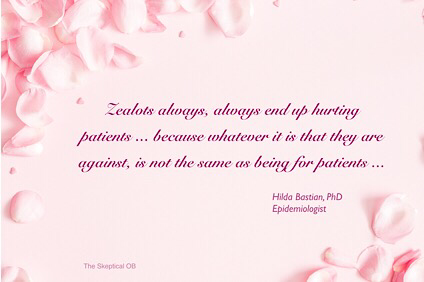
…[T]he main thing I learned – very painfully – in 20 years as a health consumer advocate, is that zealots always, always end up hurting patients. Because whatever it is that they are against, is not the same as being for patients, and it will, inevitably, betray us.

Midwives (particularly in the UK and Australia), doulas and childbirth educators are often zealots who value ideological purity above the well being of women. They oppose technological birth, doctors and insitutions that curtail their autonomy … but that’s NOT the same as being for women.

Like most zealots, they believe one size fits all: unmedicated vaginal birth is best in all but “rare” cases.

For the past three decades, while midwives, doulas and childbirth educators have blithered endlessly about promoting “physiological birth” as well as the evils of C-sections, inductions and other inventions, not a single parameter of women’s health has been improved as a result. Women have continued suffer severe morbidity and to die in and around childbirth because of lack of access to the same high tech care that natural childbirth advocates are bewailing. Worse, they may have begun to die in higher numbers in the US because providers have been bewitched by the lie that childbirth is inherently safe when in truth it is inherently dangerous.

Lactivists and most lactation professionals are zealots. They have an almost visceral hatred of formula companies and are opposed to formula … but that’s NOT the same as being for babies or women.

Like most zealots, they believe one size fits all: breastfeeding is best in all but “rare” cases. They make the bizarre claim that breastfeeding is perfect when there is NO bodily function that is perfect.

They’ve insisted that aggressive breastfeeding promotion is based on science, while forgetting that they instituted the Ten Steps of the Baby Friendly Hospital Initiative without ANY scientific evidence at all. It was ten years before they even began doing the necessary research and at that point they were trying to justify what they had already mandated.

As a result, they grasped at any data that seemed to show breastfeeding as beneficial, but didn’t bother to correct for the confounding socio-economic and educational variables that are known to be associated with breastfeeding. As a result, tens of thousands of babies and mothers are harmed each and every year by policies that never had any basis in science even though they were being touted as supported by science.

The toll of lactivist ideology is only just being appreciated because pediatricians became horrified by its harmful effects. The highest quality studies — studies that DO correct for confounding variables — have found that most of the purported benefits of breastfeeding are illusory.

The 2018 paper Is the “breast is best” mantra an oversimplification? summarizes the evidence that the benefits have been overstated and the risks ignored.

The evidence for infant breastfeeding status and its association with health outcomes faces significant limitations; the great majority of those limitations tend to overestimate the benefits of breastfeeding. Nearly all evidence is based on observational studies, in which causality cannot be determined and self-selection bias, recall bias, and residual confounding limit the value or strength of the findings.

And aggressive breastfeeding promotion has very real harms:

…[E]xclusive breastfeeding at discharge from the hospital is likely the single greatest risk factor for hospital readmission in newborns. Term infants who are exclusively breastfed are more likely to be hospitalized compared to formula-fed or mixed-fed infants, due to hyperbilirubinemia, dehydration, hyper- natremia, and weight loss (number needed to harm (NNH)=71). For weight loss >10% of birth weight with or without hospitalization, the NNH for breastfed infants is 13.

Throughout the relentless promotion of natural childbirth and breastfeeding ideologies as science, its advocates have demonstrated a curious lack of concern for the impact of these ideologies on women themselves. We are in the midst of what feels like an epidemic of postpartum depression and anxiety and not only do childbirth and breastfeeding ideologues fail to question their own role in promoting women’s distress, they insist on doubling down on the very tactics that women often identify as the source of their distress — shame and humiliation at not having an unmedicated vaginal birth and struggles to breastfeed.

All providers have an ethical obligation to provide women with informed consent and informed consent can only be given when women have access to ACCURATE scientific evidence, risks as well as benefits; ideology is not a substitute.

All providers have an ethical obligation to RESPECT the choices of informed mothers; it is paternalism to imagine that providers know better than women what is best for themselves. Claims — beloved of natural childbirth and breastfeeding ideologues — that women need more “education” and “support” to make the decisions that providers favor is just another form of paternalism.

Most importantly, natural childbirth and breastfeeding advocates must start taking women’s MENTAL HEALTH into account in their calculations about risks and benefits.

Natural childbirth and breastfeeding advocates have been proven wrong over and over and over again. Countless women have been harmed as a result. On this Mother’s Day, ideologues owe them an apology.

Is natural mothering a form of religious fundamentalism that replaces God with Nature?

A Better Life

Natural mothering is a cultural pre-occupation of both the Right and the Left.

Consider the lifestyle of fundamentalist mothers: every moment of the day consumed with child and family care. From homebirth to homeschooling, from growing her own food to baking her own bread, from extended breastfeeding to rejection of conventional medical care, women are trapped in their own homes by a never ending series of labor intensive tasks. Above all, they are indoctrinated to ignore their own needs in favor of other family members.

[perfectpullquote align=”right” cite=”” link=”” color=”” class=”” size=””]Both feature conversion experiences, trust in and submission to a higher power, a fervor for proselytizing and condemnation of those who make different choices.[/perfectpullquote]

Consider the lifestyle of a radical natural mothering advocate: every moment of the day consumed with child and family care. From homebirth to homeschooling, from growing her own food to baking her own bread, from extended breastfeeding to rejection of conventional medical care, women are trapped in their own homes by a never ending series of labor intensive tasks. Above all, they are indoctrinated to ignore their own needs in favor of other family members.

But it’s more than just the superficial similarities. Natural mothering seems to share major philosophical features including conversion experiences, trust in and submission to a higher power, a fervor for proselytizing and condemnation of those who make different choices.

The only difference is that natural mothering advocates on the Right believe they are mandated by God to adopt the lifestyle, whereas natural mothering advocates on the Left believe they are mandated by “Nature” to do so.

Is natural mothering a religion?

I’m not the first person to notice the remarkable similarities, both superficial and deep.

Chris Bobel, in The Paradox of Natural Mothering, describes the centrality of conversion experiences, which she calls shock-shift stories:

These stories unfolded predictably. Soon after the birth of her first child, the new mother was shocked by her overwhelming feelings of love for her baby and her companion feelings of being unable to leave him or her. Next, she shifted her perspective from that of a pregnant woman with careerist aspirations to that of a new mother who simply had to be with her baby around the clock. For her, there was no alternative, no choice.

Women surrender personal agency in the same way they do in religious fundamentalism. Rather than “Let go. Let God.”, natural mothering advocates encourage each other to “Let go. Let Nature.”

Describing the views of one mother, Bobel notes:

[Her] conceptualization assumes that women must willingly submit to biology’s shaping of their lives… [I]ts centrality in natural mothering undermines the mother’s claim of personal agency and free will as the impetus for her lifestyle. Natural mothering, it appears, is less a lifestyle fashioned by individual women making hard choices about the best way to parent than a chosen lifestyle represented in essentialist terms.

Bobel explains how natural mothering advocates like to think about themselves:

If we listen to their narratives of self-motivated decisions to quit jobs and careers and stay at home full-time with babies, we see strong, self-determined women who actively choose a particular lifestyle, even if that lifestyle denies the individual mother’s self-actualization.

But, in truth:

Natural mothers … may actively choose to embrace the “nature is best” ideology, but once they become attached to this ideology  –  buying into it completely and without regret  –  they surrender their capacity to make choices and in some ways become passive objects. Put differently, the ideology begins to take on hegemonic proportions and transforms women into individuals who surrender their own agency in the interest of family.

What they initially describe to themselves and others as a “choice,” comes to seem like no choice:

…[N]atural mothers claim that they could certainly choose to parent like “everyone else” (i.e., like the majority of conventional, mainstream mothers), but at the same time they speak of choice, they speak of being guided by an intuitive, body-derived source of knowledge, one that is undeniable, one that they can never dispute or reject… Natural mothering is the only real choice. The natural mothers in this study were adamant that they cannot turn their backs on the natural ideology so central to their way of living, sleeping, eating, schooling, and consuming.

They’ve surrendered their agency to a “higher power.”

It might be an overstatement to claim that the natural mothers have replaced God or Man as the authority that dictates a life course with nature as represented by the body, but perhaps not. Whether the mothers are controlled by men or religion or some conception of nature, they are still controlled.

They live their lives according to a script, whether that script is religious or based on the worship of nature.

…[C]onstructing a lifestyle on the basis of a body-derived feeling that can neither be explained nor denied is the action not of an agent, but of an individual who is dutifully following a script. In this case the script was written by biologically determinist and historically gendered ideas about women, mothers, and families.

Because — and this is the critical point — our ideas about “Nature” are cultural constructs.

When the mothers spoke of nature, they spoke of a monolithic and static concept, the one true thing that predates dates humankind and remains pure and unadulterated. To them, nature is the perfect model for human behavior because it is separate from and unpolluted by human manipulation. This view, of course, is problematic; it denies the many ways in which nature is indeed culturally constructed …

The way that ancient peoples viewed nature is very different from the way that scientists view nature, for example. The views of ancient peoples are every bit as cultural determined (it was their religion!) as the views of scientists and neither is a completely accurate assessment of nature itself. Natural mothering advocates have simply traded the religion of the present for the biologically determined, gendered and often misogynist religion of the past.

Natural mothering advocates believe, like many ancient peoples believed, that Nature is an irresistible higher power that should be worshipped: venerated, trusted and to which we must submit.

That’s not reasoning or choice; it’s religious fundamentalism.