Lactivists, please stop pretending that breastfeeding bullying is support!

Concept of accusation guilty person girl

Adele is right: the pressure on new mothers to breastfeeding is fu**ing ridiculous.

The singer was apparently responding to chef Jamie Oliver’s mansplainin’ of breastfeeding as “easy and convenient.” The press has covered both stories with dozens of articles, and breastfeeding advocates could learn a lot from reading those articles carefully. The key point, expressed in a variety of ways is this:

[pullquote align=”right” cite=”” link=”” color=”” class=”” size=””]Stop camouflaging bullying as support![/pullquote]

Lactivists, stop pretending that bullying is support!

Dictionary.com has a variety of definitions for support and the one that applies in this situation is:

To sustain (a person, the mind, spirits, courage, etc.) under trial or affliction.

Who is being sustained with breastfeeding support and what constitutes their trial or affliction?

Presumably women who breastfeed need support for two reasons:

1. Breastfeeding itself is difficult.

2. Women who breastfeed might meet resistance to it from society.

In other words, though lactivists are constantly proclaiming the ease and convenience of breastfeeding, it is neither. Indeed, such claims are downright laughable. If it were easy and convenient, breastfeeding mothers would not need support. If it were easy and convenient, we certainly would not need a force of paid professionals (lactation consultants) whose only purpose is to provide support.

How about the need for support in meeting resistance to breastfeeding from society? That’s pretty laughable, too. Every societal institution, from doctors, to hospitals, to public health authorities, to government entities is loudly proclaiming (and often exaggerating) the benefits of breastfeeding.

As I’ve written repeatedly, in industrialized countries, there is strong scientific support for only two minor benefits for term infants: a few less colds and a few less episodes of diarrheal illness across the entire population in the first year. Despite fanciful claims of lives and money that could be saved with breastfeeding, and despite the fact that breastfeeding rates have tripled in the past 50 years, advocates cannot point to a single term baby or a single healthcare dollar saved by breastfeeding.

So what exactly are breastfeeding support programs like the Baby Friendly Hospital Initiative (BFHI) supporting?

Here are the ten steps of the initiative:

  1. Have a written breastfeeding policy that is routinely communicated to all health care staff.
  2. Train all health care staff in the skills necessary to implement this policy.
  3. Inform all pregnant women about the benefits and management of breastfeeding.
  4. Help mothers initiate breastfeeding within one hour of birth.
  5. Show mothers how to breastfeed and how to maintain lactation, even if they are separated from their infants.
  6. Give infants no food or drink other than breast-milk, unless medically indicated.
  7. Practice rooming in – allow mothers and infants to remain together 24 hours a day.
  8. Encourage breastfeeding on demand.
  9. Give no pacifiers or artificial nipples to breastfeeding infants.
  10. Foster the establishment of breastfeeding support groups and refer mothers to them on discharge from the hospital or birth center.

Let’s leave aside for a moment the fact that the there is no scientific evidence that the BFHI improves breastfeeding rates, its ostensible goal, and look at whether these measures support women who wish to breastfeed. Some do, like showing mothers how to breastfeed and fostering the establishment of breastfeeding support groups. But most of the ten steps are not concerned at all with supporting women who want to breastfeed. There’s nothing supportive about banning pacifiers, banning supplementation for infants losing weight, or mandating rooming in, which makes it much harder for women to rest and heal from their deliveries.

Even more remarkable is the fact that the measures apply indiscriminately to all women, whether they wish to be supported in breastfeeding or not.

That’s not support; that’s bullying, defined as arrogant, overbearing attempts to intimidate and domineer.

When you understand that, Adele’s comments make perfect sense:

“It’s f**king ridiculous, and all those people who put pressure on us, you can go f**k yourselves, alright?,” she said. “Because it’s hard. Some of us can’t do it! I managed about nine weeks with my boobs (I mean I trip over them – I’ve got a very good push-up bra). Some of my mates got post-natal depression from the way those midwives were talking. Idiots.

“Breastfeed if you can but don’t worry, [formula milk] Aptamil’s just as good. I mean, I loved it, all I wanted to do was breastfeed and then I couldn’t and then I felt like, ‘if I was in the jungle now back in the day, my kid would be dead because my milk’s gone.’”

Adele, an accomplished, wealthy, assertive woman felt bullied by breastfeeding advocates. If she felt bullied, how much harder is it for women who may not be as self-confident?

That ought to tell lactivists something, but I suspect that they aren’t listening because they don’t want to hear it.

Stop camouflaging your bullying as support. Women don’t need it; they don’t want it, and most importantly, it hurts them.

Support those who want your support and leave everyone else alone.

Adele is right: the pressure on new mothers to breastfeed is fu**ing ridiculous!

image

When asked at a recent concert about breastfeeding, singer Adele didn’t mince words:

[pullquote align=”right” cite=”” link=”” color=”” class=”” size=””]PUSH BACK against the guilt![/pullquote]

The “Hello” singer was greeting members of the audience during a performance at London’s O2 Arena when a group asked her about breastfeeding mothers. Adele, who has a three-year-old son, responded by condemning the perception that breastfeeding is easy and reassuring women who struggle to breastfeed that formula milk is just as beneficial.

“It’s f**king ridiculous, and all those people who put pressure on us, you can go f**k yourselves, alright?,” she said. “Because it’s hard. Some of us can’t do it! I managed about nine weeks with my boobs (I mean I trip over them – I’ve got a very good push-up bra). Some of my mates got post-natal depression from the way those midwives were talking. Idiots.

“Breastfeed if you can but don’t worry, [formula milk] Aptamil’s just as good. I mean, I loved it, all I wanted to do was breastfeed and then I couldn’t and then I felt like, ‘if I was in the jungle now back in the day, my kid would be dead because my milk’s gone.’”

Adele is right. While breastfeeding has real benefits, in countries with clean water the benefits for term babies are small, limited to a few less colds and episodes of diarrheal illness across the entire population of infants. Nearly all the other purported benefits touted by the breastfeeding industry are based on scientific evidence that is weak, conflicting and riddled with confounding variables.

Why is the pressure on new mothers to breastfeed “fu**ing ridiculous”? It’s because the breastfeeding industry has moralized breastfeeding, and the moralization of breastfeeding has paralleled its monetization.

La Leche League was founded as a volunteer organization providing peer to peer breastfeeding counseling. Then in the 1980’s the folks at LLL began to wonder why they were giving away information for free when they could make money from the same information. They spun off an organization that created the lactation consultant credential; women who previously earned nothing for giving breastfeeding advice at LLL meetings, now were earning $100/hr or more giving the same advice for profit.

LLL and lactation consultants themselves began aggressively promoting and lobbying at all levels of government for lactation consultants in hospitals and doctors’ offices. They’ve grossly exaggerated the benefits of breastfeeding and minimized the difficulties for women. Regrettably, they hit upon the best marketing technique of all: they moralized infant feeding and convinced doctors (who should have known better) to moralize it, too.

Breastfeeding in 2016 has no greater or lesser benefits than breastfeeding in 1976, but the urgency around breastfeeding has grown phenomenally, far out of proportion to its actual benefits. That has harmed mothers and it hasn’t helped babies. The fact is that approximately 5% of women can’t make enough breastmilk to fully support a growing infant. Those babies are starving and their frantic mothers are admonished to “breastfeed harder,” get more help from lactation consultants, buy pumps and otherwise enrich the breastfeeding industry … and blame themselves for not giving their babies “the best.”

This pressure around breastfeeding — and natural childbirth and attachment parenting, too — has got to stop. That’s why I wrote PUSH BACK: Guilt in the Age of Natural Parenting. The pressure is not based on science, enriches an industry at the expense of women and babies, and is profoundly anti-feminist, telling women how they must use their own reproductive organs.

In this clip I explain why women should push back against the guilt.

Why are we surprised that Robert De Niro is promoting an anti-vaccine movie? As an actor he deals in fantasy.

Good vs evil road sign

The most surprising thing about Robert De Niro’s support for screening an anti-vaccine movie at his TriBeCa Film Festival is that anyone is surprised.

According to BuzzFeed:

[pullquote align=”right” cite=”” link=”” color=”” class=”” size=””]As a narrative device, the anti-vaccine conspiracy is brilliant. [/pullquote]

Organizers for the upcoming 2016 Tribeca Film Festival have come under fire for their decision to screen a documentary from controversial anti-vaccine activist Andrew Wakefield.

According to a press release about the festival’s roster, the film, Vaxxed: From Cover-Up to Catastrophe, “confirm[s] what millions of devastated parents and ‘discredited’ doctors have long-suspected – vaccines do cause autism.”

Not surprisingly, scientists, physicians and public health authorities have taken to social media to condemn both the Festival and founder Robert De Niro for the decision to include Wakefield’s movie.

De Niro responded today:

Grace and I have a child with autism and we believe it is critical that all of the issues surrounding the causes of autism be openly discussed and examined. In the 15 years since the Tribeca Film Festival was founded, I have never asked for a film to be screened or gotten involved in the programming. However this is very personal to me and my family and I want there to be a discussion, which is why we will be screening Vaxxed. I am not personally endorsing the film, nor am I anti-vaccination; I am only providing the opportunity for a conversation around the issue.”

He’s not anti-vaccination, just providing an opportunity for conversation. Sure.

De Niro is an actor and actors and actresses have been the heart and soul of the anti-vax movement. Why actors? Because actors deal in fantasy and the anti-vax movement is nothing if not fantasy.

The anti-vaccine movement has been around since vaccines were first used to save lives more than two hundred years ago. The movement has a perfect record: it has been wrong 100% of the time! Not a single claim by the anti-vax movement has ever been shown to be correct.

Anti-vax advocacy, like most of alternative health, is a product of fear: fear of the unknown and fear of losing control. Autism invokes both fears on the part of parents: fear that something has happened to your child and you don’t know why and fear that you might in some way be responsible.

But anti-vax advocacy didn’t come into its own until it was adopted by actress Jenny McCarthy. As an actress, she recognized both the value of fear and the importance of a narrative arc. Taking advantage of the fact that modern medicine has not fully elucidated the cause of autism (although it appears to be genetic), McCarthy created a narrative arc to describe what was happening to her own child.

As a narrative device, anti-vax is brilliant.

1.Fear stalks the land.

Parents are desperate to avoid what many see as the tragedy of severe autism, which leads a previously normally appearing child to lose language, withdraw into him or herself, engage in destructive and self-destructive failures, and end up incapable of independent adulthood.

2. The search is on for the perpetrator.

No one, not even the finest scientific minds, can explain why some children suddenly develop autism.

3. A clue is found.

McCarthy, like others before her, notice that autism typically begins to make itself manifest at about 18 months of age, COINCIDENTALLY at the same time that the MMR (mumps, measles, rubella) vaccine is given.

4. A brave soul finds the cause.

Hazarding the condemnation of those with actual education in immunology, medicine and public health, our heroine makes the connection between vaccines and autism. Even better, she is willing to speak truth to power to get the message out to other frightened parents.

5. A handsome hero gallops in on a white horse!

Andrew Wakefied, a former physician and researcher, produces a scientific article that confirms the heroine’s intuition, putting the imprimatur of science on a mother’s love.

6. The culprit is identified and vilified.

It has been Big Pharma all along, evil, grasping and willing to harm ALL THE CHILDREN IN THE WORLD, to increase profits. What a sordid enterprise! A multinational conglomerate has conspired to fool innocent parents into giving their children AN INJECTION they claim will keep children healthy but actually makes children sick.

7. The hero and heroine ride off into the sunset, having vanquished the forces of evil.

It would make a great movie wouldn’t it?

But it’s not a movie; it’s real life and real life does not follow a narrative arc. It has to be massaged into a narrative arc for purposes of the film and often facts are ignored, omitted and changed to fit the preferred storyline.

The history of medicine is a history of diseases that are poorly understood but eventually yield to science. Until then the disease spawns bizarre theories (like demonic possession for epilepsy), quack cures, fear, and conspiracy theories.

The claim that the MMR causes autism is one of those conspiracy theories that has no basis in fact. Andrew Wakefield was shown to have fabricated his research results with the purported aim of profiting from an alternative vaccination that he was developing. He NEVER found evidence that the MMR causes autism; he made it up to induce panic and he succeeded beyond his wildest expectation.

I haven’t seen the movie, but I’d be willing to bet that it follows the narrative arc described above, and that it also ignores and omits facts, substituting lies in their place.

I cannot blame De Niro. Desperate diseases lead to desperate parents and desperate desires for explanations and for absolution. If vaccines cause autism, De Niro and his wife did not transmit it to their child. Who wouldn’t want to believe that.

Unfortunately, De Niro has dealt in fantasy for so long that he can no longer see that real life does not conveniently follow the dramatic arc of movies. Real life is filled with bad things that happen to good people for no reason.

Human beings try to make sense of bad things and make movies with obvious heroes and villains to do so. But those movies are fantasy and Andrew Wakefield’s film is not exception. The only surprising thing about an actor who prefers fantasy to reality is that anyone else is surprised.

Why women hire dangerous homebirth midwives and why preventable deaths are inevitable

image

Yesterday I wrote about the tragic death of homebirth advocate Caroline Lovell, who bled to death while a midwife blithely ignored her pleas to call an ambulance. That midwife, Gaye Demanuele did not relent until Lovell suffered a cardiorespiratory arrest and by then it was too late.

A number of homebirth advocates have insisted that Lovell did not die because of homebirth; they blame the midwife’s horrific negligence in ignoring basic safety measures. But Lovell hired Demanuele specifically because both believed that ignoring basic safety measures was critical to achieving the desired homebirth experience.

[pullquote align=”right” cite=”” link=”” color=”” class=”” size=””]Preventable deaths are inevitable at homebirth because identity creation is the focus, not safety.[/pullquote]

Lovell was a high risk patient. Three different physicians told her that she was not a candidate for homebirth because of her history of retained placenta and postpartum hemorrhage. Lovell ignored the basic safety criteria that risked her out of homebirth and Demanuele attended her because she, too, believed that ignoring basic safety standards was completely acceptable.

Why would a pregnant woman and her midwife conspire to ignore safety standards?

If you want to understand homebirth, you need to understand this: homebirth is not about birth or about a baby; homebirth is about the creation of meaning and identity.

As Rutherford and Gallo-Cruz write in Great Expectations: Emotion as Central to the Experiential Consumption of Birth:

…[W]hen selecting alternative providers of birthing services, women are not simply purchasing health care, they are choosing and purchasing guides for and co-creating an event that is idealized and emotionally charged.

No less an authority than anthropologist and homebirth midwife Melissa Cheyney concurs. Cheyney explains in Reinscribing the Birthing Body: Homebirth as Ritual Performance:

As a socially performed act of differentiation, homebirths are constructed in opposition to dominant ways of giving birth …

In other words, homebirth has little to do with birth and virtually nothing to do with the baby or with safety. It is a piece of performance art whereby women signal an identity in opposition to medical authority.

A homebirth advocate hires a midwife not to catch the baby or even to support her through labor, though that is included. According to Rutherford and Gallo-Cruz:

Midwifery is not simply a service to be purchased, but is also an embodiment of cultural meaning; through its consumption women make the ordinary experience of childbirth a symbolically charged and extraordinary experience of “meaning transfer.” … [Campbell] argues that “the essential activity of consumption is…not the actual selection, purchase or use of the products, but the imaginative pleasure seeking to which the product image lends itself …

The choice of midwife is extremely important:

… [T]he midwife’s role is critical … because she is fluent in the alternative symbolic orientations to and understandings of natural birth … [She] also provides her association and emotional support either by sharing beliefs about the experience or by affirming the woman’s right to assign her own unique beliefs to birthing. This seemingly simple service of association and presence is a critical social need in the context of extraordinary experiences and rites of passage that depend a shared cultural consensus for their significance.

Had Lovell merely wanted a safe birth, she could have gone to the hospital where she undoubtedly would have survived. But Lovell wanted a homebirth because a safe birth was not the goal; the goal was the pleasure she found in anticipating her defiance of medical authority and the anticipation of pleasure she would experience boasting of her success in the face of being counseled that homebirth was too dangerous for her.

She hired Demanuele because Demanuele shared her belief in the symbolism of homebirth and affirmed her desire to ignore basic safety standards. Lovell wanted to create a piece of performance art and Demanuele understood that and was fully committed to helping her achieve the desired performance.

I cannot begin to imagine Caroline Lovell’s horror when she realized that Demanuele was willing to go further than she was to achieve the idealized birth they had agreed upon. Lovell was dying and she knew it. She was going to leave her children motherless and she knew it. She literally begged for her life and Demanuele ignored her pleas. She bled to death slowly, surrounded by people who could have helped her, but chose not to do so.

Of course by hiring a midwife instead of having an unassisted birth, Lovell was implicitly relying on Demanuele’s greater knowledge to recognize and treat an unforeseen serious complication. I doubt Lovell could have imagined that Demanuele would be willing to let her have a cardiac arrest before she would give up on an idealized birth experience they had planned. Who could imagine that?

But the difference between Demanuele and many other homebirth midwives is merely one of degree. Midwives who attend high risk homebirths, and there are many, do so because they share with their clients the belief that birth is an opportunity for meaning making and identity construction.

Or as Cheyney might say:

… It co-opts and restructures what Babcock has called “symbolic inversion,” where the gradual psychological opening to new messages characteristic of the liminal or transitional period of ritual is intensified by metaphorically turning elements of the normal belief system upside-down or inside-out.

It is inevitable that preventable deaths will occur at homebirth when symbolism is the focus instead of safety. Homebirth midwives and homebirth advocates “trust” that complications will not occur and, if they do, there will be plenty of time to deal with them. In waiting for complications to occur instead of acting preemptively to prevent them, homebirth midwives and their clients routinely risk death. It is much harder to treat a complication than to prevent one; it is much more dangerous, too. Inevitably, midwives will judge wrong and by the time they understand what is happening, the life of a baby or mother or both is forfeit.

The problem with homebirth isn’t merely structural (being far away from emergency personnel when an emergency occurs), it is philosophical. Nothing more clearly illustrates how viewing birth as an opportunity for identity creation leads inevitably to preventable death than the hideous experience of Caroline Lovell … who knew she was dying, begged for her life, and was ignored by the person she hired to help her make meaning from birth.

Of course Caroline Lovell’s homebirth death was preventable; nearly all homebirth deaths are

Cardiogram in green

Homebirth advocacy is based in large part on mistruths, half truths and sometimes outright lies. One of the bigger lies that you often hear in the wake of a homebirth death is “it would have happened in the hospital, too.”

No, it wouldn’t have for a very simple reason: when you “trust” birth, you assume that everything will be fine and therefore avoid real medical care until it is too late.

[pullquote align=”right” cite=”” link=”” color=”#004C01″ class=”” size=””]Homebirth killed Caroline Lovell.[/pullquote]

Caroline Lovell’s story was horrifying even before we knew the details. Death from a routine childbirth complication like bleeding is almost unheard of in an age of blood transfusions and surgical repair … but not in an age of homebirth.

Lovell was an Australian homebirth activist who wrote the following in response to midwifery legislation under consideration:

On a personal note, I am quite shocked and ashamed that homebirth will no longer be a woman’s free choice in low-risk pregnancies… I feel the decision to outlaw homebirth’s is contrary to women’s rights … Please find a solution for women and babies who homebirth after this date as their lives will be in threat without proper midwifery assisstance. And as a homebirthing mother I will have no choice but to have an unassisted birth at home as this is the place I want to birth my children.

Yours sincerely,
Caroline Flammea, Nick Lovell and daughter Lulu Lovell

Lovell did not act on her dare, but perhaps she would be alive if she did. Instead she hired midwife Gaye Demanuele.

The testimony at the Coroner’s inquest was chilling:

“A mother told her midwives she was dying and needed to go to hospital in the moments after she gave birth to her second daughter in her Melbourne home, the Victorian Coroners Court was told on Tuesday…

But just over an hour after the “overjoyed” couple greeted their daughter in their Watsonia home, the court heard Ms Lovell told her midwives she needed to go to hospital. Ms Lovell, 36, died later that night in the Austin Hospital.

And so Caroline Lovell bled to death … slowly, preventably … because the midwife she depended on was too ideologically brainwashed to perform even the most basic midwifery tasks. Instead, as reported by the assistant midwife Melody Bourne:

Just over an hour after Zahra was born in a birth pool, Ms Bourne said Ms Lovell was light-headed and hyperventilating, telling her midwives she was dying and needed to go to hospital.,,

“Gaye and I also made efforts to calm and reassure Caroline.”

Five minutes later, Ms Lovell became pale, cold and unresponsive and an ambulance was called. Examination by hospital clinicians revealed Ms Lovell had suffered two tears and a blood clot.

Any real healthcare provider will tell you that the most chilling words you can hear from a patient are: “I think I’m dying.” That’s because they probably are dying and it is up to you as the provider to undertake whatever examinations and tests are necessary to prove that they are not.

It would have been laughably simple for the Demanuele to have assessed Lovell BEFORE she reassured her. Her life threatening blood loss would have been easily diagnosed by taking her blood pressure or checking her pulse. Nothing sophisticated was required, merely the most basic of clinical skills.

The Coroner offered his assessment this morning:

After Ms Lovell gave birth at home in 2012, Coroner White said the baby had blood on her head – a sign that Ms Lovell may be bleeding. Despite this, Ms Demanuele allowed Ms Lovell to remain in the pool for an hour unchecked. Her baby was with her most of the time so they could bond.

Had Ms Demanuele turned on the lights, Coroner White said she may have noticed the pool had turned a reddish brown due to her blood loss. The blood loss was likely caused by injuries to her vaginal wall, perineum, and probably her uterus.

When Ms Lovell tried to get out of the pool, she fainted. After regaining consciousness, Ms Lovell said she feared she was dying and asked for an ambulance to be called. Ms Demanuele did not call an ambulance. Later, Ms Lovell collapsed again. Ms Demanuele started CPR and an ambulance was called.

Furthermore:

Coroner White said while Ms Lovell was being treated at the Austin, Ms Demanuele returned to her Watsonia home and removed the pool and its contents, “despite what I am satisfied was her comprehension of the potential relevance of this evidence to questions likely to be later asked of her”…

He said Ms Demanuele had:

failed to conduct a proper risk analysis before deciding to approve a home birth for Ms Lovell
failed to consult Ms Lovell’s GP throughout her antenatal care
failed to provide a safe environment for her to give birth, which made it difficult to observe the complications unfolding
failed to call for an ambulance when Ms Lovell needed one; and
failed to provide paramedics and Austin hospital staff with adequate information.

Despite these damning findings, I’ve already seen homebirth advocates declaring on line that it wasn’t homebirth that killed Ms. Lovell, it was Gaye Demanuele’s malpractice.

Let’s be clear:

Homebirth killed Caroline Lovell.

Yes, hemorrhagic shock was the proximate cause of her death … in the same way that hemorrhagic shock may be the proximate cause of death of a pedestrian hit by a drunk driver.

It is disingenuous to blame Demanuele’s irresponsible commitment to demedicalized childbirth for Lovell’s death. As in the case of many homebirths, she was hired precisely because she was willing to sacrifice safety on the altar of natural birth.

Homebirth is ALWAYS a gamble, or perhaps more accurately a dare. The mother gambles that she or the baby will not experience a life threatening complication at home. In the world of homebirth, greater risk factors mean a greater dare and therefore a greater “triumph” if mother and baby come through unscathed.

The dreadful irony is that had Lovell given birth unassisted, she might be alive today. When she told her husband she was dying, he may have called an ambulance to summon real medical professionals.

Instead, Ms. Lovell trusted homebirth Gaye Demanuele who was willing to defy basic safety precautions to attend her homebirth. In an effort to prevent “medicalization” Demanuele reassured Caroline Lovell she was fine even as her life ebbed away.

Ms. Lovell believed homebirth was safe and that belief killed her.

Her death, like nearly all homebirth deaths of babies or mothers, was entirely preventable.

There once was a time when everything was natural; it sucked!

skeleton

There once was a time when all food was organic and no pesticides were used. Health problems were treated with folk wisdom and natural remedies. There was no obesity, and people got lots of exercise. And in that time gone by, the average lifespan was … 35!

That’s right. For most of human existence, according to fossil and anthropological data, the average human lifespan was 35 years. As recently as 1900, American average lifespan was only 48. Today, advocates of alternative health bemoan the current state of American health, the increasing numbers of obese people, the lack of exercise, the use of medications, the medicalization of childbirth. Yet lifespan has never been longer, currently 78 in the US.

[pullquote align=”right” cite=”” link=”” color=”” class=”” size=””]All the existing scientific evidence shows that the myriad claims of alternative health are flat out false.[/pullquote]

Advocates of alternative health have a romanticized and completely unrealistic notion of purported benefits of a natural lifestyle. Far from being a paradise, it was hell. The difference between an average lifespan of 48 and one of 78 can be accounted for by technology including modern medicine and increased agricultural production brought about by industrial farming methods (including pesticides). Nothing fundamental has changed about human beings. We are still prey to the same illnesses and accidents, but now they can be effectively treated. Indeed, some diseases can be completely prevented by vaccination. Childbirth is just as dangerous as it has ever been, but now most serious pregnancy complications can be handled easily with routine childbirth interventions.

So why are advocates of alternative health complaining? They are complaining because they long for an imagined past that literally never existed. In that sense, alternative health represents a form of fundamentalism. Obviously, fundamentalism is about religion and the analogy can only go so far, but there are several important characteristics of religious fundamentalism that are shared by alternative health advocacy. These include:

  • The desire to return to a “better” lifestyle of the past.
  • The longing for a mythical past that never actual existed.
  • An opposition to modernism (in daily life and in medicine).
  • And the belief that anything produced by evolution (or God, if you prefer) is surely going to be good.

Advocates of the natural bemoan the incidence of diseases like cancer and heart disease without considering that they are mainly diseases of old age. That both cancer and heart disease are among the primary causes of death today represents a victory, not a defeat. Diseases of old age can become primary causes of death only when diseases of infancy and childhood are vanquished, and that is precisely what has happened.

Alternative health as a form of fundamentalism also makes sense in that it has an almost religious fervor. It is not about scientific evidence. Indeed, it usually ignores scientific evidence entirely. All the existing scientific evidence shows that the myriad claims of alternative health are flat out false. None of it works, absolutely none of it. That’s not surprising when you consider that it never worked in times past; advocates of alternative health merely pretend that it did, without any regard for historical reality.

The veneration of the natural reflects a profound misunderstanding of evolution. Evolution operates on the principle of “survival of the fittest.” That means that in every generation, the fittest for that specific environment are most likely to survive; many of the rest die. It does NOT mean that everyone currently alive is fit for the present environment. Moreover, the environment constantly changes. That’s why most animal species that have ever existed are currently extinct. The environment changed and the fit were no longer the fittest.

That also means that those who were fittest for hunter-gatherer society might not be fit at all for the highly technological society in which we live. In hunter-gatherer societies, nearsightedness was a serious affliction; it impeded both the ability to hunt and the ability to gather. In contemporary societies, nearsightedness is easily corrected and those who are nearsighted can rise to the pinnacle of achievement in any endeavor.

In hunter-gatherer societies women who grew neurologically mature babies with big heads were often doomed to die along with those babies when their heads couldn’t fit through the maternal pelvis. Today, those babies are born by C-section, potentially fitter than babies with smaller heads who are less neurologically mature at birth.

When you live in nature, natural advantages count for a lot. When you live in a highly technological society like ours, most natural advantages are meaningless.

Venerating the natural is not science; it has nothing to do with science; and it merely reflects wishful thinking about the past while ignoring both historical and present day reality.


Adapted from a piece that first appeared in July of 2009.

Existential breastfeeding questions

thinking woman with question mark on gray wall background

Lactivists, help me out here. I have some existential questions about breastfeeding.

If breastfeeding is everything you say it is, why do we need blogs, websites, professionals and lobbying organizations touting its awesomeness?

[pullquote align=”right” cite=”” link=”” color=”” class=”” size=””]If you told me I needed to eat chocolate, I wouldn’t need to be deprived of gifts of liverwurst to ensure that I comply.[/pullquote]

You know what’s awesome? Chocolate is awesome. It appears that there is no need for professionals to explain its awesomeness to doubters. That’s the thing about awesomeness. It doesn’t need to be explained.

You know what else is awesome? Sex is awesome. I don’t notice too many people in need of convincing that sex is pleasurable. People figure it out for themselves without help.

In fact, if you need the purported awesomeness of something explained to you, perhaps it isn’t that awesome after all.

Here’s another existential question:

If breastfeeding is so easy and convenient as you often claim, why do so many women try breastfeeding and then give it up?

Email is easy and convenient, and once people try it, they tend to go on using it.

Fast food is easy and convenient. Even though it may be nutritionally suspect, many people still order it and eat it because it is easy and convenient.

Sex is easy and convenient. After most people try it for the first time, they will never ever give it up.

In fact, it’s generally difficult to give up something easy and convenient, yet women give up breastfeeding in droves. What does that tell you about breastfeeding?

Help me out with this question, too:

You’re constantly claiming that women give up breastfeeding because they don’t have enough support. But why would women need support for something that is easy and convenient? Could it be that they need support because breastfeeding is often difficult, painful, and inconvenient?

On the one hand, you insist that breastfeeding is “normal.” On the other hand you are constantly trying to “normalize it” with public breastfeeding stunts. Which is it: normal or in need of normalization?

And what’s up with calling formula feeding mothers lazy? If breastfeeding is easy and convenient, aren’t formula feeders doing more, and enduring more hardship than women who fall back on breastfeeding because it’s easy and convenient?

Why are you constantly asserting benefits for breastfeeding that haven’t been proven and are often pure speculation? No one needs to be told of the benefits of sex in order to convince them to engage in it. Why should women need so much chivvying about breastfeeding?

Finally, why does the Baby Friendly Hospital Initiative bear so much resemblance to the policies of a small totalitarian states If breastfeeding is truly as easy and convenient as you say, why would any new mother need to be lectured about its benefits, be prohibited from using formula, forced to room in 24-7 with her baby, and never be given free formula gifts.

If you told me I had to eat chocolate with every meal, I wouldn’t need to be lectured on the point, wouldn’t need to have oatmeal raisin cookies hidden, and wouldn’t need to be deprived of gifts of liverwurst to ensure that I comply. That’s because chocolate is awesome.

Breastfeeding is awesome? For many women, not so much.

Just because you’re a “shit mom” for not breastfeeding doesn’t mean she’s judging you!

image

There are few things more fascinating that watching a Sanctimommy struggle to justify her sanctimony.

Yesterday I created a meme to explain to lactivists why their comments to women who formula feed are so very hurtful and posted it on Facebook.

Lactivists,

Would you tell a woman struggling with infertility that it was easy for you to get pregnant?

Would you tell a woman who just had a miscarriage that she would have carried to term if she’d just tried harder?

The DON’T tell a woman who chooses formula that it is easy to breastfeed and she should have just tried harder,

image

The meme has been liked by hundreds and seen by tens of thousands. Clearly it resonated with women who feed their babies with formula.

Not surprisingly, the Sanctimommies are up in arms about pointing out their ugly sanctimony, and they’ve parachuted in to explain why they’re not judging formula feeders who they judge to be bad mothers.

The results are hilarious. There are apparently many, many ways to miss the point.

There’s whizzing right by the point:

You are comparing two things that are completely out of a woman’s control to something that she has almost complete control over. Stop comparing apples and oranges.

There’s walking right into the point, bouncing off it and failing to recognize it:

I really can’t believe someone would trivialize infertility or miscarriage to prove a false point.

There’s “my pain is worse than yours”:

…[T]o say that not having a child, or having a dead child, is the same as not being able to breastfeed is the worst possible summary.

There’s proving the point while missing it entirely. In response to #fedisbest:

#fedisthebareminimum

There’s “I’m so not judging you for being a shit mom”:

Oh please no one ever shame [sic] women who CAN’T breastfeed but it definitely makes you a shit mom if you don’t even attempt to breastfeed.

And variations like:

…Unless you have a legit medical reason, I will always believe not breastfeeding is selfish.

And:

Some women don’t even try to give their baby the nutrition that was designed for them! Yes, it’s hard and demanding, but with support you can push through. What did women do before formula? They wet nursed! Stop making everything about you and get over it. Women who are lactivists just want to help other moms because breastfeeding is freakin amazing. We want every woman to be able to experience the same joy. It’s not a personal attack on someone who chose not to or couldn’t.

Awww, she wants every shit mom to be able to experience the same joy. That’s why she and her sister Sanctimommies are rubbing their faces in their failures. It’s such an obvious motivation that I can’t believe I didn’t think of it before.

Listen up Sanctimommies:

1. In first world countries with clean water, the benefits of breastfeeding are trivial. All that stuff you’ve heard about breastfeeding preventing obesity and every disease known to man is based on evidence that is weak, conflicting and riddled with confounders. In other words, it’s not true.

2. There are many, many things that provide greater benefits to babies in the short and long term like the families’ socio-economic status and the mother’s level of education. A woman who has a graduate degree provides a greater benefit to her child than breastfeeding. So maybe if you don’t have an MD, JD or PhD, should we conclude that you don’t care enough about your children to give them the very best?

3. Why should anyone care what you think about how another loving mother chooses to raise her child? Your ugly and unmerited sense of superiority is merely a disguise for your desperate desire to believe that you are better than somebody, anybody. It’s pathetic.

Let me make things easy for you:

You aren’t a better mother because you breastfeed and you are a contemptible person because you judge.

What if Jamie Oliver had said pregnancy is easy and convenient?

image

Lactivists have rushed to Jamie Oliver’s defense.

As I wrote on Friday, in his efforts to promote it Oliver ignited a firestorm by claiming that breastfeeding is easy and convenient.

Charlotte Gill, writing in the Independent, is typical of Oliver’s defenders. The title of her piece Jamie Oliver was right to comment on breastfeeding – we can’t silence debate for the sake of oversensitive mums is dripping with judgmentalism. Apparently lactivists just can’t help being Sanctimommies.

Gill says:

[pullquote align=”right” cite=”” link=”” color=”#F61014″ class=”” size=””]Opposition to women’s bodily autonomy is sexism.[/pullquote]

Unfortunately for Oliver, women are feeling more sensitive than ever about any claim ‘breast is best’. Over the last decade, the non-breastfeeding community has developed a faux-sense that society is ganging up on them; judging them for choosing alternative methods of feeding their babies. On learning of Oliver’s interview, many told him promptly to get back in the kitchen.

Way to miss the point Ms. Gill!

Let me see if I can explain the issue in a way you might understand:

Imagine if Jamie Oliver had said pregnancy is easy and convenient and therefore women’s shouldn’t use birth control; they should simply give birth to as many children as nature intended.

Would you be surprised at the ensuing outcry? Would you claim that women objecting to a man telling them not to use contraception were “oversensitive”? I doubt it. I suspect that you would be outraged right along with the rest of us at the idea that a man should tell a woman how she should feel about pregnancy and whether she should control her own fertility. You’d probably insist that such a view is profoundly sexist.

I wouldn’t be surprised if your outrage stemmed from your belief that a claim that pregnancy is easy and convenient is absurd. You’d probably insist (just as I would) that no one has a right to control a woman’s ovaries and uterus except the woman who owns them. They are parts of her body and how she uses them is protected by the principle of bodily autonomy. Opposition to her bodily autonomy is sexism.

Guess what? Breasts are also body parts and how a woman uses them is up to her and no one else, protected by the very same principle of bodily autonomy.

Ms. Gill laments:

… But any sort of advocation of breastfeeding is now seen as oppressive to those who can’t do it. I understand that it’s difficult and painful for many women – but when it has some many positive health outcomes, it’s for the greater good that we promote it.

It is a myth to think that the non-breastfeeding community is the silenced one; for years they have made known their difficulties. And they are wrong to assume that most people judge them for this.

But we must not be so sensitive to them as to whitewash the benefits of breastfeeding. It’s important – and if it takes a man to remind everyone of that fact, than so be it.

Would she insist that opponents of contraception aren’t oppressive to women? Would she claim that opponents of contraception have been silenced? Would she bewail listening to women whitewash the benefits of pregnancy?

I doubt it.

She would (hopefully) recognize that the issue is not the purported benefits of pregnancy to babies or to society as a whole, the issue is a woman’s right to control her own body. Similarly she should recognized that the issue at stake with Oliver’s comments is not the purported benefits of breastfeeding to babies or society, the issue is a woman’s right to control her own body.

It is sexist to oppose women’s right to control their own breasts, and no amount of hiding behind the purported benefits of breastfeeding for babies mitigates that sexism.

Meanwhile, the outcry has led Oliver to walk back his statements.

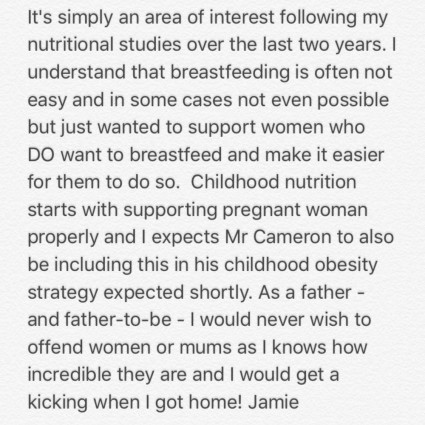
…I understand that breastfeeding is often not easy and in some cases not even possible but just wanted to support women who DO want to breastfeed and make it easier for them to do so… As a father … I would never wish to offend women or mums …

image

As a father of daughters, he should be deeply concerned about their right to bodily autonomy. His comments weren’t offensive merely because he ignored the very real difficulties of breastfeeding. They were offensive because he presumed to tell women how they should use their own breasts. That’s sexist and that’s why an apology was necessary.

Jamie Oliver and lactivists who lie

Man fingers crossed behind a backside

See what happens when you let men out of the kitchen where they belong? They start pontificating about subjects that they know nothing about and making fools of themselves in the process.

Take celebrity chef Jamie Oliver, for example. Oliver, whose US school lunch program designed to decrease obesity was a total failure because kids didn’t like the food, now turns his attention to breastfeeding.

[pullquote align=”right” cite=”” link=”” color=”” class=”” size=””]For many women, breastfeeding is NOT easy, and it is NOT convenient.[/pullquote]

Acting as a spokesperson for a British nutrition charity, he made a promotional video where he actually uttered the words:

It’s the next big thing. Breastfeeding is easy and convenient.

No, Jamie, it’s not the next big thing. It’s a very old, and very imperfect thing.

Women have been breastfeeding since the beginning of time and infant mortality rates have been hideous since the beginning of time (until the advent of modern medicine and, dare I say it, infant formula).

How could breastfeeding, “nature’s way” for feeding babies, be imperfect?

In the exact same way that pregnancy, nature’s way of making babies, is imperfect. We’ve all seen nature shows about turtles. Female turtles laboriously haul themselves out of the sand to lay and bury millions of eggs on a beach. Those eggs hatch at roughly the same time and the baby turtles have to scrabble to the water in order to survive. Only a fraction of them make it; the rest are eaten by predators waiting patiently for a feast.

Human reproduction, like turtle reproductions, like all animal reproduction is terribly wasteful. Consider that women produce millions of ova (eggs) that they never use and men produce billions of sperm that will never fertilize an ovum. Even when conception does occur, the carnage continues. Approximately 20% of established pregnancies will end in miscarriage. Death on a grand scale is inevitable in reproduction and breastfeeding is a part of reproduction.

At least 5% of women, perhaps more, cannot produce enough milk to fully nourish an infant. In the good old days when everyone was breastfed, those babies simply died. Just as miscarriage is the specter that haunts every newly pregnant woman, infant death from dehydration or failure to thrive used to be the specter that haunted new motherhood. Breastfeeding is so imperfect that the ONLY societies that have low infant mortality are societies where formula is readily available and readily used.

Oliver might be forgiven his ignorance of the entirely natural death toll of breastfeeding, but his claim that breastfeeding is “easy and convenient” is completely unforgivable. In facts, it’s the classic, self-serving lie of the lactivist movement.

Let me say this loud and clear so there’s no confusion on this issue:

For many women, breastfeeding is NOT easy, and it is NOT convenient.

Lactivists like to pretend that women stop breastfeeding because of lack of education, because hospitals give out formula, because of lack of professional support, because of lack of peer support, etc. etc. etc. All this pretending reflects the profound unwillingness of the breastfeeding industry to acknowledge  the real reasons that women stop breastfeeding or fail to start in the first place. The dirty little secret about breastfeeding is that starting is hard, painful, frustrating and inconvenient. And continuing breastfeeding is hard, sometimes painful, and incredibly inconvenient especially for women who work, which in 2016 is most women.

Why do lactivists lie about the reality of breastfeeding? Why do they sugarcoat it with little maxims like “breast milk is always available,” breast milk is always the perfect temperature,” and “breast feeding saves money.” Why does the breastfeeding industry (lactation consultants, manufacturers of breastfeeding supplies like pumps) ignore the very real challenges in initiating and maintaining breastfeeding?

They lie because they think they have a right to police women’s bodies. They fear that women will not attempt breastfeeding if they are informed honestly about the difficulties. Yet it seems that the opposite is true. By not acknowledging these difficulties up front, the breastfeeding industry sets women up for failure, guilt and possibly postpartum depression, when those women encounter the “normal” pain, frustration and inconvenience of breastfeeding.

Women are telling the breastfeeding industry that the way information on breastfeeding is presented has made them feel awful. It is the height of arrogance to tell a woman that what is hurting her is not really hurting her. When mothers tell lactivists that breastfeeding is often painful and often inconvenient, it is arrogant to tell them that breastfeeding is “easy and convenient.” When mothers tell lactivists that aggressive breastfeeding promotion leads fo crushing feelings of failure and inferiority, it is arrogant to tell them that it doesn’t.

This is the central paradox of contemporary lactivism. If breastfeeding is so easy and convenient, why do lactivists need to recruit Jamie Oliver to tell women that it is easy and convenient? Because it isn’t really easy and convenient; they know it and lie about it anyway.

Jamie Oliver should get back in the kitchen were he belongs and leave the hard work of nourishing infants to their mothers who love them, want what’s healthiest for them, and know beyond a shadow of a doubt that breast is NOT always best.

Dr. Amy