Recommendations of UK Maternity Review are an insult to the memories of those who died

image

Why didn’t they just spit on their graves?

That would hardly be more disrespectful to the dead than the mind boggling recommendations released by the supposedly comprehensive Review of Maternity Services. After reviewing the dozens of preventable infant and maternal deaths, nearly all due to LACK of supervision of midwives and LACK of technological interventions, the Review recommended … wait for it … LESS supervision of midwives and LESS access to interventions!

[pullquote align=”right” cite=”” link=”” color=”” class=”” size=””]Have these people lost their minds? No, they’re simply playing politics.[/pullquote]

That’s right. Although the Review found babies and mothers died from the same causes over and over again: failure of midwives to appropriately classify the risk level of patients, failure of midwives to use lifesaving technology, failure of midwives to call doctors who could save babies and mothers, the main recommendation is:

All pregnant women will be provided with maternity budgets of £3,000 to pay for personal midwives and home births.

Despite the fact that dozens of perinatal and maternal deaths occurred because midwives refused to consult doctors and withheld lifesaving treatment, the UK government apparently thinks the solution is less supervision for midwives, and less access to lifesaving treatment.

Have these people lost their minds? No, they’re simply playing politics, kowtowing to the powerful midwives union (the Royal College of Midwives) and pandering to those who are looking to save money on maternity care regardless of who dies as a result.

The impetus for the Review was the Morecambe Bay report investigating a Cumbrian midwife-led hospital unit after a series of preventable perinatal and maternal deaths The report identified 16 perinatal deaths and 3 maternal deaths that had taken place in the unit as potentially preventable. The cause?

…[M]idwives took over the risk assessment process without in many cases discussing intended care with obstetricians, and we found repeated instances of women inappropriately classified as being at low risk and managed incorrectly. We also heard distressing accounts of middle-grade obstetricians being strongly discouraged from intervening (or even assessing patients) when it was clear that problems had developed in labour that required obstetric care. We heard that some midwives would “keep other people away, ‘well, we don’t need to tell the doctors, we don’t need to tell our colleagues, we don’t need to tell anybody else that this woman is in the unit, because she’s normal’”

Unfortunately, Morecambe Bay was not an isolated incident. At Royal Oldham/Greater Manchester, seven babies and three mothers died in just eight months. And at Milton Keynes:

History is repeating itself with the deaths of FIVE more newborn babies following staff failures at the hospital maternity unit…

Milton Keynes has now seen at least eight such deaths in two separate periods over the last eight years.
The latest five deaths happened over eight months between 2013 and 2014…

Most of the deaths involved staff failing to recognise or act upon warning signs of foetal distress.
All the babies were full term and previously healthy, and in each case parents claim speedier medical intervention could have saved their lives.

The Maternity Review confirmed that there is an epidemic of preventable perinatal and maternal deaths in the UK maternity care system:

Half of hospital maternity units are failing to meet basic safety standards, according to the NHS watchdog.

A total of 7 per cent have been rated ‘inadequate’ and a further 41 per cent ‘require improvement’.

NHS experts warned that at the worst units there are ‘dysfunctional relationships’ between midwives and doctors who are working in ‘silos’ – almost independently of one another.

The number of mistakes is simply appalling:

At least 340 blunders are occurring on NHS maternity wards every day, figures reveal.

Mothers and babies are routinely being harmed as a result of mistakes by midwives, doctors and other staff.

Although most errors are classed as ‘near misses’ or low injury, some have tragic consequences. Last year, 151 women and newborns died on maternity wards and another 351 suffered severe harm.

How would providing women with money enabling them to choose midwife led units and homebirths address these deadly mistakes? It wouldn’t and it couldn’t:

If the problem is a midwifery philosophy that privileges unmedicated vaginal birth above the lives of babies and mothers, allowing midwives more scope to excercise their personal philosophy is likely to lead to MORE mistakes and MORE deaths.

If the problem is that midwives fail to collaborate and consult with doctors, allowing more midwives to practice where doctors aren’t available is likely to lead to MORE mistakes and MORE deaths.

If the problem is that midwives are failing to use lifesaving interventions, promoting homebirth where midwives could not possibly be farther away from life saving interventions is likely to lead to MORE mistakes and MORE deaths.

No matter. The recommendations of the Review are divorced from the reality of the findings because the maternity allowance was a done deal, decided upon long before the evidence was even examined.

UK patient advocate James Titcombe, father of baby Joshua who died at Morecambe Bay specifically because midwives refuse to consult a pediatrician, was one of the original members of the Maternity Review panel. He resigned shortly after the early meetings.

I’m concerned that the review isn’t following an evidence based approach. The work looking at evidence about the current qualitify and variation in safety is only just starting (it was only instigated at all as an afterthought). Robust evidence … should surely form the starting point …

I felt that the balance of the maternity review is weighted towards the professional voice. Those who have suffered avoidable harm of loss … are not in my view properly represented and are not being heard as clearly as they should…

Sadly, the Review was a piece of political legerdemain, pretending to address the issue of safety, but actually used to promote the goals of the midwifery trade union and provide cover for efforts to cut maternity costs by forcing women out of hospitals and into homebirth.

The end result? Babies and mothers will continue to die preventable deaths in the UK maternity system because politicians are more concerned about politics than about babies lives.

The recommendations of the Maternity Review are an insult to the memories of those who died preventable deaths at the hands of the maternity system, but apparently the Review was never meant to improve maternity care.


To the mother struggling to breastfeed

Together

Dear New Mother,

It’s miracle isn’t it … the exquisite new human being that you and your partner created! You may be overwhelmed with love, overwhelmed with fear, and overwhelmed with the desire to do everything possible for your new baby. Perhaps breastfeeding has been the way you always imagined nourishing your newborn — you’ve heard that it provides a myriad of benefits — and now you are having difficulties. Maybe breastfeeding is painful; maybe your baby is not getting enough milk; maybe you’re struggling with mild or even severe postpartum mood changes.

[pullquote align=”right” cite=”” link=”” color=”” class=”” size=””]A baby who is failing to thrive with exclusive breastfeeding is a tragedy of mothering, not a triumph of breastfeeding. [/pullquote]

You didn’t expect this and now you’re not sure what to do. I want to offer some reassurance.

1. It’s not your fault!

In their zeal to promote breastfeeding, lactation consultants and lactivists have convinced themselves that the only limitation to successful breastfeeding is a mother’s will and the support that she receives. There’s absolutely no scientific evidence that these are the causes of breastfeeding difficulties. Indeed, to my knowledge, the breastfeeding industry has never asked women why they stopped breastfeeding or inquired about the real barriers and limitations. They don’t want to know. They’d prefer to pretend that any problems with breastfeeding can be traced back to the mother, not breastfeeding itself.

2. You’re not doing anything wrong!

The most damaging fiction of the many fictions that are promoted by lactation consultants and lactivists is that difficulty is always the fault of the mother. You’re not holding the baby properly; you aren’t ensuring that the baby’s latch is correct; you’re not breastfeeding often enough; you’re not pumping between feedings; you’re not taking the unproven supplements or off label medications that would increase your milk supply.

The truth about breastfeeding — the truth that the breastfeeding industry struggles mightily to deny — is that breastfeeding is OFTEN painful, especially in the early weeks; that milk can take days to come in while a newborn screams in hunger; that not every mother can make enough milk to fully nourish her baby; or, anathema to lactivists, some women have a greater need for medications incompatible with breastfeeding than the baby has for breastmilk.

3. From 5-15% of women (and maybe more) cannot make enough breastmilk to fully nourish a baby.

That’s a biological fact, just like it’s a fact that up to 20% of recognized pregnancies end in miscarriage. Just like there’s nothing you can do to prevent most miscarriages, there’s nothing you can do to prevent a mismatch between the amount of breastmilk that you can produce and the amount your baby needs. For women in that situation, the decision to continue breastfeeding exclusively is actually a decision to let a baby suffer and starve. It’s cruel, especially when safe formula supplementation is so easy to provide.

4. Supplementing with formula does NOT destroy the breastfeeding relationship and it causes no harm to the baby.

Without any scientific evidence, lactation consultants and lactivists have insisted that formula supplementation is an enemy of successful breastfeeding. In contrast, the scientific evidence shows that judicious use of formula in the early days, to assuage a baby’s hunger when breastmilk hasn’t come in, or to calm a baby who is so hungry that he or she cannot figure out how to latch properly, can actually AID the breastfeeding relationship by tiding babies and women over until breastfeeding is working well.

5. Hypernatremia dehydration and hyperbilirubinemia are serious complications of inadequate breastmilk.

Lactation consultants like to talk about the “risks” of not breastfeeding, but they are dwarfed by the risks of newborn dehydration and elevated bilirubin. Both excess sodium and excess bilirubin are brain toxins that can lead to permanent intellectual impairment, seizures and death. Don’t let any lactivist tell you that breastfeeding is more important than protecting your baby from these brain toxins.

6. There is no known benefit to feeding your baby another mother’s breastmilk and there may be actual harm to feeding your baby breastmilk purchased on the Internet.

To my knowledge, there has not been a single study on the impact of another woman’s breastmilk on a baby. I’m not talking about wet nursing where the composition of the breastmilk could theoretically change to match a baby’s needs over time. I’m talking about supplements of breastmilk taken at random from women whose babies might be older and might have different bacterial flora. If mothers make breastmilk to match the specific needs of their own infants (highly speculative but often asserted by lactivists) then their breastmilk isn’t matched to your baby’s needs.

Based on what we know, purchasing another woman’s breastmilk to feed a term baby is a monstrously expensive, totally unnecessary endeavor. Any woman who has extra breastmilk should donate for use in premature babies where it can be lifesaving.

7. The solution to most breastfeeding problems is NOT to breastfeed harder.

If there s a biological reason for low milk supply, no amount of breastfeeding or pumping is going to overcome that; it’s just going to exhaust you without any benefit to your baby.

8. Breastfeeding has nothing to do with mother-infant bonding.

That’s just another fiction fabricated by the breastfeeding industry to promote itself. There is NO scientific evidence of any kind that mother-infant bonding is contingent on any specific action. A baby will bond to anyone who meets its basic needs for nutrition, care and comfort; it doesn’t matter how those basic needs are met. Moreover, mother-infant bonding occurs spontaneously over time, and spontaneous bonding is incredibly strong. It’s not weak; it doesn’t need to be supported by any specific action, and it requires tremendous abuse or psycholopathology to interfere with it. Adoptive mothers bond just as strongly to their children as biological mothers; the same goes for fathers and for grandparents.

9. In industrialized countries with access to clean water, breastfeeding simply isn’t that important for term babies. The only proven benefits to breastfeeding industrialized countries is 8% fewer colds and 8% fewer episodes of diarrheal illness across the entire population of infants in the first year. That’s it! Most of the other purported benefits of breastfeeding are based on scientific evidence that is weak, conflicting and riddled with confounders. Unfortunately, lactation consultants and lactivist organizations like The Baby Friendly Hospital Initiative are still promoting benefits that have been debunked long ago.

10. Outcome is more important than process.

A healthy, growing baby meeting its developmental milestones is infinitely more important than the process used to get there. Lactivism is an obsession with the process of breastfeeding at the expense of the physical and mental health of mothers and babies. That’s wrong. A baby who is failing to thrive with exclusive breastfeeding is a tragedy of mothering, not a triumph of breastfeeding. A mother who refuses to take medication for pre-existing conditions or postpartum depression because she’s been told that breastfeeding is more important than her physical and mental health is a tragedy of mothering, not a triumph of breastfeeding.

Do what YOU need to do meet your baby’s need for nutrition; that’s what a good mother does. Don’t let anyone tell you that breastfeeding is more important than your baby’s health, or your mental health.

New study shows that the Baby Friendly Hospital Initiative is a spectacular failure!

Money going down the drain.

There are so many things wrong with the Baby Friendly Hospital Initiative (BFHI) that it’s hard to know where to start.

  • The very name is a deliberate slap in the face to women who can’t or don’t wish to breastfeed. While breastfeeding has some benefits, in industrialized countries with clean water those benefits are trivial.
  • There’s nothing particularly “baby friendly” about humiliating, harassing or inconveniencing mothers who want to formula feed or find that breastfeeding is not working for them.
  • The BFHI is potentially deadly. The emphasis on 24 hour rooming in, even for mothers who don’t want it, has given hospitals cover to close well baby nurseries. That has led to babies being dropped out of bed or smothered by mothers who fell asleep while holding or nursing their babies.
  • Neonatal hypernatremic dehydration, which occurs when women can’t make enough milk to fully nourish a newborn, may be rising as women are told (erroneously) that any formula supplementation, even temporary, is harmful to babies.

But the ultimate irony of the Baby Friendly Hospital Initative is that it DOESN’T work. Despite the expenditure of millions of dollars and countless healthcare provider hours, the BFHI doesn’t increase breastfeeding rates.

[pullquote align=”right” cite=”” link=”” color=”” class=”” size=””]The BFHI is an abject failure on its own terms.[/pullquote]

This fact has been known for some time. I’ve been writing about it for years, and the professional lactivists I’ve tangled with in print have not been able to rebut it. Now, however, a comprehensive review of the BFHI literature shows that, on its own terms, the Baby Friendly Hospital Initiative is a spectacular failure.

The new paper is Baby-Friendly Hospital Initiative as an Intervention to Improve Breastfeeding Rates: A Review of the Literature was published in the current edition of the Journal of Midwifery and Women’s Health. The full study is available for free and I encourage you to read it.

The authors are clearly partisans of the program. One can almost feel sorry for them as they desperately search for benefits from the BFHI and find almost none.

When taken as a whole, the majority of research included for review supports the BFHI as an intervention to increase breastfeeding initiation, long-term breastfeeding duration, and increased breastfeeding exclusivity rates . However, it is notable that most research did not support the BFHI as an intervention that improves short-term breastfeeding duration rates. In addition, there is only a small difference in the number of studies showing that the BFHI increases breastfeeding initiation rates and those showing that it does not have an effect on initiation (4 vs 3, respectively).

What the authors mean is that when developing as well as developed countries are included, the BFHI has small benefits, but when considering only industrialized countries, the BFHI fails in most of its stated aims. The only area in which it seems to be successful is in increasing breastfeeding initiation rates while in the hospital. But most of that increase disappears when women leave the hospital. Since the goal of the BFHI is to increase the proportion of infants who are breastfed and the duration of breastfeeding, this is an indication of failure, not success. Yes, the BFI can harass women into attempting breastfeeding, but it doesn’t convince them to continue.

The authors try to put the best possible face on the dismal outcomes:

Considerable heterogeneity in definitions, design, methods, analysis, and outcomes was noted among studies; thus, it is not surprising that the results also are heterogeneous. Although it is difficult to reach definitive conclusions about the effectiveness of the BFHI based on the variety of research efforts to date, some trends do emerge.

A majority of the studies that assessed the effect of the BFHI did find that the program had a positive influence on breastfeeding outcomes. Of note, however, is that an increase in exclusive breastfeeding in the hospital is a criterion for Baby-Friendly certification. Thus, concluding that the intervention increases breastfeeding initiation employs a circular logic because the intervention itself cannot also be a measured outcome…

What can we take away from this paper.

The first surprise is that the issue has been studied so rarely. Like much of contemporary natural childbirth, the BFHI is, in Annandale and Clark’s formulation (What is gender? Feminist Theory and, the sociology of reproduction) the “largely unresearched antithesis of obstetrics.”

The lactation industry decided, without any scientific evidence, that the reason for less than 100% breastfeeding rates was “lack of support” for breastfeeding. Then they mandated specific actions that they believed constituted support, in the absence of scientific evidence that those actions were either supportive or effective in promoting breastfeeding. They created a credential (the BFHI) to award to hospitals who complied with their recommendations, with a price tag of over $11,000 per hospital.

Not only did they provide no evidence that these recommendations work (lecturing mothers about the benefits of breastfeeding, making formula virtually unavailable in hospitals, intimidating women who asked for formula, refusing supplementation under nearly every circumstance, and enforced rooming in policies), they failed to provide any possible mechanism of action by which the recommendations were going to increase breastfeeding rates.

At no point did they ask mothers why they couldn’t or wouldn’t breastfeed. They did not ask mothers who had given up breastfeeding before they had reached their stated goals why they stopped. That’s not surprising because the Initiative was designed to benefit the lactation industry, not women and not babies.

Having monetized the provision of lactation support by becoming paid lactation consultants, proponents of the BFHI made a critical error. They confused what was good for them — ever more opportunities to profit — with what was good for mothers. They never asked mothers what they wanted because as lactation consultants they believed they knew better than women themselves.

The BFHI is a classic industry sponsored initiative masquerading (as most industry initiatives do) as good for consumers. It’s not good for mothers; it’s not good for babies; and it doesn’t even work.

It time to abolish the BFHI. Hospitals should continue to employ lactation consultants, but they should be there to support women who want to breastfeed, not to “educate” those who don’t. Most importantly, lactation consultants and the breastfeeding industry should have NO control over hospital policies with regard to formula supplementation, rooming in or well baby nurseries.

The truth is that breastfeeding is simply not beneficial enough to spend millions of dollars and the efforts of millions of healthcare providers to promote it. Those scarce dollars and provider hours should be spent providing healthcare, not support for the breastfeeding industry — not least because the BFHI is an abject failure on its own terms.

Dr. Michael Kramer talks about lactivism and what he says might surprise you

image

Prof. Michael Kramer, widely known within the breastfeeding world for the PROBIT study (Promotion of Breastfeeding Intervention) from Belarus recently gave a fascinating interview to Montreal’s Radio Noon.

He was invited specifically to comment on Courtney Jung’s book Lactivism, which argues that the benefits of breastfeeding are oversold.

[pullquote align=”right” cite=”” link=”” color=”” class=”” size=””]Women who breastfeed DO NOT love their babies more than those who don’t.[/pullquote]

It would be fair to say that Dr. Kramer is a lactivist. The PROBIT study showed definitively that breastfeeding leads to fewer colds and episodes of diarrheal illness across a population of babies under one year of age. It failed to demonstrate any of the other myriad benefits often claimed by lactivists. Dr. Kramer believes that he also demonstrated that breastfeeding increases cognitive development, although that finding was contradicted by a more recent US study by Colen et al. that showed that any increase in IQ from breastfeeding disappears when the data is corrected for confounding variables like maternal education and socio-economic class.

The interview is remarkably nuanced. There’s no transcript, but I’ve linked to the audio file. It’s a short interview and I encourage everyone to listen to it.

Here’s what I took away from Dr. Kramer’s remarks:

Kramer bluntly acknowledges that “the pendulum has swung too far” in claiming benefits for breastfeeding that simply don’t exist. He agrees with Jung that aggressive promotion of breastfeeding is making women feel guilty unnecessarily.

In Dr. Kramer’s view, the benefit of breastfeeding in preventing infections is real, but not of great importance in industrialized countries. He feels strongly that breastfeeding promotes cognitive development though he acknowledges that a large US review of the literature does not confirm that claim. He also believes that breastfeeding reduced the risk of SIDS.

Dr. Kramer is emphatic that breastfeeding does NOT prevent obesity, does NOT prevent allergies, and does NOT prevent asthma. When asked why lactivist organizations continueto insist on benefits that have been shown not to exist, he explains that these organizations rely upon preliminary data and simply refuse to accept anything that contradicts it. He is quite blunt that about the fact that lactivist organizations won’t accept scientific evidence that doesn’t comport with what they believe and he worries that their insistence of exaggerating benefits will undermine women’s trust in healthcare providers.

Kramer is refreshingly honest in acknowledging that public health officials underestimate the difficulties of breastfeeding. When asked whether the public health community can present the actual scientific evidence instead of the selected evidence that it prefers to present, he ruefully explains that “no one likes shades of gray,” preferring black and white pronouncements instead.

Dr. Kramer is still a very enthusiastic lactivist, going to far as to claim that Canadian babies are much healthier in 2016 than they were 30 years before and that the improvement is the result of increased breastfeeding rates. I’m not aware of any data that shows that Canadian babies are much healthier than they were 30 years ago (let alone data that shows that breastfeeding is the cause) and Dr. Kramer doesn’t allude to any such data.

All and all, Dr. Kramer’s remarks were an eloquent plea for moderation: by exaggerating the benefits of breastfeeding and minimizing the difficulties, lactivists risk making mothers feel unnecessarily guilty and harming the relationship between women and their healthcare providers. He finds much to agree with in Courtney Jung’s book, though he fears that her highlighting of the actual facts about breastfeeding will decrease women’s efforts to breastfeed.

I agree with Dr. Kramer that the exaggeration of benefits of breastfeeding have got to stop. I would go further and state that it is long past time to end the clumsy efforts to humiliate women who can’t or don’t breastfeed. The T-shirt in the image above is a particularly ugly example. Breastmilk is NOT love turned into food. Women who breastfeed DO NOT love their babies more than those who don’t! Breastmilk is food turned into manipulation. Lactivists and their organizations, especially the Baby Friendly Hospital Initiative, have made the harassment, inconveniencing and embarrassment of women a cornerstone of their efforts to promote breastfeeding. Their claims are empirically false, their efforts are repugnant and their plan is beginning to backfire.

Dr. Kramer recognizes this. I wonder how long it will take for the rest of the lactivist community to recognize it, too.

HarperCollins announcement of PUSH BACK: Guilt in the Age of Natural Parenting

Push Back press release image

Less than 7 weeks to go! Here’s the publisher’s announcement of my book:

[gview file=”http://www.skepticalob.com/wp-content/uploads/2016/02/PUSH-BACK-PR.pdf”]

Dey Street Books is thrilled to announce the publication of PUSH BACK: Guilt in the Age of Natural Parenting (On Sale: April 5, 2016; Hardcover; $26.99; ISBN: 9780062407344) by Amy Tuteur, MD. A Harvard trained obstetrician-gynecologist, author, and mother of four, Dr. Tuteur addresses the guilt that too often destroys the confidence of new mothers and mothers to be, and subjects them to a never ending storm of judgement about their most intimate parenting choices.

In recent years, the natural parenting movement—which praises virtues of birth without medical interference, the importance of breast feeding (at all costs), and attachment parenting—has become the new normal and a big business. In PUSH BACK, Dr. Tuteur is a voice of reason for mothers who thoughtfully make the best choices for their babies and themselves, but have to contend with other mothers and so called “experts” questioning those choices, through natural parenting websites, blogs and message boards, and even in person from “Sanctimommies” in the local play group. Dr. Tuteur shows that most of the scientific claims of natural childbirth, breastfeeding, and attachment parenting gurus are at best overstated, at worst factually false. More importantly, these powerful groups have all become big business, with a multitude of products and service providers who stand to profit from the false claims.

PUSH BACK delves even further, revealing the often sexist, occasionally racist historical roots of natural childbirth, lactivism, and attachment parenting and exploring its modern reach as a network of midwives, doulas, lactation consultants and birth coaches whom exist outside of medical regulation. Incorporating Dr. Tuteur’s own experience as a successful OB-GYN and mother, and original research on the latest science, PUSH BACK debunks the guilt-inducing myths and reminds mothers that loving your babies is the most important thing, not how you give birth or whether or not you give them a bottle.

PUSH BACK tackles the many sources of mothering guilt:

There’s No Reason to Feel Guilty About Interventions in Childbirth: Interventions, from fetal monitoring to C-sections, are preventative medicine. It is better to prevent a complication than to treat it. Since the introduction of modern obstetrics—including safe C-sections, anesthesia, and antibiotics—the neonatal mortality rate has dropped 90% and the maternal mortality rate has dropped nearly 99%. Childbirth is safe because of routine interventions not in spite of them.
There’s No Reason to Feel Guilty About an Epidural: Childbirth is widely regarded as the most painful event a woman can experience—that’s a biological fact, not cultural conditioning. It’s not “good pain;” it’s exactly the same as any other form of pain: carried by the same nerves, conveyed using the same neurotransmitters and processed in the same areas of the brain. And unlike any other form of pain, it can and should be treated if the mother chooses. There is no benefit to mother or baby in forgoing pain relief.
There’s No Reason to Feel Guilty About Formula Feeding: Though breastfeeding has real benefits, in industrialized countries with clean water, those benefits are small. Moreover, up to 5% of women cannot produce enough breastmilk to fully nourish a growing baby. There is no risk to supplementing with formula or using formula exclusively. Our approach should be: her baby, her body, her breasts, her choice!
There’s No Reason to Feel Guilty for Meeting Your Own Needs As Well As Your Baby’s Needs:The hallmark of natural parenting is “more work for the mother.” That’s not surprising since the original purpose of natural parenting was keeping women in the home, judging them and teaching them to judge themselves by the function of their reproductive organs, and dismissing women’s needs for rest, privacy, and outside stimulation. There’s nothing feminist about policing women’s bodies, ignoring science, and rendering their needs invisible.

With PUSH BACK, Dr. Tuteur’s goal is to help women release the guilt, recover their confidence, reclaim their bodies and push back against the natural parenting industry.

ABOUT THE AUTHOR:
AMY TUTEUR, MD is an obstetrician-gynecologist and author of How Your Baby is Born, the first illustrated guide to labor and delivery. With degrees from Harvard College and Boston University School of Medicine, Tuteur practiced obstetrics at Beth Israel Hospital and was a Clinical Instructor at Harvard Medical School. She now blogs at The Skeptical OB, about all aspects of natural parenting. Tuteur has contributed to TIME, The New York Times, The London Times, The Boston Globe, Salon, and Science Based Medicine.

# # #

PUSH BACK: Guilt in the Age of Natural Parenting
by Amy Tuteur, MD
Dey Street Books
On Sale: April 5, 2016 • $26.99 • E-book Price: $12.99
Hardcover ISBN: 9780062407344 • E-book ISBN: 9780062407351

The lactivists at this hospital did what??!!

image

After 10 years of writing about this topic, I thought I had heard everything. I was wrong.

I recently received an email from a pediatrician who wrote in regard to the local hospital:

…Last month they tried to put through a new policy not to weigh babies on the first day of life. The reason was so that doctors would not “pull the trigger to start supplemental formula” if they didn’t know the weight and subsequently if the baby had lost too much weight.

[pullquote align=”right” cite=”” link=”” color=”#B3907D” class=”” size=””]I thought I had heard everything. I was wrong.[/pullquote]

Yes, that’s right. Lactivists were planning to dispense with newborn weights. No matter that parents want to know a newborn’s weight. No matter that newborn weight is almost certainly required on birth certificates. No matter that newborn weight and changes in weight are important indicators of health and illness. Excessive newborn weight loss (greater than 10%) can be dangerous leading to serious complications like hypernatremia (elevated blood sodium concentration) and even death … and it’s relatively common.

In Breastfeeding-Associated Hypernatremia: Are We Missing the Diagnosis? the authors explain:

In this study, we report on 70 children who developed hypernatremia attributable to insufficient or inadequate breastfeeding during a 5-year period… Nonfatal complications were frequent, the most common being severe hyperbilirubinemia, apnea, and bradycardia. One of 4 children who underwent neuroimaging had subependymal hemorrhage. These data suggest that hypernatremia is a common complication of inadequate milk transfer during breastfeeding in the United States.

In the present study, the 5-year incidence of breastfeeding-associated hypernatremia among all hospitalized term and near-term neonates was 1.9% (70 cases per 3718 admissions), significantly higher than the reported incidence of hypernatremia attributable to all causes among hospitalized children, adults, and elderly subjects (1.1%)…

There is reason to think that the incidence of breastfeeding-associated hypernatremia will increase and that currently the condition is under-recognized… Findings from a recent study revealed that 16% of exclusively breastfed infants born to primiparous women had >10% weight loss by day 3 of life, despite education and support provided by a lactation consultant.23 It is estimated that 10% of breastfed infants develop hypernatremia24 and that ∼33% of breastfed infants with weight loss exceeding 10% have hypernatremia…

Dr. Christie Castillo-Heygi has written eloquently about her son’s experience with hyponatremic dehydration. He was born healthy, weighing 8lb 11oz.

We saw our pediatrician at around 68 hours of life (end of day 3). Despite producing the expected number of wet and dirty diapers, he had lost 1 pound 5 ounces, about 15% of his birth weight. At the time, we were not aware of and were not told the percentage lost … He was jaundiced but no bilirubin was checked. Our pediatrician told us that we had the option of either feeding formula or waiting for my milk to come in at day 4 or 5 of life.

Wanting badly to succeed in breastfeeding him, we went another day unsuccessfully breastfeeding and went to a lactation consultant the next day who weighed his feeding and discovered that he was getting absolutely no milk. When I pumped and manually expressed, I realized I produced nothing. I imagined the four days of torture he experienced and how 2 days of near-continuous breastfeeding encouraged by breastfeeding manuals was a sign of this. We fed him formula after that visit and he finally fell asleep.

Three hours later, we found him unresponsive. We forced milk into his mouth, which made him more alert, but then he seized. We rushed him to the emergency room. He had a barely normal glucose (50 mg/dL), a severe form of dehydration called hypernatremia (157 mEq/L) and severe jaundice (bilirubin 24 mg/dL).

He survived with serious impairments:

At 3 years and 8 months, our son was diagnosed with autism spectrum disorder with severe language impairment. He has also been diagnosed with ADHD, sensory processing disorder, low IQ, fine and gross motor delays and a seizure disorder associated with injury to the language area of the brain…

Neonatal hypernatremia is notoriously difficult to diagnose until a baby is extremely ill. One of the few ways to diagnose it early (or even prevent it altogether) is by monitoring newborn weight, precisely what the lactivists at this hospital DON’T want to do.

Why do lactivists want to stop weighing babies? Like many natural parenting ideologues, process is more important to them than outcome. Because formula supplementation is anathema to them, they’d rather wait until babies as close as possible to permanent brain injury and death before giving them formula to save their brains and lives.

It’s like turning a lifeguard’s chair to face away from the beach instead of toward it so as not to rescue a drowning person until others are screaming on the theory that rescuing people before they actually inhale water into their lungs might ruin their fun.

Weighing newborn babies is preventive medicine. It helps prevent serious complications like seizures, hyperbilirubinemia and brain damage, rather than waiting until they happen and then rushing to prevent death. There is something very, very wrong with their philosophy if lactivists would rather promote breastfeeding than healthy babies. It is immoral; it is unethical; and it is deadly.

The 39 week rule has led to an increase in stillbirths

image

The road to hell is paved with good intentions … such as the intention to prevent complications by banning inductions prior to 39 weeks of pregnancy, also known as the 39 week rule.

I’ve been writing about the 39 week rule for years. I’ve argued that:

[pullquote align=”right” cite=”” link=”” color=”” class=”” size=””]Have we created a major disaster in an effort to fix a minor problem?[/pullquote]

1. Given that we know that the stillbirth rate is higher at 39 weeks than at 37-38 weeks, implementation of the 39 week rule would increase term stillbirths.

2. The attempt to reduce perinatal morbidity from early term delivery is fatally misguided. Sometimes the only way that you can prevent perinatal death is to deliver a baby early, which will result in increased morbidity like transient breathing problems and brief admissions to the NICU. An effort to reduce morbidity from early term delivery will NECESSARILY result in an increase in stillbirths.

It appears that this is precisely what has happened.

Changes in the patterns and rates of term stillbirth in the USA following the adoption of the 39-week rule: a cause for concern? was presented at the recent annual meeting of the Society for Maternal-Fetal Medicine.

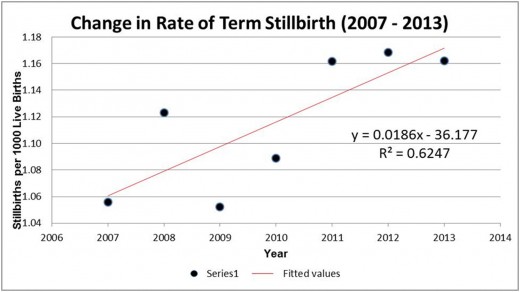
Between 2007 and 2013 in the USA, the implementation of the 39-week rule achieved its primary goal of reducing the proportion of term births occurring before the 39th week of gestation. During the same period the rate of USA term stillbirth increased significantly. Assuming 3.5 million term USA births per year, more than 300 more term stillbirths occurred in the USA in 2013 as compared to 2007. This study raises the possibility that the 39-week rule may be causing serious unintended harm. Additional studies measuring the possible impact of the implementation of the 39-week rule on major childbirth outcomes are urgently needed. Pressures to enforce the 39-week rule should be reconsidered pending the findings of such studies.

As lead author James Nicholson, MD commented to Medscape:

This study raises the possibility that the 39-week rule may be causing serious unintended harm.

Term stillbirth is clearly one of worst obstetrical outcomes, and it occurs with relatively high frequency — in one per 1000 deliveries that reach 37 weeks …

Unless or until high-quality research is published that proves that the 39-week rule does not increase term stillbirth rates, the forced imposition of the 39-week rule should be immediately reconsidered.

The authors presented an very impressive graph of stillbirth rates:

image

This increase in stillbirths neatly matches the change in gestational age at delivery that occurred during the same time period; the proportion of births at 38 weeks steadily declined while the proportion of births at 39 weeks steadily increased.

The data presented by Dr. Nicholson and colleagues seems pretty damning. In an effort to reduce mild, transient complications in newborns, we’ve let nearly 300 babies die stillborn each year, exactly as critics of the 39 weeks rule such as myself predicted.

BUT there’s an extremely important caveat. Two critical pieces of data are missing and without them, it’s difficult to draw any conclusions at all.

What’s missing?

While the increase in the stillbirth rate between 2007-2013 is impressive, it doesn’t mean much unless we know that the trend in stillbirth rates was before 2007. If stillbirth rates were steady or dropping in the years prior to 2007, there would be a very strong case that the 39 week rule is the cause of the observed increase in stillbirths. But if the stillbirth rate were rising in the years prior to 2007, we would have to postulate a different reason for the increase in stillbirth.

The other critical information that’s missing is the perinatal mortality rate. If the 39 week rule is responsible for the increased stillbirth rate, the perinatal mortality rate should have risen, too. If it didn’t rise, we’d have to consider the possibility that the babies who were stillborn would have died anyway after they were born and that the 39 week rule has merely changed the timing of death, not the eventual outcome.

It’s difficult to find these missing pieces of data because the authors used a custom database to determine the term stillbirth rate and it may not be comparable to the rates published by the CDC for the same years. I left a question on the Medscape article asking if some of that data could be provided. Without it, it’s nearly impossible to determine whether the authors’ contentions are true.

If 300 babies a year are stillborn who would have lived in the absence of the 39 week rule, we have created a major disaster in an effort to fix a minor problem. But until we learn the overall trend of stillbirths prior to 2007 and the perinatal mortality rates from 2007-2013, there’s no way to know for sure.

Marriage advice on Valentine’s Day

image

I’ve been privileged to be married for nearly 35 years to the most wonderful man in the world. On this Valentine’s Day, I’ve been reflecting on what makes a happy marriage. This is what I’ve learned.

Marry someone who is kind: There is no way to know what life will bring, but I always knew, no matter what happened that my husband would be good to me.

Marry someone who is smart … but don’t let him know exactly how smart you think he is: I like to say that I taught my husband everything he knows, but that’s not true. He’s one of the smartest, most engaged, most interesting people I have ever met. I improved him, of course, but that’s what a wife does.

Marry someone who will be a good parent: Parenting is a big part of marriage for most people and it helps to share it with someone who is a fabulous parent; my husband is an outstanding father. Whatever kind of parent I have been, I have been far better because of his advice, wisdom and patience, both with our children … and with me.

Marry your best friend: Ann Landers, an advice columnist who didn’t live to see the digital age, and is therefore someone you may have never heard of, used to say: “Love is friendship that has caught fire.” My husband was my friend long before we dated and he has remained by best friend ever since.

Don’t get married unless you can’t live without him. Our friends and family know the story of when I first declared that I could marry my husband … before I ever dated him. That shows you how sure I was that I could live with him, but I was equally sure that I could not live without him.

All the best things in my life come from my husband — our marriage, our children, our home, amazing experiences like family reunions and vacations to wonderful places … not to mention some really nice jewelry. He has made my life better in every possible way and I love him and need him more than mere words can say.

Happy Valentine’s Day! I hope everyone is spending the day with those you love.

Is there anyone who has less insight into her own actions than Modern Alternative Mama?

image

Hilarious! You cannot make this stuff up!

If it’s possible for a person to have so little insight into her own actions that it can be measured in negative increments, Katie Tietje, Modern Alternative Mama, shows how it’s done.

[pullquote align=”right” cite=”” link=”” color=”” class=”” size=””]I can’t parody Modern Alternative Mama; she is a parody.[/pullquote]

I can’t parody Tietje; she is a parody.

I’ll let her flay herself with her own words from today’s post, laughably titled Being “Semi-Crunchy” Doesn’t Make You Special:

I’ll admit, this post is born of frustration. But, with good reason, I think.

…[T]his is about a certain group of moms, moms who would probably describe themselves as “semi-crunchy,” who actually go around bragging about how smart they are because they’re crunchy…ish. That is, they embrace some aspects of crunchy, but they’re also “smart enough” to trust the mainstream, or scientists, on certain topics. They’re condescending about how this makes them better than all those too-crunchy, natural-or-bust moms (which is how they perceive us).

That. That condescending, “I know better than you stupid natural mamas” is what drives me insane.

So says Tietje, whose entire blog is a momument to unjustified condescension!

Being “Semi-Crunchy” Doesn’t Make You Special

As I said, whatever works for them. Cool

But, semi-crunchy mamas? You’re not special.

Pro tip for Katie. Prefacing withering remarks with “whatever works for you is cool” does not change their ugly intent.

What is Katie really irked about?

…[T]he woman doesn’t actually come right out and say, you’re a bad parent and your choice was stupid. But it’s pretty clearly implied.

Pot meet kettle!

…[I]t’s pretty crappy to brag about how great you are because you did something “normal” or “typical.”

Don’t you understand: only Katie and her buddies are allowed to brag about how great they are!

But wait!

Support other mamas. They don’t have to think like you, or make the same choices you do. That’s okay. Stop thinking they are uninformed, uneducated, ignorant, or bad people. Stop saying that they are, either directly or indirectly. Just trust that all mamas love their babies, many choices are okay, and everyone is doing the best they can.

English to English translation:

Don’t criticize ME. I don’t have to think like you, or make the same choices you do. Stop saying I’m uninformed, uneducated, ignorant, or bad. Stop criticizing ME, either directly or indirectly. I love my babies, my choices are okay, and I’m doing the best I can.

No, Katie, you’re not doing the best you can for your children. You’re doing the best you can for enriching YOURSELF. Your website, YOUR BUSINESS, doesn’t miss a monetization trick. You spew misinformation for PROFIT. You hide behind pious bleating when it suits you, but you are about as condescending as any human being could be with the added drawback that you are utterly, blissfully ignorant in regard to nearly every issue you tackle, whether it is vaccines, homebirth or diet.

Being crunchy doesn’t make you special, Katie Tietje; it marks you as gullible.

Running a crunchy website doesn’t make you special, either. It just marks you as a parasite, profiting by disseminating potentially deadly nonsense.

Muzzling healthcare providers

image

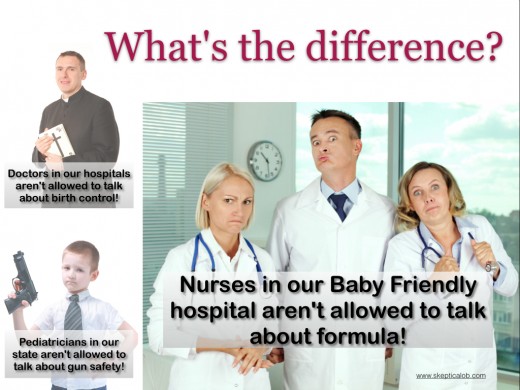
Special interest groups are often tempted to muzzle healthcare providers and many do. What’s the difference between Catholic hospitals muzzling healthcare providers who want to talk about birth control, the gun lobby muzzling healthcare providers who want to talk about gun safety, and the Baby Friendly Hospital Initiative muzzling healthcare providers who want to talk about formula feeding?

Dr. Amy