Childbirth Connection angered that estimated fetal weights are merely estimates

image

The Childbirth Connection is the leading lobbying organization for the natural childbirth industry. Their apparent goal is greater employment for the women they represent: midwives, doulas and childbirth educators. The heart of their marketing strategy is to promote distrust of modern obstetrics and obstetricians. As I noted almost exactly one year ago today, getting your information on birth from the Childbirth Connection is like getting your information on solar power from Big Oil. The conflict of interest is gargantuan.

[pullquote align=”right” cite=”” link=”” color=”” class=”” size=””]Better maimed than Cesarean shamed.[/pullquote]

Their latest effort to promote distrust of obstetricians is embodied in two recent articles, When a Big Baby Isn’t So Big in the NYTimes, and, Are Women Being Tricked Into Having C-sections? by Beth Greenfield, who often serves as a conduit for the natural childbirth industry, in Yahoo Parenting.

From the Yahoo piece:

[R]esearchers … found that a significant number of women are being erroneously told that they would be having big babies. And the study, published in Maternal and Child Health Journal in December and based on the data of 1,900 women surveyed by Childbirth Connection, further showed that mothers who believed they were having big babies were nearly five times more likely schedule a C-section — even though the large majority of their babies wound up weighing less than 8 pounds 13 ounces …

“Estimating weight is still an imprecise science. But the study is really more about communication than anything else,” one of the researchers, Eugene R. Declercq, a professor at Boston University School of Public Health, tells Yahoo Parenting. Figuring that a baby will be big, rather than too small (and then at greater risk of problems), he notes, “should be conveyed as good news, with no question about it being able to be delivered vaginally.” But based on the study’s findings, that’s not what’s happening, as a doctor telling a mom-to-be that her baby will be big “has a profound effect, and contributes to undermining women’s confidence they can deliver the baby,” Declercq told the New York Times.”

See! See! It shows you that obstetricians don’t know what they are talking about. It shows you that they just want to trick women into C-sections. How dare obstetricians fail to inform the public that an estimated fetal weight is merely an estimate? How was anyone to know?

The articles make it sound like this is some sort of shocking discovery, but obstetricians are well aware of the fact that estimate fetal weights are … gasp … estimates. Moreover, we are also aware the the accuracy of estimated fetal weights declines as the baby gets bigger. In the third trimester, EFW is accurate only to within +/- 2 pounds. A baby with an EFW of 9 pounds may weigh as little as 7 pounds, but it is EQUALLY likely that it weighs as much as 11 pounds.

There’s a simple reason why EFW is an estimate. It’s the equivalent of weighing a child with a tape measure. If you were told a child’s age, height, head size and abdominal circumference, you could probably come up with a pretty good estimate of its weight. That’s essentially the same information that ultrasonographers use to calculate the EFW.

Why does fetal weight matter anyway?

Here’s why: the baby’s very life may depend on it.

In another recent study that examined the relationship between increasing birth weight and perinatal mortality among 5,049,104 liveborns in the United States between 1995-2000, a nadir was observed at approximately 3,900 g and a sharp rise occurred for newborns with higher weights (see the image below). Thus, depending on many factors, the optimal birth-weight range to minimize the risk of fetal and maternal morbidity and mortality is between 3000-4000 g.

image

We know that very large babies have a much greater risk of paralyzed arms (Erb’s palsy), brain damage and death. We know that our best methods of estimating fetal weight can be off by two pounds in EITHER direction. What’s the solution?

The obvious solution is to develop more accurate ways of estimating fetal weight. In the meantime, we have to make do with what we have in attempting to prevent injury and death.

But that’s not how the folks at the Childbirth Connection see it. What are they doing to develop new, more accurate methods of measure fetal weight? Absolutely nothing. They don’t want to improve existing technology because … never forget this … their goal is NOT to make childbirth safer; their goal is to make vaginal birth more common, and their go-to tactic is to demonize obstetrics and obstetricians.

Listening to the Childbirth Connection declaim on the risks of technology is like listening to Big Oil declaim on the risks of solar power. There is a massive conflict of interest. But in the case of the Childbirth Connection and obstetricians, there is also an extraordinary conflict of VALUES: the Childbirth Connection values process whereas obstetricians have a laser-like focus on outcome.

That’s why obstetricians are constantly working to improve the accuracy of their technology while the natural childbirth industry, represented by the Childbirth Connection, resorts to demonizing it. The Childbirth Connection want you to hire a midwife and a doula to preside over your unmedicated vaginal birth. If that means taking a chance that your baby will end up injured, brain damaged, or dead, so be it.

As far as the Childbirth Connection is concerned, better maimed than Cesarean shamed.

The mind blowing grandiosity of quacktivists Jennifer Margulis and Kelly Brogan

40197188_s

Ever notice how quacktivists often suffer from grandiosity?

According to Wikipedia:

Grandiosity refers to an unrealistic sense of superiority … as well as to a sense of uniqueness: the belief that few others have anything in common with oneself and that one can only be understood by a few or very special people …

Take Jennifer Margulis, for example.

I’ve written many times about Margulis and her wacky theories. My personal favorite is the stupidest excuse for homebirth deaths ever.

[pullquote align=”right” cite=”” link=”” color=”#fe8d23″ class=”” size=””]Margulis and Brogan come across as pitiable, but they are also dangerous.[/pullquote]

Margulis doesn’t do well with criticism. Her latest book received a scathing review in The New York Times Book Review. She couldn’t do anything about that, but she did try to manipulate the Amazon reviews of the book.

But she’s outdone herself this time. She’s actually written to Linda Birnbaum, the Director of the National Institute of Environmental Health Sciences offering to explain the purported rise in autism.

What are Margulis’ qualifications to opine on this topic?

I’m an award-winning science journalist and book author with an interest in children’s health and autism. I am also a Fulbright grantee — I lived and worked in Niger, West Africa in 2006 – 2007. I was also in Niger in the 1990s, working in part on a child survival campaign. I think it is important to have a global perspective on health.

I have a B.A. from Cornell University, an M.A. from the University of California at Berkeley, and a Ph.D. from Emory.

Her degrees are in English language and literature! As far as I can determine, she has no training in science, medicine or statistics. In her grandiosisty, she thinks she doesn’t need them.

My extensive research has a journalist has led me to suspect that two environmental factors may be directly contributing to the autism epidemic:

1) Over/ill-timed exposure to prenatal ultrasound…

2) The use of Acetaminophen, especially before or after infant vaccination.This may be the smoking gun…

No matter that the theories are incompatible with each other, let alone the fact that there is no proof for either one. Perhaps most pitiful is Margulis’ offer to educated Dr. Birnbaum,  a toxicologist with a PhD in microbiology whose dozens of publications focus on “the pharmacokinetic behavior of environmental chemicals; mechanisms of actions of toxicants, including endocrine disruption; and linking of real-world exposures to health effects.”

I imagine you are already familiar with these issues but I’d be delighted to send you more information or to talk on the phone, if that would be helpful.

While Margulis’ grandiosity is pathetic, that of “holistic psychiatrist” Kelly Brogan is frightening.

Consider her latest piece, ironically titled Sacred Activism: Moving Beyond the Ego, which is a paean to outsized self regard:

I was seemingly born with a fire in my belly and a sharp tongue. My mind stays sharp under pressure – maybe it even gets a touch sharper – and I’m notorious for saying what I mean. Just ask my family. These qualities made me a pretty righteous babe my entire young adulthood. Strong opinions, lots of critical thinking, a heaping portion of skepticism, and belligerent atheism, I took a vow of matrimony to science in my late teens.

But Brogan is just getting started:

I felt an ancient fire kindle inside me that churned and twisted with my own native force. I held my sword aloft. I began writing, speaking, lecturing. I changed my practice. And, of course, I was given the gift of my own health challenge to initiate me into the realm of self-healing and the power of food as information. Now I had proof – my recovery, and then the recovery of dozens of my patients as I began to arm them with what they intuitively knew to be the reason they had been stuck: our systems are making us sick and then profiting off of our ongoing illness.

The monstrous path of the righteousness

I was lionized. But I also felt alone. I felt awash in a sea of thinkers, doctors, and scientists, each with one pet interest they were willing to stick their neck out for. The anti-GMOer who would trust the same corrupt industry with their life if they got a cancer diagnosis. The anti-vaxxer who ate Twinkies for breakfast. The homeschooler having their babies at the hospital, just in case “something went wrong”. The green revolutionary screwing curly Q mercury-laced bulbs into every socket. The anti-fluoride campaigner turning a blind eye to escalating prescription of stimulants to toddlers. And the list went on.

Her thoughts are ugly:

… I would sit at my daughter’s birthday parties disgusted by parents handing out epi-pens and asthma inhalers to their pizza-eating, juice-box guzzling kids. I longed for the Schadenfreud [sic] of a prominent political figure struggling with vaccine injury. Somehow further news of catastrophe at the hands of industry would only validate my beliefs and intuition that everything was wrong.

And downright scary:

There were times the Truth felt so oppressive I wanted to be dead. I wanted not to have brought children into this corrupt, twisted world where everyone is self-sedated and complicit in evils beyond all imaging. Playing sports and watching TV while babies are being experimented on in the name of sound science and the greater good.

I won’t bore you with the rest of her logorrhea. The key point for Brogan is that she, in her monstrous grandiosity, seeks to spread the “Truth.”

I understand now, that I have a choice – a choice to put my energy toward that more beautiful world I do believe in, or to seek to feed my wounds and my ego by dwelling in the misery of how far off the golden brick road we have wandered. Both in my office with patients, in my teaching and writing, and with my daughters, I hope to offer an experience of the Truth. And a glimpse of what we all know is still possible.

Margulis and Brogan come across as pitiable, but they are also dangerous. As quacktivists, their grandiosity leads them to spew deadly health misinformation … and the children of those who believe their nonsense are the ones who pay the price.

New study shows maternity clothes cause pregnancy

image

Startling finding announced in prestigious journal
by Gull E. Bull

Scientists have made an astonishing discovery about the cause of pregnancy. According to the study, published in the widely read journal JCS (Journal of Crap Science), researchers have discovered a remarkable and powerful association between maternity clothes and pregnancy raising the possibility that maternity clothes cause pregnancy. Lead author Publish R. Parrish explains that this remarkable association was found in a variety of different investigations.

1. Nearly all women wearing maternity clothes are pregnant (correlation coefficient 0.95) indicating a near perfect relationship between maternity clothes and pregnancy.

2. There is a startling association between the number of stores selling maternity clothes and the overall fertility rate (p<0.01).

3. The odds ratio for pregnancy for a woman wearing maternity clothes as opposed to non-maternity clothes, is very high (RR 35.7). For non-pregnant women, the number wearing maternity clothes drops off in a linear fashion from the day after delivery to approximately 6 weeks postpartum.

According to Dr. Parrish:

“The findings in this study are even stronger than the study touting an association between induction and autism. We believe that our study deserves far more attention because the association is much clearer and even more robust.”

Asked if it were possible that the investigators had misinterpreted their findings, confusing the fact that pregnancy causes women to wear maternity clothes and not the other way around, Dr. Parrish acknowledged the need for further research. He admitted that correlation is not causation but pointed out that if the mainstream media could make such a fuss about crap research showing an association between induction and autism, his work should be able to get even more attention.

As Dr. Parrish noted:

“We aren’t really concerned with what is true, but rather what can be published and publicized. The more sensational the results, the better. Why wait to reproduce results when you can submit crap to any journal, get it published and get it publicized in the newspapers? It’s not like anyone is really checking the accuracy of our findings or the plausibility of our conclusions, right?”

Indeed, Dr. Parrish admits that he has no intention of further research in this area. He is eager to move on to his next project: C-sections for macrosomia cause babies to grow larger.


This piece, which previously appeared in August 2013, is satire.

Homebirth isn’t about women or birth; it’s about midwives

image

I’ve been engaged in an online discussion with other healthcare providers about the NEJM Oregon study of out of hospital birth and it has crystallized for me something I’ve suspected for a long time:

Homebirth isn’t about women, babies or birth; it’s about midwives.

[pullquote align=”right” cite=”” link=”” color=”#C61210″ class=”” size=””]Homebirth is not popular among women. Most have no interest in anything that raises the perinatal death rate.[/pullquote]

Think about it: Except in the Netherlands, homebirth is (and has been for decades) a fringe practice. Anything that engages 2% of the population or less is almost by definition a fringe practice. So why does it receive so much attention? In part it’s because of the high death rate. The people who care for women and babies have a particular revulsion for preventable infant death and anything more likely to cause it. They pay attention to it because they are trying to prevent those deaths.

But I would argue that the real reason for so much attention is that the entire project is being driven by midwives. The proportion of midwives in the US, the UK, Canada and Australia who favor homebirth exceeds the proportion of women who favor homebirth by an extraordinary margin. Midwives are infatuated with homebirth for a number of reasons:

1. It is the natural end point of their obsession with promoting what they can do and demonizing what they cannot. They’ve gone from favoring the employment of midwives in maternity units, to midwife led units and birth centers. Homebirth is the logical next step, freeing them from any scrutiny by other health professionals.

2. It reflects the intellectually and moral bankrupt philosophy that the “best” birth is NOT the safest birth, but the birth with the least interventions.

3. It ensures that women cannot get effective pain relief.

4. It is a midwife full-employment plan. In contrast to a hospital based unit where one midwife can care for multiple women at a time, homebirth (in many countries) requires two midwives to care for one woman.

The truth is that homebirth is not popular and will never be popular among pregnant women. Most women have no interest in anything that raises the risk of perinatal death. Homebirth is deeply unpopular among obstetricians; most of us abhor anything that increases the risk of perinatal death. Homebirth is anathema among neonatologists for the same reason.

The provider discussion about homebirth crystallized that point. Among the participants, there was only one obstetrician on the record as favoring homebirth (though, to my knowledge, he doesn’t provide coverage for homebirth). There is not a single neonatologist who favors homebirth. Homebirth is relentlessly promoted by the midwives in the group. Sure, they dress it up with the usual nonsense that maternity care is in crisis, that we need to look at why women choose homebirth in the first place, etc.

But maternity care is not in crisis: neonatal mortality has never been lower. Women who in the past could not get pregnant, women who did not survive their serious medical illnesses to get pregnant or did not survive pregnancy are now having healthy babies. To the extent that there is a crisis it is reflected in maternal mortality and too LITTLE technology; some women with serious medical complications don’t have easy access to the technology that could save their lives.

The cries of “crisis” come from those who think that failure to privilege unmedicated vaginal birth is the crisis.

The pressure to support homebirth is not being driven by women. It is being driven by midwives and the rest of the natural childbirth industry (doulas, childbirth educators, natural childbirth lobbying organizations).Homebirth represents 100% of the income of American homebirth midwives, and it represents professional autonomy and a lack of professional scrutiny for others. The question we ought to be asking is not why some women choose homebirth; it’s why midwives promote homebirth as safe when it manifestly increases the risk of death.

The NEJM paper indicates the risk of homebirth death is underestimated, that at least in the US (and possibly in other countries as well), homebirth leads to preventable perinatal deaths. Yes, some women will choose it anyway despite the increased risk of death, but then some women will refuse to vaccinate. We don’t spend our time trying to make refusing vaccination safe; we educate our patients on the deadly consequences of their choice; that’s what we should do here, too.

Homebirth isn’t about women or babies or birth; it’s about midwives … and women contemplating homebirth need to understand both the risks of homebirth and the self-serving motivations of those who promote it.

Women who stop breastfeeding are more likely to be abused. Researchers recommend WHAT??!!

Mutilated women

I wouldn’t have believed it if I hadn’t read it with my own eyes.

Past and recent abuse is associated with early cessation of breast feeding: results from a large prospective cohort in Norway was recently published in BMJ Open. The authors made an important observation:

Nearly all women initiated breast feeding, but 12.1% ceased any breast feeding before 4 months and 38.9% ceased full breast feeding before 4 months, but continued partial breast feeding. Overall, 19% of the women reported any adult abuse and 18% reported any child abuse. The highest risk of any breast feeding cessation before 4 months was seen in women exposed to three types of adult abuse (emotional, sexual or physical), with adjusted OR being 1.47 (95% CI 1.23 to 1.76) compared with no abuse. Recent abuse and exposure from known perpetrator resulted in nearly 40% and 30% increased risk, respectively. The OR of any breast feeding cessation for women exposed to any child abuse was 1.41 (95% CI 1.32 to 1.50) compared with no abuse in childhood.

Cessation of breastfeeding appears to be associated with emotional, sexual or physical abuse of the mother.

[pullquote align=”right” cite=”” link=”” color=”” class=”” size=””]Women should NOT be treated as merely breastmilk dispensers.[/pullquote]

I don’t know how domestic abuse is handled in Norway, but here in the US, I was trained to looked for and ask about domestic abuse and if I suspected it, to offer comprehensive services to aid women in stopping, leaving and prosecuting the abuse. That approach reflects the belief that every woman deserves to live free of violence and abuse.

Astoundingly, that’s NOT what the authors recommend.

They understand what they observed:

The main finding in our study was that exposure to past and recent abuse was strongly associated with early cessation of any breast feeding. The strongest effect was seen for women exposed to three types of abuse (sexual, physical and emotional), with nearly 50% increased adjusted ORs of any breastfeeding cessation before 4 months compared to the non-exposed women. Recent abuse and exposure from known perpetrator resulted in nearly 40% and 30% increased risk of any breastfeeding cessation before 4 months, respectively. Women who reported a history of child abuse were more likely to stop breast feeding before 4 months than women who had not experienced child abuse…

But their utterly inappropriate conclusion is chilling in its disregard for women’s well being. The authors appear to view women like dairy cows, as sources of milk, but not as individuals worthy of physical and psychological support:

… Given the convincing evidence of the beneficial effects of breast feeding both for the mother and the infant, it is crucial to promote high breastfeeding rates. Mothers with a history of past or recent abuse comprise a key group to target for extra support and breastfeeding assistance.

Actually, the authors treat women worse than cows. If farmers found that their animals produced less milk when abused, they would move with alacrity to stop the abuse.

The idea that women who stop breastfeeding because of emotional, sexual or physical abuse should be treated with breastfeeding support is unspeakably ugly. The benefits of breastfeeding for term infants in Norway is trivial, perhaps a few less infants colds and episodes of diarrhea. The harms to women from emotional, sexual or physical abuse are monstrous. The authors’ conclusion that it is more important to support abused women to breastfeed longer rather than to support them in ending the abuse is both profoundly misogynistic and utterly grotesque.

It is an indication of just how far lactivists have strayed from human decency in promoting breastfeeding. Women are not cows. Their primary value to their children is NOT as milk dispensers. Their primary value to society is NOT as milk dispensers. They should not be treated worse than cows.

When women stop breastfeeding because of emotional, sexual or physical abuse, it is the ABUSE that should be targeted, NOT the breastfeeding!

I’m very cynical when it comes to the lactivism industry, but even I would have thought that lactivists would not need to be told that a woman’s right to live unabused is more important than a baby’s need for breastmilk. I was wrong. If anything, lactivism is even uglier than I had thought.

You will know that homebirth is safe when THIS happens!

Newborn baby

Many women are confused about the safety of homebirth. On the one hand, homebirth midwives insist that it is as safe (or safer!) that hospital birth. On the other hand, obstetricians insist that it increases the risk of perinatal death; that’s why most refuse to attend them.

The situation is further complicated by dueling scientific studies. The last few weeks alone have seen the release of a Canadian study that showed that homebirth did not increase the risk of infant death and an American study that showed that it did increase the risk of death,  with an increase that dwarfs death rates from SIDS or auto accidents.

There is no doubt in my mind that further research is going to corroborate the fact that homebirth in the US, particularly homebirth with a non-nurse midwife (CPM, LM), is deadly. The real difference between deaths in the hospital and deaths at homebirth with CPMs is probably in the range of 1000%!

But you don’t have to take my word for whether or not homebirth is safe; I could be wrong. You will know that homebirth is safe when this happens:

You’ll know homebirth is safe when neonatologists recommend it.

Neonatologists are doctors who care for critically ill newborns. They have no personal stake in the home vs. hospital debate. If anything, they are more likely to profit from homebirth, which leads to transfers of critically ill newborns whose problems could have been prevented by lower intensity care in the hospital.

Yet, to my knowledge, with rare exceptions, neonatologists recommend AGAINST homebirth. Babies are their only patients and babies’ wellbeing their overriding interest.  And they believe that homebirth puts babies at risk and leads to the deaths of babies who did not have to die.

Mothers are free to opt for homebirth regardless of the risk to their newborns. They may judge that avoiding the risk of a C-section or other interventions is more important than avoiding the smaller risk of perinatal death. But that doesn’t mean they’re choosing homebirth because it is safe. Until neonatologists recommend homebirth as safe for babies, you can be sure that it isn’t.

Lactimidation

Lactimidation

What if I told you that in an effort to promote weight loss a hospital refuses to provide food to obese patients? If they want to eat, they’ll have to purchase and bring their own.

Disgusting, right?

What if I told you that in an effort to promote contraceptive use a hospital refuses to provide sterile instruments for women desiring termination? If they want to have an abortion, they’ll have to purchase and bring their own.

[pullquote align=”right” cite=”” link=”” color=”#d32b2b” class=”” size=””]Lactimidation is both self-serving and unethical.[/pullquote]

An unconscionable violation of women’s autonomy, right?

Fortunately, those things haven’t happened.

But how about if I tell you than in an effort to promote breastfeeding the Countess of Chester Hospital in the UK refuses to provide formula to new mothers? If they want to feed their babies formula, they’ll have to purchase and bring their own.

It’s true!

The local newspaper report, Countess of Chester Hospital maternity shake-up means new mums will have to provide own formula milk explains:

Staff on the Countess maternity ward are advising expectant mums planning to bottle-feed their babies to include a pack of their own formula feed in their hospital bag, in keeping with other regional maternity units such as Liverpool Women’s Hospital.

Up until now the Countess has always provided ready-made bottles of the mother’s choice of formula, but this latest move is part of a drive to ‘encourage and support’ mums to breastfeed their babies…

Julie Fogarty, head of midwifery services at the Countess, said: “New parents either opt to breast feed or plan ahead and already bring formula feeds with them when coming into hospital.

It’s disgusting; it’s a violation of women’s autonomy; and it’s a prime example of “lactimidation,” the ongoing lactivist campaign to intimidate women into breastfeeding. It operates on the same principle as heckling outside abortion clinics. It’s meant to “encourage” women to breastfeed (or continue unwanted pregnancies) by shaming and browbeating them into making the choice that the intimidators approve.

Lactimidation is the latest battlefront in the lactivist campaign to oversell the benefits of breastfeeding. The truth is that in first world countries like the UK or the US, the benefits of breastfeeding for term infants are trivial, 8% less colds and 8% fewer episodes of diarrhea each year across a country’s entire population of infants. The other benefits claimed are based on research that is weak, conflicting and riddled with confounders.

But one thing is 100% certain, breastfeeding is a business, complete with salaries, products, marketing campaigns and lobbying groups. And the breastfeeding business is doing its damnedest to make sure it captures 100% of the potential market for its goods and services.

Moreover, it’s hardly a coincidence that the breastfeeding industry is dominated by Western, white women, well off women and that those most likely to choose formula feeding are women of color, young women, and poor women, those who have been traditionally underserved and discriminated against. The free formula in hospitals, which would be a trivial expense for most lactivists, represents a substantial expense for these women. That’s the point! It is so much easier to lactimidate poor women of color, and so much more satisfying to punish them for not emulating their “betters.”

Lactimidation is a central tenet of “baby friendly” initiatives to promote breastfeeding among new mothers. As a matter of principle, these initiatives seek to make accessing formula within hospitals as burdensome as possible. Whether that means locking up formula, subjecting women to lectures exaggerating the “benefits” of breastfeeding, banning formula gift bags, or making women buy and bring their own, lactivists intimidate women to enforce conformity with THEIR values about how women should use their own breasts.

Oh, but they’re doing it for the children! NOT!

As the article about the Countess of Chester hospital notes:

But staff strongly emphasise that they will not allow anyone to go without nutritional support and advice for their baby while under their care…

So the hospital is going to stock just as much formula as it ever did. The nurses are simply going to lactimidate women into not requesting it or shame them when they request it anyway.

That is both self-serving and unethical.

The Countess of Chester hospital may be leading the way with its new policy, but it is hardly alone in its efforts to lactimidate women into using their bodies in the lactivst approved way. So called “Baby Friendly” Hospitals in the US have made lactimidation a cornerstone of their policies in order to shame women into breastfeeding whether it is the right choice for them, the right choice for their babies, or even (in the case of women who don’t produce enough breastmilk) when it is an unsafe choice.

Lactimidation is an abomination and it MUST stop.

How can we put an end to lactimidation within hospitals? Suzie Barston, the Fearless Formula Feeder, is assembling lists of hospitals that do and don’t encourage lactimidation so women can make informed choices.

Ultimately, though, women will have to fight back against lactimidation by sharing their stories and exposing the unconscionable pressure applied to new mothers and the harmful results of starving, dehydrated babies, and shame and guilt wracked new mothers.

We need to name these policies for what they are: naked, ugly attempts to intimidate women into breastfeeding.

I’d be grateful to anyone who wishes to share their story with others. Just tag it with #lactimidation on Facebook or Twitter and we will be able to find it when we search.

Overselling the benefits of skin-to-skin … and ignoring the risks

Woman with long nose isolated on grey wall background. Liar concept.

Pediatrician Clay Jones has a great piece today on The Scientific Parent, Recent Reports of Skin-to-Skin Benefits Fail to Mention Key Infant Safety Risks:

The Kangaroo Mother Care concept was introduced in the the late ’70s in developing countries as an alternative solution to incubators, where access to them and more complex healthcare for infants was limited…

…[Y]ou need to know that the reduced risk of death has really only been found in babies born with low birth weight…

Moreover:

[pullquote align=”right” cite=”” link=”” color=”#96712D” class=”” size=””]Practices beneficial for premature babies extended to term babies despite a lack of evidence? Where have we heard that before?[/pullquote]

There are risks. The media reports I saw had flawed conclusions, overlooking that these practices can put babies at risk of neurologic injury and even death.

Dr. Jones is talking about Sudden Unexpected Postnatal Collapse (SUPC):

This happens in the first week of life when a low-risk (healthy) newborn suddenly and unexpectedly has difficulty breathing, which can lead to their heart stopping. In the U.S. and Canada, we typically refer to this as early SIDS and sudden unexpected early neonatal death (SUEND). The outcome is frequently tragic, and half of the children affected die, with many of the remaining newborns are disabled in some fundamental way.

I’ve written about this problem before in association with the so called “Baby Friendly” Hospital Initiative designed to promote breastfeeding, in Is the Baby Friendly Hospital Initiative really the Baby Deadly Hospital Initiative? In it I discussed the paper Deaths and near deaths of healthy newborn infants while bed sharing on maternity wards published in 2014 in the Journal of Perinatology.

We know that bed sharing (co-sleeping) can be deadly for babies, and the risk is highest when mothers are impaired by drugs or alcohol

The author reported 15 deaths and 2 near deaths:

In eight cases, the mother fell asleep while breastfeeding. In four cases, the mother woke up from sleep but believed her infant to be sleeping when an attendant found the infant lifeless. One or more risk factors that are known or suspected (obesity and swaddling) to further increase the risk of bed sharing were present in all cases. These included … maternal sedating drugs in 7 cases; cases excessive of maternal fatigue, either stated or assumed if the event occurred within 24 h of birth in 12 cases; pillows and/or other soft bedding present in 9 cases; obesity in 2 cases; maternal smoking in 2 cases; and infant swaddled in 4 cases.

So the benefits of skin-to-skin are being completely oversold and the risks and downsides completely ignored.

That sounds familiar. Where have we heard about practices beneficial for premature babies extended to term babies despite a lack of evidence? Where have we heard about benefits being oversold and risks or downsides completely ignored?

I remember! The exact same thing has happened with breastfeeding and delayed cord clamping. All three share remarkably similarities.

1. A practice found to be beneficial for premature infants is extended to term infants in the absence of any scientific effort to support it.

As Dr. Jones notes, skin-to-skin care was found to be beneficial for premature infants who need help regulating body temperature. There were no studies that showed the same benefits for term infants who don’t have trouble regulating body temperature.

Breastfeeding has been found to prevent necrotizing enterocolitis (NEC), a deadly complication of prematurity, but has no similar life saving benefits for term infants.

Delayed cord clamping has been found to prevent anemia of prematurity, but does not prevent anemia in term infants.

2. The practice is promoted and popularized by allied health professionals like midwives and lactation consultants.

3. The practice is promoted in a dual effort to demonize conventional medical practice and promote alternative medical claims.

4. The practices are examples of unreflective defiance so prominent in midwifery theory.

The midwife who first promoted delayed cord clamping did so because she believed it prevented learning disabilities. That was obviously untrue but other midwives picked it up and made the rationale more plausible but still unsupported by scientific evidence.

5. The risks and the burdens are ignored.

This is especially true in the case of breastfeeding. Approximately 5% of mothers cannot make enough breastmilk to fully support a term infant. This can result in dehydration, brain damage and death. Nonetheless lactation consultants continue to promote the utter fiction that there is “no such thing” as not enough breastmilk.

Breastfeeding can be painful, inconvenient and burdensome for mothers … but who cares about mothers? Their needs are rendered invisible and considered meaningless.

6. Even deadly dangers are ignored.

We know that co-sleeping increases the risk of infant death. We know that prone sleeping also increases the risk of infant death. We know that the risk is higher when women have taken sedative medications. We know that soft bedding also increases the risk. Yet lactivists and lactation consultants encourage co-sleeping and prone sleeping next to or on top of sedated mothers enveloped in soft bedding to “promote” breastfeeding … and there’s no solid evidence that it has any impact on breastfeeding rates.

Has anyone ever said: “I stopped breastfeeding because if I had to get up anyway to put the baby back in the crib I might as well bottle feed”?

7. White hat bias

White hat bias is bias toward what are perceived to be righteous ends. Formula companies have committed egregious crimes in the developing world. White hat bias is bias against formula in a righteous effort to punish the manufacturer.

The desire to believe that “natural” is always better than technological is another form of white hat bias.

Midwives and lactation consultants have their own form of white hat bias. In an ongoing effort to demonize any technology that they cannot provide, they are heavily biased toward practices or procedures that they can provide.

In the final analysis, only careful scrutiny of scientific evidence should guide clinical recommendations … NOT intuition; NOT wishful thinking; NOT the desire to promote midwifery or lactation consultants; NOT a desire to promote breastfeeding; NOT white hat bias.

Women who pride themselves on taking a cynical view of doctors and industry products need to expand their cynicism to midwives and lactation consultants and their products.

Otherwise babies will continue to die completely preventable deaths because their mothers never received complete and honest information about minimal (or even non-existent) benefits or complete and honest information about deadly risks.

How does having a homebirth compare to not using a car seat?

Mother Putting Baby Son Into Car Travel Seat

In the last 30 years we have engaged in a huge public health campaign to increase the use of car seats. Not only have we spent millions, we’ve enacted laws that actually make it illegal for parents to drive infants without buckling them into car seats.

The campaign has been spectacularly successful. According to the Insurance Institute for Highway Safety, from 1975 to 2013, infant fatalities fell from 6/100,000 to 1.3/100,000 while car seat use rose to 99% of children under age 1. Of course car seat use is the not the only reason why infant fatalities dropped; cars themselves are safer, but the use of car seats has played an important role.

[pullquote align=”right” color=””]Out of hospital birth has a death rate more than 50X higher than failing to put an infant in a car seat.[/pullquote]

Forgoing car seat use for infants is not merely illegal, it is social anathema. Who would defend a mother who chooses not to use a car seat for her infant. No one, right? Who would claim that the risk of not using a car seat is so small that it should be left to the mother’s choice? No one, right?

Yet, as I wrote last week, a paper in The New England Journal on out of hospital birth suggested that the increased risk of giving birth outside a hospital was small.

Small is a relative term. That’s why it is instructive to compare the risk of refusing to use a car seat with the risk of giving birth outside a hospital.

I’ve attempted to do that in the graph below:

image

The graph reflects information from the Insurance Institute for Highway Safety and the data from the NEJM paper.

Even a cursory glance reveals an inconvenient truth (inconvenient for natural childbirth advocates that is). Childbirth, even for low risk women with singleton term babies in the head first position is inherently dangerous. Infants who are unrestrained had a death rate of 4.6/100,000 whereas the infants of low risk women faced a death rate of 106/100,000 even in a hospital. Childbirth is 100X more dangerous than failing to restrain an infant in a car seat.

The graph actually dramatically understates the risk. The automobile fatality data reflects deaths per 100,000 children, most of whom rode in cars multiple times. The per trip mortality rate is substantially lower. Furthermore, the birth data is from low risk women. The true gulf between automobile infant deaths and deaths from childbirth is probably another order of magnitude.

The graph also shows that the risk of death for an infant riding in a car is actually very small, whether riding in a car seat or not (1.3/100,000 vs. 4.6/100,000). Nonetheless, we value the lives of our infants so much that we are willing to spend millions of dollars and enact laws in all 50 states to protect them from this small increase.

In contrast, there’s a much larger difference between delivering a baby outside a hospital vs. in a hospital (258/100,000 vs. 106/100,000). If 100,000 mothers of infants chose to drive with their infants unrestrained, there would be an absolute increased risk of 3 infant deaths per year. If 100,000 low risk women chose to give birth outside the hospital, however, there would be an absolute increased risk of 152 deaths!

That doesn’t change the fact that it is up to each woman to decide for herself where to give birth. But it does suggest that the increased risk of death at out of hospital birth isn’t small after all.

Simply put, no one could call the failure to buckle an infant into a car seat a safe choice. If no one would call that choice safe, no one should call the choice to deliver outside a hospital, which has an absolute increased risk of death that is 50X higher, a safe choice.

The increased risk of death at out of hospital birth isn’t small after all

image

The new out of hospital birth study, Planned Out-of-Hospital Birth and Birth Outcomes, by Snowden et al. is getting a lot of media attention.

As I explained in yesterday’s post the authors deliberately soft pedaled the findings:

Dr. Aaron Caughey, a co-author who heads the university’s obstetrics department, said the researchers consciously adopted a nonjudgmental tone so critics would not say that the in-hospital providers were demonizing out-of-hospital births.

That strategy seemed to have worked to mute the criticism of homebirth supporters, but the fact is that the increased risk of death at out of hospital birth isn’t small all. To understand why, it helps to compare the death rates at out of hospital birth to the death rates from SIDS.

[pullquote align=”right” color=”#000000″]The absolute increased death rate from out of hospital birth far exceeds the absolute increased death rate of placing a baby to sleep on her stomach.[/pullquote]

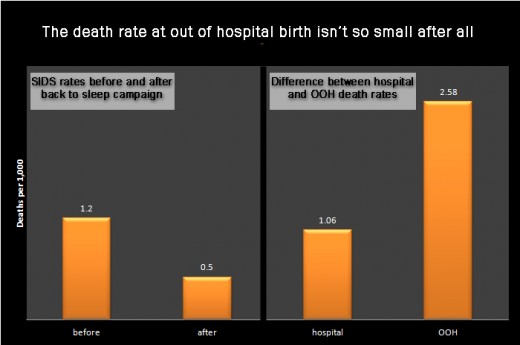
SIDS haunts the nightmares of new parents and prospective parents. It is so frightening because apparently healthy infants die suddenly for no discernible reason. The first real breakthrough in preventing infant deaths from SIDS came with the “back to sleep” campaign when researchers noted that babies were more likely to die of SIDS when sleeping in their stomachs than on their backs. Since the beginning of the campaign, death rates from SIDS have dropped from 1.2/1000 in 1992 to 0.5/1000 in 2010. The campaign is considered a great success and it is the rare parent who ignores the advice.

Who would now say that the increased risk of death from infants sleeping on their stomachs is acceptable because the absolute risk of death is small? No one, right?

So how can it be that the increased risk of death at out of hospital birth from 1.06/1000 to 2.58/1000 is acceptable because the absolute risk of death is small?

Here’s a bar chart that sets out the absolute rates of death. You can see that the absolute increased death rate from out of hospital birth far exceeds the absolute increased death rate of placing a baby to sleep on her stomach.

death rate OOH birth

Out of hospital births ought to haunt the nightmares of prospective parents. It should be frightening when apparently healthy infants die for entirely preventable reasons especially when the increased risk of death is far larger than the increased risk of death from SIDS when ignoring the back to sleep warning.

Drs. Snowden, Caughey and their colleagues are to be congratulated for publishing a paper that is so clear, meticulous and measured that even the homebirth community cannot argue with that finding that out of hospital birth more than doubles the risk of perinatal death. As Dr. Caughey noted, the authors chose a non-judgmental tone so that homebirth advocates would not be able to accuse them demonizing out of hospital birth.

But the increased risk of death at out of hospital birth isn’t small after all. The mainstream media and American women should take note.


You can find the SIDS statistics here.

Dr. Amy