Sure my baby died at homebirth, but that was just a coincidence!

image

It’s remarkable really. Homebirth had nothing to do with the fact that the baby died. It’s just an amazing coincidence.

Yes, I know that my obstetrician, my mother-in-law and my best friend warned me that the baby could die at homebirth, but that has absolutely nothing to do with the fact that the baby did die. It was just a coincidence.

You know what’s really amazing? Those naysayers who predict that homebirth might lead to the death of the baby often cite specific causes of death. Sure, that’s exactly how the baby ultimately died, but it was just a coincidence.

[pullquote align=”right” color=”” class=”” cite=”” link=””]Just because the baby unexpectedly fell out dead into my midwife’s hands, they want to blame the death on homebirth.[/pullquote]

It’s kind of eerie, when you think about it.

The naysayers insist that women shouldn’t attempt a VBAC at home because the uterus might rupture and then the baby will die. And lo and behold, the uterus ruptures and the baby dies. Fortunately, we know that was nothing more than a coincidence.

The naysayers claim that a single footling breech might have a cord prolapse and die. What do you know, the cord prolapses and the baby dies. But that was just a coincidence.

The naysayers like to scare women by claiming that if you had a shoulder dystocia in the past, the same thing may happen again in the next pregnancy. Amazingly, the baby dies at home of shoulder dystocia. Who could have seen that coming?

The naysayers don’t understand that breech is just a variation of normal. They say that the baby is at risk for head entrapment and death. Then, almost as if they predicted it, the baby’s head is trapped and the baby dies. What a coincidence.

The naysayers believe that listening to the baby’s heart rate instead of monitoring it with continuous electronic fetal monitoring will put the baby at risk for developing fetal distress without anyone realizing. Now, just because the baby unexpectedly fell out dead into my midwife’s hands, they want to blame the death on homebirth when it was nothing more than a coincidence.

The naysayers think that it isn’t enough that my midwife carries the same, the very same, the exact same resuscitation equipment at the hospital. They warn that the baby may die for lack of an expert to perform a resuscitation. Sure that’s exactly what happened, but we all know that’s a coincidence.

It’s remarkable really. Coincidence upon coincidence.

Wait, what? You think it wasn’t a coincidence that the baby died of the exact same thing that the naysayers warned against.

You are mean!

You are disgusting!

Just because they wrote their stories on blogs and message board available to hundreds of millions of people doesn’t mean that the story isn’t deeply private.

These women are grieving!

You know what? You remind me of that judge who refused to show clemency to the man who murdered his parents. The guy was an orphan! If that doesn’t deserve sympathy I don’t know what does.

How do I know these were just coincidences?

I spent years educating myself by reading everything that other laypeople have written about childbirth. I’m not like those ignorant sheeple who think that just because an obstetrician went to college (you don’t need a degree to catch a baby), and went to medical school (where they learn mostly stuff that doesn’t have to do with birth) and delivered thousand of babies (but not even one totally naturally, outdoors, in the ocean, with dolphins), they might actually know more than me.

Oh, and don’t forget:

Babies die in the hospital, too. In fact MORE babies die in the hospital than at home. And interventions kill babies, and it is much safer for a woman who had 3 previous C-sections to rupture her uterus at home while trying to deliver a 10 pound single footling breech without continuous fetal monitoring and end up with a hysterectomy and 10 transfusions than to have an elective repeat C-section!

Sure the baby died in that case, too, but that was just a coincidence.

Death rate from homebirth higher than from SIDS

image

It’s a scourge that haunts the nightmares of new parents and prospective parents.

I’m talking, of course, about SIDS (sudden infant death syndrome), which takes the lives of approximately 2000 infants each year. SIDS is so frightening because apparently healthy infants die suddenly for no discernible reason.

But the death rate from SIDS is only a fraction of the death rate for American homebirth. The SIDS death rate is 0.4/1000. In contrast, the best data we have (from Oregon in 2012) shows that PLANNED homebirth with a LICENSED homebirth midwife has a death rate of 5.6/1000 approximately 1300% higher. Deaths at homebirth are frightening because apparently healthy infants die during labor or immediately after for reasons that are not discernible to homebirth midwives. The reasons are all too apparent to obstetricians and to the pathologists who perform autopsies on these dead babies.

[pullquote align=”right” color=””]Apparently healthy infants die unexpectedly during homebirth or immediately thereafter.[/pullquote]

Homebirth advocates, to the extent that they acknowledge the increased death rate, dismiss it as trivial (“14X a small number is still a small number”). Yet no one dismisses the SIDS death rate as trivial. Why the difference? It’s because homebirth advocates have difficulty with the concepts of absolute and relative risk. Therefore, comparisons can be helpful in getting homebirth advocates to understand the terrible extent of the problem.

Everyone knows that SIDS is a tragedy. No one tries to dismiss it by claiming that babies who die of SIDS were “meant” to die. Similarly, babies who die at homebirth represent an equally terrible tragedy that is much more likely than the tragedy of SIDS. And the babies who die at homebirth were no more “meant” to die than those who die of SIDS.

We have made remarkable strides in combatting SIDS, even though we don’t yet understand the cause. We’ve found that putting babies to sleep on their backs can cut the rate of SIDS by two thirds. Once we became aware of what we could do to prevent SIDS, we instituted massive public health campaigns to warn every parent and caregiver and thousands of babies are saved each year as a result.

Every study of American homebirth and every dataset, including the data from the Midwives Alliance of North America (MANA) shows that homebirth with an American homebirth midwife (CPM or LM) has a dramatically higher rate of death than comparable risk hospital birth. In contrast to SIDS, we do understand the reasons for this: American homebirth midwives are counterfeit midwives, laypeople who awarded themselves a credential that doesn’t meet international midwifery standards and is not recognized by the UK, the Netherlands, Australia or any other industrialized country.

Midwives can save lives; counterfeit midwives cannot. They claim to be “experts in normal birth,” but no one needs experts in normal birth. We need birth attendants who can anticipate, prevent and manage complications in childbirth. CPMs and LMs cannot do those things and babies die preventable deaths as a result.

Do you view SIDS is a health problem? Then you ought to consider homebirth a much bigger health problem because it has a death rate 1300% higher than the death rate from SIDS.

Thinking about homebirth? Think again.

Why do homebirth advocates worry more about the infant gut microbiome and the antibodies in colostrum than brain damage?

Wounded Brain

I have written about it more times than I care to count.

VBA3C homebirth: ruptured uterus, brain damaged babVBA3C homebirth: ruptured uterus, brain damaged baby
You risked your baby’s brain function for this?
Another homebirth, another brain injured baby, but the midwife was awesome
Unassisted birth: surprise second twin suffers brain damage
Conflicted: successful VBAC, brain damaged baby
He’s a spastic quadriplegic as a result, but she’s glad she had a homebirth
Another unassisted birth, another brain damaged baby

Lest you think that brain damage at homebirth is merely an anecdotal experience, consider that investigators have found that homebirth increases the risk of hypoxic brain injury by more than 1700%.

I read about another such “beautiful birth” just yesterday:

[pullquote align=”right” color=”#e3b03e”]No one can possibly care more about the microbiome or breastmilk than about brain damage, can they?[/pullquote]

The midwife quickly realised Poppy hadn’t turned herself and was shoulder dystocia …

They had to do an episiotomy (with no pain relief..!) Luckily it worked and nearly 4 minutes after her head was born the rest of her came out. She was blue, floppy and unresponsive but had a strong heart rate…

Poppy suffered birth asphyxiation and HIE (Hypoxic ischemic encephalopathy) she was taken to neonatal intensive care where she was placed onto a 72 hour cooling treatment where they wrap a fluid filled mat around the baby and keep them at 34 degrees to give the brain and organs time to repair themselves after being starved of oxygen. She had probes and wires just about everywhere monitoring every aspect of her.

Does Poppy’s mother have any regrets? Of course not. What’s a little brain damage (HIE) compared to a birth experience!

People often ask me if I regret my homebirth because of the circumstances but it has only made me feel like the homebirth was even more right for us. I laboured well at home and was relaxed and in my own environment, I think the panic that would have happened at the hospital would have freaked me out and I’d not have been so productive in pushing. The shoulder dystocia could have happened anywhere and the outcome of treatment would have been the same.

What happened to baby Poppy’s brain when she was deprived of oxygen?

As her brain sensed a decrease in oxygen and an increase in carbon dioxide, she tried to raise her blood pressure to get more blood to her brain. Epinephrine flooded her bloodstream and blood was diverted from inessential organs to the brain, heart and adrenal glands.

A baby can do this for only a limited amount of time and blood pressure begins to fall.

This leads to intracellular energy failure. During the early phases of brain injury, brain temperature drops, and local release of neurotransmitters, such as gamma-aminobutyric acid transaminase (GABA), increase. These changes reduce cerebral oxygen demand, transiently minimizing the impact of asphyxia.

What happens at the level of individual brain cells?

… During cerebral hypoxia-ischemia, the uptake of glutamate the major excitatory neurotransmitter of the mammalian brain is impaired. This results in high synaptic levels of glutamate and EAA receptor overactivation … and kainate receptors… Accumulation of Na+ coupled with the failure of energy dependent enzymes such as Na+/ K+ -ATPase leads to rapid cytotoxic edema and necrotic cell death…

EAAs accumulation also contributes to increasing the pace and extent of programmed cell death through secondary Ca++ intake into the nucleus. The pattern of injury seen after hypoxia-ischemia demonstrate regional susceptibility that can be largely explained by the excitatory circuity at this age (putamen, thalamus, perirolandic cerebral cortex). Finally, developing oligodendroglia is uniquely susceptible to hypoxia-ischemia, specifically excitotoxicity and free radical damage. This white matter injury may be the basis for the disruption of long-term learning and memory faculties in infants with hypoxic-ischemic encephalopathy.

The damage doesn’t end when oxygen levels are restored to normal.

During the reperfusion period, free radical production increases due to activation of enzymes such as cyclooxygenase, xanthine oxidase, and lipoxygenase. Free radicals can lead to lipid peroxidation as well as DNA and protein damage and can trigger apoptosis. Finally, free radicals can combine with nitric oxide (NO) to form peroxynitrite a highly toxic oxidant.

…[A] second wave of NO overproduction that can be prolonged for up to 4-7 days after the insult.

This excessive NO production plays an important role in the pathophysiology of perinatal hypoxic-ischemic brain injury. NO neurotoxicity depends in large part on rapid reaction with superoxide to form peroxynitrite.[11] This, in turn, leads to peroxynitrite-induced neurotoxicity, including lipid peroxidation, protein nitration and oxidation, mitochondrial damage and remodeling, depletion of antioxidant reserve, and DNA damage.

In other words, even a limited period of oxygen deprivation can lead to a cascade of cell death and further brain damage from the extremely toxic products of cell destruction.

What does that mean for the baby?

In severe HIE it can mean:

  • Stupor or coma is typical; the infant may not respond to any physical stimulus except the most noxious.
  • Breathing may be irregular, and the infant often requires ventilatory support
  • Generalized hypotonia and depressed deep tendon reflexes are common
  • Neonatal reflexes (eg, sucking, swallowing, grasping, Moro) are absent
  • Disturbances of ocular motion, such as a skewed deviation of the eyes, nystagmus, bobbing, and loss of “doll’s eye” (ie, conjugate) movements may be revealed by cranial nerve examination
  • Pupils may be dilated, fixed, or poorly reactive to light
  • Irregularities of heart rate and blood pressure are common during the period of reperfusion injury, as is death from cardiorespiratory failure

Less severe HIE has less severe consequences, but no one should think that a baby who appears to recover has emerged unscathed.

What does infant cooling therapy do? By lowering the metabolism of brain cells it appears to limit cell death and the release of the toxic products of cell death. It can’t reverse brain damage that has already occurred, but it can limit the continuing damage that inevitably occurs when oxygen levels return to normal.

That’s what happened to baby Poppy, yet her mother seems to think that this is a trivial outcome.

Here’s what I want to know, and perhaps homebirth advocates can explain it to me:

You’re the folks who worry about C-section changing the infant gut microbiome and you are horrified if a baby deprived of the antibodies in colostrum because her mother does not want to breastfeed. Why do you think that is important but oxygen deprivation and brain damage are no big deal?

This raises the ugly possibility that homebirth isn’t about babies and what’s beneficial for them, but about mothers and their bragging right and midwives and their autonomy.

No one can possibly care more about the infant gut microbiome or breastmilk antibodies than about infant brain damage, can they?

I’m a conscientious objector in the Mommy Wars

Successfully raising children

It’s one the greatest internecine conflicts of the past 50 years.

No, I’m not talking about capitalism vs. communism, nor Democrat vs. Republican. I’m talking about the battle for mothering supremacy, the Mommy Wars.

I just finished reading a declaration of intent in one of the latest battles, and I disagree profoundly. When it comes to the central premises of the Mommy Wars, I’m a conscientious objector.

Manic Pixie Dream Mom, who writes for the Today Parenting Team, declares Bring on the Mommy Wars!

And after all the effort to stop the mommy wars, after all the kumbaya we-can-all-get-along every blogger’s been pushing lately, I’m ripping up the fragile truce. I’m done. I’m sick of the mealy-mouthed we-all-have-to-support-each-other.

Because I don’t support some of you, and I’m tired of pretending.

Don’t hold back; tell us how you really feel:

[pullquote align=”right” color=”#009bd1″]The Mommy Wars are premised on the idea that there is one right way to raise every single child.[/pullquote]

We all got into this parenting thing with various ideas. We picked those ideas because we think those are the right ideas…

That means that, by definition, we decided some ideas were wrong. Maybe not wrong in all circumstances, but wrong. For example, I think cry-it-out is barbaric unless it’s necessary for the sanity of the family, and then only as a last resort. Maybe we think some things are always wrong: for me, that’s circumcision. I’m sick of pretending to support moms who made a choice I think is contrary to human rights and dignity. I don’t support you…

But that doesn’t mean I have to shout you down. As women, we’re programmed to be butthurt when other women disagree with us. That doesn’t fly. We need to learn to live with disagreement, however uncomfortable. I can not support your choices without being rude or thinking you’re a howling idiot. I can think you’re wrong, and we can still be friends

Learning to live with disagreement is a good thing, but it is premised on the idea that there is one right way to raise every single child and that’s absurd.

Consider the following scenario:

When you attend a wedding, are you dismayed to find that other women are not wearing the exact same thing that you are wearing? Do you criticize them secretly or to their faces for not choosing the same color outfit that you chose, in the same style, with the same accessories? Of course not.

There are several reasons for this.

  • First, everyone recognizes that different things look good on different people because some styles are flattering for one body type and not for another; some colors are attractive with some skin tones and not with others. Women are different from each other and what looks good on you won’t necessarily look good on another women.
  • Second, individuals have different tastes; some are modest and prefer covering up, while others may want to flaunt a daring decolletage. Some women prefer frilly, while others feel more comfortable with simple, pared down styles. Some women love red, while others hate it.
  • Third, no one thinks that what she wears to any given event indicates whether or not she is a worthy woman.

In other words, we don’t expect every woman to show up at a wedding wearing the exact same outfit because women are individuals with individual needs, desires and preferences.

Mothering is like clothing in that regard, there is no “one size fits all” for every single mother or even for every child of the same mother. The parenting styles that women choose reflect their needs, desires and preferences and (hopefully) the needs, desires and preferences of each individual child.

It makes no more sense to insist that is best for every mother to choose the family bed her children than for every mother to wear a black pencil skirt to every meeting. And it makes no more sense to judge women by their parenting choices than to judge them by their clothing choices.

Manic Pixie Dream Mom concludes:

But it means that yes, if you find extended breastfeeding creepy, by all means, say so in the politest of terms. This should be the civilest of wars, fought with scientific evidence and eloquence. No personal attacks. No “you’re ruining the baby.” This is the only way we can discuss different ways of parenting without degenerating into “I’m okay, you’re okay” or “I’m right, and you’re a bitch.” It’s how you actually change minds – and foster honesty.

You can separate the practice from the person. You can see the failure to circumcise not as a moral judgement, but as a parenting choice. You can view cry-it-out as a choice rather than a sign of someone’s character. And we can all agree to be polite and kind about it.

But that presumes that it is one mother’s business how another mother raises her child. That’s the fundamental premise of the Mommy Wars. And that’s why I’m a conscientious objector. I would suggest that instead of viewing things like extended breastfeeding and circumcision not simply as parenting choices that you can disagree with politely, but as parenting choices that are none of your business.

Don’t “bring on” the Mommy Wars, just do your best to raise your own children in the way that you think is right for them and for your family. We don’t need to learn to “live with disagreement.” We need to mind our own business. Raising your own children is hard enough without some mothers feeling entitled to pontificate on how other women raise theirs.

To paraphrase the great Jewish scholar Hillel:

Successfully raising children requires loving them and letting them know it. All the rest is commentary.

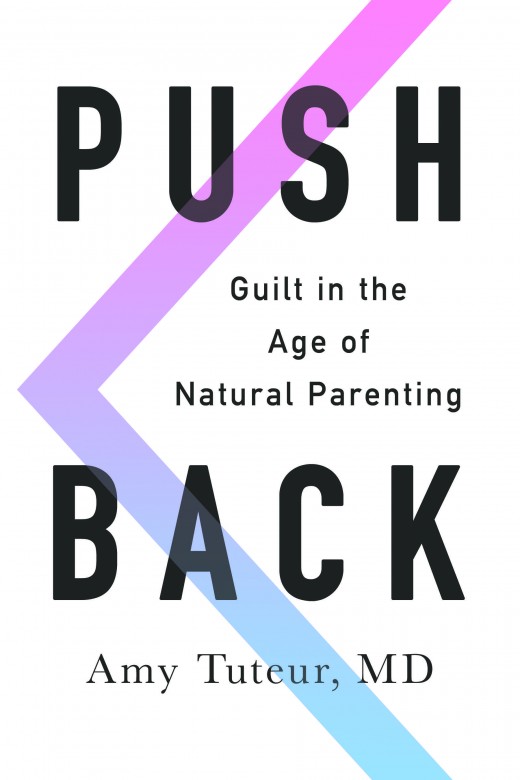
Cover of my new book

Here’s the cover for my forthcoming book, to be published by HarperCollins on April 5, 2016.

The book “debunks the myths of natural parenting, exposes the movement’s anti-feminist roots, and shows why its practices don’t line up with the science, all with the aim of freeing new mothers of the pervasive and unnecessary guilt so many of them feel today.”

Available for pre-order in hardcover and for kindle.

image

Lifesaving midwifery discoveries of the 20th Century

Midwifery discoveries

There weren’t any.

That’s right. The 20th Century saw one of the greatest public health advances of all time, the steep drop in both perinatal and maternal mortality. Childbirth went from being an occasion for women to write their wills to a “birth experience.” Childbirth is not inherently safe; it is inherently dangerous. It only looks safe because the myriad innovations of modern obstetrics and neonatology have made it safe. Discoveries included antibiotics, blood banking, epidurals, incubators, respirators, surfactant, and Rhogam among others. Not a single one was invented or discovered by a midwife.

Could we do better? I suspect that every obstetrician and neonatologist believes that we can save even more lives and is assiduously working toward that end. What are midwives doing to improve perinatal and maternal mortality rates? Not a blessed thing.

Is it any wonder then that midwives downplay or deny the inherent dangers of childbirth? Well educated, well trained midwives can provide excellent care for women, but only so long as they respect the fact that childbirth is fraught with risk for both baby and mother and it is only the liberal use of the innovations of obstetrics and neonatology that leads to safe outcomes.

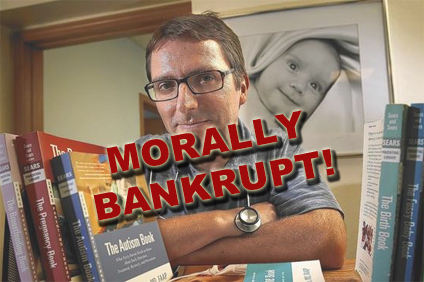
Breaking news! Dr. Bob Sears files for moral bankruptcy!

bob sears morally bankrupt

Dr. Bob Sears is a charter member of what I like to call The Quack Pack, a group of physicians who peddle pseudoscience in exchange for popularity and financial remuneration.

I’ve written about his ethics, or lack thereof, on many occasions.

In his book on an “alternative” vaccine schedule Sears wrote:

I also warn [parents] not to share their fears with their neighbors, because if too many people avoid the MMR, we’ll likely see the diseases increase significantly.

In other words, hide in the herd, but do not tell the herd you’re hiding; otherwise, outbreaks will ensue…

His grandiosity is really quite impressive. He likens his patients to victims of the Holocaust.

[pullquote align=”right” color=”#9f0b0b”]Dr. Bob has worked tireless to advance the cause of … Dr. Bob.[/pullquote]

Scarlet “V” anyone? No, not scarlet. Let’s make it yellow. And not a V – a star would be better. That way everyone can know at first glance who is safe to be around and who is not.

He’s just cashed out and filed for moral bankruptcy with this:

Dr Bobs award

DR. PAN STOLE MY AWARD.
What’s up with that? Can’t believe he got the award instead of me. Oh well. Maybe next year.

What’s up with that?

Well, let’s see. Dr. Pan has worked tirelessly to advance the cause of children’s health personally, professionally and through his government service. Dr. Pan has undoubtedly saved many lives already and will save far more in the future. As a result of that work, he faces a recall campaign instigated by anti-vax activists.

In contrast, Dr. Bob has worked tireless to advance the cause of … Dr. Bob.

A scathing piece in this week’s Economist notes:

Precisely because most children are immunised, he tells parents that it is probably safe to skip or delay jabs for their offspring. This strategy amounts to “hiding in the herd”, he says delicately, as he sips a late-afternoon coffee near his surgery. Put another way, his patients worry more than most about possible side-effects from vaccinations, above all the (thoroughly discredited) claim that vaccines cause autism. Dr Bob—as he is known to fans of “The Vaccine Book”, his best-selling guide to “selective” immunisation—does not say that worried parents are right. He just thinks that, on balance, they can safely indulge their anxieties by “taking advantage of the herd all around them.” When pushed, he makes “no claim” that the alternative vaccine plans that he offers (involving fewer jabs, or jabs administered over a longer period than most doctors recommend) are safer. He concedes that if everyone refused vaccinations, some diseases would roar back.

In other words, when pressed by someone who might actually know something about vaccines:

  • Sears acknowledges that vaccines work
  • Sears acknowledges that there is no evidence that his alternative vaccine schedule is safer
  • Sears acknowledges that anti-vaxxers are “free riders” because they enjoy the benefits of herd immunity without the risks of vaccination

What’s heroic about that?

Nothing. It’s actually morally bankrupt, the exact opposite of the selfless, caring spirit associated with heroism.

Does Dr. Sears actually think he deserves an award for heroism?

I doubt it. He’s just riling up the ignorant faithful the same way he has been riling them up and profiting from them for years.

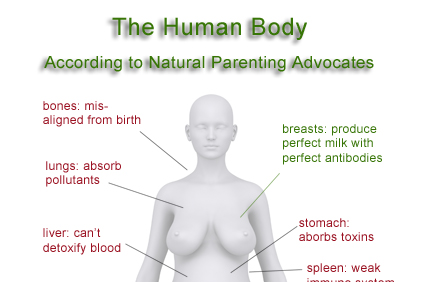
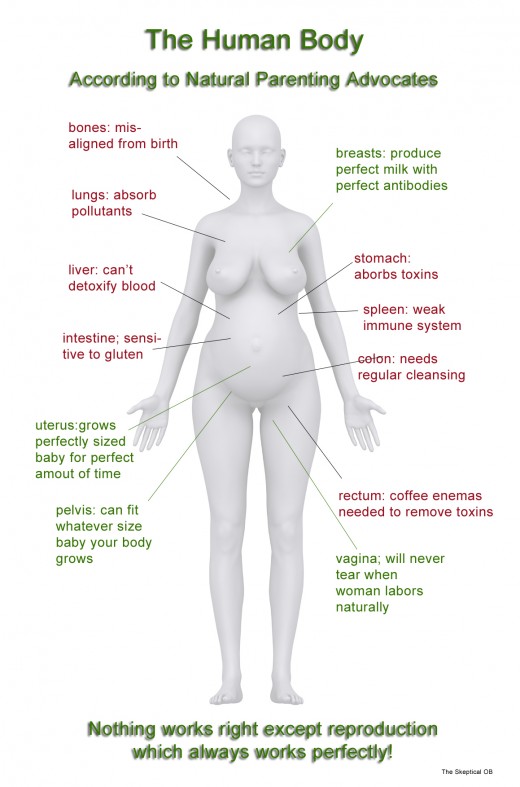
The human body according to natural parenting advocates

Pregnant woman in anatomical position anterior view with clippin

In the world of natural parenting, every day is opposite day.

Whatever the doctor says is wrong and that leaves advocates in a paradoxical situation. On the one hand, nothing in the human body works right: it absorbs toxins, is sensitive to gluten, has a weak immune system, and must be treated on a regular basis with supplements, cleanses, coffee enemas, homeopathy, cranio sacral therapy, reiki, etc. etc. etc.

On other hand, anything connected with reproduction always works perfectly. The uterus grows the perfect size baby for the perfect amount of time; the baby fits through the pelvis without difficulty; and the breasts produced the perfect amount of milk without pain or problems, complete with all the antibodies that a baby needs.

See what I mean?

Pregnant woman in anatomical position anterior view with clippin

Does it make sense that a body that is so weak that it can’t even detoxify itself and is incapacitated by a whiff of gluten can grow a perfectly sized baby for the perfect amount of time and nourish it through breastmilk for years on end?

It doesn’t make sense to me, but perhaps natural parenting advocates can enlighten us:

What’s the evidence that the human body works perfectly in every aspect of pregnancy, childbirth and breastfeeding, but fails miserably at simply surviving day to day?

I can’t wait to read your responses!

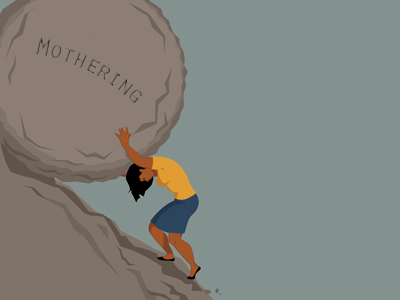
Contemporary motherhood’s big lie: if you aren’t suffering, you must be doing it wrong

Mothering boulder

Motherhood, Screened Off by Susan Dominus appeared in The New York Times several days ago. Ostensibly it is a piece about pushing aside technology to reconnect with our children. Dominus suggests that our use of technology has rendered previously transparent adult actions opaque to children and that is a problem.

My mother’s address book is one of the small visual details of my childhood that I can perfectly conjure, although I am sure no photograph of it exists… I knew when she was looking for someone’s phone number, which seems unremarkable, except that my own children do not know when I am searching for a phone number, because all they see is me, on my iPhone, intently focused on something mysterious and decidedly not them.

It is that loss of transparency, more than anything, that makes me nostalgic for the pre-iPhone life. When my mother was curious about the weather, I saw her pick up the front page of the newspaper and scan for the information. The same, of course, could be said of how she apprised herself of the news. I always knew to whom she was talking because, before caller ID, all conversations started with what now seems like elaborate explicitness (“Hi, Toby, this is Flora”).

Dominus is embarrassed to be caught using her iPhone during her twin sons’ soccer practice:

[pullquote align=”right” color=”#8c7e75″]Children do not require the caress of the maternal gaze every waking moment of their lives.[/pullquote]

…[A] woman a few feet away turned to me. “Look at us,” she said, with a sheepish smile, gesturing at a row of parents hunched over their devices. “Our kids are out there practicing, and we’re all on our phones.”

I flushed. I was guilty as charged! But I was almost as quickly indignant: I was wrongly accused! True, I was on my phone, and if my kids looked up they would have seen the same thing the woman did: someone slightly bored, distracting herself with some mindless electronic pursuit… I had unwittingly cast myself as a familiar, much-maligned character: the mom who is blind to the daily pleasures of parenting, focused instead on some diversion which, by virtue of its taking place on that phone, is inherently trivial.

I took something different away from the piece. I read it as an example of our contemporary obsession with artisanal parenting, the belief that our children are products that are rendered “high quality” by small batch production using traditional, labor intensive methods. Any moment spent not nurturing, teaching or connecting with our children is a moment wasted.

Simply put, if you aren’t suffering, you must be doing mothering wrong.

In the world of artisanal parenting (often called natural parenting), traditional and traditionally painful and inconvenient processes are required to produce artisanal children. The mother takes no shortcuts, and avoids all conveniences thereby producing superior children. Greater suffering = higher quality. Unmedicated childbirth is therefore “better” since it is a traditional method involving lots of maternal suffering. Breastfeeding is supposedly “best” since it involves lots of maternal time, effort, discomfort and inconvenience. Attachment parenting (baby wearing, family bed, no sleep training) is purportedly better because every moment of every mother’s day ought to involved a child strapped to, sucking from or draped across her body.

Adult activities must be transparent to children, hence the author’s lament that her children don’t know what she is doing when she is using her phone. Adult activities must be justifiable to children, hence the author’s worry that although she is physically at their soccer practice (where she is not needed and presumably not a focus of their concern), they might look up and see her on her phone and won’t realize that she is engaged in something meaningful (reading literature) rather than performing tasks or amusing herself.

I was impatient when my mother’s attention was occupied elsewhere. But my 9-year-old children, when they see me on my phone, feel something more intense, something closer to indignation. They are shut out twice over: They see that I am otherwise occupied, but with what, they have no idea.

I have started to narrate my use of the phone when I am around my kids. “I’m emailing your teacher back,” I tell them, or, “I’m now sending that text you asked me to send about that sleepover,” in the hopes that I can defang the device’s bad reputation, its inherent whiff of self-absorption.

Parents have private lives, private pursuits and need private time and that is a fundamental lesson every child ought to learn. Children are not entitled to a moment by moment accounting of adult activities.

What’s really the problem with a little maternal self-absorption?

It means the mother is not suffering enough!

My husband thinks no amount of narration will change the way our kids feel about the phone. The problem, he says, is that whenever I grab it, they know that I am also holding a portal, as magical as the one in Narnia’s wardrobe and with the same potential to transport me to another world or to infinite worlds. I am always milliseconds away from news of a horrific mass stampede near Mecca or images of great medieval art or a Twitter dissection of the pope’s visit. How far am I going, they might reasonably worry, and how soon will I be back? Perhaps they sense how vast the reach of the device is and how little they know of what that vastness contains; at any moment, the size of the gap between them and me is unknowable.

And it’s wrong for 9 year old children to be deprived of their mother’s rapt attention for an unknowable amount of minutes, because … why?

It means the mother is not suffering enough!

Recently, one of my sons has had trouble falling asleep… And so I lie in the dark next to him, as patiently as I can, willing myself to breathe deeply so that he will do the same. All the while I am fighting the ever-swelling urge to locate my phone, so that I can do something productive, feel that feeling of getting somewhere, at last, while my children sleep, wholly guilt free.

How dare a mother want to accomplish something that is helpful to her and not directly helpful to her child?

She’s clearly not suffering enough.

The ultimate irony of contemporary artisanal parenting is what is imagined as the “way things were” before technology could not be farther from the truth. When mothers had less technology at their disposal they had LESS time for nurturing, teaching or connecting with their children. And … here’s the kicker … they weren’t worried about nurturing, teaching or connecting with their children on a moment by moment basis; they were too busy simply trying to survive.

Prior to the advent of technology, children spent MORE time outside the direct purview of their mothers. They went outdoors for hours at a time to play with other children. They did chores (real chores, not making their bed) necessary to the family’s existence; in other words, they worked for their keep.

The truth is that children are not artisanal products whose quality is proportional to the time their mother spent suffering while ignoring her own needs.

They do not require the caress of the maternal gaze every waking moment of their lives.

They do not need constant maternal interaction; indeed they can be stifled from constant maternal interaction.

What children need is knowledge of their mother’s love and concern; her suffering merely reflects our conceit that children are our products and by suffering we can make them what we want them to be.

The issue is not breast vs. bottle but process vs. outcome

SuperMom

Only baby haters don’t breastfeed?

That’s the provocative title of piece in yesterday’s Daily Telegraph:

Only baby-haters don’t breastfeed…or alternatively: Bottle is better and my boobs aren’t round my knees. No other topic divides women as instantly and viciously as breastfeeding

Ask any woman who’s had a baby what her views on breastfeeding are, and you’re likely to get an impassioned defence of, or argument against doing it. Rarely has there been a topic that so instantly divides people, with women of all ages taking up militant stances whenever the subject arises – which is regularly, as supposedly scientific research throws up or debunks yet another fact/myth about its benefits.

So the news that breastfeeding does not, apparently, improve a child’s intelligence will see the battle lines drawn once again.

That’s deeply unfortunate because the truth is that the issue is not breast vs. bottle, but process vs. outcome.

[pullquote align=”right” color=”#a35d25″]No process, natural childbirth, breastfeeding or attachment parenting, guarantees a healthy, happy, intelligent, successful child.[/pullquote]

First the bad news:

There is no process, whether it is natural childbirth, breastfeeding or attachment parenting, that guarantees a healthy, happy, intelligent, successful child.

It doesn’t matter if you have an unmedicated vaginal birth, breastfeed and “baby wear” your child.”

Now the good news:

There is no process, whether it is natural childbirth, breastfeeding or attachment parenting, that guarantees a healthy, happy, intelligent, successful child.

That means that it doesn’t matter if you have every obstetrical intervention possible, bottlefeed and never “baby wear” your child.”

Why?

There is no law of human causation. Human beings are not widgets; we cannot demonstrate with any reliability that certain inputs will produce desired outputs.

That goes double for creating the traits which we admire in the US in the early 21st Century. Human biology evolved to create the fittest people for a hunter gatherer existence. Long term health, individual happiness and the ability to do well on the SATs and earn lots of money, qualities that we prize today, were not relevant for most of humanity for most of the time.

It is nothing short of absurd to insist that breastmilk evolved the ability to prevent obesity or the chronic disease of old age in industrialized countries, heart disease and diabetes. It is nothing short of absurd to claim that breastfeeding is the first and necessary step to getting into an Ivy League University and snagging a coveted place at Goldman Sachs.

The breast vs. bottle debate has nothing to do with babies and what is good for them and everything to do with mothers and how they compete with each other. It takes decades to find out how your children turn out (“the outcome”), but women want to compete with each other in the meantime. Therefore, they compete on “the process” insisting that it predicts the outcome.

They compete on unmedicated childbirth, implying that it contributes to future success of the baby as an adult. They compete on breastfeeding implying that it contributes to future success. These notions are ridiculous. For most of human existence, all children were born vaginally after unmedicated labor (or died in the process). That didn’t ensure that all people were equally intelligent, wealthy or successful. For most of human existence, all children were breastfed (or died of dehydration or malnutrition). That didn’t ensure that all people were equally intelligent, wealthy or successful.

The bottom line is that no matter how much certain people wish it were so, breast milk does not have magical properties that ensure success. It it merely one of two excellent sources of infant nutrition with formula being the other source.

It makes no difference whether or not you breastfeed.

Call us when your child grows up and we can assess the outcome of your parenting process. Don’t fool yourself into believing, or try to convince the rest of us into believing, that the process has anything to do with the outcome.

Dr. Amy