Babies, hostages in the mommy wars

sad baby 2 month old on isolated white background

The mommy wars are fights to the death.

No, not the deaths of the participants, but the deaths of confidence in their ability to mother their children.

Wait, what? You thought that the mommy wars were about children and their well being?

[pullquote align=”right” color=”#555555″]There are MANY right ways to raise children.[/pullquote]

How naive! Yes, children are involved in the mommy wars, but, unfortunately, their role is as hostages.

The mommy wars are about one thing, and one thing only: who is the best mother?

Given the viciousness with which the mommy wars are fought, you might think there was an actual award at stake, a Mommy Nobel Prize, complete with international recognition, adulation and a cash annuity. The stakes are far smaller though every bit as important to the participants. What’s at stake is who can claim the designation of “best mother” within the social circle of other mothers.

Wait, what? You thought that the best mother is the one who raises healthy, happy children?

How naive! Looking at the children leaves much too much to chance.

In the first place, it is difficult to point to one baby as happier than all the others. Most babies are happy and healthy when given love. Why not wait until children are older to determine who is the best mother? Even those who are most adamant that natural childbirth, breastfeeding and attachment parenting produce the best, most accomplished, most well adjusted children recognize that the “best” parental inputs don’t ensure the “best” outcome. Therefore it is critically important to judge mothers by the process, which can be controlled, and not the outcome, which cannot.

According to natural childbirth advocates, unmedicated vaginal birth produces the healthiest, happiest, most accomplished children. But look at all the teens in a high school class. Can you tell whose mothers had epidurals or C-sections? No you can’t.

According to lactivists, breastfeeding produces the healthiest, happiest, most accomplished children. But look at an Ivy League graduating class. Can you tell whose mothers breastfed them and for how long? No you can’t.

According to advocates of intensive mothering, attachment parenting (“baby wearing,” extended breastfeeding, family bed) produces the healthiest, happiest, most accomplished children. But look at Nobel Prize winners. Can you tell whose mothers practiced attachment parenting? No you can’t.

Given this reality, is it any wonder that combatants in the mommy wars are obsessed with process and ignore outcome?

That’s not to say that children aren’t involved in the mommy wars; they are, but their role is as hostages, props for their mothers to act upon, without regard for what is actually best for them.

So women martyr themselves by forgoing epidurals which have no impact on babies and risk their babies lives by refusing needed C-sections in order to be the “best” mother.

So women let their babies scream in hunger, become dehydrated and require hospitalization for IV fluids by refusing to supplement with formula in an effort to be the “best” mother.

So women risk their mental health and the health of marriages and intimate relationships to practice attachment parenting in an effort to be the “best” mother, never considering that postpartum depression and ruined marriages are harmful to children.

The truth is that, “Who is the best mother?” is the wrong question entirely.

Each child has only one mother and does not compare his/her mother to other mothers. The competition between mothers is irrelevant to children. What counts for them is whether THEIR mother is meeting THEIR needs. The secret of mothering is that successful mothering is not outer-directed, it is inner-directed. The secret of mothering is not comparing yourself to other mothers, but asking yourself, “Am I doing MY best to provide what MY child needs?”

There is no reason to ignore your own needs, either. If you have unbearable pain in labor, use pain relief; if you need medication that is incompatible with breastfeeding for your physical and mental health, formula feed; if you and your husband want to keep your bed for yourself, do that. The truth is that none of these choices determine whether your children will be happy and healthy, let alone accomplished.

The sad fact is that many mommy bloggers, mommy message boards, and medical paraprofessionals are mommy war-mongers. They encourage the vicious efforts of some women to destroy the mothering confidence of other women because it benefits them. Perhaps they are mothers themselves and can only bolster their self-esteem by battering the self-esteem of others. Perhaps they fuel their blog (and in some cases their blog income) by promoting an us against them mentality that makes participants feel good, but does nothing for children. Perhaps their entire business model (doulas, lactation consultants, etc) depends on convincing women that buying their services will ensure mothering superiority.

It is widely recognized that we have been raising a generation of children many of whom are entitled, unable to tolerate disappointment or failure, and incapable of separating from their parents and shouldering adult responsibilities on their own. Could that be due, in part, to the fact that we have been raising children as hostages in the mommy wars, acted UPON by mothers determined to demonstrate their mothering superiority, rather than raised with their own needs in mind? It’s too soon to say, but it is certainly worth considering.

If we cared about children, as we claim that we do, we would be spending a lot more time individualizing mothering and a lot less time creating one size fits all prescriptions (natural childbirth, breastfeeding, attachment parenting) for being the “best” mother. We would be spending a lot more time supporting women in the choices that are best for THEIR children, not denigrating them for failing to mirror the choices we believe to be best for OUR children.

Let me be clear: I am often accused of “hating” unmedicated childbirth, breastfeeding and attachment parenting. How could I hate them if I did all three?

What I hate is the claim that the way that I raised my children is the way that everyone ought to raise theirs. We need to stop using our children as hostages in the mommy wars and declare a truce.

If I’ve learned anything at all in nearly 30 years of mothering and more than 30 years as a physician, it is that there are MANY right ways to raise children. It is my belief that the “best” mother is the one who cares deeply for her child and lets her child know it. It isn’t natural childbirth or breastfeeding or attachment parenting that makes a good mother…

It is love.

Mothers and babies communicate through breastmilk? At the moment that’s wishful thinking.

Soft photo mother feeding breast her baby at home

Lactivists are constantly making claims about breastfeeding that aren’t supported by the scientific evidence.

I’ve written extensively about debunked claims that breastfeeding prevents obesity, diabetes, high blood pressure and a host of other chronic conditions. Those erroneous claims can be traced to the confounding variables found in most breastfeeding studies. Women who breastfeed are wealthier, more educated and have greater access to healthcare. What appears to be a benefit of breastfeeding, actually turns out to be a benefit of higher socio-economic status.

As those claims are being rolled back, lactivists have advanced a new, rather extraordinary claim: that mothers and babies communicate through breastmilk.

[pullquote align=”right” color=”#e2d3e1″]There are far simpler explanations for the presence of bioactive compounds in breastmilk than spit backwash.[/pullquote]

In The More I Learn About Breast Milk, the More Amazed I Am, Angela Garbes writes:

According to Hinde, [Katie Hinde, a biologist and associate professor at the Center for Evolution and Medicine at the School of Human Evolution & Social Change at Arizona State University] … If the mammary gland receptors detect the presence of pathogens, they compel the mother’s body to produce antibodies to fight it, and those antibodies travel through breast milk back into the baby’s body, where they target the infection.

But that’s not all:

Even before babies have any concept of time, breast milk helps them understand certain hours from other hours, night from day.

“Milk is so incredibly dynamic,” says Hinde. “There are hormones in breast milk, and they reflect the hormones in the mother’s circulation. The ones that help facilitate sleep or waking up are present in your milk. And day milk is going to have a completely different hormonal milieu than night milk.”

Or as Hinde said to me in a Twitter conversation:

… [T]his is one example of the complex biofeedback system of breastfeeding that many people don’t know & should.

Actually, it’s yet another example of the white hat bias toward breastmilk that leads researchers like Hinde to make claims that far, far outstrip the existing scientific evidence.

What is white hat bias?

‘White hat bias’ (WHB) [is] bias leading to distortion of information in the service of what may be perceived to be righteous ends…

Indeed white hat bias was first described in association with breastfeeding research:

Certain postulated causes have come to be demonized (… formula feeding of infants) and certain postulated palliatives seem to have been sanctified.

Let’s look at the ways that white hat bias has led to outsize claims about the properties of breastmilk.

Breastmilk researchers start with certain fixed, unquestioned assumptions about breastmilk such as:

  • Breastmilk is assumed to be an unalloyed “good.”
  • Components of breastmilk are assumed to be beneficial.
  • The components of breastmilk are assumed to be directed in whole or in part toward the benefit of the baby.

Breastmilk is definitely an excellent way to nourish an infant. But breastmilk, like any biological product, is not perfect. Sure, it’s the product of millions of years of evolution, but evolution can only work with what it has available; it can’t create de novo. For example, it would confer a tremendous survival advantage to have eyes in the back of our heads, yet we don’t have them. Why not? The animal genome by and large is restricted to a body plan with two eyes at the front or sides of the head. Evolution can’t spontaneously generate four eyes from the genes for two eyes. Evolution cannot spontaneously add nutrients to breastmilk simply because they are needed by the baby. They must be available in the mother’s body first.

Not all components of breastmilk are beneficial. Breastmilk is a bodily fluid derived from other bodily fluids. Therefore, it is has components that reflect what is in the maternal bloodstream whether those components are good (antibodies) or bad (viruses, medications, industrial chemicals) for the baby. HIV, the virus that causes AIDS can be found in human breastmilk of mothers infected with HIV and can be passed to the baby. The virus is bad for the baby, but since it was in the fluid used to create breastmilk, it ends up in the breastmilk, and often kills the baby. It is entirely unjustified to assume that the presence of a bioactive compound in breastmilk means that it’s there for a good reason.

Prof. Hinde was irritated with my criticism of her claims and sent a bibliography salad of references to me through Twitter.

At the very best, those reference show correlations between certain conditions and certain components of breastmilk. But correlation is not causation.

There are 9 criteria, known as Hill’s Criteria that can tell us when a correlation shows causation. One of those criteria is “consideration of alternative explanations.” Before claiming that A caused B, you must consider and rule out the more likely possibility that B occurred for a reason entirely independent of A. If you graph consumption of organic food against incidence of autism, you’ll find that as the consumption of organic food has risen over the past decades, the incidence of autism has risen almost in parallel. That does not mean that organic food causes autism.

Hinde and other researchers on breastmilk have noted that when babies are sick, the antibodies content of breastmilk rises. They’ve even proposed an extraordinary mechanism for how the baby communicated to its mother that it was sick. Their theory is known as “spit backwash.” Baby saliva is literally sucked into the breast where the mother’s body senses the pathogen and makes antibodies in response.

But there is another far simpler, far more likely explanation. It’s hard for two people to be much closer than a mother and her feeding infant. If a baby has a cold, for example, the mother can simply BREATHE IN the virus expelled when the baby sneezes and make antibodies to the virus to protect HERSELF from the cold. Those antibodies then end up in the breastmilk incidentally as a result of being in the mother’s bloodstream. If researchers had looked, they would likely have found that the father and siblings were making the same antibodies as the mother, not to transmit them to the baby, but to protect themselves.

Is it possible that the mother made the antibodies as a result of saliva being backwashed into the breast and created them in order to protect the baby? Sure, it’s possible, but you’d need a great deal more evidence to draw that conclusion. You’d need to show that the mother would make the same antibodies even if she hadn’t had oral and nasal exposure to the baby’s secretions. Furthermore, you’d need to show that those antibodies made it into the baby’s bloodstream and are biologically active there. As yet, no one has shown anything of the kind.

How about the claim that breastmilk helps facilitate infant sleep?

Yes, there are sleep promoting compounds in breastmilk produced at night, but that doesn’t mean they are there to help the baby sleep. They may be there simply because the mother is tired. In other words, the presence of these compound is incidental. Is it possible that they induce sleep in the infant? It’s possible but not particularly likely since babies have their own sleep patterns that are, sadly, unrelated to their mothers’ need and desire for sleep.

When I questioned Hinde more closely on these types of claims and presented simpler alternative explanations than spit backwash, she began walking them back:

I agree that there are reasons for maternal antibodies to be protecting the mammary gland & things can be byproducts… but I think you are also confusing the matter of science publications that grapple w/ these complexities… & aspects of the science communicated broadly: the article discusses this as one potential pathway… there is evidence for that… but doesn’t make arguments that it the ONLY pathway or that this is the ONE function of that pathway.

This is a far more nuanced view, but hardly the view that she has been presenting in her interviews and writing for laypeople where she insists that “mammary gland receptors detect the presence of pathogens, they compel the mother’s body to produce antibodies to fight it, and those antibodies travel through breast milk back into the baby’s body, where they target the infection.”

Do mothers and babies communicate through breastmilk? At the moment, that’s wishful thinking abetted by white hat bias. The existing scientific evidence shows that there are antibodies and other bioactive compounds in breastmilk; those studies are small, show only correlations, and are themselves affected by white hat bias.

There are far simpler explanations for the presence of antibodies and other bioactive compounds in breastmilk than spit backwash. They are created by the mother to protect the mother. Any benefit to the baby has yet to be demonstrated.

What vision can teach us about natural childbirth and breastfeeding

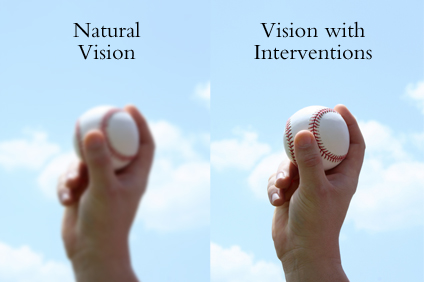
Natural vision

Vision. It’s arguably the most important of our 5 senses.

It allows us to see a grain of salt, a mountain in the distance and everything in between. It is the key to game hunting, to precision manufacturing, to hitting a home run. It is 100% natural. All human beings are “designed” to see.

Curiously, despite the centrality of vision to our existence and despite the fact that it is natural, the incidence of poor vision is extraordinarily high. Approximately 30% of Americans are nearsighted; approximately 30% of Americans are farsighted; an equal proportion of Americans suffer from astigmatism. These impairments of vision can occur alone and in combination. Indeed, there are many people over age 40 who are both nearsighted, farsighted and have astigmatism.

[pullquote align=”right” color=”#bee2fe”]Is a touchdown by a quarterback wearing contact lenses not really a touchdown?[/pullquote]

What does that tell us?

It tells us that even critical natural functions don’t work properly a large proportion of the time.

Now consider vision correction. Over 60% of Americans use glasses for vision correction. Nearly 20% use contact lenses for vision correction.

Are people who need vision correction abnormal or unnatural? Of course not.

Are people who use glasses or contact lenses “giving in” to the inconvenience of not being able to see? That’s absurd.

Does a book written by someone wearing reading glasses have less merit than one written by someone with 20/20 vision? No.

Is a touchdown pass drilled to the receiver by a quarterback wearing contact lenses not really a touchdown? No.

If a nearsighted climber summits Mount Everest wearing glasses, is it a lesser achievement than if she had done the same thing without glasses? Absolutely not.

Why not? Because we judge achievements by the outcome, not the process. It makes no difference if someone needs vision correction to complete their activities or daily living or to fulfill their wildest dreams. The achievement is not marred by the need for vision correct.

And, critically, not needing vision correction is not, in and of itself, an achievement.

Now consider childbirth.

It is critical to our existence, and women are “designed” to give birth. Curiously, despite the centrality of childbirth to our existence, and despite the fact that it is natural, the natural incidence of perinatal and maternal death is relatively high. It’s only a fraction as high as the incidence of faulty vision, but the death rates are far from trivial.

What does that tell us?

It tells us that even critical natural functions don’t work properly a large proportion of the time, and the obstetricians who point that out are not “pathologizing” birth, they’re simply stating a fact. Many women will need interventions (childbirth “correction,” if you will) to survive childbirth and for the baby to survive birth alive and healthy.

Are the births of women who need childbirth interventions abnormal or unnatural? Of course not.

Are women who choose pain relief in childbirth “giving in” to the pain? That’s absurd.

Is a baby born by C-section less intelligent, talented or valuable than a baby born by unmedicated vaginal delivery? No.

If a woman gives birth with every intervention known to man, is the result an “unnatural” or abnormal baby? No.

Is the birth of that baby any less joyous or worthy of celebration than the birth of a baby born by unmedicated vaginal birth? No.

Is the birth of that baby any less an achievement than the birth of a baby by unmedicated childbirth? Absolutely not.

Why not? Because we judge achievements by the outcome, not the process. It makes no difference whether a woman needs childbirth interventions. It is the baby that is the achievement, not the presence of absence of interventions.

The same arguments can be made about breastfeeding. Yes, it’s natural. Yes, women are “designed” to breastfeed. Nonetheless a substantial proportion of women and babies will have difficulty with breastfeeding.

Are women who don’t breastfeed abnormal or unnatural? No.

Are woman who choose to formula feed “giving in” to the difficulties. No.

Are babies nourished with formula any less intelligent, talented or valuable than babies nourished with breastmilk? Of course not.

Is raising that baby into a healthy happy child with formula any less of an achievement than doing the same with breastmilk? That’s absurd. The achievement is the healthy, happy baby, not the breastfeeding.

The bottom line is that a home run with vision correction is better than a strikeout without it. A healthy baby born with the assistance of a myriad of interventions is better than a sick or dead baby born without them. A healthy formula fed toddler is better than a stunted toddler who is breastfed.

I understand that there are women who want to view unmedicated vaginal birth and breastfeeding as achievements, but that says more about them and their fragile self-esteem than it says about childbirth or breastfeeding.

It is the outcome that counts. A great outcome is infinitely more important than a natural process!

ImprovingBirth.org celebrates Labor Day by exploiting the tragedies of women of color

--

I get it.

The folks at ImprovingBirth.org, primarily doulas, believe that the best way to promote themselves and expand their employment opportunities is to criticize modern obstetrics. As far as I’m concerned, there’s plenty to criticize. But they go a step too far when they attempt to promote doulas, natural childbirth and homebirth by exploiting the tragedies of women of color.

I found this example particularly repulsive.

ImprovingBirth gowns

Twelve hundred gowns, for the 1200 mothers who lost their lives giving birth in the U.S. in 2013. It’s a very sobering sight, thinking about what each one of the gowns stands for.

Big thanks to the people who have donated their time sewing the gowns to help honor these mothers- and to hopefully reduce the number of women dying in the future.

The implication is that these 1200 women (there is some dispute about the actual number) died because of high tech obstetrics and therefore, their deaths are an excellent marketing tool in promoting doulas, natural childbirth and homebirth.

Nothing could be further from the truth.

Here was my response:

Improvingbirth 9-6-15

[pullquote align=”right” color=””]The real tragedies? Women whose lives and babies could be saved if we had more high tech interventions.[/pullquote]

If you really cared about maternal deaths, you would do something about it besides exploit them to publicize your own organization.

There is some dispute about the actual number of mothers who died, but there’s little dispute about why they died. From the report that cited the number 1200:

“Hospitals across the USA lack a standard approach to managing obstetric emergencies and the complications of pregnancy and childbirth are often identified too late. Nationally endorsed plans to manage obstetric emergencies and updated training and guidance on implementing these plans is a serious and ongoing need.

A second factor is the increasing number of women who present at antenatal clinics with chronic conditions, such as hypertension, diabetes and obesity, which contribute to pregnancy-related complications. Many of these women could benefit from the closer coordination of antenatal and primary care – including case management and other community-based services that help them access care and overcome cost and other obstacles. In the USA, women who lack health insurance are three to four times more likely to die of pregnancy-related complications than their insured counterparts.

So these women, disproportionately women of color, die because they need HIGH TECH care. What is ImprovingBirth.org doing to obtain high tech care for these women?

Absolutely nothing, right? Oh, wait, that’s not true. You’re exploiting their deaths to promote an agenda that has nothing to do with them.

Apparently the folks at ImprovingBirth. org were stung … so they removed my comment. That indicates to me that they understand that they are exploiting the tragedies of women of color, want to continue exploiting those tragedies, but don’t want anyone to KNOW that’s what they are doing.

Apparently Dawn Thompson has been particularly stung by the criticism. She made this video last night:

Dawn Thompson video

Her primary claim is that modern obstetrics is rotten because, as a doula, she’s seen it with her own eyes.

But Dawn, who is so very impressed by what she has seen, can’t fathom that others, including obstetricians such as myself, have seen everything she’s seen AND a lot more.

Dawn is a privileged white woman who attends privileged white women who are creating a “birth experience.” There’s nothing wrong with that but it’s a tiny fraction of maternity care. Lots of women, particularly women who aren’t privileged, are more concerned with the literal survival of their babies and their own survival. They have serious pre-existing medical conditions; they’ve had difficulty accessing well woman care prior to pregnancy and these medical conditions have often progressed to further impair their health; they suffer from serious complications of pregnancy like pre-eclampsia and postpartum cardiomyopathy; they lack access to the most high tech care generally found only in regional medical centers … and as a result, they die and their babies die.

These are the real tragedies of modern obstetrics: women whose lives and babies could be saved if we had more perinatologists, more perinatal ICUs, more high tech interventions. Their lives CANNOT be saved by doulas; their lives CANNOT be saved by natural childbirth; their lives CANNOT be saved by homebirth. So why are their deaths being touted with stupid publicity stunts such as sewing pastel colored hospital gowns? Because the women of ImprovingBirth.org don’t care about deaths women of color; they care about THEMSELVES and their employment opportunities.

They are entitled to care only about themselves and other privileged white women who want to create a specific “birth experience.” But they aren’t entitled to exploit women who die in childbirth, disproportionately poor women and women of color, in order to do it.

They should be ashamed of themselves. Indeed, they ARE ashamed or they wouldn’t have deleted my comment.

Here’s how they can assuage that shame:

Stop the stupid publicity stunts like sewing pastel colored hospital gowns! Devote that effort to demanding greater access to high tech obstetric care for the women who die for lack of it!

That’s why they would do if they really wanted to improve birth, not merely improve their own employment prospects.

Large amounts of immune cells in breastmilk? We call that pus.

34910554_s

Breastmilk is amazing?

Possibly, but not in the ways that lactivists imagine.

Angela Garbes insists The More I Learn About Breast Milk, the More Amazed I Am. But Garbes doesn’t even get the basic facts about breastmilk right, let alone more dubious claims.

It contains all the vitamins and nutrients a baby needs in the first six months of life …

Wrong.

Breastmilk does not contain enough Vitamin K to prevent deadly hemorrhages of the newborn, and it doesn’t contain the iron that babies need.

[pullquote align=”right” color=”#bf0e0e”] There was no difference in immune cells in breastmilk of mothers whose babies had infections.[/pullquote]

According to Hinde, [Katie Hinde, a biologist and associate professor at the Center for Evolution and Medicine at the School of Human Evolution & Social Change at Arizona State University] … If the mammary gland receptors detect the presence of pathogens, they compel the mother’s body to produce antibodies to fight it, and those antibodies travel through breast milk back into the baby’s body, where they target the infection.

Not exactly.

According to Bode et al. in It’s Alive: Microbes and Cells in Human Milk and Their Potential Benefits to Mother and Infant:

Recently, Hassiotou et al. (5) showed that a low proportion of human milk immune cells (0–2% of total cells) exists in the milk of healthy mother/infant dyads during established lactation. Immune cell numbers increase rapidly in response to infection of the mammary gland and other maternal infections, as well as infant infections, returning to baseline amounts during recovery.

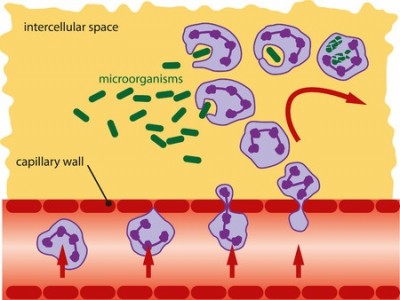
So in healthy mother/infant dyads, breast milk has few white cells. But if the mother gets mastitis, the proportion of white cells rises. That’s hardly surprising. White cells race to the site of any infection. We have a name for large collections of live and dead immune cells and the debris of the bacteria they have destroyed. It’s called pus.

Indeed, in severe cases of mastitis, abscesses (collections of pus) can develop in the breast and may require surgery to treat them.

Does the breast respond to infant infections? It does if both mother and baby have the same infection. For example, a baby can develop thrush (a yeast infection of the mouth) and the mother can get a yeast mastitis as a result, and vice versa.

But what about infections restricted to the infant? The claim that infant infections affect the immune cells in breastmilk comes from this paper, Maternal and infant infections stimulate a rapid leukocyte response in breastmilk. The authors note:

A small increase in breastmilk leukocyte content was also observed when only the infant had an infection, while the mother was asymptomatic (P=0.046).

The authors defined statistical significance as p<0.05.* Although that means that the result is significant, the paper itself shows that there were only 3 babies in that cohort and only 28 in the normal cohort. It’s unclear if the study is adequately powered and the authors never did a power calculation.

Therefore, there was NO DIFFERENCE in the level of immune cells in breastmilk of asymptomatic mothers whose babies had infections.

This is illustrated in a chart excerpted from the paper:

Immune cell response breastmilk

The red arrow shows the difference in immune cells in breastmilk from an infected breast. There’s clearly a large difference. But there’s no change when an infant has a cold (green question mark) and an insignificant difference when an infant has measles (blue arrow).

Hinde claims:

Everything scientists know about physiology indicates that baby spit backwash is one of the ways that breast milk adjusts its immunological composition. If the mammary gland receptors detect the presence of pathogens, they compel the mother’s body to produce antibodies to fight it, and those antibodies travel through breast milk back into the baby’s body, where they target the infection.

But what do the data really show?

Returning to the leukocyte response paper:

In addition to breastmilk leukocyte response to maternal/infant infection, a less consistent but often significant humoral immune response was observed…

The authors make no mention of what proportion of these infections were infant infections, so there’s no way to know if the observed response is solely due to maternal infection and whether infant infection elicits any humoral immune response at all.

So is there really spit backwash?

If there’s NO DIFFERENCE in levels of immune cells in breastmilk of mothers whose babies are sick and no evidence demonstrating a humoral response to infant infection, there NO EVIDENCE that breastmilk changes in response to a baby’s illness, and NO REASON to postulate fanciful mechanisms for events that don’t happen.

Is breastmilk amazing? Possibly.

Sure the number of immune cells changes dramatically in response to an infection in the breast. That’s pus. But breastmilk DOES NOT change in response to infant illness.

The only thing that’s amazing is how willing lactivists are to stretch the truth in a never ending effort to convince us that breastmilk is amazing.


*In my original analysis I failed to note that the authors used a p value of <0.05, which means that a result of p=0.046 is statistically significant.

Childbirth porn and the sexualization of women’s pain

iStock_000065671265_Small

Women’s agony is sexy.

Consider the latest images making the rounds under the headline Photographer Makes Statement Against Caesareans In Brazil By Capturing Girlfriend’s Home Birth. For example:

Bochi labor

If you did not know that this woman was in labor, you might confuse the images with pornographic images of sexual ecstasy. That’s not a coincidence. The image is childbirth porn.

As C.K. Egbert noted a powerful, thought provoking piece entitled Eve’s punishment rebooted: The ideology of natural birth published last year on the website Feminist Current:

[pullquote align=”right” color=”#fc4847″]Women’s agony is sexy.[/pullquote]

There’s something pornographic about the way we depict childbirth. A woman’s agony becomes either the brunt of a joke, or else it is discussed as an awesome spiritual experience… [W]e talk about the pain of childbirth — with few exceptions, the most excruciating, exhausting, and dangerous ordeal within human experience — as valuable in and of itself. Hurting women is sexy.

Wait! Aren’t women empowered by unmedicated birth?

Egbert doesn’t think so:

When people tout “natural birth” as an “empowering choice” (sound familiar?), they conveniently ignore all the women who have been harmed by these practices and for whom giving birth was (completely understandably and legitimately) one of the worst experiences of their lives. Natural birth advocates, just like many in the pro-sex movement, don’t seem to be concerned about the harm that women suffer through this practice or finding ways of preventing this harm from occurring. Women can choose, as long as they choose to suffer and see themselves as liberated through suffering.

It’s almost as if she knew the photographer’s reasons for publicizing these photos. Gustavo Gomes claims:

Our country has the highest caesarean rates in the world – around 50% of births in the public health system and shockingly 87% in the private system.

“Most of them are with no medical reasons, just because c-sections can be scheduled and are quicker for the doctors to operate.

“[W]e hope that these photos can demystify natural and home childbirths and encourage future mothers to avoid unnecessary c-sections.”

So Gomes publicized intimate images of his girlfriend’s agony to convince Brazilian women to make “better” birth choices. He believes, as Egbert predicted, that women can choose “as long as they choose to suffer and see themselves as liberated through suffering.”

Egbert rejects the notion that childbirth porn is good for women:

Natural birth advocates are not concerned with women’s welfare, because they are not advocating for safer and more effective forms of pain management; they argue they should be eliminated, because women’s suffering is itself a good… [T]he danger of anesthetic only becomes an issue — rather than a normalized part of medical treatment — only when and because it can be used to hurt women.

As she noted in the comments to her piece:

…[T]his isn’t about the best way to give birth. It’s about what significance we give to women’s suffering and pain, and how that relates to women’s subordination in general.

Why does Gomes think it is his prerogative to preach to women about the “right” way to give birth? Who is he to claim that women should not have the choice of elective C-section on request?

Here’s how I feel about that:

Mabel crotch kick

The bottom line is that Gomes isn’t normalizing unmedicated vaginal birth; he’s normalizing women’s suffering.

The inevitable result? According to Egbert:

If we normalize women’s suffering and refuse to provide palliative care, that is what women will expect. That is what they already are told to expect, given that they are socialized from infanthood to believe that their bodies are things to be used and hurt by men. They are bullied, coerced, told they are selfish or wimps or bad mothers. This ideology is pernicious in two ways. First, this will remove the motivation for finding safer and more effective means of pain management during birth. Second, if this ideology gains enough traction, we will likely regress to a society — as the UK has already done to a great extent — where women are systematically denied pain medication during birth.

Why are breastfeeding advocates so mean?

You are a loser

A Breastfeeding-Family-Friendly City designation?

According to the Daily Tar Heel:

Chapel Hill and Carrboro residents will soon see local stores with signs welcoming breastfeeding mothers and information encouraging the practice of breastfeeding.

The towns are set to become two of the first cities in the country to receive the Breastfeeding-Family-Friendly City Designation. “It’s a pilot for the world,” said Miriam Labbok, director of the Carolina Global Breastfeeding Institute and UNC professor of maternal and child health.

“There has never been a city that set out to say ‘Hey, we welcome the family.’” Chapel Hill Mayor Mark Kleinschmidt and Carrboro Mayor Lydia Lavelle announced their support for the Breastfeeding-Family-Friendly City Designation, led by the Carolina Breastfeeding Institute, on Aug. 6. The campaign is in conjunction with the United States Breastfeeding Committee’s National Breastfeeding Month in August.

[pullquote align=”right” color=”#adde25″]It isn’t enough for lactivists to promote breastfeeding; they want to rub formula feeding mothers’ faces in it.[/pullquote]

What does it take to earn the Breastfeeding-Family-Friendly designation?

Providing a welcoming atmosphere for breastfeeding families? Check.

Promoting breastfeeding education? Check.

Humiliating mothers who fomula feed?

Wait, what??!!

I kid you not:

Local groceries also must not promote commercial brand baby formula by preferential placement in the stores or direct advertising.

Labbok, who has been involved in encouraging breastfeeding since the 1980s, said she doesn’t expect all stores to stop selling formula after the launch of the initiative because of the regulations regarding chain grocery stores …

So let’s see if I get this straight: Being friendly to breastfeeding mothers means inconveniencing and humiliating formula feeding mothers?

Why?

Because it isn’t enough for lactivists to promote breastfeeding; they want to proclaim their superiority as mothers and then rub formula feeding mothers’ faces in it.

Let’s try a little thought experiment.

Imagine if the “Abstinence Friendly Institute” created a designation for an Abstinence Friendly City, and as part of that designation mandated that condoms, spermicides, and pregnancy tests be hidden from view. Imagine if a professor of abstinence went on record declaring that she doesn’t expect all stores to stop selling contraception and pregnancy tests because of regulations, but wishes she could mandate it.

Most people would be up in arms, as they should be. And I suspect that their anger would not be assuaged by claims that abstinence is safer and healthier than sexual activity, even if that were true.

Why would they be so upset? Because they would recognize such actions as a not so subtle attempts to interfere with a woman’s right to control her own body, and attempts to humiliate women who don’t toe the line.

Similarly, the efforts to hide away or even remove infant formula from stores is also an attempt to interfere with a woman’s right to control her own body and reflects an urge to humiliate women who don’t toe the line.

Who will be hurt by it?

  • Women who can’t breastfeed
  • Women who choose not to breastfeed
  • Poor women who must return to work immediately
  • Victims of sexual abuse who find breastfeeding triggering
  • Adoptive mothers
  • Foster mothers

Why is hurting these women “breastfeeding-friendly”?

It isn’t.

It is, like most supposedly breastfeeding friendly practices, not particularly friendly to breastfeeding, but profoundly friendly to the self-image of lactivists. It isn’t enough for them to breastfeed their own children. Under the guise of promoting infant health, they want to wound anyone who doesn’t mirror their own choices back to them.

And like most purportedly breastfeeding friendly practices, it was created by wealthy, white women and will disproportionately burden poor women and women of color. Who could have seen that coming?

Why are lactivists so mean? Because their self-esteem is bound up in their lactating breasts. It’s apparently not enough to feel superior to formula feeding mothers; the opportunity to rub other mothers’ faces in their supposed inferiority is simply too delicious to pass up.

What should lactivists be doing instead?

First and foremost, they should BACK OFF! The benefits of breastfeeding for term infants in first world countries are trivial. There is absolutely no public health reason to promote breastfeeding so vociferously.

Second, they should take a look in the mirror and they’ll see the woman above, sneering, mean and committed to labeling other mothers as losers. It’s an ugly picture.

Third, they should IMMEDIATELY remove any punitive measures from their breastfeeding promotion efforts. That includes renaming the Baby Friendly Hospital Initiative to the Breastfeeding Friendly Hospital Initiative, ending the hiding of formula in hospitals, and stopping the hard sell of breastfeeding within the hospital environment, among other things.

What should the rest of us do?

We should recognize the lactation industry for what it is: an industry committed to increasing profits by increasing market share. There’s nothing intrinsically wrong with that; it’s capitalism. They have every right to try to increase their profits, but that doesn’t mean that hospitals and public health officials have to help them in what is essentially a business building effort.

We should demand an accounting of return on investment for the tens of millions of dollars already expended to promote breastfeeding. Is there any evidence that lives have been saved? Is there any evidence that money has been saved? If not, we should divert hospital and taxpayer dollars to health initiatives that actually make a difference in health.

Most importantly, we should never give the imprimatur of medicine and public health to efforts to shame other women in order to boost the self-esteem of lactivists.

Lactivists are mean. The rest of us don’t have to be mean, too.

Breastfeeding and the curious epidemic of “broken” baby tongues

Tint newborn baby crying after bath in a blue towel

Am I the only one to have noticed this irony?

Lactivists insist that women are mammals and mammals are “designed” for breastfeeding. They insist that breastmilk is the perfect food; in order for it to be the perfect food, it would have to be highly nutritious, always available in the amounts needed, and the baby always able to access it easily from the breast. They appear to believe that there is no such thing as not enough breastmilk (“nurse more! and pump when you’re not nursing!”) and no such thing as pain when breastfeeding (“it’s your fault; you’re not doing it right!”). Simply put, no woman’s breasts are ever “broken”; if there’s a problem with breastfeeding it must be because of the mother’s laziness.
[pullquote align=”right” color=”#c7dcef”]If pediatricians and ENT specialists think it’s a fad, who’s making the diagnoses? Mothers and lactation consultants.[/pullquote]

Yet at least 5% of women don’t produce enough breastmilk to completely nourish a baby; many women find breastfeeding painful, and they have raw bleeding nipples to show for it; and many babies are screaming with hunger because they can’t extract enough milk from the breast.

What’s the problem? It’s the baby’s fault! Their tongues are “broken”!

There appears to be a veritable epidemic of “broken” baby tongues, known colloquially as tongue-tie and scientifically as ankyloglossia.

According to lactation consultant Nancy Mohrbacher:

What started as a problem for a small percentage of babies seems now to be an epidemic. Health-care providers report increasing numbers of breastfeeding mothers self-diagnosing tongue and lip ties in their babies, often based on online information, and asking for a tongue- or lip-tie revision, a minor office procedure to release the tie…

What is tongue-tie?

If you look carefully at the photo above, you will see that underneath the infant’s tongue there is a small vertical membrane that connects the tongue to the floor of the mouth. Tongue tie occurs when the membrane (the frenulum) is abnormally shortened and or thickened, restricting the movement of the tongue itself. Since the motion of the infant tongue is critical in breastfeeding, it’s easy to see how tongue-tie can cause problems breastfeeding.

The epidemic of tongue tie is surprising since the natural incidence of tongue-tie has been estimated as 1.7-4.8%

But releasing (snipping) the tongue tie is big business. The surgical fee for frenectomy/frenotomy is $850. I presume that $850 is what the doctor bills; what he or she is actually paid probably varies by insurance company.

How effective is surgery for tongue-tie in reducing breastfeeding problems?

Not very.

A recent review of the literature published in the journal Pediatrics, Treatment of Ankyloglossia and Breastfeeding Outcomes: A Systematic Review, found:

Twenty-nine studies reported breastfeeding effectiveness outcomes (5 randomized controlled trials [RCTs], 1 retrospective cohort, and 23 case series). Four RCTs reported improvements in breastfeeding efficacy by using either maternally reported or observer ratings, whereas 2 RCTs found no improvement with observer ratings. Although mothers consistently reported improved effectiveness after frenotomy, outcome measures were heterogeneous and short-term. Based on current literature, the strength of the evidence (confidence in the estimate of effect) for this issue is low. (my emphasis)

Indeed:

A minority of surveyed pediatricians (10%) and otolaryngologists (30%) believe ankyloglossia commonly affects feeding, whereas 69% of lactation consultants feel that it frequently causes breastfeeding problems.

So, according to the scientific literature, the incidence of tongue-tie is small (less than 5%), it does not necessarily lead to breastfeeding difficulties, and there is little evidence that surgical treatment of tongue tie improves breastfeeding difficulties.

Why has there been a dramatic increase in the diagnosis of tongue-tie and a dramatic increase in expensive surgery to correct it?

Dr. Bobby Ghaheri insists that Diagnosing Tongue-Tie In A Baby Is Not A Fad:

One of the most frequent things I hear is that primary care providers say something to the effect of “Oh, diagnosing tongue-tie is just a fad” or “This tongue-tie business is just something new that some people are doing”.

So if pediatricians and ENT specialists think it’s a fad, who’s making the diagnoses? Mothers and lactation consultants.

Why?

I have a theory:

Breastfeeding is supposed to be perfect, yet it is clear that many babies and mothers aren’t doing well with exclusive breastfeeding. The obvious conclusion is that breastfeeding is not perfect, and may not even be a healthy choice for some babies. That simple, obvious conclusion leads to cognitive dissonance in the lactation industry and among lactivists themselves. For them, breastfeeding must be perfect; therefore, it is babies who are “broken.”

Curiously, the same people who insist that women are perfectly designed to breastfeed can’t explain why so many babies aren’t perfectly designed to breastfeed, and why they apparently need surgery to treat with breastfeeding problems.

How ironic!

The Milk Meg and lactivists’ desperate desire to hurt other mothers

Angry woman abusing of another scared one

Whaddya know?

Meg Nagle, the self proclaimed Milk Meg, doesn’t “give a shit” that you feel judged, but she thinks it’s a very big deal when she is judged for her nastiness.

In the wake of my blog post about lactivists’ cruelty and crushing lack of self-esteem, she removed her rant explaining why she couldn’t care less if she hurts your feelings.

I have removed *the* blog post from my blog. There is one reason for doing this and one reason only. I do this work because I love helping women reach their own individual breastfeeding goals. Whether that goal is for 4 minutes or 4 years. Unfortunately this blog post has prompted someone to take the focus off of that and turned it into something completely different. I’m here for the women who are looking for information and support and will continue to do so. Thanks to everyone who have sent me messages!

[pullquote align=”right” color=”#93aeb5″]How can lactivists be superior to other mothers if breastfeeding is merely one of two excellent ways to nourish a child?[/pullquote]

So Meg recognized at the very least that her rant was unflattering.

Notice that although she removed the post, she never apologized for its content. She never asked how she might craft her message of “support” without demonizing women who formula feed.

How could she? The crushing lack of self-esteem that impels lactivists to pretend that breastfeeding is some sort of achievement, to grossly exaggerated the benefits of breastfeeding, and to ignore the risks and harms was hardly satisfied by choosing to back down publicly from her obnoxious effort to hurt and shame women who formula feed. How can lactivists be superior to other mothers if breastfeeding is merely one of two excellent ways to nourish a child?

That’s the dirty little secret about contemporary lactivism. It has nothing to do with infant feeding and nothing to do with what is good for babies. It’s about some mothers and their desperate desire to feel superior to other mothers.

Don’t believe me? Check out what Meg wrote in the immediate aftermath of removing her original post:

[L]et’s all write one thing we love about mothering through breastfeeding.

She could have asked for readers to write about what they love about mothering. She could have asked readers to write about what they love about breastfeeding. But she wanted, she needed, to demonstrate her supposed superiority to those lazy, derelict, formula feeders by claiming that breastfeeding adds something more to mothering than simple loving your children.

Mothering through breastfeeding?

I breastfed four children exclusively for a very long time and I can tell you that I did not “mother” them through breastfeeding, I fed them. And had I chosen to formula feed them I would not have been mothering them any differently.

The breath taking, extraordinary, incredibly intense love I have for each of them was reflected in everything I did for them, whether that was sleeping on the floor by their cribs when they were sick, scrimping to save for their college educations or teaching them to navigate their way in the wider world.

It makes me happier than I can express to see them now as adults, professionally successful, independent, involved in loving relationships and surrounded by lots of friends.

If I didn’t write about breastfeeding for my work, I wouldn’t think at all about the fact that I breastfed them. And I can assure you, they never think about how they were fed as infants.

Why not? Because — listen closely — it doesn’t matter!

Meg seems to have entirely missed the point of my blog post even though she took hers down in response.

I wrote that she “didn’t give a shit” that she made others feel bad because I wanted to highlight the cruel behavior of lactivists who act as if their self-esteem rests on tearing down mothers who don’t mirror their own choices back to them. Meg took down that egregious example of cruelty but could not resist replacing it with another cruel snub albeit one more subtle.

A physician writing on Twitter and my Facebook page is puzzled by my stance on breastfeeding.

First he tried this.

Ghaheri tweet

Then he tried the shill gambit:

Dr Tuteur, are you funded by someone to stir the pot? Like, a sponsored troll? What do you charge?

Maybe he writes only what people pay him to write, but I don’t need the money. I write about what the scientific evidence shows.

He responded:

I’m trying to figure out her angle.

It’s very revealing that he thinks I have to have an “angle” beyond conveying what the scientific evidence actually shows and expressing my firm conviction that reducing mothering to breasts, uteri and vaginas is scientifically suspect, deeply anti-feminist and gleefully vicious.

The benefits of breastfeeding for term babies in first world countries are real, but they are trivial. Sure there are many who benefit both psychologically and financially by claiming otherwise, but the scientific evidence does not support them. And it certainly does not justify the vicious efforts by those like Meg who apparently can’t feel good about themselves without cruelly snubbing women who formula feed.

MilkMeg and lactivists’ crushing lack of self-esteem

self esteem

The Alpha Parent, queen of lactivist viciousness, appears to have dropped off the map. But fortunately for me, a new queen of viciousness has crawled out from under a rock, The Milk Meg.

Meg Nagle, the eponymous Milk Meg, describes herself thus:

In between breastfeeding my youngest boy, chasing after my oldest two boys, blogging and occasionally sleeping …I work with women to help them reach their breastfeeding goals!

I have a degree in Psychology and was a La Leche League Leader (breastfeeding counsellor) for seven years before becoming an International Board Certified Lactation Consultant. I write frequently on my blog about all things breastfeeding …

I am currently being filmed for a short film documentary titled, “Lactaboobiephobia” which is based on an article I wrote about breastfeeding in public.

Meg has recently written an exquisitely reprehensible post that highlights the crushing lack of self-esteem that appears to afflict many lactivists. In their desperation to feel superior to somebody, anybody, they’ve imbued breastfeeding with significance far beyond its actual benefits, have made shaming of bottle feeding mothers intrinsic to lactivism, and react with cruelty when anyone dares question their right to shame anyone who doesn’t mirror their choices back to them.

[pullquote align=”right” color=”#901919″]Meg, we recognize that your need to bully other women means that you really don’t feel very good about yourself.[/pullquote]

The title of the piece is You’re offended? You feel judged? Here’s why I don’t give a shit… (cached version).

The irony is that Meg does give a shit.

She wants you to be offended, indeed, she needs you to be offended. How else can she feel superior to you if she doesn’t flaunt her amazing “talent” to lactate, right up there with her ability to respirate and digest her food.

Meg, with her degree in psychology, ought to recognize her piece as projection, but she can’t.

What is projection?

Projection is a defense mechanism that involves taking our own unacceptable qualities or feelings and ascribing them to other people. For example, if you have a strong dislike for someone, you might instead believe that he or she does not like you. Projection works by allowing the expression of the desire or impulse, but in a way that the ego cannot recognize, therefore reducing anxiety.

In this case, Meg is projecting her feelings of inferiority on the very people she criticizes in order to keep her own feelings of inferiority at bay.

Meg’s fragile sense of self-esteem depends on her ability to shame others who choose to formula feed. The idea that it impolite at best and cruel at worst to shame mothers who formula feed, fills her with despair and rage, so she lashes out.

Consider the main points as to why she doesn’t “give a shit that you’re offended.” The projection embodied within these statements imbues them with pathos.

It’s your ego talking…My husband loves the little phrase he made up, “Ego…let it go!” Ego is defined as, “a person’s sense of self-esteem or self-importance.” It is this very thing that drives people’s need to FEEL something when they read or hear something. “I AM IMPORTANT!” We want to scream!! “SOMEONE LISTEN TO ME AND MY IMPORTANT STORY!” “SOMEONE MUST UNDERSTAND THAT MY STORY IS DIFFERENT!”

Yes, Meg needs to feel that people are listening to her and her important story, featuring her lactating breasts.

The lens you see this in is completely different to the next person …it’s all about our perspective.

That’s right, Meg. You cannot tolerate anyone else’s perspective but your own, and it enrages you that others aren’t impressed with your “achievement” or are hurt or offended by your boasting.

Your feelings are not facts… and yes “offended” is a feeling.

Actually, in this setting women’s feelings are facts. Therefore, Meg, if your claims offend women (and it is a fact that women are offended), it is up to you to examine what you have said and how you said it. It is possible that you did not mean for other women to feel offended, in which case you should clarify. However, your insistence that you don’t give a shit when other women are offended indicates that you don’t care how your words impact others.

Someone questioned my philosophy on not being offended or upset by someone’s words and they used bullying in school as an example. I see this exactly the same though. When my middle boy was being bullied … I said to him, “He must really not feel very good about himself to be spending time saying these things to you. All of those things he is saying doesn’t matter because you know you are a good person. You know the truth so he can say whatever he likes.” I then told him to tell him that he cannot talk to him like that as it’s also equally important to stand up to oneself. After a few days of telling this boy, “Don’t talk to me like that.” The boy stopped!

And what if the bully responded that he didn’t give a shit how your son felt and that he would go right on bullying anyone he chose? What if, Meg, the bully responded like you’re responding?

Let’s see if you solution to bullying works when you are the bully:

Meg, we recognize that your need to bully other women means that you really don’t feel very good about yourself. Don’t talk to other women like that!

Are you going to stop bullying other women now? I doubt it.

You are not special…because we are all special.

And that’s your deepest fear, Meg, isn’t it? Breastfeeding doesn’t make you special, so you double down on your insistence that it does make you special and that those who don’t breastfeeding should be shamed.

Let’s take the phrase, “I’m offended” and start focusing on being in charge of our own happiness and feelings … instead of putting it in other people’s hands.

I’ve got a better idea, Meg. Let’s take the phrase “I’m offended” and start focusing on why you feel your own happiness depends on offending others.

As a first step, start “giving a shit” when others are offended and examining your contributions to their feelings.

If you can be honest with yourself, you may be surprised at what you find.

Dr. Amy