Melissa Cheyney admits home VBAC has a horrific mortality rate

image

Surprise!

Attempted vaginal birth after Cesarean (VBAC) at home has a horrific mortality rate.

That’s what Melissa Cheyney, CPM and promoter of home VBAC was forced to acknowledge in a new paper in the Lamaze “journal” Birth: Issues in Perinatal Care. The paper is Planned Home VBAC in the United States, 2004–2009: Outcomes, Maternity Care Practices, and Implications for Shared Decision Making.

Cheyney and colleagues analyzed the MANA Statistics, a self-reported survey of homebirth midwives in which only 25% of eligible midwives participated.

[pullquote align=”right” color=”#BD014D”]The perinatal mortality rate is more than 300% higher than hospital VBAC.[/pullquote]

Cheyney reports two confirmed cases of uterine rupture and 2 additional cases of suspected uterine rupture for a uterine rupture rate of 3.8/1000.

Cheyney acknowledges:

Given the high proportion of women in our study with a prior vaginal birth and/or a prior VBAC, we expected the rate of uterine rupture to be low. The recent Agency for Healthcare Research and Quality VBAC systematic review described pooled relative risks of uterine rupture of 0.26–0.62 for women with prior vaginal delivery and 0.52 for women with a prior VBAC.

So the rupture rate at home was 630% (7.3X) higher than in the hospital.

Of those 4 ruptures, 50% of the babies died.

Overall, the attempted VBAC group had a perinatal mortality mortality rate of 4.74/1000 compared to a mortality rate of 1.24/1000 in women who had not had a previous C-section (and compared to a perinatal mortality rate of 0.4/1000 at low risk hospital birth).

Cheyney notes:

Compared with the overall rate of combined intrapartum stillbirth at term and neonatal death (1.1/1,000) in Landon et al multicenter study of women who attempted an in-hospital TOLAC, there is some evidence that TOLAC in out-of-hospital settings demonstrates increased fetal/neonatal risk.

Indeed, the death rate at home VBAC was 330% higher than for hospital VBAC.

Why did these babies die?

This is expected in a setting where decision-to-cesarean delivery time in the event of a uterine rupture is presumably greater than the 18- to 30-minute interval at which evidence suggests neonatal risk increases.

In other words, they died because their mothers chose to give birth at home, far from lifesaving medical technology and personnel.

Who could have seen that coming?

Certainly not homebirth midwives and homebirth advocates who have promoted home VBAC (HBAC) as an ideal way to avoid a repeat C-section in the hospital. They rail against obstetricians who “play the dead baby card” and routinely discount the increased risk of perinatal mortality.

For example, Jen Kamel of VBACFacts participated in an Interested Parties Meeting held by the Medical Board of California that discussed, among other things, whether CPMs should attend VBACs to support her contention that home VBACs are safe.

Kamel insists that only 6% of uterine ruptures are catastrophic and quotes a perinatal death rate of 1.3/1000 at hospital VBAC.

According to Kamel:

What determines if a baby dies or has brain damage? Some research on infant cord blood gases has suggested that if the baby isn’t delivered (almost always by CS) within 16 – 17 minutes of a uterine rupture, there can be serious brain damage or death to baby…

Kamel, like most homebirth advocates, likes to take hospital safety statistics and pretend that they apply at home. As Cheyney’s data (which almost certainly undercounts the real risk of home VBAC) demonstrates, hospital statistics don’t apply at home for a very simple reason. The lifesaving technology and personnel that MUST be available to achieve those statistics are not available at home.

The bottom line is that home VBAC is dangerous.

The rate of uterine rupture is more than 600% higher than hospital VBAC.

The rate of catastrophic outcome is 8X higher than hospital VBAC.

The perinatal mortality rate is more than 300% higher than hospital VBAC.

When will we see homebirth advocates acknowledge these figures? When will MANA (Midwives Alliance of North America) begin counseling women about the dramatically increased risk of home VBAC? When will Jen Kamel and others like her change her woefully erroneous statistics?

I’m not holding my breath.

Home VBAC is dangerous, but I predict that the industry that profits from home VBAC won’t reveal that information to American women any time soon.

UK Birthplace Study tries to bury dead babies twice

got integrity

I’ve long maintained that the authors of the UK Birthplace Study, the largest study of its kind, started with the conclusion and worked backward to find evidence to support it.

The Birthplace Study began after the British government had declared that homebirth was safe and should be encouraged to save money. The study strained to bolster that claim, slicing and dicing the data every which way. But the authors of the Birthplace Study went one step further. They buried the dead babies twice.

First they buried the babies who died in tiny coffins; then they buried them again from public consciousness by refusing to acknowledge them within the papers themselves. Perinatal deaths were deliberately hidden in a “composite outcome” that amalgamated results ranging from trivial (arm injury from shoulder dystocia) to catastrophic (death). They literally would not reveal how many babies died at homebirth compared to how many died at hospital birth.

[pullquote align=”right” color=”#333333″]The death rate in the home VBAC group was 500% higher than in the hospital group.[/pullquote]

Since the death rate at each location is the single most important piece of information to come from the study, the decision of the authors to bury it is inexplicable … unless they wanted to hide those deaths.

Now comes further evidence that the Birthplace Study plays fast and loose with the truth, and this one is even more egregious than the others that preceded it. Maternal and perinatal outcomes in women planning vaginal birth after caesarean (VBAC) at home in England looks at the outcome of attempted VBAC in the Birthplace Study.

The single most important piece of data is buried in paragraph 27:

Four babies were stillborn, two in each group. Two of these four stillbirths were associated with uterine rupture.

The death rates were 2/1227 = 1.6/1000 in the hospital group and 2/209 = 9.5/1000 in the homebirth group.

In other words, the death rate in the homebirth group was 500% higher than in the hospital group.

You might think that was worthy of mention in the abstract. The authors chose to bury it with deliberate bit of obfuscation:

The risk of an adverse maternal outcome was around 2–3% in both settings, with a similar risk of an adverse neonatal outcome.

Not exactly.

Apparently the authors didn’t like the real conclusion of their study, so they buried those babies in a “composite index” outcome that combined dead babies with … babies who had a 5 minute Apgar less than 7, a trivial outcome. There is no possible scientific justification for such absurd amalgamation.

The authors conclude:

Women in the Birthplace cohort who planned VBAC at home had a significantly increased chance of achieving a vaginal birth compared with women who planned VBAC in an OU, but their chances of transfer were high (37%) and the risk of an adverse maternal outcome was 2–3%, with a similar risk of an adverse neonatal outcome.

And that is deeply and unacceptably misleading

The real conclusion ought to be: the risk of stillbirth at VBAC is 500% higher at home than in the hospital. Home VBAC has an unacceptably high mortality rate and should be strongly discouraged.

I’m not the only one who thinks so.

In an accompanying commentary, J Scott notes:

…[I]n my opinion the primary outcomes should be the rates of uterine rupture and infant morbidity and mortality, since these are much more important in assessing safety in this situation.

Scott concludes:

In my view, home birth VBAC cannot be endorsed based on these results, and the current recommendations that VBAC should occur in a hospital setting should remain.

In my view, there’s another take away from this study: the authors are determined to bury the dead babies in the Birthplace Study twice, once in tiny coffins in the ground and then again from public consciousness. Their clumsy efforts to obfuscate the deaths that occur as a result of homebirth mean that all their conclusions are suspect.

That’s hardly surprising. Starting with the conclusion and then manipulating the data to force it to fit isn’t science, it’s politics.

Homebirth kills babies who didn’t have to die … and no amount of composite indices, failures to disclose deaths and death rates, or desire to reach predetermined conclusions changes that. It simply deprives women of the opportunity to make the decisions that are best for themselves and their babies as opposed to the decisions that are cheapest or best for politicians.

We’re spending millions to promote breastfeeding; where’s the return on investment?

compact electric breast pump to increase milk

Public health initiatives, by definition, are meant to improve public health.

[pullquote align=”right” color=””]We waste millions on public health campaigns that produce no discernible return on investment.[/pullquote]

They are usually based on solid scientific evidence, their implementation saves thousands if not millions of lives, and they pay for themselves many times over in lives saved, earnings preserved and medical expenditures averted.

Consider the classic public health campaigns to promote vaccination and to reduce tobacco smoking.

This graph from E&K Health Consulting shows the dramatic drop in incidence of vaccine preventable disease after the introduction of the vaccine for the specific disease:

cases pre and post vaccine

Notice that the y-axis is logarithmic, which means that the actual changes were far more dramatic than a glance at the graph would indicate. For example, there were approximately a one hundred thousand cases of smallpox per year prior to the introduction of the vaccine. In 2012 there were no cases at all. For each and every vaccine, the number of cases decreased by several orders of magnitude after the introduction of the vaccine.

The public health campaign to reduce tobacco smoking has had similarly spectacular results.

smoking lung cancer deaths

This graph originally published in the National Cancer Institute Bulletin shows that in the wake of the Surgeon General’s report of 1964 warning about the link between smoking and lung cancer, per capita cigarette consumption dropped dramatically. After a lag period, lung cancer deaths began to drop dramatically, too.

We have spent millions of dollars promoting vaccination and reducing smoking and it has paid off in both lives and money saved.

How about breastfeeding?

In the past 20 years we have spent millions of dollars promoting breastfeeding despite scientific evidence that is weak, conflicting and riddled with confounders.

An entire industry, the lactation industry, has arisen to promote and profit from efforts to increase breastfeeding rates. For example, lactation consultants did not exist prior to the mid 1980’s. Now they are everywhere, in hospitals, in doctors’ offices and in private practice. There have been multimillion dollar health campaigns and there is now a certification costing hospitals more than $10,000 each to be designated as breastfeeding friendly.

Breastfeeding initiation rates have tripled since 1970 rising from 25% to 75%.

So where is the return on investment?

Where is the evidence that thousands of lives have been saved? Where is the evidence that millions of cases of disease have been prevented? Where is the evidence of millions of dollars in healthcare expenditures averted? Where is the evidence that the dramatic rise in breastfeeding has had any impact at all on infant or child health?

I haven’t been able to find any such evidence.

Sure there are papers making claims about theoretical health and spending benefits, but I haven’t found any evidence of actual health and spending benefits. If it exists, I invite anyone who has seen such information to share it with the rest of us.

That doesn’t mean that breastfeeding is a bad thing. It’s a good thing, but the benefits for children in first world countries are trivial. If those benefits were anything other than trivial, we should have seen a dramatic impact on infant health and pediatric care expenditure in the past 45 years when breastfeeding initiation rates rose by 200%, but we haven’t seen anything of the kind.

No doubt the lactation industry has benefited. The number of lactation consultants in the US has increased from 0 in 1980 to 3.5/1000 live births in the 2013 (14,000 lactation consultants). Tens of millions of dollars have been spent on public health campaigns, and tens of millions of dollars are spent by mothers themselves.

What do we have to show for it?

Nothing.

Unless, of course, you count the soul searing guilt and feelings of inadequacy among women who can’t or choose not to breastfeed.

Going forward we should dramatically scale back spending on breastfeeding promotion. In an era of scarce healthcare dollars, we can’t afford to waste millions on public health campaigns that produce no discernible return on investment.

Breastfeeding should be a private choice. There is no reason, scientific or economic, to spend millions promoting it.

Introducing Jen Jones CPN, certified professional nuclear physicist

image

Hi, I’m Jen Jones, CPN, MA, PsD, a certified professional nuclear physicist (CPN).

I know what you’re thinking: a real nuclear physicist needs a PhD (instead of a PsD), must have spent years at a super expensive school like MIT and has to work in a place like Los Alamos in New Mexico where they built the atomic bomb. That’s what most nuclear physicists want you to think. The truth is that you can be a certified professional nuclear physicist, train by apprenticeship and work at home.

Atoms are totally natural. They have been around for the entire 6,000 years that the world has existed. Human beings have ALWAYS been made of atoms. Smash ’em together and you get energy. What more does anyone need to know?

[pullquote align=”right” color=””]I found out about Schrodinger’s cat and everyone who knows me knows I am totally a cat person.[/pullquote]

Certified professional nuclear physicists (aka lay nuclear physicists) are experts in uncomplicated atoms, like hydrogen and helium. We leave those super duper fancy elements made with interventions (like Einsteinium, Californium and Fermium) to the MIT crowd. They use unnatural interventions to make new atoms. They refuse to let a natural process unfold over tens of thousands of years because they have to get to their golf games.

Nuclear physics is a calling for me. As I researched atoms for my high school physics class (which I flunked), I found what I can only describe as “signs” that the universe intended that I be a lay nuclear physicist.

First there was the Heisenberg uncertainty principle. People who know me say I’m a bit of a ditz; I have so much trouble making up my mind. That uncertainty principle describes me to a T.

Then I found out about Schrodinger’s cat and I am totally a cat person.

Finally, I learned that there is a thing called “chaos theory.” If you’ve ever seen my kitchen, you know that I am an expert in chaos.

I learned all this stuff on Google, and other people could, too, if they bothered to educate themselves.

You probably think you have to know math to be a nuclear physicist, but that is so not true. There’s only one equation, and it has only one number in it: E=mc2. How hard is that for someone like me who was always good at the alphabet?

What does it mean? If you were educated like me, you would know that is means that energy equals mass (that’s physics-speak for weight) times the speed of light (how fast it takes you to flip a light switch) squared (that’s the same as “times 2”). I was never very good at higher math (the 5 times tables and above), but I’m really good at “times 2.” Anyways, E=mc2 tells you how much more energetic you could be if you smashed atoms together as fast as you can switch on a light.

I’m incredibly proud of my credentials, so proud in fact that I had them monogrammed on my towels. I have an CPN (certified professional nuclear physicist) PLUS I did advanced apprenticeship for my MA (mastering the alphabet), and (I’m most proud of this) my PsD (doctor of pseudoscience).

I bet you think it took me lots of hours a week for many years to get all these degrees. Nope, I really couldn’t give it much time since I’m a MAMA (that’s not a degree; it just means mom). Fortunately, you can get any of these credentials through self-study. Then you apprentice with another lay nuclear physicist. Those requirements are pretty rigorous. You have to watch her at least 20 times to learn how to turn on a light as fast as possible. Then you have to be the primary person to turn on the light another 20 times.

And that’s not all. You have to do independent research, at home of course. My project? Well everyone knows that energy comes from busting atoms apart (that’s “fission” in physics-speak). My project was to make my husband more energetic so he would do more chores around the house. He’s pretty lazy, doesn’t have a job and just sits around guzzling beer all day. I gave him more energy by repeatedly whacking his head with a big stick. Smashing the atoms in his head with the stick gave him so much energy that he has moved out and all the way across the country.

My friend has been trying to make her husband even more energetic than mine using atomic fusion (that’s physics-speak for smashing atoms together to make bigger atoms). She tried squishing her husband’s head in a vise to see if she could make the atoms in his head fuse. It didn’t work; he died. But hey, people die when nuclear physicists are around (they don’t call them atom bombs for nothing).

The key to being a great certified professional nuclear physicist is to EDUCATE yourself and not just blindly accept what those pinheads at MIT have to say. You have just as much right to do research with your own atoms as they have to do research with theirs.

Education never stops. Even though I have all those fancy degrees, I’m going to a special seminar at Los Alamos next month to learn more. No, not at the nuclear facilities in Los Alamos; I’m going to a Farm outside of Los Alamos where the greatest lay nuclear physicist of them all, Ima Frawde, will lead us in meditating on the beauty of Schrodinger’s cat. Best of all: we’ll be getting new letters to put after our names, CLNE, certified lay nuclear physicist educator. I’ll have to re-monogram all my towels, but it will be so worth it.


This piece first appeared in September 2011.

What has the natural childbirth industry done to reduce mortality rates? Absolutely nothing.

ZERO written on chalkboard

I’ve often written that the natural childbirth industry (midwives, doulas, childbirth educators, businesses like Lamaze, and lobbying organizations like the Childbirth Connection) is obsessed with process, in contrast to modern obstetrics, which focuses on outcomes.

Simply put, how your baby is born is more important to the natural childbirth industry than whether your baby is born healthy and whether you are healthy.

There are several reasons for this:

  1. The natural childbirth industry makes money from a specific mode of childbirth (unmedicated vaginal birth), so profits depend completely on promoting that mode as superior.
  2. The natural childbirth industry is profoundly ahistorical and lacks basic knowledge of medicine. Childbirth is and has always been, in every time, place and culture, a leading cause of death of young women and the leading cause of death of babies. Most members of the natural childbirth industry appear to be utterly unaware of this basic reality. They labor under the misapprehension that birth is inherently safe and always has been.
  3. The natural childbirth industry bears no responsibility for birth outcomes. If you refuse interventions because your doula told you to do so, and your baby dies as a result, the doula is never held accountable, legally or financially, for the tragic outcome.

These reasons explain the most critical difference between modern obstetrics and the natural childbirth industry: Modern obstetrics is always seeking to lower the maternal and perinatal mortality rates, and the natural childbirth industry thinks the current level of maternal and neonatal mortality is low enough.

[pullquote align=”right” color=”#026568″]Obstetricians seek to lower the maternal and perinatal mortality rates; the natural childbirth industry thinks they’re low enough.[/pullquote]

It’s not that the natural childbirth industry is unaware of contemporary maternal and perinatal mortality rates. They follow them assiduously and are quick to exploit the tragedies of maternal and perinatal mortality (particularly among women of color who suffer disproportionately) in order to promote natural childbirth. The “reasoning” seems to go something like this: if modern obstetrics can’t guarantee the lowest possible mortality rates then you might as well pay for the goods and services of the natural childbirth industry who couldn’t care less about ensuring the lowest possible mortality rates.

Don’t believe me? Ask yourself this: What has the natural childbirth industry done to lower mortality rates?

Absolutely, positively nothing!

They spend a lot of time prattling about maternal satisfaction and the birth experience, but I’m not aware of any action they have undertaken in the past 50 years to improve outcomes. They imply, and possibly believe (despite a complete lack of scientific evidence) that unmedicated vaginal birth is somehow safer than birth with interventions, and that’s good enough. They don’t look at mortality rates among their customers; they don’t care about mortality rates among consumers of their goods and services; and they certainly aren’t going to let a little thing like dead babies interfere with making money from their philosophy.

Where is the natural childbirth industry research funding for efforts to lower mortality rates?

There isn’t any.

Where are the techniques created and promoted by the natural childbirth to save lives?

There aren’t any.

Where are the drills practicing life saving maneuvers specifically designed for the service providers of the natural childbirth industry?

They don’t exist.

Where are the goals for lowering maternal and perinatal mortality?

Surely, you are joking. As far as the natural childbirth industry is concerned profits are derived from healthy women; women who have complications can be dumped on obstetricians and forgotten.

Don’t get me wrong. There is plenty of room for improvement in modern obstetrics, BUT (and this is the critical point) obstetricians are working EVERY day and in EVERY way to do better than they’ve ever done in the past, both in terms of the provision of services and perinatal and maternal outcomes.

The natural childbirth industry is doing NOTHING to improve perinatal and maternal outcomes because they don’t care about outcomes. They profit from process and that’s all they care about.

The natural childbirth industry thinks current levels of mortality are good enough and that is a scathing indictment of their business model.

They want your money. They want your choices about birth to mirror their own choices back to them. They want you to hire them and buy their goods and services.

But if your baby dies, or you die, they couldn’t care less. They won’t lift a finger or forgo a penny of profit to prevent it.

Let’s review: Beware “Big Floss”

image

We survived almost all of human history without it. Yet in the last 100 years people have allowed themselves to be hoodwinked by a huge corporate conspiracy into believing that we “need” their products. They cite studies and claim we don’t understand science; they ignore ancient folk wisdom and have no respect for our intuition. They peddle their products without regard to the dramatic increase in chronic diseases and weakened immune systems of recent decades. I’m speaking, of course, of “Big Floss.”

It’s time to take our mouths back from corporate domination. It’s time for alternative dentistry.

[pullquote align=”right” color=”#009CDF”]It’s time to take our mouths back from corporate domination.[/pullquote]

To hear the corporate “tools” of Big Floss tell it, we need to use their products not simply every day, but many times a day. They’ve created a seemingly limitless array of products that they are forcing, literally, down our throats. Toothbrushes, toothpaste, floss, mouth wash! There appears to be no end to the number and type of products they insist we must buy to fuel their corporate ambitions. And even if we behave like sheep and buy their tainted wares, their allies the dentists insists that we must visit them not merely once a year, but twice.

We’re supposed to believe that we benefit from this meddling with the natural order. Really? So please explain how the human race survived just fine to this point without Big Floss. Clearly we didn’t need toothbrushes to survive and even thrive. So why, suddenly, should we be gullible enough to believe that every person should brush his or her teeth after every meal? Has there been even a single randomized controlled double blind study that proved that brushing saves teeth? No, there hasn’t.

Big Floss insists that it has a product for every person, often more than one. Toothpaste to prevent cavities, toothpaste for kids, toothpaste for dentures. Is there any limit to what they will sell in order to increase their profits? And are we really supposed to believe that four out of five dentists recommend Crest? Where’s the data for that claim?

They tricked people into brushing ever day and using toothpaste each time, but that’s not enough for Big Floss. They say that toothpaste prevents plaque buildup and then they turn around and insist that we need mouthwash, too, to kill the harmful germs that cause plaque. Do we look that gullible? And what’s wrong with plaque anyway? It’s natural and probably exists to strengthen our immune system, which has been weakened by constant exposure to toxins and Frankenfood.

Big Floss is not content with tricking us into buying toothbrushes, toothpaste, floss and mouthwash. They insist that we see a dentist twice a year. If their products are so great, why would we ever need to see a dentist? We wouldn’t, but the unholy alliance of Big Floss and Dentistry has colluded to increase the profits of both. Don’t believe me? The dentist always tells you that you should brush every day, and Big Floss always recommends dental checkups. What more evidence do you need?

It’s time to end our reliance on Big Floss. It’s time for alternative dentistry. Those who truly educate themselves about teeth in nature know that toothbrushes and toothpaste are unnecessary. If our ancestors didn’t need them, we don’t need them, either. We can care for our teeth with a diet of fruit, vegetables and vitamin supplements.

In the rare situation in which more is needed, we can dose ourselves with ancient herbs or pull out rotten teeth the natural way, by tying a string around the both the tooth and the doorknob and giving the door a big shove. Forget novocaine. Why would we dose ourselves with medication to numb the pain of a tooth extraction? Those who really care about their teeth want to savor every natural feeling, not deaden it with chemicals.

And let’s not forget preventive care. If you want to be sure that you have healthy teeth, all you need to do is buy powdered Bio-identical Teeth®. Unlike artificial toothpastes or mouthwashes, powdered Bio-identical Teeth® is all natural, made from human teeth with no fillers or animal products. Because it is “bio-identical” it is more effective than artificial toothpaste could even be.

It’s time to unite and fight the corporate conspiracy of Big Floss. No more toothbrushes, no more toothpaste, and no more visits to the dentist. Let’s live as Nature intended with no artificial colors or preservatives. Let’s care for our teeth naturally for as long as they last.

Brought to you as a public service by the American Pureed Food Industry

This piece first appeared in October 2009.

The language of natural childbirth: English to English translation

image

The most important thing you need to know about the philosophy of natural childbirth is that it is a business. It is a multimillion dollar business that includes trade organizations, public relations people and government lobbyists.

There’s nothing wrong with the fact that natural childbirth is a business. In a capitalist society like ours, when people have an idea, they monetize it. That’s the American way.

Once you understand that natural childbirth is a business, and that midwives, doulas and childbirth educators are the financial beneficiaries, you will never look at their claims the same way again. We understand this about other industries — you would never look to Big Oil for accurate information about solar power — and it makes us better consumers. Women need to bring the same level of skepticism to the claims of the natural childbirth industry as they would bring to the claims of the oil industry.

[pullquote align=”right” color=””]Once you understand that natural childbirth is a business, you will never look at its claims the same way again.[/pullquote]

Toward that end, I’ve created an helpful guide to the language of natural childbirth, an English to English translation of what members of the natural childbirth industry say and what they really mean. Unlike obstetricians who are educated and trained for vaginal birth, C-sections and operative vaginal deliveries, members of the natural childbirth industry can only profit from vaginal birth. That influences their views on the practices of modern obstetrics in the exact same way that the fact that Big Oil can only profit from oil influences their views on solar power.

So without further ado, let’s examine what members of the natural childbirth industry say and what they really mean in reference to their economic interest self-interest.

When they say: Vaginal birth is the standard,
What they really mean is that vaginal birth is the only form of birth they can profit from.

When they say: natural childbirth is better,
What they really mean is we don’t know how to use and therefore cannot profit from the latest life saving obstetric technology.

When they say: Unmedicated birth is healthiest,
What they really mean is we cannot provide epidurals so we cannot profit from them.

When they say: technology interferes with birth
What they really mean is we can’t profit from life saving technology because we don’t know how to use it.

When they say: Epidurals interfere with labor and harm babies,
What they really mean is we make our money by convincing women that they need us to deal with the pain of labor. A technology that safely and effectively abolishes labor pain destroys our business model.

When they say: C-sections are bad,
What they really mean is we can’t profit from C-sections.

When they say: C-sections are more expensive than vaginal births,
What they really mean is we can’t charge for C-sections.

When they say: Electronic fetal monitoring is useless,
What they really mean is electronic fetal monitoring leads to the identification of complications and therefore less profit for us.

When they say: Breech birth is a variation of normal,
What they really mean is C-sections for breech may save lives but they cost the natural childbirth industry money.

When they say: Prenatal screening tests are worthless because they don’t provide a definitive diagnosis,
What they really mean is prenatal screening tests rob of us of patients by identifying women and babies at high risk for pregnancy complications.

When they say: A healthy baby is not all that matters,
What they really mean is we cannot ensure a healthy baby if you follow our recommendations that your baby will be healthy.

These English to English translations represent just a few of the many mistruths, half truths and outright lies promoted by the natural childbirth industry; there are many more. You can figure them out for yourself if you just follow the money. When the natural childbirth industry makes a claim just apply this simple rule:

Does it enhance the profits of the natural childbirth industry?

If it does, you should view the claim with deep skepticism.

But aren’t the claims of obstetricians similar? No they’re not, for one very important reason. Obstetricians profit regardless of whether the birth is a vaginal delivery, a C-section or involves forceps or vaccuum extraction. Obstetricians are usually salaried or receive a global fee for the entirety of prenatal care and childbirth and that fee is unaffected by the use of epidurals or life saving technology. Obstetricians don’t profit by identifying pregnancy complications; often they profit less because the patient needs more time, more appointments and more attention during labor than a patient who has an uncomplicated vaginal delivery.

Obstetricians aren’t saints, but since they are capable of profiting from birth regardless of whether it is an uncomplicated vaginal birth without pain relief, a highly complicated C-section proceeded by every technological innovation ever invented, or anything in between they have no economic incentive to downplay complications, venerate C-sections, or lie about the benefits and risks of epidurals.

In contrast, midwives, doulas and childbirth educators of the natural childbirth industry can only profit from uncomplicated, unmedicated vaginal birth; therefore it is in their economic interest to deny or disregard complications, demonize C-sections, and ignore the excruciating pain of labor and the suffering that it causes.

Listen carefully to the claims of midwives, doulas and childbirth educators; apply the same skepticism that you would apply to any industry; and, above all, follow the money. An obstetrician has no incentive to deprive women of uncomplicated, unmedicated vaginal births. The natural childbirth industry, on the other hand, has a tremendous financial incentive to deprive women and babies of life saving, pain relieving, highly technological care. Who is more likely to tell you the truth about what is safest and healthiest for you and for your baby?

Obstetricians are lifeguards

image

Lifeguards are over used.

Think about it:

  • Swimming is a natural process.
  • Water is entirely natural.
  • Animals swim all the time without difficulty.
  • If death by drowning were common we wouldn’t be here.
  • Most rescues result in children and adults who are perfectly fine.

Yet despite these incontrovertible facts, people have been socialized to believe that public pools and public beaches need lifeguards.

[pullquote align=”right” color=”#F6BE00″]Some children are just meant to drown.[/pullquote]

We should simply trust swimmming.

Our ancestors trusted swimming. They swam in lakes, rivers and oceans and never used lifeguards. Children were free to jump into filled quarries and from small cliffs and frolicked at the seashore without anyone watching for sharks. Everyone understood that some people are just meant to drown.

The last 100 years have seen the rise of the lifeguard with all the technology that implies. Lifeguards sit on tall chairs above swimmers as though they knew more about swimming than the swimmers themselves. They carry whistles (unnatural), use binonculars (unnatural) and have rescue equipment like jet skis (highly technological) at their disposal.

Most of what they do is thoroughly unnecessary. Yes, some people really do need to be rescued from drowning. How do we know? Those are the people who sustain permanent brain damage or die despite rescue. But the truth is that most people “rescued” by lifeguards end up perfectly fine, demonstrating that they didn’t need to be rescued in the first place.

So why are there so many unnecessary rescues?

Isn’t it obvious? Lifeguards are worried that if we understood how uncommon drowning really is, their incomes would be threatened. Therefore they stage “rescues” of floundering men, women and children that were entirely unnecessary.

How accurate in lifeguard monitoring anyway? Judging by the fact that most of the people pulled from the water don’t even require professional medical care, lifeguard monitoring is basically useless.

Why is lifeguard monitoring such a failure? It’s because lifeguard monitoring has high sensitivity, but low specificity. Sure, if you are really drowning (as demonstrated by your subsequent death), lifeguards will recognize it nearly every time (high sensitivity). But many people who appear to be drowning (flailing, lying motionless, disappearing under the surface without reappearing) are perfectly fine when plucked from the water (low specificity). Even those who don’t appear to be fine initially do quite well if transported to the local hospital for treatment.

We are spending a fortune on lifeguards who are entirely unnecessary. How can we simultaneously save money and return swimming to the natural process that it has always been? Instead of hiring lifeguards, we should hire certified professional monitors (CPMs) to preside over swimming. The hallmark of certified professional monitors is that they are experts in normal swimming. CPMs trust swimmming because they recognize that it is a natural process to be savored, not a potential disaster to be feared.

CPMs don’t routinely employ technology like whistles and binoculars, although they do keep them in their cars in the parking lots so they can use them in the exact same way as real lifeguards; however, they use them ONLY when an emergency develops, not when everything is fine. They don’t sit on tall chairs looming above everyone else. Indeed they don’t even face the swimmers! Since monitoring swimmers is limited by low sensitivity, it is obviously useless to watch them. Watching swimmers merely leads to unnecessary “rescues” of people who might never have drowned if left on their own.

Certified professional monitors know that there is plenty of time to transfer care in the event of a real emergency. Once others have pulled the blue, pulseless child from the water CPMs can perform CPR, dial 911 and await the arrival of the ambulance crew. No doubt some of those pulled from the water won’t survive, but let’s face it some children are just meant to drown.

Think of all the money we could save by employing CPMs who are paid much less than real lifeguards!

But the real benefits of using CPMs (or no one at all) is that we can return swimming to the pristine state it occupied in nature. Instead of viewing swimmers as potential drownings waiting to happen, we would trust the natural process of swimming by returning to the traditional practices of our ancestors. Swimming ought to be a spiritual experience, unmarred by technology, not an employment opportunity for technocratic lifeguards who claim to be rescuing people who in reality would have been perfectly fine without them.

Trust swimming! Use monitors who are experts in normal swimming. Above all, restrict the use of lifeguards to true emergencies only. Prevention is entirely overrated. The experience of swimming is so much more important than the outcome!

Let’s review: Trust umbilical cords?

image

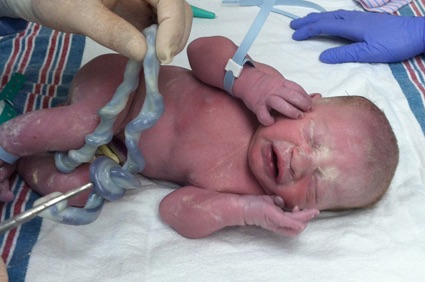
Natural childbirth and homebirth advocates get very excited about umbilical cords, specifically nuchal (neck) cords, the medical term for an umbilical cord that gets wrapped around the baby’s neck. They get excited because they believe that obstetricians dramatize the risk of nuchal cords (“the baby could die”) when they aren’t dangerous at all. As usual, natural childbirth and homebirth advocates are wrong on this point and the reason is that they fundamentally misunderstand when and why a nuchal cord dangerous.

How does an umbilical cord get wrapped around the baby’s neck in the first place. The reason is that for most of pregnancy, the baby has a lot of room to move and the cord is relatively long. Moving around, up and down, and somersaulting, the baby can easily get the cord wrapped around itself. Most of these loops will slip off at some point, generally without causing a problem. There is the possibility, however, that even if the loops eventually slip off the baby, a true knot will have been formed but many true knots never cause a problem.

[pullquote align=”right” color=”#5A70C6″]To understand the danger of a nuchal cord it helps to think of the cord as similar to the air line of a deep sea diver. [/pullquote]

Even more likely, a loop may get stuck around the neck because it is more slender than the shoulders below it and the head above it. Contrary to popular belief, the danger of a nuchal cord has nothing to do with the fact that it is wrapped around the baby’s neck. Since the fetus does not breathe, compressing its neck has no impact on whether there is adequate oxygen in the blood. In other words, the effect of neck compression is fundamentally different than if the neck of a child or adult is compressed.

In order to understand the danger of a true knot in the cord or a nuchal cord it helps to think of the cord as similar to the air line of a deep sea diver. It’s easy to understand that if a diver moved around such that he created a true knot in an air line, it could pose a serious problem. If the knot isn’t pulled tight, there is no problem. The oxygen can pass easily through the loop. However if the knot gets pulled tight because the diver pulls on the air line by diving down deep or it gets pulled tight by being snagged on something else, the supply of oxygen can get cut off and the diver could die.

Similarly, a loose true knot in the umbilical cord is not a problem for the fetus because the oxygen continues flowing through the loop. However, if the knot gets pulled tight, either by the cord being pulled as the baby descends into the pelvis or the cord getting pulled by being snagged on an arm or leg, the baby will be deprived of oxygen and die

image

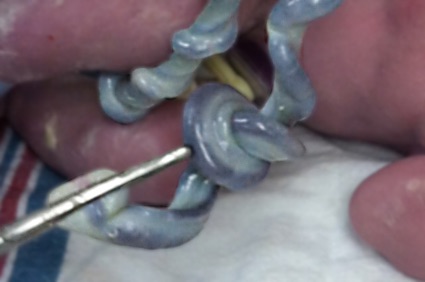
This picture of a true knot (a close up of the picture at the top) was sent to me by a reader. It was noted at her 3rd C-section. It is easy to understand that had the knot been pulled tighter, the baby might have died..

If an air line got wrapped loosely around a diver’s neck, the oxygen would keep flowing through it. However if the loop or loops were so tight as to cut off flow within the line, the diver will die. Of course a diver could actually be strangled by a loop or loops of cord, but a baby cannot. Therefore, the issue with a nuchal cord is NOT the fact that it is wrapped around the neck. The issue is whether the loop is pulled tight enough to cut off the flow of blood and therefore of oxygen.

The bottom line is that true knots of cord are not necessarily dangerous, but there is no way to no beforehand whether the knot will tighten during the course of labor and cut off oxygen to the baby. Similarly, a nuchal cord is not necessarily dangerous; in fact most nuchal cords are loose and therefore do not threaten the baby. Once again, though, there is no way to know beforehand how the loop or loops around the neck will be affected during labor. The higher the number of loops, the shorter the remaining cord, and the more likely that the cord will be fatally compressed during labor. However, even a single loop can be pulled tight during the descent of the baby and the baby will die for lack of oxygen.

Ultimately, when NCB and homebirth advocates “trust birth,” they are trusting that there are either no knots or loops in the cord, or that if they exist, they will not be pulled tight. But that makes no more sense than a deep sea diver trusting that he can assume that there are no knots in his air line and not worry if the air line gets wrapped around his neck. Obviously, in the case of the air line, trust has nothing to do with it, and, in direct contrast to what NCB and homebirth advocates proclaim, in the case of the umbilical cord, trust has nothing to do with the presence or absence of knots and loops.

The only way to know if a knot or nuchal cord is hindering the flow of the blood to the baby is to monitor the baby’s heart rate. Without monitoring, the supply of oxygen to the baby could completely stop during labor and no one would know until the baby was born dead.


This piece first appeared in February 2012.

Marginalizing women by diverting them into the vagina wars

image

When you think about it, it’s a stroke of genius.

If you were a misogynist who felt threatened by competition from women in business, science and politics, what better way is there to marginalize women once again than to divert them into competing over who has the better vagina and breasts?

That was the conscious plan of the founders of the natural childbirth, lactivism and attachment parenting movements. The movements were explicitly created to convince women to withdraw from competition with men and re-immure themselves in the home. Grantly Dick-Read, fabricated the racist lie that “primitive” (read black) women had painless childbirth and that white women of the “better classes” who wanted to have painless childbirth, too, simply had to withdraw from competing with men to compete with other women over who had the more “authentic” birth.

[pullquote align=”right” color=”#A5194C”]Convincing women to fight over who has the better vagina and breasts diverts them from taking their rightful place in wider world.[/pullquote]

That was the conscious plan of the founders of the La Leche League, 7 devout Catholic women, who saw the promotion of breastfeeding as a way to keep mothers of young children out of the workforce and send them back home where they belonged.

Dr. William Sears, the popularizer of attachment parenting, is a religious fundamentalist who promulgated a philosophy that fetishizes physical proximity of mother and child (“baby wearing”) effectively forcing women back into the home.

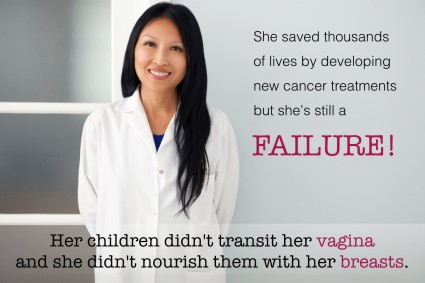
As a result we have women claiming to be “empowered” by unmedicated vaginal birth when the reality is that designating one form of birth as better than another is just a way to instigate a sophisticated version of a cat fight. We have women feeling that they have “failed” because their babies were born by C-section, when the only failure is the willingness of women to judge each other by whether a baby transited her vagina.

As a result we have a public health campaign grossly exaggerating the benefits of breastfeeding in order to moralize infant feeding, implying that some mothers are superior to other mothers because of the way they wield their breasts. The truth is that we have never detected any population wide benefits to breastfeeding term infants beside a few less colds and episodes or diarrheal illness over the first year. The aggressive promotion of breastfeeding is a masterstroke in marginalizing women, because the hours devoted to breastfeeding, or attempting to breastfeed or feeling guilty for not breastfeeding are hours that hamper the quest for equality in the workplace.

As a result we have a dominant parenting philosophy, attachment parenting, revealingly known as “intensive mothering,” that keeps women bound to their children 24/7/365 and therefore out of the workforce, the political arena and the wider world.

On the surface, it seems rather surprising that natural childbirth, lactivism and attachment parenting, explicitly created to force women back into the home, have gained traction among so many women, even women who call themselves feminists. It happened because the sexists who created these movements were aided and abetted by women who were able to monetize these movements. And the women who turned these movements into profit for themselves promoted the movements as feminist merely because all the workers are women.

Midwives have always existed, but had been overshadowed by modern obstetrics, which succeeded in saving so many lives where midwifery had failed conspicuously. The philosophy of natural childbirth came to the rescue of midwifery just when it was needed most. Natural childbirth allowed midwives to turn necessity into virtue. Their inability to use life saving and pain relieving technologies were transmuted from a rather obvious disadvantage to an asset by demonizing the technology itself.

Midwives, at least, are highly educated, but the natural childbirth industry has spawned a variety of childbirth paraprofessionals – doulas, childbirth educators, and lay birth attendants — who profit by promoting the virtues of unmedicated vaginal birth. Many of these paraprofessionals lack college degrees or even high school degrees. Their employment prospects are therefore rather bleak. Where else but in the natural childbirth industry can a woman who might not have the skills to work at Target become a private contractor charging hundreds of dollars per hour for her services?

Actually, there is one other place: the lactation industry. The lactation industry is the creation of La Leche League. In its early days, LLL leveraged the experience of mothers who had successfully breastfed to provide free advice for women who wanted to learn how to breastfeed. It didn’t take long for LLL to realize that there was no reason to give away knowledge for free when they could profit from it instead. LLL elevated the volunteer LLL leader to the lactation consultant who gave the exact same information but now charged for it. LLL leaders were not the only ones who profited. The organization itself, by charging for the certification and the courses designed to obtained it created a new profit center.

The race was on to increase profits by subverting science, claiming that unmedicated vaginal birth is superior (it’s not) and that breastfeeding provides immense health benefits (it does not). Curiously, though both unmedicated vaginal birth and exclusive breastfeeding are venerated as natural, both now require a legion of paraprofessionals, a stash of books and products, and large wads of cash in order to accomplish successfully. The central driver for both industries is vicious competition among women over who has better deployed her vagina and breasts.

And that explains in large part why my writing is deplored both by members of the natural childbirth and lactivism industries (I threaten their profits) and by natural childbirth and breastfeeding advocates (I threaten the sense of superiority that the industries have striven to promote). The result is the ultimate irony: philosophical movements created to marginalize women are aggressively promoted by women who profit from marginalizing other women.

The natural childbirth, lactivism and attachment parenting industries portray birth and infant feeding as feminist issues. It is a brilliant marketing tactic. By convincing women to fight with each other over who has the better vagina and breasts, they divert women from taking their rightful place in wider world.

Dr. Amy