Class on How to Bring Episiotomy Back!

iStock_000007308384Small

To understand why I created this class, let’s go back to March 2006 when ACOG released Practice Bulletin 71 restricting the use of episiotomies.

But I don’t like it. I’ve been waiting years for ACOG to retract it so I could cut women to my heart’s content, but apparently that’s not going to happen.


So here’s the bad news. The ACOG Bulletin on Episiotomy is not going away anytime soon.


But who cares about scientific evidence? My opinion is more important than anything the scientific evidence shows.


What is the good news?


I designed the “Bring Episiotomy Back, Baby!” class to help you prevent or reverse bans on episiotomies.

So if episiotomy has been restricted in your local hospital, or administrators are talking about suspending it, or if you were about to start a episiotomy program and it’s been put on hold because of the statement, then this class is for you.

Class Button

Wait! What?

It is wrong to hold a class designed to promote a practice proven to be dangerous and discouraged by ACOG??!!

Are you sure? Because that’s what Rebecca Dekker of “Evidence Based” Birth is doing.

See: Class on How to Bring Waterbirth Back!

You remember Evidence Based Birth? I wrote about it not long ago, Rebecca Dekker’s “Evidence Based Birth”: you can put lipstick on a pig, but it’s still a pig.

Evidence based birth

Dekker wrote to ACOG explaining why she thinks they are wrong about waterbirth, and was shocked, shocked to learn that they believe scientific evidence is more reliable than Dekker’s personal opinion.

So Dekker is only going to charge you $49 for a class (“valued at $79”! By whom? By no one, but it sounds so cool to say that!) to explain why it’s okay to ignore scientific evidence in favor of her personal opinion as a cardiology nurse.

The “Bring Waterbirth Back, Baby!” course gives you the tools, tricks, and tips to help you bring waterbirth back to the hospital in your community. We will start by talking about how change occurs in hospitals, and talk about why it is so important that you form a team to tackle this issue.

But wait! There’s more!

When you download the Waterbirth Ban Toolkit (included in the class), you will receive:

PowerPoint file you can use to critique the Opinion Statement
Change.org petition language for you to use
Printable petition to gather handwritten signatures
Sample press release about bringing waterbirth back to your community
One-page handout of “talking points” about waterbirth
Two-page handout on tips for dealing with the media
Sample letter to hospital administrators from a mother
Printer-friendly PDF of the Evidence Based Birth blog article on waterbirth (42 pages)
Evidence Based Birth Annotated Bibliography of all the research ever conducted on waterbirth (80+ pages)
Formal letter that you can give to hospital administrators about the flaws in the ACOG/AAP Opinion Statement

Who is teaching this class?

This class was designed and organized by Rebecca Dekker, PhD, RN, APRN, a nurse researcher and the founder of Evidence Based Birth. In 2014, Rebecca spent four months conducting a systematic review of the literature on waterbirth, which she published at Evidence Based Birth.

FOUR WHOLE MONTHS! OMG! OMG! The woman is a wonder!!! Obstetricians have to spend literally YEARS to master the practice of obstetrics, and Dekker, a CARDIOLOGY NURSE, did it only four months.

Can Dekker (WHO SPENT FOUR MONTHS CONDUCTING A SYSTEMATIC REVIEW OF THE LITERATURE ON WATERBIRTH!!!!!!) guarantee that we will be able to reverse waterbirth bans by taking this class?

There are no guarantees. To be totally honest and up front with you—there are many barriers to waterbirth, and by simply taking this class we cannot and do not promise that you will be able to reverse waterbirth bans in your community.

However, this class is the first time all of the knowledge, skills, and tools to fight waterbirth bans have been gathered into one online resource.

So your efforts to overcome waterbirth bans will be made exponentially stronger by what you learn here and through access to materials that will make your fight both more productive and more strategic.

Exponentially stronger!!

Bad news, Rebecca, zero to the 5th power is still zero.

But wait! There’s more!

3 buttons

And that’s not all, folks:

To celebrate the launch of this new class, I am doing a GIVEAWAY for a free waterbirth t-shirt from the soon-to-be-launched Evidence Based Birth online store.

To enter the giveaway, simply click here to visit the giveaway site and drop your email in the box below before Monday, October 6th at 9 PM Eastern Time.

Once you enter, you will be emailed details on how you can get your name entered in the giveaway up to three more times by sharing the link to the contest.

Believe me, you are going to LOVE this waterbirth t-shirt. I am planning on releasing it by November, so you will receive your prize then once the t-shirts are printed. The t-shirt design is top-secret, so I can’t show it to you right now, but I promise you– you are going to gasp and say, “AAAH! I LOVE THIS SHIRT!!”

And yes, there will be lots of options for you to choose from– V-neck, unisex, plus-size, or maternity style. And we will ship it to you for free, too!

That’s right folks. One lucky winner will get a FREE T-shirt!

No doubt this is a great deal in the fantasy land that Rebecca Dekker (WHO SPENT FOUR MONTHS CONDUCTING A SYSTEMATIC REVIEW OF THE LITERATURE ON WATERBIRTH!!!!!!) inhabits. But in the real world, the whole thing is just a way to enrich Rebecca Dekker.

I have a better offer.

For the low, low price of nothing I will give you important knowledge about waterbirth (valued at $3 million dollars!) and unlike Rebecca Dekker, cardiology nurse, I’ve spend the last 30 YEARS reading the obstetric literature.

Here it is:

Water birth is unnatural. No primate gives birth in water.

Waterbirth is giving birth in a plastic pool of water that is inevitably fecally contaminated. It is the equivalent of giving birth in a toilet, and has similar risks, including the risk that the baby will breathe in or swallow the fecally contaminated water.

The American Academy of Pediatrics’ Committee on Fetus and Newborn in conjunction with the American College of Obstetricians and Gynecologists reports:

Some of the reported concerns include higher risk of maternal and neonatal infections, particularly with ruptured membranes; difficulties in neonatal thermoregulation; umbilical cord avulsion and umbilical cord rupture while the newborn infant is lifted or maneuvered through and from the underwater pool at delivery, which leads to serious hemorrhage and shock; respiratory distress and hyponatremia that results from tub-water aspiration (drowning or near drowning); and seizures and perinatal asphyxia. (my emphasis)

Rebecca Dekker can’t fleece the gullible make a profit on giving away her worthless opinion for free. so she charges for it.

Let me end by offering my heartfelt thanks to Dekker (WHO SPENT FOUR MONTHS CONDUCTING A SYSTEMATIC REVIEW OF THE LITERATURE ON WATERBIRTH!!!!!!)

Thank you for making my job of debunking the nonsense of the natural childbirth industry so easy. Reading and responding to your website is like shooting fish in a barrel. The amount of crap you spew forth in an effort to profit from the gullibility of your followers is truly impressive. If I wanted to make money by hoodwinking the foolish, I would absolutely use you as my role model!

In the meantime, I’ll keep debunking your self-referential, self-indulgent, self-enriching idiocy for free.

Improving Birth.org offers twelve signs you can trust your provider is emotionally manipulating you

The Little Engine That Could

Improving Birth.org Vice-President Christen Pascucci offers twelve helpful signs that your provider is emotionally manipulating you.

Of course she didn’t call it that. She called it Twelve Signs You Can Trust Your Provider.

Who is Christen Pascucci and how is she qualified to write about choosing safe, competent providers?

Duh! She’s a mother and a baby transited her vagina! That makes her qualified to opine on any aspect of obstetric care.

Before we review Pascucci’s Signs, lets step back for a minute and consider why you hire an obstetric provider in the first place. As I have written many times in the past, anyone can deliver a baby if there are not going to be complications. All you have to do is hold out your hands and make sure the baby doesn’t hit the floor. Dads, policemen and taxi drivers do it on a regular basis.

The reason to choose a professional provider is because childbirth is inherently dangerous and many complications do not announce themselves until they occur during the process of birth. You choose a provider to prevent, diagnose and manage complications, limiting the possibility of severe injury or death of the baby or mother.

What should you consider when determining if a provider is qualified to provide safe, high quality, evidence based care?

  • Education – In the case of an obstetrician, that means four years of college and four years of medical school. In the case of a midwife (and following the requirements for midwives in ALL first world countries besides the US) that means a college or master’s level degree in midwifery
  • Training – In the case of an obstetrician that means four years of additional training beyond medical school. In the case of a midwife, that means years of in hospital training preventing, diagnosing and managing complications
  • Credentials – For obstetricians, an MD and, preferably, certification by the American Board of Obstetrics and Gynecology; in the case of a midwife that means a certified nurse-midwife (CNM).
  • Ability and commitment to keep up with the obstetric literature on a monthly basis. New discoveries are being made every day and knowledge is constantly advancing. You cannot trust a provider who doesn’t personally read and analyze the major obstetric journals.

One of the ways that you can tell that Improving Birth.org is substituting emotional manipulation for qualifications is that their list of twelve DOESN’T include education, training, credentials or fluency in the obstetric literature. That’s hardly surprising when you consider that the folks at Improving Birth.org think that a vaginal birth qualifies you to provide medical advice to pregnant women; it’s obvious that they have no standards at all.

What does Pascucci in her infinite experience and wisdom consider to be important? Gems like these:

Your provider recognizes that you are the one delivering the baby. Sounds funny, doesn’t it? The truth is, women are the ones doing the heavy lifting in childbirth and care should be centered around them.

And:

Your birth feels like a special event and not a drive-through service.

Or how about this?

Your provider uses language like, “We encourage you to…” and “We support you in…” —not “You’re not allowed” or “We will let you.”

And who can forget this?

Your provider believes in you, with a focus on wellness–what you can do, not what you can’t do.

Earth to Christen! Earth to Christen! These are not signs that you can trust your provider. These are signs that your provider is emotionally manipulating you, often in an effort to divert attention from the fact that she lacks the education, training, credentials and familiarity with the scientific literature to provide safe, competent care, protecting your health and life and your baby’s health and life.

Instead, Pascucci claims:

If a provider is great at what they do, they understand that women are strong and capable. You are no exception.

Improving Birth.org apparently imagines that women are children who must be chivvied along by fulsome and entirely meaningless praise, ignorant enough and emotionally needy enough to be fobbed off with the obstetric version of the children’s book The Little Engine Who Could.

I suppose if you are a woman who imagines that the depth and breadth of obstetric care is best captured by “I think you can … I think you can …” you will be impressed by this. For women who are mature enough and educated enough to understand that professional training and credentials matter more than atmospherics you will recognize this for what it is:

It’s not a list of signs you can trust your provider. It’s a list of signs that your provider is substituting emotional manipulation for competence and praying you won’t notice the difference.

Hopefully women won’t fall for it.

MANA makes a movie on homebirth safety and it’s pathetic

iStock_000000059690Small copy

We haven’t heard much from the Midwives Alliance of North America lately.

That’s not surprising since it has been a bad couple of years for pretending that homebirth is safe.

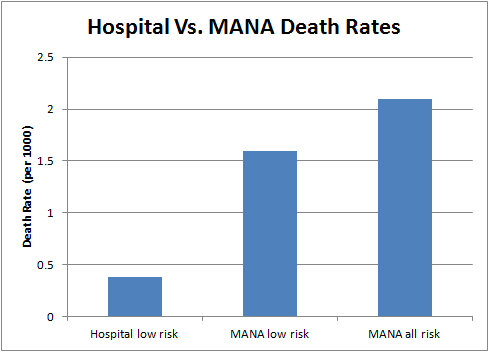
In January MANA published their landmark “study” (actually a non-representative survey of less than 30% of their members completed 5 years ago) claiming that homebirth is safe but ACTUALLY showing that homebirth increases the risk of perinatal death by 450%.

Hospital vs MANA

Why did the Midwives Alliance of North America wait 5 years to publish its statistics?

Their failure to publish the death rates had led everyone to the obvious conclusion that the death rates were hideous. Therefore, I suspect that they gambled that they had nothing to lose by publishing the data and then pretending it shows something different than what it actually shows. Everyone already knew that the death rates were horrible so the only way to combat that impression was to publish them and slice and dice the data in a million ways to confuse readers, while simultaneously misrepresenting what the death rates mean.

Simply put, MANA refused to release the death rates until 2014, because they know and have always known that these death rates are horrific. If the death rates were even close to demonstrating safety, MANA would have been shouting them from the roof tops since 2006, when the first analysis was complete. Instead they waited until they were pressure to release the data and are now hoping to hoodwink their followers by declaring that a 450% increased risk of death at homebirth is an indication of safety.

In March 2013, Oregon released an analysis of homebirth deaths prepared by Judith Rooks, CNM, MPH that showed that PLANNED homebirth with a LICENSED Oregon homebirth midwife had a death rate 800% higher than comparable risk hospital birth.

In June 2013, Grunebaum et al. demonstrated that homebirth increases the risk of a 5 minute Apgar score of zero by nearly 1000%.

In January of 2014, Wasden et al. demonstrated that the risk of anoxic brain injury is more than 18 times higher at homebirth than comparable risk hospital birth.

And those are just the highlights! Other papers and datasets were also published and all, without fail, showed that homebirth has a death rate 3-9 X higher than low risk hospital birth.

But now the MANA has struck back with a movie, Why is Midwifery Care and Home Birth Safe?

It’s nearly 7 minutes long and contains MANA’s definitive statement on homebirth safety, to wit:

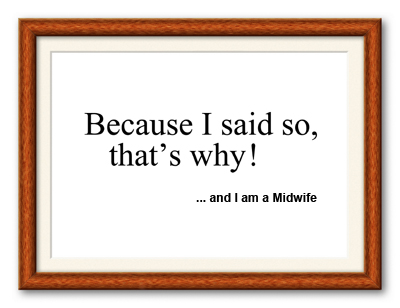
Homebirth is safe because I AM A MIDWFIFE, and I said so!

Wow, talk about a compelling argument … NOT.

You might have thought that MANA would have emphasized it’s safety guidelines, but it couldn’t do that because it has LITERALLY no safety guidelines.

Instead, according to Ida Darragh, CPM, LM, homebirth is safe because: I am a midwife, and I said so!

You might have thought that MANA would present the data from its own study, but it couldn’t do that because the executives at MANA know that THEIR OWN DATA show homebirth increases the perinatal death rate.

Instead, according to Maria Iorillo, CPM, LM, homebirth is safe because: I am a midwife, and I said so!

You might have thought that MANA would present a compelling rebuttal to the multiple papers and datasets published in the last several years showing that homebirth increases the risk of perinatal death, but it couldn’t do that because it has no rebuttal for those studies and datasets.

Instead, according to Laurie Foster, CPM, LM, homebirth is safe because: I am a midwife, and I said so!

Okay, is it just me? Or does this seem remarkably pathetic and disparaging of the intelligence of their followers? I realize that homebirth advocates aren’t the brightest bulbs in the chandelier, but are they really going to fall for “because I said so.”

Yes, MANA does sprinkle a few keywords in here and there: Intuition! Fear! Homeopathics!, but is that doesn’t seem particularly moving to me.

I’m going to go out on a limb here and suggest that even homebirth advocates are going to notice the woeful lack of data, statistics, empirical claims and rebuttals in this video.

“Because I said so,” might be compelling to a 4 year old, but not many pregnant women are going to buy it.

5 things you need to know to protect yourself from the seductive marketing tactics of the natural childbirth industry

iStock_000024630531Small

Natural childbirth advocates may be wrong about nearly all their empirical claims, but when it comes to marketing brilliance, they are second to none. Indeed, their marketing tactics are so seductive that many people who would have no trouble recognizing conventional marketing are chastened and distressed when they realize they’ve fallen for the marketing tropes deployed by natural childbirth organizations, celebrity natural childbirth advocates and by the legions of lay women who have been taught to proselytize the beliefs of the faithful.

However, knowledge is power, and you can protect yourself from even the most seductive marketing if you learn to recognize the tactics.

Here is a list of the top 5 marketing seductions that are the hallmark of contemporary natural childbirth advocacy.

1. Never forget that natural childbirth is an industry

This is the gateway seduction that many people, even sophisticated people, fail to recognize

Natural childbirth did not start as an industry. It started in the 1930’s and 1940’s as a way to control women (Lamaze originated with Russian adherents of Pavlov) and encourage more births (Grantly Dick-Read was a eugenicist who wanted white women of the “better classes” to have more children). The philosophy of natural childbirth crossed the Atlantic in the 1950’s, and, as with many imports, was adapted to the particular needs of American women.

Childbirth in the US in the 1950’s and 1960’s was, like most of contemporary medicine, afflicted with quite a few patriarchal practices that made things easier for doctors but were not beneficial, or perhaps even harmful, to women. These included assuming that women would rather be unconscious for their births, and banning fathers from the delivery room. It was natural childbirth advocacy that questioned those harmful practices and eventually ended them. The contemporary patient experience is far better than ever because of natural childbirth advocacy.

Natural childbirth advocates could have declared victory in the 1980’s and gone home; all their demands had been met. The moment that natural childbirth became an industry was the moment that they refused to declare victory and instead moved the goalposts. The original goalposts of the American natural childbirth movement were conscious deliveries, fathers in the delivery room, childbirth education, and research into and abolition of practices like perineal shaving and enemas that either had no benefit or were harmful. The new goalposts are no pain relief in childbirth, no C-sections, the promotion of midwifery, the promotion of doulas, the promotion of childbirth educators and the defiance of standard obstetric and public health recommendations. In other words, the promotion of itself and its continued existence.

Why do even sophisticated people fail to recognize that natural childbirth is an industry? Probably because they equate “industry” with massive amounts of money. True, individual professionals natural childbirth advocates don’t make a lot of money, but for most, it represents 100% of their income. That’s why they have a tremendous financial incentive to convince you to buy their products and services.

2. The primary product being sold by the natural childbirth industry is distrust of obstetricians

Read any natural childbirth book, website or message board and you will see that obstetricians are denigrated in the most scurrilous terms. Obstetricians supposedly don’t follow the scientific evidence. They aren’t up to date on best practices. They just want to get to their golf games. They will ignore or dismiss your most important desires. The derogation of modern obstetrics is absolutely critical to promoting the natural childbirth industry. They have chosen to set themselves up in opposition to obstetricians and have created a zero-sum calculus whereby natural childbirth advocacy can only “win” when standard obstetric preventive care “loses.”

This tactic isn’t merely grossly unprofessional; it is startlingly unethical. Most women, by inclination or through emergency need, will have to interact with obstetricians, so to deliberately encourage suspicion, derision and hostility does women no service; it only benefits the natural childbirth industry.

Run, don’t walk, far from anyone who sets out to destroy your relationship with the care providers whom you almost certainly will have to employ.

3. Natural childbirth advocacy seeks to create personal conflict and hostility between women and their obstetricians

The surest way to encourage distrust of obstetricians is to create conflict between patients and their providers. Natural childbirth advocacy creates that conflict by making false empirical claims about childbirth and obstetrics. They say that childbirth is inherently safe, but that’s a bald faced lie. They say that obstetricians don’t follow the scientific evidence, when it is natural childbirth advocates themselves who wouldn’t know the scientific evidence if they fell over it. Most pernicious, and most outrageous, in my view, is that natural childbirth advocates insinuate or proclaim that obstetricians don’t care about you or your baby and will actively work to harm your baby unless you aggressively resist that harm.

Consider the birth plan. It is now, through the influence of natural childbirth advocates, consider di rigueur for every birth, despite the fact that it has NEVER been shown to affect outcomes in the slightest and its only measurable effect is to decrease satisfaction among women who create one. The primary purpose of a birth plan, in my view, it to create conflict between a women and her obstetrician by encouraging a confrontational attitude, including demands that are outdated (no perineal shaving) or nonsensical (no vitamin K). Natural childbirth advocates tell you to create a birth plan and then demand that your doctor follow it; of course they warn you in advance that your doctor will become wary of you and react unfavorably to your plan (not surprisingly since it is filled with irrelevant, nonsensical and even harmful demands), and then when your doctor does react unfavorably, they claim that that means he or she cares less about you and your baby than they do.

4. Natural childbirth advocacy seeks to divert attention from having a healthy baby to having a natural childbirth experience.

Presumably you got pregnant because you wanted a baby and you fervently hope, and will do nearly anything to ensure, that your baby is healthy. But focusing on a healthy baby diverts attention from what natural childbirth advocacy offers, a preapproved scripted “experience.” Hence you will find natural childbirth advocates telling you that a healthy baby is guaranteed (false), a health baby is not enough (false for most women) or that anyone who doesn’t give priority to your experience is providing substandard care.

5. Natural childbirth uses flattery to disarm opposition.

In ordinary circumstances most of us recognize marketing tactics. We understand that those trying to sell us something have a vested interest in the sale, denigrate the competition in order to elevate themselves by comparison, and most of us would never fall for elevating the experience of a product over its safety. So why are so many women hoodwinked by the same marketing tactics when deployed by the natural childbirth industry? The reason is flattery. The natural childbirth industry flatters you into believing that you know as much (or more!) than your obstetrician, that you are so powerful that your very thoughts can ensure the perfect birth, and that by entering the fellowship of natural childbirth advocates you demonstrate that you are “educated,” strong enough to defy authority, an authentic woman, and, most important, that you are superior to other mothers. Who wouldn’t want to believe all that?

So how do you protect yourself? You recognize that you are being subjected to marketing; you recognize that you are being manipulated into distrusting your obstetrician; you refuse to engage in the confrontational behavior recommended by natural childbirth advocacy; you recognize that a healthy baby is not in any way guaranteed and that you may have to compromise your desires for a specific experience to ensure that your baby is healthy; and you recognize phony attempts at flattery for what they are.

The bottom line is this: a group of lay people who profit only when you choose the products and services of the natural childbirth industry are trying to convince you that they, the lay people, know more about pregnancy and childbirth than the women and men who have devoted 4 years of college, 4 years of medical school, 4 years of internship and residency, and many years of experience to protecting the health of mothers and babies. And though these lay people of the natural childbirth industry refuse to take ANY responsibility for your health or the health of your baby when you follow their advice, they are trying to convince you that they care more about the outcome than the doctors who take full legal and ethical responsibility for your health and the health of your baby.

The only remaining question is whether you are capable of seeing through the marketing rhetoric to the truth.

10 birth decisions that are portrayed as momentous but are actually meaningless

Ten word on a corkboard

The natural childbirth industry likes to portray itself as existing in opposition to the unsafe, soul-deadening practices of conventional parenting. The reality is quite different. In large part the natural childbirth industry is based on unreflective defiance of authority, particularly medical authority.

Part of the portrayal of natural childbirth advocates as “educated,” enlightened and progressive is the elevation of trivial parenting decisions to momentous import. Those decisions can be used to set parents in opposition to conventional medical recommendations, and, conveniently to create the need for the books, services and products being peddled by the natural parenting industry itself.

Here are 10 birth decisions that women are encouraged to see as momentous that are actually meaningless:

1. Epidurals in labor: Here’s a secret about obstetricians and labor nurses: we don’t care whether or not you opt for pain relief in labor. It literally makes no difference to us because we are not feeling the pain. Sure we’ll offer it to you, the same way we offer pain relief to anyone else who is in pain, but we don’t care if you get it. Have an epidural; don’t have an epidural; it’s all the same to us.

We do feel sorry for you if you are under the mistaken impression that pain relief is harmful to you or your baby, or if you been drinking the natural childbirth kool-aid and actually imagine that refusing an epidural says something about your character. But don’t mistake that for imagining that we are scandalized, impressed or distressed by your decision. We don’t care.

2. Moving around in labor: Moving around in labor has a trivial impact (minutes) on the length of labor. If you want to move around, knock yourself out! But don’t expect us to fall for the idea that it is more important to move around than to monitor how your baby is tolerating labor, even if you fell for it.

3. Eating in labor: This has been studied quite a bit, and there is NO BENEFIT to eating in labor. Contrary to the fabricated claims of the natural childbirth industry, it doesn’t “increase your strength,” reduce interventions, reduce the C-section rate or do anything beyond increasing the risk that you might aspirate the food into your lungs if you happen to need general anesthesia for an emergency C-section. That’s because the intestines shut down during labor, hence the nausea that most women experience to one degree or another.

There is one “advantage”to eating during labor: you get to taste the food twice, once when you eat it and then again when you vomit it back up during transition.

4. Delayed cord clamping: There is no benefit to delayed cord clamping in term infants. Sure, they get extra red blood cells, but since every study has shown that they actually destroy those extra red blood cells since they apparently don’t need them, delayed cord clamping may be adding stress to the baby, not removing it.

Immediately after birth, the oxygen content of the cord blood begins dropping precipitously as the placenta begins to peel away from the wall of the uterus. No one has ever demonstrated any benefit in oxygenation from delayed cord clamping. That’s just another one of those things that natural childbirth industry made up in their ludicrous attempt to convince the gullible that a bunch of women with no education in science, statistics, obstetrics or medicine understand neonatal physiology better than physicians. It is amazing to me that anyone falls for that nonsense, but many women do.

If you want your provider to delay cord clamping, you should certainly ask for it. It makes no difference but if it is going to make you feel superior, go for it!

5. Immediate skin-to-skin contact: There is no scientific evidence of any benefit for immediate skin-to-skin contact. That’s just something made up by lactivists who have trouble distinguishing correlation from causation. If you want to hold your baby skin-to-skin, knock yourself out! But don’t imagine that it confers any benefit.

6. Vitamin K
and
7. Ophthamic eye ointment: These aren’t meaningless decisions, they are non-decisions. There’s a right choice and a wrong choice and refusing either or both is the wrong choice that exposes your baby to the risk of blindness, hemorrhage and death. But, hey, that’s a small price to pay for dissing neonatologists and pediatricians and showing solidarity with your equally ignorant friends who have been bamboozled by the natural childbirth industry, right?

8. Hep B vaccination: Wait, let me get this straight. You’re refusing a vaccine recommended by the CDC, immunologists, virologists, epidemiologists and public health officials because you read somewhere on the internet that you should? Surely you jest.

9. Circumcision: All things being equal, circumcision confers health benefits, though those benefits tend to be trivial in first world countries. If you want to circumcise your son, do so. If you don’t want to circumcise your son, don’t. It makes no difference to the rest of the world.

10. Breastfeeding: All things being equal, breastfeeding provides some health benefits, though those benefits tend to be trivial in first world countries. Of course, all things may not be equal for you, so there are plenty of reasons why you might choose formula feeding instead. Lactivists and the lactivism industry will be appalled and try to shame you, but just ignore them. They are looking to increase their self-esteem (and profits) by having you mirror their choices back to them; they couldn’t care less what is best for you and for your baby.

Why have these meaningless decisions been elevated to momentousness by the natural childbirth and lactivism industries? Three reasons:

First, the lay people of the natural childbirth industry (most “birth workers” are just lay people) don’t know much about the truly meaningful issues in obstetrics, the ones that can affect whether your baby or you lives or dies. As self proclaimed “experts” in “normal birth,” they don’t have a clue about serious complications so they can’t formulate recommendations for serious obstetric issues. Therefore, they have elevated trivial issues to momentousness to make the natural childbirth industry appear to be something other than irrelevant to the health and safety of babies and women.

Don’t get me wrong, the natural childbirth industry is definitely irrelevant to the health and safety of your baby and you. It’s just that by elevating the important of trivial decisions, they’ve made it seem to the lay public that they actually provide some value.

Second, the fundamental product sold by the natural childbirth and lactivism industries is distrust of the medical profession. You’re supposed to be gullible enough believe that obstetricians, neonatologists and pediatricians don’t care about your health and safety, while a bunch of privileged, Western, white women (birth workers!) who know nothing about obstetrics, neonatology, human physiology, science or statistics (and who take ZERO responsibility for the outcome of their “advice”), who get their information from random strangers of the internet are both more knowledgeable about your health and more concerned with preserving it.

Natural childbirth advocacy views conflict between patients and their providers as critical to selling their good and services, and they do everything they can to encourage women to be confrontational with their physicians. Elevating meaningless decisions to momentousness is just another way to create conflict and destroy trust. Think about it: women come to their providers with lists of demands and requests that are meaningless and then are shocked and angry that their providers view those decisions (appropriately) as irrelevant. Mission accomplished.

Third, elevating these decisions to momentousness is a form of marketing. It apes the practices of most purveyors of baby products. Baby furniture manufacturers imply that the choice of a crib is momentous. Baby swing manufacturers offer multiple variations at multiple price points. Baby bottle manufacturers imply that some bottles lead to better digestion than others. Baby toy manufacturers tout the benefits of certain types of toys. As consumers, we expect this and are able to recognize fact that manufacturers are attempting to move more of their own product in order to increase profits, and we take claims of superiority with a large grain of salt. We know that a baby toy manufacturer advertising the superiority of its products is not necessarily telling the truth. They are telling you what they think will get you to buy their products.

Mothers and mothers-to-be should apply the same level of skepticism to claims about birth decisions. Are they really momentous decisions or does encouraging you to view them as momentous decisions move more books, services and products? Does your obstetrician (who may be subject to large administrative, legal and financial penalties if he or she does not preserve your health and the health of your baby) really care less about ensuring a good outcome for you both than a bunch of random strangers on the internet whose chief motivation is selling their goods and services? Would obstetricians, pediatricians, and neonatologists really recommend medications and procedures that are harmful to you and your baby and the only ones who figured it out are a bunch of random lay people on the internet? Does that make any sense at all?

There are many momentous decisions you will make as a parent. These 10 birth decisions are not among them, no matter how much the natural childbirth industry pretends that they are.

Actually, I do get to have an opinion on how other women give birth

iStock_000026553128Small

Doula Carrie Murphy is shocked, shocked to discover that some women judge other women’s births. In her Jezebel piece You Don’t Get to Have an Opinion on How Anyone Gives Birth. Ever. Murphy declaims:

Giving birth to a human being—however it happens—is a visceral, memorable and profound life experience. Why do so many people feel entitled to pass judgment on the way that anyone else makes it through?

You know what I mean. You’ve probably done it, even. Whether or not you’ve had a kid, you’ve probably texted about that friend from high school’s TMI Facebook birth photos where you can basically see her vagina. You might’ve told the pregnant lady in the grocery store just how bad the pain is, so don’t even think about trying to be a martyr because you should definitely get the meds, honey. This social tendency has practically been ingrained as tradition: passing on advice, mostly unsolicited, is part of almost every conversation about birth.

Which is why it feels so necessary to issue this reminder: You don’t actually get to have an opinion about where or how or why anyone else gives birth. Ever.

Ummm, Ms. Murphy. I have news for you. Judging other women’s birth is NOT socially ingrained tradition. It is relatively new and it can be traced to the advent of the natural childbirth movement.

What do I mean? Here’s an example of how some women judge other women’s births:

The culture around birth in the United States is a damaging culture of fear, guilt, and shame. It is a culture that teaches us that once we become pregnant, we are no longer capable of making our own decisions, no longer the stewards of our own bodies. It tells us that our bodies are broken and can’t bring a baby into this world without the help of synthetic hormones or a scalpel, while simultaneously reinforcing the idea that childbirth should be a perfect and beautiful experience where we act like amazing warrior goddesses who don’t yell or poop or beg for drugs.

Who said that? Why none other than Carrie Murphy peddling the typical judgmental crap of the natural childbirth movement within the very same piece. You know, the movement that tells you that anyone who isn’t a natural childbirth advocate is promoting a “a damaging culture of fear, guilt, and shame.” The movement that tells you that anyone who suggests that preventive care in pregnancy might improve outcomes is claiming that “our bodies are broken” or that Pitocin is only given to women because obstetricians believe women can’t give birth “without the help of synthetic hormones” or that we perform C-sections because we can’t imagine birth without a scalpel.

Murphy is mad:

Making fun of, or decrying, or trash talking, what another woman wants for when she becomes a mother is a shitty way to be a human being. The backlash against birth plans and birth preferences—the attitude that these things are for silly, high-maintenance women who are setting themselves up to fail—is just another way our society tells women that they do not deserve autonomy over their own bodies. We know what’s best for you. Adjust your expectations.

And who might be responsible for this supposed backlash against birth plans? Why none other than yours truly!

The article that Murphy links in the above quote notes:

I recently read a post (and a slew of supporting comments) on a popular parenting blog about birth plans and why you shouldn’t have one. Yes, you read that right — why you shouldn’t.

I suspect she is referring to one of my most commented posts ever, Birth plans: worse than useless, with 1049 comments and rising, where I wrote:

Birth plans engender hostility from the staff, are usually filled with outdated and irrelevant preferences, and create unrealistic expectations among expectant mothers. But the worst thing about birth plans is they don’t work. They don’t accomplish their purported purpose, make no difference in birth outcomes, and, ironically, predispose women to be less happy with the birth than women who didn’t have birth plans.

That was taken by the original writer, and apparently by Murphy as well, as criticism of women who write birth plans.

According to Murphy:

The bizarre, bitter tendency to criticize individual women for their individual choices is part of a greater cultural misogyny, where we’re taught to direct our rage at each other, rather than at the limiting messages and systems that control our lives as women.

That is self serving hypocrisy. Murphy can stuff her piece with minor criticisms of the excess of the natural childbirth movement, but that doesn’t change the fact that what Murphy is really upset about is criticism of the philosophy of natural childbirth and the people who profit from it like Murphy herself. Natural childbirth advocates had no problem with criticizing women and their births until people started criticizing THEM. Indeed, Murphy is spewing demeaning, critical nonsense in the very piece where she is decrying criticism.

Instead of focusing our energy on the epic shittiness of the maternity care system in the United States, our 32.8% cesarean rate, the abominable maternal mortality rate, or the disturbing fact that black babies are twice as likely to die as white babies, we snark on each other’s “naive” birth plans or hand-wring over elective inductions.

But our maternity care system is not shitty. That’s just another self-serving lie made up by the natural childbirth industry. The US has one of the lowest perinatal mortality rates in the world. The mortality of black infants is not a reflection of our obstetric system; it is a reflection of our cultural history of racism, classism and limited access to high quality health care. Our maternal mortality rate is the result of women who aren’t getting high tech obstetric care and has NOTHING to do with our C-section rate.

What is really going on here? The tide is turning and women are beginning to take a long, hard look at the claims of the natural childbirth movement, both their claims of scientific superiority and the claims of superiority of natural childbirth advocates, and they are criticizing natural childbirth advocacy.

Natural childbirth advocates are hypersensitive of anything that even approaches criticism of them. My empirical claims about the demonstrated ineffectiveness of birth plans are perceived as criticism of women who make birth plans. Even worse, anyone who isn’t actively praising natural childbirth is portrayed as criticizing it, when nothing of the kind is happening. But that hypersensitivity is not surprising; indeed it is only to be expected in a movement that encourages women to believe that the type of birth they choose is a sign of the type of mother they are. Simply put, the absence of praise is viewed as criticism.

While natural childbirth advocates may be hypersensitive about criticism, that doesn’t mean that they aren’t being criticized in other ways. We are just beginning to acknowledge the pernicious effects of the viciousness of natural childbirth advocates in rating women and their births. They are wrong on the science; they are self-interestedly shilling for their own products and services; and their philosophy is fundamentally anti-feminist, judging women on the function of their bodies, not on the achievements of their minds or the contents of their characters.

Actually, I do get to have an opinion on how other women give birth … and my opinion is that there is no best way to give birth and that how other women give birth tells us nothing about what kind of mothers or people they are.

Not only that, but I feel perfectly comfortable judging other women poorly for thinking that their unmedicated vaginal birth makes them better than other mothers. How sad that they only recognized the harm of judging when they started being judged for their judgmentalism.

Attachment parenting is contradicted by everything we know about attachment

harlow monkey

Scientists have found that the average infant needs approximately 100 kcal/kg/day dropping down to about 80 kcal/kg/day during the toddler years. That works out to about 430 kcal/day for newborns to nearly 1000 kcal/day for toddlers.

Imagine that as a result of that finding, parenting gurus wrote books and ran websites advocating that infants and small children should be offered 2000 kcal of food each day, claiming that if some calories are good, more calories are better. But wait, you say! Just because there is a minimum amount of food that is necessary each day doesn’t mean that lots of food is better. In fact, in many cases it’s worse, resulting in overweight, obesity and associated health problems. Offering massive amounts of food to infants and small children is contradicted by everything that we know about nutrition.

You’re right. Now consider:

Attachment parenting is the emotional equivalent of offering babies and toddlers 2000 kcal of food each day. Far from representing a better way to raise children, it is directly contradicted by everything we know about attachment.

What do we know about attachment between infants and small children and their parents? The field of attachment theory was defined by a trio of intellectual giants, John Bowlby, Donald Winnicott and Harry Harlow. Each  studied the minimal requirements for infants and small children to form attachments to a parent or caregiver. To do so, they looked at extreme emotional deprivation.

In 1949, Bowlby’s earlier work on delinquent and affectionless children and the effects of hospitalised and institutionalised care lead to his being commissioned to write the World Health Organization’s report on the mental health of homeless children in post-war Europe. The result was Maternal Care and Mental Health published in 1951.

… The 1951 WHO publication was highly influential in causing widespread changes in the practices and prevalence of institutional care for infants and children, and in changing practices relating to the visiting of infants and small children in hospitals by parents…

In other words, by studying children who had experienced extreme emotional deprivation, Bowlby identified what he believed to be minimal requirements for maternal-child attachment.

According to attachment theory, attachment in infants is primarily a process of proximity seeking to an identified attachment figure in situations of perceived distress or alarm for the purpose of survival. Infants become attached to adults who are sensitive and responsive in social interactions with the infant, and who remain as consistent caregivers for some months during the period from about 6 months to two years of age… In Bowlby’s approach, the human infant is considered to have a need for a secure relationship with adult caregivers, without which normal social and emotional development will not occur.

As the toddler grows, it uses its attachment figure or figures as a “secure base” from which to explore. Mary Ainsworth used this feature plus “stranger wariness” and reunion behaviours, other features of attachment behaviour, to develop a research tool called the “Strange Situation Procedure” for developing and classifying different attachment styles.

The attachment process is not gender specific as infants will form attachments to any consistent caregiver who is sensitive and responsive in social interactions with the infant. The quality of the social engagement appears to be more influential than amount of time spent.

Winnicott refined attachment theory with his concept of the “good enough” mother:

He thought that parents did not need to be perfectly attuned, but just “ordinarily devoted” or “good enough” to protect the baby from often experiencing overwhelming extremes of discomfort and distress, emotional or physical.

Harlow looked at extreme deprivation in primates:

… Dr. Harlow created inanimate surrogate mothers for the rhesus infants from wire and wood.[8] Each infant became attached to its particular mother, recognizing its unique face and preferring it above all others. Harlow next chose to investigate if the infants had a preference for bare wire mothers or cloth covered mothers. For this experiment he presented the infants with a cloth mother and a wire mother under two conditions. In one situation, the wire mother held a bottle with food and the cloth mother held no food. In the other situation, the cloth mother held the bottle and the wire mother had nothing.[8]

Overwhelmingly, the infant macaques preferred spending their time clinging to the cloth mother. Even when only the wire mother could provide nourishment, the monkeys visited her only to feed. Harlow concluded that there was much more to the mother/infant relationship than milk and that this “contact comfort” was essential to the psychological development and health of infant monkeys and children. It was this research that gave strong, empirical support to Bowlby’s assertions on the importance of love and mother/child interaction.

Harlow also looked at monkeys raised in total social isolation:

In the total isolation experiments baby monkeys would be left alone for three, six, 12, or 24 months of “total social deprivation.” The experiments produced monkeys that were severely psychologically disturbed. Harlow wrote:

No monkey has died during isolation. When initially removed from total social isolation, however, they usually go into a state of emotional shock, characterized by … autistic self-clutching and rocking. One of six monkeys isolated for 3 months refused to eat after release and died 5 days later. The autopsy report attributed death to emotional anorexia.

… The effects of 6 months of total social isolation were so devastating and debilitating that we had assumed initially that 12 months of isolation would not produce any additional decrement. This assumption proved to be false; 12 months of isolation almost obliterated the animals socially …

Bowlby, Winnicott and Harlow elucidated important principles: simply attending to the bodily needs of infants and children is not enough to ensure health; infants and small children must be given the opportunity to form an attachment to a caregiver; the caregiver does NOT need to be extraordinarily attuned to the child’s needs, merely “good enough”; and total social deprivation of infant primates leads to deranged behavior.

Attachment parenting, as described by William Sears and others, is supposed to be based on attachment theory, but clearly has little if anything to do with it.

Attachment parenting is designed to increase a child’s attachment security through specific practices including unmedicated vaginal birth, breastfeeding, baby wearing, and infant co-sleeping. Yet everything we know about infant attachment tells us that unmedicated vaginal birth, breastfeeding, baby wearing and infant co-sleeping are NOT required for secure infant attachment. Indeed, attachment of the infant to the mother (or other primary caregiver) is virtually guaranteed in all but the most extreme cases of abuse and neglect. Moreover, there is nothing in attachment theory that suggests that attachment security can be increased or needs to be increased above the attachment that all infants and children will naturally form with their caregivers.

Attachment parenting is, in fact, a perversion of attachment theory. Attachment theory tells us that all that is necessary for secure attachment is a “good enough” mother. Attachment parenting warns that anything less than a perfect mother poses a risk to secure attachment.

Attachment parenting is the equivalent of advising parents to offer infants and small children massive amounts of food on the theory that if some food is necessary, lots of food is better. Yet we know, when it comes to food, that more food isn’t simply NOT better, but can actually be worse. Similarly, attachment parenting may be more than simply NOT better. It might actually be worse.

Dr. Amy’s plan for a safe, sane, satisfying birth

Portrait of infant resting on mother moments after birth at hospital

Regular readers know that I consider birth plans worse than useless, utterly ineffective at achieving their objectives and nothing more than a recipe for disappointment.

I’m offering this alternative plan in an effort to mitigate the guilt, disappointment and self-recrimination engendered by standard birth plans. What follows is NOT a plan to manage birth, but a plan to manage expectations around birth in order to ensure a safe, sane and satisfying experience.

This is NOT a plan to achieve the birth of your dreams. The birth of your dreams exists in one and only one place — in your dreams. Planning the birth of your dreams is the equivalent of planning to have an infant who sleeps through the night at 3 weeks of age. It could happen, but it’s not likely and expecting it to happen is a virtual guarantee of frustration, disappointment and anger.

This is NOT a plan to achieve bragging rights. In my view, birth is an intimate experience reserved for those closest to the baby and the medical professionals needed to ensure the health of the mother and baby. It is not an opportunity to feel superior to other women, any more than having painless periods or great oral sex is a reason to feel superior to other women. It is none of their business.

This is NOT a plan to empower you. You can’t be empowered by birth any more than you can be empowered by menstruation or digestion. It happens, regardless of what you think about it, or whether you think about it at all.

This IS a plan to ensure, as much as possible, a healthy baby, and a healthy, non-traumatized, happy, satisfied mother.

Here’s the plan:

1. Don’t plan. Planning your baby’s birth makes as much sense as planning the weather on your next wedding anniversary. It is a natural process, and, as such, you have no control over it. You have no idea what your labor will be like, no idea what position the baby will be in, no idea how much pain you will have or how you will tolerate that pain, and no idea how or if your baby will tolerate labor. You can plan what music is on your iPod and perhaps what color popsicles you’d like to suck on in labor. That’s about it.

2. Respect birth. Birth is a wild, powerful, potentially life threatening process. It’s like a hurricane or a tornado. You can’t control it; you just have to do what you can to stay safe and ride it out. Don’t trust birth. Birth is no more trustworthy than hurricanes or tornadoes. Only a fool trusts that her thoughts can prevent a tornado from hitting her house. Sensible people go to the basement and hope that the storm passes by.

3. Expect to experience the worst pain of your life. There is a reason why the writers of the Bible imagined that childbirth is a punishment from God. It is widely recognized among specialists in pain and pain management to be the worst pain you are likely to ever experience. It is absolutely essential to have realistic expectations about the pain of labor. In my experience, the single biggest source of disappointment for women is that they believed the lies about pain spoon-fed to them by the natural childbirth industry: that the contractions are not pain but “surges,” that there is a difference between “good” pain (childbirth) and “bad” pain (all other sources of pain), that the pain is beneficial, that birth is “orgasmic” or the racist, sexist fabrication of the originators of natural childbirth that it is fear that leads to pain. No, it a a baby being forced from your body that is the source of the pain. Do you find Super tampons uncomfortable? Extrapolate and you begin to get the idea.

I say this not to scare you, but to prepare you. I have contempt for healthcare professionals who tell you “this won’t hurt” in an effort to gain your cooperation when they know it will hurt a lot. Honesty is a bedrock value in medical care. Don’t trust people who lie to you about pain.

4. Don’t make any decisions about pain medication until you feel the pain. Deciding before labor begins to refuse an epidural is the equivalent of vowing not to use an umbrella next Tuesday. You don’t know what the weather will be next Tuesday so it would be the height of foolishness to make plans before you know. The ONLY people who encourage you to make decisions about pain management before you actually feel and assess the pain are people who benefit from your decision to refuse pain relief. Make decisions based on what is good for you, not what is good for them.

5. Trust yourself. Understand your own priorities and don’t get fooled into substituting someone else’s priorities for your own.

6. Trust preventive care. Obstetrics is, at heart, preventive care. It’s all about the tests and procedures that monitor for complications so they can be managed early, long before disaster strikes. Opposing obstetric tests and procedures is like opposing colonoscopies when you are over 50. Sure, most people who have a colonoscopy don’t have colon cancer, but that doesn’t mean that most colonoscopies are unnecessary. It is always better to prevent a complication then wait for it to happen.

7. Don’t keep secrets. Obstetricians and labor nurses are not mind readers. You are a unique individual with unique experiences and fears that can impact your experience of birth. Have you been a victim of sexual assault? Do you have a fear of needles? Let your healthcare providers know. Most are extremely sensitive to individual fears and will try to do what they can to mitigate those fears.

8. Don’t be confrontational. Natural childbirth advocate encourage women to be confrontational as an effective way to undermine the trust between women and their providers. It serves the interests of natural childbirth advocates to set up barriers between you and the people who are caring for you. It does not serve your interest at all.

9. Don’t pretend that your thoughts have the power to avert or cause disaster. Imagine if someone told you that you can cause skin cancer by wearing sunscreen and prevent it by planning not to get skin cancer. Utterly foolish, right? But that’s the thinking of natural childbirth advocates who claim that thinking about complications causes complications and that ignoring them and imagining that they won’t happen will prevent them.

10. Keep your eye on the ball. In this case, the “ball” is a healthy mother and a healthy baby. It is not a specific birth experience. You can recover from disappointment. You will never recover from the death of your baby.

The best way to have a safe, sane, satisfying birth is to have realistic expectations, plan on pain, decide about pain medication when you feel the pain, trust preventive care, keep your eye on the ball, and, above all RESPECT BIRTH. It is wild, powerful, unpredictable and unplannable, and anyone who tries to convince you otherwise is not being honest.

A mother shares her experience with lactivism, guilt and postpartum depression

Crumpled adhesive notes with sad faces

Anne, a long time reader, read my post about breastfeeding and bullying and felt compelled to share her story in the hope that it will help others.

Every mother wants the best for her baby. The minute they place that little burrito-wrapped bundle in your arms and your eyes meet, that’s it. From that day forward, you’re responsible for another human being who is totally dependent on you and one of the most basic needs is food.

For most of human history, babies were fed breast milk—whether their own mother’s or a wet-nurse. Only relatively recently has there been a safe, nutritionally balanced formula alternative to breast milk. And although it is safe and nutritionally balanced, there is a massive pushback against it and another type of pushing: that of lactivism, or breastfeeding activism. No one denies that breastfeeding is biologically appropriate food for human babies, but when we insist it is the ONLY appropriate choice, we do both babies and their mothers a disservice. How do I know this? I tried to breastfeed my baby. I succeeded, but at great personal cost. Now I wonder if that level of effort was really necessary or even beneficial.

My first child was born on a beautiful June day. There was only one issue; he had passed meconium when my water broke and he had to be deep-suctioned the moment he came out just in case any had been breathed in. None had, and he was pronounced healthy and handed over to me via his beaming father. Our son was absolutely perfect and as I looked at him I noticed his jaw trembling just a bit. It turned out the suctioning process had left his mouth sore. I was instructed to put him to the breast every hour during the day. The nurses left the room, the doctor said she’d check back the next day, and we were alone.

Suffice it to say that our first session was an absolute failure. He cried, I cried, my husband stood there helpless and saying things like “He’ll get it. It takes time.” He wasn’t getting it. The nurses told me “first time moms always think the baby’s not latched on.” He wasn’t latching on. He was frantic, rooting and crying and not getting anything. Exhausted, I agreed to give him sugar water. We were discharged 72 hours later with no luck at feeding; I was sobbing in the glider rocker at home when the lactation nurse arrived. “I want to breastfeed and it’s not working,” I told her. “Oh honey, it’s okay,” she said, “if you really want this we can make it work.” She set me up with a nipple shield and a sample bottle of formula. She explained that “normally, we don’t advise formula, but he’s lost over 10% of his birth weight and you must build that back up.” He drank it ravenously from the syringe and wanted more. Then he latched on the nipple shield and tried to nurse. There was no milk, so we gave more formula.

Next, the LC told me “you must pump every two hours to get your milk to come in, then mix it with the formula and feed that to him with a syringe. Put him to breast as well and he will get some from that.” So now I was pumping every two hours, nursing, caring for a newborn, attempting to care for myself, and, unfortunately, dealing with a severe case of hormonal postpartum depression, which only worsened with the sleep deprivation of the schedule we were on. I was miserable beyond belief. “Can I really do this?” I asked her. “Of course you can,” she said, “just focus on your baby and let the rest go.” “When do I sleep?” I asked. “Well, there isn’t going to be a lot of that,” she chuckled, “but it’s temporary.” I was fortunate to have my husband home for ten days, by the way. Most women don’t have that privilege.

The lactation nurse came to check on us every few days for a few weeks. She encouraged me and said I was doing so wonderfully! Wasn’t it great to give my baby breastmilk? It’s so good for them. He was nursing successfully after the first week or two with a nipple shield. I didn’t have to supplement anymore. I was a success! But I was still having severe panic attacks like tetanic contractions, one right after the other. I cried randomly and often. I could not shake the feeling of despair and I was so terribly tired. She told me “it’s unfortunate about the formula, but it couldn’t be helped. Don’t beat yourself up.” I did anyway. I was sure his colic and general fussiness was from his rough start and the formula. I read about gut flora and cried some more. On the Fourth of July we watched the fireworks as I pumped and the motor whooshing sounded like it was saying “help me, help me, help me.” Please, someone help me, I thought. I continued to try. The class we’d taken on breastfeeding at the hospital (prior to birth) had us say a mantra: “It’s always too early to quit.”

So we were two weeks in, my PPD was not improving despite additional medication and my stitches from delivery were infected because I hadn’t had two seconds to do the sitz baths that I was supposed to do. The pregnancy and birth forum I belonged to online, who had been so supportive and full of information while I was planning birth and postpartum, had suggestions like eating more fruits and vegetables, or counseling, or herbs. Considering I was on the verge of hospitalization for my PPD, these suggestions were useless. I knew I had to wait for the drugs to kick in fully—the only ones that were safe for nursing, apparently—I couldn’t have most of the medication that would be of immediate help because I was nursing. Despite struggling mightily, I never once considered quitting. I had seen the statistics my group pulled out on articles they discussed and people they discussed; namely, people who didn’t measure up to their standards. People who weren’t willing to make the sacrifice to breastfeed their babies and give it their all. I was not going to be that person. After all, I knew from reading online that breastfeeding has many benefits—immunity, intelligence, even bonding. Breastfed babies are statistically more likely to survive their first year! (I don’t know where this statistic comes from, but I suspect not first world countries). All this swirled around in my already-anxious brain like a toxic cocktail.

It was a hot summer and my son was three weeks old. I felt like I was going to die. I couldn’t possibly go on like this. He was sleeping two hours at a time maximum, and I wasn’t pumping anymore but I was being awakened by horrible nightmares. I was so tired I couldn’t function. My mother had to come stay because my husband had to return to work. I didn’t trust myself to care for the baby other than nurse him. I was literally afraid I would fall asleep nursing in the chair and drop him or squash him. He nursed constantly, until he was overfull and would vomit. I phoned the lactation nurse in desperation again. “Can I give a pacifier?” “Well,” she hedged, “it’s really not great if he’s still establishing nursing, but if he’ll eat until he vomits you can try it. But he might get nipple confusion and only want a plastic nipple.” After a maximum of two consecutive hours of sleep in a month, I was willing to take that bet. And it made absolutely no difference other than getting me three consecutive hours of sleep, which I welcomed.

Finally about six weeks in I felt okay. Not great, but okay. Things looked brighter. I wasn’t desperate and despondent all day. The nipple shield went in the trash, the baby nursing like a pro. But while I remember the awful, sinking into a black abyss, nearly indescribable feeling of PPD and the guilt of hearing my hungry baby screaming, I remember nothing other than that from his first six weeks. We have pictures and for most of them I pulled it together, but I still looked like I felt: terrified and exhausted. I breastfed my baby successfully no matter what.. in the end, did it actually matter? What were the real advantages to what I put us both through? The more I know now, the less convinced I am that there are many, if any. Would he really have been irreparably damaged if I had listened to the doctor who said “you know, breastfeeding is not a requirement,” and treated my own mental health so the baby could have a healthy mother? Would he not be the smart, healthy, amazing kid he is now if I had given him formula?

In so many ways, the breast vs. formula debate is no win. But it is especially so with conditions like PPD. Mothers are guaranteed to lose either way—neglect your own health and breastfeed the baby, or give formula and suffer the guilt from that. The conditional support of lactivists inherently involves guilt. Most of the people who supported me while I tried would have withdrawn that support if I had stopped. So when one of the women from our forum was struggling the same way I did, when she clearly had terrible PPD and needed medication, my advice to her was loud and clear: your needs matter. You cannot care for others unless your own basic needs are met. Take the medicine, give the baby formula, more importantly hold the baby, love the baby, meet its needs and accept no guilt. In the end, breastfeeding is not the yardstick by which your parenting will be measured.

The liars at Lamaze: epidural edition

Multiethnic Hands Holding WTF with Exclamation Point

The new Lamaze poster on epidurals raises some existential questions for me and perhaps my readers could help me out.

Which of the many ethical violations that Lamaze has committed within the poster are the worst?

Is it the lying about facts?

Is it the lying about judgment?

Or is it the way they treat their followers with utter contempt, imagining that they are stupid enough to swallow anything that the liars at Lamaze dish out?

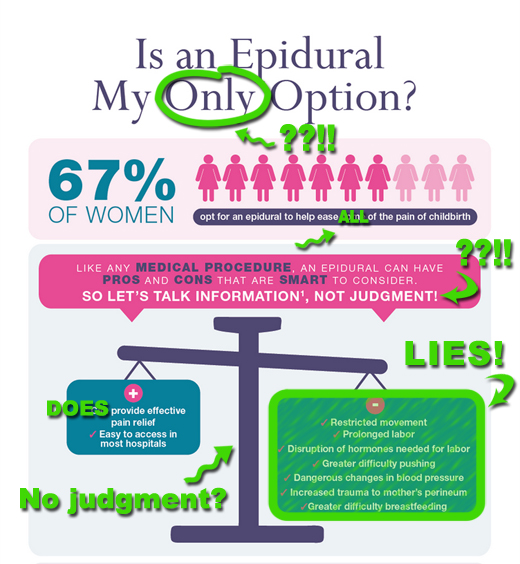
Here’s my annotated version of the top of the poster to help you out:

Lamaze epidural 11-5-14

Personally, I’m leaning toward the bald faced lies as the worst ethical violation.

It doesn’t matter to the folks at Lamaze what the scientific evidence shows. They are entirely evidence resistant. They are a business that depends on demonizing epidurals and they apparently see no problem with lying if that’s what promotes profits. Consider the plethora of lies above. In direct contrast to what Lamaze claims:

1. The fact that epidurals restrict movement has no impact on labor.

2. The “prolongation” of labor is measured in minutes and has no impact on anything.

3. There is NO DISRUPTION of hormones needed for labor. That is pure invention on the part of the liars at Lamaze.

4. There are no “dangerous” changes in blood pressure. Temporary drops in blood pressure are easily reversed and have no harmful effects.

5. There is NO EVIDENCE that epidurals cause trauma to the perineum.

6. There is NO EVIDENCE that epidurals cause difficulty breastfeeding.

The liars at Lamaze are batting 1000. Six claims and all six are lies. Way to go, Lamaze liars!

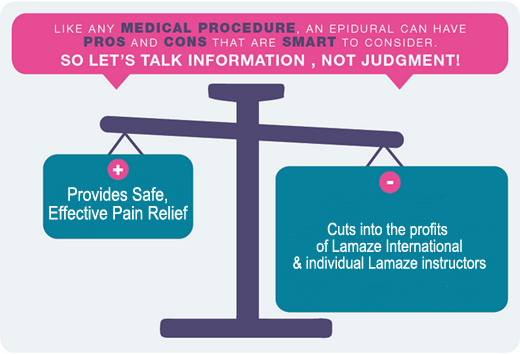
You know what the biggest risk of epidurals is? Epidurals decrease Lamaze profits!

That’s right. Lamaze is a business and it makes it money in two ways: it licenses infant toys (I kid you not) and it charges certification fees for Lamaze educators. Because Lamaze has chosen to indoctrinate its educators with bald faced lies about epidurals, epidurals themselves pose a tremendous economic threat. Who needs an educators to lie to women about epidurals if they find out that epidurals are SAFE, HIGHLY EFFECTIVE, have MINIMAL SIDE EFFECTS, TRIVIAL IMPACT ON LABOR, and NO EFFECT ON BREASTFEEDING? Apparently no one, hence the need for lying at Lamaze.

I must say that the Sanctimommy lie about no judgment is a nice touch. They are so not judging you even if you are benighted enough to believe that epidurals are the only way to relieve pain in labor (they are, of course, the only EFFECTIVE way to relieve pain in labor), even if you think epidurals relieve pain, and even if you are weak and lazy enough to pick the con side of the scale. Got to love that subliminal sanctimony of portraying the choice as the balancing scale, and weighing down the con side with lies.

Even so, I think you could make a good argument for the fact that the greatest ethical malfeasance of the liars at Lamaze is the absolute contempt with which they treat their followers. They figure that their followers are stupid enough to get their information about epidurals from people who only make money by demonizing epidurals. It’s like getting your information on renewable energy from oil companies. They believe their followers are gullible enough that they can lie with abandon and no one will either know or care. Not to mention that the liars at Lamaze apparently think any amount of women suffering any amount of agonizing pain is fine when balanced against the profits of the Lamaze itself.

Keeping that in mind, I’ve helpfully amended the Lamaze balance scale:

Lamaze scale

In conclusion, let me reassure the liars at Lamaze that I wrote this post about their lies with no judgment, exactly the same way that they designed their poster!

Dr. Amy