The moral rot at the heart of homebirth midwifery

iStock_000005403084Small copy

Homebirth midwives have come up with a new way to bury babies twice, first in a coffin in the ground, and then by erasing their lives and deaths so that pregnant women will have no way to assess the dangers of homebirth.

It’s hardly news that homebirth midwives (CPMs, LMs, and lay midwives) are dangerous. They are lay people who awarded themselves a made up “credential” in order to trick the public into believing that they are real midwives. They’re not. They lack the education and training required of real midwives in EVERY industrialized country.

Not surprisingly, their death rates are hideous. In Oregon, the state with the highest rate of homebirth, and most comprehensive statistics, LICENSED homebirth midwives have a perinatal death rate 9X higher than comparable risk hospital birth. But their ignorance and dangerous is not the worst thing about them. The worst thing is the moral rot at the heart of homebirth midwifery.

It’s hard to blame them for being stunningly ignorant, when their “training” is based on nonsense. It’s hard to blame them for the many deaths at their hands when their own certifying agencies have LITERALLY no safety standards. But no matter how ignorant they are or how clueless they are about their own deadly mistakes, there is one thing for which they bear complete moral responsibility. I’m talking about the practice of homebirth midwives changing their names in the wake of a baby’s death in order to trick both the authorities and American women.

Consider this case from Hoboken, New Jersey:

On Sept. 18, 2012, Olivia Kimball, a 31-year-old resident of Great Meadows in Warren County, assisted in the delivery of a baby in a home on Garden Street. At 6:30 p.m. that day, the baby was pronounced dead at Hoboken University Medical Center, Hudson County Assistant Prosecutor Michael D’Andrea told the media at the time.

The state medical examiner later determined that the baby had been stillborn due to an infection, according to Rubino…

Kimball was arrested on Sept. 21 and charged in a Hudson County court with unlicensed practice of medicine. The crime is a 3rd degree indictable offense, the state equivalent of a felony.

How many, many times have we heard the same story: a baby dropped dead into the hands of a clueless midwife who had no idea that the baby was in distress, let alone dead.

Since then:

… Kimball appears to have moved to the southern United States and adopted a new working last name. A professional website lists a person with the new name as director of site development for an international pro-midwifery non-governmental organization, the same position Kimball was credited as holding in a February 2012 profile in the Warren Reporter.

According to the website, she is “currently relocating to” the area and offers services as a doula, a non-medical companion who supports pregnant women during the birthing process. The website does not advertise midwifery services. (my emphasis)

This is not the first time that Kimball has attempted to trick regulators and pregnant women:

Kimball first received a license to practice midwifery in New Jersey in August 2005. Sometime between then and 2007, the Midwifery Liaison Committee of the State Board of Medical Examiners opened an investigation into her practice after learning that she had allegedly assisted in a vaginal birth for a woman who had previously received a cesarean section—also known as a VBAC—in a home setting, according to a consent order issued by a New Jersey attorney general…

In February 2007, Kimball testified before the Midwifery Liaison Committee that her patient had not informed her of her previous C-section, and that she did not perform a physical examination at the patient’s request.

Ultimately, Kimball “decided to discontinue her practice of midwifery in New Jersey and…sought permission from the board to surrender her license,” according to the consent order.

On March 19, 2007, Kimball was granted leave to surrender her license “with prejudice to any future reapplication.” According to the deputy attorney general that represents the Midwifery Liaison Committee, Kimball is not barred from reapplying, but any reapplication would require a review of the terms of her consent order.

But she didn’t stop practicing midwifery. She just continued practicing without a license or professional oversight.

This is not the first time that a homebirth midwife who has surrendered her license has continued to practice. This is not the first time a homebirth midwife has changed name in the wake of a preventable death at her hands. And it’s not the first time that a homebirth midwife, having been prosecuted in one state for a preventable death, moves to another and implies that she has a clean record. Each and every time it happens, it demonstrates the moral rot at the heart of homebirth midwifery. These actions represent both a consciousness of guilt, and an effort to preserve income by hiding their practice history. And it is emblematic of the central reality about homebirth midwives: they place making money and satisfying their desire to attend births ahead of the lives of babies and mothers.

Most states now publish the malpractice history of doctors and nurses, so patients will have access to a provider’s practice history before choosing him or her. When doctors attempt to practice without a license, the punishment is severe. When doctors lie about their malpractice history, their licenses may be revoked. And when a doctor moves and changes his name in order to hide his malpractice history, we all recognize it for the morally bankrupt, illegal action that it is.

It is no different when homebirth midwives attempt to do the same thing.

Some women do not care if their midwife has presided over previous deaths, but most do. By simultaneously exhorting women to “educate” themselves about homebirth while directly interfering with their ability to educatd themselves about practitioners, homebirth midwives demonstrate the deadly selfishness and moral rot at the heart of their “profession.”


Telling a new mother to breastfeed AND pump is barbaric!

Breast pump to increase milk supply for breastfeeding isolated background

Warning! Warning! Warning! Personal opinion ahead!

Every breastfeeding post I write leads to multiple comments about the physical and mental gymnastics some new mothers put themselves through in order to breastfeed. I hear about women who breastfeed every two hours PLUS use a SNS breastfeeding assist system PLUS pump their breasts afterward to further stimulate milk production, typically on the advice of a lactation consultant who found breastfeeding relatively easy.

Have lactation consultants lost their minds? Their “advice” is barbaric, cruel and not in any way justified by scientific evidence.

Let’s start with the baseline reality:

IN FIRST WORLD COUNTRIES, BREASTFEEDING IS SIMPLY NOT THAT IMPORTANT!

There. I said it. The claims about the benefits of breastfeeding are NOT supported by the scientific evidence, which is weak, conflicting and riddled with confounding variables. All things being equal, breastfeeding is best, but then all things being equal naturally occurring 20/20 vision is best, too.

But in real life, what’s best isn’t necessarily what happens. Eyes may be perfectly designed to see 20/20, but fully 30% of Americans are nearsighted. That’s why we have glasses and contacts. They are not ideal when compared to naturally occurring 20/20 vision, but they are close enough that it really doesn’t matter.

Similarly, in real life, breasts may be perfectly designed to provide adequate breastmilk, but 5% or more of women don’t make adequate milk. That’s why we have formula. Though formula is not ideal when compared to natural occurring exclusive breastfeeding, it is close enough that IT REALLY DOESN’T MATTER!

I realize that the income of lactation consultants depends on pretending that breastfeeding is vitally important, but it isn’t. Lactation consultants appear to have become every bit as unscrupulous as the formula companies they claim to despise. They promote their product far beyond what any scientific evidence shows, without regard for the impact of that advice on either babies or mothers.

Let’s add in another baseline reality:

BEING A NEW MOTHER IS HARD!

It is a tremendous physical and emotional adjustment, compounded by hormonal changes that can lead to the “baby blues” or true depression.

If we want to SUPPORT new mothers, and we claim that we do, we should be supporting their physical recovery and emotional adjustment. That means ensuring that they get enough sleep to fully heal, enough support with ALL aspects of mothering to feel competent, and enough reassurance that the most important each baby needs is maternal love, NOT breastmilk, and not a perfect mother.

Really supporting new mothers would ensure that they get enough sleep to function, that their babies are fed to satiety, and that they enjoy the time they spend interacting with their babies.

You will notice that breastfeeding is not among those vital needs. So will someone please explain to me how people and programs that claim to support new mothers, from lactation consultants to the Baby Friendly Hospital Initiative, IGNORE women’s most vital needs?

The reality is that they do, and they should be ashamed of themselves because they do.

The sad fact is that these people and programs are NOT supporting new mothers, they are supporting the breastfeeding industry, with its consultants, and equipment, and supplements and aids. And in their near religious devotion to the idea of breastfeeding, they are so cruel as to be barbaric.

All newborns must room in in order to support breastfeeding? How can a new mother get desperately needed sleep if she isn’t allowed to hand her baby off to professionals for a few hours? She can’t and that’s cruel.

Formula must be locked up in hospitals? How can a mother soothe a baby screaming from hunger before he or she learns to nurse effectively without formula? In many cases she can’t, and she becomes frantic with anxiety even before she leaves the hospital. That’s cruel.

Every woman must visited by a lactation consultant? Why? Did her right to control her own body come out with the placenta? It’s no one’s business whether a woman breastfeeds except her own. Anything else is profoundly antifeminist.

Every woman must exclusively feed breastmilk, and must engage in an endless cycle of feeding, supplementing with SNS and pumping? Are you people insane? It places the value of breastmilk above a woman’s emotional and physical health, and her ability to bond with her baby. That is barbaric!

There are so many people to blame for this barbarism, that’s it’s difficult to know where to begin. Obviously lactation consultants and lactivists organizations like the Baby Friendly Hospital Initiative (talk about an oxymoron!) bear the brunt of the blame. It’s business for them, and they put the health of their business ahead of the health of their patients, both babies and mothers.

But there’s plenty of blame to go around. Many physicians have elevated breastfeeding to the “holy grail” of mothering going far, far beyond what the scientific evidence shows. Many research scientists start their research papers with the conclusion that breastfeeding must be encouraged and that women should receive more breastfeeding support (in other words, more business for the lactivist industry) and simply ignore the actual findings that show that while breastfeeding has beneficial effects, in industrialized countries, those benefits are trivial. Public health officials have gotten far out in front of the scientific evidence, grossly exaggerating the benefits and importance of breastfeeding, and using weak, contradictory data riddled with confounding variables to do so.

Let’s finish with what I consider the most important baseline reality:

THE KEY TO A HEALTHY, HAPPY, THRIVING INFANT IS A PHYSICALLY AND EMOTIONALLY HEALTHY MOTHER. That means a mother who is getting enough rest, whose mental health needs are being addressed, and who is able to enjoy substantial amounts of time happily bonding with her child.

Breastmilk is NOT necessary, NOT necessarily best for every mother-infant dyad, and the effort to produce it is positively harmful in some situations.

Do we care about mothers and babies or do we just care about breastmilk?

I care about mothers and babies, and that’s why I’m not afraid to proclaim that telling a new mother that she must breastfeed and use a supplementary feeding system and then pump is cruel, barbaric and not justified by science … not matter how beneficial it is for the lactivism industry.

Breaking news: telling new mothers they are breastfeeding failures leads to depression

Breaking news

Is it really ground breaking news when a study shows that telling new mothers they are failures increases the risk of depression? Actually, it’s not, but considering the way that a new study on breastfeeding was reported, you’d be forgiven for thinking that it was.

The study is New Evidence on Breastfeeding and Postpartum Depression: The Importance of Understanding Women’s Intentions published in the open access Maternal Child Health Journal.

According to the BBC, the study showed:

Breastfeeding can halve the risk of post-natal depression, according to a large study of 14,000 new mothers.

However, there is a large increase in the risk of depression in women planning to breastfeed who are then unable to do so.

The study, published in the journal Maternal and Child Health, called for more support for women unable to breastfeed…

That’s not precisely what the study showed. The study actually found that breastfeeding had “heterogeneous effects by mental health during pregnancy and breastfeeding intention.”

Specifically:

…[T]he effect of breastfeeding on maternal depression symptoms was found to be highly heterogeneous and, crucially, mediated by breastfeeding intentions during pregnancy. Our most important finding relates to the majority of mothers who were not depressed during pregnancy, and who planned to breastfeed their babies. For these mothers, breastfeeding as planned decreased the risks of PPD, while not being able to breastfeed as planned increased the risks.

An additional critical finding was:

For the majority of mothers who did not show symptoms of depression before birth, breastfeeding … increased the risk of PPD among mothers who had not intended to breastfeed. (my emphasis)

It’s not clear to me that this study has anything to do with breastfeeding at all. In fact, it seems to me that this is really a study of the impact societal pressure on new mother’s mental health. The authors appear to have ignored their own finding that breastfeeding increased the risk of postpartum depression among women who were breastfeeding despite their previously indicated desire to bottle-feed.

That suggests that the critical variable here is NOT breastfeeding, but rather new mothers’ self assessment.

The authors conclude:

These findings have implications for the way in which new mothers are supported; they suggest that the provision of expert breastfeeding support may, in addition to increasing breastfeeding rates and durations, have the additional benefit of improving mental health outcomes among new mothers. At the same time, it is clear that where mothers had intended to breastfeed, not being able to breastfeed may have deleterious consequences on their risk of PPD, and that providing specialised support to new mothers who had intended to breastfeed, but who for some reason find themselves unable to breastfeed, may also constitute a desirable health policy objective.

Here’s another interpretation that is far more likely given the actual evidence:

Breastfeeding has no impact one way or the other on maternal mental health, but pressure to breastfeed has a dramatic effect on maternal mental health. When women could not meet their own needs, either because they could not breastfeed when they wanted to do so or because they successfully breastfed despite not wanting to do so, their risk of postpartum depression doubled.

When we juxtapose the harmful effects of pressure to breastfeed on maternal mental health against the trivial benefits of breastfeeding in industrialized societies, an entirely different conclusion is warranted:

The findings of this study have implications for the way in which new mothers are supported. They suggest that breastfeeding itself has no beneficial effect on women’s mental health, and that the pressure to breastfeed generated by lactation consultants, lactivists and public health authorities is actually harmful. Not every woman can breastfeed successfully, and not every woman who could breastfeed successfully wants to do so. Making breastfeeding the “holy grail” of new motherhood, leads to an increased risk of postpartum depression among those who cannot breastfeed successfully (presumably due to feelings of failure) and among those who do not want to breastfeed (presumably due to feelings of frustration).

To me, the conclusion is pretty obvious: when it comes to new mothers and breastfeeding, we don’t need to provide more support, we need to BACK OFF!

5 things the Ferguson police have in common with homebirth midwives

iStock_000013841997Small copy

Whatever else you might say about the debacle in Ferguson, Missouri, one conclusion is inescapable: the Ferguson police and city government have given us the perfect case study for how NOT to conduct police work.

In thinking about their mistakes, it struck me that the incompetent and inappropriate response of the Ferguson police, first to  African-American teen Michael Brown, and then to the fatal shooting of Brown has so much in common with the typical incompetent and inappropriate practice of homebirth midwives.

The Ferguson Police Department treated Michael Brown, his fatal shooting, and the aftermath the same way homebirth midwives treat childbirth.

1. They use intuition instead of facts

Michael Brown was unarmed, he did not pose a deadly threat to the police officer who encountered him. Apparently, that’s not what the police officer thought. He saw a large black male coming toward him, and his “intuition” told him that large black males are thugs with guns. He trusted his intuition instead of accurately assessing the situation. He pumped 6 bullets into Michael Brown, including one into the top of his head, hitting him when he was falling to the ground. His intuition was wrong and Michael Brown is dead as a direct result of substituting intuition for facts.

2. They don’t check facts; they might find out something they don’t want to know

If the police officer who shot Brown had checked and found that he was unarmed, he would have had no pretext to shoot him. Or he might have left himself exposed to injury. If homebirth midwives ordered routine prenatal testing on their patients, they might have no pretext for claiming that the patients are low risk and therefore good candidates for homebirth. Better not to check.

3. Protect yourself first

This has been on ongoing theme in Ferguson. A police officer shot Michael Brown because he was protecting himself first. Brown was never a threat to him, but he feared that he was and reacted with that in mind. The Ferguson Police Department met the subsequent peaceful protests with an array of tremendous force thereby inflaming the situation further. They were more concerned with protecting themselves from the harm that they “intuited” would come from a large group of African-Americans peacefully protesting than with accurately assessing and appropriately managing the situation.

Homebirth midwives routinely protect themselves first and leave mothers and babies to fend for themselves. Their goal is to attend a vaginal birth, collect a fee, and face no consequences. When complications develop, they ignore them, and avoid transporting to more qualified providers until someone is dead or nearly so. They drop patients in emergency rooms or make family members take patients to emergency rooms rather than expose themselves to legal responsibility by accompanying their dead or dying patients. They coach patients to lie on their behalf since protecting them must always be the primary goal.

4. Blame the victim

The Ferguson Police Department was strongly counseled by both State and Federal authorities NOT to release the surveillance video that showed that Brown may have been involved in a convenience store robbery immediately prior to the shooting. That State and Federal officials understood that releasing the video would be (correctly) interpreted as an effort to smear Brown for “getting himself shot.” It’s all the more remarkable that they forged ahead with the release of the video while simultaneously acknowledging that the officer who shot Brown knew nothing about the alleged robbery at the convenience store. That was a tacit admission that the robbery was irrelevant to the shooting, and simply a way to imply that Brown “deserved” what he got.

Homebirth midwives are inordinately fond of blaming the victim. When a mother asks for an epidural or needs a C-section or other interventions, it’s because she didn’t eat right, didn’t exercise, had too much “fear” or lacked sufficient strength and commitment. When a baby dies it’s because the baby “was meant to die” and “babies die in hospitals, too.” Homebirth midwives routinely share personal patient information on the internet and message boards in an effort to justify their own conduct by blaming the patient for the disappointment, disaster or outright tragedy that befell her.

5. Refuse to accept responsibility

Never, ever apologize for what happened.

Imagine if the Ferguson Police Department had responded to the shooting of Michael Brown by admitting, up front, that it was a mistake, promising a thorough inquiry, treating protesters as people whose anger was justified and whose protests are protected by the Constitution. And imagine if they actually did regret what happened, and could be trusted to thoroughly investigate what went wrong, and to institute policies, procedures and training sessions to make sure that nothing like that ever happens again. I suspect the situation would have played out very differently.

But they couldn’t do it, because that would mean accepting responsibility and in their view the responsibility belonged with the person who “got himself shot” and not with the officer who shot him. They argue that the police need to be free to do their jobs using whatever means necessary, and protecting themselves first, because anything else would result in them being unable to protect the public.

Homebirth midwives can’t accept responsibility. First they blame the victim for her own tragedy, even if the proximate cause is negligence of the homebirth midwife, Their certifying organization has literally NO safety standards, because standards would hold them open to censure if they violated them. There is no mandated peer review, no mandated training sessions, no discussions of how to prevent the same mistakes from happening over and over again. Instead, they argue that homebirth midwives need to be free to do their jobs whatever way they want to do them, because anything else would result in a restriction of women’s freedom to have the birth of their choice.

I dare to hope that at some point we will find out the truth about what happened to Michael Brown, but regardless I think we can say some things with certainty. When we allow professionals to substitute their intuition for fact finding,  disasters will happen. When we allow professionals to smear victims instead of looking to their own conduct, innocent people will suffer. And when we let professionals avoid accountability people will die. It’s true for the police, and it’s true for homebirth midwives.

Eating the placenta: stupid is as stupid does

expression -  Ignorance is bliss - written on a school blackboar

Homebirth and natural childbirth advocates can’t make up their mind about the placenta.

They all agree that human placenta has magical traits, but they can’t agree what those magical traits are:

It resuscitates the baby! Really? If the baby is born distressed because the placenta couldn’t provide enough oxygen inside the mother’s body, why would it suddenly provide adequate oxygen outside it?

You should leave the placenta attached to the baby! Really? Is there any animal that leaves the placenta attached to the baby? No, of course not.

You should detach the placenta so you can eat it! Really? Which ancient or indigenous cultures consumed the placenta? Oh, right, none.

It’s the baby’s spiritual twin! Really? Really??!!

Eating the placenta is stupid for a whole host of reasons, but the most important reason is this: the removal of the placenta, and the hormones that it produces, is the trigger for breastmilk production.

How does breastmilk production work? According to Physiology and Endocrine Changes Underlying Human Lactogenesis II:

The evidence is summarized that progesterone withdrawal at parturition provides the trigger for lactogenesis in the presence of high plasma concentrations of prolactin and adequate plasma concentrations of cortisol.

Breastmilk production is divided into two stages: preparation for production, which occurs during pregnancy, as is known as lactogenesis I; and actual production of breastmilk after the birth of the baby, known as lactogenesis II.

In pregnancy:

As the levels of progesterone, prolactin and placental lactogen rise, the terminal ductal lobular units [the part of the breast that makes the milk] undergo a remarkable expansion so that each lobule comes to resemble a large bunch of grapes. During mid-pregnancy, secretory differentiation begins with a rise in mRNA for many milk proteins and enzymes important to milk formation. Fat droplets begin to increase in size in the mammary cells, becoming a major cell component at the end of pregnancy. This switch to secretory differentiation is called stage I lactogenesis. The gland remains quiescent but poised to initiate copious milk secretion around parturition.

But it is birth, specifically the expulsion of the placenta, that triggers milk production:

This period of quiescence depends on the presence of high levels of circulating progesterone; when this hormone falls around the time of birth, stage II lactogenesis or the onset of copious milk secretion ensues…

How does it happen?

It has long been known that abrupt changes in the plasma concentrations of the hormones of pregnancy set lactogenesis in motion … It is clear that a developed mammary epithelium, the continuing presence of levels of prolactin near 200 ng/mL and a fall in progesterone are necessary for the onset of copious milk secretion after parturition. That the fall in progesterone is the lactogenic trigger is supported by evidence from many species… In humans removal of the placenta, the source of progesterone during pregnancy in this species, has long been known to be necessary for the initiation of milk secretion. Furthermore, retained placental fragments with the potential to secrete progesterone have been reported to delay lactogenesis in humans. Thus, without a fall in progesterone, lactogenesis does not occur.

It’s an elegant system. The progesterone synthesized by the placenta to support the pregnancy, inhibits the production of breastmilk. When the baby is born and the placenta is expelled, the level of progesterone drops dramatically and this is the chemical trigger for production of copious breastmilk. This drop in progesterone is so critical to breastmilk production that even small fragments of the placenta left behind in the uterus can interfere with lactogenesis.

That’s how “unhindered” breast milk production is supposed to work. Eating the placenta, therefore, is an intervention, an intervention that interferes with the exquisitely coordinated rise and fall of various hormones in the postpartum period.

Eating the placenta is an excellent example of the profound ignorance of human physiology that undergirds most of homebirth and natural childbirth advocacy. Advocates have no clue how the actual physiologic processes of pregnancy, childbirth and the postpartum work. They create a fantasy physiology where profound complications are “variations of normal,” where birth in water (unknown in any primate species) is natural, and where eating the placental hormones that suppress breastmilk production are supposed to promote breastmilk production.

Only someone profoundly ignorant of human physiology would recommend consuming placenta and only a gullible fool would actually do it.

Why placenta encapsulators are “bullsh!t”

iStock_000013208404XSmall

This gem, Why Birth Centers Are Bullsh!t, is making the rounds among the homebirth crowd. Who is Doula Anonymous? I don’t know, but the person who appears to have been the first to publicize the post, and has publicized it across multiple platforms, was Katie DiBenedetto, a doula and placenta encapsulator who received her “training” from the Placenta Liberation Front (no, I’m not making that up).

Contacted on Twitter, DiBenedetto denies that the blog is hers. Regardless of whether or not it is, her willingness to promote it indicates a startling lack of insight into her own “profession.” Imagine if a blogger gave placenta encapsulation the same treatment, Doula Anonymous gives birth centers.

It might be something like this:

Now, of-fucking-course, not ALL placenta encapsulators are bullshit. There might be one or two placenta encapsulators who are bringing healthcare and safety in birth to communities of women who have never known such a luxury (although I highly doubt it).

This post is not about THOSE placenta encapsulators.

This post is not to judge mothers who choose to encapsulate their placentas simply for the fucking bragging rights. If you encapsulated your placenta simply because you are stupid and gullible and are triggered by this post: check your shit at the door and calm the hell down. This isn’t about you.

This post is a rant about the for-profit placenta encapsulators that act as a “middle ground” for upper middle class white people who are “too scared” to eat raw placenta and don’t want to admit it.

And all too often it is the woman who desires to eat her placenta raw, the father who ignorantly says no, and placenta encapsulation acts as a compromise.

In terms of safety, equipment, medicine, etc. there is absofuckinglutely no difference between being a gullible fool who eats her placenta raw and a gullible fool who eats her placenta encapsulated. The raw placenta is the same fucking shit that your encapsulator would freeze dry. There is no advantage to encapsulation. Yet placenta encapsulators tout it like there is. How is it that you could NEVER eat raw placenta, which has ZERO fucking health benefits, yet encapsulated placenta, which also has ZERO funcking health benefits is fine? Tell me, what is the fucking difference? Is it psychological? The fact that you are PAYING someone to encapsulate? Is it more socially acceptable to eat encapsulated placenta? (probably because the general public thinks encapsulated placenta is somehow different and safer than raw).

Obviously placenta encapsulation is a fucking businesses. It just fucking is. Placenta encapsulators cost a load of money and they are in it for profit. They saw an audience (upper middle class white women who watched the Business of Being Born) and quickly concocted a brilliant business plan. They package up their doula care, placenta art, placenta encapsulation and placenta guide books, wrap it up with a little sacred pregnancy bow and sell the shit out of it. You can’t blame doulas, really. Providing doula care is no fucking cake walk. You’re not going to get rich attending home births. A placenta encapsulation business on the other hand…

Obviously – you choose whether and how you want to eat your placenta. This is fucking America, right? Just make sure that you are doing it for the right reasons and not because you’re fucking kidding yourself that it is anything other than a scam to enrich placenta encapsulators.

Does the University of Illinois Hospital know about its midwives’ Facebook page?

image

Hmm. I wonder if the folks at the University of Illinois Hospital know that their midwives maintain their own Facebook page? Based on what’s on it, I suspect they don’t.

Here’s a screencap of a new post about me:

image

Here are the best quotes.

First comes the obligatory misrepresentation of my views:

It has come to our attention that there is this person who goes by the name of “Dr Amy, The Skeptical OB”. What she spews on her page is a lot of negativity and hatred towards the normal birth process. In her opinion, why in the world would anyone want an unmedicated birth? …

Then the ostentatious sadness for me:

I feel sorry for Dr. Amy and her former patients that she pushed her biases on. She will never truly know and never get it.

Of course, no post advocating unmedicated childbirth would be complete without a “non-judgmental” jab at the “anxious and fearful” women who want an epidural.

Midwives believe we should “Listen To Women” and we do. If you want a natural, unmedicated birth, “we will do everything in our power to help you achieve that”. If you are very anxious and fearful of labor and want a labor epidural, “we will do everything in our power to help you achieve that”. (You may be surprised to find out that our epidural rate is 69.6%.) …

The obligatory accusations without any attempt to actually rebut what I write:

The last thing we want is for you to experience PTSD from your birth memories.

So Dr. Amy, you are no better than the homebirth midwives you complain about. You are on the far, far right of the birth spectrum of those on the left that you ridicule. As Certified Nurse Midwives, we are everything in between.

And the coup de grace of any obnoxious natural parenting post:

Peace.

Anyone who knows me knows that I value any opportunity to publicly debate the claims of natural childbirth advocates. So, U of I Hospital Midwives, do you have any specific claims of mine that you are capable of rebutting?

Let me guess, you don’t want to debate because you’d be eviscerated; you’d rather whine on Facebook. I wonder if the administration of the hospital and the Department of Obstetrics will be proud … or just embarrassed. I’m going to guess they’ll be embarrassed.

How many dead babies is one VBAC worth?

Doubtful Woman Holding Question Mark

How many babies would you be willing to kill to get your magical, “healing” VBAC?

I would have thought that one dead baby would be enough for even the most ardent VBAC activist to recognize the selfishness and folly of sacrificing a human life in exchange for an experience. Apparently not.

This week I’ve heard about not one, but TWO separate cases of women losing a baby as a direct result of attempting a VBAC and then attempting or planning to attempt ANOTHER VBAC!

1. The first case involves a woman I’ve written about before in a piece aptly titled Why don’t homebirth advocates learn from their mistakes? This woman didn’t learn from her first mistaken attempt at HBAC, which ended with a cord prolapse, emergency transfer, live baby born vaginally, and postpartum hemorrhage. She didn’t learn from her second planned HBAC attempt when her daughter died in utero apparently from undiagnosed IUGR. But if at first you don’t succeed in achieving your magical healing VBAC (apparently the cord prolapse vaginal birth didn’t count), risk, risk again.

This time she decided to go with a hospital and real medical professionals, she achieved her magical healing VBAC and the only thing she lost was her uterus and a lot of blood.

What truly amazing is that woman appears to think that one cord prolapse and emergency transfer + one dead baby + one hysterectomy + 3 units of blood was a reasonable price to pay for having the birth of her dreams.


2. In the second case, a woman lost her daughter Coraline at an attempted HBA4C. The story as horrifying as it is typical.

The consult with the obstetrician:

[I] did have a consult with a high risk OBGYN that works with [my midwife]… At the end of the appt, he said that overall, he sees no reason why I can’t do a vbac other than the fact that I have had 4 sections which puts me at VERY high risk!!

The obstetrician’s advice is ignored in an effort to achieve “the one thing in my life that has always meant the most to me.” Really? REALLY? That’s what has always meant the most to you? More than your baby’s life and your own?

The other complications, which in this case included prolonged rupture of membranes and prolonged latent phase:

My water broke & contractions picked up. A doula locally offered to come out & labor with me & dh & so she did Wednesday (11/20/13 10 PM) night. Through the night and the next day my contractions were close together, sometimes 2min apart & sometimes 5-7 min apart. My MW came around 3am … Later that morning, she checked me and I was about 5 1/2cm… I did not progress for the rest of the day…

Her midwife WENT HOME because she “was just so exhausted & had kids that needed to be tended to.”

It finally occurred to the mother at 3 AM on 11/22 that she ought to go to the hospital:

…DH checked the heartbeat w/the doppler that the MW had left for us & her hb was perfect. Same place & 148 bpm, which was average for Coraline the entire pregnancy.

But when they got to the hospital, Coraline was dead.

Her mother underwent a 5th C-section, this time for a dead baby:

… When the doc opened me up, my whole uterus, baby’s sac & baby was covered in infection … [I] never had any fever or other signs or symptoms that anything was wrong. NOTHING!!! Coraline weighed 11lb 2oz., 22 inches long.

Who could have seen that coming after only 30+ hours of ruptured membranes?!!

Did Coraline’s mother learn anything from this completely preventable disaster? No, not a blessed thing, although her husband appears to have learned something.

Earlier this year Coraline’s mother was posting to the VBAC group that encouraged the HBAC that ended in her daughter’s death:

…I’m going for a pre-pregnancy consult sometime in the near future to see what they say as I will be a vba5c if I can get accepted. I would do hba5c, but hubby won’t go for it.

At least he thinks that one dead baby is enough. Too bad Coraline’s mother doesn’t feel the same.

Hospital birth leads to epigenetic changes causing babies to be cuter and smarter

Interact

Scientists probing the epigenetic changes surrounding birth have made a startling finding. Hospital birth leads to babies that are cuter and smarter!

What are epigenetic changes?

For years we have believed that all human traits are fully encoded in DNA and that environment has no impact on genetic characteristics. Recent research has shown, however, that the expression of certain genes can be modified by chemical changes that in turn are affected by environment. For example, children who live through famine grow up to be adults more likely to gain weight when adequate food is present. Furthermore, that this tendency to gain weight in the presence of adequate food can be inherited by offspring. Epigenetics allows for carefully calibrated expression of the genes that help an organism make the best possible use of the environment in which it finds itself.

Midwives and other natural childbirth advocates have seized upon epigenetics as a way of demonizing the interventions of modern obstetrics, arguing that hospital birth leads to epigenetic changes that cause obesity, diabetes, cardiac disease and other 21st Century ills of old age. But recent research has found precisely the opposite. The epigenetic changes of hospital birth are beneficial. Indeed, the epigenetics of hospital birth lead to babies that are cuter and smarter.

It’s not really surprising when you think about it. We don’t yet know very much about epigenetics, but we do know this: epigenetic changes allow the organism to better exploit its environment. As the example of famine shows, the epigenetic changes allowed individuals in a food poor environment to better exploit the small amount of food that was available by avidly scavenging every possible calorie from it. Yes, it is true that the epigenetic changes were no longer beneficial, and perhaps even harmful, if they were inherited by offspring whose environment was radically different, but the changes were certainly beneficial to the people who experienced them.

That’s why the prattling of midwives and natural childbirth advocates that the interventions of modern obstetrics cause harmful epigenetic effects makes no sense at all. To date we have found no evidence that epigenetic changes lead to unrelated harmful effects, or lead to harmful effects for offspring who live in a similar environment. There is no reason to believe that any epigenetic changes caused by C-sections or other obstetric interventions would lead to the diseases of old age found modern societies. That’s yet another pathetic effort by midwives to demonize any interventions that they cannot provide.

So how do the interventions of the hospital change the epigenetics of babies? According to Professor Gull E. Bull, the latest research indicates that the human body recognizes the environment of the hospital as an indication of superior attachment between mother and infant. Women who choose hospital birth value their children more than women who choose homebirth. Prof. Bull explains that as a result of this superior bond, babies are able to express their genetic intelligence and beauty to the fullest extent, leading to babies that are cuter and smarter than babies who are born at home. And because these are epigenetic changes, the grandchildren of those who choose hospital birth are cuter and smarter as well.

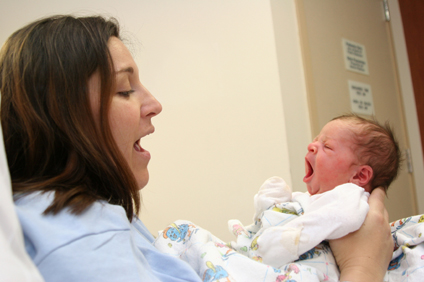
For example, the picture of the C-section born baby above demonstrates not only the superior bond between this mother and infant, but the fact that this baby is smart enough to talk and have a complete conversation with its mother at only 2 days old. No homebirth mother, no matter how much she “rocked” her vaginal birth, can make that claim about her baby.

As Prof. Bull notes, there is a tendency to view each new scientific discovery as the “explanation” for diseases with unknown cause, like autism, or diseases of old age that are found in wealthy societies. In the case of epigenetics, however, the changes occur because they benefit the organism. While they could potentially cause problems in offspring one or more generations removed, that would only happen if the environment were radically different. Therefore, the epigenetic changes associated with the interventions of modern obstetrics can all be expected to be beneficial to the organism that experiences the epigenetic changes.

The concern that a mother displays in choosing to give birth to her child in a hospital actually affects the expression of the child’s DNA, leading to cuter, smarter babies. Of course, that’s not why women choose hospital birth; they do so because they value the health of their child over their own birth “experience.” The fact that the healthy baby is cuter and smarter is just an unexpected bonus.


This piece is satire, but could ultimately turn out to be true.

Natural childbirth renders women’s needs invisible

NoBody Series - woman on the side

The philosophy of natural mothering (natural childbirth, lactivism, attachment parenting) rests on fundamental assumptions that are often unrecognized and therefore unexamined. In the past I’ve written about the social construction of risk within our culture and the social imperative that everyone (mothers and doctors) do everything possible to minimize risks to babies without ever considering the trade-offs that reducing specific risks imply. But risk is not the only thing that is socially constructed within the philosophy of “natural” mothering. Women’s needs are also socially constructed. Specifically, in the philosophy of natural mothering, women’s needs are rendered invisible. Natural childbirth advocacy and its approach to the issue of pain in labor is perhaps the paradigmatic example of the way in which natural mothering erases the needs of women.

Natural childbirth advocacy uses several different strategies to render women’s needs invisible. To understand how these strategies work it makes sense to start with the empirical facts that most of us agree upon:

1. Childbirth is excruciatingly painful. Indeed the pain of childbirth is so impressive that ancient cultures imagined that the only possible explanation was divine punishment of women for their transgressions.

2. Severe pain should be treated. No one would ever suggests that cancer pain be ignored or that pain from a broken bone should go untreated.

3. Medical professionals have an obligation to treat pain. Every human being is entitled to the medical treatment of pain if that’s what he or she desires.

Natural childbirth advocates employ a variety of strategies to render invisible women’s need for pain relief. The first strategy is to insist that a mother’s need for pain relief is insignificant when compared to the “risks” of epidurals. This strategy is all the more remarkable when one considers that the “risks” of epidurals are not empirical, but purely speculative. Presumably, the baby has a need and a right, to avoid any potentially harmful effects from epidurals that might be discovered as some unspecified future time. And that need (even though theoretical) trumps the mother’s need for pain relief, despite the fact pain of this magnitude would always be treated if it were from any other source.

The intellectual sophistry of such a claim is all too apparent. The natural childbirth project involves invoking risks that may not even exist and inflating both the severity and the likelihood of such risks. And it rests on the assumption that no matter how theoretical or how small these risks may be, they automatically trump a woman’s need for pain relief. A woman’s need for pain relief is therefore of no consequence and not even worthy of consideration.

Even when natural childbirth advocates concede that women might feel a need for pain relief, they employ a variety of strategies to diminish the importance of that need. These strategies involve

Blaming the woman for her own pain – if she did it “right,” childbirth would not be painful.
Blaming the woman for not using “natural” methods of pain relief – regardless of their questionable value in providing adequate relief.
Blaming the woman for not embracing the pain as an “empowering” aspect of her biological destiny.

Simply put, according to natural childbirth dogma, a woman’s pain in labor is irrelevant of no importance compared to the baby’s need to avoid theoretical risks, and, in any case, is her own fault.

It is important to note that in natural childbirth philosophy, it makes no difference how small the risk to the baby might be, and it makes no difference how large the mother’s need for pain relief might be. To put that in perspective, it helps to consider another, far more trivial, example of balancing risk and need that all mothers must address.

Consider the issue of driving with a baby in the car. There is no doubt that riding in a car exposes a baby to a real risk of injury and death in a car crash, a risk whose magnitude is far greater than the theoretical risk of an epidural. And consider that the mother’s “need” to go to the grocery store is trivial, and can easily be met at another time without putting the baby in danger of injury or death in a car accident. So why aren’t natural childbirth advocates berating women for driving with infants in their cars? They consider that larger risk socially acceptable. In that case, convenience trumps whatever needs the baby might have.

The reality is that every choice has risks and benefits, and those risks and benefits must weighed against each other. But when a woman’s need for pain relief is rendered invisible, natural childbirth advocates can act as if there is no benefit to pain relief in labor and can pretend that no weighing of risks and benefits is necessary.

It is difficult to imagine any other situation in which ignoring a woman’s severe pain would be socially and ethically acceptable. But for natural childbirth advocates, a woman’s needs are invisible, and therefore merit no consideration.


This piece first appeared in January 2011.

Dr. Amy