People who have heart attacks die in the hospital, too

Word cloud heart disease related in shape of heart organ

Hi, folks, Ima Frawde, CHC (certified home cardiologist) here to explain how to care for your heart at home.

It’s time for people to take back the care of their hearts from the cardiology industry and treat hearts as the natural organs that they are. Consider:

Animals don’t use cardiologists. Animals have existed for tens of millions of years despite the fact that animals in nature never use cardiologists. People are animals, too, so obviously we don’t need cardiologists, either.

If heart disease were really as big a problem as cardiologists claim, we wouldn’t be here. Cardiologists like to claim that literally hundreds of thousands of people each year require cardiac interventions. Really? Our ancestors didn’t have cardiologists and we’re still here.

All we need to do is eat and exercise like our paleolithic ancestors and care for our hearts with certified home cardiologists and everyone will be just fine.

What’s the difference between a CHC and an MD cardiologist? There are many, many important differences including:

Certified home cardiologists trust hearts. MD cardiologists act like people anybody could have a heart attack at any moment and that we must be prepared. Home cardiologists know that heart attacks are rare and that most of the time hearts work just fine.

Home cardiologists don’t do screening tests. Do you know that most people screened with tests like cholesterol levels and EKG’s DON’T actually have heart problems. It’s true; therefore you should reject any testing that might show you are at increased risk for heart problems.

Home cardiologists don’t pay any attention to risk factors. High cholesterol, abnormal EKG’s, obesity and smoking don’t make a patient high risk because they are just variations of normal.

Home cardiologists don’t play the “dead person card.” Instead of trying to scare you by claiming that heart attacks increase the risk of death, home cardiologists soothe their patients by insisting that there is no increased risk.

MD cardiologists do too many angioplasties and cardiac surgeries; home cardiologists do none. It is a well known fact that people who leave their heart care to home cardiologists have a much lower angioplasty rate and a much lower cardiac surgery rate. This dramatically reduces medical costs.

MD cardiologists do angioplasties and surgeries because they are rushing off to their golf games. Home cardiologists, on the other hand, take the time to watch your heart attack evolve.

Home cardiologists know that attitude is critically important. As our homebirth midwives sisters have taught us, merely mentioning complications causes them. That’s why we never ask our patients if they are having chest pain.

Chest pain is good pain. The heart is a muscle and like any muscle it may have pain when you exercise. Crushing chest pain is just a variation of normal. Plus, you know what they say: no pain, no gain.

Home cardiologists carry the same equipment as MD cardiologists. We carry drugs and oxygen, too, so what’s the difference?

The hospital is only 10 minutes away. MD cardiologists insist that if you are having crushing chest pain you should take a baby aspirin and call an ambulance. Why? You only need to go to the hospital if you are risk of dying of the heart attack, so there’s no reason to go to the hospital unless you your EKG flat-lines. Most of the time you don’t even need to take an ambulance. Your home cardiologist will just drop your unconscious body at the local emergency room.

And, the clincher:

People who have heart attacks die in the hospital, too. In fact MORE people die of heart attacks in a hospital cardiac care unit than at home.

If you can trust your baby’s life to a homebirth midwife, surely you can trust your own life to a home cardiologist. The reasoning is exactly the same.

I chose homebirth and now a disaster has occurred. Rescue me!

iStock_000000300188XSmall

There’s a paradox at the heart of homebirth advocacy. It depends entirely on the deeply held belief that no matter how poor the prenatal care, how stupid and incompetent the midwife, and how dangerous the unanticipated complication, the obstetricians at the local hospital will be able to save the baby’s life and the mother’s life.

There is probably no group of individuals in the world who has greater faith in obstetricians than homebirth advocates.

How do I know that? I learned long ago that watching what people do is far more revealing than listening to what they say. Sure homebirth advocates have lots of nasty things to say about obstetricians — they don’t follow scientific evidence, they just want to cut you, and horror of horrors, they think your baby’s life is more important than your birth plan — but in the end, what they do indicates that like they believe obstetricians have far more knowledge, skill and powers than even we think we have.

Every homebirth advocate and every homebirth midwife implicitly and explicitly assumes that in the event of disaster, they will simply transfer to the hospital (“It’s only 10 minutes away!”), where the obstetricians will do whatever it is they do to save the baby’s brain function and life.

But unlike the 99% of women bright enough to realize that obstetricians have the best chance to prevent injury, preserve brain function, and save lives of both mother and baby when you come to them BEFORE a disaster happens, homebirth advocates and homebirth midwives think so highly of obstetricians that they trust them to prevent injury, preserve brain function, and save lives of both mother and baby them AFTER the disaster has occurred at home.

Most people recognize the value of preventive medicine. It is much easier to prevent medical complications than to treat them. Obstetrics is preventive medicine writ large. Nearly every test and procedure in obstetrics is designed to predict complications by recognizing risk factors and by monitoring so that the complications can be detected in their earliest stages when they are easiest to treat.

But homebirth advocates and homebirth midwives often reject preventive medicine. They often refuse the routine tests of obstetrics designed to identify risk factors because they don’t want to know about the actual risks an individual patient faces. They often refuse the routine preventive care measures like antibiotics to prevent group B strep infection and vitamin K to prevent hemorrhagic disease of the newborn. It apparently makes perfect sense to them to wait until the disaster occurs before they seek treatment.

The types of complications most likely to prove deadly to babies share common characteristics. They typically result in oxygen deprivation to a baby and require either an emergency C-section or an expert neonatal resuscitation with intubation. They are situations which require operating rooms, anesthesiologists, neonatalogists and specialized equipment, none of which can be found at home or carried by a homebirth midwife. They are situations in which literally seconds matter, yet homebirth advocates are typically 30-45 minutes away from help of any kind. Despite all that homebirth advocates and homebirth midwives believe that obstetricians can save the day.

Simply put, homebirth advocates can promote the absolute nonsense that they so adore ONLY because they expect obstetricians to rescue them from their own folly. The dirty little secret of homebirth is that advocates and midwives don’t trust birth, they trust obstetricians.

Is the Baby Friendly Hospital Initiative really the Baby Deadly Hospital Initiative?

Pirate Flag

It’s the biggest oxymoron in contemporary patient care. And now comes word that it may actually be killing babies. What is it? It’s the Baby Friendly Hospital Initiative (BFHI).

I’ve written about it before. There is nothing baby friendly about efforts to promote breastfeeding to the exclusion of a mother and baby’s actual needs. There is not, and there can never be, anything “baby friendly” about destroying the confidence of new mothers and making them feel guilty about a decision with trivial consequences.

A new paper raises the possibility that it isn’t only maternal confidence that is being killed. The paper is Deaths and near deaths of healthy newborn infants while bed sharing on maternity wards published earlier this year in the Journal of Perinatology.

It starts with the obvious. Bed sharing (co-sleeping) is known to be deadly to babies, and the risk is highest when mothers are impaired by drugs or alcohol:

Although bed sharing with infants is well known to be hazardous, deaths and near deaths of newborn infants while bed sharing in hospitals in the United States have received little attention … These events occurred within the first 24 h of birth during ‘skin-to-skin’ contact between mother and infant, a practice promoted by the ‘Baby Friendly’ (BF) initiative … We report 15 deaths and 3 near deaths of healthy infants occurring during skin-to-skin contact or while bed sharing on maternity wards in the United States. Our findings suggest that such incidents are underreported in the United States and are preventable. We suggest ways in which close maternal infant contact to promote breast feeding may be done more safely.

What factors contributed to these 15 deaths and 2 near deaths?

In eight cases, the mother fell asleep while breastfeeding. In four cases, the mother woke up from sleep but believed her infant to be sleeping when an attendant found the infant lifeless. One or more risk factors that are known or suspected (obesity and swaddling) to further increase the risk of bed sharing were present in all cases. These included … maternal sedating drugs in 7 cases; cases excessive of maternal fatigue, either stated or assumed if the event occurred within 24 h of birth in 12 cases; pillows and/or other soft bedding present in 9 cases; obesity in 2 cases; maternal smoking in 2 cases; and infant swaddled in 4 cases.

In other words, mothers were encouraged to keep babies in bed with them even though multiple modifiable risk factors for infant suffocation were present, including maternal impairment due to sedating drugs or exhaustion and soft bedding. Why? To encourage breastfeeding, of course.

The author notes:

… A stated aim of BF USA [US branch of the BFHI] is to ‘help mothers initiate breastfeeding within one hour of birth’… BF USA advises that infants and mothers share a room continuously and that infants be breast fed on demand without restricting the duration of the feeding and with a minimum of 10–12 feedings in 24 h. In addition United Nations Children’s Fund encourages in-hospital bed sharing. These recommendations will likely result in bed sharing for prolonged periods of time, particularly for mothers who have had cesarean sections or others, who do not wish to leave their beds frequently to breastfed.

As a result, hospitals have felt free to abolish well-baby nurseries, thereby reducing costs. An unholy alliance of lactivists and hospital administrators have conspired to force new mothers to keep babies with them at all times DESPITE the fact that we know that such behavior is not safe for babies.

An important question is: can in-hospital bed sharing be done safely? … In the United States, breastfeeding during bed sharing is regarded as safe so long as the mother is awake … The present and prior reports clearly show this is not the case during the immediate post-partum period. Frequent bed checks by nurses at 5–10 min intervals is advocated in the BF literature, but as deaths or injury can occur in a few minutes, such checks would have to become nearly continuous to entirely prevent death or injury.

How can we prevent these entirely preventable infant deaths?

When a mother is in close contact with her infant, one-on-one supervision of infant and mother should be undertaken by a person trained to monitor the infant’s wellbeing as well as the mother’s wakefulness. In many cases, nurses will be unavailable for these duties… In some cases, dedicated relatives or friends might perform this function. An alternative approach would be to electronically monitor infants (heart rate or arterial saturation) with alarms referred to the nursing station to avoid disturbing parents with false alarms. This would offer considerable protection for infants in close physical contact with mothers…

Or, here’s a radical thought: we could mandate well baby nurseries in all postpartum wards and allow mothers to send their babies to the nursery when they want to sleep!

It is long past time to reassess the “Baby Friendly” Hospital Initiative. Anything that kills babies CAN’T be baby friendly. It’s really the Lactivist Friendly Hospital Initiative since lactivists are the only ones who seem to benefit from forcing mothers to breastfeed and shaming and blaming them when they don’t.

When you frame an issue, you own an issue. Lactivists framed their personal desires as baby friendly. The truth is that efforts to force mothers to breastfeed are deadly, so we need to re-frame the issue. We must demand an end to the Baby Deadly Hospital Initiative or more babies will die entirely preventable deaths.

Mother blame 2014: epigenetics edition

Blame

It’s seems its always the mother’s fault.

There is a long and storied history of mother blame extending back millennia. Women who couldn’t conceive were labeled “barren” even though infertility is caused by male factors 20% of the time. Women who had only daughters and no sons were blamed for the sex of their children, even though it is sperm that determine gender, not ova. For hundreds of years of recent history, women were told that their dreams could affect the outcome of pregnancy; dream of something frightening and the baby might be deformed. Within the past century, “refrigerator mothers” were blamed for autism even though there was never any evidence to support such a link.

Mother blame received impetus with the discovery of teratogens, chemical compounds (natural and synthesized) that do actually result in birth defects in offspring. Visions of teratogens (“toxins”) dance in the heads of many who care for pregnant women even though actual teratogens are rare. There is no question that alcohol (ethanol) is a teratogen in large amounts, but there’s nothing to justify the widespread hysteria over small amounts that is prevalent today.

The latest recruit to the deeply satisfying pastime of mother blame is epigenetics; all the scourges of old age in wealthy countries, like diabetes, obesity and cardiac disease, can be blamed on mothers changing the epigenetics of their offspring. No group has embraced this tactic with greater relish than natural childbirth advocates. The current favorite meme in the natural childbirth community is the claim that Cesarean sections cause epigenetic changes harmful to babies.

It’s not surprising that natural childbirth advocates seized on epigenetics with such enthusiasm. It is startlingly clear to anyone who bothers to look that modern obstetrics saves countless lives of mothers and babies each and every year. It’s pretty hard to oppose lifesaving interventions. But wait! What if those interventions caused health problems down the line? Then C-sections could be deemed harmful even if they saved lives.

Never mind that there’s absolutely no evidence than any maternal behaviors cause epigenetic changes. Mother blaming is too much fun to stop.

I’m not the only one who has noticed this.

In a recent edition of the journal Nature, seven scholars of history, philosophy, gender studies and population health offered a commentary entitled Society: Don’t blame the mothers. The authors identify the problem:

There is a long history of society blaming mothers for the ill health of their children… First recognized in the 1970s, fetal alcohol syndrome (FAS) is a collection of physical and mental problems in children of women who drink heavily during pregnancy. In 1981, the US Surgeon General advised that no level of alcohol consumption was safe for pregnant women. Drinking during pregnancy was stigmatized and even criminalized. Bars and restaurants were required to display warnings that drinking causes birth defects. Many moderate drinkers stopped consuming alcohol during pregnancy, but rates of FAS did not fall…

Until the nineteenth century, medical texts attributed birth deformities, mental defects and criminal tendencies to the mother’s diet and nerves, and to the company she kept during pregnancy.

Although it does not yet go to the same extremes, public reaction to developmental origins of health and disease (DOHaD) research today resembles that of the past in disturbing ways. A mother’s individual influence over a vulnerable fetus is emphasized; the role of societal factors is not. And studies now extend beyond substance use, to include all aspects of daily life.

The authors note that the scientific evidence to support mother blame by epigenetics is preliminary, weak, conflicting and inconclusive.

The authors offer four caveats when considering research on epigenetics:

First, avoid extrapolating from animal studies to humans without qualification. The short lifespans and large litter sizes favoured for lab studies often make animal models poor proxies for human reproduction. Second, emphasize the role of both paternal and maternal effects. This can counterbalance the tendency to pin poor outcomes on maternal behaviour. Third, convey complexity. Intrauterine exposures can raise or lower disease risk, but so too can a plethora of other intertwined genetic, lifestyle, socio-economic and environmental factors that are poorly understood. Fourth, recognize the role of society. Many of the intrauterine stressors that DOHaD identifies as having adverse intergenerational effects correlate with social gradients of class, race and gender. This points to the need for societal changes rather than individual solutions. (my emphasis)

I’d like to offer a fifth caveat: Consider whether it even makes sense to implicate epigenetics.

Take the natural childbirth love affair with the epigenetic “risks” of C-sections. It reflects a fundamental misunderstanding of what epigenetics is and how it works.

Trans-generational epigenetic changes are heritable changes in the regulation of gene expression. The classic example is famine that leads to epigenetic changes that render individuals better able to survive during food scarcity. That improved ability can be passed on to children and grandchildren. The epigenetic changes can become harmful if the environment changes radically. The epigenetic change that allowed a grandfather to survive a famine might increase the risk of a daughter being obese.

That’s the way that epigenetic changes purportedly cause harm, although there is a serious problem with that argument. If epigenetic changes occur so easily, shouldn’t the granddaughter experience epigenetic changes that decreased the risk of obesity?

The bottom line is clear. At the moment, there is no reliable, reproducible scientific evidence that C-sections cause epigenetic changes. There’s no reason to think that C-sections would cause harmful epigenetic changes. There’s no reason to think that trans-generational epigenetic changes that caused harm to future generations wouldn’t change back.

While it is certainly possible for mothers to cause harm to unborn children (think thalidomide or excess Vitamin A ingestion), there is no evidence that  C-sections cause harm or that epigenetics has anything to do with it.

Managing the birthing body: how privileged women have made childbirth a project

Project management in tag cloud

Yesterday I wrote about privilege and breastfeeding, incorporating insights from the chapter Managing the Lactating Body: The Breastfeeding Project in the Age of Anxiety by Orit Avishai.

I suspect that I am not the only one who was struck by the parallels between the breastfeeding project and birth birthing project so dear to the hearts of natural childbirth advocates. The attitude toward breastfeeding that Avishai ascribes to privileged women applies equally to childbirth.

According to Avishai:

I demonstrate that this group of women constructs the lactating body as a carefully managed site and breastfeeding as a mothering project – a task to be researched, planned, implemented and assessed, with reliance on expert knowledge, professional advice and consumption.

Here’s my conclusion about natural childbirth advocates:

Natural childbirth advocates construct the birthing body as a carefully managed site and childbirth as a mothering project – a task to be researched, planned, implemented and assessed, with reliance on expert knowledge, professional advice and consumption.

The birth project involves 4 critical tasks:

  1. Consulting books and asking experts
  2. Setting goals and assessing the product
  3. Managing the uncooperative birthing body
  4. Investing in the project

The irony is that this view of birth as a project to be managed is diametrically opposed to childbirth in nature, where childbirth, like any other bodily function, just happens. But the view of childbirth as a project serves the interests, financial and emotional, of those who promote that view.

Consider:

1. Consulting books and asking experts

If there is one thing that every natural childbirth advocate is absolutely, positively sure of it’s the idea that she has done her “research” and “educated” herself about childbirth. That’s because she has “consulted books and asked experts.” But, of course, she has done nothing of the kind. Obstetricians are the experts in childbirth and natural childbirth advocates generally ignore what they have to say. The natural childbirth advocate consults faux experts or experts in their own minds. She reads websites, books, blogs and message boards carefully curated to present an approved viewpoint and carefully monitored to delete any real scientific evidence. Natural childbirth “experts” are to birth what creationism “experts” are to evolution. They are quacks, cranks and laypeople who are so ignorant that they actually think they are knowledgeable.

The first step in the managing the birthing body, then, is not acquiring knowledge, it is indoctrination.

2. Setting goals and assessing the product

This, of course, is the real purpose of birth plans. Putting her plans in writing gives a women a way to determine if she has succeeded or failed at childbirth. The health of the baby is irrelevant; indeed the baby itself is irrelevant. The birth plan is about the project not the baby.

Years of experience, and a variety of scientific studies have demonstrated that birth plans are worse than useless.

Why?

  • Most birth plans are filled with outdated and irrelevant preferences.
  • Birth plans are gratuitously provocative.
  • Birth plans have no impact on outcomes.
  • Birth plans encourage unrealistic expectations. In fact, it appears that the birth plan may have actually set women up to be disappointed with their birth experience.

In the world of natural childbirth, the baby is not the goal, the fulfillment of the birth plan is the goal. Hence even the birth of a healthy baby after an uncomplicated labor can be a “failure” if the woman did not perform in the way that she specified in her birth plan.

3. Managing the uncooperative birthing body

In the world of obstetrics, managing childbirth complications is straightforward. The provider anticipates or diagnoses the problem, offers a treatment plan and successfully handles the complications.

It’s pretty straightforward in the world of natural childbirth, too, albeit very different. The provider denies the existence of the problem by claiming that it is a “variation of normal,” recommends wishful thinking (“trust” and birth affirmations), recommends idiotic “treatments” like chiropractic, herbs and supplements, and, when all else fails, blames the mother.

4. Investing in the project

Natural childbirth costs money. The pregnant woman must buy books, hire childbirth educators and doulas, and in the case of homebirth she must pay a midwife, buy a birth kit and rent a birth pool. Natural childbirth also costs tremendous psychic energy. She must “trust” and affirm, and be primed to argue with her caretakers if they don’t view the fulfillment of her birth plan as more important than the baby. She must also grapple with failure when, as is often the case, things do not go as planned. In the event that she is lucky enough to avoid complications, though, the payoff is that she can pretend that she is “empowered” by completing the project successfully.

Viewing childbirth as a project to be managed is only possible in a world of extraordinary privilege. It rests entirely on the notion that regardless of how absurd and unsafe the plans are, and no matter how close the mother comes to injuring or killing her baby or herself, obstetricians will successfully rescue them from her idiocy. Moreover, the idea that rejecting pain relief in labor is an achievement depends entirely on easy accessibility to pain relief. The same goes for the routine interventions of childbirth. You must have easy access to them in order to give meaning to rejecting them.

Hence natural childbirth is the province of Western, white, well off women. It has nothing to do with childbirth in nature as the millions of women forced to give birth in nature each year can tell you. Managing the birthing body is an affectation of the privileged. Everyone else merely hopes to survive.

Breastfeeding: how privileged women make privileged choices normative

mother feeding her baby in nature outdoors in the park

Lactivism, like natural childbirth and attachment parenting, is a philosophy of privilege.

Specifically, privileged women shame the less privileged — women of lower socio-economic class and women of color — by insisting that their personal preferences are not merely normative, but actually morally superior.

Lactivism, in other words, is like driving a Volvo.

Sociologist Orit Avishai explores this issue in the chapter Managing the Lactating Body: The Breastfeeding Project in the Age of Anxiety. Avishai immediately gets to the heart of the matter:

Public health campaigns [to promote breastfeeding] are based on two premises: ‘the breast is best’ and breastfeeding as ‘natural’… [T]hese premises are flawed. Like other parenting, reproductive, health and lifestyle choices, breastfeeding is an option framed by access to resources, corporate interests, public policy, competing ideas about science, motherhood and standards of infant care. Drawing on interviews with class-privileged American mothers, this chapter sheds light on how breastfeeding is shaped at the crossroads of moralised motherhood, public health campaigns and grass-roots activism, economic disparities and the commercialised, medicalised and professionalised contexts that characterise contemporary parenting. Specifically, I demonstrate that this group of women constructs the lactating body as a carefully managed site and breastfeeding as a mothering project – a task to be researched, planned, implemented and assessed, with reliance on expert knowledge, professional advice and consumption. The construction of breastfeeding as a maternal project sheds light on breastfeeding disparities (‘successful’ breastfeeders tend to be white, educated, older and heterosexually partnered mothers) and on the fallacy of the ‘breast is best’ and ‘breastfeeding is natural’ slogans.

That goes a long way toward explaining why breastfeeding has been aggressively promoted in public health campaigns despite the fact that it has only trivial benefits. These campaigns have been motivated in large part by privileged white women inscribing and reinforcing their privilege by declaring their personal preferences morally superior to those of poor women and women of color.

It is well established that breastfeeding rates differ markedly by race and class. As Avishai notes:

… [B]reastfeeding has become even more stratified… [I]n Western nations breastfeeding has become a marker of privileged motherhood, where white, middle-class, educated, heterosexually partnered and older mothers are more likely to initiate breastfeeding, continue breastfeeding beyond the first few days and upon return to paid employment and breastfeed exclusively…

These disparities are also a product of racialised and sexualised public discourses. Blum argues that the ‘breast is best’ frame creates a standard of good mothering that faults mothers who cannot comply with this standard or do not wish to comply with it. These mothers are usually poor, uneducated and minority women, some of whom resist what they see as imposition of white, middle class mothering standards.

The heart of Avishai’s argument is that, contrary to the claims of lactivists, breastfeeding as practiced in contemporary America is not natural. Indeed:

…[T]he lactating body [is] a carefully managed site and breastfeeding [is] a ‘project’ – a task to be researched, planned, implemented and assessed. Analysis of the breastfeeding project demonstrates that breastfeeding is far from a natural practice.

Breastsfeeding as a project is promoted in part because of the commercialization of breastfeeding:

… [A] new profession – lactation consulting – emerged in the mid-1980s as an alternative to the free breastfeeding advice offered by La Leche League. Working within a clinical frame, this profession boasts formal training and certification procedures, a vibrant professional association, the International Lactation Consultant Association, and a peer reviewed journal. Breastfeeding is additionally supported by a vast market of goods and services, including lactation classes and books, nursing clothes, bras, pillows, chairs and breast pumps and related paraphernalia. Numerous websites also provide breastfeeding advice, support and merchandise.

What does managing the lactating body involve? Avishai conducted in depth interviews with first-time, educated, workforce- experienced and class-privileged mothers in the San Francisco Bay Area and created this list based on what she learned.

  • Consulting books and asking experts
  • Setting goals and assessing the product
  • Managing the uncooperative lactating body
  • Investing in production facilities

Each stage is mediated by privilege, and most require money. In contrast to the claims of lactivists, breastfeeding is no longer free.

Though most of the women in this study suggested that breast milk is produced by their bodies ‘free of charge’, and contrasted breastfeeding’s ‘simplicity’ with the ‘bagfuls of paraphernalia’ associated with bottle-feeding, many of them were immersed in breastfeeding-related consumption, reflecting broader consumption trends that characterise privileged parenthood. Since the physiology of lactation assumes proper levels of nourishment and rest as well as maternal health – all stratified in the United States – the very construction of breast milk as ‘free’ by mothers and lactation experts masks social inequalities. In addition, … participants in my study embraced the expanding market of nursing gear, gadgets and accessories. They invested in nursing bras (∼ $40), nursing pads, breast pumps and related kits ($200–400), nursing pillows (∼ $40) and nursing chairs (∼$200). Some purchased herbal supplements to enhance their milk supply
or acquired breastfeeding outfits.

Avishai concludes:

Analysis of the mothering project sheds light on the obstacles encountered by women who cannot mobilise such resources, which are no longer considered optional. Viewed in this light, the twin constructs of ‘the breast is best’ and ‘breastfeeding is natural’ are impoverished slogans that do not capture the extent to which both the science and the imagery of breastfeeding are shaped by normative assumptions and middle-class experiences.

Although Avishai describes contemporary lactivism through the lens of sociology, her analysis is nearly indistinguishable from what I have been writing for years:

The benefits of breastfeeding in industrialized countries, while real, are trivial.
The public health campaigns that currently exist are not justified by the empirical benefits of breastfeeding.
Lactivism is the attempt by privileged white women to inscribe and reinforce their privilege by shaming women who are not like them.
Efforts to ban formula gift bags, lock up formula, and make women sign breastfeeding contracts are further signs of privilege and attempts at shaming.
Breastfeeding is NOT best for all mother and babies.

Or to put is in a slightly different way, breastfeeding is equivalent of driving a Volvo. It’s a mark of race and class that provides marginal benefits but serves as a visible sign of privileged status.

Can pumping increase inadequate breastmilk supply?

baby bottle dripping

It’s an exquisitely calibrated feedback system of supply and demand. Regularly challenge the organ by removing the amount needed and the organ makes more.

But what if the organ doesn’t make enough? Will the amount produced increase if we challenge the organ more frequently?

Think I’m talking about the breast and pumping? I’m not. I’m talking about the pancreas and classic, juvenile onset (type I) diabetes.

Diabetes (type I) is characterized by a failure of the pancreas to produce the amount of insulin needed. Although blood sugar regulation is meant to be an exquisitely calibrated system of supply and demand, with more insulin produced and released when the body faces a large sugar challenge, it doesn’t work that way in classic diabetes. The pancreas can’t produce more insulin regardless of the stimulus and ingesting ever larger amounts of sugar won’t stimulate the pancreas to produce more insulin; it will simply result in diabetic coma.

Reflecting on the fact that the feedback system of insulin and blood sugar fails utterly in classic diabetes made me wonder whether it makes any sense to imagine that pumping will do anything to increase inadequate breastmilk supply. I can’t find any scientific evidence that it does.

What causes failure of lactogenesis? According to this paper by lactation consultant Nancy Hurst Recognizing and Treating Delayed or Failed Lactogenesis II:

Although actual rates of failed and delayed lactogenesis are unknown, estimates ranging from 5% to 15%, respectively, have been reported.

It’s not a rare problem; it’s a common one.

Delayed lactogenesis II denotes a longer than usual interval between the colostrum phase and copious milk production, but whereby the mother has the ability to achieve full lactation. Failed lactogenesis II is a condition wherein the mother is either able to achieve full lactation but an extrinsic factor has interfered with the process, or one or more factors results in failure to attain an adequate milk production. Failed lactogenesis can be described further in the context of two types of conditions: a primary inability to produce adequate milk volume, or a secondary condition as a result of improper breastfeeding management and/or infant-related problems.

When the problem is a result of improper breastfeeding technique or infant inability to suck properly, pumping can improve the problem because the underlying feedback system of supply and demand is intact. But what if the problem is a failure of the breast to produce enough milk? That failure can be caused by:

… anatomic breast abnormalities or hormonal aberrations. Insufficient mammary glandular tissue, postpartum hemorrhage with Sheehan syndrome, theca-lutein cyst, polycystic ovarian
syndrome, and some breast surgeries have been implicated as possible causes of lactation failure.

Hurst recommends the following treatment plan for both primary and secondary failure to produce adequate breastmilk:

A treatment plan for a delay or suspected lactation failure should include the following key elements: providing adequate infant nutrition, maximizing breast stimulation and complete breast emptying, strategies to measure milk intake during breastfeeding, … and recognition of when maternal lactation potential is reached.

Note that providing adequate infant nutrition is the FIRST step to any treatment plan. Hurst emphasizes that increasing the number of breastfeeding sessions is NOT going to solve the problem. Supplementation may be required.

Determining the need for supplementation is essential in promoting adequate infant growth and energy levels. An infant who is malnourished will not have the energy to breastfeed effectively; recommending that the mother simply increase the number of breastfeeds per day to improve her milk volume and the infant’s milk intake will not improve the situation when failed lactogenesis II is suspected.

How about pumping:

Mechanical breast pumping with an effective hospital-grade breast pump following each breastfeeding should be initiated whenever a delay or failed lactogenesis is suspected. This practice serves to increase breast stimulation and promote complete breast emptying.

That should help if the problem in related to breastfeeding technique or poor infant feeding, but what’s the evidence that pumping will improve output in women with primary failure of lactogenesis?

There is no evidence that pumping improves breastmilk supply in primary failure of lactogenesis. No only is there no scientific evidence to support the recommendation of pumping, as far as I can determine, no one has even studied the issue. If anyone else is aware of any evidence, please share it.

Yes, pumping increases supply in women who have an intact hormonal feedback system of supply and demand. But if the problem is failure of supply, why would demanding more have any impact at all? It is unreasonable (and deadly) to imagine that feeding ever larger amount of sugar to a diabetic will stimulate insulin production. It seems unreasonable (and potentially deadly for an infant) to imagine that pumping more and longer is going to stimulate breastmilk production.

Last week I noted that telling a new mother to breastfeed AND pump is barbaric. I pointed out that the key to a health, happy, thriving infant is a physically and emotionally healthy mother. That means a mother who is getting enough rest, whose mental health needs are being addressed, and who is able to enjoy substantial amounts of time happily bonding with her child. Breastmilk is not necessary, not necessarily best for every mother-infant dyad, and the effort to produce it is positively harmful in some situations.

So lactation consultants telling new mother with primary lactogenesis to pump in addition to breastfeeding is not only barbaric, but also completely ineffective.

Way to go, lactation consultants.

Birth is not a crucible

Failure - sign series for business terms.

When it comes to controlling women, there are few better ways to encourage desired behavior than inducing shame. For most of recorded history, women were controlled into maintaining their virginity before marriage and sexual fidelity after marriage by surrounding women’s sexuality with intense shame. Women who had never been married were rendered unmarriageable by sexual intercourse. In most cultures married women who had sex outside the bound of marriage were subject to severe punishment up to and including execution.

Fortunately we’ve moved beyond that in industrialized societies in 2014, and it’s not by making sure that all women are virgins until their wedding night. It’s by removing the shame from women’s sexual satisfaction.

Now we need to do something similar for childbirth.

Just as shame was used by men to control women’s sexuality, shame is used by natural childbirth advocates to control women’s experience of childbirth. Where would the natural childbirth industry be if they couldn’t convince women to be ashamed for “failing”? They’d be poor and unemployed without using shaming as a marketing tool.

Childbirth educator Gabrielle Volkmer, in her piece Birth As a Crucible perfectly illustrates the intense shame that is integral to natural childbirth advocacy.

You prepare painstakingly — religiously fervent, almost — for your birth. You read, you study, you attend classes, you watch videos, you talk, you research, you listen, you question. You form firm core beliefs about pregnancy, labor, birth, femininity and motherhood. You have surrounded yourself with people you think will support you on your big day. You have conquered your fear and are prepared to have the best birth you can. You are ready to get your birth “right,” whatever unpredictable course it takes, because getting your birth right simply means doing all you can to achieve the best birth possible.

Only… you don’t achieve your best possible birth. You are left with the feeling that you and those around you didn’t do all you could to attain your goals. You have failed at getting it right — not because of your outcome, but because of how you got to that outcome. (emphasis in the original)

Why does that happen?

And all the time you wonder why. Why are you so upset? You have a healthy baby. You are safe. Your body has healed from the beating you called birth. It was fairly normal. No crazy complications. No coerced procedures. No emergency C-section or anything quite so dramatic. Just a normal birth gone a little off on an unexpected track…

It happens because Volkmer imbibed the shame-making nonsense of natural childbirth “education” that teaches women to judge themselves by their birth performance and to emotionally flagellate themselves if they don’t perform as mandated.

I have some advice for Ms. Volkmer:

Birth is not a piece of performance art
Birth is not a test of personal fortitude
Birth is not a crucible

Come closer and I’ll share with you the secret of the true meaning of birth:

BIRTH IS THE WAY THAT A BABY GETS FROM INSIDE YOUR BODY TO OUTSIDE IT … PERIOD!

Yes, I realize that natural childbirth privileges process over outcome, and views birth as primarily an opportunity for boasting when done properly or shaming if you don’t follow the pre-approved script. That’s how natural childbirth advocacy perpetuates itself. First they get you to believe, then they punish or reward you based on how faithful you are to dogma.

Volkmer responds just as prescribed:

You may not be able to control your pain, but you can channel it. After a while you use it to help you heal. You let it drive you to prepare for a better birth next time around. It motivates you to try to help other women avoid what you have gone through.

Or you could address the shaming integral to natural childbirth advocacy in the same way we addressed the shame surrounding women’s sexuality. You can reject it!

There is no “best” way to give birth. Don’t let anyone tell you that there is, because believing it means ceding power and agency to a group of people who control other women by making them feel like failures. You can’t be empowered giving others power to shame you, mandating how you must give birth and finding you wanting if you don’t comply.

Women find their power by rejecting efforts to control them, not by giving in.

Claiming that formula is dangerous is like claiming that abortion causes cancer

Newborn in mother's hands

Opponents are clear about one thing; women don’t understand the risks. They aren’t giving informed consent because they aren’t fully informed. Sure, they may be counseled about the major risks, the ones that could kill you, but deaths are rare. The other complications are so much more common. If women only knew of the myriad risks, they’d never choose it in the first place.

Opponents recommend far more extensive counseling, preferably counseling that takes place long before the decision needs to be made. They helpfully offer books and websites as well as in person counseling about ALL the risks, not just the ones that doctors deign to mention.

Inevitably there has been a backlash against the opponents but the opponents claim the high ground with the retort: “Are you saying that there are NO risks?” Everyone knows that there are risks and that comment exposes those in favor as being the lying, evil people that they are. Opponents are providing a valuable service by carefully and extensively counseling women about the risks. Once they know, they will reject the choice.

Think I’m talking about anti-choice advocates who work tirelessly to prevent women from choosing abortion? Think again.

I’m talking about lactivists and formula.

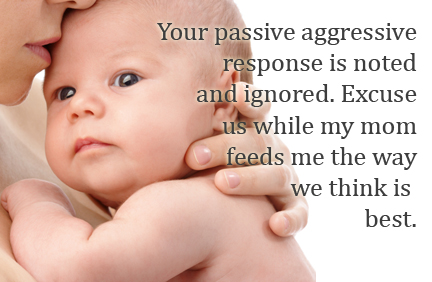
Don’t believe me? Consider the passive-aggressive, utterly tone deaf response of Fraser Health, The choice is yours: supporting moms to reach their baby feeding goals, to criticism of its breastfeeding “contract,” which I wrote about yesterday (Mom shaming is the new slut shaming). Sidney Harper, lactation consultant and Project Development Nurse, Baby Friendly Initiative, wrote:

What I find most interesting is that our culture seems to be comfortable hearing about the benefits of breastfeeding but seems uncomfortable talking about the risks of artificial baby milks or formula. Research has shown that there are higher chances of colds, flu, ear infections, diarrhea and vomiting among other illnesses with formula use.

It is easy to turn to formula when breastfeeding challenges present themselves. Mothers who deliver their babies in Fraser Health are offered support and encouragement to increase their confidence and meet their own breastfeeding goals whether in hospital or at home in their community.

Breastfeeding is normal and for most babies any breastfeeding is good. If a woman is breastfeeding but is advised by a health care provider that formula is needed, formula is given as we would give a medicine – the right amount of formula for the right period of time can be very useful.

Channeling Henry Ford who famously described the color choices for the Model T thus:

Any customer can have a car painted any color he wants so long as it is black.

For Harper,  any new mother can make any choice of infant feeding so long as it is breastfeeding.

It’s not a coincidence that lactivists like Harper and the Fraser Health “Baby Friendly” Initiative have taken a page from anti-choice activists. They both have the same aim: to conceal their true purpose while pretending that they are concerned about informed consent, trying to place any and all obstacles to formula feeding in the path of women who might choose it.

Neither group feels constrained by the truth. Reasoning that the ends justify the means, both groups routinely exaggerate and even fabricate “risks.” Seeking, above all else, validation of their personal philosophical beliefs, both groups struggle to convince women who would choose differently that those choices are wrong. Both groups have zero regard for what happens to women once they reject the disapproved choice. They care about women up to the moment that they are forced into the “correct” decision; whatever happens afterward must simply be endured by the women they have duped.

Most of is can easily recognize the tactics of anti-choice activists for what they are, mendacious attempts to force women to make approved decisions. Most of us can easily recognize that the pregnancy “support” centers have no interest in supporting pregnancy and certainly have no interest in supporting the babies that result from those pregnancies. They are exclusively concerned with foisting their philosophical views on everyone else. Their pious bleating about “informed consent” masks their true motivation.

We should recognize the tactics of lactivists for what they are, mendacious attempt to force women to breastfeed or feel guilty if they don’t We should recognize that breastfeeding “contracts” have nothing to do with supporting women in finding the choice that is best for them. Advocates are exclusively concerned with foisting their parenting views on everyone else. Their pious bleating about “informed consent” masks their true motivation.

In responding to the criticism, Fraser Health should try again. They should withdraw the breastfeeding contract immediately, and issue an apology for ever using it in the first place.

Mom shaming is the new slut shaming

Worried young woman being accused

It often seems that major appeal of natural parenting is shaming women who do not comply. Mom shaming is the new slut shaming. Take the Fraser Health hospitals new breastfeeding contract. It exemplifies everything wrong with contemporary breastfeeding advocacy: it is demeaning, infantilizing, it tramples on a woman’s right to control her own body, and it makes claims that are not supported by science. According to Jennifer Pinarski, writing in the Canadian edition of Today’s Parent:

The pressure on moms to breastfeed is real. British Columbia’s Fraser Health hospitals is asking new moms to sign an Infant Feeding Declaration. The document outlines the pros and cons of formula feeding and breastfeeding—listing the increased risks of SIDS, certain childhood cancers, obesity and diabetes with formula use. As if responsibility for a tiny, new human isn’t terrifying enough, I can only imagine how new moms struggling with breastfeeding must feel when signing the Infant Feeding Declaration.

Raina Delisle at iVillage reports:

Some highlights from the form include: “Although most babies grow on formula, studies show the routine use of formula comes with some risks to both mothers and babies.” “Even one feed of formula can damage (baby’s gut) coating and make illness more likely.” “Babies who do not receive breast milk are more likely to get significant illness and disease.” “And … mothers can take longer to lose their pregnancy weight.” So, your baby may not grow on formula, even one bottle can make him sick and the little guy is 38.5 per cent more likely suffer from SIDS. Oh, and you’ll be wearing those maternity jeans for a while longer.

WTF??!!

Four blatant lies, unsupported by any scientific evidence! Routine use of formula comes with no more risks than routine exclusive breastfeeding, just different ones. The only “risk” of exclusive formula feeding is a tiny increase in trivial neonatal illnesses. There is NO EVIDENCE, zip, zero, nada, that anything else is caused by formula feeding. The data that exists is weak, conflicting and riddled with confounders. There is NO EVIDENCE that formula IN ANY AMOUNT damages the neonatal intestinal lining, and it is a bald faced lie to suggest that there is. There is NO EVIDENCE that term babies who do not receive breast milk are more likely to get significant illnesses, the only solid evidence that exists suggests that there is a small increased risk of TRIVIAL illnesses. There is NO EVIDENCE that every woman will lose weight while breastfeeding. Weight loss depends on a myriad of factors, and some women will won’t lose weight at all while breastfeeding since it makes them ravenously hungry.

While we are on the subject of scientific evidence, there is no evidence that I am aware of that making mothers sign breastfeeding contracts improves infant outcomes (supposedly the goal) or even breastfeeding rates, the classic natural parenting elevation of process over outcome. So if there is NO EVIDENCE that breastfeeding contracts improve anything at all, why go to the time and trouble to create them, print them and get women to sign them? Why? To shame women, of course. That’s why the contract is demeaning, infantilizing, and tramples on a woman’s precious right to control her own body. It’s the mothering equivalent of slut-shaming. The parallels are really quite remarkable. What is slut shaming? According to Wikipedia:

Slut shaming … is a neologism used to describe the act of making a person, especially a woman, feel guilty or inferior for certain sexual behaviors, circumstances or desires that deviate from traditional or orthodox gender expectations, or that which may be considered to be contrary to natural or religious law. Some examples of circumstances where women are “slut-shamed” include: violating accepted dress codes by dressing in sexually provocative ways, requesting access to birth control, having premarital or casual sex, or being raped or sexually assaulted.

Mom shaming is the act of making a woman feel guilty or inferior for certain parenting behaviors that deviate from “natural parenting” expectations, which, in the minds of those doing the shaming, is considered to be natural law. Examples of circumstances where women are “mom shamed” include: “failing” at breastfeeding or worse, refusing to breastfeed; “giving in” and getting an epidural for labor pain, or worse, actually planning on it; having a C-section or worse, requesting one. Mom shaming, as in slut shaming, assumes that anything bad that happens to the mother is her fault for not trying hard enough, not trusting deeply enough, or simply having a defective body. And, as is the case with slut shaming, mom shaming has a lot to do with social class. As Marisa Taylor, reporting on a new study, explains:

The researchers discovered that definitions of “slutty” behavior and the act of slut-shaming was largely determined along class lines rather than based on actual sexual behavior. What’s more, they found the more affluent women were able to engage in more sexual experimentation without being slut-shamed, while the less-affluent women were ridiculed as sluts for being “trashy” or “not classy,” even though they engaged in less sexual behavior.

Sociology Professor Elizabeth Armstrong, one of the study’s authors, noted:

By engaging in ‘slut-shaming’ — the practice of maligning women for presumed sexual activity — women at the top create more space for their own sexual experimentation, at the cost of women at the bottom of social hierarchies.

Similarly, by engaging in mom shaming, Western, white, relatively well off women create more space for their own parenting practices, at the cost of women of color and poor women at the bottom of social hierarchies. It’s bad enough that natural parenting advocates engage in mom shaming of women who don’t mirror their own parenting choices back to them. It is completely unacceptable that Fraser Health has joined them in this odious practice.

Make no mistake. There is NO BENEFIT to a breastfeeding contract for babies or for mothers. The only people who benefit are lactivists and lactation consultants, the Western, white, well of women who simply adore shaming anyone who is not like them, and who cement their place in the social hierarchy by shaming women who won’t follow their parenting “norms.”

Fraser Health should withdraw the breastfeeding contract immediately, and issue an apology for ever using it in the first place.

Dr. Amy