Homebirth midwives and the art of emotional manipulation

iStock_000015377189Small copy

I have not forgotten about Gavin Michael and our efforts to hold midwives Christy Collins and Jan Tritten accountable for the preventable tragedy of his death. I have been in correspondence with his parents and they are currently determining how best to proceed. It may take some time, especially since they are still reeling from the loss of their baby.

Gavin Michael’s story is in many ways all too familiar to those of us struggling to educate the public about the increased risk of death at homebirth. A mother choose homebirth because she thinks she is making a safe and loving choice for her baby. Other medical professionals point out the risks, but the mother does not take them seriously. Family and friends express their worry and concern, but the mother assures them that she knows what she is doing. The situation grows steadily worse, either because a pregnancy complication is being neglected, or because a stalled or ineffective labor is being ignored. Ultimately the baby is injured or dies, even though this is the last thing that the mother imagined or wanted to happen.

The death of baby Gavin is chilling in a myriad of ways, especially because his struggle to survive played out in real time on Facebook. One aspect that I find particularly chilling is illustrated by this quote from Christy Collins apparently written in response to Gavin’s death.

Instead of … telling you to “be prepared that the perinatologist doing the NST is likely to tell you that your baby could die if he doesn’t come out;” those should have been MY words.

It’s chilling because in one sentence Collins captures the emotional dependency that she and other homebirth midwives strive to induce in their clients. Collins deliberately cut Gavin’s mother off from any medical personnel who might have helped her or Gavin by inducing such profound distrust that even if a doctor looked Gavin’s mother in the eye and told her that her baby was in imminent danger of death, she had been carefully coached in advance to reject medical advise that was both excellent and true.

I have written in the past that homebirth advocacy bears many of the hallmarks of a cult. It creates almost religious devotion to the philosophy of homebirth, places birth at the level of a deity by constant reminders to “trust birth” and demands sacrifice from acolytes, in both pain and potential injury to the baby. The most cult like aspect, however, is the emotional dependence that homebirth midwives strive to induce in their clients.

It’s no secret that 100% of the income of homebirth midwives comes from homebirth. But the economic motivation is only one factor in the determination of untrained lay people to masquerade as “midwives” even though they cannot be bothered to get a real midwifery degree. Providing medical care is not the goal for a homebirth midwife; gaining emotional power over and adulation from clients is an equally powerful goal.

The blueprint of midwife manipulation appears to be this:

To maintain your power you must always be needed and wanted. Make women depend on you and only you. To do that, you must convince the client that medical professionals are ignorant and only want to hurt her and her baby. You must explain ahead of time exactly the medical advice that these professionals will give so she will be prepared to ignore it. You must also work assiduously to isolate the client from her family and friends, emphasizing that their apparent concern is just a reflection that they are not as “educated” as she is. Makes her self-esteem utterly dependent on your approval, for the moment she trusts someone other than you, your power over her is ended.

Consider this explanation of emotional dependence and how to create it*:

Inducing Emotional Dependence

People become emotionally “hooked” on those persons who can truly satisfy their never-ending need for human understanding. The key … is to first get that person to become emotionally dependent on you… As you learn to satisfy a person’s deep-rooted emotional need for understanding, you will in time find them becoming emotionally dependent on you.

  • Be There (In Person)!
  • Listen Reflectively
  • Avoid Being Critical
  • Express Genuine Admiration And Praise
  • Supply Sympathy

It sounds like a primer for homebirth midwives, doesn’t it? Hence the hour long appointments for prenatal visits, the careful nurturing of the “friendship” between midwife and client, and the endless infantilizing praise — You are so educated! You are powerful, mama! You are a birth warrior goddess!

It’s all carefully constructed (though not necessarily consciously) to make the mother emotionally dependent on the midwife and likely to look to her for everything — medical advice, guidance, praise, support, self worth.

But like any serious attempt at inducing emotional dependence, it doesn’t rest solely on the positive. Destroying trust in others is key to maintaining emotional control. Hence it is critically important to demean modern obstetrics (“not evidence based”) and obstetricians (“they recommend C-sections only for money and convenience”) at every turn. Whether consciously or unconsciously, homebirth midwives recognize that obstetricians know far more about pregnancy and childbirth than homebirth midwives do. Therefore, it is imperative to make sure that the mother is kept as far as possible, both physically and emotionally, from real medical professionals. To that end, the midwife must be the gatekeeper between the mother and obstetricians. Only the midwife can decide whether and when the services of an obstetrician and hospital are needed. Until that moment, all her persuasive power will be bent toward keeping the mother at home.

The homebirth midwife understands (consciously or unconsciously) that the mother’s reliance on her family and friends for comfort and support threatens the exclusive power relationship that the midwife is seeking. Hence the midwife is always working to marginalize and create distrust of parents, in-laws and friends who can supplant her. They are marginalized by pointing out their lack of “education,” their culturally determined “fear of birth,” and their pathetic submission to authority figures. When all else fails, the homebirth midwife moves to have family and friends excluded from the birth itself, and in extreme situations, will physically isolate the mother and refuse entry to all others.

Christy Collins appeared to play that role to perfection in her relationship with Gavin’s mother. She even used the midwife’s trump card, the “dead baby card” to inoculate Gavin’s mother against the possibility of listening to an obstetrician. Every homebirth midwife knows that a mother will do almost anything to prevent the death of her baby. Since Christy understood that a doctor would tell Gavin’s mother that her baby might die, as zero amniotic fluid is indeed a sign of impending death, Christy prepared the mother in advance to ignore his counsel.

Christy knew that Gavin might die. She understood both that a doctor would tell that to Gavin’s mother and that it would be true. Inevitably she would lose emotional and physical control of Gavin’s mother, who would turn to an obstetrician, so she neutralized that possibility in advance by deriding the warning as the “dead baby card.”

Then Christy approached Jan Tritten, in her role as Editor of Midwifery Today, to gain support for her desire to risk Gavin’s life in order to maintain control over Gavin’s mother. Surely Gavin’s mother would go into labor soon, right? Surely Gavin would survive until then, right? Or maybe Jan and her Facebook friends might think of a way to induce labor without requiring Christy to give up emotional control of the mother. It apparently never occurred to Jan Tritten to tell Christy to place the baby’s well being over her own emotional needs. In my view, Tritten’s failure to warn Christy wasn’t merely buffoonish ignorance on Tritten’s part; it was implicit recognition and acknowledgement of the “real” task at hand, maintaining emotional control over Gavin’s mother even if at the cost of Gavin’s death.

Homebirth midwives are not medical professionals. They are laypeople who, to fulfill their own emotional needs, masquerade as “midwives,” allowing them to create emotional dependence and worship in mothers. That’s why medical knowledge is irrelevant for them. It’s not about babies and it’s not about safety. Homebirth midwifery is about homebirth midwives, and their need for power, control and adulation. Babies who die are nothing more than unavoidable, though regrettable, collateral damage.


*The explanation and list comes from a website that purports to teach people how to make others love them.

Jan Tritten’s Birth Page: to the frontier of homebirth idiocy and beyond!

expression -  There is no fool like an old fool - written on a s

If you are searching for evidence of the ignorance and incompetence of homebirth midwives and homebirth advocates, you really can’t beat Jan Tritten’s Birth Page on Facebook.

Jan’s done some editing on the page lately, what with the scandal surrounding her decision to crowd source a life and death situation on her personal Facebook page in real time while the baby was dying. Jan has removed recent posts, but for some unfathomable reason has left  the older evidence of her mind boggling ignorance.

Here’s a few examples good for laughs or expressions of horror, or both.

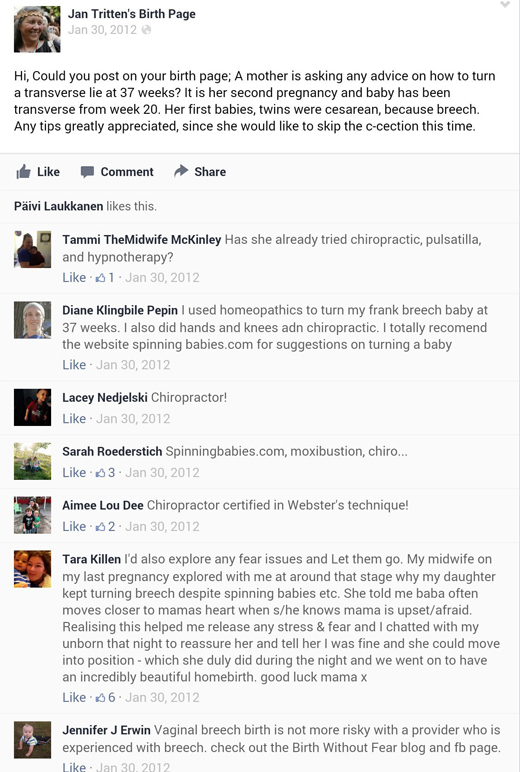
1. First we have this:

Trittens birth page 1

Jan writes (on behalf of another homebirth midwife):

A mother is asking any advice on how to turn a transverse lie at 37 weeks? It is her second pregnancy and baby has been transverse from week 20. Her first babies, twins were cesarean, because breech. Any tips greatly appreciated, since she would like to skip the c-cection this time.

Almost all the “tips” are unspeakably stupid, but the winner is Tara:

I’d also explore any fear issues and Let them go. My midwife on my last pregnancy explored with me at around that stage why my daughter kept turning breech despite spinning babies etc. She told me baba often moves closer to mamas heart when s/he knows mama is upset/afraid. Realising this helped me release any stress & fear and I chatted with my unborn that night to reassure her and tell her I was fine and she could move into position – which she duly did during the night and we went on to have an incredibly beautiful homebirth. good luck mama x

The baby senses her mother’s fear and moves closer to her heart. Really, Tara? By turning right side up, she is no closer to her mother’s heart than she was before. What is being closer to her heart do for either baby or mother? And, Tara, do you really believe that a mother’s emotions are in her heart as opposed to her brain? If so, where are they located, the atria or the ventricles?

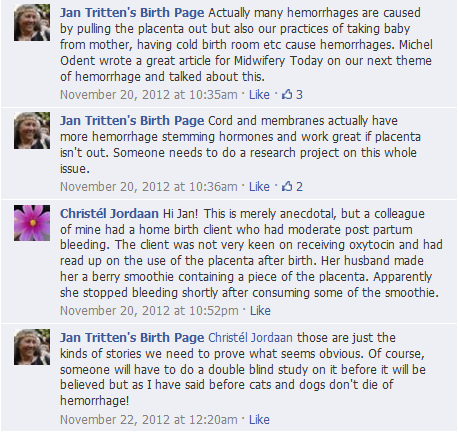
2. In this one, Jan proves she is ecumenical in her ignorance. She knows nothing about midwifery, and she knows nothing about animal husbandry, either:

Trittens birth page 2

Jan generously shares these nuggets of stupidity:

… [O]ur practices of taking baby from mother, having cold birth room etc cause hemorrhages…

Cord and membranes actually have more hemorrhage stemming hormones and work great if placenta isn’t out…

I have said before cats and dogs don’t die of hemorrhage!

3. This is the worst one of them all, but not because of the stupidity, but because of the egotism, unwillingness to take responsibility for mistakes and the apparent refusal to learn, or even try to learn, from tragedies.

Trittens birth page 3

A midwife asks:

..How does a midwife move on with confidence and trust in her skill when there is a negative outcome either due to an omission or commission on her part? What can a midwife do to heal her own heart? (my emphasis)

Tritten replies:

…Forgive yourself is a good starting point.

No, forgiving yourself is NOT a good starting point. A baby is injured or dead and the place to start is to get down on your knees and beg forgiveness to the people whose lives you have busted into a million pieces, the parents.

The next step is an investigation into what mistakes you made and why.

The third step is intensive education and practice in handling similar situations in the future so no other baby will be injured or die as a result of your ignorance or lack of training.

Forgiving yourself is not on the list, because you don’t deserve to be forgiven.

If a baby was injured or died because you didn’t understand what was happening, or you didn’t know what to do, or you pretended everything was fine and hoped the problem would fix itself, you are RESPONSIBLE for a baby’s injury or death. You should never forgive yourself because what you have done is unforgivable.

You should NEVER forget.

And you should do everything in your power to make sure that such a tragedy never happens again!

The only degree a homebirth midwife needs is a high school diploma? Seriously?

Seriously flat Xsmall

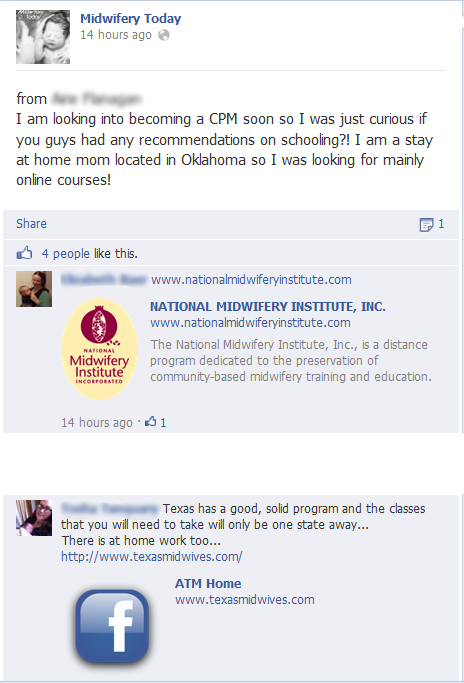
Midwifery Today posted the following query on its Facebook page:

Midwifery Today 3-6-14

In case you can’t make out the text in the image:

I am looking into becoming a CPM soon so I was just curious if you guys had any recommendations on schooling?! I am a stay at home mom located in Oklahoma so I was looking for mainly online courses!

That’s right. She plans to become a homebirth midwife by correspondence course!

If you think that’s bad, consider this: she doesn’t need any midwifery degree at all. Her high school diploma is the only degree she needs to become certified as a homebirth midwife.

Why are the standards so pathetically inadequate?

Simple, American homebirth midwives (CPMs, LMs, DEMs) aren’t real midwives. Unlike midwives in the Netherlands, the UK, Australia and Canada, who are required to have a minimum of a university degree in midwifery, American homebirth midwives aren’t required to have any formal education in midwifery. That’s very different from real midwives in the US, as well. American certified nurse midwives (CNMs) are the best educated midwives in the world with a master’s degree in midwifery.

American homebirth midwives can’t be bothered (or aren’t qualified) to complete a real midwifery degree, but they are “passionate” about birth and want to earn money from their hobby. They created credentials that are nothing more than public relations ploys, designed to convince unsuspecting women that homebirth midwives have the equivalent education and training as midwives from around the world. Nothing could be farther from the truth.

Why did these fake credentials gain a foothold in the first place?

According to Judith Rooks, CNM, MPH and long time homebirth advocate:

The PEP route to becoming a CPM seemed reasonable when it was started, but I thought it would only be used to provide an opportunity for very experienced OOH birth attendants, and that new educational programs along the lines of the Seattle Midwifery School—a direct-entry professional midwifery school based on the curriculum used in The Netherlands, would be started to provide educational opportunities for young women who wanted to start preparing themselves as midwives from scratch…

To my great disappointment, many young women who want to become midwives seem to think it is too much bother, time or money to complete an actual midwifery curriculum and think it is enough to just apprentice themselves to someone for a minimal number of births, study to pass a few tests, and become a CPM that way… (emphasis in the original)

I thought the CPM would be short-term; we have lived with it now for a long time. The data from Oregon, shows that it’s not working. The CPM credential was a stop-gap measure from the next-to-the last decade of the 20th Century. We are now in the 2nd decade of the 21st Century.

On the CPMs themselves:

…[M]any have inadequate knowledgeable, manual skills and clinical judgment. Some DEMs/CPMs say that it is the responsibility of a pregnant pregnant woman to choose her midwife wisely, but that is very hard to do.

I count on the state to not license inadequately trained health care providers. I can’t assess the skills of every professional I use. I would not hire an electrician to change the wiring in my house without someone knowledgeable exercising due diligence to assure me that the person I hire has achieved some minimal level of relevant education and prior experience (an apprenticeship). Attending lectures or reading some books isn’t enough…

Sara Snyder of Safer Midwifery for Michigan gets to the heart of the matter:

The lingering questions then become why are the minimum standards so low, especially in comparison to counterparts around the world? Why is it acceptable for midwives to aim for the cheapest, quickest route instead of striving to be their best? Why are the “certifying” bodies (ie NARM/MANA) keeping the bar so low…as in only requiring a high school diploma as of 2012 instead of requiring a college level education to deliver our babies?

Why are the minimum standards so low? Because the CPM isn’t designed to ensure competence in midwifery; it’s designed to provide a false sense of security to American women, most of whom have no idea that when they hire a CPM they are hiring someone who isn’t a real midwife.

As Rooks points out, it’s long past the time when the CPM should have been abolished. Better late than never, though. The CPM should be abolished as soon as possible.

Will American women continue to hire poorly educated, poorly trained self-proclaimed “midwives”? Some women probably will, but as long as they understand whom they are hiring, they have every right to do so.

In the meantime, anyone contemplating a homebirth needs to understand that at the moment the only degree an American homebirth midwife needs is a high school diploma.

Seriously.

Edited to correct a misattributed quote. The last quote is from Sara Snyder of Safer Midwifery for Michigan, not from Judith Rooks.

Can women be skeptics?

iStock_000026627254Small copy

It’s hardly news that the skeptic community is dominated by men. Part of the reason is pure, old fashioned gender discrimination and harassment. Apparently some male skeptics feel threatened by women and want to frighten and harm them.

Then there’s basic sexism.

For example, the aptly name Anonymous Coward has this to say on a message board:

Let’s face it. Women are more illogical than men. They have a higher rate of belief in the paranormal after all. Maybe women are just too damned sensitive to discuss theories or ideas rationally without implanting their personal emotions into the foray… It could be that women handle discussion (“confrontation”) quite differently than men and take verbal confrontation more personally then us men do… Skeptics are largely drawn from the “hard sciences” or philosophical areas which are dominated by men, I Know this, but I have also noticed very very few female athiests both in my personal life and over the internet.. why do you think this is?

Offensive, right? Women are not less logical than men. Rationalism is not the province of men alone. Women are perfectly capable of succeeding in the hard sciences and do so every day.

And yet …

I’m beginning to wonder if there is a germ of truth to the claim that there are not more women in skepticism, because women are so anxious to avoid confrontation.

Consider the case of the purportedly skeptic website, Grounded Parents,an offshoot of Skepchick.

I wrote recently about the hatchet job published by Grounded Parents that Jamie Bernstein did on my analysis of the statistics from a paper recently published by MANA (Midwives Alliance of North America, the organization that represents homebirth midwives) in the Journal of Midwifery and Women’s Health. Her take-down was sloppy and intellectually lazy, including as it did at least 8 separate errors of fact, of numbers or of math. Frankly, I felt Bernstein and Grounded Parents owed me an apology and well as owing their readers a correction of the many egregious errors.

Instead, Bernstein and Grounded Parents doubled down on their intellectual sloth and published yet another piece filled with egregious errors.

This time I’m not the only one complaining. Both math/statistics professor Brooke Orosz, PhD and ios9 blogger Esther Inglis-Arkell, who wrote about the MANA statistics, charged Bernstein with making claims that, in the words of Inglis-Arkell, are “disingenuous, if not outright false.”

Moreover, it is crystal clear to anyone who knows anything about the homebirth safety debate that Bernstein has absolutely no idea what she is talking about. Both she and Grounded Parents seemed to be entirely unaware that there are two kinds of midwives in the US, and that the MANA paper is concerned, not with real midwives, but with lay people who have awarded themselves as midwifery “credential.” Bernstein appeared to have no clue that 3 of the 6 authors of the MANA paper are homebirth midwives, and 5 of the 6 are affiliated with MANA itself. Bernstein and Grounded Parents demonstrate no recognition of the fact that American homebirth midwives are nothing like real midwives (certified nurse midwives, CNMs) or midwives in Europe, Canada and Australia.

Jamie Bernstein and Grounded Parents have violated one of the fundamental tenets of skepticism, rigorous scientific analysis.

But that’s not the big problem. Plenty of people, men and women simply aren’t that rigorous and don’t know enough science to accurately assess what they are writing about.

The larger problem is that Grounded Parents violates two other tenets that I think are basic to skeptical argument and related to each other. Grounded Parents, and Skepchick itself discourage free-wheeling debate by moderating and censoring comments that they don’t like. And they appear to place a premium on women being “nice” to each other.

I, and others, have found that our comments are moderated out of existence if the author and editor don’t like them.

According to the Skepchick comment policy:

We may ban you without warning or apology for the following reasons [including]:

not positively advancing the discussion [or]

derailing

This site is our house, and we reserve the right to kick out anyone who is making it an unpleasant place to hang out. Further, if you are particularly awful, we reserve the right to warn all of our blogger friends about you and make your email and IP public. In extreme cases, we will turn over all your information to the police.

No, this is not a violation of your freedom of speech. We are not the US government.

No, it’s not a violation of freedom of speech, but it is a violation of the principles of skepticism.

You cannot be a skeptic and censor debate. Yes, you can remove racism and other evidence of hatred or discrimination. Yes, you can remove comments that are not on point. But you can’t censor comments that you don’t like and still call yourself a skeptic.

Why is there censorship on Grounded Parents and Skepchick? Apparently, because they want us all to behave like ladies and be “nice” to one another.

Indeed, the author of a front page post on Skepchick today seems to express this view:

… [E]ach of us has in their power in every single moment, an opportunity to lead by positive example to make the world a better place each and everyday. A place where we can peacefully co-exist and grow without religion and without superstition as a driving force.

The skeptic and atheist communities have been riddled with negativity lately. But it is in our power to change that, starting today. If even half of the people who self-identify as skeptics or atheists made a promise to actively do better, we would, as a whole, become the leaders that the world needs…

Positive examples? Riddled with negativity? These are the words that women have always been told. Be nice! Don’t make others look bad! Don’t hurt anyone’s feelings! Act like a lady!

These are the words of people who value being “nice” above being correct. It’s downright embarrassing. No website can lay claim to the adjective “skeptic” if their prioritize harmony above intellectual rigor.

So can women be skeptics? Of course they can. They have the same ability to succeed in science as men, the same ability for rational thought as men, and the same inherent ability to give as good as they get in free-wheeling debate.

But when a website designed by and for skeptical women censors comments so that authors’ feelings won’t be hurt, and to erase “negativity,” they send a terrible message to women. That message?

It’s more important for women to be “nice” to each other than to be intellectually rigorous and vigorous in promoting rational thought.

Is it really surprising then that there aren’t more women in skepticism?

Wait, what? The “unreliable” CDC homebirth data is suddenly reliable?

iStock_000008930276XSmall

I am not a shy and retiring person. Indeed, my aggressive online persona is the subject of frequent comments of the web (“Dr. Amy is so meen!”) But when it comes to brazeness, professional homebirth advocates leave me in the shade.

You have to be pretty brazen to tell a bald faced lie and then turn around a month later and say the exact opposite.

Case in point, the homebirth data from the CDC Wonder database. The Midwives Alliance of North America (MANA), the organization that represents homebirth midwives, published a study in which they claimed that their analysis of nearly 17,000 births attended by homebirth midwives found that homebirth is “safe.” There was just one teensy, weensy problem. The authors of the study never compared homebirth in the years 2004-2009 for comparable risk women who gave birth in the hospital in the same time period. Had they done so, it would have been obvious that their own data showed that homebirth increased the risk of perinatal death by a whopping 450%.

When I and others pointed out that MANA had not compared their death rates to the only relevant comparison group, they responded by claiming that they couldn’t make the comparison because the CDC birth certificate data on homebirth is inaccurate.

According to MANA:

Why doesn’t the Cheyney study compare home birth to hospital birth mortality rates?

It makes sense to want to draw these comparisons. However, hospital rates in the U.S. are derived from vital statistics data (birth certificates and/or death certificates). A number of organizations, including the American College of Nurse Midwives and Citizens for Midwifery have spelled out the limitations, which include a failure to capture the intended place of birth and inaccurate reporting of some outcomes (my emphasis).

CDC Statistician (and Editor-in-Chief of the Lamaze journal Birth: Issues in Perinatal Care) Marian MacDorman went so far as to tell The Daily Beast:

Most of the alarmist studies come from data pulled from vital-statistics data, from birth certificates and infant death certificates that are linked together. These administrative records “aren’t designed for research… There are quite a few limitations in using that data for that kind of analysis.

First, the researchers aren’t able to follow women who intend to deliver at home but later transfer to the hospital, which removes trauma patients from home-birth statistics. Then home-birth data fail to account for planned vs. unplanned births. (my emphasis)

Other media outlets, including Time, published these claims.

Imagine my surprise, then, when I woke up today to find professional homebirth advocates touting the latest report from the CDC that shows the rate of homebirth in the US has increased to its highest level since 1990.

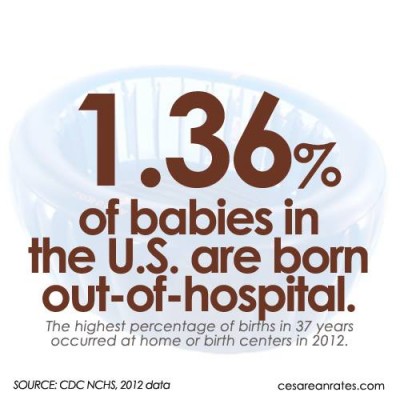
For example, Jill Arnold of the Unnecessarean and Cesareanrates.com is promoting this graphic on her Facebook page and Twitter feed.

Homebirth rates

Where did she get the data for that claim? From the CDC! The new Data Brief Trends in Out-of-Hospital Births in the United States, 1990–2012. The authors of the Data Brief note:

In 2012, 1.36% of U.S. births were born outside a hospital, up from 1.26% in 2011.

Not all of these are planned homebirths:

88% of home births … were planned in 2012

How do they know?

This report is based on data from the Centers for Disease Control and Prevention’s National Center for Health Statistics National Vital Statistics System, Birth Data Files for 1990–2012. These data files include data for all births occurring in the United States and include information on a wide range of maternal and infant demographic and health characteristics…

Reporting of separate data on home and birthing center births began with the 1989 revision of the U.S. Standard Certificate of Birth. Prior to 1989, births were reported as occurring in or out of a
hospital, with no detailed breakdown of type of out-of-hospital birth.

The 2003 revision of the U.S. Standard Certificate of Birth added a data item on planning status
of home birth…

Wait, what? I thought that Marian MacDorman, MANA, the American College of Nurse Midwives and Citizens for Midwifery said that birth certificate data is unreliable for place of birth.

Who dared to based a study on that exact same data?

The lead author of the new report is … Marian MacDorman!

See what I mean? You have to be pretty brazen to claim, with a straight face, in early February that MANA couldn’t and shouldn’t compared its death rates with CDC data because birth certificates are unreliable for place of birth, and then, less than a month later, publish a report touting an increase in the number of homebirths in the US based on THE EXACT SAME birth certificate data.

One of those claims is a bald faced lie. Considering that Marian MacDorman has published a CDC report BASED on the data she claimed was “unreliable” only a month ago, she must believe that it is quite reliable indeed.

MANA knows that, too. But the only way they could think of to hide their hideous death rate was to avoid comparing it to the CDC data. And when they were called on that deception, they responded with an even bigger deception, the claim that the CDC data is unreliable for place of birth.

I’d be curious to know what those who call me too aggressive in pointing out the dangers of homebirth call people who lie to them one month and turn around and expect them to believe the exact opposite the following month. How about aggressive in hiding the dangers of homebirth, and brazen in their belief that their followers are so foolish and gullible that they won’t remember what professional homebirth advocates have said from one month to the next?

My online persona may be aggressive. It may be “meen.” I may really be an SOB. But at least I respect the intelligence of my readers, both those who agree with me and those who disagree. That’s a lot more than you can say for professional homebirth advocates.

Who has the greater incentive to lie about deaths at homebirth, obstetricians or midwives?

Greater financial incentive flat Xsmall

Follow the money!

At first glance, it appears that this is one of the most persuasive arguments marshaled by homebirth advocates. Obstetricians supposedly oppose homebirth because it represents a loss of income. They supposedly lie about the risk that the baby will die at homebirth for no better reason than to preserve their profits. This argument appeals particularly to those who like to believe that they cannot be duped by authority figures or are in possession of secret, special knowledge that makes them more “educated” than the rest of us.

But a closer look demonstrates something else entirely. If anyone has a motivation to lie about the risk of death at homebirth, it is homebirth midwives.

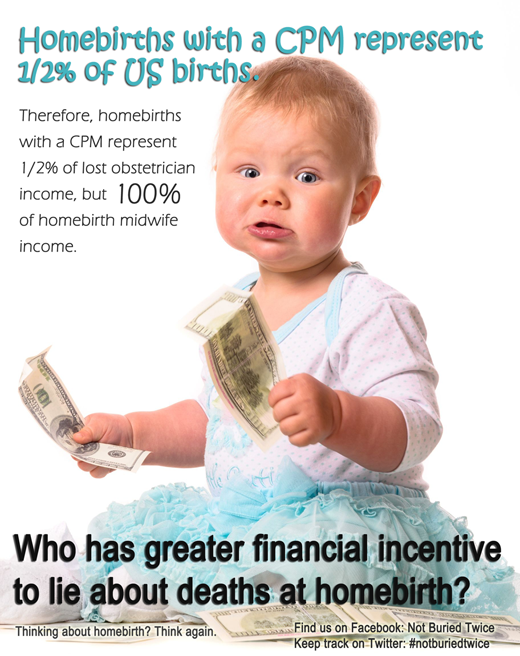
Why? At the moment, homebirth with an American homebirth midwife represents approximately 1/2% of US births each year. That translates to 1/2% loss of obstetric income for OB-GYNs and no loss of gynecology income, meaning that for most OB-GYNs, homebirths represent a potential loss of income of around 1/4%. That’s hardly likely to be a motivation for scare mongering. Moreover, there is currently a shortage of OB-GYNs willing to deliver babies, so there’s no reason to believe that homebirth with a homebirth midwife represents any loss of income for doctors who practice obstetrics.

On the other hand, homebirth represents 100% of the income of homebirth midwives. They charge upwards of $3000 per patient, often in cash, often paid in advance, non-refundable and typically not covered by health insurance. It is an especially impressive amount of money considering that American homebirth midwives require no more than a high school diploma, and no further formal schooling of any kind, to be eligible for the homebirth midwifery certification of CPM (certified professional midwife). There aren’t many people with only a high school education who can command that kind of money, and for most homebirth midwives, they cannot possibly earn as much in any other way.

So you tell me who has the greater financial incentive to lie about the risk of perinatal death at homebirth, obstetricians, for whom homebirth represents no loss of income, or homebirth midwives (CPMs, LMs, DEMs and lay midwives), for whom homebirth represents 100% of income.

In memory of Gavin Michael

notburiedtwice

Early today I received an email from the grandfather of the baby who died after Jan Tritten, Editor of Midwifery Today, and Christy Collins, CPM, the homebirth midwife caring for his mother, crowd sourced a life and death decision on Facebook. While Tritten and her Facebook friends were pondering his dire condition, Gavin died. After his death, Tritten and Collins tried to erase Gavin’s existence by deleting posts that they had written and by deleting and banning anyone who questioned them about the baby’s death.

On Friday, I received additional information about the circumstances surrounding Gavin’s death. Now Gavin’s grandfather has given me permission to share his email message below:

I want to say thank you and God Bless you for what you are doing to put the word out about what is going on with midwives and how things go deathly wrong. I am the grieving grandfather of Gavin Michael who died in Las Vegas on Feb 20 as a direct result of what Mid wife Christy M Collins didn’t do. My wife, family and I want to do anything we can to help get the word out and try to prevent this from happening to other families and to hopefully save other babies. God Bless you and please may we be in touch in the future?

Lee Grant Yeager

Thank you Mr. Yeager. I want to assure you that many people are working to be sure that Gavin is #notburiedtwice by the homebirth midwives involved in his death.

No, the new PLOS study does NOT show that C-sections cause obesity

overweight woman biting cake

What would you say if I told you that a study was just published that showed that visiting Weight Watchers causes obesity?

The authors looked at more than 150,000 people across multiple states and found that those who visited Weight Watchers were 25% more likely to be obese. This relationship was true for all subgroups: male, female, white, African-American, and across all ages.

I can imagine you rolling your eyes, but wait! How about if I added the the authors had provided all manner of charts, including funnel plots, and corrected for publication bias?

I bet I know what you would say (after you picked yourself up from rolling on the floor laughing). You’d point out that Weight Watchers doesn’t cause obesity. You’d probably point out that the people who visit Weight Watchers differ substantially from the people who never visit Weight Watchers. At a minimum, the people who visit Weight Watchers are more likely to be obese to begin with.

You’d be right. In other words, the study is meaningless if the authors did not correct for confounding variables. The investigators might have identified a correlation between visiting Weight Watchers and obesity, but that doesn’t mean that visiting Weight Watchers causes obesity. In fact the opposite is true, being obese makes it more likely that you will visit Weight Watchers.

There is no study that shows that visiting Weight Watchers causes obesity, but if you understand that example, you will understand why the new study published in PLOS ONE, Mode of Delivery and Offspring Body Mass Index, Overweight and Obesity in Adult Life: A Systematic Review and Meta-Analysis, by Darmasseelane, Hyde, Santhakumaran, Gale, and Modi is equally meaningless.

What did the authors do?

15 studies with a combined population of 163,753 were suitable for inclusion in the meta-analysis. Comparing all CS to VD in pooled-gender unadjusted analyses, mean BMI difference was 0·44 kg·m-2 (0·17, 0·72; p = 0·002), OR for incidence of overweight was 1·26 (1·16, 1·38; p<0·00001) and OR for incidence of obesity was 1·22 (1·05, 1·42; p = 0·01). Heterogeneity was low in all primary analyses. Similar results were found in gender-specific subgroup analyses. Subgroup analyses comparing type of CS to VD showed no significant impact on any outcome.

In other words, they found that for people born by C-section, the risk of obesity in later life was increased by 22%. The association was robust, meaning that it was found in most subgroups, but it is actually rather small.

But it is well known that women who undergo C-section differ substantially from those who do not. They are more likely to be obese themselves, more likely to be carrying large babies and more likely to have gestational diabetes, which impacts metabolism. The authors are aware of this, and even mention it, but they do not correct for these confounders, making their conclusions rather suspect.

In media interviews, the authors have indulged themselves in flights of fancy:

Study co-author Dr. Matthew Hyde suggested possible ways that C-sections might influence later body weight.

“The types of healthy bacteria in the gut differ in babies born by cesarean and vaginal delivery, which can have broad effects on health,” Hyde said in the news release. “Also, the compression of the baby during vaginal birth appears to influence which genes are switched on, and this could have a long-term effect on metabolism.”

No, Dr. Hyde, we have as yet no evidence that the differences in gut flora in the first few days of life have any impact on health, let alone broad effects. Furthermore, I am unaware of any studies that show that “compression” of the baby influences which genes are switched on, let alone whether that affects metabolism.

Speaking to The New York Times, Dr. Hyde said:

… [A] woman cannot make a reasoned choice [about a C-section] unless she’s fully informed not only about the short-term outcomes, but also the long-term outcomes. We want to give you the data you need to make an informed decision.”

But you haven’t given us that data, Dr. Hyde. You haven’t given us any evidence of any causal relationship.

In the paper, the authors are a bit more circumspect:

… [S]everal factors associated with increased risk of CS are also associated with increased BMI in offspring, including high maternal BMI [70], gestational diabetes [71], and lower socioeconomic status . Of these, maternal obesity is probably the most significant confounding factor in the relationship between CS and offspring BMI. This needs elucidation in datasets which can be properly controlled for maternal BMI. (my emphasis)

No fooling!

Simply put:

Although the authors analyzed data from more than 150,000 individuals, although the relationship between C-section and obesity was found in most (but not all) subgroups, although the authors provide all sorts of elaborate tables and charts, they never corrected for confounding variables, meaning that they are not entitled to conclude anything about a causal relationship between C-sections and obesity.

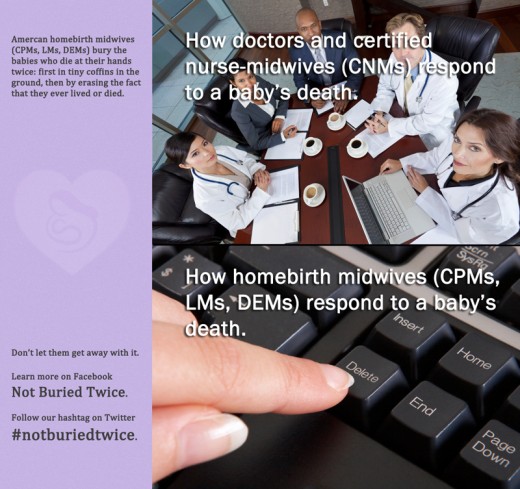
How homebirth midwives respond to a baby’s death

Interracial Medical Business Team Meeting in Boardroom

If you needed any more evidence that homebirth midwives (CPMs, LMs, DEMs) are not medical professionals, compare the way that they respond to the death of a term baby with the way that real medical professionals respond.

For doctors and certified nurse midwives (CNMs) there would be a lot of soul searching both informal and official. At a minimum, the case would be presented at weekly Grand Rounds and discussed with the entire department. The obstetricians and CNMs involved would most likely be required to meet with the head of the Obstetrics department to explain what happened and to determine how to prevent it from ever happening again. There might be grief counseling for the nurses, midwives and physicians and there would be teaching conferences arranged to reinforce safety procedures.

Contrast that to the response of the midwives involved in the debacle of crowd sourcing a life and death situation on Facebook while a baby was literally dying. Christy Collins, CPM was the midwife caring for the patient, and Jan Tritten, Editor of Midwifery Today, crowd sourced the case on Facebook and provided real time follow up on the death of the baby. The mother was 2 1/2 weeks over her due date, and ultrasound revealed that there was no longer any amniotic fluid, a sign of severe fetal compromise and impending death. The appropriate treatment was to induce this mother as soon as possible, and, at the first sign that the baby was not tolerating labor, to proceed to an emergency C-section.

Let’s leave aside for the moment the asinine comments of the homebirth midwives who were discussing the case on Facebook. Stevia? Accupuncture?

Let’s look at how these midwives and the homebirth community as a whole responded to the preventable death of a baby.


1. Violating patient privacy by sharing details on Facebook


image


2, Lying. I asked Christy on her own Facebook page whether she was the primary midwife in the case. She responded by deleting my question, deleting the entire area on her Facebook page where people can ask questions, and she sent me a Facebook message:

No, I’m not, but enough details had been passed around to select midwives to realize it was not what got created on Jan’s page, and it was NOT Jan. Someone needed to say something …


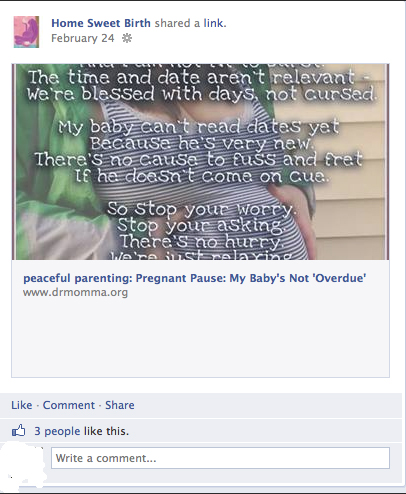
3. In an unspeakably insensitive and witless move, linking to an idiotic poem (??!!) implying that there is no danger to a baby in a pregnancy that goes overdue.


Home Sweet Birth poem

This is the poem:

Pregnant Pause

My baby’s not a library book,
So he’s not overdue.
My baby won’t take too long to cook
‘Cause he’s not veggie stew.

My baby’s not an elephant.
And I am not fit to burst.
The time and date aren’t relevant –
We’re blessed with days, not cursed.

My baby can’t read dates yet
Because he’s very new.
There’s no cause to fuss and fret
If he doesn’t come on cue.

So stop your worry.
Stop your asking.
There’s no hurry.
We’re just relaxing
In this golden pregnant time,
This pause… just his and mine.

Now, you leave us be…
We are just fine.

~Rachel Pritchard

Collins linked to this only 4 days after the baby died, possibly even before the baby was buried.


4. Sending a letter simultaneously admitting guilt and attempting to blame the mother.

Instead of … telling you to “be prepared that the perinatologist doing the NST is likely to tell you that your baby could die if he doesn’t come out;” those should have been MY words. You might have been really pissed at me for pushing you into a corner where you felt you didn’t have a choice, but … I wouldn’t care… I am angry at myself for being the midwife who tried to be as firm but gentle as possible when advising to go in when I could’ve waved the dead baby flag …

I blame me. I would rather have you hate me for pushing you harder into a bad birth experience … so you could hold a live baby instead.


How about Jan Tritten, the midwifery clown who thought the appropriate response to a baby showing every sign of imminent death was to discuss it with the other midwife clowns who are her Facebook friends?

5. Tritten deleted her Facebook post and all the responses. But the Internet never forgets and you can download and read the whole thing here:

Tritten thread


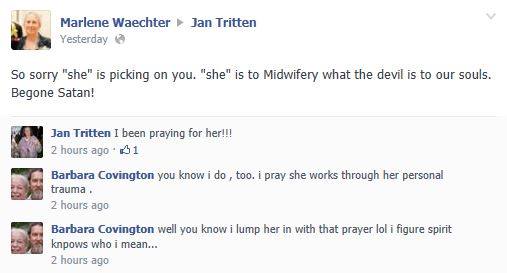
6. Tritten disappeared. She has been conspicuous by her absence. She is apparently hoping that she can ride out this disaster by ignoring it. She did surface to say that she is “praying for me” even though I am Satan.


Waechter 2


7. Tritten has offered no apology for her grossly unethical, unprofessional behavior.

How about the wider midwifery community?

8. With the exception of one homebirth midwife, there has been absolute silence from the midwifery community. Indeed one might call it a conspiracy of silence. Homebirth websites have refused to discuss the tragedy and have deleted posts and comments from those who have tried to discuss the tragedy.

9. Professional homebirth organizations, including Midwifery Today and the Midwives Alliance of North America have refused comment despite being bombarded by Facebook messages and Tweets.


The bottom line is that the homebirth community, both the midwives who were involved, and the organizations and individuals who promote homebirth have invoked standard operating procedure: Bury the baby in the ground and then bury the fact that he ever existed so no midwife will be held accountable for the death, and no American women will learn that homebirth midwives are ignorant, incompetent fools who let babies die preventable deaths.

But this time, we’re not going to let homebirth midwives bury a baby twice. We are not going to let Christy Collins and Jan Tritten avoid accountability. We have started a petition drive (557 signatures so far), a Facebook page for the Not Buried Twice campaign, and one particularly brilliant commentor devised the perfect Twitter hashtag #notburiedtwice.

Next step?

Convince skeptic bloggers, mommy bloggers and mainstream websites like Salon and Slate, that babies who die at the hands of homebirth midwives are worthy of their concern.

Dr. Amy