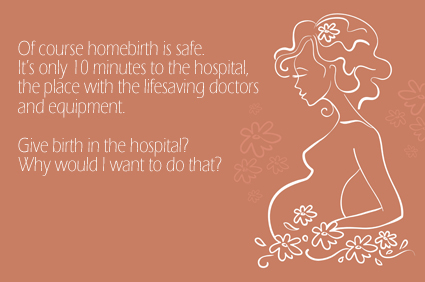
Why treat my high blood pressure? I live only 10 minutes from the hospital.

My doctor says my blood pressure is high at 160/100 and wants to start me on  blood pressure medication.

I was shocked because I do everything right. I eat lots of kale, exercise everyday, and have a normal BMI. How could I have high blood pressure? My doctor explained that as people get older, their blood vessels stiffen and blood pressure rises in response… and she expects me to believe that something that happens in the normal course of aging is pathological.

I bet she was surprised that I didn’t respond like all the other sheeple and accept her explanation and take the prescription for medication. I, unlike those fools who simply follow their doctors’ advice, refused. I have done my research and I know that the doctor is simply fear mongering.

I can’t really blame her. She’s been socialized by a medical system that insists on viewing the normal changes of aging as pathological. She probably thinks she has my best interests at heart when she warns me that high blood pressure increases the risk of heart attacks and strokes, but have educated myself about blood pressure and I can’t be fooled. I, like many of my friends on the Home Blood Pressure and Unassisted Blood Pressure forums on Narcissism.com, are no longer going to respond with fear when a doctor plays the “dead-person” card.

From my extensive research on Google and at various blood pressure blogs, I’ve learned 10 reasons to reject blood pressure medication:

1. My body is not broken. Even my doctor acknowledged that increased blood pressure is often part of normal aging and I am sick and tired of doctors pathologizing aging bodies.

2. The human race has survived tens of thousands of years without blood pressure medication. If high blood pressure were really as dangerous as my doctor claims, we wouldn’t be here now.

3. I know plenty of people who never treated their high blood pressure and lived to old age. My own grandmother refused to take the blood pressure medication prescribed by her doctor and she died at age 85.

4. Treating high blood pressure is big business for drug companies and doctors. Did you know that 3 of the top 10 most prescribed drugs in the US are high blood pressure medications? If that doesn’t indicate a conspiracy between Big Pharma and doctors, I don’t know what does.

5. Have you ever read the package inserts for high blood pressure medications? Look at all the possible side effects. Why would I want to risk that?

6. My doctor insists that high blood pressure leads to heart attacks and strokes, just because it is far more likely to have a heart attack or stroke if you have high blood pressure. But the fact is that most people with high blood pressure don’t have a heart attack or stroke. Many of them die of cancer, or diabetes or Alzheimer’s so it is wrong for doctors to play the “dead person” card to every person who has high blood pressure.

7. The US spends a massive amount of money on high blood pressure medication, but all older Americans eventually die anyway showing that treating high blood pressure is ineffective.

8. Heart attacks and strokes don’t necessarily lead to death or even to permanent damage. I know plenty of people who have had heart attacks and didn’t die. I know plenty of people who had strokes and didn’t die either. Yes, some of them have partial paralysis and others can’t speak, but some people are just meant to be paralyzed and aphasic and it would have happened whether they followed their doctors’ advice or not.

9. Since most people with high blood pressure don’t have heart attacks or strokes, there is no reason to over treat everyone who has high blood pressure. We should wait to treat only the people who do have heart attacks or strokes. We can do angioplasties, bypass surgeries or give clot busting drugs once we know exactly who has had a heart attack or stroke.

10. Everyone knows that the first hour after heart attack or stroke is a “golden” hour. Heart attack and stroke victims are much more likely to survive if they get treatment in the first hour. Since I live only 10 minutes from the hospital there is really no reason for me to treat my high blood pressure. If I have a heart attack or stroke I have plenty of time to get to the hospital before that hour is over.

So that’s why I am not going to respond to the “dead person” card, contribute to the profits of Big Pharma and follow all the other sheeple who take high blood pressure medication for no better reason than that they have high blood pressure. I may be old, but my body is not “broken” and if I am one of those unfortunate few who does have a heart attack or stroke I can transfer quickly to the hospital since I only live 10 minutes away.

There is way too much fear surrounding blood pressure these days. It hasn’t always been this way. For countless generations we have survived without blood pressure medication and I intend to die live the way nature intended. I personally feel empowered by rejecting blood pressure medication; I feel empowered by ignoring my doctor; I especially feel empowered by boasting to my friends on Narcissism.com that we are the truly educated and that everyone else is an idiot.

I will conclude with a shout out to to natural childbirth and homebirth advocates who, through their rejection of modern obstetrics, have convinced us to reject modern cardiology and neurology as well. It’s time we take back blood pressure from doctors in the exact same way that they have taken back birth. I’m sure we’ll be every bit as successful at preventing death and serious injury as homebirth advocates are, since our logic is just as impeccable. And if we’re not, we’ll take yet another page from their playbook and simply hide our death rates!


This piece is satire. The inane “reasoning” of homebirth advocates, however, not satire.

It was an awesome experience … too bad the baby died

Having an unassisted homebirth after five c-sections was an awesome experience. It was my easiest labour and birth. I could do whatever felt comfortable with and be in any position.

There was just one teensy, weensy problem: the baby died.

We had many discussions about how and where we should have this baby. Having had five c-section and two natural births we knew any doctor/ob would push for another c-section. We did a lot of praying but didn’t get many answers! We felt a peace about a natural birth, labouring at home and going to hospital if time allowed.

There was time, but they didn’t go to the hospital.

 By around 6am I got the feeling that this was going to be it! Mike got up and started slowly packing up the bus. He did a lot of praying about whether to go to the hospital or stay put. At 7.30am my waters broke! They were clear which was good. Contractions picked up a bit but were still not unbearable. I coped by supporting my weight on the hand rails of the bus! (Glad we hadn’t removed them!)  I started to feel a bit pushy around 8.30am so we made the decision to stay put. At 9am our 9lb 9oz daughter slid silently into the world into the waiting arms of her daddy. The cord was (loosely) round her neck but Mike could easily slip it off. We noticed too that the cord was already white and not pulsing.  We immediately realised that something was wrong – she was purple, limp and not breathing!

Paramedics ultimately resuscitated the baby, but she had suffered massive brain damage. The parents made the decision to remove life support and the baby died.

What we believe happened the cord prolapsed when my waters broke trapping it between Serenity’s head and the cervix. So she was about 1 – 1 1/2 hours without oxygen before she was born.

Was this a good home birth?

The outcome was a dead baby, but we all know that the process is much more important than the baby, and when it comes to the process of this baby’s birth, the mother had an “awesome” experience. In the world of homebirth narcissism and self absorption, what could be more important than that?

Human rights in childbirth: does the baby have any?

I’ve noted in the past that homebirth and natural childbirth advocates love mantras and memes. They represent simple ways to communicate complex ideas, make wonderful sound bites, and for advocates, whether or not they are true is irrelevant.

I’ve written about the “obstetricians ignore the scientific evidence” mantra, which doesn’t make sense if you think about it for any length of time.

We are supposed to believe that obstetricians (with 8 years of higher education, extensive study of science and statistics, and four additional years of hands on experience caring for pregnant women), the people who actually DO the research that represents the corpus of scientific evidence, are ignoring their own findings while NCB advocates (generally high school graduates with no background in college science or statistics, let alone advanced study of these subjects, and limited experience of caring for pregnant women), the people who NEVER do scientific research, are assiduously scouring the scientific literature, reading the main obstetric journals each month, and changing their practice based on the latest scientific evidence.

I’ve also written about the meme that the media is to blame for the pain of childbirth.

… Childbirth is not inherently painful; its depictions in popular media like TV shows and movies tricks women into believing that childbirth is painful. Hence the otherwise inexplicable preoccupation on NCB blogs with how childbirth is portrayed in specific TV shows and movies.

That one isn’t getting much traction since it is obvious that it isn’t true. The people who wrote the Bible thousands of years ago were so impressed by the pain of childbirth that they explained it as God’s punishment, and they weren’t exposed to many TV shows or movies.

The latest meme in homebirth and natural childbirth circles is “human rights in childbirth.”

That’s the name of a conference organized by, for and restricted to homebirth advocates. And it figures prominently in a new film make the rounds in homebirth and natural childbirth circles, Freedom for Birth.

Freedom for Birth is a new 60 minute campaigning film that re-frames Human Rights as the most pressing issue in childbirth today.

In many countries around the world, women are being denied the most basic human right of autonomy over their own bodies. They cannot choose how and where to give birth. Those that persist in their desire to have a normal, physiological birth are sometimes forced by judges to surrender to surgery or threatened with having their babies taken away by child welfare services.

In other words, the meme of human rights in childbirth refer to the rights of the mother.

Let’s leave aside for the moment the fact that there is no legal or ethical right to have a homebirth; the right of autonomy allows for the refusal of hospital care (or any medical care), but it does not mandate an obligation on the part of others to provide a specific form of care.

Let’s ask an obvious question: does the baby have any human rights in childbirth?

The baby? You remember the baby, the other individual whose life is at stake during the process of birth? What about the baby?

I’m not talking about legal rights. Children have virtually no legal rights before birth. I’m talking about moral rights. When a mother makes the decision to take a pregnancy to term, does the baby have a moral right to receive appropriate and life-saving medical care?

Let me be very clear: I’m not talking about the rare situation in which the mother’s life is pitted against the life of the baby. The mother has the unfettered right to determine treatment in that setting. But homebirth and natural childbirth advocates are not talking about that situation, either. As the movie details make clear, homebirth and natural childbirth advocates are talking about the “desire to have a normal, physiological birth.”

So in a very real sense, the question is: Does a baby have a moral right to receive life-saving medical care when the mother is refusing it for no better reason that to have a specific birth “experience”?

Philososphy Professor Julian Savulescu and obstetrician Lach De Crespigny of the Oxford University Centre for Practical Ethics believe that a baby does have that moral right.  They make their case in an article entitled The Continuing Tragedies of Home Birth and the Rights of the Future Child.

The authors acknowledge:

… [T]he fetus has few ethical or legal rights; maternal autonomy includes the right to risk perinatal death as well as her own death. Ultimately women have autonomy regarding whether to take such risks. Professionals and pregnant women have an ethical obligation to minimise risk of long term harm to the future child; harm to people who will exist is a clear and uncontroversial morally relevant harm. Consistent with this, antenatal care focuses on minimizing the risk of harm to the future child, whether by advocating for alcohol abstinence in pregnancy, folic acid supplementation to reduce the chance of neural tube defect, or minimizing teratogenic risks of medications in pregnancy.

But:

Maternal and perinatal mortality are truly tragic outcomes. Professionals must encourage women to deliver in a safe environment and also practice safe and competent obstetrics. The professional bodies and the law must do all they can to ensure this happens.

… [T]he silent tragedies are not the deaths, but the long term disability that results from homebirth. And it is this risk that weighs most heavily against homebirth.

What disability? When a baby is obstructed in labour at home, or born with hypoxic brain injury, the delay in transferring to a tertiary hospital may result in permanent severe disability that will persist for the rest of that person’s life. In some cases, that disability was avoidable if the delivery had occurred in hospital. To take an extreme example, a person might be avoidably quadriplegic.

Now what risk could should a parent take to have “a really lovely spontaneous birth at home” that justifies quadriplegia? One in 1000? One in 1000 000? Anything?

We contend that the choice to have “a really lovely spontaneous birth at home” is only justified if exposes the future child to zero risk of avoidable disability. And this is just never the case. (my emphasis)

I would agree. Simply put, an unborn term baby has a moral right to receive potentially life-saving medical care, and that moral right is not trumped by something as trivial as the mother’s desire for a specific birth “experience.” This is analogous to a right of a child already born to receive life-saving medical care. That is a legal as well as a moral right. The parents’ desire to avoid medical care, to substitute prayer, or to simply ignore the child’s distress pales into insignificance next to the child’s legal right to life-saving care.

And as Savulescu and De Crespigny note, there is more at stake than simply the child’s right to live. The child also has a moral right to be born with the full complement of brain cells and potential that it possesses at the start of labor. The child has a moral right to receive care that minimizes the risk of brain injury and that mother’s desire for a specific birth “experience” pales into insignificance next to that moral right.

So the next time a homebirth or natural childbirth advocate insists that childbirth is a human rights issue don’t hesitate to ask the obvious question: what human rights in childbirth does the baby have?

Cochrane Review on homebirth is a piece of garbage

Is jumping out of plane without a parachute dangerous?

Suppose that the folks at the Cochrane Review searched the scientific literature for randomized controlled trials that compared jumping out of plane with and without a parachute. Not surprisingly, there aren’t many studies like that.

Suppose that they discovered one study that looked at 11 people who jumped out of planes with and without parachutes. Any study that looks at only 11 people isn’t large enough to draw any conclusions. Would it therefore be acceptable for them to write the following?

There is no strong evidence from randomized trials to favor jumping either with or without a parachute.

Would it be acceptable for them to send out the following press release?

A new Cochrane Review concludes that all countries should consider allowing people to jump out of planes without parachutes.

That would be idiotic, right? The best thing we could say about such a study is that it is shockingly irresponsible. When randomized trials cannot be performed because letting people jump out of planes without parachutes would be unethical, we are not entitled to conclude that there is no evidence to favor jumping with or without parachutes. We are not entitled to conclude anything at all. So any study that drew that conclusion would be a piece of garbage.

That’s why the folks at the Cochrane Review owe the scientific community an abject apology for publishing a “study” on homebirth that amounts to a piece of garbage.

Homebirth advocates including the Midwives Alliance of North America are declaring that the Cochrane Review on homebirth shows that “planned home birth…as safe as planned hospital birth…w/ less intervention & fewer complications.”

But it doesn’t show anything of the kind. In fact, it doesn’t show anything at all.

Here’s a typical media report on the study:

A new Cochrane Review concludes that all countries should consider establishing proper home birth services. They should also provide low-risk pregnant women with information enabling them to make an informed choice. The review has been prepared by senior researcher, statistician Ole Olsen, the Research Unit for General Practice, University of Copenhagen, and midwifery lecturer PhD Jette Aaroe Clausen…

The updated Cochrane Review concludes that there is no strong evidence from experimental studies (randomised trials) to favour either planned hospital birth or planned home birth for low-risk pregnant women. At least not as long as the planned home birth is assisted by an experienced midwife with collaborative medical back up in case transfer should be necessary.

There’s no strong evidence because there is no evidence at all.

Here’s what the Review actually showed:

Main results

Two trials met the inclusion criteria but only one trial involving 11 women provided some outcome data and was included. The evidence from this trial was of moderate quality and too small to allow conclusions to be drawn. (my emphasis)

Authors’ conclusions

There is no strong evidence from randomised trials to favour either planned hospital birth or planned home birth for low-risk pregnant women.

No, there is no evidence PERIOD. Therefore no conclusion can be drawn PERIOD.

Well, actually there is one conclusion that can be drawn:

The Cochrane Review wants to promote homebirth. Therefore, they published a “study” written by homebirth advocates that included no data, but nevertheless concluded that homebirth is safe.

It’s been established that Cochrane Childbirth Reviews are riddled with statistical errors. But the Reviews have sunk to a new low with the publication of this homebirth “study” that is nothing more than the personal opinions of the partisan authors. The folks at the Cochrane Review should be ashamed of themselves.

You trust them to save your baby’s life, but not to ensure that the baby won’t need his life saved?

So, homebirth and natural childbirth advocates, let me see if I get this straight:

You trust obstetricians to save your baby’s life, regardless of the nature of the emergency, regardless of the complexity of the medical problem, regardless of how much time you have wasted because you had no idea your baby’s life was in danger, but you don’t trust them to prevent the very emergency that threatens your baby’s life?

Does that make any sense?

And how about this?

You trust homebirth midwives and childbirth educators who have absolutely no idea how to save your baby’s life, who have never seen many types of emergencies, who have no idea your baby’s life is in danger in the first place, to tell you an emergency is about to occur far enough in advance that you can actually do something like that?

Sounds incredibly foolish when you put it like that, doesn’t it?

Every bit as foolish as this:

You believe that the very people who know how to save your baby’s life have nothing better to do with their time than pretend that your baby’s life is at risk? And that the very people who don’t know how to save your baby’s life are honest with you about the real risks your baby faces?

I’m curious:

Do you think that oncologists are playing the “dead person card” when they tell people that smoking causes lung cancer?

Do you think architects are playing the “damaged building card” when they tell people the building with no structural beams will fall down?

Do you think lawyers are playing the “incarceration card” when they tell certain clients that if they take the stand they will hurt their own case?

So why on earth do you fall for the obviously self-serving cant of homebirth midwives and childbirth educators that obstetricians are “playing the dead baby card” when they warn you that your baby is at risk for postdates stillbirth, or shoulder dystocia, or breech with a trapped head?

As far as I can tell, the only reason is because you are incredibly gullible and know very little about childbirth, but feel free to offer valid a reason that doesn’t make you look so easily manipulated.

No, your body is not perfectly designed to give birth

Chalk up another perinatal death to inane affirmation that a woman’s body is perfectly designed to give birth.

After professing her belief in her body’s ability “to birth this baby naturally,” and “every confidence” in allowing the baby to choose her own birthday, the mother refused a postdates induction. She did not want to put at risk her desire for a VBAC after 2 C-sections.

She finally went into labor at 42 weeks and 3 days. But her baby didn’t “choose” that date because her baby was already dead and had been for nearly 48 hours.

In light of this senseless death, it is worth reviewing why a woman’s body is NOT perfectly designed to give birth. None of us are perfectly designed for anything, because the human body is was not “designed.”

As anthropologist and evolutionary medicine pioneer Peter Ellison has pointed out:

We’re trying to … educate physicians who will have a broader perspective and not think of the human body as a perfectly designed machine… Our biology is the result of many evolutionary trade-offs, and understanding these histories and conflicts can really help the physician understand why we get sick and what we might do to stay healthy.

What does Ellison mean by evolutionary trade offs?

Consider sickle cell anemia. Sickle cell anemia is caused by a genetic mutation that leads to “sickling” of the red blood cells. The abormally shaped blood cells clog the small vessels producing the characteristic painful symptoms. Evolutionary biology provides us with a reason why sickle cell anemia is so prevalent. Individuals who carry sickle cell trait (the unexpressed mutation of sickle cell anemia) are more likely to survive malaria and therefore, the trait is actually protective against a disease that is endemic in many parts of the world. When two individuals with sickle cell trait mate with each other and produce children, one quarter of the children will get a “double dose” of the trait and, therefore, suffer from sickle cell anemia. The overall benefit of sickle cell trait outweighs the cases of sickle cell anemia. Hence the trait (and the disease) have persisted.

Experts in evolutionary medicine believe that they may have found an important clue to the origin of auto-immune diseases:

Humans evolved alongside beneficial bacteria and parasitic worms, and so our ancestors built up immunity to such bugs. But nowadays with increased hygiene, we’ve eliminated the bacteria and worms. The result: Since our immune systems aren’t used to these good bugs, our bodies fight them as foreigners. That can result in allergies, asthma and autoimmune diseases …

And evolutionary medicine explains why childbirth is so dangerous for both babies and mothers. One reason is because evolution favors reproduction over health. In other words, the most successful of the species are those who produce more offspring, not perfect offspring. From an evolutionary perspective, it is better to have 10 children and have 5 die, than to have 2 perfect children.

Moreover, childbirth itself represents a compromise between competing evolutionary pressures. On the one hand, a more neurologically mature newborn is more likely to survive, so there is an advantage for a baby to be born more with a bigger head and therefore neurologically more mature. On the other hand, there is a limit to the size of the woman’s pelvis. That’s because a larger pelvis renders walking more difficult and if the pelvis is large enough, walking upright is impossible. There is tremendous evolutionary pressure to increase the size of the neonatal head and equally large evolutionary pressure to limit the size of the maternal pelvis.

As a result, there is naturally and inevitably a significant amount of incompatibility between the size of the baby’s head and the size of the mother’s pelvis. This is built into the system. In other words, a significant amount of maternal and fetal death is built into the system and is unavoidable. Understanding this leads to different conclusions than the erroneous assumption that women are “designed” to give birth.

The same principle applies to pregnancy length. The earlier a baby is born, the easier it is for the baby to fit through the maternal pelvis. The later a baby is born, the more neurologically mature it is, giving the baby a survival advantage. The variability in the length of pregnancy represents the competing evolutionary pressures on the timing of birth. The length of pregnancy is NOT a sign that the baby is “ready” to be born. We understand that premature babies are not born prematurely because they are ready to survive outside the uterus; often they aren’t. Similarly, postdates babies are not staying inside the uterus because they aren’t ready to survive; they are definitely ready to survive outside the uterus and staying inside longer can lead to avoidable stillbirth.

Human beings are not machines, and we are not “designed.” We have evolved a wide range of strategies to cope with hazards in our environment and these strategies usually represent compromised between competing imperatives. And in each individual, the compromises may be different, leading to dramatically different outcomes depending on the environment. Moreover, our personal goals are very different than the goals of evolution. Evolution favors successful reproduction; it does not favor perfect reproduction and it does not favor health. It is nothing more than wishful thinking to imagine otherwise.

Therefore, while it might be correct to state that women’s bodies have evolved to produce enough surviving offspring to perpetuate the species, it flat out false to claim that any individual woman’s body is perfectly designed (or evolved) to give birth.


Adapted from a piece that first appeared in January 2010.

If you give a homebirth advocate a baby …

With apologies to Laura Joffe Numeroff.


If you give a homebirth advocate a baby
She’s going to ask if it was born vaginally.

When you tell her the baby was born by C-section
She’ll ask you why.

When you explain that the baby didn’t fit
She’ll blame the pitocin.

Then she’ll insist that the only reason she got an epidural is because the pitocin made the contractions painful.


When you point out that the pitocin was necessary because she was stuck at 7 cm for 4 hours
She’ll declare that would never have happened if she hadn’t been induced.

When you remind her that she was 43 weeks pregnant
She’ll say that babies aren’t library books due on a certain date.

When you clarify that she also had a non-reactive NST and a bad biophysical profile with no amniotic fluid
She’ll insist she was dehydrated.

When you mention that can’t be true because she had lots of IV fluid in an attempt to improve the tracing
She’ll claim that the IV “immobilized” her and that’s why her labor stalled.

Then she’ll declare that you just wanted to ruin her birth experience so you could get to your golf game, even though you don’t golf.


When you point out that the baby was in danger as evidenced by the Apgars of 3 and 7 and the two week NICU stay for meconium aspiration
She’ll declare that the fact that the baby needed a little “jump start” doesn’t prove anything.

When you explain that the most important thing is a healthy baby
She’ll express her disgust at your flawed priorities.

And chances are …
She’s going to want another baby so she can have a healing homebirth!

The problem with breastfeeding in class is not the breastfeeding

You have to give American University assistant anthropology professor Adrienne Pine credit for attempting to divert everyone from the real issue. Instead of accepting blame for her unprofessional behavior, Pine has decided to pretend that this is a referendum on public breastfeeding.

The story is straightforward. According to the Washington Post:

Adrienne Pine was in a jam. The assistant anthropology professor at American University was about to begin teaching “Sex, Gender & Culture,” but her baby daughter woke up in the morning with a fever. The single mother worried that she had no good child-care options.

So Pine brought her sick baby to class. The baby, in a blue onesie, crawled on the floor of the lecture hall during part of the 75-minute class two weeks ago, according to the professor’s account… When the baby grew restless, Pine breast-fed her while continuing her lecture in front of 40 students.

Now Pine finds herself at the center of a debate over whether she did the right thing that day and what the ground rules are for working parents who face such child-care dilemmas.

Pine behaved inappropriately. As just about every other professional woman in the world knows, the solution is NOT to bring the child to the office/operating room/construction site. The solution is to have childcare back up. Women doctors, lawyers, and general contractors have managed to figure it out. There’s no reason why we should not hold Pine to the same standard.

Pine, of course, refuses to accept responsibility for her unprofessional behavior. Instead she claims persecution.

Pine’s piece in the political newsletter Counterpunch is self indulgent, even by the standards of academia, with the overheated title: The Dialectics of Breastfeeding on Campus; Exposéing My Breasts on the Internet

Obfuscatory language? Check.
Sexuality? Check.
Neologisms? (Exposéing is not a word.) Check.
Completely missing the point? Check.

No, Professor Pine, the point is not your breasts, no matter how much you wish it were. The point is that infants do not belong on the job.

A week ago Tuesday my baby woke up with a fever. It was the first day of my intro “Sex, Gender Culture” class with 40 students and a new TA. Cancelling did not seem like an option. A friend who was visiting from Chile said to me over breakfast, “Just take her to class. You’re a working parent. Your students won’t care. It’ll be a teachable moment.”

No, it’s not a teachable moment. It is banal reality of parenting. Children get sick. Therefore, professional women must have emergency childcare plans for children who get sick. There isn’t a professional woman alive who does not know this and does not plan for it. There are even emergency childcare programs that exist specifically for this purpose. I’m not sure why, Professor Pine, you think you are an exception to this standard of professional responsibility.

As much as you’d like to portray this as a gloriously transgressive act, it is as simple and as mundane as failing to live up to your professional responsibilities. At the current rate of tuition, students (or their parents) are paying approximately $5000 to take your class. They are expecting your full attention and to be able to give their full attention to you. That’s not what they got:

I sped through the lecture and syllabus review with Lee, dressed in her comfiest blue onesie, alternately strapped to my back and crawling on the floor by my feet. The flow of my lecture was interrupted once by “Professor, your son has a paper-clip in his mouth” (I promptly extracted it without correcting my students’ gendered assumptions) and again when she crawled a little too close to an electrical outlet…

Still missing the point, Professor Pine. The point is that students had to watch your baby to make sure that she did not harm herself, not your “daring” move in dressing her in blue.

Would a judge hearing a criminal trial would be able to focus on her professional responsibilities if her baby were crawling around the courtroom? Doesn’t she owe the plaintiff, the defendant, the jury and the lawyers her full attention?

Would a surgeon removing a cancerous tumor be able to focus on her professional responsibilities if her baby were crawling around the operating room? Doesn’t she owe the patient her full attention?

Their children get sick, too, Professor Pine, and somehow they manage to fulfill their professional responsibilities without bringing their children into the workplace.

Let me make this very clear: the fact that you breastfed your child in class is not the problem, as much as you wish it were. The problem is that you brought your child to class in the first place, instead of having emergency childcare backup plans and putting them into effect.

Oh, and one more thing. Your behavior toward a student journalist (both in person and in print) is reprehensible.

I wasn’t able to get my point across. Heather continued hounding me, as my voice became increasingly hoarse and pained. I, unfortunately, was in professor mode, too polite to tell her to go to hell…

Why should she “go to hell” for doing her job?

Stop trying to portray yourself as a martyr for the cause, Professor Pine. The situation is very simple and it has nothing to do with your breasts.

You didn’t meet your professional responsibilities and you owe your students an apology as a result. Don’t claim discrimination, don’t blame your students for their “gendered” expectations, and don’t defame the student journalists who were simply reporting on the story.

Pain with a purpose?

The unalterable bedrock of natural childbirth advocacy is that women should refuse effective pain relief in labor. The “ideal” situation is for women to embrace their pain and pretend that it is “good pain” or “pain with a purpose.”

Of course, there is no such thing as “good pain”: NCB advocates just made that up. The pain of contractions and the pain of vaginal distention do not differ in any way from any other kind of pain. It is not carried by different nerves, it is not conducted through the action of different neurotransmitters, it is not routed to different areas in the brain. It is exactly the same as any other kind of pain. So the take home message of NCB is that the excruciating pain of childbirth should be ignored.

How about the “purpose” of the pain? Does childbirth with pain have any advantages over childbirth without pain?

I thought I might find the answer in this blog post, Natural Childbirth: Pain With Great Purpose. Amanda, the author, had a child with an epidural and then a child without an epidural. I was curious to learn how forgoing the epidural improved things. Maybe it made the labor easier; maybe the baby is healthier, maybe the baby is smarter. What does Amanda tell us?

The Pain Prepares You

When a women starts to feel contractions, the dull ache is a signal that it’s not just another day. When I felt I was in labor, it gave me time to gather up the things I needed and to make sure the support I needed was there. I also made sure to not to overexert myself that morning, to lazy around, take many showers and relax.

More importantly preparing myself mentally, physically and emotionally helped prepare me in a different way compared to my first medicated birth…

Really? But she didn’t forget to go to the hospital for her first baby. She didn’t think that the day her first child was born was just like any other. She didn’t forget to gather up the things she needed. I don’t know what she means by the claim that the pain help her prepare mentally. Did she forget to bring home her first child because the labor was painless?

The Pain Protects You

While I was in labor, the pain from contractions made me move, a lot. I was on my feet for most of the day. I walked outside, inside, upstairs, downstairs. I took a shower and then walked some more. When I did lay down to rest, my left side was more painful to lay on, so I laid on my right. All of my actions that day eased the pain a bit and helped me get from one contraction to the other.

This movement protected my body as well as my daughter’s…

How did it protect her? She doesn’t report any injury due to lack of pain at her first delivery, so what was she protecting herself against?

The Pain Provides Natural Relief

Coping with pain during labor allows the body to increase oxytocin release, which in turn causes more effective, stronger contractions. This ultimately leads to the release of endorphins, a natural narcotic. Endorphins are endogenous opioid peptides that function as neurotransmitters (say that 5 times fast)…

Aside from that being a bunch of baloney, how, exactly did that change anything. While she had a functioning epidural the first time, she had no pain. When she didn’t have an epidural with her second child she had lots of pain. It doesn’t sound like endorphins are remotely as effective as an epidural.

The Pain Helps You Respond

When I used drugs with my first birth it disrupted what I should have been doing to have an efficient labor. I know this only because I experienced what labor was like without medication. There is no way in hell I would have laid on my back for 6 hours straight if I was having a natural birth. Laying down is not effective at getting a baby out, whether using drugs or not.

So did the first baby fail to come out? Apparently not. So how can she say that laying on her back was ineffective at getting the baby out if the baby came out just fine?

Let’s summarize:

Amanda didn’t forget to go to the hospital for her first baby. She didn’t think that the day her first child was born was just like any other. She didn’t forget to gather up the things she needed. She didn’t forget to bring home her first child because the labor was painless. So how exactly did the pain “prepare” her?

Amanda didn’t suffer any long term effects from not experiencing the pain of her first labor, so how did feeling the pain of her second labor protect her?

Amanda had much more pain in the unmedicated parts of both labors compared to when she had a functioning epidural. So how did those endorphins provide relief?

Amanda was able to push her first child out despite having an epidural. So what exactly does she mean when she says she “responded” better the second time?

The bottom line is that Amanda’s pain with her second birth had NO purpose. It accomplished NOTHING. It changed NOTHING.

Well, that’s not completely true. It did have one purpose: it allows her to boast about her natural childbirth, and what could be a more important purpose than that?

Jailed midwife yet another example of why the CPM credential must be abolished

Midwife Jessica Weed has helpfully provided yet another example in the seemingly endless parade of homebirth midwives who demonstrate emphatically that the CPM (certified professional midwife) credential is completely inadequate and should be abolished.

The stories share the same pattern over and over again:

1. High risk candidate taken on for homebirth? Check.

2. Serious injury (or death) for baby or mother or both? Check

3. Midwife tries to convince mother to lie about midwife’s presence? Check.

This time, however, the debacle ended with the arrest of the homebirth midwife, who is now facing felony charges.

According to Alberquerque TV station KRQE:

According to a criminal complaint, six days after Weed helped deliver a friend’s baby, the infant and mother were admitted into UNM Hospital.

Doctors say the baby had bleeding in the brain and retinas, and the mom still had not delivered the placenta which caused an infection.

The complaint says Weed asked the mother to write a letter and tell hospital officials she did not help with the delivery.

The mother finally told hospital workers the truth.

You can view the TV report here:

Midwife charged with child abuse

Even for a homebirth midwife, this represents an egregious case of negligence. The baby was so profoundly injured by the breech birth that he experienced bleeding his brain and his retinas, yet the midwife did not transfer him to the hospital. The mother retained the placenta within her uterus for DAYS (and, not surprisingly, developed an infection) yet the midwife did not transfer the patient to the hospital. The fact that Weed went so far as to insist that the mother write a letter insisting that she was not present at the delivery indicates that she understood her culpability and wanted to hide it.

Way to go, CPM!

The baby faces permanent brain damage, blindness and possibly death and the CPM is apparently more worried about her fate than that of an innocent newborn.
The mother faces a major infection, possible sepsis and possible loss of her uterus and the CPM is apparently more concerned about her fate than that of the mother.
It is unethical to lie about involvement in a medical case and it is unethical to pressure the mother to lie, but the CPM apparently places her own interests anything so mundane as ethical behavior.

And let’s not forget the other feature commonly associated with a horrific outcome at a CPM attended homebirth.

4. The local midwifery association supports the midwife, not the baby and not the mother.

According to the Alberquerque Journal:

An advocacy group for New Mexico midwives responded Monday by calling the arrest an unprecedented move that threatens to worsen a shortage of maternity care in the state…

The New Mexico Midwives Association issued a written statement Monday saying that licensed health care providers are regulated under civil law and that it is extremely rare for medical personnel to be criminally charged.

“If we used criminal law to hold health care providers responsible for their patients’ outcomes, our prison system would be overwhelmed,” Cassaundra Jah, a spokeswoman for the association, is quoted in the statement.

“If we are telling providers that they not only risk being sued, but arrested and put in jail for anything less than a perfect outcome, then we can expect to see an exodus of maternity and other health care professionals leaving our state,” Jah said.

I can’t comment on the appropriateness of filing felony charges of child abuse in this setting, but something must be done to hold this woman accountable.

Homebirth kills and hurts babies and mothers. Certified professional midwives (CPM) lack the education and training needed to prevent these disasters. The CPM credential must be abolished.

Dr. Amy